






Tehran issued a strong warning to the United States, asserting that it would not adhere to the existing memorandum of understanding unless Washington fulfilled its reciprocal commitments. This stance comes amidst a field escalation, the most severe since the ceasefire agreement came into effect last April, threatening the collapse of fragile diplomatic channels between the two parties.
Ismail Baqaei, spokesman for the Iranian Foreign Ministry, affirmed that his country would adopt the principle of reciprocity in implementing international obligations. Baqaei clarified during a press conference that Tehran would not hesitate to backtrack on its steps if the other party continued to shirk its responsibilities, noting at the same time that mediation channels remain active in an attempt to contain the situation.
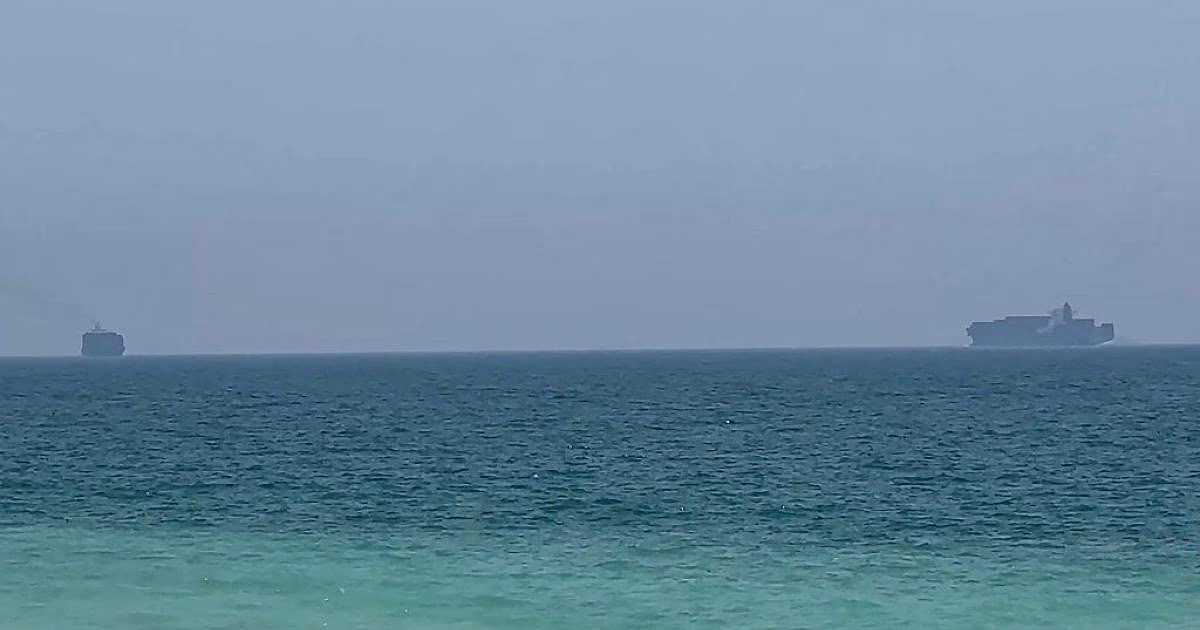
On the ground, the Iranian Revolutionary Guard announced the complete closure of the Strait of Hormuz until further notice, preventing the passage of any vessel through this strategic waterway. The Iranian military command justified this measure by the necessity of stopping what it described as American interventions, especially after a ship was detected taking an unauthorized route and was directly targeted.
In contrast, US President Donald Trump downplayed the significance of the Iranian announcements, asserting that the Strait of Hormuz remains open to global commercial navigation. The United States insists on ensuring freedom of navigation in the passage through which a large percentage of global energy supplies pass, rejecting Iranian conditions that impose prior coordination for transit.
Regarding shipping traffic, ship tracking data revealed a sharp and unprecedented decline in the number of tankers that crossed the strait in recent hours. The company 'Kepler' recorded the passage of only six ships on Sunday, the lowest number observed in over a month, reflecting the growing concern among international shipping companies.
The ships that risked crossing included the massive Iranian oil tanker 'Humanity' loaded with two million barrels, in addition to a Kuwaiti tanker carrying petroleum derivatives. It was noted that most of these tankers resorted to turning off their transponders to avoid detection or targeting amidst escalating security tensions.
Technical reports also indicated a complete absence of LNG tankers from the strait over the weekend, a dangerous indicator of the impact on supply chains. Only one tanker belonging to the UAE's 'ADNOC' company left the region heading towards India, amidst close monitoring of naval movements in the Gulf.
Militarily, the US Central Command announced a series of concentrated airstrikes against targets inside Iranian territory. US forces used precision-guided munitions to strike dozens of sites, a move described as a response to ongoing threats to navigation and American interests in the region.
For its part, the Revolutionary Guard revealed the implementation of nighttime naval interception operations that led to the detention of two unidentified vessels inside the strait. Military sources explained that the detention operation was carried out by disabling the ships' electronic systems, which raises concerns about the strait turning into a direct technical and military confrontation arena.
Every time the other party fails to fulfill its obligations, we will fail to fulfill ours... We will continue to operate in this manner.
שתף את דעתך
Escalation in Hormuz: Tehran Threatens to Renounce Understandings and Sharp Decline in Shipping Traffic