






Washington Message
Washington – Said Arikat – 7/13/2026
News Analysis
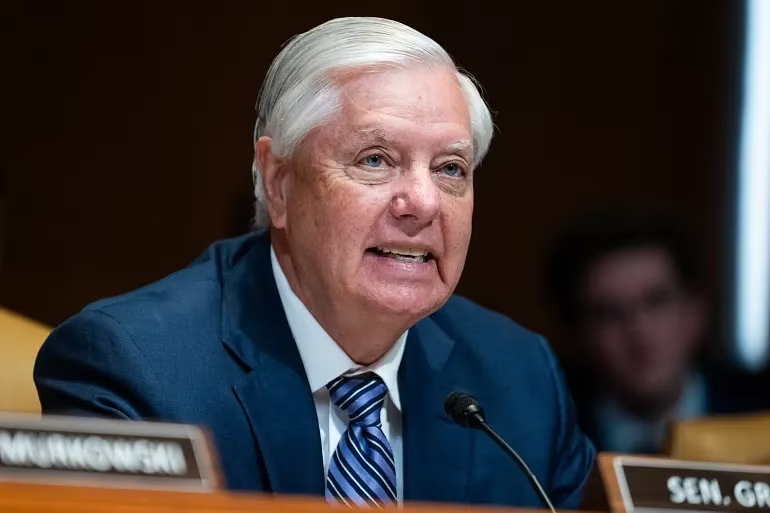
Republican Senator from South Carolina, Lindsey Graham, passed away on Saturday evening, July 11, at the age of 71, just hours after returning from a visit to Ukraine where he met with President Volodymyr Zelenskyy, a stop that reflected his continued defense of American support for Kyiv until his final days. His sudden passing caused shock in political circles in Washington, especially as he was preparing to appear on Sunday morning on NBC News' "Meet the Press" program. US President Donald Trump, in a phone call with the program, revealed that he had spoken to Graham shortly before his death, saying that he seemed "a little tired" after the return journey, but he did not notice anything concerning, adding that he never imagined that would be their last call.
As is the case with the passing of prominent political figures, eulogies poured in, praising his service of more than three decades in Congress, his extensive connections, and his dedication to the causes he championed. However, the evaluation of a political legacy does not stop at eulogies but extends to reviewing the ideas and policies he advocated for, and the consequences that resulted from them. From this perspective, it is difficult to ignore that Graham was one of the most prominent symbols of the interventionist school in American foreign policy, and one of the strongest advocates for the use of military force as the most effective tool to protect American interests and resolve international crises.
Since the September 11, 2001 attacks, Graham solidified his image as one of the most hawkish voices within Congress. He consistently advocated for the principle of preemptive strikes, believing that the credibility of the United States was linked to its willingness to use military force against its adversaries, while considering diplomacy effective only if it was based on a real military threat.
This approach was clearly embodied in his strong support for the invasion of Iraq in 2003, as he not only endorsed the war but also demanded its more resolute management and rejected most of the warnings that preceded the invasion regarding the fragility of the Iraqi state and the potential for a slide into a prolonged conflict. Years later, with Iraq turning into a scene of chaos and sectarian violence, the rise of extremist organizations, and the expansion of Iranian influence, Graham did not offer a fundamental review of his position, even though these outcomes were far from the goals announced by President George W. Bush's administration at the start of the war.
Iraq was not an exception in his political career. He supported military intervention in Libya, considering the overthrow of Muammar Gaddafi's regime a strategic necessity, even though the country later entered a long period of division and armed conflict. In Syria, he repeatedly called for broader American intervention and greater arming of opposition factions, believing that Washington's hesitation prolonged the war.
Iran was a constant focus in Lindsey Graham's positions throughout his Senate career, as he was one of the most vocal Republican voices demanding widespread military strikes against it, believing that deterrence could only be achieved by demonstrating Washington's willingness to use force. He strongly opposed the "memorandum of understanding" signed by President Donald Trump with Tehran last June 17, considering it a concession that would give Iran time and space to strengthen its capabilities instead of curbing them. He called on the US administration to adopt a tougher policy, warning that any settlement not based on the complete dismantling of Iran's nuclear capabilities would ultimately lead to a more dangerous confrontation.
Graham's critics say that his positions did not reflect a different reading of each crisis, as much as they were based on a firm conviction that American military superiority could impose political solutions, a view that has faced increasing criticism with the faltering of many American military interventions over the past two decades.
In parallel, his relationship with Israel was one of the most prominent features of his political career. He went beyond the traditional support Israel enjoys within the American political establishment, becoming one of the most prominent defenders of the policies of successive Israeli governments, especially during the era of Prime Minister Benjamin Netanyahu, with whom he had a close political and personal relationship. He also adopted the positions of the Israeli right on a number of issues, including the use of the term "Judea and Samaria" to refer to the occupied West Bank, the defense of settlements, and the rejection of many international criticisms related to the occupation and human rights violations.
This bias reached its peak during the Israeli war on Gaza, at a time when the United Nations was warning of an unprecedented humanitarian catastrophe, and the International Court of Justice was considering a lawsuit accusing Israel of committing acts that could amount to genocide. Amidst these developments, Graham sparked a storm of criticism when he invoked the American bombing of Hiroshima and Nagasaki as a historical example for ending wars, before saying that Israel should be allowed to use "whatever it deems necessary" to resolve the battle.
Although he did not explicitly call for the use of nuclear weapons, the invocation of that historical example in the context of defending Israeli military operations was widely interpreted as a justification for the use of maximum destructive force against a densely populated civilian area. His critics also saw these statements as consistent with his political philosophy of prioritizing military decisive action, even when the human cost is high.
Graham's critics also point to the outcome of the military interventions he advocated throughout his career. Iraq still suffers the consequences of the American invasion, Libya has not regained its stability, Syria emerged from a devastating war that lasted for years, while the war in Afghanistan ended with the return of the Taliban to power after the withdrawal of American forces. As for Gaza, it remains one of the most complex conflict hotspots in the world, amidst ongoing international debate about the extent of destruction and human losses.
The repercussions of these wars were not limited to the Middle East alone but extended to the American interior, where their financial and human costs increased, and questions arose about the utility of open military engagement in prolonged foreign conflicts. This contributed to the rise of currents within both the Republican and Democratic parties calling for a reduction in foreign interventions and prioritizing internal challenges, a shift that reflects a decline in confidence in the approach that Graham was one of its most prominent advocates.
In contrast, his supporters believe that Graham remained steadfast in his positions, and that he was driven by a firm conviction of the need to demonstrate strength to protect the United States and its allies and deter adversaries. They believe that the world has become more turbulent due to the decline of American resolve, and that Graham embodied a school that believes military deterrence remains the primary guarantor of international stability.
However, the debate that will accompany his legacy extends beyond his person to the political school he represented. The interventionist approach dominated American foreign policy since the end of the Cold War, based on the premise that military superiority can reshape systems and societies to serve American interests. However, the results of the past decades have shown, in the view of many researchers, that military interventions often led to adverse outcomes, such as security vacuums, internal conflicts, the escalation of the influence of rival regional powers, as well as the erosion of the United States' moral image in large parts of the world.
The Gaza file stands out as one of the most controversial issues in evaluating Graham's legacy, as his critics believed that his positions gave absolute priority to military decisive action at the expense of humanitarian considerations and international law, and contributed to reinforcing the impression that the principles Washington upholds regarding human rights are subject, in practice, to considerations of political alliances.
With the passing of Lindsey Graham, Washington turns a page on one of the most influential and controversial politicians in national security and foreign policy over the past three decades. However, the debate he represented will not end with his passing, as the American establishment remains divided between those who see military power as the primary guarantor of American interests, and those who call for a return to diplomacy and political settlements. Between these two trends, Graham's legacy will remain present in every discussion related to the role of the United States in the world, and to the question that has not yet found a decisive answer: Does military power create lasting stability, or does it often sow the seeds of new crises?
From Iraq to Libya and Syria and Iran, all the way to Gaza, Graham remained convinced that military force was the shortest path to achieving security and stability, even when the experiences of the past two decades proved that wars often left behind devastated nations, collapsed institutions, and conflicts more complex than those they came to address. For this reason, many researchers believe that the debate about Graham's legacy is not as much about his person as it is about the American interventionist school that believed military superiority alone could reshape political reality.
שתף את דעתך
With the passing of Lindsey Graham, one of the most prominent architects of American interventionist policy is gone, and the debate over his legacy remains.