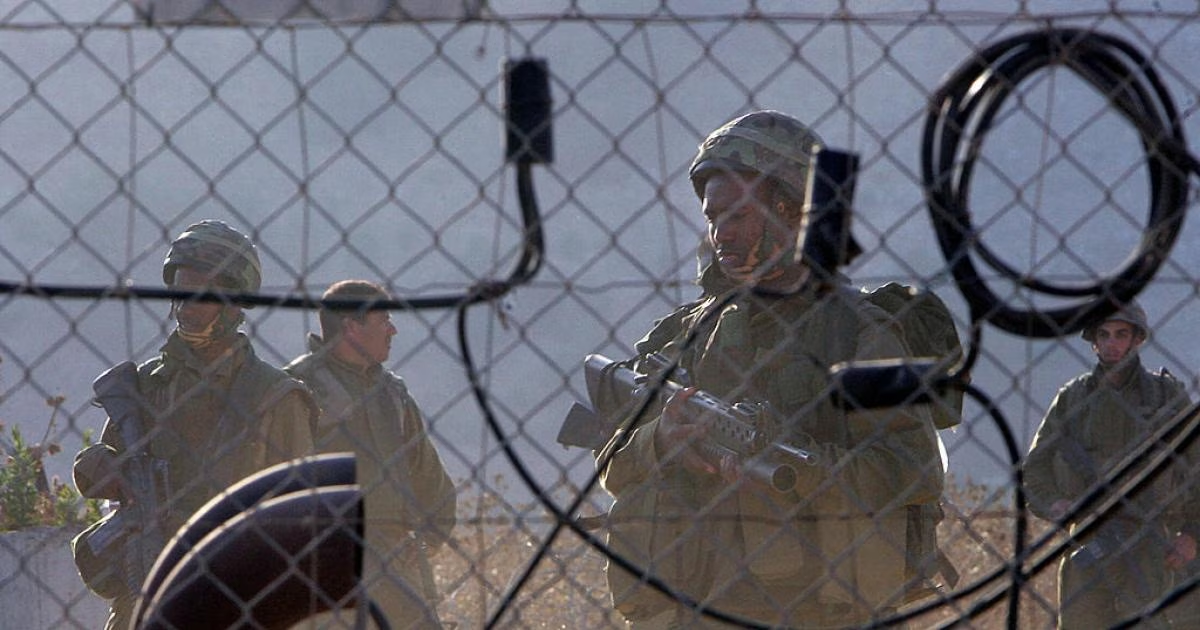







The experience of detention in Israeli occupation prisons remains a bleeding wound in the memory of those who lived it, as former detainees recount horrific testimonies of the torture and humiliation they endured. These testimonies come at a time when fears for the lives of current prisoners are increasing amidst Israeli legislation that grows harsher day by day.
Abu Ahmed Ghanawi, one of the survivors of the Khiam detention center, describes his entry into prison in the 1980s as a 'passage to hell'. Ghanawi recalls how he spent his first days shackled inside a car trunk, then in a cramped solitary cell where he was deprived of the most basic human necessities before the violent interrogation rounds began.
Ghawi revealed brutal methods that included hanging on the 'torture pole' and electric shocks to sensitive parts of the body, which led to his permanent infertility. He also recalled harsh moments when he heard the groans of detainees who died under torture next to him, while the jailers used threats against his family to break his will.
In another testimony, Qassem Ramadan (Abu Ali) reviews his journey of torment that moved between Ansar, Majdal, Ashkelon, and Nafha prisons after the invasion of Lebanon in 1982. Ramadan describes the prisons as bleak places beyond description, where isolation and daily beatings were the constant rule in dealing with detainees.
Ramadan recounts how he would lose his sense of time inside the cells, relying on the chirping of birds to realize the dawn. He points out that the food provided was often rotten, while detainees used loaves of bread as insulation against the bitter cold that ravaged their exhausted bodies.
As for the released female prisoner Kifah Afifi, she tells the story of her arrest at the age of seventeen while on her way to carry out a commando operation. Afifi describes the moment she entered occupied Palestine shackled, and how she drew strength from the scent of orange blossoms despite blatant threats of rape and physical assault by interrogators.
Afifi spoke about the atrocities of the Khiam detention center, where she was placed inside iron cages and doused with gasoline in an attempt to terrorize her. She recalled how the agent Amer Fakhoury practiced his sadism by extinguishing cigarettes on the wounds of detainees, in a desperate attempt to extract confessions or break their legendary steadfastness behind bars.
Despite their confinement, female detainees devised means of secret communication, with Afifi referring to her relationship with the prisoner Suha Bechara and their exchange of messages via 'birds'. These smuggled messages were a way to boost morale and follow news from outside, despite strict censorship and the penalties imposed when discovered.
Testimonies also touched upon catastrophic health conditions, where skin diseases such as eczema and lice spread among detainees due to lack of hygiene. Detainees were forced to collect small sums of money among themselves to buy essential medicines in the face of deliberate medical neglect by prison administrations.
Kifah Afifi asserts that her will was not broken despite the six years of torment she spent in Khiam, emphasizing that steadfastness was the only option to confront the torturer. This steadfastness eventually resulted in her release in 1994 as part of an exchange deal, returning to her family bearing indelible scars.
These narratives are not just fleeting memories, but a historical documentation of a dark era of Israeli practices against Palestinians and Lebanese. The precise details reveal a clear methodology aimed at destroying human dignity and disfiguring bodies and souls away from the eyes of international oversight.
Ghawi, Ramadan, and Afifi's testimonies intersect at the fact that the Israeli jailer used all available means, from electric shocks to waterboarding, to extract information. However, all three agree that solidarity among detainees was the fundamental pillar that enabled them to survive.
Today, with the occupation destroying Abu Ahmed Ghanawi's home in southern Lebanon once again, the tape of memories returns to link the past of prisons with the present of aggression. The suffering that began in the cells of Khiam continues in different forms, making the documentation of these testimonies a moral and national necessity.
In conclusion, these testimonies remain conclusive evidence of the inhumanity in Israeli interrogation basements, and a cry to the international community to pay attention to the suffering of thousands of prisoners. The wound of the detention centers, which has not yet healed, remains a testament to the immense sacrifices made by an entire generation for freedom and dignity.
The cell does not easily leave the detainee; the sounds, the smell of dampness, and the threats remain an open wound that seeps into the body and sleep.
שתף את דעתך
Memory of Torment: Live Testimonies Documenting the Hell of Israeli Detention Centers from Khiam to Nafha