






By: Said Arikat
July 4, 2026
News analysis
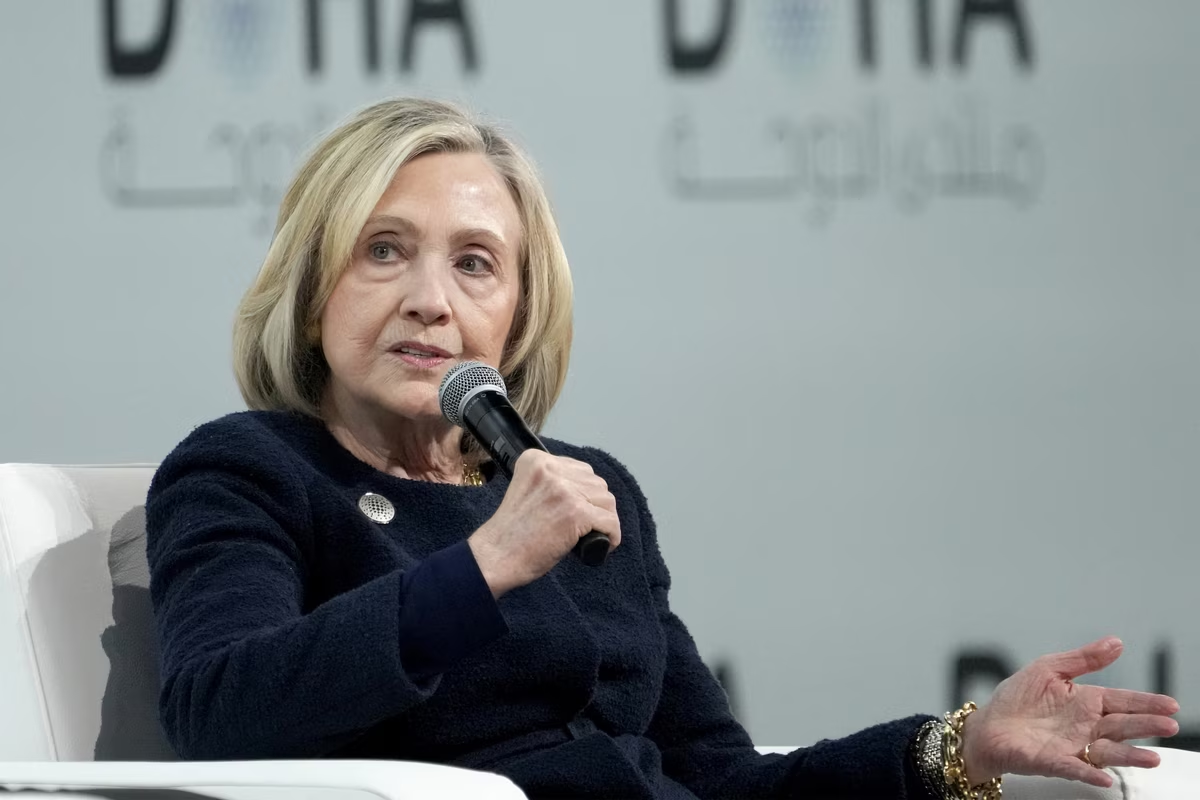
Washington, D.C- Hillary Clinton’s recent Financial Times essay will be remembered not as a sober contribution to Middle East diplomacy but as a moral and political abdication. At a moment when the Democratic base increasingly recognizes Israel as a genocidal occupying power, Clinton has chosen to align herself with the architects of ethnic cleansing. Her article is not realism—it is an endorsement of permanent subjugation dressed in the exhausted language of Washington consensus, and it reveals just how catastrophically out of touch the party’s foreign-policy elite has become with the voters it claims to represent.
For millions of Democrats—especially young people, people of color, Arab Americans, and a rising generation of anti-Zionist Jews—Israel’s war on Gaza is not a tragic conflict between two equal sides. It is a live-streamed genocide, prosecuted by a nuclear-armed apartheid state against a captive civilian population. The International Court of Justice has found it “plausible” that Israel is committing genocide. United Nations experts and human rights organizations have documented systematic war crimes: the deliberate starvation of 2.3 million people, the targeting of hospitals and schools, the massacre of over 73,000 Palestinians, the obliteration of entire family lines. The Democratic base, particularly voters under 45, has absorbed these facts. They do not see a complicated geopolitical puzzle. They see a monstrous injustice funded and armed by their own government.
Clinton’s essay pretends none of this exists. She writes as if Gaza were simply a post-conflict reconstruction challenge, a place in need of better governance and foreign investment. The word “genocide” does not appear. Occupation is reframed as a security arrangement. Palestinian self-determination—the right of a colonized people to live free from military rule, siege, and settlement expansion—is erased in favor of technocratic buzzwords like “stabilization” and “reconstruction.” For a woman who once styled herself as a champion of women and children, the silence on the thousands of Palestinian children killed by American-supplied bombs is deafening.
This is not an oversight. It is the inevitable endpoint of Clinton’s decades-long career as one of the most militantly pro-Israel figures in the Democratic Party. As senator, she defended Israel’s 2006 bombardment of Lebanon, which leveled civilian infrastructure. As secretary of state, she shielded Israel from accountability at the United Nations, opposed the nonviolent Boycott, Divestment and Sanctions movement, and oversaw record military aid packages even as settlement expansion accelerated the de facto annexation of the West Bank. She never once used meaningful leverage to halt the entrenchment of occupation. Her “two-state solution” rhetoric was always a hollow ritual, a diplomatic fig leaf covering unconditional support for Israeli military supremacy.
Now, with Gaza reduced to rubble and the West Bank carved into non-contiguous Bantustans, the mask has slipped entirely. Clinton effectively endorses Donald Trump’s proposal—a plan so blatantly colonial that it envisions the ethnic cleansing of Gaza’s surviving population and the transformation of the Strip into a real estate venture. She presents this as the only “realistic” option, dismissing the demands of international law and the will of millions as naive fantasy. This is the language of power without conscience, of an establishment so wedded to the status quo that it mistakes complicity for sophistication.
What makes this intervention politically explosive is not just its amorality but its staggering contempt for the Democratic electorate. The base has undergone a profound transformation. Ceasefire resolutions have swept through city councils and labor unions. College campuses have erupted in protest. Primary challengers running on Palestinian rights have outperformed expectations. Poll after poll shows majority support among Democrats for conditioning aid to Israel and for recognizing the reality of apartheid. This is not a fringe movement. It is the future of the party.
Clinton and the geriatric foreign-policy class she embodies respond to this uprising not with engagement but with dismissal. Her essay is addressed to a donor class and a think-tank ecosystem that still confuses AIPAC applause with electoral legitimacy. She speaks for a vanishing world in which Israeli generals are treated as moral authorities and Palestinian voices are admissible only as victims requiring humanitarian pity—never as a people entitled to sovereignty, resistance, and return. The essay does not argue with the pro-Palestinian left; it pretends it does not exist. That is the intellectual arrogance of a clique that has learned nothing from Iraq, from Libya, from Afghanistan, and now from Gaza.
The establishment’s gambit is to rebrand permanent occupation as “conflict management.” Benjamin Netanyahu has spent decades working to extinguish any possibility of a Palestinian state. Clinton’s framework now blesses that objective. Under her vision, Gaza would be rebuilt just enough to pacify its population while Israel retains full military control over borders, airspace, waters, and movement. The West Bank would remain fragmented under armed marauding settlers and army checkpoints. Palestinians would be permitted to administer their own misery, provided they abandon any claim to genuine freedom. This is not peace. It is the normalization of apartheid, and Clinton is offering it the patina of Democratic respectability.
History is littered with empires that mistook the exhaustion of the oppressed for consent. No people have ever accepted permanent subjugation because an occupier offered them economic improvement. Reconstruction without liberation is merely the architecture of a more efficient prison. The base understands this viscerally. It sees a genocide and demands it stop, not that it be managed. It hears establishment figures like Clinton speak of “stability” and recognizes the euphemism for collective punishment. The moral clarity that animates the streets, the campuses, and the grassroots is not a foreign-policy naivete; it is the recognition that international law cannot be indefinitely suspended for one state, and that “realism” built on the bones of children is not realism at all—it is complicity in atrocity.
Clinton’s article, then, is more than an opinion piece. It is a declaration of war on the conscience of her own party. It signals that the old guard would rather torch its relationship with an entire generation of voters than confront the reality of Israeli genocide and occupation. The base has moved on. It has seen too much to unsee. It will not be gaslit into believing that permanent statelessness is a viable political outcome. Clinton may imagine she is charting a pragmatic path forward. In truth, she is writing her own political obituary and that of the establishment she represents—an establishment that is rapidly being rendered irrelevant by a movement that demands not managed occupation, but liberation, justice, and an end to genocide now.
שתף את דעתך
Hillary Clinton’s Gaza Capitulation: Genocide Denial and the Bankruptcy of the Democratic Establishment