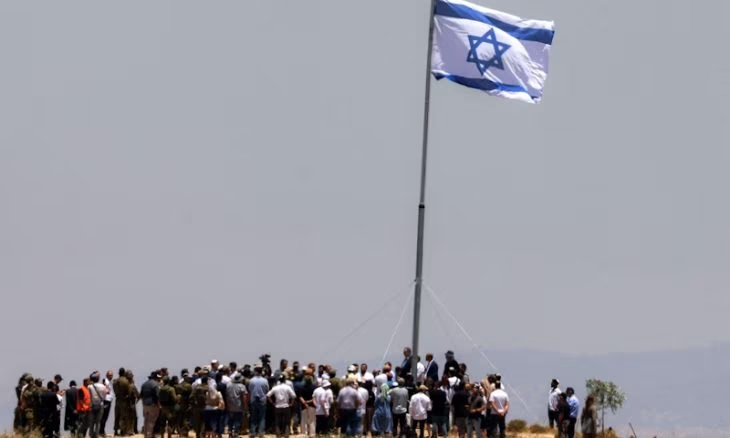







A recent journalistic investigation has revealed an escalation in the pace of settlement construction in the occupied West Bank, with the occupation government commencing the construction of 103 new settlement outposts under the guise of 'legality'. This systematic step aims to impose geographical and demographic realities that will be difficult to change in the future, effectively killing any chance of implementing a two-state solution.
Media sources indicated that the occupation is proceeding with a strategic plan to Judaize the West Bank by distributing settlements in vital and sensitive locations. Experts believe that this settlement expansion is designed to be a permanent obstacle to any potential political settlement, making it difficult for any future government to reverse these radical changes on the ground.
These moves are a practical translation of statements by extremist ministers in the government, led by Bezalel Smotrich, who affirmed that the Palestinian state is being erased from reality through actions on the ground. Smotrich considered every new housing unit built in the West Bank as an additional nail in the coffin of Palestinian national aspirations.
The danger of undermining the two-state solution is not limited to the practices of the far-right alone but also extends to the absence of any alternative political vision among the opposition camp in Israel. Previous governments have contented themselves with managing the conflict and escalating military operations in the West Bank, providing cover for the silent continuation of settlement expansion.
'Pastoral farms' are emerging as a new strategic tool to reshape the geopolitical landscape in the West Bank, having transformed from individual initiatives into a supported government policy. These farms receive extensive financial, legal, and security support, as part of the occupation's vision for long-term food security until 2050.
Since the 1990s, the settlement movement has developed the model of outposts and farms to circumvent international pressure and the decline of official construction. Ariel Sharon's call in 1999 to seize the hilltops marked a pivotal turning point, with the state providing logistical support to settlers to control strategic heights.
The 'Givat Olam' farm, established in 1996, is considered the first model upon which settlement farms spread across various areas of the West Bank. These farms have become a breeding ground for what is known as 'Hilltop Youth,' groups that carry out systematic attacks against Palestinians to displace them from their lands.
Data indicates that these farms gained double importance after 2009, as part of a counter-plan to Palestinian construction projects and institutions. Through them, settlers aim to prevent any Palestinian urban expansion in open areas and to consolidate full Israeli control over natural resources.
In the Jordan Valley region, the spread of settlement outposts near military training areas and nature reserves has accelerated since 2016. The number of these farms has reached about 130, currently controlling over 780,000 dunams, which is equivalent to half the area classified by the occupation as state land.
In a dangerous development, the Civil Administration of the occupation allocated an additional 16,000 dunams to these farms in February 2025. These settlement entities play a central role in intimidating Palestinian Bedouin communities and forcing their coercive displacement from their historical pastures through continuous violence and threats.
Reports reveal the gradual integration of these farms into the occupation's economic and agricultural system, where they have transformed into investment projects utilizing advanced technologies. Extremist ministers, such as Avi Dichter, oversee the provision of official cover for these projects, asserting that agricultural policy no longer recognizes the Green Line boundaries.
During field visits to settlements, officials in the occupation government stated that government support now extends from the sea to the river without distinction. This trend reflects a genuine desire to erase legal differences between the lands occupied in 1948 and those occupied in 1967, paving the way for the de facto annexation of the West Bank.
On the other hand, researchers and former leaders in the occupation army warn that these policies are leading Israel towards an undemocratic 'one-state' reality. They believe that the elimination of the two-state solution will return the conflict to its starting point in 1948, threatening the identity that Israel seeks to preserve before the world.
Observers affirm that continued settlement will ultimately transform Israel into an apartheid system where a minority controls a demographic majority. Former leaders warned that this reality will not withstand increasing international pressure and may end in demographic and political transformations that do not serve the Zionist project in the long run.
Every settlement, every neighborhood, and every housing unit is an additional nail in the coffin of the idea of a Palestinian state.
שתף את דעתך
Investigation reveals occupation's plans to bury the two-state solution through 103 new settlement outposts