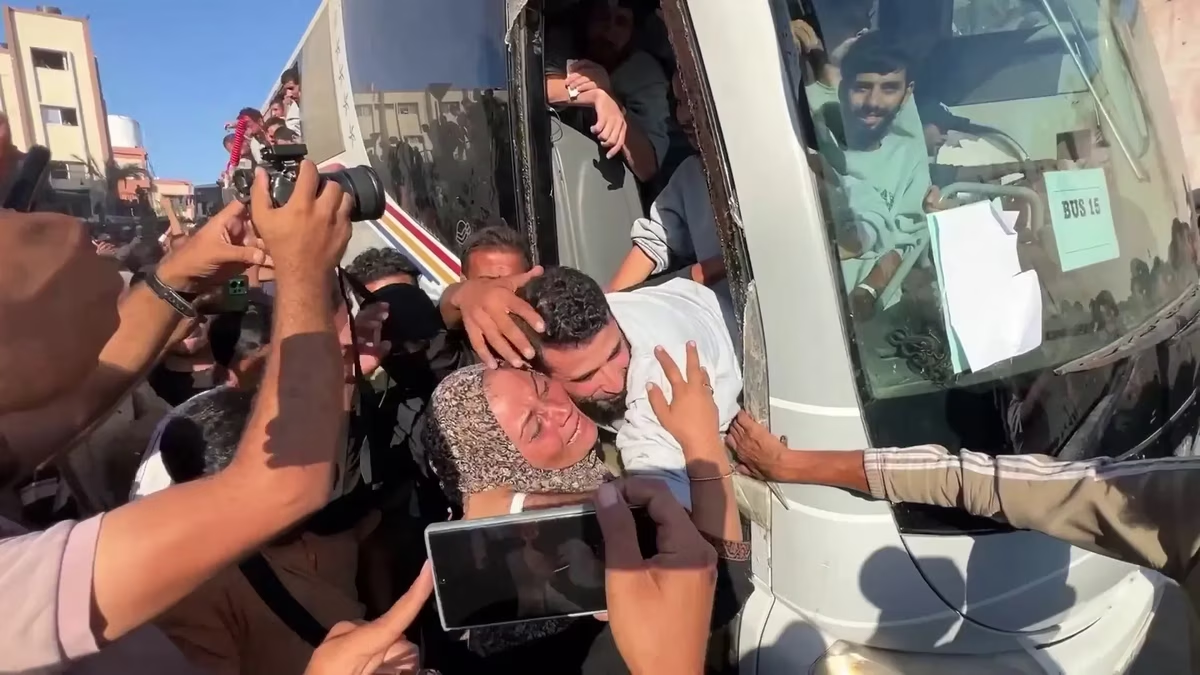







On the occasion of the International Day in Support of Victims of Torture, Palestinian prisoners released from the Gaza Strip gave shocking testimonies about the grave violations and systematic torture they were subjected to in Israeli detention centers. Sources confirmed that these practices included severe beatings, deliberate humiliation, intentional medical neglect, and deprivation of the most basic human rights from the moment of their arrest until their release.
Journalist Khader Baker Abdel Aal, who worked as a correspondent for local and international agencies, recounted details of his arrest from Al-Shifa Medical Complex on March 18, 2024. Abdel Aal explained that occupation forces tied his hands behind his back, blindfolded him, stripped him of his clothes, and subjected him to continuous beatings for long hours in extremely humiliating conditions.
Abdel Aal pointed out that the absence of international protection for Palestinian journalists made them easy prey for direct assaults from the first moments of detention. He described the transfers as taking place in large trucks packed with about 150 detainees, before they were distributed to smaller buses, shackled with iron handcuffs on their hands and feet.
The released journalist spoke about the severe physical effects left by the continuous beatings during transfers, confirming that he suffered rib fractures whose pain lasted for many months. He added that detainees were forced to wear uniform prison clothing amidst an atmosphere of continuous physical and psychological intimidation that did not stop throughout the journey.
In a horrific testimony about medical neglect, Abdel Aal mentioned that he was transferred to a medical examination point within the Gaza envelope to record data, and there he informed the specialist doctor of his chronic skin disease. The doctor's response was shocking, as he clearly told him: 'I am not here to treat you, but I came to torture you,' before he was sent back to the detention cells.
Abdel Aal revealed the crime of the death of detainee Kamal Radi inside one of the prison sections, where the latter was summoned and subjected to brutal beatings for a full hour. He explained that Radi was returned to the cell in a very critical health condition, only to die shortly thereafter, with his body placed in a black bag in front of his son, who was detained in an adjacent section.
Regarding the detention conditions in the 'Sde Teiman' camp, Abdel Aal described the 91 days he spent there as an endless series of abuse. He confirmed that the prison administration prevented detainees from speaking, praying, or sleeping normally, and restricted the use of restrooms to only a few minutes per day.
Sources reported that detainees in 'Sde Teiman' remain constantly bound and blindfolded, and are subjected to severe punishments for any slight movement or attempt to communicate with others. Repression units storm the sections weekly to carry out mass beatings without any justification, even on holidays and special occasions.
Released prisoners stressed that the violence practiced against them was not aimed at achieving intelligence purposes or obtaining information, but rather its primary purpose was humiliation and the destruction of human dignity. They described these practices as a consistent policy followed by the occupation authorities against all detainees from the Gaza Strip without exception.
In another incident, Abdel Aal recalled suffering from severe blood poisoning that required his transfer to the hospital, handcuffed and shackled, under heavy guard. There, instead of receiving care, he was subjected to a physical assault that led to bleeding in his head, and was forced under threat to conceal the truth of what happened to him to avoid a new round of torture.
Released prisoners described transfers to courts or hospitals as additional 'torture trips,' where detainees are forced to sit in painful positions for long hours. They pointed to the occupation's deliberate act of leaving them under the scorching sun and on hot asphalt surfaces to increase their physical and psychological suffering.
For his part, released prisoner Musab Amdoukh revealed the existence of special rooms known as 'the disco,' where very loud music is played continuously to prevent detainees from sleeping. He explained that this type of psychological torture aims to exhaust the mental and physical strength of prisoners and keep them in a state of constant disorientation.
Amdukh added that torture methods also included the use of electric shock and prolonged sleep deprivation as primary pressure tools. He also pointed to other humiliating practices such as forcing detainees to drink water in ways that degrade their human dignity, reflecting the sadism of the jailers in dealing with Palestinians.
Prisoners concluded their testimonies by emphasizing that what happens inside Israeli detention centers goes beyond all description and represents a blatant violation of all international conventions. They appealed to international human rights organizations to intervene immediately to save thousands of detainees who still face the risk of death and daily torture in occupation prisons.
'I am not here to treat you, I came to torture you,' the doctor replied when I told him about my chronic skin disease.
שתף את דעתך
Horrific Testimonies from Released Gaza Prisoners: Systematic Torture and Deaths of Detainees in Detention Centers