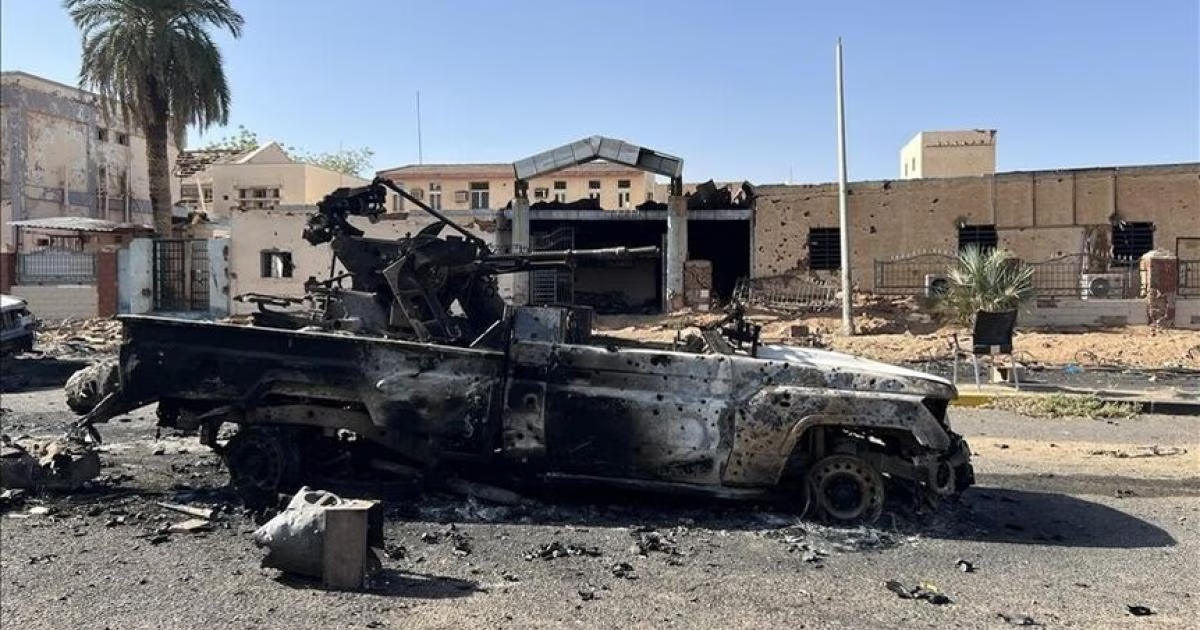







Medical and human rights sources in Sudan reported deaths and injuries due to a drone attack targeting a displacement center in El Obeid, the capital of North Kordofan state. The Sudan Doctors Network stated that the shelling hit the 'Unified Shelter Camp' inside the city, resulting in the death of two displaced persons and the injury of about 17 others, including a number of women and children who were sheltering in the center.
In an official statement, the network accused the Rapid Support Forces of being behind this attack, noting that targeting civilian sites and shelter centers represents a dangerous escalation that threatens the lives of thousands fleeing the conflict. The sources explained that this assault comes as part of a series of continuous attacks that the city has been subjected to for more than a week, leading to a severe deterioration in humanitarian conditions within residential neighborhoods.
Internationally, the United States expressed its grave concern over reports of massive military buildups by the Rapid Support Forces and their allies around El Obeid. Washington warned that this mobilization could be a prelude to committing 'mass atrocities' against civilians, calling on all parties to adhere to international humanitarian law and protect unarmed civilians from the ravages of armed confrontations.
For his part, the head of the European Union mission in Sudan criticized the policy of besieging strategic cities, describing it as a strategy of 'siege and starvation.' The European official pointed out that these practices have been repeated in cities such as El Fasher, Al Jazirah, and Kadugli, stressing that perpetrators of these violations may face legal prosecution and strict international sanctions as a result of their direct targeting of the livelihoods of civilians.
In the context of regional movements, the African Union Commission and the Intergovernmental Authority on Development (IGAD) called for an immediate cessation of attacks on El Obeid and containment of the escalating military escalation. The regional organizations stressed that the continuation of hostilities in densely populated areas thwarts peace efforts and further complicates the humanitarian crisis, which has been described as the largest globally in terms of the number of displaced persons.
El Obeid has witnessed an intensification of drone attacks for about two weeks, with these strikes targeting vital facilities including the main power station and fuel stations. According to local sources, these attacks aim to paralyze movement within the city and destroy essential infrastructure, leading to the disruption of vital services for thousands of resident and displaced families alike.
On the ground, the Sudanese Army continues to strengthen its defenses within the city, with its military units carrying out preemptive strikes targeting gatherings and movements of the Rapid Support Forces in various areas of Kordofan state. The armed forces seek through these operations to prevent any ground advance towards the heart of the city, relying on the positioning of the Fifth Infantry Division, which is considered the military safety valve for the region.
Field data indicate that the Rapid Support Forces have imposed a complete siege on El Obeid from several directions for months, with their presence concentrated in strategic points such as Bara city. Despite this siege, the city remains under the control of the Sudanese Army, while fears are growing of a large-scale ground attack that could lead to bloody confrontations within densely populated neighborhoods and displacement camps.
El Obeid city acquires extreme strategic importance due to its geographical location connecting the capital Khartoum with the Kordofan and Darfur regions, making it an indispensable logistical center for managing military operations. The city is about 370 kilometers from Omdurman, and is considered the main starting point for military and civilian supplies to the western and southern states of Sudan, which explains the fierce struggle for control over it.
In addition to its military value, El Obeid represents a global economic weight, as it is known as the main center for the production and trade of gum arabic, contributing about 80% of the global production of this vital commodity. Economic experts warn that the continuation of fighting in the city will disrupt global supply chains and destroy the main source of income for thousands of farmers and workers in the Kordofan region.
The targeting comes amid ongoing attacks on the city for more than a week, exacerbating humanitarian conditions and directly threatening civilian lives.
שתף את דעתך
Massacre in El Obeid Displacement Centers: Dead and Wounded in Drone Attack, International Warnings of 'Mass Atrocities'