ARAB AND WORLD

Sat 20 Jun 2026 10:07 am - Jerusalem Time

Despite the truce agreement... Martyrs in Israeli raids and anticipated negotiations in Washington on Tuesday

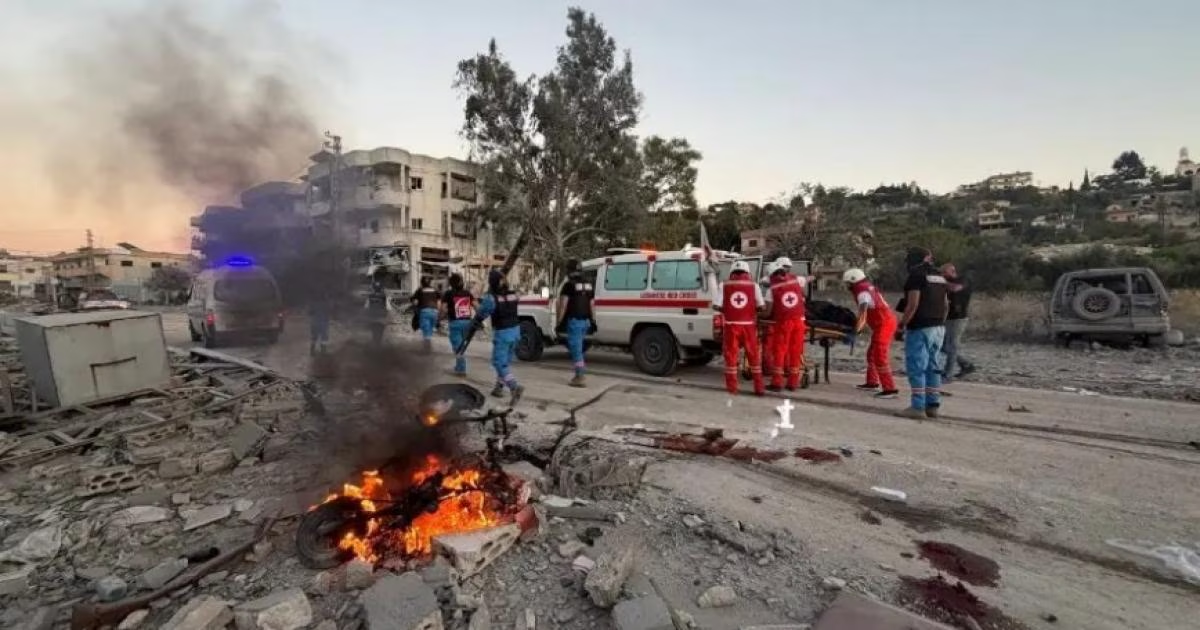
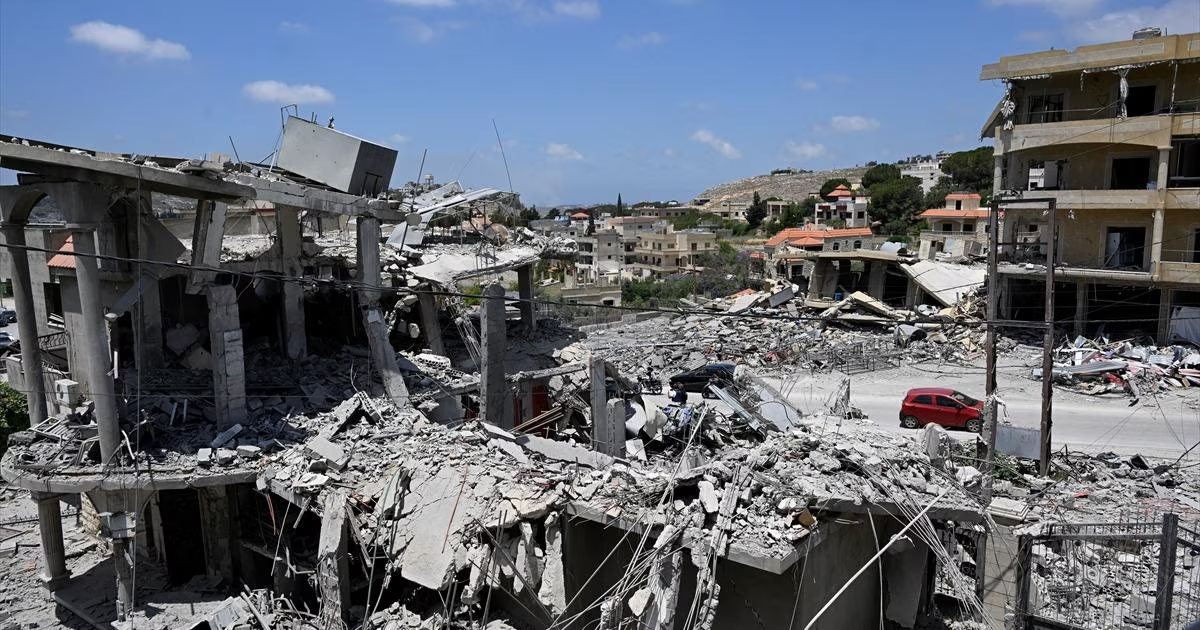
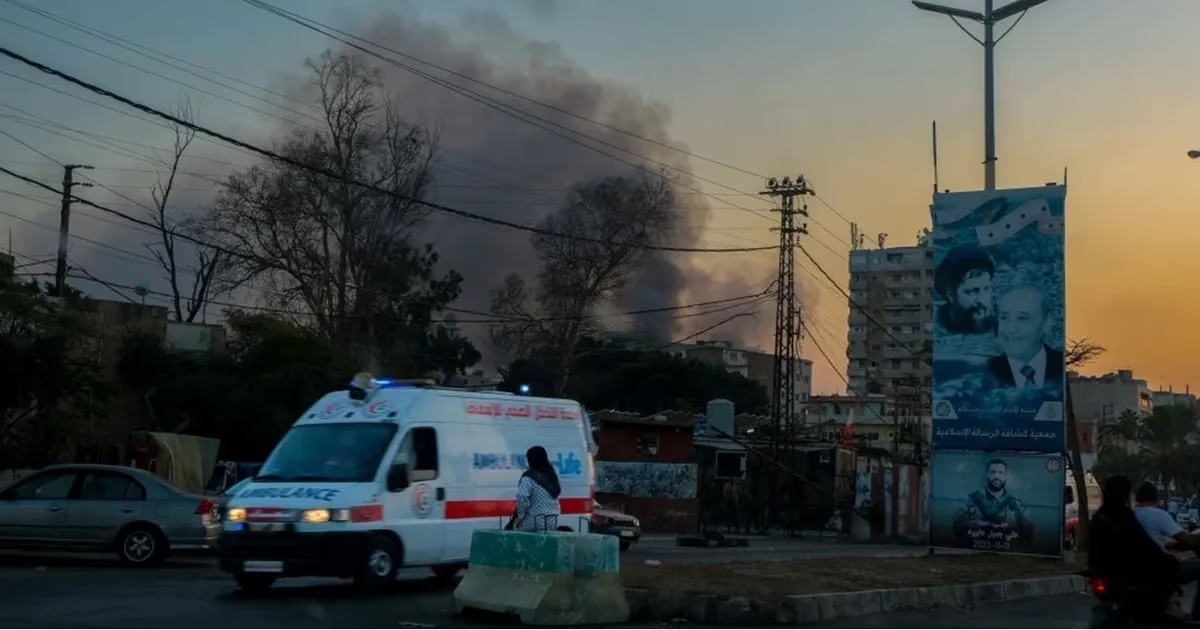
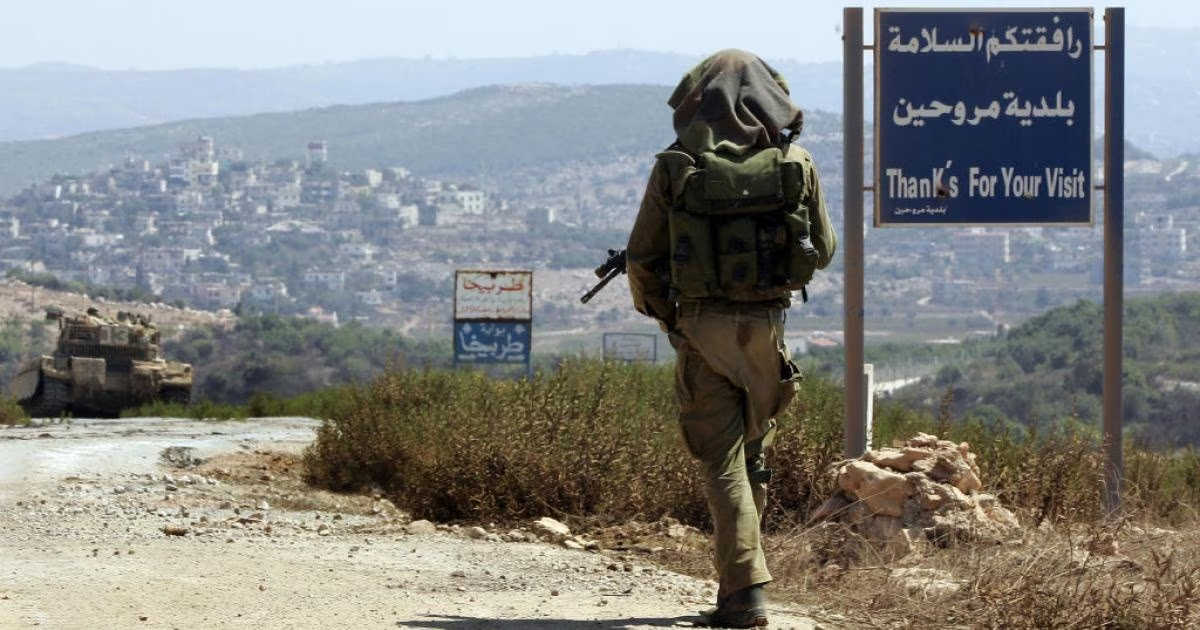
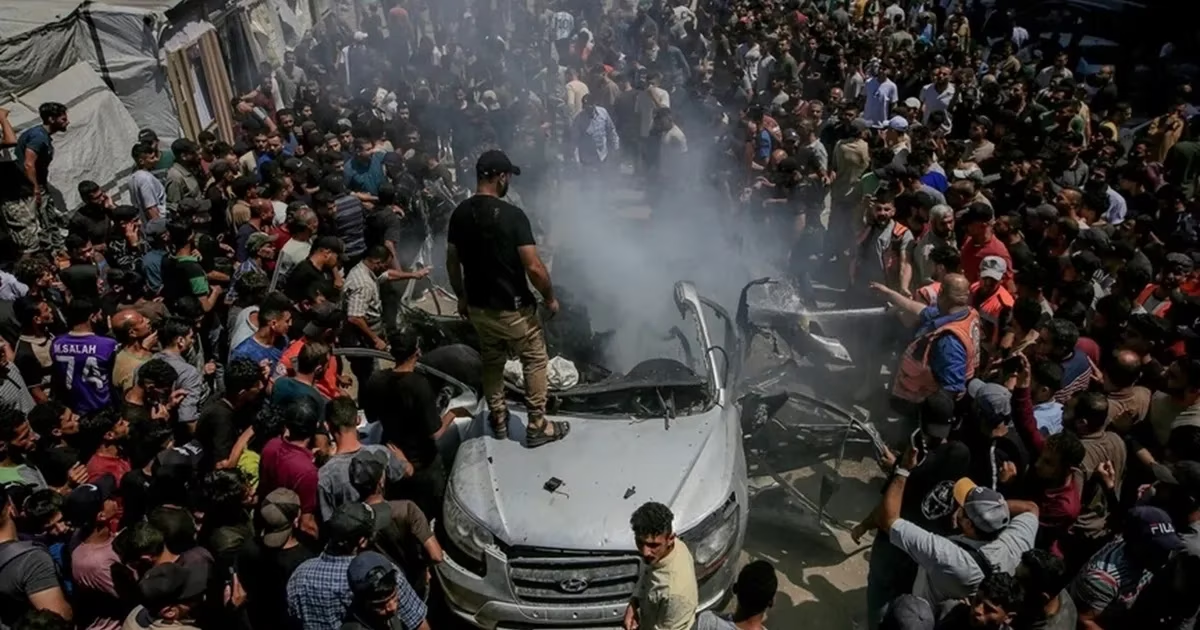
Southern Lebanon witnessed a dangerous field escalation despite the ongoing ceasefire agreement. Field sources reported that the Israeli occupation army carried out intense artillery shelling targeting the heights of Ali al-Taher. In this attack, the occupation forces used internationally prohibited phosphorus and cluster munitions, which constitutes a blatant violation of existing security understandings.

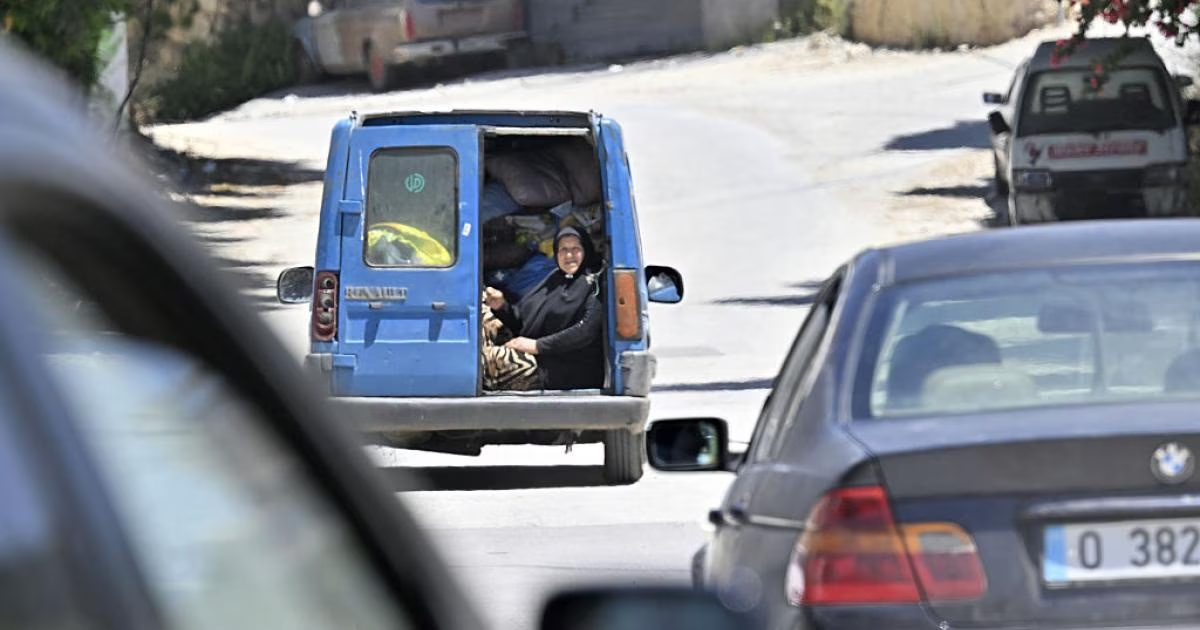
In a related context, units of the occupation army carried out extensive demolition operations that affected a number of residential homes in the town of Kunin, which belongs to the Bint Jbeil district. The towns of Nabatieh al-Fawqa and Kafr Tibnit were also subjected to intermittent artillery shelling, which led to a state of panic among residents who tried to return to their homes after the truce was announced.

Regarding human casualties, two people were martyred as a result of a raid carried out by an Israeli drone targeting a motorcycle on the Zibdin road in the Nabatieh area. With this targeting, the death toll from Israeli attacks on Lebanese territory on Friday alone rose to 49 martyrs and about 97 others injured with varying degrees of severity.

Diplomatically, the US State Department announced a phone call between Secretary Marco Rubio and Lebanese President Joseph Aoun to discuss developments in the situation. Rubio informed the Lebanese side that the next round of Lebanese-Israeli talks will be held in the capital, Washington, from June 23 to 25.

During the call, the US Secretary of State affirmed his country's commitment to working towards achieving permanent security and stability in Lebanon, with a focus on extending state authority over all its territories. Rubio also stressed support for legitimate Lebanese institutions and security forces, foremost among them the army, reiterating his call for the necessity of disarming Hezbollah to ensure full state sovereignty.

For his part, Lebanese President Joseph Aoun demanded the necessity of an immediate and comprehensive cessation of all Israeli attacks targeting Lebanese sovereignty. Aoun explained that achieving a real and sustainable ceasefire is the fundamental pillar without which no tangible progress can be made in the ongoing political negotiations.

Reports from Washington indicate that the agenda of the upcoming meeting will include a plan for the Lebanese army to take over experimental areas that were under the control of Israeli forces. This step aims to open the door for partial and gradual Israeli withdrawals from some points, as a test of the Lebanese forces' ability to control security in those areas.

In the same context, media sources stated that the negotiations, which will begin next Tuesday, will seek to reach an agreement on the names and coordinates of the experimental withdrawal areas. These areas are likely to be concentrated on the front edges of what is known as the Yellow Line, away from the direct border strip, as a first step in a long process of delineating final security arrangements.

Aoun stressed the necessity of stopping Israeli attacks by achieving a comprehensive ceasefire, which Lebanon considers a fundamental pillar for the progress of negotiations.

PALESTINE

Sat 20 Jun 2026 10:07 am - Jerusalem Time

UN warnings: 4 Arab countries face famine risk and sharp decline in international funding

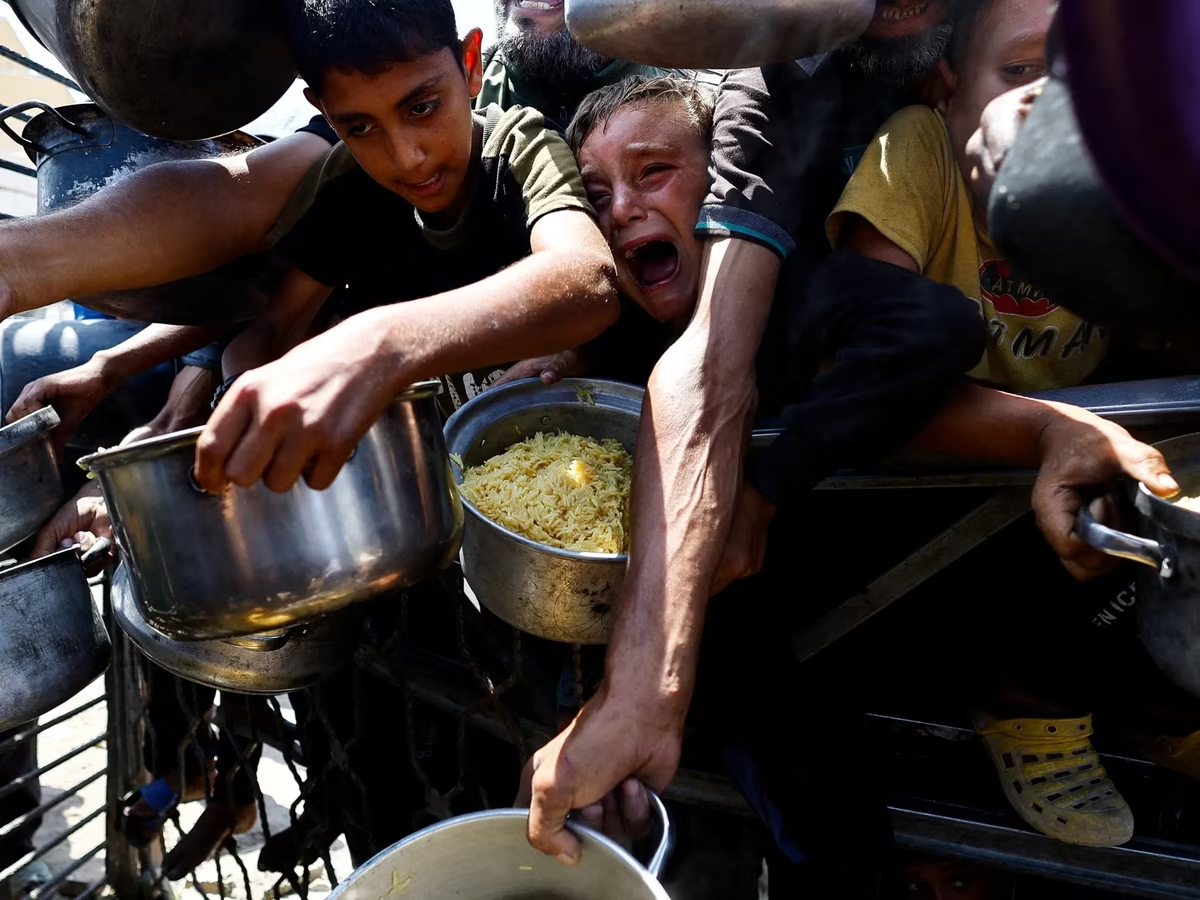
The United Nations Food and Agriculture Organization (FAO), in cooperation with the World Food Programme, issued strong warnings about millions of people sliding into catastrophic levels of hunger. The joint report explained that the overlap of armed conflicts with successive economic crises has led to the emergence of what it described as 'hotspots of hunger' in vast geographical areas.

The UN classification included four Arab countries suffering from severe humanitarian crises: Palestine, Sudan, Yemen, and Somalia, placing these countries on the list of areas most at risk. The report indicated that the continuation of these conditions threatens a complete collapse of local food security systems in these countries, which already suffer from structural fragility.

The report revealed a worrying decline in the volume of international funding allocated to relief organizations working in the field, with budgets recording a decrease of up to 60% during the period between 2022 and 2025. International bodies describe this gap as dangerous, as it hinders life-saving operations and increases rates of acute malnutrition among the most vulnerable groups.

For his part, Jean-Martin Bauer, an official at the World Food Programme, affirmed that countries such as Sudan, Palestine, Yemen, and Somalia are among the highest levels of international concern. Bauer explained that the populations in these areas face severe food insecurity that could lead to famine and mass death if urgent intervention is not made.

Regarding the Sudanese issue, the report considered the situation there to be the most tragic, with the specter of hunger threatening 14 regions, including Darfur and South Kordofan. Estimates indicate that the number of people facing catastrophic food conditions could rise to 200,000, with the crisis expected to continue until early 2027.

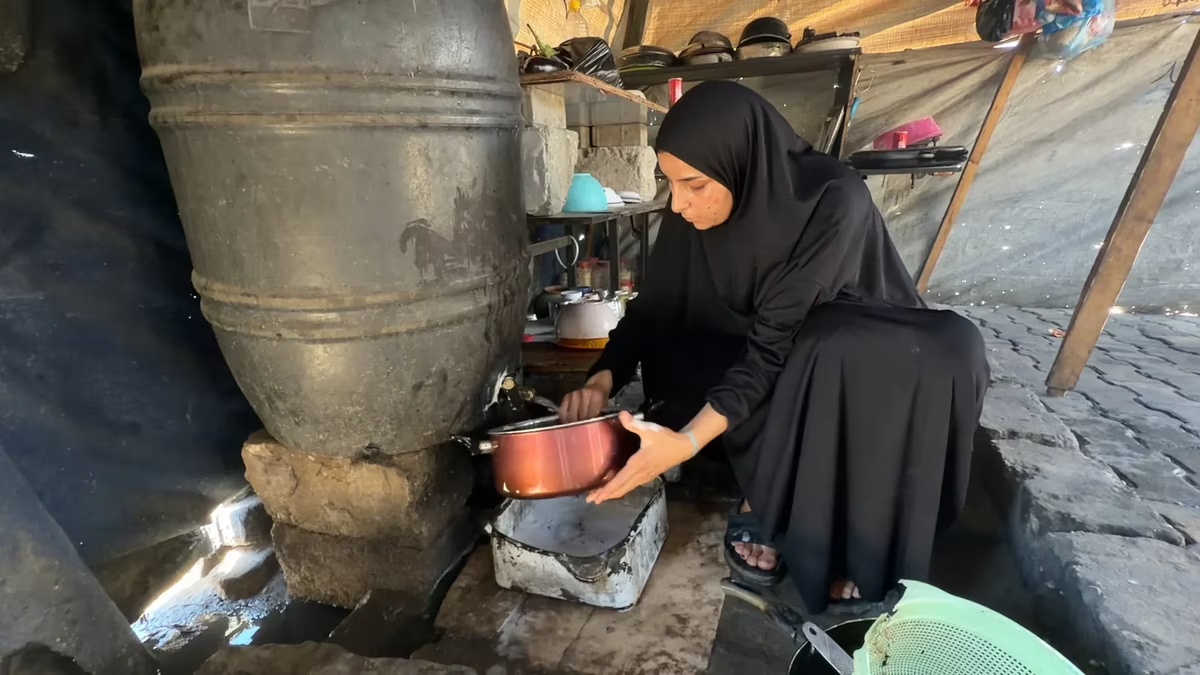
In the Gaza Strip, UN sources stressed that the risk of famine remains strong despite previous ceasefire agreements. This is mainly due to the continuous restrictions imposed by the occupation authorities on the entry of relief trucks, which has led to a sharp decline in commodity and food stocks for the population.

In Yemen, one of the world's worst humanitarian crises continues to worsen as a result of the deterioration of the local currency's value and the insane rise in basic commodity prices. Sources warned that the percentage of people in need of assistance in areas under the Yemeni government could increase by about 9% before the end of this year, putting additional pressure on international organizations.

Finally, Somalia has once again topped the list of extreme risk hotspots due to the combination of local conflicts with long droughts that have hit the country for years. Somalis in several areas face direct threats of famine, amid the inability of charitable kitchens and local institutions to meet the growing needs of displaced and affected populations.

These countries' populations face high levels of acute food insecurity, including famine and death.

OPINIONS

Sat 20 Jun 2026 10:07 am - Jerusalem Time

Billions of Tracks and Tickets of Death: Demands for Political and Criminal Accountability for Railway Disasters in Egypt

Ramallah - “Alquds ” dot com

Ramallah - “Alquds ” dot com

Opinion Writer

In the ethical charter of nations, paying the train ticket price twice cannot be accepted; once from citizens' pockets through billions in loans, and again from their lives under the wheels of silent machines. The transformation of railway tracks from a lifeline for development into a guillotine that devours bodies places the current administration before a difficult ethical and constitutional test.

When the Ministry of Transport, with its full financial arsenal, fails to provide the minimum level of safety for citizens, we are not talking about a mere minor technical flaw. This horrific administrative failure necessitates immediate accountability and makes the continued leadership of the current facility a grave danger threatening the safety and security of passengers daily.

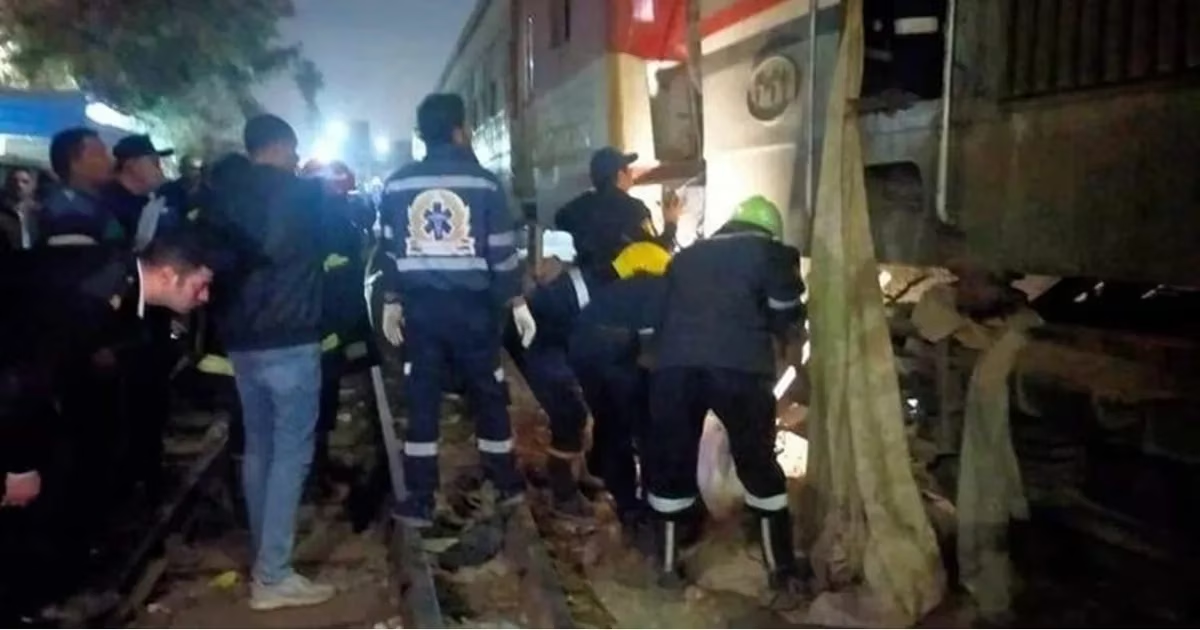
The station platform in Egypt has transformed from a space for human interaction into something akin to 'Russian roulette,' where citizens await their unknown fate with every journey. The recurring scene of bodies crushed by wheels is not just a fleeting human error; it is an embodiment of an administrative crisis that treats human blood as a marginal number.

The question that imposes itself today, above the groans of the injured, is not merely an engineering question about the quality of the tracks, but a political and legal question par excellence. This question is directed directly to the top of the executive pyramid and to the people's representatives who were entrusted with monitoring government performance and protecting citizens' rights.

Returning to the reports of the Central Agency for Public Mobilization and Statistics and human rights documentation, we find a terrifying record of intermittent tragedies over the past decade. Thousands of varied accidents, including collisions, carriage detachments, and run-overs at level crossings, have claimed hundreds of lives and left thousands injured with permanent disabilities.

The real tragedy lies in the stark paradox between the ministry's announcements of technological revolutions and massive upgrades, and the continued primitive bleeding of lives. This contradiction is conclusive evidence of a deep chasm between media spectacle and the bloody reality that citizens experience on the tracks.

The House of Representatives has approved packages of international loans and billions in allocations specifically for developing the railway network and securing human resources. Nevertheless, the legitimate question remains: where is the tangible protective impact of these massive funds on the ordinary citizen's body?

The administrative success of any service facility is not measured by the luxurious external design of trains or the glitter of new stations that have burdened the simple with their prices. The only constant global criterion is a zero accident rate and the preservation of lives, which the current administration has failed to achieve so far.

The delay in the security return of borrowed funds raises major questions about the poor prioritization of administrative matters in the Ministry of Transport. It appears that presenting superficial and aesthetic aspects came at the expense of the fundamental structural effort that protects passengers from repeated fatal accidents and run-overs.

Political and criminal responsibility falls directly on the shoulders of General Kamel El-Wazir, based on the golden rule that links absolute authority with absolute responsibility. Attempts to evade responsibility by blaming the 'switchman' or 'citizen behavior' are flimsy excuses that no longer deceive anyone.

The minister, who was granted all powers and unprecedented financial support, is primarily responsible for creating a safe 'system' that prevents human error from turning into a massacre. Preserving human life is the highest constitutional oath, and failure to do so necessitates dismissal and accountability without delay.

The House of Representatives cannot be exempted from its historical responsibility, as its lax oversight position places Parliament in question before voters. Contenting oneself with forming fact-finding committees whose reports are filed away is a clear dereliction of the oversight trust held by the representatives.

Popular demands today are focused on two crucial points: the immediate dismissal of the Minister of Transport for his failure to achieve the desired safety, and the opening of a broad judicial investigation. The paths of all loans and financial allocations must be traced to determine responsibility for every drop of blood shed on those tracks.

In conclusion, railways must be a lifeline of life and dignity, not an execution ground or a guillotine that harvests the lives of grieving families. Building the future cannot stand on tracks soaked in the blood of innocents, and a government position is a mandate and service, not immunity from criticism and accountability.

Absolute authority means absolute responsibility, and when an official fails to fulfill their constitutional oath to protect human life, their dismissal and accountability become a national duty that cannot be postponed.

ARAB AND WORLD

Sat 20 Jun 2026 10:06 am - Jerusalem Time

Arrest of a former general in the Syrian regime army accused of participating in the Ghouta massacres

The Syrian Ministry of Interior announced today, Friday, the success of the internal security forces in arresting the former general in the Syrian regime army, Rafiq Ahmed Kulthum. This step comes in the context of intensive security movements led by the new Syrian administration to control the situation and pursue symbols of the former regime involved in war crimes and grave violations against Syrian civilians.

The ministry clarified in an official statement that the arrest operation came within the ongoing efforts to pursue elements that contributed to suppressing the Syrian revolution since its inception in 2011 until the fall of the regime. The authorities confirmed that Kulthum's file contains a full record of military positions he exploited in managing combat operations against residential areas in various Syrian governorates.

According to the detainee's military record, Kulthum rose through the military ranks to the rank of general, where he began his leadership path at the outbreak of the revolution as Chief of Staff of the 116th Brigade in the Air Defense Administration in the city of Al-Qatifa in the Damascus countryside. In 2012, he took full command of the same brigade, overseeing military operations in that vital area surrounding the capital.

Kulthum's ascent in the regime's military structure continued, as he was assigned in 2016 to lead the eastern countryside of the Salamiyah region, affiliated with Hama governorate in the center of the country. This period is considered one of the bloodiest stages in the central region, as it witnessed violent confrontations and forced displacement operations under the supervision of the field military leaders of the defunct regime.

In 2018, Rafiq Kulthum was promoted to the rank of general and appointed commander of the Central Region, a position that granted him wide powers in managing the raging fronts. Security sources confirmed that this promotion came as a reward for his role in implementing military plans aimed at breaking the will of areas outside the regime's control through excessive force.

Preliminary investigations indicate that the most prominent crimes attributed to the detained general are his direct participation in managing the wide military attack on Eastern Ghouta in the Damascus countryside in 2018. This attack is considered one of the most brutal military operations, as the area was subjected to a suffocating siege and intense shelling that led to the death of thousands of civilian victims before its residents were displaced.

The competent authorities are currently continuing investigations with the detained general to document all violations in which he participated or ordered to be carried out. His complete file is scheduled to be referred to the competent judiciary to take the necessary legal measures, in a step aimed at achieving transitional justice and holding accountable those responsible for crimes committed during the past decade.

Documented data indicates that the mentioned individual rose through the military ranks until he attained the rank of general, and held a number of sensitive leadership positions through which he was involved in suppressing the Syrian people.

PALESTINE

Sat 20 Jun 2026 10:06 am - Jerusalem Time

Lebanon Ceasefire Agreement Faces Test of Resilience Amid Continued Israeli Military Presence

The ceasefire agreement in Lebanon officially came into effect at 4 PM on Friday, amidst deep questions about its ability to endure and achieve sustainable stability. Observers believe the agreement faces early tests related to the extent of the parties' commitment on the ground, especially given the continued presence of Israeli occupation forces in strategic locations within Lebanese territory.

Field data indicates that the occupation army is seeking to impose a new security reality in southern Lebanon through what is known as the 'Yellow Zone' or buffer zone. This Israeli approach clashes with a categorical Lebanese rejection of any foreign military presence, making the current calm vulnerable to disruption if aggressions or provocative military movements continue.

Informed sources reported that the agreement was not a coincidence but rather the result of intensive Qatari and American mediation, which included high-level contacts led by Sheikh Mohammed bin Abdulrahman Al Thani. Doha played a pivotal role in bridging viewpoints and conveying messages between Tehran and Washington to ensure an environment conducive to halting widespread military operations.

For his part, political science professor Hani Al-Bassous believes that the doubts surrounding the agreement are based on field realities that go beyond declared texts and granted political guarantees. He explained that Israel still deals with the issue from a purely security perspective, retaining what it calls the 'right to respond' or resume operations, which threatens the collapse of understandings at any moment.

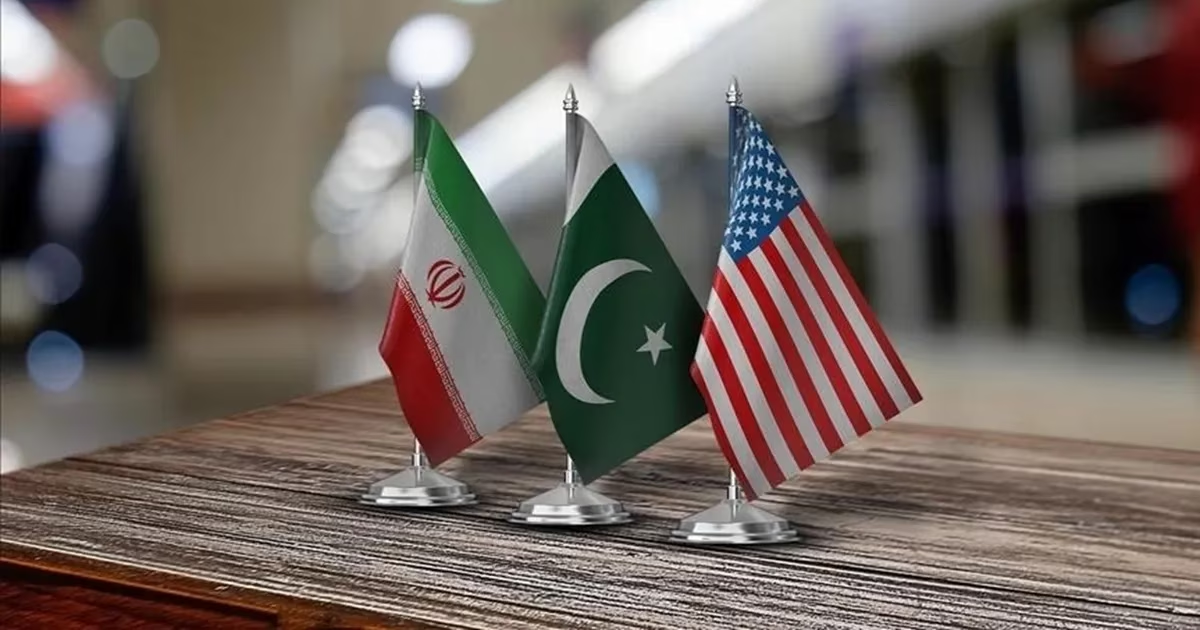
The success of this agreement is closely linked to the broader understandings between the United States and Iran, as Washington seeks to contain regional escalation and prepare the ground for negotiations. Tehran, in turn, insists on considering the Lebanese arena an integral part of comprehensive regional arrangements, rejecting any attempts to separate fronts without real guarantees.

On the Lebanese political front, the role of Parliament Speaker Nabih Berri emerged as a key negotiator representing Hezbollah, holding intensive meetings to ensure adherence to the terms of the truce. Two approaches stand out within Lebanon; one relies on international guarantees for Israeli withdrawal, and the other sees field pressure as the only means to force the occupation to retreat.

Minutes before the agreement came into effect, the Tallat Ali Al-Taher area witnessed violent clashes that resulted in deaths and injuries among the Israeli army, reflecting significant field tension. These events confirm that the field remains volatile, and the transition from a state of war to permanent calm requires measures that go beyond merely announcing a ceasefire.

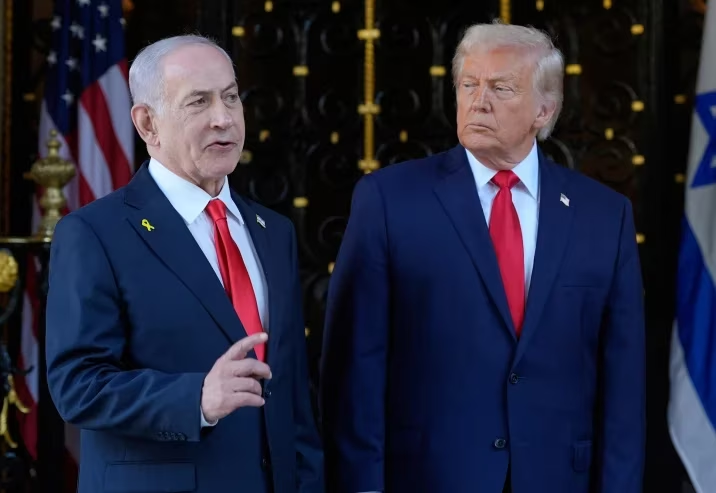
In the context of international pressure, statements by former US President Donald Trump emerged, in which he indicated his ability to force the Netanyahu government to completely halt military operations. These statements reflect the extent of the overlap between internal political calculations in the United States and the ongoing conflict in the Middle East.

The real test of the agreement remains contingent on a clear timetable for the withdrawal of Israeli forces from all positions they occupied during the recent escalation. Without achieving this complete withdrawal, the ceasefire agreement will remain merely a temporary truce imposed by international circumstances, awaiting a new round of confrontation that may erupt at the first security breach.

The real test of the agreement will not be in the first hours, but in the extent of Israel's commitment to halting its operations and withdrawing its forces from the south.

PALESTINE

Sat 20 Jun 2026 10:06 am - Jerusalem Time

Diplomatic Crisis: Occupation Cuts Ties with Kaja Kallas After 'Apartheid' Leaks

Relations between the European Union and the Israeli occupation authorities have entered a new tunnel of diplomatic tension, following reports that revealed controversial statements made by the bloc's High Representative for Foreign Affairs and Security Policy, Kaja Kallas. Sources reported that Kallas, during unannounced meetings, compared policies towards Palestinians to the 'apartheid' system that previously prevailed in South Africa, which sparked widespread anger in Israeli political circles.

According to international press reports, this comparison was made during secret meetings held by the former Estonian Prime Minister with government officials in Mexico in May 2026. The leaks indicated that Kallas based her comparison of the measures taken in the Gaza Strip and the West Bank on personal impressions she formed after a previous visit to the Apartheid Museum in Johannesburg, considering that there is a similarity in mechanisms of racial discrimination.

For his part, the occupation's Foreign Minister Gideon Sa'ar quickly took immediate punitive measures, announcing the severance of all diplomatic contacts with the EU High Representative. Sa'ar described these statements as 'pure slander' and revealing a preconceived bias against the occupation authorities, stressing that the return to the political dialogue table with her is contingent on an apology and a formal and public retraction of those allegations.

In an attempt to contain the situation, European diplomats affirmed that the statements attributed to Kallas do not in any way express the official position of the European Union towards the conflict. They clarified that what was mentioned in the leaks is a 'diplomatic blunder' for an official at this level, especially since it contradicts the general line of the bloc, which balances supporting the security of the occupation and criticizing settlement expansion in the occupied territories.

Despite significant pressure, Kallas did not issue a categorical denial or direct confirmation of the authenticity of the leaks regarding the 'apartheid' description, contenting herself with affirming the European Union's commitment to building balanced and constructive relations with all parties. This ambiguity in the response reflects the extent of the embarrassment faced by the High Representative's office in dealing with the repercussions of this crisis, which may disrupt vital communication channels between Brussels and Tel Aviv.

These developments come in the context of escalating tension in bilateral relations since the outbreak of the war on the Gaza Strip in October 2023, where European criticism of Israeli policies has intensified. The bloc had previously imposed sanctions on settlers involved in violence in the West Bank, considering that settlement constitutes a major obstacle to achieving a two-state solution, which made the latest leak the straw that broke the camel's back in diplomatic relations.

Observers believe that this diplomatic rift may directly affect the European Union's role as a mediator or actor in any future negotiations related to de-escalation or reconstruction. With the occupation's insistence on 'official retraction' as a condition for resuming contacts, the fragile diplomatic balance between the two parties remains threatened with further collapse amid the ongoing war and escalating violations in the occupied Palestinian territories.

The statements attributed to Kallas are slanderous and biased against us, and dialogue will not resume until there is a formal and public retraction.

ARAB AND WORLD

Sat 20 Jun 2026 10:06 am - Jerusalem Time

Sudden Setback in US-Iranian Understanding: Switzerland Talks Postponed and Field Escalation in Lebanon

US-Iranian understandings entered a phase of ambiguity following the announcement of the postponement of talks that were scheduled to be held at the Bürgenstock mountain resort in Switzerland. Diplomatic sources confirmed that communications are still ongoing between the two parties to arrange a new date in the coming days, with the aim of completing the implementation of the memorandum of understanding aimed at ending the state of war in the region.

For its part, the Swiss Ministry of Foreign Affairs announced the cancellation of the scheduled meeting, while Tehran preferred to describe it as a postponement, noting that the previous electronic signing of the memorandum made a direct meeting unnecessary at the present moment. The spokesperson for the Iranian Foreign Ministry, Ismail Baqaei, explained that the transition to the final agreement stage depends on actual adherence to the agreed-upon terms.

In Washington, the White House decided to postpone the visit of US Vice President J.D. Vance to Switzerland, where he was supposed to oversee the mechanisms for implementing the agreement. The US administration affirmed that the negotiating delegation remains on standby to depart as soon as political and field conditions improve, allowing for the resumption of direct dialogue.

International media reports, citing informed sources, revealed that the Iranian side set a new condition for resuming negotiations, which is to obtain real guarantees for stopping Israeli attacks on Lebanese territory. It seems that Tehran seeks to link progress in the diplomatic track to the extent of commitment to a comprehensive ceasefire stipulated in the initial understandings.

On the ground, the negotiation atmosphere did not prevent a bloody military escalation in southern Lebanon, where recent Israeli raids resulted in the martyrdom of 28 people and the injury of dozens. In return, the Israeli army admitted the killing of four of its soldiers, including an officer, in confrontations described as the fiercest since the announcement of the memorandum of understanding between the major powers.

This escalation raised serious questions about the resilience of the memorandum of understanding that ended a widespread war that erupted last February and involved multiple parties. The Switzerland meeting was supposed to be the cornerstone for transitioning from a phase of cessation of hostilities to a phase of drafting a final and comprehensive peace agreement that ensures regional stability.

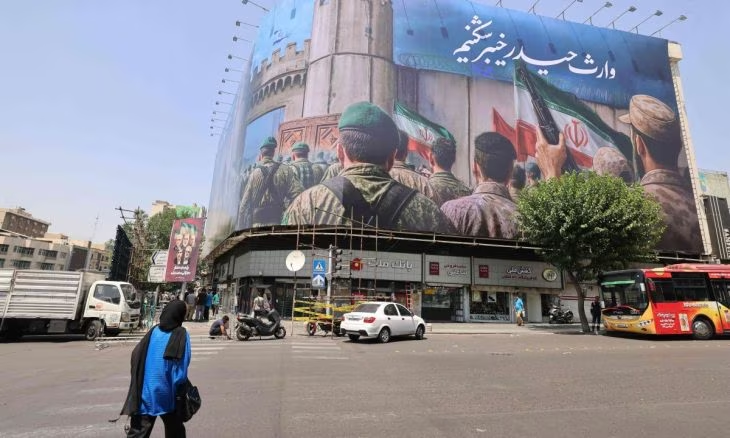
On the internal political front in Iran, Supreme Leader Mojtaba Khamenei expressed conditional approval of the agreement, emphasizing that sitting with the American side does not mean compromising national principles. Iranian officials stressed that any retreat by Washington from its commitments would be met with a decisive response, especially regarding the lifting of oil sanctions.

In a related context, signs of economic relief began to appear with the resumption of navigation in the strategic Strait of Hormuz after a long period of suspension due to military operations. Iranian authorities announced the formation of a new body to oversee the passage of ships, with temporary fee exemptions granted as a gesture of goodwill under the recent understandings.

US Vice President J.D. Vance defended the diplomatic path, noting that the US military allowed the passage of commercial vessels to ensure the stability of global energy markets. This news positively impacted oil prices, which began to decline to approach their normal levels before the outbreak of the military crisis.

However, the agreement still faces fierce opposition within political circles in Israel and the United States, where critics see it as offering huge economic concessions to Tehran. The memorandum includes an ambitious plan to rebuild the Iranian economy worth up to $300 billion, which some see as an undeserved reward for the Iranian regime.

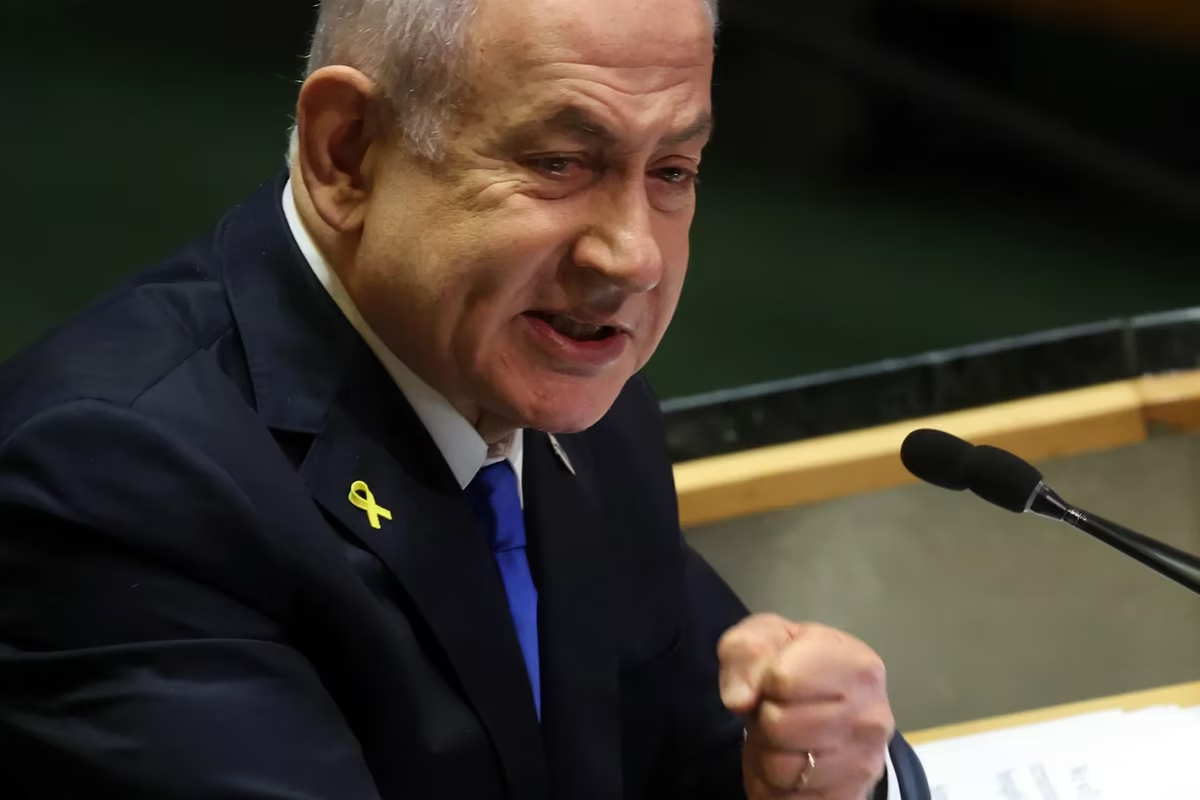
Israeli Prime Minister Benjamin Netanyahu, for his part, affirmed that the conflict is not over yet, despite his keenness not to directly clash with the Trump administration at the moment. In contrast, the Israeli Minister of National Security issued harsh statements calling for an escalation of military operations in Lebanon, putting additional pressure on international mediators.

France and other international powers are seeking to pressure all parties to respect the terms of the agreement and prevent its imminent collapse due to field violations. Observers believe that the next few days will be crucial in determining the fate of the Middle East, either a return to the negotiating table or a slide back towards a comprehensive confrontation.

Iranian President Masoud Pezeshkian described the agreement as a historic moment for his country, considering that the lifting of frozen sanctions would represent a victory for Iranian diplomacy. Tehran hopes that the implementation of the memorandum will lead to the immediate release of its financial assets abroad, which will help alleviate the suffocating economic crisis it is experiencing.

In conclusion, anticipation remains the master of the situation in the concerned capitals, awaiting the outcome of the mediators' efforts to address Iranian demands regarding Lebanon. The gap between the language of diplomacy in Switzerland and the reality on the ground in southern Lebanon continues to widen, putting the credibility of the US-Iranian understanding to the real test.

Negotiations for the final agreement will depend on the commencement of specific provisions of the memorandum and continued adherence to them.

PALESTINE

Sat 20 Jun 2026 10:06 am - Jerusalem Time

Settlement Precedent East of Ramallah: Commercial Cafe Opens in the Heart of 'Area B'

In a new provocative move, settlers have opened a commercial establishment named 'Cafe Bahar' or (Mountain Cafe), as part of the occupation's efforts to impose new facts on the ground deep within the occupied West Bank. Field sources reported that the cafe was established within the pastoral settlement outpost 'Havot HaOranim', located near the 'Ofra' settlement, which is built on citizens' lands east of the Ramallah and Al-Bireh Governorate.

The danger of this project lies in its geographical and political location, as the establishment was openly built on lands classified as (B) according to the Oslo Accords, which are areas under Palestinian civil and administrative responsibility and Israeli security control. This step is considered a commercial precedent aimed at undermining the remaining powers of the Palestinian Authority in those areas and transforming them into settlement and investment attractions for settlers.

Observers believe that this type of settlement, which integrates pastoral outposts with commercial projects, aims to tighten the siege on Palestinian communities and prevent farmers and shepherds from accessing vast areas of their lands. The project has received widespread praise from settler platforms, which considered it an actual تجاوزاً of previous political restrictions and an entrenchment of full Israeli control over Palestinian lands.

This project is the first settlement commercial establishment to be openly built in Area (B) under the Oslo Accords, thus establishing a new phase of land annexation.

PALESTINE

Sat 20 Jun 2026 10:06 am - Jerusalem Time

3 Martyrs in Gaza and UNICEF Describes Ceasefire as a 'Deadly Illusion' for Children

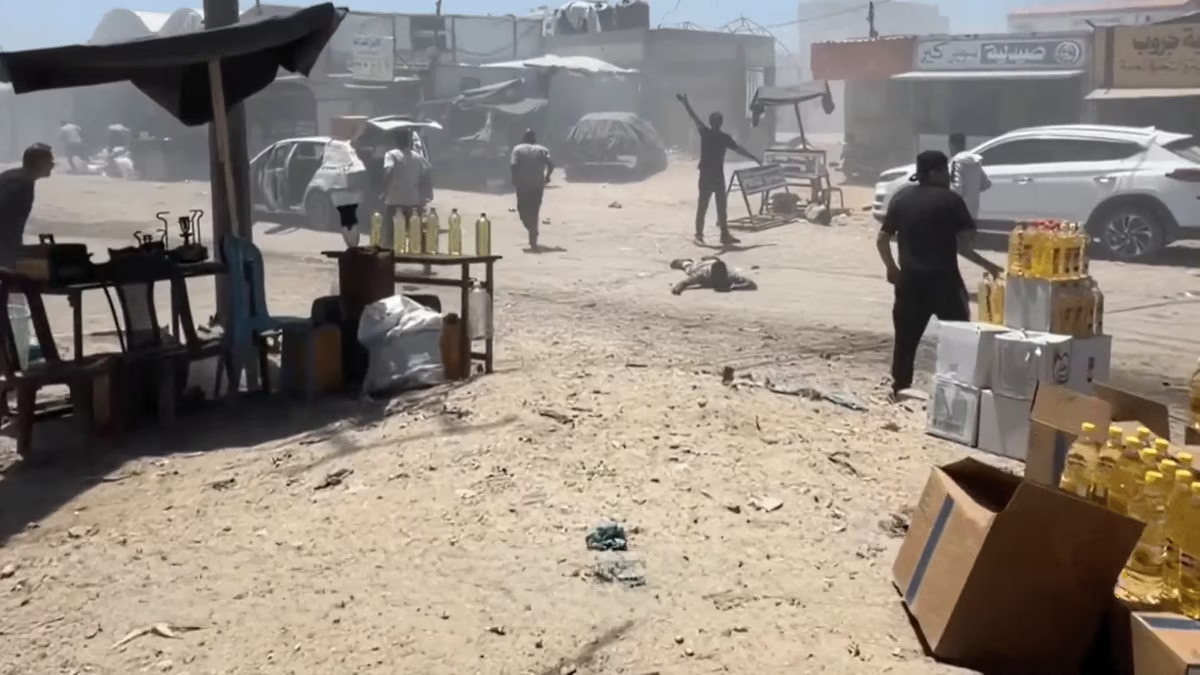
Three Palestinian citizens, including a woman and a child, were martyred in the early hours of Saturday morning, as a result of a series of raids carried out by Israeli occupation forces on various areas in the Gaza Strip. The shelling targeted a residential apartment on Thirtieth Street in Gaza City, in addition to attacks on the Mawasi area of Khan Yunis in the southern Strip, resulting in varying injuries among civilians.

Medical sources reported that the shelling targeting the residential apartment in Gaza City led to the immediate martyrdom of the woman and child, while the injured were transferred to nearby hospitals for treatment. In the Mawasi area, which the occupation forces classify as 'safe zones,' another martyr fell and a number of citizens were injured, including four children, following a direct targeting of tents and displaced persons' gatherings.

In a related context, the United Nations Children's Fund (UNICEF) described the state of relative calm or the ceasefire announced since October 2025 as a 'deadly illusion' for children and youth in the Strip. The organization affirmed that ongoing military operations are claiming the lives of minors in places that were supposed to be safe havens for them, away from the machinery of war.

UNICEF spokesperson James Elder pointed out that data documents the killing of 265 minors since the ceasefire announcement, explaining that more than 90% of these deaths resulted from direct Israeli attacks. He also noted that the rest of the victims fell due to the explosion of unexploded ordnance remnants scattered among the rubble of destroyed homes in various governorates.

Elder stressed that these children were not killed on the battlefronts or in areas of engagement, but were targeted inside their homes, in their schools, and while engaging in simple activities such as playing football or fishing. He explained that the occupation forces used 'quadcopter' drones to fire directly at civilians, leading to severe and complex injuries.

UN reports included tragic cases of child victims, among them an infant less than two years old who was martyred by occupation bullets, and a thirteen-year-old boy who was injured inside his tent. The organization also recorded a 15-year-old girl being shot in the chest by a weapon mounted on a military crane, and another child being injured in the face by a drone.

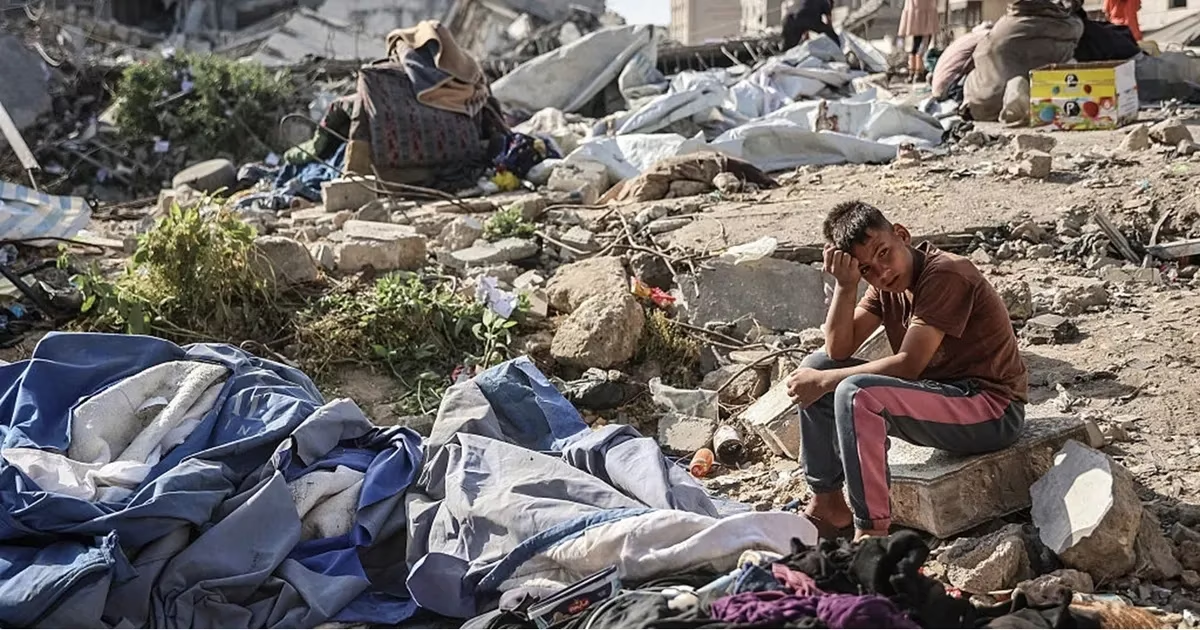
According to the latest official data, the death toll from the ongoing war of extermination since October 7, 2023, has risen to 73,018 martyrs and 173,273 injured. These figures reflect the scale of the humanitarian catastrophe experienced by the Strip amidst the continued systematic targeting of infrastructure and residential areas crowded with displaced persons.

Since the last ceasefire announcement on October 11, 2025, the total number of martyrs has reached approximately 1,007, in addition to more than 3,165 injured. Civil defense teams and citizens have also been able to recover the bodies of 784 martyrs from under the rubble of homes destroyed in previous periods, increasing the pace of grief and sorrow in the Palestinian street.

The UN official concluded his statements by demanding the necessity of stopping the 'normalization of the abnormal,' emphasizing that the continued killing of children on this scale during the truce period must raise widespread international concern. Elder criticized the absence of international political will to bring a real end to the suffering of children in Gaza, calling on institutions that claim to defend international law to act immediately.

The ceasefire announced in Gaza is a deadly illusion for children and youth, and we must stop normalizing the abnormal.

OPINIONS

Sat 20 Jun 2026 10:05 am - Jerusalem Time

US Intelligence Warns: Netanyahu May Seek to Thwart Understanding Between Washington and Tehran

Washington's Message

Washington – Said Arikat – 20/6/2026

The Washington Post revealed on Friday that there are growing concerns within US intelligence circles and the administration that Israeli Prime Minister Benjamin Netanyahu might act in a way that undermines the political understanding signed by the United States and Iran this week, a development that reflects the widening gap between Washington's strategic priorities and the calculations of the Israeli government.

According to current and former US officials, intelligence assessments circulated within the US administration concluded that Israel views the memorandum of understanding signed between Washington and Tehran with suspicion, seeing it as a shift that could weaken the policy of pressure and isolation that Tel Aviv has sought to solidify against Iran for many years.

These assessments come at a time when the administration of President Donald Trump considers the agreement with Iran a cornerstone of a new approach aimed at reducing regional tensions, securing international navigation, and preventing the region from sliding into broader and more costly confrontations. However, this path faces a major obstacle in the continued Israeli war on Lebanon and the possibility of its expansion at any moment.

US intelligence circles believe that one of the essential provisions of the new understanding is to calm the Lebanese arena and halt the spiral of mutual escalation between Israel and Hezbollah. However, recent field indicators suggest the opposite, as Israel has continued its military operations in southern Lebanon, while US warnings have increased that any large-scale Israeli operation could undermine the political foundation on which the agreement with Tehran was built.

These concerns were reinforced after the escalation on the Lebanese front on Friday, when Israel launched raids on targets in southern Lebanon in response to a drone attack attributed to Hezbollah that resulted in the death of four Israeli soldiers. At the same time, a round of US-Iranian talks scheduled in Switzerland was postponed, and Vice President JD Vance's visit, linked to the negotiation process, was also delayed, reflecting the fragility of the transitional phase the agreement is undergoing.

The American reading of events indicates that the danger lies not only in the potential collapse of the understanding with Iran but also in the possibility of a direct political crisis between President Trump and Netanyahu. The US President presented the agreement as a major diplomatic achievement that puts an end to decades of tension with Tehran, while the Israeli government appears less convinced of the utility of this shift and more inclined to continue a policy of confrontation.

Trump himself hinted at a disagreement with Netanyahu regarding Lebanon when he revealed during a press conference in France that he had asked the Israeli Prime Minister to avoid excessive military responses. These statements came at a time when questions were increasing in Washington about the extent of the Israeli government's willingness to adapt to the new political environment created by the agreement with Iran.

US intelligence assessments attribute a significant part of Netanyahu's behavior to purely internal considerations. The man, who faces critical elections, realizes that a large part of his political base views the continuation of military operations as proof of firmness and the ability to impose security realities. Therefore, any withdrawal from the Lebanese territories currently occupied by Israel, or any acceptance of long-term de-escalation arrangements, could be used against him politically as a retreat in the face of Hezbollah.

From this perspective, Washington believes that Israeli electoral calculations could dangerously intersect with US strategic interests. While the US administration seeks to solidify a broader regional understanding with Iran, Netanyahu finds himself driven towards escalatory options that grant him internal political gains, even if they come at the expense of regional stability or relations with Washington.

In contrast, Israel asserts that its military operations aim to prevent threats from Hezbollah and protect the security of its citizens. However, US officials warn that the continued Israeli occupation of parts of southern Lebanon, or the expansion of military operations, could return the region to a cycle of open escalation and undermine US efforts to build a new security and political framework.

Observers believe that the current crisis represents a pivotal moment in the relationship between Washington and Tel Aviv. The agreement with Iran is not just about a bilateral issue between the two countries; it reflects a shift in US foreign policy priorities, from managing conflicts through escalation to containing them through political settlements. This shift places Israel before a different strategic reality than it has been accustomed to in recent years.

Furthermore, the messages issued by Vice President JD Vance, in which he urged the Israeli government not to embarrass or attack its strongest remaining international ally, reflect an unprecedented degree of discomfort within the US administration regarding current Israeli policies, and indicate that Washington is now more prepared to defend its strategic choices even when they conflict with the wishes of the Netanyahu government.

In light of these facts, the coming weeks appear crucial not only for the future of the US-Iranian agreement but also for the shape of the relationship between the Trump administration and the Israeli government. The success of the agreement will largely depend on Washington's ability to prevent an explosion on the Lebanese front, while any major escalation could return the entire region to the square of confrontation that the US administration is trying to exit.

Netanyahu Between Political Survival and the Requirements of Settlement

US intelligence leaks reveal a deeper dilemma than a mere tactical disagreement between Washington and Tel Aviv. Netanyahu faces a critical electoral challenge and finds that his political image in recent years has been linked to a discourse of strength and military expansion. Therefore, any withdrawal from Lebanon or acceptance of long-term de-escalation arrangements could be presented by his opponents as a retreat or defeat. Hence, war, for him, appears to be a tool for managing internal balances as much as it is a tool for achieving security objectives, which explains the growing US concerns about his behavior in the coming period.

The US-Iranian Agreement Changes the Rules of the Game

The importance of the memorandum of understanding between Washington and Tehran is not limited to reducing tension between the two countries but extends to redefining regional security priorities. The United States now believes that the stability of international navigation, energy markets, and preventing the expansion of regional conflicts is a priority that transcends the logic of open confrontation with Iran. This shift places Israel before a new reality it has not been accustomed to in recent years, as the policy of continuous escalation no longer enjoys the same unconditional support within US decision-making circles, which explains the extent of Israeli concern about the agreement.

An Unprecedented Test for the Relationship Between Trump and Netanyahu

The relationship between Trump and Netanyahu has long been presented as one of the most harmonious between a US president and an Israeli prime minister. However, the agreement with Iran revealed the limits of this harmony when the strategic interests of the two parties conflict. The US administration views the agreement as an entry point to ending an economically and militarily costly conflict, while Netanyahu fears that it will strengthen Iran's regional position and weaken the justifications for continuing the war. Therefore, the current crisis could become the first real test of Trump's ability to impose his vision on the Israeli government if it chooses to proceed with escalation.

OPINIONS

Sat 20 Jun 2026 10:05 am - Jerusalem Time

Resetting the US-Israeli Relationship Amidst US Internal Shifts and Post-War with Iran

Dr. Ibrahim Nairat

Opinion Writer

Dr. Ibrahim Nairat

The relationship between Washington and Tel Aviv is witnessing a phase of political repositioning, which on the surface does not appear to be a rupture or a retreat from the traditional alliance, but rather reflects a significant shift in the style of American discourse itself, especially within Republican Party circles, where the importance of approaching foreign policy from the perspective of “America First” is increasing. This shift does not mean the disintegration of the strategic alliance with Israel, but it indicates a reformulation of how it is presented politically and in the media to the American public, which has become more sensitive to the cost of external involvement and its multiple crises. This coincides with the approaching US midterm elections in 2026, which push political discourse towards greater clarity and sharpness on foreign policy issues.

In this context, the increasing public statements by some American officials, which emphasize the independence of American decision-making or remind of the extent of military support for Israel, can be understood as part of a discourse primarily directed at the American public. It appears that this discourse aims to affirm that American foreign policy is not automatically managed according to alliance considerations, but rather is subject to continuous review that includes cost, results, and internal priorities, given the presence of political currents within the Republican Party that tend to reduce external involvement, and with the escalating importance of electoral sentiment in guiding the priorities of political discourse.

This shift in political language intersects with a regional phase that witnessed a military confrontation in which the United States participated alongside Israel in the context of escalation with Iran, before later ending in understandings aimed at de-escalation. This phase highlighted the risks of regional conflict expansion and its effects on energy markets and international stability, which prompted decision-making circles in Washington to be more cautious in managing direct involvement in Middle East crises, and to prefer containment and diplomatic pressure tools over open confrontation.

In this framework, public statements that criticized some positions of officials in the Israeli government, or emphasized the extent of American military support for Israel, came as part of an attempt to reset the rhythm of the relationship without affecting its strategic essence. They affirm the continuation of the alliance, but at the same time reflect a desire to reduce the risks of sliding into a wider escalation whose political or military cost Washington does not wish to bear, especially in an internal political environment more linked to electoral calculations.

In contrast, within Israel, there are readings that reflect increasing concern about a decline in the level of “unconditional political guarantee,” despite continued strong military support. This concern is not related to the possibility of ending support, but rather to the possibility of linking it more to the behavior of the Israeli government in regional files, which makes any public American criticism viewed as a sensitive political indicator, even if it does not change the essence of strategic commitments.

In this context, there is a growing discussion in some political circles about Benjamin Netanyahu's position in the equation with Washington, not from the perspective of a collapse of the relationship, but from the perspective of the limits of direct and indirect political influence on American decision-making. With increasing public differences on issues such as Iran and the management of regional escalation, and with increasing American caution about the cost of external involvement, the political maneuvering space for the Israeli government appears more complex than it was in previous stages, without this meaning a radical shift in the nature of the alliance.

As for the broader picture, what is happening can be read as a gradual transition from managing open conflicts to managing more cautious balances. US policies do not indicate a withdrawal from the region, but they are increasingly tending to reduce direct involvement, and prefer diplomatic pressure tools and balance management instead of entering into long or unpredictable confrontations.

In parallel, a more diverse public debate is escalating within the United States about the nature of the relationship with Israel. Instead of the traditional acceptance of the importance of unconditional support, some segments, especially among younger generations, are raising questions about the cost of this support and its implications for the American interior. This discussion does not reflect a unified position or a comprehensive shift in public opinion, but it indicates a re-framing of the relationship within the framework of cost-benefit calculations, given the multiplicity of internal and external crises.

This is paralleled by another development, which is the increasing debate about the prevailing narratives regarding the conflict in the Middle East, where the traditional Israeli narrative no longer monopolizes the space for interpretation as before, but has become the subject of a wider and more pluralistic discussion, in contrast to a growing presence of narratives focusing on humanitarian aspects and Palestinian suffering. This shift does not necessarily reflect a change in official policies, but it indicates a change in the environment of public debate and the multiplicity of its sources and effects, especially with the expansion of digital media and communication platforms.

In addition, American public opinion has become one of the elements that are taken into account more within foreign policy calculations, albeit indirectly. With the growing sensitivity to the cost of external interventions, American administrations have become more careful to align their discourse with the internal mood, without this meaning that external decision-making is completely subject to it, but rather introducing it as one of multiple factors in the decision-making process.

Thus, the ongoing shift does not appear to be a shift in the essence of the US-Israeli alliance as much as it is a reorganization of how it is managed and the limits of its expression. The relationship is still based on solid strategic foundations, but the way it is approached has become more complex, and more linked to the balance between external commitments and internal considerations, in a more turbulent and multi-polar international and regional environment.

PALESTINE

Sat 20 Jun 2026 10:04 am - Jerusalem Time

Mary Kostakidis: Australian Media Icon Who Confronted the Zionist Lobby in Defense of Gaza

Australian journalist Mary Kostakidis embodies a model of ethical journalism that pays the price for its commitment to human justice. Her supportive stance towards Palestinians has put her in direct confrontation with the Zionist lobby in Australia. This journey recently culminated in her winning the 2026 'Gary Webb Press Freedom Award,' a prestigious international award granted by 'Consortium News' in recognition of her exceptional courage in reporting the truth.

Kostakidis was born in 1954 in Veria, Greece, before her family immigrated to Australia, where she completed her education at the University of Sydney, specializing in philosophy, languages, and education. She began her career in academic and research fields, but her true brilliance emerged in media and field work, especially concerning immigrant issues and human rights, which formed the core of her professional identity.

Kostakidis is considered one of the founding generation of the Australian public broadcaster (SBS) in 1980, where she contributed to building the translation unit and developing the station's editorial policies. Thanks to her efficiency, she transitioned from administrative work to become the most prominent face of the main evening news bulletin for over two decades, making her one of the most trusted media personalities in the country.

In 2007, Kostakidis made a pivotal decision to resign from the SBS newsroom in protest against changes she believed undermined the station's professional standards, including the insertion of advertisements into news programs. Not content with just resigning, she pursued a legal battle against the institution, alleging breach of contract and bullying, a case that ended in an amicable out-of-court settlement.

Kostakidis's role was not confined to the screen; she was also a powerful voice in human rights forums, chairing the Sydney Peace Foundation and being appointed to the National Human Rights Advisory Committee. She was known for her staunch defense of press freedom and played a prominent role in supporting WikiLeaks founder Julian Assange, to whom she awarded the Gold Medal for Peace and Justice in 2011.

Kostakidis's positions on the Palestinian issue took a sharper turn with the escalation of the genocidal war in the Gaza Strip, where she used her platforms to highlight the occupation's crimes. This moral clarity made her a direct target of the Australian Zionist Federation, which began legally pursuing her on charges related to anti-racial discrimination due to her posts supporting Palestinian rights.

In 2024, the Zionist Federation filed a complaint against her for reposting clips calling for settlers with dual nationalities to return to their home countries if they wished to feel safe. Kostakidis clarified then that her aim was to indicate that the occupation's policies provoke escalation and drag the region towards explosion through continuous massacres.

In 2025, the pursuit evolved into a lawsuit before the Australian Federal Court, where the Zionist lobby seeks to use local laws as a weapon to silence voices critical of 'Israel.' The trial is scheduled to begin later this year, amidst widespread human rights and media anticipation of the outcomes of this confrontation, which touches upon the core of freedom of expression in Australia.

Observers believe that the Australian Zionist Federation exploits its financial and political influence to access major media outlets, attempting to brand any criticism of the occupation's crimes as 'antisemitism.' However, Kostakidis refuses to back down from her positions, asserting that defending Gaza is defending truth and justice in the face of the war and destruction machine.

Kostakidis's win of the Gary Webb Award in 2026 comes at a sensitive time, as journalists face immense pressure to prevent them from revealing the truths about war crimes. The awarding institution considers Mary's journey a model of resilience in the face of intimidation attempts by forces supporting the occupation in Western societies.

Reports indicate that Gaza has become a historical turning point in global consciousness, where crimes committed against the Palestinian people can no longer be forgiven or overlooked. Kostakidis is part of a global movement comprising academics and intellectuals who reject 'moral panic' and insist on calling things by their true names despite the risks.

Kostakidis also contributed to developing the language of cultural dialogue in Australia, through her work on facilitating the understanding of legal procedures for Greek immigrants in major historical cases. This link between language and justice has always been the primary driver of her activism, whether in courtrooms or behind radio microphones and television screens.

Despite the legal and financial challenges posed by lawsuits, Mary enjoys widespread respect in independent circles that see her as an honest voice for her communities. Her supporters affirm that attempts to silence her will only increase her determination to expose media and political complicity with forces that violate human rights in the Middle East.

In conclusion, Mary Kostakidis remains a symbol of journalism that does not compromise its principles, having proven that true professionalism requires standing with the victim against the oppressor. Her upcoming battle in the Federal Courts will not be merely a personal case, but a true test of Australian democracy and its ability to protect freedom of expression from the encroachment of lobbies.

Israel provokes escalation and invites retaliation because it is committing genocide in the Gaza Strip.

PALESTINE

Sat 20 Jun 2026 10:04 am - Jerusalem Time

With a frail body and a harsh testimony... A Jerusalemite boy recounts the horrors of 20 months in occupation prisons

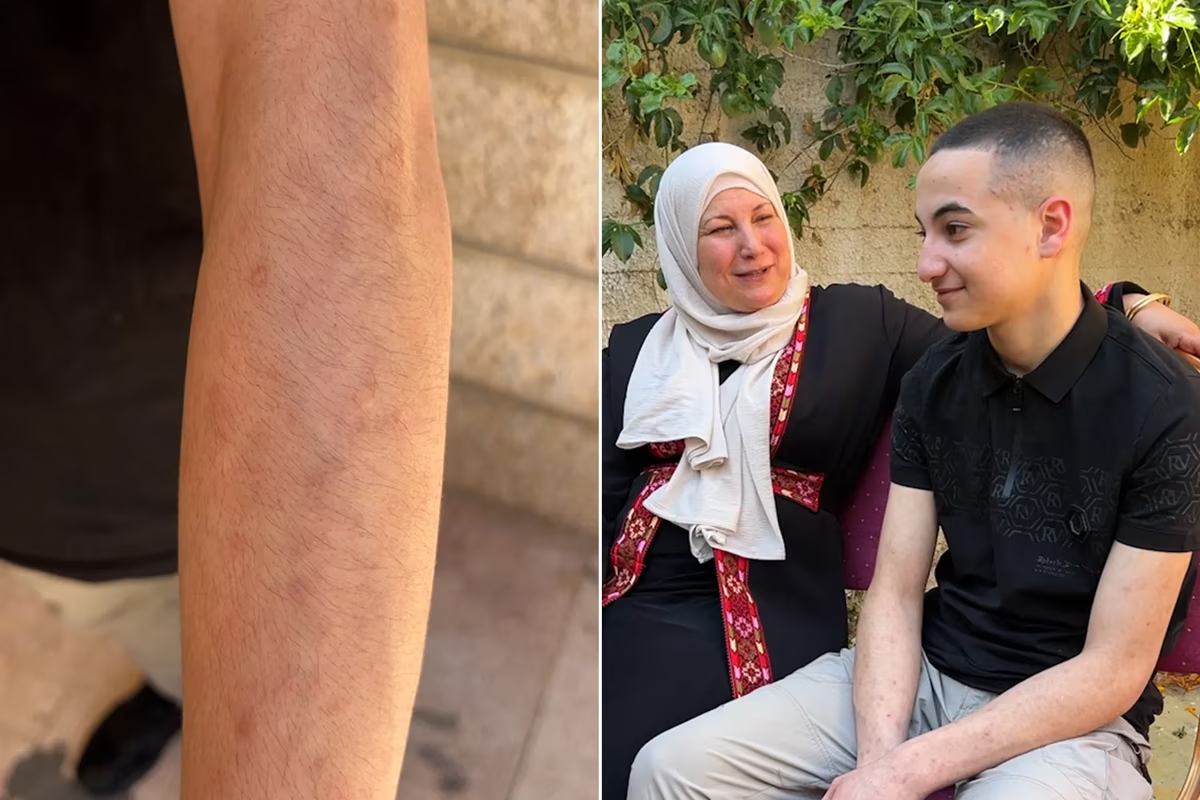
The Israeli occupation authorities released Palestinian boy Ismail Mahlis from Al-Ram town, north of occupied Jerusalem, after he spent about 20 months behind bars. Mahlis emerged from Ofer Prison with a frail body and clear signs of exhaustion, to recount harsh details of the suffering experienced by boys and children in the cubs' sections.

Ismail's journey of suffering began on October 15, 2024, when occupation forces raided his family's home and took him to interrogation centers. The boy, who was then no more than fourteen years old, was then transferred to Ofer Prison, located west of Ramallah city, to begin a long chapter of isolation and abuse.

Mahalis described the conditions inside the cubs' section as extremely difficult, where the prison administration deliberately provides very meager amounts of food to young prisoners. He confirmed in his testimony that the meals provided are often unfit for human consumption, and mainly consist of small quantities of often spoiled rice.

In addition to malnutrition, prison cells suffer from an almost complete lack of general hygiene, with no clean water available for showering. Sources reported that child prisoners are deprived of regular showering, which leads to a worsening of health conditions and the spread of skin diseases among detainees due to overcrowding.

Since the outbreak of the aggression on the Gaza Strip, the prison administration has tightened its repressive measures, preventing child prisoners from going out to the outdoor area known as 'Al-Fawra'. This internal siege has increased the psychological and physical pressure on the boys who spend their entire day inside closed and overcrowded rooms.

The Ofer Prison administration employs daily abusive methods, including removing mattresses and blankets from prisoners from early dawn until afternoon, to force them to remain without rest. Daily counts are also conducted three times in a humiliating manner, where children are forced to sit on their knees or face walls for long hours.

Mahalis revealed the presence of about 197 child prisoners in the section where he was held, distributed among 22 cramped rooms that are not large enough for their numbers. He pointed out that the age groups inside the prison include very young children born in 2011 and 2012, who are subjected to the same harsh treatment received by adults.

The released boy confirmed that the current occupation policy does not differentiate in beating and abuse between a child and an elderly man, as the privacy previously granted to the cubs' sections has disappeared. He explained that repression and assault operations have become a daily routine practiced by prison guards against all detainees without exception or regard for international laws.

For her part, Ismail's mother, Intisar Shawamreh, expressed her shock at the condition her son was in after two years of forced absence. She said that her son entered prison as a child and left it as a young man burdened with worries, stressing that she lived months of constant anxiety about his fate amid the lack of news and continuous violations.

The Mahlis family hopes that their son will be able to regain his normal life and complete his education, which was interrupted due to detention, despite the deep psychological effects. This testimony comes at a time when statistics from prisoner institutions indicate the presence of about 9,500 Palestinian prisoners, including 360 children who face similar conditions to what Ismail recounted.

There are children born in 2011 and 2012, who were too young and should not be in prison, but should live their childhood.

PALESTINE

Sat 20 Jun 2026 10:04 am - Jerusalem Time

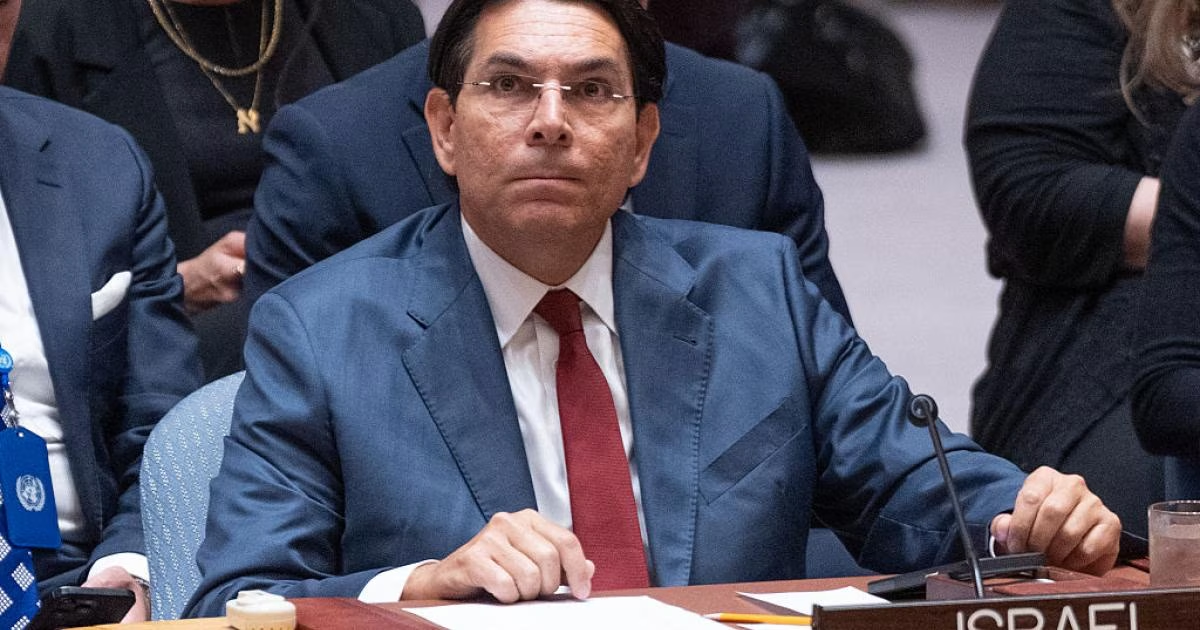
Sharp Debate at the United Nations: Israeli Representative Attacks UN Officials After Tel Aviv's Inclusion on 'List of Shame'

The United Nations headquarters in New York witnessed a sharp and unusual verbal confrontation between the Israeli representative and high-ranking UN officials. This debate occurred during a public session dedicated to commemorating the International Day for the Elimination of Sexual Violence in Conflict, where deliberations turned into a direct diplomatic clash that violated established norms within the international organization.

Danny Danon, Israel's Ambassador to the United Nations, demanded the immediate resignation of Pramila Patten, the Special Representative of the Secretary-General for Children and Armed Conflict. Danon accused the UN official of political bias, considering her report, which for the first time included Israel on the 'blacklist,' to lack objectivity and directly target the Jewish state.

In a direct attack on the organization's senior leadership, Danon stated that Patten had succumbed to what he described as Secretary-General Antonio Guterres' 'obsession' with targeting Israel in international forums. The Israeli representative considered these reports to represent a new decline in the UN's handling of conflicts, indicating that Tel Aviv would not stand idly by in the face of what he called slander.

For her part, Vanessa Fraser, Guterres' representative for children and armed conflict, strongly responded to the Israeli criticisms during the same session. Fraser called for an end to personal attacks against international staff, emphasizing that the reports she prepared were based on documented and field-based evidence that leaves no room for interpretation regarding the violations committed.

In her latest report, Fraser revealed the possibility of expanding the blacklist to include groups of settlers involved in attacks against Palestinian children. She clarified that the documentation standards are strict and apply to all parties without exception, stressing the need to protect minors in armed conflict zones in accordance with international law.

In a related context, UN Secretary-General Antonio Guterres expressed his deep concern over the astonishing increase in the number of recorded violations against children in the occupied Palestinian territories. Guterres indicated that the observed figures and facts require urgent international action to ensure accountability and prevent the recurrence of these crimes affecting the most vulnerable groups.

The diplomatic tension escalated with the Israeli Ministry of Foreign Affairs announcing its intention to cut all forms of relations with the current Secretary-General at the end of his official term. This decision comes as a protest against the inclusion of the Israeli army on the 'list of shame,' which Tel Aviv views as crossing red lines in its relationship with the international organization.

We have documented evidence supporting what was stated in the UN reports regarding violations committed against children.

ARAB AND WORLD

Sat 20 Jun 2026 10:04 am - Jerusalem Time

Massacre in Nabatieh: 24 Martyrs in the Fiercest Israeli Raids on Southern Lebanon Since the Last Agreement

Villages in southern Lebanon witnessed a wave of violent Israeli airstrikes this Friday morning, resulting in the martyrdom of at least 24 citizens and the injury of dozens with varying degrees of severity. These attacks are considered the largest and deadliest escalation since the American-Iranian agreement came into effect, which aimed to end hostilities on all fronts in the region, including the Lebanese front.

The intense airstrikes focused on the Nabatieh area, where official sources reported that occupation aircraft directly targeted residential homes after midnight. The sources clarified that the town of Harouf alone recorded eight martyrs, while the rest of the casualties were distributed among other towns affected by the concentrated shelling, leading to widespread destruction of properties and infrastructure.

In response, the Israeli occupation army issued a statement claiming that its air forces attacked Hezbollah targets in various areas of southern Lebanon. The statement alleged that these operations came in response to what it described as the party's violation of the ceasefire agreement, indicating that the attacks targeted military elements and facilities, despite field reports confirming civilian casualties inside their homes.

The enemy committed several massacres after a series of raids targeted residential homes in the towns of the Nabatieh area.

PALESTINE

Sat 20 Jun 2026 10:04 am - Jerusalem Time

Washington's Relationship with the Authority.. Is it Paving the Way for a New Approach to the Palestinian Issue?

Dr. Dalal Erekat: The value of any transformation is measured by its ability to turn a ceasefire into a political path that guarantees the rights of the Palestinian people, not just arrangements similar to the Deal of the Century.

Akram Atallah: The divergence that prevailed in the relationship between Trump and Netanyahu following the repercussions of the war with Iran and the decline in its political results may generate a new approach to the Palestinian issue in Washington.

Dr. Reham Owda: A memorandum of understanding is likely to be signed between the "Peace Council" and the Authority, outlining a roadmap for Gaza's administration in parallel with the reopening of the PLO office in Washington.

Mohammed Joudeh: Washington faces a central dilemma related to the absence of a Palestinian party capable of managing the "Day After" phase in Gaza, which pushes it to search for a reliable partner.

Dr. Hussein Al-Deek: Washington has not found a political alternative to deal with because the Palestine Liberation Organization is the legitimate representative of the Palestinian people, which prompted it to reopen communication channels.

Nu'man Tawfiq Al-Abed: Fears of using these contacts to show the existence of a negotiation path without actual results on the ground, which could be used to market normalization with Israel.

Ramallah - Exclusive to "Al-Quds" -

Amidst reports circulated by "The Times of Israel" about strengthening the relationship between the United States and the Palestinian National Authority, estimates suggest that this movement may reflect an American trend to reintegrate it into post-war arrangements in the Gaza Strip, ensuring the presence of a Palestinian party that can be dealt with in governance and reconstruction files, amidst warnings that this could come at the expense of reviving the normalization process in the region.

Writers, political analysts, specialists, and university professors, in separate interviews with "Al-Quds," believe that this trend is also linked to the expansion of the Abraham Accords, as reactivating the relationship with the Authority could provide political cover that facilitates the progress of regional normalization and alleviates the complexities of the Palestinian issue within the new equations in the region.

The scenarios, according to writers, analysts, specialists, and university professors, range from a gradual opening that raises the level of coordination and political and economic support without a comprehensive settlement, to the possibility of granting the Authority a role in managing Gaza within transitional arrangements under international supervision, versus the possibility of the relationship remaining within the framework of crisis management if regional understandings falter.

They believe that these moves may reflect a phase of political repositioning for the Palestinian Authority within American calculations, where the future of Gaza intertwines with regional normalization without a clear resolution of the shape of the next phase.

The Authority is an indispensable party

Dr. Dalal Erekat, Professor of Diplomacy and Conflict Resolution at the Arab American University, believes that the circulating information about the United States' intention to strengthen its relationship with the Palestinian Authority holds some accuracy in terms of the general direction, even if its final details are not confirmed, considering that the ongoing discussions fall within a broader political context related to the future of the Gaza Strip, reconstruction, and the expansion of the Abraham Accords.

Erekat explains that the American administration, influenced by regional partners, primarily Saudi Arabia, views the Palestinian Authority as an indispensable party in any arrangements concerning the "Day After" the war, whether in Gaza or within any new regional political path, noting that what is being circulated so far relates to deliberations and contacts, not final decisions, which is consistent with American trends that have emerged in recent months.

She warns against treating these leaks as complete facts, as they may also be used as pressure tools and political messages directed at multiple parties, including the Palestinian Authority, Israel, Arab countries, and American public opinion, emphasizing that the previous and current American administrations adopt a comprehensive approach to managing the Palestinian issue, and that any political path linked to previous UN resolutions places the Authority's role within the framework of sustaining the ceasefire and transitioning to a strategic path towards stability.

Limited Opening

Regarding potential scenarios, Erekat explains that the first scenario is a "limited opening" through improving relations between Washington and the Palestinian Authority, by reopening communication channels, increasing economic support, and enhancing political coordination without reaching significant political recognition or substantive initiatives, which is the most likely scenario in the current phase.

The second scenario, according to Erekat, is a "broader political partnership" if the United States succeeds in establishing post-war arrangements in Gaza and linking them to the expansion of the Abraham Accords, where the Palestinian Authority may be reintegrated into the political and regional scene in exchange for implementing internal reforms, with the possibility of reopening the PLO office in Washington or the American consulate in Jerusalem, ensuring the preservation of the two-state solution as a reference framework.

Erekat indicates that the third scenario is the continuation of crisis management, which is a possibility given the current Israeli government, settlement expansion, and the absence of political will for a final settlement, which may keep the American-Palestinian relationship within tactical improvements without a strategic shift, with the Palestinian issue continuing to be treated as a security and humanitarian file rather than a liberation and self-determination issue.

Erekat stresses that the fundamental question is not only about the possibility of improving the relationship between Washington and the Authority, but whether this relationship will translate into an American political will to address the roots of the conflict and end the occupation, or whether it will remain a framework for crisis management and tool rearrangement.

Erekat affirms that the value of any transformation is measured by its ability to turn a ceasefire into a political path based on international law and the right of the Palestinian people to self-determination, not just temporary or economic arrangements within previous approaches similar to the Deal of the Century.

Positive Political Signal

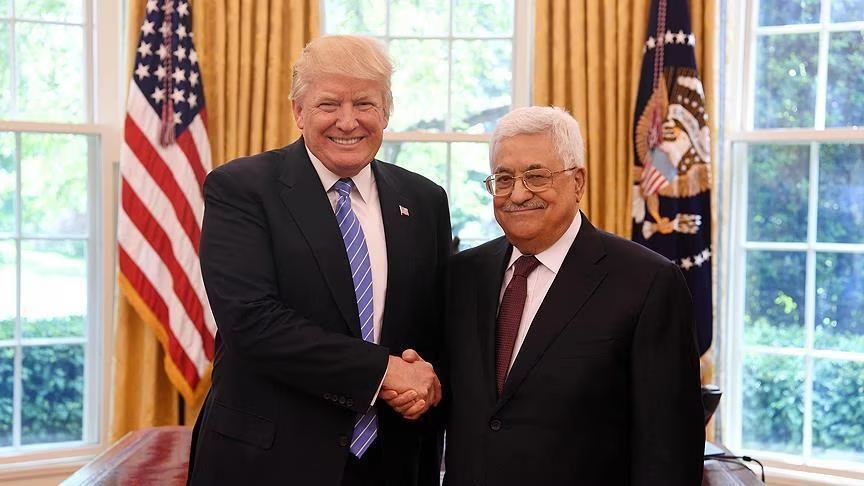
Political writer and analyst Akram Atallah believes that relations between the Palestinian National Authority and the United States began to witness renewed momentum since the Authority approved US President Donald Trump's plan to end the war in the Gaza Strip, which the American administration considered a positive political signal that opened the door for the restoration of some communication channels.

Atallah explains that one of the most prominent indicators of this rapprochement was President Trump's approval of Egyptian President Abdel Fattah El-Sisi's invitation to President Mahmoud Abbas to attend the Sharm El Sheikh summit months ago, which saw the announcement of the initiative in Trump's presence, noting that these developments constituted the beginning of a new relationship between the two sides.

Internal American Factors

Atallah points out that internal American factors, especially the need for electoral votes in the Republican Party's midterm elections, in addition to the role of the active Palestinian community in the United States, have contributed to bridging the views between Washington and the Palestinian Authority during the recent period.

Atallah notes that the divergence that prevailed in the relationship between Trump and Israeli Prime Minister Benjamin Netanyahu, following the repercussions of the war with Iran and the decline in its political results, may generate a new approach to the Palestinian issue in Washington, in addition to the increasing Arab role that pushes for reactivating the Authority's role, either through a previous Arab summit or by proposing reforms for the Authority and linking them to its return to administering the Gaza Strip.

Atallah indicates that these interactions may open the door for limited scenarios of change in American policy, especially given the growing conviction among regional and international parties that there is no practical alternative to the Palestinian Authority in managing the Gaza Strip, considering it the "lesser of evils" for the United States and its Arab partners.

Atallah believes that these developments do not mean significantly raising Palestinian expectations, but they may reflect the beginning of a gradual shift in some American policies, driven by the convergence of regional interests and changes in the internal political scene in Washington and Tel Aviv.

Not New Goals

Political writer and analyst Dr. Reham Owda believes that proposals regarding a potential role for the Palestinian Authority in the Gaza Strip after implementing internal reforms are not new, but rather are based on previous official conceptions within the framework of the "Peace Council," which was discussed as a transitional mechanism for managing the Strip during the next phase.

Owda explains that the Peace Council's envoy to Gaza, Mladenov, had stated on more than one occasion that the Council would eventually hand over the administration of the Strip to the Palestinian National Authority, provided it committed to a series of internal reforms including developing institutional performance and enhancing the effectiveness of security and administrative agencies.

Owda indicates that President Mahmoud Abbas's announcement of a date for legislative and presidential elections constituted a positive indicator in this context, reflecting the Authority's seriousness in moving towards political and democratic reforms, which contributed to opening the door for the American administration to re-evaluate the relationship with the Authority, in preparation for supporting and rehabilitating it to take over the administration of the Gaza Strip in the future.

Owda believes that there is no practical or realistic alternative to the Palestinian Authority for managing the Gaza Strip after the temporary role of the Peace Council ends, warning that its absence could lead to a political and security vacuum that opens the way for militia control, a scenario that none of the international or regional parties involved in the file desire.

Signing a Memorandum of Understanding with the Authority

According to Owda, the likely scenario is the signing of a memorandum of understanding between the Peace Council and the Palestinian Authority, outlining a roadmap for the stages of Gaza's administration, in parallel with the reopening of the Palestine Liberation Organization office in Washington, allowing the American administration to directly follow up on the file through diplomatic channels with the Authority's representative in the American capital.

The vision, according to Owda, also includes the introduction of international forces into what is known as the "Yellow Zone," and an attempt to push Hamas to surrender its weapons to a national committee, in addition to discussing mechanisms for transferring frozen Palestinian clearance funds to support the Peace Council's operations in Gaza, with a portion allocated to paying the salaries of Authority employees.

Possibility of Gradual Deployment of International Forces

In another scenario, Owda points to the possibility of a gradual deployment of international forces in the Gaza Strip with the activation of the Gaza management committee, until Palestinian elections are held, based on which the American administration will determine its future Palestinian partner, while the international envoy may maintain a coordinating relationship with the current Authority without reaching a final agreement before the elections.

Logical Trends

Political writer and analyst Mohammed Joudeh believes that dealing with what is being raised about the new American policy trends for positive engagement with the Palestinian Authority should not be limited to the accuracy of the information reported by "The Times of Israel," but rather to its consistency with the general course of American policy in the current phase, noting that these trends seem logical within the context of regional developments after the Gaza war.

Joudeh explains that the United States faces a central dilemma related to the absence of a Palestinian party capable of managing the "Day After" phase in Gaza, which pushes it to search for a reliable political and administrative partner.

At the same time, Joudeh believes that expanding the Abraham Accords normalization agreements requires keeping the Palestinian issue within political calculations, and not completely bypassing it in any new regional arrangements.

According to Joudeh, talking about strengthening the relationship with the Palestinian Authority does not necessarily reflect a radical shift in American policy or a trend towards a final settlement, but rather may be a functional tool to achieve two main goals: managing the situation in the Gaza Strip, and creating a regional environment that allows the continuation of the normalization process with Arab countries.

Joudeh indicates that strengthening the relationship does not necessarily mean recognizing a Palestinian state or launching a decisive political path, but rather often focuses on raising the level of political, security, and economic coordination, and rehabilitating the Authority to be an acceptable partner in any future regional and international arrangements.

Four Main Paths

Regarding potential scenarios, Joudeh proposes four main paths; the first is to provide greater political and financial support to the Authority and gradually integrate it into post-war arrangements in Gaza without a fundamental change in the structure of the conflict. The second, according to Joudeh, is to transform the Authority into a key party in managing Gaza in the future through new administrative formulas supported by Arabs, despite the obstacles it faces related to Palestinian legitimacy and the Israeli position.

The third scenario, according to Joudeh, is linked to an attempt to link the Arab normalization path with limited political steps for the benefit of Palestinians, in exchange for Israel making partial concessions, a path that remains subject to complex political balances, while he indicates that the fourth scenario is the failure of these trends due to Israeli or Palestinian rejection or due to field escalation that undermines any potential arrangements.

Joudeh believes that the core of the issue is not only about Washington's will, but also about the willingness of regional parties, including Israel, the Authority, factions, and Arab countries, to engage in an integrated political path, which is still undecided.

Not Surprising

Dr. Hussein Al-Deek, Professor of Political Science and specialist in American affairs and international relations, believes that what "The Times of Israel" reported, that the United States is considering strengthening its relations with the Palestinian Authority as part of its efforts to advance post-war arrangements in the Gaza Strip and expand regional normalization agreements, is not surprising.

Al-Deek explains that contacts between the Palestinian leadership and the United States have not been completely severed in recent years, despite political tension, decisions to stop aid, and the closure of official communication channels, pointing to continued contacts through the American embassy and repeated interventions in files related to Palestinian funds held by Israel, in addition to meetings between American officials and representatives of the Palestinian leadership.

Reopening Communication Channels

Al-Deek indicates that Washington, despite its previous policies towards the Palestinian Authority, has not found a political alternative to deal with, considering the Palestine Liberation Organization and the Palestinian National Authority as the legitimate representative of the Palestinian people, which pushes the American administration to reopen communication channels after realizing that any political or regional arrangements cannot be made in isolation from the official Palestinian side.

Al-Deek points out that the next phase may witness three main scenarios, the first of which is the gradual return of Palestinian-American relations in light of continuous Arab pressure on Washington to re-engage with the Palestinian Authority.

A Phase of De-escalation and Settlements

The second scenario, according to Al-Deek, is related to the region entering a phase of de-escalation and political settlements, which necessitates the presence of the Palestinian Authority in any new regional arrangements due to its relations with Arab and European countries, which may be reflected in a gradual political and diplomatic rapprochement with the American administration.

Al-Deek points to the third scenario, which is the continuation of the status quo without development in relations, but it remains a weak possibility, especially with the increasing divergences between American and Israeli positions on a number of regional issues.

Al-Deek explains that Israeli Prime Minister Benjamin Netanyahu has sought since his return to power in 2009 to achieve two main goals: confronting Iran and expanding the circle of normalization with Arab countries, especially Saudi Arabia.

Normalization and the Pledge to the Political Path of the Palestinian Issue

Al-Deek believes that any progress in the Saudi-Israeli normalization path will remain linked to the existence of a political horizon for the Palestinian issue and guarantees leading to the establishment of a Palestinian state, although the American administration has not yet put forward any clear initiative in this direction.

Regarding the future of the Gaza Strip, Al-Deek confirms that the United States has realized the limited options available for managing the Strip after the war, given the failure of previous initiatives and the lack of any real breakthrough.

Al-Deek points out that Washington sees only two options: the return of the Palestinian Authority to Gaza or the imposition of direct Israeli military rule, an option that Israel does not want to bear its political, economic, and security costs, which makes the return of the Palestinian Authority the most realistic option despite continued Israeli rejection of it.

Amendments to American Laws Related to Palestinians

Al-Deek touches upon a movement within the US Congress that includes amendments to draft laws that will be discussed in the coming period, including the reopening of the American consulate dedicated to Palestinians in Jerusalem, the resumption of funding for the United Nations Relief and Works Agency for Palestine Refugees (UNRWA), and the allocation of about $400 million for the reconstruction of Gaza, in addition to proposals to restore diplomatic relations with the Palestinian Authority. In contrast, Al-Deek points to counter-amendments pushed by supporters of Israel, including adopting the name "Judea and Samaria" instead of the West Bank.

Despite his belief that the chances of approving these proposals are still limited, Al-Deek considers that merely raising them reflects a renewed American movement towards the Palestinian issue and a possible repositioning in American policy during the next phase.

Difficulty of Implementing Any Plan Without Involving the Authority

Political writer, researcher, and international relations specialist Nu'man Tawfiq Al-Abed believes that the United States has realized the difficulty of implementing any political plan in the region without involving the Palestinian National Authority, as it is an internationally recognized entity that emerged as a result of political agreements, and enjoys recognition from a number of European countries, in addition to being an arm of the Palestine Liberation Organization.

Al-Abed explains that the absence of the Authority from any arrangements in the West Bank and Gaza Strip makes it difficult to achieve results that serve the American vision, including US President Donald Trump's plans or any future approaches related to the region, suggesting that there are ongoing dialogues between Washington and the Palestinian Authority, especially in light of the presence of active regional parties, led by Saudi Arabia, pushing for the Authority's involvement in any reform or political path.

He indicates that these contacts, if press reports about them are true, do not necessarily mean a fundamental political shift, but may be limited to specific economic and administrative files, noting that there is no official Palestinian or American confirmation yet about tangible results of these dialogues.

Al-Abed rules out the current American administration's ability to impose any real political path in light of the presence of Benjamin Netanyahu's government, which adopts hardline policies towards the West Bank and Gaza Strip, and faces internal pressures related to the upcoming Israeli elections, which makes making any political concessions extremely difficult.

Al-Abed points out that within the American administration itself there are multiple currents, some of which do not support the involvement of the Palestinian Authority in any future settlement, but rather adopt positions consistent with or more hardline than the Israeli vision, citing the statements of the American ambassador to Israel as an example of this trend.

Fears of Politically Exploiting These Contacts

Al-Abed warns of fears of attempting to politically exploit these contacts to show the existence of a negotiation path without actual results on the ground, which could be used to market normalization with Israel, considering that the Palestinian Authority should not fall into the "trap of political symbolism" without guaranteeing real results that serve the Palestinian cause.

Al-Abed believes that what is happening, if proven, does not go beyond limited management of the Palestinian reality through economic support and keeping the Authority in a state of "unstable political life," without any fundamental progress in the political path, in light of the continued Israeli rejection of any settlement, and the impossibility of making concessions under the internal electoral conditions in Israel.


OPINIONS

Sat 20 Jun 2026 10:04 am - Jerusalem Time

Patriarch Theophilos III Meets President Trump: Christian Jerusalem Knocks on the Doors of International Decision-Making at a Critical Historical Moment

Amidst the profound transformations witnessed by the Palestinian cause, and in light of the unprecedented political and religious challenges facing the city of Jerusalem, the meeting between His Beatitude Patriarch Theophilos III, Patriarch of Jerusalem and All Palestine and Jordan of the Greek Orthodox, and US President Donald Trump stands out as an event that transcends the boundaries of diplomatic protocol and traditional official meetings. It carries political, national, and humanitarian messages of exceptional importance, especially at this delicate stage where Christian and Islamic holy sites in Jerusalem are subjected to increasing pressures and continuous attempts to change the city's character and historical identity.

The importance of this meeting stems not only from the stature of the two personalities who met, but also from the nature of the issues discussed, and the regional and international circumstances under which it took place. Jerusalem today stands at a historical crossroads, while the Palestinian Christian presence faces accumulating challenges that threaten its continuity and historical role in the Holy Land. This makes any international move aimed at shedding light on this issue a crucial step that deserves attention and analysis of its political and strategic dimensions.

Patriarch Theophilos III carried to the White House the message of Christian Jerusalem with all its spiritual, national, and historical meanings. The man who leads one of the oldest churches in the world did not go merely as a representative of a religious denomination, but as a guardian of a universal Christian heritage rooted in Jerusalem for two thousand years, and a witness to the transformations taking place in the Holy City and the accompanying challenges affecting the future of the Palestinian and Arab Christian presence in the cradle of the Christian message.

In this context, the meeting represents a serious attempt to convey the reality on the ground to American decision-making circles, especially in light of the increasing pressures on churches and Christian endowments, and the political, economic, and security conditions faced by Palestinian Christians, which are driving increasing numbers of them to emigrate, threatening the erosion of one of the most important components of Palestine's historical and cultural identity.

The message carried by the Patriarch to the American administration goes beyond defending the rights of Christians alone, to affirm that targeting the Christian presence in Jerusalem and Palestine is a targeting of the religious and cultural pluralism that has formed the essence of this Holy Land throughout the centuries. Jerusalem has never been a city for followers of one religion or one culture, but rather a unique model of diversity and coexistence, which makes preserving all its components an international responsibility that transcends narrow political calculations.

This meeting gains additional importance in light of the United States' position in the international system and its direct influence on the course of the Palestinian-Israeli conflict. Regardless of the differing positions and assessments regarding American policies, Washington remains a key player capable of influencing many issues related to the future of Jerusalem and its religious holy sites. Hence, addressing the American President directly reflects a deep understanding of the importance of conveying the Palestinian Christian voice to the highest levels of international decision-making.

This meeting also reflects the continued political and national presence of the Jerusalem Orthodox Church in defending Jerusalem and its historical identity. The Church has never been a spiritual institution isolated from its national surroundings, but has played a pivotal role in protecting the Arab identity of the Holy City and in defending the rights of its people of various religious and national affiliations.

When discussing the implications of this meeting, it is necessary to pause at the historical role played by Patriarch Theophilos III over the past years in protecting Christian holy sites and endowments from various forms of targeting and Judaization. Since assuming the patriarchal throne, he has placed the issue of preserving church properties and endowments at the forefront of his priorities, realizing that Christian endowment is not just a property or a financial asset, but part of the historical memory and civilizational presence of Arab Christianity in Jerusalem and Palestine.

The Patriarch has fought complex legal and political battles in defense of the Church's rights, and faced immense pressures to preserve its historical properties. In all those stages, his position was based on a firm conviction that compromising Christian endowments or allowing them to be harmed constitutes a direct threat to the future of the Christian presence in the Holy Land.

Perhaps one of the most prominent aspects that gives this visit a special dimension is that it comes at a time when fears are escalating about attempts to impose new realities on the ground in Jerusalem, whether through restricting religious institutions, or through policies aimed at changing the historical character of some neighborhoods and holy sites. Hence, raising these issues before the American President carries a clear message that the protection of Christian holy sites is not merely an ecclesiastical demand, but an issue related to the protection of global human heritage.

The meeting also sends a message to the international community that Palestinian Christians are not an immigrant community or a temporary minority in this land, but rather original sons of Palestine, and an integral part of its national and historical fabric. From this land, Christianity spread to the world, and on this land, the oldest Christian communities continue to maintain their existence despite all challenges and difficulties.

From a political perspective, this visit can be seen as an attempt to re-highlight an issue that has often been marginalized amidst the major conflicts in the region. The world follows successive wars and crises, but the suffering of Palestinian Christians and the challenges facing their historical existence do not always receive the attention they deserve. Therefore, bringing this issue to the highest international political levels represents an important step in the path of defending the historical and religious rights of the Palestinian people with all their components.

It is no secret that Patriarch Theophilos III's international standing gives him a special ability to convey these messages. He is not just a religious leader, but a personality widely respected in international ecclesiastical and political circles, which makes his positions and actions an influential factor in shaping global public opinion on the issues of Jerusalem and its holy sites.

What also distinguishes this visit is that it is an extension of a consistent approach adopted by the Patriarch throughout his years of service, based on openness to various capitals and international decision-making centers in order to defend Jerusalem, its people, and its holy sites. The man realizes that the battle to preserve the city's historical identity cannot be fought only at the local level, but requires an active presence in all international arenas.

Hence, his meeting with the American President carries a strategic dimension that transcends the present moment, as it seeks to build international awareness of the importance of protecting the Palestinian Christian presence and preserving the holy places from any attempts aimed at changing their identity or their historical and legal status. It also reflects the determination of the Jerusalem Church to remain present in international discussions related to the future of Jerusalem and its spiritual and humanitarian status.

In conclusion, this meeting constitutes an important milestone in the efforts to defend Jerusalem and its holy sites, and confirms that the Jerusalem Orthodox Church continues to play its historical role in protecting the Christian heritage, preserving endowments and holy sites, and defending the Palestinian Christian presence in the land of their fathers and ancestors.

Through this meeting, Patriarch Theophilos III wanted to remind the world of a fundamental truth often lost amidst the clamor of politics and conflicts, which is that Jerusalem is not just a negotiating file or a title for a political dispute, but a holy city that carries a spiritual and humanitarian heritage belonging to all humanity. He also wanted to affirm that Palestinian Christians remain in their land, adhering to their rights, identity, and historical message, and that the Church will remain, as it has been for centuries, a guardian of holy sites and endowments, and a defender of justice, peace, and human dignity.

In a time when attempts to obscure facts and change landmarks are multiplying, the voice of Jerusalem emanating from its ancient patriarchate remains a testament that identity cannot be erased, and that holy sites are not just stones and buildings, but the memory of a people, the history of a nation, and a civilizational message that will remain alive as long as believers in the values of justice, freedom, and peace endure.

ARAB AND WORLD

Sat 20 Jun 2026 10:03 am - Jerusalem Time

A Reading of the US-Iranian Agreement: Temporary De-escalation or Forced Concessions?

The revelation of the terms of the recent US-Iranian agreement sparked a wide wave of conflicting interpretations. Parties affiliated with Tehran rushed to promote a narrative of victory, while opposing voices in Washington considered that President Trump's administration made concessions disproportionate to the military superiority on the ground. This division reflects a state of political polarization that extends beyond the text of the agreement to the ideological aspirations of each party.

Domestically in Iran, a message attributed to Supreme Leader Mojtaba Khamenei revealed a clear divergence of views within the hierarchy of power, with the Leader distancing himself from the direct outcomes of the agreement. Khamenei clarified that he authorized the step based on President Masoud Pezeshkian's full assumption of responsibility as head of the Supreme National Security Council, reflecting the supreme leadership's desire to disclaim any negative repercussions in the future.

Opposition was not limited to the supreme leadership but extended to the corridors of the Iranian parliament, where hardline deputies described the agreement as a state of national 'humiliation'. The deputy head of the National Security Committee warned that the conditions contained might turn the country into something akin to an 'American colony', accusing the negotiating team of crossing red lines and ignoring sovereign directives.

On the other hand, Israel appears cautious in its handling of this diplomatic path, with its leaders affirming that they are not bound by this agreement. Israeli sources emphasize that the army will not withdraw from the positions it controlled in southern Lebanon, but will use the period of calm to reorganize its ranks and prepare plans for unprecedented military strikes against Iranian facilities in the event of a breach of the de-escalation.

Observers believe that placing the agreement in its proper context requires defining it as a narrow framework aimed at establishing a ceasefire according to written and temporary controls. Despite some limited incentives and gains for the Iranian side, they remain very small when compared to the enormous destruction and economic losses Tehran has incurred during the past period.

The gains Iran has achieved are described as 'near zero' given the disruption of the economic lifeline due to the American naval blockade. The recent experience has proven the effectiveness of the cordon imposed on the Strait of Hormuz, which caused Tehran to lose approximately half a billion dollars daily, putting the regime in a very difficult negotiating position.

Phase two of the negotiations represents the real test of the parties' intentions, during which the possibility of reaching a final and comprehensive agreement or returning to escalation will be decided. Concerns remain that this transitional period may merely be an opportunity for Washington and Tel Aviv to rearrange logistical papers and secure the requirements for any upcoming military confrontation.

One cannot overlook the personality of US President Donald Trump in this equation, as he has a history of sudden withdrawal from international agreements if he senses any procrastination. This possibility places the Iranian side under constant pressure to meticulously implement commitments, fearing a return to the 'maximum pressure' policy, which this time could be more devastating to the exhausted economy.

Reports indicate that the naval blockade tested by the United States has proven its ability to completely paralyze Iranian exports and imports. Should military operations resume, Washington will be in a position to implement this blockade more effectively, reducing the maneuvering options available to decision-makers in Tehran.

Internally, the agreement faces challenges from active parties in both countries who do not wish to see any diplomatic rapprochement, as these forces believe their interests are linked to the continuation of the conflict. These affected parties may actively seek to derail the transitional agreement during the specified sixty-day period, putting the entire diplomatic process on a knife-edge.

The conflicting interpretations of 'victory and defeat' reflect each party's desire to market the agreement to its domestic audience as a political achievement. However, the reality indicates that the agreement is merely a mechanism to establish a ceasefire and avoid total collapse, not a final settlement that ends the long-standing hostility between the two parties.

It appears that Iranian President Masoud Pezeshkian has put his political future at stake by accepting responsibility for this path, especially given the continued field operations by the Revolutionary Guard, which sometimes contradict official discourse. This conflict of authorities weakens the credibility of Iranian commitments before the international community and increases the American administration's suspicions.

Ultimately, the current US-Iranian agreement remains a 'necessity agreement' imposed by harsh economic and field conditions, awaiting the outcome of the next phase of negotiations. The question remains as to the extent of the parties' ability to withstand internal pressures and sudden shifts in US foreign policy before the specified deadline expires.

In conclusion, the coming days will reveal whether this agreement is a bridge towards new regional stability or merely a short warrior's rest before a larger storm. Current data indicate that all parties are preparing for the worst-case scenarios even as they sit at the negotiating table, making lasting peace a distant goal for now.

In principle, I had a different opinion, but in light of the President's commitment as head of the Supreme National Security Council, I authorized the agreement.

OPINIONS

Sat 20 Jun 2026 10:03 am - Jerusalem Time

Controversy over US Ambassador Huckabee's statements regarding the 'Jewish foundation' of the United States

Recent statements by the US Ambassador to Israel, Mike Huckabee, have sparked widespread controversy in political and media circles, after he publicly declared that America's existence is fundamentally indebted to Jewish roots. These words brought back old discussions about the extent of Zionist influence on decision-making centers in the United States and the direction of its foreign policies.

Despite the shock these statements caused among segments of the public and American historians who considered them an insult to national identity, the American administration did not take any diplomatic action against the ambassador. No decision was issued to dismiss him or even summon him for reprimand, which reinforced the belief that this view represents a deep current within the current ruling establishment.

Observers believe that the relationship between Washington and Tel Aviv, during President Donald Trump's era, transcended the traditional framework of alliance to become an absolute organic partnership. It appeared that the presidential agenda was primarily focused on protecting and expanding the influence of the Israeli entity in the region, even if it was at the expense of traditional American interests or relations with historical allies.

The stark contradiction appears in the American leadership's dealings with international powers, where the President does not hesitate to direct sharp criticism at leaders of major European countries such as France and Spain. In contrast, there is complete silence regarding any transgressions or insults issued by Zionist officials, or even by American diplomats who show loyalty to Tel Aviv that exceeds their loyalty to their home country.

Ambassador Mike Huckabee is known for his strong enthusiasm for the 'Greater Israel' project, which was evident in his previous answers about the possibility of swallowing up lands from neighboring Arab countries. Huckabee considered Israeli expansion from the Nile to the Euphrates to be a 'biblical right,' emphasizing that he had no objection to seizing the lands of eight Arab countries to achieve this plan.

These public stances reveal an 'existential secret' linking American power and the Zionist project, which was clearly manifested during recent wars and crises in the Middle East. It seems that Ambassador Huckabee deliberately revealed the threads of this complex relationship, which has long been the subject of speculation and lengthy political and historical analyses.

Ultimately, the question remains before the American public about the motives that lead their leadership to dedicate state resources to serve another entity in a way that raises suspicion. While the political debate continues, the field is left open for historians and researchers to unravel these deep ties that have come to shape the features of the new international order and the balance of power in the Arab region.

Without a Jewish foundation, America would not exist!

PALESTINE

Sat 20 Jun 2026 10:03 am - Jerusalem Time

US Intelligence Warnings: Netanyahu May Obstruct Iran Deal Through Escalation in Lebanon

International press reports, citing US intelligence agencies, stated that the administration of President Donald Trump received serious warnings regarding the actions of Israeli Prime Minister Benjamin Netanyahu. The intelligence report indicated that Netanyahu might take escalatory steps on the Lebanese front, primarily aimed at obstructing a lasting peace agreement with Iran, amidst the complexities of the internal political scene in Israel.
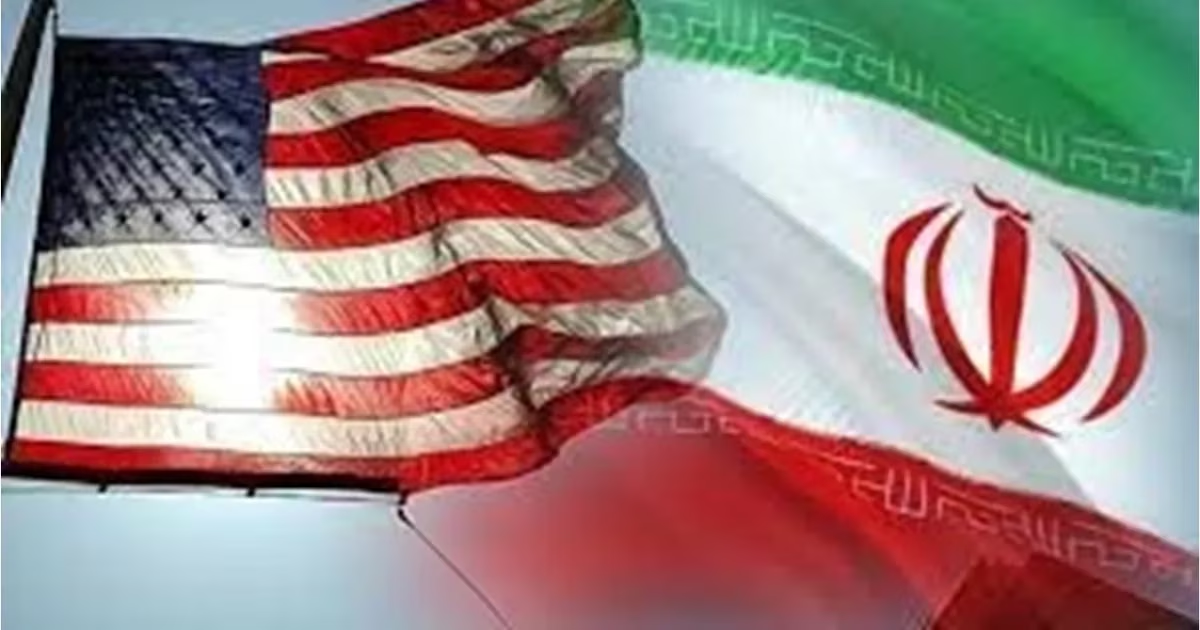
The American report links the continuation of military operations in Lebanon to Netanyahu's political future, especially with the upcoming national elections scheduled for next fall. American analysts believe that the Israeli Prime Minister fears that any withdrawal or de-escalation might be interpreted by his right-wing public as a personal defeat, pushing him towards the option of military escalation against Hezbollah to bolster his electoral position.
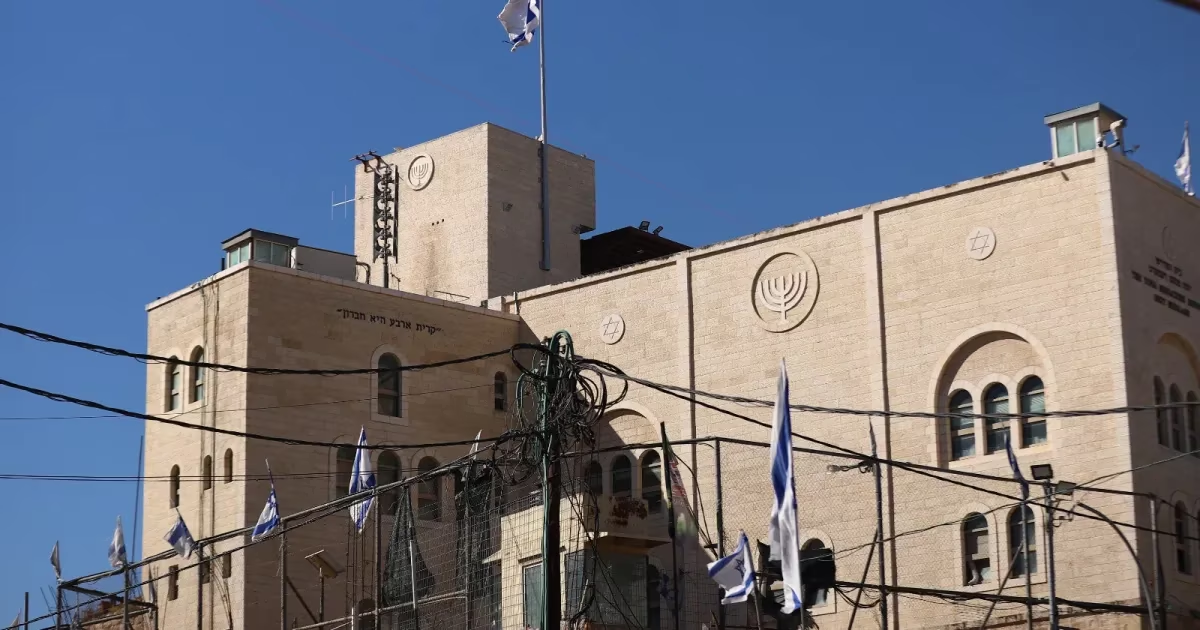
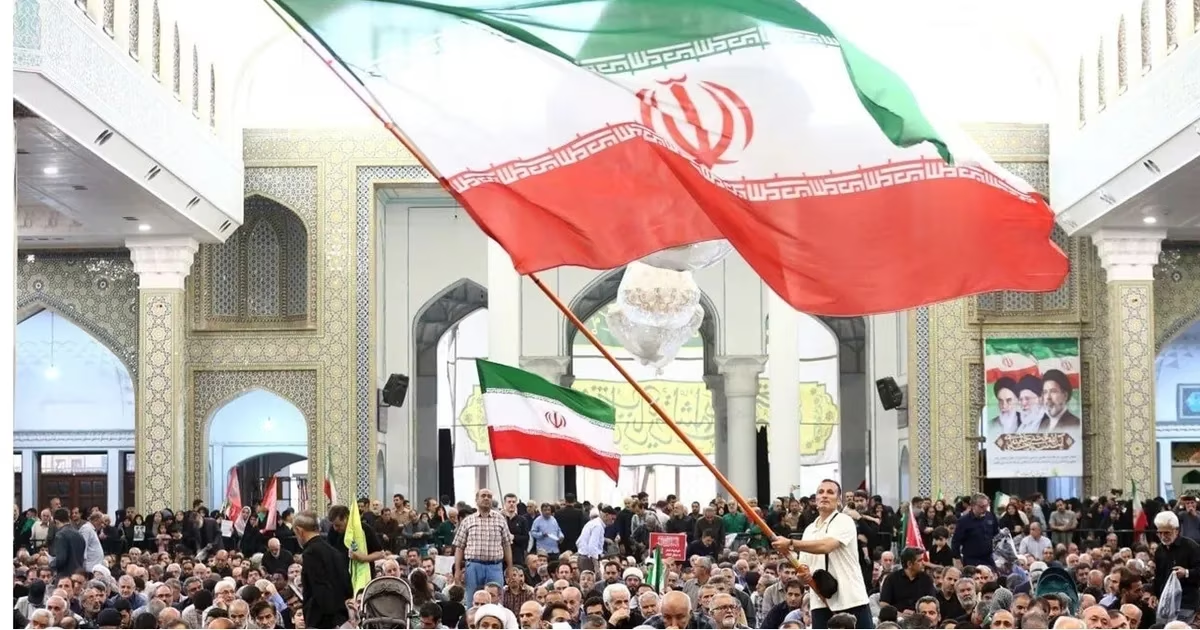
For its part, informed sources in the Trump administration confirmed that Washington's top priority currently is to finalize the agreement with Tehran and ensure the reopening of the Strait of Hormuz to avoid a global economic crisis that could sweep international markets. Although the US administration affirmed that the terms of the agreement guarantee Israel's right to defend itself and respond to any fire from Lebanon, it believes that Netanyahu's political ambitions should not hinder global economic stability.

In a related context, Tehran announced the postponement of the round of talks scheduled in Switzerland, in response to what it described as the bloody Israeli escalation in Lebanese territories. This diplomatic setback comes at a time when the West Bank is witnessing a parallel escalation, as Israeli Finance Minister Bezalel Smotrich proceeded to withdraw planning and construction powers from the Hebron municipality, in a move aimed at expanding settlements in the heart of the historic city.

These developments coincide with severe military restrictions in the city of Hebron, where the occupation authorities began expanding the 'Shavei Hebron' Talmudic school, built inside the confiscated Osama bin Munqidh school. These measures, along with the imposed military siege, have led to a sharp decline in the number of worshippers at the Ibrahimi Mosque by up to 80%, amidst Palestinian demands for the return of international monitoring to protect residents from increasing settler attacks.

Netanyahu's political survival is linked to showing his domestic audience that he will not withdraw Israeli forces from Lebanon.

PALESTINE

Sat 20 Jun 2026 10:03 am - Jerusalem Time

Life on the Brink of Thirst: How Gaza Families Cope with 70 Liters of Water Per Week?

The moment the water truck arrives at the displacement camps in the Gaza Strip, it transforms into a bustling beehive of activity and anticipation, as children and women rush to secure their meager shares. In this exhausted geographical area, the water tanker has become a sacred weekly appointment around which all details of daily life, from cooking and cleaning to bathing, are rescheduled.

As the summer heat intensifies, calculations within a single tent become more complex and precise, as families must manage very limited quantities of water. The displaced carefully monitor the distribution process, for every drop has its price, and any miscalculation could mean deprivation of basic needs until the next truck arrives.

Nine-year-old Kanan represents one face of this suffering, as he jostles with his frail body to get his family's share, consisting of 11 members. Kanan's family was displaced from Beit Hanoun city and relies entirely on this weekly shipment to manage their harsh lives under displacement conditions.

Kanan's tragedy is compounded by his neurological illness and injuries from a previous bombing, making his need for clean water to take medicine a top priority. His mother, Ni'ma, is forced to make difficult trade-offs, cutting from washing and cooking allocations to ensure enough water for her sick son, who lacks specialized treatment.

Inside the tent, black jerry cans and barrels appear as strategic life stores, with each container allocated for a specific, pre-determined purpose. Local sources say that families devise precise plans to divide the eight water containers they receive, covering drinking, cooking, and personal hygiene for seven full days.

In another tent, Alaa Al-Qabaj's family lives a similar experience, where water containers become a timeline for a full week of resilience. His wife, Farah, distributes water with extreme precision, allocating some for drinking and others for cooking, while the little remaining goes to washing children and accumulated dishes.

Upon the tanker's arrival, the place turns into a race against time, as everyone strives to fill their containers before the truck leaves. The displaced describe these minutes as part of the daily battle for survival, where father, mother, and children participate in transporting and carefully storing water within the narrow corners of their tent.

Once the filling process is complete, Farah begins to tackle postponed tasks, lighting the fire to cook food and washing the dishes that have waited for a long time. In these moments, the extent of the burdens imposed by the absence of water becomes clear, as bathing or washing clothes becomes a dream that only comes true once a week.

Near these tents, the suffering of Hajja Fathiya Hamad stands out. She lost her husband, sons, and daughters' husbands during the ongoing war. Fathiya lives with her three daughters and grandchildren in a tent lacking a provider, placing the entire burden of securing water and firewood on the women.

Fathiya's daughters move with great speed when the water truck arrives, carrying heavy jerry cans that press on their exhausted necks and shoulders. The absence of men is most evident in these moments, as women are forced to perform arduous tasks requiring significant physical effort to transport water from the tanker to the tent.

Yasmin, one of Fathiya's daughters, says that life has completely changed after losing their support, as they are now forced to run after water trucks and collect firewood. Yasmin's words express a bitter reality lived by thousands of women in Gaza, who find themselves in direct confrontation with the harsh demands of living.

The suffering is not limited to transporting water but extends to physical pain resulting from carrying heavy loads over long distances between tents. Suha, Yasmin's sister, confirms that back and neck pain has become an integral part of her day, but she is forced to continue working to meet the needs of her sister's children and elderly mother.

Mariam, the third daughter, experiences a double burden as she tries to balance the needs of her four children with the limited water supply. Motherhood enters into complex calculations; every drop of water consumed must be in its right place to ensure the continuation of life inside the tent until the next appointment.

The seventy liters that families receive are not just a quantity of liquid but a daily test of human resilience and resourcefulness. In the displacement tents, water remains the lifeblood of movement and activity, and without it, life stops, and pains accumulate, awaiting a tanker that may come or be delayed.

We reduce water for cooking and washing, and save it for my sick child's medicine above all else.

OPINIONS

Sat 20 Jun 2026 9:50 am - Jerusalem Time

Netanyahu’s Last Gamble: The Serial Saboteur of Middle East Peace


By: Said Arikat


June 20, 2026


News analysis


Washington, D.C- The ceasefire announced between Israel and Hezbollah may have temporarily lowered the temperature along the Lebanese border, but it has done little to obscure the larger political reality emerging from the historic U.S.-Iran agreement signed on June 17, 2026.


At the center of that reality stands Benjamin Netanyahu—not merely as an opponent of the agreement, but as the latest and perhaps most consequential obstacle in a decades-long pattern of resistance to diplomacy across the Middle East.


The debate surrounding the U.S.-Iran accord is often framed as a disagreement over security policy. In reality, it is something far more fundamental. It is a confrontation between two competing visions of regional order: one built around negotiated accommodation and de-escalation, the other around perpetual confrontation and managed instability. For more than three decades, Netanyahu has been the foremost political champion of the latter.


His record is neither ambiguous nor episodic. From the Oslo process in the 1990s to repeated ceasefire arrangements in Gaza, from negotiations over Palestinian statehood to diplomatic openings with Iran and efforts to stabilize Lebanon, Netanyahu has repeatedly positioned himself against initiatives that sought to replace military confrontation with political compromise. The particulars have varied, but the pattern has remained remarkably consistent: whenever diplomacy threatens to alter the strategic landscape, Netanyahu emerges as one of its most determined adversaries.


That history matters because the war in Lebanon cannot be understood in isolation from it.


As negotiations between Washington and Tehran approached their final stages, Israel expanded military operations in Lebanon, deepened its occupation of Lebanese territory, and intensified warnings about a broader regional confrontation. These actions did not occur in a vacuum. They unfolded precisely when diplomacy was gaining momentum and when the prospect of a transformative U.S.-Iran agreement was becoming increasingly likely.


The result was predictable. Military escalation created political pressure on Washington, heightened regional tensions, and introduced uncertainty into a diplomatic process Netanyahu had opposed from the beginning. Whether viewed through the lens of timing, strategic consequence, or political benefit, the Lebanon campaign functioned as an instrument for complicating and potentially undermining the emerging agreement.


This is not an isolated episode. It is the continuation of a familiar strategy.


Netanyahu’s political career has been built on the premise that the Middle East is ultimately resistant to political solutions and that security can only be achieved through overwhelming force and permanent vigilance. That worldview has not merely informed Israeli policy; it has shaped the political environment that sustains Netanyahu himself. Diplomacy presents a challenge to that framework because successful negotiations inevitably weaken the sense of permanent crisis upon which it depends.


The 2015 nuclear agreement with Iran offers perhaps the clearest precedent. Netanyahu did not simply criticize the accord. He mounted an extraordinary campaign against it, openly lobbying the United States Congress and directly confronting President Barack Obama in an effort to prevent its implementation. Few foreign leaders have gone to such lengths to undermine the foreign policy of a sitting American administration. Yet Netanyahu regarded the agreement as such a threat to his strategic vision that extraordinary measures became politically acceptable.


The current U.S.-Iran agreement presents an even greater challenge. Unlike the 2015 accord, which focused primarily on Iran’s nuclear program, the June 17 agreement seeks to establish a broader framework for reducing regional tensions and managing long-standing disputes between Washington and Tehran. Its success would undermine the central argument that has animated Netanyahu’s regional agenda for decades: that conflict with Iran is both inevitable and permanent.


This helps explain the intensity of his opposition.


A successful American-Iranian rapprochement would reorder regional priorities. It would shift diplomatic attention away from military confrontation and toward negotiated arrangements. It would reduce the political utility of constant warnings about imminent regional catastrophe. Most importantly, it would weaken the argument that Israel’s security requires the perpetual maintenance of regional crises.


For Netanyahu, this is not simply a policy disagreement. It is a challenge to the political architecture upon which much of his career has been constructed.


His critics therefore argue that Netanyahu should not be viewed merely as a skeptic of peace initiatives. He should be understood as a recurring and consequential saboteur of them. The historical record provides substantial support for that assessment. The erosion of the Oslo process, the repeated collapse of ceasefires in Gaza, the expansion of settlement activity in the occupied West Bank, the recurring destabilization of Lebanon, and the sustained campaign against diplomatic engagement with Iran all point in the same direction. Time and again, opportunities for political accommodation have collided with a leadership that derives strategic and political advantage from their failure.


The consequences extend far beyond Israel itself.


Every failed ceasefire, every abandoned negotiation, and every diplomatic collapse increases the likelihood that the United States will once again be drawn into regional crises not of its own making. The pattern has become familiar: diplomacy advances, tensions rise, military escalation follows, and Washington finds itself managing another emergency that diverts attention from long-term solutions.


That is why the central question facing the Trump administration is not whether Iran will comply with the agreement. It is whether Washington is prepared to protect the agreement from those who have a vested interest in its failure.


History suggests that diplomatic breakthroughs in the Middle East often collapse not because they are impossible, but because powerful actors work relentlessly to ensure that they do. Netanyahu’s career offers one of the clearest examples of this phenomenon. He has not merely opposed individual agreements; he has consistently challenged the very notion that diplomacy should replace confrontation as the organizing principle of regional politics.


The ceasefire in Lebanon may hold or it may fail. The U.S.-Iran agreement may ultimately succeed or collapse. But one conclusion is already difficult to escape: if the agreement falters, it will not be because the forces opposing diplomacy were hidden from view. They have been visible for decades.


Benjamin Netanyahu has spent much of his political life warning that peace is dangerous, compromise is naïve, and conflict is unavoidable. The tragedy of the modern Middle East is that his efforts to make those warnings self-fulfilling have too often succeeded.

ANALYSIS

Fri 19 Jun 2026 2:27 pm - Jerusalem Time

The Labor Pains of the New Middle East: Has the Era of American Hegemony Ended?

The Middle East is witnessing major geopolitical transformations indicating the decline of the era of unipolar American hegemony, which experts attribute to internal exhaustion and the structural collapse of a political structure founded on coercion rather than popular consent. Observers believe that Washington did not achieve true hegemony, but rather maintained control lacking popular legitimacy, which made it primarily rely on authoritarian regimes to secure its interests.

The regional order that formed after the 1991 Gulf War and the Madrid Conference began to systematically unravel, after the falsity of its foundations was proven. That system was based on absolute military superiority and the claim of a peace process, while the reality was the engineering of a security protectorate that ensured the flow of energy and marginalized legitimate Palestinian rights.

The peace process worked for decades as a diplomatic umbrella that granted the United States legitimacy for its military presence, while enabling Israel to consolidate its occupation of Palestinian territories. Over time, it became clear that overwhelming military force cannot be a substitute for a just political horizon, making the collapse of this system a historical inevitability.

The Abraham Accords in 2020 represented the last attempt to repair this crumbling structure by building a security alliance that explicitly bypassed the Palestinian issue. However, this gamble proved to be a failure because it ignored demographic and historical realities, making the resulting system fragile and vulnerable to violent shocks that were not long in appearing.

Data from the Arab Opinion Index consistently indicates that Arab peoples view American and Israeli policies as the greatest existential threat to their national security. This stark contradiction between the aspirations of the peoples and Washington's strategic necessities pushed the latter to support dictatorships and suppress any democratic transformation that might threaten its vital interests in the region.

The events in Gaza in 2023 are the final catalyst that exposed the moral bankruptcy of the US-led international system, as Washington transformed from a mediator to a direct partner in violence. The unlimited military and diplomatic support for military operations shattered the mental image of Western leadership and ended what remained of its soft power in the region.

In the context of hypothetical military confrontations in 2026, it became clear that the American security umbrella is no longer able to protect its allies from asymmetric attacks. Strikes targeting vital energy facilities in the Gulf undermined the region's image as a safe haven for global capital and revealed the inability of advanced defense systems against cheap technologies.

Regional powers have realized that absolute reliance on Washington is no longer sufficient to ensure survival in an explosive and unstable security environment. This realization has prompted countries like Saudi Arabia and the UAE to seek alternative strategic options, invest in local defense industries, and build diverse partnerships with emerging international powers.

Today, features of a new security system characterized by 'differentiated hegemony' are emerging, where Washington retains military deterrence but loses political monopoly and the ability to reassure. In this vacuum, major regional powers such as Turkey, Egypt, and Pakistan seek to coordinate their positions to manage crises from within the region, away from external dictates.

The escalating Pakistani role as a security guarantor and diplomatic mediator embodies the ongoing restructuring of the balance of power, where geopolitics intertwines to include new actors. Moreover, the Gulf states' shift towards multiple alliances reflects a genuine desire to transform from a consumer of security to a producer of it, serving their national interests first.

On the international level, China and Russia are exploiting American strategic mistakes to strengthen their economic and political influence in the Middle East. Beijing, in particular, offers a model of partnership based on mutual interests without imposing burdensome political or security conditions, making it an attractive alternative for many countries in the region.

The 'BRICS' group and technological cooperation with Asian powers have become vital tools for Middle Eastern countries to hedge against American sanctions and demands. This shift towards the East is not just a change in trade, but a comprehensive strategic repositioning in a world where unipolarity is no longer the dominant force.

The dawn of the post-American era does not necessarily mean immediate stability, but rather an era characterized by turmoil and fierce competition among multiple poles. In this complex landscape, regional actors must constantly negotiate to secure their existence, relying on fluctuating power balances and flexible alliances that transcend old colonial legacies.

In conclusion, it can be said that the era of imperial dictates has ended in favor of an organic regional reality, even if it is forming amidst the pains of conflicts and wars. The new Middle East is redefining itself based on its self-capabilities and the multiplicity of its international options, away from the hegemony that lasted for decades under the crumbling American umbrella.

True hegemony requires ideological consensus and normative agreement, while Washington exercised its control through coercion and structural violence.

PALESTINE

Fri 19 Jun 2026 2:27 pm - Jerusalem Time

Arrival of the first contingents of the "International Stability Force" begins, in preparation for their deployment in the Gaza Strip

Hebrew media sources reported today, Friday, the beginning of the arrival of the first contingents of the "International Stability Force" to the occupied territories, as part of the final arrangements for their deployment within the Gaza Strip in the near future. This force is a fundamental pillar among four entities identified by US President Donald Trump's plan to end military operations in the Strip.

The deployment of these forces is based on international legal cover, as the United Nations Security Council adopted this step under Resolution No. 2803 issued in November of last year. The plan aims to create a sustainable security formula that ensures a permanent ceasefire and manages the transitional phase in Gaza.

"Yedioth Ahronoth" newspaper quoted a senior official in the so-called "Peace Council" concerned with managing the affairs of the Strip, stating that the forces have actually begun to arrive to prepare for their field missions. The official affirmed that coordination is taking place at the highest levels to ensure the smooth deployment process and to identify vital concentration points.

In the context of logistical preparations, sources revealed the commencement of construction of a massive technical and logistical support center near the Kerem Shalom crossing from the occupation side. This center will serve as a main station for receiving soldiers, military, and technical equipment coming from participating countries before their transfer into the Strip's borders.

Thousands of international soldiers are scheduled to undertake sensitive tasks, most notably forming a security buffer separating the positions of the Israeli occupation army and the areas whose administration will be transferred to the Palestinian Committee. These forces will be responsible for ensuring that no armed clashes occur during the gradual withdrawal phases.

Reports indicate that officers from four countries, namely Kosovo, Morocco, Kazakhstan, and Albania, have already arrived to begin initial coordination tasks. In contrast, Indonesia decided to temporarily freeze its participation in the international force after it was among the list of candidates to send military reinforcements.

The commander of the international force, Jasper Jeffers, had previously stated that five countries had formally committed to participating in securing the Strip. He also pointed out the pivotal regional role of both Jordan and Egypt, as they will undertake the task of training and qualifying Palestinian police elements who will work alongside the international forces.

The tasks of the "Stability Force" include dismantling the military infrastructure of armed factions and ensuring complete disarmament in vital areas. The force will also work to protect civilians and secure the flow of humanitarian aid through safe corridors that will be established under international agreements.

Administratively, the force will monitor compliance with the ceasefire provisions and submit periodic reports to the Peace Council and donor entities. The continued operation of these forces depends on direct international funding pledged by several countries to support the stability of the region and rebuild what the war destroyed.

These field developments come within the second phase of the comprehensive political vision, which ultimately aims to achieve a complete Israeli withdrawal from city centers. The coming weeks are expected to see an intensification in the arrival of foreign forces as the logistical bases at the borders are fully prepared.

A logistical support center is currently being established on the Israeli side of the Kerem Shalom crossing, to serve as a reception and transit point for the international forces expected to arrive successively.

ARAB AND WORLD

Fri 19 Jun 2026 2:27 pm - Jerusalem Time

Iran adheres to 'red lines' and threatens military response amid stalled Switzerland talks

The chief Iranian negotiator and Speaker of the Parliament, Mohammad Bagher Ghalibaf, stressed that any negotiation path with the United States of America will remain governed by the constants and red lines set by the leadership in Tehran. Ghalibaf clarified that his country will not compromise on achieving the interests of the Iranian people, affirming that the armed forces are in a state of constant alert to respond to any attempt to cross sovereign borders.

In a related context, Swiss authorities announced the cancellation of the talks session scheduled for Friday between the American and Iranian delegations, which was hoped to discuss mechanisms for ending the ongoing conflict in the region. This cancellation came after a sudden decision by US Vice President, J.D. Vance, to apologize for traveling to Switzerland, adding more ambiguity about the future of de-escalation.

For its part, the White House issued a brief statement indicating that the logistical arrangements related to these negotiations were complex and unpredictable. Although the American delegation was supposed to head to the Bürgenstock mountain resort to finalize the arrangements, the Swiss Foreign Ministry confirmed the postponement of the meeting while preparatory work continues.

These developments come after Tehran showed flexibility regarding the initiation of technical talks based on a 14-point framework agreement, primarily aimed at extending the ceasefire for at least two months. However, there is still a gap in views on the necessity of holding official signing ceremonies, as the Iranian Foreign Ministry believes that the signature of former presidents is sufficient to implement the provisions.

On the ground, the repercussions of the war that erupted on February 28 continue to cast a shadow over the scene, with air attacks causing the deaths of nearly 7,000 people. These confrontations have led to severe disruptions in global energy markets, pushing prices to record levels that have raised international community concerns.

In a comment on the American position, Iranian Supreme Leader Mojtaba Khamenei considered that President Donald Trump's signing of the agreement was a result of despair and political necessity. Khamenei warned that negotiations on the nuclear program would not be easy, stressing that Iran would not accept any exaggerated demands or additional pressure from the American side.

According to informed sources, political attention in Tehran has begun to shift significantly towards military escalation in southern Lebanon, where developments there now dominate official discussions. The circulating information suggests that the cancellation of the Switzerland meeting may be closely linked to the worsening situation on the Lebanese front, despite the absence of official confirmations of this link.

The Iranian National Security Council affirmed in a statement that it will continue to work to protect the state's rights and support the resistance front in the region by all available means. The council pointed to a deep state of distrust towards American promises, stressing that Tehran will take immediate countermeasures if any violation of existing agreements is detected.

In the context of combat readiness, the Iranian Revolutionary Guard announced an increased state of alert among its ground, naval, and air forces to deal with any emergency. The Guard's leadership clarified that it awaits higher directives for action, noting that the balance between diplomatic and military paths is the current strategy to ensure deterrence.

A state of questioning prevails within political circles in Tehran regarding the US administration's ability to control Israeli movements and adhere to declared understandings. Observers believe that the Lebanon file has become an integral part of any comprehensive agreement, which puts Washington to a real test of its ability to curb Tel Aviv, away from the influence of internal lobbies.

In conclusion, the scene remains open to all possibilities amid continued diplomatic intransigence and mutual military buildup, as Tehran believes that any imbalance in the political path will be met with field escalation. International parties are awaiting what the coming days will bring in terms of attempts to revive the Suez negotiation channel or slide towards a wider confrontation.

If the enemy seeks to cross the borders, we have proven that our fingers are on the trigger, and we will not hesitate to deliver a fatal blow to them.

PALESTINE

Fri 19 Jun 2026 2:27 pm - Jerusalem Time

Russia attacks 'Gaza agreement' in Security Council and reveals extent of Israeli violations

Russia sharply criticized the declared ceasefire mechanisms in the Gaza Strip, considering them to have failed to become a real guarantee for protecting civilians from continuous attacks. Diplomatic sources stated during a session of the UN Security Council that field practices prove the agreement's lack of seriousness in curbing the aggression, as statistics recorded the martyrdom of more than a thousand Palestinians since October 2025, in addition to dozens of casualties during the first week of June.

For her part, Anna Evstigneeva, Deputy Permanent Representative of Russia to the United Nations, affirmed that statements issued by occupation officials clearly indicate intentions to control about 70% of the Gaza Strip's area. Evstigneeva clarified that these trends hinder any international settlement plans, stressing that attempts to blame the Palestinian side for the stalled negotiations are futile claims that contradict the field and political reality.

Regarding the humanitarian file, the Russian mission revealed shocking figures related to relief funding, as only 15% of the humanitarian appeal allocated to Palestine, valued at $4.1 billion, has been met. Sources indicated that restrictions imposed on aid convoys and complex bureaucratic procedures have led to a reduction in essential life-saving services, making children the most affected group by this systematic blockade.

In terms of human losses since the start of the recent understandings, reports documented the killing of 1007 Palestinians and the injury of 3165 others due to continuous Israeli violations until Thursday. These developments come at a time when international pressure to open crossings and secure aid access is increasing, while military operations continue to undermine any opportunities for stability or protection of lives in the afflicted Strip.

These practices mean that partners are forced to reduce vital services, and the biggest victims here are children.

PALESTINE

Fri 19 Jun 2026 2:27 pm - Jerusalem Time

Occupation begins expanding settlement outposts in Hebron amid fears of undermining 1997 agreement

The city of Hebron is witnessing an unprecedented escalation in settlement activities following decisions by Israeli Finance Minister Bezalel Smotrich, which stripped the Hebron Municipality of its planning and construction powers. This move has raised widespread fears among residents of the Old City, who face daily restrictions and continuous attacks aimed at forcing them into involuntary displacement from their homes and historical properties.

Occupation authorities have already begun implementing construction work and annexes for the Talmudic religious school known as 'Shavei Hebron,' located within the 'Beit Romano' settlement. This settlement project was originally established inside the historic Osama bin Munqidh School building in 1983 and now represents the spearhead in attempts to gain full control over the heart of the Old City.

Observers warn that these measures effectively terminate the Hebron Agreement signed in January 1997, which divided the city into 'H1' and 'H2' areas. While the first area is under Palestinian control, the second area is under the grip of the occupation, and it is currently witnessing the fiercest operations of Judaization and systematic demographic change.

Local sources reported that expansion work at the religious school began about two months ago at the entrance to the Old City, threatening to completely close the road leading to the Ibrahimi Mosque. This expansion aims to provide housing for about 200 settlers, while depriving thousands of Palestinians of their basic right to movement and access to their homes and businesses.

Activist Issa Amro affirmed that the danger lies in isolating about 50,000 Palestinians living in the Israeli-controlled area, increasing their daily suffering through checkpoints and military gates. Amro considered Smotrich's statements to be a legitimization of a reality of ethnic cleansing that began years ago and has accelerated wildly after the recent aggression on the Gaza Strip.

Field data indicate that the occupation seeks to seize 'absentee properties' in the Old City to convert them into new settlement outposts. These moves coincide with the closure of the southern entrances to the Ibrahimi Mosque, which has led to a sharp decline in the number of worshippers by up to 80%, in a clear attempt to impose full sovereignty over the mosque.

On the legal front, the Hebron Municipality has engaged in long disputes before occupation courts to preserve the ownership of historical buildings. Despite rulings confirming Palestinian ownership of some properties, the occupation circumvents these decisions. Settlers exploit legal loopholes to seize control of building rooftops and surrounding areas, supported by political decisions from the extreme right-wing government.

Legal researcher Hisham Al-Sharbati explained that the addition of any settlement outpost necessarily means an increase in the number of armed settlers and intensified military presence to protect them. This reality translates on the ground into more closures and restrictions aimed at reducing the Palestinian presence to its lowest levels and creating geographical connectivity between isolated settlements.

Transgressions were not limited to the 'H2' area but extended to include the seizure of lands in Jabal Al-Rahma, classified within the Palestinian-controlled 'H1' areas. This expansion indicates the occupation's desire to bypass all previously signed agreements and impose a fait accompli policy through military force and new racist legislation.

Residents of the southern neighborhoods of Hebron suffer greatly to reach their city center, as they are forced to travel long distances due to the closure of direct roads. This policy aims to isolate neighborhoods from each other and destroy the social and economic fabric of the city, pushing merchants and residents to voluntary migration under pressure of need and security.

For his part, the Mayor of Hebron, Yousef Al-Ja'abari, stated that the municipality had not been officially notified of the decisions to withdraw powers, but the facts on the ground confirm the existence of a fierce settlement attack. Al-Ja'abari stressed that Israel is trying to give a false legal character to its actions, emphasizing that these measures lack any legitimacy under international law and signed agreements.

Al-Ja'abari considered Smotrich's calls to cancel the Hebron Agreement, condemning Palestinian rights, as part of an election campaign aimed at satisfying extremist settlers. He pointed out that the conflict in Hebron has moved to a stage of direct confrontation over powers and existence, with occupation authorities openly targeting municipality buildings and vital facilities.

Hebron Municipality is currently seeking to escalate the issue internationally by communicating with UNESCO and global municipalities with which it has twinning agreements. These moves aim to expose Israeli practices targeting a city listed on the World Heritage list and demand immediate intervention from the international community to stop Judaization operations.

In conclusion of Palestinian demands, national activities in Hebron stressed the need for the return of the Temporary International Presence in Hebron (TIPH) to protect civilians from settler attacks. Appeals were also directed to the European Union to send international observers to document daily violations, emphasizing that international silence encourages the occupation to proceed with its policy of ethnic cleansing.

Israel decided to suspend the municipality's powers to give a legal character to all its actions within Hebron, but this does not protect it under international law.

ARAB AND WORLD

Fri 19 Jun 2026 2:27 pm - Jerusalem Time

US Assessment of War Outcomes with Tehran: Iran Survives with Minimal Losses, Washington Pays a Heavy Strategic Cost

Prominent American press reports have re-evaluated the outcomes of the recent military confrontation between the United States and Iran, indicating that Tehran managed to survive the joint attack launched by Washington and Tel Aviv. Analytical readings considered that the gains achieved by the US administration remained very limited when compared to the high costs incurred militarily and economically.

Sources stated that US President Donald Trump appeared at the G7 summit as someone seeking to finalize deals, while his deputy, JD Vance, took on the task of defending the memorandum of understanding concluded with the Iranian side. These moves come at a time when a new round of negotiations, lasting sixty days, has begun, opening the door for a comprehensive review of what was described as the 'war of choice' launched by the White House.

Despite the US administration's insistence at the beginning of the conflict that its goals were to completely destroy Iranian military and industrial capabilities, the reality on the ground showed different results. The operations failed to end the influence of pro-Tehran factions in the region, nor did they succeed in extracting radical concessions regarding the Iranian nuclear program, which remains in place.

Leaked intelligence data indicates that the Iranian regime succeeded in preserving about 70% of its missile capabilities despite the severe strikes targeting vital sites. Reports also confirmed the continued operational activity of Tehran's allies in Lebanon and Yemen, reflecting the failure of the comprehensive deterrence strategy that Washington tried to impose during months of fighting.

Regarding the nuclear file, sources clarified that the current understanding agreement did not impose the dismantling of fortified facilities, but rather sufficed with reducing uranium enrichment levels while maintaining current stockpiles. The complex technical details are scheduled to be discussed over the next two months, amid fears of Tehran's ability to quickly resume its activities should the understandings collapse.

On the American side, the human and military toll was heavy, with 13 soldiers killed and hundreds injured, in addition to a severe depletion of qualitative weapon stockpiles. Strategic studies reported that the US military consumed more than half of its strategic ammunition, which may require a full six years to replenish and return to pre-war levels.

Diplomatically, the war revealed cracks in international alliances, as European powers refused to engage in securing waterways in the Strait of Hormuz. At the same time, a state of concern prevailed among Gulf countries due to instability, while the Israeli side found itself excluded from some final negotiation stages led by Washington.

Economically, the war caused inflation rates within the United States to rise to alarming levels of 4.2%, but the impact was catastrophic on the Iranian domestic front, which recorded inflation of 84%. However, observers believe that lifting the naval blockade and allowing oil exports again will give the Iranian economy a necessary lifeline in the coming phase.

The terms of the agreement also included the release of $24 billion in frozen Iranian assets abroad, in addition to international promises to establish a reconstruction fund worth up to $300 billion. These financial gains were considered by Iranian Parliament Speaker Mohammad Qalibaf as a major political victory achieved at the negotiating table, surpassing what military force failed to achieve.

In conclusion of the situational reading, tension remains dominant with Trump's threats to return to heavy bombardment if any breach of the agreement occurs. Sources warned that Tehran might exploit the state of American 'deterrence weakness' to strengthen its regional influence, especially with close monitoring from China, which could benefit from any future collapse of these fragile understandings.

Iran triumphed at the negotiating table more than it achieved militarily, while Washington depleted half of its strategic ammunition stockpiles.

ARAB AND WORLD

Fri 19 Jun 2026 2:26 pm - Jerusalem Time

Bloody Israeli escalation in southern Lebanon leaves dozens dead and displaces thousands of families

Southern Lebanon witnessed a widespread and intense wave of displacement on Friday, affecting hundreds of families from the Tyre and Bint Jbeil districts, with convoys of displaced people heading towards the cities of Sidon and Beirut. These field developments come after a series of Israeli airstrikes described as the most violent since the announcement of the recent understandings between the United States and Iran.

Local sources reported that the reverse displacement movement began suddenly after thousands of residents had returned to their border villages in recent days. The renewed shelling caused panic among civilians who found themselves forced to leave their homes again in search of safer areas in the north.

On the ground, medical and official sources confirmed the martyrdom of about 30 people and the injury of dozens with varying degrees of severity since dawn on Friday, as a result of the raids that targeted towns and villages in the south and the Bekaa region in the east of the country. Reports indicated that the Israeli shelling focused on residential neighborhoods and inhabited homes, leading to widespread destruction of infrastructure and private property.

For its part, the Israeli army announced the continuation of its military operations and the targeting of what it described as Hezbollah infrastructure in various areas of Lebanon. The army spokesman claimed that these attacks come within the framework of responding to repeated violations of the ceasefire agreement, claiming that the operations aim to ensure the security of the northern border areas.

These tragic scenes recall the major waves of displacement that Lebanon witnessed during the past months, which led to the displacement of more than one million people from their homes. The Lebanese Ministry of Health confirms that the toll of the aggression since the beginning of last March has reached 3,912 martyrs and more than 11,000 injured, in a worsening humanitarian catastrophe.

On the political front, this escalation comes at a sensitive time as Lebanon prepares to participate in an anticipated round of negotiations in the United States of America in the coming days. Through these negotiations, the Lebanese side seeks to raise the issue of a complete Israeli withdrawal from the recently occupied territories, in parallel with a plan for the deployment of the Lebanese army.

Lebanon's vision revolves around the military establishment taking over the areas from which Israeli forces withdraw gradually and systematically, with enhanced official security presence to ensure sovereignty. The proposal also includes technical arrangements related to restricting weapons to specific areas, within what is known as the model areas project that aims to restore stability to the south.

In a related context, the American-Iranian agreement stands out as a pressing element in the scene, as its first clause stipulates the immediate and permanent cessation of all military operations on various fronts. The parties pledge under this agreement not to initiate any direct military confrontations, which places the current escalation in the category of a direct threat to these international understandings.

Field data indicate that Israeli forces are still continuing their incursions into some border points, reaching in some axes a distance exceeding 10 kilometers deep inside Lebanese territory. This incursion is the deepest of its kind since the occupation withdrew from southern Lebanon in 2000, which further complicates diplomatic efforts aimed at a solution.

In light of this explosive reality, Lebanese and international circles are awaiting the results of diplomatic moves in Washington, amidst fears of a complete collapse of the truce agreements. The fate of hundreds of thousands of displaced people remains dependent on the extent to which international pressure succeeds in curbing military operations and ensuring a safe and stable return of residents to their destroyed villages.

The night was described as one of the most difficult nights during the ongoing Israeli aggression since last March, as the shelling targeted inhabited homes and residential areas.

PALESTINE

Fri 19 Jun 2026 2:26 pm - Jerusalem Time

A Reading of Azzam Tamimi's Book: Hamas from Social Roots to Political Power

Dr. Azzam Tamimi's book 'Hamas: Unwritten Chapters' is one of the most prominent references that attempted to decipher the code of the Islamic Resistance Movement from within. Through this work, the author seeks to provide a documentary narrative based on primary sources and testimonies of decision-makers within the movement, away from the prevailing Western security readings.

Tamimi's thesis begins by critiquing Western literature that reduced Hamas to its military dimension only, ignoring the historical and social contexts that produced it. He believes that most previous studies drew their information from intelligence sources, which created a gap in understanding the true principles that drive the organization.

The book clarifies that the birth of Hamas in December 1987 was not a coincidence or merely an immediate reaction to the First Intifada. Rather, it was the culmination of a long process of advocacy and educational work led by the Muslim Brotherhood in Palestine over decades, where they focused on building institutions before declaring confrontation.

The author refers to the historic meeting that included Sheikh Ahmed Yassin and six of his companions, where they decided to transform the Brotherhood organization into a resistance movement. This transformation aimed to exercise a direct struggle role based on a broad social base built through mosques and charitable associations.

Sheikh Ahmed Yassin emerges in the book as a pivotal figure who did not aim for mere military action, but rather sought to organize and strengthen Palestinian society. Yassin believed that effective resistance requires a believing and organized individual capable of long-term steadfastness in the face of occupation measures.

Tamimi boldly addresses the Hamas Charter issued in 1988, considering it to have become a political burden on the movement in international forums. The researcher believes that the movement's political practice has demonstrated much greater flexibility than what was stated in the charter's texts, which no longer accurately express the movement's current philosophy.

The book discusses the evolution of the idea of 'truce' in Hamas's thought, showing that it was proposed as a formula for managing the conflict without compromising national constants. This vision reflects the movement's attempt to balance the demands of political reality with its ideology that rejects recognition of the legitimacy of the occupation.

The work also addresses the issue of suicide operations and the controversy they sparked at jurisprudential, political, and international levels. The author places these operations in their temporal context as a military pressure tool used by the movement at certain stages of the conflict with the Israeli occupation.

The book highlights the thorny relationship between Hamas and the Palestine Liberation Organization, describing it as a competition for legitimacy and national representation. This competition intensified with the movement's entry into the official political arena and its participation in elections that shifted the balance of power.

Hamas's victory in the 2006 elections is considered a fundamental turning point that moved the movement from the seats of opposition and resistance to the helm of governance and responsibility. This transition imposed unprecedented challenges on the movement in how to manage people's affairs under siege and international pressure.

The importance of this book lies in its ability to reveal the internal logic of the Hamas movement and how it views itself and the world. It does not merely recount historical events but analyzes the intellectual transformations that have occurred in the movement's discourse and strategies over the past four decades.

Azzam Tamimi's style is characterized by combining academic rigor with engaging narration, making the book a reference for specialists and general readers alike. Despite the author's sympathy for the cause, he opens the door for serious discussions about the movement's documents and positions.

Azzam Tamimi, as a Palestinian researcher based in London, was able to employ his academic tools to present the Palestinian narrative first in English and then in Arabic. His background in political philosophy contributed to giving the book an analytical depth that goes beyond mere traditional historiography of political movements.

In conclusion, the book 'Unwritten Chapters' remains a serious attempt to shift the discussion about Hamas from the realm of ready-made judgments to the space of historical understanding. It is an invitation to the reader to reflect on the complexities of the Palestinian situation and how the resistance identity is formed under exceptional occupation circumstances.

Hamas emerged from the womb of a social project driven by charity and benevolence, and it did not begin with the rifle but with building the Palestinian individual.