ARAB AND WORLD

Thu 25 Jun 2026 11:38 am - Jerusalem Time

Trump Announces Receiving Iranian Assurances Regarding the Strait of Hormuz and Complications Pursue the Nuclear Inspection File

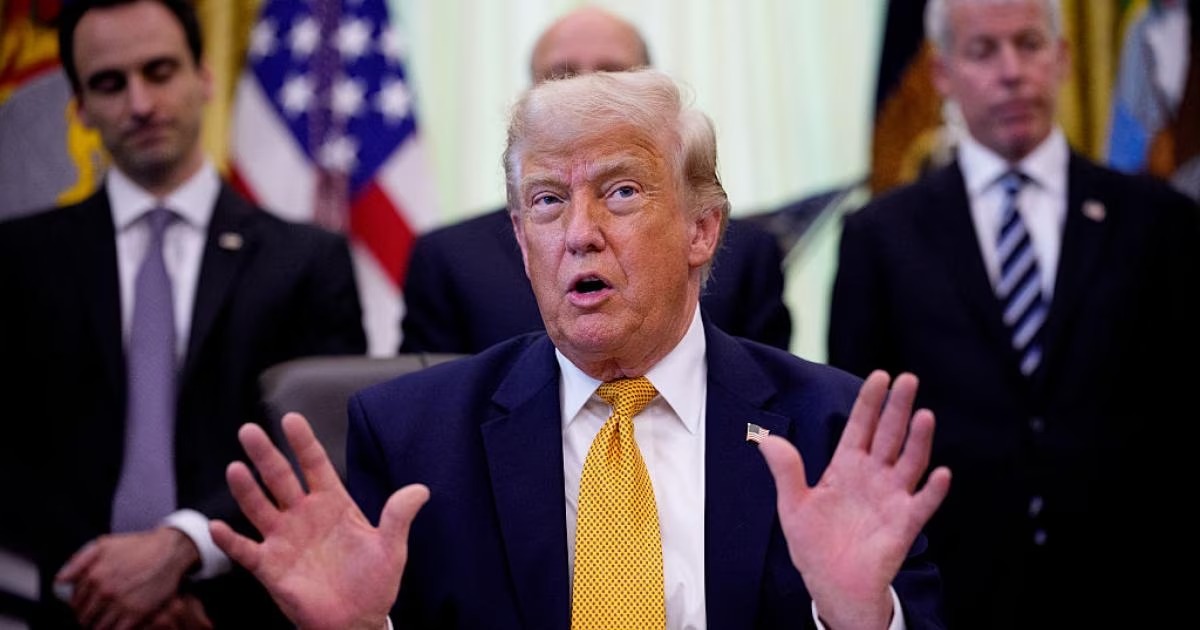
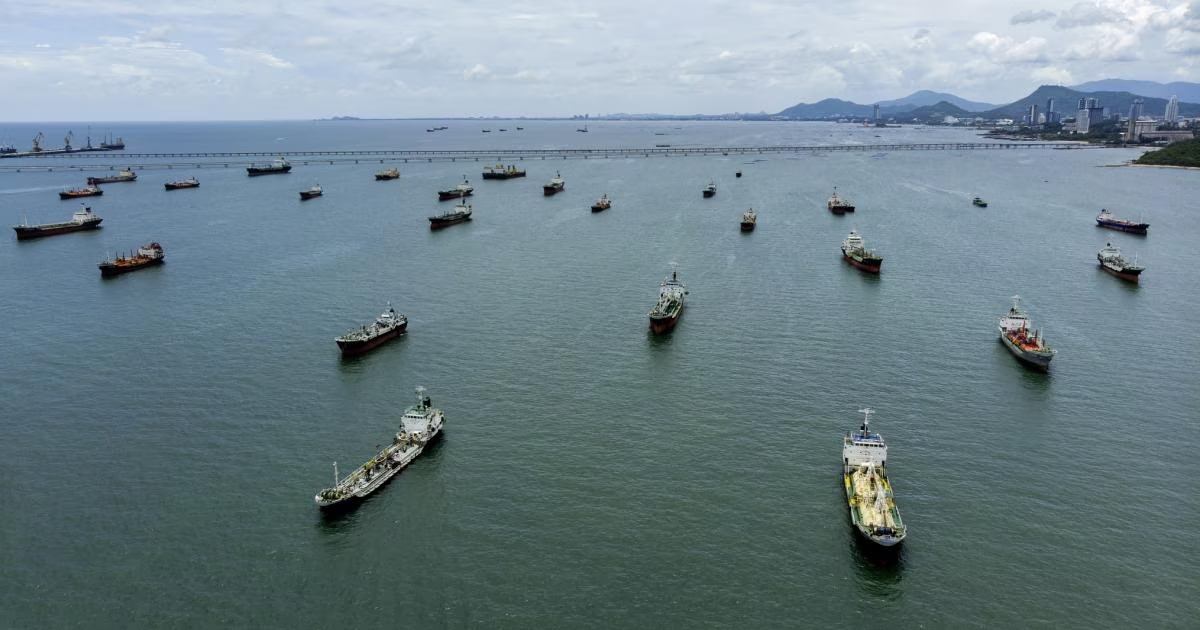
US President Donald Trump announced today, Wednesday, that he had received official assurances from the Iranian side that no transit fees or additional insurance costs would be imposed on commercial vessels passing through the Strait of Hormuz. Trump clarified via his 'Truth Social' platform that these assurances include all types of fees that Tehran had previously threatened to impose, representing a retreat from threats that had raised international concern about the safety of navigation in the strategic waterway.

These statements come amid ongoing intensive negotiations between Washington and Tehran, aimed at drafting a comprehensive agreement to end the state of tension and violence in the Middle East. The US President did not specify whether these Iranian pledges are linked only to the current sixty-day negotiation period, or if they will become a permanent commitment within the anticipated final agreement between the two parties.

Tehran had previously announced, in coordination with the Sultanate of Oman, its intention to study imposing fees for maritime services in the strait, emphasizing its full sovereignty over this passage. These moves were met with strong opposition from the United States and its allies, who considered any additional fees a threat to global trade freedom and the stability of energy markets.

In a related context concerning the nuclear file, the Director-General of the International Atomic Energy Agency (IAEA), Rafael Grossi, revealed arrangements for upcoming inspections at Iranian facilities. Grossi indicated during a press conference in Japan that the interim agreement concluded between Washington and Tehran paves the way for the return of international inspectors to carry out their oversight duties, which had been suspended for varying periods.

However, the Iranian stance appeared more reserved, as Tehran linked allowing access to key nuclear sites to the extent of progress in lifting the economic sanctions imposed on it. Iranian sources confirmed that access to sensitive facilities remains conditional on reaching a final agreement that fully and practically guarantees the interests of the Islamic Republic.

Last week, the two parties signed a memorandum of understanding consisting of 14 clauses, essentially aiming to establish a general framework for ending the ongoing conflict. This memorandum serves as a roadmap for the sixty-day talks, during which the focus will be on complex technical issues, primarily the nuclear program and uranium enrichment levels.

For his part, Iranian Deputy Foreign Minister, Kazem Gharibabadi, stressed that there are no current plans to open facilities that have been subjected to military attacks to international inspectors. He clarified that these files will only be discussed within the framework of reciprocal practical steps that include lifting US restrictions imposed on vital sectors in Iran.

Since the aerial attacks that targeted them in June of last year, the International Atomic Energy Agency has faced significant difficulties in monitoring the most sensitive sites. The recent military escalation in February led to a complete suspension of inspection operations, creating an information gap regarding the actual extent of Iranian nuclear activity in recent months.

The fate of highly enriched uranium stands out as one of the most difficult obstacles in the ongoing negotiations, as Iran possesses stockpiles enriched to up to 60%. This percentage is considered very close to the levels required for producing nuclear weapons, which raises concerns among international powers seeking to prevent Tehran from acquiring nuclear military capabilities.

Grossi affirmed that paragraph eight of the memorandum of understanding clearly stipulates that nuclear activities and facilities are subject to IAEA supervision. He considered that implementing inspections is imperative if Iran wants to prove its seriousness in adhering to the agreement, noting that the exact timing of visits will be determined through executive mechanisms to be established soon.

In contrast, Gharibabadi warned against attempts to use 'media hype' to impose a new reality on the ground before political understandings are completed. The Iranian official indicated that inspection arrangements are not an isolated measure, but rather part of an integrated package that fundamentally depends on Washington's responsiveness to demands for lifting sanctions.

IAEA estimates indicate that Iran possessed approximately 440.9 kilograms of 60% enriched uranium before the Israeli attacks last June. Technical sources believe that a significant portion of these materials is stored in fortified underground complexes in the Isfahan region, sites that the agency insists on inspecting to ensure they are not diverted for military purposes.

Iran has informed us that it will not impose transit fees, insurance costs, or any other fees of any kind on vessels passing through the Strait of Hormuz.
PALESTINE

Thu 25 Jun 2026 11:38 am - Jerusalem Time

UN Inquiry Committee: Occupation Deliberately Targeted Palestinian Children to Prove Genocidal Intent

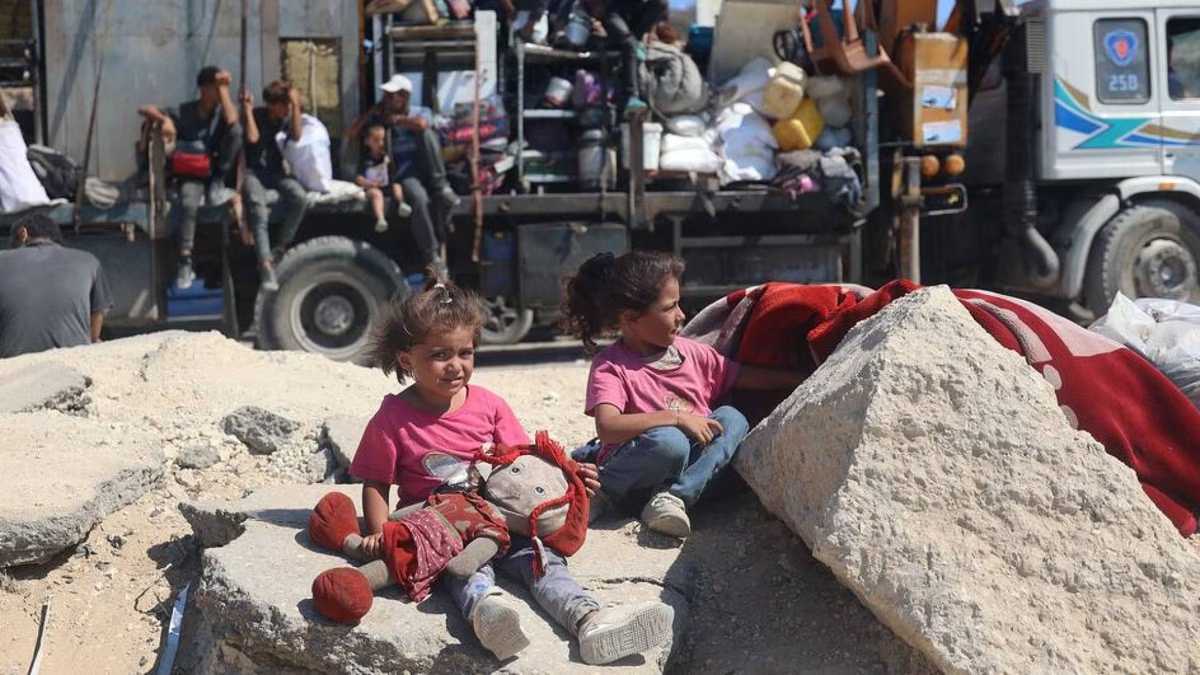
An independent UN inquiry committee issued a shocking official report concluding that the occupation authorities and their security forces deliberately targeted Palestinian children in the Gaza Strip. The committee affirmed in its report issued on Tuesday that these practices amount to genocide and crimes against humanity, emphasizing that this targeting was not accidental but part of a systematic policy aimed at destroying the Palestinian social fabric.

The report, chaired by Srinivasan Muralidar, revealed horrific statistics, with children accounting for about 30% of the total victims of the ongoing aggression on the Gaza Strip. Documented data indicated that more than 20,000 Palestinian children were martyred and nearly 44,000 others were injured to varying degrees by the end of 2025, reflecting the scale of the humanitarian tragedy suffered by minors during the intensive military operations.

The international committee considered the systematic targeting of children a fundamental pillar in proving the 'genocidal intent' of the occupation, as direct killing aims to undermine the Palestinians' ability to survive as a group. The report clarified that the occupation army used precise techniques, including drones and sniper fire, to eliminate children even within areas it declared 'safe,' and these operations continued even after ceasefire agreements came into effect.

The documented violations were not limited to the Gaza Strip but extended to include the occupied West Bank, which witnessed similar war crimes committed by security forces and settlers. The committee monitored blatant cases of sexual violence, physical torture, and arbitrary detention against minors, in addition to the use of drones in field executions targeting children in various cities and camps in the West Bank.

In response, the occupation promptly rejected the investigation's findings entirely, describing the report as 'false defamation' falling within what it called biased propaganda against it. Despite this rejection, legal experts believe that the committee's conclusions carry significant moral and legal weight in international forums and open the door wide for prosecuting those responsible for these crimes in international criminal courts to ensure accountability and protect victims.

The evidence collected unequivocally shows that Israeli security forces deliberately targeted and killed Palestinian children in escalation zones.

PALESTINE

Thu 25 Jun 2026 11:38 am - Jerusalem Time

Netanyahu admits to occupying 70% of Gaza despite ongoing ceasefire agreement

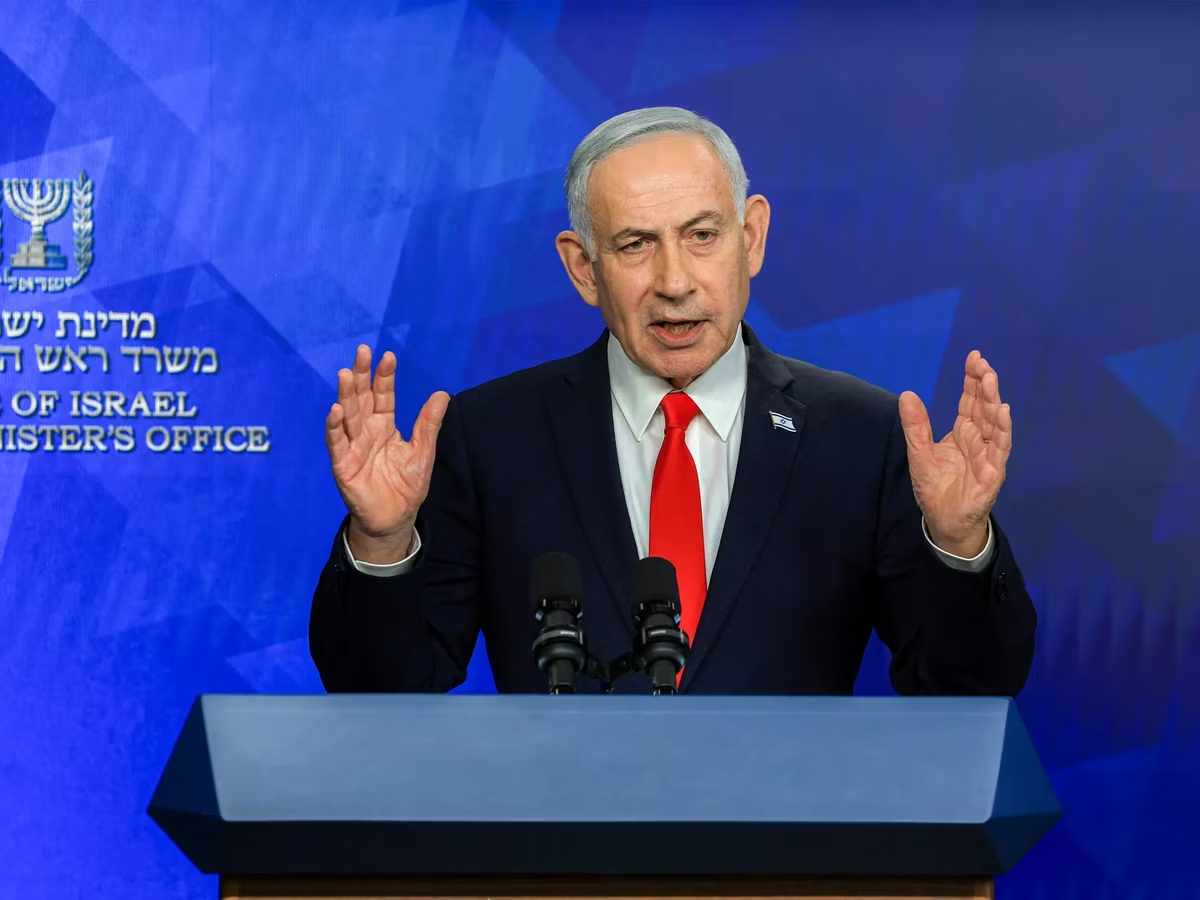
Israeli Prime Minister Benjamin Netanyahu, during a speech at the 'Money Expo 2026' exhibition in Tel Aviv, admitted that his forces currently control approximately 70% of the total area of the Gaza Strip. This official admission confirms the continued expansionist operations of the occupation within the Strip, disregarding the understandings related to the ongoing ceasefire agreement.

Netanyahu explained that reaching this percentage of field control was a direct result of the decision to invade the city of Rafah, noting that his government rejected all international pressure that called for not entering the city. He considered that this expansion primarily aims to tighten the siege and stifle the military and political capabilities of the Hamas movement in the remaining areas.

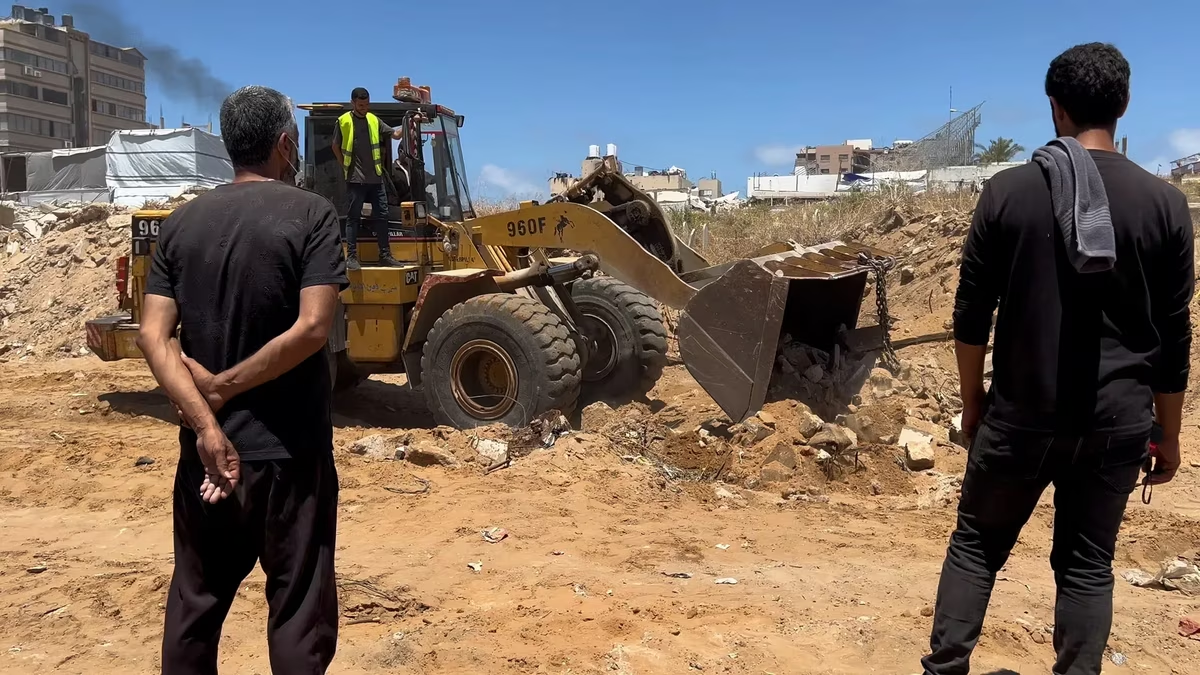
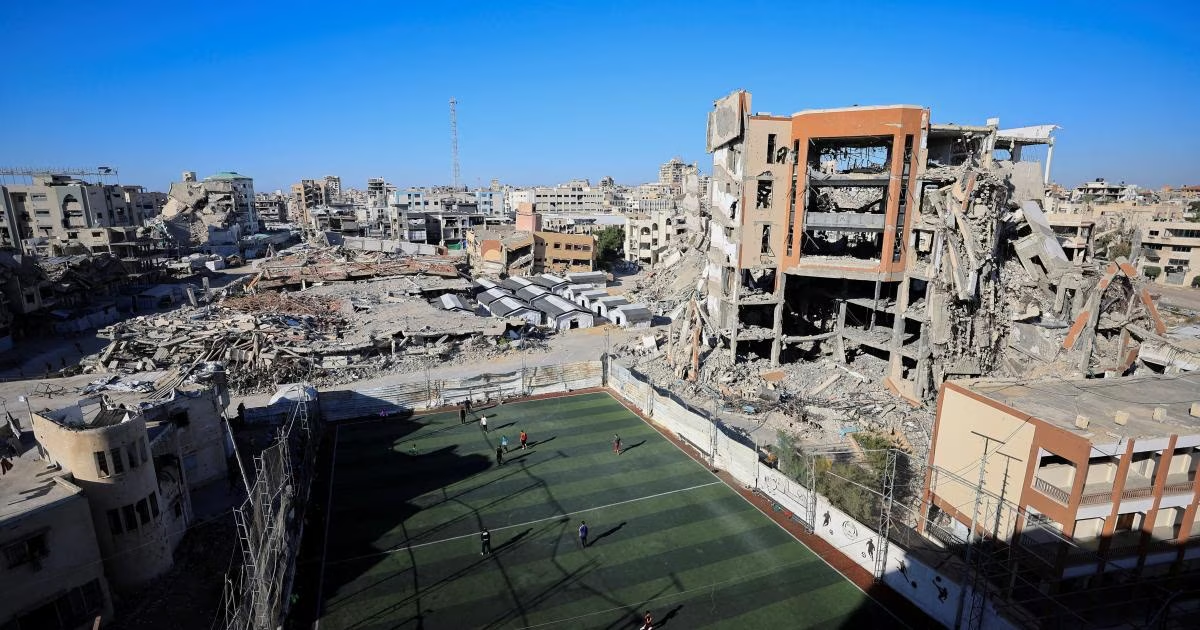
These figures mean that the Israeli army now effectively occupies an area estimated at 255 square kilometers out of the total area of the Strip, which is 365 square kilometers. This military expansion has led to the crowding of approximately 2.13 million Palestinians into a very narrow area not exceeding 110 square kilometers, creating a catastrophic and unprecedented humanitarian situation.

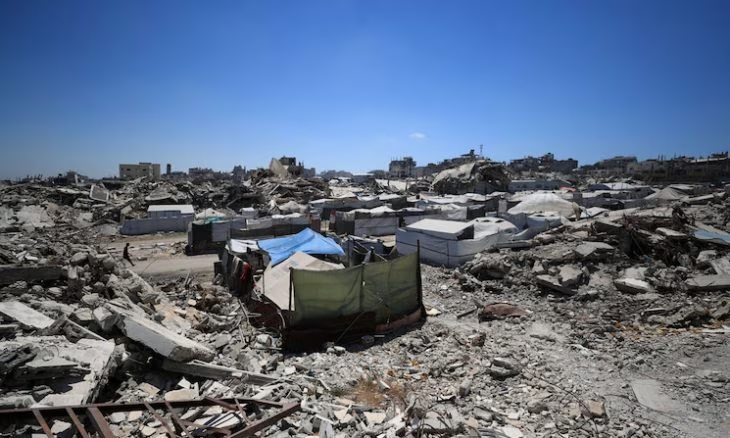
Field data indicates that the population density in areas not yet directly affected by the occupation has exceeded 19,000 people per square kilometer. This suffocating density coincides with massive destruction of infrastructure and a severe shortage of shelters and basic services, exacerbating the suffering of displaced persons who lost their homes during the ongoing military operations.

The United States and the United Nations had previously warned against the consequences of invading Rafah, which housed about 1.4 million displaced people, fearing human massacres and disruption of aid flow. However, Israel carried out the invasion on May 7, 2024, and took control of the Palestinian side of the Rafah crossing and completely closed it, causing a wave of forced displacement of 800,000 people.

Returning to the political agreements, the first phase of the ceasefire agreement, which began in October 2025, included clear provisions such as prisoner exchange and a partial withdrawal of the Israeli army. However, the facts on the ground prove the occupation's evasion of these commitments, as forces continued to seize more land and expand their military presence.

Netanyahu's figures reveal a continuous escalation in the pace of occupation, as the control rate was 53% when the agreement was signed, then rose to 60% in mid-May. Today, with the rate reaching 70%, Palestinian and international demands for deterrent mechanisms to compel Israel to stop expansion operations and withdraw to the agreed lines are increasing.

Amid this escalation, informed sources reported that the continued Israeli control over large areas of the Strip hinders any real opportunities for reconstruction or the return of displaced persons to their areas. The field situation remains prone to further tension given the Israeli government's insistence on establishing a new occupation reality that permanently changes the geography of the Gaza Strip.

If we had listened to the calls rejecting the entry into Rafah, we would not have reached control of 70% of Gaza's territory today.

PALESTINE

Thu 25 Jun 2026 11:38 am - Jerusalem Time

Netanyahu links staying in southern Lebanon to electoral calculations amid stalled Washington negotiations

Israeli Prime Minister Benjamin Netanyahu chaired a series of high-level security consultations on Wednesday evening, with the participation of Defense Minister Israel Katz and leaders of intelligence and military agencies. These meetings primarily focused on assessing the field situation on the Lebanese front and movements in Syrian territories, amidst escalating regional tensions.

These security moves come after statements issued by the US administration, led by Donald Trump, regarding the possibilities of Syrian intervention in Lebanon, which was met with a categorical denial from Damascus and Beirut. Syrian President Ahmed Al-Shara affirmed his country's rejection of these claims, while Lebanese officials emphasized protecting their territorial sovereignty from any external interference.

Coinciding with these consultations, General Brad Cooper, commander of the US Central Command, arrived in Israel on an official visit aimed at coordinating positions. Cooper is scheduled to hold meetings with Israel Katz and Chief of Staff Eyal Zamir to discuss strategic cooperation and exchange sensitive intelligence information regarding the inflamed fronts.

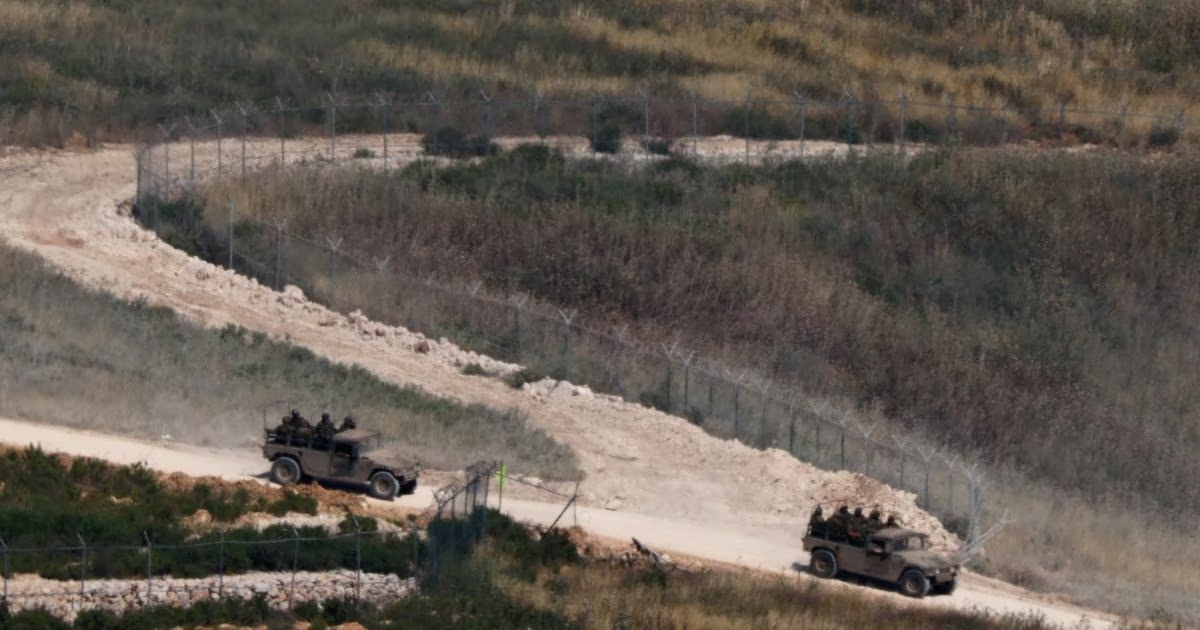
Informed sources reported that discussions within the Israeli establishment did not result in clear public outcomes, but indications point to Tel Aviv's insistence on consolidating its military presence in southern Lebanon. Israel is proposing the idea of 'limited withdrawals' from some points south of the Blue Line, but without committing to any timelines for implementation.

In a related context, Defense Minister Israel Katz stated that Israel would not succumb to international pressure, including US pressure, regarding withdrawal from southern Lebanon. Katz considered military presence an urgent security necessity that cannot be compromised at the current stage, regardless of the surrounding political circumstances.

For his part, Benjamin Netanyahu adopts a discourse focusing on the so-called 'safe zone' in southern Lebanon, emphasizing the continuation of military operations to ensure the security of northern settlements. Political readings indicate that Netanyahu seeks to turn the issue of staying in Lebanon into a winning electoral card against his political opponents within Israel.

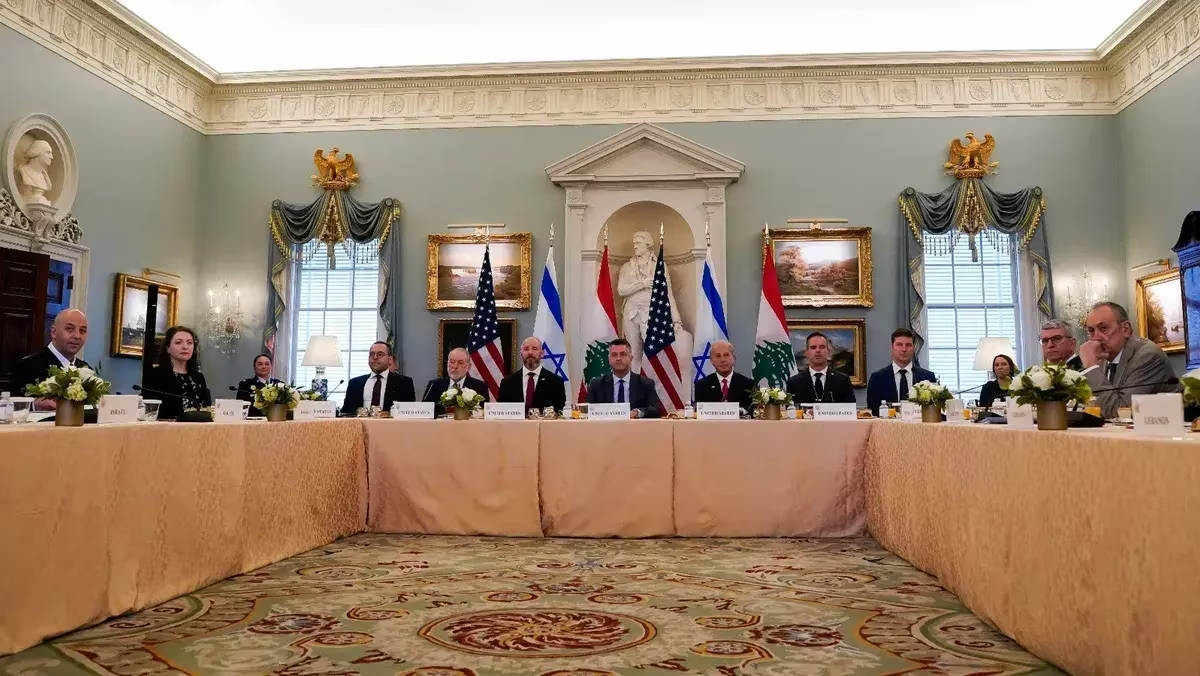
On the diplomatic front, the fifth round of indirect Lebanese-Israeli negotiations, sponsored by the US, concluded in Washington without reaching a final agreement. Despite talks of a positive atmosphere prevailing in the negotiation halls, significant gaps remain regarding the details of withdrawal and border security arrangements.

Media sources reported that both sides exchanged maps illustrating proposed deployment points, but disagreement clearly emerged over the pace of withdrawal and the areas that should be immediately evacuated. Sources expect Israel to content itself with a partial withdrawal from some secondary locations while retaining strategic positions that Beirut refuses to allow the occupation to remain in.

Official Lebanese position remains committed to the necessity of a complete and unconditional Israeli withdrawal from all occupied territories in accordance with international resolutions. Lebanese political forces affirm that any attempt to impose a new security reality under the name of 'safe zones' will be met with categorical rejection at all official and popular levels.

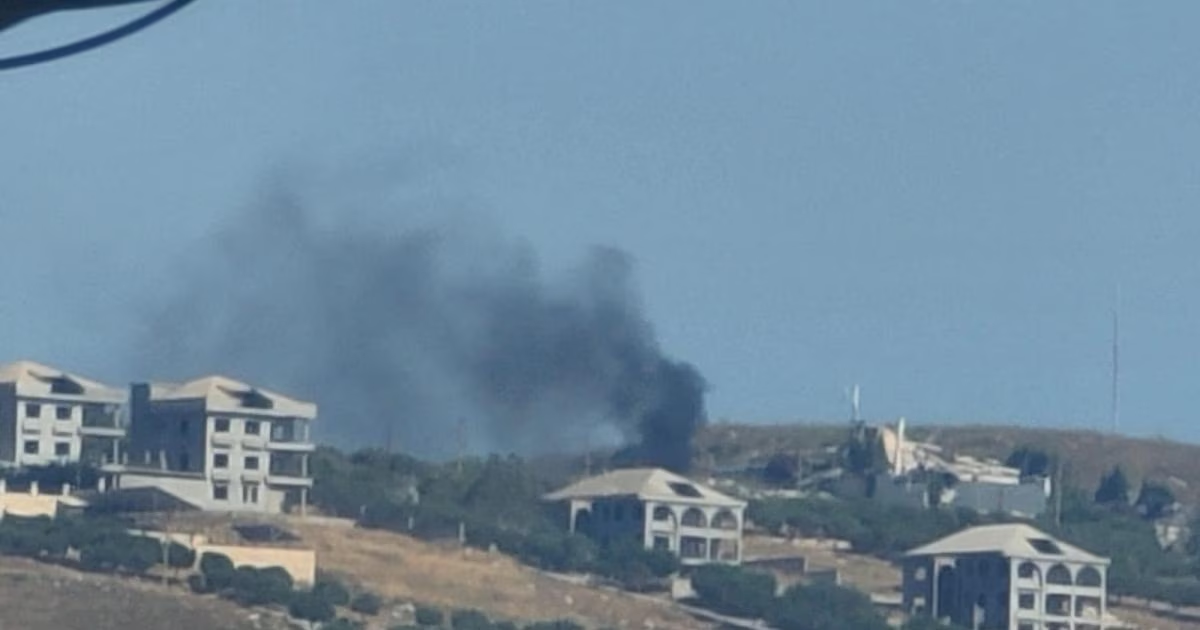
On the ground, the Israeli aggression that began in March 2026 continues to claim civilian lives and destroy infrastructure in various Lebanese regions. According to the latest statistics issued by Lebanese authorities, the number of martyrs has exceeded 4,200 people, while the number of injured has surpassed 12,000.

The ongoing military operations have caused a widespread displacement wave, with more than a million Lebanese forced to leave their homes and seek refuge in safer areas. Humanitarian organizations face enormous challenges in providing basic needs for the displaced amidst continued shelling and the siege imposed on many border towns.

Israel will not withdraw from southern Lebanon even if Washington asks it to, and we will continue to maintain the safe zone.

ARAB AND WORLD

Thu 25 Jun 2026 11:38 am - Jerusalem Time

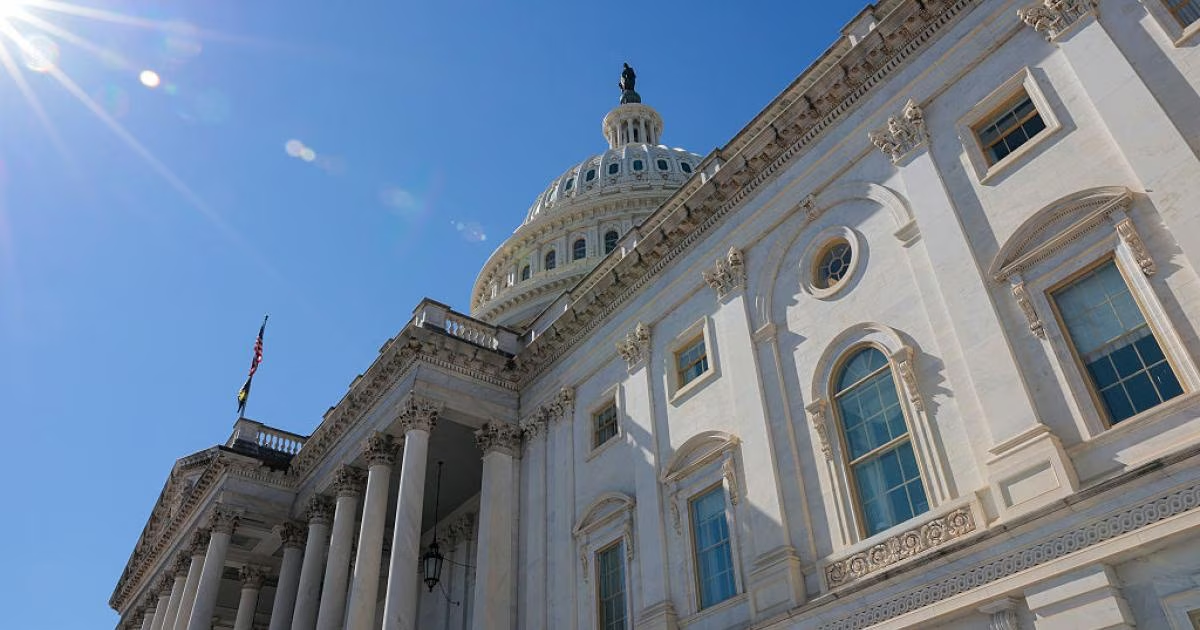
Trump Administration Requests $87.6 Billion from Congress to Fund War with Iran

The administration of US President Donald Trump has formally submitted a request to Congress for approval of an urgent additional funding of $87.6 billion, primarily aimed at covering the escalating expenses of the war with Iran. This move comes amidst growing concerns within both the Republican and Democratic parties regarding the economic and political costs of the ongoing conflict and its repercussions for regional stability.

The government's proposal came just one day after Congress voted on a symbolic resolution demanding the President end military operations against Tehran unless he obtains explicit authorization to use force. This step reflects the increasing tension between the White House and lawmakers over war powers and the management of major international crises at the current stage.

In a letter addressed to House Speaker Mike Johnson, Office of Management and Budget Director Russell Vought emphasized the necessity of swift legislative action to secure these funds. Vought described the requests as 'important and urgent' to ensure the continuity of military operations and protect American interests in the Middle East, which is experiencing unprecedented turmoil.

Direct military expenditures account for the largest share of the requested budget, with approximately $67.15 billion allocated to fund secret military programs and modernize the military arsenal. This item includes rebuilding weapon stockpiles depleted in recent months, as well as purchasing advanced munitions and enhancing war manufacturing capabilities.

Specifically, the US administration requested $21 billion for military capabilities and munitions, and approximately $17.3 billion to cover field operational costs. The request also included $12.1 billion for secret intelligence and military projects related to the conflict, reflecting the extent of technical and informational involvement in the confrontation.

The request was not limited to purely military aspects but also included $768 million for the Department of Energy to enhance nuclear and energy security related to the Iranian file. The State Department also requested $300 million to secure and fortify US embassies in countries bordering Iran, in anticipation of any potential reactions or targeting.

Despite the enormous amount requested, it remains below the estimates previously set by the Pentagon, where Defense Secretary Pete Hegseth indicated the department's need for approximately $200 billion. The war erupted following joint US and Israeli airstrikes targeting Iranian sites in late February, leading to a surge in global energy prices.

This request is expected to face fierce opposition in the Senate, where passing major spending bills requires the support of 60 members, which forces the administration to seek compromises with Democrats. Democratic Minority Leader Chuck Schumer accused President Trump of dragging the country into a 'reckless war' and then asking taxpayers to bear its exorbitant costs.

The White House Office of Management and Budget Director called on Congress to act quickly to approve important and urgent funding requests related to national security.

OPINIONS

Thu 25 Jun 2026 11:37 am - Jerusalem Time

Creeping Displacement in Jerusalem and the West Bank!

On June 11, 2026, the Israeli government, according to Axios reporter Barak Ravid, approved the allocation of $350 million to establish 61 new settlements in Jerusalem and the West Bank. The goals of this move include accelerating construction in dozens of sensitive Palestinian areas, especially in Hebron and all of Area C, which constitutes 61% of the West Bank, and also in the Jordan Valley. This approval came based on a recommendation by Bezalel Smotrich, the Minister of Finance, and was granted in exchange for Smotrich's party agreeing to dissolve the government! Amnesty International commented on the Israeli government's decision, with Agnes Callamard, Amnesty's coordinator, stating: "The purpose of allocating this budget is to annex the West Bank to Israel. These violations are not isolated; they fall within the ethnic cleansing adopted by the Israeli government. One hundred villages in the West Bank have been completely or partially evacuated between January 2023 and April 2026, and 7,280 cases of Palestinian displacement from their homes have been recorded!" The Peace Now movement newspaper published the following on June 10, 2026: "The Israeli government is in a frantic race before the elections to plunder public funds. This race aims to create a catastrophic reality on the ground for the next government, even though the Chief of Staff of the Israeli Army warned against establishing such a large number of settlements, and emphasized that it would harm security and push the army into a state of collapse. The government should seek a political solution, but the government is trying to drown us in a quagmire of blood. The goal is complete control over the West Bank, while reducing the area for Palestinians!" This government is rushing to issue special laws to make the task of any new government almost impossible. On May 31, 2026, it approved a law transferring responsibility for Palestinian archaeological sites from the Civil Administration, i.e., from temporary military decisions, to the Israeli Ministry of Heritage. The decision will also apply to antiquities in the West Bank and Gaza Strip. This decision is one of the most unfair decisions after the annexation of East Jerusalem in 1967! Examples of Israel's plan to implement creeping displacement in Jerusalem and the West Bank include the story of the displacement of Palestinian Bedouins in Abu Dis, Jerusalem, under the pretext of expanding the Jabal neighborhood. The Israeli Jerusalem municipality forced those Israel called (Bedouins) to move next to the Abu Dis village landfill, where millions of tons of waste accumulate! As for the displacement of the Palestinians of Khan al-Ahmar, they are now awaiting Smotrich's and Ben Gvir's army to be expelled from Khan al-Ahmar, after they were at the forefront of the peaceful Palestinian struggle. Smotrich issued an order to evacuate all residents of Khan al-Ahmar, even though its residents were displaced from their homes in 1948 and settled in East Jerusalem in the 1960s under Jordanian rule. Since 1967, the Israelis occupied the West Bank and demanded their evacuation from Khan al-Ahmar because Khan al-Ahmar is located on Road No. 1 near the Ma'ale Adumim settlement. However, international public opinion and solidarity from all over the world forced previous Israeli governments not to implement the deportation and demolition orders! The emptying of Khan al-Ahmar of its Palestinian residents is part of Smotrich's plan to control the central West Bank and prevent the establishment of a Palestinian government, even though there is an Israeli plan to build a settlement in Area E1, which is the area connecting the northern and southern West Bank. It is known that the area is 12 kilometers, and it is a sensitive area in the West Bank because it is an obstacle to connecting the Ma'ale Adumim settlement to Jerusalem! Eid al-Jahalin, head of the Khan al-Ahmar residents' assembly, said: "Palestinian solidarity activists supported us in 2018. They stayed with us. I hosted thousands of solidarity activists from all over the world. Our cause was in the news, but after the October 7 disaster in Gaza, Khan al-Ahmar turned into a settler state. They are waging war against us. The whole world today is far from our cause!" There is a plan submitted by Smotrich's association specializing in the usurpation of Palestinian lands, called (Regavim), to build a settlement in Area E1 comprising 3401 housing units, and the tender for the plan will be announced next July! There is a plan that was frozen (temporarily) but is proceeding very slowly by the same Regavim settlement association. This plan was approved by the Knesset on June 24, 2013, presented by the former Deputy Head of the Israeli National Security Council, Ehud Braver. This plan stipulated: "Evacuating unlicensed Palestinian Bedouin dwellings and gathering the Bedouins in other cities. Israel, under the plan, will seize eight hundred thousand dunams of the property of the displaced Bedouins, whose number reaches more than forty thousand residents of the Negev." The Israeli government publicly stopped the implementation of this plan after six months, but individual creeping deportation operations are ongoing! To implement the displacement plan, Israel sprayed internationally banned (Roundup) powder by planes to destroy Palestinian crops in the Negev, an international environmental crime that did not provoke environmental organizations worldwide! We must also remember the phoenix of Palestinian villages, the village of al-Araqib in the Negev. Digital sites have stopped publishing most of its news. The number of times it has been demolished reached two hundred and fifty times by May 2026, and its residents are still rebuilding it! I will always remember what David Ben-Gurion, the first prime minister of Israel, said about the Negev: "The Negev will become a home for Jewish immigrants, and it is a settlement reserved to house millions of Jews worldwide." For this reason, Ben-Gurion decided to build the first settlement in the Negev on the ruins of the Palestinian village of Abdah, to live there, to call it Sde Boker, and to be buried there in 1973. Settlers celebrate the Midburn festival in the Negev every year, where thousands of settlers gather and light fires around Ben-Gurion's grave. The veneration of Ben-Gurion is not only due to the strength of his personality but also to his plan for settling the Negev! There are major settlement systems in Israel that control most governments because they carry central religious genes, which are the genes of religious settlement. Among the most prominent of these major systems, feared by all party leaders in Israel, is the Gush Emunim bloc, religious Zionism led by Rabbi Zvi Yehuda Kook, the chief rabbi of the religious Zionist movement. The bloc was founded in 1971 within the National Religious Party (Mafdal), which supported the Zionist movement in the 1970s. However, the Mafdal party, which was the nucleus of Gush Emunim, joined the Likud party in 1977 and left the left-wing government. Therefore, the Likud party carries the main settlement gene, the gene of Gush Emunim and Mafdal! The Gush Emunim movement gave birth to another settlement movement, (Amana), and also gave birth to the effective and oppressive settlement arm, the Yesha Council, a greenhouse for right-wing voters. Yesha today is the head of the settlement movement in the West Bank and Gaza Strip! The truth is that Israeli settlement is not a political principle, but a religious doctrine among the Haredim. This religious doctrine is deeply rooted in the core belief of the religious Zionist movement and the Haredi movement, who do not recognize Zionism. Most Haredim even arrange the doctrine of repentance for Jews according to three repentances: the first repentance is the repentance of fear of enemies in exile, the second repentance is the repentance of the land when they return to the Promised Land, and the third repentance is the repentance of love, which is waiting for the return of the awaited Messiah! Rabbi Moshe ben Nachman established settlement in Jewish religious doctrine. This rabbi died in 1270 at the end of the thirteenth century AD. He is the first theorist of the Zionist settlement movement before the entire Herzl lineage appeared. He said: "Settlement is a mandatory Jewish religious commandment, and it is a commandment equal to all religious commandments, and Jewish religious rituals may only be practiced in the Promised Land, and every religious commandment outside the Promised Land is not accepted by God, and a Jew may divorce his wife if she refuses to immigrate to Palestine!" This Rabbi Moshe ben Nachman is also one of the contributors to attracting the Christian Zionist movement to Israel. This Christian Zionist movement today constitutes about 13% of the world's Christians, and this rabbi also pushed the Christian Zionist movement to believe that the establishment of Israel in Palestine is the way for the return of the awaited Messiah, and this meeting between the two poles was and still is the largest source of funding for Israel worldwide! The Christian Zionist preacher, Jerry Falwell, said in 1980: "God blessed America because America supported Israel." Remember: Israel's turning a blind eye to the killings in the steadfast Palestinian villages and cities since 1948 is part of the creeping displacement project intended to be implemented sooner or later! ========================== The truth is that Israeli settlement is not a political principle, but a religious doctrine among the Haredim. This religious doctrine is deeply rooted in the core belief of the religious Zionist movement.

PALESTINE

Thu 25 Jun 2026 11:37 am - Jerusalem Time

Martyr in Salfit and arrest campaign targeting 16 Palestinians amidst warnings of 'chaos' at West Bank checkpoints

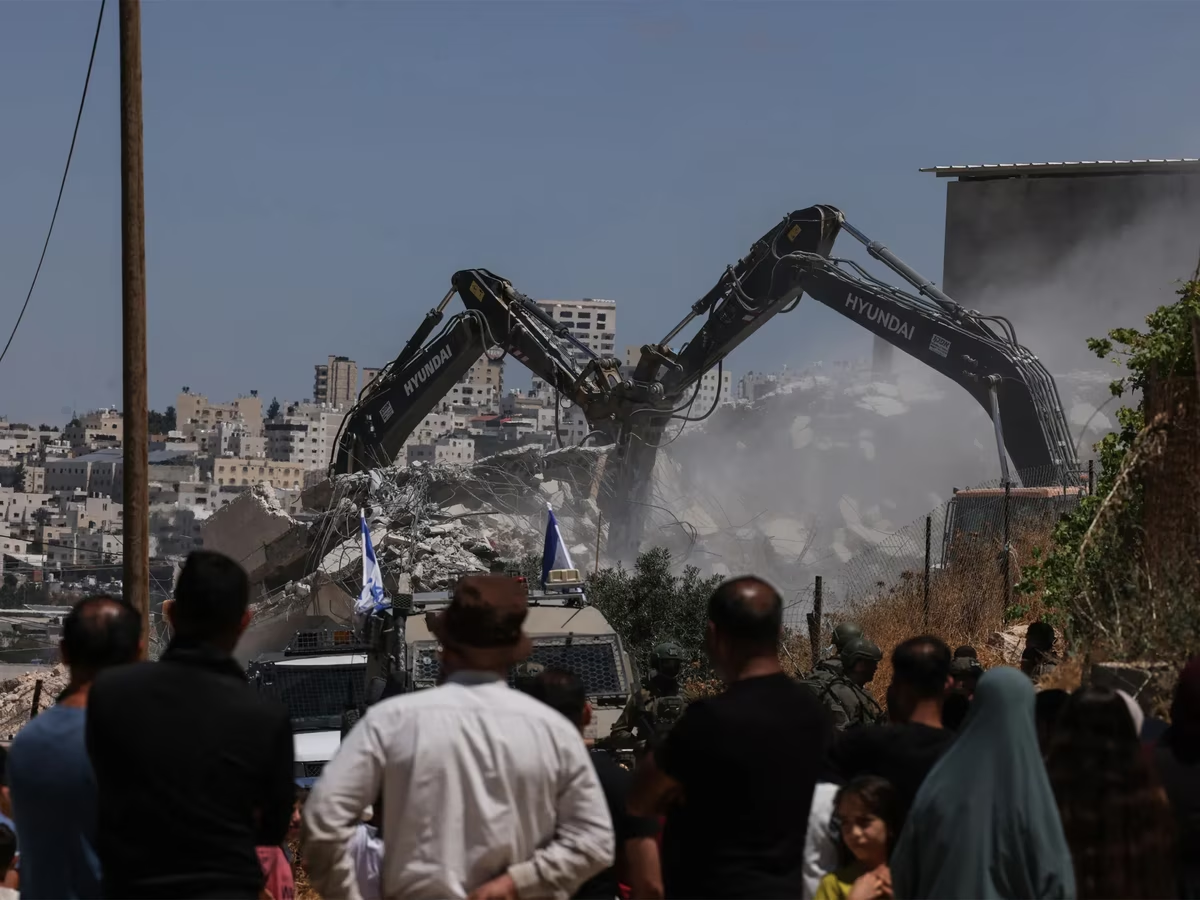
The young Palestinian Mustafa Taha Khatib was martyred this Thursday morning, as a result of being shot by the Israeli occupation army during an incursion targeting the village of Sarta, north of the occupied West Bank. Local sources reported that a military force raided the village, located west of Salfit city, stormed the young man's home, and shot him directly inside, leading to critical injuries from which he was transferred to the hospital where his death was announced.

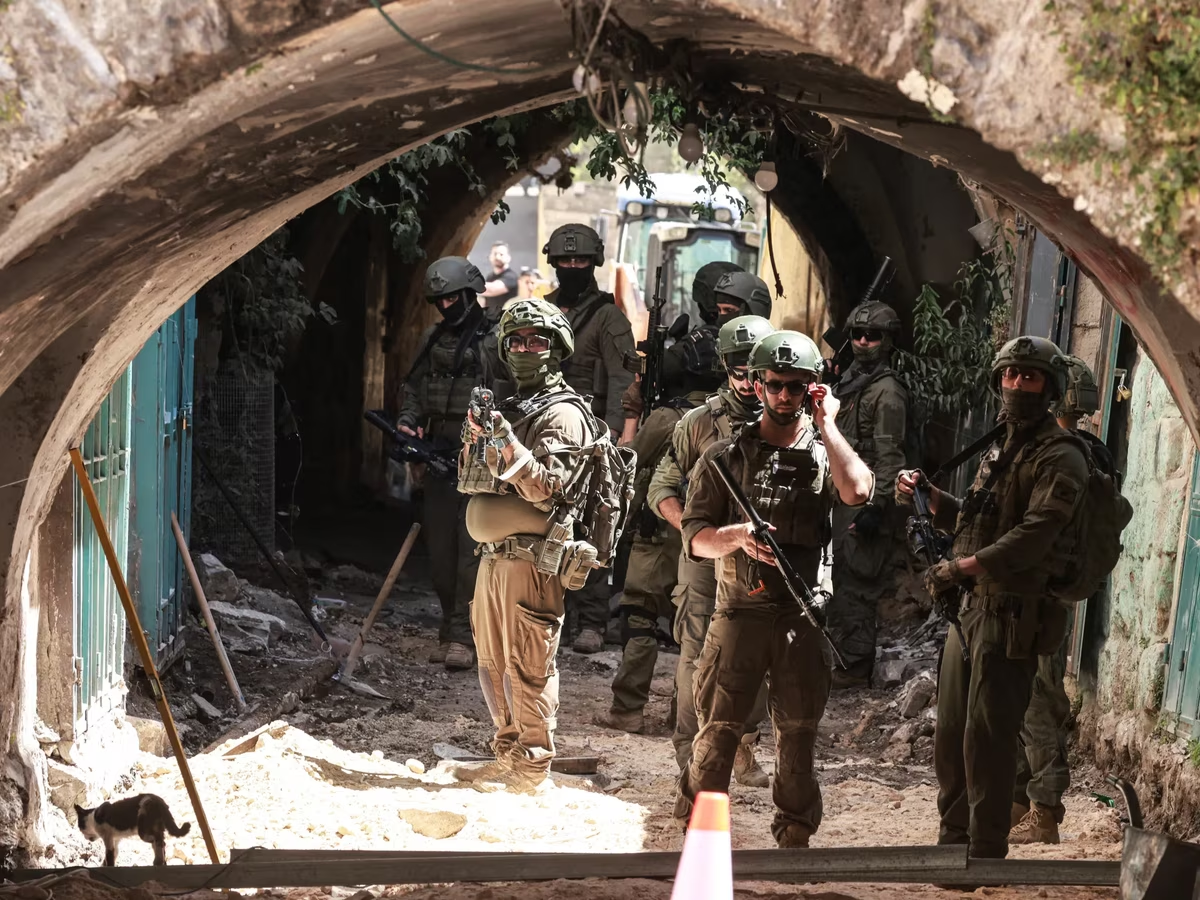
The assassination operation coincided with a widespread raid and arrest campaign launched by occupation forces in various areas of the West Bank, resulting in the arrest of at least 16 citizens. Human rights sources confirmed that the campaign targeted children and local officials, with homes being ransacked and their residents terrorized in the early hours of dawn.

In Nablus Governorate, military vehicles stormed the town of Huwara and the villages of Qaryut and Majdal Bani Fadil, where they carried out thorough searches and property destruction. These incursions resulted in the arrest of Huwara municipal council member Mohammed Saed Odeh, in addition to the two children Tamim Ma'mar and Yaman Ashraf Othman, who are both under sixteen years old.

Arrests also targeted citizens from the town of Kafr Qaddum, east of Qalqilya, and five young men from the village of Deir Qaddis, west of Ramallah city. These field movements come within the framework of an ongoing escalation since October 8, 2023, with official statistics indicating that the number of detainees in the West Bank has reached approximately 23,000 Palestinians.

On the internal legal front of the occupation, reports revealed a strongly worded letter sent by Lieutenant Colonel Kobi Marcus, the legal advisor for the West Bank area in the Military Advocate General's office. In his letter addressed to the commander of the Central Command, Avi Bluth, Marcus warned of a state of 'leadership and legal chaos' prevailing in the management of Palestinian movement and transit in the occupied territories.

The legal advisor explained that the army imposes restrictions and military checkpoints in a manner that violates operational orders and commitments made by the state before the Israeli Supreme Court. He pointed out that field commanders are now making decisions to close roads and erect checkpoints without obtaining the necessary legal approvals or professional recommendations from the civil administration.

Sources stated that the letter focused on physical checkpoints that last for more than 24 hours, emphasizing that they are implemented without completing the required official procedures. Marcus considered that these practices have become a fixed pattern since the outbreak of the war, emptying previous legal commitments of their content and weakening central military oversight.

The document criticized the absence of official documentation for these checkpoints, which led to a state of field ambiguity making it difficult to distinguish between official security measures and checkpoints illegally erected by settlers. This overlap, according to the letter, contributes to increased tension and arbitrary violation of the basic rights of Palestinian residents.

The legal advisor stressed that ignoring the procedures committed to by the state before the Supreme Court in 2017 represents a dangerous regression from administrative principles. That commitment came after petitions submitted by heads of Palestinian councils against movement restriction policies that stifle villages and cities in the West Bank.

In a related context, field data shows that the escalating Israeli operations have so far resulted in the martyrdom of 1,173 Palestinians and the injury of more than 12,000 others with varying degrees of wounds. These figures reflect the scale of military escalation accompanying the policies of siege and the fragmentation of Palestinian areas through the increasing system of checkpoints.

Marcus concluded in his warning that the continued imposition of these restrictions without a clear legal basis not only constitutes a violation of individual rights but also starkly contradicts the principles of international law. This internal legal testimony places the occupation army in direct confrontation with its claims about adherence to legal standards in its administration of the occupied territories.

Continued imposition of restrictions without a clear legal basis constitutes a violation of fundamental rights and contradicts the principles of administrative law and international law.

OPINIONS

Thu 25 Jun 2026 11:37 am - Jerusalem Time

Trump links release of Iranian funds to strict US oversight, nuclear negotiations face new contradictions

Washington Message

Washington – Said Arikat – 25/6/2026

US President Donald Trump announced that any Iranian funds released under a potential peace agreement between Washington and Tehran would remain under direct US oversight and would only be allowed for the purchase of food and medical supplies from the United States. This move reflects the continuation of economic pressure policies even if a political settlement is reached to end the confrontation between the two countries.

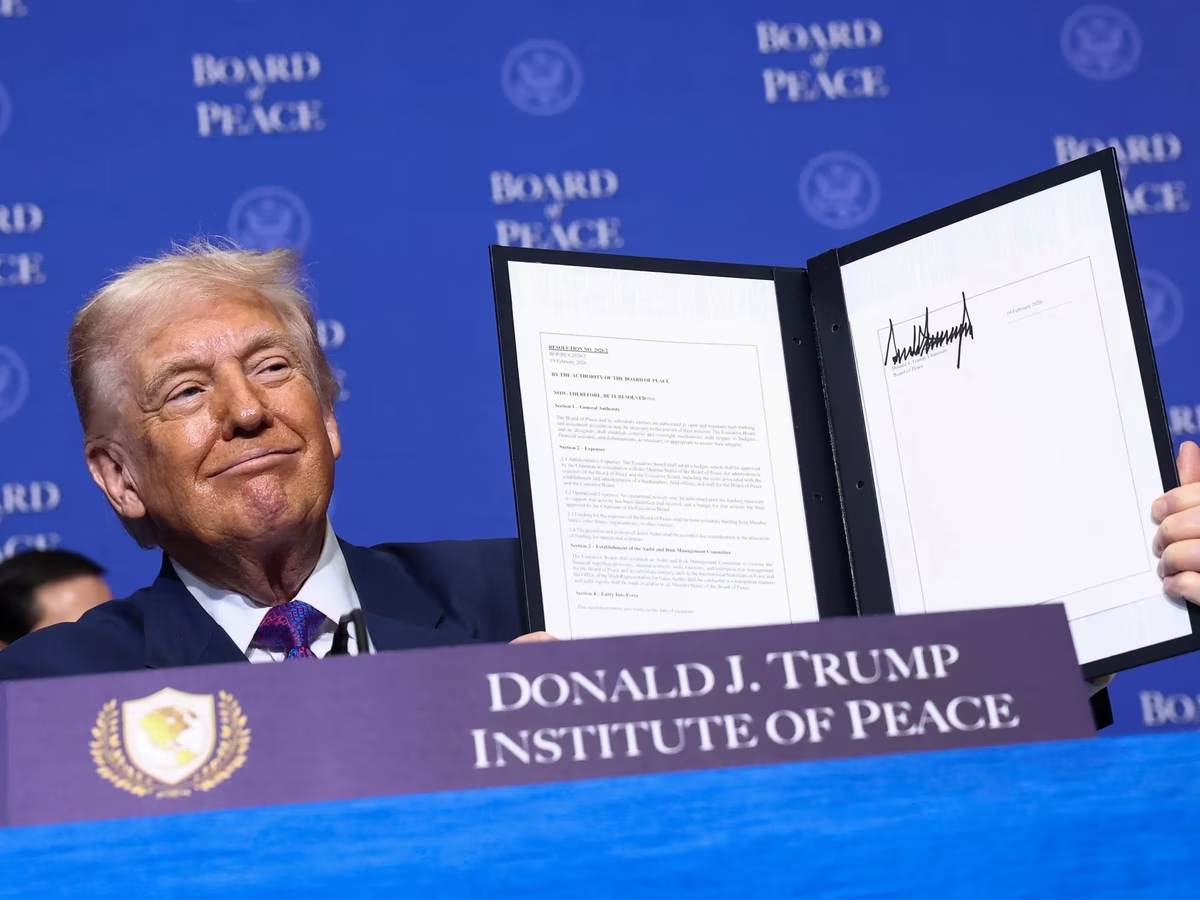
Trump stated, in a post on the "Truth Social" platform, that funds or sanctions relief approved for release by the US Treasury Department would be placed in escrow accounts under US control and would be used exclusively for the purchase of food and medicine, including corn, wheat, and soybeans from American farmers.

The US President justified this approach by citing what he described as a "humanitarian crisis" within Iran, emphasizing that providing essential materials has become an urgent necessity that must be addressed before it is too late. However, the wording of the American statements also reflects a clear desire to prevent Tehran from using any released funds to rebuild its military capabilities or support its regional allies.

These statements come at a time when ongoing negotiations between Washington and Tehran are in a delicate phase aimed at stabilizing the cessation of military actions and reaching a long-term political and security framework. Iran has repeatedly stressed that lifting economic sanctions and unfreezing Iranian assets abroad are essential conditions for any final agreement.

In an indication of the extent of the remaining disagreements, Trump announced that Iran had agreed to “the highest levels of nuclear inspection indefinitely,” considering that this would ensure what he called “nuclear honesty.” He added that continued negotiations would have been impossible without Tehran's acceptance of this condition.

However, these statements quickly clashed with a contradictory Iranian stance. One day after US Vice President JD Vance announced that Iran had agreed to allow international inspectors to monitor its nuclear facilities, the Iranian Foreign Ministry denied the existence of any such agreement, raising questions about the reality of the understandings reached during the recent rounds of indirect contacts.

This contradiction recalls the disagreements that surrounded the 2015 nuclear deal, which included a wide-ranging international inspection regime considered at the time to be the strictest in the history of the International Atomic Energy Agency. Despite the US withdrawal from the agreement in 2018 during Trump's first term, Iran continued to allow international inspections for a long time, before the relationship sharply deteriorated following US and Israeli attacks targeting its territory and facilities last year, which led it to expel inspectors and halt extensive forms of supervisory cooperation.

Observers believe that the US administration is trying to build a new agreement that differs from the 2015 agreement in terms of implementation and oversight mechanisms. Instead of merely lifting sanctions in exchange for nuclear restrictions, Washington seeks to retain economic leverage that allows it to monitor the movement of Iranian funds and control their use, which may provoke widespread Iranian objections as an infringement on national sovereignty.

Trump's statements also reflect a desire to reassure opponents within the United States and Israel who fear that any sanctions relief could provide Tehran with additional financial resources that could be used to enhance its regional influence. For this reason, the US administration appears keen to emphasize that the released funds will not be directly available to the Iranian government but will be subject to strict US oversight.

The proposed approach to handling Iranian funds reveals a new American philosophy in conflict management, based on combining political settlement with the retention of economic dominance tools. Washington does not seem willing to relinquish its financial influence even if the conflict ends; instead, it seeks to transform this influence into a permanent part of any future agreement. From an Iranian perspective, these conditions may be seen as a continuation of sanctions through different means, which could complicate the chances of reaching a final and stable agreement, and make negotiations revolve around implementation details rather than major political principles.

Furthermore, the contradiction between American and Iranian statements regarding nuclear inspection reflects a deep trust deficit accumulated over years of confrontation. Tehran still recalls the experience of the unilateral US withdrawal from the 2015 agreement and believes that any new commitment must be met with a genuine guarantee that the same scenario will not be repeated. In contrast, Washington seeks to obtain stricter oversight mechanisms than those previously in place. Between these two positions, negotiations appear vulnerable to repeated setbacks unless a formula is reached that balances American security requirements and Iranian sovereignty demands.

At the regional level, the debate over frozen funds and nuclear inspection is not limited to the bilateral relationship between Washington and Tehran but extends to the calculations of Israel and Middle Eastern countries. The success of any agreement could open the door to a period of regional de-escalation, while its failure could lead to a renewed cycle of military escalation. Israel also continues to press for strict restrictions on Iran's nuclear program and Tehran's missile capabilities, which means that any future agreement will also be governed by regional power balances and the US administration's ability to reconcile the interests of its allies with the requirements of a settlement with Iran.

PALESTINE

Thu 25 Jun 2026 11:37 am - Jerusalem Time

Bennett's statements: An early election campaign that courts the desire for control and dreams of expansion among extremists

Dr. Suhail Diab: Bennett wants to assure settlers of his commitment to annexing Area C and his refusal to backtrack on positions related to settlement and control over large parts of the West Bank. Khalil Shaheen: Bennett's statements do not represent a fundamental shift in his positions, but his current electoral calculations are pushing him to a political repositioning aimed at the right-wing and center-right electorate. Labib Taha: The talk of annexing Area C is not new but is linked to a deeply rooted vision since the signing of the Oslo Accords as a strategic goal for various Israeli projects. Dr. Osama Abdullah: Bennett's statements reflect a growing trend within the Israeli political scene that relies on exploiting current circumstances to reshape reality. Hani Abu Al-Siba': Bennett's proposal goes beyond being a fleeting election program and entails the practical abolition of the idea of a Palestinian state by controlling the wider geographical expanse of the West Bank. Thaer Al-Deek: Bennett's statements represent an early launch of the Israeli election campaign and an attempt to present him as the most prominent candidate to lead the post-Benjamin Netanyahu era. Ramallah - Exclusive to "Al-Quds": The statements by former Israeli Prime Minister Naftali Bennett regarding the annexation of areas classified as (C) in the West Bank and keeping areas (A) and (B) under the control of the Palestinian Authority, highlight the accelerating transformations within the Israeli political scene, where annexation and control over Palestinian lands have moved to the forefront of the electoral discourse of competing parties, amidst a decline in talk about any political path leading to the establishment of an independent Palestinian state. Writers, political analysts, specialists, and university professors, in separate interviews with "Al-Quds", confirm that Bennett's proposal does not represent a new shift in his positions, as much as it reflects a growing trend within various Israeli currents based on imposing sovereignty over areas classified as (C), which constitute about 60% of the West Bank's area and include the majority of settlements and strategic resources, while keeping Palestinians in areas with limited powers that lack the elements of sovereignty and geographical contiguity. They point out that Bennett's statements come in the context of the Israeli arena entering an early stage of electoral competition, as Bennett seeks to reposition himself within the right-wing camp and present himself as a potential alternative to lead Israel in the post-Benjamin Netanyahu era. Electoral and Political Strategy: Professor of Political Science and specialist in Israeli affairs, Dr. Suhail Diab, believes that former Israeli Prime Minister Naftali Bennett's statements regarding Area (C) in the West Bank go beyond being a known political stance on the Palestinian issue, to form part of an electoral and political strategy aimed at repositioning him as a prominent candidate to lead the Israeli right in the post-Benjamin Netanyahu era. Diab explains that through these statements, Bennett sends simultaneous messages to three main sectors within Israeli society; the first message targets Likud voters who are dissatisfied with Netanyahu's performance, implying that they can abandon Netanyahu without abandoning their right-wing orientations. As for the second message, according to Diab, it targets the settler community, as he assures them of his commitment to the project of annexing Area (C) and his refusal to backtrack on positions related to settlement and Israeli control over large parts of the West Bank. Diab points out that the third message is directed to the Israeli center, by presenting himself as more moderate and less confrontational than far-right figures such as Itamar Ben-Gvir and Bezalel Smotrich. Continuation of an Old Political Project: Diab notes that Bennett's statements reflect the continuity of his old political project based on annexing Area (C), which constitutes about 60% of the West Bank's area, and rejecting the establishment of a fully sovereign Palestinian state, but its current timing gives it a clear electoral dimension related to his attempt to build a political platform that qualifies him to lead the right-wing camp in the future. Diab emphasizes that the proposal presented by Bennett is not limited to electoral aspects, but carries strategic implications related to the future of the Palestinian issue, as it is based on combining Israeli control over the largest part of the West Bank lands with keeping Palestinian communities within limited areas. Diab points out that the annexation projects historically proposed were linked to attempts to combine expanding control over land and addressing what Israel considers the Palestinian demographic challenge. Diab explains that the essence of Bennett's vision is to prevent the establishment of a Palestinian state in any sovereign form, in exchange for proposing a model of limited self-rule for Palestinians in areas that do not exceed one-third of the West Bank's area, although they include more than 75% of the Palestinian population, thereby consolidating Israeli control over the land and restricting any possibility for the development of an independent Palestinian entity in the future. Annexation is one of the most prominent axes of electoral competition: Writer and political analyst Khalil Shaheen believes that former Israeli Prime Minister Naftali Bennett's statements regarding the annexation of Area (C) in the West Bank come in the context of an unprecedented escalation of Israeli discourse related to annexation projects, and the transformation of this issue into one of the most prominent axes of competition between Israeli parties and lists as the next elections approach, in addition to the stance on the Gaza Strip and the repercussions of the ongoing war since October 7, 2023. The West Bank versus a political trade-off: Shaheen points out that the West Bank file is likely to be a central electoral issue in the coming months, amidst estimates that the US administration may show flexibility towards Israeli steps in the West Bank, including the annexation of parts of it, in exchange for Israeli flexibility or overlooking the ongoing negotiations between the United States and Iran and the possibility of reaching an agreement between them in the coming period. Shaheen believes that any potential US-Iranian agreement in the next two months will coincide approximately with the atmosphere of the Israeli elections, which will put Prime Minister Benjamin Netanyahu before major political and electoral challenges. Targeting settler votes: According to Shaheen, Bennett's statements do not represent a fundamental shift in his known positions, as he historically belongs to the right-wing camp and was previously director of the "Yesha" settlement council, but his current electoral calculations are pushing him to a political repositioning aimed at the right-wing and center-right electorate more than targeting settler votes. He attributes this to Bennett's realization that settler votes tend more towards the settlement and extremist right-wing parties, led by the parties of Itamar Ben-Gvir and Bezalel Smotrich, in addition to the Likud party. Shaheen points out that the noticeable decline in opinion polls for the alliance that includes Bennett and Yair Lapid, after its estimates fell from high levels to only between 17 and 20 seats, compared to the rise of other competitors such as Gadi Eisenkot, pushes Bennett to try to regain voters from the right-wing and center camps by adopting a discourse that balances traditional right-wing positions and the requirements of the new electoral competition. "Partial annexation" versus "full annexation": Shaheen emphasizes that the essence of Bennett's proposal is to call for the full annexation of Area (C), which constitutes about 61% of the West Bank's area, while keeping areas (A) and (B) under the administration of the Palestinian Authority. Shaheen believes that this proposal reflects the option of "partial annexation" versus "full annexation" advocated by Ben-Gvir and Smotrich, which includes the entire West Bank. Shaheen points out that Bennett announced his support for what he calls "legal settlement" in Area (C), in contrast to opposing settlement outposts and farms that he considers illegal. Shaheen believes that the ongoing debate within the Israeli political arena no longer revolves around the establishment of a Palestinian state or the application of the two-state solution, but rather around the size of the lands to be annexed and the nature of future Israeli control over them. Absence of the Palestinian state proposal: Shaheen points out that the parties that were previously classified within the settlement camp, including the "Democrats" alliance led by Yair Golan, no longer propose a fully sovereign Palestinian state, but rather talk about a limited entity with acceptance of the annexation of large settlement blocs that include hundreds of thousands of settlers. Shaheen believes that the West Bank and Gaza Strip will be the main focus of competition in the upcoming Israeli elections, especially after Netanyahu's reduced ability to employ other issues such as the war on Iran or regional normalization to achieve political gains. According to Shaheen, with the failure to achieve the declared Israeli goals in Iran and Lebanon, the Gaza and West Bank cards remain the most prominent area through which Israeli party leaders will try to convince voters of their ability to achieve political and security achievements in the coming period. A widely accepted trend: Writer and political analyst Labib Taha confirms that former Israeli Prime Minister Naftali Bennett's statements regarding the future of the West Bank do not represent a new shift in Israeli positions, as much as they reflect a widely accepted trend within most Israeli political currents, based on keeping areas (A) and (B) under the administration of the Palestinian Authority, in exchange for imposing Israeli sovereignty over areas classified as (C). Taha explains that the talk of annexing Area (C) is not new, but is linked to a deeply rooted Israeli vision since the signing of the Oslo Accords, where these areas have remained a strategic goal for various Israeli projects. Taha points out that the importance of Area (C) for Israel stems from several considerations, most notably its proximity to major settlement blocs and the city of Jerusalem, in addition to its containing natural resources and sites of economic and strategic importance, including groundwater sources in the northern West Bank, as well as areas believed to contain natural resources west of Ramallah. Control over land and resources: Taha believes that Israeli adherence to these areas reflects in its essence a colonial project aimed at controlling land and resources, noting that the differences between Israeli parties are not related to the essence of the project, but rather to the degree of rigidity in presenting it. According to Taha, while ministers and leaders from the far-right, such as Itamar Ben-Gvir and Bezalel Smotrich, adopt more radical positions calling for expanding annexation and direct control, Bennett presents a less severe formula but it does not fundamentally differ from the general trend prevailing within Israeli political society. Taha points out that Israeli voices that still talk about a Palestinian state have become limited in influence, and the concept of a Palestinian state proposed within Israel has become vague and undefined, at a time when Israeli society is witnessing a growing trend towards the right and political rigidity, which narrows the scope of proposals calling for a political settlement. Early election propaganda: Regarding the electoral dimension, Taha believes that Bennett's statements come in the context of escalating propaganda activity by Israeli parties as the elections approach, explaining that election campaigns remain constantly present between one election cycle and another, but they become clearer as the election approaches, and with about four months remaining until the next elections, parties have already begun to intensify their political discourse and prepare for the post-Netanyahu era. Nevertheless, Taha stresses that talk of the end of Benjamin Netanyahu's political career is still premature, as election results remain linked to the trends of the Israeli voter in the last weeks and days before the ballot. Taha points out that Netanyahu faces increasing challenges and internal and external political isolation, which makes the possibilities of his decline or loss of power real, although it depends on the shifts that may occur in the mood of the Israeli voter until the last moments. Exploiting current circumstances to reshape reality: Political researcher and academic Dr. Osama Abdullah believes that former Israeli Prime Minister Naftali Bennett's statements regarding retaining Area (C) of the West Bank, while areas (A) and (B) remain under the administration of the Palestinian Authority, cannot be viewed as mere electoral positions or fleeting political judgments, but rather reflect a growing trend within the Israeli political scene, especially among the national and religious right, based on exploiting current circumstances to reshape the political and geographical reality in the occupied Palestinian territories. Abdullah explains that the essence of this vision is to establish an equation based on annexing Area (C), which constitutes about 60% of the West Bank's area and includes most settlements, natural resources, and strategic sites, in exchange for granting Palestinians a form of limited self-administration within areas (A) and (B), without any real sovereign content or prospect for the establishment of an independent Palestinian state. Increasing presence in Israeli political discourse: Abdullah points out that the danger of these proposals lies in the fact that they are no longer confined to the most extremist parties, but have gained an increasing presence in general Israeli political discourse. He notes that the war on the Gaza Strip, international preoccupation with other crises and issues, in addition to the state of Palestinian division and weakness, have provided a favorable environment for expanding the presence of these ideas within Israel. Abdullah explains that the Israeli debate no longer focuses on managing the occupation or searching for a political settlement, but has gradually shifted to how to consolidate the results of the occupation and transform them into a permanent reality through long-term annexation and control projects. Abdullah explains that the vision presented by Bennett practically aims to confine Palestinians within geographically separate population centers, which the Palestinian Authority manages civilly, while the land, borders, resources, and actual sovereignty remain under Israeli control, which empties the idea of a Palestinian state of its content and undermines the possibility of establishing a contiguous and viable state. A deeper transformation within the Israeli political establishment: Regarding the timing of the statements, Abdullah believes that they carry two parallel dimensions; the first is related to early preparation for any potential Israeli elections amidst the ongoing debate about Benjamin Netanyahu's government's performance during the war and its political and security repercussions, as Bennett seeks to re-present himself as a capable alternative to lead the next phase. As for the second dimension, according to Abdullah, it goes beyond electoral considerations to express a deeper transformation within the Israeli political establishment, represented by the growing consensus on rejecting a return to the traditional political settlement path. Abdullah emphasizes that the competition within the Israeli camp no longer revolves around ending the occupation or establishing a Palestinian state, but rather around who is capable of presenting a more rigid project to maintain Israeli control over the West Bank. Abdullah stresses that the fundamental challenge facing Palestinians is not related to the names of Israeli leaders as much as it is related to the accelerating structural transformations within Israel, which are pushing towards consolidating permanent annexation and control projects and redefining the Palestinian issue as a matter of managing a population, not a matter of a people seeking self-determination and establishing their independent state. Practical abolition of the idea of a Palestinian state: Writer and political analyst specializing in Israeli affairs Hani Abu Al-Siba' believes that Bennett's statements regarding retaining Area (C) and annexing it to Israel do not represent a new shift in his political positions, but rather are an extension of a project he previously advocated during his tenure in previous government positions, based on imposing full Israeli sovereignty over these areas, which constitute about 60% of the West Bank's area, in exchange for keeping areas (A) and (B) under Palestinian administration in the form of expanded self-rule. He explains that the proposal presented by Bennett goes beyond being a fleeting election program, as it entails the practical abolition of the idea of an independent Palestinian state on the 1967 borders, by controlling the wider geographical expanse of the West Bank and confining the Palestinian presence to fragmented and limited areas. Abu Al-Siba' points out that Area (C) represents the natural extension of the future Palestinian state, and also includes agricultural areas and strategic resources that make it the food basket of the West Bank. Promoting rigidity in Bennett's discourse: Abu Al-Siba' notes that Bennett, who was previously classified within the relatively moderate right, is now seeking to present himself as more rigid than Benjamin Netanyahu, based on a political discourse that focuses on strengthening settlement and imposing Israeli sovereignty over Palestinian land. Abu Al-Siba' explains that Bennett distinguishes between settlements that Israel considers "legal" and unlicensed settlement outposts, expressing willingness to deal with the latter in accordance with American and European pressures demanding curbing settlement expansion, without affecting the project of annexing Area (C). The electoral race through annexation: Abu Al-Siba' points out that Bennett's entry into the electoral race through the annexation of Palestinian lands reflects a growing trend within the Israeli political arena, where control over the West Bank has become one of the most prominent titles of competition between right-wing parties. In contrast, Netanyahu and his allies, led by Smotrich and Ben-Gvir, adopt more rigid positions calling for expanding Israeli control to include additional areas, including parts of areas (A) and (B). Abu Al-Siba' emphasizes that the differences between the poles of the Israeli right do not revolve around the principle of controlling Palestinian land, but rather around the limits of this control and the mechanisms for implementing it. Balanced discourse towards the West: Abu Al-Siba' believes that Bennett's proposal aims to present himself to the West as a less confrontational option than the current government, at a time when Netanyahu's government faces increasing international criticism and a decline in the level of external political support. Abu Al-Siba' emphasizes that the seizure of Palestinian land has become the most prominent title of Israeli election propaganda, amidst projects aimed at tightening the noose on Palestinians and confining them to isolated population pockets, which pushes towards gradual displacement and undermines the chances of establishing a viable Palestinian state. Separation between population and land: Writer and political analyst Thaer Al-Deek believes that Bennett's statements regarding the future of the West Bank carry political and electoral dimensions that go beyond their direct content, and reflect his adherence to an old vision based on the administrative separation of Palestinians versus the broad geographical annexation of Palestinian lands. Al-Deek explains that Bennett's proposal is based on what is known as the "calming" plan, which is based on annexing areas classified as (C), which constitute about 60% of the West Bank's area and include the majority of settlements and areas of strategic importance, in exchange for keeping Palestinians in areas (A) and (B) within separate geographical enclaves. Al-Deek believes that this vision consolidates a new political and security reality based on the separation between population and land, with Israeli control remaining over the wider and more important areas. Al-Deek points out that this vision represents, in practice, a complete end to the idea of the two-state solution, as areas (A) and (B) lack geographical contiguity and remain surrounded by areas under Israeli control, which transforms any future Palestinian entity into a form of limited self-rule within isolated cantons subject to Israeli security hegemony. In the internal Israeli context, Al-Deek believes that Bennett's statements are also linked to electoral calculations, amidst the increasing shift of Israeli society towards the right since the events of October 7, 2023. Steps to compete with Likud and right-wing parties: According to Al-Deek, in accordance with this reality, Bennett seeks to confirm his belonging to the right-wing camp by adhering to settlement and rejecting the establishment of a Palestinian state and adopting positions supporting annexation, which enables him to compete with Likud and other right-wing parties for voters' votes. Al-Deek believes that Bennett's statements represent at the same time an early launch of the Israeli election campaign, and an attempt to present him as the most prominent candidate to lead the post-Benjamin Netanyahu era. Al-Deek cites the establishment of a new political alliance called "B'Yachad" (Together) in partnership with Yair Lapid, in addition to presenting a comprehensive political and economic program under the title "The New Covenant", as well as intensifying press conferences and speeches directed to the Israeli and international public, as part of his efforts to market himself as a ready alternative to lead the government in the next phase.

ARAB AND WORLD

Thu 25 Jun 2026 12:38 am - Jerusalem Time

Behind the Scenes of the Switzerland Talks: How Trump's 'Tweets' Nearly Derailed Negotiations with Iran

The diplomatic talks in Switzerland witnessed unprecedented tension that nearly scuttled efforts to de-escalate the conflict between Washington and Tehran. This escalation came after US President Donald Trump issued a sudden threat via social media platforms, hinting at military targeting of Iran unless it ceased supporting and funding Lebanese Hezbollah, which the Iranian side considered a dangerous escalation at a sensitive time.

Sources reported that the chief Iranian negotiator, Mohammad Bagher Ghalibaf, was not immediately aware of the post due to leaving his phone outside the closed meeting room. Upon being informed by his aides, Ghalibaf sharply addressed his American counterpart, J.D. Vance, reprimanding him for what he considered a departure from the diplomatic norms agreed upon at the start of the round.

Ghalibaf explained to the US Vice President that these threats constituted a clear violation of the opening paragraph of the recently signed memorandum of understanding between the two parties. That memorandum, which Trump electronically endorsed, obliges both the United States and Iran to refrain from issuing any military threats or engaging in mutual hostile acts throughout the negotiation period.

Consequently, the Iranian team decided to end the direct session and withdraw from the hall, asserting that Tehran would not accept negotiations under pressure or public threats. Ghalibaf later stated in remarks to Iranian state television that the American side attempted to resume the meeting through mediators, but the Iranian delegation maintained its refusal to return to the table under those circumstances.

For his part, J.D. Vance tried to contain the situation by justifying the US President's statements, considering them not a threat to initiate an attack, but rather a clarification of the consequences Tehran might face if it violated the terms of a future agreement. A US official indicated that Vance requested a temporary suspension of talks to give the Iranians an opportunity to study the technical proposals away from the noise of media statements.

Informed sources revealed that international mediators, particularly from Qatar and Pakistan, made strenuous efforts to persuade the Iranian delegation to ignore Trump's posts and focus on what was happening inside the closed rooms. These mediators repeatedly warned the American side that Trump's 'digital diplomacy' approach posed serious obstacles to the possibility of reaching a final and sustainable agreement.

This scene reflects the new reality imposed by the Trump administration, where unconventional envoys and an overt style characterized by excessive frankness and maneuvering are relied upon. Observers believe that Trump deliberately projects an 'unstable' or hardline image to force adversaries to make substantial concessions, a tactic he has previously demonstrated in other international crises.

In an attempt to understand this mindset, Iranian diplomats resorted to studying Trump's book 'The Art of the Deal,' which he authored in the 1980s, explaining his strategies as a business leader. The book advises using extreme and unexpected demands to create anxiety in the other party, which the Iranian team seems to have begun to grasp as part of the political game.

Some reports went further, with sources indicating that Iranian negotiators consulted a team of psychologists to analyze Trump's reactions and anticipate his next moves. Despite official denials from some sources in Tehran, Iranian interest in deciphering the US President's personality has become clear behind the scenes of the diplomatic mission.

Despite these skirmishes, talks continued through back channels and mediators, with Tehran successfully achieving some technical and political gains. Among the most prominent of these results was securing a US commitment to allow Iran to sell its oil in dollars, which is a significant breakthrough in the wall of economic sanctions imposed on the Islamic Republic.

In contrast, Iran managed to thwart Washington's attempts to directly include the role of the International Atomic Energy Agency in the final statement of this round. Tehran insists that the issue of inspecting damaged nuclear facilities must be addressed in a separate track, away from political bargaining related to the comprehensive agreement.

Experts believe that Trump's sharp statements weaken the position of the pragmatic current in Tehran against hardliners who doubt the utility of trusting the United States. Each time Trump issues a new threat, internal pressure on the Iranian government increases to adopt tougher stances and refuse to make any concessions on regional or missile issues.

Trump's previous threats included vows to destroy 'an entire civilization' and target power plants, statements Tehran considered mere tactics to raise the bar of demands. However, the repetition of these threats at crucial diplomatic moments raises the level of risk and threatens the collapse of the negotiation process at any moment.

Ultimately, the Iranian delegation left the luxurious negotiation headquarters in Switzerland to move to a modest residence, in a symbolic gesture of protest against American behavior. As dialogue continues through mediators, the question remains about the ability of traditional diplomacy to withstand the storm of tweets and unexpected decisions emanating from the White House.

I told Vance that your president issued threats today... Understand that we never negotiate under threat or pressure.

ARAB AND WORLD

Thu 25 Jun 2026 12:37 am - Jerusalem Time

Rubio in the Gulf: US Efforts to Allay Allies' Concerns Amid Divergence with Tehran

US Secretary of State Marco Rubio's tour of the Gulf region opened the door wide to in-depth discussions concerning the future of regional security. Through these moves, Washington seeks to provide assurances to its traditional allies following recent understandings with Tehran, which raised a series of questions about the nature of the upcoming balances.

The Strait of Hormuz issue topped the agenda of talks as it is the vital artery for global energy supplies. Rubio delivered a firm message, emphasizing that no party would be allowed to impose transit fees or unilaterally control the waterway. In contrast, Tehran insists that the rules of the game in the Strait have changed, stressing its right to manage the passage in a way that guarantees its national security.

Regarding the nuclear file, a clear gap emerged in the narratives between Washington and Tehran after the round of negotiations in Switzerland. While the American side expressed optimism, speaking of Iranian agreement to unrestricted international inspection, Tehran quickly denied making any commitments beyond previously agreed frameworks, reflecting a continued state of apprehension.

The missile and drone file still constitutes a stumbling block on the path to sustainable stability, despite Washington's retreat from the tone of forced dismantling of these capabilities. The US administration now links regional calm to Tehran's ability to rein in its allies in the region and stop attacks targeting vital interests.

For his part, Iranian President Masoud Pezeshkian settled his country's position on defensive capabilities, affirming that they are a red line not open to negotiation. Observers believe that this Iranian adherence further complicates the scene for Gulf countries that have suffered in recent years from attacks on their facilities using these advanced weapons.

Gulf capitals are monitoring these developments with extreme caution, as there is a feeling that temporary understandings may not provide the required security. The countries of the region demand comprehensive agreements that address the roots of tension, including regional interventions and armament programs that threaten the military balance in the region.

In this context, media sources quoted researchers in international relations as saying that Gulf countries are experiencing a state of 'apprehension' regarding the next phase. The sources explained that previous experiences with attacks on oil facilities and strategic interests make it difficult to trust promises of de-escalation without tangible guarantees.

Analyzes indicate that the crisis of trust is not limited to the relationship with Iran but extends to include traditional allies such as the United States. There is a growing conviction in some capitals that American policy may witness sudden shifts that leave the region in direct confrontation with escalating security challenges.

Regarding regional initiatives, Gulf reservations emerge regarding security projects proposed by Tehran to manage regional security away from international powers. These countries believe that the Iranian vision essentially aims to entrench regional hegemony, which the Gulf side rejects, preferring adherence to international law.

Moreover, the Israeli factor enters as an additional complicating element in the scene, as Israeli policies in Lebanon, Syria, and the Palestinian territories raise increasing concern. Experts believe that adopting the logic of force in managing regional crises contributes to keeping the region in a state of permanent uncertainty.

During his tour, Rubio called on the Iranian leadership to transform into what he described as a 'normal state' as a prerequisite for integration into the global economy. He considered that continuing the revolutionary approach and exporting crises would keep Tehran isolated, despite ongoing diplomatic overtures behind the scenes.

At present, there remains an urgent need for security arrangements that ensure sustainable stability and prevent the recurrence of previous conflict scenarios. With the ongoing tug-of-war between Washington and Tehran, the Gulf region remains in anticipation of what the coming days will bring in terms of actual results on the ground.

No country can impose transit fees in the Strait of Hormuz, and regional stability is linked to stopping attacks by groups allied with Iran.

PALESTINE

Thu 25 Jun 2026 12:37 am - Jerusalem Time

Washington Negotiations Under Fire: Israeli Intransigence on Withdrawal and Field Escalation in Nabatieh

The capitals Beirut and Tel Aviv are preparing for a new round of direct negotiations in Washington, the second session of the fifth round, amidst a fragile ceasefire witnessing repeated Israeli violations. These discussions aim to reach a final formula for establishing security, but the mechanisms for Israeli withdrawal from the south remain the most prominent obstacle to any tangible progress.\n\nOn the ground, the Israeli war machine has not quieted, with sources reporting the martyrdom of two people following a drone strike targeting a car in the vicinity of the town of Kafr Rumman, part of the Nabatieh district in southern Lebanon. This strike comes in the context of ongoing attacks launched by the occupation under the pretext of removing immediate threats, putting security understandings at risk.\n\nFor its part, the Israeli army announced the targeting of two Hezbollah militants in the Tallat Ali al-Taher area near Nabatieh, claiming they posed a direct threat to its forces stationed there. This is the second time in two days that the occupation has announced carrying out field liquidations deep within areas that are supposed to be subject to security arrangements.\n\nIn the diplomatic corridors of Washington, the Lebanese delegation maintains a firm stance requiring a complete and unconditional Israeli withdrawal from all occupied Lebanese territories. Lebanon stresses that extending state sovereignty and limiting weapons to the Lebanese army is the only way to achieve sustainable stability on the northern borders of occupied Palestine.\n\nIn contrast, Israel shows clear intransigence by demanding to retain military positions in strategic areas within Lebanese territory. Israeli Prime Minister Benjamin Netanyahu seeks to impose a fait accompli in the form of a permanent 'security zone,' which Beirut considers a blatant violation of national sovereignty and a retreat from international understandings.\n\n"Experimental areas" emerge as one of the proposed solutions that spark wide debate, where a limited Israeli withdrawal from certain sectors is stipulated to test the Lebanese army's ability to control security there. Tel Aviv monitors this mechanism with extreme caution, stipulating the prevention of any return of Hezbollah's military influence to those areas to ensure the continuation of the withdrawal.\n\nRegarding hardline political stances, Israeli Security Minister Israel Katz stated that Tel Aviv would not withdraw from southern Lebanon even if the American administration explicitly requested it. These statements were made during a conference in Tel Aviv, reflecting the extent of the Israeli challenge to the American-Iranian understandings that call for respecting the integrity of Lebanese territory.\n\nThis rigid stance from Katz aligns with a recent joint statement issued by Netanyahu and Chief of Staff Eyal Zamir, in which they affirmed their intention to continue occupying what they describe as the security zone. This approach reflects an Israeli desire to transform the temporary occupation into a long-term reality, disregarding repeated Lebanese and international demands.\n\nFor his part, Lebanese President Joseph Aoun clarified that discussions about 'model areas' are still ongoing and have not yet reached a final agreement, awaiting clear responses from the Israeli side. Aoun affirmed during his meeting with a British delegation that the top priority is to establish a ceasefire and ensure the return of displaced persons to their villages and reconstruction.\n\nThese movements coincide with international efforts led by Washington and Doha in cooperation with Tehran and Pakistan to devise an effective monitoring mechanism to prevent the situation from escalating into a full-scale confrontation. This mechanism raises concerns in Israeli circles, especially since it includes parties that do not have relations with Tel Aviv, making field coordination complex and difficult.\n\nIn the context of international support for Lebanese institutions, diplomatic documents revealed a European Union proposal to send a military and civilian mission to Lebanon for three years. This mission aims to provide technical advice and advanced training to the Lebanese army and internal security forces to enhance their capabilities in controlling borders and southern areas.\n\nThe EU proposal requires consensus from the 27 member states, which is currently being discussed in Brussels as a proactive step to support the Lebanese state in the post-withdrawal phase. Observers believe that this European support could provide an additional international guarantee to allay Israeli security concerns about a military vacuum in the south.\n\nDespite these initiatives, the reality on the ground remains the primary driver of events, as Israel continues its artillery and aerial bombardment under flimsy security pretexts. Field sources confirm that these violations aim to pressure the Lebanese negotiator in Washington to make concessions on the sensitive border areas file.\n\nIn conclusion, the Washington negotiations remain suspended between a Lebanese desire to restore full sovereignty and an Israeli insistence on encroaching on parts of the south under the guise of security. With the continued fall of martyrs and wounded, the gamble remains on the extent of international pressure's ability to curb Israeli escalation and ensure the implementation of relevant UN resolutions.\n\nEven if there is an American demand, the Israeli army will not withdraw from southern Lebanon.

ARAB AND WORLD

Thu 25 Jun 2026 12:37 am - Jerusalem Time

Trump attacks Congress: Decision to restrict war powers against Iran 'meaningless'

US President Donald Trump launched a scathing attack on Congress following the adoption of a symbolic resolution calling for an end to war powers related to Iran. Trump considered this legislative move to lack political value and to come at a completely inappropriate time for the strategic goals his administration seeks to achieve in the Middle East.

Through his social media platform 'Truth Social', Trump explained that the Iranian regime was suffering from severe pressures that had put it in a very weak position. The US President indicated that Tehran was 'cornered' and on the verge of imminent collapse, which, from his perspective, makes any move to restrict American military options illogical.

Trump criticized the senators who pushed for this vote, asserting that they had made his task of dealing with the Iranian file more complex and difficult. Despite this, he stressed his ability to overcome these legislative obstacles, affirming in his usual tone that he would accomplish the mission one way or another, as he always does with thorny issues.

These statements come amid ongoing tensions between the White House and lawmakers over the limits of executive power in declaring wars or engaging in long-term military conflicts. Observers believe that this clash reflects a deep gap in visions between an administration that prefers to exert 'maximum pressure' and a Congress that fears involvement in an open confrontation.

Sources reported that the resolution adopted by the Senate is primarily symbolic, but it sends a strong political message about lawmakers' desire to reclaim their constitutional role. However, Trump believes that such messages weaken the United States' negotiating position and give Tehran a much-needed breathing space at the present time.

In his widely circulated post, Trump claimed that Iran was ready to make substantial concessions that were not conceivable in past decades. He asserted that the respect currently enjoyed by the United States, under his personal leadership, had forced adversaries to radically recalculate their positions before Congress intervened with this decision.

Reports from Washington indicate that the White House is considering all legal options to circumvent any restrictions that lawmakers might impose in the future. Trump's team insists that presidential powers in protecting national security give him sufficient flexibility to act against any potential Iranian threats without constantly returning to Congress.

On the other hand, Trump's statements sparked mixed reactions within American political circles, with some considering them an undermining of democratic institutions. In contrast, the President's supporters believe that Congress is trying to pursue a policy of 'obstruction' that harms supreme national interests and serves the agendas of regional powers hostile to Washington.

It appears that the struggle over war powers will remain a focal point in American political debate in the coming period, especially with important electoral deadlines approaching. Each side tries to use the Iranian issue to strengthen its position before voters, between a current advocating military firmness and another calling for diplomacy and caution against involvement in 'endless wars'.

In conclusion, the on-the-ground and political situation regarding Iran remains subject to rapid developments in the region, amid international anticipation of what this confrontation between the presidency and parliament will yield. Monitoring sources confirm that Trump will not back down from his escalatory approach towards Tehran, regardless of the legislative pressures he faces in Washington D.C.

Iran has been cornered, is ready to fall, and the Senate decides to take an ill-timed and meaningless vote.

PALESTINE

Thu 25 Jun 2026 12:37 am - Jerusalem Time

Gaza Begins Restoring Its Destroyed Cemeteries: A Journey to Find the Dignity of the Dead Under the Rubble of War

Under the scorching sun in Gaza City, technical teams and workers are engaged in a difficult and sensitive mission among sand dunes and shattered gravestones. Workers meticulously observe the movement of bulldozers, searching for any trace of white shrouds that might emerge from the excavated soil, in an attempt to recover the bodies of martyrs and the deceased buried by systematic Israeli shelling.

Sheikh Radwan Cemetery, located west of Gaza City, witnessed widespread destruction affecting its eastern and southern sides, leading to the complete disappearance of hundreds of graves. This destruction did not stop at killing the living but pursued the dead in their graves, transforming previously identified bodies into unidentified remains after the loss of their markers and identifying data.

The Ministry of Endowments, in cooperation with the Body Management Committee, announced the start of the first phase of a national project to rehabilitate and restore cemeteries attacked by the occupation army. The project primarily aims to preserve the dignity of the dead and collect scattered remains resulting from the bulldozing and shelling operations that targeted the infrastructure of burial sites in various areas of the Strip.

The committee overseeing the work consists of representatives from the Ministry of Health, Civil Defense, forensic evidence, as well as forensic medicine and the Ministry of Endowments. These teams work in an integrated manner to ensure the documentation of every body recovered, with a focus on the religious, legal, and technical aspects of dealing with decomposed remains.

Responsible sources reported that work began in Sheikh Radwan Cemetery due to the extensive damage it sustained and its repeated targeting. The project is expected to extend later to include all accessible cemeteries in Gaza City and the northern Strip, to restore what the occupation destroyed during the long months of war.

The teams face a significant challenge in identifying the bodies, as the concrete and marble gravestones bearing names and dates have been destroyed. Sources confirmed that the majority of graves currently being dealt with are now unknown, placing an additional burden on forensic teams in attempting to build a new database.

Initial estimates indicate that more than 40 bodies were recovered on the first day of work in Sheikh Radwan Cemetery alone. Officials expect the total number of bodies extracted after completing work in this cemetery to reach at least 300, which were buried due to airstrikes and ground bulldozing operations.

Forensic medical teams are documenting each recovered case through precise photographic imaging and the collection of biological samples. These procedures aim to prepare files for future DNA testing, once the necessary technical and laboratory capabilities become available to identify the owners of these remains.

Those in charge of the project explained that the absence of families from the recovery operations is due to the difficulty of visually identifying the bodies because of their prolonged decomposition. Moreover, the harsh conditions of war forced many to undergo emergency and rapid burials without their relatives being able to attend or accurately document the burial sites.

The plan extends to include 62 cemeteries in the Gaza Strip, all of which have been subjected to systematic destruction and aggression by the occupation forces. After completing Sheikh Radwan Cemetery, the teams will move to Sheikh Shaaban Cemetery, Faluja cemeteries, and the Beit Lahia project, in a race against time to restore what can be saved.

There are still significant obstacles preventing access to cemeteries located in the 'yellow zones' completely controlled by the occupation army. These areas include the Martyrs' Cemetery east of Jabalia and the cemeteries of Beit Hanoun and Rafah, where no accurate information is available about the extent of the damage they have sustained so far.

According to human rights data issued by the Euro-Mediterranean Monitor, the occupation destroyed about 93.5% of Gaza Strip cemeteries, either completely or partially. The Monitor considered this targeting a war crime aimed at erasing the collective memory of Palestinians and severing their historical connection to their land and ancestors.

Statistical analyses showed that 39 official cemeteries were completely destroyed, while another 19 cemeteries suffered severe partial damage. Only 4 cemeteries escaped the Israeli destruction machine, reflecting a systematic policy of targeting cemeteries as part of the ongoing genocide.

Workers continue to collect the remains and place them in designated, tightly sealed bags, in preparation for reburial in organized graves with documentation numbers. Hopes remain that technical efforts will succeed in the future in returning names to their owners, so that Gaza's martyrs and deceased may rest in peace befitting their sacrifices.

We are working to restore these graves and try to identify the remains; the current goal is to preserve the dignity of these deceased according to divine laws and international laws.

OPINIONS

Thu 25 Jun 2026 12:36 am - Jerusalem Time

New York primary elections deal a blow to AIPAC and Netanyahu's allies

Urgent: Washington's Message

Victories of progressives backed by Zohran Mamdani reflect a rapid shift within the Democratic Party towards Gaza and Palestine

Washington – Said Arikat – 24/6/2026

The results of the Democratic primary elections held on June 23 in New York State revealed deep political shifts within the Democratic Party. A number of progressive candidates critical of Israeli policies succeeded in achieving remarkable victories over candidates associated with the traditional party establishment. Observers considered these results a political setback for pro-Israel lobbying groups, foremost among them the American Israel Public Affairs Committee (AIPAC), and a clear message that defending Palestinian rights is no longer an electoral burden as it was perceived in past decades.

New York City Mayor Zohran Mamdani emerged as the most influential political figure in these elections, having played a pivotal role in supporting and mobilizing voters for a group of progressive candidates who adopted critical stances on the Israeli war on Gaza and supported Palestinian rights.

The most prominent victory was Brad Lander's win in the 10th Congressional District, which includes parts of Manhattan and Brooklyn, over incumbent Representative Dan Goldman, one of the most prominent defenders of Israel in Congress. The competition between the two men turned into a political confrontation over the future of the Democratic Party and its stance on the war in Gaza, with Lander successfully attracting the votes of youth and progressives who expressed growing dissatisfaction with unconditional American support for Israel.

In the 13th District, Daraliza Avila Chevalier achieved a major surprise by unseating veteran Representative Adriano Espaillat, one of the most prominent figures of the Democratic establishment in New York. Observers saw this result as reflecting the growing influence of the progressive wing within the party, especially among Latino and young voters who made the war on Gaza one of the central issues in their electoral choices.

Claire Valdes also won the Democratic Party nomination in the 7th District after defeating Antonio Reynoso, based on a campaign focused on social justice and the need to re-evaluate US military aid to Israel, an issue that until recently was a political taboo within many Democratic circles.

Among the most significant results was the victory of Palestinian-American Abeer Qawas for a New York State Senate seat in a Queens district, after defeating a candidate backed by the party establishment. Activists considered this victory to have special symbolism, as it reflects the rise of a new generation of Arab and Palestinian-American politicians capable of winning major elections without abandoning their identity or their positions supporting the Palestinian cause.

Analysts believe that the common denominator among these victories is the political and organizational support provided by Zohran Mamdani, who, since his election as Mayor of New York, has succeeded in building a broad coalition of youth, unions, and progressive movements. Mamdani's political network has transformed into an influential electoral force within the city, capable of mobilizing thousands of volunteers and voters behind candidates who adopt a progressive agenda that includes economic justice, civil rights, and the defense of Palestinians.

These results gain additional importance because they come amidst the ongoing Israeli war on Gaza and escalating international criticism of Benjamin Netanyahu's government due to military operations that have resulted in tens of thousands of Palestinian casualties, in addition to settlement expansion in the occupied West Bank and the continued Israeli occupation of parts of southern Lebanon.

Observers say that the message carried by the New York elections extends beyond the state itself, indicating a tangible change in the political mood within broad sectors of the Democratic Party, especially among young voters who are now more willing to criticize Israeli policies than previous generations.

These elections reveal a decline in the effectiveness of the strategy adopted by AIPAC for decades, which was based on using massive electoral spending to isolate or defeat candidates critical of Israel. While the organization still possesses enormous financial resources and widespread influence in Washington, the New York results suggest that political money is no longer the sole decisive factor in Democratic elections. Grassroots campaigns, field organizing, and reliance on volunteers have demonstrated an increasing ability to compete with massive funding, especially when linked to moral and humanitarian issues that concern public opinion, such as the war on Gaza and Palestinian rights.

Zohran Mamdani also stands out as one of the most important rising political figures in the United States. His success was not limited to winning the position of Mayor of New York, but extended to reshaping the political map within the city by building a multi-ethnic and multi-background progressive coalition. The recent elections showed that his influence now extends beyond his executive position to become a decisive factor in tipping the scales for the candidates he supports. This gives him an advanced position within the Democratic Party and makes him a new model for political leadership that combines municipal work, grassroots organizing, and broad electoral influence.

Circles close to President Trump may view these results as an internal matter concerning the Democratic Party, but their national implications are much broader. The continuous rise of the progressive current supporting Palestinian rights indicates a gradual shift in American public opinion towards the Israeli-Palestinian conflict. If these trends continue in the coming years, successive US administrations may find themselves forced to reconsider some traditional assumptions that have governed the relationship with Israel for decades, especially with increasing popular pressure demanding that US support be linked to respect for international law and human rights.

PALESTINE

Thu 25 Jun 2026 12:36 am - Jerusalem Time

Netanyahu admits his army controls 70% of the Gaza Strip

Israeli Prime Minister Benjamin Netanyahu announced on Wednesday that his army forces now effectively control about 70% of the total area of the Gaza Strip. These statements came during a speech he delivered at the 'Money Expo 2026' exhibition in Tel Aviv, where he considered this military expansion a strategic achievement aimed at tightening the noose on Palestinian resistance factions.

Netanyahu explained that the Israeli army currently occupies an area estimated at 255 square kilometers out of 365 square kilometers, which is the total area of the Strip. He explicitly indicated that reaching this percentage was contingent on invading the city of Rafah, stressing that his government ignored all international warnings that called for not entering the densely populated city with displaced people.

These figures reveal a systematic policy to expand the area of occupation within the Strip, as the control percentage jumped from 53% at the signing of the ceasefire agreement last October, to 60% in mid-May, before settling at the current percentage. This progression reflects a clear Israeli disavowal of the truce terms that stipulated partial withdrawals and the opening of crossings.

In light of this military expansion, the area available to the Palestinian population has shrunk to only 110 square kilometers, creating an unprecedented humanitarian crisis. Approximately 2.13 million people face dire living conditions, as the population density has doubled to exceed 19,000 people per square kilometer, amid an almost complete lack of basic services and shelter.

The United States and the United Nations had repeatedly warned of the repercussions of invading Rafah, which housed 1.4 million displaced people, but Israel carried out its ground offensive in May 2024. This attack led to the control of the Palestinian side of the Rafah crossing and its complete closure, causing a wave of forced displacement that included 800,000 Palestinians within a few days.

On the ground, medical sources in the Gaza Strip reported that the death toll from the ongoing war of extermination since October 2023 has risen to 73,041 martyrs. The Ministry of Health records also registered more than 173,000 injured Palestinians, at a time when the health system is suffering from an almost complete collapse due to direct targeting and siege.

Despite the ceasefire agreement coming into effect on October 10, 2025, Israeli violations have not stopped, as sources documented the killing of 1,029 Palestinians since that date. Military operations continue to target the remaining infrastructure, with reports indicating that about 90% of civilian facilities in various areas of the Strip have been destroyed.

Palestinian circles demand the necessity of decisive international intervention to stop the Israeli aggression and ensure compliance with the terms of the concluded agreement, including withdrawal from newly occupied areas. In contrast, Netanyahu continues to boast about military results, considering that control of the land is the only guarantee to achieve war objectives, disregarding all international resolutions and demands.

If we had listened to the calls rejecting entry into Rafah, we would not have reached control of 70% of Gaza's territory today.

PALESTINE

Thu 25 Jun 2026 12:36 am - Jerusalem Time

Leaked documents reveal 'Peace Council' plan to undermine Palestinian state via Gaza gateway

Recent leaked internal documents have revealed the continued push by the 'Peace Council' for a 15-point roadmap, primarily aimed at reshaping the reality in the Gaza Strip. Observers view these moves as an attempt to undermine the prospects of establishing an independent Palestinian state by imposing complex security arrangements.

The circulated documents indicate two parallel negotiation tracks; the first relates to fundamental amendments submitted by Palestinian negotiators to the Council's original draft in mid-June. These amendments included explicit objections to clauses affecting national sovereignty and the proposed security arrangements for the Strip.

The second document represents the official response submitted by Nickolay Mladenov, as a senior representative of the Council, to the Palestinian side last week. According to informed sources, the response reflects the Council's adherence to its security vision, which places disarmament as a prerequisite for any future political movement.

Palestinian factions, led by Hamas and Islamic Jihad, stressed that the resistance's weapons are not a technical issue that can be discussed in isolation from political rights. Sources confirmed that any talk of disarmament must be part of a binding timetable leading to the end of the occupation and the establishment of the state.

The leaked draft shows the 'Peace Council's' insistence on considering disarmament as the sole 'reliable path' to a settlement, without providing clear international guarantees regarding sovereignty. This approach raises Palestinian fears of turning the issue into merely a security file managed internationally, far from national aspirations.

The fundamental disagreement between the two parties extends to the unity of Palestinian territories, where the Palestinian side demands the integration of Gaza and the West Bank into a single political entity. In contrast, the Council's proposal seeks to deal with Gaza as a separate administrative and security entity subject to international oversight for long transitional periods.

The Palestinian amendments categorically rejected any formulations that would make the future of the state hostage to pre-emptive security conditions set by international or regional parties. Palestinian negotiators considered these conditions to reproduce failed models for conflict management instead of working to resolve it radically and definitively.

For his part, Mladenov's response reflects an adherence to a negotiating framework that focuses on 'security first,' with only general and non-binding references to a future political path. This divergence in visions led Palestinian parties to describe the proposal as unbalanced and serving agendas that seek to liquidate the issue.

Regarding mediation, sources reported that mediators in Qatar, Egypt, and Turkey are following these developments with extreme caution, trying to bridge viewpoints. Despite some relief at the logical Palestinian responses, the gap regarding the weapons issue and the form of governance in Gaza remains deep.

These leaks come at a time when the political track is suffering from almost complete stagnation, amidst mutual accusations of violating previous understandings between the concerned parties. There is growing fear that the 15-point plan will become an imposed reality that entrenches the geographical and political division between Gaza and the West Bank.

The leaked documents pose real questions to the international community about the seriousness of the 'Peace Council' in achieving a just and comprehensive peace. While focusing on precise security details, real guarantees that ensure the Palestinian people's right to self-determination on their land are absent.

Ultimately, the future of the settlement remains suspended between a Palestinian vision that adheres to the state as the starting point for any agreement, and an international vision led by Washington that places Israeli security above all else. These developments confirm that the diplomatic battle is no less fierce than the field confrontations in determining the fate of the Strip.

Linking disarmament to non-binding or vague political promises empties the process of its content and turns it into a one-sided security arrangement.

PALESTINE

Thu 25 Jun 2026 12:36 am - Jerusalem Time

With the participation of startups from the Gaza Strip and the West Bank.. Intersect Business Incubator celebrates promising Palestinian startups at the graduation ceremony of the eighth cohort of the "STIR" program

Intersect Business Incubator, the entrepreneurial arm of Bank of Palestine Group, celebrated a new generation of promising Palestinian technology startups that participated in the eighth edition of Intersect's leading startup incubation program, the "Startup in Residence (STIR)" program. The conclusion of this edition was crowned with the graduation ceremony of the program's eighth cohort, which was organized in Ramallah, with the participation of startups involved in the program from the Gaza Strip via Zoom video conferencing technology.

The ceremony was attended by representatives from prominent local and regional entrepreneurial institutions, along with STIR program mentors, partners, and alumni from previous cohorts, in the presence of Ms. Lana Abu Hijleh, Chairperson of Intersect Incubator's Board of Directors, and a number of Intersect board members, and Thaer Hamayel, General Manager of PalPay - the fintech arm of Bank of Palestine Group, in addition to the Intersect programs team.

After six months of structured learning, intensive mentorship, professional guidance, and practical support, the program culminated in a closing ceremony that showcased a selection of the most distinguished startups in this cohort. The event brought together an elite group of entrepreneurs, investors, business environment enablers, mentors, and partners to celebrate the achievements of the participating companies and explore prospects for future cooperation and growth.

This program is supported by Bank of Palestine Group and Proparco, a subsidiary of the French Development Agency (AFD) Group, and aims to empower early-stage entrepreneurs and provide them with the knowledge, skills, guidance, and resources necessary to transform innovative ideas into market-ready projects.

In her speech, Ms. Abu Hijleh congratulated the startups participating in the eighth edition of the program, emphasizing the bank's commitment to supporting young entrepreneurs in Palestine. Abu Hijleh added, "At the bank, we affirm our continuous commitment to supporting young innovators and fostering an inclusive entrepreneurial environment, not only through 'Intersect' but also by providing funding opportunities and long-term support for startups across Palestine. Although we are concluding the eighth edition of the program today, the journey continues; the six-month incubation period is only a first step in the journey of every startup, and we hope to see all participating companies today progress and be able to attract funding and achieve a sustainable impact, with our continuous support."

For his part, Mr. Hamayel, in his speech, pointed to potential partnership and funding opportunities, specifically with "PalPay," noting ongoing discussions to explore ways of future cooperation to support the growth and expansion of startups. Emphasis was also placed on the importance of providing post-incubation support, with a focus on building broader partnerships and activating engagement in the business environment to help startups accelerate their growth locally and regionally.

Reham Da'bas, from the Intersect incubator team, also provided a general and brief overview of the STIR program's journey and its development over five years, highlighting the program's growth, its impact, and its contribution to developing the entrepreneurial environment in Palestine.

Speakers highlighted the values of resilience, innovation, and determination demonstrated by the participating founders, emphasizing the pivotal role that entrepreneurship and innovation play in creating opportunities and driving economic development in Palestine, especially during challenging times.

During the ceremony, seven selected startups presented their projects, showcased their products, and interacted directly with the audience through a live Q&A session. These companies included three startups from the Gaza Strip and four startups from the West Bank, where the companies showcased the remarkable progress each had made during their incubation journey, representing diverse sectors including: Fintech, HealthTech, EdTech, Artificial Intelligence (AI), Software as a Service (SaaS), and E-Commerce.

Three startups from the Gaza Strip presented their pitches via video conferencing technologies. Makeflow provided an overview of its AI-powered front-office operating system for medical clinics, which automates bookings, answers common patient inquiries, and sends reminders and guidance via WhatsApp and social media platforms, thus replacing manual administrative work with its innovative system. Wessal - Wessal from the Gaza Strip, presented an integrated software platform that enables users to follow governance principles and audit operational communication channels for schools and institutions, with the aim of managing attendance and absence and workflow notifications. MedicoAI showcased a unified healthcare platform that integrates clinics, laboratories, pharmacies, and AI-powered diagnostics into one seamless operating system.

From Ramallah, Students Hub participated, which developed an integrated academic platform aimed at guiding Palestinian students in choosing their university majors, tracking their academic rates, and achieving university success, supported by an interactive student community.

In turn, Loyint from Nablus participated by presenting its digital platform, which the company developed to enhance restaurant customer loyalty. The platform helps restaurant owners and managers convert transient visitors into permanent customers through a rewards system, interaction tracking, and referral and recommendation tools.

Two companies from Hebron also participated, where Wamda showcased a mobile-based "social commerce" operating system, specifically designed for small merchants in Palestine who offer sales through various communication channels and social media platforms, as this system will provide them with an integrated storefront without the need for specific technical skills. In addition to Seola, which showcased an integrated solution for Islamic supply chain finance, which connects retailers with Sharia-compliant financing, through an innovative alternative credit scoring engine called (NeoScore).

Since its inception, the STIR program has successfully completed eight cohorts, graduating more than 65 startups, and providing support to over 120 entrepreneurs. Building on this momentum, Intersect will soon open applications for the ninth cohort of the program, to welcome a new generation of entrepreneurs ready to transform ambitious ideas into scalable startups.

About the STIR Program

The "Startup in Residence" (STIR) program was established in 2021 and is Intersect Incubator's leading incubation program, specifically designed to support early-stage Palestinian entrepreneurs in transforming their innovative ideas into market-ready projects. Over the past five years, STIR has evolved into a comprehensive and structured program that accompanies founders through idea validation, product development, business growth, and investment readiness stages. The program is currently offered through Intersect centers in Ramallah, Nablus, and Hebron, in addition to its virtual extension in the Gaza Strip, allowing for a hybrid incubation model that integrates training, personalized mentorship, professional guidance, networking opportunities, and post-incubation support.

PALESTINE

Thu 25 Jun 2026 12:36 am - Jerusalem Time

Arrest campaign targets 11 Palestinians in the West Bank, Ben Gvir boasts of demolishing thousands of homes

Israeli occupation forces launched a series of widespread raids and incursions in various areas of the occupied West Bank early Wednesday morning, resulting in the arrest of 11 Palestinian citizens. This campaign focused on the northern and southern governorates, targeting citizens' homes which were subjected to thorough searches, tampering with their contents, and spreading panic among their residents.\n\nLocal sources reported that the arrests were geographically distributed to include the governorates of Qalqilya, Tulkarm, Jenin, and Nablus, in addition to Bethlehem and Jerusalem. The sources confirmed that the occupation army deliberately stormed cities and villages from several entrances, and set up sudden military checkpoints to obstruct the movement of citizens and facilitate arrest operations that targeted various segments of Palestinian society.\n\nIn Qalqilya governorate, Israeli forces arrested three Palestinians after storming the city from its eastern entrance and raiding several residential neighborhoods. In a related context, Bethlehem governorate witnessed the arrest of three other citizens, who were taken to occupation interrogation centers after searching their relatives' homes and abusing them on the ground.\n\nIn Tulkarm, occupation forces arrested a woman from the village of Iktaba, east of the city, in a move that reflects the occupation's insistence on targeting all groups, including women. The arrests also included a young man from the town of Jaba' south of Jenin, in addition to the arrest of two other young men during a violent incursion into the village of Qasra south of Nablus city.\n\nIn occupied Jerusalem, specifically in the town of Biddu northwest of the city, occupation forces arrested a Palestinian academic after raiding his home and vandalizing his property. This step comes within a systematic policy targeting Palestinian elites and academics in an attempt to undermine social and national activism in the villages and towns surrounding Jerusalem.\n\nThe village of Madama, south of Nablus, witnessed a wide-ranging military operation, where dozens of military vehicles raided the village and soldiers stormed dozens of homes. Occupation forces subjected a large number of citizens to harsh field interrogations inside their homes, and although no official arrests were recorded in the village, the operation caused widespread damage to property.\n\nFor its part, the Prisoners' Information Office indicated that the continuation of these daily campaigns reflects a dangerous escalation in the policy of raids carried out by the occupation authorities. The office clarified that these arrests spare no one, including women, academics, and youth, which raises the pace of field tension in all governorates of the West Bank.\n\nIn a related political context, the extremist Israeli National Security Minister, Itamar Ben Gvir, boasted of demolishing about 5,700 Palestinian homes in the last year alone. Ben Gvir's statements came during the 'Local Government Center' conference in Tel Aviv, where he pledged to continue this policy and intensify demolition operations, especially in Bedouin communities which he considers illegal.\n\nBen Gvir claimed in his statements, reported by Hebrew media, that the law must apply to anyone who builds without a permit, ignoring the impossible restrictions imposed by the occupation on Palestinian construction. The extremist minister affirmed his intention to demolish more homes in areas classified as 'C', which threatens to displace thousands of Palestinian families from their lands.\n\nOfficial Palestinian data indicates that this field and political escalation has resulted in the martyrdom of 1,173 Palestinians and the injury of more than 12,000 others since the beginning of the current wave of escalation. The total number of arrests reached about 23,000 cases, while demolition and displacement policies have resulted in the displacement of about 33,000 Palestinian citizens from their homes.\n\nRegarding settlements, the Israeli organization 'Peace Now' revealed that the Netanyahu government has given the green light for the establishment of 102 new settlements in the West Bank since late 2022. These decisions are accompanied by an escalation in settler attacks on Palestinian farmers and their property, especially in areas near illegal settlement outposts.\n\nMore than half a million settlers currently live in West Bank settlements, which are considered illegal under international law, amidst continuous tightening of restrictions on three million Palestinians. This settlement expansion, supported by extremist ministers like Ben Gvir, aims to change the demographic and geographical reality in the West Bank and prevent the establishment of a future Palestinian state.\n\n"Only 5,700 homes were demolished in the last year, and I will continue to demolish more and more homes in Bedouin communities.

OPINIONS

Wed 24 Jun 2026 12:18 pm - Jerusalem Time

Gaza Strip and the US-Iranian Memorandum of Understanding

Although the Gaza Strip does not appear in any of the texts of the US-Iranian Memorandum of Understanding signed by both sides on Thursday (June 18, 2026), Gaza (and the Palestinian issue in general) remained present in the background, priorities, and future paths of the scene, contrary to the declared American and Israeli goals of overthrowing the Iranian regime, establishing an allied regime on its ruins, eliminating the Iranian nuclear file, subjugating and taming Iran, and moving towards forming a new Middle East and ushering the region into the “Israeli Era.” All of this has not been achieved, and America and “Israel” have become further away and more frustrated with the possibility of achieving their goals. It is true that Iran suffered significant targeting of its political and military leaders and scientists, and many of its nuclear, missile, naval capabilities, and infrastructure were hit. However, the Iranian political system maintained its cohesion and effectiveness, and was able to renew and compensate for many of its military capabilities. It also witnessed greater popular support in the face of external aggression and was able to “cleanse” its internal front of large numbers of “agents” and supporters of the counter-revolution. At the same time, Iran forced the American side to end the war, lift the siege on Iranian ports, and allow for much better Iranian economic conditions (than before the war) through the freedom to export oil, and an American commitment to provide at least 300 billion US dollars for the reconstruction of Iran in cooperation with regional partners, and to lift sanctions and release frozen Iranian funds and assets as part of the final agreement. Iran also succeeded in linking the cessation of war with it to its cessation in Lebanon; the agreement provided practical American recognition of Iran’s regional role. As for Iran’s commitments regarding the opening of the Strait of Hormuz and its nuclear file, there are no real new commitments, while arrangements and agreements were left for future negotiations. Perhaps this is the reason for the great frustration among the ruling coalition and the opposition in Israel; many saw what happened as a major strategic failure for “Israel”; and that Netanyahu’s “adventure” in aggression against Iran did not bear fruit, with widespread demands for his resignation. Repercussions on the Gaza Strip: There are two scenarios or conflicting views regarding the potential repercussions on the Gaza Strip: The first scenario believes that the repercussions will be negative, as it assumes that the transition of the Iranian situation from confrontation to regional and international settlement and accommodation will push Iran towards a repositioning commensurate with development and reconstruction projects in Iran, which will reduce its involvement in confronting the Zionist project and weaken its preoccupation with regional influence; consequently, the Palestinian issue will decline in Iran’s priorities; especially after the heavy prices Iran has paid, and with the presence of regional countries normalizing with “Israel” and allied with America. This scenario assumes that even if the principled Iranian stance towards the occupation and towards Gaza, Jerusalem, Palestine, and its people continues, it will be more confined to the political and media framework, and will move further away from military and financial support for the resistance. This scenario also assumes stronger opportunities for Israeli-American unilateralism in Gaza and the Palestinian file, and an attempt to erase it, and a greater impetus towards Arab-Islamic normalization with the occupation. This means moving more towards dealing with Gaza as a humanitarian relief issue, not as a political issue or an issue of liberation from occupation. The second scenario states that: • As long as Iran has established itself as an undeniable regional player, • As long as the hypothesis of overthrowing the regime, on which many relied, has fallen, • As long as “Israel’s” dreams of forming a new Middle East have “evaporated,” • As long as “Israel’s” value as a potential strategic ally has greatly diminished in the eyes of Gulf and regional countries, • As long as America, with all its “greatness,” failed to open the Strait of Hormuz and fully protect its allies, • As long as Iran has emerged from its war with a more hardline and resolute leadership, and with a greater desire for revenge for its dignity, its leader, and its leadership, and with a stronger role for the Revolutionary Guard, • As long as it has been able to compensate for many of its weapons and military capabilities, • It has also been able to impose a ceasefire in Lebanon on the Memorandum of Understanding, with readiness to return to war and bomb “Israel” if the Israeli aggression in Lebanon does not stop, • As long as the value of Lebanese and Palestinian resistance has increased in Iranian national security considerations, All of this gives clear indications that the Iranians still give weight to their allies and to regional considerations, and that a state of internal Iranian “retreat” remains unlikely. According to this trend, the Iranians clearly realized, after the fierce aggression that targeted the heart of their political system and killed their leaders, the extent of the Israeli danger to them, and that dealing with them as an “enemy” and entering into a “direct conflict” with them took its actual dimension; therefore, confronting the Zionist project is not a tactical matter, nor a matter that can be postponed; consequently, the importance of Palestinian resistance and its support as a first line of defense against the Zionist project and its extensions in the region is increasing. Also, lifting the siege on Iran and the flow of investments and the improvement of the economic situation will free Iran from external economic pressures; and will increase its financial surplus, putting it in a better position to protect its national security, and to rebuild and support its network of allies. Therefore, perhaps the understanding of Israeli politicians, experts, and military personnel of the implications of the second scenario made them express their anger and frustration; and pushed the Israeli occupation to escalate its aggression against Lebanon in an attempt to thwart the “Memorandum of Understanding,” and also pushed them to further escalation in the Gaza Strip. While Netanyahu will try to race against time to achieve some accomplishment before the upcoming Israeli elections, the opinion polls themselves indicate that time will pass Netanyahu by, with a tremendous record of destruction and genocide and a strategic failure to achieve the declared goals. This does not mean that the opposition that may win is better than him, but it may be more realistic in dealing with the facts on the ground; while avoiding a clash with Trump, who is trying to make the Memorandum of Understanding a success, as he is trying to make the “Peace Council” in Gaza a success. Therefore, America pressured to prevent an imminent Israeli attack to try to invade what remains of the Gaza Strip; which made the Israeli occupation cancel the attack, albeit temporarily. Also, “Israel’s” attempt to improve its image (in an environment of international isolation and global popular hostility) may force it to ease pressure on the Strip, especially in humanitarian and living aspects. Finally, perhaps the course of events in the short term will tend to favor Iran’s calming stance regarding Gaza and Palestine, in the hope of passing the Memorandum of Understanding and benefiting from its outcomes, especially in the next sixty days, but the second scenario may become more likely in the medium and long term. The state of instability in the region will also continue, as will the state of formation and re-formation, which opens the door for a number of opportunities, the most prominent of which is that the decline in Arab countries’ trust in the benefits of the relationship with “Israel” and the emergence of the danger of expansion and hegemony will create better common ground in the relationship with Palestinian resistance forces and support for Gaza and the Palestinian issue in general, and even with Iran. This is with our deep understanding that many risks remain, and that there are regimes that do not learn from the lessons of history!

OPINIONS

Wed 24 Jun 2026 12:18 pm - Jerusalem Time

Demolition in Jerusalem… A Political Project to Change the City's Identity

The policy of home demolitions in Jerusalem is no longer merely a punitive measure or a regulatory violation, as the Israeli occupation claims. Instead, it has become a systematic policy aimed at demographically and geographically reshaping the city to serve the Israeli settlement project and impose new realities on the ground that will be difficult to change in the future.For years, the occupation has been working according to a clear strategy based on disrupting the demographic balance in East Jerusalem by reducing the Palestinian presence while increasing the number of Jewish settlers. Many Israeli studies and plans have revealed the occupation's endeavor to reduce the percentage of Palestinians in Jerusalem to only about 17%, a policy based on restricting Palestinians in housing, construction, and daily life, to make their continued presence in the city more difficult.In this context, the demolition policy has become one of the most important tools of silent displacement. It is not limited to removing buildings and structures but extends to targeting the family, social, and economic stability of Jerusalemites, forcibly pushing them to leave their city or move to other areas outside Jerusalem's borders.What is happening today in the towns on the outskirts of Jerusalem, especially Kafr Aqab, Mukhmash, Anata, Al-Ram, Beit Hanina, Hizma, Beit Surik, Jaba, and Biddu, confirms that the occupation has moved to a new stage of escalation. Hundreds of notices to stop construction and demolish have been issued in recent months, in an attempt to impose a new reality on these densely populated Palestinian areas. This reveals that the real goal is not to apply the law, as the occupation claims, but to reduce Palestinian urban expansion and curb the population growth of Jerusalemites.Kafr Aqab has become a clear example of this policy; it is located within the borders that the occupation declares annexed to Jerusalem, but at the same time, it deprives its residents of basic services and prevents natural urban development there, then uses the pretext of unlicensed construction to justify demolition operations. This contradiction confirms that the issue is purely political, and that the occupation uses urban planning and organization tools as a weapon to achieve its demographic goals.The numbers reveal the unprecedented scale of escalation in the demolition policy, as demolition operations in Jerusalem during the first half of this year exceeded 300 demolitions, a figure that reflects a dangerous increase in the pace of Israeli targeting of Palestinian homes and structures. Moreover, these numbers do not represent mere statistics, but mean hundreds of families who have lost their homes, and thousands of citizens who live in a state of anxiety and instability, in light of the continued policy of collective punishment pursued by the occupation.Demolition in Jerusalem is not an engineering or legal issue, but a comprehensive political project that targets people, land, and identity. The real battle waged by the occupation is a battle over the future of Jerusalem and its Arab Palestinian identity, and an attempt to impose a Jewish demographic majority that guarantees it complete control over the city.Despite the harshness of these policies, Jerusalemites have proven to be the most attached to their land and the most steadfast in the face of attempts at uprooting. Jerusalem will remain, despite demolition, walls, and settlement, an Arab Palestinian city with its identity, history, and people, because the will of peoples is stronger than policies of oppression, and because a house that is demolished can be rebuilt, but belonging cannot be demolished or confiscated.

ARAB AND WORLD

Wed 24 Jun 2026 12:17 pm - Jerusalem Time

Osama Hammad's Government Bans Entry of Sudanese, Ethiopian, Eritrean, and Somali Citizens into Libya

Osama Hammad, head of the Libyan government appointed by the House of Representatives, announced strict legal measures prohibiting the entry of citizens from four Arab and African countries into Libyan territory. The decision, issued on Tuesday, included nationals from Sudan, Eritrea, Ethiopia, and Somalia. This ban will be enforced across all land, sea, and air border crossings without exception.

Official sources clarified that the decision included specific exceptions for members of diplomatic and consular missions officially accredited to the Libyan state, as well as their family members who enjoy diplomatic immunities and privileges. This exception aims to uphold international obligations and diplomatic agreements concluded with these countries within the framework of official representation.

The decision also permitted certain professional categories to enter and work, specifically those working in the education sector and medical and paramedical professions. These individuals are required to obtain prior approvals and legal employment contracts accredited by the competent authorities in Libya, to ensure filling the deficit in these vital sectors in accordance with the laws and regulations in force in the country.

In the context of field implementation, the head of government tasked the Ministry of Interior with immediate coordination to begin implementing the provisions of the decision and monitoring border crossings with high precision. The mandate included direct instructions to take all necessary legal measures to deport individuals belonging to these nationalities if they do not possess valid residency permits within Libyan territory.

Although the government has not officially disclosed the direct security or political motives behind this sudden decision, observers link it to the escalating migration crisis. Regions in eastern and southern Libya, under the control of the appointed government, have witnessed intensive security campaigns in recent weeks targeting irregular migrant gathering centers.

Libya has suffered for years from massive human flows, with official estimates indicating the presence of millions of irregular migrants who use the country as a transit point to Europe. Human trafficking networks exploit the existing political division and security vacuum in some areas to enhance their illegal activities, increasing pressure on infrastructure and national security.

This move comes at a time when authorities in eastern Libya are seeking to impose greater control over their vast borders, especially in light of the security unrest in neighboring countries such as Sudan. These measures are part of a broader strategy aimed at regulating foreign presence and reducing the security and economic repercussions of irregular migration.

The entry of nationals from Sudan, Eritrea, Ethiopia, and Somalia into Libyan territory is prohibited through all land, sea, and air crossings.

OPINIONS

Wed 24 Jun 2026 12:16 pm - Jerusalem Time

Reporting Corruption in Palestine: A Lever for Integrity, Protection of Resources, and Guarantee of Social Justice

Corruption in the Palestinian Context: A Threat to Resilience and Existence

In the exceptional Palestinian context, corruption is not merely a transient financial waste or an administrative deviation that can be overlooked; rather, it constitutes a direct threat to existence and the ability to endure. National efforts to raise the voice of truth come as part of a universal solidarity celebrated globally on International Whistleblowers Day, reminding communities that breaking the silence is the fundamental pillar of any democratic structure. The Palestinian people, facing complex political, economic, and existential challenges, need to fortify their internal front and protect their limited resources to ensure their continued survival and steadfastness on their land. From this perspective, reporting corruption acquires double importance, transcending traditional legal frameworks, transforming from a mere civic duty into an essential tool for protecting national capabilities, reducing opportunities for the spread of corruption, and creating a deterrent environment that prevents those in power from encroaching upon public rights and the supreme interests of society.

The Efficacy of Reporting: Fortifying Public Funds and Creating a Deterrent Environment

The utmost importance of reporting corruption is evident in its role as the first line of defense for public funds and national resources, a large part of which depends on volatile external aid or taxes collected from citizens burdened by economic hardships. When a citizen or public official decides to break the silence and report a financial or administrative transgression, they directly contribute to closing the loopholes through which corrupt individuals infiltrate, and prevent the waste of funds that rightfully belong to future generations. This courageous act inevitably reduces the opportunities for the spread and continuation of corruption, especially since corruption grows and thrives in darkness and under the cover of silence and complicity, making reporting a light that exposes these practices and dismantles illicit networks of interests before they turn into centers of power immune to accountability.

Furthermore, continuous and organized reporting constitutes a real deterrent tool within the institutional structure; when an official or employee, regardless of their position or influence, realizes that there are vigilant community eyes and that silence is no longer the prevailing or acceptable option, they will think carefully before exploiting their position for personal gain. This deterrence does not only come from the fear of subsequent legal punishment, but primarily stems from the fear of societal exposure and the loss of moral and social immunity, which rebuilds the lost trust between the citizen and the public institution.

Necessary Measures to Break the Barrier of Fear

Despite the critical importance of reporting, reluctance to do so remains a concern that plagues anti-corruption efforts in the Palestinian experience. The main reason for this is the fear of retaliation, malicious prosecution, or loss of employment and social status. Based on this, a system of enhanced reporting procedures becomes an imperative necessity to protect and encourage whistleblowers. This system begins with a protective legislative environment that, through strict legal texts, ensures that whistleblowers are not subjected to any administrative penalties or harassment in their work environment, in parallel with providing secure and encrypted communication channels that guarantee the absolute confidentiality of their personal data and non-disclosure of their identity except with their explicit consent. These measures are complemented by providing psychological, legal, and financial support, and offering fair compensation to whistleblowers who may suffer professional harm as a result of their testimony, and supporting them in court, which transforms the act of reporting from an unsafe personal risk with unknown consequences into a safe and valued national responsibility that encourages everyone to come forward without fear.

"AMAN": Community Leadership and Dismantling the Culture of Silence

In the ongoing battle against corruption, the Coalition for Integrity and Accountability (AMAN) stands out as a key player and a primary driver for strengthening the transparency system in Palestine. AMAN has not merely monitored transgressions or issued annual documentary reports; it has led a profound intellectual and societal transformation through strategic and systematic interventions aimed at dismantling the culture of fear and indifference, replacing it with a culture of initiative that encourages reporting and rejecting corruption in all its forms.

Transforming the Whistleblower from a Circle of Fear to a National Hero

Among the most influential of these interventions was the launch of the annual National Integrity Awards, which AMAN initiated out of a commitment to honor the values of honor and honesty in an environment where corruption might seem disheartening. These awards are not only aimed at rewarding public officials, citizens, or journalists who have exposed corruption cases, but also carry a tremendous symbolic and social message that restores dignity to the whistleblower, transforming them in the eyes of society from a troublemaker into a national hero celebrated for their integrity and courage, thereby boosting the morale of the Palestinian street and creating a great moral incentive for others to follow suit.

The Media as a Supervisory Arm Revealing Facts

In a parallel track, AMAN recognized early on that the media is the fourth estate capable of penetrating closed fortresses and revealing what goes on behind the scenes. Therefore, it invested heavily in building the capacities of Palestinian journalists and encouraging investigative journalism. Through specialized training, financial, logistical, and legal support, AMAN contributed to empowering journalists to produce solid investigative reports based on facts and evidence, which succeeded in exposing corruption and mismanagement of public funds in vital and sensitive sectors such as health, education, and public services. These investigations not only informed public opinion but also constituted a powerful and direct pressure tool that often forced decision-makers to open official investigations and hold transgressors accountable.

The Advocacy and Legal Guidance Center: A Safe Umbrella for Pursuing Transgressions

The Coalition's efforts were not limited to honorary and media aspects; the executive and legal arm to support citizens was embodied in the establishment of AMAN's Advocacy and Legal Guidance Center, which has become the actual lifeline for whistleblowers and ordinary citizens in Palestine. This center operates as a safe, free, and reliable platform that receives citizens' complaints and reports about suspected corruption, nepotism, and favoritism they encounter in their daily lives. The center's role does not stop at receiving reports; it extends to providing citizens with accurate legal guidance, thoroughly examining the case to determine the seriousness of the suspicions, and then following up on it in its official capacity with the competent authorities, such as the Anti-Corruption Commission or the Public Prosecution, without endangering the identity of the original citizen, which gives whistleblowers a real sense of security and that there is a strong institution standing behind them and protecting their interests.

Future Horizon: Towards a State of Institutions and Social Justice

The battle against corruption in Palestine is not a battle for a single institution, nor is it a purely legal matter that ends with the issuance of judgments. Rather, it is primarily a battle of awareness and collective culture. The progress made by Palestinian society, with clear support from civil society organizations, especially the AMAN Coalition, proves that awareness of the importance of reporting is continuously growing despite all complex political challenges.

This escalating awareness coincides with the ongoing global trend to stand by truth-tellers and emphasize the principles upheld by International Whistleblowers Day as an urgent humanitarian and human rights necessity. Protecting Palestinian capabilities and enhancing citizens' steadfastness on their land require the sustainability and integration of these efforts, and the development of the legislative structure to provide full immunity for whistleblowers, and ensure the independence of judicial and oversight bodies. When collective awareness matures to the point where reporting corruption becomes a natural, protected, and valued behavior by both the state and society, we will have taken a huge and sincere step towards building a Palestinian state of institutions based on justice, integrity, and equal opportunities, as an indispensable cornerstone for achieving true freedom and independence.

Wael Ibrahim Baalousha, Regional Office Director - Gaza Strip, Coalition for Integrity and Accountability_AMAN, holds a Master's degree in Regional Studies, Bachelor of Political Science.

OPINIONS

Wed 24 Jun 2026 12:16 pm - Jerusalem Time

The Battle of Reconstruction After Destruction: Realities and Challenges of Rebuilding Gaza

The process of rebuilding the Gaza Strip faces an unprecedented humanitarian and economic challenge in modern history. After successive rounds of destruction, specifically the devastating war that began in October 2023, the Strip has been reduced to rubble, necessitating exceptional international plans to make it a habitable place again. The battle of reconstruction in Gaza is not merely about paving roads or constructing buildings; it is a complex process where politics intertwine with funding and spatial planning.Statistics and reports issued by the United Nations and the Government Media Office in Gaza indicate the scale of a disaster that has affected all aspects of life:Residential Sector: Approximately 70% of homes in the Strip have been damaged, with hundreds of thousands of housing units completely or partially destroyed.Infrastructure and Facilities: Around 85% to 90% of water and sanitation facilities are out of service, in addition to the destruction of 65% of road networks.Health and Education Systems: 95% of schools in the Strip have been damaged, and most hospitals and health centers are out of service. Destruction also affected 99% of universities.Economic and Financial Sector: More than 90% of economic establishments and about 93% of bank branches have been destroyed, plummeting Gaza's contribution to the Palestinian GDP to its lowest levels.Joint assessments issued by the United Nations, the European Union, and the World Bank agree that the total cost of reconstruction ranges from 70 to 80 billion US dollars.The urgent and immediate phase alone (during the first three years) requires approximately 20 billion dollars to revive the sector and provide basic services.The first and most complex step begins with confronting the "mountains of rubble," as lifting and removing millions of tons of debris and rubble requires extensive timelines and massive equipment in preparation for any new construction.Despite proposals and plans for the "day after" the war, their implementation on the ground faces a wall of obstacles.Political Conditions and Funding: Many international and regional donors condition the flow of reconstruction funds on a comprehensive political settlement and changes in governance structures to manage the Strip.Restrictions and Siege: The continued Israeli control over crossings and the mechanism for entering essential materials (such as cement and iron) under the pretext of "dual-use" hinders the pace of any sustainable construction.Internal Governance Crisis: Experts believe that the absence of a unified Palestinian entity, internationally and locally acceptable, undermines effective coordination for managing the largest reconstruction operation in the region.To ensure that previous stalled reconstruction experiences are not repeated, experts recommend adopting a new approach based on:Establishing an Independent National Authority: The creation of a professional, non-political institution to manage funding and oversee urban planning in cooperation with civil society.Priority for Local Forces: Giving priority to local Palestinian companies and labor to stimulate Gaza's economic wheel and recycle funds internally.Lifting the Comprehensive Siege: No construction process can succeed and stabilize without fully opening the crossings and ensuring the free movement of individuals and goods.Conclusion:Rebuilding Gaza is not just an engineering project; it is a humanitarian and political lever to restore hope for over two million Palestinians who have suffered years of wars and siege.The success of this process primarily depends on the availability of international will to lift restrictions and provide generous and unconditional funding, transcending narrow interests to place the Palestinian people and their basic needs at the forefront of priorities.

OPINIONS

Wed 24 Jun 2026 6:02 am - Jerusalem Time

When Wars Stop Producing Endings

Dr. Ibrahim Nairat

Opinion Writer

In the Middle East and beyond, an old assumption that has governed thinking about war for decades is quietly eroding: that military force, if used sufficiently and decisively, can produce a definitive political outcome. From Iran to Gaza, and with the widening competition between major powers, conflicts are increasingly moving away from clear endings, towards a more ambiguous state that can be described as “conflict management” rather than resolution.

Iran is at the heart of this transformation. It is neither a state heading towards decisive regional hegemony, nor is it on a clear path of strategic collapse. Rather, it seems stuck in a “gray area” where containment tools intertwine with escalation dynamics, where pressure is increased and the cost of influence is managed, without this translating into a stable final outcome.

This reality reflects a deeper shift in the nature of war itself. Contemporary war is no longer a separate military event, but has become a multi-level system in which military tools intertwine with economics, financial pressure, cyber warfare, proxy conflicts, and media influence. In this context, war is no longer fought on a single battlefield, but in an extended network of interconnected arenas.

More importantly, war no longer produces linear outcomes. Possessing power no longer necessarily means the ability to produce a stable political outcome, because the transition from power to outcome has become conditioned by more complex factors: the international environment, deterrence balances, political cost, and the adversary's response. Thus, the “distance between power and outcome” has itself become the space of modern politics.

Moreover, the nature of the cost in war has radically changed. Technological development in precision fire and surveillance has made strikes more targeted, but at the same time has increased the sensitivity to casualties in civilian environments. With urban density and the intertwining of civilian and military, any widespread confrontation now generates a high human and political cost in a short time, which cannot be isolated from immediate media pressure and the repercussions of international legitimacy. Thus, war can no longer be contained within its traditional battlefield.

Arguments that speak of the “limits of hard power” capture part of the picture, but sometimes oversimplify it. The problem is not in the decline of power, but in the transformation of its function: from a tool for resolution to a tool for managing balance. Power is no longer used to end conflicts, but to define their ceilings: deterrence, containment, and raising the cost of uncontrolled escalation.

This transformation is not limited to the Middle East. China exerts its influence through economics, supply chains, technology, and reshaping interdependence, while Russia employs a mix of military force, cyber tools, and influence in gray areas to reshape geopolitical realities. In both cases, power becomes a tool for long-term positioning rather than a tool for final resolution.

In this framework, American policy towards Iran seems closer to managing balance than to seeking resolution. Washington works to contain Iranian influence, raise the cost of regional expansion, and strengthen a multilateral deterrence structure, while avoiding slipping into a widespread war whose outcomes are difficult to control. It is an approach based on setting the pace, not ending the game.

In this context, Gulf states are being reintegrated into a broader deterrence system, where their military and security capabilities are strengthened, but remain within a calculated ceiling that prevents them from becoming independent centers of power capable of reshaping the regional balance of power in an uncontrolled manner. In the background, Israel's qualitative military superiority remains a constant element in the engineering of this unstable balance.

However, this pattern does not appear uniformly in all arenas. The war in Gaza offers a different example of the limits of military resolution in the modern era. It began with a logic closer to traditional wars: clear military objectives, intensive use of force, and expectations of achieving a quick outcome. However, this path quickly encountered structural limitations, most notably the difficulty of achieving resolution in a dense urban environment, the high human cost resulting from the high precision of modern weapons, and the intertwining of civilian and military, in addition to immediate global media and political pressure. With the accumulation of these limitations, the war gradually shifted from a logic of resolution to a logic of attrition and managing a highly complex reality.

Thus, it becomes clear that the world is not witnessing a complete transition from one war model to another, but is experiencing an overlap between two patterns: wars that seek resolution but encounter its limits, and conflicts that are managed long-term without clear endings.

In this context, Iran does not appear to be an exceptional case, but rather an indicator of a broader transformation: a world where wars no longer produce clear endings, but are managed within complex control systems. Power is still central, but it is no longer a tool to end conflict, but to keep it within controllable limits.

Over the next decade, this pattern is likely to deepen further: wars will not return to the logic of quick resolution, but will continue to transform into long-term managed conflicts, where power is measured by its ability to control escalation, not to end it, and by its ability to manage balance, not to break it.

OPINIONS

Wed 24 Jun 2026 6:00 am - Jerusalem Time

Lebanese-Israeli Negotiations in Washington to Cement Ceasefire Amid Deep Divisions Over Security and Sovereignty

Washington Message

Washington – Said Arikat – 24/6/2026

On Tuesday, the fifth round of negotiations between Lebanese and Israeli delegations, lasting three days, began in the US capital, Washington, in an attempt to solidify the fragile ceasefire agreement on Lebanon's southern border and discuss long-term security arrangements that would prevent a renewed military confrontation between the two sides.

These talks come under direct American patronage and in the context of accelerated regional diplomatic activity following recent understandings between Washington and Tehran, which contributed to reducing regional tension and opening the door for political endeavors to address a number of conflict hotspots in the region, foremost among them the Lebanese-Israeli front.

The current discussions focus on addressing outstanding issues that have prevented the ceasefire from being transformed into a more stable agreement. The Lebanese delegation demands a full Israeli withdrawal from Lebanese territories where Israeli forces are still stationed, an end to aerial violations and military operations within Lebanese territory, in addition to establishing clear and binding mechanisms for monitoring the implementation of the ceasefire agreement.

In contrast, the Israeli side focuses on obtaining strict security guarantees related to removing Hezbollah fighters and their military installations from areas south of the Litani River, strengthening the role of the Lebanese army in those areas, and preventing any future military operations or cross-border attacks.

This round is an extension of a series of unprecedented meetings hosted by Washington in recent months between representatives of Lebanon and Israel. Previous rounds had resulted in initial understandings regarding security arrangements and the deployment of Lebanese forces in the south, but fundamental differences remained over the Israeli withdrawal, the future of Hezbollah's weapons, and the nature of any potential permanent settlement.

Diplomats familiar with the negotiations say that the immediate goal of this round is not to reach a comprehensive peace treaty, but rather to consolidate calm on the ground, prevent a return to war, and create practical mechanisms for gradually addressing contentious issues.

The negotiations are taking place in a charged atmosphere, as Lebanese authorities reported two deaths in southern Lebanon as a result of Israeli shelling coinciding with the start of the talks, while Israel said it targeted Hezbollah elements, affirming its right to respond to what it considers security threats.

The continuation of these field incidents reflects the magnitude of the challenges facing American mediation efforts, as observers fear that any limited escalation on the ground could undermine the negotiation process and return the region to an open confrontation cycle.

These negotiations reveal a significant shift in the American approach to the Lebanese file, as Washington now views the stability of the Lebanese-Israeli border as part of a broader regional security system that is also linked to the course of relations with Iran. From this perspective, the US administration seeks to capitalize on the current atmosphere of de-escalation to push for sustainable security arrangements. However, the success of these efforts remains contingent on the mediators' ability to address the root causes of the crisis, rather than merely managing the field tensions that have recurred periodically for many years.

Despite increasing talk about opportunities to reach new understandings, the gap between the Lebanese and Israeli positions remains wide. Lebanon links any permanent agreement to Israel's full withdrawal from Lebanese territories and an end to its repeated violations, while Israel views the Hezbollah file as the central issue that must be addressed first. This divergence means that the current negotiations may achieve procedural progress on some technical files, but they will face significant difficulty in addressing the more sensitive and complex political and strategic issues.

The importance of these talks extends beyond the relationship between Lebanon and Israel, as they are seen as a test of the United States' ability to translate recent regional de-escalation into permanent political arrangements. They also represent an indicator of future trends in the Middle East, where paths to settlement compete with the potential for a return to escalation. If Washington succeeds in cementing the ceasefire and launching a sustainable negotiation process, this could serve as a model to build upon in other regional crises that remain open to various possibilities.

OPINIONS

Wed 24 Jun 2026 5:58 am - Jerusalem Time

From Ceasefire to Capitulation: The Hidden Agenda Behind Gaza’s “Board of Peace


By: Said Arikat


June 24, 2026


News analysis


Washington, D.C- The most consequential political struggle underway in Gaza today is not being fought on the battlefield. It is unfolding behind closed negotiating-room doors, where the future of Palestinian self-determination is increasingly being subordinated to a security architecture designed primarily to satisfy Israeli demands.


According to documents obtained and published by Drop Site News, negotiations between Palestinian factions and Donald Trump’s privately directed “Board of Peace” reveal a troubling reality: what began as a ceasefire arrangement is gradually being transformed into a political framework that conditions virtually every aspect of Palestinian life on the dismantling of Palestinian resistance, while offering little assurance of statehood, sovereignty, or protection from continued Israeli military domination.


If the reported documents accurately reflect the negotiations, they suggest that the central objective of the process is no longer ending the war in Gaza. Rather, it is reshaping Palestinian political realities in a manner that secures Israeli strategic objectives while postponing indefinitely the core Palestinian aspirations of independence and national self-determination.


The irony is difficult to ignore. Palestinians entered the October 2025 agreement seeking an end to a devastating war, humanitarian relief, reconstruction, and a pathway toward political recovery. Yet months later, the conversation appears increasingly focused not on Israeli obligations under the ceasefire but on Palestinian obligations to surrender the remaining instruments of resistance.


This shift reflects a familiar pattern that has characterized decades of failed diplomacy. Palestinian negotiators are asked to provide detailed commitments regarding security, weapons, governance, and political conduct. Israel, meanwhile, is often offered broad flexibility, vague obligations, and minimal accountability mechanisms when violations occur. The result is an asymmetrical negotiating environment where one side is required to prove its compliance while the other retains effective veto power over implementation.


The reported roadmap advanced by the Board of Peace appears to deepen this imbalance. Palestinian negotiators insist that discussions regarding weapons must be linked to a credible process leading to statehood and self-determination. The Board’s language reportedly removes such guarantees and replaces them with references to merely creating conditions for a possible future pathway. The distinction is not semantic. It is political.


A guaranteed path to statehood implies a destination. A pathway merely suggests a road that may or may not lead anywhere.


This ambiguity is especially significant given the realities on the ground. While negotiations continue, Israeli forces have reportedly expanded military infrastructure across Gaza, deepened territorial control, and publicly discussed long-term occupation plans. Under such circumstances, Palestinians naturally question whether disarmament is being proposed as part of a peace settlement or as a prerequisite for permanent political subordination.


Equally troubling is the emerging role envisioned for the Board of Peace itself. Rather than functioning as a neutral mediator, the institution appears increasingly positioned as an external governing authority overseeing major aspects of Gaza’s future administration, reconstruction, security arrangements, and political transition.


The concept raises profound questions about sovereignty. Who ultimately governs Gaza? Who controls reconstruction funds? Who determines security policy? Who defines compliance? If these powers are exercised by an international mechanism heavily influenced by Washington and aligned with Israeli security priorities, then Palestinians may find themselves living under a new form of external supervision rather than genuine self-rule.


The experience of previous peace processes offers little reassurance. For more than three decades, Palestinians have witnessed negotiations that promised statehood while producing expanding settlements, shrinking territorial continuity, and deepening occupation. The Oslo process became synonymous with endless interim arrangements that never reached their stated destination. Critics now fear that the Board of Peace risks creating a similar dynamic under a different name.


What makes the current moment especially alarming is the humanitarian context in which these demands are being advanced. Gaza remains devastated. Large portions of its infrastructure lie in ruins. Hundreds of thousands of Palestinians continue to struggle with displacement, food insecurity, inadequate healthcare, and economic collapse. Yet instead of prioritizing reconstruction and civilian recovery, negotiations appear consumed by security benchmarks and disarmament mechanisms.


Such an approach reflects a broader international failure to address the root causes of the conflict. Security cannot be separated from justice. Stability cannot be built on permanent inequality. No political framework can achieve lasting legitimacy if it ignores the national aspirations of the people it seeks to govern.


For Israel and its allies, the argument is straightforward: no sustainable peace can emerge while armed groups retain military capabilities. For Palestinians, however, the issue is inseparable from the realities of occupation, settlement expansion, and the absence of a sovereign state. Any discussion of weapons inevitably becomes a discussion about power, protection, and political rights.


This is why the negotiations have become so contentious. At stake is not simply the future of armed factions. At stake is the very definition of Palestinian political existence after the war.


The broader danger is that the international community may once again mistake management for resolution. Creating new committees, monitoring bodies, verification mechanisms, and security arrangements may temporarily reduce tensions. But none of these structures addresses the fundamental question at the heart of the conflict: whether Palestinians will ultimately enjoy the same right to self-determination that international law recognizes for all peoples.


A durable peace requires more than the absence of armed resistance. It requires political legitimacy, equal rights, accountability, and a clear end to military domination. Without those elements, any agreement risks becoming merely another chapter in a long history of imposed arrangements that postpone rather than resolve the conflict.


The documents reported by Drop Site suggest that Gaza may be approaching such a crossroads. The question is whether the international actors shaping its future are genuinely building a path toward Palestinian freedom—or constructing a more sophisticated framework for managing Palestinian dependency. The answer may determine not only the fate of Gaza but the future credibility of diplomacy itself.

OPINIONS

Wed 24 Jun 2026 4:38 am - Jerusalem Time

The Limits of Power: A Lesson from the Last War on Iran

Wars have taught us many lessons, full of insights for those who wish to learn. If politicians were to learn from the calamities of past wars, they would refrain from embroiling their peoples and nations in them, and their number would at least have decreased year after year in our world, if not completely ceased. The Israeli-American war on Iran is no exception; it brought with it many lessons, perhaps the most important of which relates to "the limits of power."In modern political thought, political realism is associated with the ideas of the Italian statesman Niccolò Machiavelli, presented in his book "The Prince," in which he offered advice to the prince of the Medici family regarding matters of governance. What distinguished Machiavelli's ideas in this regard was their directness, clarity, and frankness: the ultimate goal is to preserve the state's survival, and the prince must do everything necessary to achieve this, without any deterrent whatsoever; for politics and morality do not meet, and the end, which is the realization of the state's survival interest, justifies the means to ensure this survival.

If moral constraints are absent from political action, what then limits this action between states and defines the boundaries between them? The determining factor for politics between states, at the core of realist theory, is power; the amount of power a state accumulates compared to other states. According to the power it possesses, primarily military power, which has come to be known as "hard power," the state's position and status among nations are determined.

Realist theory of international relations settled on the basis that "hard power" is the foundation that grants a state its position among nations. The stronger a state is, the more it can achieve its interests and impose its will on weaker states. If a state is weak, it must accept that the will of stronger states will be imposed upon it.Therefore, in order to preserve the state's existence and independence, the political actor must make the accumulation of its power their primary concern. On this basis, realist theory held that the world is composed of geographical regions, and the international system is hierarchically structured from states that compete with each other for dominance over the region in which they are located.

Whoever tops the list of contenders enters the ranks of regional powers, some of which, through the power differential, transform into major powers. If any of them can achieve complete dominance over its region, its influence and status extend beyond it to become a superpower. As a result, the relationship between major powers, vying with each other for regional, and then global, hegemony, controls the contexts of the international system and the rules that govern its paths.Therefore, it is observed that since the inception of the state, the accumulation of "hard power" has been a primary goal for states, which have continued throughout history in a frantic race with each other for armament. This was the goal of militaristic Sparta to achieve victory over its rival democratic Athens, leading to the endeavor of both the Soviet Union and the United States to gain an advantage over each other in the military field, until the competition between them reached not only the possession of nuclear weapons, but also the number of nuclear warheads each of the two states possessed. As for the intense conflict that has been raging for decades in our region, especially between Israel and Iran, which have continuously accumulated their military power, it is a struggle between them to exclude one another from achieving the status of a dominant regional state.

Although the recent war launched by Israel and America on Iran falls within this context, its outcome, which ended without achieving the objectives it called for, specifically the overthrow of the Iranian regime and the termination of the Iranian project to transform Iran into an entrenched regional power, calls into question the foundation upon which realist theory was built, namely the maximization of "hard power." Indeed, it indicates that this power, no matter how great, has limits that states discover, and exceeding them makes reliance on maximizing the use of this power of little, if any, benefit. The resulting consequence is that states' achievement of an advanced position in the hierarchical international system transcends, and does not exclude, the accumulation of "hard power," to achieving progress in other fields—scientific-cognitive, economic, technological, and cultural—within a general vision with an optimistic radiance of moving the world to a better state. Sparta's reliance solely on militarization, and its victory over Athens because of it, did not last, but ended in its collapse and demise as a dominant power after little more than three decades, while Athens' intellectual legacy has endured to this day.

Returning to the limited effect of "hard power," the Israeli-American war on Iran alerts us to the necessity of deconstructing the relationship and differentiating between the influence and effect of three motives for state actions, which are different from each other, although they appear at first glance to be interconnected, even intertwined: desire, capability, and ability. Not everything a state desires can be achieved, even if it possesses the material capability to achieve its desire, as many factors can stand between it and its ability to achieve what it desires, and what its material capability enables it to achieve.

This is the limit of power: that a state cannot achieve its desire, even with the accumulation of the capability that qualifies it to achieve this desire.Since the overthrow of the pro-Israel Shah's regime, the latter has been wary of the alternative regime, as it possesses an opposing project for regional hegemony. With Netanyahu's rise to power in the 1990s, Israel's desire to overthrow the Iranian regime and replace it with a compliant one crystallized. Although Tel Aviv possesses a great deal of "hard power," it alone was not capable of achieving its goal, and therefore needed to enlist its major ally, America, to carry out the mission with it.

Despite his insistence, Netanyahu was unable to convince three American presidents who had no desire to embroil America in an unproductive war with Iran. Netanyahu persisted in his insistence and, with the help of his allies in America, managed to involve Trump in making American capability available to Israeli desire. Trump was convinced that superior American capability, when combined with Israel's capability, would overthrow the exhausted and dilapidated Iranian regime within days, and at most within two weeks. The war broke out, and America and Israel poured the lava of their bombers on Iran, successfully targeting the elimination of the regime's leadership and causing severe material destruction.

The war, especially in its early days, was a stark example of the intensive use of the combined "hard power" capability of two forces, a superpower and a regional one, who eagerly awaited the fall of the regime in Tehran. But the regime, which received successive waves of painful blows, did not fall. Instead, it relied on its high capacity for endurance to withstand the bombardment and managed to turn a mighty military campaign, which its perpetrators expected to be short-lived and without losses, into a war of attrition that Iran was prepared to keep long-term. With the losses Tehran inflicted on Israel and America and their interests in the region, and its creation of a global energy crisis by closing the Strait of Hormuz, which threatened to turn into a global economic crisis, and threatened to destabilize America's position as a superpower in the world, and warned Trump of the possibility of sabotaging what remained of his second term, the latter quickly concluded that he had to find a face-saving way out for himself and his country; to withdraw from a war in which his country's superior capability could not achieve victory.Of course, Trump's conclusion that American capability could not accomplish the mission did not align with the continued Israeli desire to escalate the use of that capability to achieve the unfulfilled goal. While Netanyahu and his allies in Washington intensified their pressure on Trump to continue the confrontation, the American president concluded that continuing would further plunge America into a bottomless pit with no way out. So he decided on an implicit acknowledgment of the inability to achieve the desired goal, regardless of the capability at his disposal, by agreeing to negotiate with the very regime that was targeted for overthrow. The result was that negotiations led to a framework agreement, which not only curbed Israel's rampant desire to change the Iranian regime but also solidified Iran's position as a regional power with American recognition.

Events have proven that the war failed to achieve its objectives, foremost among them the overthrow of the Iranian regime, not due to a lack of desire and capability, as these were available in unprecedented abundance. What was lacking was the ability to transform rampant desire and superior capability into a successful outcome. Therefore, Israel and America lost their failed war on Iran.A note worth mentioning: America and Israel's possession of nuclear weapons did not grant them additional power, as the purpose of these weapons is deterrence, not use. In contrast, Iran's ability to control the Strait of Hormuz, and its capacity to use this capability and actually close it, had a greater impact than America and Israel's possession of nuclear weapons, or even Iran's own possession of them.And the question that no longer needs an answer after this failed war is: Why does Iran seek to possess nuclear weapons in the short and medium term, as long as it has proven its ability and capacity to control the Strait of Hormuz?!

ARAB AND WORLD

Wed 24 Jun 2026 3:41 am - Jerusalem Time

US Senate Votes to Halt Military Operations Against Iran

The US Senate, controlled by the Republican Party, approved a bill aimed at ending military operations directed against Iran. This decision passed with a majority of 50 votes to 48, reflecting growing political concern within Washington regarding the continuation of armed conflict, despite the diplomatic efforts led by the current administration to reach a peace agreement with Tehran.

This vote is a continuation of a similar step taken by the House of Representatives earlier this month, highlighting the escalating legislative reservations towards the war that erupted on February 28th. A number of Republican lawmakers joined their Democratic colleagues in supporting the decision, indicating a crack in the unified stance within the President's party regarding foreign policy.

Politically, this move represents a moral blow to President Donald Trump, especially as it comes at a sensitive time in the ongoing negotiations with the Iranian side. Although the procedural rules within Congress may not force the President to use his veto power, the political message reflects a loss of complete control over the war file within the halls of Capitol Hill.

President Trump had launched a sharp attack on previous legislative moves in the House of Representatives, describing them as 'unpatriotic.' He accused his political opponents of trying to obstruct his foreign victories, considering that Democrats and some dissenting Republicans prefer to see the country fail rather than acknowledge his administration's successes in managing the crisis.

This legislative attempt comes within the framework of efforts led by Democrats to restrict the President's military powers, as they accuse the White House of exceeding constitutional mandates. Lawmakers emphasize that the US Constitution limits the power to declare wars to Congress, while the President's role is limited to responding to imminent threats with the necessity of returning to Parliament within two months.

Data indicates that the US administration exceeded the 60-day legal deadline last May, justifying it by stating that the conflict, which began with joint strikes with Israel, had effectively ended. However, the Democratic opposition rejects these justifications, asserting that the military presence on the ground is still ongoing despite the recently announced truce.

In the context of the parliamentary debate, Democratic Minority Leader Chuck Schumer stated that the American people are paying the price for what he described as Trump's 'historic mistake' in starting this war. In contrast, Republican senators warned that this decision could weaken Washington's negotiating position, which might prompt the Iranians to withdraw from the diplomatic talks table.

Concurrently with the political moves, recent opinion polls conducted by international media sources showed that only a quarter of Americans believe there is a real justification for the war on Iran. The data revealed a sharp decline in President Trump's popularity to 34%, his lowest rating since the beginning of his second presidential term, amidst public fears of a truce collapse.

The survey results showed that a large segment of the American public believes that the United States' global standing has become weaker as a result of this conflict. Also, 63% of participants expressed doubts about the ability of recently signed agreements to achieve sustainable peace, a pessimistic view shared by a large part of supporters of both the Republican and Democratic parties alike.

On the diplomatic front, the Swiss resort of Bürgenstock witnessed an intensive round of talks between American and Iranian officials earlier this week. These meetings fall within the framework of the 'Islamabad Memorandum of Understanding,' which aims to establish a roadmap for ending the joint military operations launched by Washington and Tel Aviv against Iranian targets.

In mid-June, the parties announced reaching a preliminary agreement consisting of 14 basic articles to address outstanding issues. The agreement stipulates a transitional period of several weeks, during which all hostilities will cease and a comprehensive negotiation process will begin, aimed at resolving the contentious issues that led to the outbreak of military confrontation.

Despite the lifting of the naval blockade on Iranian ports as a gesture of goodwill, tension remains dominant in American political circles. The question remains about the administration's ability to balance internal legislative pressures with the requirements of the complex diplomatic path with Tehran amidst a sharp division in public opinion.

Americans paid the price for Trump's historic mistake in Iran, and he should never have started this war.

PALESTINE

Wed 24 Jun 2026 3:41 am - Jerusalem Time

The health sector in the West Bank on the verge of collapse due to the withholding of clearance funds

Hospitals in the West Bank are facing a severe and unprecedented crisis, as warehouse shelves have been emptied of essential treatments and necessary medical supplies. This deterioration is a direct result of the Israeli occupation authorities withholding clearance funds, which constitute the backbone of the Palestinian Authority's budget, accounting for up to 68%.

This financial policy has led to the accumulation of huge debts on the Palestinian Ministry of Health, negatively impacting the ability of pharmaceutical supply companies and private hospitals to continue operating. Official bodies have warned that hundreds of essential drug types have completely run out, putting the lives of thousands of patients at risk.

Official data for 2025 indicates that Israel is withholding approximately 3 billion dollars of Palestinian clearance funds. This measure has caused deep economic fragility and led to the Authority's inability to fulfill its obligations towards the health sector, which relies primarily on these revenues.

Private and non-governmental hospitals were not immune to this disaster, despite having served as a safety valve in previous crises. The Ministry of Health's debt to these hospitals reached about 900 million dollars, out of a total health debt of 1.3 billion dollars, posing an existential challenge that threatens their survival.

Figures released by the Ministry of Health reflect the depth of the tragedy, with 726 types of medicines completely depleted from central warehouses. The shortage also affected 265 specialized medical products, in addition to the absence of 50 types of cancer drugs out of 97 types previously available.

Yousef Al-Takrouri, head of the Union of Private and Non-Governmental Hospitals, confirmed that the situation has reached a critical stage, prompting some institutions to apologize for accepting new cases. He explained that the severe shortage of medicines and supplies has made it difficult to provide advanced services or adequately care for oncology patients.

For his part, Muhannad Habash, head of the Union of Pharmaceutical Supply Partners, revealed a tragic reality faced by supply companies that have received only 1% of their dues over the past six months. This financial setback has led to the depletion of the strategic stock allocated for emergencies without the ability to replenish it from external sources.

This crisis has caused the postponement of approximately 11,000 surgical operations scheduled since the beginning of the current year in various hospitals. The difficulties extend to the inability to provide the simplest surgical tools, such as surgical sutures, exacerbating the suffering of patients awaiting urgent medical interventions.

The Ministry of Health warned of an imminent danger threatening the lives of 4,000 cancer patients due to the absence of specialized treatment protocols. The depletion of essential medical consumables from central warehouses means the cessation of vital services that Palestinian patients cannot obtain elsewhere.

Mustafa Al-Qawasmi, Director General of Hospitals, launched an urgent appeal for international intervention to save what can be saved in the health sector. He indicated that the continued withholding of funds makes it impossible to continue localizing medical services, calling for immediate support to ensure the provision of minimum care for citizens.

The health sector, whose services were previously highly regarded, now faces a real threat of comprehensive collapse due to the suffocating financial crisis.