LATEST NEWS

Tue 03 Feb 2026 9:29 pm - Jerusalem Time

Jeddah Astronomical Society Determines Astronomical Date for Ramadan Crescent Moon Appearance

The Jeddah Astronomical Society has determined the date for the appearance of the Ramadan crescent moon in the sky during the current month of February, according to astronomical calculations. This month witnesses a number of diverse astronomical phenomena, making it one of the most distinctive months for observation, and providing astronomy enthusiasts with an opportunity to follow the moon, planets, and stars and enjoy striking cosmic scenes.

In this regard, the head of the Jeddah Astronomical Society, Engineer Majed Abu Zahra, explained that the observation of faint celestial bodies is affected during the first week of February due to the bright moonlight, as the moon was full on the first of the month. Abu Zahra clarified that the name 'Snow Moon' is not a scientific astronomical term, but rather a traditional name used by some indigenous North American cultures due to its historical association with the period of snowfall.

The head of the society affirmed that astronomy does not rely on such designations in scientific classification, as the moon is known according to its geometric state in its orbit, such as 'Full Moon' when it is at an elongation of approximately 180 degrees from the sun. He mentioned that the full moon follows a high path in the northern hemisphere sky, rising with sunset and setting with sunrise, following the path of the summer sun.

Sources added that on the night of February 2nd or 3rd, depending on the geographical location, the waning gibbous moon will pass in front of the star Regulus, the brightest star in the constellation Leo, in a phenomenon known as occultation, which is observed across a geographical range extending from Northwest Africa to parts of North America, while it is seen as a conjunction in Saudi Arabia and most Arab countries.

Regarding Ramadan, Abu Zahra said that February 18th will witness the observation of the thin Ramadan crescent between the planets Mercury and Venus shortly after sunset, which requires a clear western horizon free of obstructions, while the waxing crescent will appear on the evening of February 19th near Saturn in a low scene on the western horizon after sunset.

The head of the Astronomical Society explained that Jupiter is the most prominent celestial body during this month, appearing in the constellation Gemini and easily distinguishable as a very bright point in the southeastern horizon after sunset. He also indicated that Saturn is making its last evening appearances this season, being seen low in the southwest at the beginning of the month and setting early.

February 18th will witness the observation of the thin Ramadan crescent between the planets Mercury and Venus shortly after sunset.

ARAB AND WORLD

Tue 03 Feb 2026 4:49 pm - Jerusalem Time

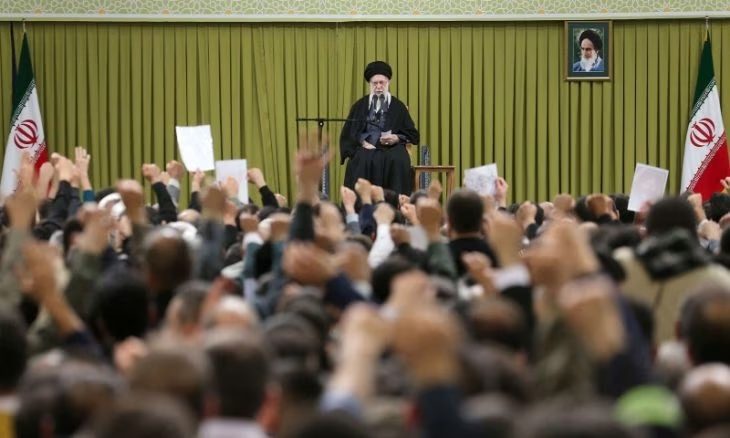
Scenarios of Confrontation Between Tehran and Washington: Difficult Choices for the Iranian Regime

Analytical reports indicate that Iran today faces the most dangerous strategic reality since the 1979 revolution, as an internal legitimacy crisis coincides with serious external threats that endanger the regime's survival. Sources noted that traditional strategies adopted by Tehran, such as regional power projection and suppression of opposition, are no longer sufficient to confront current pressures.

The intensified American military presence in the region, which includes the aircraft carrier 'USS Abraham Lincoln' and advanced air defense systems, stands out as a clear signal from President Donald Trump's administration to shift from a policy of containment to imposing a final solution to the decades-long conflict. Observers believe that Trump seeks to force Tehran to accept an agreement under strict American conditions or face military strikes aimed at dismantling the regime.

Internally, the Iranian regime suffers from severe economic depletion and currency collapse, which has led to the erosion of the social contract. Data revealed the extent of repression in last January's protests, where the deaths of over 6,000 people were confirmed, with thousands of other cases under investigation, reflecting the increasing boldness of the Iranian street in confronting authority despite the heavy cost.

Regionally, Tehran has lost a significant part of its deterrence power after successive Israeli strikes on what is known as the 'Axis of Resistance' since the events of October 7th. Assassinations, cyberattacks, and direct confrontations have exposed the weaknesses of pro-Iranian militias in Iraq, Syria, Lebanon, and Yemen, transforming its regional influence from a source of strength into a strategic burden.

Analyses propose three scenarios for the future of the crisis: the first is a 'forced deal' that limits the nuclear and missile program in exchange for sanctions relief; the second is a 'coordinated war' to cripple the regime's military and leadership capabilities; and the third is an 'uncontrolled collapse' that could turn Iran into an arena of internal conflict similar to the Libyan or Syrian models.

In the absence of European mediation, Russia's preoccupation with the war in Ukraine, and China's caution, the region remains stuck in a logic of escalation. The question now is no longer the possibility of de-escalating the crisis, but rather the extent of the damage expected before reaching the end of this long conflict.

The choice facing the Iranian regime is either to accept a settlement imposed by the United States, or the destruction of the Islamic Republic in its current form.

PALESTINE

Tue 03 Feb 2026 3:34 pm - Jerusalem Time

Hamas: Occupation restricts aid entry to Gaza despite agreement entering its second phase

Hamas spokesman Hazem Qassem affirmed that the Zionist enemy continues to deliberately and strictly restrict the entry of humanitarian aid into the Gaza Strip, denying any tangible improvement on the ground, despite the announcement by various parties that the ceasefire agreement has entered its second phase. Qassem considered these practices a clear violation of the truce understandings and a continuation of the siege policy.

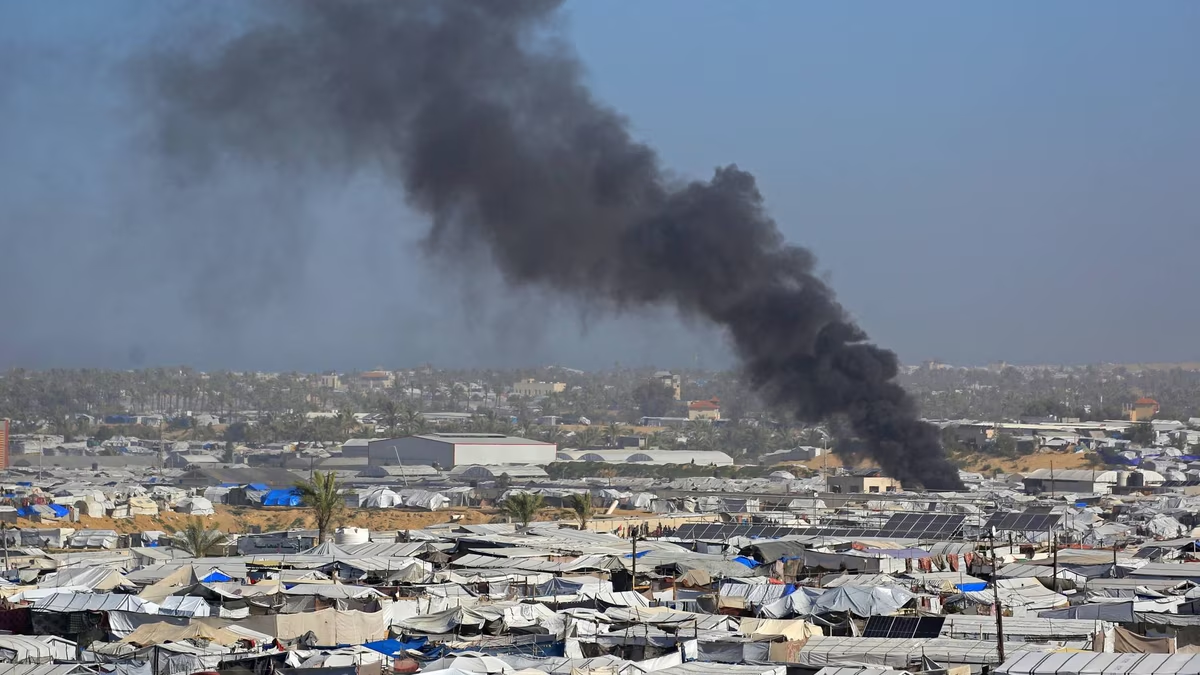
The movement's spokesman warned of the worsening catastrophic conditions for the displaced, especially with the Strip being affected by a new low-pressure system, as thousands of families are in tents that do not protect from the winter cold or rain.

He pointed out that the occupation's prevention of fuel and gas entry, except in very scarce quantities, increases the suffering of citizens and makes daily life a battle for survival in the absence of basic heating and cooking means.

Qassem also exposed the falsity of the occupation's narrative regarding the number of aid trucks, stressing that the figures announced by the so-called 'Civil and Military Coordination Center' affiliated with the occupation are pure fabrication, and that what actually enters does not exceed half of the announced numbers.

The Hamas spokesman called on the international community and the guarantor parties of the agreement to intervene immediately to compel the occupation to open the crossings and allow the flow of humanitarian needs without restriction or condition.

“The figures announced by the so-called 'Civil and Military Coordination Center' affiliated with the occupation are pure fabrication, and what actually enters does not exceed half of the announced numbers.”

ARAB AND WORLD

Tue 03 Feb 2026 2:49 pm - Jerusalem Time

Intensive Gulf-Egyptian Movement to Contain Gaza and Iran Crises and Advance American Plan

The Gulf is moving through an intensive network of political communications led by Saudi Arabia, the UAE, and Qatar, in a coordinated regional effort to contain the repercussions of the escalation in the Gaza Strip and the Iranian nuclear file, within an international scene characterized by high levels of security risks and intertwined political and humanitarian paths.

Egyptian Foreign Minister Badr Abdel Aty held two separate meetings with his Saudi counterpart, Faisal bin Farhan, in Riyadh, and his Emirati counterpart, Abdullah bin Zayed, in Abu Dhabi, where discussions focused on developments in the field and political situation in Gaza, in addition to the regional implications of the tension related to the Iranian nuclear program, according to official statements issued by the Egyptian Ministry of Foreign Affairs.

The consultations emphasized the importance of containing tension and preventing the escalation from widening, while pushing for the activation of political and diplomatic tracks as the most effective option for addressing current crises, amid growing fears of the repercussions of any widespread security explosion on regional stability and global trade and energy movement.

The discussions extensively covered the situation in the Gaza Strip, where emphasis was placed on implementing the requirements of the second phase of the American plan, including supporting the national committee for Gaza administration, accelerating the deployment of an international stabilization force to monitor the ceasefire, ensuring the entry of humanitarian aid, and preparing the ground for the early recovery and reconstruction phase.

During the discussions, the importance of the Rafah crossing emerged as a vital lifeline for the Strip, in addition to the necessity of providing a stable field environment that allows for the launch of reconstruction projects, given the widespread destruction of civilian infrastructure and the complex humanitarian crisis that resulted.

In this context, sources reported that Gaza has entered a highly sensitive political and security phase that transcends the logic of temporary calm, explaining that the Strip has become a real test of the international community's ability to move from managing the conflict to addressing its roots. The sources indicated that the second phase of the American plan carries political and security dimensions that require solid regional consensus, considering that any imbalance in implementation could reproduce cycles of violence in a more complex manner.

The sources clarified that Gaza today represents an intersection point between military deterrence considerations and the re-engineering of the Palestinian political scene, noting that focusing on disarmament without a comprehensive political framework could lead to a dangerous security vacuum. They considered that the success of any sustainable path requires linking reconstruction to a clearly defined political process, ensuring effective Palestinian administration and enjoying regional and international cover.

The sources indicated that the Gulf role, especially through Qatar, gains strategic weight at this stage, given its communication channels with various parties and its ability to link humanitarian and political tracks. They stressed that the absence of this role could open the door to short-term security approaches that deepen instability.

The Gulf-Egyptian consultations moved to the Iranian nuclear file, where emphasis was placed on the priority of diplomatic tracks and creating suitable conditions for resuming dialogue between the United States and Iran, leading to a comprehensive and balanced agreement that limits the possibilities of escalation and enhances opportunities for building trust.

The meetings also discussed other regional developments, including the situation in Sudan, where emphasis was placed on supporting efforts aimed at calming the situation and improving humanitarian conditions, amid the ongoing conflict and the exacerbation of the displacement crisis.

This diplomatic movement reflects a growing Gulf trend towards playing a pivotal role in managing regional crises through multilateral political coordination, relying on mediation tools and preventive diplomacy. Gaza remains at the forefront of this movement, as a real testing ground for the region's ability to produce sustainable stability in a turbulent international environment.

Gaza has entered a highly sensitive political and security phase that transcends the logic of temporary calm, and the Strip has become a real test of the international community's ability to move from managing the conflict to addressing its roots.

PALESTINE

Tue 03 Feb 2026 2:19 pm - Jerusalem Time

Gaza Civil Defense out of service: Complete paralysis warns of humanitarian catastrophe

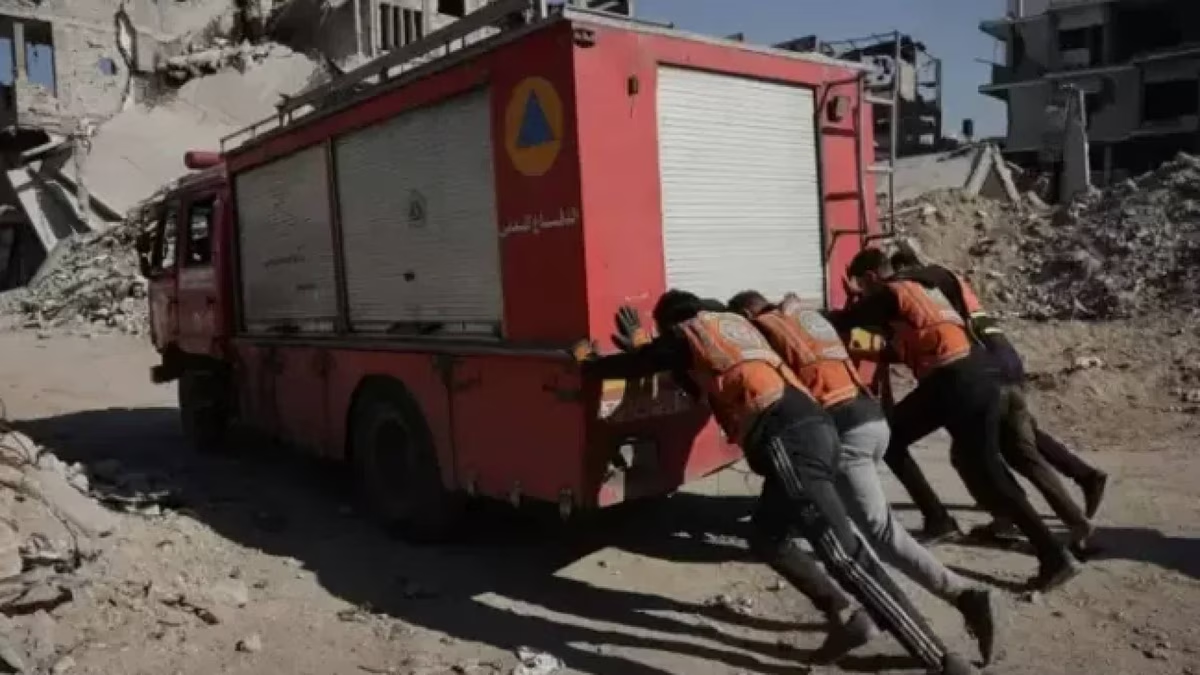
The Civil Defense in the Gaza Strip announced on Tuesday that its vehicles have completely stopped operating due to the unavailability of the minimum amount of fuel needed for humanitarian interventions, warning that this paralysis will exacerbate the suffering of the residents amidst the catastrophic conditions the Strip is experiencing.

The Civil Defense indicated that the depletion of fuel forced the suspension of a number of pivotal tasks, foremost among them body recovery operations, as vehicles became completely unable to move, in addition to the heavy equipment stopping its tasks of removing hazards and rubble.

In a related context, field teams confirmed their inability to respond to distress calls during the recent low-pressure systems, which directly threatens the lives of citizens and doubles the severity of humanitarian crises in affected areas.

In light of this dangerous reality, the Civil Defense issued an urgent appeal to international institutions and humanitarian organizations to intervene immediately and provide the necessary fuel to restart vehicles and equipment, to ensure the continued provision of vital services and alleviate the burden on citizens, warning that the continuation of the crisis means a complete halt to humanitarian operations.

Fuel depletion forced the suspension of a number of pivotal tasks, foremost among them body recovery operations, as vehicles became completely unable to move.

PALESTINE

Tue 03 Feb 2026 12:34 pm - Jerusalem Time

A dead shot by the occupation army in Khan Yunis, and truce violations raise the toll to 526 martyrs

A young Palestinian man was martyred on Tuesday, succumbing to his injuries from being shot by Israeli occupation forces in the city of Khan Yunis, south of the Gaza Strip, at a time when these forces continue their ongoing violations of the ceasefire and truce agreement.

Palestinian medical sources at Nasser Medical Complex stated that the young man was martyred after being shot by the occupation in an area outside the deployment of Israeli forces south of Khan Yunis. According to the same sources, the martyr is Ahmed Mohammed Ahmed Abdel Aal, 19 years old, who was hit by a bullet in the head while in the slaughterhouse area south of the city.

In a related context, civil defense sources reported early on Tuesday the evacuation of another injured person due to occupation forces' fire from Sheikh Nasser neighborhood east of Khan Yunis. The sources indicated that occupation Apache helicopters fired their machine guns towards the eastern areas of the city, while local residents confirmed that military vehicles continued firing east of Al-Bureij refugee and displaced persons camp in the central Gaza Strip.

This comes amid the continued daily violations of the ceasefire agreement by the occupation, which have resulted in the martyrdom of 526 Palestinians and the injury of 1447 others since October 11, 2025, according to the latest data issued by the Ministry of Health on Monday.

The martyr is Ahmed Mohammed Ahmed Abdel Aal, 19 years old, who was hit by a bullet in the head while in the slaughterhouse area south of the city.

OPINIONS

Tue 03 Feb 2026 11:06 am - Jerusalem Time

American Roughness: A Strategic Circumvention of China's Rise

Dr. Ibrahim Nairat

Opinion Writer

A large part of political analysis tends to interpret the behavior of the United States under Donald Trump as a product of exceptional personal traits, combining populism with a tendency towards confrontation and disregard for diplomatic norms. However, this interpretation, despite its prevalence, remains inadequate. It isolates the phenomenon from its structural and strategic context, transforming it into an individual anomaly, instead of reading it as an expression of a deeper shift in how the United States manages its conflict with the most significant rising power in the international system, namely China.

Trump, with his crude style and provocative rhetoric, was not an unexpected actor within the American establishment. He was not an aberration from it as much as he was a moment of revelation for what had accumulated within influential sectors of the Republican Party. These sectors came to believe that the diplomatic system that had governed American foreign policy since the end of the Cold War was no longer capable of dealing with the pattern of China's rise. China did not pursue a path of direct confrontation, but rather adopted a quiet, calculated, and gradual expansionist policy, avoiding military conflict, and quietly accumulating economic, technological, and energy influence in a way that is difficult to contain within traditional liberal rules.

In this context, classical American diplomacy was no longer an effective tool to curb China. On the contrary, it began to be seen as a framework that gave Beijing time and space to expand its influence without direct cost. From this, a new perception began to crystallize within Washington: if China was moving wisely within the system, then confronting this rise required transcending some of its rules. Not through direct confrontation with Beijing, but by circumventing it, and striking at the joints of its non-military expansion, especially in the areas of energy, supply chains, and geopolitical influence.

Here, Trump's nomination for a second term can be understood, despite the Republican Party's prior knowledge of his unconventional style and confrontational practices, even after his loss to Joe Biden. This nomination was not merely a gamble on a controversial personality, but an implicit acknowledgment that this rough style of behavior was now seen as a functional tool in a moment of conflict with a rising power that excels at operating within the system and avoiding direct confrontation.

From this perspective, US policies during that period do not appear to be a random deviation from the institutional path, but a conscious shift towards a more confrontational tactical pattern. A pattern that redefines power, not as the ability to build long-term consensus, but as a direct pressure tool used to break down barriers that are difficult to overcome under traditional diplomacy. In this framework, transcending "political correctness" becomes a working tool, not a moral burden, and breaking liberal rules becomes a means to achieve goals that were difficult to reach under an international system that gives China the advantage of quiet movement.

This shift re-imagines the international system as a zero-sum arena. Not because Washington rejects multilateralism in principle, but because it believes that China benefits from it more than it should. There is no place for value discourse or normative commitments unless they translate into tangible material superiority. This represents a clear break with the traditional liberal conception of American leadership, which has long relied on combining power and legitimacy.

The problem here lies not only in the sharpness of this approach, but in its assumption that breaking the rules will automatically weaken China. Harsh pressure may achieve quick tactical gains, but at the same time, it creates strategic vacuums. These vacuums do not remain unoccupied, but may push China itself, and other powers, to accelerate the construction of alternative networks that reduce dependence on the US-led system.

This circumvention policy is clearly evident in arenas that, at first glance, seem far from China. American dealings with Venezuela, for example, were characterized by unprecedented political and economic escalation. Crippling sanctions and attempts to isolate the regime were justified by fragile democratic rhetoric. But this behavior becomes more understandable when Venezuela is read as a primary source of Chinese oil, and a vital node in the energy network that Beijing is working to secure outside American control.

The same applies to Iran. The conflict does not stop at the nuclear file or regional behavior. Rather, it extends to Iran's position in the global energy equation, and its role in supplying China and its partners with oil. Here, American pressure becomes an attempt to reset the energy arteries that feed China's rise, not merely an endeavor to prevent nuclear proliferation.

Even the Palestinian situation, specifically the war on Gaza, and attempts to impose alternative political paths under names such as peace councils, cannot be separated from this context. The blatant American bias, and the marginalization of international law, reflect the logic of crisis management from a position of power, and the imposition of geopolitical realities in a region central to trade and energy, thereby limiting China's ability to expand its political and economic influence there.

However, this approach does not mean a permanent break with traditional American behavior. What we witnessed was closer to a phase of maximum pressure, aimed at modifying the rules of the game, before returning to a more disciplined facade in form. The United States has historically combined shock and repair, and roughness with the re-production of acceptance. What is imposed by force is not later abolished, but re-presented in more acceptable language.

Nevertheless, another possibility cannot be ignored. This roughness may not be an expression of excessive confidence, but of a structural anxiety about a Chinese rise that is difficult to contain. The American economy faces accumulated internal challenges, while China continues its quiet expansion, without direct provocation, and without giving Washington a clear pretext for confrontation.

In this framework, American behavior can be understood as an attempt to circumvent an adversary that avoids confrontation. But this circumvention is fraught with risks. The rougher the approach, the greater the incentives for China and other rising powers to build a system less dependent on the American center.

Therefore, reducing this phase to the person of Trump or his style remains a misleading simplification. The real question is whether the United States is capable of curbing China's rise by breaking the rules, or whether this approach will, paradoxically, accelerate the reshaping of the international system in a way that diminishes American influence itself. This question does not concern a specific phase, but touches the core of the ongoing struggle over the shape of the global order and the limits of power in an era of multipolarity.


OPINIONS

Tue 03 Feb 2026 10:13 am - Jerusalem Time

The Unwanted Palestinian… A Passport Without a Homeland and a World Without Justice

At airports around the world, Palestinians are not treated as ordinary travelers but as a mobile security file. As if geography was not enough to punish them, the punishment extended to their passport, visa, electronic gate, and the gaze of the border official before stamping entry or refusal. Today, Palestinians are unwelcome in most countries of the world, not because they committed a crime, but because they carry an identity that the international system has decided to keep suspended between suspicion and denial. Security approvals, exorbitant fees, suspended visas, and explicit or implicit bans have made crossing itself a small battle that Palestinians fight alone in humiliating silence.

The irony is that this treatment is not limited to Western countries or those accustomed to viewing the Palestinian issue from a cold security angle, but extends to Arab countries that are supposed to be a support, not a barrier, and a refuge, not a barricade. Here, the scene is no longer just international hypocrisy but transforms into a moral downfall, where the occupation's discourse is replicated with Arab bureaucratic tools and with terminology almost identical to that used in Tel Aviv airports. Security approval, no objection, a sponsor, and under-the-table fees are all procedures presented under the guise of sovereignty, while in essence, they are a form of political punishment for identity.

Palestinians are treated as a problem, not as human beings, because their existence disrupts the prevailing narrative. They are a living witness to a Nakba that has not yet ended and to an occupation that did not turn into a fleeting conflict as they wished. When Palestinians cross, they carry with them a memory that condemns, a history that exposes, and a simple moral question that the world cannot answer without revealing its duality: How can you claim to defend human rights while punishing the victim and rewarding the executioner?

In the Arab context specifically, Palestinians become a political burden, not because their presence is a real security threat, but because it is a symbolic threat. They are a constant reminder that major issues do not die with obsolescence, that normalization does not erase blood, and that peoples do not easily forget. Therefore, some regimes fear them, not because they are armed, but because they carry a different narrative that might awaken consciousness or open deferred questions about freedom, justice, and legitimacy.

The real crime for which Palestinians are punished is that they did not disappear, did not turn into silent refugees, a number in a relief report, or a memory in history books. They insisted on remaining, on holding on to their right, and on being a human being with full rights, not an exceptional case. In a world that opens its borders to corrupt capital and war criminals and closes them in the face of victims, Palestinians become a moral burden before being a security one.

What is happening is not an administrative misunderstanding or a fleeting strictness, but an undeclared policy to control, confine, and strip Palestinians of their most basic human right, which is the right to movement. It is a clear message that tells Palestinians: you are monitored even when you are a victim and suspected because you belong to a cause that has not been resolved in the way they wanted.

Nevertheless, despite this global and Arab siege, Palestinians continue to live. They travel when they can and are prevented when they wish, but they do not abandon their narrative or shed their identity at the airport gate. This is precisely what is unforgivable in the logic of this world: that they remain despite everything, and insist on being human beings, not a security file, and carry their homeland in a fragile passport and a memory that cannot be stamped with prohibition.

OPINIONS

Tue 03 Feb 2026 10:10 am - Jerusalem Time

Gaza Management Committee: Between Declared Independence and Disguised Guardianship

Political writer and researcher

The controversy surrounding the announcement of handing over governance to the Gaza Management Committee raises legitimate questions about the nature of this handover and its actual limits. The issue, at its core, is not about protocol procedures or formal ceremonies, but rather about the essence of the committee's political and administrative independence, and its ability to operate without guardianship or prior pressure.

It does not seem logical for the transfer of powers to an administrative committee to require all this political show, nor for a body that has been absent for years, such as the so-called National and Islamic Forces Committee, to be suddenly summoned to serve as a supervisory or reference framework for the new committee's work. This belated summoning can only be interpreted within a broader political context, beyond concern for partnership or national consensus.

It is noteworthy that these ceremonies are presented to public opinion as evidence of a complete handover of power, while facts indicate continued attempts to influence the committee's work from behind the scenes, whether by objecting to certain names, or by insisting on keeping the committee captive to previous administrative and security structures, thereby transforming the “handover” into a formal procedure that does not touch the essence of actual authority.
More dangerous is the attempt to reproduce the National and Islamic Forces Committee as an alternative political reference, practically placed above the Gaza Management Committee, instead of the natural reference being the Palestinian Authority and the Palestine Liberation Organization. This step does not seem innocent; rather, it carries a clear endeavor to draw Palestinian factions into a loose framework, which may later be used to issue statements and positions in the name of “consensus,” without real authorization or clear institutional representation.

These factions, before appointing themselves as guardians or overseers of the Gaza Management Committee's work, should have had the courage to review and frankly admit the strategic mistake they committed on October 7th and the subsequent miscalculations for which Gaza paid in blood and destruction. Political and moral responsibility requires acknowledging failure before claiming oversight, and self-accountability before imposing guardianship on others.

These forces have spent many years managing a scene of division and paralysis, without succeeding in unifying the national ranks or building a comprehensive vision to confront the escalating challenges. On the contrary, division turned into a managed reality, and quotas entrenched narrow interests at the expense of the public interest, while society became more fragile, and the sector moved closer to the brink of collapse. Their losing bets exacerbated the tragedy, resulting in widespread destruction, thousands of victims, and waves of displacement and forced migration affecting most of the population.

In such a context, it does not seem logical or ethical for these factions to present themselves again as a reference or overseer of a committee that was originally born to address the consequences of previous failures. It would be better for them to step back and allow for an independent professional administration to work away from the legacy of factional conflicts, instead of reproducing their influence through new titles.

The current stage does not need more guardians, but rather a degree of political humility, national honesty, and room for faces and mechanisms capable of managing recovery and reconstruction with a spirit of public service, not a spirit of control. Sometimes, responsible withdrawal is the most courageous national act.

Transforming this body into an undeclared reference threatens to undermine the idea of independent administration from its foundation, and reproduces the logic of quotas and partisan pressures, at a time when the Gaza Management Committee should be given real space to work, away from narrow factional calculations.

Hence, national responsibility dictates early vigilance against these attempts, and not allowing the committee to be encircled from the moment of its birth. The success of any transitional or temporary administration is not measured by the size of the accompanying ceremonies, but by the extent of its independence, the clarity of its reference, and its ability to work freely to serve the people, not to recycle bodies.

OPINIONS

Tue 03 Feb 2026 10:04 am - Jerusalem Time

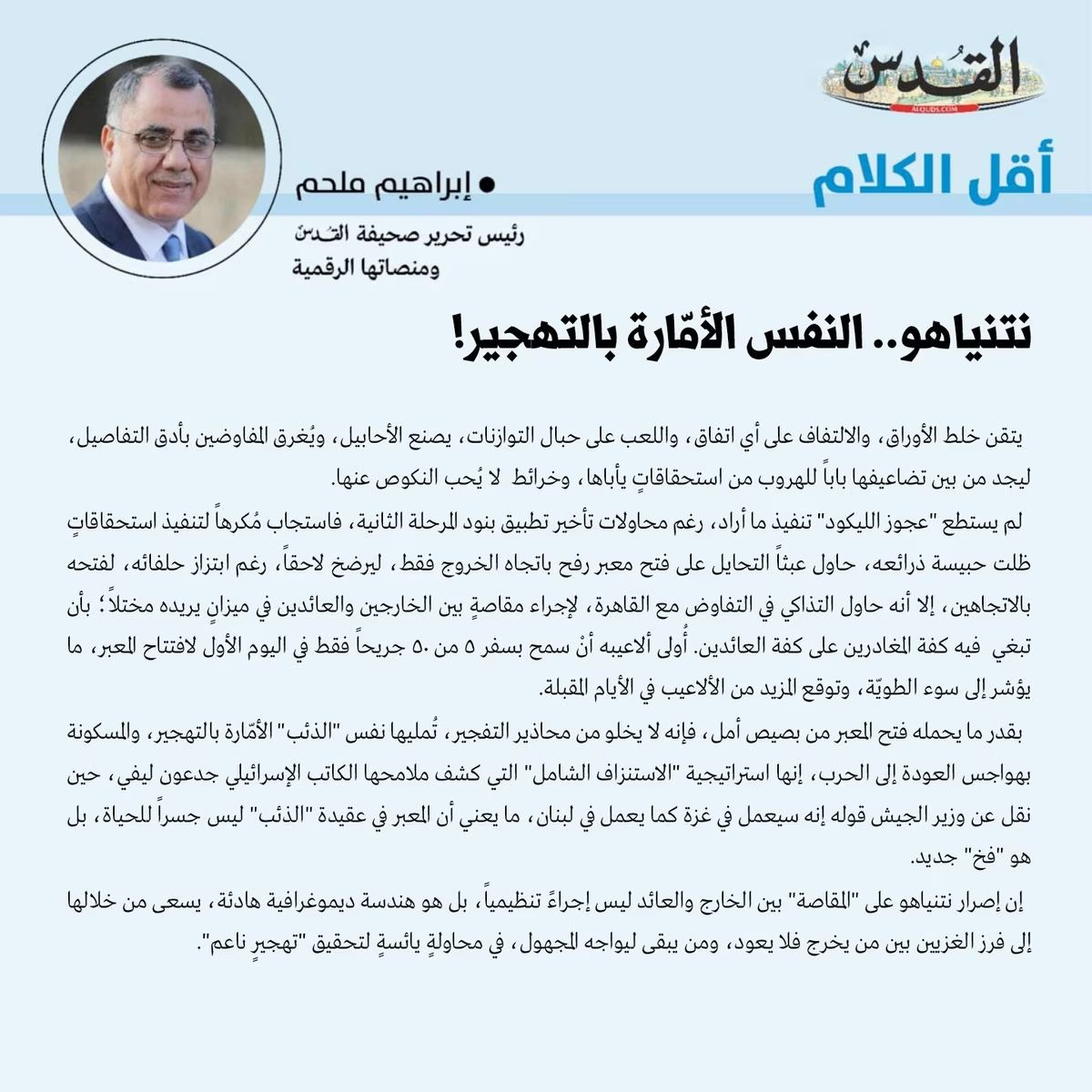
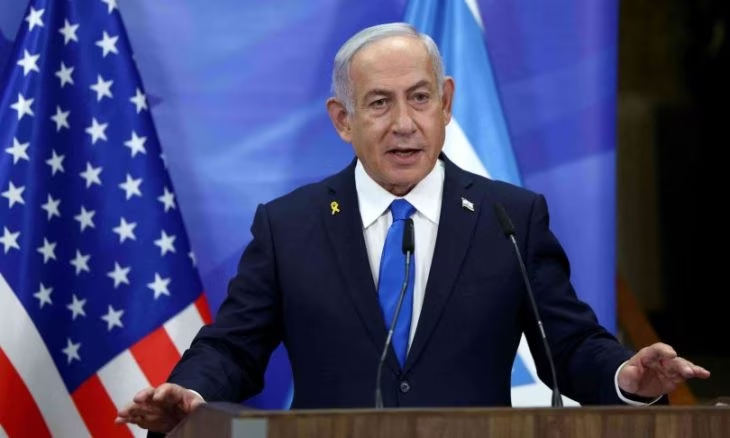
Netanyahu.. The soul that commands displacement!

Dr. Ibrahim Melhem

Editor-in-Chief

The least that can be said

He is skilled at mixing cards, circumventing any agreement, and playing on the ropes of balances. He creates tricks and drowns negotiators in the finest details, to find among their folds a door to escape from obligations he dislikes, and maps he does not like to retreat from.

The "old man of the Likud" could not implement what he wanted, despite attempts to delay the implementation of the second phase's provisions. He reluctantly responded to implement obligations that had been held captive by his pretexts. He tried in vain to circumvent the opening of the Rafah crossing for exit only, only to later succumb, despite the blackmail of his allies, to open it in both directions. However, he tried to be clever in negotiating with Cairo, to make a clearance between those leaving and those returning in a balance he wants to be skewed; so that the scale of those leaving outweighs the scale of those returning. His first trick was to allow only 5 out of 50 injured people to travel on the first day of the crossing's opening, which indicates bad intentions and anticipates more tricks in the coming days. 

As much as the opening of the crossing carries a glimmer of hope, it is not without the dangers of explosion, dictated by the soul of the "wolf" that commands displacement, and is haunted by the obsessions of returning to war. It is the strategy of "total attrition" whose features were revealed by the Israeli writer Gideon Levy, when he quoted the Minister of Defense as saying that he would work in Gaza as he works in Lebanon, which means that the crossing in the "wolf's" doctrine is not a bridge to life, but rather a new "trap."

Netanyahu's insistence on "clearance" between those leaving and returning is not a regulatory measure, but rather a quiet demographic engineering, through which he seeks to sort Gazans between those who leave and do not return, and those who remain to face the unknown, in a desperate attempt to achieve "soft displacement."

ARAB AND WORLD

Tue 03 Feb 2026 10:02 am - Jerusalem Time

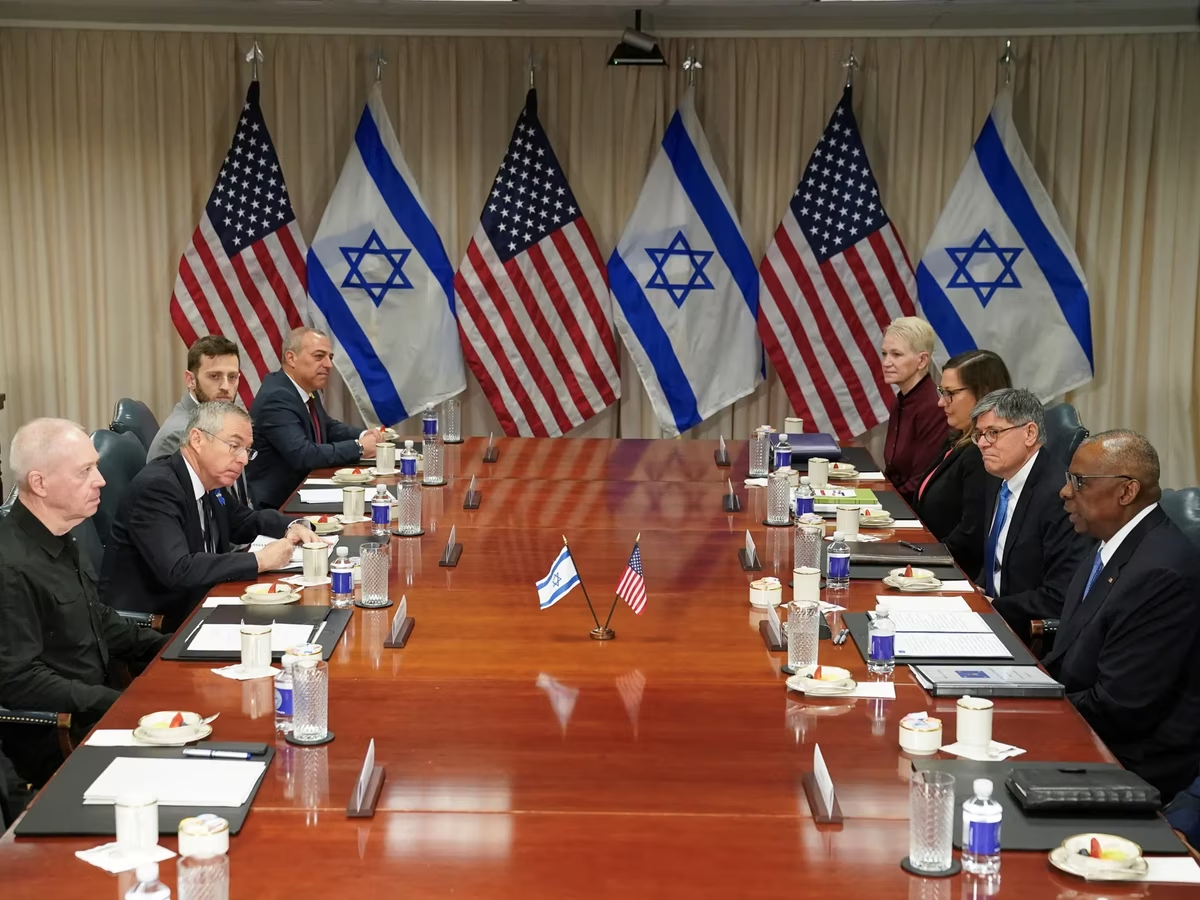
High-level US-Israeli military meeting at the Pentagon amid escalating threat of striking Iran

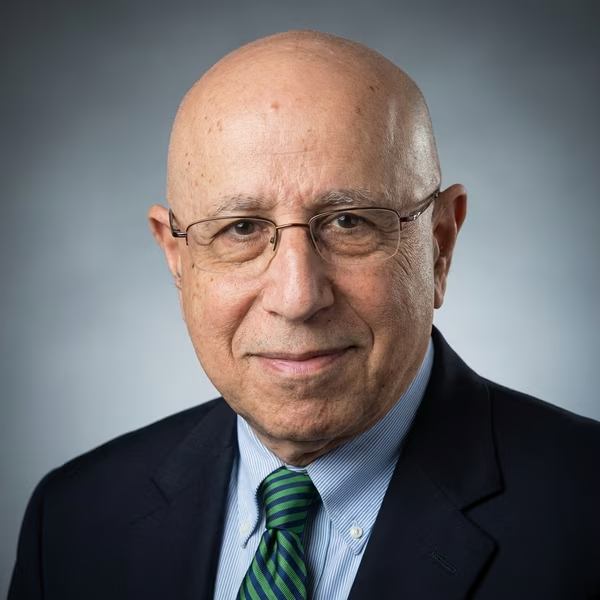
Said Erikat

Opinion Writer

Signals from Washington and Tel Aviv continue to suggest that the Middle East is approaching a phase of military escalation that could redraw regional balance maps, amidst a clear increase in US-Israeli military coordination and an unprecedented intensification of field preparations. In this context, two American officials, who requested anonymity, revealed that the Chairman of the US Joint Chiefs of Staff, Dan Kaine, held a closed meeting at the US Department of Defense (the Pentagon) with the Chief of Staff of the Israeli occupation army, Eyal Zamir, last Friday.

Despite the American officials' refusal to disclose details of the talks, the timing and political and military context of the meeting give it implications that go beyond a mere protocolary nature. According to consistent reports, the United States is deploying additional military assets in the Middle East, including naval and air reinforcements and advanced air defense systems, in a move that reflects readiness for escalation scenarios, not just traditional deterrence measures.

This impression is reinforced by assessments issued from within the Israeli military establishment itself. The Israeli occupation army radio reported, after Zamir's return from his visit to Washington, that the Chief of Staff estimated internally that an American attack on Iran could occur within a period ranging from two weeks to two months. This assessment reflects a high level of confidence within the Israeli military leadership regarding the American decision, and also reveals the depth of strategic coordination between the two parties.

One day before that, "Drop Site News" had reported, in an article published on January 30, that the United States had informed a key Arab ally in the region that President Donald Trump might give the green light for an attack on Iran "very soon." The importance of this information lies not only in its content but also in Washington's choice to convey it in advance to regional capitals, in what appears to be a political prelude to potential repercussions, or an attempt to contain reactions before the event occurs.

Most indicative in this context is what a former American intelligence official, who works as an unofficial advisor to the current American administration and communicates with Arab governments, revealed when he said that the issue "is not about the Iranian nuclear program or the missile program, but about regime change." This statement shifts the essence of the American approach from a technical security framework to a comprehensive political project, and brings back to the forefront the discourse of regime change that has always formed the unstated background of American policy in the region.

This shift in rhetoric points to a chronic political dilemma in dealing with Iran. Instead of investing in negotiation paths or regional security arrangements, there is a direct leap to the military option, as if force alone is capable of re-engineering balances. However, past experiences, from Iraq to Afghanistan and Libya, confirm that overthrowing regimes by force does not produce stability, but rather opens the doors to extended chaos that transcends the borders of the targeted countries.

In this framework, Israeli Prime Minister Benjamin Netanyahu plays a pivotal role in pushing towards confrontation. According to the same American source, Netanyahu "hopes for an attack," and is working to reassure Trump that Israel is capable of contributing to the establishment of a new government in Tehran that would be "friendly to the West." However, this gamble largely reflects an internal Israeli crisis as much as it reflects strategic calculations, as Netanyahu finds in external escalation a means to reproduce deterrence and export his political and judicial crises.

On the ground, the US aircraft carrier "Abraham Lincoln" strike group recently arrived in the Middle East, in a move that confirms that American movements are not limited to political messages. Reports also indicated that the United States is working to strengthen air defense networks in the region, in anticipation of potential Iranian counter-attacks that could target American bases or Israeli territory in the event of a direct confrontation.

In conclusion, these developments suggest that the region stands on the threshold of a highly dangerous phase, where military calculations intertwine with narrow political stakes, and the logic of diplomacy recedes before the allure of power. In light of this scene, it seems that any miscalculation could push the Middle East into a wide regional war, whose trajectories cannot be predicted nor its repercussions controlled, at a time when the cost of previous wars is still present in the memory of the region.

ARAB AND WORLD

Tue 03 Feb 2026 9:58 am - Jerusalem Time

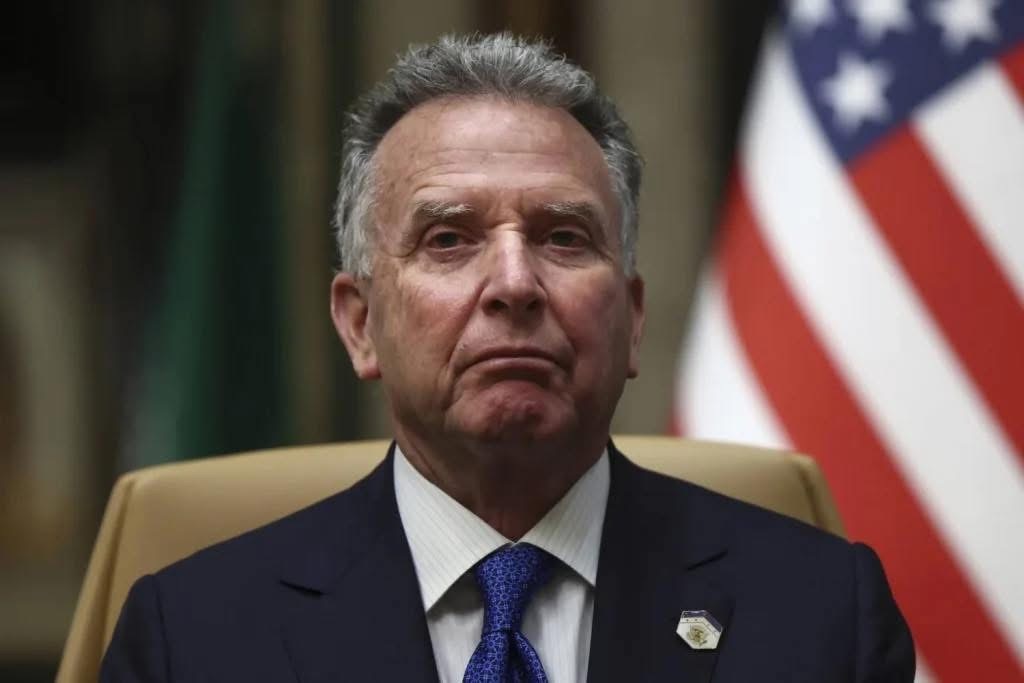
Witkoff in Israel before Istanbul: Diplomacy Race on the Brink of War with Iran

Said Erikat

Opinion Writer

In a regional moment saturated with escalation and conflicting messages, US Special Envoy Steve Witkoff is heading to Israel, where he is expected to hold high-level meetings on Tuesday with Israeli Prime Minister Benjamin Netanyahu and Israeli Chief of Staff Eyal Zamir. The visit, according to Israeli officials, is not merely protocol, but comes in a highly sensitive political-security context, whose central theme is: Iran, and the limits of what confrontation or diplomacy with it can achieve.

Witkoff's visit to Tel Aviv is preceded by a notable visit by the Israeli Chief of Staff to Washington over the weekend, where he held a series of discussions with American defense officials regarding the Iranian nuclear program and the repercussions of any potential military action in the region. This temporal synchronicity clearly reflects the extent of US-Israeli coordination, but at the same time reveals unspoken discrepancies regarding the timing and form of confrontation, or the possibility of containing it through a negotiated path.

According to an American official, the Israel stop is only part of a broader tour, as Witkoff is scheduled to meet with Iranian Foreign Minister Abbas Araqchi on Friday in Istanbul after leaving Tel Aviv, in a meeting arranged with Turkish, Qatari, and Egyptian support, as reported by the American website "Axios". The stated goal is to discuss the possibility of reaching a nuclear agreement, or at least to test Tehran's intentions at this tense stage.

In Washington, President Donald Trump continues his policy of "dual pressure": military threat on one hand, and opening the door to diplomacy on the other. Following the widespread protests in Iran last month, and the violent security response to them, Trump hinted at the possibility of military action and ordered the deployment of an aircraft carrier group to the Middle East. In contrast, he expressed optimism about the possibility of reaching an agreement that would spare the region a comprehensive war.

Tehran was quick to respond. It warned that any American strike would be met with direct targeting of Israel and American bases and interests in the region. The Israeli Prime Minister, in turn, capitalized on this atmosphere in a speech to the Knesset, asserting that Israel is "prepared for all scenarios," and issuing a stern warning that "whoever attacks us will face unbearable consequences."


But behind this public escalation, back channels are advancing. Iranian media reported that President Masoud Pezeshkian issued a directive to begin nuclear talks with the United States, a development reflecting an Iranian awareness of the sensitivity of the stage. Iranian Foreign Ministry spokesman Ismail Baqaei confirmed that regional countries are playing a mediating role in exchanging messages, noting that the diplomatic process is being discussed in terms of "methodology and framework," with hope for its completion within days.

It is worth noting that Iranian Foreign Minister Abbas Araqchi said, in an interview with CNN, that he believes an agreement with Washington is possible, indicating Tehran's desire to avoid an open confrontation scenario, without abandoning its deterrent cards.

Regionally, a clear Jordanian stance emerged, as Foreign Minister Ayman Safadi, in a call with his Iranian counterpart, stressed that Jordan will not be a battlefield or a platform for any military action against Iran, affirming Amman's rejection of violating its airspace or endangering its internal security. This stance reflects growing Arab concern about the repercussions of any widespread clash.
As for Russia, the Kremlin reiterated its readiness to play a role in de-escalating tensions, including a proposal to process or store enriched Iranian uranium, a file that Moscow says has been on the table for a long time and constitutes one of the tools for de-escalation.

All of this is taking place against the backdrop of last year's war, during which Israel targeted Iranian nuclear and missile sites, and Tehran responded by launching hundreds of ballistic missiles and drones, resulting in casualties and injuries within Israel. While Iran denies seeking to possess nuclear weapons, international and Israeli reports indicate high enrichment levels, restrictions on inspectors' work, and an expansion of the missile program, keeping the specter of confrontation strongly present.

Witkoff's visit reveals that American diplomacy is not operating in a vacuum, but under the umbrella of intense military pressure. Washington is not negotiating from a position of retreat, but from a position of dictating the pace. However, this approach, which has previously proven limited with Iran, may lead Tehran to buy time instead of making fundamental concessions. The real question is not whether both parties want an agreement, but what kind of agreement, and at what internal political cost for each.

Israel appears to be more of a pressuring player than a negotiating party. Netanyahu's escalatory rhetoric serves deterrence, but carries the risk of entanglement, as Tel Aviv may find itself in the midst of a confrontation whose pace it cannot control if diplomatic efforts fail. The irony is that the most Israel wants is to prevent a nuclear Iran, but the least it wants is a long-term regional war that drains its military and economic capabilities.
The positions of Jordan, Turkey, Qatar, and Egypt reflect a regional understanding that any US-Iranian clash will not be contained. The entire region will be an arena for security and economic repercussions. Therefore, these countries are acting not out of a love for mediation, but out of fear of an explosion. However, their ability to influence remains limited unless there is a genuine will from Washington and Tehran to break the logic of the brink.

PALESTINE

Tue 03 Feb 2026 9:21 am - Jerusalem Time

Hamas disarmament takes center stage after Israel recovers all its hostages from Gaza

Media sources reported that after the recovery of the last hostage's body from the Gaza Strip, negotiations to resolve the conflict entered a crucial phase centered on disarming the Hamas movement. Washington believes that this path may be linked to provisions related to a general amnesty and comprehensive reconstruction programs for the Strip, with American officials expressing confidence that the movement's leadership is considering the possibility of transforming into a new political entity, considering any retreat from disarmament a breach of agreements.

In contrast, the Hamas movement adopts a completely different stance, with Hussam Badran, a member of its political bureau, stating that the issue of Palestinian weapons is an internal sovereign matter concerning the Palestinian people alone, emphasizing the movement's categorical rejection of resolving this issue under external pressure. The movement affirmed that it has fulfilled all its commitments stipulated in the first phase of the ongoing understandings.

For his part, Israeli analyst Roman Yanushevsky considered that Israel has effectively closed one of the most painful chapters in its history with the return of the last hostage's remains, asserting that the real tests will begin now. He indicated that the next phase will determine whether international pressure is capable of dismantling Hamas's military and political control in Gaza, which is the second strategic objective that remains unresolved despite achieving the goal of recovering the hostages.

In a related context, the United Arab Emirates denied any connection to the future administration of the Gaza Strip, emphasizing that the administration of the Strip is the sole responsibility of the Palestinian people. On the ground, the Israeli army demolished the home of the perpetrator of the 'Gush Etzion' operation in northern Hebron, while the Rafah crossing witnessed the entry of a limited number of returnees amidst a suffocating humanitarian crisis faced by thousands of sick and wounded awaiting an opportunity for treatment abroad.

ANALYSIS

Tue 03 Feb 2026 9:21 am - Jerusalem Time

From War to Humanitarian Crisis: How Are Global Cultural Institutions Reshaping the Gaza Narrative?

The language used in statements issued by international cultural institutions regarding what is happening in Gaza has undergone a remarkable shift towards what has become known as 'white language', which are formulations that do not accurately reflect the reality of a region subjected to continuous bombardment under a complete siege for more than two years. In statements issued by major film festivals, global museums, and artistic and literary associations, expressions such as 'humanitarian crisis', 'the current situation', and 'humanitarian suffering' have been repeatedly used, in contrast to a clear decline in the use of the term 'war on Gaza' as a direct description of what is happening on the ground.

This linguistic shift coincides with the language of international political statements and declarations, which in turn adopt general humanitarian vocabulary, allowing these formulations to become a ready linguistic reference within the cultural field, without naming the perpetrator or referring to the military context. A question arises about these institutions' recourse to a 'safe' linguistic reference, and whether this is due to concerns related to funding or adherence to a specific political lexicon.

A few weeks after the war began in October 2023, international institutions adopted a lexicon that focuses on the humanitarian impact and moves away from describing military action. Sources from the United Nations (OCHA) reported that 'the humanitarian situation in the Gaza Strip continues to deteriorate', while UNRWA described what was happening as a 'catastrophic humanitarian crisis', with a clear focus on the outcomes without naming the war.

This lexicon has settled at the highest levels of international discourse; in October 2023, the UN General Assembly called for an 'immediate and sustained humanitarian truce', and the Security Council reiterated the same formula in its Resolution 2720, speaking of 'urgent humanitarian needs'. This lexicon automatically transferred to cultural institutions to avoid direct confrontation with politics, where the European Union described the situation in January 2024 as 'catastrophic' without reference to military operations.

In the American context, official statements focused on 'humanitarian pauses' instead of 'ceasefire' in the early stages. This trend found its way into the discourse of the 'Venice Biennale' in April 2024, where the opening of the Israeli pavilion was linked to 'an agreement for a ceasefire and the release of hostages' without mentioning the war, which was echoed in American museums that used the description 'ongoing humanitarian suffering', and in the 'Sundance' festival which presented Gaza films as 'stories from affected communities'.

In cases of excluding artists due to their stances, institutions used phrases such as 'the sensitivity of the current moment' as a crisis management tool. This alignment with the political lexicon is not a coincidence, as these institutions operate within funding and governance systems linked to states, and their statements pass through legal advisors who seek formulations that do not raise concerns, thus granting them moral and legal cover at the expense of accuracy in describing the bitter Palestinian reality.

PALESTINE

Tue 03 Feb 2026 9:21 am - Jerusalem Time

Wall of Tears in New York documents the names of 18,000 children martyred in Gaza

In the heart of New York City, the 'Wall of Tears' stretches along a Brooklyn street, bearing the names of 18,457 Palestinian children killed by Israel in the Gaza Strip over the past two years, specifically between October 7, 2023, and July 19, 2025. The mural, unveiled on Thursday, was designed by American artist Phil Buehler, who arranged the names of the victims chronologically according to their deaths, based on data from the Gaza Ministry of Health, accompanied by individual photos and stories about them.
The mural begins with the name of the boy Wissam Iyad Mohammed Abu Fsaifes (14 years old) and ends with the girl Sabah Omar Saad Al-Masri (8 years old), and between them are thousands of children killed by Israel up to July 2025. However, the mural excludes victims who fell after that date, due to the last update of the health authorities' database in Gaza at that time.

The ivory-colored mural is 50 feet long and 10 feet wide, made of waterproof vinyl coated with a UV protective material, and was executed by the artist in collaboration with the organization 'Radio Free Brooklyn'.

Buehler, 69, said in press statements: 'This is perhaps one of the most emotionally difficult works I have ever done. I always remember Stalin's saying: The death of one person is a tragedy, and the death of a million people is just a statistic. People may sympathize with the suffering of one person, but they quickly ignore or drown in a sea of suffering in the face of thousands of victims. The destruction and death in Gaza are a prime example of this.'

He added: 'I hope that through this artwork you can realize the magnitude of the tragedy of 18,457 children dying, by seeing their names stretch 50 feet along the street, and that you will sympathize with their surviving families.' The artist noted that from a distance, the artwork looks like an abstract painting that attracts people, before they discover that they are the names of children killed in Gaza.

Buehler continued: 'You will be more drawn to seeing the faces and reading some of their stories that I distributed along the wall. This is what truly affects me; you see these faces full of joy and hope, snapshots from graduations and birthdays, and you know that the lives of these children ended suddenly.'

The artist launched his mural coinciding with the second anniversary of the death of Hind Rajab, the five-year-old girl who was left to bleed to death among the bodies of six of her family members, after an Israeli tank targeted their car with 335 bullets, according to the research group 'Forensic Architecture'.

It is worth noting that Buehler previously designed massive murals including the 'Wall of Lies' which displayed President Donald Trump's lies during his first term, and the 'Wall of Shame' which documents the events of the January 6 Capitol attack, in addition to a work addressing the issue of Ukrainian children.

ANALYSIS

Tue 03 Feb 2026 9:21 am - Jerusalem Time

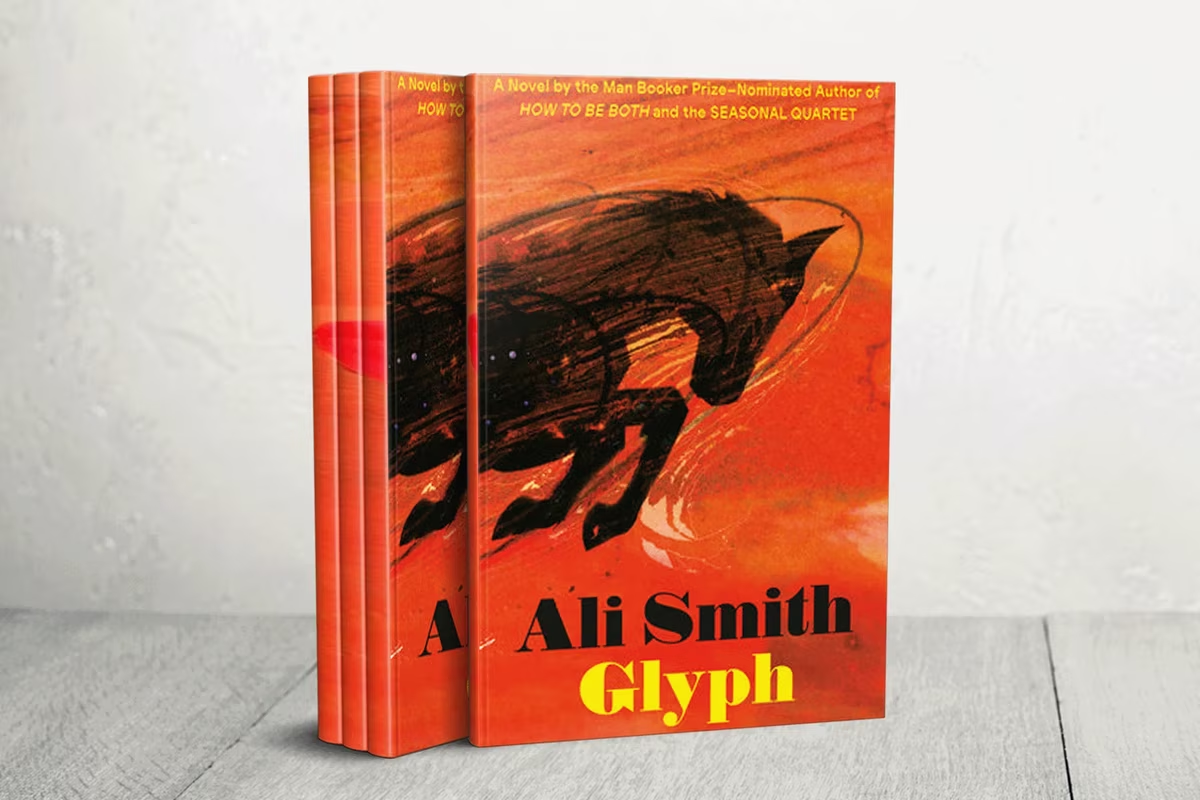
'Glyph' novel traces the impact of the Gaza war and explains 'surveillance capitalism' through the eyes of children

At the beginning of 'Glyph', the new work by Scottish novelist Ali Smith, a phone conversation takes place between two sisters; Patch asks her sister Petra if she has read the book she recently sent her? Petra replies cautiously: 'I thought it was well-written and everything, but it was a bit dark for me, and perhaps too clever and politically burdened for a novel.' For readers who have read Smith's previous novel 'Gliff' (2024), this dialogue will seem like an intentional 'literary joke'; the new novel is divided into three parts with evocative titles such as 'Wink' and 'Nod'. The reader quickly confirms that the book the sisters are discussing is 'Glyph' itself: a story about Prior and her younger sister Rose as they navigate life in a future world governed by 'surveillance capitalism', where the marginalized silently disappear.

While the previous novel looked to the future, 'Glyph' brings us back to our present time with its familiar pains. The text echoes the ongoing war in the Gaza Strip, the arrests of protesters in the United Kingdom, the rise of right-wing currents, the spread of fears about immigrants, and the concern about the dominance of artificial intelligence over jobs; all these events appear as fleeting threads in the narrative fabric. With this engagement with the present moment, 'Glyph' seems like an extension of Smith's 'Seasonal Quartet' (2016-2020), which she wrote and published in real-time, responding to ongoing events as they were still unfolding.

The publisher describes the relationship between the two novels as 'familial'; while there is no continuation of plot or characters, the two books clearly speak through recurring echoes: pairs of siblings, horses, and reflections on the art of storytelling. The term 'companionship' appears at the end of the novel during a discussion about how to comfort a blind horse, where an expert suggests providing a 'companion animal' (a donkey or goat) to care for it and keep it company. In a way, the relationship between Smith's novels seems similar to this dynamic; they support each other in a narrative language characterized by experimental innovation and wordplay.

The sisters Petra and Patch grew up with a mother suffering from psychological problems and a harsh father, which led Petra to play an overly protective role towards her 'sensitive' younger sister. Two war-inspired stories emerge in the novel, leaving a deep impact on the sisters: one about a blind horse and a young soldier in the trenches, and the other about a terrifying encounter with death at the end of World War II. These stories haunt the text and the sisters alike, blurring the lines between reality and fiction, and raising fundamental questions about the ethics of using 'reality' as raw material for creating 'imagination'.

The novel sometimes leans towards 'metafiction', meaning the novel talking about itself, a topic that has become common in contemporary literature. Although Smith does not offer fresh insights in this area, the true value of her work lies in 'testimony'; over seven novels published in the past decade, she has presented a dynamic and engaging picture of how we live now.

Smith excels at portraying the relationship between the sisters, especially in childhood scenes; her innovative language appears in its most beautiful form, revealing a bond that combines care, play, and love. The novel also confirms Smith's exceptional ability to write child characters with astonishing realism, adopting their curiosity and fresh perspective on the world. 'Glyph' is a novel that combines human depth and psychological analysis, affirming that literature in moments of great transformation is not a luxury, but a means of understanding the forces that reshape our world between the 'light' of creativity and the 'darkness' of reality.

PALESTINE

Tue 03 Feb 2026 9:03 am - Jerusalem Time

Israeli Analysts: Netanyahu's Government Bets on Failure of Trump's Plan to Regain Control of Gaza

Two Israeli analysts believe that Benjamin Netanyahu's government hopes for the "failure" of the second phase of US President Donald Trump's plan for Gaza, with the aim of regaining full control of the strip, according to Hebrew media reports today, Friday. These analytical readings come as the United States began implementing the second phase of the plan in mid-January, despite repeated Israeli demands for its postponement.

The second phase of Trump's plan, consisting of 20 clauses, includes reopening the Rafah crossing, disarming Hamas and other Palestinian factions, implementing an additional withdrawal of Israeli army forces, and initiating reconstruction efforts. However, a gap in visions emerges; Netanyahu's government stipulates the completion of disarmament before any reconstruction begins, while Washington insists on implementing the steps in parallel.

Amos Harel, military analyst for "Haaretz" newspaper, explained that current Israeli policy is betting on the collapse of American efforts to impose a new security and political reality. He added that the Israeli right hopes to receive a "green light" from President Trump to attempt to regain effective control and forcibly disarm Hamas, a path Netanyahu might choose if it guarantees his stay in power and electoral gains.

Harel indicated that the Trump administration gave Hamas a deadline of approximately 100 days for the organization to disarm, and in case of failure, Washington would have to intervene or leave the task to Israel. The analyst revealed that the Israeli army has already prepared operational plans to control the strip in the event of the agreement's collapse, with current directives not to obstruct implementation to avoid angering the US administration.

For his part, Nahum Barnea, analyst for "Yedioth Ahronoth" newspaper, confirmed that Netanyahu is awaiting an "explosion" resulting from Hamas's refusal to voluntarily surrender its weapons, paving the way for a resumption of fighting, occupation of the strip, and remaining there. Barnea warned of the difficulty of this option, noting that Hamas still controls the population despite two years of fierce war and heavy losses.

It is worth noting that the current ceasefire agreement came after a devastating war that resulted in the martyrdom of more than 71,000 Palestinians and the injury of 171,000 others, in addition to massive destruction affecting 90% of the infrastructure, in a humanitarian catastrophe whose reconstruction cost the United Nations estimated at about 70 billion dollars.

PALESTINE

Tue 03 Feb 2026 9:03 am - Jerusalem Time

Seeds of Solidarity: International Artists Launch London Auction to Support Gaza Doctors

An art auction titled "Seeds of Solidarity" will be launched in the British capital, London, on Sunday, organized by the "Health Workers for Palestine" organization. The proceeds from this auction are dedicated to supporting the Gaza Doctors Solidarity Fund, which is responsible for providing salaries to healthcare workers, supporting mobile clinics, and contributing to the reconstruction of maternity wards damaged by the ongoing events.

The auction features artworks by 21 international visual artists, including Mona Hatoum, Lisa Brice, Caroline Walker, Alison Wilding, Sam Durant, and Rana Begum. Also prominent in the auction is artist Hassan Hajjaj, who donated a portrait of the famous hip-hop artist Yasiin Bey (formerly known as Mos Def). Zeina Saleh, a British-Palestinian art curator, is overseeing the auction. She previously led the "Voices for Palestine" initiatives, which successfully raised over $1.4 million in the past two years, with the participation of major artists such as Banksy and Peter Doig.

The auction witnessed significant donations, with the internationally renowned sculptor Gormley, a Turner Prize winner, contributing his artwork "Threshold 23" (produced in 2025), executed in ink on paper. Musician and visual artist Eno also contributed his artwork "View Through the Sky" (2025). These widespread participations reflect the extent of global artistic commitment to the humanitarian cause in the Gaza Strip.

In this context, Omar Abdel Mannan, founder of "Health Workers for Palestine" and a resident doctor in London, affirmed that the auction represents a strong message that art is an effective means of change. Abdel Mannan, who accompanied the first child evacuated from Gaza to the UK for treatment in July 2025, explained that the auction combines creativity and public conscience to provide tangible support to medical personnel working amidst unprecedented violence and deprivation.

Abdel Mannan added that the generosity of the participating artists transforms this event into a large-scale act of solidarity, noting that every artwork sold represents not only creative value but also a moral commitment to protecting life and affirming human dignity. He stressed that culture has a pivotal role to play in confronting moments of historical injustice.

TECHNOLOGY

Tue 03 Feb 2026 8:35 am - Jerusalem Time

Russian scientists develop smart fertilizers that adapt to soil types and crops

Scientists at Ogarev State University in the Republic of Mordovia, Russia, have successfully developed innovative smart fertilizers capable of adapting to different soil types and agricultural crops, according to official sources from the university's public relations department.

The statement clarified that the new technology relies on releasing nutrients to plants within a specific timeframe, where the release rate of components is controlled in line with external environmental conditions. This ensures the fertilizers remain active for extended periods and maintains an optimal and stable nutritional level for plants without the need for frequent application.

These fertilizers gain particular importance in regions suffering from unstable weather conditions or low soil fertility. Dmitry Glushko, Rector of Mordovia State University, indicated that this innovation represents a strategic step towards enhancing the country's food security, emphasizing that the project primarily aims to reduce the quantities of chemical substances used and lower environmental pressure while increasing crop productivity.

For her part, Lyudmila Klimayeva, a researcher at the university's Electrocatalysis Laboratory, stated that the project is currently undergoing field tests after successful laboratory synthesis. Work is underway to optimize component ratios and develop production methodology based on real-world results.

In a related context, Talina, one of Russia's largest agricultural companies, has shown great interest in the project. It is expected to be the main consumer of these innovative fertilizers once the testing and approval phases are completed.

It is worth noting that this development comes within the framework of Russian scientific trends to integrate technology into the agricultural sector to ensure resource sustainability and improve the quality of food production in the face of climate challenges.

PALESTINE

Tue 03 Feb 2026 7:34 am - Jerusalem Time

British Ambassador outlines his country's priorities at the Security Council and refuses to apologize for the 'Balfour Declaration'

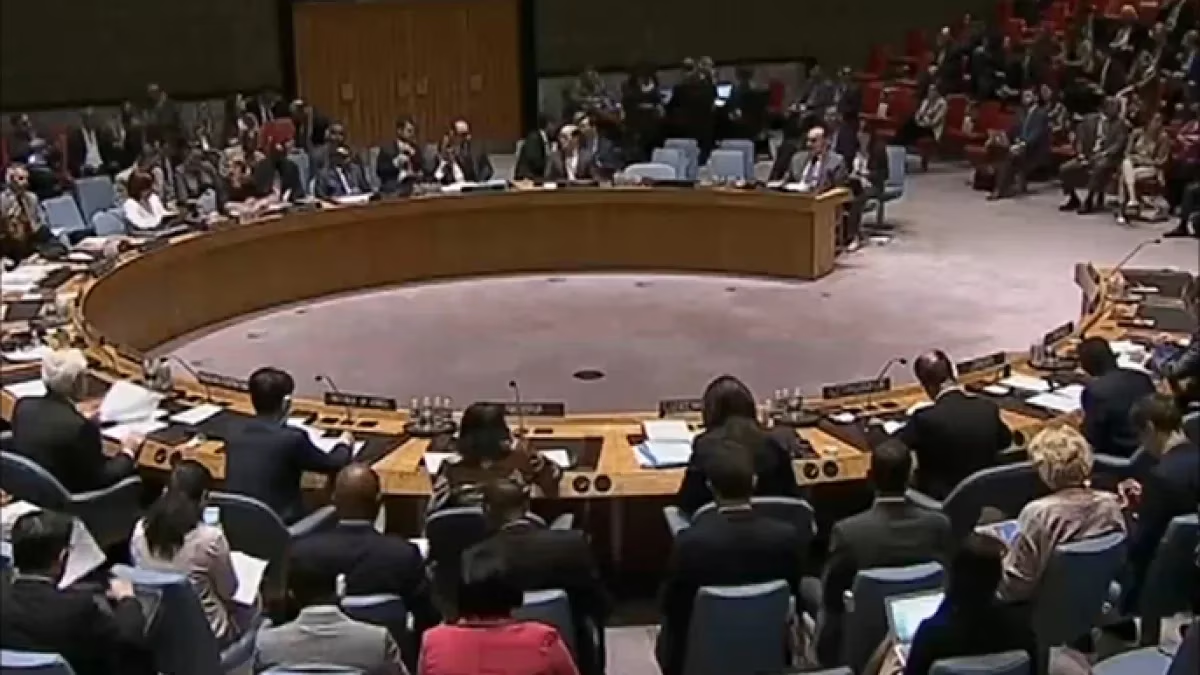
British Ambassador James Kariuki, Chargé d'Affaires of the United Kingdom Mission to the United Nations, held a press conference at the organization's headquarters on the occasion of his country assuming the presidency of the UN Security Council for February 2026. Kariuki presented a detailed overview of the Council's work program, emphasizing that Britain's priorities are focused on three main issues: Ukraine, Sudan, and the Gaza Strip.

In response to questions about how the United Kingdom's recognition of the State of Palestine (announced last September) would translate into practical steps, the Ambassador described this recognition as a "historic" political step aimed at creating international momentum to support the two-state solution. He explained that this step contributed to creating the political environment that later led to the twenty-point plan approved by the Security Council, noting that it is part of a long path aimed at a final settlement that guarantees the security of both states.

Regarding historical responsibility for the "Balfour Declaration," the Ambassador apologized for not answering a question about offering a formal apology to the Palestinians, stressing that he would not enter into a debate about "ancient history." He merely reiterated London's commitment to the two-state solution as the only viable framework, without addressing a re-evaluation of his country's historical role in the genesis of the conflict.

Concerning the situation in Gaza, Kariuki stressed that the Security Council, through Resolution 2803, approved the political plan that led to the ceasefire, considering that its sustainability requires strict adherence to the terms of the agreement. He pointed to the necessity of opening all crossings, including the Rafah crossing, fully and regularly to increase the flow of humanitarian aid, which remains below the level of the great needs in the Strip.

The Ambassador added that the British vision for the next phase requires building on the ceasefire by disarming the Hamas movement and dismantling its military capabilities, in parallel with an Israeli withdrawal that paves the way for a Palestinian civil administration of Gaza's affairs. He considered that the establishment of a national committee to manage the Strip represents a pivotal step, provided that the deterioration in the West Bank is addressed to reach a comprehensive political settlement.

Kariuki also touched upon the Security Council delegation's recent visit to Lebanon, noting meetings with the Lebanese government and army. He pointed to a limited improvement observed in direct communication channels between Lebanese and Israeli authorities within the coordination mechanism concerned with de-escalation, despite the continued violations related to Lebanese sovereignty.

ARAB AND WORLD

Tue 03 Feb 2026 6:05 am - Jerusalem Time

Confrontation Scenarios: US Military Options for Dealing with Iran in the Trump Era

The United States has significantly bolstered its forces in the Middle East recently, particularly through the deployment of a naval group led by the aircraft carrier “USS Abraham Lincoln,” following President Donald Trump’s threats of military action against Iran. The options available to Washington range from executing precise strikes with specific targets to a broad military campaign aimed at weakening the Islamic Republic or overthrowing its leadership.

President Trump hinted at military intervention in support of participants in anti-government protests in Iran that erupted late last December and faced a crackdown that resulted in thousands of deaths. The US fleet currently includes the “Abraham Lincoln” carrying more than 80 aircraft, in addition to its accompanying “strike group” which includes three destroyers equipped with Tomahawk missiles and anti-missile capabilities, with an attack submarine recently arriving in the region’s waters.

These movements enhance existing US military capabilities, as Washington deploys four mine countermeasures ships in Bahrain to secure the Strait of Hormuz, and dozens of aircraft at airbases in Qatar, the UAE, and Jordan. Air traffic tracking sites also detected the arrival of transport aircraft carrying air defense batteries and squadrons of F-15 fighters to bolster air presence.

On the political front, President Trump expressed hope of avoiding military action, but warned Tehran that time was running out to reach an agreement on its nuclear program. Analysts believe that the strikes launched by the United States on Iranian nuclear facilities in June 2025, during the Israeli war on Iran, raised the bar for American demands to include a complete halt to enrichment, restriction of ballistic missiles, and dismantling the influence of regional allies such as Hezbollah and the Houthis.

Regarding the limited strike scenario, sources indicate the possibility of targeting ships exporting Iranian oil to cripple the economy, or striking air defense systems and drone launch platforms, similar to operations carried out last June. These strikes could also include sites belonging to the Revolutionary Guard and “Basij” forces based on precise intelligence.

As for the widespread strike scenario, it could target the pillars of the Iranian regime starting from the top, including Supreme Leader Ali Khamenei and senior political officials and Revolutionary Guard leaders. This strategy aims to paralyze the command and control chain, with the gamble that these airstrikes will mobilize the Iranian street to bring about change from within.

Despite the damage it sustained in the June 2025 confrontations, Iran still retains deterrent capabilities, including between 1500 and 2000 medium-range ballistic missiles capable of striking Israel, cruise and anti-ship missiles, in addition to squadrons of drones and fast boats, making any military confrontation fraught with widespread regional risks.

ISRAELI AFFAIRS

Tue 03 Feb 2026 5:19 am - Jerusalem Time

Netanyahu Seeks Presidential Pardon Without Remorse or Retirement: A Political Earthquake in Israel

The decision by the head of the occupation government, Benjamin Netanyahu, to formally approach Israeli President Isaac Herzog with a request for a pardon, has sparked a massive wave of internal debate about the state's identity and the authorities' powers. This request comes at a sensitive time, as Netanyahu aims to obtain a pardon without offering any apology or showing remorse, and most importantly, without any indication of his intention to leave the political arena, which was widely considered an attempt to impose a new reality that bypasses the judicial process.

Opposition circles quickly condemned this move, with opposition leader Yair Lapid calling on President Herzog not to grant the request unless Netanyahu commits to permanently retiring from political life. The opposition accused Netanyahu of trying to divert attention from his government's efforts to pass the 'Conscription Law,' which exempts Haredi Jews from military service, and which is scheduled to begin deliberation in the Knesset tomorrow, Monday.

For his part, President Herzog's office confirmed that the request was referred, according to established procedures, to the pardon department in the Ministry of Justice to gather the necessary legal opinions. The office noted that this request is 'exceptional and has serious implications,' emphasizing that the President will consider it responsibly and seriously after completing all consultations with the legal advisor and relevant parties.

Netanyahu's request included a detailed letter from his defense lawyer and a personal one, in addition to a video in which he tried to justify the move as aiming to mend internal divisions. Netanyahu said in his letter that despite his interest in proving his innocence through trial, 'the public interest dictates otherwise' in light of the security challenges and historic political opportunities facing Israel in the Middle East, emphasizing his need to dedicate his full time and energy to these tasks.

Unlike typical pardon requests, Netanyahu's file did not include any admission of wrongdoing, but rather stressed that the criminal proceedings against him harm the state's interests and fuel divisions. He pointed out that the current pace of the trial, which consumes most days of the week, constitutes a heavy burden that prevents him from performing his duties as prime minister and dealing with vital issues such as the judicial system and the media.

In the same context, sources revealed that this move comes after external pressure and recommendations, as former US President Donald Trump had publicly called on Herzog to grant Netanyahu a pardon during his visit to the Knesset about a month and a half ago, followed by an official memorandum 20 days ago. While government ministers, including Defense Minister Yoav Gallant, blessed this step to stop 'internal bleeding,' observers and legal experts described it as an attempt to escape the imminent danger of conviction in corruption cases that began investigations a decade ago.

ARAB AND WORLD

Tue 03 Feb 2026 5:19 am - Jerusalem Time

New American Documents Re-Highlight Jeffrey Epstein's Relationship with the Mossad

Documents released by the U.S. Department of Justice concerning billionaire Jeffrey Epstein, convicted of operating a sex trafficking network, have reignited controversy regarding his connections to the Israeli intelligence agency (Mossad). A report from the U.S. Federal Bureau of Investigation dating back to October 2020 highlighted allegations suggesting Epstein's potential ties to the Mossad, based on a confidential informant's testimony, details of which were recently published.

The informant claimed that law professor Alan Dershowitz wielded extensive influence, noting that Jared Kushner, son-in-law and advisor to U.S. President Donald Trump, was among his students. The documents stated that Dershowitz informed former U.S. Attorney for the Southern District of Florida, Alex Acosta, that Epstein had connections with American intelligence agencies and those of allied countries. Communications between Dershowitz and Epstein were also observed, followed by contact from Israeli intelligence.

Regarding the Israeli aspect, the informant revealed that Epstein was close to former Israeli Prime Minister Ehud Barak, and that he was groomed during Barak's tenure (1999-2001) in the context of intelligence activities. The documents include email correspondence, such as a 2018 message in which Epstein asked Barak to deny working for the Mossad, and another in 2017 inquiring about using former Mossad agents for investigations.

Following the release of these documents, analysts and social media users linked the timing of their disclosure to President Donald Trump's policy towards Iran. Some considered these files to be used as a "political pressure tool" or a "dagger pointed" to push the American administration towards military escalation against Tehran, coinciding with anticipated Iranian maneuvers in the Strait of Hormuz and escalating tensions in the region.

These developments come amidst an unprecedented American military buildup, with Trump renewing his threats to Iran of facing a "much worse attack" than what occurred in June 2025 if it does not cooperate on the nuclear file. Jeffrey Epstein was found dead in his prison cell in 2019, leaving behind a legal file that included the names of prominent international figures in politics and art.

Sources reported that these documents reopen sensitive files related to how networks of influence and international blackmail are managed, and the extent of foreign intelligence agencies' penetration into circles close to the White House in recent years.

ARAB AND WORLD

Tue 03 Feb 2026 5:19 am - Jerusalem Time

Sources: Trump Considers Military Strikes on Iran to Incite Popular Protests

Multiple sources reported that US President Donald Trump is considering options for dealing with Iran, including launching targeted strikes on security forces and leaders to encourage protesters to act, while Israeli and Arab officials said that air strikes alone would not overthrow the religious rulers in Tehran.

Sources familiar with the discussions stated that Trump wants to create conditions for "regime change" after authorities suppressed a nationwide protest movement this month, resulting in thousands of deaths. To achieve this, Trump is considering options to target leaders and institutions that Washington holds responsible for the violence, to give protesters confidence to act on the ground.

The sources indicated that Trump has not yet made a final decision, but options also include broader strikes targeting ballistic missiles and uranium enrichment programs. The arrival of a US aircraft carrier and accompanying warships in the Middle East this week has enhanced the US administration's ability to take immediate military action.

For their part, Arab officials and Western diplomats expressed concern that these strikes might weaken the protest movement rather than strengthen it. Analysts warned that the absence of a clear alternative to Supreme Leader Ali Khamenei could lead to the Revolutionary Guard taking full control, exacerbating regional and nuclear crises.

In the context of regional coordination, Saudi Crown Prince Mohammed bin Salman informed Iranian President Masoud Pezeshkian that Riyadh would not allow the use of its airspace or territory for military operations against Tehran, amid Gulf concerns about Iranian reactions that could target vital facilities in neighboring countries.

On the internal Iranian front, reports indicate that Khamenei (86 years old) has reduced his public appearances, while the daily management of affairs has shifted to figures loyal to the Revolutionary Guard. In contrast, Tehran insists that its nuclear program is peaceful, affirming its readiness for dialogue while vowing unprecedented self-defense if attacked.

PALESTINE

Tue 03 Feb 2026 2:16 am - Jerusalem Time

Netanyahu objects to Gaza administration committee's logo and rejects any role for the Palestinian Authority

The office of the occupation's prime minister, Benjamin Netanyahu, issued an official statement objecting to the change in the logo of the 'National Committee for the Administration of Gaza', known as the 'Technocrat' committee tasked with managing the Strip's affairs. The statement affirmed that the logo published on Monday evening is completely different from what was previously presented, asserting that the occupation will not accept the use of the Palestinian Authority's symbol, and the Authority will not be a partner in the administration of Gaza.

The objection came after the committee updated its logo on social media platforms, where it became almost identical to the Palestinian Authority's logo, which features a 'golden eagle carrying a shield with the colors of the Palestinian flag', with the word 'Palestine' replaced by an abbreviation of the committee's name. The initial logo announced in January 2026 contained a different symbol reflecting an independent technocratic identity, away from the symbols of the Authority or factions.

The occupation authorities affirm their rejection of any role for the Palestinian Authority in the administration of Gaza after the war, considering that this contradicts their policy aimed at preventing the return of any unified Palestinian entity without strict security conditions. Despite this rejection, the occupation recently allowed some representatives of the Authority to enter to work in the mechanism for operating the Rafah crossing, but under strict security supervision.

This tension comes in the context of implementing the second phase of the American plan under the supervision of the 'Peace Council' headed by President Donald Trump. While the occupation government rejects any hint of the Authority's return, the committee, headed by Ali Shaath, seeks to begin its administrative and relief work, considering the partial reopening of the Rafah crossing as a window of hope for the besieged residents.

ISRAELI AFFAIRS

Tue 03 Feb 2026 1:46 am - Jerusalem Time

Israeli historian warns of 'trap' of Gaza reconstruction and Hamas remaining armed

Israeli historian and Middle East expert, Harel Chorev, suggests that the current question is not whether war will return to the Gaza Strip, but when and with what intensity? He explained in an analytical article that any political settlement that does not include the dismantling of Hamas as a governing and armed organization will simply turn into a transitional phase allowing the movement to rebuild its ranks, considering that the movement remaining armed and organized means that the next confrontation is an inevitable outcome, not a failure of the settlement.

In the context of field developments, Chorev pointed out that the opening of the Rafah crossing today will allow about 50 people to return to the Strip daily, compared to 150 people leaving for Egypt, without allowing the passage of goods so far. Although tens of thousands of stranded individuals and students are waiting to cross, this limited number does not solve the Strip's crisis, but it represents a first step in the international effort to move towards a new reality, coinciding with the technocratic government beginning its administrative duties.

The Israeli analyst paints a bleak picture of the internal situation, where most parts of Gaza have been destroyed and residents live in less than half of the total area, while Israel controls the remaining areas. He added that the economic elite has left the Strip, weakening the chances of a quick recovery, emphasizing that international promises to inject billions for reconstruction remain conditional on achieving security and political stability, which seems elusive at present.

Chorev accused Hamas of being an obstacle to any progress, claiming that it views the population and infrastructure as tools to protect its fighters, and rejects any settlement that includes disarmament. He recalled the experience of 2004 when the movement rebuilt itself after the assassination of its leaders, transforming from a small organization into an army of 20,000 fighters that controlled the Strip in 2007, warning against a repeat of the same scenario.

The historian identified three goals Hamas is currently seeking to achieve: remaining a political and social force, controlling reconstruction resources, and maintaining its military wing. He pointed to the movement's demand to integrate 10,000 of its members into the future police force, considering that the appointment of Sami Nasman as a security official in the technocratic government and his forced work from Rafah reflects the magnitude of the challenge, as he is pursued by Hamas security agencies.

Chorev concluded that the probability of renewed fighting remains high given the wide gap between the demands of Israel and the United States and Hamas's apparent willingness. He noted that the Trump administration is giving Hamas only a few months to disarm as part of a broader regional strategy, while Benjamin Netanyahu continues to emphasize disarming the movement either voluntarily or through military force.

PALESTINE

Tue 03 Feb 2026 1:17 am - Jerusalem Time

First Buses of Returnees Arrive in Gaza Strip via Rafah Crossing as Part of Truce Agreement

Palestinian sources reported the arrival of a bus carrying 12 returning travelers to the Gaza Strip via the Rafah land crossing, as part of the partial and limited re-operation of the crossing in both directions starting from February 2, 2026. This event comes within the implementation of the second phase of the ceasefire agreement, after a closure that lasted more than a year and a half since the occupation forces took control of it in May 2024.

Under the agreed arrangements, approximately 50 people are allowed to enter the Gaza Strip daily, most of whom are patients who have completed their treatment abroad or are stranded. The occupation authorities impose strict restrictions on luggage; only one bag, one mobile phone, and an amount not exceeding $600 are allowed, with electrical and metal devices prohibited. Returnees are also subjected to security checks by the occupation at a military point in coordination with Egypt and under the supervision of the European Union mission.

In the opposite direction, it was decided to allow the exit of between 150-200 people daily, mostly patients and injured individuals. However, the occupation imposed restrictions that drew Palestinian criticism, such as sometimes reducing the numbers to only 50 and without escorts, and forcing some departing individuals to pass through the Kerem Shalom crossing first. This mechanism raises fears of using the crossing as a political bargaining chip, given the thousands of stranded patients and students.

The Rafah crossing is Gaza's only land outlet to the outside world without passing through the occupation territories. While the United Nations and humanitarian organizations demand the unimpeded opening of the crossing to facilitate the entry of aid, residents hope for a gradual expansion of crossing movement with the stabilization of the truce, despite the strict security measures currently imposed.

PALESTINE

Mon 02 Feb 2026 11:29 pm - Jerusalem Time

Details of Trump's first decision as President of the 'Peace Council': Broad powers to manage Gaza and appointment of Mladenov as High Representative

The first decision taken by US President Donald Trump as President of the 'Peace Council', issued on January 22, 2026, revealed his assumption of broad tasks similar to those of the UN Security Council regarding the Gaza Strip. The decision is based on the implementation of Security Council Resolution No. 2803, which adopted Trump's twenty-point plan for the future of Gaza, whereby the 'Peace Council' assumes all legislative, executive, and emergency powers in the Strip.

Under the decision, founding members were appointed to the 'Executive Council' and the 'Gaza Executive Council', including Jared Kushner, Susan Wiles, Tony Blair, and Minister Marco Rubio. Trump also nominated Nikolay Mladenov to be the first 'High Representative' for Gaza, to oversee the 'National Committee for Gaza Management' headed by Dr. Ali Shaath, a Palestinian technocratic body that will manage daily affairs and police forces.

The decision's fifth section stipulated the appointment of the United States as the first leading nation for the international stabilization force, led by General Gasper Jeffers. The decision strictly prohibits the participation of any entities classified as terrorist organizations, or non-governmental organizations that have supported or been influenced by the Hamas movement. The Council will also establish 'humanitarian zones' and protected corridors for civilians to ensure the delivery of humanitarian aid.

According to the text of Decision No. 2026/1, the 'Peace Council' assumes the tasks of transitional administration to oversee the transformation of Gaza into a demilitarized zone. Sections two and three included the appointment of Aryeh Lightstone and Joshua Grunbaum as senior advisors, while Nikolay Mladenov was tasked with the executive arm and issuing the necessary orders to implement the adopted plan.

PALESTINE

Mon 02 Feb 2026 10:25 pm - Jerusalem Time

Hebrew media: Ramming operation targets occupation forces near Nabi Musa camp

Israeli media reported, in a breaking news item on Monday evening, that a ramming operation targeted elements near the 'Nabi Musa' camp, located on the road connecting the cities of Jericho and Jerusalem.

Hebrew sources quoted field parties as saying that the occupation forces rushed to the scene of the incident and imposed an intensive security cordon in the area surrounding the camp, while they began extensive sweeping operations to determine the circumstances of the operation.

PALESTINE

Mon 02 Feb 2026 10:00 pm - Jerusalem Time

4 dead, Including a Child, by Occupation Fire in Gaza and Continuous Violations of the Ceasefire Agreement

Four Palestinians, including a child, were martyred and others injured today, Monday, as the Israeli occupation army fired and dropped a bomb from a drone on tents and a school housing displaced people in the Gaza Strip, in violation of the ceasefire agreement that has been in effect since last October. Medical sources reported the martyrdom of child Iyad Ahmed Al-Rabaia (3 years old), after occupation boats fired at the tents of displaced people in the 'Al-Mawasi' area west of Khan Yunis city.

In the same city, a Palestinian was martyred by occupation bullets in an area outside the army's deployment and control zones according to the agreement. In the northern part of the Strip, young Yahya Shaaban (33 years old) was martyred by bullets from an Israeli 'Quad Copter' drone near Al-Halabi roundabout in Jabalia البلد, and a Palestinian was martyred by occupation snipers in Halawa camp east of Jabalia.

In a separate incident, a bomb from an Israeli drone hit a school housing displaced people in Jabalia البلد, resulting in a number of seriously injured people. For its part, the Israeli occupation army announced that it killed 4 Palestinians today, Monday, after spotting them near the Yellow Line north of Gaza, claiming they posed a threat to its forces.

Sources reported that an Israeli drone launched a raid on Al-Nuseirat camp in the central part of the Strip, while another drone targeted a Palestinian in the Faluja area to the north, injuring him. Meanwhile, eyewitnesses reported intense gunfire from Israeli vehicles east of Khan Yunis, coinciding with demolition operations of buildings and facilities in Rafah city and in the central Gaza Strip.

These field developments come despite the ceasefire agreement being in effect since October 10, 2025, and the start of the second phase of the agreement last January, which stipulates additional withdrawal of occupation forces and the beginning of reconstruction efforts.

It is worth noting that the agreement ended a two-year genocide war, which left more than 71,000 martyrs and 171,000 injured, and destruction affecting 90% of the infrastructure, but hundreds of continuous Israeli violations since the signing of the agreement have caused hundreds of casualties, including martyrs and injured.