






The language used in statements issued by international cultural institutions regarding what is happening in Gaza has undergone a remarkable shift towards what has become known as 'white language', which are formulations that do not accurately reflect the reality of a region subjected to continuous bombardment under a complete siege for more than two years. In statements issued by major film festivals, global museums, and artistic and literary associations, expressions such as 'humanitarian crisis', 'the current situation', and 'humanitarian suffering' have been repeatedly used, in contrast to a clear decline in the use of the term 'war on Gaza' as a direct description of what is happening on the ground.
This linguistic shift coincides with the language of international political statements and declarations, which in turn adopt general humanitarian vocabulary, allowing these formulations to become a ready linguistic reference within the cultural field, without naming the perpetrator or referring to the military context. A question arises about these institutions' recourse to a 'safe' linguistic reference, and whether this is due to concerns related to funding or adherence to a specific political lexicon.
A few weeks after the war began in October 2023, international institutions adopted a lexicon that focuses on the humanitarian impact and moves away from describing military action. Sources from the United Nations (OCHA) reported that 'the humanitarian situation in the Gaza Strip continues to deteriorate', while UNRWA described what was happening as a 'catastrophic humanitarian crisis', with a clear focus on the outcomes without naming the war.
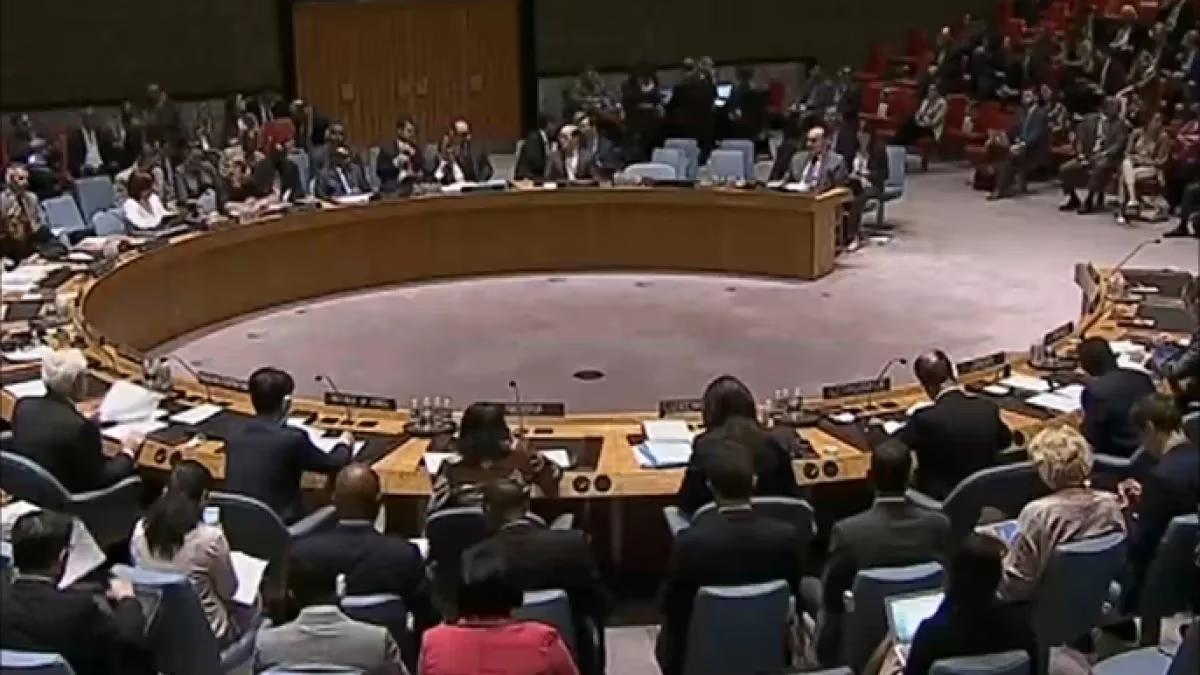
This lexicon has settled at the highest levels of international discourse; in October 2023, the UN General Assembly called for an 'immediate and sustained humanitarian truce', and the Security Council reiterated the same formula in its Resolution 2720, speaking of 'urgent humanitarian needs'. This lexicon automatically transferred to cultural institutions to avoid direct confrontation with politics, where the European Union described the situation in January 2024 as 'catastrophic' without reference to military operations.
In the American context, official statements focused on 'humanitarian pauses' instead of 'ceasefire' in the early stages. This trend found its way into the discourse of the 'Venice Biennale' in April 2024, where the opening of the Israeli pavilion was linked to 'an agreement for a ceasefire and the release of hostages' without mentioning the war, which was echoed in American museums that used the description 'ongoing humanitarian suffering', and in the 'Sundance' festival which presented Gaza films as 'stories from affected communities'.
In cases of excluding artists due to their stances, institutions used phrases such as 'the sensitivity of the current moment' as a crisis management tool. This alignment with the political lexicon is not a coincidence, as these institutions operate within funding and governance systems linked to states, and their statements pass through legal advisors who seek formulations that do not raise concerns, thus granting them moral and legal cover at the expense of accuracy in describing the bitter Palestinian reality.
When the word 'war' is erased from cultural statements, the war is not erased from reality, but rather it is linguistically re-described in a way that mitigates its political impact.

Share your opinion
From War to Humanitarian Crisis: How Are Global Cultural Institutions Reshaping the Gaza Narrative?