ARAB AND WORLD

Sat 24 Feb 2024 7:54 am - Jerusalem Time

Israel Radio: Arab countries proposed an initiative to integrate Hamas into the PLO

The Israeli Radio Corporation quoted sources as saying that the US administration informed Israel that Arab countries are preparing an initiative regarding the so-called “day after the war in Gaza,” noting that this Arab plan includes a clause stipulating the integration of the Islamic Resistance Movement (Hamas) into the Palestine Liberation Organization.


This Israeli body stated that Brett McGurk, the US President's envoy, pressured Prime Minister Benjamin Netanyahu to hold a discussion in the government regarding "the day after the Gaza war."


It said that - in conjunction with the Paris negotiations that seek to reach an agreement to release prisoners - the United States is holding talks with Arab countries (which it did not name) regarding the day after the war.


The Israeli Broadcasting Corporation added that the US President's administration is pressuring Netanyahu to hold a ministerial discussion on this issue.


There was no immediate comment from Washington or the Arab League regarding this news.


The day after the war

During his visit to Israel, the US President's special envoy - Netanyahu - urged a ministerial discussion on the issue of "the day after the war."


McGurk warned that if Israel did not make decisions, the Arab countries and the United States would move forward with the issue without it, according to the Israel Broadcasting Corporation.


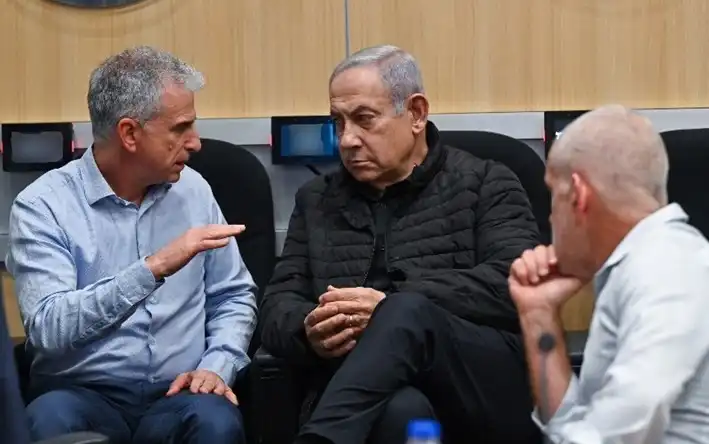
Yesterday, Friday, talks began in Paris to discuss reaching an exchange and calm deal in the Gaza Strip with the participation of Egypt, Qatar, the United States, and an Israeli delegation headed by Mossad chief David Barnea, while a Hamas official said that the movement is waiting for what the mediators will return.


Also yesterday, the Israeli Broadcasting Corporation reported that the Prime Minister presented to the security cabinet a document of principles related to the policy of “the day after the Gaza war.”


The broadcasting corporation said that the "Netanyahu document" includes Israel retaining its freedom to operate in the entire Gaza Strip without a time limit, and also includes establishing a security zone in the Strip adjacent to Israeli towns.


Source: Al Jazeera + Anatolia

PALESTINE

Sat 24 Feb 2024 7:49 am - Jerusalem Time

Hamas: Israel's positions in the negotiations are "negative" and we agree with the factions to form a government.. These are its tasks

On Friday, the Hamas movement described the Israeli occupation’s positions on the negotiations on a prisoner exchange deal with the Palestinian factions in Gaza and the ceasefire as “negative.”


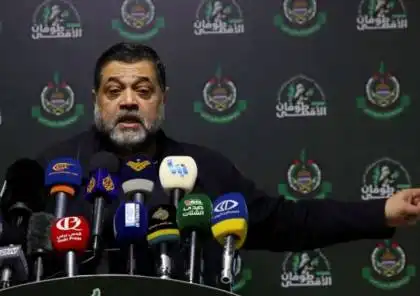
This came in a press conference by the leader of the movement, Osama Hamdan, held in the Lebanese capital, Beirut.


Hamdan said, “The occupation’s positions and responses to the mediators are negative and pose many obstacles to reaching an agreement.”


He added, "Israeli Prime Minister (Benjamin) Netanyahu is stalling and evasive and aims to disrupt reaching an agreement. He does not care about the release of prisoners held by the resistance. Rather, it is a card he uses to achieve his goals."


Hamdan added, "Netanyahu holds his delegation responsible for any upcoming negotiations with four nos: no cessation of aggression, no withdrawal from the Gaza Strip, no return of the displaced to the north, and no real exchange deal."


He considered that "Netanyahu's private and personal goals, and those behind him, the group of extremist settlers who form the backbone of his fascist government, clash with all the initiatives and positions proposed."


Hamdan pointed out that his movement “dealt in a positive spirit with the mediators’ proposals and initiatives, and based its positions on its clear priorities of stopping the aggression against our people in the Gaza Strip, and ending their human suffering, which was caused by the Zionist machine of killing and destruction, and the freedom of movement of our people and their return to their homes and areas in North of the Strip, and in all its areas, and the necessity of urgent relief, shelter, and the start of reconstruction.”


He pointed out that “the Netanyahu government’s insistence on continuing the war of extermination against civilians in the Gaza Strip, without even caring about the killing of more (Israeli) prisoners held by the resistance, under the barbaric Zionist bombing, will not be stopped by mere ideas and initiatives, but rather requires firm positions and practical measures to end the aggression.” “And responding to the rights of our people and ending the occupation.”


Hamdan considered that the Netanyahu government, “which sees prolonging the war as a primary goal, to escape the entitlements of the post-aggression phase, still adopts an intransigent position regarding the just demands put forward by the Hamas movement and the Palestinian resistance factions, most notably the cessation of the aggression and the return and shelter of the displaced.” And lifting the siege to rebuild what was destroyed by the Zionist aggression.”


He added that this "requires the international community and concerned countries to properly diagnose the current situation."


Hamdan's statements came coinciding with the start of the Paris meetings to discuss reaching a calm in the Gaza Strip, in the presence of the delegations of Hamas and Israel, and the participation of Egypt, Qatar and the United States.


The meetings aim to achieve calm in Gaza, release Israeli and Palestinian detainees, and support the humanitarian situation in the Strip.


In this context, Osama Hamdan said that his movement agreed with the Palestinian factions to form a government to provide relief to the Palestinians, rebuild Gaza, and prepare for elections.


In a press conference, on Friday evening, Hamdan called on the official and popular sides, in the countries through which land shipments pass to supply the occupation with goods, to stop them, in light of the siege imposed on the Gaza Strip and the brutal starvation process against the Palestinians.


The Hamas leader said that the war of starvation and massacres in Gaza would not have continued without the support of the American administration.


He added: "American spy planes fly over the Gaza Strip around the clock to identify targets, monitor leaders, and find prisoners."


Regarding reports of the occupation’s violations against Palestinian female prisoners, which revealed cases of sexual harassment and rape, Hamdan said, “We call for an independent and rapid international investigation into the UN report on Israeli violations against Palestinian women.”


Regarding the situation in occupied Jerusalem, and the occupation’s threats to restrict the number of worshipers during Ramadan, Hamdan warned that “the explosion is coming and the anger is coming, and the occupation’s decision to restrict freedom of worship in Al-Aqsa, during Ramadan, will not pass without accountability, no matter the sacrifices and costs.”


He called for "mobilizing to Al-Aqsa Mosque, to let the occupation know that attacking the place will not pass without accountability, whatever the cost."


ARAB AND WORLD

Sat 24 Feb 2024 7:46 am - Jerusalem Time

Washington expresses disappointment at Israel’s announcement of building new settlements and rejects any “new occupation” of the Gaza Strip.

On Friday, the United States expressed its disappointment at Israel’s announcement that it plans to build 3,000 housing units in the occupied West Bank settlements.


US Secretary of State Anthony Blinken said in a press conference from Argentina: “We regret that the Israeli government announced its intention to build thousands of settlement units.”


He added, "The United States believes that the settlements are not consistent with international law, and do not help achieve peace. They only weaken Israel's security, not strengthen it."


US Secretary of State Anthony Blinken reiterated on Friday that the United States rejects any “new occupation” of the Gaza Strip after the end of the war, in response to Israeli Prime Minister Benjamin Netanyahu’s announcement of a post-war plan against Hamas that notes the continued “security control” of Israel in the occupied West Bank and Gaza Strip. .


Blinken said in response to a question during the press conference, “I have not seen the plan, so I refrain from answering,” but he added, “There should not be a new Israeli occupation of Gaza” and “The territory of Gaza should not be reduced,” which, in his opinion, constitute “basic principles” for the future of the Strip. .

ARAB AND WORLD

Fri 23 Feb 2024 11:00 pm - Jerusalem Time

Red Cross: We are terrified by the plans to attack Rafah

The head of the International Committee of the Red Cross delegation in Gaza, Pascal Hunt, warned in an interview with the French newspaper Le Monde that a large-scale Israeli military attack on Rafah would create an "absolute disaster."


Hunt spoke about the horrific humanitarian situation in the Strip, with Israel threatening to launch a military attack on the city of Rafah, where there are more than 1.3 million displaced people.


The Ministry of Health in Gaza announced the death of more than 29,000 since October 7, 2023, in daily massacres committed by the Israeli occupation forces.


What made the situation worse was the World Food Program's announcement last Tuesday of a "temporary suspension" of aid distribution in the northern Gaza Strip due to the lack of security conditions for aid convoys to enter.


Regarding the extent of the International Committee of the Red Cross's ability to send aid to Gaza, Hunt said that this is not possible, especially after the killing of 14 Palestinian Red Crescent volunteers.


He explained that the security guarantees obtained by the committee are not sufficient, which has made the activity of humanitarian workers more complex, especially in light of the continuing war.


Huge needs

Hunt stressed that there is an urgent need for very huge aid throughout the Gaza Strip, adding, "We spoke with parents who were crying because they saw the trucks passing and they had nothing left to give to their children. There are only 200 trucks that pass through Rafah every day, that is, one truck." For 10 thousand people.


Regarding Israel's intention to invade Rafah, Hunt replied, "We are terrified of that. When it bombed Rafah on February 12, within less than an hour, between 50 and 70 people were killed. This means that any large-scale military operation would be an absolute disaster."


He continued that some are talking about a new population displacement, but that is not available today in Gaza, as there is no place for people where they feel safe, and the need for water, food, and health care is urgent, noting that the health system has collapsed in the Gaza Strip, and a hospital or Two work in Rafah.


Hunt confirmed to the French newspaper that, according to international humanitarian law, people can be displaced for security reasons, but this displacement must be temporary, but what is happening is that entire areas in Gaza City have been destroyed and entire neighborhoods in Khan Yunis as well, and if the same fate would befall Rafah.” What will be the future of the Palestinians in Gaza: living in tents for 10 years?


According to Hunt, the Palestinians feel that the international community has completely abandoned them, especially those working in the humanitarian field who believe that all countries have ratified the Geneva Conventions and must also abide by their provisions. He stressed that the committee is still providing some of its simple services in Rafah despite the lack of capabilities compared to its size. "We all feel as if we are on the list, but we do not know when our turn will come," Hunt quoted one of the Palestinians as saying.


Source: Le Monde

PALESTINE

Fri 23 Feb 2024 10:38 pm - Jerusalem Time

West Bank: Israeli settlers assault two young Palestinians and seize their vehicle south of Hebron

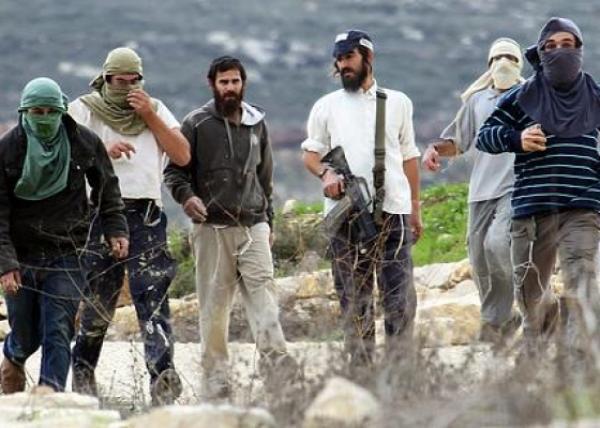
On Friday evening, armed settlers beat two young Palestinians before seizing their vehicle, in Masafer Yatta, south of Hebron.


Local sources reported that a group of armed settlers blocked the road to a vehicle in which the two young men, Muhammad Murr and Mahmoud Ayed Murr, were traveling, near the village of Susya in Masafer Yatta, while they were on their way to their homes in the village of “Amnizel”, and assaulted them by beating them and spraying hot and poisonous gas on their faces, which led to their injuries. Bruised.


It added that the settlers then seized the two young men's vehicle and transported it by large truck to one of the nearby settlements.

PALESTINE

Fri 23 Feb 2024 9:04 pm - Jerusalem Time

War on Gaza: A new Israeli massacre in Deir al-Balah leaves 24 killed

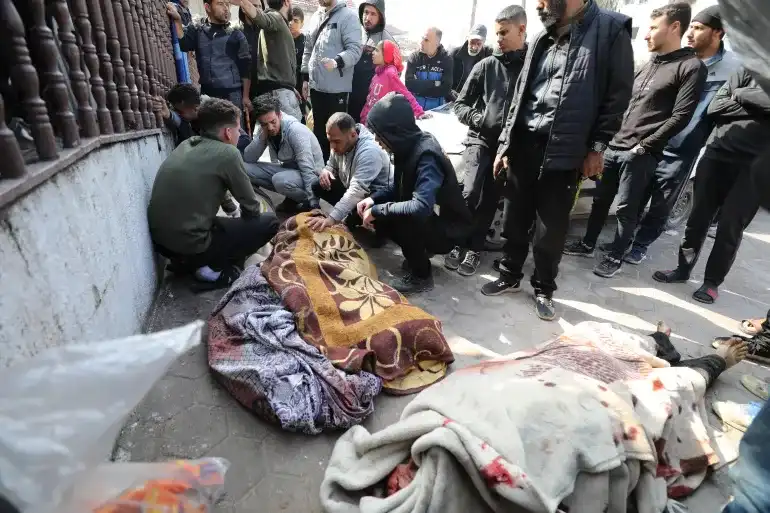
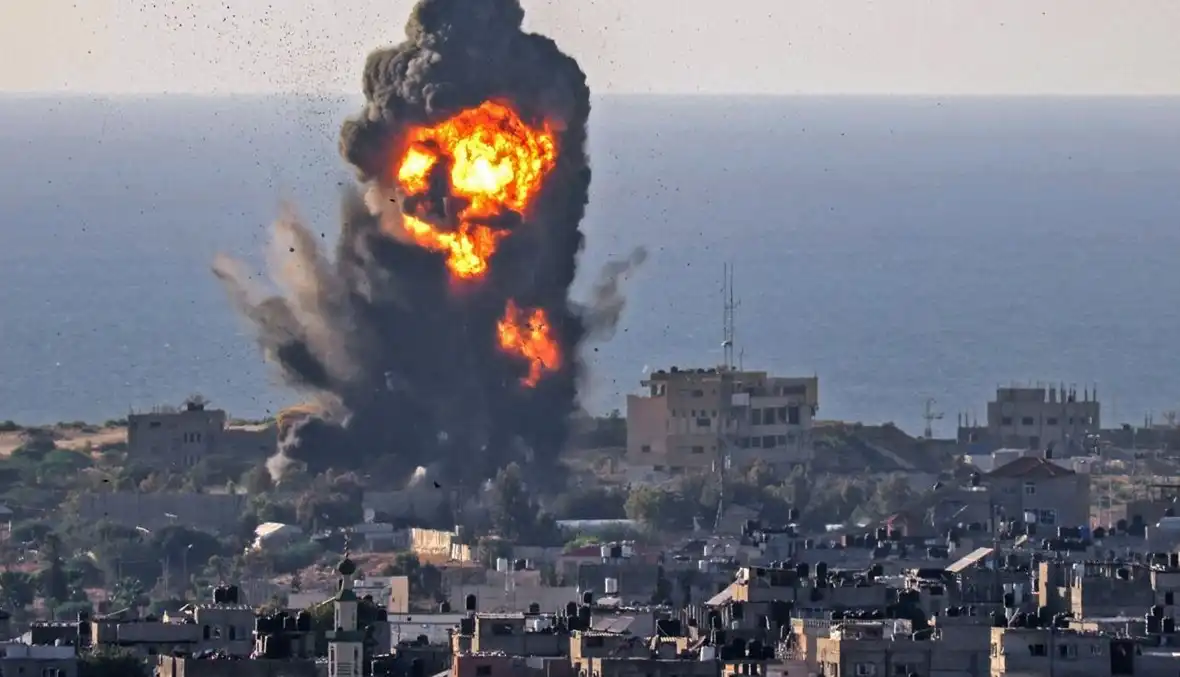
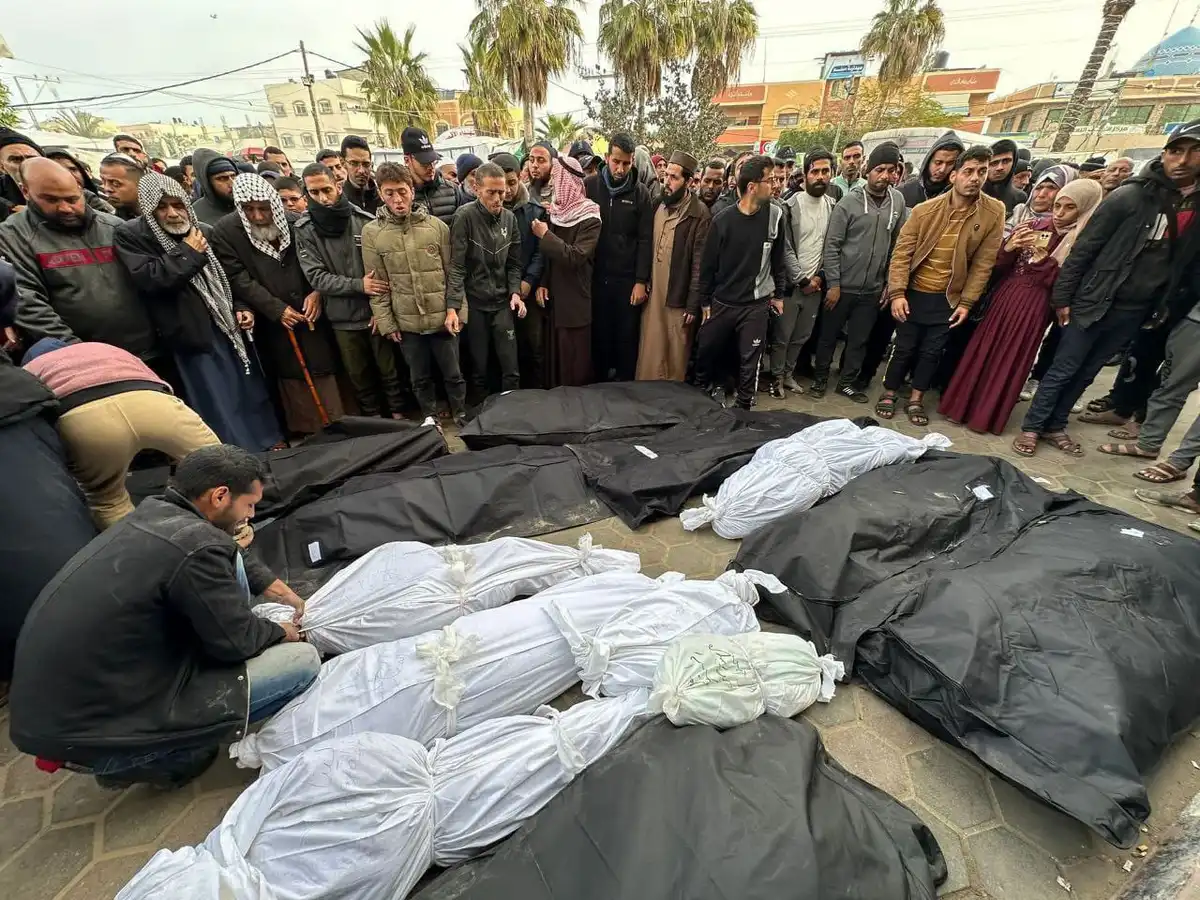
At least 24 citizens were killed and others were injured, this Friday evening, in a new massacre committed by the Israeli army in Deir al-Balah in the central Gaza Strip.


Local sources reported that 24 citizens were killed and others were injured, the majority of them children and women, as a result of the Israeli aircraft bombing a house for the Abu Zuaiter family in the Bishara neighborhood in Deir al-Balah.


The bodies of the dead and the wounded were transferred to Al-Aqsa Martyrs Hospital in the city, while ambulance and rescue crews continued attempts to extract the victims from under the rubble of the house.


The Israeli aircraft also bombed a house north of Al-Maghazi camp in the middle of the Gaza Strip, wounding a number of citizens. A number of citizens were injured, some of them critically, in an Israeli raid that targeted them near the “Al-Shallal” cafeteria on the shore of the Nuseirat Sea. The Israeli aircraft opened heavy fire on the town of Al-Mughraqa, north of the Nuseirat camp in the central Gaza Strip, and the Israeli aircraft and its artillery bombed Khirbet Al-Adas, north of Rafah, in the south of the Gaza Strip, and a house. Hanoun, north of the Gaza Strip.


The Palestine Red Crescent Society said that the Israeli forces targeted the vicinity of its Al-Amal Hospital in Khan Yunis, south of the Gaza Strip, causing major damage to the hospital facilities.


It indicated that for the fourth time, its crews carried out the mission of evacuating the wounded from the Nasser Medical Complex in Khan Yunis after it was out of service, in coordination with the United Nations Office for Humanitarian Affairs (OCHA), in which 4 ambulances participated and evacuated 18 wounded, including two newborn girls who were missing. Their mother, and the cases were transferred to the International Medical Corps field hospitals, the Indonesian field hospital in Rafah Governorate, the European Gaza Hospital in Khan Yunis, in addition to the Al-Aqsa Martyrs Hospital in Deir al-Balah in the central Gaza Strip.


The number of killed since the start of the Israeli aggression on the Gaza Strip on October 7 has risen to 29,514 people, in addition to 69,616 wounded, in an infinite toll.

ARAB AND WORLD

Fri 23 Feb 2024 7:32 pm - Jerusalem Time

Blinken: We reject Israel’s announcement of a plan to build 3,000 new units in the settlements

Blinken: “We are working with countries in the region to develop a plan for the next day in the Gaza Strip. We are determined to end the conflict in the Middle East as quickly as possible.”


US Secretary of State, Anthony Blinken, said that Washington is upset and rejects Israel’s announcement of a plan to build 3,000 new units in the settlements.


He pointed out, "We are disappointed by Israel's announcement that it plans to build 3,000 new units in the settlements, and we reject that."


He also said, "We are working to achieve lasting peace in the Middle East that ends the cycle of violence forever," adding, "We are keen to release the hostages in Gaza as soon as possible and establish a humanitarian ceasefire."


Blinken continued, "We are working with countries in the region to develop a plan for the next day in the Gaza Strip. We are determined to end the conflict in the Middle East as quickly as possible."


Blinken's statements come as the Israeli government pushes a plan to build 3,344 new settlement units in the occupied West Bank and Jerusalem, under the pretext of "responding" to the shooting that took place east of Jerusalem yesterday, Thursday.


The Israeli Broadcasting Corporation (“Kan 11”) reported on Thursday evening that Israeli Prime Minister Benjamin Netanyahu held a session to discuss “pushing the construction of thousands of housing units in the ‘Maale Adumim’ settlement, in response to the shooting.”


The Minister of Defense, Yoav Gallant, the Minister of Finance, Bezalel Smotrich, and the Minister of Strategic Affairs, Ron Dermer, participated in the session. The government intends to invite the Supreme Planning Council to hold a session within the next two weeks, to approve the new construction.


The Israeli government decided to hold a session of the Supreme Planning Council to approve the construction of thousands of settlement units in “Maale Adumim” (2,350 settlement units), “Kedar” (300 units), and “Efrat” (694 units).

ARAB AND WORLD

Fri 23 Feb 2024 7:29 pm - Jerusalem Time

Demonstrations around the world denouncing Israeli massacres and a march against AIPAC

Demonstrations took place in many Arab and Western cities - today, Friday - to denounce the Israeli massacres in the Gaza Strip and demand an end to the war. Activists also warned against the occupation carrying out its threats to invade the city of Rafah, south of the Strip.

A massive demonstration was organized in the Iraqi capital, Baghdad, during which banners were raised saying, "The death of Gaza's children from hunger is a disgrace to all of humanity."


This comes with escalating warnings of the threat of famine looming over the Gaza Strip in general and its north in particular in light of the Israeli siege and obstruction of the entry of aid trucks.


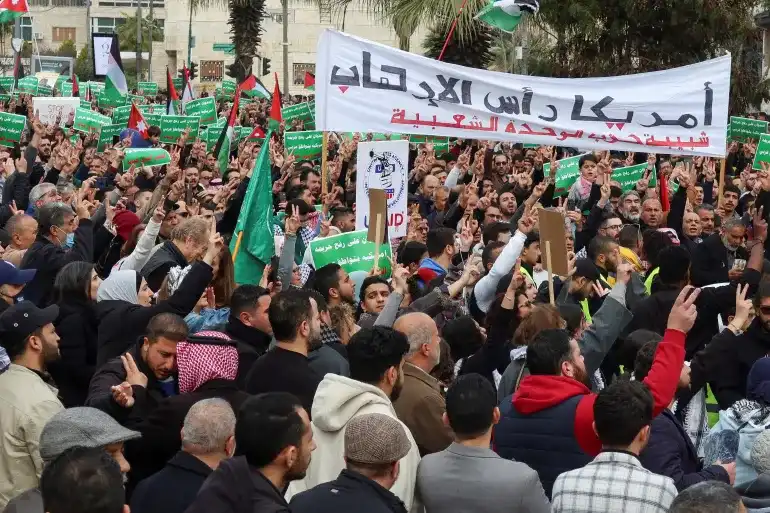
In Jordan, crowds of demonstrators gathered to stand in front of the Ebad Al-Rahman Mosque, near the US Embassy in Amman, at the invitation of the “National Forum to Support the Resistance.”


The protest was titled “An American crime with Arab complicity,” as an expression of anger at the attack that Israel threatens to launch on Rafah in the southern Gaza Strip.


Demonstrators carried banners saying, “America is the head of terrorism,” “The Rafah aggression is an American-Zionist crime,” and “Stop the genocide.”


Anti-America chants

During the demonstration, chants were chanted in support of the Islamic Resistance Movement (Hamas) and chants against the United States, including: “America is the head of the snake,” and “America is the devil. It supports Zionism.”


Washington used its veto - Tuesday - to thwart an Algerian draft resolution in the Security Council calling for an immediate humanitarian ceasefire in Gaza.


Jordanian demonstrators called on the country's King Abdullah II to provide them with weapons to fight against Israel.


The protest also carried the slogan “The land bridge is betrayal,” referring to reports of a land bridge extending from the Gulf through Jordan and then to Israel to supply it with goods, which the Jordanian authorities denied earlier.


In Italy, a massive demonstration took place in Florence in solidarity with the Palestinian people, and the demonstrators chanted slogans demanding an end to the genocide in Gaza.


March towards AIPAC

As for the United States, thousands participated in a march in New York City, on Thursday, towards the headquarters of the American Israel Public Affairs Committee (AIPAC) to protest its support for the Israeli massacres against the Palestinians.


The demonstrators raised Palestinian flags and chanted slogans against AIPAC. They also criticized US Senators Chuck Schumer and Kirsten Gillibrand for receiving money from the committee.


The march witnessed occasional altercations with the New York Police, as its members arrested a number of demonstrators.


On Thursday, demonstrators in solidarity with Palestine stormed a hotel where US President Joe Biden was staying in San Francisco, California, demanding a ceasefire.


The demonstrators chanted slogans including, "Biden, you cannot hide. We accuse you of genocide." The US President was visiting the city as part of his campaign for the presidential elections.


The United States provides broad political support to Israel in its war on Gaza, as well as an air bridge to supply it with thousands of tons of weapons and ammunition.


Source: Al Jazeera + agencies

ARAB AND WORLD

Fri 23 Feb 2024 7:25 pm - Jerusalem Time

A poll shows a decline in support for Zionism among British Jews

The Israeli war on the Gaza Strip raised discussion again in academic and research circles about the noticeable change in the trends of Jewish public opinion critical of the Zionist narrative and its relationship to Jewish identity in the largest Western capitals in support of Israeli policies, in light of the escalation of controversy over Israeli politicians’ deliberate intention to label every speech that opposes their settlement policies and rejects Zionist ideology is called "anti-Semitism."


The results of an opinion poll conducted by the Institute for Jewish Policy Research (based in London), released this February, showed a decline in the percentage of British Jews who identify themselves as Zionists from 73% 10 years ago to 63%, especially among young people. The institute's survey, the largest of its kind in studying the formation of Jewish identity in Britain, indicates that young people prefer to separate their Jewish identity from association with Zionism as a political and ideological movement.


The study sheds light on the nature of the relationship between adopting the Zionist ideology and party affiliation among the Jewish minority in Britain, which does not exceed 300,000 Jews but is the second largest Jewish community in Europe. The survey concludes that most British Jewish supporters of the Conservative Party define themselves as 73% are Zionists, while this percentage drops to around 27% among supporters of the Green Party, which is affiliated with the far left of Britain.


The same results also indicated that approximately 88% of the respondents stated that they had visited Israel at least once, while 73% confirmed that they felt some kind of connection towards Israel.


Israel's racism

In an interview with Al Jazeera Net, Braden McGeever, an expert in anti-Semitism and professor of sociology at the University of London, said, “This emotional attachment to Israel no longer means unconditional support for its policies,” referring to a similar poll of the opinions of American Jews regarding Israel’s political behavior and its management of the peace process with the Palestinians, which Reflecting strongly critical positions of those policies.


While a previous poll among Jewish voters conducted by the Jewish Electoral Center found that more than a quarter of respondents agreed with describing Israel as an “apartheid state.”


MacGyver added that “an estimated quarter of the Jewish community in Britain prefers to put a distance between themselves and the Zionist ideology and refuses to be described as Zionists,” considering that these numbers embody a turning point that must be paid attention to, and work to examine and monitor the shifts that will occur in the trends of Jewish public opinion after the events of the 7th of September. Last October, to understand in depth the extent of the impact of the Israeli war on the Gaza Strip on shaping public opinion among Jewish communities around the world in the coming years.


With the escalation of protests in the British street against the war on the Gaza Strip, the “Jewish Voice for Peace” movement emerged, which organized solidarity movements with the people of the Strip in a number of British cities, and went out in protests demanding an immediate ceasefire in Gaza. The movement, which is active in More than one Western capital raises the slogan “Not in our name.” It rejects Israel committing its crimes against the Palestinians in the name of the Jews by monopolizing the representation of their religious and cultural identity.


This trend represents a shift in the mood of Jewish public opinion, especially in Western countries, where the margin of freedom of opinion and expression expands, and a new generation of Jewish communities emerges that is more open and learns about another narrative of the conflict through various channels that is different from the narrative promoted by Israel and the governments that support its policies.


Deliberate confusion

But the accusation of anti-Semitism by Israeli officials in the face of every critic of Israel revives the debate about the necessity of drawing a dividing line between rejection of Zionism and anti-Semitism, especially after Israel accused UN officials who criticized the Israeli military operation against the Gaza Strip of anti-Semitism, a speech that some saw as a deliberate confusion between anti-Semitism. As a racist and discriminatory practice against Jews because of their religious identity, and criticism of Israel and the Zionist settlement project on Palestinian lands.


The British arena experienced this dispute more than once, as it was renewed with the rise of voices criticizing the Labor Party’s handling of what was described as “anti-Semitic statements” made by some of its members commenting on the Israeli war in the Gaza Strip, and holding Israel responsible for the events of October 7. The first is 2023, when the party leadership took the initiative to withdraw its support for two electoral candidates due to their critical views of the occupation.


Meanwhile, a trend within the party warns that the charge of “anti-Semitism” has become a justification to protect Israel from accountability, and a pretext to prevent it from being held accountable for discriminatory policies against the Palestinians.


Source: Al Jazeera

ARAB AND WORLD

Fri 23 Feb 2024 7:23 pm - Jerusalem Time

The White House: We made clear to the Israelis our refusal to occupy the Gaza Strip

A White House spokesman said that Washington made clear to the Israelis its refusal to occupy the Gaza Strip.


He added that President Job Biden's administration has seen reports about Israel's plans for the aftermath of the Gaza war, and believes that any arrangement should have the Palestinians having a say in it.


He stressed that the White House will not support any Israeli military plan in Rafah that does not take into account civilians in Gaza, he said.

ARAB AND WORLD

Fri 23 Feb 2024 7:18 pm - Jerusalem Time

Washington Post: Netanyahu proposed a post-war plan that surprised the Israeli government

The Washington Post quoted an Israeli official as saying, “Prime Minister Benjamin Netanyahu’s presentation of the post-war plan in the Gaza Strip surprised many in the Israeli government,” expecting that the step was made in coordination with the American administration.


Netanyahu presented to the security mini-ministerial council (the cabinet) a document of principles related to the policy of the day after the Gaza war, which includes Israel’s preservation of freedom to operate in the entire Gaza Strip without a time limit, and also includes the establishment of a security zone in the Strip adjacent to Israeli towns, “It will remain in place as long as there is a security need for it.”

ARAB AND WORLD

Fri 23 Feb 2024 7:14 pm - Jerusalem Time

CIA questions Israeli accusations against UNRWA

An assessment conducted by the US Intelligence Agency (CIA) cast doubt on the validity of Israeli allegations that employees of the United Nations Relief and Works Agency for Palestine Refugees (UNRWA) were involved in the attack launched by the Islamic Resistance Movement (Hamas) on October 7.


Israel accused 12 UNRWA employees of participating in the attacks launched by Hamas on the settlements surrounding the Gaza Strip, and said that 10% of all employees of the UN agency belong to Hamas.

This accusation - which was not based on evidence - prompted many countries, including the United States, to cut off the funding they were granting to the agency, which plays an important role in providing relief to Palestinians in Gaza during the unprecedented humanitarian crisis in the Strip due to the siege and war that has been ongoing for 140 days.


According to the Wall Street Journal, the US intelligence report issued last week assessed with “low confidence” that “a handful of agency employees may have participated in the attack,” and indicated that intelligence considered these accusations credible, although it could not confirm them. health independently.


However, the US intelligence report explicitly questioned the validity of the accusations made by Israel against the UN agency of cooperation with Hamas on a broader basis.


A report published by the British newspaper "The Guardian" indicated that the report stated that although UNRWA coordinated with Hamas to provide humanitarian aid and work in Gaza, there was no evidence to indicate that it had entered into a partnership with the movement. She added that Israel "did not share the raw intelligence behind its assessments with the United States."


The newspaper explained that two informed sources - whose identities were not revealed - referred in this regard to the hatred that Israel has for UNRWA, and quoted one of the sources as saying, “A specific section mentions how Israeli bias distorts many of their assessments of UNRWA and says that this has led to distortions.”


The newspaper reported that the 4-page report issued by the National Intelligence Council was distributed to US government officials last week.


Investigations

It is noteworthy that UNRWA dismissed two workers in Gaza against the backdrop of Israeli accusations, and announced last January the opening of an independent investigation into the Israeli accusations regarding the involvement of its workers in the Hamas attack.


UNRWA spokeswoman Tamara Al-Rifai said, “It is extremely important for us to conduct an independent investigation into these specific matters in the individual cases that Israel has brought to our attention.”


She added in statements to Agence France-Presse, "We have 33,000 employees, almost all of whom work hard and are very committed, and have worked at the agency for many years."


Al-Rifai indicated that UNRWA received allegations from the Israeli government regarding 12 names in Gaza, and we had to verify these names in the records of the organization, which includes 13,000 employees in Gaza, and we were able to match 8 of these names.


She pointed out that countries freezing their funding contributions to UNRWA is extremely devastating, explaining that the agency provides shelters, food and medical aid, and clean water to about two million people in Gaza.


For his part, United Nations Secretary-General Antonio Guterres appealed to all countries to ensure the continuity of UNRWA's "life-saving" work.


Fair solution

UNRWA was established by a resolution of the United Nations General Assembly in 1949, and was mandated to provide assistance and protection to refugees in 5 regions: Jordan, Syria, Lebanon, the West Bank, and the Gaza Strip. Its work aims to reach a just solution to the refugee tragedy.


The agency provides relief services to about 5.9 million registered Palestinian refugees, including 1.7 million in the Gaza Strip, while Israel confirms that it will seek to prevent the agency from working in the Gaza Strip after the end of the war.


The Israeli accusations against the agency are not the first of their kind. Since the beginning of the aggression on Gaza, Israel has accused the agency’s employees of working for the Hamas movement. According to observers, this accusation is a prior justification for targeting UNRWA schools and facilities in the Gaza Strip, which hosts tens of thousands of displaced people, most of whom are children and women.


Source: Al Jazeera + The Guardian

ARAB AND WORLD

Fri 23 Feb 2024 7:10 pm - Jerusalem Time

New York Times: Most of Hamas's tunnel network is intact and thousands of its fighters are still fighting

On Friday, February 23, 2024, the American newspaper "The New York Times" quoted Israeli security officials as saying that Prime Minister Benjamin Netanyahu's goal of destroying the Islamic Resistance Movement (Hamas) "is still elusive," stressing that most of Hamas's tunnel network is still intact.


An Israeli military intelligence official, speaking on condition of anonymity under military protocol, said that Israel is engaged in a comprehensive mission to expose Hamas' military capabilities.


Israel launched its attack on Gaza after Operation Al-Aqsa Flood on October 7, 2023, which was launched by the Palestinian resistance in response to Israeli violations, in which an estimated 1,400 people were killed, or the resistance detained Israeli prisoners.


Since then, Israel has confirmed that it has killed more than 10,000 resistance fighters, but it has not explained how it calculates the number, and analysts say that it is difficult to obtain an accurate number in light of the chaos of war, according to the newspaper.


Meanwhile, Israeli officials indicated that “the occupation army dismantled the leadership structure of 18 of the 24 Hamas battalions in Gaza, resulting in the killing of commanders, deputy commanders, and other officers, rendering the units virtually ineffective.”


But thousands of Hamas fighters, attached to the remaining brigades, or operating independently, remain above and below the ground, according to what the American newspaper quoted former and current security officials as saying.


Hamas has revealed little about its losses, although it has expressed public grief over the killing of at least two of its senior leaders, Ayman Nofal and Ahmed Al-Ghandour. The movement regularly issues statements saying it has attacked Israeli soldiers throughout the Strip.


Youssef Hamdan, Hamas' representative in Algeria, said this month: "The resistance is still capable of inflicting pain on the enemy."


Israeli analysts also added that during the recent fighting in Gaza, Hamas avoided direct confrontations with Israeli units, which Israel considered a sign of weakness.


But other experts say Hamas has a reason behind this strategy, and according to Western officials who requested anonymity because they were not authorized to speak publicly on the issue, “Hamas leadership believes that if any significant amount of its military strength survives the war, it will be "Victory."


North Gaza

In northern Gaza, Colonel Noshi Mandel, chief of staff of the Nahal Brigade, which operates in northern Gaza, said: “Hamas has not been completely defeated in the northern Gaza Strip.” “We have accomplished a lot of work, but there is still more to do.”


Mandel added that the occupation army returned this month to the vicinity of Al-Shifa Hospital, which was the scene of fierce fighting in November, to fight the resistance who regrouped in the region, and will return to other parts of the north in the coming weeks.


Meanwhile, current and former Israeli officials said, “Israeli forces will likely continue to invade northern Gaza to suppress the Hamas rebellion for the foreseeable future, at least until some kind of post-war political settlement for Gaza is reached.”


Khan Younes

Since the collapse of the fragile ceasefire between Israel and Hamas in early December, Israeli forces have advanced through the southern city of Khan Yunis – and headed west towards the Mediterranean. Israeli military officials said, "The city was one of the most important centers of Hamas' military activity."


The intelligence official said that Israeli forces are targeting the extensive network of tunnels belonging to the Hamas movement in and around the city. The official added that several key underground command centers had been destroyed, but most of the tunnel network remained intact.


Military analysts explained that "Hamas fighters clearly avoided confrontations with the army in Khan Yunis, hoping to outlast their opponents in their safe underground areas."


For his part, Amos Harel, a military affairs analyst for Haaretz newspaper, said, “The army is behaving very aggressively there without facing much competition from the other side.”


Over the past month, Israeli forces have focused on the western edge of Khan Yunis, which includes two major medical complexes — Al-Amal and Al-Nasser Medical Center — in order to target what officials described as the last bastions of organized Hamas resistance in the area.

ARAB AND WORLD

Fri 23 Feb 2024 7:08 pm - Jerusalem Time

Euro-Med: 6 main indicators that Israel is continuing the “crime of genocide” in the Gaza Strip

A human rights observatory reported that it monitored 6 main indicators that Israel was continuing the “crime of genocide” in the Gaza Strip within 4 weeks of the International Court of Justice’s decision, which obligated it to take measures to prevent this from happening.


The Euro-Mediterranean Human Rights Observatory said in a statement today, Friday, that these 6 indicators include: “the continuation of mass killings of civilians in the Gaza Strip, intentionally inflicting serious physical and psychological harm on the residents of the Strip, and deliberately subjecting residents to miserable living conditions with the aim of actual destruction, including the destruction of homes.” Facilities and infrastructure, starvation and obstruction of humanitarian access, imposing measures aimed at preventing childbirth within Palestinian families, and official and public incitement by Israeli officials to escalate the commission of the crime of genocide.”


The Observatory also announced that it documented “the killing of more than 3,847 Palestinians by the Israeli army, including 1,306 children and 807 women, in addition to the injury of about 5,119 since the issuance of the Court of Justice decision.”


Euro-Med pointed out that the death toll of Palestinian victims since the seventh of last October had risen to "38,067, including 14,350 children and 8,620 women, including more than 8,000 martyrs under the rubble and in the streets who were unable to be recovered by medical teams, including hundreds after the court's decision."


The Euro-Mediterranean Human Rights Monitor accused Israel of continuing to violate international law with its peremptory rules "by committing the crime of genocide, as part of its implementation of grave violations, war crimes, and crimes against humanity, which exist as independent crimes in their own right, against the Palestinians, entirely in the Gaza Strip."

ARAB AND WORLD

Fri 23 Feb 2024 4:15 pm - Jerusalem Time

Renewed Israeli bombing of towns in southern Lebanon

Today, Friday, Israeli bombing renewed on a number of towns and areas in southern Lebanon.


Israeli warplanes launched violent raids on the towns of Labouneh and Kafr Kila, as well as mock raids over the cities of Sidon and Nabatieh.

ARAB AND WORLD

Fri 23 Feb 2024 3:49 pm - Jerusalem Time

Paris Talks: Netanyahu's intransigence threatens the prospects of reaching a prisoner exchange deal

This afternoon, Friday, talks began in Paris on a prisoner exchange deal between Israel and the Hamas movement, in which the head of the CIA, the heads of Mossad and Shin Bet, the director of Egyptian intelligence, and the Qatari prime minister will participate. But the results of this meeting are not yet clear, in light of the intransigence of Israeli Prime Minister Benjamin Netanyahu to continue the war on Gaza and his repeated phrase “until absolute victory.”


The Israeli delegation arrived in Paris this afternoon, and includes the head of the Mossad, David Barnea, the head of the Shin Bet, Ronen Bar, and Nitzan Alon.


The delegation is accompanied by Netanyahu's political advisor, Ofir Falk, "in order to closely monitor the delegation's performance," according to Channel 12. The delegation will also return to Israel tonight, according to Channel 13.


Meanwhile, Hamas leaders’ communication abroad with the movement’s head in the Gaza Strip, Yahya Sinwar, remains difficult and sporadic.


The military analyst in the Haaretz newspaper, Amos Harel, pointed out today, “There is difficulty in agreeing on the deal without the permanent involvement of Sinwar, and this is also because the foreign leadership cannot appear less resolute than the domestic leadership, which bears the burdens of the fighting.”


Harel quoted a source who has known Netanyahu closely for decades, saying, “What is currently preoccupying Netanyahu without stopping is the assassination of Sinwar. He needs a clear achievement, almost a victory, that he can present to the public in Israel.”


According to the Ynet website, contrary to reports in the Israeli media, Sinwar is no longer described as “cut off from communications” and that the mediators, namely Egypt and Qatar, are talking with Hamas outside as well as with Hamas inside, in the Gaza Strip.


Channel 12 quoted an Israeli official as saying, “There is reason for optimism, but even if there is an initial general plan, the negotiations will be difficult and take time.”


The deal that will be discussed in Paris now is similar to what was agreed upon in the Paris talks, at the beginning of this month, which Netanyahu agreed to and then backed down.


The first stage requires a prisoner exchange, with the release of about 35 Israeli hostages in Gaza, including women, the elderly, the sick, the wounded, and perhaps Israeli female soldiers as well. It includes a ceasefire for 45 days and extends throughout the month of Ramadan.


In the second stage, the rest of the hostages, who are soldiers and men under the age of 50, and the bodies of the hostages are released.


According to Harel, the second phase would be associated with ending the war and the complete withdrawal of the Israeli army from the Gaza Strip.


Harel pointed out that "Washington has lost its patience with Netanyahu's positions, statements, and deceptions. It also appears that the extent of international support for Israel is in doubt this time."


He added that Netanyahu has three options in the talks about the deal. The first possibility is that he will agree to the deal and "Israeli concessions", including the liberation of hundreds of Palestinian prisoners with high sentences, apparently in the first stage, and he is expected to face opposition within his government.


The second possibility is the continuation of the war during the month of Ramadan, which may include the invasion of Rafah. But Harel indicated that after that, Israel will return to the negotiating table and perhaps consider the “Biden Doctrine” about a new regional order.

He pointed out that this possibility "involves a bet that must take into account a severe deterioration in the regional situation due to the occupation of Rafah, which will primarily affect the civilian population in the Strip."


The third possibility is that Netanyahu will continue to “provoke” the Biden administration and evade a prisoner exchange deal. But Harel pointed out at the same time that sources in the Israeli government suggest not ruling out the possibility that “Netanyahu might decide to surprise and turn to the left. The United States and Saudi Arabia are making tremendous efforts to push a regional deal forward, and it allows presenting a picture of the success of the Biden administration’s foreign policy, before the elections.”

ARAB AND WORLD

Fri 23 Feb 2024 3:43 pm - Jerusalem Time

Washington's aid worth $14 billion to Israel to prepare for a multi-front war

American Jewish media reported that the additional $14 billion in military aid to Israel that President Biden was seeking was not only intended for the war on Gaza, but also to prepare Israel for a “multi-front war.”


On Wednesday, the Jewish Telegraph Agency (JTA) quoted a senior official in the Biden administration as telling the agency that the amount of $14 billion is allocated “to Israel to defend itself in a multi-front war and to ensure its ability to deter a multi-front war.”


Israel has intensified its air strikes in Lebanon against Lebanese Hezbollah, although many of the strikes have killed civilians. The cross-border exchange of fire threatens all-out war, and there is no sign that tensions will ease anytime soon. Israeli officials threaten to invade if Hezbollah does not retreat from the Israeli-Lebanese border.


American officials admitted to the Washington Post that Israeli Prime Minister Benjamin Netanyahu may view the war in Lebanon as the key to his political survival, as opinion polls showed that the Israelis want him to step down after the current conflict.


Israel also appears to be trying to provoke Iran, as several members of Iran's Islamic Revolutionary Guard Corps have been killed in Israeli airstrikes in Syria since October 7. According to the New York Times, Israel was also behind a secret attack on two natural gas pipeline sites inside Iran.


The $14 billion comes within the $95 billion foreign military aid bill that was passed by the Senate but has not yet been put to the House of Representatives for a vote as Republicans are still searching for a border agreement. The legislation also includes about $60 billion for Ukraine, $4.8 billion for Taiwan, and other spending in the Asia-Pacific region.


It is noteworthy that the $14 billion provided to Israel is in addition to the $3.8 billion that Israel receives from the United States every year, and includes $5.2 billion allocated to Israeli missile defense, which is seen as a crucial necessity for the war with Hezbollah.


Another $3.5 billion will be allocated to compensate and renew the ammunition used by Israel in its war on Gaza. The United States will use $4 billion to replenish its own stockpiles, including emergency stockpiles in Israel that the Israeli army was authorized to use in the war on Gaza.


Since October 7, the United States has been shipping tons of bombs and other types of weapons almost daily. According to the Israeli news site Ynet, the United States shipped more than 25,000 tons of military equipment to support the Israeli massacre in Gaza, which resulted in the deaths of 30,000 Palestinians and the wounding of 65,000 citizens, the overwhelming majority of whom were children and women.

PALESTINE

Fri 23 Feb 2024 3:36 pm - Jerusalem Time

Israel intends to establish 3,300 settlement units in the West Bank

The official Israeli Broadcasting Authority said that Israel intends to approve, within the next two weeks, the establishment of more than 3,300 settlement units in the occupied West Bank.


If the decision is approved, this will be the largest settlement project in the occupied West Bank since the beginning of the Israeli aggression on the Gaza Strip on October 7th.


The Israeli Broadcasting Authority said on Friday that the relevant committee will meet within two weeks to approve the establishment of 2,350 housing units in the Maale Adumim settlement, east of East Jerusalem, about 300 in the Kedar settlement, southeast of East Jerusalem, and 700 units in the Efrat settlement, south of occupied Jerusalem.


The commission claimed that the decision comes in response to the shooting operation carried out by Palestinian resistance fighters yesterday near the Maale Adumim settlement, which resulted in the death of an Israeli soldier and the wounding of at least 8 others with varying injuries.


According to the Commission, the Israeli authorities announced the closure of part of the road leading to Al-Za’im checkpoint, east of East Jerusalem, to Palestinian movement for at least two weeks.


The current right-wing Israeli government, headed by Benjamin Netanyahu, promotes and supports settlement in the occupied Palestinian territories. Recent years have witnessed a significant increase in settlement activities in the West Bank, according to the Israeli “Peace Now” organization, which monitors settlement in the Palestinian territories.


According to estimates by the left-wing organization, more than 700,000 settlers reside in Israeli settlements in the West Bank, including East Jerusalem.


A report last week revealed that the number of Israeli settlers in the occupied West Bank rose by approximately 3% last year, 2023, and expected “accelerated growth” in the number of settlers in the West Bank in the coming years.


The United Nations and the international community consider Israeli settlement in the Palestinian territories occupied since 1967 an illegal activity. The United Nations and human rights organizations have often called on Israel to stop settlement operations and warned that they undermine the chances of peace in accordance with the principle of the two-state solution, but these calls and warnings were rejected and ignored by Israel. 


PALESTINE

Fri 23 Feb 2024 3:12 pm - Jerusalem Time

Sharp criticism of Israel in the fifth day of the International Court hearings

Today, Friday, the hearings held by the International Court of Justice in The Hague continued to discuss the legal consequences arising from Israel’s policies and practices in the occupied Palestinian territories.


On the fifth day of the sessions, representatives of a number of countries deliberated on the platform, and the representative of the State of Qatar expressed his rejection of double standards, stressed that international law must be applied to everyone, and said that Israel has obstructed all peaceful solutions and continues to occupy the Palestinian territories and pursues and practices a policy of apartheid as a flagrant violation of international humanitarian law.


The representative of the State of Qatar stressed that the basis of the Israeli project is settlement and the imposition of settlers on the occupied territories, and pointed out that Israel exploited the war in the Gaza Strip to cover settlement activities in Jerusalem and the West Bank, which are witnessing a situation no less bad than the situation in Gaza.


He explained that ending the apartheid regime requires creating a situation that gives the Palestinians their rights, and considered that the court is obligated to take into account all opinions that consider the Israeli occupation illegal.


For his part, the representative of the Sultanate of Oman said that the Israeli occupation is working to change the demographic composition in the occupied territories, and stressed that the world witnessed today one of the worst atrocities committed in the Gaza Strip.


The Omani official said that the Palestinians have been living under occupation, oppression and daily humiliation for 75 years, and demanded that Israel’s violation of the right to self-determination of the Palestinians be examined, and that all activities that prevent the Palestinians from exercising their right be put to an end.


In turn, the representative of Norway described the apartheid wall built by Israel as a violation of international law and makes the two-state solution difficult to achieve. He accused Israel of exploiting natural resources to perpetuate its occupation of Palestinian lands. He considered it illegal to annex any Palestinian lands or impose a fait accompli on the ground. He said that establishing settlements in Palestinian lands violates Article 416 of the Geneva Convention.


For her part, the representative of Indonesia stressed that no country can be granted the right to do what it desires in front of weak countries, and said that Israel avoids negotiations, avoids stopping settlement projects, and constantly obstructs peace negotiations and the two-state solution. Israeli governments also publicly express their rejection of the peace process and ignore calls Security Council to resolve the conflict peacefully.


The representative of Pakistan spoke about Israel imposing facts on the ground that are difficult to remove, and accused Israel of imposing discrimination against the Palestinian people since 1967, and restricting the freedom of Muslims and Christians to worship in Jerusalem.


He stressed that the two-state solution should be the basis for peace, and called for the cancellation of all changes resulting from the forceful annexation of territories.


Disrespect for the court

On the other hand, Michael Lynk, the former United Nations rapporteur on the situation of human rights in the Palestinian territories occupied in 1967, said that Israel does not respect the International Court of Justice by not participating in the hearings.


Israel was among the countries that submitted written statements to the court by the deadline set on July 25, 2023, and decided not to participate in the oral hearings, according to information contained on the United Nations website.


Link told Anadolu that the participation of 55 countries and international organizations in the hearings at the International Court of Justice is “historic,” and he considered that the main reason behind Israel’s avoidance of participating in the hearings is that it does not have an answer to the accusations against it.


He added, "I think the biggest reason is that Israel knows that the arguments it is making about annexation (lands), preventing the right to self-determination, and systematic discrimination against the Palestinians will not work, and it does not have any concrete political and legal answers to that."


The International Court of Justice sessions will be held between February 19 and 26, during which 52 countries will make statements about the legal consequences of Israeli practices in the occupied Palestinian territories, along with the League of Arab States, the Organization of Islamic Cooperation, and the African Union.


PALESTINE

Fri 23 Feb 2024 3:02 pm - Jerusalem Time

War on Gaza: Dozens of dead and wounded as Israel targeted various areas in the Gaza Strip

Dozens of citizens were killed and injured today, Friday, in an Israeli bombing that targeted the Al-Dahdouh area in Gaza City.


Medical sources announced the arrival of nine dead Palestinians and a number of wounded to the European Gaza Hospital, as a result of targeting a gathering of citizens near the Ashkelon School, east of Khan Yunis, in the south of the Gaza Strip.


A number of citizens were also injured with various injuries, as a result of a violent Israeli bombardment that targeted Al-Sinaa Street in the Al-Zaytoun neighborhood, south of Gaza City, while the Israeli forces targeted the displaced people in Al-Falah School with smoke bombs and forced them to move from the neighborhood to the west of the city. These forces are still continuing the work of digging and destroying homes east of Gaza City. District.


These sources confirmed that the Israeli army places the residents of the Gaza Strip in a triangle of death represented by continuous targeting, famine, and the spread of epidemics, noting that the continuation of the aggression means more genocide, pointing out that half a million citizens of northern Gaza are suffering from famine, which is silently killing their lives.


The sources confirmed that there are about 350,000 patients suffering from chronic diseases, 60,000 pregnant women, as well as 700,000 children in the Gaza Strip, who are exposed to serious complications as a result of malnutrition, dehydration, and the lack of medical facilities.

PALESTINE

Fri 23 Feb 2024 2:51 pm - Jerusalem Time

West Bank: Israeli settlers continue their attacks on Palestinians in Hebron and Nablus

Today, Friday, Israeli settlers continue their attacks against citizens and their property in Hebron and Nablus.


In Hebron, a group of settlers attacked sheep herders and foreign sympathizers and beat them in the village of Al-Mufaqara in Musafer Yatta, under the protection of the Israeli occupation forces.


The Israeli occupation army also renewed the closure of all entrances leading to Masafer Yatta.


In Nablus, settlers opened fire on a vehicle near Khirbet Yanun on the lands of Aqraba, causing it to overturn, but no casualties were reported.


Settlers also attacked citizens' vehicles near the town of Al-Nasariya, east of Nablus, with stones, causing damage and smashing the windows of a number of them.

ARAB AND WORLD

Fri 23 Feb 2024 2:41 pm - Jerusalem Time

Olmert: Gaza is just a step in Netanyahu's plan to expel the Palestinians from the West Bank

Former Israeli Prime Minister Ehud Olmert said that Gaza is “just a step” in Benjamin Netanyahu’s government’s plan to “cleanse” the West Bank of Palestinians, empty the Al-Aqsa Mosque of Muslims, and annex Palestinian lands to Israel.


In an article in the Israeli newspaper "Haaretz" on Friday, Olmert described Netanyahu's government as a "gang," noting that "the ultimate goal of the extreme right-wing duo, National Security Minister Itamar Ben Gvir and Finance Minister Bezalel Smotrich, is not to occupy the Gaza Strip."


He added: "Even settlement throughout the devastated Strip is not the ultimate goal of a group of hallucinators who seized power in Israel."


He continued: "Gaza is just an introductory chapter, and the platform that this gang wants to build as a foundation on which the real battle they aspire to will take place: the battle of the West Bank and the Temple Mount," referring to Al-Aqsa Mosque.


Olmert pointed out that "the ultimate goal of this gang is to cleanse the West Bank of its Palestinian population, cleanse the Temple Mount of Muslim worshipers, and annex the lands to Israel." He warned, "The path to achieving this goal is filled with blood. Israeli blood in the state and in the lands that Israel has controlled for 57 years, as well as Jewish blood in other places in the world."


He said: "There is also a lot of Palestinian blood, of course, in the (Palestinian) areas, in Jerusalem, and if there is no alternative, also among the Arab citizens of Israel."


He added: "This goal will not be achieved without large-scale violent conflict. Catastrophe. All-out war." Olmert pointed out, "This gang succeeded in the first stage before the uproar and all-out war that they seem to hope will break out here."


Referring to Netanyahu's government, he said: "They have taken control of the government of Israel and made the man who heads it their servant. The possibility that they will dismantle the government and expel the prime minister from running the affairs of state is not strange. It is a process taking place at this very moment, step by step."


Olmert: We are far from complete victory in Gaza

Regarding the war on Gaza, Olmert stated, “It is clear that we are far from complete victory. Such victory is not possible, and even if military action continues for several more months, the price to be paid is not worth seeing a victory that there is no real possibility of achieving.”


He said: "Continuing military action now will drag Israel to Rafah, and this is what they want. Such a step will jeopardize the peace agreement between Israel and Egypt in a tangible and immediate way."


Israeli threats to carry out a ground operation in Rafah, adjacent to the border with Egypt, are escalating, despite mounting regional and international warnings of possible catastrophic repercussions.


He added: "Amidst all this, Prime Minister Benjamin Netanyahu decided to burn the Temple Mount (Al-Aqsa Mosque)."


He pointed out that Ben Gvir and Smotrich want the reactions to the decision to restrict prayers in Al-Aqsa Mosque during Ramadan to explode the situation in the West Bank, and they also want war on Lebanon.


Last Sunday, Netanyahu agreed to the recommendation of extremist National Security Minister Itamar Ben Gvir, to restrict and limit the access and entry of Palestinians from Jerusalem and the interior (the 1948 territories) to Al-Aqsa Mosque during the month of Ramadan, according to Hebrew media.


Olmert said: “The prime minister is aware of the inevitable consequences resulting from this complete surrender to the extremist cabal that controls his government. He sees, he understands, but he is cooperating.”


He added: “Ultimately, Netanyahu is willing to give up the hostages (Israeli prisoners in Gaza) and undermine the peace agreements with Egypt and Jordan.”


Olmert continued: "He is willing to undermine relations with the United States to the point of causing a clear crisis with the president most committed to Israel's security ever, Joe Biden."


He warned, "Netanyahu realizes that the continuation of this reckless process will lead to Israel's isolation in the international community in a way it has never witnessed before."


Source: (Anatolia, Al-Arabi Al-Jadeed)


ARAB AND WORLD

Fri 23 Feb 2024 2:38 pm - Jerusalem Time

ICJ: Eight other countries are submitting interventions today

For the fifth day, the International Court of Justice continues its hearings for dozens of countries and 3 international organizations questioning the legitimacy of the Israeli occupation of the Palestinian territories.


After the intervention of Norway, the Sultanate of Oman and Pakistan on Friday, Indonesia, Qatar, the United Kingdom, Slovenia, Sudan, Switzerland, Syria and Tunisia will provide interventions on the repercussions of Israel’s occupation of the Palestinian territories.


Interventions end at 6 pm Dutch time.


PALESTINE

Fri 23 Feb 2024 11:11 am - Jerusalem Time

The war on Gaza: Israel commits 10 massacres, leaving 104 dead

The Israeli army committed 10 massacres against families in the Gaza Strip, leaving 104 killed and 160 injured during the past 24 hours.

According to the Ministry of Health, there are still a number of victims under the rubble and on the roads, and Israeli army prevents ambulance and civil defense crews from reaching them.

The Ministry indicated that the toll of the Israeli aggression had risen to 29,514 dead and 69,616 injured since the seventh of last October.

PALESTINE

Fri 23 Feb 2024 11:05 am - Jerusalem Time

A new Palestinian prisoner dies in Israeli prisons

Today, Friday, the Prisoner's Club announced the death of a prisoner from the Gaza Strip in "Ramla" prison.


The club confirmed in a statement that the number of prisoners who died in Israeli prisons since the seventh of last October had risen to 10.


It pointed out that the prisoner was arrested after the war launched by Israel against Gaza on October 7, without details about his identity or the date of his arrest.


PALESTINE

Fri 23 Feb 2024 10:59 am - Jerusalem Time

UN Committee: Allegations of sexual assaults against Palestinian women are credible

UN experts say they have seen “credible allegations” that Palestinian women and girls have been subjected to sexual assault, including rape, while in Israeli prisons, and are demanding a full investigation.


According to a report in The Guardian newspaper, the expert committee said that there was evidence of at least two cases of rape, in addition to other cases of sexual humiliation and threats of rape.


Reem Al-Salem, the UN Special Rapporteur on violence against women and girls, said the true extent of sexual violence may be much higher. "We may not know for a long time the actual number of victims," she added.


She pointed out that secrecy in reporting sexual assaults is common due to fear of retaliation, noting that in the wave of arrests of Palestinian women and girls after the outbreak of war between Israel and Hamas on October 7, there was an increasingly lenient attitude towards sexual assault in centers. Israeli detention.


Reem, who was appointed by the UN Human Rights Council as a special rapporteur in 2021, said, “I would like to say that violence and the dehumanization of Palestinian women, children, and civilians, in general, have become a normal thing throughout this war.”


Israeli Rejection: The newspaper indicated that the Israeli government rejected allegations of sexual violence against Palestinians, describing them as “despicable and baseless allegations.”


US State Department spokesman Matthew Miller said that the administration is aware of these allegations and has asked the Israeli authorities to investigate.


The UN experts said in their report, which was delivered last Monday, “We are particularly distressed by reports that detained Palestinian women and girls were also subjected to multiple forms of sexual assault, such as being stripped of their clothes and searched by male Israeli army officers. It was reported that at least two Palestinian detainees were raped, while others were threatened with rape and sexual violence.”


The independent experts, appointed by the Human Rights Council but not representing the United Nations, reported that humiliating images of female Palestinian detainees, said to have been taken by Israeli soldiers, had been uploaded to the Internet.


Experts said that women and girls were not spared the widespread killing of Palestinian civilians.


With the death toll in Gaza now approaching 30,000, experts have pointed to reports of women and girls being arbitrarily killed in Gaza, often along with family members.


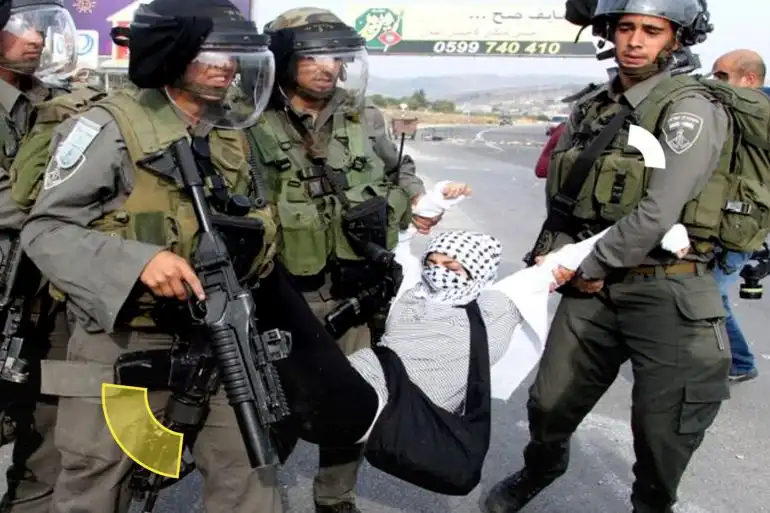
“We are shocked by reports of the deliberate targeting and extrajudicial killing of Palestinian women and children in places where they have taken refuge, or while fleeing,” they said in a joint statement. Some of them were reportedly carrying pieces of white cloth when they were killed by the Israeli army or its forces.

OPINIONS

Fri 23 Feb 2024 9:46 am - Jerusalem Time

How Israel Fights And Why Military Prowess Doesn’t Guarantee Strategic Success

Foreign Affairs

Foreign Affairs

Opinion Writer

By Shashank Joshi

On a hot, dry afternoon, a wave of aircraft surges into the sky. They are hunting the enemy’s surface-to-air missile batteries. The SAM batteries scoot around every ten minutes—aerial surveillance photos taken earlier in the day are useless. But the attackers have a solution. They send in decoy drones, simulating the radar cross section of jets, prompting the SAM operators to turn on their radars. As they light up, another set of drones beams back real-time video footage. The video is sent to a cutting-edge command-and-control computer that knows which attacking plane—100 are airborne at the peak of the battle—is where and armed with what. This orchestra of air power, conducted by an algorithm, smashes the SAMs.

The scene is not from the pages of military science fiction, nor is it from the war in Ukraine. Instead, this lopsided battle, known as Operation Mole Cricket 19, took place between Israel and Syria more than 40 years ago, in the early days of Israel’s 1982 invasion of Lebanon. For Edward Luttwak and Eitan Shamir, the authors of The Art of Military Innovation, the battle exemplifies the sort of military inventiveness at which Israel excels.

Luttwak is an eccentric 81-year-old strategist who consults for governments and has written books on the grand strategy of the Roman Empire, an irreverent guide to launching a coup, and several tomes on warfare. This most recent book’s acknowledgments nod to his picaresque career: he thanks various Israeli generals, one of whom helped him wander the Sinai front in the Yom Kippur War of 1973, another who let him tag along in the invasion of Lebanon, and a third whom he cryptically describes as having invited him “to participate in the design of a special operations unit.” Shamir runs the Begin-Sadat Center for Strategic Studies, a think tank in Israel.

It is awkward timing for a book extolling Israeli military prowess. On October 7, Israel’s armed forces were caught by surprise, suffering a terrorist attack that resulted in the bloodiest day for Israel since its independence in 1948 and the bloodiest for Jews anywhere since the Holocaust. In an assault led by the Palestinian militant group Hamas, around 1,200 people were killed, including 332 Israeli soldiers, and some 240 were taken hostage, including an estimated 18 soldiers. The resulting war has had mixed results for Israel. Hamas has been weakened but not destroyed. The group has enjoyed a surge of popularity among Palestinians in the West Bank, and much of Gaza lies in ruins.

Yet despite its failures on October 7, Israel’s military has punched above its weight since its founding. Luttwak and Shamir chalk up the success of the Israel Defense Forces to its ability to innovate, explained not only by operating in an environment of constant peril but also by its relaxed culture and streamlined structure. The authors give too much credence to innovation and technology, however, and understate three aspects of war. One is the interplay between technology and tactics: the IDF’s secret weapon has been its ability to adapt swiftly on the battlefield when crisis strikes. The second is that Israel’s apparent superiority in weaponry and intelligence has sometimes bred complacency about the intentions and capacity of its adversaries—a complacency that was exposed, brutally, on October 7. A third, and one admittedly beyond the purview of this book, is that tactical and operational innovation—designing a superb tank, building a new missile-defense system at breakneck speed, or discovering novel ways to use these weapons—alone cannot win a war.


LEAN, MEAN, FIGHTING MACHINE

Luttwak and Shamir’s basic proposition is simple. In 1962, Israel had a largely agricultural economy, virtually no electrical or mechanical industry, and a population less than half that of Sicily. By 1973, it had developed the world’s first sea-skimming missile and used it to sink 19 Egyptian and Syrian vessels. Less than a decade later came the computerized aerial blitzkrieg over Lebanon. These were not one-offs. Israel developed world-class tanks, pioneering tank-protection methods, and air defense systems that are the envy of the world. Israel has sold arms to China, India, and the United States, and officers from many of the world’s militaries flock to Israeli training centers.

The secret of this success, according to Luttwak and Shamir’s engaging and eclectic book, begins with the IDF’s egalitarianism. One of the first things that foreign military officers notice about the IDF is its laid-back culture. Most officers, other than defense attachés abroad, wear field dress rather than gold-braided uniforms. Soldiers address officers by their first names, and saluting is unusual. Women fill roles such as combat instructor that are normally performed in other armies by what the authors call “ultramasculine drill sergeant types.” The reliance on reservists also means that know-how can move from the civilian world into the military more easily than in other countries.

Such a relaxed atmosphere makes it easier for good ideas to flow up. Luttwak and Shamir’s book is full of compelling details, one of which emerges from their account of Israel’s stunning eve-of-war air offensive against Egypt in 1967. In the space of around four hours, the Israeli air force destroyed the bulk of the Egyptian, Jordanian, and Syrian air forces on the ground—some 450 planes in all—paving the way for Israel’s ground forces to win a sweeping victory in less than a week of fighting. The conventional wisdom was that attacking jets should swoop at dawn or dusk, when the approaching planes would be less visible to observers on the ground. A 19-year-old Israeli corporal familiar with the routines of Egyptian pilots argued that the attack should instead take place at 8 AM, when the pilots took their breakfast. His commanders listened, and the attack was a spectacular success.

Another reason that Israel’s military excels at innovation is the relative youth of its members. Israel’s full-time army is small and promotes personnel quickly. Luttwak and Shamir note that Israeli officers tend to be a decade younger than their American or European counterparts. The United Kingdom’s Royal Air Force, which has fewer fighter jets than Israel, is led by a four-star general with several three-stars and more than a dozen two-stars under him. By contrast, Israel’s air force is commanded by a two-star major general, served by a far slimmer staff that has no choice but to devolve authority downward.

The result of this compressed hierarchy is that big decisions are made by officers in their 30s who are “much less shaped by the past and much more open to the future,” according to the authors. In combat, junior commanders can take the initiative without meddling from phalanxes of staff officers at higher levels. During the IDF’s first large-scale offensive, in 1948, the IDF general staff ordered Yigal Allon, the frontline commander, to drive out Egyptian forces; the instructions they gave him fit on a single page.

The structure and history of Israel’s military have also contributed to its success. Israel’s armed forces emerged in 1948 from the two major Jewish militias that had fought the British and the Arabs. Instead of re-creating the model of Western militaries, with separate—and feuding—armies, navies, and air forces, the fledgling IDF opted for a single service with one commander. One benefit was that funds for research and development were not diluted among separate branches that, as in the United States, might otherwise have designed and built the same weapons in parallel.

The absence of a standalone air force—Israel instead had a lesser “air command,” now an “air and space arm,” subordinate to the general staff—was particularly important. In other countries, pilots have resisted the notion that they ought to be removed from cockpits in favor of remotely piloted or uncrewed aircraft, which allow for smaller airframes, longer flights, and riskier missions. Israel, then a poor country of a few million people, pioneered the use of drones in the 1970s. Eighteen years later, during the first Gulf War, a conflict in which technology had a starring role, the United States had no drones, the authors point out, other than those that the U.S. Navy and Marine Corps imported from Israel.


MOVE FAST AND WIN WARS

These cultural factors play out in a context of constant threat. Since its establishment, Israel has fought five large conventional wars, including the present one in Gaza, and many smaller campaigns between them. The specter of war accelerates innovation. Consider the case of the Iron Dome missile defense system. During the October 7 attack and in the months since, Hamas has launched more than 10,000 rockets into Israeli territory. But only a handful of people have died in those strikes, thanks in large part to Iron Dome, which tracks incoming rockets, works out where they will land, and intercepts those that are headed for built-up areas or other valuable targets.

The Lebanese militant group Hezbollah compelled Israel to develop this system after the militants fired 4,000 rockets at Israel in 2006. “As happened repeatedly and on all sides during the second world war,” write Luttwak and Shamir, “groups of engineers and scientists personally committed to an urgent national mission that might avert the deaths of loved ones achieved a critical mass of dynamic creativity otherwise not only unattainable but unimaginable.” Most missile projects take 15 to 20 years to reach fruition, so developing such a sophisticated system in such a short time—Israel managed to create Iron Dome in four years, from 2007 to 2011, albeit with significant financial help from the U.S. government—was “unheard of,” they write, given that the system’s radar, software, and interceptor missiles were all entirely new.

Iron Dome also illustrates how the line between bottom-up initiative and outright insubordination is often blurred. Danny Gold, the head of an IDF weapons agency in the early years of the twenty-first century, pushed ahead with the design and manufacture of the system despite instructions not to, which were rooted in intense skepticism in the IDF about whether it would be economical. According to Luttwak and Shamir, Israel’s state auditor saw it as a case of “sustained, piratical insubordination, budgetary misappropriation, and administrative irregularity on the largest scale.” But after Iron Dome was completed, Gold was promoted and honored by the state. Another case in point: in the 1973 war, an IDF commander named Ariel Sharon disobeyed orders by leading his troops across the Suez Canal and into Egyptian territory. But when his operation was later deemed to be a success, he was forgiven and celebrated—and eventually became prime minister.

Persistent danger has also encouraged Israel to improvise. In the 1940s, Jewish militias (and later the IDF) were starved of weapons from abroad. But they managed to get their hands on 3,000 ten-ton U.S. “half-tracks”—lightly armored vehicles with wheels at the front and tank-like tracks at the back. Some carried troops. Others had Czechoslovakian guns bolted on. The United States retired its half-tracks as soon as it could, but Israel was still using them in Lebanon in the 1980s. The IDF similarly recycled Soviet tanks it captured in its wars against its Arab neighbors, raising an entire division out of such second-hand kit, allowing it to keep up with far larger Arab armies. Bigger, better-resourced, and more complacent militaries would not have bothered.


SENSE, NOT SENSORS

Luttwak and Shamir believe that technological innovation is the key to military success. Big “macroinnovations,” as they call them, “not merely new and improved versions of what already existed, but weapons or techniques that did not exist at all until then,” such as the digitized drone-enabled assault in 1982, can be revolutionary because they catch an enemy by surprise before it has time to prepare a response—what the authors refer to as a “countermeasure holiday.”

But their own argument shows that what matters is not the invention of new gadgets but how they are combined and used. The United States had pilotless aircraft before Israel did, long before the attack on Syrian SAMs, but it was Israel that turned U.S. target-practice drones into revolutionary decoys in 1973. A similar story took place ahead of World War II. The United Kingdom had tanks first, but it was Germany that exploited them to the fullest. And Germany’s blitzkrieg against France in May 1940 was devastating not because tanks, aircraft, and artillery were novel weapons but because they had been stitched together in what would come to be called “combined arms” tactics.

The precise relationship between technology and warfare lies at the heart of many of the most important debates in military science over the past 50 years. In the 1990s, American thinkers argued that a “revolution in military affairs” was underway, in which new sensors, precision-guided weapons, and computer networks to connect the two would enable a new sort of blitzkrieg, one demonstrated by the U.S. victory over Iraq in 1991.

What matters is not the invention of new gadgets but how they are combined and used.

But some scholars have questioned the primacy of technology in such military outcomes. In a seminal book, Military Power, the political scientist Stephen Biddle argues that what really mattered was tactics. Well-drilled armies built around small, cohesive units capable of using the terrain for cover and concealment could still survive in the face of modern weaponry. Biddle points to the example of al Qaeda’s ability to evade massive U.S. bombardment in Afghanistan’s eastern Shah-i-Kot Valley and Arma mountains in March 2002. One dug-in al Qaeda command post was ringed by five craters caused by large U.S. precision-guided bombs. Its garrison survived and had to be cleared out by infantry.

The war in Ukraine has given a twist to that debate. The technologies of the revolution in military affairs have, in one sense, fulfilled their promise. Sensors are better than ever and have proliferated widely—Ukraine has access to radar satellites, capable of spotting Russian tanks in woodland, that most large military powers could only have dreamed of 25 years ago. Artificial intelligence is fusing data such as electronic emissions detected by satellites and mobile phone signals to find high-value targets, including Russian generals and Hamas leaders.

Yet in Ukraine, at least, the result has not been a fluid war of shock and awe. The frontlines seem viscous. Ukraine’s counteroffensive last year resulted in paltry territorial gains. In October 2023, Valery Zaluzhny, Ukraine’s top general, gave his own diagnosis for this state of affairs. “Just like in the First World War, we have reached the level of technology that puts us into a stalemate,” he said. “We see everything the enemy is doing and they see everything we are doing. In order for us to break this deadlock we need something new, like . . . gunpowder.”

The problem is that this is a dangerously deterministic way of looking at technology. Zaluzhny was right in suggesting that new—perhaps hitherto undiscovered—means of clearing mines, jamming drones, or locating Russian artillery batteries would smooth the path out of the stalemate. But as Biddle has pointed out in these pages, the same technological environment can produce dramatically different outcomes. In World War I, Germany’s initial invasion of Belgium and France made huge progress despite the existence of the same machine guns and artillery that later produced the Battle of the Somme in 1916, in which the Allies advanced a mere seven miles at the cost of more than one million casualties on all sides. Later, in its spring offensive of 1918, Germany took 4,000 square miles of ground without using tanks.


RISK AND RETURNS

Luttwak and Shamir argue that the culture of the IDF has encouraged bold and daring tactics, often involving tremendous risks. That is partly because smaller armies facing larger foes must rely on guile over brawn. It is also to do with which skills are rewarded. “In the IDF the commando element . . . is not peripheral,” they write, “because many senior officers are promoted from the commando units.” Israel’s prime minister and defense minister are former special forces officers. The IDF’s chief of staff, as well as his predecessor, were both paratroopers.

Israel’s early leaders, experimenting with armored warfare, opted to send troops to West Germany’s military schools—not without some reluctance—rather than British ones because they believed they had more to learn from a military that had managed dynamic maneuvers in the deserts of North Africa during World War II, an environment similar to the Negev desert, as opposed to a military that, in the IDF’s estimation, had relied on firepower, attrition, and superior numbers.

Many of Israel’s greatest military triumphs have indeed come from audacious tactics such as the aerial bolt from the blue in 1967 and Sharon’s dash across the canal six years later. But the same attributes that produced such successes have also contributed to Israeli vulnerabilities. In October 1973, Israel convinced itself that Egypt would not launch an attack. That was, in large part, a political misjudgment, but one rooted in deeper pathologies. Israeli military intelligence, AMAN, failed to predict not just the war but also Egypt’s innovative tactics and the training that had occurred since its defeat in 1967. “A common factor behind all these failings,” writes the journalist Abraham Rabinovich, in his book on the war, “was the contempt for Arab arms born of that earlier war, a contempt that spawned indolent thinking.”

The question, one left unaddressed by Luttwak and Shamir, is whether technology reinforced that complacency. In 1973, AMAN experts believed they would be able to provide a warning four to six days before the beginning of war, thanks to battery-powered signals-intelligence devices planted in the sand outside Cairo and in the hills west of Suez City. But these sensors were switched on too late and did not alert Israeli officials to the coming assault.

Luttwak and Shamir argue that the debacle of 1973 reinforced the IDF’s culture of egalitarianism. In Unit 8200, Israel’s equivalent of the U.S. National Security Agency, even rookies are free to contact senior officers regardless of the chain of command. AMAN established a “devil’s advocate” department that reports directly to the head of military intelligence. Yet there is now copious evidence that such dissenting channels failed in the months before October 7, when Israeli sentries and junior intelligence officers picked up many signs of an impending Hamas attack, such as exercises to blow up the border fence and enter kibbutzim, only for their warnings to be dismissed as “imaginary scenarios.”

It is too early to say conclusively why senior officers were so resistant to evidence for a likely attack. Intelligence failures are complex, but many of the factors at work in the lead-up to October 7 likely echo those that afflicted the IDF in 1973: a rigid political conception of what the enemy would or would not do, a systematic underestimation of the enemy’s competence to conduct a military raid deep into Israel, and a conviction that high-tech means of surveillance and defense, such as vibration sensors and border cameras strung along the perimeter with Gaza, would be adequate.

Even world-beating innovation and adaptation will get an army only so far.

Indeed, focusing on Israel’s successes can distract from what really matters: the response to failures. Israel’s armor corps was shocked in 1973 by the onslaught it faced from new Soviet antitank weapons and Arab tanks. The IDF eventually realized that its tanks were vulnerable by themselves, so it placed mortars on them to fire at locations where antitank squads might be hiding and used smoke to obscure their own positions. Tank losses fell quickly. Israel’s success was not in having the best weapons or the boldest commanders—welcome as these are—but in swift adaptation under fire.

For all that, even world-beating innovation and adaptation will get an army only so far. Israel’s offensive in Gaza exemplifies many of the strengths that Luttwak and Shamir highlight. Israel has deployed cutting-edge drones, one of the world’s most advanced armored personnel carriers (the Eitan), and an artificial intelligence system (Gospel) capable of identifying at least 100 potential targets per day—all capabilities that would be envied by larger and better-resourced armies.

These technologies have doubtless helped the IDF advance deep into Gaza, kill over 9,000 Hamas fighters, and keep its own casualties down to fewer than three Israeli soldiers killed per day, a remarkably low tally by the standards of grueling urban warfare. But wars are fought for political reasons, and waging them well is not just about winning battles, which Israel has always done proficiently, but translating those victories into political outcomes, which it has not.

Innovation is not enough to root out and destroy an enemy that has spent almost two decades burrowing in and under dense urban areas. Nor does it help to persuade Israel’s Arab neighbors to underwrite the reconstruction of postwar Gaza and participate in its governance. Luttwak and Shamir rightly praise the IDF for “striving to surprise the enemy by novel schemes of action, inevitably by accepting major and sometimes extravagant risks.” If only Israel’s political leaders were willing to take the same bold leaps into the unknown.


OPINIONS

Fri 23 Feb 2024 9:40 am - Jerusalem Time

The Palestinian Authority And The PLO

Nabil Amr

Nabil Amr

Opinion Writer


Regardless of the polls showing a decline in popular support, and despite ongoing excavation efforts to dig up a body to run things after this war, particularly in Gaza, bets are on the Palestinian Authority and the Palestine Liberation Organization once again. Both are organs of a single body that enjoys Palestinian, regional, and international legitimacy.
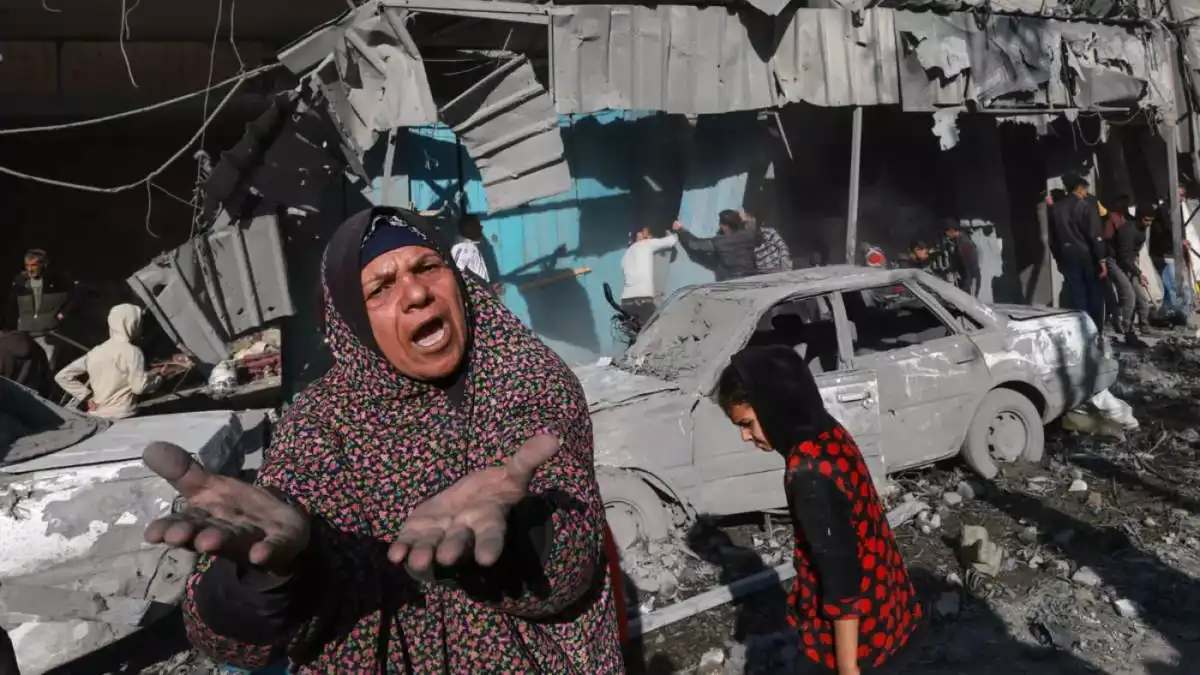
The President of the PA has met this development by expressing his readiness - on behalf of both the PA and the PLO - to take on the responsibility of governing Gaza, provided that this responsibility encompasses the Palestinian entity in its entirety: the West Bank, Gaza, and Jerusalem, i.e., all of the territory that it is presumed will (as it indeed should) become Palestine. Plans for a Palestinian state are currently being discussed by the entire world, including the United States and half of Israel, and this is not idle talk but a serious project. Implementation on the ground, as well as official recognition by those who have so far refused to recognize this state, are now subject matter of this dialogue, not just slogans or principles.

On what is commonly referred to as "the day after," the wisdom of betting on the Palestinian Authority and the PLO will be determined by the Palestinians themselves. They must lift themselves up without directives from anyone and prepare the domestic scene for the negotiation process. That means ensuring the necessary popular and partisan support, with the integration of every faction into the Palestine Liberation Organization a priority in its political program and the negotiation process.

This does not preclude opposition within parliament (the Palestinian National Council), and Hamas should have seats in this parliament, whether Council members are appointed through an agreement between the factions or elected. Either way, elections must eventually be held after the war, to reinforce the representatives of the Palestinian people's legitimacy, which has seriously eroded over the past few years.

The PA cannot go back to governing Gaza, which it considers to have never left despite the coup against it, so long as a single Israeli soldier remains in the strip. National unity through the emergence of a state is another requisite for its return. Indeed, the PA's experience in the West Bank and the unhealthy relationship with the Israelis that developed during, before, and after the collapse of Oslo, should be a lesson, and the same mistakes should not be repeated.

The framework according to which the PA was responsible for running Area A and partially responsible for Area B, while it was absent from Area C, gave Israel everything it wanted for nothing in return. Settlement building continued and expanded, and the wonton, cost-free occupation persisted, with and without security coordination. The arrangements of the Oslo Accords turned the PA into a policing arm of the occupation in the eyes of Palestinians, which is a crucial factor in explaining its loss of support and prestige.

As Mahmoud Abbas is very well aware, the PA, along with the Fatah movement and the Palestine Liberation Organization, needs to be reformed in a whole host of ways, whether the negotiation process begins tomorrow or the day after tomorrow. Such reforms are not only needed to bolster their influence over these talks and turn them into serious actors, but also because these bodies manage the lives of millions of Palestinians in the West Bank, Gaza, and Jerusalem. This administration must, with or without a settlement, improve in a manner that makes Palestinians' lives easier and provides them with the means to remain resilient and stay on their land, as well as to remain committed to their national movement, which will not abandon its responsibilities in leading the Palestinian people towards their objectives and granting them their rights, which have been recognized by the entire world.

After the war on Gaza, with everything it can be credited and blamed for, with all the challenges it has created, foremost among them are rebuilding an area that has been totally destroyed, reconstituting a political system that has eroded and collapsed due to a lack of renewal, and reunifying a nation whose division left it split...

After the war, Palestinians will be on the frontlines leading the efforts to achieve these goals. The better and more convincing the performance, the less hesitant the world be to support Palestinians and strive in earnest work for the establishment of a Palestinian state, whose emergence alone could mitigate all the repercussions of a conflict. Only through this state could fragments of this nation exhausted by wars and calamities be brought together and finally achieve its aspirations. We should not ignore the fact that this is now what the whole world wants.

ARAB AND WORLD

Fri 23 Feb 2024 9:36 am - Jerusalem Time

Israel is looking for “the right people” to run Gaza

Political sources in Tel Aviv revealed that representatives of the Israeli army and government leadership recently met with a number of local Palestinian figures in Gaza City, and discussed the possibility of forming local leaderships to replace the Hamas movement in managing civil affairs in general and distributing humanitarian aid in particular, and the importance of Searching for “the right people”.


The Israeli “Channel 12” said that the government has begun developing a model for local government in Gaza, as part of Israel’s preparation for the “day after” the war, and that the army has begun the process of cleaning up the Al-Zaytoun neighborhood in Gaza City with the aim of launching a model that allows the residents of the Strip to manage this neighborhood away from “ agitation".


Channel 12 added, “The Israeli challenge in this plan is to provide protection for the project so as to prevent (Hamas) from disrupting the process.” It explained that the army began “cleaning up” the Al-Zaytoun neighborhood by completely destroying and bulldozing the buildings, and paving the way for the establishment of a large neighborhood of tents. In this model, Israel also focuses on the need to fundamentally change the education curriculum in the Gaza Strip’s schools, especially with regard to content that incites hatred of Israel and Jews.


Reuters quoted an Israeli official as saying that the planned “humanitarian enclaves” will be launched in the areas from which Hamas was removed in the Gaza Strip, but their ultimate success will depend on Israel achieving the goal of destroying Hamas in the Gaza Strip.


For its part, Hamas said that the Israeli plan would also exclude any employee on the Palestinian Authority’s payroll, making the plan “an Israeli reoccupation of Gaza that is doomed to failure.”


On the ground, Israeli strikes and heavy bombardment on the city of Rafah flattened a mosque and destroyed homes in what residents described as one of the worst nights they had experienced so far. An Israeli strike demolished Al-Farouq Mosque in the center of Rafah, turning it into rubble and rubble, and the facades of nearby buildings were shattered. The authorities said that the Israeli army bombed four homes south of Rafah and three in the city center.

OPINIONS

Fri 23 Feb 2024 9:21 am - Jerusalem Time

US leverage over Israel moves by ‘millimeters’ as it looks to secure hostage deal

Middle East Eye

Middle East Eye

Opinion Writer

The worsening humanitarian crisis in Gaza and Israeli threat to launch a ground offensive in Rafah expose Washington's limited appetite to wield its leverage


By Sean Mathews

The worsening humanitarian crisis in Gaza and the Israeli threat to launch a ground offensive in Rafah expose the US’s limited appetite to wield its unrivalled leverage against Israel, even as it impedes Washington's policy goals. 

On Thursday, the White House's top Middle East advisor, Brett McGurk, arrived in Israel as the UN painted a picture of lawlessness and hunger stalking Gaza. 

New data released by the UN showed a staggering decline in aid entering the enclave. The daily average of aid trucks reaching Gaza between 9 to 20 February was just 57, compared to 200 in January. The plunge comes as humanitarian workers warn that the besieged enclave is on a "very rapid path towards famine”.

Coaxing Israel to allow more aid into Gaza is just one dilemma facing McGurk. The primary is pushing for a deal to pause fighting in Gaza so an exchange of captives can be held between Israel and Hamas.   

Reaching a truce that would free the roughly 130 hostages Hamas is still believed to hold has become the main axis on which US diplomacy revolves. 


From Washington’s perspective, such a deal would give the US space to deescalate tensions with Iran-backed groups like Hezbollah and Yemen’s Houthis, surge aid into Gaza, and provide a political reprieve going into an election for Biden as he faces stiff criticism among progressives over his support of Israel, current and former US officials have told MEE.

Biden wants the deal to be extended to a “sustained pause in the fighting" which the White House believes will give them space to start early conversations with Arab allies about a two-state solution and a final settlement to the conflict. 

Israeli war cabinet minister Benny Gantz said the talks had raised the "possibility of progress”, but they could face a reckoning if Israel follows through on its pledge to launch a full-scale ground invasion of Rafah, the southern Gaza border town where 1.5 million Palestinians are sheltering in squalid conditions.

Israel has given Hamas a deadline of early March to release the hostages or face an onslaught in Rafah. But Hamas has shown little willingness to move beyond its demand of a permanent ceasefire and the release of thousands of Palestinians held in Israeli jails.

Prime Minister Benjamin Netanyahu has called those demands "delusional".

US leverage with Hamas, designated a terror organisation by Washington, is limited. It is negotiating with the group via Qatar and Egypt. 

The administration’s push to avert a Rafah offensive and seal a hostage deal comes as many say the US is conducting diplomacy with one hand tied behind its back, handicapping the full weight of leverage it can deploy against Israel to achieve its policy goals. 

“Until the Biden administration makes more effective use of US leverage, there will continue to be a big gap between what they ask of the Netanyahu government and what that government actually does,” Democratic Senator Chris Van Hollen, told Middle East Eye.


Moving by millimeters

President Joe Biden threw the US’s full weight behind Israel’s military campaign after 7 October, when Hamas and other armed Palestinian groups killed about 1,139 people and took 250 hostages back to Gaza.

Washington’s unconditional support for Israel was in part the gut reflex of a US president who has championed himself as an ally of Israel his entire political life. But it was also described by US officials as a way for Washington to maintain influence in the conflict, and better shape the political and humanitarian impacts of the war.

Instead, as fighting grinds on with no end in sight, Netanyahu has baulked at most US initiatives.

In addition to threatening a ground invasion of Rafah and constricting Gaza aid, he has flatly rejected US calls to support political talks on the creation of an independent Palestinian state. Meanwhile, the Israeli army is constructing a buffer zone in Gaza that goes against US demands to maintain the territorial integrity of Gaza. 

Israel’s actions have fuelled tensions with the administration. The most visible sign of that has been an increase in Biden's public criticism.

In December, he said the US’s closest Middle East ally was conducting an “indiscriminate bombing” of Gaza, and earlier in February said the military campaign was “over the top”.

That came amid a White House media leak in which Biden had called Netanyahu an “asshole”.

Besides the public rhetoric, the US says it was reviewing reports that Israel harmed civilians in Gaza under guidelines to monitor countries receiving US arms.

But Brian Katulis, a senior fellow at the Middle East Institute, described the administration’s approach as “moving by millimeters".

“None of this amounts to a policy change by the Biden administration,” he told Middle East Eye, “and despite gaps on key issues, it hasn’t changed the administration's first priority which is to back Israel’s right to self defence".


Investment trap

Former and current US officials have told MEE there is no appetite within the administration to wield the US’s most powerful lever of influence against Israel: arms transfers .

Washington is Israel's biggest military patron, sending about $3.8bn in military aid to Israel each year. Since October, the White House has twice bypassed Congress to rush military assistance to Israel, removing another lever, the potential for Congressional oversight, that could slow down arms transfers.

And even as Biden has criticised Israel in recent months, he has publicly lobbied Congress to approve an additional $14bn in military aid.


'The administration understands that it is in an investment trap' 

- Aaron David Miller, Carnegie Endowment


Besides putting it at odds with calls from its Arab and Muslim partners to demand an immediate ceasefire, the gap between the administration's rhetoric and actions has frustrated some of its closest western allies.

Earlier this month, EU foreign policy chief Josep Borrell took a veiled swipe at the US when he said: “if you believe that too many people are being killed [in Gaza], maybe you should provide less arms in order to prevent so many people being killed”.


But Biden is far from alone.

Even lawmakers in Congress who have been critical of Israel are unwilling to restrict arms sales, or at the very least, condition military assistance on the US's stated policy objectives. 

The defence bill allocating $14bn in aid to Israel, and tens of billions more for Ukraine, passed the Senate by a vote of 70 to 29.

Katulis said proponents of cutting military aid to Israel misjudge how profoundly Hamas’s 7 October attack shook senior US administration officials.

The US's unconditional embrace of Israel since 7 October also means they are now intimately tied to the successes and failures of its offensive in Gaza. 

“The administration understands that it is in an investment trap. They are so tethered to the Israeli war that creating an open breach with Netanyahu will leave them with no policy,” Aaron David Miller, a former US Middle East negotiator now at the Carnegie Endowment for International Peace, previously told MEE.


As the war grinds on, it has seeped out beyond Gaza's borders, morphing into a shadowy proxy contest between Tehran and Washington over who calls the shots in the Middle East. 

In Yemen, Houthi rebels are waging war against commercial shipping, in what they say is solidarity with Palestine. Israel is exchanging near daily fire with Hezbollah along the Lebanese border and Iran-backed groups in Syria and Iraq are attacking US forces. 

Hamas also receives training and support from Iran, making it a Mediterranean linchpin in Tehran’s so-called "axis of resistance", in the view of multiple US officials who have spoken with MEE. 

“The US is engaged in active combat in Yemen, Iraq, and Syria against Iran-backed forces,” Katulis said. “Ultimately when it comes to the wider chessboard in the region, the US and Israel are aligned.”


'Israel raises the price'

The White House is also weighing domestic politics. 

Restricting arms sales or conditioning them on an immediate ceasefire may help restore confidence in Biden among progressive voters and Arab and Muslim Americans in the key swing state of Michigan. But it would also lead to backlash from Israeli lobbying groups, just as Biden gears up for a likely general election against Donald Trump.

 “Israel is very good at raising the price politically," Frank Lowenstein, the former special envoy for Israeli-Palestinian negotiations in the Obama administration, told MEE.

While Biden has faced fire on the progressive left for his unconditional support of Israel, he could face pressure from Republicans in Congress for not doing enough to back Israel. 

“The way to look at Biden’s tools of leverage with Israel is not what the administration can theoretically use against the Israelis, but what are the costs and benefits of doing so," Lowenstein said. 

With arms transfers off the table as a lever of power, the US has few tangible tools at its disposal. One arena where the US can cajole and coax Israel is the United Nations, Lowenstein said.


Venting at the UN

On Tuesday, the US vetoed a UN Security Council resolution calling for an immediate ceasefire in Gaza. It marked the fourth time the US has weilded its veto power to shield Israel from resolutions and amendments criticising it. 

US ambassador to the UN Linda-Thomas Greenfield defended the vote, saying that calls for an immediate ceasefire without a demand for Hamas to release the roughly 130 hostages it is believed to hold would derail negotiations for a deal.

Humanitarian and aid groups slammed the US move, while Russia and China gloated at Washington’s isolation on the world stage.

The vote was 13-1, with the United Kingdom abstaining and the US casting the lone veto.

In response, the US drafted its own resolution.

It offers Washington’s sharpest formal criticism of Israel to date.

According to the draft resolution viewed by MEE, it calls for “a temporary ceasefire in Gaza as soon as practicable” and “lifting all barriers to the provision of humanitarian assistance at scale”.

The text also underlines Washington’s frustration with Israel’s threat to invade Rafah, demanding it “not proceed” with a major ground offensive there, which could “result in further harm to civilians and their further displacement including potentially into neighbouring countries”.

“It is a shot across Bibi’s bow in a way,” Lowenstein said. “The Israelis are extremely sensitive about the UN. They view it as a hostile body and rely on the US to protect them there.”

But Katulis said the small shift in tone underscored the limits of the conditions the US is willing to impose on Israel. 

“The UN does have impact, but is it practical in shaping a pause in fighting? The UN tends to be an arena for people to vent.”