PALESTINE

Fri 22 Mar 2024 8:39 am - Jerusalem Time

UN rapporteur: There is no moral argument justifying the continued sale of weapons to Israel

UN Special Rapporteur on the situation of human rights defenders, Mary Lawlor, said that there are no moral arguments that can justify the continued sale of arms to Israel by states that respect the principle of the universality of human rights.


Lawlor added that providing weapons to Israel, which kills more Palestinian civilians, is a “war on human rights” and nothing justifies continued arms sales to it.


She pointed out that Israel has proven over time that it will use such weapons “indiscriminately against the Palestinians,” and that any claims by Israel of self-defense will be “useless.”


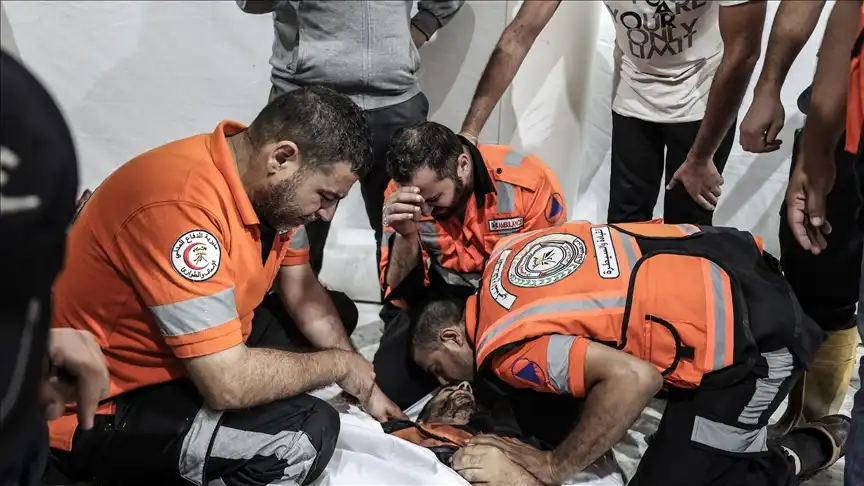
Lawlor pointed to the human rights defenders, journalists and healthcare workers who have been killed in the besieged Gaza Strip over the past few months, noting that this is a “war on women and children”, who constitute approximately 72% of the victims of the current war.


Regarding the journalist victims, Lawlor said that more than 122 journalists and media professionals were martyred in the Gaza Strip at the hands of Israel.


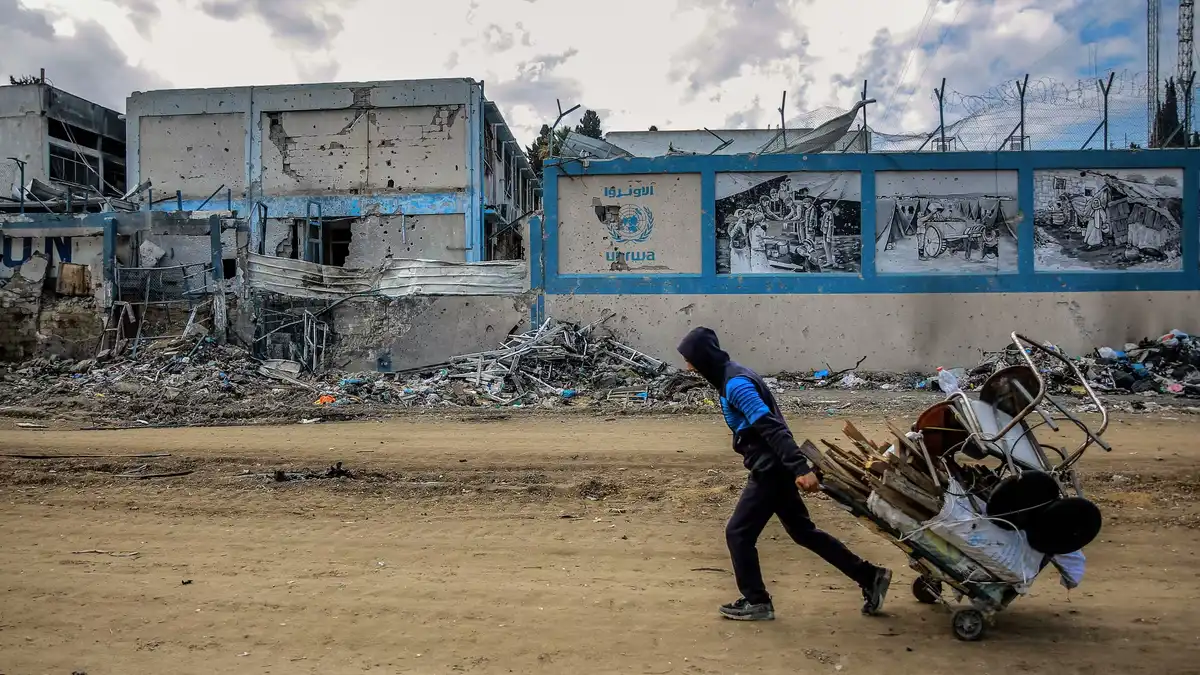
Referring to the killing of 162 employees of the United Nations Agency for Palestine Refugees (UNRWA), Lawlor stressed that this is also a “war against humanitarian workers.”


She stressed that the international human rights structure is "suffering under the weight of the hypocrisy" of countries that have expressed their support for a rules-based system, but at the same time continue to send weapons to Israel that kill more Palestinian civilians, noting "above all else." "It is a war on human rights."


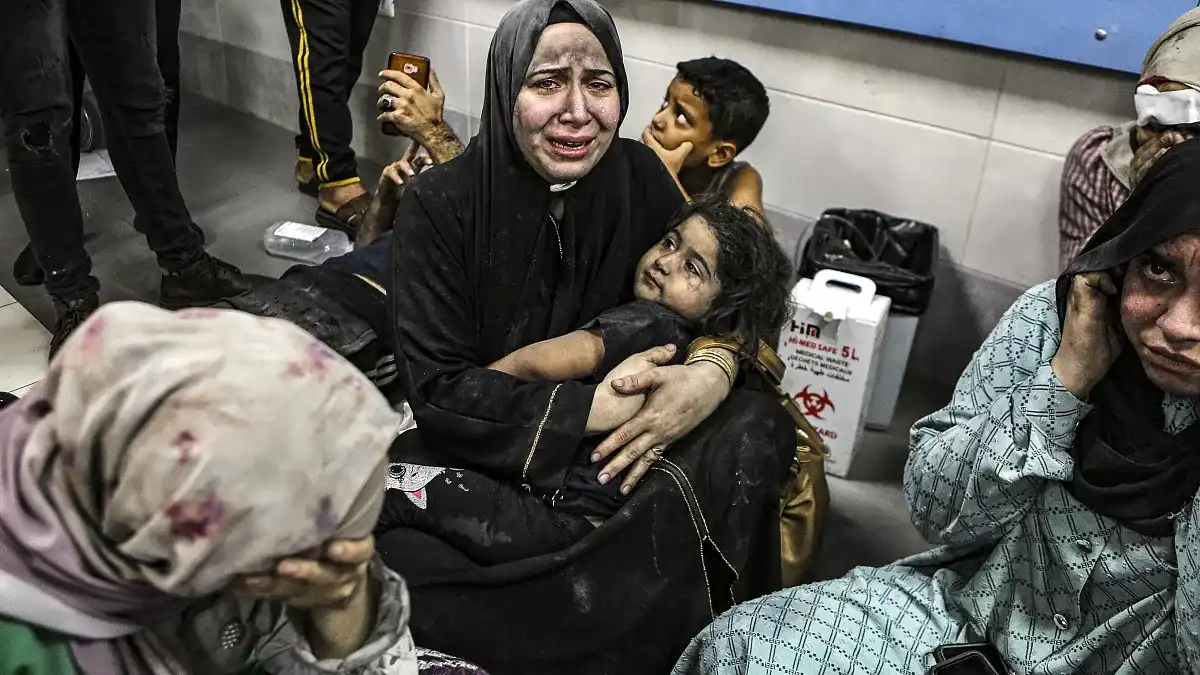
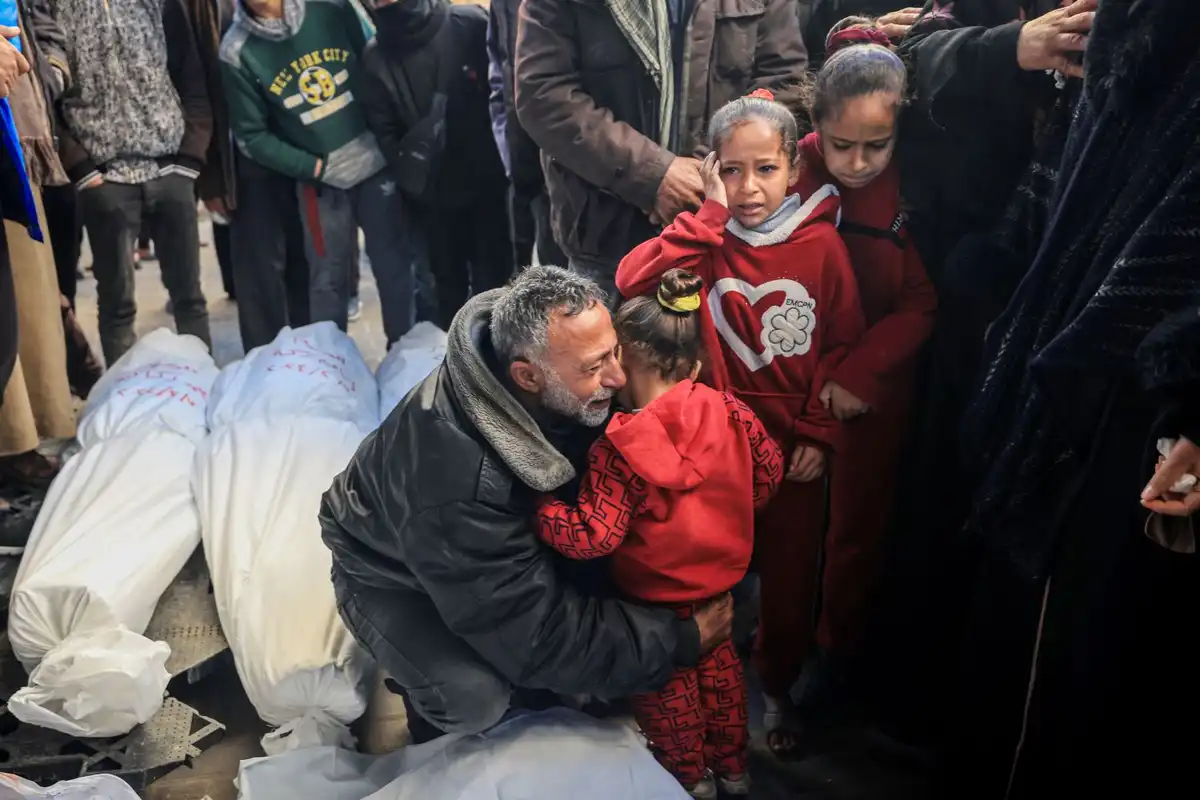
The death toll in the Gaza Strip has risen since October 7, to about 32,000 killed and 74,188 injured, the majority of whom are women and children, in addition to thousands of victims who are still under the rubble.


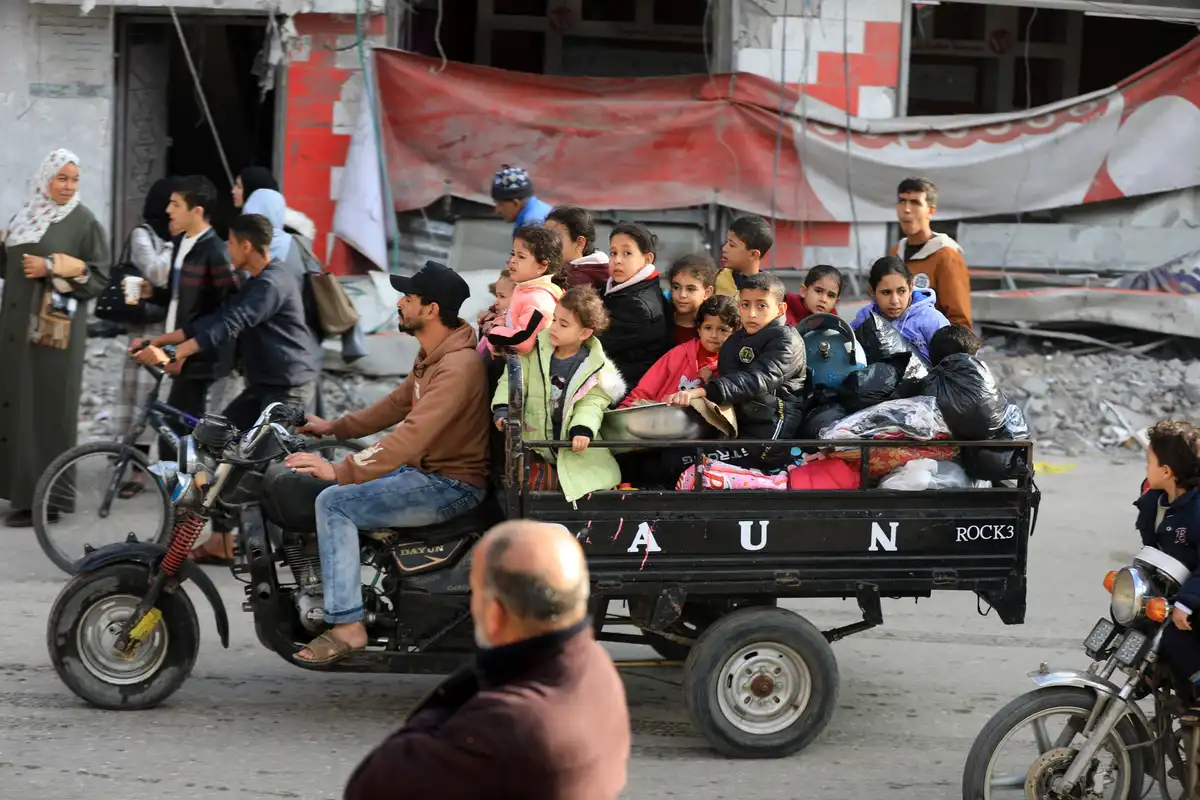
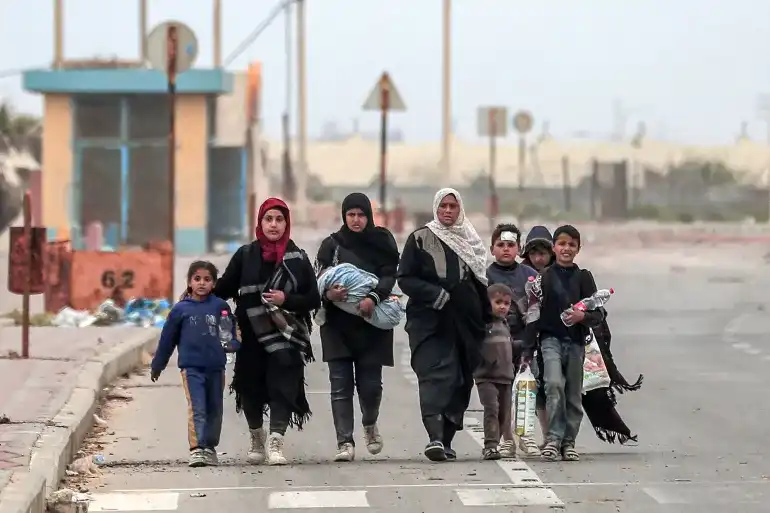
The aggression against the Gaza Strip, which entered its 168th day, pushed more than 85% of Gaza’s citizens into internal displacement amid a stifling siege of most food supplies, clean water and medicines, while 60% of the Strip’s infrastructure was damaged or destroyed, according to a United Nations report.


Israel faces charges of genocide before the International Court of Justice, which in January issued interim rulings ordering it to stop acts of genocide and take the necessary measures to ensure the provision of humanitarian aid to civilians in Gaza.

PALESTINE

Fri 22 Mar 2024 8:29 am - Jerusalem Time

UN Security Council votes today on a draft US resolution on Gaza

Today, Friday, the UN Security Council will vote on a draft US resolution regarding the Gaza Strip.


The American draft resolution, according to Anadolu Agency, calls for an immediate ceasefire in Gaza, the protection of civilians from all parties, allowing the delivery of basic humanitarian aid, alleviating human suffering, and concluding an agreement on prisoners.


The draft resolution, which the United States has been negotiating for some time, indicates that Gaza is part of the territories occupied in 1967 and expresses its support for the two-state solution.


The draft resolution supports ongoing international diplomatic efforts to secure a ceasefire, and also calls on all parties to adhere to international law and international humanitarian law, protect civilians, preserve civilian infrastructure, and ensure humanitarian access.


The draft resolution opposes the forced displacement of civilians in Gaza, noting that this violates international law, international humanitarian law, and international human rights law.


In addition to the American draft resolution, the ten elected members of the Security Council are also preparing a draft resolution on the situation in Gaza.


The draft resolution, known as “E-10,” calls for an immediate ceasefire in Gaza during the holy month of Ramadan.


France, which held closed Security Council sessions over the past two weeks regarding Gaza, is also preparing a draft resolution. It is expected that he will focus on a permanent ceasefire later.


To be adopted, the draft resolution requires the approval of at least nine votes and the non-use of the veto by any of the five permanent members: the United States, France, Britain, Russia, and China.


Since the start of the aggression on Gaza, on the seventh of last October, Washington has used its veto power against three draft resolutions, two of which called for an immediate ceasefire.


The death toll in the Gaza Strip has risen since October 7, to about 32,000 and 74,188 injured, the majority of whom are women and children, in addition to thousands of victims who are still under the rubble.

PALESTINE

Fri 22 Mar 2024 8:28 am - Jerusalem Time

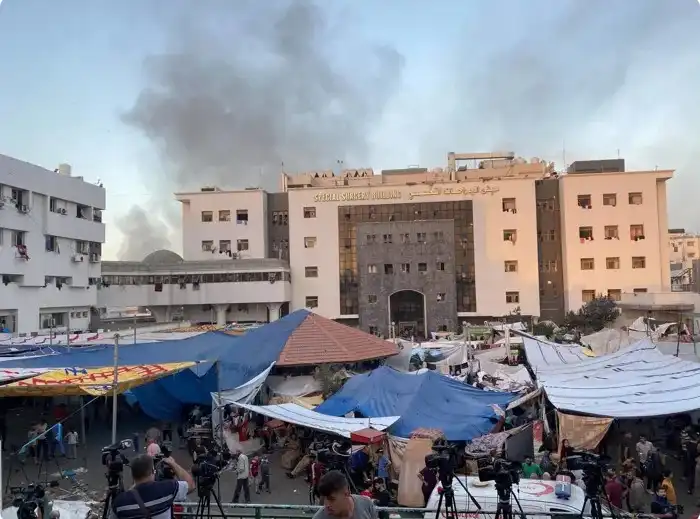
War on Gaza: Bombing and burning buildings in Al-Shifa Hospital and arresting dozens of medical personnel

The Ministry of Health in the Gaza Strip said on Friday, “The Israeli army bombed several buildings and burned the arterial department in the Shifa Medical Complex, while dozens of medical personnel were arrested and about 240 patients, their companions, and 10 health personnel were detained.”


A number of citizens were killed and others were injured as a result of the ongoing Israeli war on the Gaza Strip.


Here are the latest developments: A dead body arrived at the Kuwait Hospital as a result of the targeting of a group of citizens in the city of Rafah, south of the Gaza Strip.


Three patients died inside Al-Shifa Hospital in Gaza City, due to the siege and the Israeli forces preventing the arrival of medicines to the complex in Gaza.


10 citizens were killed as a result of the Israeli bombing of a house for the Al-Quqa family, northwest of Gaza City.


A number of citizens were killed and injured in a bombing by Israeli aircraft, northeast of the city of Rafah, south of the Gaza Strip.


Local sources said that Israeli aircraft bombed a house over the heads of its residents in the town of Al-Nasr, northeast of the city of Rafah in the southern Gaza Strip, killing eight citizens and wounding others.


The same sources added that among the dead were 3 children and 3 women, and that there were injured people, one of whom was in critical condition.


In the same context, Israeli aircraft bombed a house on Al-Tarzi Street in Deir Al-Balah.


The Israeli forces continue to storm the Al-Shifa Medical Complex in Gaza City, deploying dozens of tanks and vehicles in its vicinity, and their planes also carried out violent bombardment of residential buildings in that area.


The death toll in the Gaza Strip has risen since October 7, to about 32,000 and 74,188 injured, the majority of whom are women and children, in addition to thousands of victims who are still under the rubble.

The aggression against the Gaza Strip, which entered its 168th day, pushed more than 85% of Gaza’s citizens into internal displacement amid a stifling siege of most food supplies, clean water and medicines, while 60% of the Strip’s infrastructure was damaged or destroyed, according to a United Nations report.


Israel faces charges of genocide before the International Court of Justice, which in January issued interim rulings ordering it to stop acts of genocide and take the necessary measures to ensure the provision of humanitarian aid to civilians in Gaza.

PALESTINE

Thu 21 Mar 2024 10:47 pm - Jerusalem Time

Israeli Minister: We will go to Rafah even if the whole world stands against us

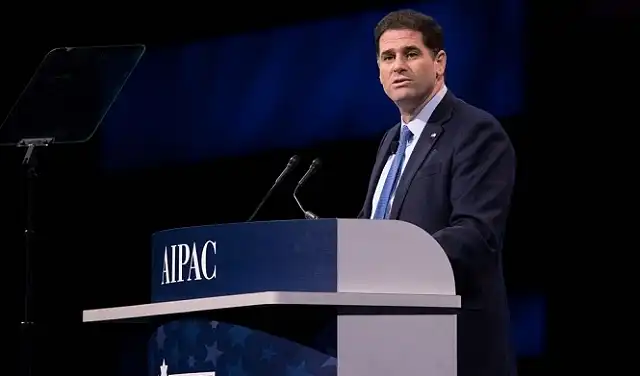
Israeli Minister of Strategic Affairs Ron Dermer said that the Israeli occupation army will eventually invade the city of Rafah, south of the Gaza Strip, and defeat the Islamic Resistance Movement (Hamas) "even if the entire world becomes against Israel, including the United States."


Dermer said in an American audio program (podcast) broadcast over the Internet: “We will enter and finish this mission, and anyone who does not understand this does not understand that the existential nerve of the Jews has been pressed” in the Al-Aqsa flood battle on the seventh of last October.


The far-right minister added: "This will happen even if Israel has to fight alone. Even if the whole world turns against Israel, including the United States, we will fight until we win the battle."


Israeli Prime Minister Benjamin Netanyahu shows his determination to carry out a military operation in Rafah, claiming that achieving the goal of eliminating Hamas will not be achieved without this.


“We are very confident that we can do this in an effective way not only from a military perspective, but also from a humanitarian aspect,” Dermer said. “They have less confidence in our ability to do this,” he added.


Dermer, a former Israeli ambassador to the United States, a member of the war cabinet and one of Netanyahu's close associates, is scheduled to travel with National Security Advisor Tzachi Hanegbi to Washington next week to hear the Biden administration's concerns that such an invasion would lead to the fall of more... Civilian casualties at a time when famine and disease are spreading in Gaza.


Dermer said leaving the Islamists out would invite open attacks against Israel from across the region, “which is why the determination to push them out is so strong, even if it leads to a potential breach of relations with the United States.”


Dermer said that there are 4 Hamas brigades intact in Rafah, supported by militants who have withdrawn from other parts of Gaza, which represents 25% of the group’s strength before the war.


Emphasizing that they will not leave a quarter of Hamas fighters there, “We are going to Rafah because we have to.”


Several countries warned Israel of the consequences of invading Rafah, due to its catastrophic repercussions on the city, which represents the last refuge for the Palestinians after the scale of bombing, destruction and killing caused by the Israeli occupation in the Gaza Strip. As a result, it faces accusations of committing genocide before the International Court of Justice.


Rafah Governorate currently houses more than 1,400,000 Palestinians, including 1,300,000 who were displaced from other governorates under the weight of violent bombardment with the intention of forcing them to evacuate their areas, starting in the north of the Gaza Strip in particular.


OPINIONS

Thu 21 Mar 2024 10:02 pm - Jerusalem Time

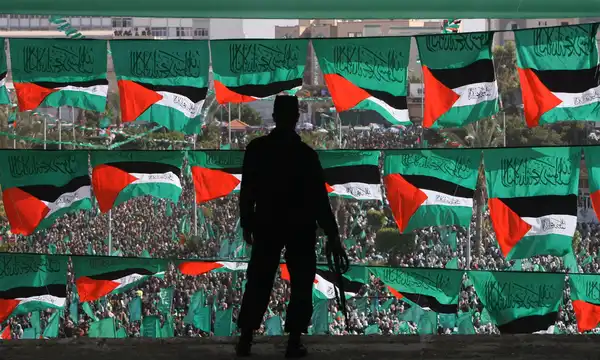
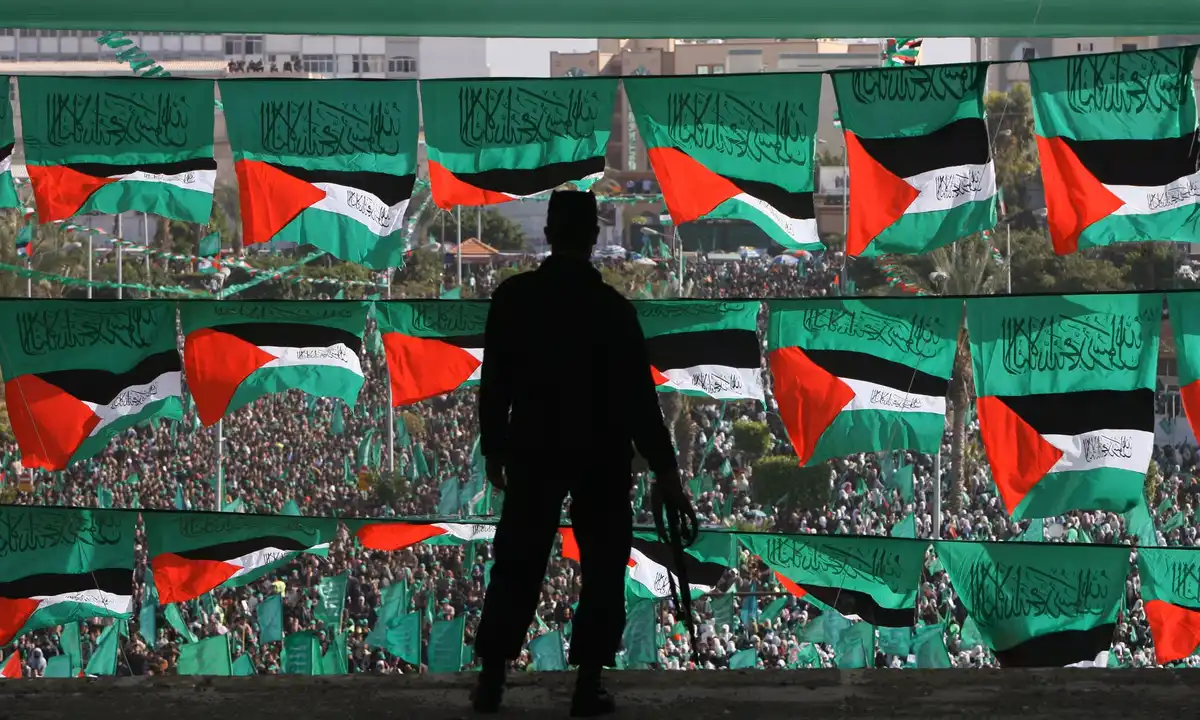
What is the real Hamas?

The Guardian

The Guardian

Opinion Writer

How Israeli, Palestinian and US political actors understand Hamas is not merely a theoretical question – it will determine what kind of agreement can be reached to end the current war, and what the future of Gaza will look like

by Joshua Leifer

In late October 2023, the veteran Israeli peace activist Gershon Baskin published an open letter denouncing a man he had long called a friend – Ghazi Hamad, a senior Hamas official. Baskin, an architect of the deal that freed the Israeli soldier Gilad Shalit from Hamas captivity in 2011, is one of the only Israeli citizens who has maintained consistent contact with leaders of the Palestinian Islamist movement. Hamad, a former journalist with a degree in veterinary medicine, was also involved in the Shalit negotiations and served as deputy foreign minister in the 2012 Hamas government. Prior to the 7 October attacks, for more than a decade and a half, Hamad and Baskin had exchanged frequent phone calls and text messages. These mainly concerned negotiations around prisoner swap deals, and sometimes the possibility of a long-term truce between Israel and Hamas. The pair developed a warm working relationship based on mutual trust.

After 7 October and the start of Israel’s ground invasion of the Gaza Strip, that relationship started to unravel. Hamad insisted that the attacks were entirely justified, and denied that Hamas fighters had carried out atrocities during their incursion into Israel. On 24 October, in an interview for a Lebanese TV channel, Hamad vowed that Hamas would commit the same acts “again and again”. He said that “Al-Aqsa Flood”, Hamas’s name for its armed offensive, “is just the first time, and there will be a second, a third, a fourth”. Once considered a thoughtful observer of Palestinian politics, Hamad now declared that “nobody should blame us for what we do – on 7 October, on 10 October, on October 1,000,000. Everything we do is justified.”

To Baskin, this did not sound like the man he had come to know. The proclamations by Hamad, “thought to be one of the most moderate people in Hamas”, Baskin noted, landed like a betrayal. Baskin had long argued that it was possible to broker an agreement with Hamas for a “hudna”, or a fixed-term armistice, in exchange for opening the land, air, and sea blockade of the Gaza Strip, which Israel has enforced, with Egypt’s support, since Hamas came to power in 2007. Baskin had believed that Hamad could help move Hamas toward acceding to a two-state solution. In the months before 7 October, Baskin had been trying to organise a meeting with him in Europe to discuss the prospect of a long-term truce.

But after 7 October, Baskin, too, shifted his position. “Hamas has forfeited its right to exist as a government of any territory and especially the territory next to Israel,” he wrote in an article for the Times of Israel on 28 October. “Hamas now fully deserves the determination of Israel to eliminate them as the political and military body that controls Gaza.” More recently, Baskin has proposed exiling Hamas leaders such as Yahya Sinwar from Gaza as part of a potential ceasefire deal. He has also proposed that Hamas be barred from contesting future Palestinian elections unless they renounce violence. It is not that Baskin has given up on peace – he remains a fixture in international media coverage as a lonely, even desperate Israeli voice calling for an end to the war. It is that he no longer believes Hamas can be part of the equation. Since October, many Israelis, even or perhaps especially on the centre left, have gone on a similar journey.

In late December, I sat with Baskin in the basement of his home, in a quiet, leafy neighbourhood of Jerusalem. Born in New York, Baskin is a stocky, energetic man in his late 60s. He answered the door wearing the silver dog tag engraved with the words “Bring them Home”, which has become an emblem of the movement calling for the return of the more than 100 Israeli hostages still held by Hamas.

One question looms over the story of Baskin’s exchange with Hamad: did Hamas change, or did Baskin simply misunderstand the group all along? Baskin believes it was the former. “Most of the years previous to 7 October, there was a willingness to explore pragmatic, long-term ceasefires,” he told me. “In retrospect it became clear – there were signs, but none of us read them – that from two years before 7 October, Hamas had made a decision that there was a no-go on a long-term modus vivendi [with Israel] and that they were beginning to make their plans for an eventual attack.”

Baskin recalled his final exchange with Hamad in late October. “During the early days of the war, when I heard that his house was bombed, and I didn’t know he wasn’t in Gaza, I said to him: ‘Ghazi, if they’re going after you, there is no one in Hamas who is safe.’” (Ahead of the war, Hamad had departed for Beirut.) “He responded to me: ‘We have lots of surprises, and we will kill lots of Israelis.’”

That was when Baskin posted his open letter to Hamad on social media. “I’m sorry to say that you were someone who I actually trusted and thought that we could help bring a better future to our peoples. But you and your friends have brought the Palestinian cause back 75 years,” he wrote. “I think you have lost your mind and you have lost your moral code.” And with that, Baskin severed their ties.

Five months into Israel’s brutal war in Gaza, more than 30,000 Palestinians, most of them civilians, have been killed. The Israeli ground invasion has displaced 2 million Palestinians within the Gaza Strip, many of them now forced into makeshift tents in and around the southern city of Rafah. In northern Gaza, vast swaths of which have been flattened by relentless Israeli airstrikes and artillery shelling, international experts warn that “famine is imminent”. Gazan children have already begun to die from lack of food.

As the war continues, how Israeli, Palestinian and American political actors understand Hamas is not merely a theoretical question; it is as much a material factor on the ground as bullets and tanks. It is one of the factors shaping military strategy, and will determine what kind of agreement can be reached to bring the current war to an end, and what the future of Gaza will look like.

The disintegration of Baskin and Hamad’s relationship thus reflects a larger and older debate about Hamas, one that has only become more urgent. At its core is a question about the essence of the organisation: whether it is primarily a nationalist group with an Islamist character, which could be a constructive player in a meaningful peace process, or whether it is a more radical, fundamentalist group, whose hostility to Israel is so unwavering that it can only play the role of violent opposition.

One camp in this debate, chiefly composed of western counterterrorism experts and US and Israeli security analysts, has long seen the group as defined by its violent hostility to Israel’s existence. According to this view, there was nothing surprising about 7 October. Instead, in the words of Matthew Levitt, a former Bush administration official and the author of a 2007 book on Hamas, it “demonstrated in the most visceral and brutal way that Hamas ultimately prioritised destroying Israel and creating an Islamist Palestinian state in its place”. Analysts of this school tend to point to Hamas’s vast tunnel infrastructure as evidence that the group protects its own fighters while leaving Gazan civilians above the surface to fend for themselves, without any system of bomb shelters.

An opposing, more heterogeneous camp, comprised of academics and thinktankers, many of them Palestinian, sees Hamas as a multifarious, complex political actor, divided between radical and moderating tendencies. Hamas, they argue, is the product of the reality under which Palestinians live – brutal occupation and blockade – and therefore potentially responsive to changes in those conditions. The problem, according to this view, is that even when Hamas leaders have appeared to be open to moderation, Israeli policy has made it impossible for the group to pursue this line without losing its credibility among Palestinians as the last-standing bastion of meaningful opposition to Israel and its occupation.

When we spoke in January, the Palestinian scholar Tareq Baconi said that “the major misconception” at the core of the dominant discourse about Hamas is the idea that “if Hamas as a security threat was undermined, Israel will have no issue with the Palestinians”. But if “Hamas were to disappear tomorrow,” he said, the Israeli blockade on Gaza and military rule in the West Bank would remain. “There’s this tendency to suggest that this is a war between Israel and Hamas rather than a war between Israel and Palestinians, which places Hamas outside of Palestinians,” he added. “It’s an inability to address the political drivers animating Palestinians.”

Khaled Elgindy, who is a former adviser to the Palestinian Authority (PA) leadership on negotiations with Israel and now a senior fellow at the Middle East Institute thinktank, argues that any postwar arrangement that excludes Hamas will be doomed to repeat the mistakes that led to the current war. “It’s exactly this notion of: ‘We’re going to make peace with this group of Palestinians while we make war with that group of Palestinians,’” which had served as the rationale for Israel’s economic suffocation and periodic bombardment of the Gaza Strip, he told me. “That’s nonsensical in terms of conflict resolution.”

“Hamas is a fact of political life in Gaza and in the Palestinian scene in general. And if anything, it is much more relevant today than it’s ever been,” Elgindy said. In an article for Foreign Affairs published late last year, he expanded on his view that Hamas must form part of a postwar settlement. The goal, wrote Elgindy, should be to incorporate Hamas and other hardline militant factions into the Palestine Liberation Organization (PLO), the umbrella group dominated by the secular-nationalist party Fatah, which is recognised as the sole official representative of the Palestinian people on the world stage.

Elgindy believes that Palestinian politics could contain Hamas’s rejectionism alongside the Palestinian Authority’s cooperation with Israel, just as Israeli politics includes parties that support and those that oppose engagement with the Palestinian Authority. In the short term, he acknowledged, that might make “achieving a two-state solution harder, because they’re going to have a veto the same way any opposition does”. But in the long run, Elgindy continued, integrating Hamas into the PLO might begin to heal the persistent split in the Palestinian national movement, which has provided Israel with a convenient excuse for refusing to participate in any negotiations. If Hamas were to agree to abide by the agreements signed between Israel and the PLO, not only would this increase the chances that a peace agreement might last, it would also curtail Hamas’s ability “to act as a free agent and be the spoiler it can be”, Elgindy said.

At present, though, it seems highly unlikely Hamas leaders, in Gaza or abroad, would be willing to agree to a programme of the kind that Elgindy and others in what’s known as “the Middle East policy space” have sketched out. In early March, representatives from Hamas, Fatah and other Palestinian political factions reportedly met in Moscow for unity talks. Since the 2007 Hamas-Fatah war, there have been more than a dozen similar reconciliation attempts sponsored by a range of Arab and Muslim-led governments. None have translated into any durable arrangement.

But if Palestinian unity with Hamas may prove elusive, it is equally difficult to imagine a future without the militant group. “I think people believe this basic line, that if we destroy or at least marginalise Hamas, that will make peace more likely,” Elgindy said. In practice, he continued, this position rationalises Israel’s devastating continued assault on Gaza. This view is wrong, he said – not just strategically but morally.

Hamas was formed in 1987 by members of the Palestinian branch of the Muslim Brotherhood against the backdrop of the first intifada, the popular Palestinian uprising ignited when an Israeli truck killed four Palestinian workers in Gaza’s Jabalia refugee camp. The group’s name, which means “zeal”, is an acronym for Harakat al-Muqawamah al-Islamiyyah, or the Islamic Resistance Movement. Historically, Palestinian Islamists had inclined toward political quietism, believing that Palestinian society had to be Islamicised if the fight against Israel were to be successful. Yet as demonstrations mounted, the struggle appeared to them as one they should lead.

Hamas’s founding leaders were, for the most part, refugees who had been born in what is now Israel and forced to flee to the Gaza Strip during what Palestinians call the Nakba, the displacement of roughly 700,000 Palestinians during the 1948 war. Sheikh Ahmad Yassin, the group’s spiritual leader, was born in 1936 in the village of Al-Jura, near the city of Ashkelon, in the south of present-day Israel. Diminutive and softly spoken, Yassin, who dressed in a white shroud and used a wheelchair owing to a childhood accident, seemed to his followers to embody the suffering of his people. In 2004, Israel assassinated Yassin, as it would many of Hamas’s leaders, when Israeli helicopters fired on his entourage as he left a mosque after prayers at dawn.

The organisation’s 1988 founding charter is a mixture of Qur’anic quotations, disquisitions on Islamic doctrine, nationalist declarations and conspiratorial antisemitism. The document defined the land of Palestine as a waqf, or Islamic trust, “consecrated for future Muslim generations until judgment day”, of which no inch could be given up. It accused Zionists of instigating the French and Bolshevik revolutions and labelled groups like “the Freemasons, the Rotary and Lions clubs” as “destructive intelligence-gathering organisations” that facilitated the “nazism of the Jews”. It subsumed the Palestinian national struggle under the banner of religious war. It was, in other words, an unlikely charter for a movement that, within a decade, would bid to represent the Palestinian cause, which had for the better part of the previous half-century been led by avowedly secular groups.

Whether the Islamic radicalism of the founding charter represents the operative ideology of the organisation has been debated almost since the group’s creation. Some scholars of Islamist politics see Hamas’s religious rhetoric as mainly a framework in service of its nationalist goals, which are its central concern. According to Azzam Tamimi, author of the book Hamas: A History from Within, the movement’s leaders realised that, as it grew, it needed a more accessible way of defining itself to the broader world. A document titled This Is What We Struggle For, written in the mid-90s in response to a request by a European diplomat for clarity on the group’s objectives, defined Hamas in rather different terms to those in the founding charter. Hamas was “a Palestinian national liberation movement that struggles for the liberation of the Palestinian occupied lands and for the recognition of Palestinian legitimate rights”. In a sense, the question of how to understand Hamas grows out of the gap between these two rhetorical modes: between uncompromising jihad and the language of anticolonial resistance, between fundamentalist ideology and political pragmatism.

 “There is no single ‘Hamas,’” Tareq Baconi writes in his book, Hamas Contained: The Rise and Pacification of Palestinian Resistance. “It is an exercise in futility, as well as fundamentally inaccurate and reductionist to try to suggest that the movement is some form of monolithic actor,” Baconi continues. There are, within the organisation, hardliners and pragmatists, religious conservatives and comparative moderates, those who prioritise the armed struggle against Israel, and those, at least until recently, who sought gains through political means. Hamas has “always sought to play between the violent and the diplomatic tracks, to shift from one track to the other, whenever it saw its best interests as either”, says Hugh Lovatt, a Middle East expert and senior policy fellow at the European Council on Foreign Relations.

Yet if Hamas’s leadership was not always unified on matters of vision, the persistence of Israel’s occupation of the West Bank and Gaza gave the group unity of purpose. In 1993, when the PLO, led by Yasser Arafat, recognised the state of Israel and renounced violence with the signing of the first Oslo accord, it was Hamas that claimed the mantle of armed resistance and commitment to liberating all of historic Palestine. The agreement between Israel and the PLO was a disappointment to many Palestinians, and not just supporters of Hamas. In a prescient 1993 essay, the Palestinian intellectual Edward Said called the Oslo Accords “an instrument of Palestinian surrender, a Palestinian Versailles”. Arafat had agreed to give up armed struggle against Israel and discounted the Palestinians’ “unilateral and internationally acknowledged claim to the West Bank and Gaza”, Said wrote, while “Israel has conceded nothing”.

Throughout the 1990s, Hamas, adamantly opposed to Oslo, intensified its fight against Israel. In its early years, its attacks had mainly taken the form of small arms fire, low-intensity roadside bombs and low-tech attempts to kidnap Israeli soldiers. That changed on 6 April 1994, when a Palestinian man, dispatched by one of the leaders of Hamas’s armed wing, blew himself up at a bus stop in the northern Israeli city of Afula, killing eight Israelis. It was expressly an act of vengeance in response to the massacre of 29 worshippers at the Ibrahimi mosque, carried out two months earlier by an Israeli extremist hoping to derail peace talks between the Israeli government and the PLO. The suicide bombing was also an expression of Hamas’s emerging military strategy. Hamas leaders saw civilian deaths as Israel’s weak spot, believing they would erode Israelis’ sense of personal security and, ultimately, reduce Israeli resolve.

The collapse of the Camp David talks in 2000, and the eruption of the second intifada, marked the transformation of Hamas into something more than just a spoiler. It emerged as a genuine challenger to the PLO and the institutions of the recently formed Palestinian Authority. The more Israel pursued settlement construction, and the more it entrenched the apparatus of military occupation, building checkpoints and walls, the more Fatah and the PA appeared to have capitulated, and the more Hamas’s uncompromising position gained in appeal. As the group mounted more suicide attacks through the 2000s, it also diversified its arsenal. In 2001, Hamas fired its first rockets from the Gaza Strip.

For Hamas’s leaders, this strategy of violence appeared to be vindicated in August 2005, as Israel began to withdraw its military and more than 8,000 settlers from the Gaza Strip. (By contrast, for Ariel Sharon, the Israeli prime minister at the time, the disengagement was a tactical move intended to sabotage future peace negotiations.) “Today you are leaving Gaza humiliated,” proclaimed Mohammed Deif, Ayyash’s successor and commander of the Qassam Brigades, in a videotaped message after the disengagement. “Hamas will not disarm and will continue the struggle against Israel until it is erased from the map.”

One perhaps surprising outcome of the Israeli withdrawal from Gaza was that while it seemed, to many in Hamas, to reflect the success of armed struggle, it was at this moment that the group appeared to shift its focus toward more conventional politics. Previously, Hamas had largely boycotted the electoral process, on the grounds that participation would have amounted to a recognition of the Oslo accords. Now, buoyed up by the Israeli withdrawal, Hamas contested the January 2006 legislative elections, running on an anti-corruption and law-and-order platform. To the shock of many in the PA, Israel and the Bush administration, Hamas won an outright majority. “I’ve asked why nobody saw it coming,” the US secretary of state Condoleezza Rice said at the time. The group that had long rejected the institutions created by the Oslo framework now had a popular mandate to lead them.

In contesting the elections, Hamas appeared to be deprioritising violence in favour of political engagement. “There are certain fundamental principles that they will not relinquish, but ultimately, they are not rigid in their approach,” said Tahani Mustafa, Palestine analyst at the International Crisis Group. “That doesn’t mean they’re going to give up the fight to liberate Palestine,” Mustafa added. “It’s just recognising what they want, and what reality will allow, and then trying to figure a middle ground between them.” Ahead of the legislative election, Hamas, led at the time by Khaled Meshaal, had signed on to the 2005 Cairo declaration, which affirmed the PLO as “the sole legitimate representative of the Palestinian people” and called for the establishment of the Palestinian state.

 “Hamas had de facto acquiesced between 2005 and 2007 to a political programme that [might], if leveraged correctly, have led to the creation of a Palestinian state alongside Israel and the dismantling of the occupation,” Baconi wrote in an essay for Foreign Policy last November. But whether a Hamas-run Palestinian Authority would have used its popular mandate to pursue a Palestinian state alongside Israel, or if it would have harnessed the PA to pursue an intensified armed conflict, as Israeli leaders feared, we will never know. “Hamas’s gamble” – its shift to participation within the PA framework and endorsement of a Palestinian state on ’67 lines – “paid off,” Baconi writes in Hamas Contained, “in the sense that its bluff was never called.”

In response to Hamas’s 2006 electoral victory, Fatah members refused to join the Hamas-led government. Israel tightened its enclosure of the Gaza Strip. The US and European Union soon cut off aid. By the autumn of 2006, groups of Fatah and Hamas gunmen were carrying out assassinations, kidnappings and torturing each other’s loyalists, even as unity talks between Abbas and Meshaal continued. On 14 June 2007, after five days of fierce gun battles in Gaza, Hamas expelled the PA from the territory – and suddenly Hamas found itself in an entirely new role. It was now responsible for daily life in Gaza.

Sheikh Yassin once claimed that, during the first intifada, he had turned down an Israeli offer to take over the Gaza Strip. “It would have been crazy for us to consent to be mere stand-ins for Israeli rule,” he said. But now Hamas found itself with the task of administering a territory besieged by air, land and sea, and subject to near-routine aerial bombardment and artillery shelling by Israel.

Gradually, through the next decade and a half, Hamas consolidated its rule over the coastal enclave. To some, it seemed that Hamas had transitioned from a militant group with an ideology of armed opposition to a pseudo-state governing force. A quarter of its first elected cabinet boasted US graduate degrees. “They were never democratic or soft authoritarian, as some of the literature says,” Khalil Sayegh, a Gaza-born peace activist, told me. “They were hard authoritarian, but they were smart enough to deceive the west in how they dealt with the situation.” After expelling Fatah, Hamas moved on to limit the power of Gaza’s clans, which represented an alternative base of power. To clamp down on dissent and enforce conformity, Sayegh added, Hamas relied on tactics that ranged from public shaming to blackmail and torture.

Hamas never implemented sharia law, despite the push from some of the movement’s hardliners, but it did attempt, rather haphazardly, to legislate public morality. “Islamising measures are put forth tentatively, then retracted when citizens object,” a 2011 report by the Crisis Group found. At the same time, Hamas faced criticism from more radical Salafist groups for failing to impose strict Islamic law on the territory. In 2009, when al-Qaida-aligned Salafists declared an Islamic State in the southern Gaza Strip, Hamas forces violently crushed them during an assault on a Rafah mosque.

Hamas developed its elaborate system of tunnels to get around the harsh conditions of the blockade, as well as to shield its fighters from Israeli airstrikes. In particular, the tunnels connecting Gaza to Egypt became the besieged territory’s economic lifeline and a primary conduit for the smuggling of weapons. According to one estimate, in the mid-2010s, tunnel revenue provided the Hamas government with roughly $750m a year. Yet this was not nearly enough to prevent what the American political scientist Sara Roy has called the “de-development of Gaza”. While the first years of Hamas rule saw economic growth, between 2007 and 2022, real GDP per capita declined at a rate of 2.5% a year, as the population rose sharply. For much of the last decade and a half, UN officials have warned that Gaza was on the brink of a humanitarian crisis.


During these years, Hamas and Israel developed a mode of relating to each other – what Baconi calls an equilibrium of belligerency. Hamas rocket fire from Gaza became a means of negotiating with Israel. In return for pausing fire, Hamas would seek eased restrictions of the blockade or work permits for more Palestinian labourers crossing into Israel. In turn, Israel would retaliate to Hamas rockets with airstrikes and shelling – “mowing the grass”, as Israeli military strategists described it in their grisly euphemism – until it could claim it had sufficiently “deterred” Hamas from fighting until the inevitable next round.

For Israel, Hamas became useful as the functional government in Gaza, responsible for supporting the besieged Gazan population and containing the activities of other armed militant groups, much like the PA did in the West Bank. At the same time, Hamas maintained its claim to represent unbowed resistance to Israel. “There seemed to be some kind of modus vivendi between Israel and Hamas,” says Zaha Hassan, a human rights lawyer and senior legal adviser to the Palestinian negotiating team during Palestine’s bid for UN membership. (In the month leading up to 7 October, she added, “there was greater interaction and engagement between Israel and Hamas than there was between Israel and the PA.”)

To Netanyahu, this arrangement had an additional advantage. By keeping the PA-run West Bank and the Hamas-run Gaza Strip under separate administrations, Israel also kept the Palestinian national movement divided against itself, and therefore easier to manage. Over the course of a decade, Netanyahu’s governments helped prop up the Hamas administration in Gaza, facilitating the transfer of billions of dollars from Qatar to the Islamist group. “Netanyahu has always had a strong unspoken partnership with Hamas, which he has regarded as an invaluable asset in preventing the creation of a Palestinian state,” Hussein Ibish, a senior resident scholar at the Arab Gulf States Institute, told me via email. “His incredibly cynical divide-and-rule strategy, which he does not appear to have fully surrendered yet, led inexorably and virtually inevitably to 7 October.”

But Netanyahu was not merely cynical. He, like much of Israel’s defence establishment, appears to have genuinely believed that the burden of governance had led to a fundamental shift in the group’s strategic considerations – that Hamas, in effect, had been pacified.

It is now clearer than ever that Israel’s policy towards Hamas was built on a contradiction. On the one hand, Israel justified its punitive blockade and periodic bombardment of Gaza on the grounds that Hamas was a bloodthirsty terrorist group that sought Israel’s destruction. On the other, in Israel’s actual dealings with Hamas, it behaved as if Hamas had abandoned not just its commitment to destroying Israel but any alternative vision to occupation, and would be satisfied managing Gaza into perpetuity.

From within Hamas and among its supporters, however, the perception was very different. “2008-2009, 2012, 2014, 2021 – it’s continuous war,” Azzam Tamimi told me by phone from Istanbul, summing up this view. “Hamas has not been pacified. It’s just been fighting, and then there are breaks in the fighting.” This analysis is not so different from how much of Israel’s security establishment sees the group today. “Hamas has never stopped preparing for operations to respond to Israeli provocations,” Tamimi added. “I mean, the preparations for 7 October are not the sort of thing that happens overnight.”

Indeed, within Israeli defence circles, the cumulative failures of 7 October have been taken as proof that Netanyahu’s governments understood Hamas all wrong. A new common sense has begun to emerge. “We felt that if we bribed the organisation by providing it money or by enabling it to develop the economy, then it would become a more responsible and accountable sovereign,” said Kobi Michael, a senior researcher at the Institute for National Security Studies, a thinktank with close ties to Israel’s military, when we spoke in late December. “This is an illusion.” As Michael sees it, Israeli leaders failed to recognise that Hamas, at its core, is a “messianic” organisation that cannot be managed. “Theirs is a very religious way of thinking, which is irrational,” he said. “It was convenient for us to think that they are similar to us.”

As the war grinds on, Israeli policy analysts increasingly argue that the bellicose, maximalist rhetoric of Hamas’s leaders should be taken literally – that when they pledge to fight until Israel is destroyed, they mean it. “I read the other side’s writings in their original language, and I believe them, I simply believe them,” Michael Milshtein, an Israeli former intelligence officer, has said of Hamas’s Arabic publications and communiques. In his view, one major reason for the Israeli military’s colossal failure on 7 October was that the intelligence agencies and, even more fatefully, the country’s political leaders, forgot the nature of their enemy and failed to take notice of the manifold public threats issued by Hamas leaders that a massive armed operation against Israel was in the offing.

In the eyes of most Israelis, any semblance of peace will only be possible when Hamas no longer exists. Yet when Gershon Baskin and I spoke again in March, he told me that he and Ghazi Hamad had reconnected. The re-establishment of contact was mutual. “The first communication was about two months ago, which was an unpleasant back and forth,” he said. “The basic question is, could it be possible for us to have a constructive role [in making] a secret back channel,” Baskin added. “It’s not yet clear.”

Today, as 30 years ago, Hamas derives much of its popularity from Palestinian despair. “When oppression increases,” Sheikh Yassin told the late Guardian journalist Ian Black in 1998, “people start looking for God.” A survey conducted in December by the Palestinian pollster Khalil Shikaki found that 72% of Palestinians in Gaza and the West Bank believed that Hamas was correct in launching the 7 October attacks, despite the destruction Israel has unleashed. If, as many believe, Hamas will remain a force the day after the fighting stops – in what form, and with what consequences?

Proponents of incorporating Hamas back into the structures of Palestinian politics argue that the group’s leaders were once serious about pursuing the interim solution, of a Palestinian state on only part of historic Palestine, and that, under the right conditions, they might be willing to do so again. “It was real,” Hugh Lovatt said of Hamas’s openness to a two-state solution, which was expressed in the group’s 2017 revised charter. “There clearly is a political and relatively moderate wing within Hamas,” he continued. “The question is, what happens to them? Do they split from the movement? Will they be completely overwhelmed by the hardliners? Or do they find a way to steer the movement back toward the political track?”

Those who see a future role for Hamas in Palestinian politics as a necessity – a view that presupposes Hamas’s willingness to join the institutions it has hitherto scorned– argue that excluding Hamas would be undemocratic, as well as likely to guarantee future bloodshed. “Their inclusion is a prerequisite for creating a Palestinian leadership that is representative of its people,” Baconi told me when we spoke by phone, “regardless of what we think about their tactics or their ideology.”

At the same time, when I asked Baconi about the prospects of a return to the two-state paradigm after the war, he was not optimistic. “If there is a political process which would achieve a Palestinian state on ’67 borders – which I don’t think will ever exist, as in a state with real sovereignty – I do think Hamas, politically and strategically, would engage with it very effectively and would, I think, be pushed to recognise the potential of such a diplomatic process,” he replied. But against the backdrop of the total devastation of Gaza, talk of restarting the two-state process is mainly a distraction, Baconi added. “I don’t see any kind of effective political process coming out of this older discourse that takes us back to the 90s and early 00s.”

In all likelihood, the Hamas leadership’s willingness to re-engage in the political track may not be tested. “The idea of incorporating Hamas [into the PLO] is, I think, a brilliant one that is now politically impossible,” said Nathan Brown, a senior fellow at the Carnegie Endowment for International Peace. “You basically need the existing generation of American leaders to die off before it becomes politically feasible,” Brown said of the possibility of the US shepherding a process that saw Hamas enter the PLO. “And it’s unthinkable in Israel.”


Israeli public opinion has lurched even further right after the 7 October attacks. Benjamin Netanyahu’s popularity has tanked, but his replacement will not be a dove. And though it is true that, in the late 1980s and early 90s, the Israeli prime minister Yitzhak Rabin agreed to talks with the PLO and Yasser Arafat, considered by most Israelis to be an unrepentant terrorist, the signing of the Oslo accords was only possible after the PLO had agreed to comply with a raft of preconditions. By contrast, no Hamas leader could ever totally renounce armed struggle or agree formally to recognise Israel.

There is a tendency to view events such as 7 October and the ongoing war through the prism of rupture. The death and destruction on such a massive scale appear to signal a shift in paradigm, the emergence of a new phase. But part of what makes Israel’s prosecution of the current war so chilling is that, after killing more than 30,000 Palestinians, and after 1,200 Israelis were killed by Hamas on 7 October, the basic political framework of Israel/Palestine may, the day after the war, remain the same as it was on 6 October.


 

PALESTINE

Thu 21 Mar 2024 9:58 pm - Jerusalem Time

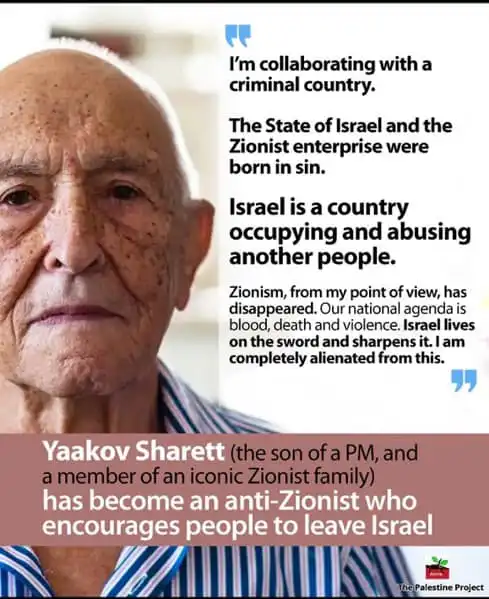
HIS FATHER WAS PRIME MINISTER OF ISRAEL

ARAB AND WORLD

Thu 21 Mar 2024 9:51 pm - Jerusalem Time

He renewed his attack on Netanyahu.. Schumer: Israel may end without American support

The New York Times quoted US Senator and Senate Democratic Leader Chuck Schumer as saying that Israel's future may end unless it receives American support, expressing his fear that Israel, led by Benjamin Netanyahu, will become a global pariah, even in the United States.


The newspaper quoted Senator Chuck Schumer as saying that Netanyahu could prevent elections in Israel until 2026.


Schumer had called in a speech a few days ago for holding elections in Israel, directing criticism at Netanyahu, which angered the latter.


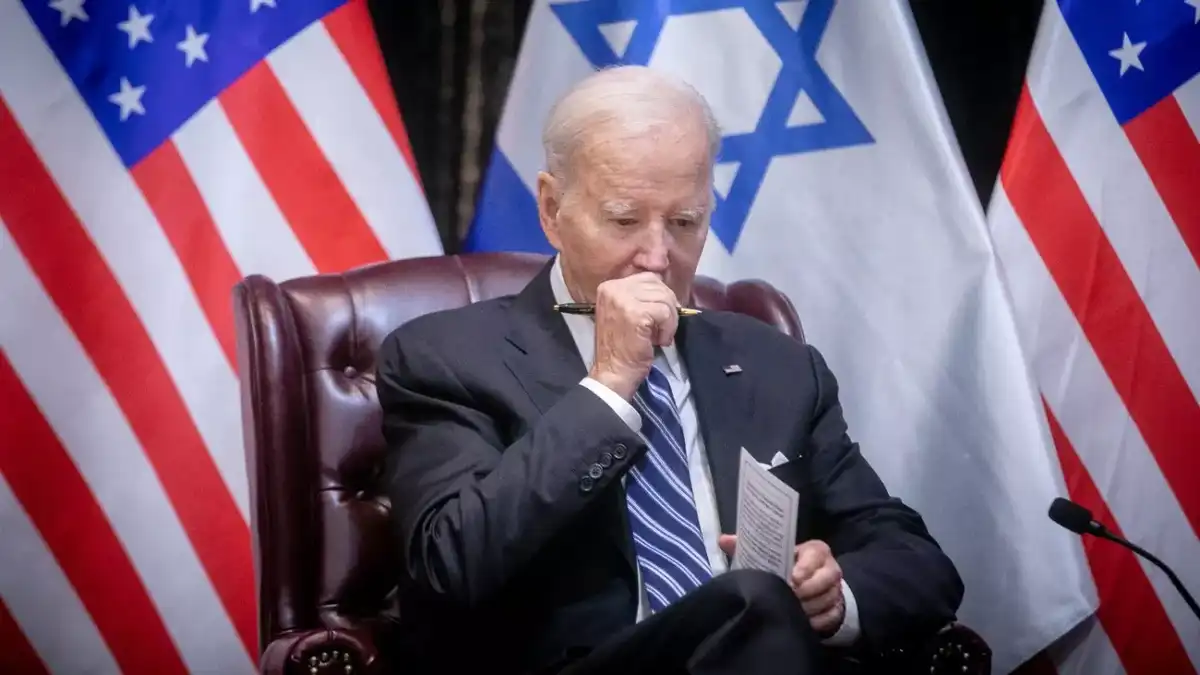
Netanyahu is facing increasing international pressure, especially from US President Joe Biden, who on Friday praised the “good speech” delivered by Schumer in which he called for early elections in Israel.


In two interviews with CNN and Fox News on Sunday, Netanyahu condemned this call, and believed that the statements of Schumer, the highest-ranking Jewish figure in the American legislative authority, were “completely inappropriate,” stressing, “We are not a banana republic.”


He said that members of the "international community" who call for elections "do so because they know that the elections will stop the war and paralyze the country for at least 6 months."


There is still no specific date for parliamentary elections in Israel.


Source: Al Jazeera + agencies

PALESTINE

Thu 21 Mar 2024 9:22 pm - Jerusalem Time

An Israeli delegation to Qatar on Friday amid talk of progress in negotiations with Hamas

Israeli Prime Minister Benjamin Netanyahu agreed to leave a delegation headed by Mossad chief David Barnea tomorrow, Friday, to Qatar to hold a meeting with the head of the CIA, William Burns, the Qatari prime minister and foreign minister, Sheikh Mohammed bin Abdul Rahman Al Thani, and the head of the US Central Intelligence Agency, William Burns. Egyptian Intelligence, Abbas Kamel, in order to work on the release of detainees, according to a statement issued by Netanyahu’s office.


This high-level meeting will be held within the framework of the negotiations taking place in Doha, with the aim of advancing efforts to recover detainees in Gaza and reaching a ceasefire agreement.


This comes at a time when the American CNN network, on Thursday, quoted an unnamed diplomatic source as saying that the talks between Israel and Hamas regarding the truce in Gaza are progressing positively, but there are still “many differences.”


The diplomat did not shed light on the differences, but he doubted that the two sides were close to reaching an agreement, at a time when US Secretary of State, Anthony Blinken, confirmed yesterday, Wednesday, that the two sides were close to reaching an agreement and that “the gaps were narrowing.”


According to CNN, the slow progress in the talks was further reflected after the head of the Mossad, David Barnea, left the Qatari capital, Doha, after only one day of indirect talks last Monday.


The American network said, "One of the most difficult obstacles may be Hamas's demand that after the initial exchange of hostages and prisoners, Israel will have to agree to a permanent ceasefire and the withdrawal of its army from Gaza."


Coinciding with a visit by US Secretary of State Anthony Blinken to Cairo, a meeting was held today, Thursday, in the Egyptian capital, which included the foreign ministers of Egypt, Saudi Arabia, Qatar, and Jordan, the UAE Minister of State for International Cooperation, and the Secretary of the Executive Committee of the Palestine Liberation Organization, to discuss developments in the situation in the Gaza Strip. 

According to the official spokesman for the Egyptian Ministry of Foreign Affairs, the meeting of Arab foreign ministers came to “discuss efforts to stop the Israeli war against Gaza, and the inevitability of achieving a ceasefire and full access to aid.”


The day before yesterday, Tuesday, the spokesman for the Qatari Ministry of Foreign Affairs, Majed Al-Ansari, said: “I do not think that we are at this moment where we can say that we are close to reaching an agreement, It is still too early to announce any successes.”

PALESTINE

Thu 21 Mar 2024 9:20 pm - Jerusalem Time

Hebrew newspaper: Biden administration informed Netanyahu that it will not allow the invasion of Rafah during Ramadan

The administration of US President Joe Biden sent a clear message to Israeli Prime Minister Benjamin Netanyahu, through war cabinet member Benny Gantz, who visited Washington at the beginning of this month, stating that “the administration will not allow an Israeli incursion into Rafah during the month of Ramadan,” according to a report by the military analyst in the newspaper "Haaretz", Amos Harel, today, Thursday.


He added that Netanyahu's decision to send a delegation to Washington next week, at the request of Biden, in order to present the Israeli plan to invade Rafah, reflects the real situation of US-Israeli relations in the middle of the sixth month of the war on Gaza.


Netanyahu threatens on a daily basis to invade Rafah, pledges an “absolute victory” over Hamas, and boasts of the “independence of the Israeli decision,” despite the tense relations between him and Biden.


Harel pointed out, “In actual terms, the idea that Israel will defend itself with its own forces has been in great doubt since the October 7 attack. Biden is presenting Netanyahu with challenges from all directions: by airdropping aid into Gaza, building a naval pier, and a certain slowdown in the pace of the supply of ammunition from the United States to Israel as well as through increased and more public American opposition to a military operation in Rafah.”


According to the report, Israeli preparations for an invasion of Rafah are taking place slowly, despite presenting its military plans to Netanyahu, who announced that he had approved them.


He added that the change in the Biden administration's policy towards Israel occurred at the end of last month, in the wake of the Rashid Street massacre, which claimed the lives of more than 115 Palestinian who were waiting for humanitarian aid. "Then Biden lost his patience, and since then bad news and insults against Netanyahu from the United States began on a daily basis."


He continued that the most prominent expression of this was issued in Washington through the announcement of the leader of the Democratic majority in the US Senate, Chuck Schumer, last week, in which he described Netanyahu as an obstacle to peace and called for new elections in Israel, while Biden described his statements as a “good speech.”


Harel described the recent American steps and statements as meaning that “the United States has given itself increased powers over Israel’s security, by insisting on the right of veto against the operations of the Israeli army.”


However, indications of this appeared at the beginning of the war, when Biden warned Iran and Israel against opening a front between them with the participation of Hezbollah, as well as through the participation of administration officials in the Israeli war cabinet meetings, during which detailed deliberations on military plans took place. “Since then, Israeli attachment to the United States has only increased, reaching a worrying degree,” according to Harel.


He added that the statements in the United States and the European Union against the invasion of Rafah "very narrow the scope of Israeli capabilities. It is possible that Netanyahu will try to cling to the obstacles placed by Biden in order to explain the reason for the delay in the invasion of Rafah."


ARAB AND WORLD

Thu 21 Mar 2024 8:53 pm - Jerusalem Time

Blinken: Any major military operation in Gaza will mean more “martyrs”

US Secretary of State Anthony Blinken confirmed that any major military operation in the Gaza Strip would mean more “martyrs.”


Blinken said during a press conference held in Cairo on Thursday that there is consensus on priorities, the first of which is the need for an immediate and sustainable ceasefire in the Gaza Strip.


He added that the Hamas movement responded to the proposal that was drawn up and we are pushing to reach an agreement in Doha.


He pointed out that the United States presented a draft on Gaza to the Security Council and we look forward to its approval


Blinken stated that the people of Gaza are suffering from severe levels of food scarcity, and we must not allow this to continue.


The US Secretary of State stressed that the ceasefire is one of the ways that will lead to an increase in humanitarian aid to Gaza.


He pointed out that it is difficult to reach an agreement, but it is possible to achieve it.


Blinken explained that there are officials meeting in Cyprus today regarding the sea corridor and the temporary sea pier to deliver aid.


He pointed out that the sea pier cannot replace the opening of land crossings for aid to reach the Gaza Strip


Blinken also stressed that there should be no displacement of citizens in Gaza or occupation of any lands by the Israeli occupation army.


He revealed that the United States will hold talks next week with its Israeli counterparts to confirm that any military operation in Rafah would be a mistake.


ARAB AND WORLD

Thu 21 Mar 2024 8:43 pm - Jerusalem Time

An Arab ministerial meeting begins in Cairo to discuss truce efforts in Gaza

An Arab ministerial meeting began in Cairo, today, Thursday, in the presence of a senior Palestinian official, to discuss efforts to achieve a humanitarian truce in the Palestinian Gaza Strip, which has been subjected to a devastating Israeli war since last October 7, according to an official source.


Egyptian Foreign Ministry spokesman Ahmed Abu Zeid stated - in a post on the X platform - that the meeting includes Egyptian Foreign Minister Sameh Shoukry, Saudi Foreign Minister Prince Faisal bin Farhan, Qatari Foreign Minister Sheikh Mohammed bin Abdul Rahman, Jordanian Foreign Minister Ayman Al-Safadi, and the UAE Minister of State. For International Cooperation Affairs, Reem Al-Hashemi, and Hussein Al-Sheikh, Secretary of the Executive Committee of the Palestine Liberation Organization.


The meeting will discuss efforts to stop the Israeli war on Gaza, the inevitability of achieving a ceasefire, and full access to aid, without further details.


US Secretary of State Anthony Blinken is expected to meet later today, Thursday, following the meeting with the foreign ministers of Egypt, Saudi Arabia, Qatar, Jordan, the UAE Minister of State for International Cooperation, and the Secretary of the Executive Committee of the Palestine Liberation Organization.


Sisi and Blinken

In a related development, Blinken met with Egyptian President Abdel Fattah El-Sisi in Cairo. The Egyptian President's office and the US State Department said that Sisi and Blinken reviewed the progress made in the negotiations.


Al-Sisi stressed “the necessity of an immediate ceasefire,” pointing to a humanitarian catastrophe that threatens the lives of civilians in Gaza. The Egyptian President warned of "the dangerous consequences of any military operation in the Palestinian city of Rafah."


Blinken arrived in Cairo - earlier today, Thursday - from Saudi Arabia, as part of his sixth tour in the region since the Gaza War, which he will conclude tomorrow, Friday, in Israel.


Blinken's tour in the region coincides with the launch of new negotiations sponsored by Egypt, Qatar, and the United States to help reach an agreement between the Islamic Resistance Movement (Hamas) and Israel that guarantees a ceasefire and the exchange of prisoners.


The Israeli war, which comes with strong American support, left tens of thousands of civilian victims, most of them children and women, massive destruction and an unprecedented humanitarian catastrophe, which led to Israel appearing, for the first time since 1948, before the International Court of Justice on charges of committing genocide.


ARAB AND WORLD

Thu 21 Mar 2024 5:08 pm - Jerusalem Time

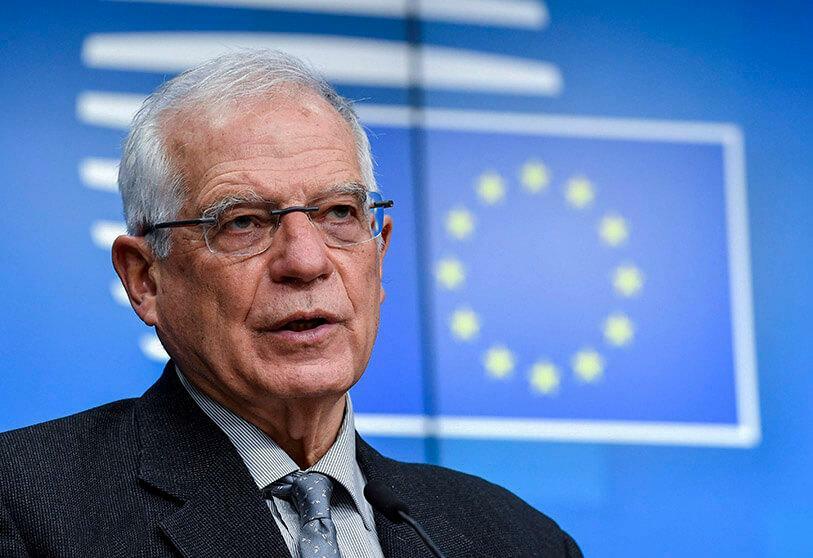
Borrell calls on European Union leaders to send a firm message to Israel

On Thursday, the High Representative of the European Union for Foreign Affairs and Security Policy, Josep Borrell, called on EU leaders to send a firm message to Israel “to stop preventing food from entering Gaza and protect civilians.”


Borrell's call came before the launch of the Union leaders' summit in the Belgian capital, Brussels, in which he touched on the humanitarian conditions in the Gaza Strip, which has been exposed to a devastating Israeli war for about 6 months.


Borrell said that there are no words to describe the situation in Gaza, noting that the conditions in the Palestinian Strip "have reached the worst condition."


He pointed out that "the European Union Council will take greater steps than demanding support for UNRWA, a sustainable ceasefire, and the release of prisoners."


He added: "What is happening in Gaza today is not a humanitarian crisis. It is a failure of humanity. People are starving, especially children, who are very sick because they do not eat."


Calling on the leaders of the EU countries, Borrell said: “I hope that the European Union Council will send a strong message to Israel saying: Stop preventing food from entering Gaza, allow its crossing, and protect civilians.”


On Monday, Borrell said at a forum in Brussels that Israel is using hunger as a weapon by preventing aid from entering the Gaza Strip.


Israel restricts humanitarian access; This caused a scarcity of food, medicine, and fuel supplies and created a famine that claimed the lives of children and the elderly in the Strip, which has been besieged by Israel for 17 years, and is inhabited by about 2.3 million Palestinians in catastrophic conditions.


PALESTINE

Thu 21 Mar 2024 4:28 pm - Jerusalem Time

West Bank: Israeli settlers seize 150 dunums south of Bethlehem

Today, Thursday, settlers seized 150 dunams of land in the town of Al-Khader, south of Bethlehem.


According to local sources, settlers seized the land in the “Abu Bakir” area near the “Alazar” settlement, which was built on citizens’ lands, and planted it with vine and almond seedlings, indicating that ownership of the land belongs to citizens of the Musa family.


It is noteworthy that the settlers have recently escalated their settlement attack on the lands of the town of Al-Khader, by seizing areas, bulldozing others, demolishing agricultural rooms, and preventing farmers from reaching their lands.

PALESTINE

Thu 21 Mar 2024 3:20 pm - Jerusalem Time

Al-Sisi meets with Linken in Cairo and warns against the attack on Rafah

US Secretary of State Anthony Blinken continued his regional tour, which he began yesterday, Wednesday, in Saudi Arabia, and met today in Cairo with Egyptian President Abdel Fattah El-Sisi and Foreign Minister Sameh Shoukry, to discuss the war on the Gaza Strip, mediation efforts to reach a prisoner exchange deal, and efforts to deliver aid to the Gaza Strip.


The Egyptian presidency said in a statement that Sisi stressed, during his meeting with Blinken, the necessity of an immediate ceasefire in the Gaza Strip.


It added - in a statement - that Al-Sisi warned of the dangerous consequences of any military operation in the city of Rafah, adjacent to the Egyptian border.


The Egyptian President also stressed - according to the statement - the necessity of urgent action to bring sufficient amounts of aid into the Gaza Strip, and to open the horizons of the political track through intensive work to activate the two-state solution.


Blinken is scheduled to participate today, Thursday in Cairo, in a meeting with his Qatari, Jordanian, and Egyptian counterparts, the UAE Minister of State for International Cooperation Affairs, and the Secretary of the Executive Committee of the Palestine Liberation Organization.


Jeddah meeting

Blinken met in Jeddah yesterday, Wednesday, with Saudi Crown Prince Mohammed bin Salman, at the beginning of a regional tour in the region.


The Saudi Press Agency said that Blinken discussed with the Saudi Crown Prince the developments in the Gaza Strip and its surroundings and the efforts made to stop military operations and deal with their security and humanitarian repercussions.


The Saudi Foreign Ministry also said that Saudi Foreign Minister Prince Faisal bin Farhan discussed with Blinken the developments of the situation in the Gaza Strip and the city of Rafah, the importance of an immediate ceasefire, and efforts to ensure the entry of urgent humanitarian aid.


In turn, Blinken said in a post on the X platform that the talks he held in Saudi Arabia addressed the humanitarian crisis in Gaza and efforts made to increase immediate aid to the Palestinians.


Blinken reaffirmed Washington's commitment to lasting peace and security in the region, as he put it.


For its part, the Palestinian Ministry of Foreign Affairs praised Blinken's efforts, but said, "We do not see tangible results from his tours."


The ministry added in a statement today, "With every visit by the US Secretary of State, Israel resorts to escalating its aggression against our people, as is currently happening at the Al-Shifa Medical Complex in Gaza."


It is noteworthy that Israel continues for the 167th consecutive day its devastating war on the Gaza Strip, which left tens of thousands of civilian martyrs - most of them children and women - massive destruction and an ongoing famine that claimed the lives of children and the elderly, according to Palestinian and UN data.

PALESTINE

Thu 21 Mar 2024 3:16 pm - Jerusalem Time

Netanyahu is considering canceling the war council and transferring its powers to the cabinet

The Israeli newspaper Maariv said that Israeli Prime Minister Benjamin Netanyahu is considering abolishing the War Council and transferring its powers to the members of the Mini-Ministerial Council for Political and Security Affairs (Cabinet).


This is as a solution after the crisis sparked by the leader of the "New Hope" party, Gideon Sa'ar, by threatening to withdraw from the Israeli emergency government if he did not become a member of the war council.


The newspaper reported that National Security Minister Itamar Ben Gvir would not hesitate to resign from the government if Sa'ar obtained membership in the War Council and he did not obtain it.


Sa'ar had threatened to withdraw from the government if he did not join the war council, accusing the government of not having a clear plan to destroy the capabilities of the Islamic Resistance Movement (Hamas) in the Gaza Strip.


Last week, Sa'ar announced the dissolution of his political partnership with Minister in the War Council, Benny Gantz, and the dissolution of the "State Camp Alliance," calling for it to join the War Council as an independent bloc.


Sa'ar joined the state camp coalition led by Benny Gantz - who leads the Blue and White party - in the last rounds of elections, and was one of the strongest advocates for Netanyahu's removal in light of the corruption files persecuting him.


Escalating disagreements prevail at the Israeli political and military levels, threatening to dissolve the government and calling for early elections, in the wake of last October 7, following the Al-Aqsa Flood operation launched by the Palestinian resistance in Gaza against Israel, in response to the ongoing occupation attacks against the Palestinian people and Al-Aqsa Mosque.

PALESTINE

Thu 21 Mar 2024 3:12 pm - Jerusalem Time

Dermer: Israel will invade Rafah even at the cost of a rift in relations with America

Israeli Minister of Strategic Affairs, Ron Dermer, said during a podcast interview conducted with American journalist Daniel Senor today, Thursday, that “Israel will control Rafah even if this leads to a rift (in relations) with the United States.”


Israeli Prime Minister Benjamin Netanyahu decided to send Dermer and the head of the National Security Council, Tzachi Hanegbi, to Washington next week, at the request of US President Joe Biden, to present Israeli military plans to invade Rafah to the US administration.


Dermer, one of Netanyahu's closest associates, added, "We are very sure that we can work in Rafah in a way that will be effective, not only from a military standpoint, but also from a humanitarian standpoint. This will happen even if Israel is forced to fight alone and even if the world stands still." "It's all against us, including the United States."


Dermer's statements come as military analyst in the newspaper "Haaretz", Amos Harel, reported today that the Biden administration sent a clear message to Netanyahu, through a member of the war cabinet, Benny Gantz, who visited Washington at the beginning of this month, stating that "the administration will not allow an incursion into Rafah during the month of Ramadan.


In turn, Minister Gideon Sa'ar wrote on the "X" platform that "at this time when the whole world stands against Israel's military operation in Rafah, the time has come when Israel must present the idea of surrender and exile to the military arm of Hamas, as an idea that regulates the end of the war."


Sa'ar considered, "Such a step would, of course, be accompanied by the return of all the kidnapped people. The small possibility of implementing this idea currently should not prevent it from being presented publicly and officially."


It is noteworthy that Sa'ar, who defected from the "National Camp" bloc headed by Gantz, is demanding that Netanyahu include him in the war cabinet, and threatened to withdraw from the government if his request is not met. If Netanyahu responds, expectations are that National Security Minister Itamar Ben Gvir will demand his inclusion in the war cabinet.

PALESTINE

Thu 21 Mar 2024 12:04 pm - Jerusalem Time

Red Crescent: 37 mothers die daily in the Gaza Strip

The Palestinian Red Crescent Society said that 37 mothers are killed every day in the Gaza Strip.


The Red Crescent added, in a statement on the “X” platform, that while the countries of the Arab world celebrate Mother’s Day, there are 37 mothers being killed every day, in the ongoing Israeli aggression against the besieged Gaza Strip, for the 167th day.


The Prisoners and Ex-Prisoners’ Authority and the Prisoners’ Club announced that there are 28 detainees who are mothers, and they are among 76 detainees languishing in Israeli prisons, where Israel deprives them of their families and children.


In an infinite toll, the death toll in the Gaza Strip has risen to 31,988, and injuries to 74,188, the majority of whom are children and women, since the start of the Israeli aggression on the seventh of last October.

PALESTINE

Thu 21 Mar 2024 11:25 am - Jerusalem Time

Gaza: a collective of researchers unveils a highly organized campaign to denigrate UNRWA for the benefit of Israel

The open conflict between Israel and the UN agency for Palestinian refugees continues online. The NGO FakeReporter on Tuesday uncovered disinformation campaigns by Israel targeting the UN agency.


The conflict between Israel and UNRWA continues online. Monday March 18, Philippe Lazzarini, the head of the United Nations agency for Palestinian refugees, claimed to have been prevented from entering Gaza. False, respond the Israelis, who speak of an administrative error for which the head of UNRWA is responsible.


For several weeks, humanitarian workers from this UN agency have accused Israel of hitting their personnel and infrastructure indiscriminately, the Jewish state says it has proof of the involvement of agency employees in the October 7 attacks. . On Tuesday, a collective of Israeli network researchers, the NGO FakeReporter, uncovered an ingenious campaign to denigrate UNRWA on the Internet for the benefit of Israel.


This is what you could call an amplification campaign. It is first a matter of seizing real facts reported in traditional media, such as the American channel CNN or the British daily The Guardian, then relaying them on the sites of false press organs, which at first glance seem completely credible, and then relying on fake accounts on social networks, to give more coverage to this information.


Elected officials targeted by fictitious profiles

In the case of the conflict between Israel and UNRWA, 500 fictitious profiles widely distributed articles on Instagram, Facebook and X which dealt in particular with the alleged involvement of employees of the United Nations agency in the attacks of October 7 . The target: Democratic African-American senators and deputies, sensitive to the Palestinian cause.


“The difference between this type of operation and ‘fake news’ is that they are carried out by people who seem normal,” observes Achiya Schatz, the executive director of FakeReporter, who uncovered the manipulation. are tapping profiles that don't exist but that support Israel's messages. It's another battlefield in this war. And it concerns both sides." A few weeks ago, the FakeReporter association denounced disinformation campaigns favorable to Hamas. They were launched from Iran and Russia.

ARAB AND WORLD

Thu 21 Mar 2024 11:17 am - Jerusalem Time

Britain threatens Israel to stop arms exports to it

The Israeli newspaper Yedioth Ahronoth reported that Britain threatened Tel Aviv to stop arms exports to it if it did not allow the Red Cross Society to visit Hamas prisoners who were arrested by the Israeli army since the beginning of the war.


The newspaper added that the British request came against the backdrop of reports that Israel refuses to allow the Red Cross to visit Hamas detainees due to the harsh conditions in which they are being held.


Israel claims that it is arresting dozens of members of the elite unit of the Al-Qassam Brigades who participated in the Al-Aqsa Flood operation on October 7, and Israel did not clarify the number of these prisoners or the location of their detention.


OPINIONS

Thu 21 Mar 2024 11:15 am - Jerusalem Time

PATRICK LAWRENCE: Authorized Atrocities

Consortium News

Consortium News

Opinion Writer

By Patrick Lawrence

Israel’s lawlessness has a history that those in the West share with the apartheid state. 

It is remarked often enough, including in this space, that Israel’s savagery in its determination to exterminate the Palestinians of Gaza — and we had better brace for what is next on the West Bank of the Jordan — marks a turn for all of humanity.

In its descent into depravity the Zionist state drags the West altogether down with it. 

This is true, certainly, but we must put Israel’s criminal conduct, which warrants another Nuremberg trial at this point, in its proper context.

When we do, we find that Israel’s lawlessness has a history, an etymology, and if there is a road to Western salvation it must start with a recognition of a past that those in the West share with the apartheid state.  

We can say Israel’s crimes against Gaza’s 2.3 million children, women, and men are unspeakable, in other words, but this would not be right. They are altogether speakable, and it behooves us now to speak of them if we are to grasp where responsibility for this stain upon the human story truly lies.   

Pankaj Mishra has just published a thorough and thoroughly remarkable piece on these matters in the London Review of Books. 

The Indian author, essayist, and columnist takes up many things in “The Shoah After Gaza,” chiefly the extent to which Zionists have exhausted “the culture of conspicuous Holocaust consumption” — excellent phrase — in defense of a nation that, to quote Primo Levi, “was a mistake in historical terms.” 

Here is a passage in Mishra’s piece that is to our present point: 

“Israel today is dynamiting the edifice of global norms built after 1945, which has been tottering since the catastrophic and still unpunished war on terror and Vladimir Putin’s revanchist war in Ukraine. The profound rupture we feel today between the past and the present is a rupture in the moral history of the world since the ground zero of 1945 — the history in which the Shoah has been for many years the central event and universal reference.”

I am not with Mishra on everything he writes in the LRB piece. Vladimir Putin’s revanchist war in Ukraine? Absolutely not. Unless you are into the demonization ploy to which propagandists commonly resort, it is the Russian Federation’s war, not the Russian president’s. 

Revanchist? Simply wrong, a very poor take on a purposely provoked proxy war that left Moscow little choice but to intervene. 

But “dynamiting the edifice of global norms built after 1945,” and “a rupture in the moral history of the world since the ground zero of 1945”: It does not get much pithier in the essay genre. 

At the same time, we must not take from these phrases the thought that the edifice was sound before Israel lit the fuses, or that the moral rupture we can now see plainly has come upon us suddenly or as a surgical cut. 

I saw some pictures just this morning of Israeli soldiers photographing themselves while playing with lingerie Palestinian women left behind when the Israel Defense Forces displaced them.

“It was the tongue that stopped me cold,” Nina Berman writes in her commentary. “The tongue and the savage, shit-eating grin on the soldier’s face as he and his buddy mug for the camera.” Mondoweiss published the pictures and the piece.

IDF grunts have done vastly worse things in Gaza, but these “selfies” got me to thinking. As Berman says of them, “They join a long line of conquest images, from Abu Ghraib images to the spectacle of Jim Crow-era lynchings.”

Who We Are Condemning 

But exactly, Nina. You trip us into just the historical context we need before we, setting ourselves on some Doric pedestal, cavalierly condemn the conduct of IDF troops as they storm through Gaza in the manner of a blitzkrieg.

Condemnable, yes. We had better take care to understand just who we are condemning.  

In the decade before the American defeat in Indochina, the U.S. and its allies dropped more than 7.5 million tons of bombs on Vietnam, Laos and Cambodia. 

If we want to go further back in postwar history we can think about Hiroshima and Nagasaki. Then we can think about Israel in Gaza: As of the start of this year — leaving us more than three months to count — it had dropped more than 70,000 tons of ordnance on a territory the size of Manhattan.

Torture of Palestinian prisoners — the beatings, the maiming, the waterboarding, the forced confessions: Is this so different from how the U.S. conducted the “war on terror?”

Long-term detentions in dungeons with no charges and no recourse to attorneys: There is no echo in this of what goes on at Guantánamo as we speak?  

Those IDF soldiers in the photographs are nothing more than punks with guns, vulgarians with no shred of humanity in them. Can we rightfully describe the U.S. troops at Abu Ghraib any differently?

Israel ignores the International Court of Justice? Where might this impudence come from? 

There is more, much more, that we can add to this list. Afghanistan merits a place on it. There is the West’s “back-to-the-Stone–Age” destruction of Libya in 2011. I confine myself to the postwar decades to allow us to take a good, clear look at that “edifice of global norms” of which Mishra writes. 

When we do, we find the West has licensed the Israelis. They bear a pre-authorization by way of many precedents. There is one for more or less every shameful act the Israelis perpetrate against the Palestinian population — this in the West Bank as well as Gaza.  

And so we discover — or remind ourselves, depending on how attentive we have been to events — that the post–1945 edifice has looked from the start roughly as it looks now. Israel is at bottom an outcome, not the prime cause of anything.  

Insidious Mythology

Certainly the grotesque spectacle of mass murder and wholesale destruction we witness daily has marked a rupture, to stay with Mishra’s term. But to assert that this rupture lies in Israel’s conduct is to sustain an insidious mythology of innocence for the West.

No, the true rupture lies with those in the West who are sucked into Israel’s utter immorality and now come face-to-face with their amoral indifference or, for the best of them, discover the extent of their powerlessness despite their authentic efforts. 

As to Israel, I am with Primo Levi as Mishra quotes him. “The Jewish state” had already proven a mistake when he made his much-disputed remark in 1985.

The truth of it has since been demonstrated a hundred times over. Israel has proven a failed experiment, incapable of conducting itself as a legitimate nation-state. 

But whose mistake is Israel? It was the West, Britain in the lead, that created Israel by caving to the Zionists at the expense of indigenous Palestinians. This is the reality of power that should weigh most heavily on our shoulders. Israel ‘R’ us. 

Britain’s abandonment of the 1920 Mandate brings us to one of the deeper characteristics of our time, our postwar edifice. This is the ever more complete disregard of those in power for the principles, standards and broadly accepted ethics that give form and coherence to a stable civilization and keep its public space clean and well lit. 

In our crumbling edifice, everything is done according to its value as an expedient to a desired outcome. This, too, is a kind of depravity. And it is this depravity that produces the depravity we watch as we watch Israel’s effort to destroy an entire people. 


ARAB AND WORLD

Thu 21 Mar 2024 10:37 am - Jerusalem Time

Israeli Poll: A sharp increase in the rate of Israelis who support concluding an agreement with Hamas to exchange prisoners

An opinion poll conducted by the Hebrew University of Jerusalem showed a sharp increase in the rate of Israelis who support an agreement with Hamas to release Israeli hostages held in the Gaza Strip.


The university said in a statement on Wednesday that about half of the 3,227 survey participants support the deal, which also includes the release of Palestinian prisoners and an end to the ongoing conflict between Israel and Hamas, while only 20 percent of participants opposed it.


The poll, conducted between March 4 and 11, shows a significant shift compared to a previous poll conducted by the same university in mid-February, when 45 percent of respondents rejected such a deal, and only 33 percent supported it.


The researchers attributed this shift to the previous survey being conducted shortly after the Israeli army released two hostages in Rafah, which raised hopes on the Israeli street that more would be released.

PALESTINE

Thu 21 Mar 2024 9:50 am - Jerusalem Time

War on Gaza: Israel committed 7 new massacres in Gaza, killing 65 Palestinians

The Israeli army committed 7 massacres against families in the Gaza Strip, claiming 65 killed and 92 injured during the past 24 hours.


According to the Ministry of Health, a number of victims are still under rubble and on the roads, and ambulance and civil defense crews cannot reach them.


The Ministry indicated that the toll of the aggression had risen to 31,988 dead and 74,188 injured since October 7.


Here are the latest developments: 4 citizens were killed, and others were injured, in an Israeli bombing that targeted a vehicle in the town of Bani Suhaila, east of the city of Khan Yunis, in the southern Gaza Strip.


The Israeli forces admitted to executing 140 citizens since they began storming the Shifa Medical Complex in Gaza City, which houses dozens of displaced and injured people.


The Israeli forces also bombed the vicinity of Al-Shifa Complex, causing fires in nearby houses.


It indicated that the Israeli forces opened fire on citizens near Al-Kuwaiti Roundabout, east of Gaza City, and the occupation artillery bombed the town of Al-Qarara, northeast of Khan Yunis, without any casualties being reported so far.
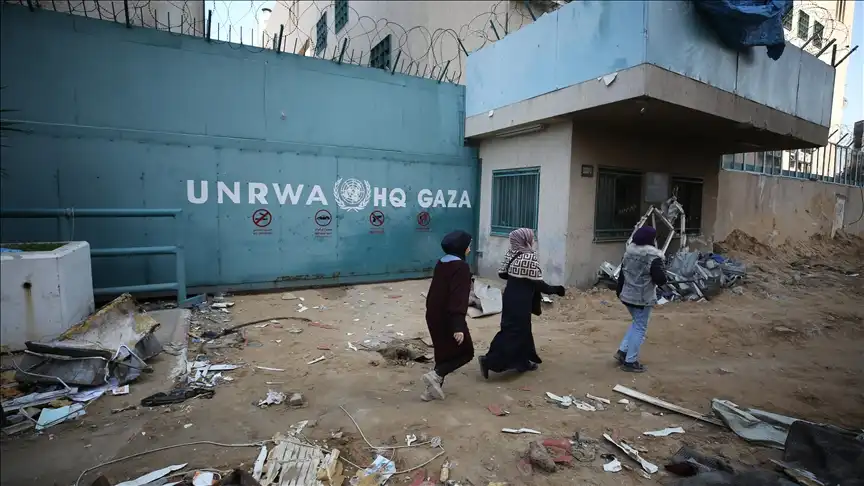

For the fourth day in a row, the Israeli army continues a massive incursion and invasion into the Al-Rimal neighborhood, and inside and around the Al-Shifa Medical Complex, amid missile and artillery shelling and gunfire, which led to the death of dozens of citizens, and the injury of others with separate injuries, and a large number are still under the rubble.


The Israeli army blew up the specialized surgical building in the Shifa Medical Complex, west of Gaza City, amid a complete loss of communication with all medical teams inside the complex in Gaza City, after the Israeli army threatened everyone inside to evacuate it immediately, as families inside appealed to the Red Cross and international institutions to go to the complex to rescue them.


Dozens of citizens were killed, and others were injured, in a violent artillery shelling that targeted homes belonging to the Abu Hasira family, and others on Al-Rashid Street and its surroundings in the Al-Mina area, west of Gaza City.


The Israeli Apache helicopter opened fire on the houses surrounding Al-Shifa Hospital, west of Gaza City.


The western neighborhoods of Gaza City, Tal al-Hawa, al-Rimal, Sheikh Ajlin, and al-Shati camp are witnessing intense artillery shelling.


An air strike targeted a house in the Beach Camp, west of Gaza City, causing deaths and dozens of injuries.


A number of citizens were killed when the Israeli army bombed a house for the Saidam family in the Maghazi camp in the central Gaza Strip.


Israeli warplanes also bombed a house for the Kurd family next to the Jaffa Mosque in the city of Deir al-Balah in the central Gaza Strip, resulting in the death and injury of dozens.


Nine persons died, and there are a large number under the rubble, as a result of Israeli aircraft bombing a house for the Abu Al-Arabi family in the new camp, west of the Nuseirat camp in the central Gaza Strip.


Israeli warplanes renewed their bombing for the fourth time on the Nuseirat camp in the central Gaza Strip.

ARAB AND WORLD

Thu 21 Mar 2024 9:28 am - Jerusalem Time

Netanyahu addresses Republicans in the US Senate


Israeli Prime Minister Benjamin Netanyahu delivered a video speech to Republican senators in Washington on Wednesday, days after the Senate Majority Leader, Democrat Chuck Schumer, described him as an obstacle to peace, and that he had lost his way.


Senate Minority Leader Mitch McConnell told reporters, shortly after leaving the Senate Republicans' political lunch, that Netanyahu joined the gathering via video link, made a presentation, and answered questions.


“We asked for and got an update on the war, the release of the hostages and the efforts to defeat Hamas,” said Sen. John Barrasso, a Republican from Wyoming, who invited Netanyahu to address the group. "We told him that Israel has every right to defend itself, and he said that this is exactly what they continue to do," he told reporters after the meeting.


McConnell said that Netanyahu called him last week and asked for an opportunity to address members of his conference and that he accepted the offer. Netanyahu asked to address Senate Democrats during their lunch meeting on Wednesday as well, but Schumer refused to give him this opportunity.


“When you make these issues partisan, you hurt the cause of Israel,” Schumer told reporters on Capitol Hill.


The contradictory responses highlight the growing partisan division over US support for the crushing Israeli war on the besieged Gaza Strip, which has resulted in the deaths of more than 31,000 Palestinians so far, the overwhelming majority of whom are women and children, and pushed the entire population of the Strip to the brink of famine.


Republican House Speaker Mike Johnson said in a press conference on Wednesday that he was considering a request to invite Netanyahu to address Congress.


He said: "I think it is very important for us to show solidarity and support for Israel now in its time of great struggle, and we certainly support this position and will try to reinforce that in every possible way." He added that he had a "lengthy" conversation with Netanyahu on Wednesday morning, in which Netanyahu informed him that Schumer's speech last week was "reckless" and "dangerous."


Schumer, the highest-ranking Jewish official in American history, faced severe reactions from Republicans and Israeli political leaders in recent days due to his speech in the Senate, in which he said that Netanyahu had “lost his way” five months after the war began.


McConnell accused Democrats of being hostile to Israel. “It is ridiculous enough for US senators to act as if they were members of the Israeli Knesset (by asking the prime minister to resign) – as if their views should have any impact on how Israel conducts its policies,” McConnell said in a speech on Wednesday. Interior.


Schumer rejected Republican criticism that his comments amounted to "foreign interference" or an attempt to "pressure" an ally for domestic political gain.


Democrat Schumer said: “I gave this speech out of my true love for Israel.” He expressed concern that the behavior of Netanyahu and his far-right ruling partners threatens to turn Israel into an international “pariah.”


Schumer is considered one of the biggest defenders of Israel in all its actions.


Israel has long enjoyed bipartisan support in Congress. But in recent years, Democrats have become increasingly critical of Netanyahu, who, over the course of several US presidencies, has been closely allied with Republicans.


Tensions between Netanyahu and Joe Biden over Israel's behavior in the war on Gaza have come to light in recent weeks, with Biden endorsing Schumer's speech and warning of a large-scale invasion of the southern city of Rafah, where more than half of Gaza's surviving population is sheltered. However, Netanyahu vowed to go ahead with the attack, in defiance of Biden's warnings.


The United States is pressing for a temporary ceasefire in exchange for the release of Israeli hostages and time to allow relief groups to transport much-needed food and medicine to the besieged area.


PALESTINE

Wed 20 Mar 2024 9:14 pm - Jerusalem Time

Israeli military says 90 people killed in Gaza’s al-Shifa Hospital raid

As siege on medical complex enters its third day, survivors recount harsh detentions, humiliation and abuse.

The Israeli military says it has killed 90 people during its raid on Gaza’s al-Shifa Hospital where a siege has entered a third day, as displaced Palestinians sheltering in the facility described long detentions and abuse.

Hamas condemned what it called Israel’s “bloody massacre” at al-Shifa and said civilians, patients and displaced people were among the fatalities.

Al-Shifa, the Gaza Strip’s largest hospital before the current conflict started, is one of the few healthcare facilities that is even partially operational in the north of the enclave.

It housed more than 7,000 patients and displaced people before the latest attack, the Gaza government said.

On Wednesday, the Israeli military said about 300 suspects were interrogated at the complex and more than 160 detained were brought to Israel “for further investigation”.

“Over the past day, the troops have eliminated terrorists and located weapons in the hospital area, while preventing harm to civilians, patients, medical teams, and medical equipment,” the military said in a statement.

Ismail al-Thawabta, the director of Gaza’s government media office, denied the Israeli military’s claims of having killed fighters and said all the dead were wounded patients and displaced people.

“The Israeli occupation army practises lying and deception in spreading its narrative as part of justifying its continuous and law-breaking crimes, which violate international law, international humanitarian law,” he told the Reuters news agency.


 ‘All the places are destroyed’

Displaced Palestinians spoke to Al Jazeera about their hours-long detentions during the Israeli army’s storming and siege of al-Shifa. The raid started early on Monday and the military said it had sent in special forces supported by infantry and tanks.

“We were in one of the buildings inside the al-Shifa Medical Complex,” said Saleh Abu Sakran. “The soldiers fired at the building where we are. They asked us to take off our clothes and go down to the hospital yard and sat us inside a residential building next to the hospital where we were interrogated.”

On Tuesday night, the army ordered them to head towards southern areas of the Gaza Strip, Abu Sakran said. He did not know the fate of the detainees inside the complex.

One woman recounted the ordeal she faced during her forced discharge from al-Shifa.

“I faced great difficulties in walking among the Israeli vehicles and bulldozers, and the children suffered greatly, and tanks fired at us,” said the woman, a diabetic.

“Gaza is not Gaza. All the places are destroyed. We went three days without eating. I felt like I was going to die.”

Some of the wounded and sick discharged from al-Shifa arrived at the Baptist Hospital in Gaza City for treatment.

Moath al-Kahlout, reporting from Gaza City, said the Israeli shelling has not stopped since Tuesday.

“It has been ongoing. Many were killed in the streets while fleeing and their bodies are still there,” he said.

Israel faced fierce criticism last November when troops first raided al-Shifa Hospital. They claimed to have uncovered tunnels ostensibly used as command and control centres by Hamas.

Hamas and medical staff denied the hospital was used for military purposes or to shelter fighters.

Meanwhile, an Israeli attack on the Nuseirat refugee camp in central Gaza killed at least 27 people, most of whom were displaced because of attacks on other parts of the enclave. At least five women and nine children were among the dead.

The injured were taken to Al-Aqsa Martyrs Hospital in Deir el-Balah after an Israeli air strike targeted a three-storey family home in the camp late on Tuesday.

Another Israeli strike hit the nearby Bureij camp, killing eight people, including three women.

Nuseirat and Bureij are among several densely populated refugee camps in Gaza that date back to 1948 when an estimated 750,000 Palestinians fled or were driven from their homes in what is now Israel, during the war surrounding its creation. Refugees and their descendants make up a majority of Gaza’s population of 2.3 million.


SOURCE: AL JAZEERA AND NEWS AGENCIES


PALESTINE

Wed 20 Mar 2024 8:59 pm - Jerusalem Time

War on Gaza: Biden donors say US president's Gaza policy 'increasing chances' of Trump victory

While donors say Trump would be 'disaster for our country', many voters are growing disillusioned over US support for Israel

A group of more than 100 donors for the Democratic Party sent a letter this week to US President Joe Biden, warning him that his "unconditional support" for Israel's war on Gaza is increasing his odds of losing the upcoming presidential election.

The letter, reported by The New York Times, says that Israel's current military campaign in Gaza, in which Israeli forces have killed more than 31,000 Palestinians, is failing to achieve its own stated goals of eliminating the Palestinian group Hamas and freeing the remaining Israeli hostages held in Gaza.

"As donors and activists, we have committed much time and treasure in helping increase the turnout of likely Biden voters, particularly among young voters and voters of color," the letter states.

"Many of these voters are now questioning whether the Democratic Party shares their values. If they stay home or vote for a third-party candidate, there is the very real danger that President Biden will be defeated in November."

The letter goes on to say how the election of Donald Trump in November would be "a disaster for our country" and that the signatories "fear that the Gaza war is increasing the chances of that occurring".


"Because of the disillusionment of a critical portion of the Democratic coalition, the Gaza war is increasing the chances of a Trump victory."

According to The New York Times, among the letter's signatories are several individuals who gave six-figure donations to Biden's presidential campaigns in 2020 and 2024.

A handful have also given more than $1m to Biden's campaigns, the newspaper reported.

Biden needs to 'immediately change course'

Israel's war on Gaza began on 7 October, when Hamas led a surprise attack on southern Israel, killing around 1,200 people and taking at least 240 hostages back to the enclave.

In response, Israel declared war, launching a military operation that began with an indiscriminate bombing campaign followed by a ground invasion of Gaza.

So far, Israeli forces have killed more than 31,000 Palestinians, laid siege to and attacked hospitals, targeted other civilian infrastructure, including schools and mosques, and attacked medical workers.

Since the beginning of the war, Biden declared his full-fledged support to Israel, also visiting Israel and becoming the first US president to visit the country during a war.

He has also been calling for an additional $14.3bn in military aid to Israel, and has bypassed congressional authority to fast-track weapons to the country.

"Regrettably, President Biden has provided what appears to be unconditional support for the Israeli operation," the letter states.

"The Biden administration has been providing armaments, including 2,000-pound bombs which have been used to flatten entire civilian neighborhoods, causing massive casualties with a high ratio of women and children."

The president's stance comes at odds with many voters in his base, who favour an end to the war. Two-thirds of US voters support a permanent ceasefire in Gaza, according to a poll conducted by Data for Progress.

And a smaller but significant number, 35 percent, believe Israel is committing genocide in Gaza, according to a YouGov poll.

"We are asking the Biden administration immediately to change course," the letter said.

"Conditions need to be placed and monitored on any further military, financial, or diplomatic aid. All indiscriminate bombing and demolition must stop."

However, it is unclear whether the letter for Biden would sway the president from changing course on his policy on Gaza.

On Tuesday, the League of Conservation Voters, a leading climate organisation, said it would put $120m towards Biden's presidential reelection bid, and outside of independent groups, Biden's campaign says it expects to raise and spend more than $2bn on its campaign.

OPINIONS

Wed 20 Mar 2024 8:55 pm - Jerusalem Time

How the Western media helped build the case for genocide in Gaza

Jonathan Cook

Jonathan Cook

Opinion Writer

From obscuring the West’s role in starving Gaza to sensationalised accounts of mass rape by Hamas, journalists are playing the role of propagandists, not reporters

The past five months have been clarifying. What was supposed to be hidden has been thrust into the light. What was supposed to be obscured has come sharply into focus.


Liberal democracy is not what it seems.

It has always defined itself in contrast to what it says it is not. Where other regimes are savage, it is humanitarian. Where others are authoritarian, it is open and tolerant. Where others are criminal, it is law-abiding. When others are belligerent, it seeks peace. Or so the manuals of liberal democracy argue.

But how to keep the faith when the world’s leading liberal democracies – invariably referred to as “the West” – are complicit in the crime of crimes: genocide?

Not just law-breaking or a misdemeanour, but the extermination of a people. And not just quickly, before the mind has time to absorb and weigh the gravity and extent of the crime, but in slow motion, day after day, week after week, month after month.

What kind of system of values can allow for five months the crushing of children under rubble, the detonation of fragile bodies, the wasting away of babies, while still claiming to be humanitarian, tolerant, peace-seeking?

And not just allow all this, but actively assist in it. Supply the bombs that blow those children to pieces or bring houses down on them, and sever ties to the only aid agency that can hope to keep them alive.

The answer, it seems, is the West’s system of values.

The mask has not just slipped, it has been ripped off. What lies beneath is ugly indeed.


Depravity on show

The West is desperately trying to cope. When Western depravity is fully on show, the public’s gaze has to be firmly directed elsewhere: to the truly evil ones.

They are given a name. It is Russia. It is Al Qaeda, and Islamic State. It is China. And right now, it is Hamas.

There must be an enemy. But this time, the West’s own evil is so hard to disguise, and the enemy so paltry – a few thousand fighters underground inside a prison besieged for 17 years – that the asymmetry is difficult to ignore. The excuses are hard to swallow.

Is Hamas really so evil, so cunning, so much of a threat that it requires mass slaughter? Does the West really believe that the attack of 7 October warrants the killing, maiming and orphaning of many, many tens of thousands of children as a response?

To stamp out such thoughts, Western elites have had to do two things. First, they have tried to persuade their publics that the acts they collude in are not as bad as they look. And then that the evil perpetrated by the enemy is so exceptional, so unconscionable it justifies a response in kind.

Which is exactly the role Western media has played over the past five months.


Starved by Israel

To understand how Western publics are being manipulated, just look to the coverage – especially from those outlets most closely aligned not with the right but with supposedly liberal values.

How have the media dealt with the 2.3 million Palestinians of Gaza being gradually starved to death by an Israeli aid blockade, an action that lacks any obvious military purpose beyond inflicting a savage vengeance on Palestinian civilians? After all, Hamas fighters will outlast the young, the sick and the elderly in any mediaeval-style, attritional war denying Gaza food, water and medicines.

A headline in the New York Times, for example, told readers last month, “Starvation is stalking Gaza’s children”, as if this were a famine in Africa – a natural disaster, or an unexpected humanitarian catastrophe – rather than a policy declared in advance and carefully orchestrated by Israel’s top echelons.

PALESTINE

Wed 20 Mar 2024 8:53 pm - Jerusalem Time

Saudi Arabia signs a funding memorandum for UNRWA worth $40 million

On Wednesday, Saudi Arabia signed a memorandum to fund the United Nations Relief and Works Agency for Palestine Refugees (UNRWA) with $40 million, to support its role in the Gaza Strip.


The Saudi News Agency, SPA, said that the King Salman Relief Center signed with UNRWA, via video call, a financial support memorandum of $40 million to support the agency’s emergency appeal in the Gaza Strip.


The memorandum was signed, according to the Saudi agency, by the Advisor to the Royal Court and the General Supervisor of the Center, Abdullah bin Abdulaziz Al-Rabiah, and the Commissioner-General of UNRWA, Philippe Lazzarini.


According to the agreement, the food security sector will be supported for the Palestinian people in Gaza, benefiting 250,638 individuals from the most needy groups, in addition to providing shelter and non-food materials to 20,19 families, amounting to 200,190 individuals, according to the same source.


The agency indicated, "This comes within the framework of the tireless efforts made by the Kingdom through the center to provide relief to the affected Palestinian people in the Gaza Strip, in order to alleviate their suffering as a result of the current humanitarian crisis they are going through."


As a result of the war and Israeli restrictions, the residents of Gaza, especially the Gaza and northern governorates, are on the verge of famine, in light of a severe scarcity of food, water, medicine and fuel supplies, with the displacement of about two million Palestinians from the Strip, which has been besieged by Israel for 17 years.


Since last January 26, 18 countries and the European Union have suspended their funding to the UN agency, against the backdrop of Israeli allegations that a number of its employees participated in the attack on settlements adjacent to the Gaza Strip on October 7, 2023, while the agency announced that it is investigating those allegations.


However, this March, some of these parties began reviewing their decisions regarding UNRWA, as the European Commission said that it would release 50 million euros ($54.7 million) of funding for UNRWA, while Sweden announced the resumption of funding for UNRWA with about 20 million dollars after Obtaining guarantees from the UN agency to conduct additional audits of its expenses and employees.


During the crisis of suspending funding for UNRWA, Saudi Arabia stressed its “total rejection of compromising” the role of the UN agency and “the mandate granted to it, and to the means of blackmail and pressure to which it is exposed,” according to what was stated by its permanent ambassador to the United Nations, Abdulaziz Al-Wasel.


ARAB AND WORLD

Wed 20 Mar 2024 8:43 pm - Jerusalem Time

A Statement From Jewish Americans Opposing AIPAC

“We will support candidates who are opposed by AIPAC, and who are advocates for peace and a new, just US policy toward Israel/Palestine.”


For decades, the American Israel Public Affairs Committee (or AIPAC) has been the most powerful wing of the Israel lobby in the United States. Until recently, it enjoyed almost total support from politicians in both major political parties.


In the past few years, though, attitudes within the Democratic Party towards Israel, Palestine, and AIPAC itself have begun to shift dramatically, threatening AIPAC’s lobbying power. In response, AIPAC has begun aggressively intervening in Democratic primary elections, spending vast sums of money to defeat political candidates who might oppose the policies of the Israeli government. AIPAC recently boasted that it was “dollar for dollar, the largest contributor to candidates in the 2022 midterm elections,” and it has plans to spend even more money in 2024.1:59Much of AIPAC’s power and legitimacy derives from the idea that it broadly represents the views of American Jews. But Jews have never been a monolith, and, in the wake of Israel’s unrelenting assault on Gaza, more and more Jewish Americans are speaking up in favor of a different kind of politics.

The following open letter is a clear example of this. It has been signed by prominent Jewish Americans from every walk of life, all of whom have decided to publicly repudiate both AIPAC’s unconditional embrace of the Israeli government and its attempts to crush the nascent movement within the Democratic Party for a new approach to Israel and Palestine.


The text of the letter follows.

We are Jewish Americans who have varying perspectives. We’ve come together to highlight and oppose the unprecedented and damaging role of the American Israel Public Affairs Committee (AIPAC) and its allied groups in US elections, especially within Democratic Party primaries. We recognize that the purpose of AIPAC’s interventions in electoral politics is to defeat any critics of Israeli government policy and to support candidates who vow unwavering loyalty to Israel, thereby ensuring the United States’ continuing support for all that Israel does, regardless of its violence and illegality.   

Given that Israel is so isolated internationally that it could not continue its inhumane treatment of the Palestinians without US political and military support, AIPAC is an essential link in the chain that holds in place the unbearable tragedy of Israel/Palestine. In the coming US elections, we need to break that chain in order to help free the people of Israel/Palestine to pursue peaceful coexistence.  

In the same 2021-22 election cycle in which AIPAC endorsed Republican extremists and dozens of Congress members who’d voted against certifying Biden’s victory over Trump, AIPAC’s network raised millions from Trump donors and spent the money inside Democratic primaries against progressives, mostly candidates of color. 

AIPAC is now vowing to spend even more millions in the 2024 Democratic primaries, targeting specific Democrats in Congress—initially all legislators of color—who’ve advocated for a Gaza cease-fire, a position supported by the vast majority of Democratic voters. AIPAC’s election spending increasingly works to defeat candidates who criticize Israel’s racist policies.


In contrast to AIPAC, we are American Jews who believe that US support for foreign governments should only be extended to those that respect the full human and civil rights, and right to self-determination, of all people. We oppose all forms of racism and bigotry, including antisemitism—and we support the historic alliance in our country of Jewish Americans with African Americans and other people of color in the cause of civil rights and equal justice.


Therefore, we strongly oppose AIPAC’s attempts to dominate Democratic primary elections. We call on Democratic candidates to not accept AIPAC network funding, and demand that the Democratic leadership not allow Republican funders to use that network to deform Democratic primary elections. We will support candidates who are opposed by AIPAC, and who are advocates for peace and a new, just US policy toward Israel/Palestine.


PALESTINE

Wed 20 Mar 2024 7:41 pm - Jerusalem Time

Gaza Civil Defense: Israeli army prevents our access to the wounded in the Shifa complex

The Civil Defense in the Gaza Strip announced today, Wednesday, that the Israeli army is refraining from coordinating with international bodies in order to allow its crews to rescue hundreds of wounded people in the vicinity of the Shifa Medical Complex.


In a statement published on his account on the Telegram application, the Civil Defense (Civil Protection) considered this “an extension of the policy of slow execution” of these wounded.


Since dawn last Monday, an Israeli army force has continued to storm the Shifa complex, despite the presence of thousands of sick, wounded, and displaced persons inside it, in parallel with widespread killings, shootings, and arrests carried out among the ranks of the displaced inside the hospital, and the bombing of nearby homes.


The Civil Defense said, “The Israeli refuses to coordinate with international bodies such as the Red Cross in order to allow Civil Defense crews to arrive to rescue hundreds of wounded citizens whose appeals we received in the vicinity of Al-Shifa Medical Complex, west of Gaza City.”


It added that this prevents "reaching these wounded and providing them with assistance."


The Civil Defense considered that the Israeli decision to prevent coordination was “an extension of the policy of slow execution of innocent and wounded citizens who are trapped.”


Earlier Wednesday, the Israeli army announced that it had killed 90 Palestinians and interrogated 300 in Al-Shifa Hospital, while 160 others were arrested and transferred to Israel for investigation.


The army said, in a statement: “Army forces and the General Security Service are engaged in fighting in the Al-Shifa Hospital area.”


It claimed that "Forces belonging to the 13th Marine Commando Unit and the Combat Group of the 401st Brigade under the command of the 162nd Division, over the last 24 hours, eliminated militants and found combat means."


This is the second time that Israeli forces have stormed the complex, since the beginning of the war on Gaza on October 7, 2023. They stormed it on November 16, after besieging it for a week, then withdrew from it after 8 days, during which its courtyards and parts of the building were destroyed its buildings and medical equipment, in addition to the electricity generator.


PALESTINE

Wed 20 Mar 2024 7:11 pm - Jerusalem Time

A provocative march by Israeli settlers on Al-Wad Street hinders worshipers from reaching Al-Aqsa

This Wednesday evening, settlers obstructed worshipers’ arrival to the blessed Al-Aqsa Mosque, with a provocative march they organized on Al-Wad Street leading to Al-Aqsa Mosque.


According to local sources, a provocative march on Al-Wad Street in Jerusalem, organized by settlers, caused the road to be closed in the face of Arab citizens and those arriving to the blessed Al-Aqsa Mosque.


The settlers provoked citizens and passers-by, and the march ended near the Buraq Wall near Al-Aqsa Mosque.