OPINIONS

Wed 23 Oct 2024 9:56 am - Jerusalem Time

Can the United Nations Be Saved? The Case for Getting Back to Basics

Foreign Affairs

Foreign Affairs

Opinion Writer

By Thant Myint-U


The quest to fix the United Nations is almost as old as the organization itself. Eighty years ago, Allied leaders imagined a postwar order in which the great powers would together safeguard a permanent peace. The Security Council, dominated by its five veto-wielding members—the United States, the Soviet Union, the United Kingdom, France, and China—reflected the world as it was. Other, less hierarchical parts of the new UN system were meant to foster international cooperation across a host of issues: the global economy, public health, agriculture, education. The seeds of a future planetary government were evident from the start.

The UN was initially conceived as a military alliance, but that objective became impossible with the onset of the Cold War. Many observers predicted an early death for the UN. But the organization survived and was soon reenergized, fashioning aims that its founders never imagined, such as peacekeeping. Its secretary-general became a figure on the global stage as the world’s preeminent diplomat, jetting off to war zones to negotiate cease-fires. Specialized agencies under the UN, such as its Educational, Scientific and Cultural Organization (UNESCO), and a raft of new technical assistance programs spread their wings. For some officials, scholars, and activists both within and outside the UN, a hopeful vision of global government persisted.

The American legal scholar Richard Falk and the former German diplomat Hans von Sponeck are clearly in the camp of those who would like to see a far stronger UN. In Liberating the United Nations, they make the case for an organization that can deal effectively with the slew of challenges facing the world today, from climate change to nuclear proliferation. They see no alternative. At the same time, they bemoan the UN’s current dysfunctional state and its increasing marginalization from the major issues of the day. The global body, they say, “is more needed than ever before and yet less relevant as a political actor than at any time since its establishment in 1945.”

The authors provide a detailed overview of the UN’s complex structures and multifaceted undertakings and make a spirited attempt to convince readers that a renewed investment in the organization is the best possible path to a better future. They offer a worthy vision of an ideal global body, imagining, for example, a reformed Security Council linked with civil society organizations from around the world. Their prescriptions, however, do not fully account for challenges to the UN’s legitimacy and standing. Given today’s realities, those who believe in the enduring importance of the UN should not seek to make the institution all things to all people but should instead adopt a laser-like focus on strengthening the organization’s most fundamental function: preventing war.

THE GOOD OLD DAYS

In Falk and von Sponeck’s telling, the UN has demonstrated considerable innovation, even during the Cold War, despite the constraints of that era’s superpower rivalry. This was especially true under Dag Hammarskjold, who served as secretary-general from 1953 until his death, in 1961, and pioneered new forms of preventive diplomacy. The speedy deployment of blue-helmeted UN peacekeepers during the Suez crisis in 1956 was a prime example of this early creativity.

By the 1990s, with the Cold War over and Moscow’s veto no longer a hindrance to American primacy, the UN expanded its peacekeeping operations, which proved successful in places as far from the seats of power as El Salvador and East Timor. The organization also became an intellectual leader—it crafted, for example, the notion of human development as a counterbalance to the simple metric of per capita GDP.

For Falk and von Sponeck, this was also a period of lost opportunity, as the United States focused its energies on consolidating a new international regime favorable to global capitalism rather than on building the foundation of a UN-centered world government. A series of peacekeeping failures, from Bosnia to Rwanda, colored the lead-up to the turn of the century, by which time the world’s post–Cold War enthusiasm for the UN had largely dissipated. The American invasion of Iraq without UN authorization marked a new low point for the organization, demonstrating its impotence in the wake of great-power aggression. Today, Falk and von Sponeck say, in the face of a “dysfunctional ultra-nationalist backlash,” the organization is hobbled even more and has little political support for much-needed amendments to the UN Charter, such as reforming the composition of the Security Council.

The quest to fix the United Nations is almost as old as the organization itself.

There are problems with the book’s history. For example, the authors mistakenly describe the crisis in the Republic of the Congo, which drew in the UN in 1960, as being caused principally by “tribal conflicts and ethnic regionalism,” when it was very much about attempts by white supremacists to maintain their dominance over Congo—in particular, its vast mineral riches—after the country won independence from Belgium. The authors are also mistaken in suggesting that Hammarskjold supported what they oddly describe as Congolese Prime Minister Patrice Lumumba’s “radical economic nationalism.” The two men were famously at odds, and at least a few of Hammarskjold’s aides, if not the secretary-general himself, were complicit in Lumumba’s overthrow in 1960.

Far more important, however, is what’s missing from the authors’ account. For nearly all the peoples of Africa and Asia, the history of the twentieth century was first and foremost a history of empire and their long fights for freedom. Over the late 1950s and early 1960s, representatives from newly independent nations—the “Afro-Asians,” as they called themselves—transformed the UN, bringing it to the height of its ambition and vigor. The UN was the mechanism through which they asserted their hard-won independence and shaped and protected their sovereignty. For them, Congo was a test of whether white supremacy would be a mainstay of the postcolonial world.

Falk and von Sponeck correctly mention the critical role played by the UN from its very beginning in the struggle against racism globally and against the apartheid regime in South Africa in particular. But they are incorrect in suggesting that non-Western governments were more interested in the development of a fairer world economy than in the prevention of war. For the Afro-Asians, peace, development, and the realization of human rights were interdependent parts of a bigger project of equality after empire.

The Afro-Asians embraced the UN. In 1961, they were instrumental in the appointment of one of their own to secretary-general: the Burmese diplomat U Thant (my grandfather). In 1962, Thant, working closely with other Afro-Asian leaders, played a pivotal role (which is lost in most narratives) in the de-escalation of the Cuban missile crisis. His mediation efforts between U.S. President John F. Kennedy, Soviet Premier Nikita Khrushchev, and the Cuban revolutionary Fidel Castro marked the apex of the organization’s work in war prevention. While the Security Council was often deadlocked, the secretary-general and his team of mediators were more active than ever across a variety of conflicts, from Cyprus and India to Pakistan and Vietnam. The UN’s record of peacemaking endeavors, which were intimately linked to the ascendancy of what was then called the “Third World” majority, is absent from the book.

REFORM AND REALITY

Liberating the United Nations includes a deep dive into the authors’ own experiences in the organization. Falk, for many decades a professor of international law at Princeton University, was in the early 2010s the UN’s special rapporteur on the situation of human rights in the Palestinian territories occupied since 1967. Von Sponeck, a career international public servant, was the UN’s humanitarian coordinator in Iraq in the late 1990s; he resigned in protest over the harm that sanctions did to Iraqi civilians. Both demonstrate the many ways in which their efforts were thwarted by geopolitics—that is, the interests of the United States and other powerful governments. Behind their accounts is the central tension in the book: on the one hand, the authors’ desire to see the UN become a kind of global government and, on the other, the political currents frustrating this aim.

Falk and von Sponeck are “puzzled” by the inability of the UN to “gain the political traction needed” to make itself the effective tool for peace that they believe it can be. They contend that over the decades, despite herculean obstacles, the UN has proved itself an “indispensable feature of a sustainable and positive world order.” With more funding, “as well as greater forbearance by geopolitical actors and more appreciation by member governments, civil societies, and the media,” the world body could again scale new heights.

The obstacle, as they see it, is an “outmoded form of ‘political realism’” that “will require an ideological struggle” to overcome. Governments are trapped in their own geopolitical calculations and do not appreciate that the only answer to today’s global challenges is a reformed UN at the heart of vigorous global cooperation. For this to happen, they call for a “progressive transnational movement of peoples,” one “strong enough to exert a benevolent influence on governmental and international institutional practices.” Only with this kind of groundswell will the UN be able to address “such basic structural problems as predatory capitalism, global militarism, and ecological unsustainability.”

The authors are certainly right that the UN has not only survived but succeeded in a number of sectors and settings. It has produced a body of international law unprecedented in history. Its humanitarian agencies would be difficult to replace. In the event of another pandemic, only the World Health Organization, for all its flaws, could coordinate a truly global response.

With more funding, the UN could again scale new heights.

Falk and von Sponeck place front and center the need to update the composition of a Security Council that is still locked in a World War II–era constellation. There are few, if any, good arguments for denying countries such as India a position at least on par with that of the United Kingdom or for denying non-Western states greater representation more generally. In recent decades, the story of the Security Council has been of a body dominated by five rich countries deliberating conflicts in low-income countries. The unrepresentative composition of the five permanent members leads to a host of inequities, such as the biased appointments of senior officials, that run through the UN system. It is easy to see why enthusiasm for the UN in much of the world has steadily declined.

But any effort to fix the UN today will run against immense political headwinds. It’s nearly impossible to imagine a package of changes to the Security Council’s membership that could win support among its current permanent members. It’s also unclear that any change to the composition of the Security Council, however salutary to the UN’s legitimacy, would improve the organization’s effectiveness. The only result may be new kinds of deadlock (albeit with perhaps more interesting debates).

There’s also a more basic challenge: the plethora of alternative avenues for governments to pursue their interests, including bilateral agreements; regional organizations, such as NATO; and forums, such as the G-20. The UN’s headquarters, in New York, was once the only place in the world where representatives of many countries could meet. There were few other summits. Over the late 1950s and early 1960s, the annual General Assembly meetings stood at the very center of global politics, with everyone from Kennedyto Khrushchev to anticolonial revolutionaries, among them Ghanaian President Kwame Nkrumah and Egyptian President Gamal Abdel Nasser, all playing their larger-than-life roles in a dramatic theater that gripped the planet.

Falk and von Sponeck conclude that U.S. unilateralism is what has been constraining the UN, with Washington unwilling to invest in the organization’s renewal. But surely, it is not only the United States that seeks to act outside the UN. For smaller states, the UN may be the one arena where they have an equal seat at the table. But for others, such as the rising middle powers of the world, there’s an ever-increasing menu of options.

MISSION: POSSIBLE

There’s a deeper challenge still: the nature of the UN itself. Over the decades, the UN has developed its own culture, language, and ways of working—invaluable products of the only attempt ever to build an institution that involves all humanity. But it has long been addicted to process over outcome. The organization’s built-in need to reflect everyone’s views, in every paragraph of every text—in a staff circular as in a General Assembly resolution—too often strips away meaning and value from even its best-intentioned efforts.

The manner in which the UN manages its people is another vexing issue. The organization includes legions of public servants, including aid workers and peacekeepers, who are dedicated to its lofty principles and perform heroically, often under the most trying circumstances. But few of them have benefited from good management. The most capable are rarely recognized for their skill and sacrifice. Governments, especially the great powers, insist on their own (often unqualified) nominees for the top jobs, creating a perversion at the heart of the system that undermines morale, as well as efficiency. An effective UN needs at its core a highly motivated civil service staffed by the most qualified women and men from around the world. It’s an area of reform that receives almost no attention.

The default scenario is one in which an unreformed or slightly reformed UN continues evolving a smorgasbord of functions—protecting refugees, facilitating climate change negotiations, providing development assistance—doing well in some areas and less so in others. Its conferences, even if they do not necessarily solve global problems, keep alive dialogue on global issues, at times providing a platform for an array of international civil society organizations. The trouble with this status quo scenario is that by spreading itself thin, the organization is distracting itself from its main purpose of preventing war.

For the foreseeable future, the Security Council, the main body responsible for international peace and security, will likely remain unable to address the primary threats of the day, among them the Russian invasion of Ukraine, conflicts in the Middle East, and disputes over Taiwan and territories in the South China Sea. Superpower tensions within the Security Council are nothing new—but they need not stand in the way of preventive diplomacy and mediation. Hammarskjold and Thant’s most important peacemaking achievements took place during the Cold War, in the late 1950s and early 1960s. In the late 1980s, the quiet mediation of Secretary-General Javier Pérez de Cuéllar made possible several peace agreements that set the stage for the end of the Cold War itself.

By spreading itself thin, the UN is distracting itself from its main purpose of preventing war.

In the absence of a dynamic, reformed Security Council, the key to future UN success is the secretary-general’s role as the world’s preeminent diplomat. Peace is the primary business of the UN. There are many conflicts that may well be resolved without any UN role. But the past 80 years demonstrate that the secretary-general, an impartial mediator representing a universal body, is at times indispensable. One who is sidelined on the issues of war and peace will have far less influence with which to lead on global challenges such as climate change and development.

The public expects the UN to head efforts to end war. Today, terrible new wars are destroying the lives of millions and raising the threat of nuclear confrontation. It’s a very different time than the 1990s, when all the great powers were content to dispatch peacekeeping operations to end internal conflicts. The world has returned to a period of warfare between states, exactly what the UN was set up to prevent.

Because there is little oxygen for reforming the UN, whatever oxygen exists needs to be deployed efficiently to restore and broaden the secretary-general’s peacemaking role, which can address not only internal conflicts but interstate wars, as well. This will require building a team of experienced in-house mediators who have an intimate knowledge of what the organization can and cannot do. In the past, the UN achieved considerable success through the leadership of officials such as the Nobel laureate Ralph Bunche, who served both Hammarskjold and Thant and was instrumental in dozens of peace efforts around the world.

In this dangerous and uncertain moment, the secretary-general of the United Nations can explore and create opportunities for conflict resolution. Only the UN has the authority and credibility to play this role. And over the coming years, it may make all the difference between global war and peace.
PALESTINE

Wed 23 Oct 2024 9:43 am - Jerusalem Time

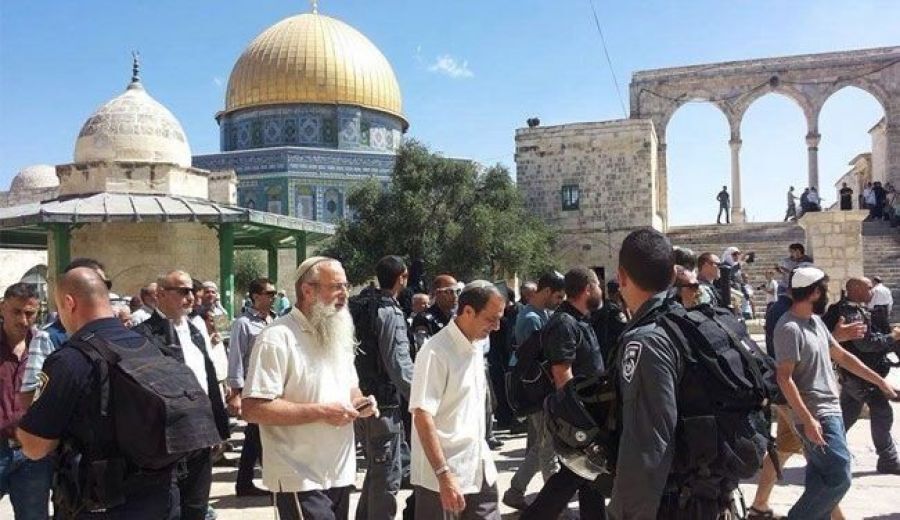
200 Israeli settlers storm Al-Aqsa on the seventh day of the Jewish "Feast of Tabernacles"

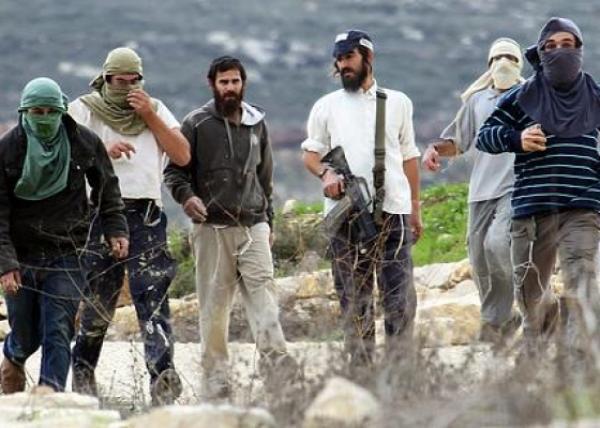
Today, Wednesday, 200 settlers stormed the blessed Al-Aqsa Mosque, under heavy protection from the Israeli occupation police.


Local sources reported that successive groups of settlers in large numbers stormed Al-Aqsa Mosque and performed Talmudic rituals in its courtyards, on the seventh day of the Jewish "Feast of Tabernacles."


Hundreds of settlers also performed Talmudic rituals at the Buraq Wall, adjacent to Al-Aqsa Mosque on the western side.


It is noteworthy that there is a continuous increase in the number of settlers storming Al-Aqsa Mosque, as their numbers several years ago did not exceed 5,000 annually, while this year they reached more than 60,000 intruders.

PALESTINE

Wed 23 Oct 2024 9:20 am - Jerusalem Time

Bullet Injury.. Israeli occupation Launches an Arrest Campaign in the West Bank and Jerusalem

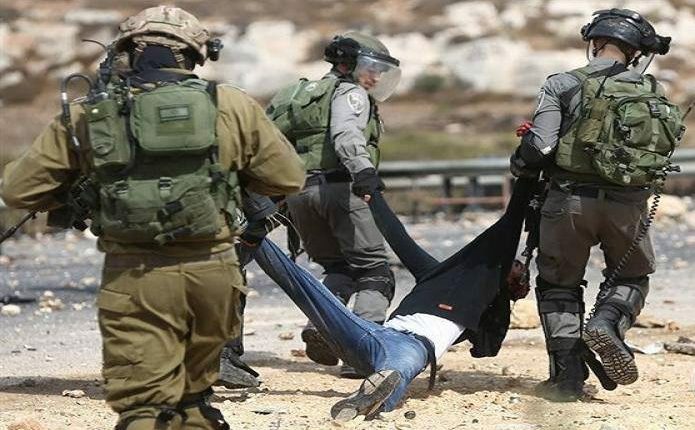
Today, Wednesday, the Israeli occupation forces launched an arrest campaign in various areas of the West Bank and occupied Jerusalem.


In Qalqilya, the occupation forces arrested a number of citizens, including: Muhammad Qaraan, Anas, Mahdi and Tariq Nawaf, after raiding and searching their homes.


They arrested the young man, Muhammad Quraan, after raiding and searching his house.


In Ramallah, the occupation forces arrested the young man Mustafa Hassan Al-Atrash, from Jaljulia.


In Hebron, a boy was shot in the leg with live ammunition and his injury was described as moderate, during clashes with the Israeli occupation forces in the town of Halhul.


In occupied Jerusalem, the occupation forces arrested the young man Hadi Darbas, after raiding and searching his home in the town of Issawiya.


In Tubas, a special Israeli force infiltrated the town of Aqaba at dawn and arrested the young man, Muhammad Saqr Ahmad Abu Ara (22 years old), from his home.


ARAB AND WORLD

Wed 23 Oct 2024 8:54 am - Jerusalem Time

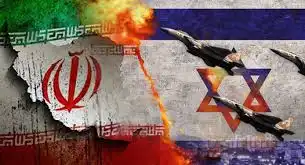
The expected Israeli strike on Iran.. Every delay is a choice of major targets!

Major General Wassef Erekat: The effects of a possible Israeli strike will be determined based on its size and the damage it will inflict on Iranian targets

Yasser Manaa: The decisive factor in determining the future of the next stage is related to the type of Iranian targets that Israel will strike

Antoine Shalhat: Netanyahu is betting on Trump’s victory and may not be interested in postponing the Iran strike until after the US elections

Talal Okal: Netanyahu is trying to bypass American restrictions regarding the nature of the potential targets of the strike, which may not be delayed much

Fayez Abbas: Netanyahu seeks to achieve his dream of destroying Iranian nuclear reactors and will choose the timing of the strike carefully to serve Trump's campaign

Ahmed Zakarneh: The possibility of striking Iran before the US presidential elections will be weak according to the natural logic of the course of events


The world is awaiting the possibility of Israel launching a military strike against Iran before the upcoming US elections, and the possibility of that strike reshaping the political landscape in the Middle East or not.


In separate interviews with “I”, writers, political analysts, specialists and experts believe that the effects of any Israeli strike on Iran will depend on the size of the operation and the damage it will inflict on Iranian targets, amid fears of the possibility of a comprehensive regional war breaking out as a result of the Iranian response.


They point out that targeting Iranian nuclear facilities directly remains a weak option, although Israeli Prime Minister Benjamin Netanyahu is trying to bypass American restrictions on targeting Iranian strategic sites, taking advantage of the United States’ preoccupation with the elections to carry out the strike.


Writers, political analysts, specialists and experts indicate that the Israeli strike could include assassinations of prominent Iranian leaders or bombing sensitive industrial and military targets.


Controversy over Israeli Air Force readiness to strike Iran


Military and security expert, retired Major General Wassef Erekat, explains that there is an ongoing debate about the readiness of the Israeli Air Force to carry out a military strike against Iran, as many Israeli leaders, led by Prime Minister Benjamin Netanyahu, are seeking to accelerate this strike before the upcoming US presidential elections, for reasons related to influencing those elections and avoiding internal criticism from the opposition, which fears that postponing the strike will lead to its complete cancellation.


However, Erekat confirms that there are several indicators that indicate the possibility of postponing this strike until after the US elections, the first of which is the continuous change in the target bank, which highlights the Israeli leadership’s hesitation in making the final decision regarding executing the strike despite announcing its readiness.


Erekat points out that the second of these indicators is the statements of US Secretary of Defense Lloyd Austin, which confirmed the difficulty of predicting the form that the Israeli strike against Iran will take, indicating that the vision is not yet clear.


A third indicator, according to Erekat, is the leaks related to the Israeli plans for the strike, which prompted the American side to open an investigation into them. The fourth is the faltering of military operations on the northern Israeli front, especially with the delay in the ground invasion in this axis. The fifth is obtaining guarantees of military and political support from the United States, which is essential, as Israel relies heavily on the support of its American ally in such operations.


Deployment of the THAAD system within the framework of the US commitment to protect Israel


Regarding the US sending the THAAD missile defense system to Israel, Erekat explains that the goal of this step is that it comes within the framework of the US commitment to protect Israel and ensure its military superiority over its neighbors in the region. Providing Israel with this system also aims to enhance its deterrence capability and reassure the Israeli leadership in the event that Iran responds to any Israeli attack. This step also aims to influence the Israeli target bank and avoid striking nuclear facilities and vital energy sources in Iran.


As for the possible scenarios for an Israeli attack on Iran, Erekat points out that if there is an Israeli commitment not to target Iranian nuclear reactors and oil facilities, this opens the door to several scenarios, the most important of which are: carrying out assassinations against prominent Iranian leaders using agents or aircraft, or targeting industrial facilities with missiles. The strike may also include bombing military and civilian airports, and perhaps targeting sensitive camps and facilities belonging to the Iranian Revolutionary Guard or the army, in addition to striking communications centers, bridges, and other vital targets.


Regarding the size of the potential Israeli strike, Erekat explains that this depends on the specific target. If the target includes striking several Iranian sites, the operation will require the use of a large number of aircraft and missiles, in addition to refueling aircraft and others for early warning and control. However, the question remains as to whether Israel will carry out the strike in the form of a single comprehensive attack or in multiple stages.


The repercussions of the strike are determined based on its size.


As for the potential repercussions of an Israeli attack on Iran, Erekat explains that the effects of the strike will be determined based on its size and the damage it will inflict on Iranian targets.


Erekat points out that Iran had threatened that any Israeli attack would be met with a strong response from its side, which could lead to things getting out of control and dragging the region into a comprehensive war, according to Erekat's estimates.


Timing and nature of the strike


Writer and expert on Israeli affairs Yasser Manna points out that Israel has already made a decision to launch a military strike against Iran, but the main question remains about the timing and nature of this strike.


Manaa explains that the United States is seeking to postpone any Israeli attack on Iran so that it does not coincide with the upcoming presidential elections, as a military strike before or during the elections could negatively affect their results. The ruling Democratic Party currently fears that escalation would alienate Arab and Muslim voters in the United States, which would enhance the chances of Republican candidate Donald Trump returning to the White House.


Regarding the potential Iranian targets of the Israeli strike, Manaa believes that targeting Iranian military sites or government facilities is the most likely scenario.


But Manaa believes that targeting Iran's nuclear facilities directly remains a weak option in the absence of full American participation, as a partial strike may not succeed in destroying the Iranian nuclear project completely, which may push Tehran to accelerate its nuclear program at an increasing pace in response to the attack.


Manna discusses the potential economic impacts of any strike targeting Iranian oil facilities, stressing that this type of strike would lead to a global rise in fuel prices, which would affect not only the global economy, but also the Israeli and American economies, as both are greatly affected by fluctuations in energy prices.


Important messages behind the deployment of the THAAD system


In the context of air defenses, Manna points to the deployment of the American THAAD system in Israel, explaining that this move sends important messages, the first of which is that the deployment of this system indicates that Israeli air defenses are not completely immune as was previously promoted, and that their defensive capabilities may be exaggerated.


The second message, according to Manaa, is that the deployment of THAAD shows that the United States is actually participating in the conflict, not just providing financial or intelligence support. This confirms that the Iranian attacks against Israel were painful and caused great damage, but were not officially announced, perhaps for political reasons or to avoid showing Israeli weakness.


Unprecedented conflict in the region


Regarding the nature of the ongoing conflict in the region, Manaa points out that it is unprecedented in terms of its nature and multiple arenas, stressing that the coming transformations may be surprising and unexpected.


Manaa stresses that the decisive factor in determining the future of the next stage is related to the type of targets that Israel will choose to strike in Iran. Will the strikes be limited and focused, or will they target broader strategic sites?


Manaa believes that Iran has been able to establish a deterrence equation in the region, which means that any Israeli attack will be met with an immediate and appropriate response.


This balance, according to Manaa, forces Israel to deal with extreme caution, especially since the Iranian response has become a fixed policy through which Tehran seeks to confirm its ability to protect its interests and deter threats. As a result, Israel was forced to modify its military strategy, especially with regard to separating the fronts.


In the media context, Manna points out that Israel is trying to portray the integration of the various fronts as serving its interests in gathering international support against Iran.


Manaa explains that targeting the home of Israeli Prime Minister Benjamin Netanyahu was part of a media campaign aimed at portraying Iran as an international threat that requires a collective response.


The "Hidden Wars" Between Israel and Iran


Manna deals with the "hidden wars" between Israel and Iran, which include unconventional confrontations that extend to other areas, such as water warfare, mutual attacks on oil tankers and commercial ships, and cyber warfare.


Manaa points out that these ongoing confrontations, away from the media spotlight, play an important role in escalating tensions between the two countries and shaping the future conflict.


Netanyahu not interested in postponing strike until after elections


Israeli writer and political analyst Antoine Shalhat points out that Israeli Prime Minister Benjamin Netanyahu is betting heavily on former US President Donald Trump winning the upcoming presidential election, and therefore he may be interested in not postponing a strike on Iran until after the election.


However, Shalhat explains that Netanyahu needs a full green light from the United States before embarking on any military action, because Israel will be in dire need of American support in the event of a strong Iranian response, and the situation is very complex and requires complete agreement between the two sides.


Sending THAAD reflects Israel's inability to fully protect itself


Regarding the US sending the THAAD missile defense system to Israel, Shalhat believes that this step clearly reflects the fact that Israel is unable to fully protect itself in the event of a large-scale Iranian attack.


Shalhat points out that this system is evidence that the United States remains Israel's primary protector, and that Israeli defenses are not as strong as they claim.


As for the potential targets of an Israeli strike on Iran, Shalhat believes that what is being circulated indicates the possibility of targeting Iranian military facilities or high-level leaders, or perhaps both.


Shalhat believes that what is being circulated is that there are directives from the United States and some Arab countries to avoid targeting Iranian nuclear facilities or oil facilities, and that Israel has responded to those directives so far, but despite what is being circulated, Israel may not respond.


However, Shalhat believes that there is a possibility that Israel will ignore these directives, especially after Netanyahu directly accused Iran of trying to assassinate him. This accusation came after his private home in Caesarea was targeted by a drone launched from Lebanon earlier this week. This development may push Netanyahu to act more aggressively, perhaps including expanding the range of potential targets.


Escalating friction between Israel and Iran


As for the repercussions of this potential strike, Shalhat believes that the escalation of friction between Israel and Iran will be the immediate result of the strike.


However, Shalhat explains that the next stage will depend largely on the size and impact of the Israeli strike on Iran, as well as on Iran's response.


According to Shalhat, if Tehran chooses to respond forcefully, the conflict could develop into a large-scale war involving several arenas.


Shalhat points out that Iran currently seems uninterested in entering into a comprehensive war, and neither does the United States, while Netanyahu appears not to fear this scenario and does not take it seriously.


Green light from Biden


Writer and political analyst Talal Okal believes that the Israeli strike against Iran may not be delayed much, especially after Israeli Prime Minister Benjamin Netanyahu received the green light from US President Joe Biden.


This green light, according to Awkal, was not limited to political approval only, but extended to American military preparations in the region, where the THAAD missile defense systems were deployed, designed to counter ballistic missiles, which confirms the existence of an American-Israeli military partnership in this context.


Awkal believes that Netanyahu is trying to bypass American restrictions regarding the nature of the potential targets of the strike, as he seeks to target Iranian facilities of strategic importance.


Okal points out that Netanyahu believes that such goals will force Iran to respond, which will open the door to a wider regional escalation, which he seeks to do to drag the region into an ongoing war.


According to Okal, although Netanyahu appears on the surface to be giving American diplomatic efforts a chance, his conditions make it difficult to make progress in those efforts, which means that those efforts are likely to fail, but indirectly.


Okal expects that Netanyahu is planning to launch the strike before the upcoming US presidential elections, as he believes that the lack of impact of the US decision due to preoccupation with the elections provides a suitable opportunity to carry out the attack while ensuring that US objections are reduced.


The moment may be right for Netanyahu to realize an "old dream."


Awkal points out that Netanyahu believes that this moment may be an opportunity to realize an “old dream” of striking Iran’s nuclear reactors, which will present his Western allies with a fait accompli. If he succeeds, Netanyahu will appear as a brave leader who has achieved what Western countries have failed to achieve through diplomacy, making him a hero in the eyes of some, especially in Arab countries that fear Iran’s nuclear program.


According to Okal, what Netanyahu is planning goes beyond a mere tactical strike, as he seeks to drag Iran and the entire region into a large-scale war.


Awkal believes that Netanyahu believes that launching a strategic strike against Iran will force Tehran to respond, which will lead to broad repercussions that may include the involvement of other regional and international parties in the vortex of war. In this sense, Netanyahu seems to be setting his sights not only on confronting Iran, but also on bringing the entire region into the circle of conflict, which could radically change the shape of the political and military map of the Middle East.


Washington will be a partner to Israel in the event of a strike on Iran


Israeli affairs expert Fayez Abbas explains that the timing of a potential Israeli strike on Iran remains uncertain, but it is certain that the attack will happen, and perhaps soon.


Abbas points out that the US Department of Defense has completed the deployment of the air defense system in Israel, which will completely cover Israeli airspace, and that Israel has also completed its contacts with countries in the region to ensure regional support in the event of an attack.


Regarding partnership with the United States, Abbas stresses that Washington will be a partner to Israel if it strikes Iran, as it was in its wars against Gaza and Lebanon.


He points out that American soldiers will be the ones operating the air defense system that is now ready. This coordination shows the extent of the close alliance between the two sides, especially with regard to major military operations.

Regarding the timing of the strike, Abbas believes that the US presidential elections will be an influential factor, as Netanyahu, who supports Republican candidate Donald Trump, may choose the timing of the strike carefully to serve Trump’s election campaign, especially after Netanyahu informed Trump that he does not listen to President Joe Biden’s instructions, and therefore the strike is likely to be carried out before the US elections.


Regarding the nature of the strike, Abbas points out that Netanyahu is seeking to achieve his old dream of destroying Iran's nuclear reactors, stressing that he had previously promised that Iran would not be able to produce a nuclear bomb, and he sees this strike as a historic opportunity to fulfill this promise. The potential strike will be very painful for Iran, but the Iranian response will be no less severe for Israel.


However, Abbas believes that American and Western support for Israel will mitigate the impact of the Iranian response, as it is expected that Iran will be responded to through economic and political strikes, in addition to imposing strict international sanctions that may harm the Iranian economy and affect its regional influence.


Netanyahu was keen not to miss the opportunity to strike the Iranian nuclear project.


Writer and political analyst Ahmed Zakarneh explains that the possibility of Israel carrying out a military strike against Iran before the US presidential elections will be weak for logical reasons.


Zakarneh points out that the first reason is the Israeli need to ensure US partnership in the event that Iran responds to the Israeli strike, as US partnership is necessary to ensure military and political support in such a sensitive operation.


The second reason, according to Zakarneh, is related to the US presidential elections themselves, as Donald Trump’s victory and return to the White House will give Israeli Prime Minister Benjamin Netanyahu more support, even though Netanyahu has already agreed with the position of the administration of Democratic US President Joe Biden, and the sending of the THAAD missile defense system is the best evidence of this.


Zakarneh explains that the US sending the THAAD system to Israel reflects Netanyahu’s keenness not to miss the opportunity to strike the Iranian nuclear project, as the goal of this attack will be to deliver a major and direct blow, either to the nuclear reactor, without affecting any nuclear warheads “if any”, which requires high accuracy and effectiveness, or he will submit to American and European pressure to lower the ceiling of his aspirations from this strike, towards a painful strike on the Iranian state, without affecting its nuclear project, for fear of expanding the circle of conflict.


Zakarneh points out that the delivery of this system strengthens Israel's defenses against any possible Iranian response, and confirms the United States' commitment to providing full military support to Israel.


The Israeli attack will be major.


As for the size of the expected Israeli strike against Iran, Zakarneh believes that the attack will be large in any case, whether it includes targeting the nuclear reactor or not.


According to Zakarneh, the main goal of this strike will be to achieve two main things: the first is to harm Iran's non-nuclear capabilities, and the second is to prevent it from being able to respond more broadly than the last strike.


Regarding the repercussions of a possible Israeli strike on Iran, Zakarneh points out that the Iranian state, according to its statements and declarations, will respond regardless of the size of the strike it will receive, and that this response will play a fundamental role in shaping the features of the next stage.


Zakarna believes that the Iranian strike will ignite the region in an unprecedented way, and this war will not end until one of the parties is defeated, and the battlefield will become the main arbiter of dominance over the region, if the active and influential countries in the region do not move in a way that serves their interests away from the project of the two conflicting parties, and without giving up Palestinian national rights, which is what the recent Saudi and Egyptian moves are pushing for.


Zakarneh believes that Netanyahu made a mistake in managing the Israeli surplus of power, as the failure to optimally use this military superiority necessarily leads to a security deficit in the short and long term, which we can notice when we follow the successive strikes from the northern front, where Hezbollah is regaining the initiative, while the Israeli forces are finding it extremely difficult to reach their targets in the northern Gaza Strip, due to the fierce resistance they are facing despite a full year of targeting all aspects of life in the Strip. In other words, Israel’s military power was a valuable opportunity that was not properly exploited by this extreme right-wing government, and its arrogance has created and continues to create unprecedented security challenges since the establishment of the Israeli state after the Nakba in 1948.

ARAB AND WORLD

Wed 23 Oct 2024 8:52 am - Jerusalem Time

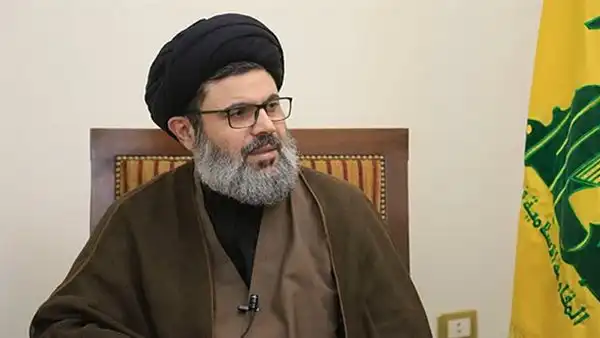
The Israeli army officially announces the assassination of a senior Hezbollah commander

A senior Hezbollah commander, Hashem Safieddine, was killed, Israeli military spokesman Avichay Adraee said on Twitter late Tuesday.


This is the first confirmation of the martyrdom of Safieddine, who was seen as the successor to the group's Secretary-General Hassan Nasrallah, since reports of his being targeted in Israeli strikes on Lebanon.


In early October, heavy Israeli airstrikes hit the southern suburbs of Beirut, and Israeli media reports said at the time that the strike targeted Hashem Safieddine, the potential successor to the late Hezbollah Secretary-General Hassan Nasrallah, who was assassinated by Israel.


At that time, the Israeli occupation army refused to deny or confirm targeting Hezbollah leader Hashem Safieddine.

For its part, Hezbollah did not comment on Safieddine’s fate, and stressed that it announces its positions only through official statements, in response to what it described as “rumors” published by some media outlets about the fate of its leaders after recent Israeli raids on the southern suburbs of Beirut.

ARAB AND WORLD

Wed 23 Oct 2024 8:40 am - Jerusalem Time

Hochstein in Lebanon... Fire when speech stumbles!

Dr. Hassan Marhej: Hochstein's demands contradict Resolution 1701 and aim to force Lebanon to surrender, impose harsh conditions on it, and violate it

Dr. Abdullah Nehme: There is a major diplomatic move to stop the war, but the solution that is sought to be reached is an “agreement from under fire.”

Suleiman Shakirat: Hochstein's visit comes within the framework of managing the American war against Lebanon and Palestine using Israel as a tool

Johnny Mansour: Israel is trying to exploit the current situation as a pressure card on the Lebanese government.. and negotiations may move soon

Tarek Wehbe: Washington leaves the arena open to expand Israeli influence and similar steps may target the occupied Syrian Golan


Yesterday's visit by US envoy Amos Hochstein to Lebanon was not his first since the start of the war, but this time Hochstein brought Israel's demands that it had delivered to Washington, which included its conditions for ending the war, the most prominent of which, according to many reports and informed sources, is "the freedom of Israeli flights in Lebanese airspace, and the freedom to carry out military operations to prevent Hezbollah from rebuilding its military infrastructure in southern Lebanon."


"I" spoke to a number of writers and political analysts to explore the objectives of this visit, especially at this critical time, who indicated that it comes within the framework of diplomatic moves to stop the war, but the solution that is sought to be reached is an "agreement under fire", as the Israeli escalation continues on the Lebanese front, with the aim of pressuring Lebanon to accept the Israeli demands, which are adopted by the American administration, which aim to impose harsh conditions on it and violate its lands by land, air and sea.


A number of analysts who spoke to “Y” considered that the demands carried by Hochstein contradict Security Council Resolution 1701, indicating that the United States is leaving the arena open for Israel to expand its political and military influence in the region, while others saw that Hochstein’s visit to Beirut comes within the framework of managing the American war against Lebanon and Palestine by using Israel as a tool.


last chance attempt


In turn, the expert in Middle East affairs, Dr. Hassan Marhej, said: The visit of the American mediator Amos Hochstein to Lebanon is of particular importance due to its critical timing, as it comes within the framework of a last-chance attempt to achieve a halt to the Israeli aggression on Lebanon before the American presidential elections scheduled for November 5.


He considered that this visit comes before the visit of Lebanese Prime Minister Najib Mikati to Paris to participate in the Lebanon Support Conference on October 24, which will focus on providing direct protection and relief to civilians and supporting the Lebanese army.


Marhej pointed out that this visit was preceded by a statement from the American envoy in which he expressed the United States' desire to amend UN Resolution 1701, after Israel submitted a document of principles to the United States last week, including its conditions for reaching a diplomatic solution to end the war in Lebanon.


He stressed that the demands that Hochstein carried to Lebanon reflect the Israeli demands, which seek to prevent Hezbollah from rearming and preventing it from returning to vital areas in southern Lebanon.


Demands aiming at Lebanon's surrender


He believed that these demands carried by Hochstein aim to force Lebanon to surrender, impose harsh conditions on it, and violate its lands by air, land, and sea, which is something that Lebanon cannot accept, not just Hezbollah.


Despite the war that has been going on for about a month, Marhej stressed that the resistance in Lebanon has not been defeated and is still capable of confronting Israeli attacks, as demonstrated by several incidents, including preventing a comprehensive ground advance and launching missiles and drones, which recently targeted the home of Israeli Prime Minister Benjamin Netanyahu in Caesarea.


Marhej pointed out that Hochstein's demands are in complete contradiction with UN Resolution 1701, and are impossible demands that aim to force official Lebanon and Hezbollah to make concessions.


He pointed out that the military escalation that followed Hochstein's visit reflects the failure of the negotiations and Lebanon's rejection of those demands, adding that the pressures exerted by fire will not be of any use, and that Lebanon, including Hezbollah, will not submit to the American conditions.


Marhej pointed out that the situation in Lebanon this time is different, as Lebanon has nothing to lose, and therefore it must face the challenges to improve its negotiating conditions, instead of submitting to Israeli dictates under the pressure of bombing.


Dangerous escalation in Lebanon amid intense diplomatic moves


Lebanese political analyst Dr. Abdullah Nehme said: "The American envoy Amos Hochstein arrived in Lebanon to hold talks with the Lebanese government regarding the implementation of Resolution 1701, which aims to stop hostilities. The Secretary-General of the Arab League, Ahmed Aboul Gheit, also arrived on a similar visit to discuss the same file."


Nehme confirmed that there is a major diplomatic move to stop the war, but the solution that is sought to be reached is an "agreement under fire", where the military escalation continues until an agreement is reached on American terms, which is rejected by the axis of resistance in Lebanon.


Nehme referred to the "brutal escalation by the Israeli occupation army, where a massacre was committed in Beirut, and the regions of the South, Bekaa and the suburbs witnessed intense and violent raids, with the aim of forcing Lebanon and Hezbollah to accept the Israeli-American conditions. Although President Nabih Berri stated that the atmosphere of the talks was positive but needed some adjustments, Lebanon is today paying the price for those adjustments."


Nehme added: There are major obstacles standing in the way of reaching an agreement, pointing out that the war will not stop before reaching a solution, and that the coming days may witness a dangerous escalation in Lebanon as long as an agreement has not been reached yet, which leaves the future of the escalation dependent on the decisions of the two conflicting parties.


Extracting concessions from Lebanon and weakening the resistance


Jerusalemite political analyst Suleiman Shakirat said: The visit of US envoy Amos Hochstein to Beirut comes within the framework of managing the US war against Lebanon and Palestine using Israel as a tool.


Shakirat explained that the purpose of Hochstein's visit was to test the political situation in Lebanon and assess Lebanon's ability to withstand the destruction and killing caused by the Israeli attacks.


He added that these visits aim to link the air strikes to the rounds of negotiations with the aim of extracting official concessions from the Lebanese side, and deepening the internal divisions between the Lebanese factions in an attempt to weaken the state of popular solidarity around the resistance.


Shakirat pointed out that the United States is trying, through this pressure, to encourage its allies in Lebanon and the West to launch campaigns against the Lebanese resistance, under the pretext that the resistance has played its role in supporting Gaza, and that the time has come to stop the war on Lebanon to avoid further destruction.


Shakirat added: The American tactic depends on intensifying the air strikes on Lebanon after every failure in the rounds of negotiations, with the aim of paving the way for more destruction and killing of civilians, benefiting from previous experiences, such as what happened in Beirut in 2002 when the Palestinian revolutionary forces were deported into exile.


He also referred to the statements of US Secretary of State Anthony Blinken, which carry implications of the seriousness of the American position in finding political solutions, whether in Lebanon or Palestine, and at the same time legitimizing the continuation of aggression with the aim of widening internal divisions and weakening the resistance.


The ultimate goal, according to Shakirat, is to try to force the Lebanese resistance to cease fire in Lebanon separately from Gaza, unless it changes its position.


Israeli demands towards Lebanon are considered to be very high


Johnny Mansour, a historian and researcher in Middle Eastern affairs, said that the Israeli demands conveyed by the American mediator Amos Hochstein to the Lebanese government include two basic points: the first relates to Israel’s control over Lebanese airspace to exploit it for military purposes and monitor the airspace, and the second relates to Israel’s supervision of the implementation of international resolution 1701 regarding Lebanon.


He pointed out that these demands come under complex circumstances and are considered to have a very high ceiling.


He explained that Israel is trying to exploit the situation as a pressure card on the Lebanese government, as well as on the Arab parties that have begun to move to pressure for reaching a truce that prevents the escalation of military tensions in the region, which could lead to a wider regional war.


Mansour stressed that the Lebanese government, Hezbollah, the Amal Movement and other political parties in Lebanon will not accept these Israeli demands.


He expected that this escalation would lead to a lowering of the ceiling of Israeli demands, with the continuation of the bickering and evasions, whether from the Israeli or American side.


Negotiations will move soon to stop the escalation in Lebanon


Historian and researcher Mansour pointed out that diplomatic negotiations will soon move forward with the aim of stopping the Israeli escalation in Lebanon after the massive destruction that affected many areas, especially in Beirut. He pointed out that there are Israeli attempts to copy military methods previously used in Gaza, such as accusing hospitals of having tunnels underneath them containing weapons and money.


Mansour pointed out that Israel seeks to achieve several goals, including removing Hezbollah from the southern region adjacent to the border with Israel and up to the Litani River, and restructuring the international forces (UNIFIL) to play a greater role in monitoring the situation there. It also seeks to enhance the deployment of the Lebanese army under indirect international or Arab supervision.


Resolution 1701 is no longer sufficient to ensure stability in the region


Researcher and political analyst in international relations, Tariq Wahbi, confirmed that Hochstein's visit to Lebanon came within the framework of American pressure on the Lebanese government to abide by Resolution 1701, with reference to the possibility of adding new protocols to strengthen this resolution. However, Lebanese Parliament Speaker Nabih Berri, who also heads the Amal Movement and is one of the poles of the Shiite duo in Lebanon, rejected these pressures, stressing that this matter requires a vote in the Security Council.


Wahbi pointed out that Resolution 1701, which was adopted in the wake of the 2006 Lebanon war, is no longer sufficient to ensure stability in the region in light of the current developments in 2024.


He added that there is a need to activate the role of the Lebanese army and security forces to control the borders and prevent the entry of illegal weapons into southern Lebanon.


Wehbe also highlighted the conference scheduled to be held in Paris on the 24th of this month, which aims to support the Lebanese army to enable it to implement Resolution 1701 more effectively, especially with regard to monitoring the borders and illegal crossings between Lebanon and Syria.


Speaking about the American political scene, Wahbi explained that the current American administration led by President Joe Biden, who is described as a “manager” in the absence of a president capable of making decisive decisions, is leaving the field open for Israel to expand its military and political influence in the region. This reality explains why Israeli Prime Minister Benjamin Netanyahu continues his military operations, whether in Gaza, Lebanon, Syria, or even Yemen and Iraq, amid a clear absence of effective international responses.


Wahbi pointed out that the current situation may push Israel to expand the scope of its military operations in Lebanon with the aim of "cleaning up" the areas it believes are a source of rocket fire towards Israel.


He also expressed his fears that Israel might take similar steps in the occupied Syrian Golan, where large military forces of up to 35,000 soldiers are present.


Despite the difficulties facing Hezbollah and other resistance forces in Lebanon, Wahbi believes that the battle remains unequal, unless the Lebanese resistance is able to surprise the world with its capabilities, as the Palestinian resistance did recently in Gaza.

OPINIONS

Wed 23 Oct 2024 8:40 am - Jerusalem Time

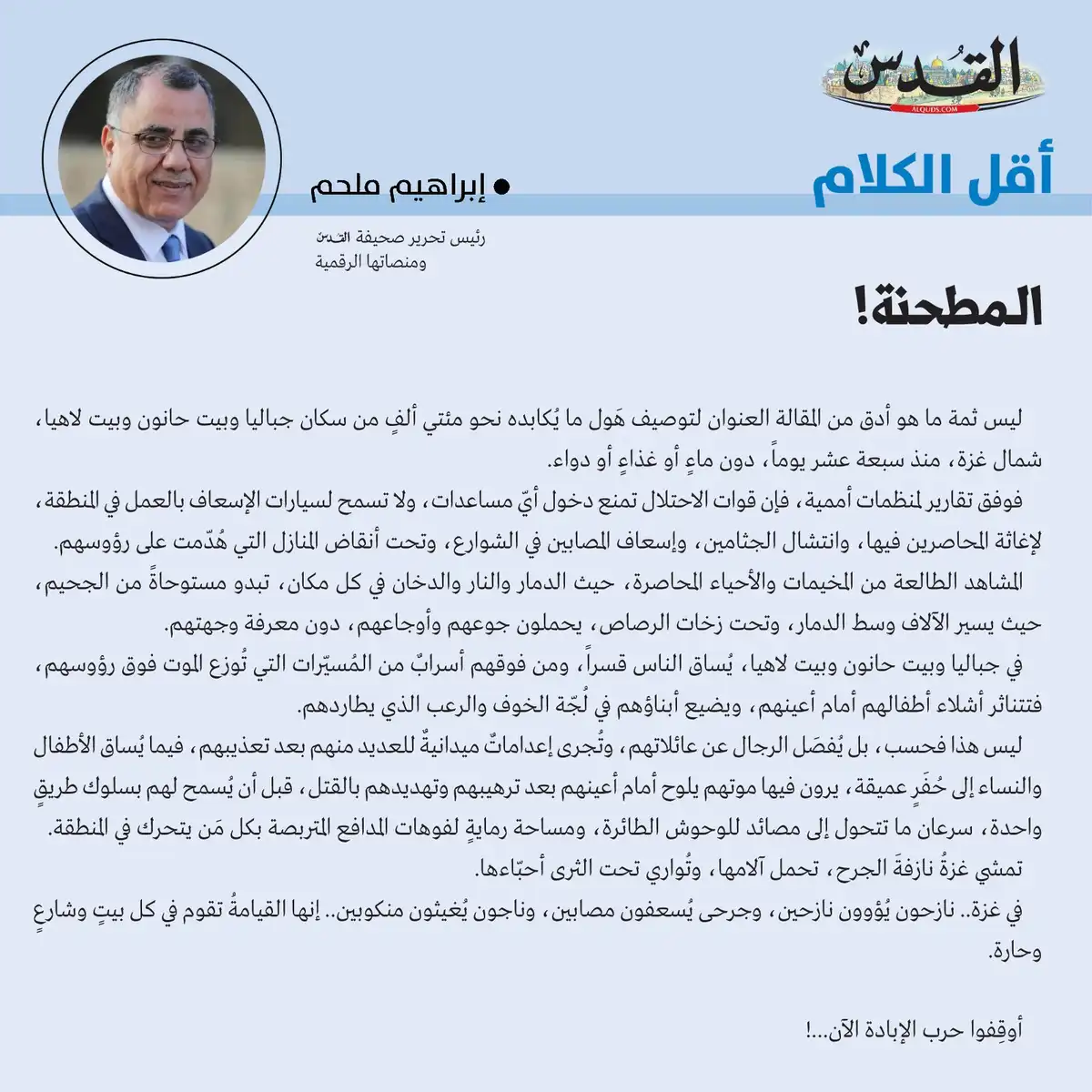
The mill!

Ibrahim Melhem

Ibrahim Melhem

Opinion Writer

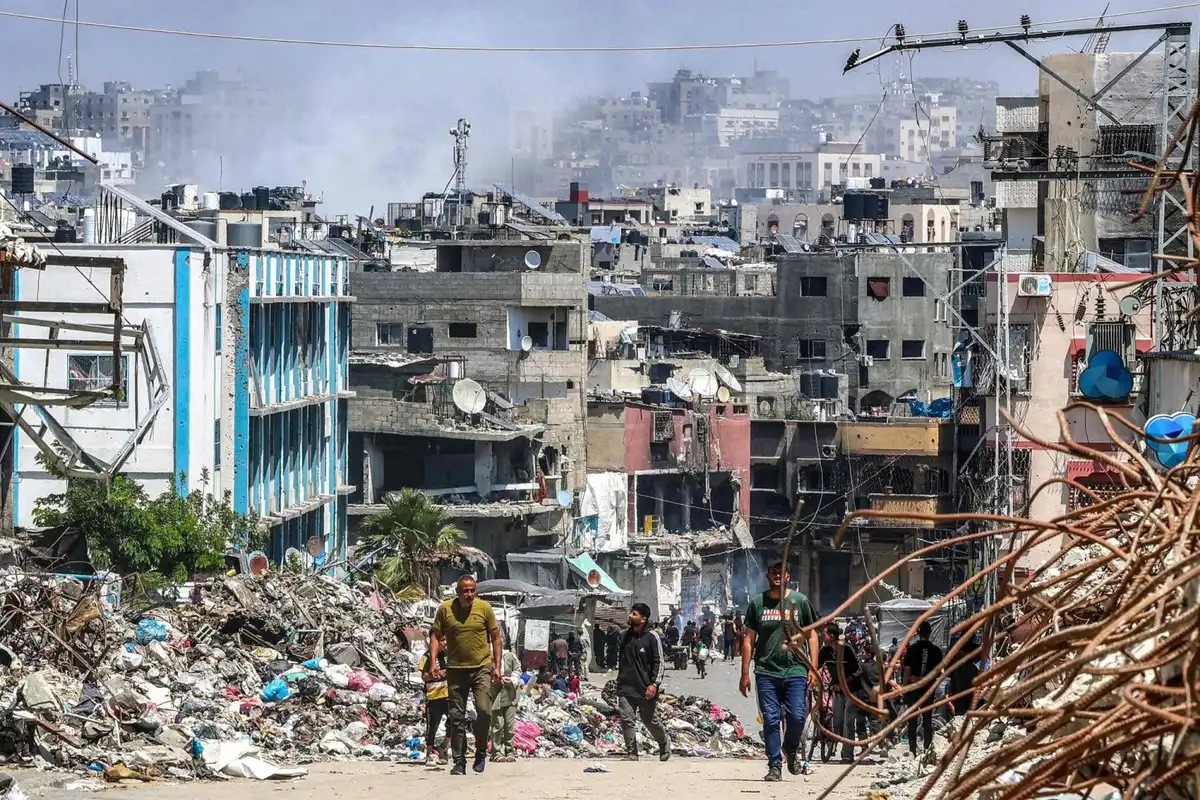
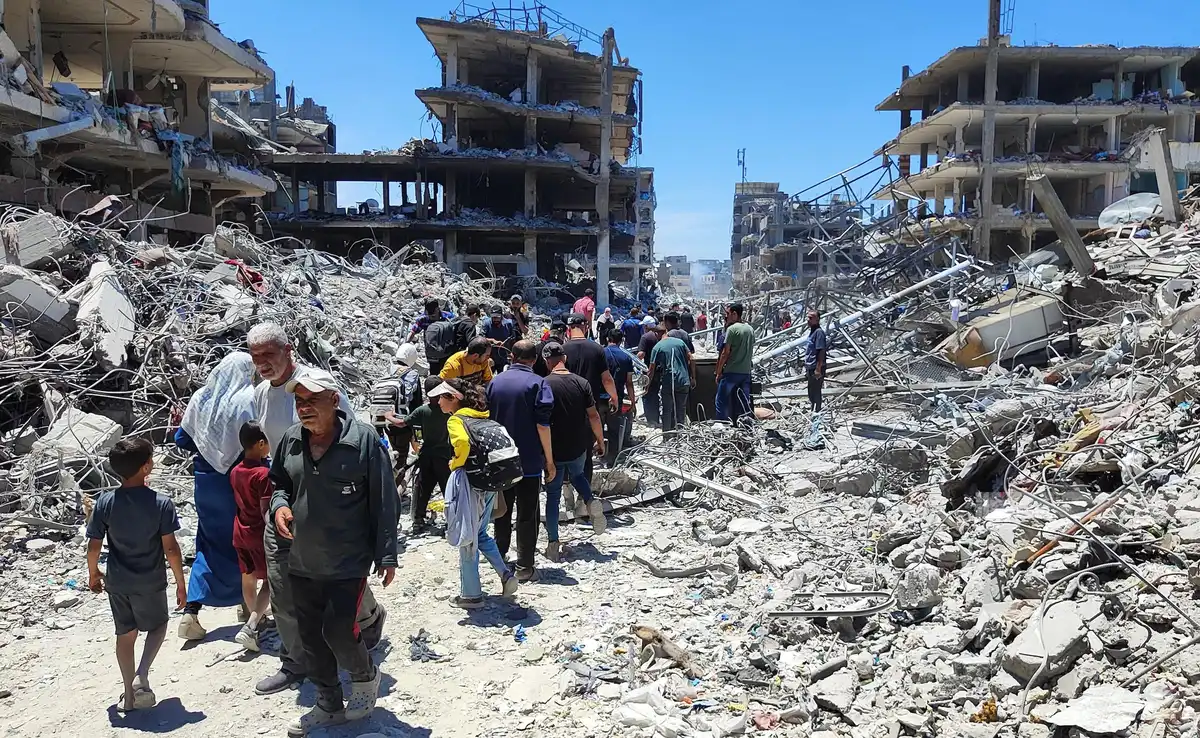
There is nothing more accurate than the title of the article to describe the horror of what nearly two hundred thousand residents of Jabalia, Beit Hanoun and Beit Lahia, north of Gaza, have been suffering for seventeen days, without water, food or medicine.

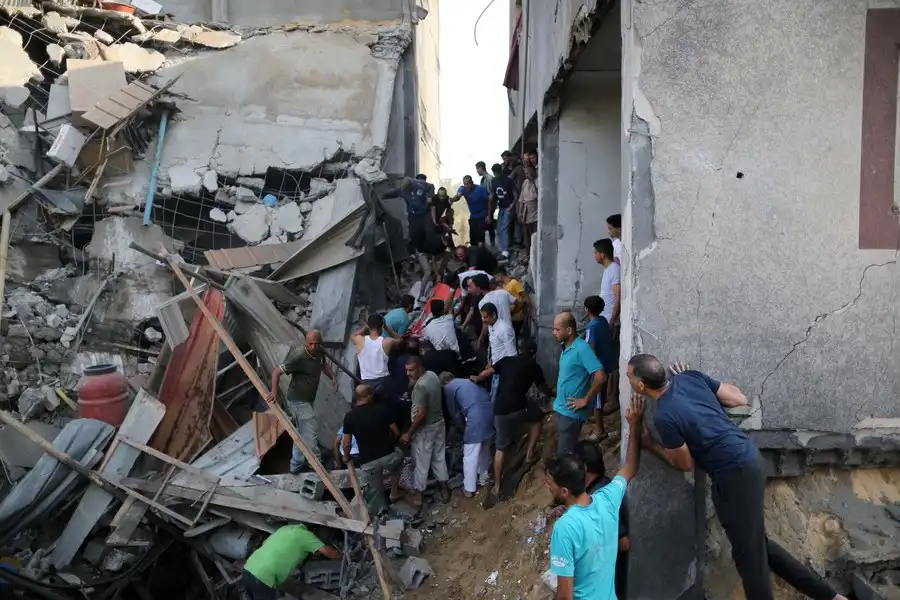
According to reports from international organizations, the occupation forces are preventing the entry of any aid, and are not allowing ambulances to operate in the area to help those trapped there, retrieve bodies, and treat the injured in the streets and under the rubble of homes that were demolished on their heads.

The scenes emerging from the camps and besieged neighborhoods, where destruction, fire and smoke are everywhere, seem inspired by hell, as thousands walk amidst the destruction, under a shower of bullets, carrying their hunger and pain, without knowing their destination.

In Jabalia, Beit Hanoun and Beit Lahia, people are being forcibly driven away, with swarms of drones distributing death over their heads. The remains of their children are scattered before their eyes, and their sons are lost in the abyss of fear and terror that haunts them.

Not only that, but men are separated from their families, and many of them are executed in the field after being tortured, while children and women are led into deep pits, where they see their death looming before their eyes after being terrorized and threatened with death, before they are allowed to take one road, which quickly turns into traps for flying monsters, and a shooting range for the muzzles of the cannons lying in wait for anyone who moves in the area.

Gaza walks bleeding, carrying its pain and burying its loved ones.

In Gaza, displaced people shelter displaced people, wounded people treat injured people, and survivors help the afflicted. It is the resurrection taking place in every house, street, and neighborhood.


ARAB AND WORLD

Wed 23 Oct 2024 8:38 am - Jerusalem Time

Blinken: I discussed with Israel delivering aid to Gaza and ending the war

The Washington Post quoted an American official on Wednesday as saying that Washington informed Tel Aviv that there is a belief that Israel is seeking to isolate northern Gaza, while US Secretary of State Anthony Blinken said that he discussed with the Israelis charting the path to peace and the importance of delivering aid to the Strip and ending the war.


The Washington Post reported, quoting a US State Department official, that Washington informed Israeli Prime Minister Benjamin Netanyahu that there is a belief that Israel is seeking to isolate northern Gaza, and that the US administration believes that Israel's strategy is to threaten the residents of northern Gaza that they will become targets.


The newspaper pointed out that Washington asked Netanyahu to declare his position, "but he refused to make this commitment," as he and his main aide responded that this was not their policy at all, according to the newspaper.


Blinken's meetings


Blinken said that he discussed with Netanyahu "charting the path to lasting peace and security for both Israelis and Palestinians," stressing that he stressed in Israel the importance of delivering aid to Gaza and ending the war in a way that provides lasting security and stability.

CNN quoted a senior US administration official as saying that Blinken directly asked Netanyahu whether he was adopting a plan to kill and starve in Gaza, noting that Netanyahu pledged to Blinken that his government would not adopt what is known as the "generals' plan."

The US State Department also said that Secretary Blinken discussed with Israeli President Isaac Herzog ongoing efforts to calm tensions in the region, noting that Blinken "stressed the importance of ending the war in a way that ensures the release of the hostages and creates conditions for broader regional stability."


For its part, the Israeli Broadcasting Corporation reported that Anthony Blinken "told the families of the hostages that work was underway to conclude a limited deal to test the existence of another party to negotiate," while Haaretz newspaper said that "the families of American hostages in Gaza met with Blinken and called on him to pressure for the release of their sons."

This comes after US Secretary of State Anthony Blinken arrived in Tel Aviv yesterday, Tuesday, on his 11th visit since the outbreak of the Israeli war on Gaza, at a time when there are continuing demands within Israel for the government to conclude a deal to return prisoners from the Gaza Strip.

Source: Al Jazeera + American press + Israeli press


PALESTINE

Wed 23 Oct 2024 8:31 am - Jerusalem Time

Three people, including two children, were killed in an Israeli airstrike on Gaza, and the bombing of the northern Gaza Strip continues.

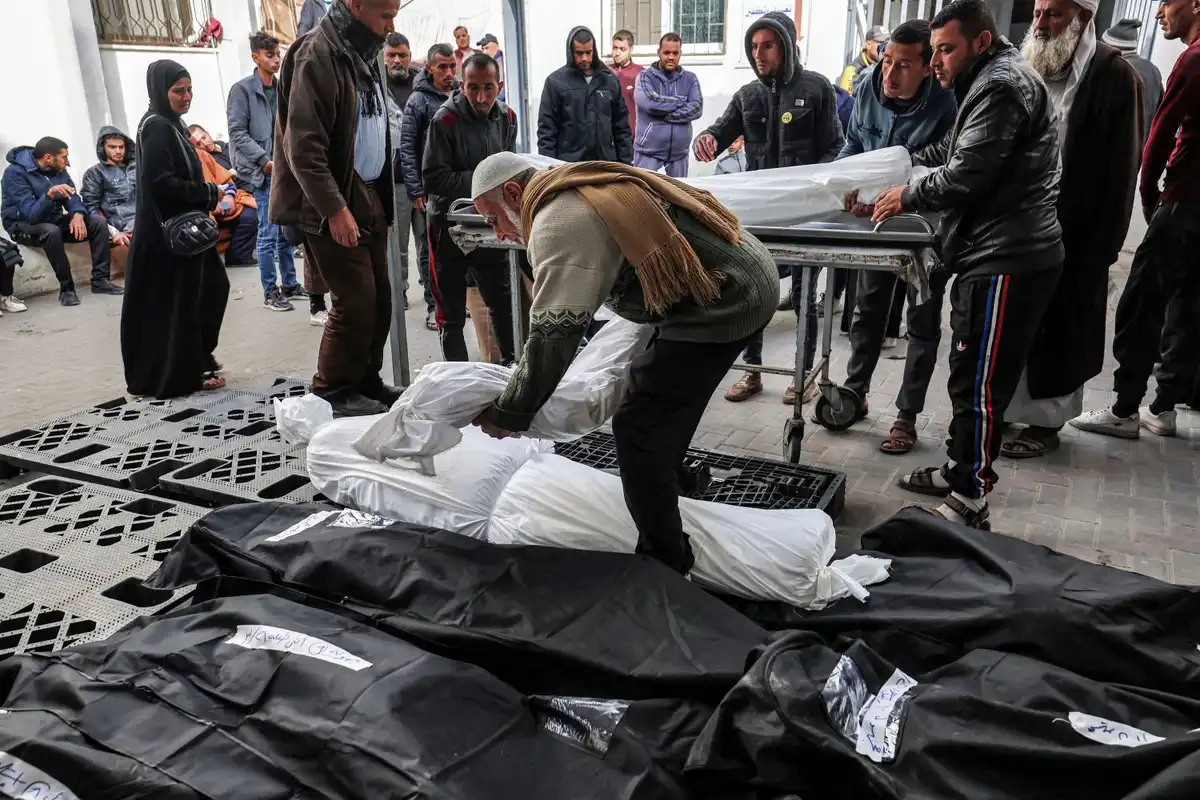
Three citizens, including two children and their mother, were killed and six others were injured in an Israeli missile strike that targeted the Halawa family home in the Zarqa area north of Gaza City, at dawn on Wednesday. The wounded and martyrs were transferred to the Baptist Hospital in the city.


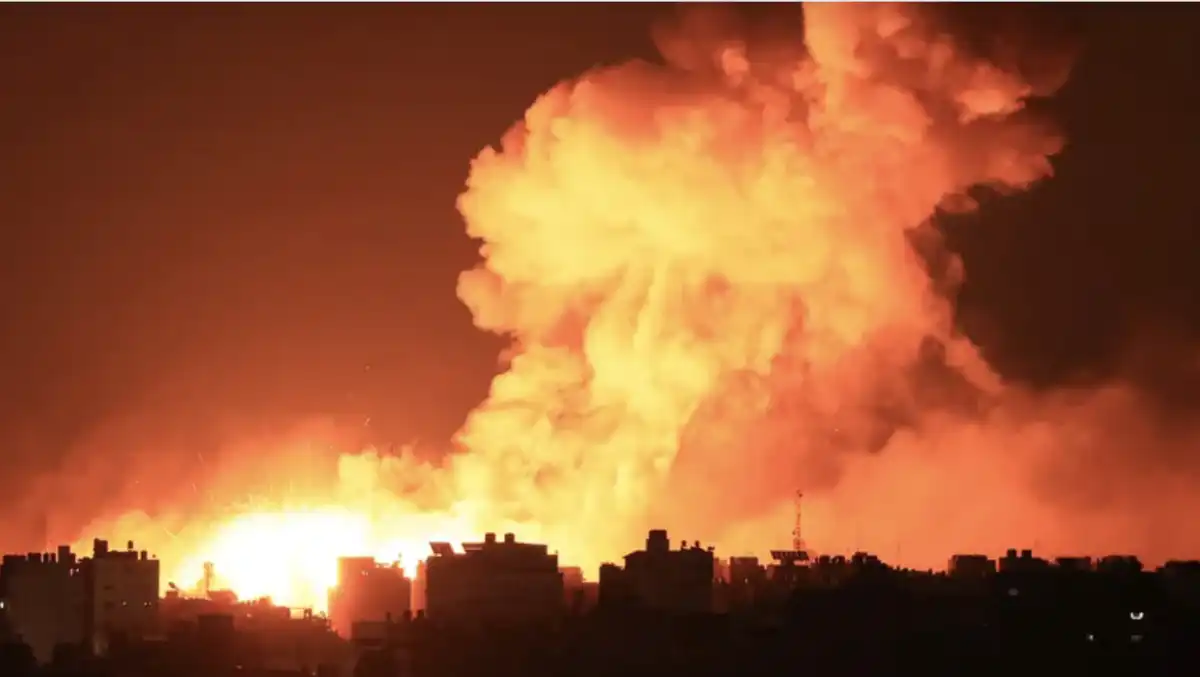
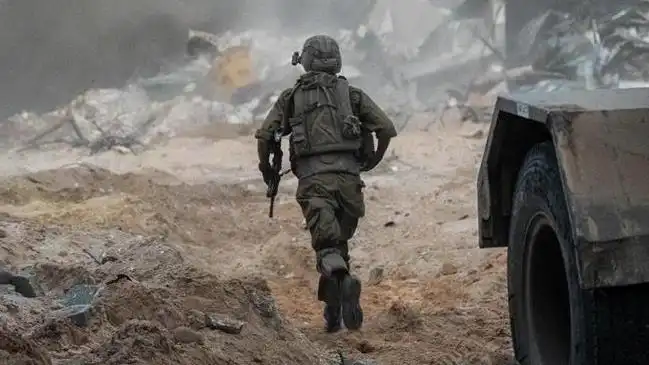
In a related context, Israeli warplanes launched violent raids on the neighborhoods of Jabalia camp and Beit Lahia project in the northern Gaza Strip, coinciding with intensive artillery shelling targeting populated areas, which led to the destruction of a number of homes and terrorizing civilians.


This escalation comes within the framework of the ongoing Israeli aggression on the Gaza Strip since October 7, 2023, where the death toll has so far reached 42,718 citizens, and 100,282 others have been injured, in an incomplete toll with thousands of missing people under the rubble.

PALESTINE

Tue 22 Oct 2024 10:13 pm - Jerusalem Time

War on Gaza:7 deaths as a result of Israeli bombing that targeted a school sheltering displaced people in Beit Lahia

Seven citizens were killed on Tuesday evening in an Israeli bombing that targeted a school housing displaced people in Beit Lahia, north of the Gaza Strip.


Local sources reported that the occupation artillery shelled the Zaid bin Haritha School, which shelters displaced people in Beit Lahia, killing seven citizens and wounding others.


For the eighteenth consecutive day, the occupation continues to besiege the northern Gaza Strip, destroy and bomb homes, prevent the entry of food supplies, and force citizens to flee.


The occupation forces continue their aggression on the Gaza Strip, by land, sea and air, since October 7, 2023, which resulted in the death of 42,718 citizens and the injury of 100,282 others, the majority of whom are children and women, in an incomplete toll, as thousands of people are still missing under the rubble.

PALESTINE

Tue 22 Oct 2024 9:25 pm - Jerusalem Time

President Abbas arrives in Kazan to attend BRICS summit

Palestinian President Mahmoud Abbas arrived in Kazan, the capital of the Republic of Tatarstan, on Tuesday evening, to attend the BRICS summit, at the invitation of Russian President Vladimir Putin.


The President is accompanied by: Secretary of the Executive Committee of the Palestine Liberation Organization Hussein Al-Sheikh, Chief Justice of Palestine, Advisor to the President for Religious Affairs and Islamic Relations Mahmoud Al-Habbash, Advisor to the President for Diplomatic Affairs Majdi Al-Khalidi, and the Palestinian Ambassador to Russia Abdul Hafeez Nofal.


Kazan will host the 16th BRICS Summit over three days, with the participation of about 40 countries, 24 of which will be represented by their leaders, while 8 countries will be represented by high-level officials. The UN Secretary-General Antonio Guterres is also scheduled to participate in the summit, and the main topic of the summit is "Strengthening multilateralism for fair global development and security."


This is the first summit after 5 new countries joined the BRICS group in 2024, and the group summit will continue for 3 days until next Thursday (October 24, 2024).


Russia chairs the BRICS group this year and during this period Moscow has set three priorities: politics and security, cooperation in the economy and finance, and humanitarian and cultural exchanges. It has also organized more than 200 political, economic and social events to promote ways to implement further cooperation among the BRICS countries.


PALESTINE

Tue 22 Oct 2024 9:13 pm - Jerusalem Time

A distress call to save two million displaced people in Gaza before winter

Recently, the world's attention has been drawn to the rapid expansion of the war front between Israel and Lebanon, coinciding with the first anniversary of the Israeli war on Gaza. In light of these developments, the world is preparing to receive the cold and rainy winter. Markets are crowded with buyers seeking to buy warm clothes and waterproof shoes, in addition to preparing heating devices for their homes. For their part, municipalities are working to maintain rainwater drainage and sewage networks to avoid road closures or the spread of epidemics resulting from the accumulation of shallow water.


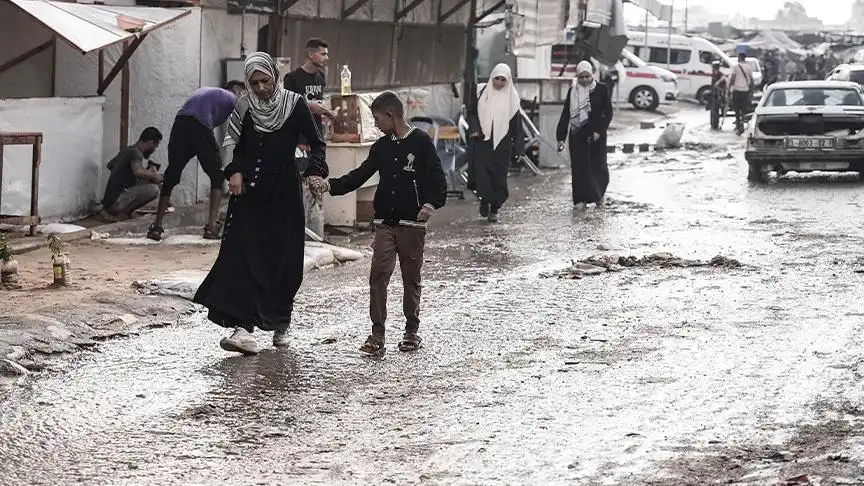
However, in Gaza, the conditions are completely different. The residents of the Strip, most of whom are displaced, live in dilapidated tents that are uninhabitable or in overcrowded shelters that lack the most basic necessities of life. In these harsh conditions, electricity and water have become luxuries that they cannot obtain, while cooking with gas or providing heating has become a distant dream. The displaced in Gaza are looking for suitable tents to protect them from the summer heat and the winter cold, and for basic sources of food and water to ensure their survival.


In this context, the Government Media Office in Gaza launched an urgent humanitarian distress call to save more than two million displaced people from the dangers of winter. It pointed out that 100,000 tents out of 135,000 have become unusable due to their deterioration. The Ministry of Social Development also warned of the risk of death of thousands of children, the elderly and the sick due to the severe cold and the lack of heating and basic medicines. Concerns are also growing about the spread of epidemics due to the accumulation of waste, sewage and rain.


Since the beginning of the war on Gaza on October 7, 2023, Israeli forces have destroyed approximately 165,000 meters of sewage and storm water drainage networks, in addition to almost completely destroying road networks and all municipal machinery. As a result, municipalities and government agencies find themselves unable to meet the needs of the population, especially in light of the ongoing blockade.


Despite these challenges, Gaza Municipality workers, in cooperation with citizens and international organizations, continue their efforts to clean up the remaining sewage networks to mitigate the expected disaster as the rains intensify and temperatures drop in the coming days. Gazans remain hopeful that an agreement will be reached that will do justice to their cause and return them to a life free from the smell of death and destruction.

ARAB AND WORLD

Tue 22 Oct 2024 8:32 pm - Jerusalem Time

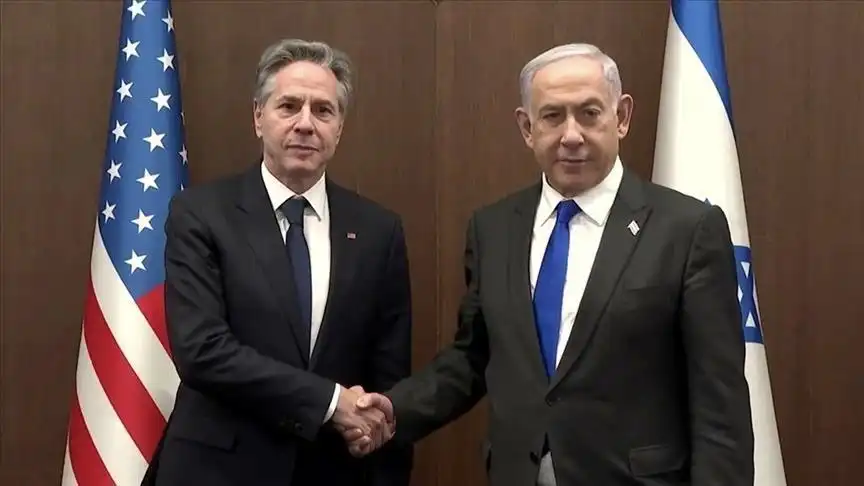
Netanyahu and Blinken discuss plans for 'day after' Gaza war

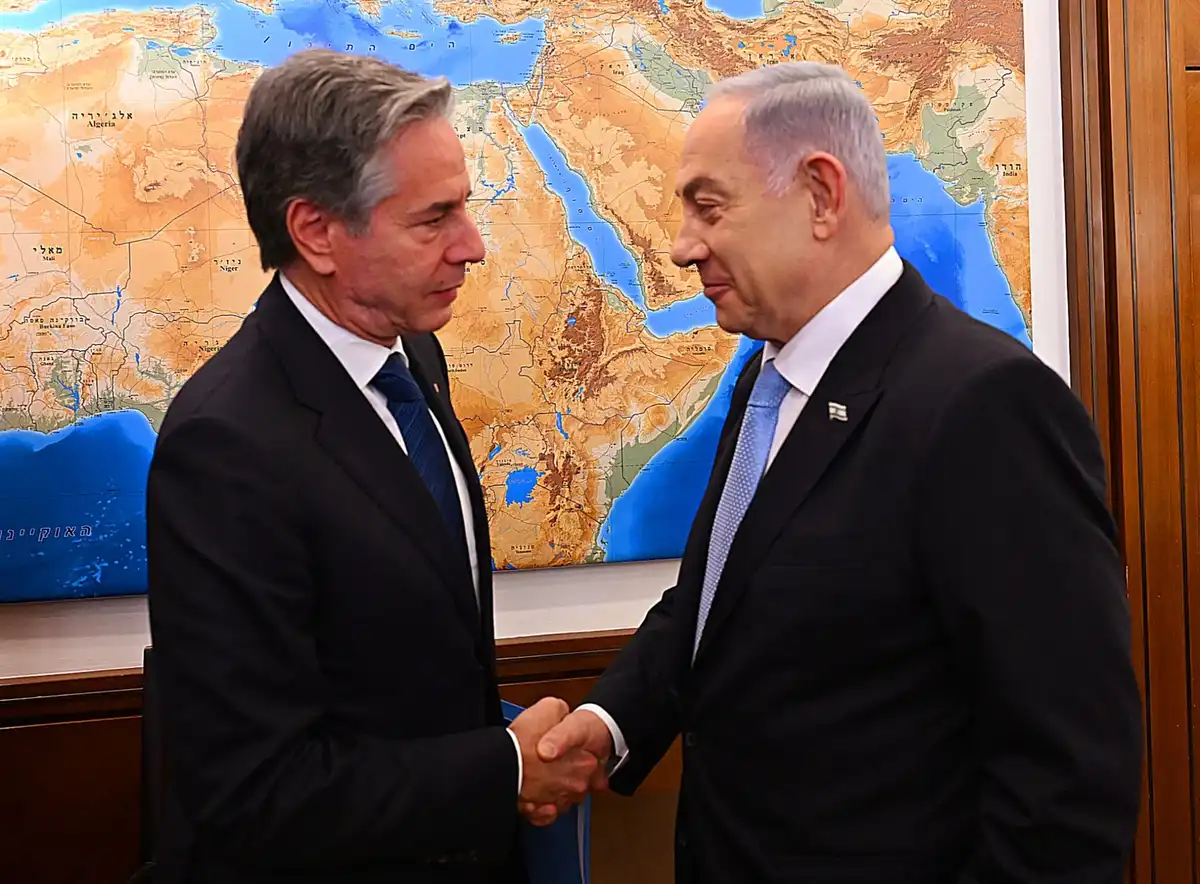
US Secretary of State Antony Blinken and Israeli Prime Minister Benjamin Netanyahu discussed working together to confront what their countries describe as the "Iranian threat," as well as plans for "the form of governance in the Gaza Strip" the day after the end of the aggression.


Talk of these discussions comes at a time when Israel, with absolute American support, is insisting on continuing the genocide in Gaza and proceeding with plans to occupy its north and other areas of the Strip.


Netanyahu's office said the latter met with Blinken in his office in Jerusalem shortly after the latter's arrival in Israel today.


The office said in a statement that Netanyahu and Blinken's meeting lasted about two and a half hours and was "friendly and fruitful."


Following this bilateral meeting, the American and Israeli sides held an expanded meeting with the participation of the working groups, and the presidency of Netanyahu and Blinken.


According to the same statement, "the issue of the Iranian threat was raised during the meeting, and the necessity of the two countries joining forces to confront it."


Netanyahu thanked Blinken for the US support for Israel in what he claimed was a war against the "axis of evil and Iranian terrorism."

ARAB AND WORLD

Tue 22 Oct 2024 8:03 pm - Jerusalem Time

Israeli soldier killed, 3 'seriously' injured in southern Lebanon fighting

The Israeli occupation army announced, on Tuesday evening, the death of one of its soldiers and the serious injury of three others during battles in southern Lebanon.


The army said in a statement published on its account on the "X" platform that the soldier (reserve) "Sa'ar Eliad Navarsky" (27 years old), from Tel Aviv, a fighter in the 508th Battalion, Brigade (7338) "Adirim" (artillery), was killed during the fighting in the north.


"In the incident in which Norski fell, three reserve soldiers from the 508th Battalion were seriously injured," he added.


He continued: "The soldiers were evacuated to receive treatment in hospitals, and their families were informed," according to the same source.


Earlier on Tuesday, the Israeli army announced the death of one of its soldiers from the Nahal Brigade in an "operational incident" near the Gaza Strip border.


He added at the time in the same statement: "Today, a reserve soldier from the 9203rd Battalion of the Alexandroni Brigade (3) was seriously injured during a battle in southern Lebanon. The fighter was transferred to the hospital to receive medical treatment, and his family was notified."


Also on Tuesday, the Hebrew newspaper "Israel Hayom" said that 16 Israeli soldiers were injured in battles in southern Lebanon today and were evacuated to Ziv Hospital in Safed in the Upper Galilee.


The announced death toll of the Israeli army since the beginning of the war has reached 751 officers and soldiers, including 356 since the beginning of the ground invasion of the Gaza Strip on October 27, 2023, according to the latest update published by the army's official website.


The total number of injured reached 5,043 officers and soldiers, including 2,362 since the ground invasion of the Gaza Strip.

PALESTINE

Tue 22 Oct 2024 7:21 pm - Jerusalem Time

A child dies of wounds sustained by the occupation forces in Nablus

A child died, Tuesday evening, by Israeli occupation forces in the city of Nablus.


The Ministry of Health reported the death of the child Abdullah Jamal Hawash (11 years old) as a result of being shot by the occupation forces in Nablus.


According to local sources, the child Hawash was shot in the chest by the occupation soldiers as they withdrew from the city, after arresting the young man Nasser Nashat Anati from the Old City. He was subsequently transferred to the hospital, where doctors declared him dead.


This evening, Israeli special forces stormed the old town of Nablus, specifically the Al-Qaryoun neighborhood, amidst the firing of smoke bombs, and arrested the young man Al-Anati, while the occupation sent military reinforcements to the old town.


With the martyrdom of the child Hawash, the death toll in the West Bank rises to 760 martyrs, including 18 women and 166 children.


PALESTINE

Tue 22 Oct 2024 5:27 pm - Jerusalem Time

The Generals' Plan Maker: 4 Reasons Why Israel's War in Gaza Must End

Former Israeli National Security Council Chief Giora Eiland stressed the need to stop the war on the Gaza Strip now, warning that its continuation will not change the reality there, and will lead to the death of all prisoners and the killing of more soldiers.


Eiland considered, in an article published in the Israeli newspaper Yedioth Ahronoth, that continuing the war for another year will not achieve any achievements for Israel, and will not bring any strategic benefit, while "human losses among Israeli soldiers and hostages will escalate without a fundamental change in the equation of the conflict."


He said, "If we continue fighting in Gaza for another 6 months, or a year, it will not change the reality there. Only two things will happen: all the detainees will die and more soldiers will be killed."


Despite his claim that it is possible to try to improve the terms of the deal, especially with regard to the number of Palestinians who will be released in exchange for each living Israeli prisoner, he stressed that "there is no need to insist on nonsense, especially not on the Philadelphi Corridor."


This is in reference to the position of the Israeli Prime Minister Benjamin Netanyahu's government, which refuses to withdraw from this axis with the borders on Egypt in any deal reached with the Islamic Resistance Movement (Hamas).


Reasons for stopping the war

In his article, Eiland presented 4 reasons that he believes are strong and push for the need to stop the war in Gaza immediately, considering that the most important reason is that "human losses have become greater than any possible gains."


He also highlighted the new variable in Israeli society, saying, "In the past, the Israeli people felt great sadness for every soldier killed in battle, but this feeling has turned into a kind of cruelty and indifference, as society no longer cries for soldiers as it did in the past."


He added, "Our hearts have become cruel to the death of soldiers, our best sons, and soldiers are not only exposed to killing, but many soldiers suffer physical and psychological injuries that affect their entire lives, such as the loss of limbs or sight, which completely destroys their future."


The Israeli general also pointed to another reason, which is the enormous pressure on the soldiers, especially the reservists, who he said "suffer from complex economic and family circumstances, which make the continuation of the war an unbearable burden."


In addition, the Israeli general believes that the economic cost of the war makes its continuation unfeasible. According to Eiland, about half a billion shekels ($132.3 million) are spent every day of fighting, which burdens the Israeli economy.


He says that although the Lebanese front is currently receiving the greatest focus, the drain on resources in Gaza will cast a heavy shadow on the economy in the near future.


Eiland adds another reason lies in the international position demanding an end to the operations in Gaza. He says that "the fight against Hezbollah in Lebanon is more understood, but the world does not understand what we want to achieve in Gaza, and this puts Israel in diplomatic isolation."


Priority for the prisoners

On the other hand, Eiland believes that any agreement with Hamas should have the sole goal of freeing the detainees, without demanding any additional concessions from Hamas, but he believes that the real battle is with regional parties, such as the United States, Egypt and Qatar, which he calls for pressure to ensure that Gaza is not rebuilt unless Hamas disarms.


He said, “Gaza is completely destroyed. Hamas will not be able to rebuild its strength unless there is a massive reconstruction project. We will not allow this without a mechanism that systematically destroys what remains of the military infrastructure.”


Eiland claims that “there is a potential disappointment among the residents of Gaza toward Hamas, but this popular rebellion will not happen as long as the war continues, and as long as Israeli forces are present in the Gaza Strip,” noting that “prolonging military operations will lead to continued suffering of the population and renewed hostilities.”


The Israeli general was keen to emphasize the statement that “a war aimed at removing a threat is necessary and justifies the high costs involved, but this is not the situation in Gaza.”


Eiland blamed the Israeli government, saying: "Unfortunately, the Israeli government does not follow this logic, and does not even meet to discuss the choice between two alternatives: continuing the war in Gaza until the final victory, or preparing to end the war in Gaza in exchange for the return of all the detainees." 

Source: Yedioth Ahronoth + Al Jazeera

OPINIONS

Tue 22 Oct 2024 5:10 pm - Jerusalem Time

Analysis | Hamas Lost Its Senior Leadership, but Palestinians in Gaza Still Don't See an Alternative

Haaretz

Haaretz

Opinion Writer


Residents agree that only an internal Palestinian agreement will decide who controls Gaza, but with both Hamas and the PA in deep distress, it will either be impossible to reach an agreement or impossible to implement one. In practice, the party controlling everything right now is Israel


Jack Khoury


Last week's killing of Hamas leader Yahya Sinwar raises questions about the future of the organization's control of the Gaza Strip and to what extent it still has this capability.

Hamas supporters in Gaza agree that Sinwar's assassination in itself isn't a reason for Hamas to lose control of the territory. But this is just one of many killings of members of Hamas' political and military chains of command, on a scale unprecedented since the organization seized control of Gaza in 2007.

Palestinian supporters of Hamas in Gaza, the West Bank and elsewhere said in conversations with Haaretz that Hamas' military and political wings both have considerable experience with assassinations and damage to their infrastructure, as this has happened many times over the years. Yet each time, the organization has been able to recover, replace slain leaders and commanders and beef up its mechanisms of administrative and military control.

Gazans divided after Hamas chief Sinwar's death, hoping for leader who'll end suffering

Israel is killing us. But Hamas is exploiting our deaths

End the war, bring the hostages home

Nevertheless, they added, the scale of the events of the past year in every field raises questions about what comes next.

Gazans who aren't Hamas supporters still have trouble identifying any other player that could control the territory, unless the various Palestinian parties agree on such a government. A former senior Palestinian Authority official who was ousted from his position in Gaza after Hamas took power in 2007 said that despite what has happened over the last year, Hamas is still paying salaries to its own government officials, even if they are only partial or belated.

Over the years, he continued, Hamas has managed to fill a great many positions with people who aren't its own members, but are merely bureaucrats, in some cases professionals. Consequently, he said, Gaza's administrative spine will remain in place in any case. That is true in medicine, education and many other fields, even policing.

"The question now, to which there is no answer, is how well this system will be able to function on the day a cease-fire is declared," he added. "Nobody knows."

A senior official in Hamas' political wing told Haaretz that Hamas now has several options. It can resume functioning as an underground while attempting to repair its military apparatus and transferring the movement's leadership overseas. Alternatively, it can try to restore its position in Gaza. But Israel will try to prevent that at any price, so it isn't clear how things will develop, he added.


At the leadership level, this official said, Sinwar's assassination isn't the main problem. Hamas can deal with that just as it has dealt with assassinations in the past, and it still has a functioning political leadership overseas. It also still has thousands of fighters in Gaza. And more importantly, many more Gazans still identify with its path of resistance.

What Israel doesn't understand, he continued, is that if it doesn't offer the Palestinians a realistic political horizon, there is no option other than resistance. And in that case, Hamas remains the most significant resistance organization.

"I hope Israel won't make the mistake made by the Americans in Iraq," he said. "They came, they occupied, they destroyed the regime, and then tens of thousands of bureaucrats became members of the Islamic State or all kinds of other militias that no one controls. That's what will happen in Gaza if there is no orderly plan."

"In the end, only an internal Palestinian agreement will decide who controls Gaza," he added. "And Hamas will have to be a party to any such agreement."

Nevertheless, some Gazans voiced great skepticism about Hamas' ability to regain exclusive control.


"In the media, everyone is looking at Sinwar's killing," said a Gaza resident who used to work in one of Hamas' financial institutions. "But in practice, the significant damage is the damage to its financial and economic infrastructure. The moneychangers and merchants who were the organization's main donors have been wounded or killed or lost their source of income."

At this stage, he said, nobody knows to what extent Hamas has replacements for them or who will provide its economic infrastructure going forward. Today, Hamas is still giving money to its own members and its bureaucrats but isn't financing services in Gaza. Consequently, for now, it is still managing to survive.

The question, he added, is what will happen once the war ends and who will fill the vacuum – "Israel, the PA, Arab states in some format or other, no one knows."

Researchers who study Palestinian society, including Hamas, said that every past agreement between the Palestinian Authority and Hamas included an agreement in principle on either joint administration or technocratic administration of both Gaza and the West Bank. But there was never any progress beyond that, because neither side was willing to give up the control it had – Hamas in Gaza and the PA in the West Bank.

Now, both of them are in deep distress, the researchers added. But absent a clear plan with an Arab and international umbrella, it will either be impossible to reach agreements or impossible to implement them, because in practice, the party controlling everything right now is Israel. Thus, as long as there has been no announcement of the end of the war and of what Israel and America plan, it's impossible to know where things are headed, they concluded.


OPINIONS

Tue 22 Oct 2024 5:08 pm - Jerusalem Time

Netanyahu said Israel won't resettle Gaza. His own ministers tell a different story

Haaretz

Haaretz

Opinion Writer

Rachel Fink

It might have been possible to dismiss the 'Preparing to Resettle Gaza' conference as the collective rantings of a fringe group of extremists with no actual power to affect policy, were it not for one thing: the lineup of speakers


Israel's far-right National Security Minister Itamar Ben-Gvir dancing at the conference calling for Jewish resettlement of the Gaza Strip, near the Israeli-Gaza border, southern Israel, on Monday.

On Monday morning, hundreds of settlement-supporting Israelis, many with their gaggle of young children in tow, headed down to the southern border for a special Sukkot-themed celebration. Over two days, they gathered in temporary huts to discuss permanent resettlement. Of the Gaza Strip, that is. "Every single sliver of it," as one speaker declared.

Hers was just one of a slew of comments jockeying for the title of most incendiary statement made during the event. "We will sun ourselves on the sandy beaches of the Gazan coastline," another contender proclaimed. Conference organizer Daniella Weiss has bigger plans. "We know from the Bible that the real borders of Greater Israel are the Euphrates and the Nile," she said to the audience, who cheered enthusiastically. "And the sooner we make this a reality, the better."

The "from the river to the sea" crowd has nothing on Weiss, who vowed to make her messianic dreams come true within the next year. "You will see," she told a group of slightly bewildered foreign journalists. "Jews will go into Gaza and Arabs will disappear from Gaza."

It might have been possible to dismiss the entire event as just the collective rantings of a fringe group of extremists with no actual power to affect policy, were it not for one thing: the lineup of speakers. Because, one by one, some of Israel's most prominent politicians made their way to the stage to express support for resettlement.

"We have to speak to them in the only language they understand," said Likud MK Tally Gotliv, "Taking their land away from them."

"We will hit them where it hurts," her fellow party member May Golan threatened. "Anyone who uses their plot of land to plan another Holocaust will receive from us, with God's help, another Nakba that they will tell their children and their grandchildren about for the next 50 years."

National Security Minister Itamar Ben-Gvir. Finance Minister Bezalel Smotrich. Negev and Galilee Development Minister Yitzhak Wasserlauf. Religious Zionism MK Tzvi Succot. For hours, they mingled and danced and discussed. They posed for photos with adoring fans and gave press interviews to anyone who asked (except Haaretz). And they made their position quite clear – Make Gaza Jewish Again.

Their boss, it would seem, is inclined to disagree. Netanyahu has regularly rejected the idea of permanently occupying Gaza, calling it "off the table" and "unrealistic" in various interviews and speeches. Gotliv was asked about this discrepancy by a reporter at the conference, to which she replied, "The prime minister is very clear about the need for security. And settlement equals security. Period." Weiss fielded the "unrealistic" claim. "Oh, how I love that word," she exclaimed. "It's like a sweet treat for my ears. Because that's exactly what they told me about settling Judea and Samaria. So when they tell me settling in Gaza is unrealistic, I know it can be done."

It's possible the prime minister is telling the truth when he says he won't allow resettlement in Gaza and that Israel has no plans to displace its civilian population, but it is awfully hard to hear him over the din of voices – all coming from inside his own coalition – who are declaring the very opposite to be true. Perhaps he should speak a little


PALESTINE

Tue 22 Oct 2024 4:44 pm - Jerusalem Time

West Bank: Israeli Settlers attack olive pickers in Ramin Plain, east of Tulkarm

Today, Tuesday, settlers, under the protection of the Israeli occupation forces, attacked olive pickers in the Ramin Plain area, east of Tulkarm.


According to local sources, a number of settlers, under the protection of occupation soldiers, attacked the farmers and provoked them in an attempt to prevent them from picking olives, and issued threats against them.


The Ramin Plain area has been exposed to settler attacks almost daily since the beginning of the olive season, including beatings, abuse, and expelling farmers from their lands at gunpoint, releasing their livestock into the plain, and stealing crops.

ARAB AND WORLD

Tue 22 Oct 2024 4:19 pm - Jerusalem Time

Harris campaign says it rejects accusations of Israel committing genocide in Gaza

Vice President Kamala Harris's presidential campaign has made clear that she does not believe Israel is committing genocide in Gaza after an incident at a rally suggested it was.


At a campaign event at the University of Wisconsin-Milwaukee on Saturday, Harris was interrupted by a protester who said she had invested “billions of dollars in genocide” and pressed her on the massive child casualties in Gaza, repeatedly describing the Israeli offensive as genocide.


Speaking to the students, Harris said, "What he's talking about is real. It's not the subject I came here to discuss today, but it's real, and I respect his voice."


A Harris campaign spokesperson said Sunday that the protester’s comments “do not reflect the position of the Biden-Harris administration or the position of the vice president.” The spokesperson added that Harris “does not agree with the definition of war as genocide, nor has she expressed such a position in the past, as that is not her position.”


The International Court of Justice has ruled that Israel is committing genocide against the Palestinian population of Gaza. There were massive civilian casualties in the attack, and Israeli forces deliberately targeted children.


A group of 99 American health care workers who volunteered in Gaza said in an open letter to Harris and President Biden that each of them “treated pre-teens who had been shot in the head or chest on a regular or even daily basis.” The American health care workers also estimated that more than 118,000 Palestinians have been killed in Gaza, or about 5% of the population.


Despite the mass slaughter, the Biden administration insists that Israel is not committing genocide because that would mean that American officials support genocide. Harris also angered pro-Palestinian groups over the weekend when she discussed the situation in Gaza by describing Hamas’s October 7, 2023, attack on southern Israel as the “most tragic” part of the conflict.

PALESTINE

Tue 22 Oct 2024 3:37 pm - Jerusalem Time

Salfit: Israei Settlers establish a colonial outpost on the lands of the village of Farkha

Today, Tuesday, settlers established a new colonial outpost on the lands of the village of Farkha, southwest of Salfit.


According to local sources, the settlers, under the protection of the Israeli occupation forces, began establishing a new colonial outpost in the Al-Batin area, west of the village of Farkha, where they transported building materials and caravans to the site.


She reported that this outpost is an extension of the "Ariel" settlement, which may extend over an area of approximately 1,250 dunams.


She explained, "The confiscated area is surrounded by approximately 800 dunums planted with olive trees, and a water spring that supplies the village with 40% of the citizens' consumption. The area also contains a Bedouin community that faces the risk of forced displacement."


It is worth noting that the occupation forces began several months ago to prepare the place and pave a new colonial road leading to the area.

ARAB AND WORLD

Tue 22 Oct 2024 3:29 pm - Jerusalem Time

Deaths as a result of the continued aggression of Israeli occupation on Lebanon

The occupation's aggression continues today, Tuesday, on several Lebanese regions, resulting in a number ofdeaths and wounded, amid widespread destruction of buildings, facilities and infrastructure.


The occupation aircraft renewed their raids on the Ghobeiry area in the southern suburb of the Lebanese capital, Beirut.


The occupation aircraft and artillery bombed the city of Baalbek and the towns of: Al-Hawsh, Houla, Ainatha, Al-Tayri, Nabatieh, Kfar Joz, Yater, Kafra, Kfar Rman, Haboush, Al-Duwair, Khartoum, Al-Numairiyeh, Maaroub, Shama, Aitat, Al-Khardali, Al-Kharayeb, Rashkananiyeh, Jdeidet Marjeyoun, Ain Baal and Deir Mimas in southern Lebanon and the Bekaa.

OPINIONS

Tue 22 Oct 2024 2:23 pm - Jerusalem Time

The Middle East in the grip of the ruler and the executioner

op-ed - Al-Quds dot com

op-ed - Al-Quds dot com

Opinion Writer

The Middle East scene seems bleak and far from any diplomatic horizon to resolve the human suffering resulting from the Israeli war on the Gaza Strip and southern Lebanon. The absence of this horizon is due to American policies and orientations that support Israel and allow it to play the role of the executioner, to flog the countries of the region, however it wants, and violate the sovereignty of their lands and dignity, whether in Palestine, Lebanon, Syria, Iraq or other countries, thanks to the role of the ruler played by the United States, as a result of the complete official Arab submission, in addition to the terrible global silence.


US Secretary of State Anthony Blinken is scheduled to arrive in Tel Aviv and the region today, the shuttle of American visits since the beginning of the aggression, and he has in his bag Israeli ideas that he will present on behalf of Israel, foremost of which is reaching a temporary truce in exchange for the release of Israeli detainees and a number of Palestinian prisoners, without the withdrawal of the Israeli army from the Gaza Strip, as the Shin Bet wants based on the vision presented yesterday by the head of the agency Ronen Bar after his return from Cairo, in addition to more temptations regarding humanitarian aid and increasing the pace of its entry into the northern Gaza Strip, while ignoring the ongoing war of extermination, starvation, massacres and displacement.


Yesterday, Amos Hochstein, US President Joe Biden’s envoy, was in Beirut, and he came to play a mediation role between Lebanon and Israel, but he claimed that a solution without adding new understandings as an annex to Security Council Resolution 1701 is unrealistic, knowing that Resolution 1701 established a cessation of hostilities between Israel and Hezbollah after the 2006 war, and stipulated Israel’s complete withdrawal from Lebanon, strengthening the deployment of the United Nations Interim Force in Lebanon (UNIFIL), and limiting the military presence in the border area to the Lebanese army and the international force, which is something that Israel does not want, as it stipulated yesterday that ending the war on Lebanon requires allowing Israel to practice a policy of enforcement and ground penetration into Lebanon, and opening Lebanese airspace to Israeli aircraft. These are purely Israeli conditions, and because of them the United States rejects a solution through Resolution 1701, which reinforces Israel’s desire to continue its aggression against Lebanon as well.


The US withdrawal from implementing Resolution 1701 on the pretext that any amendment to it requires Russian and Chinese approval appears to be a new maneuver by Washington, to allow the opportunity to launch more attacks on Lebanon, under the pretext of Israel’s right to defend itself, and in order to eliminate those it describes as “terrorists.”


It is time for this devastating war waged by Israel on the Gaza Strip to stop with a comprehensive ceasefire, a clear and explicit withdrawal of the occupation army from the Gaza Strip, the start of the reconstruction campaign, the entry of aid, the removal of barriers, and the release of Palestinian prisoners demanded by the resistance in exchange for the liberation of Israeli detainees, in addition to ending the war file in southern Lebanon immediately and reaching an agreement based on UN Resolution 1701. However, the United States, with its yellow diplomacy, is still playing the role of the ruler who runs all matters, while Israel is playing the role of the executioner directly, which will undoubtedly prolong the war.

PALESTINE

Tue 22 Oct 2024 2:22 pm - Jerusalem Time

PM Mustafa: What is happening in the northern Gaza Strip is a continuation of the crime of genocide

Prime Minister Mohammed Mustafa stressed, during the opening of the weekly cabinet session held today, Tuesday, that what has been happening in the northern Gaza Strip in Jabalia for more than two weeks is a continuation of the crime of genocide in its most hideous forms and chapters, from displacement, starvation, and the demolition of residential areas over the heads of their residents, and the siege of hospitals and displaced persons’ gatherings and forcing them to flee towards the south by force.


The Prime Minister stressed that, under the President's directives, the government is continuing its efforts and international contacts to stop this unjust war against our people, renewing the call for the international community to take action to stop these heinous massacres, and implement the advisory opinion of the International Court of Justice, which calls for ending the occupation and removing its effects, so that our people can enjoy freedom and independence, like the rest of the peoples of the world.


Mustafa announced that the government is preparing a draft of the first phase of the “National Development and Improvement Program” to be implemented over the next two years, 2025-2026, in order to give the national economy a push forward towards getting out of its crisis, and at the same time work on specific goals, the most important of which are: changing the existing imbalance in the economic relationship with Israel, increasing self-reliance, increasing growth rates, and reducing poverty and unemployment rates.


The Prime Minister pointed out that the programme contains two main parts: the first part of the programme consists of “cross-sectoral” development initiatives that aim to achieve specific outcomes within a specific timetable for their completion, and the second part of the programme is a programme to develop the legislative environment and institutional reforms necessary to enable us to achieve the aforementioned development initiatives and future investment programmes.


Mustafa added that the first part includes seven development initiatives, namely: renewable energy, localizing health services, digital transformation, social protection, developing local government bodies, food security, and education for development.


The Prime Minister continued: The second part of the program is the program for developing the legislative environment and the institutional reforms necessary to enable us to achieve the aforementioned development initiatives and future investment programs. This program includes four main axes: reviewing the development of financial policies and developing public finance management, strengthening the governance system and the rule of law, improving the legislative and regulatory environment for investment and business, and upgrading the performance of institutions providing public services, including water, electricity, health, education, and communications.


Mustafa stressed that the relevant ministries and institutions will soon hold extensive consultations with relevant parties from the private sector and civil society to contribute to completing the preparation of these programmes on the one hand, and preparing for their implementation on the other hand.


In another context, the Council of Ministers indicated that it assumed its responsibilities under exceptional and extremely difficult circumstances, in light of a catastrophic war on the Gaza Strip, a military escalation in the West Bank, high debt, and a severe financial crisis resulting from the large deductions made by the occupying state from Palestinian tax revenues (clearance), all of which, along with other factors, affected the performance of the national economy, including high rates of poverty and unemployment.


Despite the serious challenges, the Council of Ministers affirmed its continued tireless work, in cooperation with stakeholders and partners at the local, regional and international levels, to enhance relief efforts for our people in the Gaza Strip, and to provide as much resources as possible to ensure the continuation of services provided to our people, including education, health, social protection and others.


He continued, "The government has determined from day one that one of its priorities will be to achieve financial and economic stability, and it has taken some initial steps in this direction, but it is still working to achieve more, by recovering the tax money that Israel is withholding, and securing more international and Arab financial support."


The Cabinet stressed that there is an urgent need to take additional steps to revitalize the national economy, whose performance indicators have declined significantly, especially in light of the war waged by the occupation on Gaza, and its clear effects in all Palestinian governorates.


The Council of Ministers affirmed its determination and persistence in harnessing all capabilities and mobilizing more resources to serve our people, despite the ongoing genocide in Gaza, the occupation’s aggression on the West Bank, including Jerusalem, and its financial and economic siege through continued deductions from clearance funds.


The Council also took a number of administrative and procedural decisions that will be published later on the Cabinet’s website.

PALESTINE

Tue 22 Oct 2024 2:17 pm - Jerusalem Time

UN report: Effects of war set back development in Gaza by nearly 69 years

The United Nations warns of the seriousness of the deterioration of the situation in the occupied Palestinian territories in general, and not just in Gaza, while stressing the need to take action to put an end to the comprehensive collapse witnessed by Palestinian society due to the Israeli war on Gaza and the occupation’s violations in the West Bank.


A new assessment released on Tuesday by the United Nations Development Programme (UNDP) and the United Nations Economic and Social Commission for Western Asia (ESCWA) expects the poverty rate in the State of Palestine to rise to 74.3% in 2024, affecting 4.1 million citizens, including 2.61 million new citizens joining the ranks of the poor.


GDP is also projected to contract by 35.1% in 2024 compared to estimates in the absence of war, with the unemployment rate rising to 49.9%.


The report pointed out the seriousness of the situation, one year after the war in Gaza.


UN experts have said the humanitarian crisis has reached catastrophic proportions, with unprecedented human losses, widespread destruction, and severe food insecurity.


The report added that the mass displacement and scarcity of safe places, in addition to Israeli restrictions on the delivery of aid, have exacerbated the crisis.


The war has sharply exacerbated multidimensional poverty, with the State of Palestine’s multidimensional poverty index projected to rise sharply from 10.2% measured by a household survey in 2017 to an estimated 30.1% in 2024.


The most affected dimensions, with all indicators deteriorating significantly, include: housing conditions, access to services, and safety.


Regarding the impact of the war in Gaza on the Palestinian people and the humanitarian situation, the report, which was supervised by the United Nations Development Program, and international and UN institutions and bodies, indicated that as of September 2024, approximately 3.3 million Palestinians (2.3 million in Gaza), including 1.5 million children, were in dire need of various forms of humanitarian assistance.


He added that by September 16, 2024, at least 41,534 Palestinians had been killed in Gaza, and 96,092 injured. The Palestinian Ministry of Health published a 649-page document revealing the full details of 34,344 of the 40,738 people killed or injured between October 7, 2023 and August 31, 2024. This includes 11,355 children and 6,297 women.


According to the UN report, many of the injuries suffered by Gaza residents will change their lives. According to the Commissioner of the United Nations Relief and Works Agency for Palestine Refugees (UNRWA), “every day in Gaza, 10 children lose one or both legs amid the ongoing Israeli bombardment.”


In parallel, the West Bank also witnessed an escalation in violence, with Israeli violations resulting in significant civilian casualties, the highest recorded toll since at least 2009. By 30 September 2024, 700 Palestinians had been killed, including 160 children, and more than 5,750 injured, including 660 children.


The number of victims has risen sharply since August 28, 2024, when the occupation launched an aggression in the West Bank.


This escalation in violence has been accompanied by widespread arrests, with the occupation forces arresting more than 16,000 Palestinians by 30 September 2024. These arrests have had a severe social and economic impact on families, resulting in loss of income and increased dependence on humanitarian assistance. The psychological toll of these events is profound, especially for children exposed to violence and instability.


forcing the population to move

The UN report noted that 86% of Gaza’s population is under “evacuation orders,” and that 2.1 million Palestinians in Gaza are expected to seek shelter in just 13% of the Strip’s land area. Up to 1.9 million people (90% of the population) have been internally displaced, many of them repeatedly (some up to 10 times). Displacement has also affected Palestinians in the West Bank.


By 25 September 2024, over 4,450 Palestinians, including some 1,875 children, had been displaced as a result of the destruction of their homes and livelihoods, and 1,628 had been displaced in the context of settler-related incidents. This is three times higher than the number of people displaced during the same period prior to 7 October 2023.


The comprehensive report of the United Nations confirmed that a year has passed since the outbreak of the war in Gaza, and the situation continues to deteriorate, and losses, injuries and human suffering continue to escalate, as destruction has reached unprecedented levels, and famine threatens an increasing percentage of the population. Mass displacement and limited safe spaces, in addition to Israeli restrictions imposed on the delivery of aid, have exacerbated the crisis.


The severity of human suffering, especially among children, has reached historic levels, Gaza remains in a state of deep crisis, and no viable solutions are in sight.


The UN report highlighted what is happening in the West Bank, from the intensification of violence against Palestinians, their property, and their infrastructure.


The report said that this violence reached a new level, after Israel launched a wide-scale aggression in urban centers in the West Bank, focusing on refugee camps, resulting in large numbers of casualties and damage to infrastructure, the highest levels since the United Nations began recording information on casualties and destruction systematically in 2005.


specter of famine

The United Nations stresses the state of food insecurity in Gaza, describing it as catastrophic, as 96% of the population, or 2.15 million people, face severe food insecurity, with half a million people (22% of the population) suffering from catastrophic levels of food insecurity.


According to the World Health Organization, 165 patients have been hospitalized due to severe acute malnutrition. 34 people have died from malnutrition, most of them children.


According to the comprehensive UN report monitoring the situation in Gaza, 93% of children and 96% of pregnant and lactating women consume fewer food groups daily, leading families to skip meals.


As a result, the need for nutritional support has become more urgent, and food shortages will have significant impacts on maternal and child health.


ARAB AND WORLD

Tue 22 Oct 2024 12:38 pm - Jerusalem Time

The transformation of the Middle East is underway without "Israel"

The New York Times notes that a year ago, Saudi Arabia was preparing to recognize Israel in a normalization deal that would have radically reshaped the Middle East and further isolated Iran and its allies while doing nothing to advance Palestinian statehood.


“Now, that deal is further away than ever, even after the killing of Hamas leader Yahya Sinwar, which the United States and others saw as a potential opening for a peace deal. Instead, Saudi Arabia is warming relations with its traditional arch-enemy, Iran, while insisting that any diplomatic agreement now depends on Israel accepting a Palestinian state, a notable shift for the kingdom,” the report said.


A diplomatic thaw is underway in the Middle East, but not the one envisioned by Israeli Prime Minister Benjamin Netanyahu, who continues to say his government can reach an agreement with Riyadh. This month, Gulf Arab foreign ministers met as a group for the first time with their Iranian counterparts. The fragile rapprochement at an early stage will only thaw centuries of sectarian animosity, but it represents a sharp turn in a region where the rivalry between Riyadh and Tehran has engulfed the region in bloodshed for decades.


Tehran’s efforts continued after that, with Iranian Foreign Minister Abbas Araghchi visiting Saudi Arabia before heading to other countries in the region, including Iraq and Oman, in an attempt to ease tensions. He also visited Jordan before traveling to Egypt and Turkey. The visit to Egypt was the first by an Iranian foreign minister in 12 years, according to Iranian media.


"In the region, we now have a common complaint about the danger of the spread of war, the wars in Gaza and Lebanon and the displaced," Mr. Araghchi said on Friday, when he landed in Istanbul.


While Mr. Netanyahu continued to reject the establishment of a Palestinian state, Saudi officials turned to newspapers and public speeches to put the two-state solution on the negotiating table. But what changed? Images began pouring in from Gaza of children buried alive in rubble, mothers weeping over their dead children, and Palestinians starving because Israel blocked aid from entering the region—all of which made it impossible for the Saudi leadership to ignore the issue of Palestinian statehood.


“What Gaza has done is to hinder any Israeli integration into the region,” said Ali Shihabi, a Saudi businessman close to the royal family who sits on the advisory board of Neom, the futuristic city that is the pet project of Crown Prince Mohammed bin Salman, the future ruler of the kingdom. “Saudi Arabia sees any connection with Israel as toxic since Gaza, unless the Israelis change their positions and show a real commitment to a Palestinian state, which they refuse to do.”


For now, Saudi Arabia and its Gulf partners remain skeptical of the sincerity of Iran’s diplomatic overtures. While two of Iran’s proxies, Hamas and Hezbollah, have been hit by Israeli strikes, Iran continues to arm and support its third ally, the Houthis in Yemen, who have attacked Saudi Arabia.


But “as long as the Iranians are extending a helping hand to Riyadh, the Saudi leadership will take it,” Mr. Shihabi said, adding that if Iran is serious, “this will be a real reorganization of the Middle East.”


Saudi Arabia and Iran have long competed for regional dominance, a competition shaped by the competing branches of Islam each country professes.


The war on Gaza has been raging for more than a year, after Hamas launched a bold and bloody attack on October 7, 2023, which resulted in the killing of about 1,200 Israelis, including at least 311 soldiers on duty, according to official Israeli reports, and the kidnapping of more than 200 others, while more than 42,000 Palestinians were killed, most of them women and children.


While palace insiders like Shihabi acknowledge that Saudi Arabia is not a democracy, Prince Mohammed is sensitive to public opinion, which has become more hardline toward Israel over the past year. The Gulf region has one of the world’s youngest populations, with the median age of Saudis reaching 29 in 2022. And many of its citizens are transfixed by the endless stream of horrific images coming out of Gaza on social media, changing many of their previously positive, or at least ambivalent, attitudes toward the deal with Israel.


In the months leading up to October 7, Saudi Arabia had been planning a deal with Israel that would give Riyadh an expanded defense pact with the United States and support for a civilian nuclear program in exchange for normalizing relations. While some other Gulf states opened diplomatic relations with Israel in 2020 in a deal known as the Abraham Accords, they have not used their leverage to push Israel to create and recognize a Palestinian state.


While Riyadh has long been a strong advocate of a two-state solution, that goal has become less of a foreign policy priority in recent years as the crown prince has consolidated his power and shaped the country’s regional and domestic policies. In talks last year to normalize relations with Israel, Palestinian statehood was not raised as a condition. Instead, Riyadh demanded that Israel allow the Palestinian Authority—which governs the West Bank—to expand its territorial control and power, according to Shihabi and Arab diplomats familiar with the talks.


But the situation in Gaza has turned this contradiction upside down.


In his first public comments calling for a Palestinian state, Crown Prince Mohammed bin Salman was clear about Riyadh’s new demands.


“The Kingdom will not cease its tireless efforts to establish an independent Palestinian state with East Jerusalem as its capital, and we affirm that the Kingdom will not establish diplomatic relations with Israel without that,” the Crown Prince said on September 18 before his Supreme Advisory Council, in a speech resembling the US State of the Union address.


The Abraham Accords have been criticized for not delivering the regional peace promised by former President Donald Trump, whose administration brokered the deal. None of the Arab countries that signed the accords have fought a war with Israel in decades (Jordan and Egypt being the only ones), and the deal does not include Iran and Syria, which are in active conflict with Israel.


The historic meeting between Iran and the Gulf states this month came a day after Tehran fired 180 ballistic missiles at Israel. The attack was in retaliation for the killing of Hezbollah leader Hassan Nasrallah last month and the July 31 assassination in Tehran of Hamas political chief Ismail Haniyeh, two key Iranian allies.


Observers wonder whether Iran is now more eager to thaw relations with the Gulf because of Israeli operations that have killed most of Hezbollah’s top leaders in recent weeks. The Lebanese militia has long been Iran’s most powerful Arab ally and proxy, long feared by Israel and a linchpin of Tehran’s efforts to project power across the Middle East. It has also provided Iran with a bulwark against Israel. Without Hezbollah, Tehran is severely weakened.


The war on Gaza has also forced countries that signed the Abraham Accords to begin calling for the establishment of a Palestinian state, perhaps because they are concerned about public opinion at home.


While the United Arab Emirates, the second most powerful player in the Gulf, has maintained ties with Israel over the past year, the relationship has come under increasing strain.


“The UAE is not prepared to support the day after the war in Gaza without the establishment of a Palestinian state,” UAE Foreign Minister Sheikh Abdullah bin Zayed said last month, referring to Israeli demands that the UAE bear the burden of rebuilding Gaza after the war ends.


While Netanyahu continues to claim that a massive deal is in the works with Riyadh, Saudi officials have pushed back, highlighting the growing rift between their countries.


“The Abraham Accords were formal; there was nothing substantive about them when it came to a real, lasting regional peace agreement,” Al-Shahabi said, according to the newspaper. “Many of the countries that signed them did so because they saw Israel as a path to influence in Washington.”


“But we now see that the United States has no power or influence over Israel — to an insulting degree,” he added, “and that the Israelis have no intention of creating a Palestinian state.”

PALESTINE

Tue 22 Oct 2024 12:36 pm - Jerusalem Time

UNRWA Commissioner: People in northern Gaza are just waiting to die

“People in northern Gaza are just waiting to die,” said UNRWA Commissioner-General Philippe Lazzarini. “The smell of death is everywhere. Bodies are left lying on the roads, or under the rubble, and missions to remove them or provide humanitarian assistance are refused.”


"Our staff in northern Gaza cannot find food, water, or medical care," he added in a tweet on the X platform.


He continued: They feel abandoned, hopeless, and lonely. They live from one hour to the next, afraid of death every second.


He pointed out that during the war over the past year, some UNRWA staff remained in the north, doing the impossible to provide assistance to the internally displaced, and some of our shelters remained open, despite the heavy shelling and attacks on buildings.


He continued: On behalf of our staff in northern Gaza, I call for an immediate truce, even if only for a few hours, to enable safe humanitarian passage for families wishing to leave the area and reach safer places.


He concluded his post with the phrase, "This is the minimum to save the lives of civilians who have nothing to do with this conflict."

PALESTINE

Tue 22 Oct 2024 12:34 pm - Jerusalem Time

Updated:: Israeli occupation forces arrest 4 Palestinians in Hebron and Qalqilya

Today, Tuesday, the Israeli occupation forces arrested 4 citizens from Hebron and Qalqilya.


According to local sources, a number of settlers assaulted the two young men, Hamza Abu Jundia and Salah Abu Jundia, while they were grazing livestock in Khirbet al-Tuba in Masafer Yatta, south of Hebron, under the protection of the occupation army, which stormed the village, detained 6 citizens for several hours, and then arrested them.


In Qalqilya, the occupation forces arrested citizens Asid Ahmed Bari and Iyad Yousef Ghanem after raiding and searching their homes.


PALESTINE

Tue 22 Oct 2024 12:29 pm - Jerusalem Time

Gaza Health: 117 deaths and 487 injuries in the past 48 hours

The Ministry of Health in Gaza announced today, Tuesday, that the death toll in the Gaza Strip has risen to 42,718, the majority of whom are children and women, since the start of the Israeli occupation aggression on October 7, 2023.


It added that the number of injuries has risen to 100,282 since the beginning of the aggression, while thousands of victims are still under the rubble.


It pointed out that the occupation forces committed 7 massacres during the past 48 hours, which resulted in the death of 117 citizens and the injury of 487 others.

ARAB AND WORLD

Tue 22 Oct 2024 11:27 am - Jerusalem Time

Lebanese Health: 13 deaths as a result of Israeli occupation's bombing of Beirut last night

The Lebanese Ministry of Health announced today, Tuesday, that the Israeli occupation raids on the Al-Janah area, near Hariri Hospital in the Lebanese capital, Beirut, last night, led to the death of 13 people, including a child, and 57 wounded.


In a statement, it indicated that 17 of the injured were transferred to the hospital, and 7 of them are in critical condition.


The raid also caused significant damage to Hariri Hospital.