ARAB AND WORLD

Thu 19 Dec 2024 8:53 am - Jerusalem Time

Houthi group: Dead and wounded as Sana'a and Hodeidah are subjected to "Israeli strikes"

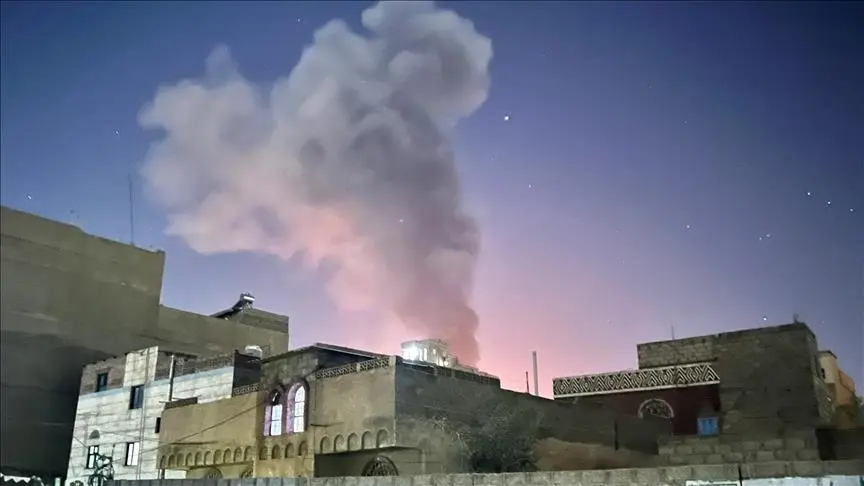
The Yemeni Houthi group announced that Israel launched a series of raids on the capital, Sanaa, and the Hodeidah governorate at dawn on Thursday, which resulted in the death and injury of a number of citizens.


Saba News Agency (Houthi version) said, "The Israeli aggression launched four raids on the Haiz power station south of the capital, Sanaa, and two raids on the Dhahban power station north of the capital."


It explained that the Civil Defense teams were able to extinguish the fire at the Dhaban station and are continuing their work at the Haziz station.


It pointed out that the Israeli enemy also launched four raids on the port of Hodeidah, and two raids on the Ras Issa oil facility, which led to thedeath and injury of a number of employees of the Ras Issa facility, without specifying their number.

ARAB AND WORLD

Thu 19 Dec 2024 8:42 am - Jerusalem Time

Israeli army announces bombing of ports and energy infrastructure in Yemen

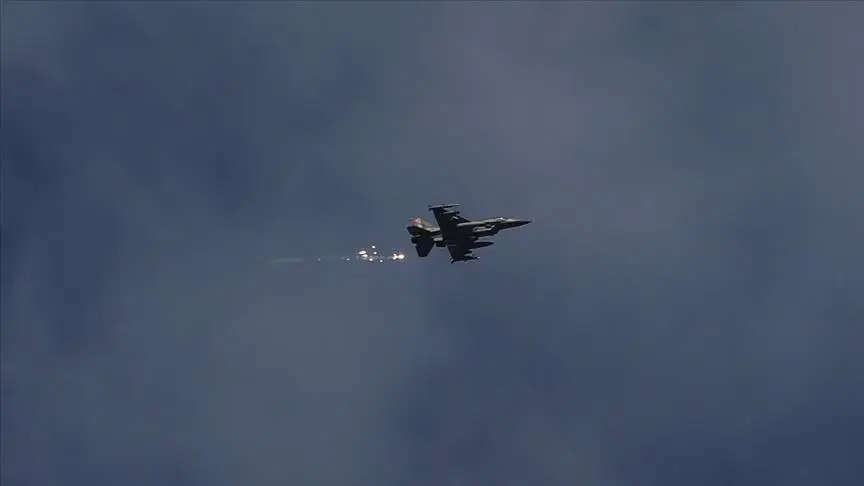
The Israeli army said, at dawn on Thursday, that it launched raids targeting Houthi targets in Yemen, including ports and energy infrastructure in the western coastal sector and deep inside Yemen.


Israeli military spokesman Daniel Hagari said in a video statement that the Yemeni Houthi group fired a missile towards Israel on Thursday night, forcing millions of Israelis to take shelter in bomb shelters.


Earlier on Thursday morning, the Israeli army claimed to have "intercepted a missile launched from Yemen before it penetrated Israeli airspace, and alarms were activated in the center of the country for fear of falling shrapnel from the interception," but videos on social media platforms showed damage to vehicles and buildings in areas of Tel Aviv.


He added: Over the past two weeks, the Houthis launched a drone that hit a civilian area in the south of the country, and last Sunday they launched a long-range missile towards the center of the country.


For its part, the Yemeni Houthi group announced that Israel launched a series of raids on the capital, Sanaa, and the Hodeidah governorate at dawn on Thursday, which resulted in the death and injury of a number of citizens.


Saba News Agency (Houthi version) said, "The Israeli aggression launched four raids on the Haiz power station south of the capital, Sanaa, and two raids on the Dhahban power station north of the capital."


It pointed out that the Israeli enemy also launched four raids on the port of Hodeidah, and two raids on the Ras Issa oil facility, which led to the death and injury of a number of employees of the Ras Issa facility, without specifying their number.


In "solidarity with Gaza" in the face of the ongoing Israeli genocidal war on the Strip since October 7, 2023, which has so far led to the killing and wounding of more than 152,000 Palestinians, the Houthi group began targeting cargo ships linked to Israel in the Red Sea with missiles and drones since November of the same year.


The Houthis also launch missile and drone attacks on Israel from time to time, some of which have targeted Tel Aviv, and they stipulate that stopping their attacks requires ending the Israeli war of extermination on Gaza.


On Monday evening, the official Israeli Broadcasting Corporation said that Israel is preparing to launch an attack on the Houthi group due to its continued launching of missiles and drones. It confirmed that "there is a consensus within the Israeli security establishment on the necessity of attacking the Yemenis after a series of attacks, as the Houthis launched 6 drones and two ballistic missiles towards Israel last week."


Since the beginning of the Israeli genocide in the Gaza Strip, Israel has attacked Yemen twice. The first was last July, and Israel called it “the long arm,” when it bombed the port of Hodeidah in the west of the country, in addition to the fuel facilities in the city’s power plant. While the second attack was last September, when Israel targeted several targets of the Yemeni group in Hodeidah.

PALESTINE

Thu 19 Dec 2024 8:36 am - Jerusalem Time

Israeli forces takes measurements of three houses and threatens to demolish another in Tubas and Jerusalem

Last night, the Israeli occupation forces took measurements of three houses in the town of Aqaba, north of the city of Tubas.


Local sources said that the occupation forces took measurements of the homes of the families of the martyrs Ahmed Walid Abu Ara and Abdul Raouf Al-Masry, in addition to the wounded prisoner Ayman Najeh Al-Yassin, in preparation for demolishing them.


Last night, the occupation forces stormed the city of Tubas and the town of Aqaba in the north.


In occupied Jerusalem, the occupation forces stormed the village of Rafat and raided the home of the detainee, Hael Issa Daif Allah (58 years old), and notified his family of the demolition of the house.


It is noteworthy that the detainee, Dhaif Allah, was arrested after being shot by the occupation forces near the "Givat Asaf" settlement, east of Ramallah, on September 11th.

PALESTINE

Thu 19 Dec 2024 8:34 am - Jerusalem Time

Dead and wounded as a result of the continued Israeli aggression on the Gaza Strip

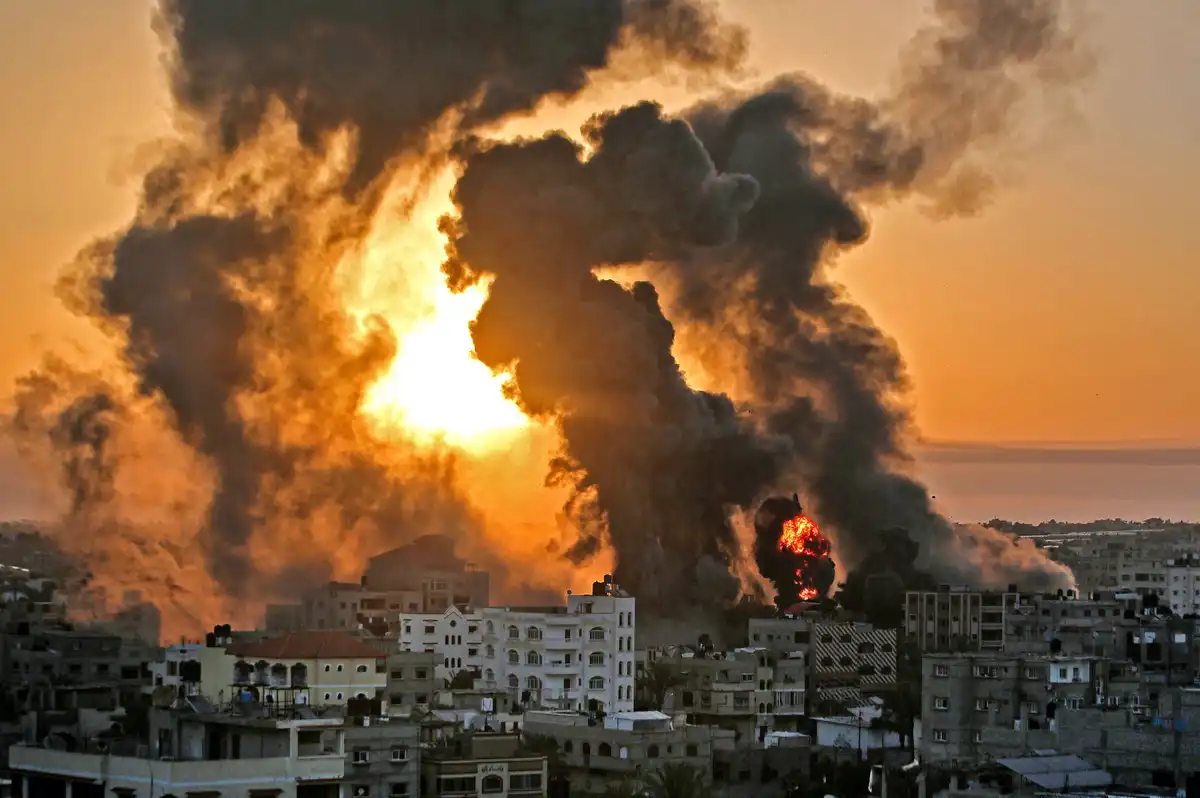
A number of citizens were killed and injured today, Thursday, in the bombing of various parts of the Gaza Strip by the occupation warplanes.


Local sources reported that three citizens were killed and others were injured in the occupation's bombing of Al-Zahour neighborhood, north of Rafah city, in the south.


Four citizens were killed and others were injured when the occupation bombed the Darwish family's house in Al-Maghazi camp in the central Gaza Strip.


Jabalia camp in the north is witnessing successive air raids by the occupation's warplanes.


In an incomplete tally, the occupation forces continue their aggression on the Gaza Strip, by land, sea and air, since October 7, 2023, which resulted in the death of 45,097 citizens, the majority of whom are women and children, and the injury of 107,244 others, as thousands of victims are still under the rubble and on the roads, and ambulance and rescue crews are unable to reach them.

PALESTINE

Thu 19 Dec 2024 8:30 am - Jerusalem Time

Haaretz investigation: Netzarim, the triangle of death and the “line of corpses” left for stray dogs

Testimonies of horrific executions

252nd Division Officer: We Arrest Civilians and Execute Them Because They Are Militants

Only 10 militants out of 200 civilian dead

Soldier: A 16-year-old boy was shot dead

Officer: The army acts like armed militias not governed by laws


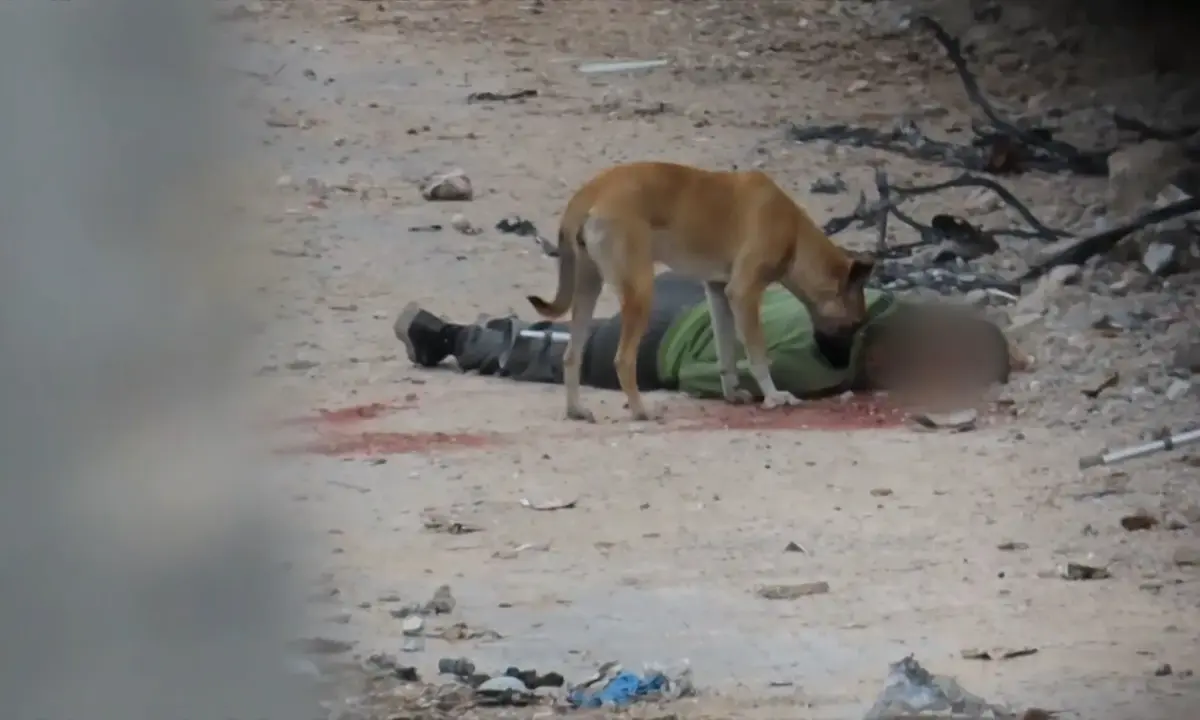
An investigation by the Israeli newspaper Haaretz revealed the routine killings carried out by soldiers and officers of the occupation army against any Palestinian who dares to approach the Netzarim axis, most of whom are unarmed civilians. The victims are declared as militants, even if they are just children, and their bodies become prey for stray dogs, because they are not allowed to be retrieved from their location.


Haaretz newspaper quoted soldiers and officers who served in recent months on the Netzarim axis: There is an imaginary line, and anyone who crosses it is killed, even if he is not carrying a weapon, or those who lose their way, and even cyclists.


"This line is not drawn on any map, and is not mentioned in any official order. If senior IDF commanders were asked, they would probably deny its existence. But in the heart of the Gaza Strip, north of the Netzarim axis, there is nothing more obvious than it," Haaretz said.


“There is something called among the troops on the ground ‘the line of bodies,’” a commander in the 252nd Division told Haaretz. “After a shooting, the bodies are not collected immediately, and the dogs come to eat them. In Gaza, they have learned that the place where the dogs appear is the place they should run from.”


Another officer from the 252nd Division, who recently completed his service, told Haaretz: “From the division’s perspective, the kill zone is the range of a sniper’s vision. We kill civilians there and they are counted as militants.” He noted that the IDF spokesman’s statements about the number of casualties for each unit and division have turned into a competition between the forces, explaining: “If the 99th Division killed 150 Palestinians, the next division will try to reach 200.”


"One incident involved the shooting of a young boy, about 16 years old, who was unarmed," said a soldier in the company. "When one of the soldiers tried to point this out, he was met with screaming from everyone.


"For me, anyone who crosses the line is armed. There are no exceptions," the division commander said.


According to Haaretz, commanders and soldiers expressed frustration at the ease with which civilians are turned into militants after being killed. It quoted a reserve commander as saying: “Saying that we are the most moral army in the world is an attempt to justify our actions. We know very well what we are doing there. We are in a place where there are no laws, where human life is worth nothing.”


The newspaper said that the Netzarim axis extends seven kilometers, starting near Kibbutz Be'eri and ending at the coast occupied by the Israeli army. The area was completely evacuated of its residents and their homes were destroyed to pave roads and build military sites. Officially, Palestinians were completely banned from entering the area. But in practice, it is not just an invitation to the residents to turn back (if they reach the place).


"It's just a metaphor from the army," Haaretz quoted a senior officer in the 252nd Division, who served three reserve tours in Gaza. "In effect, the division commander has designated this area as a killing zone. Anyone who enters will be shot."


The Haaretz investigation indicated that brigade commanders have unlimited authority. In the past, it required the approval of the chief of staff to bomb an aerial target or hit a high-rise building. But now, a brigade commander can make the decision himself.


"Sometimes the IDF acts like an armed militia, without clear laws," said another officer.


A soldier said that after a person was shot and killed, the body was photographed and the data sent to intelligence to confirm that he was a militant, adding: "It didn't matter. The data we are announcing shows hundreds of militants killed."


"In another horrific incident, the body of a young boy was found, photographed and his cell phone confiscated. Later, it was confirmed that he was not a Hamas member, but just a child," Haaretz said.


PALESTINE

Thu 19 Dec 2024 8:29 am - Jerusalem Time

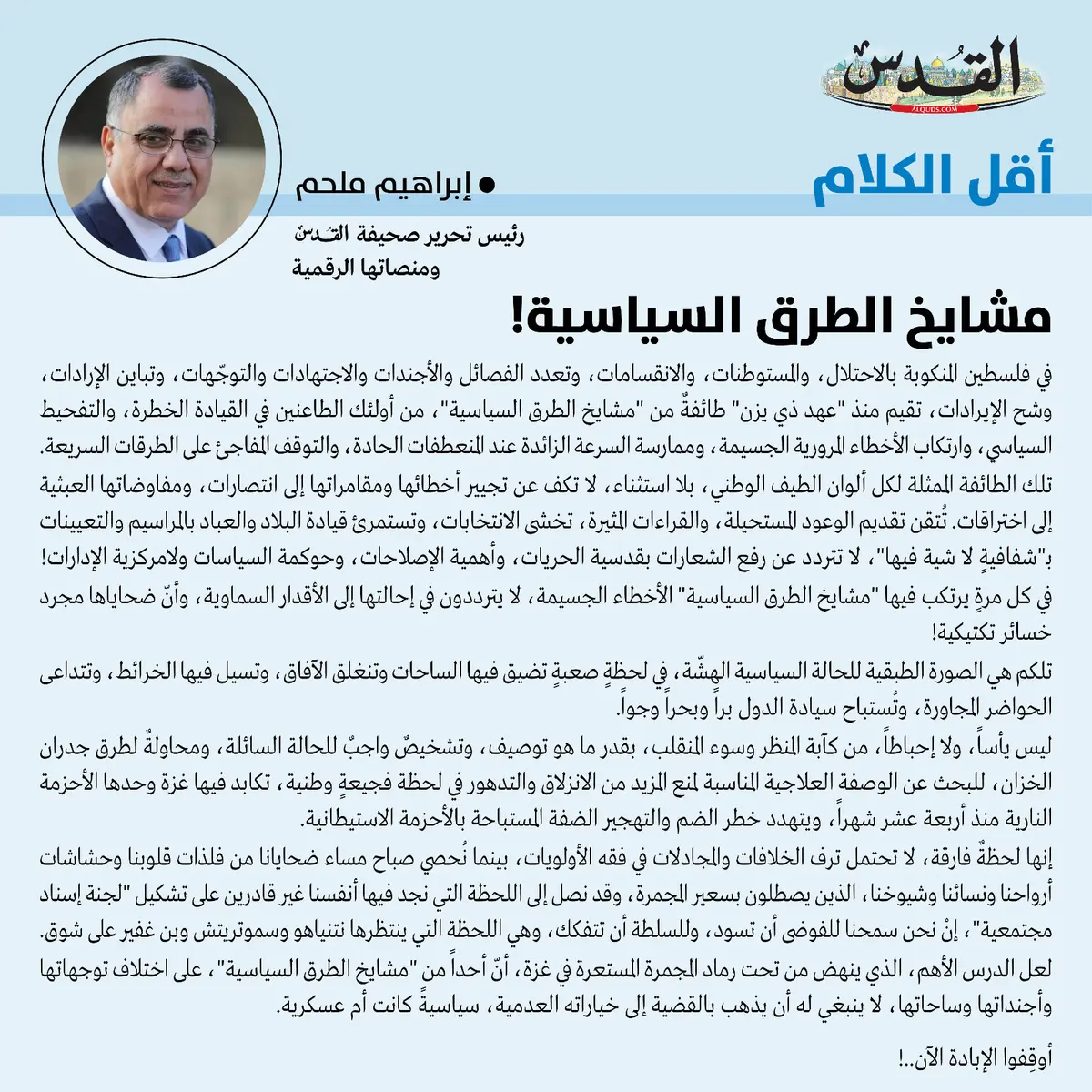
Sheikhs of political orders!

In Palestine, which is afflicted by occupation, settlements, divisions, multiple factions, agendas, efforts and orientations, varying wills and scarce revenues, a group of “political sheikhs of the roads” has been established since the “era of Dhi Yazan”, who are known for their dangerous driving, political drifting, committing serious traffic errors, practicing excessive speed at sharp turns, and sudden stops on highways.


This sect, which represents all colors of the national spectrum, without exception, does not cease to turn its mistakes and gambles into victories, and its futile negotiations into breakthroughs. It is skilled at making impossible promises and exciting readings, fears elections, and enjoys leading the country and its people with decrees and appointments with "nothing but transparency", and does not hesitate to raise slogans about the sanctity of freedoms, the importance of reforms, the governance of policies, and the decentralization of administrations!


Every time the “Sheikhs of the political orders” commit grave mistakes, they do not hesitate to attribute them to divine destiny, and that their victims are merely tactical losses!


This is the class image of the fragile political situation, at a difficult moment when arenas are narrowing, horizons are closing, maps are flowing, neighboring cities are collapsing, and the sovereignty of countries is being violated by land, sea, and air.


It is not despair, nor frustration, from the gloom of the scene and the bad outcome, as much as it is a description, and a necessary diagnosis of the liquid state, and an attempt to knock on the walls of the tank, to search for the appropriate therapeutic prescription to prevent further slippage and deterioration in a moment of national tragedy, in which Gaza alone has been suffering from fire belts for fourteen months, and the danger of annexation and displacement threatens the West Bank, which is being violated by settlement belts.


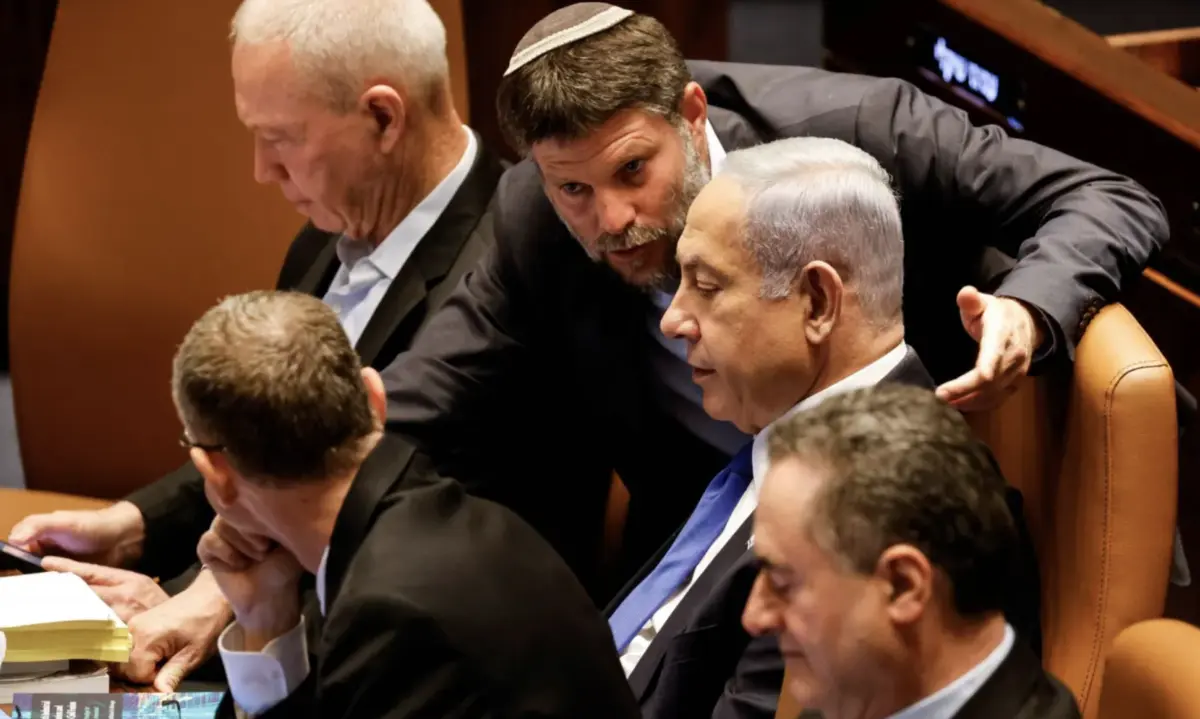
It is a critical moment that cannot tolerate the luxury of disagreements and arguments over the jurisprudence of priorities, while we count our victims, morning and evening, from the apples of our eyes, the apples of our eyes, our women and our elders, who are scorched by the fire of the brazier. We may reach the moment when we find ourselves unable to form a “community support committee,” if we allow chaos to prevail and the authority to disintegrate. This is the moment that Netanyahu, Smotrich and Ben-Gvir are eagerly awaiting.


Perhaps the most important lesson that emerges from the ashes of the raging incense burner in Gaza is that none of the “sheikhs of the political orders,” regardless of their orientations, agendas, and arenas, should take the issue to their nihilistic options, whether political or military.


Stop the genocide now..!

ARAB AND WORLD

Thu 19 Dec 2024 8:24 am - Jerusalem Time

Liquid Maps in a Troubled Region: Analysts Fear the Danger of Dividing Syrian Territories

Dr. Ahmed Tibi: Israel exploited the situation in Syria to occupy additional lands and deepen the occupation in the Syrian Golan

Dr. Amani Al-Qarm: The situation in Syria indicates an upcoming political vacuum and conflicts between the parties, and this will give Israel a greater opportunity to expand.

Imad Abu Awad: Israel is exploiting the absence of any real resistance from the Syrian side at this stage to determine the features of the next stage

Dr. Hassan Marhej: Israel seeks to consolidate its control over the Golan with aspirations extending to areas further into Syria

Amir Makhoul: Israel is working to consolidate its occupation of the Golan and expand its control towards Damascus, Sweida and Jabal al-Arab

Dr. Amjad Shehab: Israel adopts a policy of testing the waters, imposing facts on the ground, and using them as a negotiating card to achieve additional goals


In a move that reflects, on the one hand, the occupation state’s persistence in violating all international norms and laws and the sovereignty of neighboring countries, and on the other hand, the international community’s inability to defend its principles, Israeli Prime Minister Benjamin Netanyahu took the initiative, the day before yesterday, Tuesday, to hold a meeting on Mount Hermon in the far north of the occupied Syrian Golan, with his Defense Minister Yisrael Katz, Chief of Staff Herzi Halevi, Head of the National Security Agency (Shabak) Ronen Bar, and the Commander of the Northern Command, to assess the situation there.


Netanyahu took advantage of the visit and meeting to declare that the Golan Heights “will forever remain an integral part of the State of Israel,” noting that “Israel still faces challenges, but it is working to establish itself as a powerhouse in the region.” He said: “On this occasion, I would like to thank my friend, President-elect Donald Trump, for responding to my request to recognize Israel’s sovereignty over the Golan Heights in 2019. These heights will forever remain an integral part of the State of Israel.”


In turn, writers, analysts and politicians who spoke to “Y” considered that this meeting falls within the framework of passing political messages that the Golan has become part of Israel as a foregone conclusion, especially with the expansion of the areas controlled by his army in the Golan Heights and southern Syria in general.


Israel violates international law and America justifies it


The head of the Arab Movement for Change, MP Dr. Ahmad Tibi, said: Israel and its Prime Minister Benjamin Netanyahu exploited the situation in Syria to occupy additional Syrian lands and deepen the occupation in the Syrian Golan, without any reaction from the international community. Moreover, the US administration described these practices as falling within the "right to self-defense."


Al-Tayyibi pointed out that the occupation of the territory of a sovereign state, which is a clear violation of international law, was justified by the United States under the umbrella of "self-defense," coinciding with a sweeping Israeli attack on Syrian territory that included the bombing of military and scientific facilities.


He added: Before that, Israeli officials spoke clearly about deepening Israeli settlement in the Syrian Golan.


Al-Tayyibi stressed that there are those in the Israeli government who seek to continue this occupation of the new Syrian lands that were seized, and that the Israeli political approach often turns the temporary into permanent.


He explained that Netanyahu did not publicly state that this occupation is temporary, but rather indirectly indicated his desire to expand settlements, which indicates that the current occupation is heading towards becoming permanent, as happened with the occupation of the Syrian Golan in 1967.


Al-Tayyibi added that the problem lies in the international silence, which sometimes reaches the level of implicit support for this occupation, in addition to the silence prevailing in the region and the Arab world, as if the matter is normal, which is not the case at all.


Regarding the establishment of the David's Corridor project from the Euphrates to the Mediterranean, Al-Tayyibi said that the expansionist ideology of the Israeli government is well-known, and is evidenced by the repeated statements of a number of its ministers.


Al-Tayyibi stressed that the entire Syrian Golan must return to Syrian sovereignty, praising the position of the segments of Syrian society that stand united in confronting this occupation.


The October 7 attacks were a golden opportunity for Israel


For her part, writer and researcher on American and Israeli affairs, Dr. Amani Al-Qarm, said that the attacks of October 7, 2023, represented a golden opportunity for Israel, especially for the rising new nationalist movement and extremist religious Zionism, to reshape the region in line with the greater Israeli vision.


Al-Qarm confirmed that the balance of power in the Middle East has changed in Israel's favor, as Iran's agents such as Hamas and Hezbollah have been reduced, the Assad regime has been toppled, and the influence of the Houthis has been reduced, with the imminent possibility of a decline in Iranian influence in Iraq.


She pointed out that Iran itself is shrinking after a series of blows that have weakened it.


In contrast, Al-Qarm pointed out that Israel is living in a state of excess power, as it acts with complete freedom thanks to the unlimited support of the United States, the world's superpower.


With the expected arrival of a new US president who focuses on domestic affairs, Crimea believes that Israel will have a freer hand in the region, and will even become the nucleus of regional alliances and a strategic deterrent tool for Washington, especially after its successes in eliminating its opponents.


Al-Qarm explained that the move by Israeli Prime Minister Benjamin Netanyahu to hold meetings on Mount Hermon and control the buffer zone indicates a clear Israeli strategy aimed at expanding and establishing complete control over the Syrian Golan.


She stressed that Israel no longer views the Golan Heights as disputed territory, and Netanyahu himself stated that the Golan Heights will remain "Israeli forever."


$11 million to double the number of settlers in the Golan


Al-Qarm added: "Israel was quick to announce the allocation of $11 million to double the number of settlers in the Golan, in addition to building a long-term infrastructure to support the settlement."


She considered that the situation in Syria indicates an upcoming political vacuum and conflicts between the currently controlling parties, which will give Israel a greater opportunity to expand, especially with the infrastructure projects it is working on along the border in the Golan.


Al-Qarm expected the continuation of Israeli expansion in southern Syria, reaching the Jordanian and Iraqi borders, within the framework of a project known as the "David's Corridor", which is considered one of the plans of the new nationalists in Israel and religious Zionism.


She pointed out that this project revives what she describes as Zionist myths about the establishment of "Greater Israel", and provides it with major strategic benefits, including limiting Iranian influence, controlling Syrian resources, especially oil, and strengthening Israel's long hand in the region. The project also supports the establishment of a Kurdish state loyal to Israel and the United States, which enhances its interests in the region.


Israel seeks to transfer the battle to the Syrian interior


In turn, the expert in Israeli affairs, Imad Abu Awad, considered that the recent Israeli movements inside Syrian territory come within the framework of exploiting the current circumstances in Syria, which is going through a state of instability and is preoccupied with rearranging its internal affairs.


He stressed that Israel is fully aware that this stage represents a golden opportunity, given the weakness of Syria's ability to respond or take countermeasures.


Abu Awad pointed out that the Israeli incursion aims to achieve several goals, most notably: imposing ground control, and continuing to target the Syrian depth to ensure neutralizing any future threats.


He added: "Israel was aware of the nature of the former Syrian regime, which showed hostility to Israel through statements and support for Hezbollah with weapons, but in reality was seeking to continue its survival without posing a real threat to Israel."


He continued: "Today, Israel is concerned about the possibility that the Syrian scene could turn into an actual resistance instead of being limited to hostile rhetoric. Hence, Israel seeks to exploit this period to draw new features on the ground, whether in anticipation of a possible military clash in the coming years, or to establish facts on the ground that could affect any future political settlements."


Keeping the Golan Heights within the Israeli equation


Abu Awad explained that one of Israel's main goals is to move the battle into Syria, so that the theater of potential military operations becomes inside Syrian territory, not deep inside Israel. Israel also aims to influence the internal scene in Syria, in line with its declared vision of dividing Syria into regions under the control of different minorities.


He added: "Israel seeks to complicate any future international negotiations with Syria, so that the return to the situation before the fall of the Syrian regime is without addressing the occupied areas such as the Golan."


He stressed that the greater Israeli goal is to impose a new reality, which is to recognize the Golan as part of Israel, and not an occupied territory.


Abu Awad pointed out that Israel is exploiting the absence of any real resistance from the Syrian side at this stage to determine the features of the next stage.


He explained that this incursion aims to ensure that the Golan remains within the Israeli equation, whether in the event of a military conflict or within the framework of any future political settlement.


He pointed out that the Israeli expansion in Syria is not an easy step, but rather it imposes great burdens on the Israeli army and the general budget of the occupying state.


However, Abu Awad said, Israel is closely monitoring developments in Syria, hoping that its division will strengthen its control over neighboring areas. If Syria is reunited, Israel seeks to ensure that these areas remain within the framework of international settlements that may be imposed in the future.


Israel is preparing for all possible scenarios


For his part, Middle East expert Dr. Hassan Marhej said: Israel is exploiting the current situation in Syria to consolidate its control over the occupied Syrian Golan, as it seeks to impose its sovereignty over the region in a final and irreversible manner.


He added that the Israeli messages aim to emphasize that the Golan is an "integral part" of Israel, with aspirations extending to areas beyond the Golan.


Marhej pointed out the strategic and military importance of these steps, as Israel focuses on expanding and positioning itself in areas beyond Quneitra Governorate, reaching the Al-Khashab front and the highest point in Mount Hermon.


He explained that this deployment helps Israel to remove any future threat from its borders, noting that these areas are no more than 20 kilometers away from the capital, Damascus, and perhaps less.


Marhej stressed that Israel is anticipating all possible scenarios in Syria, as the internal situation in Syria is still suffering from major divisions and disagreements between the armed factions, noting that these tensions could lead to a new explosion in areas such as Idlib, southern Syria, and Jabal al-Arab, in addition to the violations and conflicts witnessed on the Syrian coast.


Turkish expansion in northern Syria


He added: "Türkiye continues its preparations to expand its influence in northern Syria, while the American presence remains concentrated in the east, which creates a state of alert in the region."


He explained that Israel is closely following these developments, and may need to expand further to enhance its national security and remove any future danger on its borders.


In a related context, Marhej pointed out that Israel plans to intensify its focus on the West Bank by 2025, as it works to neutralize any future threat that may affect its security.


Marhej pointed out that Israel was able to easily impose its control over Syrian territory without any international deterrent, with increasing support from some international parties, including the encouragement of former US President Donald Trump for these steps.


A visit to cover up other more important matters.


In turn, political analyst Amir Makhoul said that Israeli Prime Minister Benjamin Netanyahu's visit to the areas that Israel recently occupied in Syria was not the most important step he took, indicating that the visit may have been to cover up other more important matters.


He explained that there are questions within Israel about the reasons for Netanyahu's absence and his whereabouts, which indicates the possibility of other plans related to visits or regional or international goals.


Makhoul added: "Israel sees the Syrian situation as a golden opportunity to consolidate its permanent occupation of the Syrian Golan, and even seeks to expand its control towards Damascus, Sweida, and Jabal al-Arab."


He pointed out that Israel might work to divide Syria and establish a region loyal to it if it succeeded, a project that has not yet been decided.


He pointed out that Israel is planning to establish a buffer zone on the border between Lebanon and Syria, under its direct control, under the pretext of preventing Hezbollah from strengthening its military capabilities.


He explained that Hezbollah is now facing major challenges as a result of regional changes and the interruption of Iranian support lines, which has put it in a more isolated position.


"Expanded Golan" and doubling the number of settlers


Makhoul stressed that Israel seeks to double the population of the Golan, but it is talking about the "expanded Golan", which goes beyond the areas occupied since 1967, and includes new lands that it wants to annex.


He explained that this plan includes strengthening control over agricultural and water resources, and is part of a clear policy to establish a Druze regional government in the Golan, despite the categorical rejection of this project by the Druze in Syria and the occupied Golan.


"Israel may find itself in trouble if it continues to occupy Syrian territory, as it may face popular Syrian resistance in the future," Makhoul added, noting that the decades-long calm on the border could turn into a confrontation with the Syrians.


He pointed out that the Israeli plan is not limited to the Golan Heights, but includes weakening the Syrian army and attacking Iran, which may be complex and difficult to implement.


Makhoul stressed that Israel is waiting for Donald Trump to return to the US presidency to support these plans, but he warned that Trump will not have the "magic wand" to subjugate the region in Israel's favor.


Clear messages that Israel will not give up the Golan


For his part, political analyst Dr. Amjad Shehab said: Israel relies on a policy of testing the waters and imposing new facts on the ground, exploiting these facts as a negotiating card to achieve additional goals within its occupation program.


He pointed out that one of the most prominent indications of this trend is sending clear messages that Israel will not give up the Golan Heights, which it officially annexed in 1981, and received recognition of this annexation from the administration of former US President Donald Trump.


He explained that the meeting, which took on a military and security character, indicates Israel's intention to occupy the buffer zone, parts of western Daraa and Quneitra Governorate, under the pretext of preserving its national security and confronting Hezbollah and extremist Islamic movements.


Shehab explained that under these pretexts, Israel seeks to remain in these areas due to their strategic and military importance, until security arrangements are reached with the new Syrian leadership.


He pointed out that the newly occupied areas are being used as an additional pressure card to blackmail the future Syrian government, with the aim of achieving additional gains that may include strengthening its control over the Golan Heights, which was occupied in 1967.


He added: The withdrawal of Israeli Prime Minister Benjamin Netanyahu from the disengagement agreement signed with the Syrian government in 1973 confirms that Israel is seeking to use the lack of understandings as a pretext to guarantee its control over more territory, while sending messages aimed at weakening the new Syrian leadership.


Spreading chaos in the regional political arena


He considered that these measures constitute a clear violation of international law, which Israel does not pay any attention to, as it seeks to spread chaos in the regional political arena to justify its military presence as a legitimate defensive measure.


"In a move that confirms these motives, a decision was issued during the meeting to increase the number of settlers in the occupied Syrian Golan Heights, with an additional budget allocated to expand the settlements. This came despite Arab, Islamic and international condemnations of these measures, which constitute an infringement on Palestinian and Arab rights, and a flagrant violation of international norms and laws," Shehab said.


Shehab concluded by saying: “These measures aim to achieve long-term strategic and political goals, under the cover of flimsy justifications and pretexts, such as establishing a safe zone or waiting for political stability to be achieved in Syria.”

PALESTINE

Thu 19 Dec 2024 8:12 am - Jerusalem Time

Intensive efforts to complete it before the end of the year.. A partial deal with no political gains

Dr. Amr Hussein: Intensive efforts to reach a temporary truce in Gaza before Trump’s inauguration.. and Israel will not make any political concessions at this stage

Nizar Nazzal: Israel does not seek a comprehensive cessation of war, considers the Palestinian state an existential threat, and is trying to fragment any efforts to achieve this goal

Yasser Manna: Israeli near-consensus on accepting a partial deal and rejecting any talk of understandings that would give the Palestinians long-term political gains

Imad Moussa: Netanyahu's government is not interested in establishing a Palestinian state, but rather seeks to achieve temporary calm that allows it to focus on other issues

Mohammad Hawash: Linking talks on the deal to any steps towards establishing a Palestinian state or normalizing relations with Israel is far from reality


The region is witnessing intense diplomatic activity, with talk of the possibility of reaching a deal in the Gaza Strip soon, while there is talk of a series of deals that include establishing a Palestinian state and normalization with Israel.


There are increasing indications that a deal could be reached within the next two weeks. According to Israeli media, there is talk of arrangements for a ceasefire in Gaza, coinciding with the arrival of the Director of the US Central Intelligence Agency (CIA) in Doha to follow up on developments in the deal. At the same time, reports have emerged that the team of US President-elect Donald Trump has received Saudi messages stressing that normalization with Israel will not be achieved until the war on the Gaza Strip stops.


In separate interviews with “I”, writers, analysts and specialists explain that the prisoner exchange deal between Israel and the Palestinian factions in Gaza includes a temporary truce and a ceasefire in the Strip. At the same time, the efforts of the United States have reached their peak, as American reports confirm the existence of pressure on Israel, while the Director of the American Central Intelligence Agency is following up on movements related to the deal during his visit to Doha. However, questions remain open about the nature of this agreement and the extent of Israel’s readiness to withdraw completely from Gaza and achieve a permanent cessation of war.

On the other hand, there is talk about efforts to establish a Palestinian state, but writers, analysts and specialists believe that there are major obstacles to it, as Israel has issued laws that criminalize any attempts to reach an agreement that leads to this goal.


They point out that Benjamin Netanyahu's government insists that the establishment of a Palestinian state on the 1967 borders constitutes an existential threat, and therefore it shows no willingness to make concessions, especially with Israeli policies focusing on annexation and control in the West Bank.


As for normalization, according to writers, analysts and specialists, there are indications that the official Saudi position links normalization with Israel to achieving tangible steps towards stopping the war in Gaza and achieving progress in the Palestinian political track.


According to writers and specialists, these developments put the region at a crossroads, between a temporary calm that may last, and the continued ambiguity about achieving comprehensive solutions that address the roots of the Palestinian-Israeli conflict.


Large gaps hinder reaching an agreement


The writer and political analyst specializing in international relations and strategy, Dr. Amr Hussein, believes that there are intensive efforts to stop the war in the Gaza Strip before the inauguration of US President-elect Donald Trump on January 20.


Hussein points out that the United States is working hard to reach an agreement to end the war, which may provide an opportunity to begin a phase of temporary calm and rearrange the cards.


Hussein explains that American reports show that there are large gaps between Hamas and Israel that prevent reaching a final agreement, or even a partial agreement.


Hussein believes that the form of the settlement is still unclear, as all the terms of the agreement have not yet been determined. However, the negotiations may lead to a 60-day truce that includes a ceasefire and a prisoner exchange. However, the expected Israeli withdrawal will be partial, with no indication of a complete withdrawal from the Strip.


Hussein asserts that Israeli Prime Minister Benjamin Netanyahu has destroyed everything in the Gaza Strip and no longer has new military targets. The Israeli aggression has also resulted in the martyrdom of 45,000 Palestinians and the injury of 130,000 others, making the Gaza Strip a completely disaster area.


Regarding any deal or agreement that includes the establishment of a Palestinian state, Hussein points out that Israel will not make any political concessions at this stage, as the Israeli Knesset has issued a decision preventing the establishment of a future Palestinian state, considering that the establishment of a state on the 1967 borders constitutes a threat to Israel’s security.


Regarding the regional role, Hussein points to the intensive Egyptian efforts to stop the war, as Cairo plays a pivotal role in relation to the deal, and the visit of the Director of the American Central Intelligence Agency, William Burns, to Doha, all of which enhance the proximity of reaching an agreement on the deal, and these visits aim to enhance diplomatic efforts to achieve a calm in Gaza.


Despite the international efforts, Hussein stresses that the biggest challenge in the next phase is the reconstruction of the Gaza Strip.


Hussein points out that the Gaza Strip needs more than $100 billion for reconstruction, stressing that reconstruction requires international coordination and integrated efforts to restore life to the Strip, which is suffering from a catastrophic humanitarian crisis.

Hussein points out that the next stage may witness an initial agreement that reduces the tension, but it will not be the final solution to the conflict.


Hussein stresses that any calm will be temporary unless the root causes of the crisis are addressed, noting that reconstruction and ensuring long-term stability require significant international support and courageous political decisions.


Intense diplomatic activity and moves towards major regional deals


Nizar Nazzal, a researcher specializing in Israeli affairs and conflict issues, believes that the region is witnessing intense diplomatic activity, amid clear moves towards major regional deals.


Nazzal points out that US President-elect Donald Trump has practically begun working on his political agenda before he officially assumes office on January 20, and it appears that there is intense and direct pressure from the United States on Israel, which is evident in the change in the tone and statements of Israeli Prime Minister Benjamin Netanyahu, which have become less severe compared to what they were during the past 14 months.


He explains that the scene in the Gaza Strip is heading towards a temporary truce in stages, but it is governed by a limited timetable.

Nazzal believes that Israel is not seeking a comprehensive cessation of the war in Gaza, but rather a temporary ceasefire, which would allow it to rearrange its strategy in the Strip.


Nazzal believes that Netanyahu is relying on replicating the experience of southern Lebanon, where Israel is focusing on partial withdrawal and positioning itself in locations that allow the use of air power and artillery when needed without the need for a permanent military presence.


Nazzal believes that the strategy of “intermittent truces” reflects Israel’s desire to achieve its goals without an official or written commitment with the Palestinian factions, which shows Netanyahu’s refusal to sign any comprehensive ceasefire agreement or complete withdrawal from Gaza. Instead, he aims to manage the conflict intermittently to achieve interim goals, especially with regard to the release of Israeli detainees in exchange for a temporary calm.


Regarding the establishment of a Palestinian state, Nazzal stresses that Israel categorically rejects this option, explaining that the Israeli Knesset has passed multiple readings of decisions criminalizing any attempts or signing of agreements that lead to the establishment of an independent Palestinian entity.


Nazzal believes that the current Israeli government considers the establishment of a Palestinian state an existential threat, and adopts policies aimed at fragmenting any attempts to achieve this goal.


He points out that the next stage will be full of diplomatic activity, but these movements will not lead to any real political breakthrough.


Calming the fronts without extinguishing them


Nazzal describes these diplomatic moves as "political maneuvering", aiming to calm the fronts without extinguishing them.

Nazzal believes that the coming scenario will be a cooling of the conflicts, with the continuation of the “intermittent conflict” based on air strikes and limited confrontations when Israel sees a specific threat.


Nazzal points out that Israel is now moving from confronting Palestinian movements and factions to confronting regional countries, speaking about the possibility of Israeli strikes on Yemen and Iraq in the near future, as part of its efforts to limit Iran’s influence in the region, noting that Israel may target Iranian nuclear facilities as part of its strategy to confront the Iranian threat.


Nazzal believes that these steps may shuffle the political cards in the region, but they will not achieve long-term stability.

He points out that the United States and some Arab and Gulf countries are exerting great pressure on Israel to end the escalation in Gaza.


In his opinion, these pressures come as a result of the absence of clear military objectives for Israel inside the Strip after the last months of military operations. However, Israel prefers to manage the conflict rather than resolve it radically, which explains its adoption of a strategy of intermittent truces.


Nazzal believes that the next phase will be very sensitive, as Israel will move towards managing the conflict using the “vertical conflict” method, which depends on gathering intelligence and directing concentrated strikes when needed, while maintaining a state of relative calm. However, Nazzal warns that this strategy could lead to continued instability in the region.


Nazzal points out that the intermittent truces that Israel seeks to impose are nothing but attempts to cool the fronts without a radical solution to the conflict.


Nazzal stresses that this strategy aims to prevent a comprehensive escalation while keeping the Palestinians under constant pressure.

Nazzal believes that this policy reflects a long-term Israeli vision of containing the conflict without making real concessions, which makes regional stability an unattainable goal under these conditions.


The possibility of achieving an interim agreement that may begin with a ceasefire


Writer and expert on Israeli affairs Yasser Manna believes that the talks related to concluding a prisoner exchange deal between the Palestinian factions in Gaza and Israel indicate the possibility of achieving a transitional agreement that may begin with a ceasefire, then be implemented in stages until the war ends completely.


Manaa explains that there are signs of optimism coming from the Israeli media and statements by Palestinian factions, which enhances the possibility of reaching partial understandings. However, the most important question for the Palestinian factions remains: Is Israel prepared for a complete withdrawal from the Strip and a permanent cessation of the war?


Manaa points out that one of the most prominent Israeli questions at this stage is related to how to manage the Gaza Strip after the end of the war.


He asked: "Does Israel want to have only a service administration in Gaza, while keeping security in its hands?" He explained that Israel might be prepared to end the war if this form of administration is agreed upon, but he doubts the possibility of achieving a comprehensive agreement that guarantees full Palestinian sovereignty over the Strip.


Regarding the establishment of a Palestinian state, Manna believes that this option is out of reach, especially in light of Israeli policies that focus on annexation and control of the West Bank.


Manaa stresses that Israel considers annexation necessary not only for political reasons, but also for security reasons, especially after the events of October 7.


Manaa points out that the next stage will witness intensive Israeli attempts to consolidate its control over Area C in the West Bank, while marginalizing any idea of establishing a future Palestinian political entity.


Regarding the ongoing talks on the deal, Manna indicates that the expected deal in Gaza may be partial and not comprehensive, as Israel views the deal from the perspective of releasing Israeli detainees only, without making major concessions.


It shows that the Palestinian view of the deal differs radically, as the Palestinian factions believe that the deal must include a complete Israeli withdrawal and an end to the war.


Manna explains that Israel is not yet showing any seriousness in discussing broader political issues related to ending the war comprehensively or offering a political price in exchange for the deal.


Manna points out that there is a near consensus within Israel to accept a partial deal, while rejecting any talk of comprehensive political understandings that might give the Palestinians long-term gains.


Manaa points out that there are clear Palestinian fears that Israel may break the agreements after reaching them.


In this context, Manaa explains that Hamas is demanding written pledges to ensure Israel's commitment to the agreement.


Manaa points out that Israel seeks, through these understandings, to end the war in Gaza in order to devote itself to plans for annexation and control in the West Bank.


He stresses that Israel's strategic goal is to separate the Palestinians from each other geographically and politically, which hinders any possibility of achieving national unity or establishing a future Palestinian political entity.


Manaa believes that Israel seeks to achieve this goal by imposing a new reality on the ground in the West Bank, after ensuring a calming of the situation in Gaza.


Manna believes that the potential deal in Gaza, despite the relative optimism surrounding it, may be only the first stage in a larger Israeli plan aimed at reordering its settlement priorities in the West Bank.


The region is heading towards a phase of geopolitical restructuring.


Writer and political analyst Imad Moussa believes that the region is heading towards a sensitive phase of geopolitical restructuring, where there are no real intentions for calm or peace.


Musa believes that the main goal of these moves is to redraw the regional map with the double exclusion of both Russia and Iran, paving the way for Israel to become the dominant regional player, at a time when the roles of other regional powers such as Egypt are declining.


Mousa points out that Israel is doing everything in its power to destroy any chance of establishing an independent Palestinian state. Mousa cites Israeli measures aimed at keeping the idea of a Palestinian state as “ink on paper” confined to the files of the United Nations.


Musa points out that the international institution, which recognized Israel as a full member state, is today facing continuous Israeli attacks to weaken its role in maintaining global security and peace.


Among these attacks, Musa points to Israel’s targeting of UNRWA employees, systematic attacks on its schools in the Gaza Strip, and direct targeting of UNIFIL peacekeeping forces in southern Lebanon. The International Criminal Court is also being subjected to a systematic Israeli attack, coinciding with US moves to activate the “Hague invasion” law, reflecting a harmony between Washington and Tel Aviv in disrupting international institutions that could hinder their policies.


Musa explains that Benjamin Netanyahu's government is not interested in establishing a Palestinian state in any way, but rather seeks to achieve temporary calm that will allow it to focus on other issues.


According to Moussa, the first of these issues is Syria, where Israel is keen to secure its share of the gains there, including freedom of military action inside Syrian territory to pursue what it describes as “terrorist organizations.” Moussa points out that Israel continues to target sites inside Syria, not only through air strikes, but also through strategies aimed at asserting its regional hegemony.


The second issue, according to Musa, is the potential escalation against Yemen and Iran.


Musa believes that Israel, in cooperation with the United States and some Arab allies, may launch dual military strikes targeting vital sites in Iraq and Yemen, creating a state of regional confusion, as these operations aim to demonstrate Israeli military superiority and enhance its deterrent capacity.


On another level, Musa believes that Turkey is playing a growing regional role, as it has surpassed Egypt as an influential regional power, as Turkey seeks to divide Syria by emptying Aleppo, Syria’s major economic base, of its residents, who were displaced to Turkish territory.


Musa believes that these moves aim to expand Türkiye's influence at the expense of traditional powers in the region.


Mousa points out that Israel seeks to establish itself as the dominant state in the Arab region through coordinated military, diplomatic and economic moves, with the aim of redrawing the region in line with Israeli and Western interests, while marginalizing major Arab issues, most notably the Palestinian issue.


The Israeli right still insists on rejecting the establishment of a Palestinian state


Writer and political analyst Muhammad Hawash believes that the recent developments related to the prisoner exchange deal and talks on a temporary ceasefire in Gaza, despite reaching advanced stages, do not reflect a fundamental change in Israel’s positions on the Palestinian issue.


Hawash asserts that the ruling Israeli right is still adhering to its principles that reject the establishment of a Palestinian state and the right of self-determination for the Palestinian people, pointing out that these positions are based on expansionist plans at the expense of the Palestinians in the West Bank and Gaza Strip.


Hawash explains that the current talks regarding a prisoner exchange deal include limited details, such as the release of Israeli detainees in Gaza, especially those with dual nationalities.


Hawash points out that this issue is of particular interest to the United States and Western countries, noting that the deal also includes partial withdrawals from hubs such as Netzarim and Philadelphia.


However, Hawash stresses that these steps are not linked to any complete withdrawal of the Israeli army from the Gaza Strip or a permanent ceasefire.


Hawash explains that negotiations are now revolving around the finer details of the exchange deal, including the number of Palestinian prisoners to be released and their classifications, without any clear political framework for these talks.


Hawash points out that Hamas, which previously demanded a complete withdrawal from the Strip, has now agreed to partial withdrawals, reflecting a change in its positions as a result of field and political pressures.


Hawash points out that the idea of a two-month ceasefire that could be extended based on the success of the deal could create important regional and international changes. However, achieving a permanent ceasefire depends on developments that may occur later and not on any previously signed agreements.


Hawash confirms that the talks are taking place in the context of international and regional desires, especially from the United States and Arab and Islamic countries, which seek to end the war and establish a comprehensive ceasefire.


Hawash confirms that there is a desire within Israeli society to stop the war, especially after achieving the main military objectives and exhausting the Israeli military targets in Gaza.


However, Hawash points out that there are concerns about the resumption of settlement in Gaza, which could lead to a long-term conflict with the Palestinians.


However, Hawash warns that Israel may re-use the scenarios of procrastination and failure of agreements as happened previously, especially in light of the widening internal opposition in Israel to any deal that it may consider concessions.


Hawash points out that the US administration is dealing cautiously with these developments related to the deal, fearing that Israel will not abide by the deal, which would complicate matters further.


Hawash stresses that the success of the exchange deal and the continuation of the ceasefire requires strong international and regional commitment, amid ongoing doubts about Israel's intentions.


Hawash stresses that the current scene indicates limited but risky progress, leaving all possibilities open in light of the volatile political and military conditions.


Hawash believes that linking the current talks on the deal to any steps towards establishing a Palestinian state or normalizing relations with Israel is far from realistic.


Hawash asserts that the official Saudi position rejects normalization without achieving a reliable and irreversible path towards establishing a Palestinian state, pointing out that Israel’s bypassing of the Palestinian issue by expanding the scope of normalization with Arab countries represents Israeli wishes that do not reflect reality.


OPINIONS

Thu 19 Dec 2024 6:21 am - Jerusalem Time

An Israeli Order in the Middle East

Foreign Affairs

Foreign Affairs

Opinion Writer

A Chance to Defeat the Iranian Vision for the Region—and Improve on the American Vision

Amos Yadlin and Avner Golov

What is happening in the Middle East today is best understood as a struggle over a new regional order. Since the Hamas attack on Israel on October 7, 2023, three competing visions for that order have emerged and then faltered: the Hamas vision, the Hezbollah-Iranian vision, and the American vision. Hamas sought to ignite a multifront war aimed at destroying Israel. Iran, along with its proxy Hezbollah, aimed for a war of attrition that would cause Israel to collapse and push the United States out of the region. The United States, which stood firmly behind Israel, hoped for regional stability built on new political possibilities for the Israelis and the Palestinians, normalization between Israel and Saudi Arabia, and a defense pact between Washington and Riyadh.


None of these visions, however, proved tractable: Hamas, Hezbollah, and Iran misjudged the strength of the Israel Defense Forces (IDF), Israeli society, and the U.S.-Israeli alliance. The United States overestimated its capacity to influence Israel’s approach to the war in Gaza and did not sufficiently contend with the regional threat posed by Iran.

The failure of these three visions creates an opening for a more realistic fourth one: an Israeli vision. Over the past three months, Israel has begun to exert its power to reshape the Middle East. It eliminated Hamas’s military capabilities and—shattering its own long-standing approach to deterrence—decapitated Hezbollah’s leadership and compelled the Lebanon-based group to accept cease-fire terms it had long resisted, leaving Hamas isolated and Iran without its most capable proxy. Israel has also carried out sophisticated strikes inside Iran. The opportunistic toppling of the Assad regime in Syria at the hands of rebel forces can be understood, in part, as an attempt to take advantage of Israel’s undermining of Iranian regional power. As a result, Iran has lost the land corridor stretching from its borders to Israel’s, a corridor that Iran had devoted significant resources to establishing over the past four decades.

These developments mark a dramatic shift: for nearly a year after the October 7 attack, Israel’s vision for the region’s future was unclear. It was defending itself and, by extension, fighting to preserve a status quo that would never be reestablished. Although its operations were aggressive, Israel refrained from disrupting the existing deterrence dynamics with Hezbollah and Iran. Moreover, it hesitated to impose a new order while it was viewed as an instigator internationally and while divisions weakened Israeli society domestically.

Israel is now reshaping the Middle East through military operations, but it would benefit from asserting itself politically, too. It has both the opportunity and the responsibility to steer the region’s trajectory toward a new, more peaceful and sustainable reality. Currently, Israel’s ability to force regional changes militarily outpaces its readiness to articulate and enact a cohesive strategic vision; its operational successes do not, as yet, have clear strategic ideas to go along with them. Israel should push for a political framework to match its battlefield successes. An Arab-Israeli coalition backed by the United States could repel threats from Shiite and Sunni radicals, provide the Palestinians with a realistic political future, safeguard Israel’s security interests, secure the return of the Israeli hostages still in Gaza, and prevent another attack on Israeli soil.
Israel must not seek to impose its vision of a new regional order alone. It needs buy-in from the United States, Saudi Arabia, Jordan, Egypt, and the United Arab Emirates, as well as Germany and the United Kingdom, even as U.S. foreign policy undergoes its own realignment under President-elect Donald Trump. The situation is delicate. But for the first time since the October 7 attack, Israel has the opportunity to seize the moment.

BEST-LAID PLANS

When Yahya Sinwar, the late Hamas leader, ordered an invasion of Israel on October 7, 2023, he did so with a calculated vision for the Middle East: immediately after Hamas’s attack, he anticipated a coordinated assault from all Iranian-backed militant groups in the region, which would in turn inspire Israeli Arabs and Palestinians in the West Bank to launch a new intifada. Sinwar’s plan relied on the participation of Hezbollah and other members of the Iranian-backed “axis of resistance” and even of Iran itself, ultimately leading to the complete military defeat of Israel.

But Sinwar severely misjudged regional dynamics. On October 8, although Hezbollah declared its support for Hamas and began shelling Israeli towns, its actions were limited. Shiite militias from Iraq and Syria launched rockets and drones to disrupt Israel’s advanced air defense systems, but these efforts posed no significant threat to them. The Houthis in Yemen joined the assault by targeting ships in the Red Sea and launching missiles at Israeli cities. The Syrian dictator Bashar al-Assad facilitated Iranian arms transfers to Lebanon but notably stopped Iranian militias from attacking Israel from Syrian territory and did not involve the Syrian army in the conflict, despite facing pressure to do so from Iran. Hezbollah did not invade Israeli territory, focusing instead on distracting the IDF in the north to divert its attention from Gaza. Additionally, Sinwar’s hoped-for Palestinian uprising did not materialize, in part because of the IDF’s rapid and effective deployment to areas of the West Bank with Hamas and Palestinian Islamic Jihad presences. Meanwhile, Israel applied intense force in Gaza, killing thousands of Hamas fighters and, eventually, Sinwar himself.

Israel’s decision to engage in a prolonged war initially emboldened Iran and Hezbollah. They saw the conflict as an opportunity to assert their regional hegemony. Unlike Hamas, whose goal was Israel’s outright destruction, Iran sought, more modestly, to improve its regional standing. By sustaining a multifront war of attrition against Israel, Tehran aimed to increase the pressure on Israeli society and amplify the costs of the war. With the United States focused on its strategic competition with China and the war in Ukraine, Iran anticipated that Washington would further withdraw from the region.


Sinwar severely misjudged regional dynamics.

The initial Israeli response to the Hezbollah-Iranian strategy appeared cautious. Israel evacuated northern communities to create a security buffer instead of invading Lebanon to directly counter Hezbollah’s missile attacks, effectively allowing Hezbollah to continue its strikes. Additionally, although the United States publicly backed Israel, Western governments largely failed to impose significant costs on the Iranian-backed axis of resistance. Their inability to stop the militant Houthis in Yemen from interfering with Red Sea maritime traffic emboldened the group to escalate its attacks on Israel. International pressure constrained Israel’s ability to decisively defeat Hamas and fueled Sinwar’s hope that Israel would not be able to sustain the fighting for long. These factors combined to create the perception among Iran and its allies that Israel might eventually find itself isolated, economically drained, and exhausted. This idea was reinforced when, in April, Iran launched an unprecedented missile and drone attack directly from its own territory against Israel. Iranian leaders celebrated Israel’s measured response—and the ongoing political turmoil inside Israel. Prime Minister Benjamin Netanyahu’s government pursued policies that prolonged the war, strained the economy, and intensified polarization, giving the upper hand to Israel’s enemies.

Meanwhile, the United States continued its pursuit of a Middle East strategy built on the Abraham Accords, which normalized relations between Israel and Bahrain, Morocco, and the United Arab Emirates. After October 7, Washington pressed Saudi Arabia to finalize a defense pact tied to normalization with Israel and reasserted its belief in a two-state solution to the Israeli-Palestinian conflict. The Biden administration sought to leverage the war to create a stronger pro-American coalition in the Middle East, shoring up Washington’s influence and creating a more integrated regional economic hub linking Europe and the Indo-Pacific in its competition with China.

But the U.S. plan failed to adequately address the threat from an emboldened Iran or assuage the concerns of the United States’ junior partners. Saudi Arabia declined to normalize ties with Israel as the war in Gaza persisted, particularly as Israel refused to commit to a two-state solution—a move that would be interpreted by Israel’s enemies in the region as a victory for Hamas. Netanyahu, for his part, chose to delay ending the war’s intense phase, waiting instead for the outcome of the U.S. presidential election in the hope of a Republican victory. Trump’s election, he believed, would lessen U.S. oversight over its campaign against Hamas. With the Democrats’ loss in November, the United States’ strategy in the Middle East has been thrown into doubt. Despite all of Washington’s power and leverage, the American vision for a new regional order, reasonable though it may have seemed, has proved similarly infeasible to those of Hamas, Hezbollah, and Iran.

EMPTY THRONE?

In September, the prevailing winds in the Middle East began to shift. After 11 months in which the Israeli government set no objectives in the northern theater, the Israeli cabinet added the safe return of Israel’s northern residents to their homes as a formal war objective. The war had already begun to shift northward, provoked by Hezbollah’s late July rocket attack on a soccer field in the Golan Heights, which killed 12 children and injured over 40. In response, Israel assassinated Hezbollah leader Hassan Nasrallah’s deputy, Fuad Shukr, and targeted Hezbollah’s command structure with a humiliating operation. Explosives planted in the organization’s pagers ignited simultaneously, killing and maiming scores of operatives. Then Israel launched a series of airstrikes that destroyed approximately 3,000 rockets and cruise missiles, and killed Hezbollah’s leadership, including Nasrallah. These acts restored some of the IDF’s lost prestige.

To retaliate, Iran launched a direct attack on Israel on October 1, firing 181 ballistic missiles. But this hail of munitions caused only limited damage to three Israeli sites: the Mossad compound in Glilot and two Israeli air force bases in the south. This time, Israel organized a larger response than it had in April, deploying 150 aircraft to strike 20 significant targets in Iran. The strikes showcased the asymmetry in the two countries’ military capabilities: Iran launched many missiles with limited results, but the IDF accurately hit high-value targets, including Iran’s S-300 antiaircraft systems and a nuclear weapons research facility in Parchin. The campaign demonstrated the vulnerability of Iran’s most valuable energy and nuclear sites, should the Iranian regime choose to escalate further. Since then, despite repeated threats, Iran has not launched another direct attack on Israel.

On November 24, Israel and Lebanon, with the approval of Iran and Hezbollah, signed a cease-fire agreement, which has largely held. That same day, Syrian rebels backed by Turkey initiated a military operation against the Assad regime. In less than two weeks, the rebels reached Damascus and declared a new government, with minimal resistance from Syrian, Russian, or Iranian forces or from Hezbollah. Instead of consolidating Iran’s hegemony, the war has dealt a significant blow to its regional standing.

The cease-fire in Lebanon and the unfolding situation in Syria have created a leadership vacuum in the Middle East. Israel’s military achievements present an opportunity to form a new coalition capable of reshaping the region’s future and to offer an alternate reality of peace, stability, and prosperity.

COALITION OF THE WILLING

Israel must build on its operational triumphs by clarifying and pursuing a coherent strategic vision of a moderate regional alliance between Israel and the Sunni Arab states, led by Saudi Arabia. It must address key security threats, foremost among them Iran, and present a unified front against Turkey’s and Qatar’s attempts to bolster the Muslim Brotherhood’s influence in the Arab world, a task made all the more urgent following the collapse of the Assad regime. Finally, the coalition must offer the Palestinians a political future while safeguarding Israel against future terrorist attacks.

Israel is now in a strong position to make real progress on bringing this outcome to fruition. But it cannot do so alone. It needs the United States to lead the complex effort and an Arab partnership to provide legitimacy in the Middle East and transform its vision into an effective regional force. The first step: Israel should convene a summit with the United States, Saudi Arabia, Bahrain, Egypt, Jordan, the United Arab Emirates, and any actors aspiring to help reshape the Middle East, including Palestinian representatives, in a leading Middle Eastern capital such as Riyadh. Its objectives would include establishing a U.S.-Arab-Israeli alliance based on a shared regional vision; advancing the normalization process between Israel and Saudi Arabia (and, ideally, additional countries such as Oman and Indonesia); creating a new regional security framework; and establishing a road map for a Gaza free of Hamas through a deradicalization campaign. The plan should also aim to increase the Gulf states’ footprint in Syria to reduce the influence of Iran and the Muslim Brotherhood in the country.

The regional vision must also include a Palestinian component, following an agreement on a cease-fire in Gaza that facilitates the return of all Israeli hostages. The summit must establish a political future for the Palestinians distinct from past approaches taken by Arab states and the United States, which focused on a two-state solution. Instead, the alliance should emphasize a flexible, long-term transition in which the Palestinians demonstrate effective governance and actively work to eliminate the influence of the most radical factions from Palestinian society.

Israel has reasserted its ability to shape Middle Eastern politics and security.

Furthermore, Arab leaders must agree that Gaza’s reconstruction by the alliance will proceed only after the territory is fully demilitarized, at which point Israel must commit to withdrawing the IDF. Before then, the IDF must retain the ability to establish a security buffer zone within Gaza along the border with Israel to prevent any potential Hamas military buildups.

The United States should oversee a well-monitored transition to effective governance in Gaza by an Arab-led Palestinian committee that recognizes Israel as a Jewish state, eliminates terrorism, ceases payments to terrorists, and promotes deradicalization within Palestinian society as well as in international forums. It should also work with Egypt to devise a strategy for securing the Egyptian-Gazan border to prevent Hamas’s rearmament.

These Israeli conditions would align with U.S. and Arab interests, particularly those of the Gulf states, which seek an end to the war in Gaza and understand that a viable Palestinian state is currently unrealistic, but recognize the importance of providing the Palestinians with a political horizon to advance regional goals, such as countering Iran, combating the Muslim Brotherhood, and enhancing economic and technological cooperation with Israel. 

The summit should aim to accelerate the development of a permanent regional defense architecture. Dedicated task forces led by U.S. Central Command, the IDF, and the militaries of Bahrain, Egypt, Jordan, Saudi Arabia, the United Arab Emirates would address air and missile defense, secure maritime navigation, counter terrorism from Shiite and Sunni extremists, and enhance intelligence sharing. Israel and the United States must work especially hard to align their strategies to prevent Iran from acquiring nuclear weapons. It is increasingly crucial that credible deterrence be established, because the weakening of Iran’s proxy network makes nuclearization a more attractive option.

ON THE SAME PAGE

It is in the interests of both Israel and its regional partners that the incoming Trump administration remains committed to the Middle East and willing to use force to guarantee the security of its allies and deter shared adversaries. This commitment to defending the region may face opposition from factions within the administration that have advocated for reducing U.S. international involvement. Trump has signaled that the United States would not intervene in Syria and has indicated a desire to complete the withdrawal of U.S. forces from Syria at a time when Russia’s and Iran’s positions have weakened.

Hamas’s shock attack on October 7 appeared to prove that Israel had far less control over the trajectory of its region than it had imagined. And for almost a year, Israel’s ensuing war in Gaza suggested the same. Over the past three months, Israel has reasserted its ability to shape Middle Eastern politics and security. Without brave leadership, however, Israel’s opportunity could slip away. Aspirations of extreme members of Netanyahu’s coalition to annex parts of Gaza and the West Bank, impose military rule in Gaza, or pursue a polarizing domestic agenda that weakens democratic institutions will severely hinder this progress.

An Israeli government that advances the proposed vision will garner the support of the majority of its citizens and is more likely to strengthen Israel’s regional standing. Conversely, a government that does not curb its own extremist rhetoric and actions will only pave the way for an expanded regional conflict with no realistic end game—and play into the hands of the Iranian regime.

Sinwar and Iran’s leaders recognized the war’s potential to reorder the Middle East. Israel should settle for nothing less. But it must use its power swiftly and wisely. Only a vision for the region that addresses the threats posed by Iran, advances regional integration, and establishes a political horizon for the Palestinians, supported by a coordinated plan backed by the United States, Saudi Arabia, and the United Arab Emirates, can leverage Israel’s military success against Iran to accomplish a more stable, peaceful, and prosperous Middle East and capitalize on the opportunities that will emerge in the war’s wake.

PALESTINE

Thu 19 Dec 2024 6:17 am - Jerusalem Time

Israel expands urbicide as a tool of genocide in Gaza

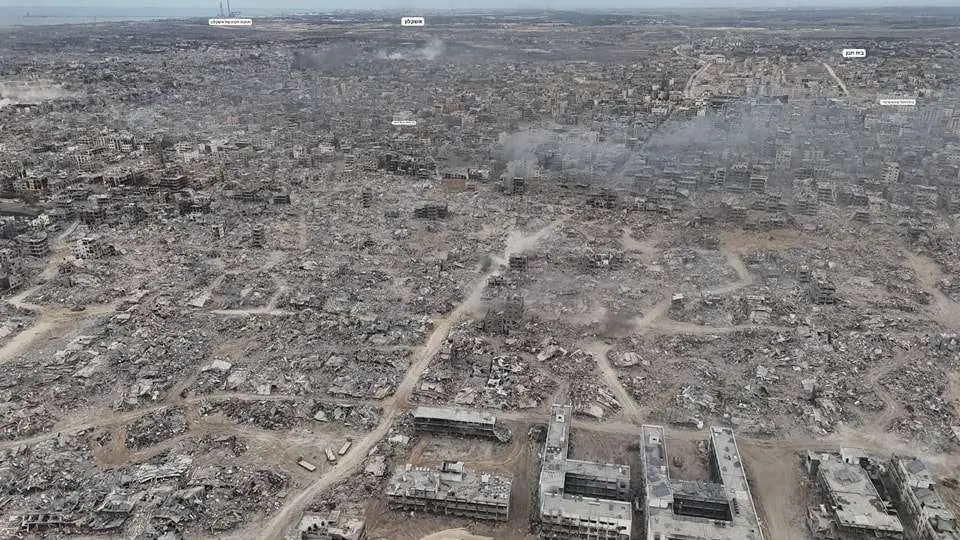
Palestinian territory – The Israeli military’s destruction of entire Palestinian cities and neighbourhoods in the Gaza Strip is a clear manifestation of the genocide Israel has been committing in Gaza for the past 14 months, and a primary tool for its implementation.

This crime has not been confined to the killing of tens of thousands of Palestinians or the gradual decimation of two million people's basic survival elements. It has extended to the complete annihilation of Palestinian cities, obliterating their architectural and civilisational fabric. This systematic destruction aims to erase the Palestinian national and cultural identity, impose permanent forced displacement, prevent return, dismantle communities, and eradicate their collective memory. It is a deliberate attempt to eliminate their physical and human existence while destroying their past, present, and future.  

    Information documented by Euro-Med Monitor's field team reveals that the Israeli army has pursued a policy of comprehensive erasure and destruction.   

Information documented by Euro-Med Monitor's field team, alongside testimonies from families forcibly displaced from northern Gaza, reveals that the Israeli occupation army has pursued, since its third ground assault on the northern Gaza Strip starting 5 October 2024, a policy of comprehensive erasure and destruction.

Methods employed include demolition using robots and booby-trapped barrels, aerial bombardment with destructive ordnance, planting explosives for remote demolition, and bulldozing using Israeli military and civilian machinery.

Euro-Med Monitor has meticulously reviewed videos and photographs published by Israeli soldiers and media platforms. Extensive aerial footage confirms the scale of destruction inflicted upon the northern Gaza Strip, with Jabalia camp left entirely in ruins, reduced to piles of rubble and impassable streets.

Entire areas, including Blocks 2, 3, 4, and 5, as well as Al-Alami, Al-Houja, Al-Falluja, Al-Tuwam, and the northern outskirts of Al-Saftawi, have been completely annihilated. Similar devastation has occurred in Beit Lahia and Beit Hanoun, leaving these once-thriving communities uninhabitable.

The systematic and comprehensive destruction of Palestinian towns and neighbourhoods—targeting homes, infrastructure, and civil and economic facilities—has persisted for over 73 days (since 5 October 2024). The pattern of devastation demonstrates that it is not militarily necessary but serves the deliberate purpose of erasing the Palestinian material and cultural presence. This constitutes a grave breach of international law.

Israel's actions align with a broader policy of urbicide where the destruction targets not just Palestinian individuals and property, but the erasure of their cultural and civilisational existence. The goal is to obliterate any material or historical trace connecting Palestinians to their land, thereby weakening their ability to remain and survive in their ancestral areas.

Israeli government ministers, officials, Knesset members, and settler organisations openly promote these actions as part of efforts to impose a new demographic and geographic reality—replacing the indigenous Palestinian population with Israeli settlers. This constitutes a flagrant violation of international law and demands immediate intervention, accountability, and justice for the victims.

This policy of urbicide is not limited to northern Gaza. Initial reports from Rafah, in the southern Gaza Strip, alongside satellite imagery and testimonies, indicate that large areas have been nearly erased. Similar destruction has devastated Khan Yunis, Shuja'iyya, Zeitoun, and neighbourhoods along the Netzarim axis. The destruction extends to homes, streets, infrastructure, and essential civil, economic, and cultural facilities, rendering these areas uninhabitable and systematically preventing Palestinian return.

This urbicide is also tied to the ongoing crime of culturcide, initiated on 7 October 2023. Since then, Israel has deliberately targeted Palestinian archaeological and cultural landmarks in a clear effort to erase the Palestinian cultural heritage. Euro-Med Monitor has documented dozens of cases where the Israeli army targeted mosques, churches, historical buildings, museums, cultural centres, and universities, all integral to Gaza's cultural identity.

While previous Israeli military operations destroyed key aspects of Gaza’s rich architectural heritage, the current assault represents its near-total obliteration.

Gaza’s heritage belongs not only to Palestinians but to all of humanity. These sites hold cultural and historical significance that transcends national borders, representing a shared global memory. The international community must act urgently to protect these sites, conduct impartial investigations into Israel’s violations, and pressure Israel to cease its systematic destruction.

All states must fulfil their international responsibilities to halt the genocide and other grave crimes being committed by Israel in Gaza. This includes imposing effective sanctions, ensuring compliance with international law and ICJ rulings, and halting all forms of political, financial, and military support to Israel. Immediate cessation of arms sales, transfers, and military aid to Israel is essential, alongside enforcing accountability for crimes against Palestinians. The International Criminal Court's arrest warrants for Israel’s Prime Minister and Defence Minister must also be executed without delay.

Moreover, countries complicit in Israel’s crimes—most notably the United States and others providing military, financial, and political support—must also be held accountable. This includes states engaging in intelligence sharing, contractual agreements, and other forms of collaboration that enable Israel’s crimes.

Immediate action is imperative to end this unprecedented destruction, bring justice to the victims, and safeguard humanity’s shared heritage and dignity.


PALESTINE

Wed 18 Dec 2024 10:17 pm - Jerusalem Time

Guterres: Ending the occupation and establishing an independent Palestinian state is a long-awaited path

UN Spokesman Stephane Dujarric announced that Secretary-General Antonio Guterres will participate in the Palestinian settlement conference next June, stressing his readiness to support the conference as necessary to ensure its success.


On September 18, the General Assembly decided to hold a “high-level international conference for a peaceful settlement of the Palestinian question and implementation of the two-state solution” next June.


In this context, Dujarric said that the Secretary-General will participate in the opening part of the conference, and that he stressed that "the region needs urgent and irreversible action to enable the parties to re-engage in the long-awaited political process towards ending the occupation and resolving the conflict."


He added that the Secretary-General stressed that this "must happen in line with international law, relevant United Nations resolutions and bilateral agreements in pursuit of the vision of two States - Israel and an independent, democratic, contiguous, viable and sovereign Palestinian State - living side by side."

ARAB AND WORLD

Wed 18 Dec 2024 9:24 pm - Jerusalem Time

Erdogan: Türkiye, Lebanon agreed to work together in Syria

Turkish President Recep Tayyip Erdogan said that Türkiye will not give up on the unity and sovereignty of Syria, adding that Lebanon and Turkey will stand by Syria for its renaissance in the next stage.


Erdogan added, during a joint press conference with Lebanese caretaker Prime Minister Najib Mikati in Ankara, that "a new era has now begun in Syria... We agree that we must work together as important neighbors of Syria."


The Turkish President pointed out that Türkiye's priorities include achieving stability in Syria, forming a permanent administration, and ensuring the integrity of Syrian territory, calling on the Syrian people to work towards unity and agreement.


Erdogan stressed that Ankara will continue to stand by the Syrian people during the next phase as it has done since the beginning of the conflict and will provide all necessary contributions, adding that Ankara looks forward to "the contribution of everyone who realizes that the stability of Syria means the stability of the region."


For his part, Lebanese caretaker Prime Minister Najib Mikati announced that his country is counting on the important Turkish role in overcoming the crises in the region, especially in Syria.


Mikati said, during an official visit that will last for hours, according to a statement issued by the Lebanese Prime Minister's Office, that Beirut is counting on the role that Turkey enjoys and its active presence in the region and the world, "especially in the radical political changes regionally, especially in Syria, which is witnessing an Israeli occupation of part of its land, and strong pressure must be exerted to end it immediately."


The Lebanese Prime Minister expressed his wishes for freedom and stability for the Syrian people, stressing the unity of Syria and its people and its full sovereignty over its lands. He also stressed working for the best relations between Lebanon and Syria on the basis of mutual respect and good neighborliness.


On December 8, Syrian opposition factions took control of the capital, Damascus, and overthrew the regime of ousted President Bashar al-Assad. Israel took advantage of these developments, canceling the separation of forces agreement with Syria and occupying the demilitarized buffer zone in the Golan.


It also launched hundreds of air strikes, destroying warplanes, various missiles, and air defense systems in numerous military sites across Syria.


PALESTINE

Wed 18 Dec 2024 8:57 pm - Jerusalem Time

Netzarim Axis... Death Corridor: No Considerations for Executing Palestinians

The Israeli army continues to commit a wide range of serious violations that amount to war crimes in the Netzarim axis in the central Gaza Strip, where civilians, including children and people carrying white flags, are being randomly targeted under flimsy pretexts, according to a report by Haaretz published today, Wednesday.


The report includes horrific testimonies of excessive and unjustified use of force in the context of the war of extermination waged by Israel on Gaza, including firing missiles from helicopters at civilians, leaving bodies to be eaten by dogs, and humiliating treatment of survivors, in a scene that reflects a flagrant violation of international laws, while the occupation classifies every Palestinian martyr as a “terrorist,” regardless of whether he is unarmed, or even if he is a child.


Corpse Line: Indiscriminate Targeting of Every Palestinian Who Approaches

The investigation focuses on the practices of the Israeli army in the "Netzarim" axis in the central Gaza Strip, where the occupation soldiers target anyone who approaches the area, or crosses an "imaginary line", which has become known among soldiers and commanders as the "line of corpses."


According to field testimonies from officers and soldiers who served in recent months in the axis established by the occupation army to separate the northern Gaza Strip from its southern part, every Palestinian executed in that area is classified as a “terrorist,” even if he is a child or an unarmed civilian.


The investigation revealed that this line, which does not appear on any map and was not mentioned in any official military orders, was known among army units as an open killing zone. One commander in the 252nd Division described the situation, saying: “After the shooting, the bodies are left uncollected, which attracts dogs that tear them apart.”


"In Gaza, residents have come to know that the presence of dogs means the presence of corpses," he continued.


The Netzarim axis extends for seven kilometers, between the security fence separating the Strip from the 1948 territories, adjacent to Kibbutz Be'eri and the coast. Note that the area surrounding it was completely evacuated of its residents and their homes were destroyed, turning the area into a military base for the occupation.


According to the report, the Israeli army officially prohibits Palestinians from entering the area, but in practice, anyone who does enter is considered a legitimate target. One officer said: “The field commanders described the area as a ‘killing zone’, where anyone who enters must be shot without exception.”


Horrific Testimonies: Civilians and Children in the Line of Fire

The newspaper reviewed numerous testimonies about targeting civilians, including children, and even people carrying white flags, showing how Palestinians are treated in Gaza. In one of the testimonies, a soldier spoke about shooting a 16-year-old Palestinian boy, stressing that he was unarmed.


When one of the soldiers objected, saying that "the boy is unarmed," the battalion commander responded, "Anyone who crosses the line is a terrorist. No exceptions, no civilians here." The body was later photographed and sent to military intelligence to verify his identity, and it turned out that he had no connection to any "militant activity."


Among the testimonies cited in the report was a soldier’s account of targeting a group of unarmed Palestinians who were carrying a white flag and waving it at the drone that was monitoring them; however, orders were given to shoot them.


“One of the commanders pointed to the white flag, saying it was an indication that they were civilians, but the senior commander said, ‘I don’t want to hear about a white flag, shoot,’” the soldier said. Despite attempts by field commanders to object, they were reprimanded and called cowards.


Excessive use of force and missiles against civilians

In another incident, four Palestinians walking near the axis were targeted. The soldier at the scene said: “They were unarmed and were spotted by drones. Despite that, we were ordered to shoot them. Three were killed on the spot. The sight of the bodies is still in my head.”


“The fourth survived and raised his hands in surrender. However, he was held naked in a cage near the site. Several soldiers passed by him and spat on him. It was disgusting. Eventually, a POW interrogator from Unit 504 arrived and asked him some questions while pointing a gun at his head. He questioned him for a few minutes and then ordered him released,” he continued.


In an example of excessive use of force in targeting civilians in Gaza, the report found that a missile was fired from a helicopter at a man and two children who were walking near Netzarim. The soldier who witnessed the incident said that “there was no justification for using such force. They were directly targeted by missiles.”


Competition between units to kill

The report said that competition between military units over the number of Palestinians killed has become a prominent feature of military operations. “Official army statements describe every dead person as a terrorist and announce the number of dead (whom they claim are terrorists), which turns it into a race between units to raise the number of dead,” said one officer. “If the 99th Division killed 150 people, the next division will try to reach 200 dead.”


The report also noted a significant expansion in the powers granted to field commanders. One officer said that battalion commanders now have unprecedented powers, including making decisions to use air power without referring to higher command. “Often, commanders feel they are running an armed militia, where field laws and regulations are bypassed,” he added.


The commander of the 252nd Division, Yehuda Wach, was described in the investigation as an extremist figure who runs operations with a mindset that is at odds with traditional military norms. In one meeting, Wach, a settler from Kiryat Arba near Hebron, said, “As far as I’m concerned, there are no innocent people in Gaza. Everyone is a terrorist.”


One officer who attended Wach’s first meeting with commanders in the Netzarim axis said he was a commander who integrated his political visions into his military plans. Another officer described him as “a little Napoleon” in a position “beyond his capabilities, and requiring leadership wisdom that was lacking from the beginning.”


The report also indicated that it sought to force the Palestinian population in northern Gaza to leave their homes forcibly towards the south, but failed to achieve this completely; the report revealed a large number of crimes, characterized by the absence of accountability and the erosion of controls, and representing a flagrant violation of international laws.


The report concluded by pointing out the psychological impact of these practices on the soldiers themselves, as one of them said, “What is happening here is not only killing Palestinians, but also killing us. If I am asked to return to Gaza, I will not do so.”

PALESTINE

Wed 18 Dec 2024 8:49 pm - Jerusalem Time

Palestinian Prisoners Authority: Detainees in Rimon Prison Suffer Starvation and Humiliation

The Commission of Prisoners' Affairs and Liberated Prisoners revealed today, Wednesday, that the detainees in "Ramon" prison are suffering from a daily war of starvation and humiliation practiced against them by the prison administration on a daily basis, in addition to the bitter cold that is ravaging their emaciated bodies.


The Commission’s lawyer reported, after visiting a number of the prison’s detainees, that the detainee Hatem Yasser Muhammad al-Jiyusi (53 years old), Section 18 Nafha, from Tulkarm, who is serving a life sentence + 55 years, was arrested on 2/21/2003, suffers from a blocked artery, and takes medication and a blood thinner.


The lawyer added that the detainee Al-Jiyousi was brought for the visit after being led in a humiliating manner for a distance of approximately 450 meters, and then he was placed in the waiting rooms for a long period while his hands and feet were tied and his eyes were blindfolded, which caused him exhaustion, fatigue and fear, and on some occasions he suffered physical injuries as a result of falling.


Regarding the situation of the section where the detainee Al-Jiyusi is being held, the Commission’s lawyer said that the detainees in the section do not have any supplies, and all their belongings have been confiscated. The detainee inside the section only has the clothes he is wearing, and all electrical appliances have been confiscated from inside the sections. He added that the detainees are cut off from the outside world and do not know anything about what happened during the previous period.


He pointed out that the administration of "Ramon" prison deliberately treats the detainees in a very bad way, with punishments, insults, assaults and continuous searches that cause anxiety, confusion and fear among them. The prison guards also confiscated the "canteen" and all its contents, and the prison administration did not leave the detainees with any necessities of life.


Regarding food, the Authority’s lawyer stated that the prison administration is adopting a starvation policy, as food is prepared in a way that causes health damage to detainees, in small quantities and of poor quality, and does not meet the needs of any detainee, as most detainees have lost a significant amount of weight, ranging between 20 and 30 kilograms.


He added that the detainees are deprived of sugar and salt, and most of them have lost consciousness due to low blood sugar. Food is also prepared without salt, and detainees are not allowed to drink tea or coffee. He pointed out that about 7 detainees are sleeping on the floor due to the lack of mattresses and blankets in the "Raymond" prison, and that the cold is ravaging their emaciated bodies.


The Authority’s lawyer indicated that he visited the detainee Muhammad Mahmoud Basyouni (36 years old) from Nablus, who was arrested on 8/10/2023, and has been suffering from a difficult psychological condition for 14 years. He was visiting the psychiatric clinic and receiving psychiatric medications on a regular basis.


Detainee Bassiouni said that detainees are subjected to extremely poor treatment, as they are forced to kneel with their faces towards the wall during each count or search, in addition to shouting, insults, humiliations and spreading terror among them.

PALESTINE

Wed 18 Dec 2024 8:43 pm - Jerusalem Time

Clashes with Israeli forces east of Tulkarm

Clashes erupted with the Israeli occupation forces, on Wednesday evening, in the town of Anabta, east of Tulkarm.


Local sources reported that the occupation forces stormed the town from the Anab military checkpoint, and patrolled its main streets and neighborhoods, specifically Al-Sikka and Al-Qahawi streets, the center of the town, and the southern mountain, which led to the outbreak of clashes during which explosions were heard.


She added that the occupation forces obstructed the movement of citizens and vehicles, and arrested a number of young men and assaulted them, without any arrests being reported.

ARAB AND WORLD

Wed 18 Dec 2024 8:23 pm - Jerusalem Time

Israeli army admits that settlers infiltrated Lebanon

The Israeli occupation army admitted today, Wednesday, for the first time, that right-wing Israelis who support settlements infiltrated Lebanese territory, where they crossed the Blue Line separating them in the Maroun al-Ras area. The infiltrators set up tents and raised banners reading "Lebanon is ours", in a move that Israeli media described as dangerous.


According to Israeli Army Radio, the group crossed the border without prior coordination, violating Lebanon's sovereignty and threatening the security of the region. The army said the incident is currently under investigation.


The radio explained that the group belongs to the right-wing "Uri Hatzvon" association, which calls for strengthening Israeli settlement in southern Lebanon.


On December 8, the Uri Hatzvon Association, known for its calls for settlement in border areas, announced the establishment of a settlement point near the Lebanese border town of Maroun al-Ras. However, the Israeli army denied the allegations at the time, stressing that no settlement point had been established inside Lebanese territory.


"The army has admitted for the first time that Israeli citizens managed to cross the border into Lebanon and set up tents there," the Israeli Army Radio said in a statement on Wednesday. "After the army claimed that the activists did not set up tents inside Lebanon, it now appears, after an investigation, that they actually crossed several meters across the Blue Line in the Maroun al-Ras area, before army forces removed them from the area," it added.


The Israeli army had earlier claimed that the infiltrators had not set up tents inside Lebanon (social media)

In turn, the army spokesman described the incident as dangerous, noting that any attempt to cross the border without coordination affects the army's ability to carry out its missions and endangers the lives of infiltrators. He stressed that the army has taken measures to enhance border security, including closing gaps in the separation fence to prevent the recurrence of such incidents.


The infiltration comes amid escalating border tensions between Israel and Lebanon, where the region has witnessed a violent exchange of shelling since October 2023. Last September, Israel declared a large-scale war on Lebanon, which resulted in thousands of deaths and injuries and the displacement of hundreds of thousands.


Although a fragile ceasefire has been in effect since November 27, Israel continues to violate it repeatedly, resulting in casualties.


There has been no official response from the Lebanese side, but the incident constitutes a new violation of Lebanese sovereignty in light of the decades-long Israeli occupation of Lebanese and Syrian territories.


PALESTINE

Wed 18 Dec 2024 7:31 pm - Jerusalem Time

Palestinians sue US State Department, demanding it cut aid to Israeli occupation army

Five Palestinians in Gaza, the occupied West Bank and the United States are suing the U.S. government for trying to cut off U.S. aid to the Israeli military over its involvement in serious human rights abuses.


The lawsuit, announced Tuesday, accuses the State Department of failing to enforce a federal law that prohibits transferring funds to foreign military units involved in serious abuses such as extrajudicial killings and torture.


“The State Department’s calculated failure to enforce the Leahy Law is particularly shocking in the face of Israel’s unprecedented escalation since the outbreak of the Gaza War on October 7, 2023,” the lawsuit says.


The Israeli war of extermination on Gaza has killed at least 45,000 Palestinians since early October 2023, most of them women and children, and the United Nations and the world's leading human rights groups have accused the Israeli military of committing war crimes, including genocide.


According to media reports, the lead plaintiff in the case, a teacher from Gaza referred to by the pseudonym Amal Gaza, has been forcibly displaced seven times since the war began and 20 members of her family have been killed in Israeli attacks.


“My suffering and the unimaginable loss my family has endured would be greatly reduced if the United States stopped providing military assistance to Israeli units that commit gross human rights violations,” she said in a statement accompanying the lawsuit.


The US State Department says it does not comment on pending litigation.


The case revolves around what is known as the Leahy Law, a federal regulation that prohibits the U.S. government from providing funds to foreign military units when there is “credible information” that they are involved in gross human rights violations.


These abuses include torture, extrajudicial killings, enforced disappearances and rape, the US State Department says in a fact sheet explaining the law.


Raed Jarrar, advocacy director for Dawn, a US nonprofit that works for democracy and human rights in the Arab world and supports the plaintiffs in the case, said Dawn is calling on the US government to obey the law.


For months, lawyers and human rights advocates have urged President Joe Biden's administration to restrict aid to the Israeli military amid multiple reports of abuses against Palestinians in Gaza and the West Bank.


Human rights groups have documented Israel's use of US-made weapons in numerous deadly attacks in Gaza, including indiscriminate strikes that killed dozens of Palestinian civilians.


Palestinians in the West Bank have also seen an increase in deadly Israeli military and settler violence since the start of the Gaza war, with the UN Office for the Coordination of Humanitarian Affairs reporting that 770 Palestinians were killed there from October 7, 2023, to the end of November 2024.


The United States provides Israel with at least $3.8 billion in military aid annually, and researchers at Brown University in Providence, Rhode Island, recently estimated that the Biden administration has provided an additional $17.9 billion since the Gaza war began.


Observers said that if the United States cut off this aid, Israel would not be able to continue its war efforts.

ARAB AND WORLD

Wed 18 Dec 2024 6:49 pm - Jerusalem Time

Smotrich rejects the "Gaza deal": Netanyahu knows our red lines

Israeli Finance Minister Bezalel Smotrich rejected the planned ceasefire agreement in the Gaza Strip, saying that in its current form it “is not good and does not serve Israel’s goals in the war and constitutes a lifeline for Hamas.”


“Hamas is at its lowest point since the beginning of the war. This is not the time to give it a lifeline. This is the time to continue crushing it and pressuring it,” Smotrich told a right-wing Israeli radio station on Wednesday. “Hamas must return the kidnapped soldiers, but in its surrender deal, not in ours.”


Red lines

Smotrich attacked the emerging deal, saying: “A deal in which hundreds of murderers who will return to killing Jews are released, and in which we give up the northern Gaza Strip and allow a million Gazans to return there, will eliminate the achievements that were achieved with so much blood, and this is a grave mistake.” He added: “The deal is not good and does not serve the goals and interests of the State of Israel, nor victory nor the return of the kidnapped soldiers, because in the end it is a partial deal.”


“He (Netanyahu) knows our red lines, and we have a lot of influence over the government’s moves,” Smotrich said, in what appeared to be a warning to Israeli Prime Minister Benjamin Netanyahu not to proceed. “There is only one thing that matters to us, and that is the interest of Israel.”


Smotrich's opposition statements came after reports of significant progress in ceasefire negotiations. Various reports confirmed on Wednesday what Asharq Al-Awsat published on Tuesday evening about significant progress in the negotiations that could make signing imminent, with most issues closed.


The agreement is supposed to include, in the first stage, a ceasefire and the withdrawal of the Israeli army from city centers, but not from the Gaza Strip, while remaining in the Netzarim and Philadelphi axes, and all women and children will be allowed to return to the northern Gaza Strip. In a later and gradual stage, the return of men will take place according to an agreed-upon mechanism.


In the first phase, which will last from 45 to 60 days, the movement will hand over about 30 Israeli prisoners, only half of whom are alive, in exchange for an undetermined number of Palestinian prisoners, including dozens sentenced to life imprisonment. According to the agreement, the Rafah crossing will be handed over to the Palestinian Authority, but not immediately and under arrangements also supervised by Egypt.


The brother of Or Levy, 34, who has been held by Hamas in Gaza since October 7, 2023, holds a poster of him during an interview with Reuters

According to a source who spoke to Asharq Al-Awsat, Hamas considers that it has made major concessions by abandoning the conditions of a ceasefire and a complete withdrawal of the army from the Gaza Strip. However, he confirmed that the movement received guarantees that this stage would be reached in the subsequent stages of the agreement. It is assumed that the handover of the remaining prisoners held by Hamas and the cessation of the war will be discussed during the first stage.


Israel and Hamas confirmed Tuesday that there had been significant progress in the negotiations. But Israeli officials believe that the matter “still needs time” due to disagreements over guarantees for a ceasefire and the fate of released Palestinian prisoners.


There is discussion about deporting some prisoners outside the Palestinian territories, an issue that has not been finally resolved because it requires the approval of Hamas, the prisoners, their families, and the host countries.


The Ynet website said that Hamas may be flexible regarding the release of prisoners abroad, and the possibility of deporting them to a third country such as Turkey, Qatar or another Islamic country is being considered.


Intensive talks are underway in Doha, joined by CIA Director Bill Burns, and in Cairo by US President-elect Donald Trump's recently appointed special envoy for hostages, Adam Boehler.


Boehler met with Prime Minister Benjamin Netanyahu on Monday and then flew to Egypt. According to Israeli media, he is also scheduled to travel to Doha for similar talks.


The US administration, joined by mediators from Egypt and Qatar, has been making intensive efforts in recent days to push the talks forward, with The Times of Israel reporting Monday that President Joe Biden is working with Trump’s team to try to conclude the deal before the latter’s inauguration on January 20.


Informed sources told Asharq Al-Awsat that Biden and Trump’s envoys came to close the deal once and for all. Several rounds of negotiations faltered and failed to reach a follow-up to an agreement reached in late November 2023, during which 105 hostages were released in a week-long truce. Four hostages were released before that, and Israeli forces rescued eight of the kidnapped alive, and the bodies of 38 of them were recovered.


Israel believes that 96 of the 251 hostages kidnapped by Hamas militants on October 7, 2023, are still in the Strip, a figure that includes the bodies of at least 34 hostages the Israeli military has confirmed were killed. Hamas is also holding two Israeli citizens who entered the Strip in 2014 and 2015, as well as the bodies of two Israeli soldiers killed in 2014.

PALESTINE

Wed 18 Dec 2024 5:43 pm - Jerusalem Time

A citizen dies of wounds sustained by the occupation forces' bullets, south of Nablus

Palestinian youth, Sobhi Sayel Hassan Darwish, died of his wounds during the occupation forces’ storming of the village of Qusra, south of Nablus, on Tuesday.


Darwish was injured yesterday, Tuesday, during the occupation forces’ storming of the village of Qasra while he was on the roof of his house.


The young man, Darwish, was declared dead on Wednesday after attempts to save him failed.

PALESTINE

Wed 18 Dec 2024 5:28 pm - Jerusalem Time

Sullivan reveals latest developments in Gaza negotiations

US National Security Advisor Jake Sullivan confirmed that the obstacles to reaching an agreement on Gaza are related to the fine details, such as determining the names of the Palestinian detainees and prisoners who will be released.


Sullivan explained that Israeli Prime Minister Benjamin Netanyahu expressed Tel Aviv's readiness to conclude the agreement.


He stressed the need for Hamas to commit to releasing the detainees in the first phase of the agreement.


He added that the negotiations are close to achieving the desired goal, and with the continued pressure of the mediators and the commitment of both parties, an agreement can be reached soon.

PALESTINE

Wed 18 Dec 2024 4:49 pm - Jerusalem Time

International newspapers: Hamas and Israel "more serious" about reaching an agreement

The developments in the Gaza Strip and Syria have captured the attention of some international newspapers and websites, in addition to the internal situation in Israel in light of an opinion poll whose results showed that “Israeli democracy is in grave danger.”


An analysis in the New York Times concluded that there is growing optimism about a ceasefire in the Gaza Strip. It noted that the Israelis and Palestinians have refrained from leaking details of the talks to the media, unlike what was prevalent in previous negotiations.


Some analysts believe that the blackout indicates that Hamas and Israel are “more serious” about reaching an agreement this time, the New York Times reported.


Hamas said - in a statement published yesterday, Tuesday, on its official website on Telegram - that reaching an agreement to cease fire in Gaza and exchange prisoners is possible "if the occupation stops setting new conditions."


On the subject of Syria, an article in Foreign Policy magazine called for preserving records of atrocities in Syria, and demanded rapid and coordinated efforts to protect them from being lost in the chaos.


He pointed out that "Sednaya prison represents an archive of horror," and that these documents constitute essential evidence for understanding the mechanisms of the atrocities carried out by the regime of ousted President Bashar al-Assad, identifying the perpetrators responsible, and most importantly "achieving justice for the victims and survivors of one of the most brutal regimes in modern history."


In the same context, The Times wrote that Maher al-Assad, Bashar's brother, was the actual military commander who led the campaigns of repression against the Syrians, and "his name represents a horror story. He is close to Iran, and it is believed that he was constantly pressuring his brother Bashar throughout the war not to give in."


According to the newspaper, Maher al-Assad is among the most corrupt figures in the former regime, as he withdrew money from state coffers into family accounts, and supervised the manufacture of drugs.


The Times confirmed that France has already issued an arrest warrant against Maher al-Assad, and that a group of Syrian and Western legal experts are preparing plans to prosecute him.


Regarding the internal situation in Israel, Haaretz newspaper published the results of a poll conducted by the Israel Democracy Institute, which showed that the majority of Israelis “have lost confidence in their state’s institutions, and believe that democracy is in grave danger.”


More than 48% of them described the general situation in Israel as bad or very bad, compared to only 19% who said that “the situation in Israel is good or very good.”


According to an article by Eran Weintraub in the Jerusalem Post, “Israel is engaged in internal and military struggles on multiple fronts.”


But poverty has become, according to the writer, “an existential threat to hundreds of thousands of Israeli families,” stressing that the result of the war on poverty so far is absolute failure.

PALESTINE

Wed 18 Dec 2024 3:30 pm - Jerusalem Time

Hamas: Gaza ceasefire agreement in final touches, 90% of prisoners' file resolved

A leader in the Islamic Resistance Movement (Hamas) confirmed, in exclusive statements to Al-Araby Al-Jadeed, today, Wednesday, that the ongoing negotiations to reach a ceasefire agreement in Gaza were able to resolve the vast majority of the points of contention, adding that the agreement may be in the final touches stage.


The leader explained that the indirect negotiations in Doha resolved the thorny points in the file of Palestinian prisoners with high sentences who are scheduled to be included in the exchange deal, noting that "90% of this file has been resolved and there are still some minor remarks." The leader stressed that "it can be said that we are about to announce reaching a real agreement unless any new demands or remarks are added by the Israeli occupation government," adding that "the discussion of the proposed vision has been completed and understandings have been reached regarding all of its provisions."


This comes at a time when Hamas confirmed in an official statement issued by its leadership yesterday, Tuesday, "that in light of the serious and positive discussions taking place in Doha under the auspices of Qatari and Egyptian mediators, reaching an agreement for a ceasefire and prisoner exchange is possible if the occupation stops setting new conditions."


Sources had previously revealed that a leadership delegation from Hamas is scheduled to arrive in Cairo within two days to discuss the agreement file and the Gaza Administration Committee, which is a major part of the expected agreement, as it is scheduled to operate the Rafah land crossing according to the mechanism of the 2005 agreement with the occupation government, and for the authority to be on the Palestinian side of the crossing.


The Hamas delegation is scheduled to arrive in Cairo at the same time as an Israeli delegation to discuss points related to the agreement regarding the operation of the crossing and the nature of the Israeli presence in the Salah al-Din (Philadelphi) border corridor. Palestinian President Mahmoud Abbas is scheduled to arrive in the Egyptian capital, Cairo, today, Wednesday, at the invitation of Egypt to hold in-depth discussions on his position rejecting the formation of the Gaza Administration Committee, despite Hamas’s announcement of its approval of it. Abbas’s discussions are also scheduled to include developments in the situation in the West Bank and Israeli attempts to annex it, in light of estimates related to the support of the administration of US President-elect Donald Trump for this approach.


PALESTINE

Wed 18 Dec 2024 2:40 pm - Jerusalem Time

Israeli forces arrest a Palestinian woman north of occupied Jerusalem

Today, Wednesday, the Israeli occupation forces arrested a woman from the town of Beit Hanina, north of occupied Jerusalem.


Local sources reported that the occupation forces arrested the director of the Arab Studies Association, Sanaa Hasna, after raiding the association’s headquarters in the town.

PALESTINE

Wed 18 Dec 2024 1:53 pm - Jerusalem Time

Israel opens new detention camps amid rising number of detainees

The Commission of Prisoners' Affairs and the Palestinian Prisoners' Club said that the detainees held in the Israeli "Manashe" camp have been carrying out protest steps for days, and yesterday they informed the lawyers during their appearance before the occupation court via video conference that they had begun a hunger strike in protest against the difficult and harsh detention conditions they face.


The Authority and the Club explained in a joint statement, today, Wednesday, that the number of detainees held in the (Manashe) camp until yesterday is about 100 detainees, noting that the camp is one of a number of camps that the occupation has established, in light of the escalation of arrest campaigns in the West Bank since the beginning of the war of extermination. It is geographically located in the north of the West Bank near the (Salem) camp, and administratively it is affiliated with the occupation army, as is the case with the (Etzion and Hawara) detainees, which are administratively affiliated with the occupation army, as they were established during the years of the second intifada with the escalation of arrest campaigns, and later the occupation kept the two camps to detain new detainees, and they are among the worst detention centers.


In this context, the Commission and the Club pointed out that there are dozens of reports from human rights institutions that have documented over the years the nature of the harsh and difficult detention conditions that degrade human dignity, which have doubled after the war against detainees as a result of the practice of torture crimes in them, specifically the (Etzion) detention center, which after the war has turned into an arena for torturing and abusing detainees, and there are dozens of testimonies that document what detainees are exposed to in the aforementioned camp, noting that since the beginning of the war, the occupation has deliberately detained dozens of detainees in (Etzion) for several months, so that the detainee’s only wish becomes his transfer from the camp, which represents a station of humiliation and terror for detainees.


One of the detainees explained to the lawyer through the court that the camp does not have warm water at least, in light of the severe cold, and it lacks a clinic or even a nurse. There are some detainees who suffer from health problems and have been in the camp for some time, in addition to their suffering from the crime of starvation and the severe shortage of clothing, since the camp is basically a new camp, and all of those in it are new detainees under arrest, in addition to the acts of torture to which they are subjected.


The Authority and the Club pointed out that despite the numerous demands from the relevant institutions to close the Etzion and Hawara camps, the occupation insists on using them as a station for abusing and torturing detainees, under the management of the occupation army. Today, instead of closing the Etzion and Hawara camps, it is working to expand the circle of camps affiliated with the army, by establishing new camps such as the Manash camp, in addition to other camps established for detainees from Gaza, such as the Naftali camp. The Authority and the Club previously issued a report regarding the new camp.


The Authority and the Club also pointed out that the camp administration, since its establishment, has imposed great restrictions and complications on completing visits to the detainees in it, and since its establishment it has allowed visits only once, while stressing that there are legal efforts being made through lawyers in order to improve the conditions of the detainees and convey their demands, as well as in order to allow visits to them.

PALESTINE

Wed 18 Dec 2024 1:03 pm - Jerusalem Time

Gaza: 38 dead in 24 hours, bringing the death toll to 45,097

The Ministry of Health in Gaza announced today, Wednesday, that the death toll in the Gaza Strip has risen to 45,097, the majority of whom are children and women, since the start of the Israeli occupation aggression on October 7, 2023.


She added that the number of injuries has risen to 107,244 since the beginning of the aggression, while thousands of victims are still under the rubble.


She pointed out that the occupation forces committed 3 massacres during the past 24 hours, which resulted in the death of 38 citizens and the injury of 203 others.

PALESTINE

Wed 18 Dec 2024 12:16 pm - Jerusalem Time

Sources to Al-Quds: The exchange deal is in its final stages, and those with high sentences will be deported to Turkey and Iran

Al-Quds learned from Palestinian sources familiar with the progress of the exchange deal negotiations that they have reached their final stage and that the names and sentences of the prisoners to be released from the occupation’s prisons are being investigated.


These sources reported that those with long sentences will be deported to Türkiye and Iran, while the rest will be released in the West Bank and Gaza Strip.

PALESTINE

Wed 18 Dec 2024 10:44 am - Jerusalem Time

Smotrich: Israeli prisoners must be returned in Hamas surrender deal

The head of the Religious Zionism Party and Israeli Finance Minister, Bezalel Smotrich, said on Wednesday that he opposes the prisoner exchange deal between Israel and Hamas, which is currently being negotiated, and claimed that it is a deal that is "not good and does not serve Israeli goals and interests in the war, nor the return of the kidnapped soldiers because it is a partial deal."


Smotrich said in an interview with a right-wing radio station that "Hamas is at its lowest point since the beginning of the war, and this is not the time to give it a lifeline. This is the time to continue striking it and pressuring it to return the kidnapped soldiers, but through a surrender deal, not our surrender."


He added that deals in which hundreds of Palestinian prisoners would be released and the Israeli army would withdraw from the northern Gaza Strip "and allow a million Gazans to return there, are a grave mistake."


Smotrich claimed that "if we were not talking to Hamas but seeing it through the muzzles and fire of tanks and planes and madness, the kidnapped would have been here a long time ago."


He added that Prime Minister Benjamin Netanyahu "knows what our red lines are, and we have a great influence on the government's moves. I am proud of the ability to conduct objective deliberations, and only a donkey does not change his mind." He claimed that "there is only one thing that matters to us, and that is the interest of Israel, and now we are talking about another deal, not one that serves the security of the state or the return of all the kidnapped. And this is a problem in my view, that we decide who will return and who will not return."


Yesterday, the Israeli Broadcasting Corporation (Kan 11) reported that the recent progress in the negotiations did not lead to a "breakthrough," with disagreements continuing over key issues, most notably the Israeli presence in the Salah al-Din "Philadelphi" axis, the prisoner exchange plan, and the number of prisoners that might be included in the deal.


The Walla website also quoted three senior Israeli officials as saying that the gaps are still large and that reaching an agreement in the near future is not expected. One of the officials said that "Hamas insists that any prisoner deal must lead to an end to the war," which Israel rejects.


Israeli sources considered that some gaps cannot be bridged through the ongoing talks in Doha, and require decisions from the political leaderships on both sides.


One of them added that "we may need to go through a new crisis in the negotiations to push the two sides to make the required decisions," and Channel 13 reported that the negotiations are being managed in a limited manner by Netanyahu, Minister of Strategic Affairs, Ron Dermer, and Mossad chief, David Barnea.


Hamas said in a statement yesterday that the indirect talks taking place in Doha with Qatari and Egyptian mediation were "serious and positive," noting that reaching an agreement is possible if "Israel stops setting new conditions."

ARAB AND WORLD

Wed 18 Dec 2024 10:03 am - Jerusalem Time

Israel pushes for security control in buffer zone in Syria and Gaza

The Wall Street Journal reported Tuesday that the Israeli defense minister indicated that Israel plans to maintain tighter, long-term security control over territory across its borders in Syria and Gaza, and take advantage of the weakness of its neighbors to better insulate itself from potential threats.


Israel has taken control of the 155-square-mile (260-kilometer) buffer zone separating it from Syria after the collapse of Syrian President Bashar al-Assad’s regime more than a week ago. The Israeli military has also taken control of Mount Hermon, a high ground in the buffer zone that offers a commanding view of the strategically sensitive territory.


According to the newspaper, "During a visit to the buffer zone and a summit with Israeli Prime Minister Benjamin Netanyahu, Defense Minister Israel Katz ordered soldiers on Tuesday to set up fortifications and prepare for an extended stay. He described the summit as 'the eyes of the State of Israel.'"


Abu Mohammed al-Jolani, the rebel leader who led the offensive that toppled Assad, said in an interview Monday that there was no justification for Israeli military forces inside Syria. Katz described the rebels as extremists and said they needed to be deterred.


The United Nations and other countries including France, Saudi Arabia, Kuwait, Egypt and Jordan have condemned Israel’s move into the buffer zone — created under a 1974 agreement between Israel and Syria that assigned U.N. peacekeeping forces there — as a violation of international law that threatens Syria’s territorial integrity. Israel said the agreement was void after Syrian troops abandoned their positions as the regime collapsed.


Meanwhile, signs that Israel is preparing for an indefinite presence in the Gaza Strip continued to grow, with Katz saying the IDF would maintain security control over the enclave just as it does in the occupied West Bank.


“My position on Gaza is clear: After we defeat Hamas’s military and governmental power in Gaza, Israel will have security control over Gaza with full freedom of action as it did in Judea and Samaria,” Katz said in a post on Twitter on Tuesday, using the biblical term for the occupied West Bank. The Palestinian Authority partially controls some areas of the West Bank while Israel maintains tight security control and regularly carries out military raids.


Katz’s comments were unusually strong for a senior official and come as negotiations for a cease-fire in Gaza are underway. A halt to the fighting has proven elusive for months in part because of disagreements over Israel’s insistence on keeping troops in parts of the enclave.


Palestinians and some Israelis fear that security control would lead to a long-term military occupation of the Gaza Strip. That would require a large and costly force and burden Israel with the task of administering a civilian government over a population of about two million.


Analysts said the comparison with the West Bank was flawed because Israel has a security partner there in the form of the Palestinian Authority. Israel currently has no such partner in Gaza, which could be responsible for civil affairs such as education and garbage collection.

“With troops on the ground, Israel’s obligations increase,” Adil Haq, a professor at Rutgers University in New Jersey who focuses on the international law of armed conflict, told the newspaper.

Netanyahu has previously said that Israel will maintain security control over Gaza, and has previously ruled out the option of the Palestinian Authority running the territory instead of Hamas. Members of his Likud party and other parties in his coalition have expressed support for tighter control, including the establishment of Jewish settlements in the Strip.

The International Court of Justice, the United Nations’ highest court, said in an opinion in July that Israel had violated various international laws in its decades-long occupation of Palestinian territory, including Gaza and the West Bank. The court said that under international law, an occupation is supposed to be temporary, and that an occupying power has legal responsibilities towards the population of the occupied territory.

The court said Israel had committed acts that indicated that its occupation of the Palestinian territories did not appear to be temporary and that Israel had neglected some of its duties as an occupying power. Israel has challenged the court's opinion and its jurisdiction.

Since the early days of the invasion of Gaza, the Israeli military has been building a sprawling, 18-square-mile security corridor known as Netzarim—the name of a former Jewish settlement in the Strip. Consisting of military bases, outposts, electricity poles, cell towers and even a synagogue, the corridor bisects the Strip and controls the movement of Palestinians. Those seeking to move south must pass through one of two checkpoints that run through the corridor.

Katz's comments and Israel's construction of military infrastructure in Gaza suggest that the long-term future "is moving toward not just de facto control, but outright military control over the lives of Palestinians in Gaza," said Diana Buttu, a former legal adviser to the Palestine Liberation Organization who worked on International Court of Justice cases.

Last November, Housing and Construction Minister Yitzhak Goldenbeff toured the area near the Gaza border with prominent settlement leader Daniella Weiss as they looked at a map showing planned future settlements in Gaza. “Jewish settlements here are the solution to the terrible slaughter,” he said, referring to the October 7, 2023, attack. Lawmakers from Netanyahu’s Likud party have attended two major conferences calling for resettlement in the Strip since the war began.

The Wall Street Journal reported earlier that Hamas had told mediators it would agree to a deal that would allow Israeli troops to remain in Gaza temporarily when the fighting stops. Previous rounds of talks have repeatedly faltered, but Hamas has shown more flexibility in recent weeks on several key issues. The mediators said the proposals include a willingness to accept Israeli troops temporarily staying in the Netzarim Corridor and the Philadelphi Corridor, a small strip of land along Gaza’s border with Egypt.

OPINIONS

Wed 18 Dec 2024 9:38 am - Jerusalem Time

Changing Arab Societies - Adonis.. Once Again-

Almutawkel Taha

Almutawkel Taha

Opinion Writer

In his interviews and writings, Adonis is accustomed to making statements that carry definitive and decisive implications, which actually establish one-dimensional criticism and demand “change” and “revolution” from his point of view, because Arab Islamic society, from the time of the Muhammadan mission until today, is backward, and its history is a series of blood, conspiracies and bitterness, according to his statement.


As I reviewed the lines issued by Adonis, from his article in the Lebanese newspaper As-Safir on July 13, 2011, until his statement a few days ago in Paris, I felt compelled to repeat what I said; that the man covers the crisis of his cultural content with a cover of philosophy and historical selectivity, and falls into the mire of contradictions. With his historical selectivity, he drags one case upon another completely different case, because he wants the “revolutions” to be a carbon copy and literal copy of the West’s conflict in the Middle Ages with the dark church at that time. He wants us to uproot the intellectual and cultural system that shaped our Arab identity, over the course of fourteen centuries, in order to achieve the process of severing ties with our history and roots. And severing ties here, too, is an idea imported from the West, and out of context in its mission with our history, because it belongs to the same stage that he cut off from Western history, which is the Middle Ages. It is clear that his philosophical and terminological immersion did not serve him much, and did not intercede for his ideas in marketing the idea of the "continuous past", because the most important confirmed facts in the social sciences are that the variable is the only constant, and there is no continuous past intellectually or philosophically. This, again, is one of Adonis's many sophistries, which appeared clearly in his previous letter to his "elected" fugitive president Bashar al-Assad in 2011! As long as we are in the context of the social sciences, Adonis, despite his size and output, makes mistakes in the simplest definitions related to society, homeland and state. Society is a group of people living on a land that has a common history, "one collective memory", and has common goals, and Arab society does not lack any of these pillars. As for the issue of contradictions between social classes, it is one of the manifestations of human gathering. Are Western societies in their medieval and modern ages free of contradictions? So, what is diversity? Adonis is not allowed to formulate the components of nations and their cultures as he pleases, because they are the product of the interaction of the individual/society with enormous and multiple historical factors that are not interrupted, or abstracted in Adonis’s way, and citizenship is not an alternative to religion or contradictory to it. If you like, the definition of civil society is the group of institutions and organizations that arise voluntarily, separate from the state, and voluntariness here is a basis and a condition, while for Adonis it is coercive and involuntary.


It is arbitrary in Adonis's views to begin with the denial of the Arabs and their failure, throughout their history, to build a civil society. The term is essentially modern and dates back to the second wave of democratic change in the West, while it is authentic and deep-rooted in Arab-Islamic thought, from the state of Medina and the twenty-one points that the Prophet Muhammad - may God bless him and his family and grant them peace - began with, which were based on contracting and not coercion, fourteen centuries in advance, which the great thinker Adonis mocked, and passing through Cordoba and Andalusia at their peak, as well as the era of Harun and al-Ma'mun in Baghdad, since social justice is the practical essence of the civil state and civil society. The conflict, against the backdrop of which the Arab revolutions erupted, was not free of suspicious interventions, but it began, and it cannot be reduced to a mere political conflict over rule and authority, because it arose against a backdrop of injustice and the absence of social justice, and an economic, intellectual and cultural interaction that seeks freedom, dignity and equality, regardless of its consequences.


I do not deny that the scene in the midst of the transformation process was ambiguous for everyone, and perhaps the chaos, suspicious interventions and destruction during and after the change contributed to confusing understanding, and perhaps people were repelled by the entire change process because of its color, discourse and connections, and perhaps they preferred the continuation of injustice, oppression and dictatorship over freedom coupled with destruction, chaos and the absence of security.. which requires those who are responsible for the current and future change to be up to the enormous challenge facing everyone, or else!


Changing the ruler was not a priority, and it was not a goal except to the extent that his absence achieves the presence of rights and the restoration of free space, justice, democracy, and changing the social, economic, and political reality. Religion was not the reason for the components of oppression, injustice, selling wealth to the West, and defeat in the face of the power of arrogance. Rather, it was carried out by wicked, authoritarian regimes that were linked to our opposite and were dedicated to serving it. Perhaps the people’s raising of the slogan of the civil state means that they realized with their awareness, and not with the theorizing of “Westernized thinkers,” that the civil state is a state that does not only serve difference, but also establishes it and accepts its practice. It thus fuses social diversity into a single national identity governed by a contractual relationship based on the law of citizenship.
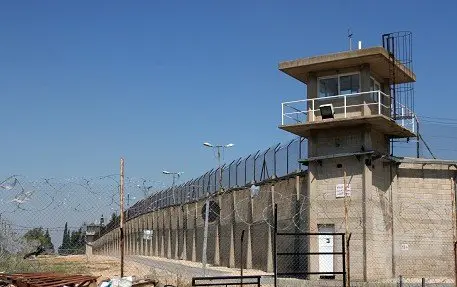

What is happening in the Arab world is broader than the struggle for power. Rather, it establishes a massive, deep and broad transformation in the local, regional and international reality, and places the Arab peoples in the face of their local, regional and international usurpers.


In Adonis’s defense of minority rights and identity, he made a methodological mistake in an issue related to democracy, because the essence of democracy is based on the authority of the people, regardless of their thought, belief, gender, and color. Adonis thus lost the majority and the minority when he erased the right of the majority and put it in a contradictory formula intertwined with the minority, while in reality it goes back to the contractual relationship between individuals and the state, as citizenship is a law that includes everyone. Coercion in the Western democratic model is a thorny intellectual issue that is still an arena for discussion, dialogue, and criticism among thinkers; liberal democrats and non-liberal democrats. Applying this issue to the Arab countries, which have not yet established their democratic model, is an out-of-place preemption. Dyeing Arab-Islamic history with one color, which is blood, violence, and oppression, indicates unnecessary blindness or suspicious selectivity. Arab history, which gave human civilization much of its luminous cargo and treasures; It did not witness the emergence of fascist or Nazi phenomena in its lap - as happened in the West - and Muslims and Arabs did not commit the genocide of millions in the New World, nor did atomic bombs, the Inquisition, two world wars, and McCarthyism. Rather, Arab and Islamic history resembles the history of positive civilizations that were right and wrong, and its product must not be reduced to one bad, offensive characteristic that characterizes it with criminality, backwardness, and blackness.


Conflict is a historical phenomenon, and many consider it a driving force of history, while bloodshed is an individual tendency or the result of social and economic crises that do not mark the face of history for any people. I am not calling for the purification of our history, as much as I am calling for objectivity, and for us to mention the flare-ups along with the failures. Adonis has fallen into stereotyping and repeating ready-made, unjust sayings, without examining or scrutinizing, as he deliberately and easily repeated Western, Orientalist sayings about Arabs and Muslims.


We ask: Why did Adonis not mention the horrific and terrifying brutality of the Syrian regime, and what the “civilized” West is doing in Gaza while supporting and appeasing the genocide? And why did Adonis not condemn this resounding holocaust, with a single word?! Or does he take into consideration the feelings of those who present him with awards? And why does he criticize the opposition because of its ideological color, and take it to the closed wall?!

From all of the above, it appears that Adonis’ revolution is limited to one concept, which is the necessity of ruling the nation from outside its culture.


On the other hand, I realize that there is a cultural discourse that has chosen to stand on the sidewalk, and it will certainly not be able to comprehend the past, identify the dangers, and triumph over them, because it has simply stopped thinking and working. Our cultural discourse, today, is similar to our situation, and is not much different from our reality. In other words, the colonial West’s action, which aims to keep us in a state of loss, fragmentation, nihilism, ignorance, plunder, alienation, conflict, difference and division, has succeeded to a large extent, not only because it is strategic, continuous, comprehensive and supported, but also because we have not created the theory capable of creating a greater action to absorb and confront those decisive strategies, and I mean, at least, creating a cultural and intellectual action that is capable of exposing the conspiracy, its components and parties, and reviving the factors of survival, unity, identity, belonging and presence, on the land of freedom and natural pluralism that enriches, and on the principle of experimentation and modernity connected to the origin and the root, and from the perspective of criticism as a permanent state and a corrective goal, far from execution or accusation or falling into the sayings of Orientalism, or adopting ready-made or populist or pre-prepared ideas.

OPINIONS

Wed 18 Dec 2024 9:33 am - Jerusalem Time

His Holiness Pope Francis and President Abbas: Men of Peace

Father Ibrahim Faltas, Deputy Custos of the Holy Land

Father Ibrahim Faltas, Deputy Custos of the Holy Land

Opinion Writer

I had the opportunity to meet Pope Francis twice in a few days.


Meeting and listening to Him is always a blessing and a reason for spiritual growth.


On Thursday, December 12, I was part of the delegation that accompanied Palestinian President Abu Mazen to his meeting with His Holiness Pope Francis.


It was like a meeting between two elderly men who understand and support each other. Two men who look into each other’s eyes and hearts and seek and build peace through truth and justice. Pope Francis is not silent, and he is not afraid to courageously affirm the power of truth and justice.


President Abu Mazen, like a wise and loving father, tries to support the children of Palestine and keep them united. He suffers with them and for them in the pursuit of the right to peace that seems so difficult to obtain. The Holy Father does not judge people according to the color of their skin, their place of birth or their religion. Pope Francis welcomes everyone: victims and persecutors, innocents and sinners, and asks us to forgive like Jesus who, before giving up his spirit, forgave and asked forgiveness for those who crucified him.


Two men, who seem to belong to two different worlds, but have the same heart and the same vision.


The Holy Father asks for peace, he did so also on the day before the Feast of the Immaculate Conception in front of the scene of the Nativity scene, which was given as a gift from the city of Bethlehem.


About 800 years ago, Saint Francis of Assisi wanted to represent the Nativity scene in the Italian city of Greccio: this was the first depiction of the coming of the Savior on earth, the living God.


In the Nativity scene, which was made by craftsmen from Bethlehem and donated to Pope Francis, and at the initiative of the Higher Presidential Committee for Church Affairs and the Embassy of Palestine to the Holy See, the Chairman of the Higher Presidential Committee for Church Affairs, Dr. Ramzi Khoury, always seeks to take the initiative in everything that would convey the voice and message, the suffering and pain of the people and the Embassy of Palestine to the Holy See, the land of love and peace, Palestine, to the world through spiritual and political leaders, and with coordination and follow-up from the Embassy of Palestine to the Holy See, represented by Ambassador Issa Qassisieh, who in turn worked day and night to bring out this initiative in the most beautiful way.

Craftsmen from Bethlehem transformed olive wood into statues of the Holy Family, seashells into stars, wool into sheep, and the fabric and distinctive colors of the keffiyeh into the warmth that should envelop all the children of the world represented by the Child Jesus. This piece of cloth protected the Holy Child from the cold of the cave and from the indifference of those who did not receive him and did not want to understand his message, a message of love and peace.

The keffiyeh fabric is decorated with olive leaf motifs that express the value of the Palestinian land and the strength of its people, and fishing net motifs because the Mediterranean Sea was a great resource for Palestine. This is expressed by the texture of waves and lines that symbolize contact with other countries and exchanges between neighboring and different peoples.


There is no higher goal than working for peace, and whenever we try to save children and save their future and the future of humanity, our work is for peace and peace only.


We work for peace so that we do not forget or erase the memory of 20,000 children who lost one or more limbs, and who, if they survive, will bear indelible marks on their bodies for life.


We work for peace by taking the example of two men of peace who, despite the weight of the years and their own experience, never lose hope in the possibility of seeing humanity united and free from wars.


Meanwhile, in Gaza and around the world, children continue to die and suffer, like the peers of the baby Jesus, who suffered and died, because the power of King Herod feared the humility of a child born in a cave.


The men of peace demand protection for children who are not protected and who have been deprived of their rights and vital needs. Children who have no voice and no ability to cry out and expose the defeat, shame and scandal of war.


The Holy Father does it for all of them: “Enough war! Enough violence!” Enough cheap dealings with precious lives and sublime values.