PALESTINE

Fri 10 Jan 2025 2:49 pm - Jerusalem Time

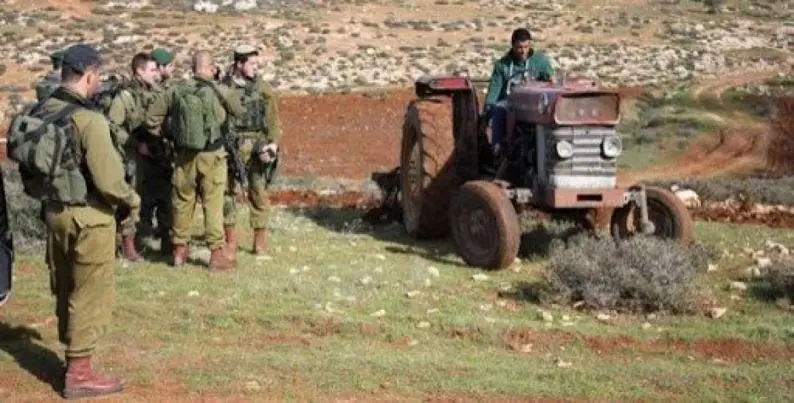
Israeli occupation prevents citizens from cultivating their lands in the northern Jordan Valley

Today, Friday, the Israeli occupation forces prevented citizens from cultivating their lands in the Umm al-Quba plain in the northern Jordan Valley.


According to local sources, these forces prevented citizens from completing their work of ploughing and cultivating their agricultural lands in the plain.


Two weeks ago, the occupation prevented citizens from cultivating their lands in the plain, under direct incitement from the settlers.

PALESTINE

Fri 10 Jan 2025 1:20 pm - Jerusalem Time

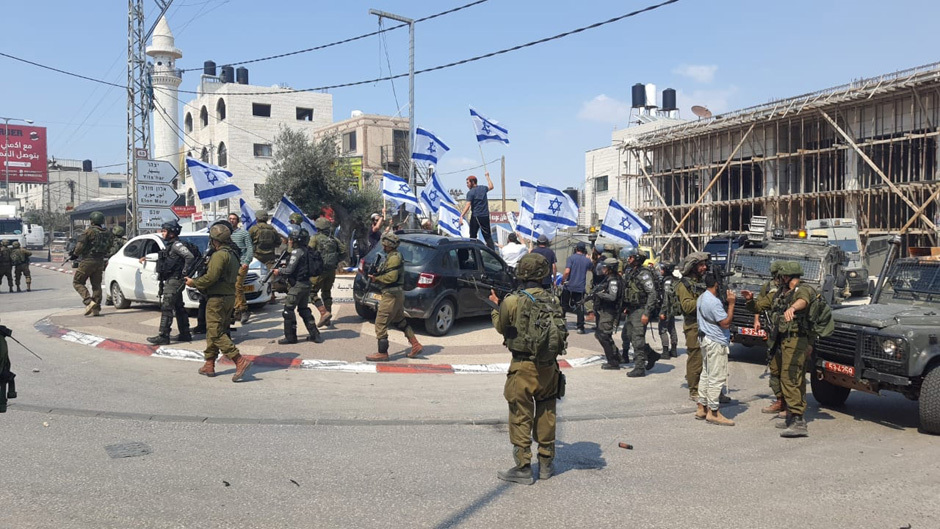
Injuries during Israeli occupation's suppression of a march against colonialism south of Nablus

A number of citizens suffered from suffocation, today, Friday, after the Israeli occupation forces suppressed a march against colonialism in Beita, south of Nablus.


Local sources reported that the occupation forces targeted the participants in the march and prayer in the vicinity of Mount Sabih in the town of Beita, with toxic tear gas bombs, which led to a number of them suffocating.


It is noteworthy that the anti-colonial march came in denunciation of the occupation’s seizure of dozens of dunams and the legalization of the “Avitar” colonial outpost on the lands of Jabal Sabih in the towns of Beita, Qabalan and Yatma in the south.

PALESTINE

Fri 10 Jan 2025 1:19 pm - Jerusalem Time

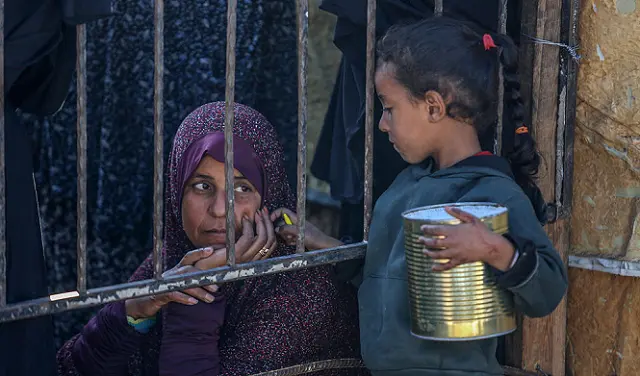
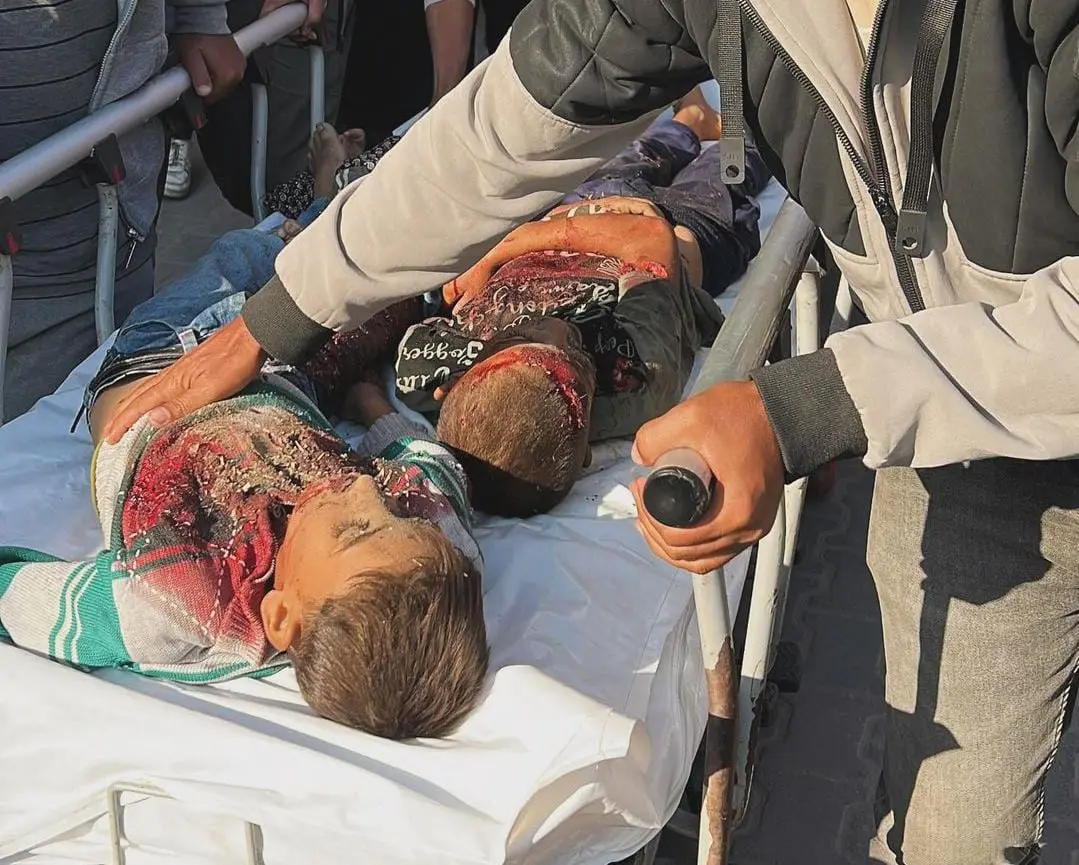
Dead and wounded in Israeli bombing of central and southern Gaza

At least 5 citizens were killed and others were injured in a bombing that targeted Al-Bureij camp in the central Gaza Strip.


A number of citizens were also killed and others were injured in an Israeli bombardment that targeted the Al-Mawasi area west of Khan Yunis city in the southern Gaza Strip.


Local sources also reported that at least two citizens were killed in a warplane attack on Al-Mansoura Street in the Shuja'iyya neighborhood, east of Gaza City.

ARAB AND WORLD

Fri 10 Jan 2025 1:12 pm - Jerusalem Time

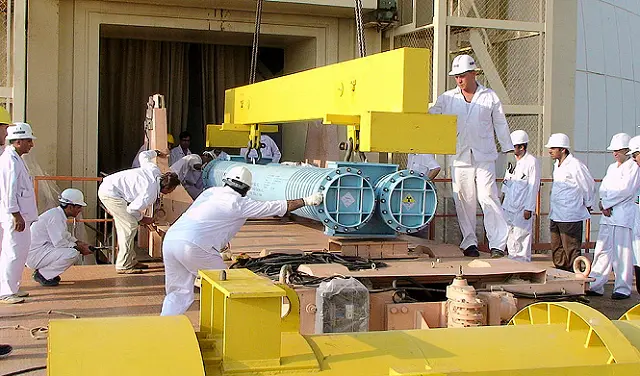
Israel is convinced that it can attack the Iranian nuclear program alone

There is a growing conviction in the Israeli security establishment that Israel can attack and destroy the Iranian nuclear program facilities on its own, if it is trained and equipped with the necessary weapons. This is linked to the capabilities and training that the Israeli intelligence services and air force have accumulated during the war on Gaza and Lebanon and raids in Iran and Yemen in the past year and a half, according to a report published by the Yedioth Ahronoth newspaper today, Friday.


Israel announced that 2025 will be the "Year of Iran," considering that "after the destruction of the axis of resistance, the elimination of Hezbollah's arsenal, and the destruction of most of Iran's air defenses, there will be no better opportunity," according to the newspaper.

The Israeli political level asked the army to prepare and make plans for an attack against the Iranian nuclear program, which could be carried out quickly and with tremendous force, "and not through a war that lasts for weeks."


The newspaper pointed out that there are two conditions for such an Israeli attack. The first condition is that the United States provide equipment and capabilities that it has refrained from providing until now. The second condition is that “the Americans have a plan for the day after the attack in Iran,” so that Iran stops developing its nuclear program, “and realizes that there is no point in responding and attacking Israel or responding with an attack in the Gulf and igniting the entire region.”


Israeli Prime Minister Benjamin Netanyahu fears that US President-elect Donald Trump will dictate to Israel to stop the war on Gaza and a new nuclear deal with Iran, according to the newspaper.


The newspaper pointed out that "Israeli self-confidence is somewhat intoxicating," and pointed out that what was not revealed after the Israeli operation to blow up the pagers in the possession of Hezbollah members, is that Israel detected that Iran transferred to Hezbollah machines that could have detected this Israeli operation, and that the Israeli Air Force bombed the warehouse of these machines, but the media at the time spoke of bombing a Weapons will be deposited, “so the deep danger is euphoria and overconfidence, in the context of Iran as well.”


Israel would prefer the United States to launch a large-scale attack on Iran’s nuclear facilities, “but those who have spoken to President-elect Trump remain skeptical about his intentions and determination to act against the nuclear facilities. All those who have spoken to him have no doubt that he will provide Israel with the ammunition and equipment necessary to launch a successful attack.”

PALESTINE

Fri 10 Jan 2025 12:11 pm - Jerusalem Time

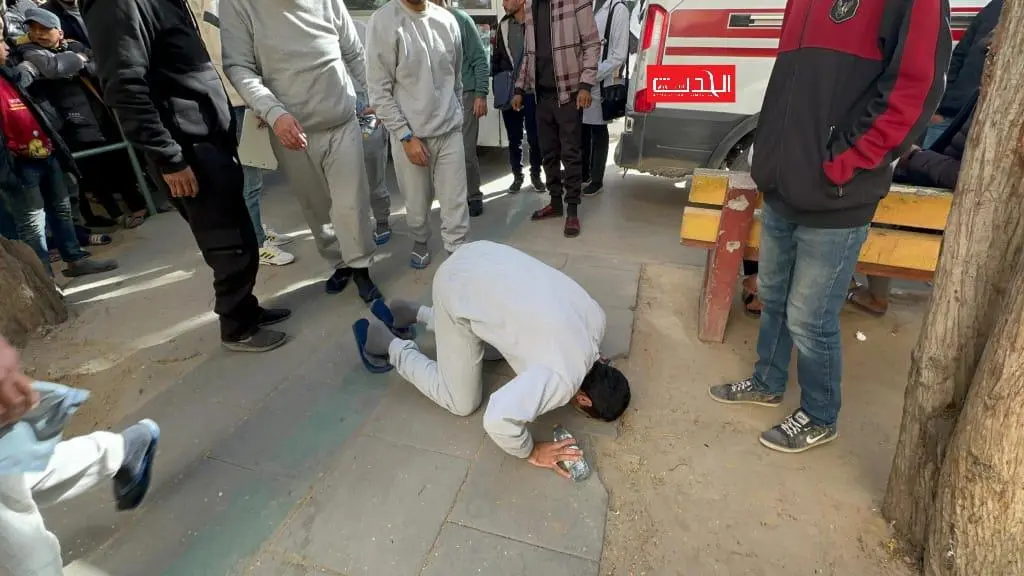
Israeli occupation releases 5 Palestinian prisoners from the Gaza Strip

The Israeli occupation authorities released, on Friday afternoon, 5 prisoners who were arrested from different areas in the Gaza Strip.


According to local sources, the five prisoners arrived at the European Hospital in Khan Younis after their release.


The sources indicated that the five prisoners are: Ahmed Fouad Matar, Tamer Ismail Al-Aloul, Hazem Asaad Alwan, Mohammed Eid Al-Shanbari, and Ahmed Diab Abu Rafi.

PALESTINE

Fri 10 Jan 2025 12:06 pm - Jerusalem Time

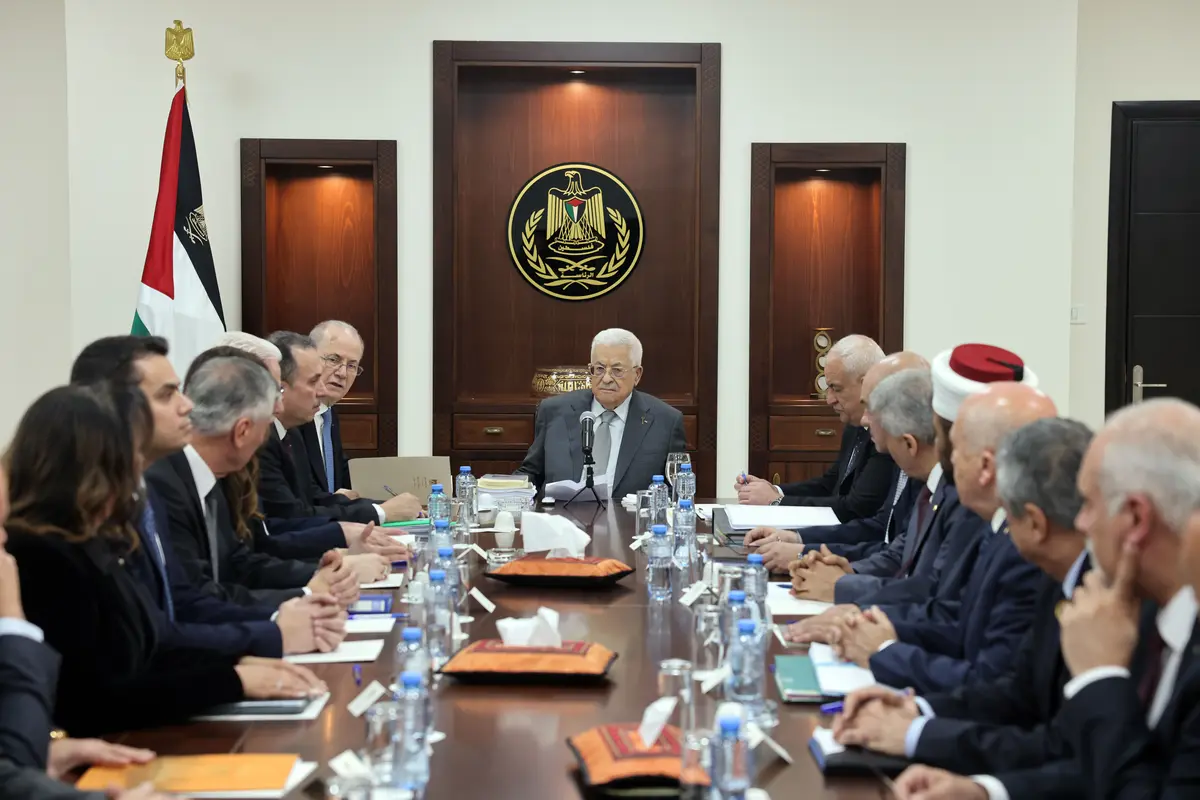
President Abbas chairs a meeting of the security services

President Mahmoud Abbas chaired a meeting of security chiefs last Thursday evening at the presidential headquarters in Ramallah.


The security leaders briefed President Abbas on the security situation in the governorates, and what has been accomplished in the Homeland Protection Campaign to impose the rule of law in Jenin Governorate, and the most prominent results of this campaign, which will be reflected in the security and safety of the Palestinian citizen.


President Abbas reiterated his full support for the efforts made by the Palestinian security services to maintain security and stability, stressing that no one is above the law, and that the principle of applying the rule of law, respecting the dignity of the citizen, and preserving his security and safety is the main objective of the measures and policies taken by the security establishment, especially in light of the changes and challenges facing the region, the difficult conditions experienced by the Palestinian territories, and the Israeli aggression on the Gaza Strip, which requires preserving our national gains and our independent national project.


He pointed out that achieving the interests of our people and their goals of freedom and independence requires everyone to put them above any other consideration, especially in these delicate and difficult circumstances that our cause is going through, praising the great national rally to support the imposition of the rule of law and the achievement of security and safety for the citizen.

PALESTINE

Fri 10 Jan 2025 12:03 pm - Jerusalem Time

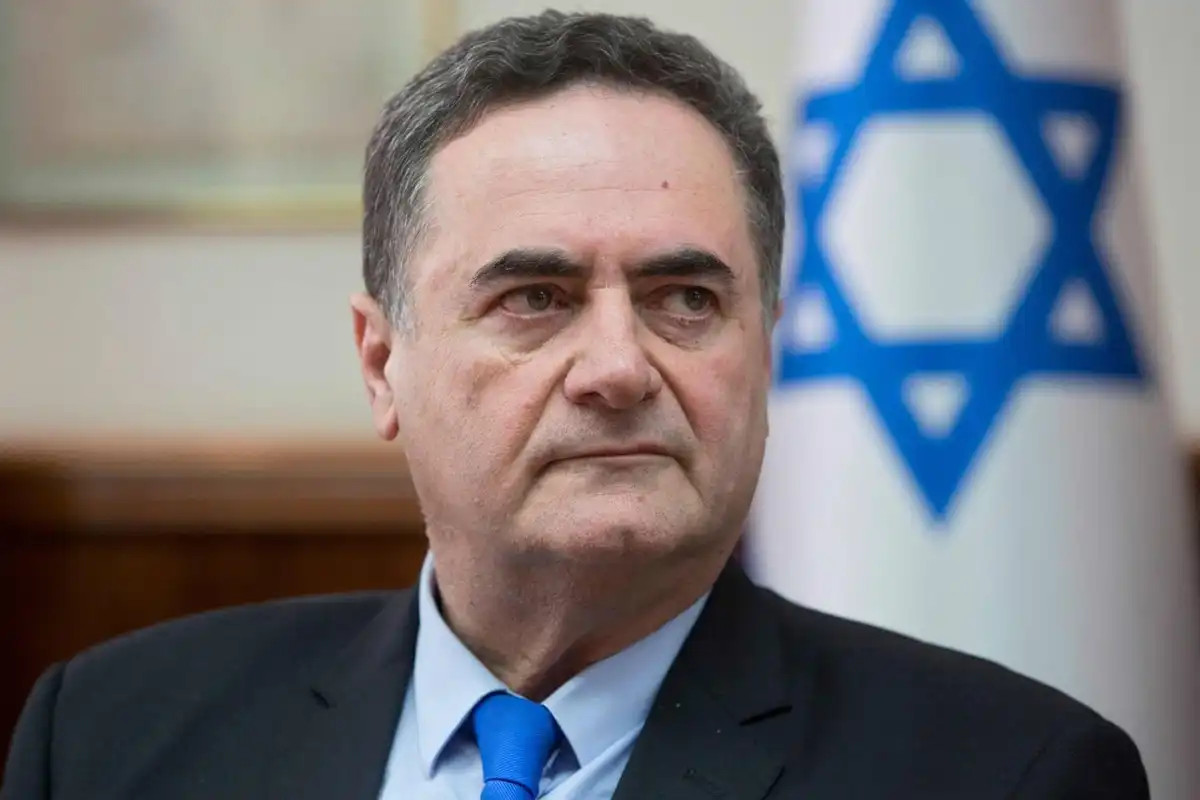
Katz: No Arab party will bear responsibility for Gaza as long as we do not defeat Hamas

Israeli Defense Minister Yisrael Katz said that no Arab party will bear responsibility in Gaza as long as Hamas is not defeated, warning against being dragged into a war of attrition with the movement, which would "cost a heavy price."


This came according to a statement issued today, Friday, by the Israeli Ministry of Security, indicating that Katz "instructed that a plan be presented to him to completely defeat Hamas in Gaza, if Hamas does not release the hostages by the time President (elect, Donald) Trump takes office," in a veiled admission that Israel has not defeated Hamas, despite the fact that it has claimed this dozens of times.


The statement pointed out that Katz's statements came "in an assessment of the security situation, held yesterday, Thursday, where the Minister of Defense met with Chief of Staff Herzi Halevi, Director General of the Ministry of Defense Eyal Zamir, and Head of Military Intelligence, Nitzan Alon."


According to the statement, Katz stressed that "the issue of releasing the kidnapped (Israeli prisoners held in Gaza) was at the top of the security services' priorities, and that everything in his power must be done to return them to their homes."


The Israeli Minister of Security stressed that "it is forbidden to be dragged into a war of attrition against Hamas in Gaza, while the hostages remain in the tunnels, which puts their lives in danger."


According to the statement, "Katz asked the Israeli army to point out the points that might make it difficult to implement the plan, including humanitarian and other issues, and to leave it to the political level to make the necessary decisions."


He stated that "the issue of a political solution in Gaza is not related to the plan and the current required activity, because no Arab or other party will bear the responsibility of managing civil life in Gaza, as long as Hamas is not completely crushed."


He pointed out that "the leaders of the Israeli army and its regular and reserve soldiers are fighting a war, but at the same time, they must change their method of work in order to eliminate Hamas and end the war in Gaza."


He added, "We must not be dragged into a war of attrition that will cost us dearly, and will not lead to reaping the fruits of victory and a complete strategic defeat of Hamas, and ending the war in Gaza."


PALESTINE

Fri 10 Jan 2025 11:56 am - Jerusalem Time

Hebron: Occupation forces storm towns, settlers attack citizens' homes

Today, Friday, the Israeli occupation forces stormed the towns of Beit Ula, Adh Dhahiriya, As Samou and Zakhlet Al-Mayya near the town of Yatta in the Hebron Governorate, while settlers attacked citizens’ homes in the village of Susya in Masafer Yatta.


Local sources reported that the occupation forces stormed the town of Beit Ula and searched the house of prisoner Abdul Rahman Muhammad Al-Adam, and bulldozed the agricultural lands near his residence, and the sounds of explosions were heard in the area.


The occupation forces also stormed the towns of Adh Dhahiriya, As Samou, and Khallet Al-Mayya in the town of Yatta, south of Hebron, and searched several homes. Settlers also attacked the homes of citizens in the village of Susiya in Masafer Yatta and threw stones at the homes of citizens.

ARAB AND WORLD

Fri 10 Jan 2025 11:24 am - Jerusalem Time

Because of Israel: US House of Representatives passes law punishing the International Criminal Court

The US House of Representatives has passed a bill calling for sanctions against officials at the International Criminal Court, which previously issued arrest warrants against Israeli officials.


The House approved the bill by a vote of 243 to 140 on Thursday.


The bill stipulates that arrest warrants targeting Israeli officials must be condemned in the strongest terms.


He called for sanctions on those who support the ICC in “investigating, arresting, detaining, or prosecuting a person from the United States or its allies.”


In June 2024, the House of Representatives passed a bill calling for sanctions on the ICC by a vote of 247 to 155, but it was not sent to the Senate for approval due to the Democratic majority.


For a bill to become law, it must be approved by the Senate and signed by the President of the United States.


In the same context, Democratic Representative James McGovern criticized the House's focus on the International Criminal Court while uncontrollable fires continue in Los Angeles, California.


"We are already dealing with a natural disaster, with hundreds of thousands of people trying to flee a climate-change-induced fire that is destroying entire neighborhoods," he said.


McGovern added that the Republicans' vote on the ICC bill in such a situation "shows how their priorities have been turned upside down."


He pointed out that 40 million people in the United States suffer from hunger, and "despite all these tests, the Republican Party, which is out of touch with reality, wants to spend our time imposing sanctions on the International Criminal Court."


Since October 7, 2023, Israel, with American support, has been waging a genocidal war on Gaza, resulting in more than 155,000 Palestinian martyrs and wounded, most of them children and women, and more than 11,000 missing.


Israel continues its massacres, ignoring two arrest warrants issued by the International Criminal Court on November 21 against Prime Minister Benjamin Netanyahu and former Security Minister Yoav Galant for committing war crimes and crimes against humanity against the people of Gaza.

PALESTINE

Fri 10 Jan 2025 9:42 am - Jerusalem Time

Israeli army: We found Hamza al-Zayadneh's body inside a tunnel in Rafah

The Israeli army announced in a statement, today, Friday, that it had informed the Al-Zayadneh family in the Negev, of the death of their son Hamza, a day after his father’s funeral, following his death in the Gaza Strip, where he was being held captive.


The army said in a statement, "After completing the diagnostic process at the Forensic Medicine Institute and the Israel Police, army representatives informed the Al-Zayadneh family this morning of the news of the killing of their son Hamza Al-Zayadneh in a Hamas prison, after he was kidnapped into the Gaza Strip."


He stated that "during the activities of the army and Shin Bet forces over the past few days inside the Gaza Strip, the forces found and returned the bodies of Yousef and Hamza al-Zayadneh from inside an underground tunnel in the Rafah area."


The family of the deceased announced on Wednesday evening that they had received an official notification that the bodies of Youssef and his son Hamza had been found in Gaza and returned to Israel, amid conflicting statements issued by the Israeli Minister of Security, Yisrael Katz, on the one hand, and the army on the other, as the latter announced the return of Youssef’s body and the discovery of evidence linked to Hamza.


Yousef and Hamza al-Zayadneh were detained in the October 7, 2023 operation carried out by Hamas targeting military sites and Israeli towns in the “Gaza Envelope,” while they were working in one of the towns in the area.

PALESTINE

Fri 10 Jan 2025 9:29 am - Jerusalem Time

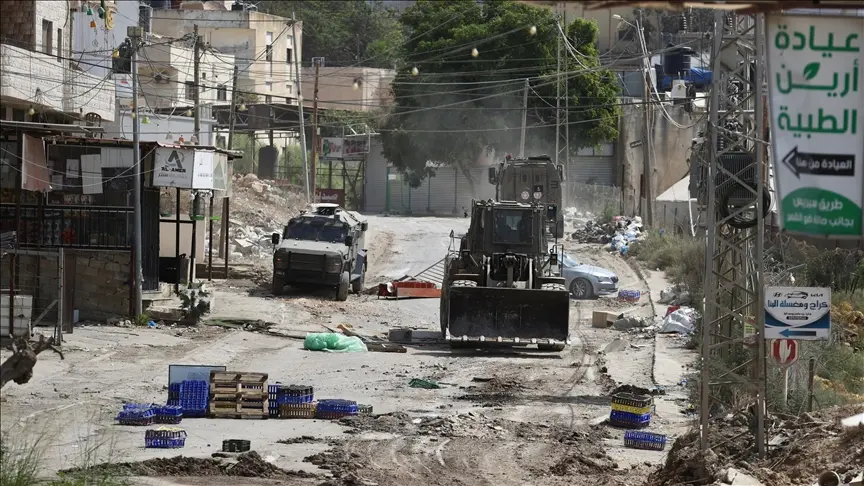
Updated: Israeli forces launched a campaign of raids and arrests after besieging a house in the town of Qabatiya

Israeli special forces surrounded a house and an agricultural facility in the town of Qabatiya, south of Jenin, on Friday morning.


Al-Quds.com correspondent reported that these forces launched a campaign of raids and arrests, which included repression and abuse of civilians, as the operation continued in the town.


Local sources reported that the occupation forces bombed the house with "Energa" shells, and completely closed the area, amid intense aircraft flying overhead.


The occupation forces sent military reinforcements accompanied by bulldozers to the town.


In turn, the Israeli Army Radio reported that the ongoing operation in Qabatiya is related to the repercussions of the shooting attack in the village of Al-Funduq in Qalqilya a few days ago, in which 3 settlers were killed.


ARAB AND WORLD

Fri 10 Jan 2025 9:02 am - Jerusalem Time

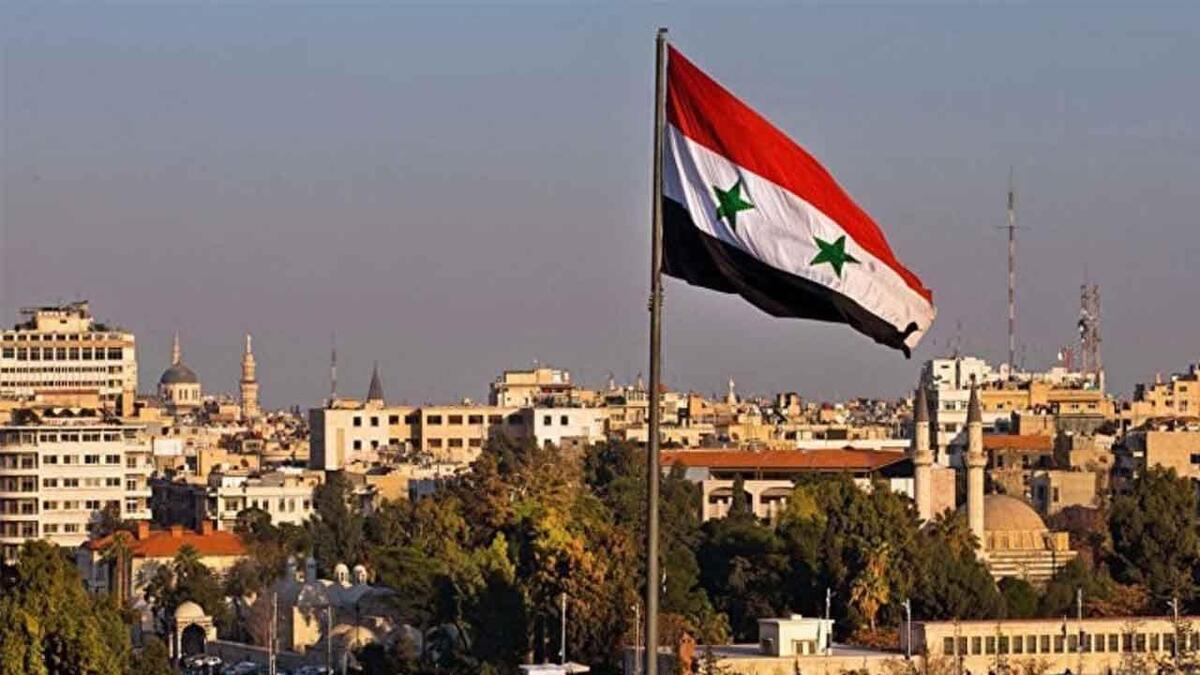
UN investigation committee enters Syria for the first time since 2011

A UN investigation committee on Syria has been able to access the country for the first time since the start of the Syrian revolution in 2011, after ousted Syrian President Bashar al-Assad had previously refused to enter.


The UN investigator tasked with looking into human rights violations during the uprising in Syria, Hanny Megally, said that Assad never granted investigators permission to enter Syria, but the new authorities did so "immediately."


Megali added in a statement to Agence France-Presse that he hopes the committee will be able to establish a good relationship with the current authorities.


The commission has been investigating war crimes and other violations of international human rights law since the start of protests and the outbreak of war in Syria in 2011, and has so far carried out its work remotely, compiling lists of 4,000 people suspected of committing serious crimes.


Megali said he had visited detention centres and mass grave sites in and around Damascus, and had held talks at the ministries of justice and foreign affairs, explaining that the commission wanted to be able to visit the sites it had documented to "reconfirm the information" it had collected and fill in the gaps.


Don't repeat the past

The commission, which has investigated all parties involved in the Syrian conflict, including former opposition figures now in power, also wants to work with current authorities "to ensure that the past does not repeat itself."


"No party to the conflict in Syria can say: 'We have respected human rights or international humanitarian law,'" Megali said, adding, "But we are now in a new phase, and it would be good to be able to say that lessons have been learned."


On December 8, the armed Syrian opposition factions took control of the capital Damascus and other cities before that, thus ending 61 years of Baath Party rule and 53 years of Assad family control.


The next day, the leader of the new Syrian administration, Ahmed al-Sharaa, announced that Mohammed al-Bashir (the head of the government that had been running Idlib for years) had been tasked with forming a new government to manage a transitional phase.

ARAB AND WORLD

Fri 10 Jan 2025 8:58 am - Jerusalem Time

Supreme Court rejects Trump's request to halt sentencing in New York

The U.S. Supreme Court on Thursday rejected President-elect Donald Trump's last-minute bid to halt his sentencing in the Stormy Daniels hush-money case.


By a vote of five to four, the Supreme Court rejected Trump's emergency request to halt Friday's sentencing, 10 days before he returns to the White House.


Shortly after, Trump wrote on his social media platform, Truth Social, “I am innocent of all false accusations invented by the judge,” adding that he will continue to appeal this case.


Trump attacked Judge Juan Merchan, describing him as "very political and corrupt."


After several unsuccessful appeals, lawyers for the president-elect, who takes office on January 20, asked the US Supreme Court on Tuesday to suspend the procedure on an emergency basis "to prevent a grave injustice and attack on the institution of the presidency and the work of the federal government."


On May 30, a New York jury convicted the former president, who was re-elected in November, on 34 counts of falsifying business records to hide a payment made to porn actress Stormy Daniels in 2016 to keep her from talking about an affair she says they had.


The judge said Trump could appear in person or via video at the hearing, which is scheduled for Friday, January 10.

OPINIONS

Fri 10 Jan 2025 8:56 am - Jerusalem Time

What hell is Trump talking about?

op-ed - Al-Quds dot com

op-ed - Al-Quds dot com

Opinion Writer

US President-elect Donald Trump reiterated his statements, in which he threatened to open the gates of hell in the Middle East and turn Gaza into hell, if the problem of the Israeli detainees is not resolved, before his inauguration on the twentieth of this month and his official entry into the White House.


It is not at all strange for this reckless president to make such statements that prove his premeditated intentions to target our cause and our people, as if Gaza has not been exposed to this hell and has not been living it since the beginning of the war. Here we ask: Will the elected American president kill the martyrs again? Will he destroy what has been destroyed? Will he impose a policy of evacuation and displacement on those who have been displaced, and other humiliating measures that Gaza is living through in an unprecedented hell?


The question extends to knowing whether hell has another definition than the one Gaza is currently experiencing according to Trump, and whether he will introduce new and strange policies that Gaza has never witnessed before, and what are these measures? Is there a way left to kill the lives and assets of the Palestinians and destroy everything they own that Israel has not used until this moment?


We are certain that Trump will not be able to carry out his threats, in the face of the steadfastness and pride of our people, who stand tall in the face of the Israeli aggression, and all the projects and attempts to liquidate the cause of our people that are planned by the Western countries, most notably the United States, which is lying in wait for us, and there is no doubt that it, with all its old and modern administrations, is the one that supports Israel and provides it with ammunition and military equipment to kill, slaughter and execute our people.


We do not rule out the United States and its presidents’ systematic targeting of our Palestinian people. Trump and others who have come to the White House are nothing but tools that Israel moves as it pleases to continue its aggression against the Gaza Strip and the West Bank. A number of ministers have exploited Trump’s statements. Israeli Finance Minister Bezalel Smotrich said that humanitarian aid must be stopped and prevented from entering Gaza on the 20th of this month. Reserve Brigadier General Effi Eitam said that we must realize that within 11 days, if the prisoners are not released or an agreement is not signed regarding the process of their return, hell will open in Gaza, and humanitarian aid will be reduced to a minimum.


Israel has opened the gates of hell on earth on the Gaza Strip since the beginning of the war, and has used every method to suppress our people. Despite the statements of its army leaders that their military objectives have ended, the aggression continues in order to kill more civilians, as Israel deliberately targets the largest number of them, especially in the center and north of the Strip, so that the number of martyrs has exceeded 46,000, with more than 70 martyrs killed in three massacres committed by the occupation army yesterday. Is there a greater hell than what Gaza is currently experiencing, or does the hell of Gaza, based on Trump’s threat, mean bombing it with an atomic or nuclear bomb?

OPINIONS

Fri 10 Jan 2025 8:54 am - Jerusalem Time

The euphoria of Israeli tactical achievements draws miscalculations

Firas Yaghi

Firas Yaghi

Opinion Writer

Before October 7, there were studies and discussions about the reality in Israel in terms of the nature of the political system and the conflict that is taking place for personal and ideological reasons (“Netanyahu, Deri, and the identity of the state”), and the readiness of the Israeli army in terms of its ability to confront multiple arenas at the same time, and its ability to do so in terms of equipment and numbers, especially the ground forces in it, due to plans to reduce the size of the regular army and transform it into the concept of a “small and smart army.”


Unfortunately, there were many analysts in the “Axis of Resistance” who underestimated the capabilities of the Israeli army. Rather, they saw that the internal conflict that was taking place over the identity of the state in Israel and the attempt to control the judicial system through the enactment of laws that were primarily aimed at protecting “Netanyahu” and “Aryeh Deri” with him, represented a major obstacle to the state’s ability to wage major wars. Moreover, these analysts spoke as if the Israeli army was not ready and could not wage comprehensive wars on several fronts.


At the same time, there were a few specialists in Israeli affairs who believed that the nature of the conflict in the Israeli political system does not necessarily reflect itself on the army, despite all the Israeli media hype about refusing to serve or threatening not to serve in the army if the far-right government continues its judicial reforms, and that security issues in Israel are above all else, and no one will hesitate to defend any threat to the state. Rather, the threat will lead to the unity of the political system and to everyone’s identification under one security goal, which is to protect the security of the settler and the settlement.


These few analysts saw Israel through Israeli and American eyes, not through eyes and estimates stemming from the development of the capabilities of the “Axis of Resistance” in terms of numbers and numbers. I remember in one of the discussions that took place via Zoom in a Russian academic circle that one of those familiar with the field reality from the Lebanese front spoke as if the Israelis were unable to confront Gaza, so how would they confront Lebanon (may God have mercy on him). At that time, I did not know who he was, and later after his martyrdom and seeing his picture, I knew who he was. However, that day, I asked for a response, and I said with all due respect that these were unrealistic estimates, and that the direction in Israel was a destructive war, and that the narrative of the declared existential war and the second war of independence was not absurd, but rather it was a confirmation that the founding Israel had made a decision for a comprehensive war on all fronts, and that the Lebanese front was coming after Gaza, if not during it, and that the Americans had also made a decision not only to stand by Israel, nor to provide it with weapons only, but to enable it to win, and that there was no alternative for Israel after October 7, except for a clear victory that was beyond doubt and that would lead to the dismantling of the “Axis of Resistance” that had become It is a concern for the Americans and the region as a whole.


After October 7, the analysts of the “Axis of Resistance” were divided, as the Palestinians among them began to see the necessity of a comprehensive war on all fronts and not just going towards support fronts. Those among them who doubted the capabilities of the Israeli army, especially its ground forces, backed down from that, while those who believed that Israel was unable to open another front, especially the northern front, remained entrenched in their position, insisting that Israel would not go to a comprehensive war with the Lebanese resistance. It seems that there is a great deficiency in understanding the nature of the settler state called Israel, and a deficiency in the American view of this settlement, to the point that some of them believed to a great extent that there were American interests in the region that prevented it from giving the green light to the occupying entity to carry out adventures and wars in the region, believing that this would harm the interests of the United States of America. They forgot or did not understand that the supreme interest that is above everything for America is “Israel” and after that come the other interests. There are no other interests at all without the strong and victorious settler state “Israel”, because its function is primarily to preserve those interests and no one else in the region is capable of that, of course except Other connections as a globalized Zionist concept.


After October 7th and until now, unfortunately, many analysts, especially those specializing in Israeli affairs, are still in a state of confusion due to the huge amount of information provided by the Israeli media, to the point that they believe that some articles, some news, or even some statements are what shape Israeli policy, whether in terms of what the far-right government wants, headed by Netanyahu, or the new strategic security concepts of the settlement called “Israel.”


Therefore, there is a need to clarify some matters that have become the ABC of politics in Israel, especially after the October 7 earthquake and its repercussions that are still present and rolling rapidly, so that through them the true strategic directions of the settler state "Israel" can be understood, in addition to the tactical issues related to the concept of survival of the right-wing coalition headed by "Netanyahu". Here we point out that the new elements are what determine the new reality on all the close and immediate fronts "Lebanon, Syria, Gaza, the West Bank", and also the surrounding fronts "Yemen, Iraq and Iran", and these elements are represented by the following:


First - Adopting the concept of the buffer zone... There is no return for the settlers of the north and south without it, and no security can be maintained and October 7 prevented without it, and the incursion into "Syria" is part of that, and the buffer zone in "Gaza" has become a fait accompli, while in "Lebanon" work is being done on it at a great speed through the comprehensive destruction of all the villages adjacent to the border, and the continuation of that even in light of the ceasefire agreement, and through talk about not withdrawing from all Lebanese lands according to the agreement, but "Lebanon" may be dealt with in a security manner without actual presence, but rather by setting new conditions that make direct presence a reality.


Secondly - the policy of "prevention" and "frustration" as an alternative to the policy of "warning" and "defense". This policy is clearly imposed through daily air raids and continuous incursions into the southern Lebanese front, the "freedom of movement policy" according to the US-Israeli bilateral understandings paper, and what this means in dealing with all fronts in the same way "Syria", including also the surrounding fronts "Yemen, Iran and Iraq", and according to the concept of the security need to prevent the development of capabilities on the one hand, and frustrate intentions according to the estimates of the security establishment on the other hand. As for the "Gaza" front, its story is much bigger than that, as they see it as an arena like the "West Bank".


Thirdly - There is no Palestinian state next to the settler state "Israel", and no security other than the Israeli security and army between the sea and the river, and the presence of local security formations in the West Bank and Gaza is permitted on the condition that they are under Israeli supervision and with direct American assistance and cooperation with specific regional countries.


Fourthly - The settlement called "Israel", with unlimited American support, has a strategic security space that includes the West Asia region in particular and North Africa as a future estimate, and this means creating a geopolitical security change first, and a geographic change "dividing the divided and fragmenting the fragmented" second when needed, that is, imposing political data in those countries in a way that leads to a new vision for any existing political system.


According to the above elements, it is possible to read the scene of talking about a prisoner exchange deal, stopping the war, and a comprehensive withdrawal from the Gaza Strip, and to see the future scene of Lebanon and Syria from the point of view of the settler state "Israel" of course, and to see the upcoming scene in Yemen, Iran, and possibly Iraq as well. Therefore, the scene of 2025 is a scene of the continuation of the war, meaning that it will be a "year of war" as before, but its pace and nature are determined by the facts on the ground. Whoever wants to understand the reality of what is happening must follow the movements and plans of the Minister of Strategic Affairs, Minister "Ron Dermer", because he and "Netanyahu" draw up future plans in a way that serves the security and political strategy of the settlement called "Israel" on the one hand, and maintaining the cohesion of the ruling coalition on the other hand.


Bottom line

There is no deal without the visions of the settler state "Israel" led by Netanyahu being realized, especially regarding "Gaza", and everything is coordinated with the Americans and specifically with the Trump administration, and the goal is to thwart the deal and hold "Hamas" responsible for that before President Trump in order to achieve that vision. As we said in November, the issue of prisoners and detainees is not valuable to "Netanyahu" and his plans, and the difference between him and the military and security establishment is that they want the prisoners through a deal even if it leads to stopping the war and withdrawing from the Gaza Strip "a temporary postponement of implementing the vision", while "Netanyahu" sees that the settler state "Israel" is achieving great accomplishments, but he sends his close minister "Dremer" to reach an understanding with the Trump administration about everything, especially about American support for what the settler state "Israel" wants as a security and strategic need, restoring to it not the concept of "deterrence" but rather the concept of "an army that can reach any place in the entire region of West Asia and North Africa (the Middle East)", i.e. returning to the concept of "an invincible army".


As for the Lebanese front, the issue of giving the army a free hand and ease of movement has become a daily security reality in southern Lebanon, and will continue as a permanent policy unless something happens to restore the balance of deterrence, and this does not seem to be on the horizon in the near future, especially since the official “Syrian” scene supports the Israeli orientations towards the security understanding of the “Syrian and Lebanese” fronts, but only the emergence of something called “Syrian resistance” to the occupation will mess up the cards and force the settler state “Israel” to search for other solutions based on returning to the 2006 understandings.


As for the surrounding fronts, it seems that 2025 is the year in which they will be directly targeted with direct American support and participation, especially with regard to Iran, because the implementation of strategic security plans cannot be done without a major and decisive blow to the head, and that is why we said that 2025 is a “year of war,” because any blow to the head of the axis of resistance will necessarily lead, at a minimum, to an exchange of blows between the two parties, if it does not lead to a comprehensive war. As for “Yemen,” the policy of Israeli-American-British air strikes will continue, with the civil war being activated again if possible.


The settler state "Israel" has achieved great tactical achievements due to the wrong assessments of the leadership of the countries and fronts of the "Axis of Resistance", and its short-sighted view of the direction of this entity after October 7th. However, with the geopolitical developments in the region, and the emergence of a new regime in "Damascus", I believe that all those who are tired of the destruction and genocide that the settler state "Israel" has committed and is committing must look for a new strategy that is not based on ordinary or strategic "patience", and the first steps in this regard are the birth of a "Syrian resistance".


The options are imposed by the settler state "Israel", so there is no luxury of time and they must be dealt with, either by the concept of waiting for the opportunity which will not come at least in a decade, or by confronting it and trying to impose facts on the ground that may allow at least a return to previous understandings "and this is not possible" because confronting the options of the settler state "Israel" will necessarily impose other options that will take the region to a new reality in which the "Syrian" scene will have a decisive impact if a new resistance front appears against the Israeli occupation of Syrian land.


The tactical achievements made by the settler state "Israel" came about thanks to wrong estimates, reliance on American promises, and fear that the brutality that appeared in the Gaza Strip - "genocide, cleansing, and destruction" - would spread to the rest of the fronts, and this is what happened on the northern front.


PALESTINE

Fri 10 Jan 2025 8:48 am - Jerusalem Time

Settlers burn agricultural room and write racist slogans in Ramallah

Tonight, settlers burned an agricultural room and wrote racist slogans in the village of Abu Falah, northeast of Ramallah.


Local sources reported that settlers attacked the outskirts of Abu Falah village, burned an agricultural room belonging to one of the village’s citizens, and wrote racist slogans in Hebrew on its walls, without any injuries being reported.


Palestinian Civil Defense crews rushed to the scene and worked to extinguish the fire.


In recent days, the village of Abu Falah, the town of Turmus Ayya and the village of Al-Mughayyir, northeast of Ramallah, have been subjected to repeated attacks by settlers under the protection of the Israeli occupation forces, which included the burning of a house and agricultural rooms and the writing of racist slogans.

PALESTINE

Fri 10 Jan 2025 8:46 am - Jerusalem Time

War on gaza: Dead and wounded in the Gaza Strip

A number of citizens were killed and injured today, Friday, as a result of the continued Israeli raids on the Gaza Strip.


Civil Defense confirmed that its crews recovered a dead and two wounded people after the Israeli occupation targeted citizens in the vicinity of Al-Shafi’i Mosque near Taiba Towers, west of Khan Yunis Governorate, south of the Gaza Strip.


Our correspondent reported that a female citizen was killed as a result of her injuries following an Israeli bombardment that targeted a residential apartment near Al-Amal Hospital, west of Khan Yunis. Meanwhile, a young man was killed as a result of his wounds following the occupation forces’ bombardment of the Mawasi area of Khan Yunis, while a female citizen was killed as a result of the occupation forces’ bombardment of the tents of the displaced in Khan Yunis Governorate several days ago, joining her three sons who were killed as a result of the same bombardment.


He pointed out that a young man died of his wounds in an Israeli bombardment east of Rafah city in the southern Gaza Strip.


Medical sources confirmed that more than 100,000 citizens have been injured since the start of the aggression on the Gaza Strip on October 7, 2023, and that more than 12,000 of them are in critical condition and need treatment outside the Strip.


According to local sources, a citizen was killed and three others were injured when an Israeli drone bombed a gathering of citizens in Khan Yunis.


The Israeli occupation continues its aggression on the Gaza Strip, by land, sea and air, since October 7, 2023, which resulted in the death of 46,006 citizens, the majority of whom are women and children, and the injury of 109,378 others, in an incomplete toll, as thousands of victims are still under the rubble and in the streets, and ambulance and rescue crews cannot reach them.

PALESTINE

Fri 10 Jan 2025 8:42 am - Jerusalem Time

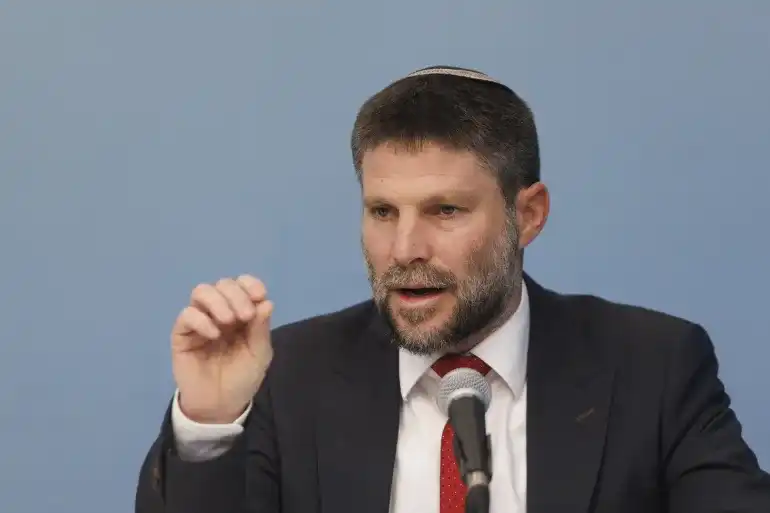
Smotrich keeps the story going... Maps to impose myths and beliefs

Dr. Saeed Shaheen: Israeli settlement ambitions in Arab countries have become public in light of the state of submission and surrender to American hegemony

Muhammad Joda: Smotrich's statements are not just individual dreams, but rather reflect strategic policies that the extreme right is gradually implementing.

Dr. Suhail Diab: Israel does not want to accept a multi-polar and multi-axis region after the Syrian earthquake, but rather presents itself as a regional power to shape the region

Oraib Al-Rantawi: The weakness of the official Arab position, including the continuation of normalization, strengthens Israel’s appetite for settlement and increases its hegemony over the occupied territories

Dr. Abdul Majeed Suwailem: The “Israeli Maps” Phase Reflects the Zionist Project’s Move to Resolve the Conflict and Expand with a Project That Cuts Off Arab Lands


The Arab region is witnessing a new phase of escalating Israeli ambitions, as what has become known as the “Smotrich Maps” has emerged, which were translated by what was published by official accounts on social media, affiliated with the Israeli Ministry of Foreign Affairs, as the latest embodiment of the Zionist expansionist dreams that extend from Palestine to parts of Egypt, Jordan, Syria and Lebanon.


In separate interviews with “I,” writers and political analysts believe that these maps, which are accompanied by statements and calls from extremist figures in the Israeli government, are not just pipe dreams, but rather reflect systematic policies that seek to impose a new reality on the ground.


They believe that the absence of effective Arab responses, along with surrender to American hegemony, enhances Israel's ability to implement its plans.


They point out that these Israeli ambitions are based on biblical and Christian Zionist ideologies, which find strong support from Western powers, led by the United States, especially from US President-elect Donald Trump. With the escalation of Arab normalization with Israel, the occupation’s appetite to expand its influence is increasing, taking advantage of the weakness of Arab and international responses.


Although these maps have been condemned by some Arab countries, writers and analysts believe that the Palestinians and Arabs are required to conduct a comprehensive review of their political programs and tools of resistance, whether by unifying Palestinian ranks or exploiting the Arabs’ economic and diplomatic cards. The current stage requires more effective confrontations, not only to deter Israeli expansion, but also to preserve the threatened Palestinian and Arab rights.


An extension of the Zionist project that was founded on the basis of expansion and annexation


Dr. Saeed Shaheen, Professor of Political Media at Hebron University, confirms that Israeli settlement ambitions, which include Palestinian lands and parts of Arab countries such as Jordan, Syria and Lebanon, are not a recent development, but rather an extension of the Zionist project that was founded on the basis of expansion and annexation.


Shaheen explains that these settlement ambitions come in the context of biblical trends that converge with Christian Zionism, which began to crystallize in a practical way with the administration of US President-elect Donald Trump, especially in light of his promises to expand the territory of Israel, which gave the extreme Israeli right greater boldness to implement its settlement plans.


He points out that Israeli settlement ambitions are not new, as the Zionist project has been, since its inception, a goal of expansion beyond the borders of historical Palestine. However, these ambitions have been subject to failures as a result of intertwined Palestinian, Arab and international factors. However, the biblical idea, which reflects Israel’s expansionist ambitions, has remained and is waiting for the right opportunity to emerge.


Shaheen asserts that the Trump administration contributed to transforming these ideas into practical steps, as this represented unprecedented boldness on the part of the extreme Israeli right and religious Zionism to demand expansion and annexation of more Palestinian lands and parts of Arab lands.


According to Shaheen, these Israeli settlement ambitions in the Arab countries have become public in light of the state of Arab and international submission and surrender to American hegemony, which has become largely subject to the influence of Zionism.


Shaheen points out that Israel's current leadership, with extremist figures such as Finance Minister Bezalel Smotrich and National Security Minister Itamar Ben-Gvir, is adopting a fascist agenda that pushes for settlement expansion and the annexation of more Palestinian and Arab lands.


These plans, Shaheen says, threaten to kill the Palestinian dream of establishing an independent state on the 1967 lands.


Shaheen stresses the need to take Palestinian, Arab and international steps to confront these plans, calling in this context for unifying the Palestinian ranks and putting the internal house in order to confront the challenges, while continuing to use all Palestinian political, diplomatic and legitimate resistance cards to ensure the Palestinians remain on their land, as Shaheen urges the use of diplomatic tools to keep the Palestinian cause alive on the international scene.


Shaheen points out that the Arab movement must be more influential, by exploiting the economic influence of the Arab countries, especially in the field of energy, and using trade relations with the West as a means of pressure, calling for the international community to move to isolate Israel politically, by seeking to deny its membership in the United Nations due to its continued violation of international laws.


Shaheen points to the importance of boycotting Israel and halting normalization with it as a means of pressuring it. He also stressed that threatening to use military force should be an option on the table if Israel proceeds to implement these expansionist plans on the ground.


Shaheen stresses that any slackness in confronting these ambitions will lead to dire consequences for the future of the Palestinians and the entire region.


A major challenge that goes beyond the Palestinian borders to threaten the stability of the region


Writer and political analyst Muhammad Joda believes that talk about the map of “Greater Israel,” which includes the lands of Palestine, Jordan, Lebanon, and Syria, reflects a major challenge that goes beyond the Palestinian borders to threaten the stability of the entire region.


Joudeh explains that this expansionist project, adopted by the extreme Israeli right, constitutes a long-term strategy aimed at changing the political geography of the region and imposing a new reality that cannot be reversed.


He points out that the Israeli plans directly aim to liquidate the Palestinian cause through escalating settlement and annexing the West Bank, as these policies aim to end any hope for a two-state solution, by displacing Palestinians and imposing new facts that make resisting annexation extremely difficult.


Joda believes that the occupation is seeking to re-settle in the Gaza Strip, in an attempt to change the demographics of the region and undermine the Palestinian social structure.


Joda believes that the internal Palestinian division represents a major weakness that Israel exploits to implement its expansionist policies, stressing that achieving national reconciliation and ending the division is an urgent necessity to form a unified Palestinian front capable of confronting these challenges.


Joudeh stresses the importance of strengthening popular and civil resistance, in addition to escalating international diplomacy to expose Israeli practices in international forums.


On the other hand, Joudeh believes that Israeli ambitions extend to Jordan, pointing out that these plans represent a direct threat to Jordanian sovereignty.


Jodeh explains that "Israel seeks to abolish the Jordanian identity and consider Jordan an alternative homeland for the Palestinians, which threatens the stability of Jordan through political and economic pressure resulting from regional tensions."


Joudeh stresses the need for Jordanian-Palestinian coordination to confront these challenges, especially with regard to Jordanian guardianship over Islamic and Christian holy sites in Jerusalem, calling for the exploitation of international relations to strengthen Jordanian positions in the face of Israeli plans.


Regarding Lebanon and Syria, Joudeh believes that Israel is exploiting the internal crises in the two countries to expand its influence.

Joudeh points out that the Israeli occupation of the Syrian Golan represents a flagrant violation of Syrian sovereignty and weakens any chance for a regional settlement.


Joudeh stresses that Israeli ambitions in southern Lebanon threaten Lebanon's stability, especially in light of the political and economic crises that are sweeping the country.


"Israel is seeking to exploit these circumstances to expand its control and destabilize the region," Joda said.


He believes that normalizing relations between some Arab countries and Israel may be used to justify annexation and occupation policies, especially in light of the absence of real Arab pressure to stop these policies.


Joda points out that the continued American support for Israel provides cover for these ambitions to become a reality, stressing that this support makes Israel more daring in implementing its expansionist plans.


Joda believes that the Israeli war on Gaza is not separate from the major expansionist plans, and says: “Israel is using the war as a pretext to justify its annexation policies and settlement expansion in the West Bank, and is also trying to create a new reality by separating Gaza from the West Bank to fragment and weaken the Palestinian cause.”


He believes that Israel seeks to change the regional balance of power by threatening and destabilizing neighboring countries, stressing at the same time that Israeli plans represent a threat to the regional and international order, pointing out that the continuation of the occupation and the violation of international law weakens the credibility of the global order.


Joudeh believes that Israel is exploiting global crises, such as the war in Ukraine, to divert international attention from the Palestinian issue and advance its expansionist plans.


Joudeh points out that the statements of Israeli officials such as Smotrich are not just individual dreams, but rather reflect strategic policies that the Israeli far right is gradually implementing.


Joudeh believes that the policy of de facto annexation of the West Bank and increased settlement activity shows that Israel is seeking to impose a new reality that makes a return to the 1967 borders impossible.


Joudeh calls for escalating political and diplomatic efforts to confront Israeli plans, stressing the importance of activating Arab League decisions to support the Palestinian cause and unifying media efforts to highlight the dangers threatening the entire region.


Joudeh stresses the need to exert international pressure on Israel, including the threat of sanctions, to push it to stop its violations.


"Confronting these ambitions requires a firm regional and international move, because surrendering to this reality will lead to a new division of the region and the continuation of occupation and unrest for decades to come," Joda said.


Strategic moves aimed at achieving major goals in the region


Professor of Political Science and expert on Israeli affairs, Dr. Suhail Diab, believes that the escalation of Israeli statements about the so-called dreams of “Greater Israel,” which include expanding Israeli influence regionally and escalating security and military operations, reflects strategic moves aimed at achieving major goals in the region.


Diab points out that these statements, which coincide with an Israeli escalation in the West Bank, such as what happened in the town of Tamoun, when three Palestinians from one family, including two children, were killed, express an Israeli policy aimed at redefining its role in the region.


Diab stresses that Israel seeks to impose itself as a major regional player in the Middle East, which can be considered the first challenge facing Israel.


Diab explains that "Israel does not want to accept a multi-polar and multi-axis region after the earthquake in Syria, and seeks to present itself as a regional power that has the greatest influence in shaping the features of the region."


The second challenge, according to Diab, is linked to the first and is represented by attempts to liquidate the Palestinian cause, which is considered the main obstacle to achieving the Israeli dream of regional hegemony.


Diab explains that this liquidation takes on a demographic character through the displacement of Palestinians and linking geographical control to demographic change, as is currently happening in the Gaza Strip and the West Bank.


Despite the Israeli escalation, Diab believes that achieving these goals seems almost impossible under the current circumstances.

Diab points out that the regional axes, despite their different orientations, all require a solution to the Palestinian issue as an entry point for any Israeli role in the region.


Diab stresses that the contradiction between the two main Israeli challenges - regional hegemony and the liquidation of the Palestinian issue - makes achieving these goals more complicated, noting that Israel will either have to reach a solution to the Palestinian issue or face opposition from regional axes that see this Israeli role as a threat to their interests.


Diab points out that Israel's insistence on achieving its expansionist goals could lead to a number of serious repercussions at the regional and international levels.


Diab believes that the Israeli escalation could strengthen the belief in the resistance option among the Iranian axis and its allies in the region.


Diab explains that Israel deals with these forces as an obstacle to its expansionist project, which may lead to growing public awareness in the region that resistance is the most effective option to confront Israeli policies.


Diab points out that talk about liquidating the Palestinian cause and the continued Israeli occupation of the Syrian Golan might create a state of mistrust in the credibility of the new Syrian leadership, especially in light of Israel’s attempts to exploit Syria’s internal crises to achieve geographic and political gains, and this matter might lead to a reversal of Syrian public opinion in favor of escalating the confrontation with Israel.


Diab believes that the Saudi-Egyptian axis, which is considered moderate, may find itself in a difficult position before the United States due to Israeli policies that seek to impose comprehensive security, military and economic hegemony.


Diab points out that this tension may extend to affect global trade, especially in the Red Sea and other waterways.


Diab points to recent Israeli reports that Türkiye is considered a major security challenge in the coming era, adding a new dimension to the complexity of regional relations.


Diab believes that Israel realizes that major transformations in the region, such as the repercussions of the earthquake in Syria, may reduce its ability to implement its plans.


Diab believes that "these Israeli expansionist dreams are now being spread in an attempt to reduce the potential damage resulting from major changes in the region."


Diab points out that Israeli talk about the threat of fundamentalist movements after the earthquake in Syria reflects deep concern about regional transformations.


Diab stresses that these dreams face major obstacles in light of current regional and international relations.


"Israel may be able to stir up tensions, but it will find it extremely difficult to achieve its expansionist goals without radical solutions to the Palestinian issue, which makes the realization of these dreams unlikely in the near future," Diab says.


Israel is experiencing a "season of expansive maps flying around"


Director of the Jerusalem Center for Political Studies, Oraib al-Rantawi, confirms that Israel is experiencing a “season of expansive maps flying around,” as it works daily to present new maps that aim to annex more Arab lands and impose its sovereignty over them, and publishing maps that include several Arab countries reflects its goals that it is working on in a planned manner and not randomly.


Al-Rantawi explains that these movements are not limited to Palestine alone, but extend to other Arab lands, reflecting blatant plans that Israel seeks to transform into facts on the ground.


He points out that Israel has gone beyond the stage of declarations in the West Bank, where bulldozers are paving the way for settlement outposts and bypass roads deep inside the West Bank, which is the basis and doctrine of the Israeli settlement project.


Al-Rantawi points out the statements of Israeli Prime Minister Benjamin Netanyahu, who denies the existence of the occupation in the West Bank, considering the West Bank to be part of “Judea and Samaria.”


Al-Rantawi believes that these statements, accompanied by actual practices, reveal clear Israeli plans to annex the entire West Bank, in an attempt to change the geographical and demographic reality in favor of the Zionist project.


Al-Rantawi explains that Israeli ambitions are not new, but they are now taking on a more daring character. For example, Israel continues to extend its presence in southern Lebanon, while refusing to negotiate over the Shebaa Farms. In Syria, it occupies new lands equivalent in size to the Gaza Strip, in a clear indication of its desire to establish new facts on the ground, showing that it is continuing to achieve its expansionist dreams.


Al-Rantawi believes that the official Arab response to these expansionist settlement plans is still limited to angry statements or condemnation statements, devoid of any practical steps.


He stresses that the absence of joint Arab action, whether through putting the internal house in order or strengthening the movement between Arab countries, contributes to enabling Israel to move forward with its projects.


Al-Rantawi points out that the weakness of the official Arab position, including the continuation of normalization with Israel, strengthens its appetite for settlement and increases its hegemony over the occupied territories.


Al-Rantawi criticizes the Arab countries' continued adherence to the peace option as the only strategy for dealing with Israel, even though the latter has not shown any indication of its desire to reach a comprehensive peace.


Rantawi points out that Israel deals with peace from a purely material perspective, through “peace for the economy” or “peace for security,” which reflects the absence of Israeli commitment to any real peace project.


Al-Rantawi stresses that what stops Israel from expanding is resistance, explaining that the cost of occupation must be higher than the gains Israel achieves from its expansionist policies.


According to Rantawi, the Zionist appetite, which he described as "like an insatiable hell," exploits the state of Arab weakness to expand the area of control at the expense of Palestinian and Arab rights.


Rantawi stresses the need to reconsider the relationship with Israel, resist normalization, and build a comprehensive Arab strategy to confront Israeli plans.


He points out that the absence of serious collective action leaves the door open for Israel to impose new facts on the ground, leading to further domination of the region and the squandering of the legitimate rights of the Palestinian people and the surrounding Arab countries.


Zionism has moved from the stage of thought and ideology to the practical agenda.


The writer and political analyst, Dr. Abdul Majeed Suwailem, confirms that Palestinian political thought suffers from a clear failure to read the major transformations that the Zionist-Israeli project has reached.


Suwailem explains that the Zionist movement has moved from the stage of thought and ideology to the practical agenda, where the Israeli project has come to focus on resolving the conflict with the Palestinians and expanding the vital area of the occupying state, beyond the borders of historical Palestine from the river to the sea.


Suwailem points out that what he called the “Israeli maps phase” reflects the transition of the Zionist project from managing the conflict to resolving it, and from a state within the borders of the mandate to an expansionist project that aims to seize more Arab lands under security, political, and geopolitical pretexts.


Suwailem believes that this transformation requires the Palestinians and Arabs to seriously and comprehensively review their political programs and intellectual tools, pointing out that the Palestinian political institutions are still stuck at points outside the basic context of the confrontation.


He believes that the absence of intellectual and political review among the Palestinians constitutes a major weakness, explaining that the political parties and institutions lack the capabilities necessary to seriously confront these challenges.


Suwailem points out that some people deliberately evade facing this entitlement through a general discourse that does not provide practical solutions, stressing that these programs will remain unable to achieve any progress, especially in light of the complexities of the regional and international scene.


Suwailem says: “There is no Palestinian political will to confront the new Israeli project, whether because of the difference in programs or the inability to bear the cost of confrontation. The Palestinian situation will not be stable unless there is a real national project capable of dealing with the requirements of the stage.”


Suwailem describes the Israeli right's expansionist projects as "illusions," noting that Israel is unable to achieve these plans despite the great Western support.


Suwailem points out that Israel has been unable to control the Gaza Strip for more than 400 days, and that any attempt to regain control will cost it a heavy price that exceeds its capabilities. Israel's attempts to expand into Lebanon and Syria also face major obstacles, as it will only be able to advance a limited distance.


"These expansionist delusions are what will destroy the Israeli state," Suwailem says. "The deadly international isolation that Israel is experiencing will worsen as this project continues, making the dreams of the Zionist right a burden on the state itself."


Suwailem stresses that the Palestinian and Arab response to this stage must be serious and effective.


Suwailem believes that the current state of Palestinian and Arab impotence makes it easier for Israel to implement its plans, calling for reformulating Palestinian and Arab national programs in a way that is consistent with the requirements of the confrontation, whether through political tools or new means of struggle.


He stresses that the crisis of the Israeli right lies in its incorrect understanding of reality and its reliance on imaginary perceptions.


Suwailem believes that the future of the Zionist project depends on the ability of the Palestinians and Arabs to provide practical alternatives and comprehensive confrontation strategies, pointing out that Palestinian and Arab hesitation gives Israel space to implement its projects despite its worsening crises.


PALESTINE

Fri 10 Jan 2025 8:39 am - Jerusalem Time

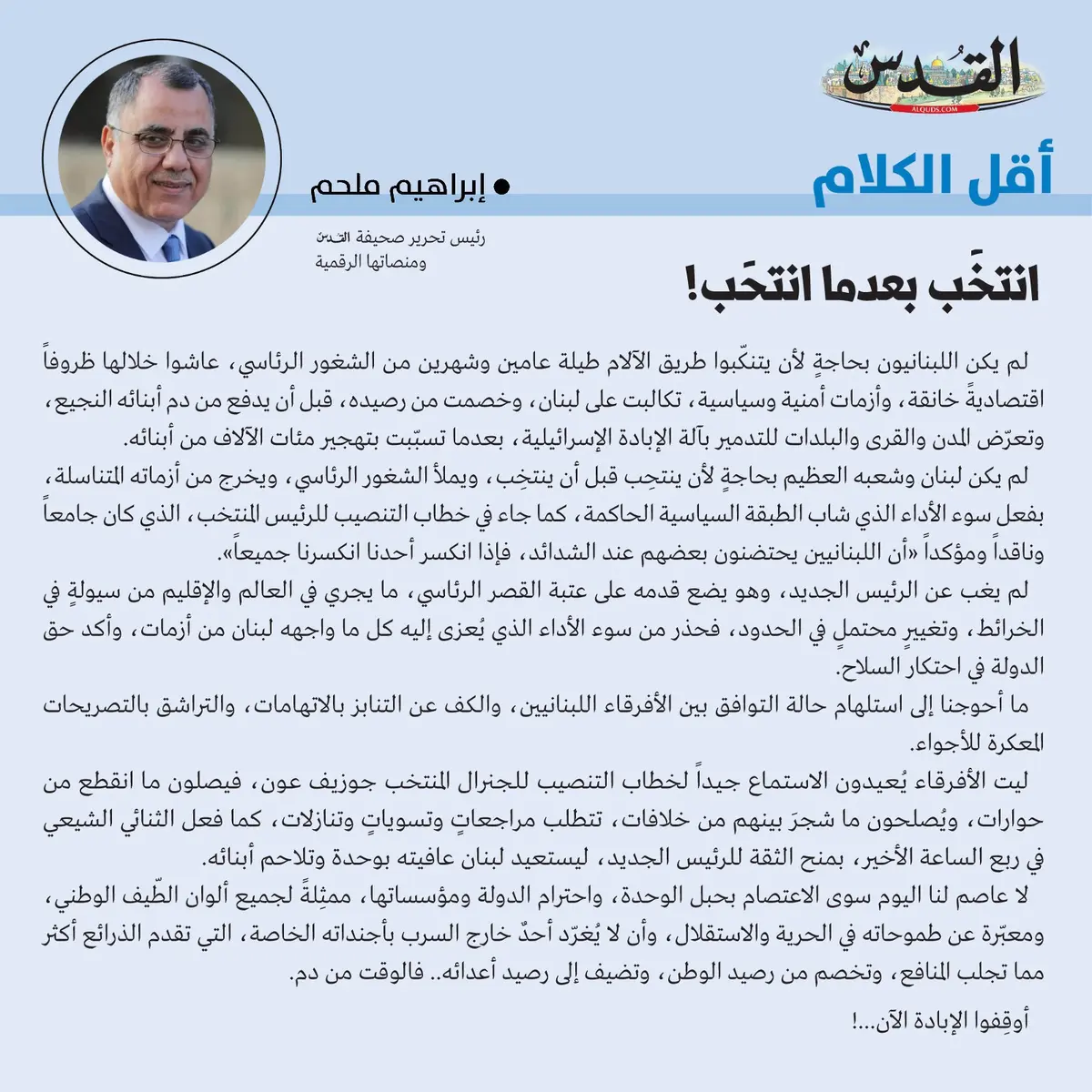
He was elected after he cried!

The Lebanese did not need to take the path of pain for two years and two months of presidential vacancy, during which they lived through stifling economic conditions and security and political crises that befell Lebanon and deducted from its balance, before it paid with the pure blood of its sons, and cities, villages and towns were exposed to destruction by the Israeli extermination machine, after it caused the displacement of hundreds of thousands of its sons.


Lebanon and its great people did not need to weep before it was elected, filled the presidential vacancy, and emerged from its successive crises, due to the poor performance of the ruling political class, as stated in the inauguration speech of the elected president, which was inclusive, critical, and affirmed that “the Lebanese embrace each other in times of hardship, so if one of us breaks, we all break.”


The new president, as he set foot on the threshold of the presidential palace, did not miss what was happening in the world and the region in terms of fluidity in maps and a possible change in borders. He warned of the poor performance to which all the crises that Lebanon faced were attributed, and he affirmed the state’s right to monopolize weapons.


We are in dire need to draw inspiration from the state of consensus among the Lebanese parties, and stop the exchange of accusations and statements that spoil the atmosphere.


I wish the parties would listen carefully to the inauguration speech of the elected General Joseph Aoun, so that they could connect the dialogues that were interrupted, and fix the differences that arose between them, which require reviews, settlements, and concessions, as the Shiite duo did in the last quarter of an hour, by granting confidence to the new president, so that Lebanon can regain its health with the unity and cohesion of its people.


Today, we have no protection except to cling to the rope of unity, respect the state and its institutions, representing all colors of the national spectrum, and expressing its aspirations for freedom and independence, and that no one should sing out of tune with his own agendas, which provide excuses more than they bring benefits, and deduct from the nation’s balance, and add to the balance of its enemies... for time is of blood.


Stop the genocide now...!

PALESTINE

Fri 10 Jan 2025 8:29 am - Jerusalem Time

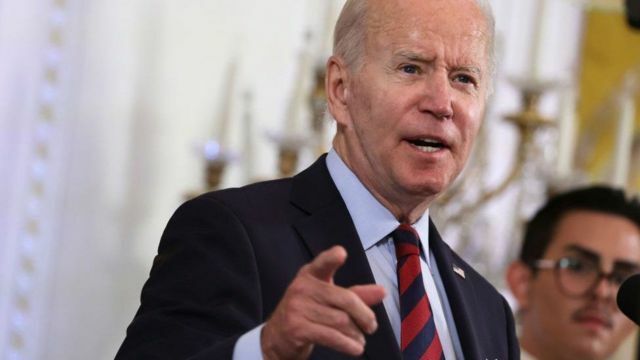
Biden: We have made real progress towards a hostage exchange deal

US President Joe Biden said "real progress" had been made in negotiations to release Israeli detainees in the Gaza Strip, some of whom are US citizens.


"We're making some real progress, I met with the negotiators today," Biden told reporters at the White House, referring to his meeting with CIA Director William Burns and his Middle East envoy, Brett McGurk.


"I still hope that we can do a prisoner-for-hostage exchange," he added.


Biden reiterated what he said during the long months of war, that Hamas "is the one standing in the way of this exchange right now, but I think we may be able to get it done, we need to get it done."


It is noteworthy that the Biden administration and officials in the US State and Defense Departments have always spoken optimistically about the prospects for a ceasefire, and when the government of Israeli Prime Minister Netanyahu rejected it (each time), they placed the blame on Hamas.


The Biden administration has only 11 days left in office, ending at noon on January 20.


US Secretary of State Antony Blinken said on Wednesday that a ceasefire agreement in Gaza and the release of Israeli hostages was "very close," hoping to reach it in the time remaining for President Biden's administration.


“I hope we can get it done in the time we have left, but if we don’t, the plan that President [Joe] Biden has put forward for a ceasefire and hostage release will be handed over to the next administration, and I think when we get that deal — and we will get it — it will be based on the plan that President Biden put forward to the world last May,” Blinken said at a press conference with his French counterpart in Paris on Tuesday, stressing that the Biden administration has spent a significant amount of time pushing an initiative to govern Gaza after the war that includes arrangements for the security, governance and reconstruction of the Strip.


"We are prepared to hand that over to the [Trump] administration so they can work on it and take advantage of it when the opportunity arises," he added.


In turn, US President-elect Donald Trump confirmed that he looks forward to releasing the Israeli hostages in the Gaza Strip before his inauguration scheduled for this month.


In response to a question about the Gaza negotiations, he said at a press conference on Tuesday, "If the hostages are not released by the time of my inauguration, the gates of hell will open wide," repeating his threats against Hamas and the stricken Gaza Strip.


On December 2, Trump issued a stern warning that if the hostages were not released before his inauguration on January 20, there would be a "serious problem" in the Middle East.


In a related matter, Steve Witkoff, President-elect Donald Trump's Middle East envoy, said Tuesday he would travel to Qatar to participate in ceasefire and hostage negotiations in Gaza with Biden administration officials.


Chances of a deal appear slim as Israeli Prime Minister Benjamin Netanyahu has made clear he has no intention of ending the genocidal war and Hamas says any deal must lead to a permanent ceasefire, but Witkoff insisted progress was being made.


It is unprecedented for an official from an incoming administration to join the diplomatic work of the current administration.

PALESTINE

Thu 09 Jan 2025 8:39 pm - Jerusalem Time

Prisoners Club: 10,400 Palestinian detainees in Israeli prisons


Two Palestinian organizations said that the Israeli authorities are detaining 10,400 Palestinians in their prisons until the beginning of January.


This came according to a joint statement by the Palestinian Liberation Organization's Commission of Prisoners' Affairs and the Palestinian Prisoners' Club (Ahli).


The statement explained that among the prisoners are 87 women, including four female prisoners from the Gaza Strip, and 320 children.


The statement indicated that the number of administrative detainees (without charge) reached 3,376, including 95 children and 22 women, in addition to 1,886 detainees classified by the Israeli authorities as "illegal combatants."

PALESTINE

Thu 09 Jan 2025 8:36 pm - Jerusalem Time

Families of Israeli soldiers appeal to Netanyahu to end war in Gaza

A group of families of Israeli soldiers on Thursday called on Prime Minister Benjamin Netanyahu to end the war on the Gaza Strip in order to preserve the lives of their sons, accusing him of prolonging the conflict in vain.

The “Families of Soldiers Cry Enough” group includes more than 800 families of soldiers, conscripts and reservists serving in combat units in Gaza, including those who have continued fighting almost non-stop since October 7, 2023.

In a letter addressed to Netanyahu by “Families of Soldiers Cry Enough,” the group reiterated these accusations.

The letter read: “We accuse you of a war without a horizon, unprecedented in the history of our country. And this is only for reasons related to your personal political survival.”

The message added: "We accuse you of abandoning the hostages and soldiers! We appeal to you: End the war!"

The soldiers' families said that "everyone knows, including them (the soldiers), that the war continues without a goal and that the hostages will not return except within the framework of an agreement" currently being negotiated in Qatar, one of the three mediating countries alongside the United States and Egypt in the peace talks.

The group of soldiers' families continued, "The Israeli army has no reason to remain in Gaza, except to fulfill the messianic desires (of some members of the extreme right) to settle there."

The families concluded their message by telling Netanyahu, "We will not allow you to continue sacrificing our sons like cannon fodder."

ARAB AND WORLD

Thu 09 Jan 2025 8:34 pm - Jerusalem Time

While continuing to violate its lands, Israel congratulates Lebanon on electing a new president

Israel congratulated Lebanon on Thursday on the election of a new president, despite the lack of diplomatic relations between the two countries and the continued occupation of parts of Lebanese territory by the Israeli army and violations of the ceasefire agreement.

In a post on the X platform, Israeli Foreign Minister Gideon Sa'ar said: "I congratulate Lebanon on electing a new president after a long political crisis."

Saar added: "I hope that this choice will contribute to achieving stability and a better future for Lebanon and its people and strengthening good neighborly relations."

This congratulation comes despite the fact that Israel and Lebanon are in a state of ongoing hostility.

The latest manifestation of this hostility was the fierce war waged by Israel on Lebanon last year, which resulted in the killing and wounding of thousands, in addition to the widespread destruction of buildings in many Lebanese cities and towns, including the capital Beirut.

At the time the congratulations were issued, the Israeli army continued its violations of Lebanese sovereignty and breached the fragile ceasefire that ended the war on November 27, especially in the Nabatieh Governorate (south).

In the Marjeyoun district of this governorate, the Israeli army carried out, on Thursday, extensive bombing operations against buildings and homes in the towns of Houla and Rab Thalatheen.

In the Nabatieh district of the same governorate, Israeli drones have been flying since the morning hours in the skies of the towns of Deir al-Zahrani, Kfarjouz, Haboush, Arabsalim, Kfarreman, Toul, al-Kafour, Harouf, Yahmar al-Shaqif, Arnoun, and Kfar Tibnit.

Thus, the total number of Israeli violations of the ceasefire agreement, which entered into force 44 days ago, rose to 435 violations, according to statistics prepared by Anadolu Agency based on the announcements of the official Lebanese News Agency until 14:40 GMT.

Lebanon did not immediately officially comment on this Israeli congratulation.


PALESTINE

Thu 09 Jan 2025 5:44 pm - Jerusalem Time

US State Department warns Trump team of imminent humanitarian 'catastrophe' in Gaza if UNRWA is banned


State Department officials have told the Trump administration’s transition team that a humanitarian “catastrophe” could occur in Gaza when a new Israeli law banning contact with the United Nations agency for Palestinian refugees goes into effect at the end of the month, three US officials told Axios.


The United Nations Relief and Works Agency for Palestine Refugees (UNRWA) is the primary aid agency operating in Gaza. U.S. officials say there is no serious backup plan to provide humanitarian supplies and services to the Palestinians.


More than 15 months into Israel’s war of extermination, the United Nations and other aid organizations have warned that Gaza is close to being uninhabitable. The vast majority of Gaza’s housing has been destroyed, and nearly two million Palestinians who depend on aid for food, water and medical services have been displaced.


The Israeli law will go into effect just days after President-elect Donald Trump is inaugurated, as his new administration inherits mounting global crises.


The website says: “Biden administration officials told Axios that they initiated the briefing on UNRWA because they wanted the new administration to be aware of the impending crisis.”


It is noteworthy that last October, the Israeli Knesset approved two bills that would significantly limit UNRWA's ability to continue operating in Gaza, the West Bank and East Jerusalem.


The first bill bans UNRWA from operating in Israeli territory, and is most relevant to UNRWA’s activities in East Jerusalem. But it also affects the relief agency’s operations in the West Bank, which are run from Jerusalem. The second bill bans any Israeli government official from contacting UNRWA, and strips all UNRWA workers of their diplomatic privileges and immunity.


“Israel has long been hostile to UNRWA – and has been since the start of the war in Gaza, alleging that some of the agency’s employees were involved in the Hamas terror attack on Israel on October 7, 2023. The agency expelled nine employees following a UN investigation, but has repeatedly denied allegations that the agency has extensive ties to Hamas.


It is noteworthy that during Trump’s first term (2017-2021), his administration gradually cut all US aid to UNRWA. The Biden administration later resumed US aid to the agency and supported its budget with hundreds of millions of dollars. But Congress passed a law last March prohibiting the United States from funding UNRWA until at least 2025.


UN officials said they were concerned that once the laws came into effect, UNRWA staff would not be able to travel between Gaza and Israel, and the agency would not be able to implement deconfliction arrangements with the IDF. It was also not clear whether the IDF would treat the agency’s facilities as part of the UN, which under international law cannot be targeted by Israeli forces.


UN officials said this would jeopardize UNRWA's ability to continue operating in Gaza, while a senior UNRWA emergency official told the Guardian that the social system in the Strip was likely to collapse, according to Axios.


Last week, State Department officials briefed Joel Rayburn of Trump's transition team on UNRWA's situation and raised "deep concerns" about the impact of the new laws on the humanitarian situation in Gaza, US officials said.


Axios says that Rayburn, a seasoned Middle East expert and former US envoy to Syria, is expected to be named assistant secretary of state for Near Eastern affairs in the next administration, replacing Barbara Leaf.


“We wanted them to know what would happen 10 days after Trump took office,” a US official told Axios. “We thought that was the responsible thing to do. It’s a disaster waiting to happen.”


US officials told the site that Israel and the United Nations have not made any serious plans for what will happen next.


U.N. Secretary-General Antonio Guterres has refused for the past two months to engage in discussions with Israel about alternative U.N. agencies that could take over some of UNRWA’s roles, U.S. and Israeli officials said. A spokesman for Guterres declined to comment.


The Israeli government has held several consultations on the UNRWA issue, but has not made any decisions on what to do in Gaza after the laws go into effect, a senior Israeli official told Axios.


“Both sides are playing a dangerous game, waiting for a magic bullet — and they think that if they don’t do something, it will resolve itself, but it won’t,” a US official said.


In a letter to members of the UN General Assembly last December, Guterres wrote that halting or restricting UNRWA’s activities in Gaza and the West Bank would have “devastating consequences” for Palestinian refugees.


“There is currently no realistic alternative to UNRWA that can adequately provide the services and assistance required,” he wrote.


UNRWA communications director Juliette Touma told Axios that the agency will not close its operations on January 31, when the law goes into effect. “We plan to stay in Gaza and work as long as we can until the very last moment; it will be catastrophic if the bill is implemented,” Touma said.

ARAB AND WORLD

Thu 09 Jan 2025 3:53 pm - Jerusalem Time

Trump faces challenge of uniting Republicans with slim majority

Since his landslide victory, President-elect Donald Trump has seemed to be in a comfortable position, but with just two weeks to go until his inauguration, he will first have to unite a narrow and divided Republican majority.


Faced with a Democratic camp still reeling from Kamala Harris's defeat in November, Republicans appear to be in a better position, but internal divisions threaten to thwart the next president's grand ambitions, from a hardline anti-immigration policy to radical tax cuts.


While top tech CEOs have begun to express their support for Trump, his political camp is beginning to see divisions.


But House Republican leader Mike Johnson said this week that his party’s lawmakers were “ready to get to work.” “We’ve made a great start, as we promised,” he told reporters.


It is known that the debate with the senators is taking on a more tense dimension regarding the legislative strategy. Should Trump’s program be adopted in a single package of laws or spread over a series of separate measures?


The second approach is of interest to prominent Trump supporters, who see it as the quickest way to secure a first victory on border control, the central theme of Trump’s campaign, which has been marked by fierce anti-immigration rhetoric.


But with a narrow majority in the House, Republicans favor an “all or nothing” strategy, fearing failure to pass promised tax cuts.


"This is what I prefer."

As for Trump, the first concerned party, he announced that he preferred a “big bill,” adding: “This is what I preferred and will always prefer.”


But he also added: “If having two projects provides more security, things will go a little faster because we will be able to take care of immigration earlier.”


Trump’s team must be quick, because the midterm elections are less than two years away, with the risk of losing control of Congress or one of its chambers, especially since the list of battles to be fought is long, from lifting the restrictions imposed by President Joe Biden on offshore drilling to the ambition to acquire Greenland and the Panama Canal.


A disunited Republican base could be Trump’s biggest weakness in his second term, acknowledged one of his supporters, Oklahoma Senator Markwayne Mullin, who added on the conservative-friendly Fox News channel: “Everyone is pulling in different directions.”


The verdict

Since his election, Trump has taken on the role of arbiter, making a point of addressing unruly lawmakers and holding internal consultations at his Florida residence.


Here, too, at Mar-a-Lago, he has largely succeeded in rallying the tech giants around him, most of whom had been highly critical of him during his first term before turning to him again since his last presidential campaign.


Trump will host Republican state governors at his headquarters on Thursday, who are considered the most independent, in addition to other representatives he is expected to meet with on Saturday. American media reported that he plans to hold a large party for Senate Republicans in the coming weeks.


For their part, the leaders of the Democratic bloc in Congress pledged to work with Republicans on the reforms they agree to, without making it easier for them to do so on the rest of the reforms.


“They are the majority and now they are in charge,” Senate Minority Leader Chuck Schumer said in a speech to the Senate. “We and the American people will watch them.”

PALESTINE

Thu 09 Jan 2025 3:46 pm - Jerusalem Time

Two young Palestinians injured after the occupation forces attacked them in Hebron

Two young men were injured and bruised today, Thursday, after the Israeli occupation forces attacked and abused them in Hebron.


According to local sources, these forces stopped two young men while they were trying to reach the sanctuary, took them inside the military checkpoint, and severely beat them, causing them to suffer wounds and bruises, after which they were transferred by Red Crescent crews to the hospital.

PALESTINE

Thu 09 Jan 2025 3:20 pm - Jerusalem Time

Washington warns of imminent humanitarian "catastrophe" in Gaza if UNRWA is banned

State Department officials have told the Trump administration’s transition team that a humanitarian “catastrophe” could occur in Gaza when a new Israeli law banning contact with the United Nations agency for Palestinian refugees goes into effect at the end of the month, three US officials told Axios.


The United Nations Relief and Works Agency for Palestine Refugees (UNRWA) is the primary aid agency operating in Gaza. U.S. officials say there is no serious backup plan to provide humanitarian supplies and services to the Palestinians.


More than 15 months into Israel’s war of extermination, the United Nations and other aid organizations have warned that Gaza is close to being uninhabitable. The vast majority of Gaza’s housing has been destroyed, and nearly two million Palestinians who depend on aid for food, water and medical services have been displaced.


The Israeli law will go into effect just days after President-elect Donald Trump is inaugurated, as his new administration inherits mounting global crises.


The website says: “Biden administration officials told Axios that they initiated the briefing on UNRWA because they wanted the new administration to be aware of the impending crisis.”


It is noteworthy that last October, the Israeli Knesset approved two bills that would significantly limit UNRWA's ability to continue operating in Gaza, the West Bank and East Jerusalem.


The first bill bans UNRWA from operating in Israeli territory, and is most relevant to UNRWA’s activities in East Jerusalem. But it also affects the relief agency’s operations in the West Bank, which are run from Jerusalem. The second bill bans any Israeli government official from contacting UNRWA, and strips all UNRWA workers of their diplomatic privileges and immunity.


“Israel has long been hostile to UNRWA – and has been since the start of the war in Gaza, alleging that some of the agency’s employees were involved in the Hamas terror attack on Israel on October 7, 2023. The agency expelled nine employees following a UN investigation, but has repeatedly denied allegations that the agency has extensive ties to Hamas.


It is noteworthy that during Trump’s first term (2017-2021), his administration gradually cut all US aid to UNRWA. The Biden administration later resumed US aid to the agency and supported its budget with hundreds of millions of dollars. But Congress passed a law last March prohibiting the United States from funding UNRWA until at least 2025.


UN officials said they were concerned that once the laws came into effect, UNRWA staff would not be able to travel between Gaza and Israel, and the agency would not be able to implement deconfliction arrangements with the IDF. It was also not clear whether the IDF would treat the agency’s facilities as part of the UN, which under international law cannot be targeted by Israeli forces.


UN officials said this would jeopardize UNRWA's ability to continue operating in Gaza, while a senior UNRWA emergency official told the Guardian that the social system in the Strip was likely to collapse, according to Axios.
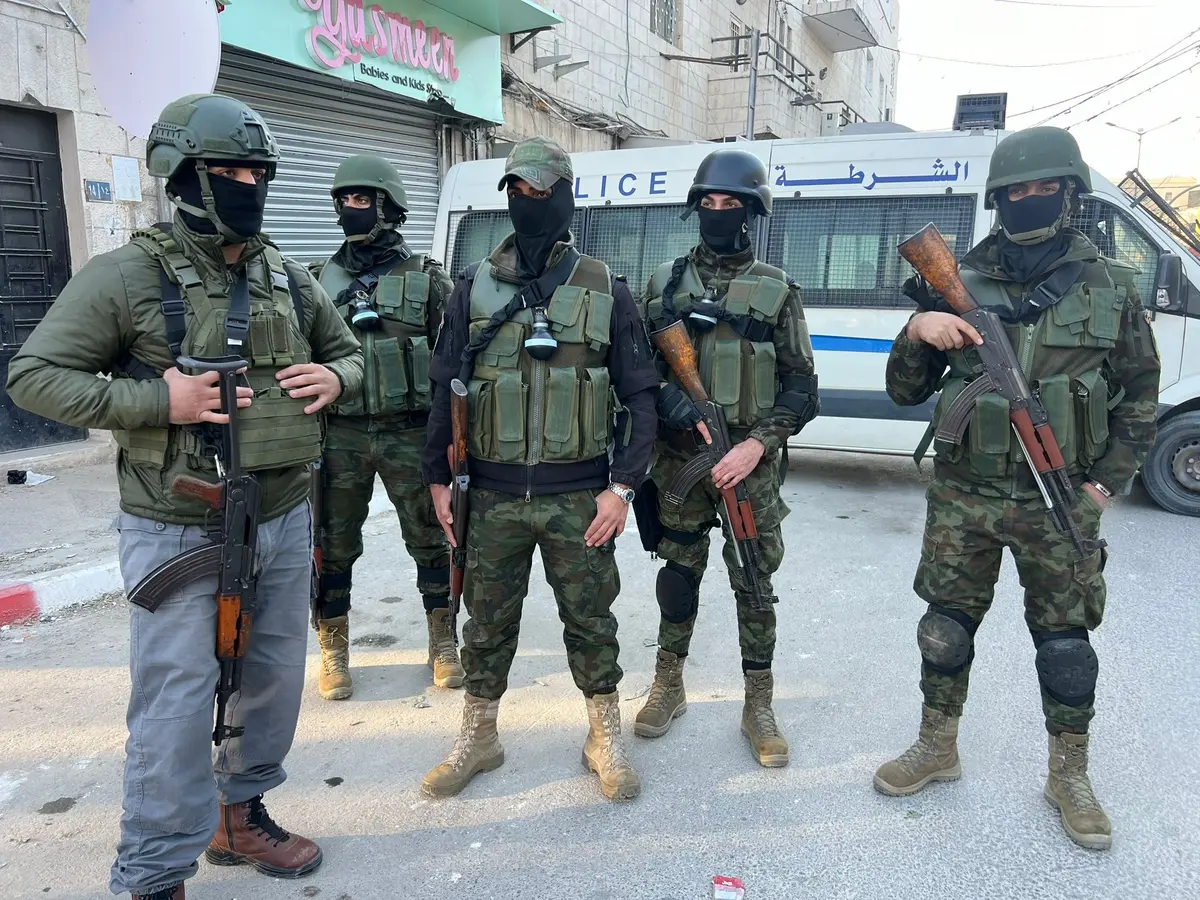

Last week, State Department officials briefed Joel Rayburn of Trump's transition team on UNRWA's situation and raised "deep concerns" about the impact of the new laws on the humanitarian situation in Gaza, US officials said.
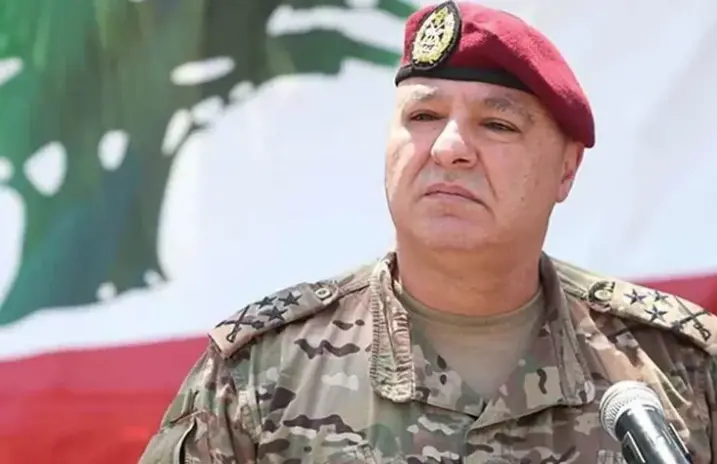

Axios says that Rayburn, a seasoned Middle East expert and former US envoy to Syria, is expected to be named assistant secretary of state for Near Eastern affairs in the next administration, replacing Barbara Leaf.


“We wanted them to know what would happen 10 days after Trump took office,” a US official told Axios. “We thought that was the responsible thing to do. It’s a disaster waiting to happen.”


US officials told the site that Israel and the United Nations have not made any serious plans for what will happen next.


U.N. Secretary-General Antonio Guterres has refused for the past two months to engage in discussions with Israel about alternative U.N. agencies that could take over some of UNRWA’s roles, U.S. and Israeli officials said. A spokesman for Guterres declined to comment.


The Israeli government has held several consultations on the UNRWA issue, but has not made any decisions on what to do in Gaza after the laws go into effect, a senior Israeli official told Axios.


“Both sides are playing a dangerous game, waiting for a magic bullet — and they think that if they don’t do something, it will resolve itself, but it won’t,” a US official said.


In a letter to members of the UN General Assembly last December, Guterres wrote that halting or restricting UNRWA’s activities in Gaza and the West Bank would have “devastating consequences” for Palestinian refugees.


“There is currently no realistic alternative to UNRWA that can adequately provide the services and assistance required,” he wrote.


UNRWA communications director Juliette Touma told Axios that the agency will not close its operations on January 31, when the law goes into effect. “We plan to stay in Gaza and work as long as we can until the very last moment; it will be catastrophic if the bill is implemented,” Touma said.

PALESTINE

Thu 09 Jan 2025 3:01 pm - Jerusalem Time

10 Israeli soldiers killed in northern Gaza Strip in two weeks

Ten Israeli soldiers were killed in Beit Hanoun, north of the Gaza Strip, over the past two weeks, following operations carried out by Palestinian fighters in response to the ongoing Israeli genocide war for the 16th month.


The Hebrew newspaper Yedioth Ahronoth said on Thursday: "10 soldiers have been killed since the start of the Israeli military operation in Beit Hanoun (two weeks ago)."


On Wednesday evening, the Israeli army announced the killing of 3 soldiers and the injury of 3 others in the explosion of an explosive device that a tank passed over in Beit Hanoun.


According to army data, 831 officers and soldiers have been killed since the start of the war of extermination in Gaza on October 7, 2023, including 396 in the ground battles that have been ongoing since the 27th of the same month.


While 5,589 officers and soldiers were injured since the beginning of the war, including 2,535 in ground battles.


17 soldiers are still receiving treatment in hospitals for serious injuries, 174 for moderate injuries, and 7 for minor injuries.


This data includes soldiers killed and wounded in Gaza, the West Bank, inside Israel and Lebanon, and does not include police and Shin Bet personnel.


Since October 7, 2023, Israel, with American support, has been waging a genocidal war on Gaza, leaving more than 155,000 Palestinians dead and wounded, most of them children and women, and more than 11,000 missing, amid massive destruction and famine that killed dozens of children and the elderly, in one of the worst humanitarian disasters in the world.


Tel Aviv continues its massacres, ignoring two arrest warrants issued by the International Criminal Court on November 21 against Israeli Prime Minister Benjamin Netanyahu and former Defense Minister Yoav Galant, on charges of committing war crimes and crimes against humanity against Palestinians in Gaza.


For decades, Israel has occupied lands in Palestine, Syria and Lebanon, and refuses to withdraw from them and establish an independent Palestinian state, with East Jerusalem as its capital, on the borders before the 1967 war.

PALESTINE

Thu 09 Jan 2025 2:49 pm - Jerusalem Time

A Palestinian woman was killed in the ongoing events in Jenin camp

Mrs. Saeda Muhammad Yassin Abu Bakr (50 years old), a resident of the town of Ya’bad, southwest of Jenin, was killed today, Thursday, in the ongoing events in Jenin camp.


The official spokesman for the Palestinian security forces, Anwar Rajab, claimed that Mrs. Abu Bakr was killed as a result of outlaws opening fire on the civil court building in the city of Jenin, according to him.


He said: "A group of outlaws opened fire from inside the camp on the civil court, and they are known to us, which resulted in Mrs. Sa'ida being fatally shot in the waist, and after she arrived at the hospital, her death was announced," according to his statement.


He held the gang of murderers and outlaws responsible for her death, he said.


ARAB AND WORLD

Thu 09 Jan 2025 2:42 pm - Jerusalem Time

Joseph Aoun elected President of Lebanon

The Lebanese parliament elected Army Commander General Joseph Aoun as president of the country on Thursday, in the fourteenth round of voting, ending 26 months of presidential vacancy, after the term of former President Michel Aoun ended in October 2022.


Parliament Speaker Nabih Berri announced Army Commander Joseph Aoun as president after he received 99 votes out of 128, while 15 voted for other names, 9 submitted blank papers, and 5 votes were cancelled.


Before Aoun's election, official preparations were made at the presidential headquarters in Baabda Palace, in preparation for receiving the President of the Republic and rolling out the red carpet.


The session to elect the president witnessed disagreements and quarrels, as some MPs objected to the constitutionality of Joseph Aoun’s nomination for the presidency, because he is the current commander of the army, as the constitution prohibits the election of first-class public employees to the position. According to Article 49 of the constitution, the election of any candidate holding a government position “requires a constitutional amendment.”


There was a dispute among the representatives regarding the interpretation of the articles of the constitution, and the representatives said that these unusual circumstances allow Aoun to be nominated after two years of presidential vacancy.


Parliament Speaker Nabih Berri based his approval of Joseph Aoun’s candidacy on a similar precedent that occurred with former Lebanese President Michel Suleiman, when he was elected in the session of May 25, 2008, and he was the commander of the army at the time.


The position has remained vacant since Aoun's term ended and he left Baabda Palace in October 2022, despite the Parliament holding 12 sessions to elect the president, the last of which was in June 2023.


Joseph Aoun and the powers of the President

General Joseph Aoun, 60, has been commander of the Lebanese army since 2017, leading his forces through a devastating financial crisis that paralyzed much of the Lebanese state after the banking system collapsed in 2019.


The President of Lebanon has powers related to the legislative and executive authorities, the most prominent of which is calling for extraordinary sessions of the House of Representatives and postponing the convening of the House of Representatives for a period not exceeding one month.


In specific cases, the President may request the Prime Minister to dissolve the House of Representatives before the end of its actual term. If the Council of Ministers decides to dissolve the House, the President of the Republic shall issue a decree to that effect.


The President of Lebanon also has the right to issue laws within the specified period for their issuance, and he also has the right to request a review of the law once, in addition to his right to review the Constitutional Council regarding monitoring the constitutionality of laws.


The President has the right to propose a review of the Constitution, and the government submits the draft law to the House of Representatives. He also has the right to decide on the draft budget.