PALESTINE

Wed 08 Nov 2023 12:36 pm - Jerusalem Time

Blinken stresses that Israel will not “reoccupy” the Gaza Strip

US Secretary of State, Anthony Blinken, stressed on Wednesday the need for Israel not to reoccupy the Gaza Strip, after the end of the war it is currently waging against Hamas.


Blinken stressed to reporters, following a meeting in Tokyo of the foreign ministers of the “G7” countries, that “Gaza must not be reoccupied after the conflict.”


Blinken rejected the idea of forced displacement of Palestinians from Gaza at any stage, and said: “There must be no forced displacement of Palestinians from Gaza, neither now nor after the war.” The US Secretary also stressed the need not to “reoccupy Gaza after the end of the conflict or reduce its territory.” He said: “It is clear that Hamas cannot continue to run Gaza, and it is also clear that Israel cannot reoccupy Gaza.”


He continued: “The realistic matter is that we may need a transitional period after the end of the conflict, but it is inevitable that the Palestinian people will be the center of government in Gaza.”


ARAB AND WORLD

Wed 08 Nov 2023 12:32 pm - Jerusalem Time

Hezbollah and Israel exchange bombing of military sites

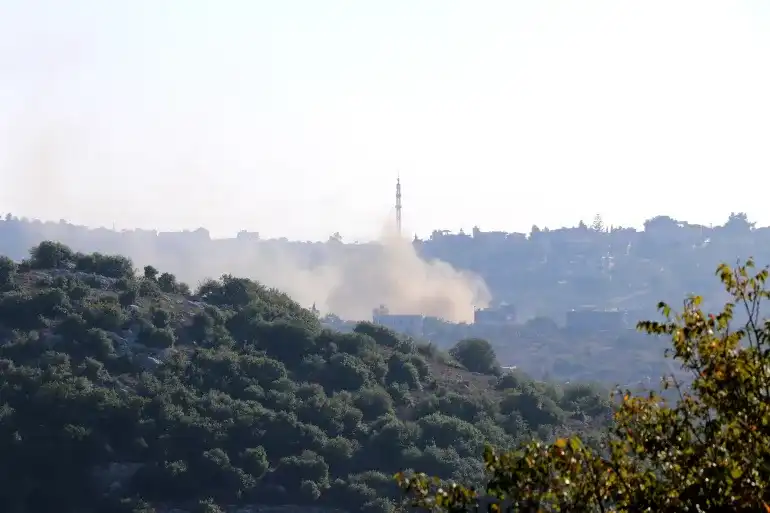
In recent hours, the Israeli army launched several raids on areas in southern Lebanon, while Hezbollah continued to bomb Israeli military sites adjacent to the border.


The Israeli military spokesman said that the army bombed "targets" belonging to Hezbollah, including weapons depots and missile launch pads.


Yesterday evening, Tuesday, the Israeli army launched a series of air strikes on several towns and regions in southern Lebanon.


The official Lebanese Information Agency said, "The enemy warplanes launched two raids on the outskirts of the towns of Yater and Kafra in the Bint Jbeil district."


Anadolu Agency reported that one of the raids in the town of Yater hit a 3-storey house, causing major material damage, but no information was received about any casualties.


Israeli aircraft also launched raids targeting the vicinity of the border towns of Naqoura, Alma al-Shaab, and Jabal al-Labouneh in the South Governorate, according to the Lebanese agency.


The same source reported that bombing targeted the Marjayoun Plain and the forests of the town of Shebaa in Nabatieh Governorate (south), without information being received about any casualties.


On Tuesday afternoon, Israeli warplanes flew over the airspace of the capital, Beirut, and its suburbs, according to what the official Lebanese National News Agency announced.


Hezbollah fire

For its part, Hezbollah announced that its fighters targeted Israeli artillery positions in occupied Palestine, in response to the bombing by Israeli forces of one of the resistance points in the Al-Tuffah region in southern Lebanon.


Al Jazeera's correspondent reported that "Hezbollah fighters targeted the Israeli site of Barkat Risha, off the southern border of Lebanon." The Israeli military spokesman said that "20 rocket shells fired from Lebanon towards the Israeli side of the border were repelled."


Al Jazeera's correspondent reported that "six rockets were intercepted in the occupied Syrian Golan area."


Since the eighth of last October, Israel, on the one hand, and Hezbollah and Palestinian factions in Lebanon, on the other hand, have exchanged intermittent bombardments, leaving dead and wounded on both sides of the border. These confrontations come in the wake of the continued Israeli aggression on Gaza, which led to the death of more than 10 people. Thousands of martyrs and 26 thousand wounded.


PALESTINE

Wed 08 Nov 2023 12:29 pm - Jerusalem Time

(Updated) 6 Palestinians injured by Israeli army during the it’s storming of Bethlehem

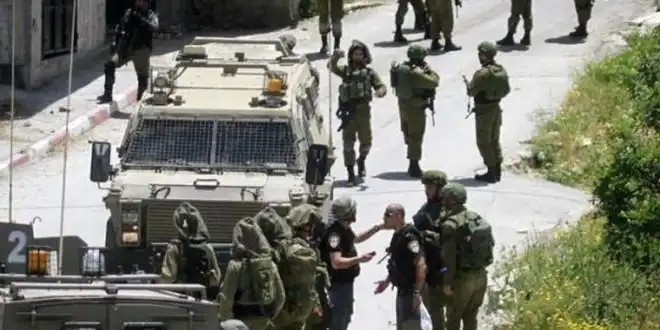
6 citizens were injured by live bullets, 3 by shrapnel, in addition to dozens from suffocation, during the Israeli occupation forces’ storming of the city of Bethlehem and besieging a citizen’s home in the slaughterhouse area.


Medical sources in the Red Crescent, Bethlehem branch, reported that 6 citizens were injured by live bullets in the lower extremities, and 3 others by shrapnel. They were taken to a hospital in Bethlehem, where their injuries were described as stable.


According to local sources, a large force of Israeli occupation army, accompanied by a special undercover unit, “Musta’ariboun,” stormed the areas of Hindaza, Al-Saf Street, and the Halal Market, and surrounded the house of former prisoner Hamdi Imad Al-Kamel in the slaughterhouse area, amidst shooting bullets and poison gas bombs.

PALESTINE

Wed 08 Nov 2023 11:56 am - Jerusalem Time

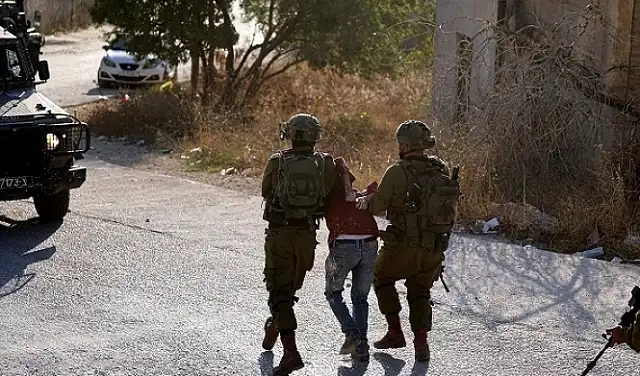
65 detainees on Wednesday and 2,280 arrests in the West Bank since the “Al-Aqsa Flood”

The arrests were concentrated in the Bethlehem and Hebron governorates, while the rest of the arrests were distributed in the governorates of Ramallah, Nablus, Jenin, Tulkarm, Qalqilya, Jerusalem, and Tubas.


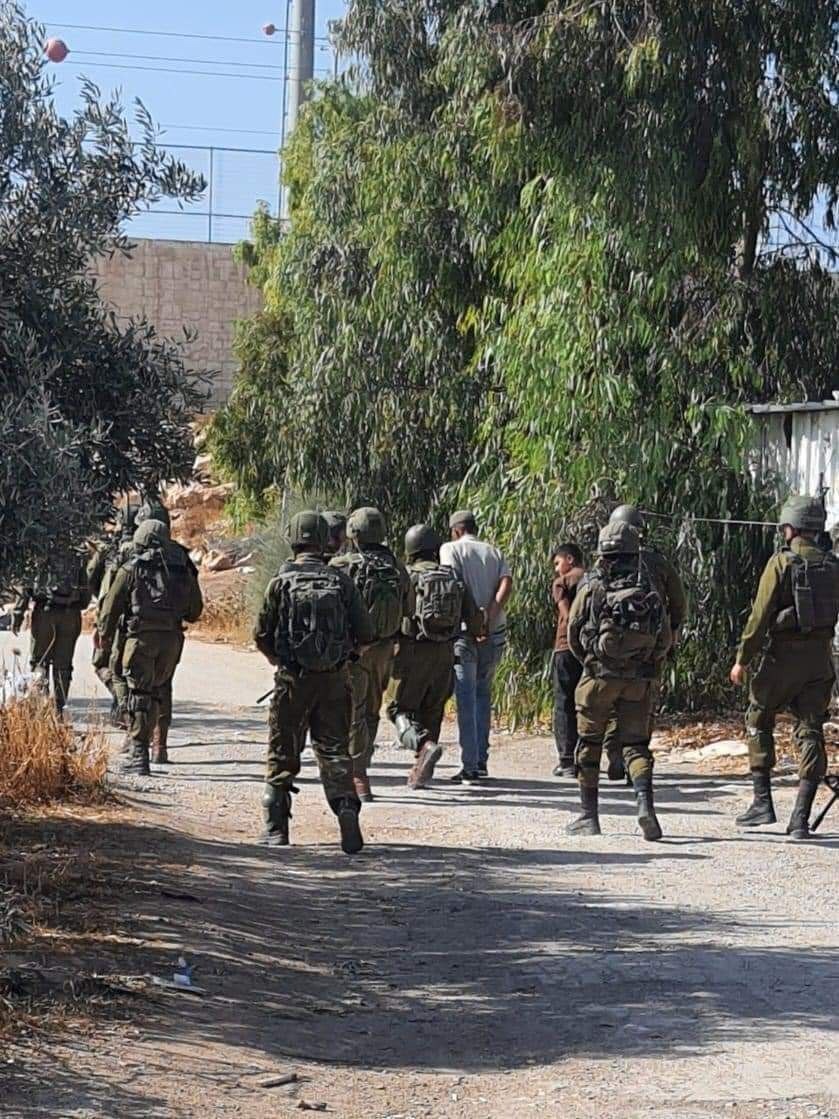
Last night, and at dawn on Wednesday, the Israeli occupation forces launched a new arrest campaign in the West Bank, targeting 65 Palestinians, including the wife of a prisoner and the mother of a prisoner from the town of Tal, Nablus district, a girl from the town of Dura, Hebron district, and two journalists from Hebron.


The arrests were concentrated in the governorates of Bethlehem and Hebron, while the rest of the arrests were distributed in the governorates of: Ramallah, Nablus, Jenin, Tulkarm, Qalqilya, Jerusalem, and Tubas.


The arrest campaign was accompanied by acts of abuse, severe beatings, and threats against detainees and their families, in addition to widespread sabotage and destruction of citizens’ homes. Today at dawn, the occupation bombed the home of the child prisoner, Muhammad Al-Zalbani, from the Shuafat camp, who has been detained since February 2023.


Thus, the total number of arrests after the seventh of last October rose to more than 2,280 cases, and this total includes those who were arrested from homes, through military checkpoints, those who were forced to surrender themselves under pressure, and those who were held hostage.


The ongoing arrest campaigns come within the framework of the comprehensive aggression against the Palestinian people and the ongoing genocide in Gaza, after the seventh of last October.


It is noteworthy that the data related to arrest cases includes those who were kept in detention by the occupation, or those who were later released.

PALESTINE

Wed 08 Nov 2023 11:52 am - Jerusalem Time

Israeli settlers fence lands in the northern Jordan Valley

Today, Wednesday, settlers fenced lands in “Wadi Al-Faw” in the northern Jordan Valley.


The official responsible for the Jordan Valley file in Tubas Governorate, Moataz Bisharat, said that the settlers have fenced off additional areas of Wadi al-Faw lands, near Ain al-Hilweh, in the northern Jordan Valley, stressing that this fencing is a continuation of the operations to seize large areas of land months ago.


These days, settlers have seized large areas of pastoral land in the northern Jordan Valley, after fencing it off for years, which has caused a large percentage of Palestinians to lose areas of pastures that provide free food for their livestock.

ARAB AND WORLD

Wed 08 Nov 2023 11:09 am - Jerusalem Time

Israeli analysts: A truce within days, and then the nature of the war will change

The truce in the war on Gaza may take place due to American pressure on Israel, and in parallel with attempts to reach a prisoner exchange deal. In the Israeli army, they wonder about “the extent of Hamas’ desire to fight now.”


Israeli analysts indicated today, Wednesday, that the war on Gaza, in its current form, may end in the coming days, due to pressure exerted by the American administration regarding a truce and attempts to reach a prisoner exchange deal, but they considered that the war may resume in a different form, and through local Israeli incursions of the Gaza Strip and assassinations of leaders in the Hamas movement and other factions.


According to Nahum Barnea, a political analyst in the Yedioth Ahronoth newspaper, “The coming days may be the final, decisive stage in the two efforts: the war against Hamas and the American-Qatari attempt to reach a kidnapping deal. After this period, there is doubt as to whether Israel will be able to withstand.” In the face of American pressure regarding a ceasefire, especially if a kidnapped deal is on the table, the clock is ticking.”


Barnea pointed out that “past experiences in Gaza, as well as in Lebanon, indicate that there is no high probability of resuming the ground invasion after a ceasefire agreement. Students (in Israel) will return to schools, residents will return to work, the reconstruction of towns will begin, and the world expects another agenda.” "And the reserve soldiers want to return to their homes, families and jobs. The Israeli army will remain in Gaza and continue to work, but not with the current size of the forces."


He added, "It is important to maintain realistic expectations. It is not certain that the Israeli army will be able to reach (Hamas leader in Gaza) Yahya Sinwar and his colleagues in the current round. Even if they are liquidated, Hamas will not disappear. It is important to remember that we are not alone in this drama, and we need the American administration and are obligated to listen to it.”


According to Barnea, “The votes that Biden is losing in America exacerbate his need for an imminent ceasefire in Gaza. We must realize that Gaza is only one section in the devastation that befell Israel on October 7. The Israeli government is now looking forward to a settlement in a diplomatic way to remove the power of Al-Radwan (in Hezbollah) on the border in the north. Without that, there is doubt whether the residents will return to their towns in the north. We have not yet reached the question of what Hamas will demand in exchange for the return of some of the kidnapped people.


He pointed out, "When Netanyahu and others talk about an ongoing war, they seem to mean not the war that took place in the last month, but rather a war of a different kind: assassinations, local raids, and continuous security operations."


Barnea pointed out, “As long as they talk about continuing the war, Netanyahu can put pressure on him to bear responsibility (for the security and intelligence failure on October 7) along with the government. At the end of the first month of the war, no one in Israel will be able to celebrate a victory. And sometimes the victory is by realizing that there is no victory.”


Military analyst in the newspaper "Haaretz", Amos Harel, also pointed out that "the duration of the war, with the current size of the forces, is not unlimited. The United States, which supports the Israeli operation to defeat Hamas, is in parallel exerting pressure to implement longer humanitarian truces and hints at “In the not-too-distant term, there will be a need to research changing the nature of war.”


He added, "The leadership of the southern region (of the Israeli army) wants many months to complete the military operation, targeting Hamas in the northern Gaza Strip in particular, and carrying out a radical survey in these areas with the aim of targeting terrorists and all weapons."


Harel continued, "The American administration is talking with Israel about the suitability of the form of war later: withdrawing most of the forces from the Gaza Strip and moving to the method of local incursions against Hamas systems, in the northern Gaza Strip and perhaps in other areas as well."


Harel pointed out, "It is not yet clear what reality the Israeli army intends to establish after the war. The belief is that it is possible to dismantle Hamas' military and organizational strength, and not completely eliminate it, because an idea or ideology cannot be destroyed."


He added, "A more complex picture emerges from conversations with Israeli officers who are leading the war in the Gaza Strip and the levels above them. They are satisfied, and even positively surprised, by the level of professionalism of the ground forces, in the second week of the ground invasion in Gaza. But there is still the question about the extent of Hamas' desire to fight now."


Harel continued: “The fact that Hamas refuses at this stage any real negotiations about the broad liberation of the kidnapped people would also indicate that its leadership does not currently see its situation as very dangerous. In the last two days, a decline in the amount of rocket shells launched into the center of the country has become apparent.”


There appears to be a combination of two reasons here: the difficulty Hamas faces by launching from the northern Gaza Strip following the Israeli army attack, and a desire to preserve a sufficient number of medium-range rockets for the next stages of the war.


PALESTINE

Wed 08 Nov 2023 11:05 am - Jerusalem Time

Palestinian Ministry of Labor, the World Bank, and UNRWA disburse financial aid to workers in the Gaza Strip

The Ministry of Labor announced that the cash financial aid payment had begun to be disbursed to approximately 5,200 Gaza Strip workers who were forcibly expelled by the Israeli occupation from their workplaces within the territories of 1948, in light of the Israeli war on the Gaza Strip since last October 7, and they were stranded and were received in... Shelter centers in the West Bank.


The United Nations Relief and Works Agency for Palestine Refugees (UNRWA) provided financial assistance to about 2,500 Gaza workers, worth 700 shekels per worker.


Through PALPAY, the World Bank, through the Government of Norway, provided financial aid to Gaza workers worth 700 shekels for 2,700 workers, which will be disbursed through the Bank of Palestine.


The Ministry thanked the World Bank and UNRWA for their efforts to support Gaza workers affected by the Israeli aggression on Gaza.

ARAB AND WORLD

Wed 08 Nov 2023 11:01 am - Jerusalem Time

The G7 confirms its support for a “truce” without calling for an end to the war

Japan, the host of the summit, said in a statement that the issue was raised during a working dinner late on Tuesday evening, and that the group continues, today, Wednesday, talks on the crisis between Israel and Gaza, the Ukrainian war in Russia, and issues related to China.


On Wednesday, the foreign ministers of the Group of Seven countries affirmed their support for “truces and humanitarian corridors” in the ongoing war between Israel and Hamas, without calling for a ceasefire.


The ministers said in a joint statement following a meeting in Tokyo, “We stress the need for emergency action to confront the deteriorating humanitarian crisis in Gaza... We support humanitarian truces and corridors in order to facilitate urgently needed assistance, the movement of civilians, and the release of hostages” held by Hamas since its attack on the 7th. Since last October.


G7 foreign ministers discussed how to revitalize peace efforts in the Middle East and the next in the Gaza Strip once the war there subsides, as they met for a two-day summit in Tokyo.


Japan, host of the summit, said in a statement that the issue was raised during a working dinner late on Tuesday evening, and that the group continues, today, Wednesday, talks on the crisis between Israel and Gaza, the Ukrainian war in Russia, and issues related to China.


According to identical diplomatic sources, the foreign ministers of the seven countries - the United States, Japan, France, Britain, Germany, Italy and Canada - are seeking to bridge the gap that divides their countries' positions regarding the ongoing conflict between Israel and Hamas by launching a joint appeal to establish a humanitarian truce in the Gaza Strip.


A diplomatic source said that “constructive discussions” took place between the ministers on this issue on the first day of their meeting.


He added that there appears to be "great unity" among the ministers' positions regarding the need to "urgently" increase humanitarian aid to the Gaza Strip.


Japan announced today, Wednesday, following talks held in Tokyo by foreign ministers of the Group of Seven countries, that the group is “united” in continuing its “strong support” for Ukraine in confronting the Russian invasion of its lands, “even in light of the current international situation,” in a clear reference to the ongoing war between Israel and Hamas. .


The Japanese Foreign Ministry said in a statement: “As a result of the discussions, the foreign ministers of the G7 countries agreed that the G7 will remain united in its position of imposing tough sanctions on Russia and providing strong support to Ukraine even in light of the current international situation.”


The statement added that the ministers also confirmed that they would continue to impose “tough sanctions” on Moscow, accelerate Ukraine’s reconstruction efforts in the “medium and long term,” and continue “working toward a peace process.”


Ukraine's fears are mounting that its allies' support for it will diminish at a time when its counter-attack, which it has been waging since June, has failed to achieve tangible results and the chances of the current conflict turning into a long war of attrition are increasing.


The statement quoted Japanese Foreign Minister Yoko Kamikawa as saying that despite the war that has been raging for a month between Israel and Hamas, the G7 is keen to inform the international community that its commitment to support Ukraine “will never run out.”

PALESTINE

Wed 08 Nov 2023 10:58 am - Jerusalem Time

Palestine Energy Authority: 70% of the electricity transmission and distribution networks were destroyed due to the aggression against Gaza

The head of the Energy Authority, Dhafer Melhem, announced that 70% of the electricity transmission and distribution networks had been destroyed due to the continuing Israeli aggression on the Gaza Strip, for the 33rd day in a row, with losses estimated at about 80 million US dollars.


In an interview with Voice of Palestine Radio, Melhem pointed out that the occupation targeted solar cells, which are the only remaining source of energy in Gaza, and whose production does not exceed 5 megawatts.


He stated that about 70% of these cells have been destroyed to date, stressing that Israel has so far refused to bring fuel into the Gaza Strip despite continuous appeals from the international community and donor countries to put pressure on Israel to bring fuel at least for use in reserve generators in hospitals and for pumping, desalination, and water treatment stations. 


He stressed that Israel's prevention of basic services and its attempt to make the Gaza Strip an uninhabitable place is a war crime for which the occupying state must be held accountable.

PALESTINE

Wed 08 Nov 2023 10:55 am - Jerusalem Time

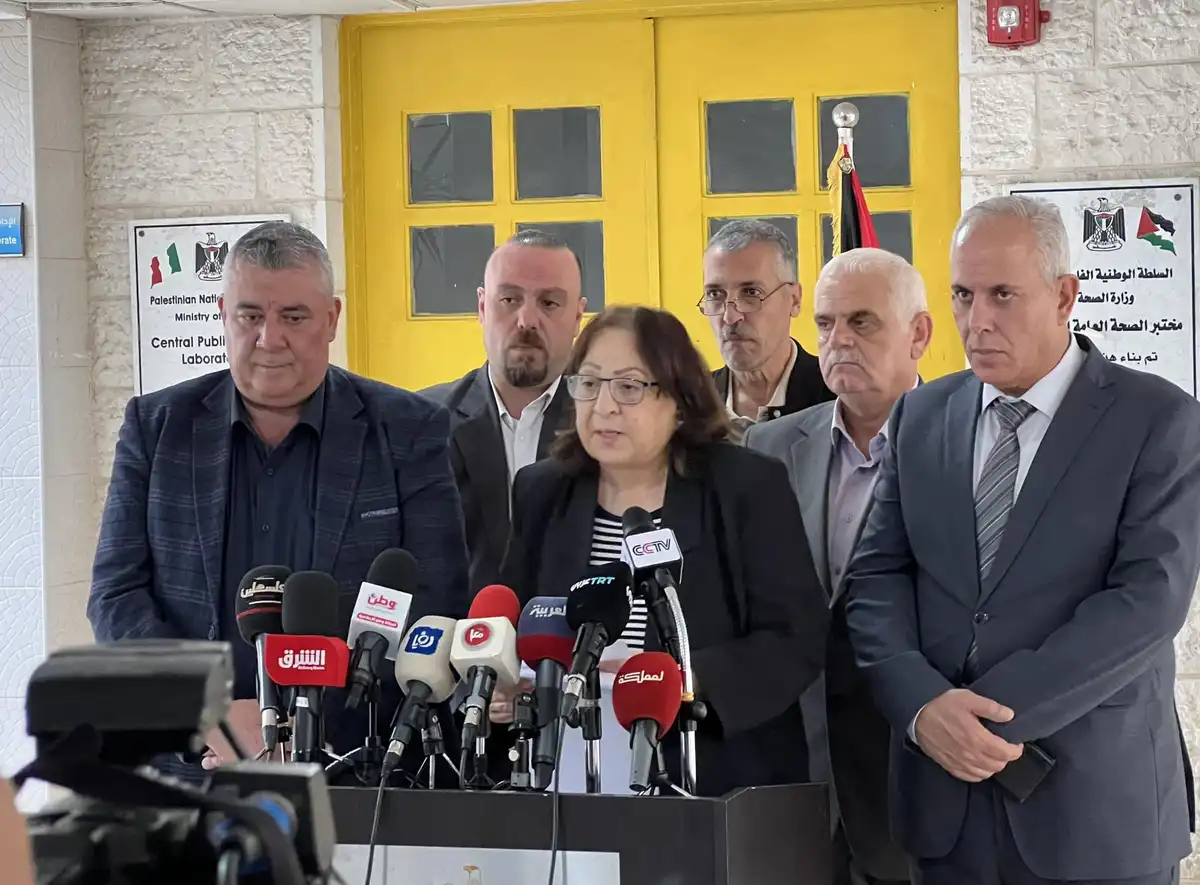
The Minister of Health issues the final warning of the collapse of the entire health system in the Gaza Strip

The Minister of Health, Mai Al-Kaila, issued the final warning of the collapse of the entire health system in the Gaza Strip, after the occupation aircraft targeted the solar cells that were supplying the Strip’s hospitals with little electricity, in addition to the insufficient medical and health supplies that meet the enormous needs of health care centers and hospitals in the Gaza Strip. Gaza.


Al-Kaila said in an interview with Voice of Palestine Radio that medical personnel are paying a heavy price for being on the job, which has been completely exhausted due to the number of successive infections, which amounted to more than 25,000 wounded, while the number of martyrs and wounded among medical and ambulance personnel exceeded hundreds.


Al-Kaila confirmed that there are a number of doctors who work for the International Red Cross, and others in various sectors, and Israel still refuses to allow them to enter the Strip to support doctors in Gaza hospitals, calling on the international community, Arab and Islamic countries, as well as United Nations organizations, to intervene urgently to bring in relief and medical aid and open the door for Humanitarian corridors.

ARAB AND WORLD

Wed 08 Nov 2023 10:45 am - Jerusalem Time

Barak: Israel has lost public opinion in Europe and we are headed toward friction with the Americans

Former Israeli Prime Minister Ehud Barak said that friction with the Americans will appear within a few weeks, and that Israel has lost public opinion in Europe, considering this a cause for concern.


In an interview with Politico, Barak said: “The rhetoric of American officials has shifted in recent days with increasing calls to stop the fighting for humanitarian reasons. The sympathy that arose toward Israel has now begun to diminish.”


He believed that "it is clear that we are heading towards friction with the Americans over the attack," stressing that "America cannot dictate to Israel what it should do. But we cannot ignore them," referring to Washington's role as the main guarantor of Israel's security.


He pointed out that "we will have to accept American demands during the next two or three weeks, and perhaps less," adding: "It will take months or even a year to eliminate the Hamas movement, but Western support is weakening due to the number of civilian deaths in Gaza, and fears that it will lead to "The Israeli campaign led to a broader and more disastrous war in the region."


Barak pointed out that “Western countries are also concerned about their citizens among the 242 hostages held by Hamas in Gaza,” and continued, “Listen to the public tone and behind doors it is a little clearer. We are losing public opinion in Europe, and within a week or "In two weeks we will start losing governments in Europe. After another week, friction with the Americans will come to the surface."


He stressed that “Israel is right to raise the ceiling of its goal in the Gaza war. The shock of the attack (Operation Al-Aqsa Flood) was enormous. This was an unprecedented event in our history, and it was immediately clear that a strict response was necessary. Not for the sake of revenge.” "But to make sure it doesn't happen again forever."


He believed that “to change the political landscape, a multinational Arab force could take control of Gaza after the Israeli military campaign,” considering that “it is not at all unlikely that, with the support of the League of Arab States and the Security Council, a multinational Arab force could be mobilized, including some units.” "Tokenism from non-Arab countries. They can stay there for three to six months to help the Palestinian Authority take power properly."


source: Sama News

ARAB AND WORLD

Wed 08 Nov 2023 10:31 am - Jerusalem Time

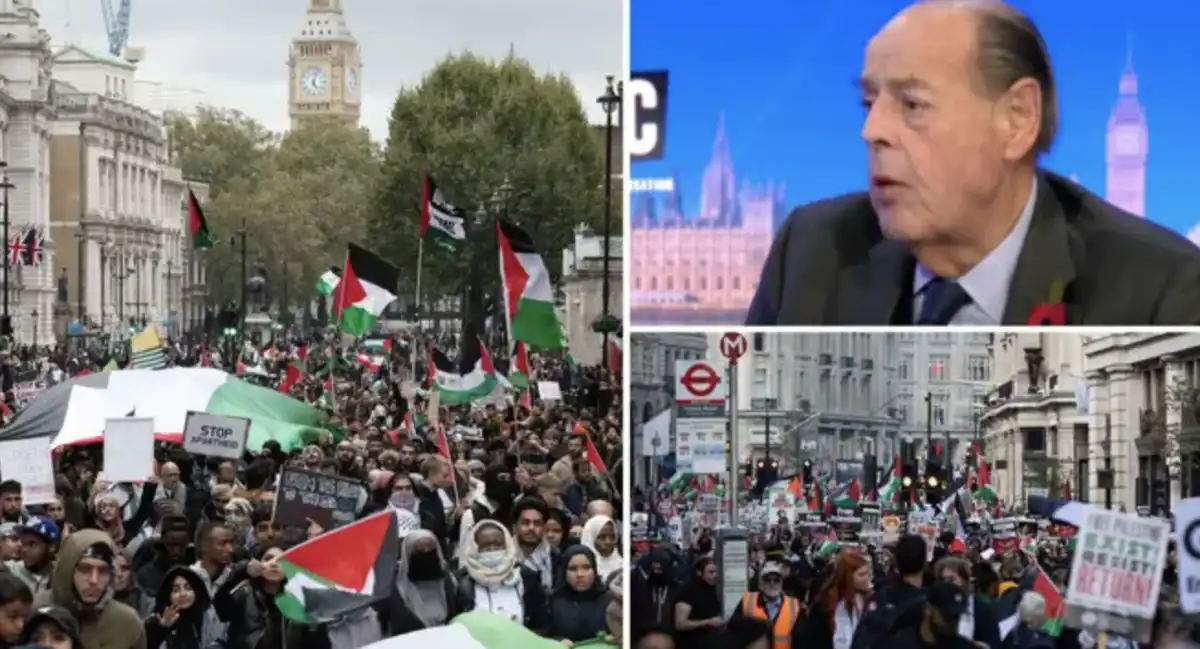
Winston Churchill's grandson: Pro-Palestinian march planned for the weekend "must go ahead"‼️

The grandson of former UK Prime Minister Winston Churchill said during a program on LBC Radio: “The pro-Palestinian march planned for the Armistice Day weekend must go ahead.”

Winston Churchill's grandson, Lord Nicholas Soames, said: "Whether you may not agree with their views would be very controversial and difficult, but banning this march would put enormous pressure on the police, so I think it should be allowed to go ahead."


Lord Nicholas Soames' comments come as the Metropolitan Police continues to confirm that, at this moment, the march will be allowed to go ahead on Saturday, as the police have not yet met the "evidence threshold" to ban it.


Lord Nicholas Soames explained that pro-Palestine demonstrators would be in the street to express a profound point of view, and said: “I think it would be a great mistake to introduce politics to prevent the march scheduled to take place next Saturday.”

He added: "The pro-Palestine marches are not hate marches, as the British Home Secretary described them."


It is noteworthy that the London Metropolitan Police are under pressure to ban the march scheduled to be carried out next Saturday, November 11, 2023, because it coincides with Armistice Day, which is a celebratory day on November 11 of each year to commemorate the armistice signed between the Allies in World War I and Kaiser Germany in French Compiègne. 

OPINIONS

Wed 08 Nov 2023 10:15 am - Jerusalem Time

Will There Be a ‘Day After’ the Gaza War?

Ramallah - “Al-Quds” dot com

Ramallah - “Al-Quds” dot com

Opinion Writer

By Middle East Policy

Netanyahu claims “indefinite” right of Israeli military to secure the territory, imperiling the American vow to revive the moribund peace process; the journal has long provided analysis of this dynamic. If anyone maintained hopes that an Israeli “victory” in Gaza would create a path toward the security of the Jewish state and the sovereignty of the Palestinian people, Prime Minister Benjamin Netanyahu brought them crashing down with a declaration that his defense forces will maintain security responsibility in the territory for an “indefinite period.” This appears to be another way for Netanyahu to frustrate the two-state solution. The prime minister has long supported Hamas in order to weaken the Palestinian Authority and claim that Israel does not have a partner for peace. 


As Tal Schneider documents in the Times of Israel, at a Likud faction meeting in early 2019, [Netanyahu] was quoted as saying that those who oppose a Palestinian state should support the transfer of funds to Gaza, because maintaining the separation between the Palestinian Authority in the West Bank and Hamas in Gaza would prevent the establishment of a Palestinian state. Middle East Policy has covered Netanyahu’s career from before he was first elected prime minister, documenting his attacks on the peace process. Please see below for links to our coverage; you can also search our entire library. Our analyses through the present day provide an understanding of the possibilities for an enduring political solution. 

Netanyahu’s statement that Israel sees the war as indefinite flies in the face of Secretary of State Antony Blinken’s claim that “Israel has made it clear it has no intention or desire to...resume control of Gaza.” Like other US officials and analysts, Blinken has promised to focus on the “day after” the war—that is, the moment when a UN, Arab, or even US authority can swoop in, run the territory, and prepare the ground for a two-state solution or at least for an interim Palestinian administration. 

These American dreams appear to rely on an expectation that, on the “day after” the war, Netanyahu will be removed from office and that the Israeli government will owe its US benefactor. This belief that Netanyahu will leave the scene may seem reasonable: As the Biden administration has suggested, “the buck stops on the prime minister’s desk.” In addition, critics in Israel lay some of the blame on Netanyahu for Hamas’s atrocities on October 7. 

The prime minister had allowed the transfer of security forces to protect settlers who are expanding their claims in the West Bank, allegedly leaving Gaza vulnerable. Netanyahu’s diversion of resources away from protecting the Gaza border and his support for Hamas have been backed by far-right figures like Bezalel Smotrich, one of the key hardline members of the governing coalition. Smotrich recently blocked the transfer of funds to the Palestinian Authority in the West Bank and demanded more military protection for Israeli settlements in the occupied territories. One of the many results of such a security zone would be the blocking of Palestinian farmers from the olive harvest. 


These issues—as well as his attempt to overhaul the judicial system—have drastically undercut Netanyahu’s support. Polls show that the prime minister is backed by less than 30 percent of the people and that 80 percent hold him responsible for security failures. And his attempts to shift the blame for the October 7 massacres have led even his staunchest supporters to demand his resignation. 

But many questions remain for US officials and Western analysts who see an opportunity to restart the moribund peace process when the war is “over”: If Israel maintains indefinite security responsibility, will there actually be a “day after”? Should American officials really expect Netanyahu’s days to be numbered if the war never really ends?  Or, if Netanyahu is able to declare victory over Hamas, can they be sure the prime minister will really face a day of reckoning? Will a Prime Minister Benny Gantz be any more open to a lasting political solution? He once boasted of blasting Gaza back “to the stone age.” And what leverage is the United States willing to use to prevent the de facto or actual annexation of the Jordan Valley? The administration claims that despite its rhetorical and monetary support for the Gaza bombardment that it cannot dictate to Israel the terms under which it fights (and Zvi Bar’el believes the Americans are losing patience). 


But should we expect the United States to make political demands on the Israelis “after” the war? Of course, it could take years for Israel to even come close to “winning”—at the expense of unfathomable deaths of civilians, of whom 10,000 are estimated to have been killed in just one month of war. In which case there could literally be no day after.  Understanding Netanyahu’s Obstruction of Palestinian Sovereignty Middle East Policy has been covering the politics of occupation since 1982. 


The first mention of Netanyahu came in the June 1992 issue, in an article by Israel Shahak titled, “Israeli Land Seizure in the Occupied Territories.” Shahak, a Holocaust survivor, argued that Israeli seizures of land had been carried out with the express purpose of preventing an effective Palestinian sovereignty. He quotes Netanyahu’s thinking at that time, one year before the Oslo accords, about West Bank policy: These areas will not be connected one with the other, there will be no central authority linking them, and each area will be surrounded by Israeli military installations, roadblocks and Jewish settlements. 

Four years later, after Prime Minister Yitzhak Rabin was murdered by an Israeli nationalist who sought to undo the peace process (settlers had long opposed his policies, another Middle East Policy analysis from 1992 shows), Netanyahu was elected for the first time. 

In an article on that 1996 contest, “Electoral Upset in Israel,” Guilain Denoeux and Jonathan Fox analyze the electoral processes that put Netanyahu over the top. But they also raise a red flag about the new prime minister’s use of the politics of fear, which has become a hallmark of his appeal: This strategy was most evident during the televised debate between the two candidates [the other was interim Prime Minister Shimon Peres], when Netanyahu used the word “fear” eleven times in fourteen minutes, accused Peres of having put the security of Israeli children in [PLO leader Yasser] Arafat's hands, and stated that every time they board a bus Israelis wonder whether they might become the victims of the next terrorist attack. 

Never, he implied, had the country felt more vulnerable. During his first stint as prime minister, writes Israeli sociologist Lev Grinberg in a 2002 Middle East Policy article, Netanyahu offered Israelis an “openly arrogant discourse” that denied Palestinian control over the resources required for true sovereignty and a path toward statehood: “borders, water, electricity, telephones, ports and airports, movement between the cities, and the Palestinian economy.” Indeed, Grinberg’s analysis applies today if we substitute the Palestinian Authority or its leader, Mahmoud Abbas, for “Arafat”: Arafat was expected to do what the Israeli army had failed to do: restrain Palestinian extremists and provide security to the Israelis. 

However, he wasn’t entitled to protect the security of the Palestinians, still ruled by the Israeli IDF [Israel Defense Forces], or to struggle for independence for his people. Hence, Arafat’s authority was not derived from the Palestinian people and their legitimate rights but rather from Israel’s consent to his presence. 

After losing the position to Ehud Barak in a decisive 1999 vote, Netanyahu retook power in 2009 and has served as prime minister ever since (with a very short interlude before his ascension in late 2022 in coalition with far-right nationalists). A decade ago, Ian Lustick told an audience convened by the Middle East Policy Council that despite the churn in Israeli politics since Netanyahu’s first election and upheavals in the region, including the Arab Spring, there was a surprising continuity. “Virtually nothing has changed to deflect the trajectory of the West Bank and its relationship to Israel as a tightly subordinated, politically impotent, and developmentally stagnant region,” Lustick, a professor at the University of Pennsylvania, lamented.  

That brings us to the present. In the Summer 2023 issue of Middle East Policy, Fadi Nahhas explains that the Israeli mainstream rejects the overt annexation of the West Bank preferred by the far right. (Indeed, we are seeing this nationalist project play out during Israel’s onslaught of Gaza, with state-sanctioned land grabs by settlers in the West Bank and more than 100 Palestinians reported killed.) 

But the preferences of the military and the bulk of the Israeli political elite should not be seen as leading toward a two-state settlement.  Even if Netanyahu does not survive, and the far-right government is replaced by more moderate politicians, we should expect a de facto annexation, Nahhas argues. 

PALESTINE

Wed 08 Nov 2023 10:14 am - Jerusalem Time

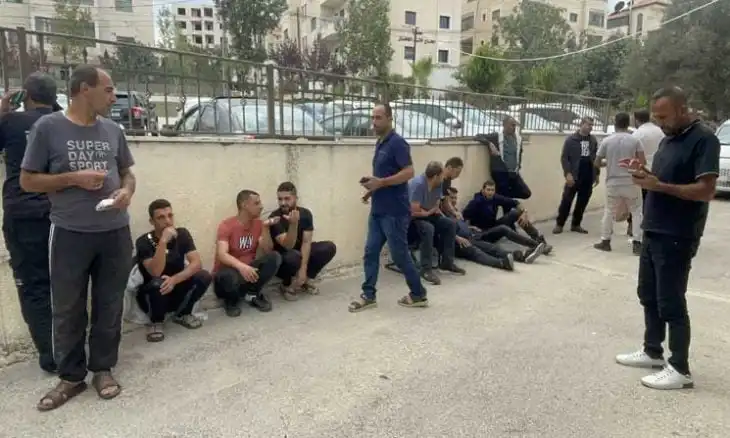
Israeli army arrests three workers after beating them

Late last night, the occupation forces arrested three workers from the towns of Nazlet Issa and Sidon, north of Tulkarm, after severely beating them.


The Prisoners' Club in Tulkarm said that Israeli forces surprised the workers while they were passing in a vehicle near the apartheid wall separating Baqa al-Gharbiyya, inside the 1948 territories, and the town of Nazlet Issa, and forced them to get out of the vehicle at gunpoint, and severely beat them before arresting them.


He added that the detainees are: Muhammad Mustafa Mahmoud Babiya (35 years old), from Nazlet Issa, Muhammad Hani Ajaj (20 years old), and Mahdi Muwaffaq Ajaj (30 years old), from the town of Sidon.


Social media sites showed a video of Israeli forces shouting at the workers to get out of the vehicle, throwing them to the ground, and beating them.

ARAB AND WORLD

Wed 08 Nov 2023 10:07 am - Jerusalem Time

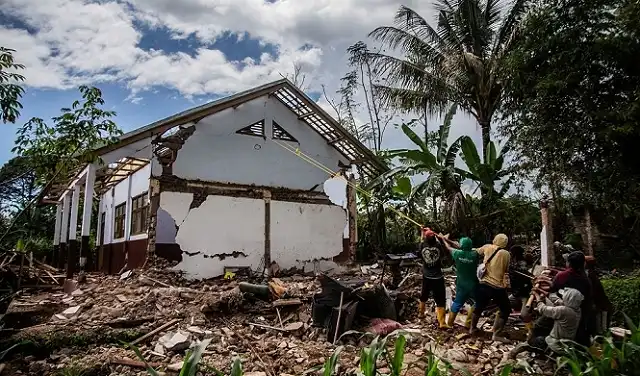
Two successive earthquakes hit the coast of Indonesia

The US Geological Survey reported that the epicenter of the two earthquakes was located about 340 kilometers south of the Indonesian province of Maluku, and its depth was 10 kilometers.


Two successive earthquakes of magnitude 6.7 and 7.1 struck the Banda Sea area off the coast of Indonesia on Wednesday morning.


According to the Anadolu Agency, the US Geological Survey reported that the epicenter of the two earthquakes was located about 340 kilometers south of the Indonesian province of Maluku, and its depth was 10 kilometers.


According to preliminary information, there were no human or material losses, and no warning was issued about the possibility of tsunami waves following the two earthquakes.


AFP reported that a 7.1-magnitude earthquake struck the Banda Sea off eastern Indonesia, more than 300 km from the coast, according to what the American Institute of Geophysics reported on Wednesday.


The institute explained that the earthquake, which initially declared a magnitude of 6.9, occurred at 11:53 (04.53 GMT) at a depth of 10 km and at a distance of more than 340 km from the nearest point on land, and no warning was issued as a result. From tsunami waves.


Residents of the town of Samulaki in the Tanimbar Islands of Indonesia felt an earthquake from the earthquake, according to the local agency for meteorological, climatic and geophysical monitoring.


Lambart Tatang, who lives in the town, told Agence France-Presse, “The tremor was very strong, but people here did not panic.


We are accustomed to the tremors.” The 41-year-old man added that residents dealt calmly with the earthquake, “especially after we made sure that no tsunami warning was issued, so life is normal now.”


Indonesia is exposed to frequent earthquakes due to its location on the “Ring of Fire,” an area where earthquakes and volcanoes are active in the Pacific Ocean. In November 2022, a 5.6-magnitude earthquake struck the densely populated province of West Java, killing more than 600 people.


A major earthquake off the Indonesian island of Sumatra on December 26, 2004 caused a tsunami in the Indian Ocean that killed more than 230,000 people in several countries, including Sri Lanka, India, and Thailand.


ARAB AND WORLD

Wed 08 Nov 2023 9:54 am - Jerusalem Time

Former Israeli National Security Chief: Gaza is a Nazi state and civilians are not innocent

Analysts and former Israeli military personnel continue the seemingly systematic campaign of incitement against the residents of the Gaza Strip through the Hebrew media, not only accusing them of terrorism, but also describing the completely besieged Strip as a "Nazi state."


While Israeli army is committing what the United Nations and all international organizations say are war crimes against the civilian population, the former head of the Israeli National Security Council, General Giora Eiland, said during a participation on Channel 12 that talk about the presence of innocent citizens in Gaza who must be saved is not realistic, adding that Gaza is “very much a Nazi state.”


Eiland said that the Islamic Resistance Movement (Hamas) succeeded in recruiting the entire civilian population and made them support the conflict against Israel, and that every house in Gaza has a tunnel opening leading to the military infrastructure.


Not only that, Eiland accused all hospital and school directors and mayors of being “employees of Hamas,” stressing that all Gazans are making a great effort against Israel, and they are all rallying around the leadership and not against it, as he described it. Regarding the goals of the war, Knesset member Mickey Rosenthal told Channel 13 that the Israelis must remember that the goal is not to destroy every missile and demolish every tunnel in Gaza, but rather to kill the main Hamas leaders and weaken the movement militarily in order to reach a new leadership for the Strip and perhaps negotiate with it.


But Rosenthal said that the matter is not only about changing the leadership of Hamas, but also about changing the leadership of Israel so that there is another Middle East and people feel hopeful. As for Culture Minister Miki Zohar, he said that Israel must maintain its security doctrine in Gaza from all sides so that it prevents the entry of more weapons to the Gaza Strip after Hamas is disarmed and the known land and sea crossings are monitored.


Regarding the frameworks of the ground military operation in Gaza, Yossi Yehoshea - security and military affairs correspondent for the Yedioth Ahronoth newspaper - said that a very senior officer in the General Staff told him that the goals they set for the army were high in ambition and that they would achieve them, but it would not take a week or two because the destruction of the armed Hamas' military action requires months, international legitimacy, and economic strength for a long period.


Yehoshua also quoted the senior officer as saying that Israel cannot coexist with 300,000 reserve soldiers on duty with a faltering economy, in addition to hundreds who were evacuated from their homes in the Gaza Strip and on the border with Lebanon, adding, “Therefore, people must understand that it is not a lightning strike that will end the matter quickly".


Regarding the prisoners, Eyal Eshel - the father of the captive soldier Roni - said that there are surveillance cameras present at the site where his daughter was working, but he does not know where the tapes for these cameras went and why the cameras that were in Axis 232 have not been examined yet.  He stressed that he has not received any answers to these questions yet.


Source: Al Jazeera

PALESTINE

Wed 08 Nov 2023 9:44 am - Jerusalem Time

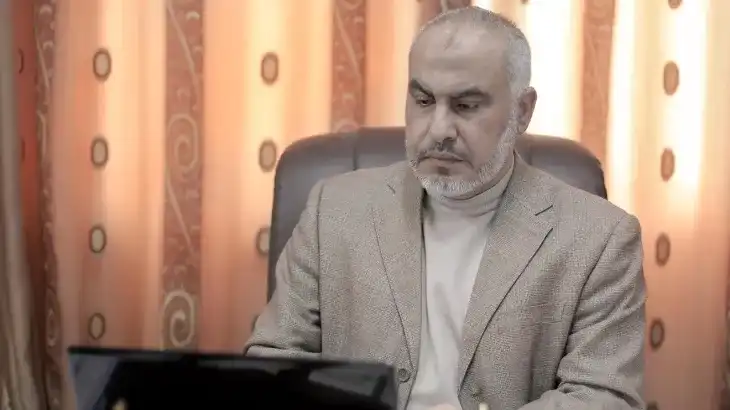
Hamas: We will remain a major actor in the future of Gaza, despite the will of America and Israel

Member of the Political Bureau of the Islamic Resistance Movement (Hamas), Ghazi Hamad, said that the United States’ talk about the movement’s lack of place in the future of the Gaza Strip reflects its failure to achieve any achievement on the ground, and its conviction that Hamas has become a political and military force controlling the course of events.


Hamad added in an interview with Al Jazeera that the United States and Israel are trying to rearrange the situation in Gaza while they have not achieved any achievement on the ground other than killing civilians and destroying hospitals and civilian facilities.


He stressed that Washington and Tel Aviv are losing their reputation, soldiers and vehicles every day in Gaza, and that the prestige that Israel enjoyed has been broken forever and will not return.

Hamad also stressed that arranging the situation in Gaza “is a purely Palestinian matter, and Hamas will be a part of it against their will, because it is part of the national fabric that today stands with the resistance, the right to establish a state, and the rejection of occupation.”


A member of Hamas' political bureau said that "there is no Palestinian party that will cooperate with the Americans in this matter," and that "if they tried to search for some fragile and weak parties, the Palestinians would fail this suspicious plan just as they failed the deal of the century," he said.


Hamad explained that he is not talking about the Hamas movement only, but “about all the Palestinians who have become fully aware that the United States is not working for their benefit, but for the benefit of the occupation, and they are trying to empty Gaza of resistance to provide security for Israel.”


He stressed that Gaza will remain resistant to normalization and failure and will remain “a thorn in the side of the Americans and Israelis,” as he put it.


Hamad attributed the talk of Washington and Tel Aviv about arranging the future of Gaza without Hamas, to their awareness of the fact that the movement is currently driving events and that it has become a capable force politically and militarily after it moved the region and the world on the seventh of last October.


He concluded that the whole world realized that the Palestinians remaining under occupation was no longer possible in view of what happened on October 7, and also in view of the prices they paid, stressing that the resistance broke the prestige of the occupation and caused it a great failure.


Hamad challenged the Prime Minister of Israeli occupation government, Benjamin Netanyahu, or his army spokesman to provide a single piece of evidence of a real military achievement they achieved on the ground. He also stressed that the United States is no longer a superpower in the Middle East, as he put it.


Hamad called on the Palestinian Authority not to deal with the United States and not to come to Gaza on the back of an American tank. He addressed President Mahmoud Abbas, saying, “Rejecting what the Americans are planning will write you in history, because they will fail anyway.”


He said that the Authority's silence regarding the United States' claims regarding its acceptance of playing a role in Gaza after Hamas raises question marks, but he stressed that the Gaza Strip will never turn into an American state.


He stressed that the Palestinian Authority must clearly announce its rejection of America's plans and not accept it coming on the backs of tanks, as it previously rejected the deal of the century, adding, "This is what we expect from the Authority."


Hamad described the Arab regimes participating in the discussion of "the future of Gaza after the defeat of Hamas" as "incapable and failed, as they were unable to help the people of the Gaza Strip in these harsh circumstances and in light of these massacres and holocausts."


Regarding the issue of the cessation of war being contingent on the release of civilian detainees, Hamad said that the resistance tried to provide steps in this file, but the Israeli side did not deal with these steps, and at the same time it was not able to free a single prisoner or detainee, nor did it succeed in attacking Hamas as it had promised.


Hamad said that the resistance “is the one that will break the head of the occupation and Netanyahu’s head,” stressing that the movement is communicating with all parties in order to bring aid to the Palestinians and provide them with humanitarian support in light of the starvation campaign they are being subjected to.


Source: Al Jazeera

OPINIONS

Wed 08 Nov 2023 9:08 am - Jerusalem Time

Who will rule Gaza by the end of the war?

Ramallah - “Al-Quds” dot com

Ramallah - “Al-Quds” dot com

Opinion Writer

By  Ali Hamada

Last Monday, Israeli Prime Minister Benjamin Netanyahu spoke about the post-Hamas phase in the Gaza Strip. He indicated that Israel is the one that may assume security responsibility in the Strip for a period of time. Last night, Agence France-Presse quoted American officials as saying that the American administration opposes Israel’s reoccupation of the Gaza Strip. In other words, Washington opposes the Israelis assuming security responsibility in the post-Hamas period.


Of course, these positions are based on estimates that the Israeli army will be able to resolve the war in its favor in the Gaza Strip, first in the northern part, then in the southern part. These positions or proposals are not limited to the Americans or the Israelis. Rather, the Europeans are working to formulate visions for the post-Hamas era in Gaza. European Commission President Ursula von der Leyen stressed in her speech last Monday to ambassadors accredited to the European Union that “we must think about tomorrow to imagine what permanent peace could look like, to restore hope to the Palestinians and Israelis. They need a perspective that is a two-state solution.” She added, "Hamas cannot control or rule Gaza, and there must be only one Palestinian national authority and one state," and "There cannot be a long-term Israeli security presence in Gaza. Gaza is an essential part of any future Palestinian state."


This is a very brief sample of the pattern of thinking in the post-war phase, in which the West acts as if its results are settled in terms of ending Hamas’ rule of the Gaza Strip. But what caught my attention was the Kremlin’s position yesterday, Tuesday, expressed by Russian presidential spokesman Dmitry Peskov, in which he said: “It is very important that there be humanitarian truces during the Israeli operation in Gaza!” In other words, Moscow is also acting on the basis that the Israeli military operation in Gaza will continue, and that the focus now is on humanitarian truces, not on stopping the war, nor on a medium or long-term ceasefire. "Only humanitarian truces, usually limited to a ceasefire for a few hours."


So we are talking about a course of war that the international community deals with on the basis that its results are predetermined. That is, ending Hamas' rule in the Gaza Strip, and removing it as a military and political force from the equation by eliminating it from its main stronghold in Gaza. As for Hamas' military presence in the West Bank, it remains limited and has limited impact. As for its presence in Lebanon and Syria, its effectiveness is also limited, because if it loses its base in the Gaza Strip, it will be greatly weakened. But this is not coupled with the inevitability of the current Palestinian National Authority replacing it in Gaza, given the structural weaknesses that the authority suffers from, starting with its sagging and weak leadership.


In any case, it is too early to say for certain the results of the war currently taking place in northern Gaza.

The question is: Will Israel impose its control over the northern part of the Strip in the short term? Or will the war there prolong to the point that it is no longer possible to build future visions for the Gaza Strip based on the premise of ending Hamas’ control there? Hence, the current phase, which may extend for the next two weeks, of the war in Gaza City in particular, is what will shape the future.

Annahar Al- Araby


OPINIONS

Wed 08 Nov 2023 8:57 am - Jerusalem Time

A voice outside the embrace of Israeli tyranny

Antoine Shalhat

Antoine Shalhat

Opinion Writer

The time will come later to present many pieces of evidence regarding the behavior of most of what is known as the “Israeli left” during the fierce war that has been ongoing for more than a month on the Gaza Strip, in terms of people and geographical space. These are pieces of evidence that have been proven again, among countless times, as a previous judgment on this left, leading to its deviation, first of all, from the universal values of the left, which more and more consolidates the fact that this “left” can be called by any name, except to be called a left according to those universal concepts. .

At the level of the relationship with the Palestinians in the recent period, it can be said that the lightness with which the “Israeli Left” accepted the excuses of the former Israeli Prime Minister, Ehud Barak, when he was head of the (left-wing) Labor Party, regarding his failure in the Syrian-Lebanese negotiation track and the Palestinian track, in 2017. 2000, and the consequences of all of that, were the first testimony to his fragility. What later became clear, according to the bare facts, is that the majority of Israelis who take pride in bearing the title of “leftists” are nothing more than “doves tweeting within the Zionist flock,” not “doves with universal values.” They support the peace process with the Palestinians from the standpoint of pragmatic considerations that refer only to what falls within the framework of the interest of the Jewish people, such as the demographic balance, ensuring Israel’s security, or advancing its economic prosperity. As for the type that supports peace with universal moral motives, it has become a rare type that does not seek refuge in the embrace of blind patriotism, nor in situations of national consensus. It may soon be proven that this rare type is diminishing after this war, but without losing the value of what was issued during it, which this article will stop at, because it contains something that sheds light on a current process even from the perspectives of space and time.


While media reports talk about an unprecedented campaign of intimidation and harassment against Palestinians in the 1948 territories, it is also worth paying attention to a parallel campaign against members of that rare breed of the Israeli left, including researcher and academic Nurit Bild Elhanan, who has completed numerous studies on educational curricula in Israeli schools. For the most part, I used the metaphor of gardening to address the discourse of victims and authority in textbooks circulating in Israel, and how this discourse works, systematically, to legitimize the occupation of Palestine. According to these researches, this discourse instills in people the fear of the goyim (the Gentiles), consolidates the principle of the sovereignty of the Jewish majority, and contributes to the formation of the Israeli identity based on plunder and plunder.


Hours after posting a message in an internal WhatsApp group that included lecturers at the college where she teaches, Bild Elhanan received an email informing her of her dismissal on the pretext of “expressing support for and justifying Hamas’ terrorist acts.” In detail, Bild Elhanan commented in that group on a film that was published, which compared the attack by fighters from the military wing of the Hamas movement on military sites and settlements adjacent to the Gaza Strip to Nazi practices, by quoting a saying by the French philosopher Sartre, which appeared in an introduction he wrote to one of Frantz Fanon’s books, by paraphrasing it. In line with the context of the Israeli occupation. It said: “After all those long years in which the occupier’s neck was strangled under the heels of your sandals, and he was suddenly given the opportunity to raise his eyes to the light, what look do you think you would have seen there?” (Originally, the word black was used instead of the word occupier.) “This outlook is exactly what we saw on October 7, 2023,” she added.

But it seems that what aroused the most anger among the tyrants of Israel, as Bild Elhanan describes them, is its assertion that comparing the actions of Hamas to the actions of Nazism is not correct at all, as the latter was the ideology of an authority that decided to exterminate minorities under its rule, and this situation does not exist in our case, because we are not under Hamas authority never.


ARAB AND WORLD

Wed 08 Nov 2023 8:49 am - Jerusalem Time

US Representatives blame the only female representative of Palestinian origin

The US House of Representatives voted, on Tuesday, to censure Democratic Representative Rashida Tlaib, based on comments she made about the war between Israel and Hamas in Gaza.


According to the text of the resolution, the Democratic representative of Palestinian origin was convicted of promoting “false narratives” regarding the Hamas attack on Israel, in addition to her call for the destruction of Israel, according to Al Hurra’s correspondent in “Washington.”


According to the same source, 224 members voted to pass this decision in approval, while 188 representatives objected to it.


Twenty-two Democrats joined most Republicans in the chamber to censure Tlaib for allegedly “promoting false narratives” about the armed attack launched by Hamas on October 7 in Israel and “calling for the destruction of the State of Israel.”


Four Republicans voted against the proposal, while three Democrats and one Republican abstained from voting, according to Reuters.


US Representative Rashida Tlaib, the first American woman of Palestinian origin in Congress, accused President Joe Biden of supporting “genocide” of Palestinians, warning of the repercussions of this in next year’s elections.

Tlaib repeatedly denounced the Hamas attack, which led to the death of about 1,400 people, the majority of whom were civilians, but she also criticized American support for Israel, at a time when the Israeli army continues a bombing campaign that has claimed the lives of thousands of Palestinians in Gaza.


The measure specifically cited a video Tlaib posted on social media containing the pro-Palestinian phrase “from the river to the sea,” which many Jews view as anti-Semitic and calling for the elimination of Israel.


Tlaib, according to Reuters, also angered many of her Democratic colleagues on Friday when she posted a video clip in which she accused President Joe Biden of supporting “the genocide of the Palestinian people.”


Israel strongly rejects accusations of genocide.


The Democratic representative rejected accusations of anti-Semitism during a speech she delivered on the floor of the House of Representatives on Tuesday.


“I am the only Palestinian American in Congress, and my viewpoint is needed more than ever,” Tlaib said.


She added, "My criticism has always been directed at the Israeli government and the actions of (Prime Minister Benjamin) Netanyahu... The idea that criticizing the Israeli government is anti-Semitic sets a very dangerous precedent."


She continued by saying, "The Palestinian people cannot be eliminated," before she stopped speaking for a long time while suppressing her feelings, according to what Reuters reported.


Tlaib's grandmother and many of her relatives live in the village of Beit Ur Al-Fawqa in the Ramallah and Al-Bireh Governorate in the West Bank.

ARAB AND WORLD

Wed 08 Nov 2023 8:35 am - Jerusalem Time

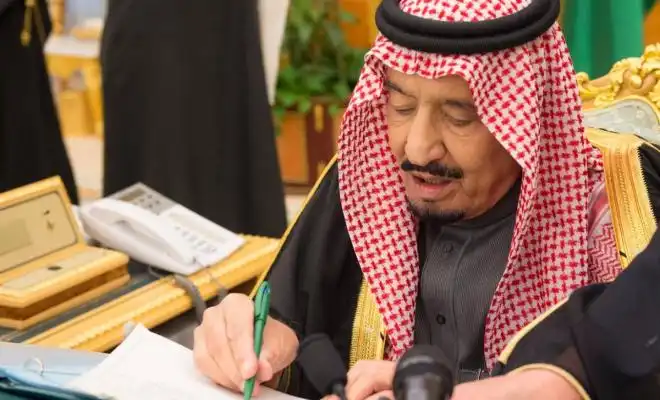
Saudi Arabia hosts two Arab and Islamic summits on Gaza

The Kingdom of Saudi Arabia announced that it will host two Arab and Islamic summits next Saturday and Sunday to discuss developments in the Gaza Strip, and postpone another Arab-African summit that was concerned with economic cooperation.


This announcement came in a statement by the Saudi Ministry of Foreign Affairs, whose country holds the rotating presidency of the summits of the Arab League and the Organization of Islamic Cooperation.


The ministry said that developments in Gaza "necessitated a call for an extraordinary Arab summit and an Islamic summit to discuss the current crisis and the serious humanitarian repercussions it is witnessing," without details.


On Monday, the Organization of Islamic Cooperation announced that “it has been decided to hold an emergency summit next Sunday in Riyadh to discuss the Israeli aggression (against Gaza), based on the invitation of Saudi Arabia, in its capacity as chair of the current summit.”


While the Arab League announced, on October 30, that its General Secretariat had received an official request from Palestine and Saudi Arabia to hold an Arab summit on November 11, to discuss “the continuing Israeli aggression against Gaza.”


While “it was decided to postpone the date of the fifth Arab-African summit (which was scheduled for next Sunday) to a time to be determined later in view of the current developments in Gaza,” according to the Saudi Foreign Ministry.


It added that this step "came after coordination with the secretariat of the League of Arab States and the African Union Commission, and out of concern that the political events in the region would not affect the Arab-African partnership, which is based on the development and economic dimension."

PALESTINE

Wed 08 Nov 2023 8:32 am - Jerusalem Time

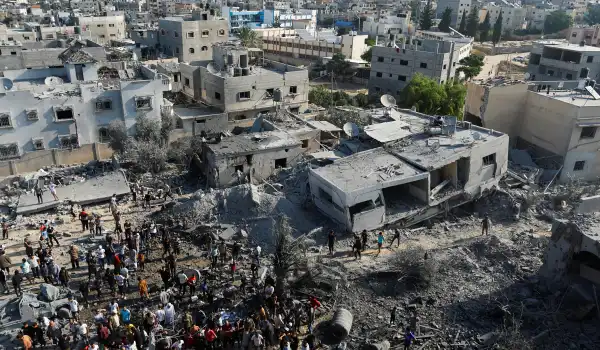
40 thousand Palestinians are victims of the Israeli war on Gaza

The government media office in Gaza announced that the Israeli war on the Strip, which has entered its 33rd day, has affected about 40,000 Palestinians, including martyrs, wounded and missing persons.


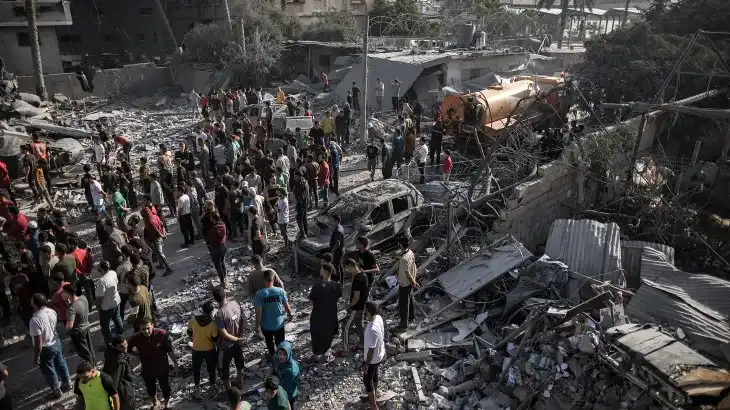
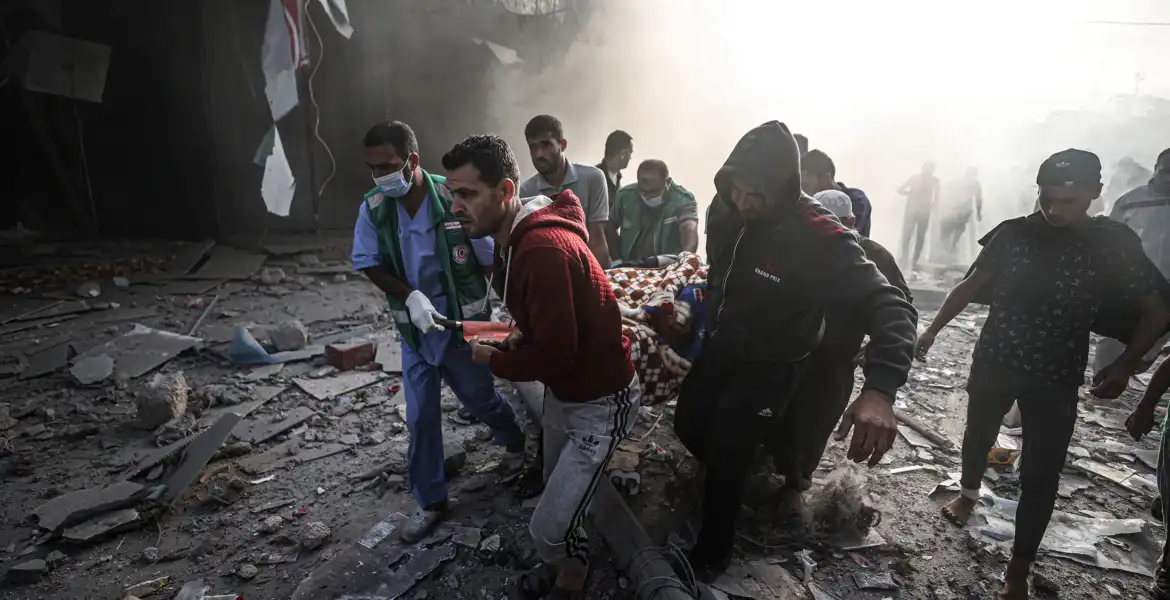
The head of the government media office, Salama Marouf, said in the press conference, on Tuesday evening, that since the start of the aggression on the seventh of last October, 10,328 martyrs have risen, including 4,237 children, 2,719 women and girls, and 631 elderly people, and reports have also been recorded of more than Of the 3,000 missing and 26,000 citizens injured.


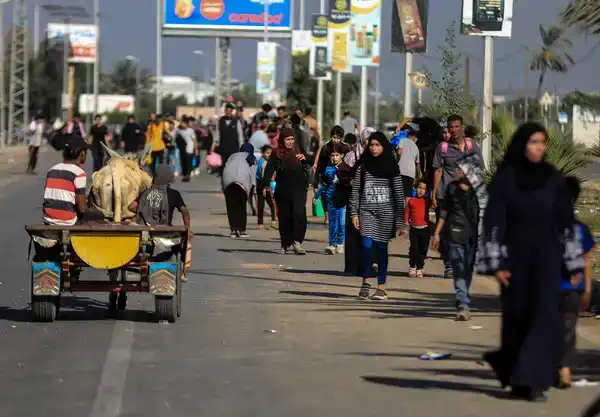
He added that government teams recorded the progress of 1,021 citizens of Gaza City and the northern Gaza Strip who were displaced to areas that the occupation claimed were safe in the south of the Gaza Strip, and 49 journalists also advanced since the start of the aggression.


He added that 192 medical and health personnel were injured, 40 ambulances were destroyed, 113 health institutions were severely damaged, and 18 hospitals and 40 health centers were taken out of service.


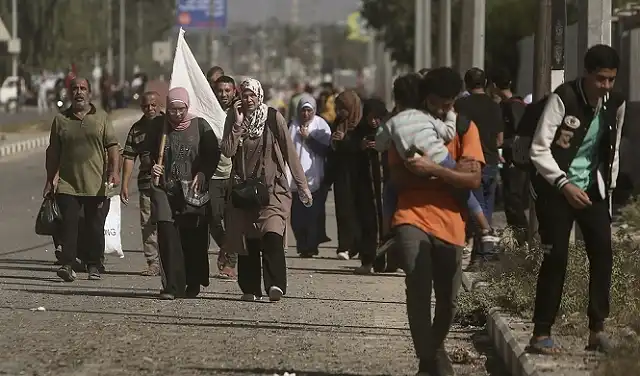
Salam said that the occupation has so far committed 1,071 massacres against Palestinian families, claiming the lives of thousands of martyrs and wounded, the majority of whom are women and children, while 1.5 million citizens were displaced from their homes to shelter centers, gatherings, or relatives.


For 32 days, the Israeli occupation has been waging a brutal war on the Gaza Strip, razing entire residential squares to the ground. According to the Euro-Mediterranean Human Rights Observatory, Israel has dropped more than 25,000 tons of explosives on the Gaza Strip since the seventh of last October, which is equivalent to a nuclear bomb in strength. 30 kilotons.


Source: Anadolu Agency

PALESTINE

Wed 08 Nov 2023 8:28 am - Jerusalem Time

Israeli forces storm Birzeit University campus and wound a young man with live bullets

At dawn on Wednesday, Israeli forces stormed the campus of Birzeit University, north of the city of Ramallah.


Local sources said that Israeli forces forced the university guards to open their doors, as 6 military vehicles entered the campus.


The Israeli forces stormed the town of Birzeit, where soldiers shot a young man, wounding him with live ammunition, without providing further details about his condition.


The University Council decided to switch to e-learning since last October 9, in view of the escalating attacks by Israeli forces and colonists in the West Bank, and because of the expected risks resulting from blocking roads at the occupation’s military checkpoints and the policies of collective punishment pursued by Israeli authorities.

OPINIONS

Wed 08 Nov 2023 8:22 am - Jerusalem Time

The American ticking hour, and Israel’s movements in its war against “Hamas”

Institute for National Security Studies

Institute for National Security Studies

Opinion Writer

Eldad Shavit

The US administration, under the direct supervision of President Biden, continues to provide support to Israel, even a week after the start of the ground operation in the Gaza Strip. The US President and other officials in his administration reiterate that Israel has the right and duty to protect its citizens. The White House also generally agrees with Israel's war goals: defeating Hamas. US Secretary of State Anthony Blinken repeated this again in the press conference he held with Arab foreign ministers on October 4. There is also a comprehensive and ongoing dialogue taking place between the Israeli leadership and the United States, and it seems that it revolves around the following issues:


Humanitarian aid to the Gaza Strip: It seems that Israel has adapted its policies to the demands of the American administration, and that the talk is now focused on asking the administration to allow a humanitarian truce, mainly with the aim of making room for the release of the kidnapped people, although this has not happened yet, according to public statements, Reaching understandings. In any case, the US administration is emphasizing that what is meant is not a ceasefire that it believes will serve the interests of the Hamas movement.

Strict adherence to the laws of war: distinguishing between the enemy and civilians, and trying to avoid causing harm to civilians, as much as possible. The administration has called for these considerations to be included in field operational plans, and it appears that Israeli measures now, especially with regard to the separation of the northern and southern Gaza Strip, as well as the designation of “safe zones” for the civilian population, are sufficient to meet American expectations.


Attention to the issue of the day after the war: In this regard, the gap between President Biden and his administration, and Israel, is evident. In this context, Blinken said after his meeting with the President of the Palestinian Authority in Ramallah: “The next day, and in view of everything related to the future of the Gaza Strip and the West Bank, the visions, voices and aspirations of the Palestinians must be at the center of attention.” It is not clear how much these gaps will affect the US administration’s tolerance for Israel, although it is clear that the lack of Israeli desire to discuss this issue may negatively affect American patience with the continuation of hostilities, and exacerbate US doubts about Israel’s plans regarding “Next day to the war."


Motives for American support for the fighting in the Gaza Strip

The emotional support that President Biden provided to Israel, and the painful impression left on the president by the Hamas attack, as was evident in his speeches in solidarity with Israel, testify that what happened on October 7 is not just another round of fighting. In his opinion, it is a major event that not only caused the reshaping of Israeli identity, but its effects will also extend to the regional and international arenas for many years to come. This is due to the repercussions of the war on the global conflict between the “good guys” and the “bad guys”: the new “axis of evil” that includes, in the eyes of President Biden, China, Russia, Iran, and the parties supported by these countries.


In practice, expressing commitment to the ally Israel is, practically and theoretically, a position derived from the position of President Biden, who says that the United States must defend its allies, similar to the administration’s position in its support for Ukraine since the beginning of its war with Russia.

 In addition to the above, the American administration sees this war as an opportunity to reshape the Middle East again. Biden has already stated that there must be no return to “the status quo that existed before October 7th.” From his point of view, the defeat of Hamas will contribute to strengthening his perspective of strengthening the moderate countries in the region, pushing forward towards a political solution to the Palestinian issue, and strengthening normalization relations between Israel and the Arab countries, led by the Kingdom of Saudi Arabia. On the other hand, it is clear to the Biden administration that Israel's failure to achieve its goals in the fight against the Hamas movement will strengthen the motives of Iran and Hezbollah to challenge Israel, and at the same time, the matter will affect the standing of the United States in the region and beyond.

The administration’s position mentioned above has implications with regard to the domestic American arena: despite the escalation of voices opposing the war launched by Israel on the Gaza Strip, and the impact of this, consequently, on American support for Israel, the president’s behavior strengthens his image as a strong leader, especially on the threshold of the opening of the election year for Presidential in the United States.


Considerations affecting the American administration

Conduct of the military operation: The American administration is concerned with the success of the military campaign. There are American officials who have provided (and are providing) advice to Israel, but it seems that they do not have in their hands an effective alternative military plan that guarantees the success of the campaign. “The IDF standing still” without an assessment that progress has been made toward achieving the goal of defeating Hamas may reduce the administration’s willingness to continue giving Israel time. It is also possible that there is a difference between the time required to achieve military objectives, according to Israeli statements (months, and perhaps more), and the administration’s demands (a few weeks, maximum). It must be emphasized here that the administration is not engaged in a public discussion with Israel regarding the military aspects of the war, although the American media published news about certain criticisms directed at Israel in this regard.


The behavior of the Israeli government: The logic that Biden presents as a basis for supporting Israeli military action is that its success will open the door to an Israeli-Palestinian political settlement process that serves the vision of “two states for two peoples.” Even if it is not clear whether such a goal is achievable, it is important for the US administration that the Israeli government act responsibly and refrain from taking actions in the West Bank that would hinder the achievement of this vision. Administration spokesmen are making strong statements against settler violence targeting the Palestinian population in the West Bank, fearing that this phenomenon will erode the American ability to provide support to Israel, on both the logistical and moral levels. In addition to the above, it is likely that the administration is operating based on the assumption that the internal political reality in Israel will change after the military campaign, and this will allow political-diplomatic action to be promoted. The US administration's awareness that Israel is not prepared for this matter, and that it is consciously acting against the logic of a political settlement the day after the war, will make it difficult for the administration to provide support to it in the next stages of the military campaign.

Internal American issues: Even if the American administration does not currently express concern about the consequences of its policies on the president’s political standing, on the eve of the start of the presidential election year, it is already clear that the current American administration will face, with the increasing number of civilian casualties and destruction in the Gaza Strip, mounting criticism of the support provided to It is available to Israel, especially by groups traditionally affiliated with the Democratic Party. Opinion polls conducted in the United States indicate increasing criticism among young Democratic voters, in addition to the loss of initial support for the administration among Muslim voters, especially in states such as Michigan (where Muslims represent 3% of the population), which may It turns the scales in the 2024 presidential elections. It is noteworthy that the media reported the presence of a growing “rebellion” in the Ministry of Foreign Affairs, led by parties critical of the policies of the Biden administration.

Insights and recommendations


Contrary to what happened in previous rounds of Israeli-Palestinian confrontations (especially between Israel and Hamas), when the gap between the media and public opinion in Europe and the United States, which was critical of Israel, affected the positions of the leaders of these countries, and their support for Israel quickly diminished, the leaders remained These countries have been committed to supporting Israel throughout the weeks that have passed since the start of the war against Hamas, despite the escalation and breadth of popular criticism. It is clear that President Biden and his administration are leading this trend with ability and resolve, at least publicly (if we exclude disagreements regarding the entry of humanitarian aid into the Gaza Strip). There are no major differences here in positions between the American administration, the majority of European leaders, and Israel.


From the Israeli point of view, it is the Biden administration's position that will decide whether to take the time to move forward in the direction of achieving the goals of the Israeli military campaign against Hamas. Accordingly, Israel must focus its efforts, no less than its military efforts, on ensuring continued American support for the period it needs to achieve its military objectives against Hamas, and at the same time, continue to deter Hezbollah from pushing An escalation trend that will lead to the outbreak of a large-scale war on the northern front.

The immediate goal is to prevent the escalation of calls for a ceasefire in the Gaza Strip. It is clear to the US administration, at least so far, that a ceasefire (unlike short-term humanitarian truces) may increase the pressure calling for a cessation of hostilities and allow the Hamas movement to recover and restore part of its administrative and military capabilities, which it rejects. It is true that Israel does not have the ability to directly influence some of the parties that impose the American administration’s positions, but Israel must continue to highlight its effort to adhere to the principles of humanitarian aid and the lives of civilians in the Gaza Strip, as long as the objectives of the fighting are presented clearly, and in realistic terms. It proves that it is implementable, which increases the chances that the American administration will rely on it to maintain its support for Israel.

Even in light of this problematic political reality that Israel is experiencing, it is necessary to present a realistic political plan that takes into account American interests and ideas. In this context, Israeli official spokesmen, in particular, must refrain from issuing statements that constitute fuel for opponents of Israel and reasons for withdrawing its support. It is very important to think concretely about the issue of the “day after the war”, while avoiding harmful (and unrealistic) statements, such as “occupation of the Gaza Strip” or “displacement of Palestinians”.


ARAB AND WORLD

Wed 08 Nov 2023 8:17 am - Jerusalem Time

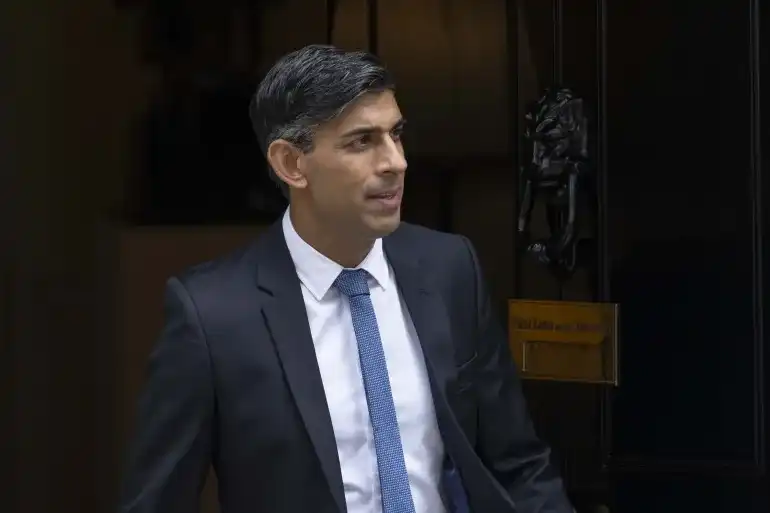
Sunak calls for canceling a demonstration against the aggression on Gaza

British Prime Minister Rishi Sunak said that planning to organize a demonstration next Saturday against the Israeli aggression on Gaza is “provocative and shameful,” because it coincides with “Armistice Day,” in which London honors its dead in the First and Second World Wars.
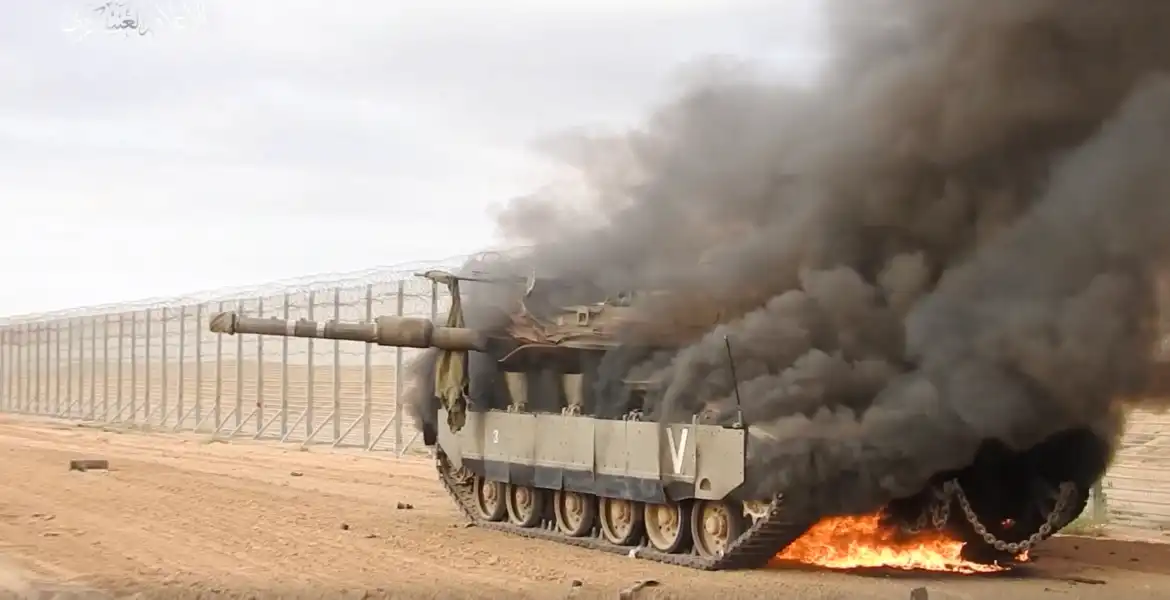

On Tuesday, the British Prime Minister called on pro-Palestinian groups to cancel the march, which will demand an end to the Israeli aggression.


Until now, the aggression against Gaza has led to the fall of more than 10,000 martyrs, most of them women and children, the destruction of infrastructure and the displacement of most of the population.


The organizers of the demonstration defied appeals from the British Metropolitan Police to postpone the demonstration scheduled for next Saturday.


Tens of thousands are expected to participate in the demonstration in the streets of London, to demand an immediate ceasefire in Gaza.


"We continue to believe that planning protests on Armistice Day is provocative and disrespectful, and we urge organizers to reconsider," Sunak's spokesman told reporters.


He added that the government would "carefully consider any request" from the police to prevent the protest from continuing.


Some observers fear that the demonstration on Saturday will disrupt the commemoration of “Remembrance Day,” which also falls on Sunday and includes a two-minute silence in honor of the dead British soldiers.


The organizing groups did not indicate that they planned to demonstrate on Sunday or on “Remembrance Day,” the culmination of celebrations honoring soldiers who fell in previous wars.


Organizers pledged to avoid the Whitehall area of central London, where the memorial is located.


Source: Al Jazeera + French

PALESTINE

Wed 08 Nov 2023 8:07 am - Jerusalem Time

Israel launch massive arrest campaign in the West Bank and Jerusalem

Institutions concerned with prisoners’ affairs reported that the occupation forces arrested dozens of Palestinians from the West Bank after storming their homes, tampering with their contents, and subjecting their residents to field investigations, after detaining them for hours, and transferred dozens of detainees for investigation by the occupation security services.


At dawn and Wednesday morning, the Israeli occupation forces launched a campaign of raids and searches in the occupied West Bank and Jerusalem, which included clashes and confrontations in some areas, resulting in injuries and cases of suffocation, while the Israeli forces arrested dozens of Palestinians, including 3 women and two journalists.


ARAB AND WORLD

Wed 08 Nov 2023 8:04 am - Jerusalem Time

The attack awakened fears of the collapse of Israel.. How was the “Israeli security” theory shattered by the “Al-Aqsa Flood” battle?

The Minister of Defense in the Israeli occupation government, Yoav Galant, announced that the war in the Gaza Strip consists of three stages, starting with the destruction of the Hamas movement through a military campaign targeting the movement and its infrastructure. The second phase will be to continue fighting, but with less intensity “to eliminate any pockets of resistance.” The third step is “establishing a new security system in Gaza, and creating a new security reality for the citizens of Israel and residents of the areas adjacent to Gaza.” But how can this be understood within the framework of the Israeli security theory on which the state was built 75 years ago?


After the "Al-Aqsa Flood"... the occupation is searching for an alternative to the Israeli security theory

The Israeli security theory emerged from the thesis of Zeev Jabotinsky (1880-1940), the founder and leader of the Revisionist Zionist movement and the godfather of the Israeli right, which he published in two articles in 1923 entitled “The Iron Wall,” in which he saw that reaching an agreement with the Arabs was not possible, because they will not give up their land and rights, so conflict with them is inevitable.


According to Jabotinsky, this matter requires the establishment of an iron wall based on building a deterrent military force sufficient to generate despair in the hearts of the Arabs and push them to give up Palestine. He stressed that peace with the Arabs would become possible only after inflicting severe military defeats on them. What prompts them to accept the existence of “Israel” and the futility of resisting it militarily.


A report by Asabab website, which specializes in political and strategic analysis, says that the Israeli Prime Minister and former Defense Minister David Ben-Gurion, immediately after the establishment of the occupying state in 1948, supervised the crystallization of a national security theory emanating from the “Iron Wall” thesis, and was based on the small population of Israel compared to its Arab surroundings. And its lack of defensive depth due to its limited geographical area, and therefore the “all people are an army” model was adopted, which makes the occupation army the largest army in the world in terms of its size, which depends on reserve forces compared to the number of population.


The foundations on which the "Israeli security" theory was built: deterrence, intelligence superiority, and rapid decisiveness.


First: deterrence

This is done by possessing a superior military force that discourages opponents from attacking “Israel” for fear of being destroyed by its army, which, despite being a small regular army, has huge reserve forces in accordance with the “all the people is an army” approach.


Second: Intelligence superiority

Which aims to provide early warning that allows the threat to be thwarted proactively, and also provides the opportunity to mobilize reserves at the appropriate time to confront threats, given that reserve mobilization represents a necessity. Intelligence superiority depends on multiple sources of information collection, such as: human sources, cyber penetration, electronic eavesdropping, aerial photography, and benefiting from the exchange of information with friendly intelligence services, which allows obtaining detailed information about the opponent’s intentions, the size of his forces, their armament, and their locations. And its movements.


Third: Quick resolution

By solid defense along the border to prevent the opponent from occupying any part of the territory controlled by the occupation, and transferring the war to enemy territory as quickly as possible, and possessing an air force capable of providing assistance to the ground forces from the first hour of combat, and launching a pre-emptive attack in the event of danger. serious or potential, and eliminate threats as quickly as possible to prevent the mobilization of reserve forces for a long time.


“Ironing consciousness,” “mowing the lawn,” and “the battle between wars.”

The Israeli security theory was developed to confront regular forces during the conflict of the occupying state with the Arab armies, but following the peace agreements with Egypt and then Jordan, and the invasion of Iraq in 2003, the threats from the Arab countries declined, and resistance movements and organizations such as Hamas, Islamic Jihad in Palestine, and Hezbollah emerged among the threats. In Lebanon. Therefore; Israel coined new terms within its security doctrine, such as “ironing consciousness,” “mowing the grass,” and “the battle between wars.”


The "battle between wars" is based on taking pre-emptive offensive measures based on high-quality intelligence information with the aim of deterring the enemy, keeping the fighting outside the territory of "Israel", and weakening opponents without having to wage a wide-scale war with them.


This includes undermining the opponent's military capabilities, or "mowing the grass", and inflicting on him heavy human and material losses if he engages in hostile attacks that are sufficient for the process of "cauterizing consciousness" to prevent him from attempting to repeat those attacks, given his certainty that he will pay a heavy price, which is what ultimately, it ensures that long periods of calm are maintained to the greatest extent possible, in order to provide the stability necessary for the development of the state, ensure its economic, social and political prosperity, and allow resources to be redirected towards education, science and other civic areas to enhance Israel's comprehensive potential.


How did the “Aqsa Flood” battle destroy all these theories?

The “Asbab” website says that the “Al-Aqsa Flood” operation struck the entire foundations of the Israeli security theory. The Israeli force did not deter the Al-Qassam Brigades from thinking about launching a large-scale attack that would include dozens of Israeli settlements and sites. Israeli intelligence was unable to obtain any prior information about the attack, and the Palestinian fighters succeeded in controlling large areas of the occupied territories for the first time.


This collapse once again awakened concerns about the possibility of the collapse of Israeli state in light of the steadfastness of the Palestinians despite the oppression and siege. It also undermined the sense of security and stability that allowed for more immigration and settlement operations in recent decades.


Regardless of the repercussions of the current brutal Israeli campaign on Gaza, the Israeli security theory has collapsed, the theories of “cauterizing consciousness” and “mowing the grass” have collapsed, and the “battle between wars” approach has proven its failure in undermining the capabilities of the resistance or deterring it from carrying out a massive attack like the one it carried out. The morning of October 7.


And so; The statements of the occupation leaders reflect the impact of shock, and the impact of a crisis of confidence shaking the Israeli army and intelligence services, that the previous security and strategic model has ended, which means that they are searching to impose a “new model” and build a new security theory, which will restore the attractiveness of “Israel” and its collapsed reputation as a haven safe for Jews from around the world. But this is a task that does not seem simple or within reach, regardless of the outcome of the destruction taking place in the Gaza Strip.


PALESTINE

Wed 08 Nov 2023 7:55 am - Jerusalem Time

Israeli aggression continue with “violent” raids on Gaza.. The number of killed and missing people exceeds 13,500

The Government Information Office in Gaza said, on Tuesday evening, November 7, 2023, that more than 13,500 have been killed and missing since the beginning of the Israeli aggression against the besieged Strip, at a time when it has been subjected to an intense bombing campaign for more than a month and the supply of water, electricity, food and fuel has been cut off.


The media office reported that the toll of dead, in addition to those missing, reached 10,328 persones, including 4,237 who were children, in addition to 25,956 wounded since the beginning of the aggression against Gaza.


The office noted that 46% of the number of dead were from the southern regions, “which the occupation says are safe.”


It also pointed out that more than 30,000 tons of explosives were dropped on Gaza within a month, and that 40,000 housing units have been completely demolished so far, pointing out that the occupation has committed 1,071 massacres against the people of the Gaza Strip since the start of the war on October 7 last.


In the same context, the office warned that one and a half million displaced people reside in shelters, including schools and hospitals, and explained that the occupation “took advantage of the flight of dozens of citizens to talk about opening a humanitarian corridor.”


Violent bombing of Gaza

This comes as the Gaza Ministry of Interior announced, on Tuesday evening, that the Israeli occupation launched a series of “violent” raids on Gaza City and the northern Gaza Strip, with Israeli bombing continuing on several areas in the Gaza Strip.


Earlier Tuesday, the Ministry of Health in Gaza revealed that the death toll in Gaza had risen to 10,328 Palestinians, including 4,237 children who died in the Israeli occupation strikes on the Gaza Strip that have continued for more than thirty days.


While the Ministry of Health added that the occupation committed 21 massacres in the past hours, resulting in the martyrdom of 548 Palestinians.


Tens of thousands displaced

Also at dawn on Tuesday, the government media office in the Gaza Strip announced that 70% of the population of the Gaza Strip have been forcibly displaced from their homes.


The office said in a press release, under the title “Scary Humanitarian Figures and Statistics,” that “70% of the population of the Gaza Strip (2.3 million people) have been forcibly displaced from their homes, due to bombing and raids.”


He added that about 2% of the total population of the Gaza Strip became direct victims as a result of this aggression, either as martyrs or wounded. He also pointed out that the hospitals of the Gaza Strip receive, on average, a wounded person every minute since the beginning of the aggression, and 15 martyrs every hour, and that the average number of child martyrs is 6. Every hour, and 5 females per hour.


The office added that "30 thousand tons of explosives were bombed in the Gaza Strip, with an average of 82 tons per square kilometer," and pointed out that "half of the hospitals in the Gaza Strip and 62% of primary care centers have stopped and are effectively out of service."


This comes with the worsening deterioration of the humanitarian and health conditions in most parts of the Strip, especially Gaza City and its northern governorate (within 5 that make up the Strip); As a result of the ongoing Israeli siege.


Since the outbreak of the current war, Israel has cut off supplies of water, food, medicine, electricity, and fuel to the residents of the Gaza Strip, who are about 2.3 million Palestinians who already suffer from extremely deteriorating conditions. As a result of an ongoing Israeli siege since Hamas won the legislative elections in 2006.


For 32 days, the Israeli army has been waging a “destructive war” on Gaza, which resulted in the martyrdom of more than 10,328 Palestinians, including 4,237 children and 2,741 women, and the injury of more than 25,000 others, in addition to the martyrdom of 163 Palestinians and the arrest of 2,215 in the West Bank, according to the report. Official sources.


PALESTINE

Wed 08 Nov 2023 7:46 am - Jerusalem Time

The war on Gaza...new massacres and Israel army targets an aid convoy

On the 33rd day of the war on Gaza, intensive raids on the Gaza Strip continued. Yesterday, Tuesday, the occupation forces committed new massacres in Deir al-Balah, the Maghazi and Beach camps, and in the Zaytoun neighborhood. They also targeted by bombing a building belonging to al-Shifa Hospital and the vicinity of the Indonesian Hospital in the northern Gaza Strip.


An Israeli soldier was killed in the northern Gaza Strip


The Israeli army said that a soldier was killed and three were seriously injured during clashes in the northern Gaza Strip.


The army reported that the total number of our soldiers killed had risen to 349 since October 7.


Director of the Indonesian Hospital: Continuous Israeli bombing around the hospital and within hours the electricity will be cut off


The director of the Indonesian hospital in Gaza said that the Israeli bombing is continuing around the hospital and that its electricity will be cut off “within hours” due to the running out of fuel.


Director of Gaza Strip Hospitals to Al Jazeera: The situation is catastrophic


Director of Gaza Strip Hospitals: The situation in the Strip's hospitals is catastrophic and cannot be described, especially in the northern regions.


-Hospitals in the northern Gaza Strip suffer from a shortage of medicines and foodstuffs.


-We were able to transfer only 9 wounded cases to Egypt after long mediations.


-18 hospitals stopped service, including 8 government hospitals.


We stress the necessity of bringing fuel to hospitals because the situation is tragic

PALESTINE

Wed 08 Nov 2023 7:33 am - Jerusalem Time

World Health: 160 children are killed every day in Gaza

More than 11,000 Palestinians, or about 0.5 percent of the Gaza Strip's total population, were reportedly killed in the area, with an average of 160 children killed daily there, according to a World Health Organization official (Tuesday).


Christian Lindmeier, spokesman for the organization, said in a press conference here that so far, 16 health workers have been killed while performing their work duties, and the organization is working to support health workers in Gaza and is once again calling for their safety.


He explained that 102 attacks were recorded against healthcare facilities in Gaza, 121 in the West Bank, and 25 in Israel. Currently, 14 hospitals in Gaza are out of service due to fuel shortages or damage.


He also said that the population in Israel is afraid and concerned about more than 200 prisoners in Gaza, reiterating the call for the immediate release of all prisoners, as many of them need urgent medical care.


He stressed that at the same time, nothing justifies the horror suffered by civilians in Gaza, where they need water, food and health care.


Jens Laerke, spokesman for the United Nations Office for the Coordination of Humanitarian Affairs, told reporters that a total of 561 trucks have entered Gaza since October 21, but without fuel shipments on them due to the ban imposed by the Israeli authorities.
Alessandra Vellucci, Director of the United Nations Information Service in Geneva, said at the press conference that more than 1.5 million people in Gaza have been displaced, nearly half of them to UN facilities.