PALESTINE

Sat 08 Mar 2025 11:37 am - Jerusalem Time

Israeli occupation continues its aggression on the city of Tulkarm and its two camps

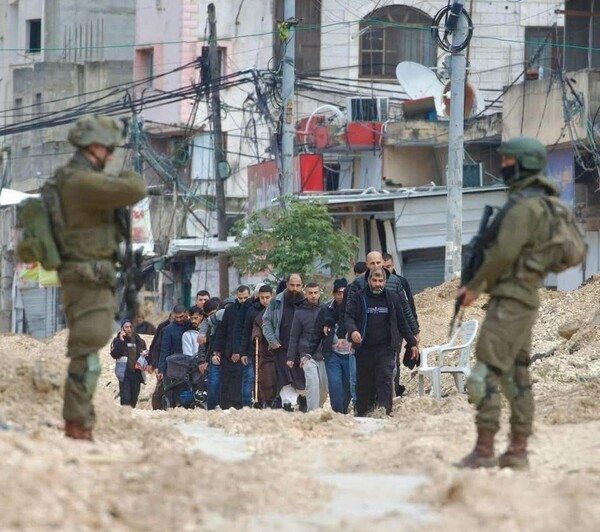
The Israeli occupation forces continue their aggression on the city of Tulkarm and its camp for the 41st consecutive day, and for the 28th day on the Nour Shams camp, amid military reinforcements, raids on homes, and shooting at citizens.

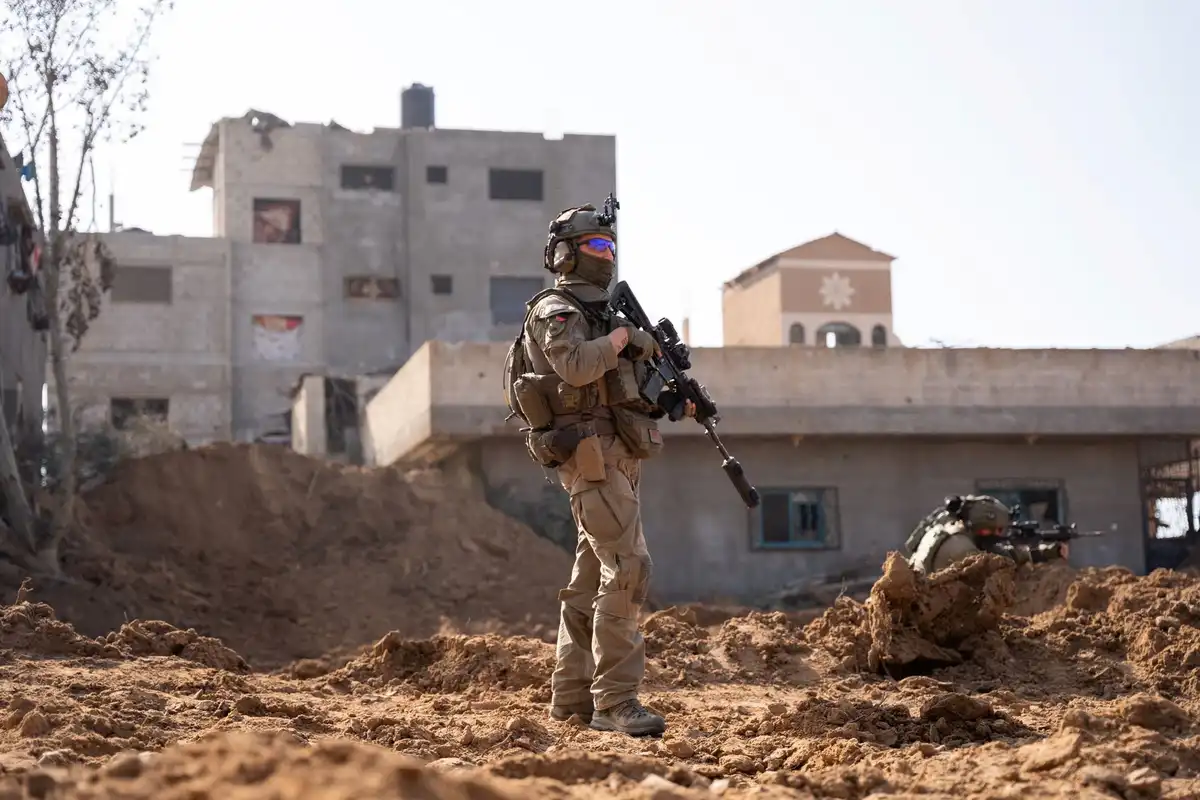
The WAFA news agency said that the occupation forces sent military reinforcements towards the city and its two camps, deployed their vehicles and infantry units in the streets and neighborhoods, and were stationed around and at the entrances to the Tulkarm and Nour Shams camps, accompanied by the firing of live ammunition, sound and light bombs, and the sound of explosions being heard.

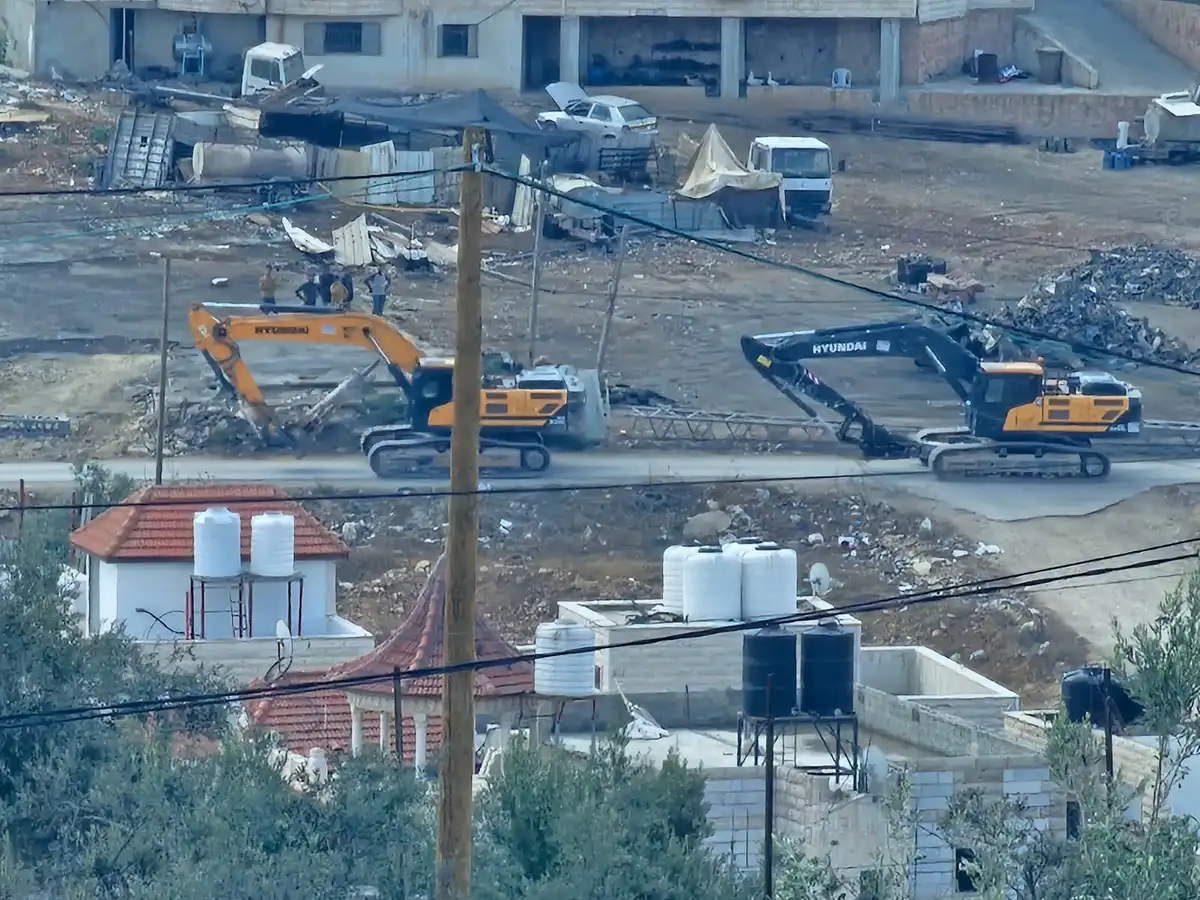
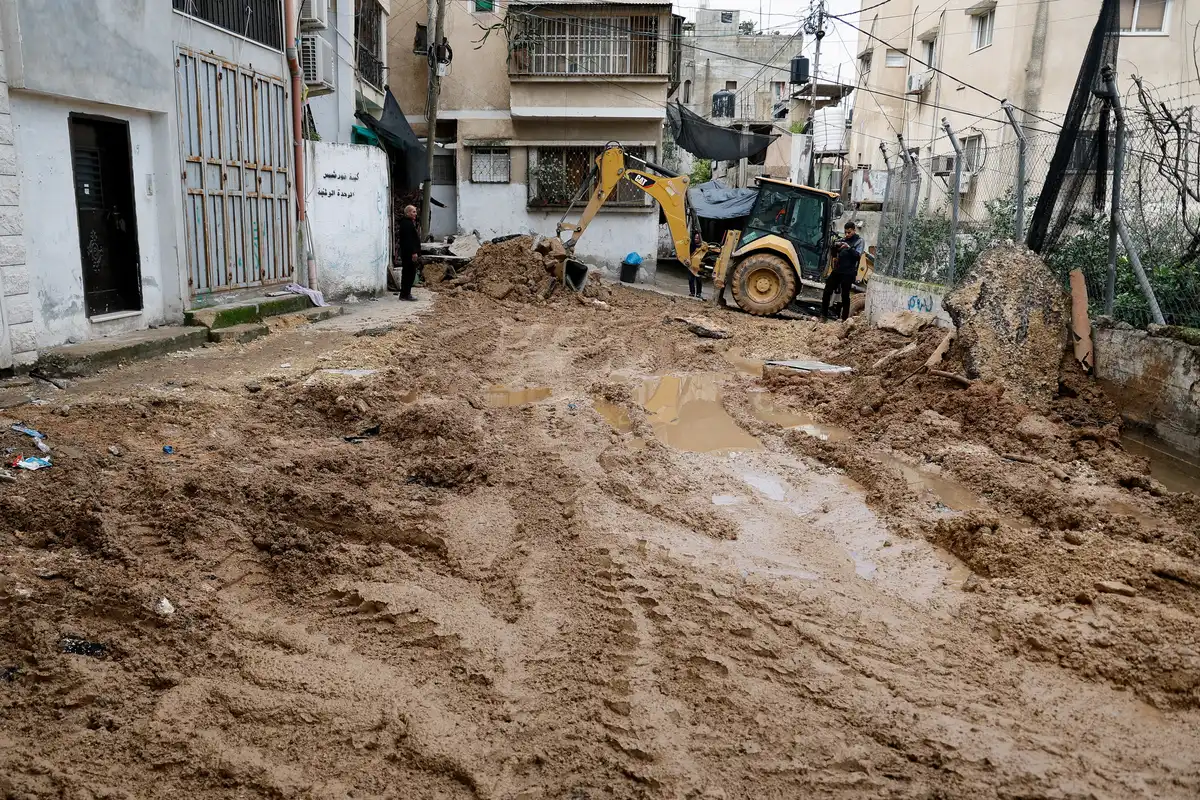
The occupation forces and heavy bulldozers continue to be present in front of the houses and residential buildings that they seized and turned into military barracks, on Nablus Street, which connects the two camps, where the soldiers stop and search vehicles, in addition to checking the identities of citizens and detaining them for interrogation.

In Tulkarm camp, the occupation soldiers chased groups of its residents as they entered the camp and tried to reach their homes to inspect them and collect whatever belongings they could from them.

Eyewitnesses reported that the occupation forces fired live bullets and sound bombs at the citizens, detained a number of them, forced them to leave the camp, and threatened to shoot them if they returned again.

Eyewitnesses added that occupation soldiers were seen installing surveillance cameras on the roofs of houses inside the camp, which they had seized and turned into military barracks.

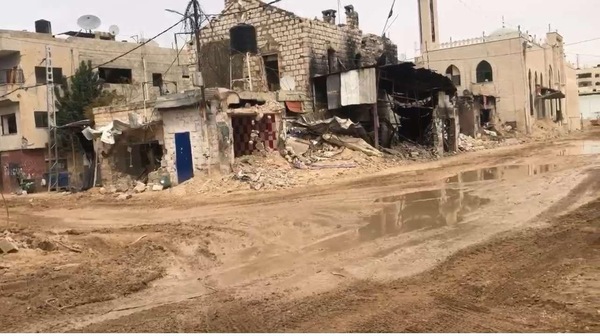
The camp is witnessing a comprehensive destruction of the infrastructure, and of the houses that were completely and partially demolished, vandalized and burned, while the rest of them were converted into military barracks, accompanied by extensive bombing operations inside it, the sound of which can be heard at intermittent intervals.

The occupation forces sent military reinforcements to Nour Shams camp, which is witnessing a tight siege, accompanied by its continued raids on homes and forcing their residents to evacuate them by force, and turning them into military barracks, coinciding with the destruction caused by its bulldozers to the infrastructure and the complete demolition of homes in the Al-Manshiya neighborhood as part of its plan to pave roads and change the geographical features of the camp, as it demolished more than 28 homes in one week.

Local sources reported that after midnight, the occupation forces fired flares over the slaughterhouse neighborhood in Nour Shams camp, amid extensive search and combing operations in the area.

In a press statement, the Popular Committee for Services in Nour Shams Camp confirmed that the policy of house demolitions and forced displacement pursued by the occupation forces is part of the collective punishment aimed at displacing citizens and breaking their will.

The ongoing aggression on the city and the camps resulted in the martyrdom of 13 citizens, including a child and two women, one of whom was eight months pregnant, in addition to the injury and arrest of dozens, and the forced displacement of more than 9,000 citizens from Nour Shams camp, and 12,000 from Tulkarm camp.

The United Nations Relief and Works Agency for Palestine Refugees in the Near East (UNRWA) stated that the Jenin, Tulkarm and Nur Shams camps in the northern West Bank have become uninhabitable due to the ongoing aggression by the occupation forces.

She explained that this aggression is the longest and most destructive since the Al-Aqsa Intifada in 2000, and has resulted in the largest wave of Palestinian displacement in the West Bank since 1967, as the occupation forced about 40,000 people to be forcibly displaced from their homes.

UNRWA indicated that the camps of Jenin, Tulkarm and Nur Shams have been almost emptied of their residents, in light of the widespread destruction of civilian infrastructure, including homes. Under these circumstances, citizens face the possibility of having no place to return to.

OPINIONS

Sat 08 Mar 2025 10:56 am - Jerusalem Time

International Women's Day: Woe to a world that does not see

Today, International Women's Day comes to my mind, and in a big way, but today it comes to my mind with great sadness, and with even greater pain, given what women are suffering, whether in the Gaza Strip or in the camps in the northern West Bank these days. I say to myself, how can this world remain silent, ignore, and turn a blind eye to what women are suffering from, a severe shortage of their basic needs, which are stipulated by heavenly and earthly laws alike?

My reproach is to the Arab and Islamic nation as it watches with its own eyes the Palestinian woman being oppressed, humiliated and deprived. My reproach is to those who take the Qur’an as their method and rise up in anger when women demand their freedom and rights, and then slink like ostriches into their holes when women’s rights are violated and their lives and futures are destroyed.

My reproach is to the world, or what is falsely called the first civilized world, which sees but does not see, watches but does not feel, does not move, and does not bat an eyelid at what women suffer in Nour Shams, Jenin, Jabalia, the beach, Nuseirat, and everywhere, at the hands of soldiers armed with fire, hatred, and malice towards the Palestinian woman, the origin of our story, its shepherd, and the waterer of its eternal, immortal beauty.

I imagine, contemplate and grieve that we are in the twenty-first century, and the rights of Palestinian women are still being violated as never before in the most horrific, bloody and destructive human experiences. This is not a reproach to time nor anger at the neutral geographic data that grants humanity a deeper dimension in awareness, conscience and humanity. It is a reproach and anger at those who write the history of these days and excel in explaining the data of human development in the world, progress, development and launching into greater horizons for the future. I wonder, what kind of future is this that the world and women are striving for that deprives them of their right to live and practice their great existential role in a world that preserves their dignity, rights and needs.

Instead, the Palestinian woman was robbed of her safe home, and the home of displacement was thrown in her face, without providing for her most basic needs, and without caring about her most basic dreams, feelings and concerns. The occupation has gone too far in its crimes of violating the most basic rights of women, children, youth, elderly and the Palestinian human being in all forms of their livelihood, time, life and place, in length, breadth and height. It has deprived them of their right to move, their right to learn and their right to walk a safe path, and has imposed on them the thugs of our time, its Tatars and Mongols. But unfortunately, this occupation has found a protector, a shepherd and a legislator in the far reaches of the earth, who turn a blind eye to its crime and continue their day with indifference that rises to the level of a crime.

On Palestinian Women's Day: Your Patience is Our Eternal Hope

Every year, the Palestinian woman is up to the challenge, difficulties and hope.

OPINIONS

Sat 08 Mar 2025 9:45 am - Jerusalem Time

Negotiations with Hamas are a necessary evil

Hamada Faraana

Hamada Faraana

Opinion Writer

Before the "Gaza War" and the fascist aggressive attack of the colony on the Palestinian people in the Gaza Strip stopped, the puzzling question, often repeated by observers, was: What comes after the war?? What comes after the second day of the war?? Who will take power in the Gaza Strip after Hamas??

I would answer that there are three possibilities:

The first is to install a Palestinian civil administration that has no connection to the resistance. I used to answer that this was an unlikely option, and that no civilian would be able to respond to such an option. In fact, no one had the courage to accept this adventurous option, in response to the Israeli demand.

The second is the return of the Palestinian Authority to Gaza as it was before the Hamas coup and its military option in 2007, but this requires understanding and coordination between the Fatah and Hamas movements, and it is the most realistic option.

The third, which observers ruled out, but I did not rule it out for two reasons: first, the results of the military battle and the field engagement, which reached the essence of the Palestinians holding out even if they did not win yet, and that the Israelis failed but were not defeated yet, and therefore the political battle will be an extension of the military battle with the same tools of engagement between the two parties, and second, the ceasefire negotiations are taking place between the colony and Hamas, and the truce agreement was reached between the colony and Hamas under American sponsorship with Qatar and Egypt, and therefore it is natural for the negotiations between them to continue to reach this level of understanding, acceptance and result, even if both of them were forced to do so.

Observers ruled out this option because the colony and Washington viewed Hamas as a “terrorist” organization. I said and I say that the colony and Washington were dealing with Fatah and the PLO as “terrorist” factions. However, the late Palestinian President Yasser Arafat, head of Fatah and head of the PLO, was the one who was received at the White House and signed the Oslo Accords in 1993. Washington had previously negotiated with the “very terrorist” Taliban movement and handed it power in Afghanistan. These are examples of many similar models in the world, and the whole world is witnessing negotiations between enemies.

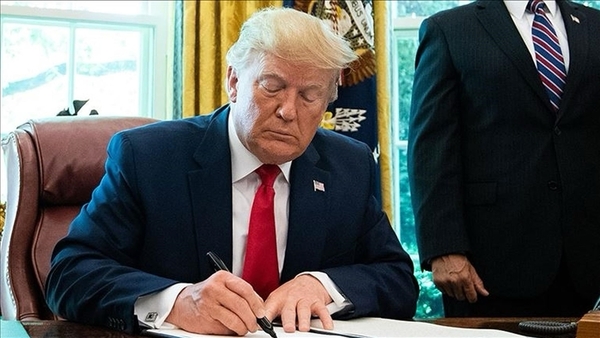
Here is Trump, the "political extremist" and "strongly" supporter of the colony, announcing that the United States is negotiating with Hamas, although this is accompanied by "extremist" terms that undermine Hamas, but it did not stop there, because it realizes that the most important content for it is accepting to sit at the table with the Americans as a party that decides and practices negotiations.

.........


The truce agreement was reached between the colony and Hamas under American sponsorship, along with Qatar and Egypt. Therefore, it is natural for negotiations between them to continue to reach this level of understanding, acceptance and result, even if both of them were forced to do so.

OPINIONS

Sat 08 Mar 2025 9:43 am - Jerusalem Time

To control the West Bank!

Dr. Hassan Brijia

Dr. Hassan Brijia

Opinion Writer

Israeli sovereignty over the West Bank is a highly complex issue that touches on international law, Palestinian rights, and regional politics. Under international law, the West Bank has been occupied territory since 1967, and its fate must be determined through negotiations. Voting or discussing Israeli sovereignty over the West Bank in an Israeli-only framework ignores Palestinian rights and UN resolutions that consider settlements illegal and call for a two-state solution. Such a discussion, if conducted without genuine Palestinian participation, would be a unilateral move that would increase tensions, rather than pursue a just political solution.

The problem is that “next Sunday, the bill to apply Israeli sovereignty over the West Bank is scheduled to be discussed in the Ministerial Committee for Legislative Affairs, where the campaign is led by Knesset members from the Otzma Yehudit party, and here in this descriptive analysis we will examine the legality of this measure.”

Legally, this procedure is in conflict with international law, but it is carried out within the framework of the internal Israeli legal system. Here is an explanation of the legal dimensions:

1- According to international law:

• The West Bank is considered occupied territory under UN resolutions and the Geneva Conventions, and therefore Israel does not have the legal right to impose its sovereignty over it unilaterally.

• Security Council Resolution 242 (1967) affirms the inadmissibility of the acquisition of territory by force, which applies to the West Bank.

• Security Council Resolution 2334 (2016) condemns settlements and considers them a violation of international law, meaning that the imposition of Israeli sovereignty would also be internationally illegal.

2- From the Israeli side:

The Knesset and the government can debate any bill, but passing it will not change the international legal status, but rather will be a domestic political move aimed at consolidating Israeli control over the West Bank. Israel has previously annexed East Jerusalem and the Golan Heights through unilateral decisions, but the international community has not recognized these decisions.

3- Possible repercussions:

Any move to annex the West Bank could lead to a dangerous escalation, whether within the Palestinian territories or at the diplomatic level with the countries of the world, and could result in international punitive measures against Israel, especially from the European Union or other countries that oppose the annexation, which could undermine any future possibility of a two-state solution.

The procedure is not legal according to international law, but it is possible within the Israeli political system, especially in the midst of Israeli disputes over the dismissal of the legal advisor and the targeting of the judicial system in Israel by extremists, although it may lead to serious consequences on the political, legal and security levels.

Addressing this situation:

Preventing this action requires action on several levels:

1- Palestinian level

Intensify diplomatic efforts: The Palestinian Authority must move quickly to the United Nations, the Security Council, and the European Union to request a clear condemnation of this project as a violation of international law.

Unifying the internal ranks: The Palestinian division weakens any international position, so achieving national unity may increase the ability to confront this step effectively. Activating peaceful popular resistance and organizing peaceful protests and movements on the ground may put pressure on Israel and attract the attention of the international community.

2- Arab and Islamic level

The Arab and Islamic countries, especially those that have relations with Israel, such as the UAE, Bahrain, Jordan and Egypt, are moving to pressure Tel Aviv to stop any steps towards annexation, and to activate the role of the Arab League and the Organization of Islamic Cooperation in issuing decisions and taking diplomatic measures against Israel.

3- International level

Escalating the file to the Security Council and the United Nations to impose sanctions or issue resolutions against Israel if it continues with this approach, to pressure the European Union to oppose any annexation step, and this can be used to impose sanctions or freeze economic agreements with Israel, legal action to file complaints with the International Court of Justice or the International Criminal Court against Israeli officials who push for annexation.

4- The internal Israeli level

Supporting opposing Israeli voices: There are Israeli parties and organizations that reject annexation for fear of its security and diplomatic repercussions. These voices can be supported internationally and in the media. Israel can be warned of the consequences if it becomes clear that this step will lead to international isolation. The Israeli government may back down from it, as happened in some previous attempts.

The confrontation requires a unified Palestinian move, Arab and Islamic pressure, activating international channels, and using legal and diplomatic tools to prevent this step before it becomes a reality.


........

The bill to apply Israeli sovereignty over the West Bank is scheduled to be discussed next Sunday in the Ministerial Committee for Legislative Affairs, where the campaign is led by Knesset members from the Otzma Yehudit party.

OPINIONS

Sat 08 Mar 2025 9:38 am - Jerusalem Time

Hamas's relations with the West: America...the surprise and the backstage!!

Dr. Ahmed Youssef

Dr. Ahmed Youssef

Opinion Writer

When Hamas won the legislative elections in January 2006 and formed the tenth government, many Western delegations, European ambassadors to the Palestinian Authority, and figures close to decision-making circles in the United States and the European Union flocked to meet with its prime minister and leaders.

Most of these meetings were conducted with extreme caution, and were often kept secret, for fear of being accused of communicating with a terrorist movement, especially since Hamas was subjected to continuous demonization operations led by Israel and its media arms in Western countries, along with what the Zionist lobbies and Jewish associations in America were doing in terms of targeting to distort the image of Hamas and incite against it, with the aim of isolating the movement and keeping it away from conveying its voice to the presidencies and parliaments of Western countries.

To establish justice, the Western media, which was surprised by the victory of Hamas and its dominance of the political scene in Palestine, was able to carry out a “notable campaign” to introduce the movement, its figures, its ideas, what its political vision represents, and what this victory means for an Islamic movement for the future of the conflict with Israel, and so on.


At the time, I was a political advisor to Prime Minister Ismail Haniyeh (may God have mercy on him), and I was one of the most prominent figures in the government who arranged these meetings or who were contacted to conduct interviews and dialogues with them, as my official position as one of Prime Minister Haniyeh’s close associates, and one of the English speakers, gave them a lot of importance, which drew the attention of Western politicians and media professionals to be keen to sit with me and read the map of events and trends through me.

Accordingly, these meetings and media coverage were what opened the door to receiving invitations to visit some Western capitals.

In November 2006, I made my first visit to the British capital, London, which lasted for several days, during which I met with members of the House of Commons and the House of Lords, and there were also meetings with the media, especially the Guardian newspaper and some television channels.

I also travelled to Belfast, where I met a number of leaders of the Irish Republican Party (IRA) and Sinn Féin, to learn about their political and militant experience.

The main question in these political and media meetings was: Who is Hamas? What are its political and struggle goals? Will it recognize Israel? And other questions that reflect the absence of Hamas from the cognitive scene in the West.

After that, I was invited to visit Switzerland and enter into contacts regarding this European country’s vision of the possibility of achieving peace and finding a solution to the Palestinian issue.

Indeed, these meetings resulted in the Swiss proposal, which bore the name “Geneva-Ahmed Youssef Vision.”

Although this proposal is based on the idea of a three-year truce, during which the two-state solution would be achieved in three stages, the positions of the European countries were supportive of this step, while America remained silent, and it was understood that it did not oppose it, but Israel rejected it completely.

After that, the doors of Europe opened to receive Hamas figures, both parliamentary and governmental, and this encouraged the Prime Minister and Foreign Minister to send messages to many European countries, in which the government presented its political vision for achieving peace and closing the file of the Palestinian issue, but Israel continued to watch and warn these countries against the accusation of "dealing with terrorists"!!

As a testimony and documentation of the sessions that I attended, there were the meetings of the French special envoy to President Sarkozy with Prime Minister Haniyeh, who carried a message from him. Then we met him again in Geneva to hear from him about the results of that visit.

Among the high-level delegations was also the Dutch Foreign Ministry delegation, which we hosted in my office in Gaza, and then we met them later during an important meeting with Dr. Musa Abu Marzouk in Cairo, and there was also another meeting with the Swiss Special Envoy with Mr. Khaled Meshaal in Cairo.

In fact, the Norwegian ambassador to the Palestinian Authority in Jerusalem was one of the most active and communicative ambassadors with Hamas. He was always proactive and, like the Swiss ambassador, had new ideas.

Sweden, represented by parliamentary and party figures, was also among the first we met in Geneva and Gaza, and I also met German and British figures in Tunisia on the sidelines of a special dialogue forum that brought together Islamic and European figures.

As for the relationship with America, it remained limited to some contacts with figures who came wearing the cloak of scientific and academic research to communicate and conduct dialogues with the government, but - and this is what we learned through intermediaries - they were close to the White House, especially during the era of President Barack Obama.

I met some of them, and they indicated to me that their movements were with the knowledge of the official authorities.

In 2009, there was a visit by President Erdogan to the White House, which encouraged Prime Minister Ismail Haniyeh to send a message from him to President Obama, which the Turkish President carried with him, who blessed such a step, considering that managing political crises always requires that communication channels remain open.

Only a few months after that letter, I received a call from an American expert on the Middle East (Prof. TS), with whom I had been friends during my time in Washington as director of the UASR Center for Research and Policy Analysis.

The summary of the call was: Ahmed, you need to get ready to travel, as there is a mission awaiting you in Europe, and an American delegation - officially - wants to meet with you in the Norwegian capital, Oslo.

I immediately replied: My friend, Oslo is not my favorite, because of its “bad” political reputation, linked to the historic Oslo Accords between the Palestinians and the Israelis. As for me, I would like the meeting to take place in the Swiss city of Zurich, where I can easily obtain a visa, and also guarantee the secrecy of the movement.

We agreed on that, and I told Prime Minister Haniyeh about the mission, who gave me approval to travel.


At that time in 2009, the relationship with Egypt was not at its best, which made our movements as government figures through the Rafah crossing extremely difficult.

In fact, my relations with the Egyptian intelligence men who were responsible for the Palestinian file were based on respect and appreciation, and Major General Mohamed Ibrahim was one of the most respected and appreciated figures in the Hamas movement, and the same was true of Colonel Ahmed Abdel Khaleq.

So, I had a feeling that my mission would go to its goal, and no one would hinder my travel.

I stayed at the Rafah crossing waiting for the approval decision and permission to pass to Cairo for more than four hours. Unfortunately, the response was a refusal.

I returned home, saying, “You never know… God might bring about something else.” I called the person close to the White House and told him about the refusal to allow me to pass, and that the matter required contacting General Omar Suleiman (may God have mercy on him), the head of the Egyptian General Intelligence Service, to facilitate my travel.

The response came quickly: The mission must remain secret and under absolute secrecy, and any reference to it here or there might reach the Israelis, and the problem of leaking it would create a scandal for the White House, and the Zionist lobby in America would exploit that to defame President Obama and accuse him of communicating with terrorists!!

Accordingly, the visit was postponed until travel was possible, but unfortunately, the relationship with Egypt remained tense and restrictions on the travel of government figures like us through the Rafah crossing were tightened.

In April 2009, there was an attempt by former US President Jimmy Carter to come to Gaza and meet with Hamas leaders there, but Israel prevented this from happening, claiming that there were security risks threatening his life!!

Accordingly, President Carter decided to travel to meet with Mr. Khaled Meshaal, head of the movement’s political bureau, at his residence in the Syrian capital, Damascus, and then meet with the movement’s leadership in the Gaza Strip in the Egyptian capital, Cairo.

The Cairo meeting was secret at the Semiramis Hotel, and I participated in its five-hour session with Dr. Mahmoud Al-Zahar and the brothers Dr. Khalil Al-Hayya and the martyr Saeed Siam (may God have mercy on him).

The president was interested in achieving a historic accomplishment similar to Camp David, but he clashed with an extremist Zionist mentality that does not seek peace and besieges anyone who seeks it.

President Carter enjoyed great respect among the Palestinians for his fair positions on our cause, which he expressed in many of his books published in the West.


In fact, these recent leaks about meetings between America and Hamas were not the first attempt at communication between the two parties, as the backstage backgrounds during the last three years witnessed some of these meetings, and Dr. Musa Abu Marzouk, the most prominent leader in the Hamas movement, was one of its witnesses.

For all of this, the recent contacts with the movement regarding negotiations to release Israeli soldiers of American origin are not the first and will not - of course - be the last, as they come in the context of American interests, which the Trump administration sees as coming first.

These meetings will have consequences, and will pave the way for openness and communication, even after a while, or as they say: There is more to come than meets the eye.

True, Trump has raised the slogan “America First,” and this seems to be the case in general, but the truth is that there is one exception to that rule, and that is Israel.

Many American politicians and academics have spoken about this issue, such as Professor Jeffrey Sachs of Columbia University, who indicated in more than one lecture and television interview that Israel is the one who directs the priorities of the United States in the Middle East, and he said: Unfortunately, America’s foreign policy is being made and driven today by the war criminal Netanyahu!!

And that America is complicit with him in the massacres he is committing against the Palestinians.


..........

These recent leaks about meetings between America and Hamas were not the first attempt at communication between the two parties, as the backstage scenes during the last three years have witnessed some of these meetings, and Dr. Musa Abu Marzouk, the most prominent leader in the Hamas movement, was one of its witnesses.

PALESTINE

Sat 08 Mar 2025 9:35 am - Jerusalem Time

Unpublished investigations: The Israeli army ruled out the possibility of a surprise attack scenario by Hamas

Last week, the Israeli army published the results of its investigation into the October 7 failures, but it turned out yesterday, Friday, that what the army published about its investigations was a small part of the results of the investigations. The results show that the “Al-Aqsa Flood” attack, on October 7, 2023, was carried out on land, at sea and in the air, during which Hamas forces also used gliders to cross the security fence surrounding the Gaza Strip.

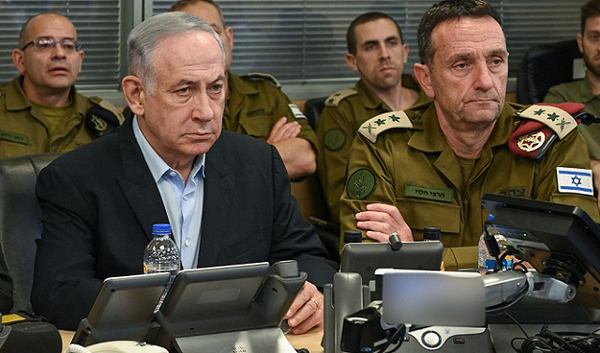
A report published by Yedioth Ahronoth newspaper yesterday, Friday, shows that the failures of the Israeli army on October 7 and the period preceding the day of the attack were enormous, and in all branches of the Israeli army, especially in the intelligence field, according to what the Chief of Staff of the Israeli army, Herzi Halevi, said during a closed meeting with the participation of the commander of the Southern Command and the heads of the local authorities in the "Gaza envelope", before the end of his term, this week.

"We viewed Hamas as a limited military force, and we did not see a scenario of a large-scale surprise attack as a realistic scenario. If something like that happened, we would have received advance intelligence warning about it. Intelligence played a role in this war in the great failure. We wanted to receive advance warning, and we wanted to know from the intelligence that could have changed the reality. We did not," Halevy was quoted as saying by the newspaper. The head of the Southern Command, Yaron Finkelman, added during the meeting that military intelligence said that an attack by Hamas "will not happen in the immediate time frame."

According to the newspaper, during a discussion he held at 4:00 a.m. on October 7, Halevy believed that intelligence was wrong. The summary of the discussion reads, "At the beginning of his remarks, the Chief of Staff stressed that what was required at this stage was to delve into the cause of the events (i.e., indications of Hamas's actions), without relying on concepts that would make Hamas's initiative to attack illogical."

Halevi ordered the air force to "examine targets for a rapid response in the event of Hamas attack activity at dawn." The newspaper reported that Halevi's order was not carried out, and that Halevi did not order Israeli forces on the fence surrounding the Strip to raise their alert status. He did, however, instruct other intelligence agencies to review their information and hold further discussions in the morning.


"October 7th is a deadly disease that spread in the army."


While presenting the results of the investigations to the Israeli army officers last week, the commander of Unit 8200, Yossi Shariel, said that “October 7 is not an incident, but rather a terminal illness that has spread throughout the army. Contrary to the victory over Hezbollah and the claim that the entire Israeli army was victorious, the investigations (about October 7) suddenly show that the entire problem is intelligence.”

The Israeli army sought to mislead the public about the results of the investigations. Although the investigations’ results extended to thousands of pages, the army provided military correspondents with a 15-page summary of them, and dictated to the correspondents to write in their reports “in the name of the correspondent” that the investigations were the result of “continuous and in-depth work whose compass is the truth for the purpose of study and correction.”

Among the things that the army did not reveal to the public when publishing its investigations was that during the night of October 7, information was received indicating Hamas movements in the Gaza Strip. The Air Force Intelligence Unit was aware of a Hamas document, entitled “Jericho Wall,” which included details of a large-scale Hamas attack. Unit 8200 had intercepted it in April 2022, and a senior Air Force representative had seen it during discussions in the army’s Southern Command, held on September 3, 2023, during which it was said that there was a problem with the quality of intelligence in Gaza, and that “Hamas will strike when it believes it serves it.”

The IDF concealed from the public in its summary of the investigation findings that “the air force failed to intercept the glider incursion of Hamas’ elite fighters, or to shoot down Hamas drones that destroyed the ‘see and shoot’ sites on the Gaza border.” The IDF also concealed from the public that “the Iron Dome batteries failed to intercept half of the rockets fired from Gaza.”

The investigation, which was not included in the summary published by the army, according to the newspaper, stated that regarding the gliders and drones launched by Hamas, “the air force did not carry out the mission of defending the country’s skies.” The army did not mention the investigation’s findings that the air force attacked targets in the Gaza Strip that were present in the combat aircraft’s computer software, under the “Sword of Damocles” plan, even though it had no connection to the events of October 7, and while Hamas’s elite forces had already begun their attack inside Israel.

The investigations, which the army did not publish, confirmed that "the navy did not fulfill its defense mission at sea," and revealed that Hamas fighters sought to penetrate southern Israel from the sea with seven boats, and that the navy targeted five of them, while two reached the "Zikim" beach and Hamas elements seized a "Savannah" military vehicle and continued their attack in the "Gaza envelope." The newspaper indicated that the investigations into the navy were not presented to army officers when they were informed of their results.


"Where did the failure begin?"


Halevy asked the team investigating the failure to start in 2018, but the team began in 2002. In 2017, then-IDF Chief of Staff and current MK Gadi Eisenkot drew up a plan titled “Strategic Operational Framework for War in the Gaza Strip,” which included three scenarios that could lead to war against Gaza: Hamas initiating a surprise attack; the situation deteriorating as a result of a gradual escalation against Hamas; or Israel initiating a preemptive attack. The team found that the scenario of Hamas initiating a surprise attack, such as the one that occurred on October 7, was removed from Eisenkot’s plan.

In its speech, the Israeli army replaced the phrase “advance warning” with the phrase “intelligence superiority,” which is based on high intelligence capabilities that can know what is happening and any movement at any time. One of the reasons for the feeling of “intelligence superiority” is the so-called “secret tool,” which is a set of technological and operational capabilities aimed at reaching Hamas’s secrets. However, the army’s investigations confirmed that the “secret tool” did not provide advance warning of the “Al-Aqsa Flood” attack.

The investigation team also did not find any document or intelligence assessment in the Military Intelligence Division, the Southern Command, or the Gaza Division, stating that “Hamas is deterred.” This expression “seemed to appear out of nowhere, and was established as a fact, even in the political establishment.”

The army’s investigations into October 7 revealed that the aggression on Gaza in May 2021 created a perception in Israel that distorted reality. The perception has taken root in the security establishment and the political establishment in Israel, including Netanyahu, that this aggression ended with a fatal blow to Hamas, and that it will be deterred for many years.

But Hamas's perception of the results of this battle was the opposite. Hamas even considered that it had achieved a great accomplishment, according to the results of the army's investigations. It succeeded in launching rocket attacks, and caused rockets to be fired from Syria and Lebanon, and there was a state of turmoil in the mixed cities in Israel. The Israeli army conducted three investigations following this battle, which showed that "the success of the Israeli army in it may be a story told by the army and politicians, but in reality, the story was somewhat different."

Mossad also participated in the October 7 failure, as it was unable to detect “the resistance axis’ preparations for the attack.” Hamas’s sense of the May 2021 battle strengthened its ties with Iran and Hezbollah, and the leaders of the resistance axis began to crystallize what would later be described as a “sense of ability” to launch a large-scale attack. “Contacts began to take place between Gaza, Tehran and Beirut in order to build plans for a joint attack. Mossad completely failed to detect them.”


OPINIONS

Sat 08 Mar 2025 9:22 am - Jerusalem Time

Why does Hamas insist on the condition of stopping the war?

Ibrahim Melhem

Ibrahim Melhem

Opinion Writer

Hamas' insistence on the condition of stopping the war at the end of the second phase of the booby-trapped truce raises a series of pending questions.

The first of these questions: Is there anything in the rogue state’s biography throughout the years of conflict that would lead to the belief that it adheres to the agreements it signs, the most important of which is the Oslo Accords, which were signed publicly in the White House?

Didn't Hamas reinforce this certainty and urge it in its literature, speeches, and the sermons of its sheikhs on the pulpits on all religious occasions, that Israel does not fulfill its promises and does not abide by its covenants?

Isn’t Netanyahu’s retreat from what he signed in the first phase, and his fabrication of flimsy excuses to justify his not entering the second phase, enough to understand the approach of deception, lying, and fabricating excuses to overturn the agreements that are signed before the ink dries?

Do Hamas negotiators believe that Netanyahu will fail to find a way to create a pretext to return to war, as he has returned to it time and time again without justification, the latest of which was his war that he is waging on the camps in the north, under the pretext of bombing buses that he kept secret, after its threads were conveyed to Jews involved in it?

Isn't what the liar is doing today, starving and bombing from afar, a form of war?

The condition of stopping the war was not among the goals of the “liberation war” that Hamas launched on October 7, which it embarked on with a miscalculation and political bet on allies who were involved and whose calculations were exposed, who lost their assets, and who returned from the support war with broken teeth and amputated limbs.

Necessities, precise calculations, the disintegration of allies, and disappointment from brothers and friends, Arabs and Muslims, who were unable to bring in a bag of flour without Israel’s approval, dictate that Hamas proceed with ending the detainees’ crisis in exchange for clearing the prisons, because there is no value to any commitment or agreement that Israel signs today and turns against tomorrow in a world that buys its narrative, gives free rein to its crimes, and holds the victim responsible for the causes of his death!

The daily violations committed by Israel in southern Lebanon and the Golan Heights, with the approval of the Americans who have placed themselves in the position of both adversary and judge, are sufficient evidence of bad intentions.

PALESTINE

Sat 08 Mar 2025 9:18 am - Jerusalem Time

Two dead after an Israeli drone bombed a group of citizens east of Rafah

Two citizens were killed and others were injured today, Saturday, as a result of an Israeli drone attack on a group of citizens east of Rafah, south of the Gaza Strip.


Wafa Agency said that the two martyrs are: Mahmoud Hussein Al-Hissi and Mahdi Abdullah Jarghoun, and they were killed in the Abu Halawa area in Rafah, and they were transferred to the European Hospital in Khan Yunis.


Since Friday evening, the city of Rafah has been exposed to heavy fire from Israeli tanks and drones, as the shells hit citizens' homes, especially in the neighborhoods of: Al-Janina, Al-Shawka, and Tel Al-Sultan.

ARAB AND WORLD

Fri 07 Mar 2025 10:13 pm - Jerusalem Time

Trump says he sent letter to Iranian Supreme Leader Ali Khamenei

US President Donald Trump acknowledged on Friday that he had sent a letter to Iran's Supreme Leader Ali Khamenei, seeking a new deal with Tehran to curb its rapidly advancing nuclear program and replace the accord the United States withdrew from during his first term in May 2018.


Iranian state media immediately picked up President Trump’s acknowledgment, contained in excerpts from an interview with Fox Business News that aired Friday, though there was no confirmation from Khamenei’s office that any message had been received.


The interview will be broadcast in full on Sunday.


It remained unclear how the 85-year-old supreme leader would react, given that former President Barack Obama kept his messages to Khamenei secret before starting negotiations that led to Tehran's 2015 deal with world powers.


Trump said on Friday that "something will happen with Iran very soon," expressing his hope for a peace agreement that would prevent Tehran from possessing a nuclear weapon.


Trump added in remarks he made at the White House that the United States is "in the last moments" of negotiations with Iran, and that he hopes military intervention will not be necessary.


Trump continued, saying: "We have a situation with Iran, something is going to happen very, very soon... You'll be talking about that soon, I think."


He expressed his hope for reaching a peace agreement, saying: “I am not speaking from a position of strength or weakness, I am just saying that I would rather see a peace agreement than the other option, but the other option will solve the problem,” without further clarifying what he meant by the other option.


Trump had said (earlier in an interview with Fox Business that aired Friday) that he wanted to negotiate a nuclear deal with Iran and that he had sent a letter to the Iranian leadership on Wednesday proposing talks with Tehran, which the West fears is rapidly approaching the ability to make nuclear weapons.


"I think they want to get that message across. The other alternative is that we do something, because we cannot allow another nuclear weapon," he continued.


Asked whether he had sent the message to Iranian Supreme Leader Ayatollah Ali Khamenei, Trump replied, "Yes."


"There are two ways to deal with Iran: militarily or make a deal," Trump said. "I prefer to make a deal because I'm not looking to hurt Iran. They're a great people."


Last month, Trump reimposed a policy of “maximum pressure” on Iran, including efforts to cut off its oil exports to zero. But he also said in February that he wanted to strike a deal with Iran that would prevent it from developing a nuclear weapon.

PALESTINE

Fri 07 Mar 2025 9:38 pm - Jerusalem Time

Hebrew media: Instructions to prepare to return to fighting in Gaza

The Israeli Broadcasting Authority reported on Friday that the political level has issued instructions in preparation for returning to fighting in Gaza. The Broadcasting Authority quoted security sources as saying that returning to fighting in Gaza would pose a threat to the lives of prisoners held in the Strip.

Earlier, a Hamas delegation arrived in Cairo on the eve of talks on a truce with Israel in the Gaza Strip, two officials in the movement said Friday.

"A high-level Hamas delegation headed by acting head Mohammed Darwish arrived in Cairo on Friday afternoon," one of the officials told AFP, noting that he would meet "on Saturday with officials in Egypt to consult on developments in the situation and the progress made in implementing the ceasefire agreement and regarding the start of the second phase." He added: "Hamas is demanding that the mediators compel the occupation to implement the agreement and start negotiations for the second phase in accordance with the agreement it signed, and to open the crossings to allow humanitarian and relief aid to enter the Gaza Strip."

After 15 months of war that erupted following Hamas's unprecedented attack on southern Israel on October 7, 2023, a ceasefire went into effect in the Gaza Strip on January 19, based on an agreement brokered by the United States, Egypt and Qatar.


The first phase of the ceasefire agreement lasted six weeks, and allowed the return of 33 hostages to Israel, including eight dead, while Israel released about 1,800 Palestinian prisoners who were in its prisons.


With the end of the first phase, Israel announced its desire to extend it until mid-April based on an American proposal, while Hamas insisted on the need to negotiate the second phase, which is supposed to put an end to the war.


During the Hamas attack, 251 people were kidnapped, including 58 who are still in Gaza, and Israel says that 34 of them were killed.


The next stages of the truce agreement collide with the conflicting positions of the two parties.

PALESTINE

Fri 07 Mar 2025 7:14 pm - Jerusalem Time

Israeli occupation forces a Palestinian citizen to demolish part of his house in the village of Bardala

The Israeli occupation forces forced a citizen from the village of Bardala in the northern Jordan Valley to demolish part of his house.


Local sources reported that citizen Izzat Rashaida was forced, today, Friday, to demolish the third floor of his house, which was under construction, after he was notified by the occupation forces earlier.

The occupation forces stormed the village about two weeks ago, accompanied by crews from the so-called “Settlements Council,” and began photographing the house.

PALESTINE

Fri 07 Mar 2025 7:07 pm - Jerusalem Time

UNRWA: Jenin, Tulkarm and Nour Shams camps have become uninhabitable

The United Nations Relief and Works Agency for Palestine Refugees (UNRWA) announced that the Jenin, Tulkarm and Nur Shams camps in the northern West Bank have become uninhabitable due to the ongoing attacks by the Israeli occupation forces.

The agency said in a press statement, on Friday, that the extensive demolitions in these camps represent a new and disturbing pattern that leaves unprecedented effects on Palestinian refugees.

She stressed that these operations aim to permanently change the basic characteristics of these camps.

This aggression is the longest and most destructive since the Second Intifada, and has resulted in the largest wave of Palestinian displacement in the West Bank since 1967, as the occupation has forced about 40,000 people to be forcibly displaced from their homes.

UNRWA explained that the Jenin, Tulkarm and Nur Shams camps have been almost completely emptied of their residents, with widespread destruction of civilian infrastructure, including homes. Under these circumstances, Palestinians face the prospect of having no place to return to.

The agency indicated that its teams on the ground are working to meet the needs of the displaced, at a time when the humanitarian space in the West Bank continues to shrink continuously.

In a related context, the Minister of the Occupation Army, Yisrael Katz, announced that he had instructed the army forces to continue occupying Palestinian refugee camps in the northern West Bank until the end of this year.

Katz's statement came during his participation, on Friday, in the "Federal Zionism" conference in Tel Aviv, according to the newspaper "Israel Today".

Katz admitted that 40,000 people were displaced from the Palestinian refugee camps in Jenin, Tulkarm and Nur Shams, due to the ongoing aggression for about 50 days.

Since the start of the war of extermination on the Gaza Strip on October 7, 2023, the Israeli occupation army and settlers have escalated their attacks in the West Bank, including East Jerusalem, which led to the martyrdom of about 930 citizens, the injury of nearly 7,000 others, and the arrest of 14,500 citizens.

ARAB AND WORLD

Fri 07 Mar 2025 5:31 pm - Jerusalem Time

Poll: Less than half of Americans sympathize with Israelis


Although Americans are still more likely to say their sympathies in the Middle East conflict lie with the Israelis than the Palestinians, only 46 percent say they favor Israel, the lowest in 25 years of Gallup’s annual tracking of this measure in its World Affairs Poll. The previous low of 51 percent was last year and in 2001.


At the same time, the poll found, the 33 percent of American adults who now say they sympathize with the Palestinians is up six percentage points from last year, a two-point increase.


The latest reading from the most reliable and accurate polling organization of all types, Gallup, found that from February 3 to 16, while the temporary ceasefire and hostage exchange between Israel and Hamas that began in mid-January held, the poll began a day before Israeli Prime Minister Benjamin Netanyahu’s visit to the White House, which included a joint press conference with President Donald Trump, in which Trump expressed his intention to take over Gaza, expel the Palestinians from it, and turn it into the Riviera of the Middle East.


The February poll also found that 40% of U.S. adults approve of Trump’s handling of the Israeli-Palestinian conflict, down from 45% overall. Republicans and Democrats are sharply divided in their assessments of Trump’s performance, and they hold different views of Israel and the occupied Palestinian territories (including Gaza), with Republicans viewing Israel more favorably than Democrats (83% vs. 33%) and Democrats viewing the Palestinians and the Palestinian territories more favorably than Republicans (45% vs. 18%).


Republicans more sympathetic to Israelis, Democrats more sympathetic to Palestinians


Partisan sympathies for the Middle East follow a similar pattern to their positive assessments of both sides. That is, Republicans sympathize broadly with the Israelis (75%) versus the Palestinians (10%), while Democrats sympathize with the Palestinians nearly three times as much (59% vs. 21%). Independent sympathies are similar to national averages. Republicans and independents have consistently supported the Israelis since 2001, though independent support for the Israelis is now at its lowest point in world affairs polls, at one point. Democrats also leaned toward the Israelis until 2022, when roughly equal shares said they sympathized with each side. Since then, Democrats have consistently supported the Palestinians.


Initially, the decline in Democratic sympathy for Israelis was apparently a result of disapproval of the country’s right-wing political leadership under Benjamin Netanyahu. However, it has declined further over the past two years. In February 2023, Democratic sympathy for Israelis fell to 38%, while the reading for Palestinians jumped 11 points to 49%, marking the first time that sympathy for Palestinians has prevailed among this group. “Eight months later, on October 7, 2023, Hamas militants attacked Israel, killing more than 1,000 Israelis and taking nearly 250 hostage. Democratic sympathy for the Palestinian people had fallen by six points by February 2024. A year later, as the humanitarian crisis in Gaza continued, Democratic sympathy for Palestinians rose by 16 points, marking the first time it has reached a majority.


Americans continue to support the two-state solution in the Middle East


For years, a central tenet of Middle East peace proposals has been the so-called “two-state solution,” which would entail the creation of a Palestinian state, according to Gallup. Gallup has been measuring Americans’ views on this issue since 1999. Since then, more Americans have supported the creation of an independent Palestinian state in the West Bank and Gaza Strip, and that support continues today. Currently, 55 percent of Americans support the two-state solution, while 31 percent oppose it, and 14 percent of those surveyed said they had no opinion on the issue.


The latest poll finds that 55% of American adults support the creation of a Palestinian state, which is consistent with readings from 2020, which ranged from 52% to 55%. Before then, Americans were still more likely to support an independent Palestinian state than oppose it, but support was often below majority level. Support and opposition were broadly similar in 2015 and 2017.


Majority of Democrats and Independents Support Independent Palestinian State


Given their overwhelming sympathy for the Palestinians, according to Gallup, it’s only natural that Democrats also broadly support an independent Palestinian state. The poll found that about three-quarters of Democrats, 76%, support such a state, compared with 53% of independents. Meanwhile, 41% of Republicans support a Palestinian state, and 49% oppose it.


Democratic support for Palestinian statehood has been on an upward trend since 2021, while independent support has been relatively flat over the same period. Republican support has risen by 15 points after falling sharply last year.


Conclusion


The Gallup poll finds that American sympathy for Israelis continues to decline, largely due to declining support among Democrats for the Israelis in the long-running conflict with the Palestinians. Republicans remain overwhelmingly sympathetic to the Israelis.


Meanwhile, the creation of an independent Palestinian state still enjoys the support of a majority of Americans, though far more Democrats than Republicans. Discussion of a two-state approach to peace in the region has largely stalled in the wake of the October 7, 2023, attack, as world leaders grapple with how to secure Israel after the war, what role Hamas will play in Gaza, and how to govern the West Bank.

PALESTINE

Fri 07 Mar 2025 3:57 pm - Jerusalem Time

Israeli Settlers set up two tents and break olive trees north of Jerusalem

Today, Friday, settlers set up two tents and broke olive trees near the village of Jaba, northeast of Jerusalem.


According to local sources, settlers stormed the "Jabaa Plain" area, set up two new tents on lands east of the village, owned by a number of citizens, broke a number of olive trees, and prevented the landowners from reaching them.


She pointed out that the settlers have been trying for two weeks to seize the lands of Jaba' Plain and link them to the "Adam" settlement, which is located on the town's lands.

PALESTINE

Fri 07 Mar 2025 3:45 pm - Jerusalem Time

Israeli occupation forces injure two children and arrest another west of Ramallah

Two children were injured by Israeli occupation forces' bullets and another was arrested today, Friday, in the town of Ni'lin, west of Ramallah.


Local sources reported that the occupation forces stormed the center of the town, and clashes erupted during which the occupation soldiers fired live bullets and tear gas canisters, which led to the injury of two children (17 and 16 years old) with bullets in the lower limbs of the body, and they were subsequently transferred to the "Nilin Emergency Center", in addition to cases of suffocation.


She said that the occupation forces arrested a child "whose identity is not yet known", and set up a military checkpoint north of the town, stopped citizens' vehicles and checked their ID cards, which caused a severe traffic jam.

PALESTINE

Fri 07 Mar 2025 3:22 pm - Jerusalem Time

Hamas delegation in Cairo for talks on Gaza ceasefire

  1. A Hamas delegation arrived in Cairo on Friday, on the eve of talks on a truce with Israel in the Gaza Strip.


The Egyptian State Information Service announced that "a delegation from the leadership of the Hamas movement arrived in Cairo to discuss the procedures for implementing the ceasefire agreement in Gaza and to push the negotiations to enter the second phase."


She added that the General Authority for Information said that "the Egyptian-Qatari efforts aim to provide the necessary guarantees to move to the second phase of the ceasefire agreement in Gaza."


Two officials in the movement said on Friday that "a high-level leadership delegation in the Hamas movement, headed by Mohammed Darwish, the acting head of the movement, arrived in Cairo on Friday afternoon," according to what was reported by Agence France-Presse, quoting one of them.


The same source indicated that he will meet "on Saturday with officials in Egypt, to consult on developments in the situation, the progress made in implementing the ceasefire agreement, and what is related to starting the second phase."


On Sunday, the Israeli government decided to stop the entry of humanitarian aid into Gaza, hours after the end of the first phase of the ceasefire and prisoner exchange agreement between Hamas and Tel Aviv, and the latter’s obstruction of entering into negotiations for the second phase.


The war on Gaza left more than 160,000 Palestinian martyrs and wounded, most of them children and women, and more than 14,000 missing.


Washington said that the direct talks with Hamas were not for the purpose of negotiation but rather "to convey the American position in a different way."


This was stated by the spokeswoman for the US State Department, Tammy Bruce, in a press conference.


In response to a question about the meeting of the US Special Envoy for Prisoner Affairs, Adam Boehler, with Hamas leaders in Qatar, Bruce said on Thursday: “If I have a conversation with someone, this is not a negotiation, this is a transfer of the American position in a different way.”

PALESTINE

Fri 07 Mar 2025 2:41 pm - Jerusalem Time

Washington: Our direct talks with Hamas are to convey our position, not to negotiate

Washington said that direct talks with Hamas were not for the purpose of negotiation but rather to "convey the American position in a different way."


This was stated by the spokeswoman for the US State Department, Tammy Bruce, in a press conference.


In response to a question about the meeting of the US Special Envoy for Prisoner Affairs, Adam Boehler, with Hamas leaders in Qatar, Bruce said on Thursday: “If I have a conversation with someone, this is not a negotiation, this is a transfer of the American position in a different way.”


She stressed that there was no change in the US position towards Hamas.


In response to a question about Washington's support for Israel's decision to block humanitarian aid to Gaza, Bruce said: "Aid can only be provided within a safe framework."


She claimed that the cessation of aid does not represent a renunciation, but rather a reflection of the ongoing situation on the ground, she said.


On Sunday, the Israeli government decided to stop the entry of humanitarian aid into Gaza, hours after the end of the first phase of the ceasefire and prisoner exchange agreement between Hamas and Tel Aviv, and the latter’s obstruction of entering into negotiations for the second phase.


The war on Gaza left more than 160,000 Palestinian martyrs and wounded, most of them children and women, and more than 14,000 missing.

PALESTINE

Fri 07 Mar 2025 2:34 pm - Jerusalem Time

Two Palestinians killed in Israeli bombing east of Gaza City

Two citizens were killed, Friday afternoon, when an Israeli drone bombed a group of citizens east of the Shuja'iyya neighborhood, east of Gaza City.


According to local sources, the two victims are Alaa Imad Aslim and his cousin Muhammad Subhi Aslim, who were killed in a bombing on Al-Mansoura Street, east of Al-Shuja'iyya neighborhood.


Thus, the number of dead in the Shuja'iyya neighborhood since yesterday evening until now has risen to five.

PALESTINE

Fri 07 Mar 2025 2:27 pm - Jerusalem Time

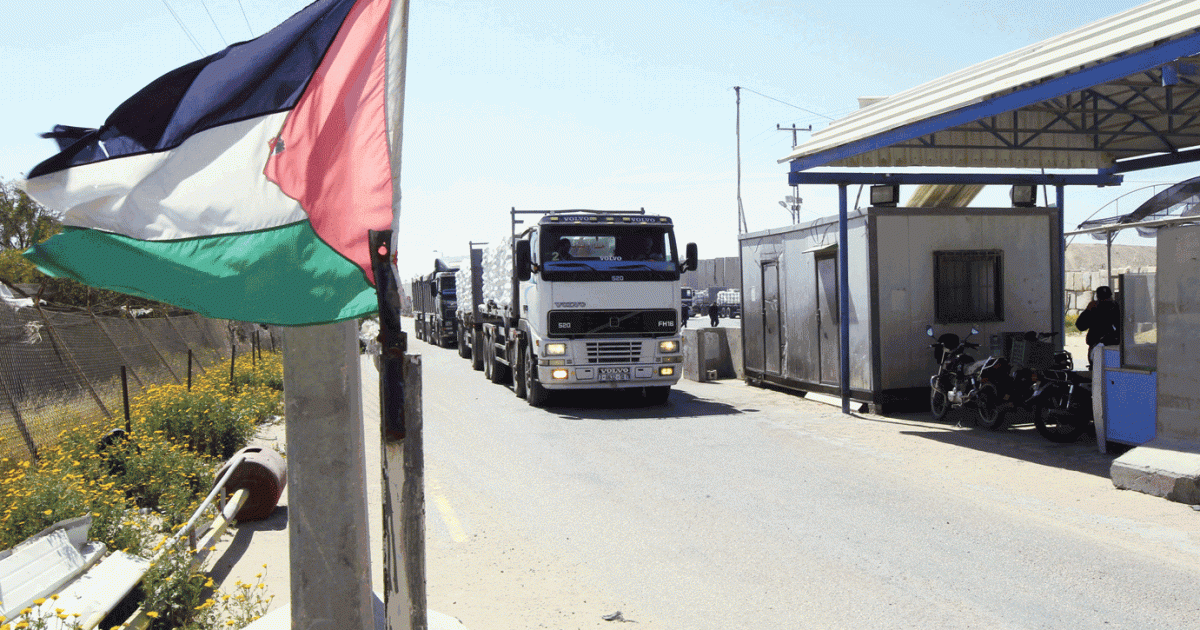
Israeli occupation continues to close the Kerem Shalom crossing and prevents the entry of aid

  1. Today, Friday, the Israeli occupation forces continue to close the Kerem Shalom commercial crossing located southeast of the Gaza Strip for the sixth consecutive day.

The Israeli government, headed by Benjamin Netanyahu, decided last Saturday evening to close the border crossings and stop the flow of aid and goods to the Strip, claiming that Hamas refused to extend the first phase of the agreement and respond to the proposal of the US envoy to the region, Steve Witkoff.


As a result of the Israeli decision, the prices of basic goods and materials in the Strip immediately jumped, amid government and international warnings of the return of starvation among the population if the decision to close the crossing remains in effect.

Following the decision to close the border crossings and stop the flow of goods, former and current Israeli officials launched incitement campaigns against the Strip and its residents, most notably the statement of the Deputy Speaker of the Knesset and former Minister of National Security Itamar Ben-Gvir, who called for bombing warehouses containing goods and cutting off electricity and water supplies.

PALESTINE

Fri 07 Mar 2025 2:02 pm - Jerusalem Time

Unpublished investigations: The Israeli army ruled out the possibility of a surprise attack scenario by Hamas

Last week, the Israeli army published the results of its investigations into the failures of October 7, but today, Friday, it turns out that what the army published about its investigations was a small part of the results of the investigations.


The results show that the “Al-Aqsa Flood” attack, on October 7, 2023, was carried out on land, at sea and in the air, during which Hamas forces also used gliders to cross the security fence surrounding the Gaza Strip.


A report published by Yedioth Ahronoth newspaper today, Friday, shows that the failures of the Israeli army on October 7 and the period preceding the day of the attack were enormous, and in all branches of the Israeli army, especially in the intelligence field, according to what the Chief of Staff of the Israeli army, Herzi Halevi, said during a closed meeting with the participation of the commander of the Southern Command and the heads of the local authorities in the "Gaza envelope", before the end of his term, this week.


"We viewed Hamas as a limited military force, and we did not see a scenario of a broad, surprise attack as a realistic scenario. If something like that happened, we would have received advance intelligence warning about it. Intelligence in this war played a role in the great failure. We wanted to receive advance warning, and we wanted to know from the intelligence information that could have changed the reality. We did not receive it," the newspaper quoted Halevy as saying.


The commander of the Southern Command, Yaron Finkelman, added during the meeting that military intelligence said that an attack by Hamas "will not happen in the immediate time frame."


According to the newspaper, during a discussion he held at 4:00 a.m. on October 7, Halevy believed that intelligence was wrong. The summary of the discussion reads, "At the beginning of his remarks, the Chief of Staff stressed that what was required at this stage was to delve into the cause of the events (i.e., indications of Hamas's actions), without relying on concepts that would make Hamas's initiative to attack illogical."


Halevi ordered the air force to "examine targets for a rapid response in the event of Hamas attack activity at dawn." The newspaper reported that Halevi's order was not carried out, and that Halevi did not order Israeli forces on the fence surrounding the Strip to raise their alert status. He did, however, instruct other intelligence agencies to review their information and hold further discussions in the morning.


"October 7th, a deadly disease that spread through the army"

While presenting the results of the investigations to the Israeli army officers last week, the commander of Unit 8200, Yossi Shariel, said that “October 7 is not an accident, but rather a terminal illness that has spread throughout the army. Contrary to the victory over Hezbollah and the claim that the entire Israeli army was victorious, the investigations (about October 7) suddenly show that the entire problem is intelligence.”


The Israeli military sought to mislead the public about the results of the investigations. Although the investigations’ results extended to thousands of pages, the military provided military correspondents with a 15-page summary of them, and instructed the correspondents to write in their reports “in the name of the correspondent” that the investigations were the result of “continuous and in-depth work whose compass is the truth for the purpose of study and correction.”


Among the things that the army did not reveal to the public when publishing its investigations was that during the night of October 7, information was received indicating Hamas movements in the Gaza Strip. The Air Force Intelligence Unit was aware of a Hamas document, entitled “Jericho Wall,” which included details of a large-scale Hamas attack. Unit 8200 had intercepted it in April 2022, and a senior Air Force representative had seen it during discussions in the army’s Southern Command, held on September 3, 2023, during which it was said that there was a problem with the quality of intelligence in Gaza, and that “Hamas will strike when it believes it serves it.”


The IDF concealed from the public in its summary of the investigation findings that “the air force failed to intercept the glider incursion of Hamas’ elite fighters, or to shoot down Hamas drones that destroyed the ‘see and shoot’ systems on the Gaza border.” The IDF also concealed from the public that “the Iron Dome batteries failed to intercept half of the rockets fired from Gaza.”


The investigation, which was not included in the summary published by the army, according to the newspaper, stated that regarding the gliders and drones launched by Hamas, “the air force did not carry out the mission of defending the country’s skies.” The army did not mention the investigation’s findings that the air force attacked targets in the Gaza Strip that were present in the combat aircraft’s computer software, under the “Sword of Damocles” plan, even though it had no connection to the events of October 7, and while Hamas’s elite forces had already begun their attack inside Israel.


The investigations, which the army did not publish, confirmed that "the navy did not fulfill its defense mission at sea," and revealed that Hamas fighters sought to penetrate southern Israel from the sea with seven boats, and that the navy targeted five of them, while two reached the "Zikim" beach and Hamas elements seized a "Savannah" military vehicle and continued their attack in the "Gaza envelope." The newspaper indicated that the investigations into the navy were not presented to army officers when they were informed of their results.


"Where did the failure begin?"


Halevy asked the team investigating the failure to start in 2018, but the team began in 2002. In 2017, then-IDF Chief of Staff and current MK Gadi Eisenkot drew up a plan titled “Strategic Operational Framework for War in the Gaza Strip,” which included three scenarios that could lead to war against Gaza: Hamas initiating a surprise attack; the situation deteriorating as a result of a gradual escalation against Hamas; or Israel initiating a preemptive attack. The team found that the scenario of Hamas initiating a surprise attack, such as the one that occurred on October 7, was removed from Eisenkot’s plan.


In its speech, the Israeli army replaced the phrase “advance warning” with the phrase “intelligence superiority,” which is based on high intelligence capabilities that can know what is happening and any movement at any time. One of the reasons for the feeling of “intelligence superiority” is the so-called “secret tool,” which is a set of technological and operational capabilities aimed at reaching Hamas’s secrets. However, the army’s investigations confirmed that the “secret tool” did not provide advance warning of the “Al-Aqsa Flood” attack.


The investigation team also did not find any document or intelligence assessment in the Military Intelligence Division, the Southern Command, or the Gaza Division, stating that “Hamas is deterred.” This expression “seemed to appear out of nowhere, and was established as a fact, even in the political establishment.”


The army’s investigations into October 7 revealed that the aggression on Gaza in May 2021 created a perception in Israel that distorted reality. The perception that this aggression ended with a fatal blow to Hamas, and that it would be deterred for many years, has become entrenched in the security establishment and the political establishment in Israel, including Netanyahu.


But Hamas' perception of the results of this battle was the opposite, and Hamas considered that it had achieved a great accomplishment, according to the results of the army's investigations. It succeeded in launching missile attacks, and caused rockets to be fired from Syria and Lebanon, and there was a state of turmoil in the mixed cities in Israel.


The Israeli army conducted three investigations following this battle, which showed that “the success of the Israeli army in it may be a story told by the army and politicians, but in reality, the story was somewhat different.”


Mossad also participated in the October 7 failure, as it was unable to detect “the resistance axis’ preparations for the attack.” Hamas’s sense of the May 2021 battle strengthened its ties with Iran and Hezbollah, and the leaders of the resistance axis began to crystallize what would later be described as a “sense of ability” to launch a large-scale attack. “Contacts began to take place between Gaza, Tehran and Beirut in order to build plans for a joint attack. Mossad completely failed to detect them.”

PALESTINE

Fri 07 Mar 2025 11:22 am - Jerusalem Time

Israeli settlers raise flags near citizens' tents in the Jordan Valley

Today, Friday, settlers raised the occupation flags near citizens' tents in the northern Jordan Valley.


Local sources reported that a number of settlers stormed Khirbet Samra in the northern Jordan Valley and raised the occupation flags near the citizens' tents, amid fears that they would seize more agricultural and pastoral lands in the area.


Last night, settlers roamed among the citizens' tents in the same area, causing terror among children and women.

PALESTINE

Fri 07 Mar 2025 10:33 am - Jerusalem Time

Israeli occupation imposes restrictions on worshipers to perform the first Friday prayer of Ramadan

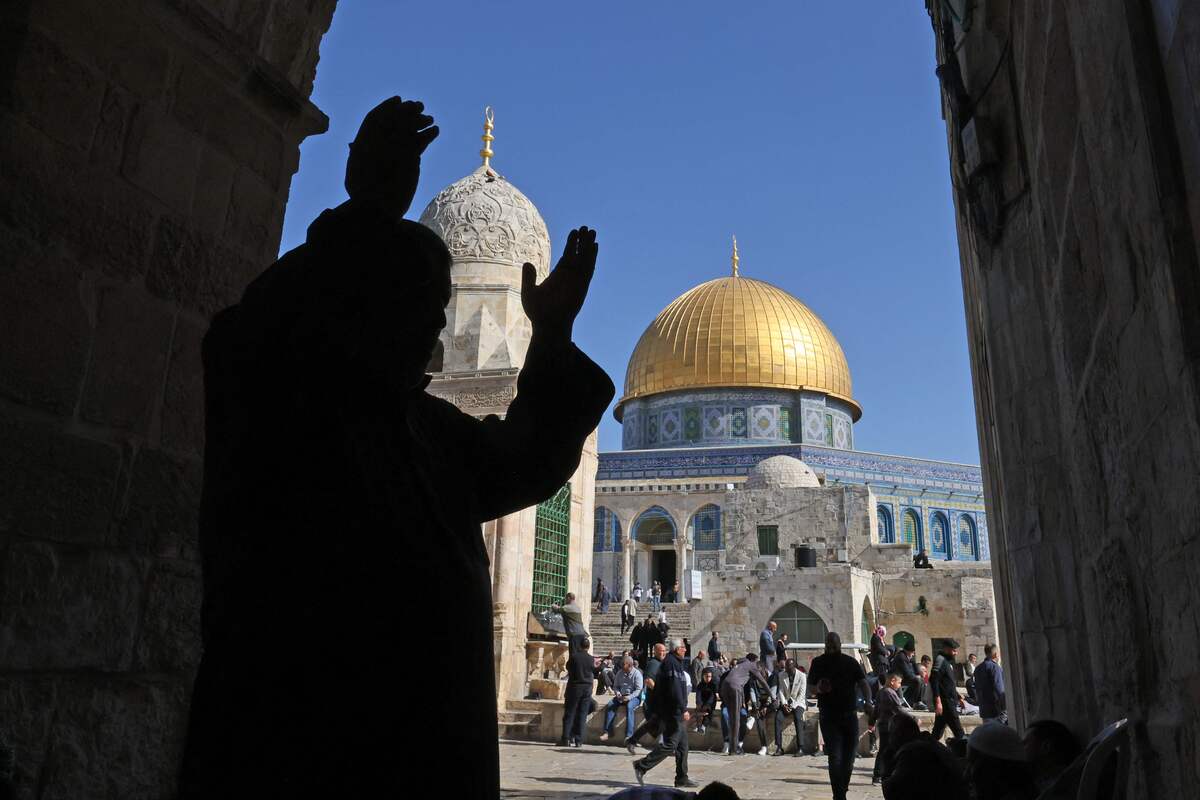
Today, Friday, the Israeli occupation forces imposed strict restrictions on the entry of worshipers coming from the West Bank to the occupied city of Jerusalem, to perform the first Friday prayer of the holy month of Ramadan in the blessed Al-Aqsa Mosque.


Despite the strict military restrictions, thousands of citizens have flocked since this morning through the Qalandia military checkpoint, where the occupation army has reinforced its forces at the checkpoint, checked the citizens’ identities, and prevented men under the age of 55 and women under the age of 50 who obtained “special permits” from entering Jerusalem.


Eyewitnesses reported that the occupation forces returned dozens of elderly people at the Qalandia and Bethlehem checkpoints who were on their way to Al-Aqsa Mosque, on the pretext that they did not have the required permits to enter.


The occupation forces also imposed restrictions on the entry of worshipers into Al-Aqsa Mosque, checked the identities of young men at the entrances to the Old City and the doors of the mosque, and prevented a number of them from entering.

PALESTINE

Fri 07 Mar 2025 10:31 am - Jerusalem Time

What's gone is gone, so let's prepare for what's coming?


The summit ended without any significant outcomes that would relieve the distress and remove the gloom. This is the state that the nation has not left since the first summit was held on May 28, 1946, in the Zahrat Anshas Palace in the town of Anshas, which is located about 33 kilometers northeast of Cairo, and bore the same name as the Cairo Summit: “The Palestine Summit.”


Between Inshas and Cairo, abundant water and blood flowed in the river of suffering that flowed without stopping, and the Palestinian cause remained the same priority in all Arab summits, both emergency and regular.


Aside from the eloquence in adapting the vocabulary that relieves tensions and raises morale, the outcomes of the summit are disappointing, given that it did not obtain the required consensus, which was evident in the absence of some leaders from its deliberations, which indicates that the Arab summits have not abandoned their differences, and that the phrase “the Arabs agreed not to agree” has remained the permanent refrain that characterizes all successive summits.


The host country is credited with its good organization and its perseverance in removing the trigger of displacement, by proposing an alternative to reconstruction while the Gazans remain on their land and participate in the reconstruction of their destroyed cities, towns, villages and camps.

The danger of displacement has not gone away by presenting an alternative. What is coming, in light of the Israeli and American rejection of the summit outcomes, must set off more than one red flag, to build high Arab and Palestinian walls of resistance, to re-align the ranks and overcome the differences, in preparation for what is coming.


May God save us from the coming!

PALESTINE

Fri 07 Mar 2025 10:13 am - Jerusalem Time

Israeli escalation and demolition of homes in Tulkarm and its camps

  1. The Israeli aggression on the city of Tulkarm and its camp entered its 40th consecutive day, and the 27th day on the Nour Shams camp, amidst an escalation in the field, coinciding with intensive military reinforcements, raids, and the demolition of many homes.

Local sources said that the occupation forces sent military reinforcements towards the city and its two camps, and deployed their vehicles and infantry squads in the streets and neighborhoods, especially in the southern and western areas and the middle of the market, in addition to the surroundings and entrances to the Tulkarm and Nour Shams camps, in conjunction with the firing of bullets and sound and light bombs, and the sound of huge explosions.


She added that the occupation forces' heavy machinery and bulldozers continue to be present in front of homes and residential buildings on Nablus Street, which connects the Tulkarm and Nour Shams camps, where soldiers stop and search vehicles, check citizens' identities and detain them for interrogation.


In the details of the daily raids, local sources reported that the occupation forces raided several homes on Nablus Street belonging to the families of Al-Tabbal, Hussein Younis, and Al-Hamdallah, and forced them to evacuate them, after giving them until 10:00 a.m. to leave.


The occupation army also raided the Abu Muntaser Al-Assas building in the Aktaba suburb housing project, east of the city, and searched the residential apartments and destroyed their contents.


Around Tulkarm camp, the occupation forces continued to deploy their vehicles in its neighborhoods, concentrated in the airport, Abu al-Foul, and Dabbat Umm Jawhar neighborhoods in the Balawneh neighborhood, and prevented anyone from entering them, while firing live bullets at anyone who tried to do so.


Eyewitnesses confirmed that the occupation forces escalated their operations in the camp, from systematic destruction of every corner of it, such that it turned into an area empty of its residents, except for a few families in some neighborhoods at its entrances, where there was comprehensive destruction in the infrastructure, and the houses that were subjected to demolition, vandalism and burning, while the rest of them were turned into military barracks, in conjunction with extensive bombing operations inside the camp.


In Nour Shams camp, the occupation bulldozers demolished houses and residential buildings in the Al-Manshiya neighborhood, as part of a plan aimed at paving a new road to change the geographical features of the camp, after the occupation notified the demolition of 17 houses in this area.


It is noteworthy that the occupation bulldozers have demolished more than 11 houses in recent days as part of the same plan.


Nour Shams camp is witnessing a continuous escalation and a stifling siege, as the occupation forces are sending military reinforcements and continuing their raids and demolition operations on homes after blowing up their doors and forcing the residents to leave them. Some homes are also being turned into military barracks, in addition to the complete destruction of the infrastructure and property, including homes and shops, which were subjected to demolition, bombing, burning and looting.


The ongoing aggression on the city and its two camps resulted in the martyrdom of 13 citizens, including a child and two women, one of whom was eight months pregnant, in addition to the injury and arrest of dozens, and the forced displacement of more than 9,000 people from Nour Shams camp, and 12,000 people from Tulkarm camp.

OPINIONS

Fri 07 Mar 2025 10:01 am - Jerusalem Time

The neighborhood piper is not entertaining

Amin Al-Hajj

Amin Al-Hajj

Opinion Writer

The emergency Arab summit was held in Cairo last Tuesday amidst tense atmosphere and complex political and security conditions in the region. Despite the extensive media coverage and statements issued by Arab leaders, the results seemed, as usual, far from popular expectations, which brings to mind the old Arab proverb, "The piper of the neighborhood does not entertain."

The summit witnessed “strong” speeches and affirmations of Arab unity in the face of challenges, especially with regard to the Palestinian issue, recent developments in the region, and the war on Gaza. However, the outcomes did not go beyond condemnation and denunciation, without being accompanied by practical steps that could make a difference, even once, on the ground. This made many people view the summit as an extension of its predecessors, sharing the same opportunities for success as well as failure, as the same phrases are repeated without any apparent or substantive change.

The Arab League has been suffering for decades from a crisis of influence, as it appears as if it is unable to make binding decisions or adopt unified positions that translate into effective policies, which is the spirit of the League and the basic purpose of its existence. On the contrary, while crises in the region intensify, Arab positions remain different and varied, if not contradictory, which weakens any joint effort and prevents it from having a tangible impact.

As is known, one of the topics of the Cairo summit was the Israeli war in the region, especially on Gaza, the escalation in the West Bank and the consequences of this war, specifically Trump’s plan to displace the Palestinian residents of the Strip. As expected, known and always recognized, the Arab leaders affirmed their support for the Palestinians and their right to establish their independent state with Jerusalem as its capital, but this time another condition was added, which is to guarantee the security of the occupying countries. However, questions remain about how to translate this support into practical steps, especially in light of Israel’s rejection of the Arab Peace Initiative and what followed it, the latest of which is the Arab plan, as well as the continuation of some Arab countries’ policies of normalization and bilateral relations that do not necessarily reflect a unified Arab position.

During the summit, Egypt put forward an initiative aimed at stopping the fire in Gaza and preparing the conditions for resuming negotiations. However, this plan was rejected by Israel and the United States, which considered that the conditions were not yet ready for any comprehensive cessation of military operations, which reflects the extent of the complexities surrounding the Palestinian file, where the Arab will clashes with regional and international interests, which makes any Arab move unable to impose itself as a practical solution in the absence of significant international support.

In a related context, Palestinian President Mahmoud Abbas announced a series of internal reforms aimed at strengthening governance in Palestinian institutions and restructuring some government agencies. It is no secret that these steps come in response to external and internal pressures demanding improved performance of the Palestinian Authority and ensuring broader representation of Palestinians in the political process. However, questions remain about the effectiveness of these reforms in bringing about fundamental change in light of the continued Israeli occupation of Palestinian land, in addition to the internal division.

The question remains: Can Arab summits transform from a platform for exchanging data and speeches into an actual mechanism for making decisive decisions? It seems that the answer is known in the foreseeable future, but as for the future, the answer depends on the ability of Arab leaders to overcome their differences and develop policies that are consistent with the aspirations of their peoples.

Finally, it must be remembered that, as every time, the Arab leaders left the summit hall after their closing statements, while the challenges remained the same, without radical solutions or decisions that would bring about tangible change. It seems that the “pipe flute” will continue to play, but who will hear him?

PALESTINE

Fri 07 Mar 2025 9:24 am - Jerusalem Time

Israeli occupation refuses to hand over the Ibrahimi Mosque on the first Friday of Ramadan

The Ministry of Endowments and Religious Affairs reported that the Israeli occupation authorities refused to hand over the Ibrahimi Mosque in the Old City of Hebron, with all its halls, courtyards and facilities, to the Endowments Administration, as is customary on Fridays during the month of Ramadan every year.


The ministry said in a statement issued on Friday that this is a dangerous and unprecedented step, in its size and timing during the holy month of Ramadan, as part of a systematic plan to obstruct the opening of the Grand Mosque, with all its halls and courtyards, completely to Muslims.


The ministry added that on Friday night of Ramadan, the ceremony of receiving the Ibrahimi Mosque begins by the director and custodians of the Ibrahimi Mosque, in preparation for its full opening to worshippers. These Fridays in Ramadan are among the ten days in which the mosque is fully open to Muslim worshippers. However, the Waqf employees were surprised by the occupation’s failure to open the eastern gate area, which is the women’s prayer area during Friday prayers. This step represents a dangerous and surprising precedent that will necessarily lead, if approved, to the establishment of this new reality in preventing the opening of new sites each time in preparation for taking full control of the Ibrahimi Mosque, as a member of the Knesset threatened a short while ago.


She pointed out that this new and ongoing violation comes to satisfy the desire of the settlers who reject the procedures for opening the sanctuary completely to Muslim worshippers, and comes within their desire to control the sanctuary completely and transform it into a synagogue in which they perform their Talmudic rituals, noting that the occupation has prevented those under the age of twenty-five from entering the Ibrahimi Mosque since the beginning of the holy month of Ramadan.


The Ministry of Endowments confirmed its rejection of the occupation’s measures to obstruct the opening and complete handover of the sanctuary during the agreed upon days, and its refusal to receive the sanctuary within these measures that violate our rights within it, calling on UNESCO, which has placed the Ibrahimi Mosque on its list of world heritage sites, to work to stop this occupation from its attacks and violations of the sanctuary.

PALESTINE

Fri 07 Mar 2025 9:19 am - Jerusalem Time

Gaza: Israeli shelling east of Khan Younis and stalemate in negotiations

Israeli occupation army vehicles opened fire towards the east of the town of Abasan al-Kabira, east of Khan Yunis, south of Gaza, while the humanitarian suffering of the people of the Strip worsens, especially during the days of the month of Ramadan, with the continued prevention of the entry of aid.


This comes as the occupation authorities continue to prevent the entry of aid into the Gaza Strip and completely close the crossings, while negotiations are witnessing a state of stagnation in light of Israel’s denial of the requirements of the second phase of the ceasefire agreement, while US President Donald Trump’s envoy to the Middle East, Steve Witkoff, asked Israel to postpone its resumption of the war on Gaza, in an attempt to achieve a breakthrough in the talks.


Egyptian Foreign Minister Badr Abdel Aati reviewed with the US envoy to the Middle East the Arab plan for early recovery and reconstruction in Gaza, and stressed his country's aspiration to continue positive interaction with Washington to present the advantages of the plan in a comprehensive manner.


The Foreign Ministry said that Abdel Aati reviewed, during a phone call between the two sides on Thursday, "the Arab plan for early recovery and reconstruction in Gaza, addressing its various elements and stages," noting that the minister highlighted "the full Arab consensus on the plan, as reflected in the Arab summit hosted by Cairo on March 4."


Abdel-Ati stressed his country's aspiration to continue "positive and constructive interaction" with US President Donald Trump and his administration, "to review the plan and its advantages in a comprehensive manner."

PALESTINE

Fri 07 Mar 2025 9:09 am - Jerusalem Time

Updated: Raids and arrests in Nablus and Hebron

The Israeli occupation forces arrested three citizens at dawn today, Friday, during their raid on the city of Nablus, and raided a number of mosques in the old city and prevented the dawn prayer from being held there.


Security and local sources reported that occupation forces stormed several neighborhoods of the city and its old town, and fired live bullets, tear gas and sound bombs.


She added that the occupation forces raided a number of homes, searched them, and wreaked havoc on them, and arrested three citizens: Majd Muhyi al-Din Subh from Kashika Street, Ataya Muhammad Tabuk, and Omar Jihad al-Qawqa from inside the Old City.


The occupation forces raided and vandalized a number of mosques, including: Al-Satoun Mosque in Al-Yasmina neighborhood, Ajaj Mosque in Al-Basha Street, Al-Salahi Al-Kabir Mosque in the Eastern Market, Al-Tina Mosque in Al-Qaryoun neighborhood, Al-Nasr Mosque in Bab Al-Saha, and Al-Baik Mosque in Al-Nasr Street, all of which are located in different areas of the Old City.


The Ministry of Endowments and Religious Affairs condemned the occupation forces’ storming and searching of the mosques in the Old City, in a move that is considered a dangerous precedent of this magnitude and timing in the holy month of Ramadan, in which the occupation desecrates its sanctity by storming the mosques before dawn prayers and preventing prayers from being held in them.


The ministry said: This dangerous incursion in its size and timing is nothing but a systematic step taken by this occupation, the details of which have become clear in the desecration of our sanctities, mosques and places of worship, disregarding human rights, especially those related to freedom of worship and the right to access them, and disregarding the feelings of Muslims towards the desecration of their sanctities under the eyes and ears of the world.


In Hebron, the occupation forces stormed the Fawwar camp in the south, raided a number of citizens’ homes and ransacked their contents, and arrested the freed prisoner Fares Adel al-Titi after severely beating him, as well as Mahmoud Ali Abu Warda, Ismail Yaghi, Muhammad Ahmad al-Najjar, and Mahmoud Nael al-Titi.


It also stormed the town of Dura in the south, and arrested Abdullah Amer Al-Darabi, Muhammad Al-Darabi, Akram Al-Fasfous, Humam Ali Hantash, Issa Yousef Al-Awawdeh, Aref Salama Ahribat, and Muhammad Salama Awidat, and arrested Ismail Hussein Qadimat from the town of Kharas in the west.


In the same context, the occupation forces continued to close the towns, camps and entrances to the city of Hebron with iron gates and earth mounds, and tightened their military measures in the neighborhoods of the Old City, the vicinity of the Ibrahimi Mosque and the military checkpoints.


The Ministry of Endowments called on the international community and international institutions concerned with human rights and heritage preservation to work to stop these attacks and end them completely. The mosques that were desecrated by the occupation at dawn today, in addition to being places of worship, are historical heritage buildings that are affected by the barbarity of this occupation.

PALESTINE

Fri 07 Mar 2025 9:03 am - Jerusalem Time

Washington - Hamas talks

Dr. Hussein Al-Deek: US talks with Hamas are a message to Netanyahu that Washington has other options for negotiation if he does not complete the deal

Hani Abu Al-Sabaa: These negotiations may reflect a growing American awareness of the impossibility of reaching any permanent solution in the region without involving Hamas.

Dr. Dalal Erekat: This American move comes within a broader approach to contain armed resistance movements instead of confronting them directly

Noman Abed: It would have been better for Hamas to enter these talks as part of a unified Palestinian delegation, while ensuring that the Palestinian issue is discussed as a whole.

Dr. Walaa Qadimat: Washington wants to communicate with Hamas to control the pace of changes in the Palestinian arena, especially the future of Gaza and the Palestinian cause


In a remarkable development, there is talk that the administration of US President Donald Trump has begun opening channels of communication with the Hamas movement, in a move that is considered a precedent since the movement was classified as a terrorist organization in 1997, which is considered a shift in US policy towards the movement.


In separate interviews with “I,” writers, political analysts, specialists, and university professors believe that these talks may be part of American efforts to resolve the issue of detainees in the Gaza Strip, but they may extend to broader political arrangements that redefine the future of the Gaza Strip and the role of Hamas in it.


But they point out that the move could send a clear message to the Israeli government that Washington has other negotiating options if Israel does not complete the second phase of the current deal.

They point out that these talks may come as part of a broader American approach to contain armed resistance movements rather than confront them directly, while the talks may reflect a growing American awareness of the impossibility of reaching any permanent solution in the region without involving Hamas.


  1. A historical precedent and a message that nothing is impossible in politics


The writer and political analyst specializing in American affairs, Dr. Hussein Al-Deek, explains that in a remarkable development, the United States of America has begun opening channels of communication with the Hamas movement, in a step that is considered a historical precedent since the movement was classified as a terrorist organization in 1997.


According to Al-Deek, this move sends a clear message that “nothing is impossible in politics, and when it comes to interests, everything is possible.”

Al-Deek points out that these talks come within the framework of American efforts to resolve the issue of detainees in the Gaza Strip, but they may extend to broader political arrangements that redefine the future of the Strip and the role of Hamas in it.


Al-Deek points out that relations between the United States and political Islam movements are not new. Historically, Washington has negotiated with Islamic forces on more than one occasion. For example, after the Muslim Brotherhood won in Egypt in 2012, the US administration established strong diplomatic relations with President Mohamed Morsi. The administration of President Donald Trump in his first term also negotiated with the Taliban movement, which was classified as a terrorist organization, and signed the Doha Agreement with it in 2018. These precedents show that the United States deals with these movements based on its strategic interests, which explains its current orientation towards Hamas.


According to Al-Deek, the talks with Hamas carry multiple messages. There is a message to Israeli Prime Minister Benjamin Netanyahu that Washington has other options for negotiating if Israel does not complete the second phase of the current deal.


According to Al-Deek, this step is a pressure on Netanyahu to push him towards completing the second phase of the agreements related to the exchange of prisoners and detainees, as well as a strong message to the Israeli opposition and the families of Israeli prisoners, who have begun to see that the key to resolving the issue of their sons lies in Washington and not in Tel Aviv.


Al-Deek confirms that President Trump recently met with eight prisoners and detainees who were released from Gaza, arranged by the Zionist lobby in the United States, as this step shows that there is a new trend towards pressuring the American administration to play a more effective role in pushing Netanyahu’s government to complete the deal.


Although the current talks seem to be focused on the issue of prisoners and detainees, Al-Deek believes that they may extend beyond that to broader political files. The ongoing contacts between the American hostage file official, Adam Boehler, and Hamas leaders in Doha may lead to a permanent ceasefire and a political agreement on the future of the Gaza Strip. This step is a historic precedent, as the United States has never coordinated with Hamas since it was classified as a terrorist organization.


Al-Deek points out that the United States has a precedent for changing its positions on movements that were classified as terrorist. Previously, Washington considered the PLO a terrorist organization, but later recognized it as the legitimate representative of the Palestinian people. The same thing may happen with Hamas, especially in light of its great popularity in the Palestinian street and the Israelis’ own recognition that it represents an intellectual and political movement that cannot be eliminated by military force.


Al-Deek believes that there is an important development in these negotiations, which is Washington’s realistic acceptance of Hamas as a political movement and part of the Palestinian national liberation movement. This acceptance may translate into American recognition of Hamas’ role as a representative of part of the Palestinian people, which may radically change the political scene in Gaza.


Al-Deek confirms that the current talks are addressing the possibility of reaching a long-term truce and a comprehensive agreement that would end the war and rearrange the situation in the Gaza Strip.


He points out that these developments are receiving great attention from international and regional parties, including Israel and Arab countries, which are closely following the details of these negotiations.


Al-Deek points out that the ongoing negotiations between Washington and Hamas may be the beginning of major changes in the political scene in Gaza. In addition to the issue of prisoners, there is a strong possibility that these talks will develop into political arrangements that recognize Hamas as a major player in the political future of the Strip. However, the success of these negotiations depends on developments in the coming days and weeks, and the ability of the parties concerned to overcome the obstacles that may stand in their way, especially the issue of hostages.


Washington seems ready to expand dialogue with Hamas


Writer and political analyst Hani Abu Al-Sabaa considers the remarkable shift in American discourse towards Hamas that has taken place in the political arena, where direct negotiations between American envoy Adam Mueller and a high-level Hamas delegation in the Qatari capital, Doha, were officially announced as a surprising development of great importance.


Abu Al-Sabaa points out that this step comes only weeks after the Trump administration threatened to open the “gates of hell” on the movement, which raises questions about the nature of this shift and its causes.


According to the writer Abu Al-Sabaa, these negotiations, although they focused publicly on the issue of releasing dual-nationality prisoners, also addressed deeper and more complex issues, including the management of the Gaza Strip, the permanent ceasefire, in addition to pending issues such as reconstruction and the management of the crossings.


Abu Al-Sabaa points out that these negotiations may reflect a growing American awareness of the impossibility of reaching any permanent solution in the region without involving Hamas, which held out throughout the last war and still enjoys broad support among citizens in Gaza despite the massive destruction that befell the Strip.


Abu Al-Sabaa raises a fundamental question: Do these negotiations constitute an implicit recognition of Hamas’s legitimacy? Or are they merely a tactical move by Washington to contain the movement within the framework of a broader strategy? It seems that the answer may be closer to the second possibility, as the United States appears prepared to expand the scope of dialogue with Hamas, which was expressed by the movement’s leader, Musa Abu Marzouk, the official in charge of the foreign relations file, when he expressed the movement’s readiness to enter into dialogue with America as soon as the first phase of the deal begins to be implemented.


Although the office of Israeli Prime Minister Benjamin Netanyahu expressed concern about this direct dialogue between the Trump administration and Hamas, Abu Al-Sabaa believes that this dialogue will not be the last, but will be repeated and expanded to include discussing all pending issues between the two parties.


He points out that given the location of the meetings, Qatar, which previously successfully mediated between the Taliban and the United States regarding the withdrawal from Afghanistan, appears once again to be an effective mediator.

Abu Al-Sabaa points out that the next rounds of negotiations may reach a stage that will be announced in advance, with their outcomes being revealed to the public.


Abu Al-Sabaa believes that the region may be on the cusp of a new phase of restructuring, as the United States seeks to stop wars and begin a phase of investment in the economy. Washington’s support for wars in the region has allowed countries like China to compete economically with it worldwide without engaging in direct wars, prompting America to re-evaluate its strategy in the region.


Deep political and strategic implications


Dr. Dalal Erekat, professor of diplomacy and conflict resolution at the Arab American University, points out that Washington’s holding of direct talks with Hamas in Qatar through its envoy for the hostage file carries several deep political and strategic implications. This step comes in the context of an intertwined context of internal and external pressures facing the US administration, in addition to Washington’s awareness of the failure of Israeli military solutions to achieve its goals.


Erekat points out that the US administration’s primary focus in these talks is on the issue of detainees, especially American hostages. The message of former US President Donald Trump via his “X” platform after his meeting with eight of the freed hostages in the White House confirmed this approach, as his message was full of threats and coercive orders, which raises questions about the nature and seriousness of these direct talks.


She explains that Trump's priorities revolve primarily around ending the hostage crisis, in light of intense domestic pressure from the families of the detainees and American public opinion.


Erekat points out that the US administration is exerting great pressure to achieve this goal, which makes the hostage file a major axis in the negotiations.


Erekat explains that despite the United States' classification of Hamas as a terrorist organization, entering into direct talks with it indicates Washington's recognition of its ability to influence the course of events, especially in light of the complexity of the regional scene and Washington's unwillingness to engage militarily.


Erekat points out that Trump's demand that Hamas leaders leave Gaza to leave a future for civilians reflects this implicit recognition.


She believes that this American move comes within a broader approach to contain armed resistance movements rather than confronting them directly. Washington has previously dealt with various factions in the Middle East, such as the Syrian Democratic Forces (Kurdish) in Syria, and undeclared understandings with Hezbollah in Lebanon. This reflects a shift in the way it deals with non-state actors that Israel refuses to recognize.


Erekat points out that this step may reflect Washington's awareness of the limitations of the Israeli military option and the need to search for negotiated political solutions. After more than a year and a half of intensive military aggression, Israel has not been able to achieve its goals of defeating Hamas or subjugating the Palestinian people in Gaza.


According to Erekat, Washington is facing internal pressure from American public opinion and progressive Democrats to stop unconditional support for Israel, and is also exposed to international pressure from its allies in the Middle East and Europe to push for a political solution, noting that these pressures may be a major driver behind changing the American approach.


Erekat believes that in the absence of a strong Palestinian authority in Gaza, Hamas appears to be the only party capable of negotiating and implementing any future agreements, whether regarding prisoners or ceasefire arrangements.


Erekat points out that this reality makes Hamas an indispensable party in any future negotiations.


She explains that on the surface, the talks seem to focus on the release of detainees, but they may expand to deeper and larger files, including: a long-term ceasefire, as Washington may use the detainees file as a pressure card to push the two parties to a long-term truce, in preparation for a broader agreement.


Among the files, according to Erekat, are post-war arrangements in Gaza, as the talks may include security arrangements such as easing the siege, guarantees of no escalation in the future, and perhaps re-establishing previous agreements such as the 2014 understandings.


Erekat points out that Qatar, Egypt and Turkey may play a role in expanding the talks to include reconstruction, humanitarian aid and reorganizing the internal Palestinian scene.

She believes that the talks focus primarily on the hostage issue, but involving Hamas in the dialogue goes beyond this goal to reflect an American approach to containing armed actors rather than isolating them, which is what we have seen in other issues such as Syria and Lebanon.


Erekat points out that the continuation of these talks may reflect a shift in American policy towards the Palestinian issue, which may lead to new dynamics in the region, while maintaining Israel's interests as a priority.


Trump administration adopts approach aimed at calming conflict zones


Writer, political analyst and international relations specialist Noman Abed explains that the current US administration is adopting an approach aimed at calming conflict zones globally, including the Middle East, in a way that serves its strategic interests.


Abed points out that Washington has become convinced that it is impossible to defeat the Palestinian resistance militarily, despite the unprecedented military support it has provided to the Israeli occupation government headed by Benjamin Netanyahu.


Abed explains that the US administration, after five months of the Israeli aggression on Gaza, has come to realize that military means have not achieved their goal of breaking the Palestinian resistance.


He points out that Netanyahu used all the tools of modern military power, intelligence and operations, with direct support from the United States, and yet he failed to eliminate the Palestinian resistance and the Hamas movement or to completely subjugate the Gaza Strip.


He stresses that this realization prompted Washington to adopt a new strategy, which was represented in shifting to negotiations with the Palestinian factions, headed by the Hamas movement, where mediation began in the ceasefire talks, and the introduction of humanitarian aid, then moving to more complex files such as withdrawing forces, and declaring the end of the Israeli aggression.


Abed points out that the US talks with Hamas in Qatar are part of a new US approach based on direct negotiations with parties that Washington considers “adversaries,” citing Trump’s experience in dealing directly with the North Korean leader, and Trump’s desire to engage in dialogue with Russian President Vladimir Putin to end the war in Ukraine.


Abed believes that the Biden administration is now applying the same approach in the Gaza file, by opening direct channels of communication with the Hamas movement.


Abed believes that direct negotiations with Hamas carry several political messages, the first of which is to the Palestinian interior, as these discussions reflect American recognition of the movement’s existence as a major party that cannot be bypassed, which strengthens its position in the Palestinian political scene.


The second message, according to Lab D, is to Netanyahu's government, as the talks reflect the US administration's dissatisfaction with the Israeli prime minister's stalling tactics in the negotiations, and his attempts to exploit time for domestic purposes, which could affect his political position if direct negotiations between Washington and Hamas continue, especially if they yield tangible results.


Abed links these negotiations to the plan proposed by the recent Arab Summit, which came at the initiative of Egypt, considering that direct negotiations with Hamas may support the implementation of this plan, which aims to stop the Israeli aggression and rebuild the Gaza Strip, in addition to stabilizing the situation in the Strip in preparation for reorganizing the Palestinian scene.


Abed confirms that the talks between Hamas and the United States are not limited to the prisoner exchange file, although it represents a priority for Washington, especially since there are American prisoners among those held by Hamas.


Abed explains that the US administration had initially focused on freeing prisoners who held US citizenship, but the negotiations expanded to include other issues, reflecting a shift in the US vision for the future of the conflict.


However, Abed warns that these talks may affect national unity, criticizing that they are being conducted by Hamas alone without the participation of all factions, most notably the Palestine Liberation Organization.


Abed points out that it would have been more appropriate to form a unified Palestinian delegation that includes all parties, because the Palestinian people in Gaza are the ones being subjected to genocide and destruction, not a specific faction.


Abed points out that Hamas and the Palestinian Authority are exchanging accusations regarding the lack of a unified Palestinian position, at a time when everyone was supposed to overcome their differences and unite to confront the Israeli aggression and plans to liquidate the Palestinian cause.


Abed believes that excluding the Palestine Liberation Organization from the negotiations may lead to weakening its political position regionally and internationally, especially after it appeared as if it was separate from what was happening after October 7, 2023, in terms of a war of extermination, although what happened after that requires a unified Palestinian position to confront this unprecedented attack.


Abed points out that it would have been better for Hamas to enter these discussions as part of a unified Palestinian delegation, while ensuring that the Palestinian issue is discussed as a whole, including the aggression on Gaza and the West Bank.


Abed believes that this approach may affect the outcomes of the Arab Summit, and may increase the distance between Hamas and the Palestine Liberation Organization, which will reinforce the exclusivity of each faction individually, instead of achieving true Palestinian unity.


Abed believes that the ongoing negotiations with Hamas reflect a strategic shift in American policy, but at the same time they raise questions about the future of Palestinian representation in these talks.


Abed stresses that overcoming the Palestinian division was necessary before starting the negotiations, because that would have prevented each faction from acting alone, and would have ensured a unified Palestinian position capable of imposing its political conditions in any future settlement.


Talks may signal Washington's disinterest in Arab plan


Writer and political researcher Walaa Qadeem explains that the ongoing talks between Hamas and the United States may reflect Washington’s desire to move forward towards ceasefire negotiations, according to a path it deems appropriate.


She points out that these talks come within the framework of the United States' focus on releasing the largest possible number of detainees and reaching a temporary truce. They also fall within an American plan to pressure Hamas to follow the arrangements that are consistent with the American-Israeli vision for the future of the Gaza Strip.


Qadeem believes that these talks may also indicate the United States' indifference to the Arab plan, and may even reflect an attempt to put pressure on all parties to accept what Washington and the Israeli occupation state want.


Old sources indicate that the United States may be seeking to bypass Israeli Prime Minister Benjamin Netanyahu's position regarding the ceasefire negotiations, as Washington wants to reach a calm or truce, perhaps to avoid the continuation of the war in the bloody manner it was.


Qadeemat explains that the United States seeks, in short, to manage the negotiations as it sees fit, in line with its interests and the vision of Netanyahu and the Israeli occupation state, noting that these talks come in the context of American pressure on Hamas to move forward on the path adopted by Washington.


Qaddimat believes that direct communication with Hamas, which the United States classifies as a terrorist organization, is a significant development, as these talks are taking place with the American envoy for hostage affairs, who has the authority to speak and listen to all parties.


Qadeem believes that Washington wants, through this communication with Hamas, to control the pace of changes in the Palestinian arena, especially with regard to the future of the Gaza Strip and the Palestinian cause.


Qadeemat indicates that these talks are primarily aimed at extracting the largest possible number of detainees, but they may develop in the future to include reaching a truce between Hamas and the Israeli occupation state, which is what the United States wants.


Qadeemat points out that these talks may be a first step towards more effective American management of the crisis in the region, but they will remain governed by the framework that Washington and Tel Aviv draw up for the future of Gaza and the Palestinian issue.


ARAB AND WORLD

Thu 06 Mar 2025 10:43 pm - Jerusalem Time

Urgent: Washington: President Trump in his message on "Truth Social" reiterated the declared American policy

Tammy Bruce, the new spokeswoman for the US State Department, said in her first press conference at the State Department building since the administration of President Donald Trump took office on January 20, that all the US president did in his message threatening Hamas and the Palestinian people was to confirm the fixed US policy.


In response to a question from a Al-Quds newspaper correspondent regarding the US President’s threat to the people of Gaza with death if he continued to hold the hostages, while the White House announced on the same day that its envoy for hostage affairs, Adam Boehler, had met with senior Hamas officials in Qatar to discuss the issue of the detainees, and how she explains that, Bruce said: “President Trump has not changed or altered anything in his statements regarding Hamas, and he has stuck to this position regardless of whether the platform from which he speaks is his meetings in the White House with journalists, his speeches, or his tweets on social media platforms. His position is consistent and represents US policy towards what Hamas has done, this terrorist movement, and what it is doing in Gaza.”


The official spokeswoman added: "The president declared from the beginning that there is no place for Hamas in Gaza, and that the priority lies in releasing the unjustly held hostages."


President Trump had sent a strongly worded message to Hamas threatening to unleash hell on them if they did not immediately release the hostages. He also issued a blunt warning to the people of Gaza, saying: “Also, to the people of Gaza: A beautiful future awaits you, but not if you take hostages. If you do, you are dead! Make a smart decision. Release the hostages now, or there will be hell to pay later.”


Regarding the efforts and plans of the President's envoy to the Middle East, Steve Witkoff, Bruce responded to the question of the Jerusalem correspondent by saying that she does not have a specific time for his return to the region.


Witkoff had asked Israel to maintain the ceasefire until he returned to the area.


In turn, Witkoff, US President Donald Trump's special envoy to the Middle East, described the situation in Gaza as "dangerous" on Thursday, considering the idea of rebuilding the Strip within 5 years "unrealistic."


In a press conference at the White House, the US envoy said that the situation in Gaza is "dangerous," especially for children, and therefore the idea of rebuilding the Strip within 5 years is "unrealistic."


In response to a question about the possibility of moving to the second stage or extending the first stage of the ceasefire and prisoner exchange agreement between Israel and Hamas in Gaza, Witkov said: “We do not care much about the names. What we are focusing on is reaching a solution and recovering the prisoners from the Strip.”


Envoy Witkoff said that the US discussions with Hamas activists came recently and that the message to the movement was that the United States wanted the hostages returned.