PALESTINE

Thu 11 Jun 2026 8:51 pm - Jerusalem Time

The End of the Era of Traditional Invasion: How Technology Reshaped the Boundaries of Superpower?

The rapid transformations in international conflicts in recent years have shown that traditional military superiority is no longer the sole guarantee for resolving disputes. According to international reports, superpowers have begun to realize that their ability to impose control over targeted countries now faces unprecedented technological and field obstacles.

Observers believe that modern technology has contributed to leveling the playing field between strong and weak nations, making traditional invasion wars extremely difficult. These developments have revealed that major powers do not possess the absolute influence they thought they enjoyed in past decades.

Despite some global leaders adopting the principle of 'might makes right' to reshape the international order, the reality on the ground has proven otherwise. The historical sayings that the powerful do as they please no longer apply to the complexities of contemporary warfare.

Sources indicate that the US military, despite its massive spending on long-range munitions and targeting Iranian leaders, has not been able to achieve a decisive strategic victory. Tehran still retains its ability to close vital waterways and launch missiles, reflecting the limits of American military power.

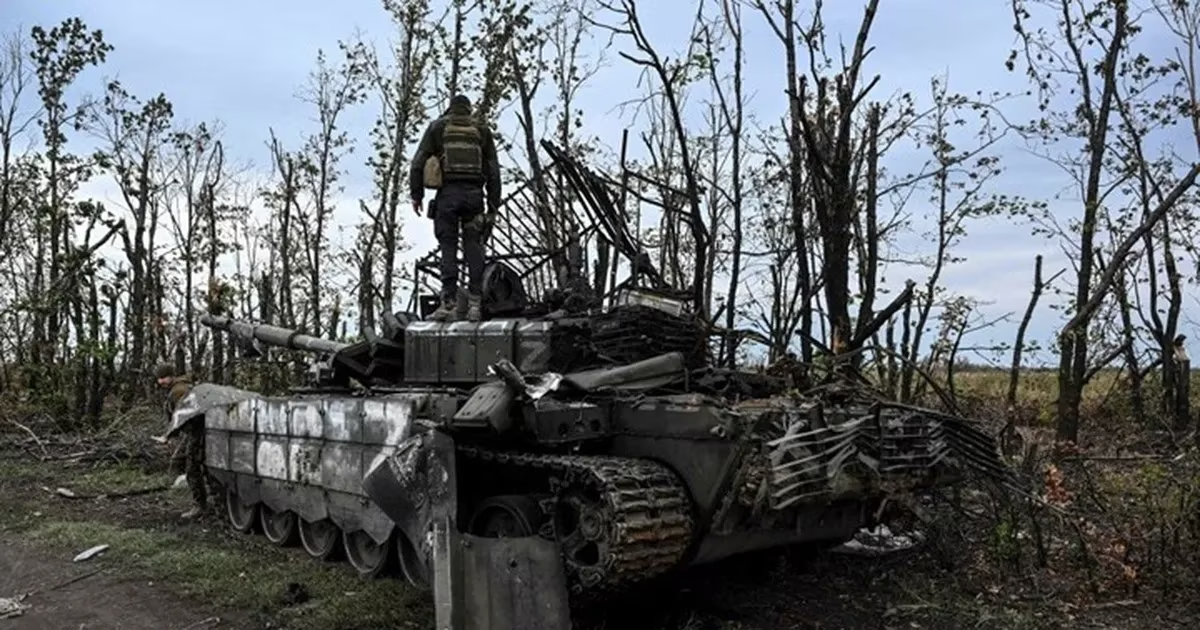
In the Ukrainian scene, Kyiv did not collapse despite significant diplomatic pressure and the cutting of military aid at certain stages. Instead, Ukrainian forces were able to turn the tide of the war and inflict painful blows deep into Russia, benefiting from qualitative technological superiority.

Drones and low-cost precision missiles have contributed to narrowing the gap between large regular armies and smaller forces. Diplomatic sources confirmed that this technological development has significantly limited what mere military power can achieve on battlefields.

China is closely monitoring these transformations as it considers its options regarding Taiwan, as Beijing realizes that a military invasion is no longer an easy stroll. The question arises whether military power alone can achieve long-term political goals in the face of popular resistance.

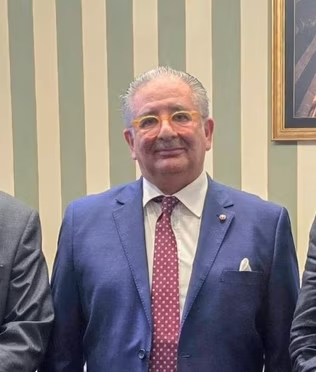
Italian Defense Minister Guido Crosetto affirmed that the model of traditional invasion and occupation wars is a thing of the past and no longer applicable. He stressed that the will of the people to fight makes it difficult for any superpower to achieve a quick and lasting victory.

The Palestinian example stands out as additional evidence for this theory, as Israel has achieved little success against resistance factions in the Gaza Strip despite the enormous disparity in capabilities. This field failure reinforces the conviction that changing regimes by military force alone has become an elusive goal.

Military leaders in Europe have acknowledged that swift attacks aimed at regime change often lead to an impenetrable dead end. Experts believe that failure to achieve military decisive action within the first weeks of a conflict means sinking into a long war of attrition.

Historically, Washington and Moscow faced defeats in Vietnam and Afghanistan due to long-running insurgencies that drained popular support. But the difference today lies in the armies' inability to achieve even initial military victories, as happened with Russian tanks near Kyiv.

The revolution in drones and precision missile arsenals has eroded the enormous advantage that superpowers once enjoyed in reconnaissance and air power. It has become impossible to imagine traditional armored attacks achieving their objectives without incurring unbearable human and material losses.

Middle powers, such as Canada and European countries, are seeking to strengthen their military and economic alliances to reduce dependence on the American and Chinese poles. Analysts believe that the unity of these powers gives them the ability to resist the dictates of superpowers and impose independent international decisions.

The most important lesson from modern conflicts is that the will of the people and innovative technology have redefined the concept of power. The world is no longer an open arena for only the powerful, but has become a place where small nations possess effective tools to defend their sovereignty.

The type of war we were accustomed to, and the type of war Russia was planning in Ukraine - an invasion and occupation of a country - is no longer conceivable in the contemporary world.

PALESTINE

Thu 11 Jun 2026 8:50 pm - Jerusalem Time

Sharp escalation between Ankara and Tel Aviv: Erdogan warns of national security threat, Trump rules out confrontation

Diplomatic relations between Ankara and Tel Aviv have entered a new tunnel of political and media escalation, following a sharp exchange of statements between Turkish President Recep Tayyip Erdogan and Israeli Prime Minister Benjamin Netanyahu. These developments come amidst the widening regional conflict and increasing fears of the repercussions of ongoing wars on regional stability.

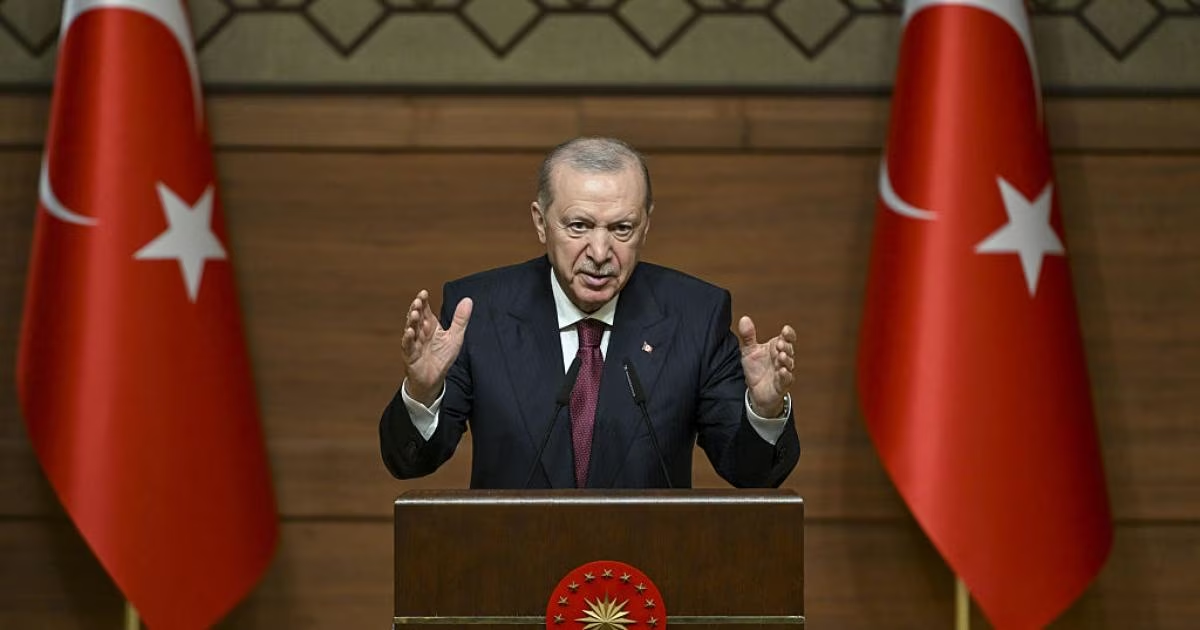
In a televised speech, the Turkish President launched a scathing attack on Netanyahu, describing him as the 'butcher of Gaza' and accusing the Israeli government of committing genocide against the Palestinian people. Erdogan likened the international silence regarding what is happening in the Strip to the silence that accompanied Nazi crimes during the era of Adolf Hitler.

Erdogan did not stop at criticizing military operations in Gaza, but directly linked Israeli actions to Turkish national security. He indicated that the military repercussions extending to Syria and Lebanon represent a threat that Turkey cannot overlook or ignore its future effects on its borders.

The Turkish President clarified that his country is closely monitoring Israeli objectives and what is known as the 'Promised Land' project, considering these ambitions to affect Turkish sovereignty. He affirmed in his speech that Ankara will take all necessary measures to prevent the achievement of any goals that undermine the stability of the Turkish state or its regional security.

For his part, Israeli Prime Minister Benjamin Netanyahu responded to these accusations by describing Erdogan's statements as indicative of 'anti-Semitism'. Netanyahu stressed that Tel Aviv will not back down from its military operations targeting what he described as 'Iran and its proxies' in the region, considering them the real danger.

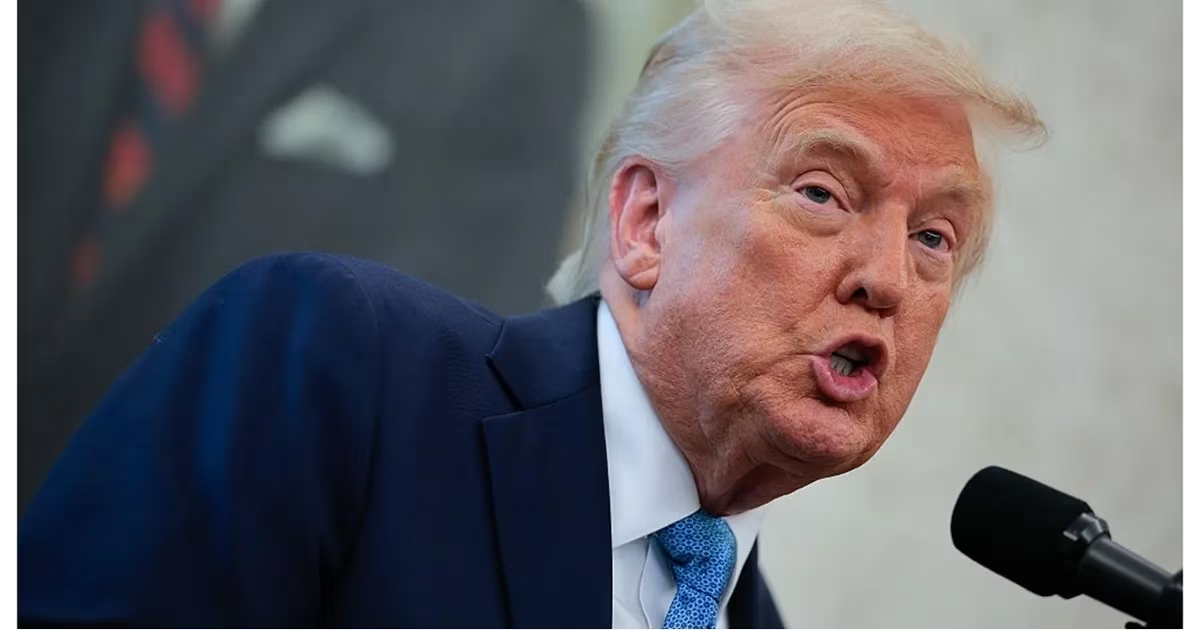
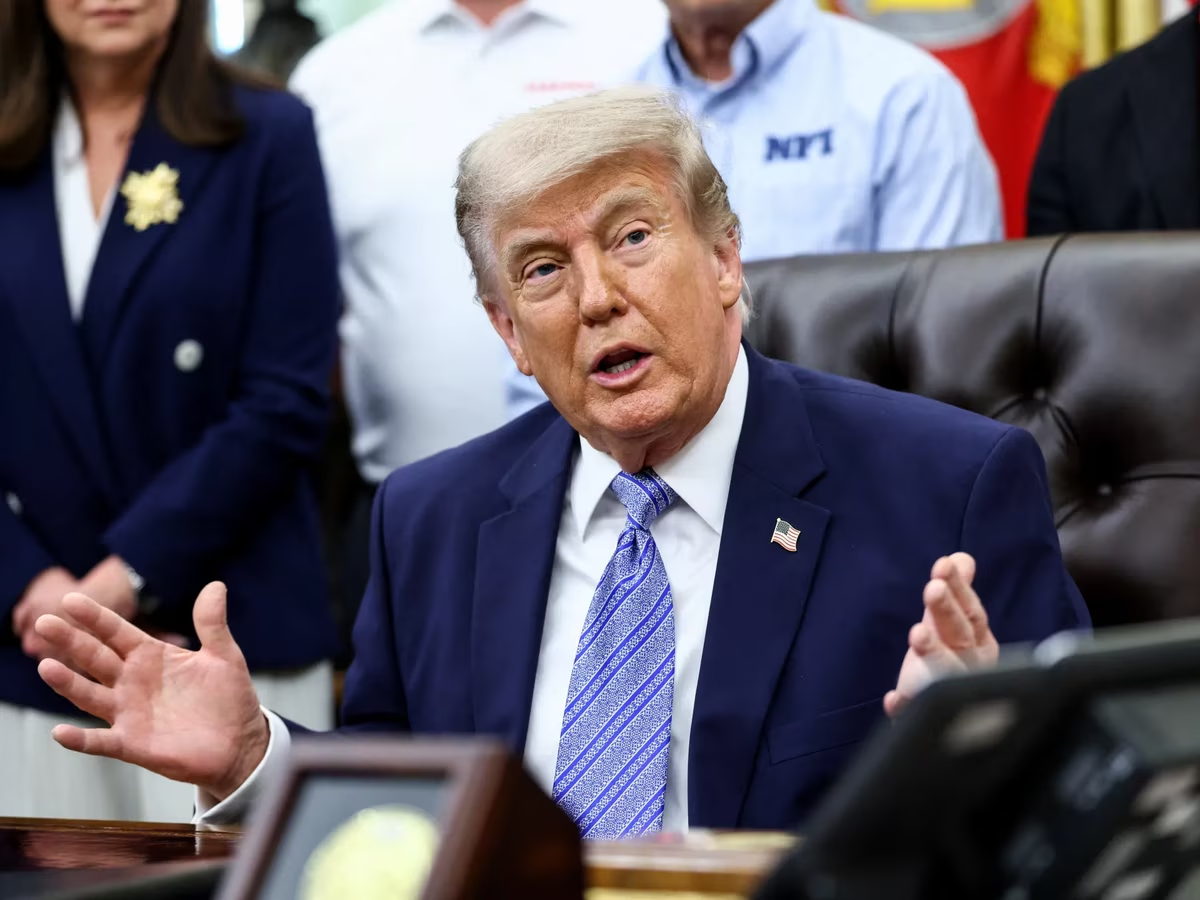
Amidst this escalating tension, a remarkable comment emerged from US President Donald Trump, who completely ruled out the possibility of this dispute turning into a direct military confrontation. Trump indicated during statements from the White House that diplomatic channels and personal ties play a crucial role in curbing escalation.

Trump described the Turkish President as a 'close friend and strong leader', emphasizing that his close relationship with Erdogan contributes to a better understanding of the Turkish position. The US President considered that direct communication between active parties reduces the chances of sliding into an open conflict that no one desires.

These tug-of-war reflect an unprecedented level of tension in contentious issues ranging from the Gaza Strip to the Syrian and Lebanese files. Observers believe that the Turkish discourse has become more stringent in linking the Palestinian issue to the strategic security of the Turkish state, which puts relations with Tel Aviv in jeopardy.

In conclusion, the international stance remains divided on this escalation, with Washington trying to balance its relations with its two allies in the region. With the continuation of Israeli military operations, the prospects for diplomatic de-escalation between Ankara and Tel Aviv remain slim in the foreseeable future, awaiting new field or political shifts.

The attacks launched by Israel in the region have reached a stage that directly affects Turkish security.

PALESTINE

Thu 11 Jun 2026 4:56 pm - Jerusalem Time

Hamas attacks security coordination and accuses the Authority of 'role-playing' with the occupation in the West Bank

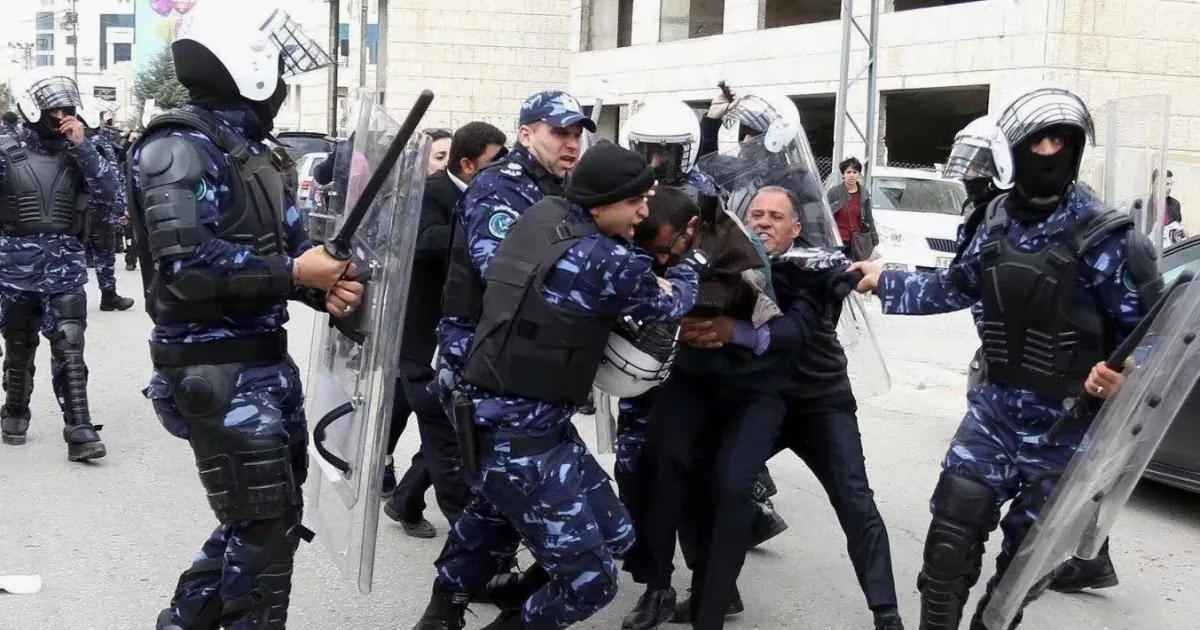
The Islamic Resistance Movement (Hamas) directed sharp criticism at the performance of the Palestinian Authority's security forces in the West Bank, describing the continued pursuit of resistance fighters as a state of alignment and role-playing with the Israeli occupation. The movement affirmed in a press statement issued today, Thursday, that this approach aims to undermine resistance work at a time when Israeli aggression against Palestinian cities and towns has escalated.

The movement clarified that the repeated incidents of occupation forces arresting wanted Palestinians immediately after their release from PA prisons prove the existence of direct and nationally rejected security coordination. Hamas considered these practices to be reprehensible behavior that undermines the sacrifices of the Palestinian people, especially in light of the continuous attacks launched by settlers and Israeli army forces in various governorates of the West Bank.

Hamas stressed that what it described as the 'farce of security coordination' must stop immediately, calling on the Authority's leadership to side with the Palestinian street and protect resistance fighters instead of pursuing them. The movement believed that the continuation of political arrests amidst the genocide and ethnic cleansing faced by Palestinians constitutes a stain that requires a firm national stance from all forces and political currents.

In a field monitoring of these violations, local sources reported that the occupation forces arrested the released prisoner Musab Qawzah just two days after his release from Palestinian Authority prisons. It is worth noting that Qawzah had gained his freedom as part of the 'Al-Aqsa Flood' deal, but the Palestinian security services arrested him for a short period before he fell into the hands of the occupation again.

The sources also pointed to another incident that occurred in the town of Saida, north of Tulkarm, where occupation forces stormed the home of young man Sarra Raddad and arrested him a few hours after his release from PA prisons on March 25. These incidents reinforce the accusations of national forces that there is a 'revolving door' between Palestinian and Israeli prisons targeting active field cadres.

Hamas concluded its statement by calling on Palestinian forces and factions to adopt a comprehensive national strategy that rejects security coordination and pressures the security services to change their doctrine. It stressed the need for the immediate release of all political prisoners and the provision of protection for the resistance, which faces existential challenges amidst settlement expansion and daily aggressions.

The occupation's arrest of wanted individuals immediately after their release from PA prisons reflects direct coordination and behavior that contradicts the aspirations of our people.

PALESTINE

Thu 11 Jun 2026 4:55 pm - Jerusalem Time

'National Park' plan threatens Al-Bustan neighborhood: Occupation escalates demolition operations in Silwan

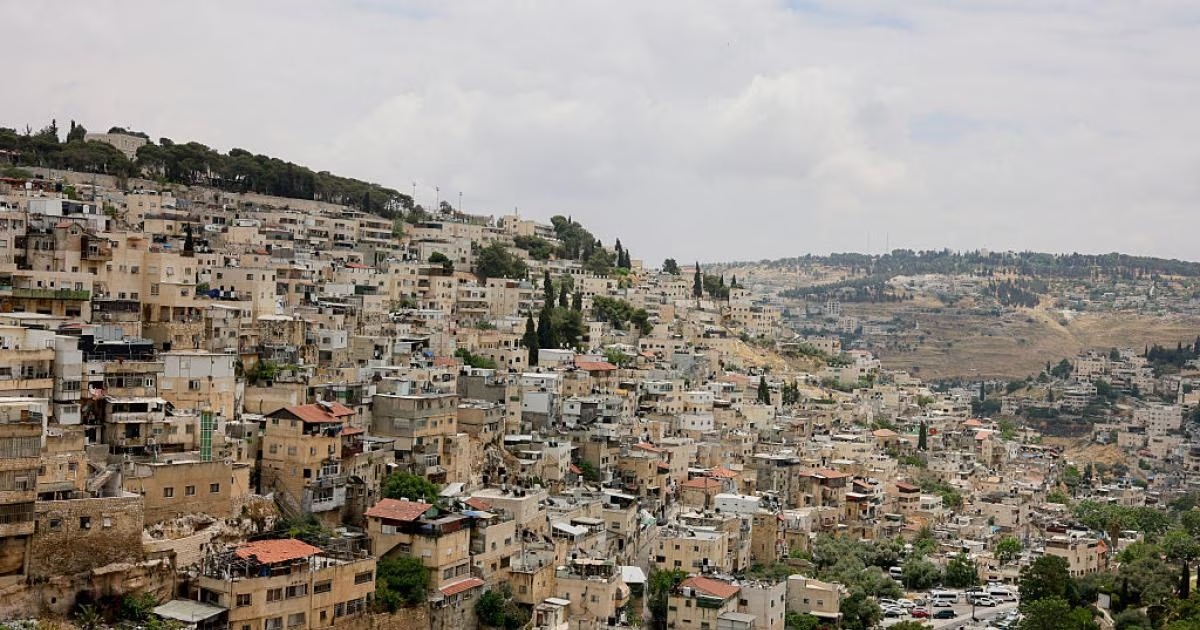
The residents of Al-Bustan neighborhood in Silwan, occupied Jerusalem, are experiencing escalating anxiety and fears amidst a fierce campaign launched by the occupation authorities to demolish homes and displace residents. These measures are being implemented as part of an Israeli plan aimed at erasing the neighborhood from the map to establish a so-called 'national park' that serves settlement projects in the area surrounding Al-Aqsa Mosque.

Hajj Al-Abbasi, one of those affected by this policy, recounted how the occupation municipality's bulldozers turned his home into rubble within a few hours, without regard for the years of life and memories he spent within its walls. He explained that demolitions occur suddenly and under heavy guard, depriving families of the opportunity to save their belongings or find alternative shelter.

In a scene reflecting the harsh reality, the young man Mujahid was forced to demolish his home with his own hands after living in it for seven years, to avoid exorbitant fines and protect his family's home on the lower floor. Many Jerusalemite families resort to this bitter option to avoid structural damage that might affect the rest of the building if the occupation mechanisms carry out the demolition.

For his part, Hajj Ahmed, who is over seventy years old, expressed the tragedy of the continuous threat of demolition, describing the loss of a home as more bitter than death. He pointed out that starting from scratch at this advanced age represents an impossible challenge, especially in light of the continuous restrictions imposed by the occupation on the Palestinian presence in the Holy City.

Mohammad Dahleh, a lawyer specializing in Jerusalem affairs, affirmed that what is happening in Al-Bustan neighborhood is a practical application of the forced displacement policy pursued by the occupation authorities and their affiliated Jerusalem municipality. He clarified that these measures are not merely regulatory decisions, but a declared policy aimed at changing the demographic and geographic reality in the heart of Jerusalem.

Field data indicate a significant decline in the number of existing buildings in the neighborhood, with human rights sources documenting the demolition of about 59 structures recently, the vast majority of which were inhabited residential homes. The remaining homes in the neighborhood face similar demolition orders, leaving hundreds of citizens facing an unknown future in the absence of international protection.

The residents of Al-Bustan neighborhood emphasize their steadfastness on their land and in their homes despite all pressures, asserting that the 'National Park' project is merely a cover for expanding settlements at the expense of the Arab presence. Popular and legal activities continue in an attempt to obstruct these plans that threaten to liquidate one of the oldest neighborhoods in occupied Jerusalem.

Demolishing a home is harder than death, because its owner finds himself forced to rebuild his life anew at the age of seventy.

ARAB AND WORLD

Thu 11 Jun 2026 12:52 pm - Jerusalem Time

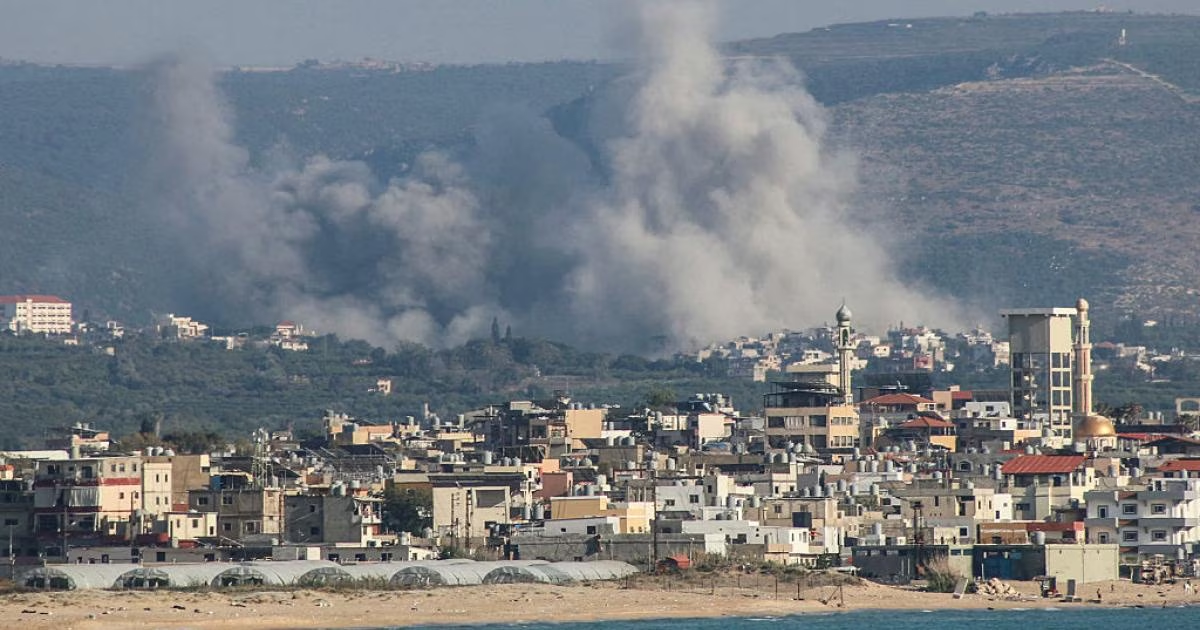
Violent Israeli escalation in southern Lebanon: Intense raids and attempts of ground infiltration towards Majdal Zoun

The western sector of southern Lebanon was subjected to a series of intense aerial raids and artillery shelling, in a wave of escalation described as the most violent in months. Field sources reported that the Israeli army intensified its strikes on border villages, using warplanes and drones to simultaneously hit multiple targets.

Military operations focused mainly on the town of Majdal Zoun and its surrounding hills, where Israeli fighters launched more than 12 airstrikes targeting residential neighborhoods and open areas. These attacks come amid escalating tension witnessed in the area opposite the towns of Shama and Al-Bayada, leading to a state of panic among local residents.

Field reports indicated attempts of ground advance by Israeli forces towards the town of Majdal Zoun under heavy fire cover, which is the first development of its kind since the ceasefire agreement last April. Movements of military vehicles were recorded from the directions of Wadi Hassan and Tyre Harfa, in an attempt to infiltrate the neighborhoods of the border town.

The shelling was not limited to Majdal Zoun but extended to include the town of Mansouri and neighboring villages up to the Zibqin area, where artillery shelling continued for long hours. Sources explained that the pace of raids witnessed a slight decrease this morning, but reconnaissance planes are still flying heavily in Lebanese airspace.

In another field development, the targeting circle extended to include areas in Western Bekaa, Jezzine district, and Nabatieh, amid news of suspicious military movements north of the Litani River. Unconfirmed reports spoke of Israeli vehicles advancing towards Kafrtibnit from the towns of Yahmar Al-Shaqif, Arnoun, and Eastern and Western Zawtar.

News platforms circulated videos showing the movement of military vehicles towards the Nabatieh Al-Fawqa area and the strategic Ali Al-Taher site. This site is considered a militarily commanding point as it directly overlooks the city of Nabatieh and its surroundings, raising fears of an expansion of ground confrontations.

In the Jezzine area, official sources reported that Israeli artillery targeted the outskirts of Al-Qatrani town near Shbeil school, coinciding with four airstrikes on the same location. A drone also targeted Al-Shahabiya town in the Tyre district, causing severe material damage to properties near the Health Authority center.

On the humanitarian front, the Lebanese Ministry of Health announced a heavy toll from the Israeli raids, with 9 citizens martyred, including a woman, and 10 others injured in the town of Tyre Diba. A raid targeting the city of Sidon also resulted in the martyrdom of 3 people and the injury of another, while rescue operations continue to remove the rubble.

In the town of Haris, two paramedics belonging to the Al-Risala Health Ambulance Association were injured due to a raid that targeted the area while they were performing their humanitarian duty. Shelling also hit a house in the Maqasid neighborhood of Nabatieh city this morning, causing a large fire that consumed the house and several parked cars in the area.

This military escalation comes at a sensitive time, as observers believe that these field movements may undermine the fragile existing understandings. Field sources continue to monitor ground movements on the border, amid full alert of relief and medical agencies in various governorates of southern Lebanon to deal with the repercussions of the ongoing aggression.

The escalation was clearly manifested in the western sector, which experienced one of the most violent days since the beginning of the war, with an unprecedented level of shelling.

PALESTINE

Thu 11 Jun 2026 10:10 am - Jerusalem Time

Warnings of deteriorating health of Kamal Adwan Hospital director in solitary confinement

Nasser Odeh, the lawyer for Dr. Hussam Abu Safiya, director of Kamal Adwan Hospital, revealed a serious deterioration in the health and humanitarian conditions of his client inside Israeli occupation prisons. Odeh explained that the Israeli authorities recently transferred Dr. Abu Safiya to solitary confinement in 'Nafha' prison, which led to a complete قطع of his communication with lawyers, human rights organizations, or even his fellow prisoners.

Legal sources reported that Abu Safiya's transfer from Naqab Prison to solitary confinement came directly after an appeal was filed with the Israeli Supreme Court to consider the legality of his detention. The lawyer pointed out that his client has not undergone any medical examination since his transfer, despite his known suffering from chronic diseases that require intensive care and daily and regular medication to ensure the stability of his condition.

Regarding the health situation, the defense confirmed that the detained doctor repeatedly requested the prison administration to enable him to obtain his necessary medications and undergo urgent medical examinations, but these requests were met with continuous refusal. This critical medical file was presented to the Supreme Court during the appeal session, to warn of the serious consequences of neglecting his health condition related to heart problems and high blood pressure.

On the legal front, the defense team stressed the need for the immediate and unconditional release of Dr. Abu Safiya, based on the fact that he was arrested while performing his humanitarian and professional duty as the director of a medical facility. The lawyer confirmed that medical teams enjoy special protection under international humanitarian law and the Geneva Conventions, which prohibit targeting or arresting medical personnel during armed conflicts.

Odeh pointed out that Dr. Abu Safiya has been in detention for about a year and a half without any official indictment or clear and specific charges being brought against him. The Israeli security services claim the existence of 'secret materials' indicating that he poses a security threat, a pretext used to extend his detention without providing public evidence that would allow the defense to refute it in court.

The last court session ended without a final decision, as the defense team awaits a judicial decision regarding the continuation of detention in the coming days. The lawyer conveyed a message from the imprisoned doctor confirming his adherence to his professional identity as a pediatrician who dedicated his life to treating patients, considering what he is subjected to as arbitrary detention aimed at preventing him from returning to his family and hospital in the northern Gaza Strip.

It is worth noting that the occupation forces arrested Hussam Abu Safiya on December 27, 2024, during a widespread raid that targeted Kamal Adwan Hospital. Demands from UN and international human rights organizations are increasing for urgent intervention to ensure the doctor's safety and provide him with the necessary treatment, in light of reports confirming a worrying deterioration in his health condition in solitary confinement.

Abu Safiya is a pediatrician who performed humanitarian work, and his arbitrary detention deprives him of returning to his environment and work in treating patients.

ARAB AND WORLD

Thu 11 Jun 2026 10:09 am - Jerusalem Time

International Analysis: Iran Imposes a 'Historical Trap' on Trump, Reviving the Ghost of the Carter Era

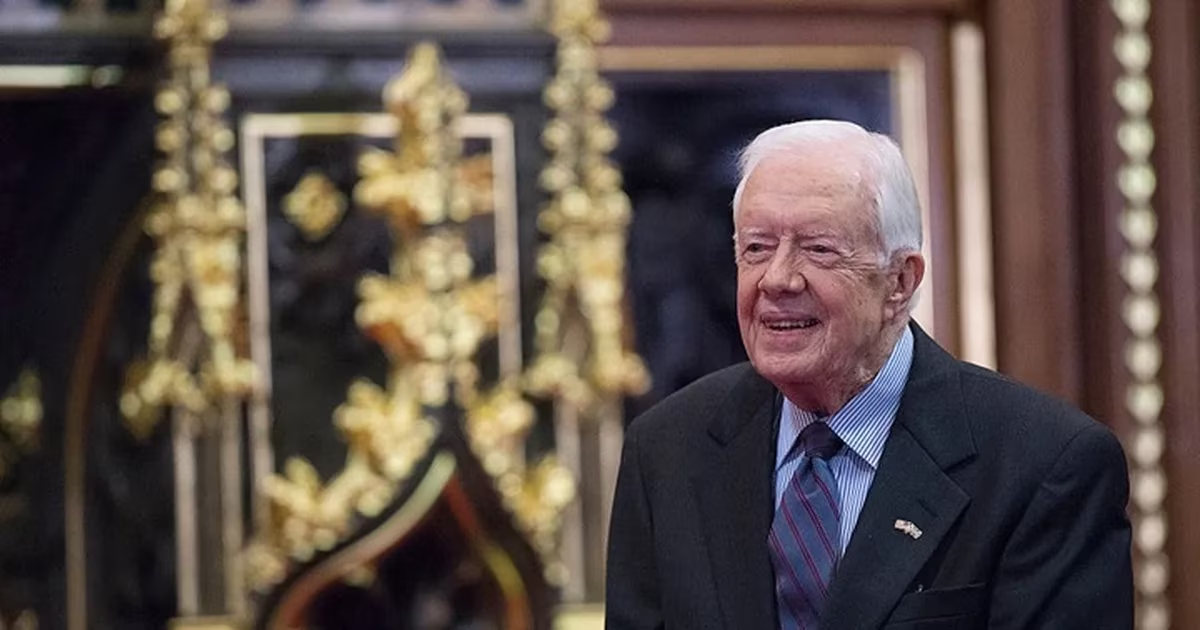
International analytical readings suggest that US President Donald Trump is now facing a political predicament reminiscent of the era experienced by the 39th President of the United States, Jimmy Carter. Reports indicate that Tehran has successfully seized control of the war narrative, forcing the current US administration to operate within parameters set by Iranian field and political developments.

Despite the vast difference in personality and style between Trump and Carter, with the latter known for being frugal and serving the citizen, Iran has become the common denominator threatening their political futures. Just as the hostage crisis hijacked Carter's presidency and led to a political catastrophe from which he did not recover, Trump now finds himself in a trap of 'epic anger' that he entered dismissively.

Sources indicate that concern over human casualties represents a shared weakness between the two presidents, as both dislike seeing the coffins of American soldiers return home. The loss of eight soldiers in a failed rescue attempt left a deep impression on Carter's psyche, while Trump today faces increasing pressure after the killing of 13 soldiers in the Gulf region.

The White House is currently concerned about an angry popular backlash should the pace of casualties among US forces escalate. This fear gives the Iranian side greater ability to maneuver and impose conditions, exploiting the American public's sensitivity to involvement in long-term or humanly costly military conflicts.

Looking back at history, analysts recall that the Carter administration's inability to resolve the hostage crisis signaled weakness that encouraged the Soviet Union to invade Afghanistan. That invasion came just weeks after the storming of the US Embassy in Tehran, which shifted the international balance of power in that sensitive historical era.

Reports reveal that high-level diplomatic interventions, including the role of Pope John Paul II and National Security Advisor Zbigniew Brzezinski, prevented the Soviets from invading Poland at that time. Nevertheless, the failure to contain the Iranian file remains the defining mark that led to the erosion of American prestige in the late 1970s.

In the current scene, it appears that Trump has become a hostage in the heart of the complex 'Middle East labyrinth,' where regional issues are intertwined in a way that makes them difficult to separate. The matter is no longer limited to direct confrontation but has extended to include Iranian influence in neighboring countries and its impact on energy security and shipping lanes.

Tehran today imposes harsh conditions for sitting at the negotiating table, foremost among them a comprehensive and complete ceasefire in Lebanon. This demand puts the US administration in a critical position before its allies, especially with the continued Israeli military operations targeting various sites in Lebanese territory.

Sources indicate that whenever Israel launches new attacks on Hezbollah targets or deep within Lebanon, Iran's conditions for reaching any agreement become more complex. This mutual escalation makes Trump a party trying to catch up with events rather than create them, which reinforces the hypothesis of dependence on the Iranian path.

Ultimately, the American president finds himself facing choices, the least bitter of which is still bitter: either accepting Iranian conditions, which may seem like a concession, or risking further military escalation. The comparison with the Carter era remains a warning that external crises, particularly with Iran, are capable of undermining the foundations of the strongest American presidencies.

Trump has become a hostage to Iran's mindset, which insists on a complete ceasefire in Lebanon as a prerequisite for any negotiations.

PALESTINE

Thu 11 Jun 2026 10:09 am - Jerusalem Time

Warnings of a 'chickenpox' outbreak in Gaza displacement camps amid health system collapse

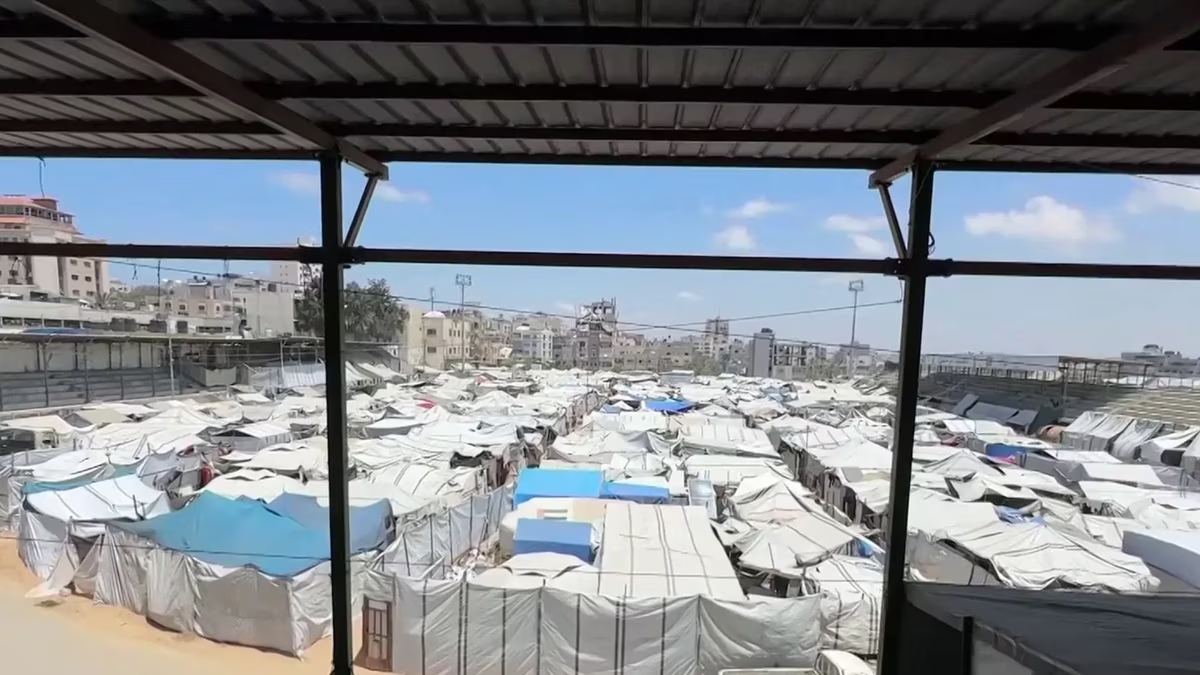
Shelters and canvas tents in the Gaza Strip are facing catastrophic health challenges as they become fertile ground for the growth of viruses and infectious skin diseases. With the sharp rise in temperatures, these overcrowded places lack the most basic proper ventilation, threatening an imminent epidemic outbreak, led by chickenpox, which has already begun to appear among the displaced.

Field sources in Deir al-Balah reported that the tents have turned into hot ovens during daylight hours, while residents suffer from a complete lack of clean water for bathing or drinking. Displaced families have observed unknown red blisters appearing on their children's bodies, causing panic among parents who lack any means of isolation or treatment.

Overcrowding is the most prominent factor exacerbating the health crisis, as entire families are forced to live in very confined spaces, making social distancing impossible. The complete absence of sanitation services and the accumulation of solid waste around the tents directly contribute to accelerating the rate of infection transmission among the most vulnerable groups.

For his part, the Director-General of the Ministry of Health in Gaza, Munir al-Barsh, confirmed that the health scene is witnessing a dangerous escalation in the spread of epidemics due to harsh living conditions. Al-Barsh explained in statements to media sources that the reduction of available space for residents after the occupation's control over about 70% of the Strip's area has created an unprecedented population density globally, making disease control a complex matter.

The medical system in the Strip suffers from a near-complete paralysis after the majority of hospitals and health centers went out of service due to direct targeting and fuel shortages. Medical staff complain of a severe shortage of essential medicines, antiviral drugs, and soothing preparations for itching, leaving those infected without medical care to alleviate their pain or prevent their condition from deteriorating.

Doctors warned that chickenpox infection in children, pregnant women, and those with weakened immunity under these conditions could lead to fatal complications. In the absence of cleaning materials and disinfectants, displaced persons find themselves unable to maintain personal hygiene, threatening a health catastrophe that could get out of control if the siege and closure of crossings continue.

The confined space where people live with unprecedented population density accelerates the spread of infection and the emergence of diseases.

PALESTINE

Thu 11 Jun 2026 10:09 am - Jerusalem Time

The family of Dr. Hussam Abu Safiya reveals details of his health condition after his first appearance in a year

Elias, the son of the imprisoned Palestinian doctor Hussam Abu Safiya, stated that the leaked photo of his father during his court session on Wednesday revealed a tragic reality he is living inside the occupation prisons. Elias explained that his father's features showed clear signs of torture on his face, in addition to a widespread skin disease that reached his hands, considering these scenes to be conclusive evidence of the violations prisoners are subjected to.

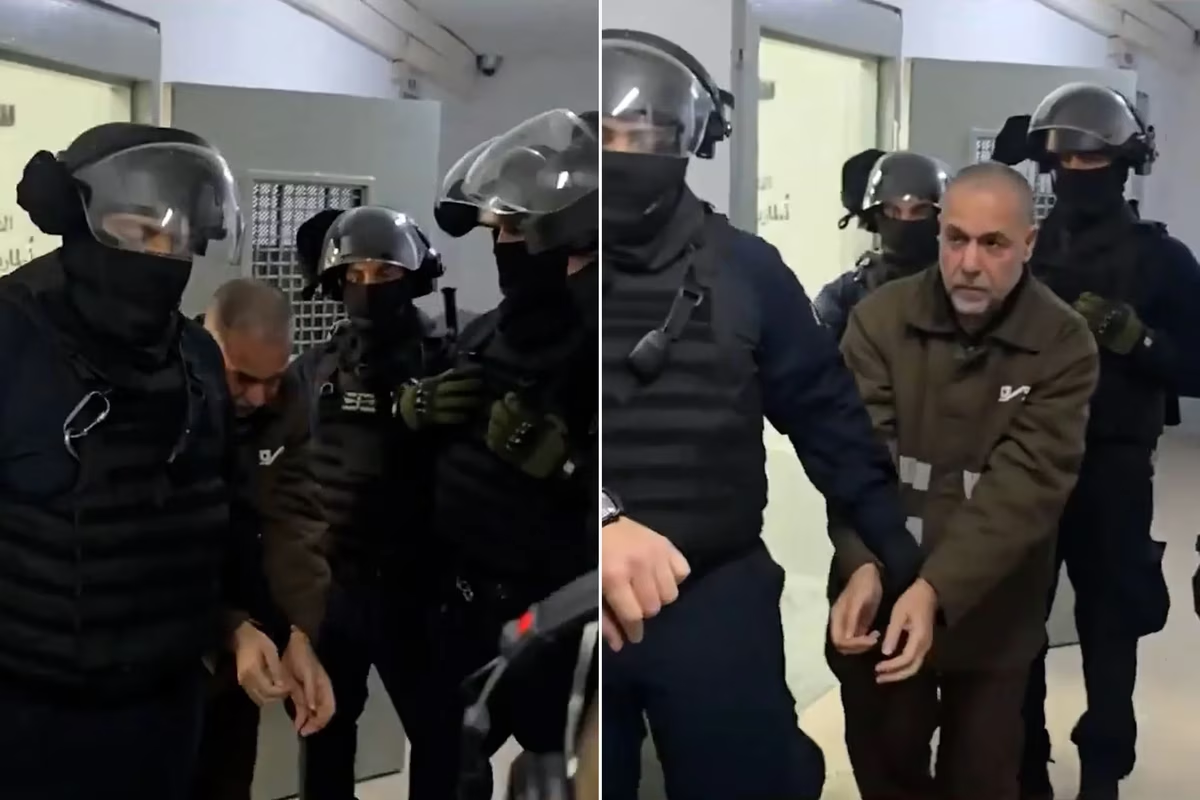
The occupied city of Jerusalem witnessed the first session for Dr. Abu Safiya since news of him was cut off for more than a full year, as he appeared before the court via video conference from inside his cell. The doctor appeared in a difficult health condition, handcuffed, in a scene that caused widespread indignation among his family and those following his case, who affirmed that the occupation deliberately conceals the true condition of prisoners behind bars.

During the session, Dr. Abu Safiya sent a direct message demanding an end to his suffering and his immediate release, describing the measures taken against him as an unjust and arbitrary arrest that lacks any legal basis. Defense lawyer Nasser Abu Odeh conveyed his client's insistence on his innocence and the necessity for human rights organizations to intervene to stop the excesses practiced against him and against detained medical personnel.

For his part, lawyer Abu Odeh indicated in statements following the session that the court did not make a final decision regarding the doctor's legal status, as it decided to postpone ruling on the continuation of his detention for a short period that may extend for a few hours or days. The family and medical circles are awaiting this decision cautiously, amid serious fears for his life as a result of deliberate medical negligence and the apparent effects of torture.

My arrest is unjust and arbitrary, and I demand my immediate release.

PALESTINE

Thu 11 Jun 2026 10:09 am - Jerusalem Time

While the world awaits the World Cup... Gaza's athletes struggle to survive amidst the ruins of their stadiums

The world's attention is focused on the World Cup stadiums preparing to welcome fans and stars, while the brilliance of football talents in the Gaza Strip is fading due to the ongoing war that has destroyed sports infrastructure. Mahmoud Salmi, one of the most prominent talents who was expected to have a promising future, now finds himself trapped within tent walls, after losing his career and his only source of income, living the harsh suffering of displacement far from the green field.

Stadium stands in Gaza no longer echo with the cheers of fans; instead, they have become shelters for thousands of displaced families who found no place other than sports fields to pitch their tents. Sources reported that major stadiums, including 'Al-Durra' stadium, have been transformed from sports facilities into overcrowded shelters for displaced people, making any sports activity impossible amidst the destruction that has affected most facilities.

For his part, sports journalist Alian Al-Zaytoun confirmed that the sports scene in the Strip has become almost non-existent after nearly three years of continuous military escalation. He pointed out that athletes cannot find a single place to practice their training, as major stadiums have been bombed, and only some small five-a-side pitches remain, which have also been damaged, leading to a complete paralysis of local sports activity.

Human losses in the sports community have been devastating, with the Palestinian Football Association announcing the martyrdom of 1007 athletes since the outbreak of the war, including 45 female sports cadres and players. These shocking figures reflect the extent of targeting that the sports system has endured, in addition to the destruction of hundreds of facilities and clubs that served as incubators for youth and talented individuals in various sports.

And the repercussions of the war did not stop at professionals but extended to children who were deprived of their most basic rights to play and practice sports in safe spaces. Public squares and school playgrounds have turned into rubble or crowded shelters, leading to the absence of a nurturing environment for the younger generation, at a time when the world is busy preparing for the biggest international football wedding, far from the tragedy of Gaza.

As athletes, we have completely lost our livelihoods, and our suffering as displaced people cannot be described after stadiums have turned into shelters.

ARAB AND WORLD

Thu 11 Jun 2026 10:09 am - Jerusalem Time

Trump threatens widespread military strikes against Iran in response to targeting of American helicopter

US President Donald Trump issued strong threats against Tehran, confirming that the United States would launch powerful military strikes against the Iranian side in the coming hours. This escalation came in response to an attack targeting a US Army Apache helicopter, with Trump emphasizing that Iran would pay a heavy price for targeting American interests and military mechanisms in the region.

Trump clarified in his statements that the current US administration is actively seeking to prevent the Iranian regime from acquiring any nuclear weapons, accusing the leadership in Tehran of pursuing a policy of procrastination in ongoing negotiations. He indicated that Washington was close to reaching a new agreement which he described as 'good and meaningful,' but the Iranian side continues to exploit time and persist in attempts to deceive the international community and the United States.

In the context of reviewing military options, the US President revealed that the armed forces had successfully targeted radar systems inside Iranian territory last night and on previous occasions. Trump strongly criticized the 2015 nuclear deal, considering that it paved the way for Tehran to possess a nuclear bomb, while the current American move aims to permanently close all avenues for Iranian nuclear ambitions.

These developments come at a time when reports indicate that Iran is setting preconditions for negotiations, including a complete ceasefire in Lebanon, which complicates the diplomatic path between the two parties. The Trump administration faces increasing internal pressure with 13 American soldiers lost in the Gulf region so far, amidst comparisons made by political circles between Trump's handling of the current crisis and former President Jimmy Carter's failure to manage the 1979 hostage crisis.

Observers believe that Trump fears popular and political repercussions if more American forces are killed, which could affect his political future as happened with Carter previously. Nevertheless, the White House appears determined to restore deterrence through direct military operations, amid the dominance of escalatory rhetoric in the general scene and Iran's determination of US foreign policy in the current phase.

We will strike Iran hard again today, and it should have signed the agreement Washington is working on because it is meaningful.

PALESTINE

Thu 11 Jun 2026 10:08 am - Jerusalem Time

Occupation admits to aircraft hangar hit at 'Ramat David' base by Iranian missile

The Israeli occupation authorities admitted today that one of its vital military facilities in northern occupied Palestine sustained direct damage. Media sources stated that military censorship allowed the publication of details regarding an aircraft hangar being hit inside the 'Ramat David' airbase, as a result of an Iranian missile strike during the recent wave of bombardment that targeted Israeli depth.

Ramat David base is considered one of the strategic airbases for the occupation, housing advanced squadrons of American-made 'F-35' fighters. The occupation army had imposed a strict blackout on the results of the Iranian missile attacks for weeks, before being forced to acknowledge precise hits on the infrastructure of the important airbase.

For its part, the Iranian Revolutionary Guard had previously confirmed its direct targeting of this base, indicating that it was among the target bank of the missile operation. The delayed Israeli admission confirmed the accuracy of the Iranian narrative regarding the hitting of specific military targets in the north, despite the media disinformation attempts practiced by the occupation immediately after the attack.

In a related context, media reports revealed that the Revolutionary Guard relied on precise coordinates provided by the resistance in Lebanon to identify its targets. Sources explained that Hezbollah supplied the Iranian side with excellent intelligence data collected through advanced aerial reconnaissance operations carried out by 'Hudhud' drones over secret Israeli facilities.

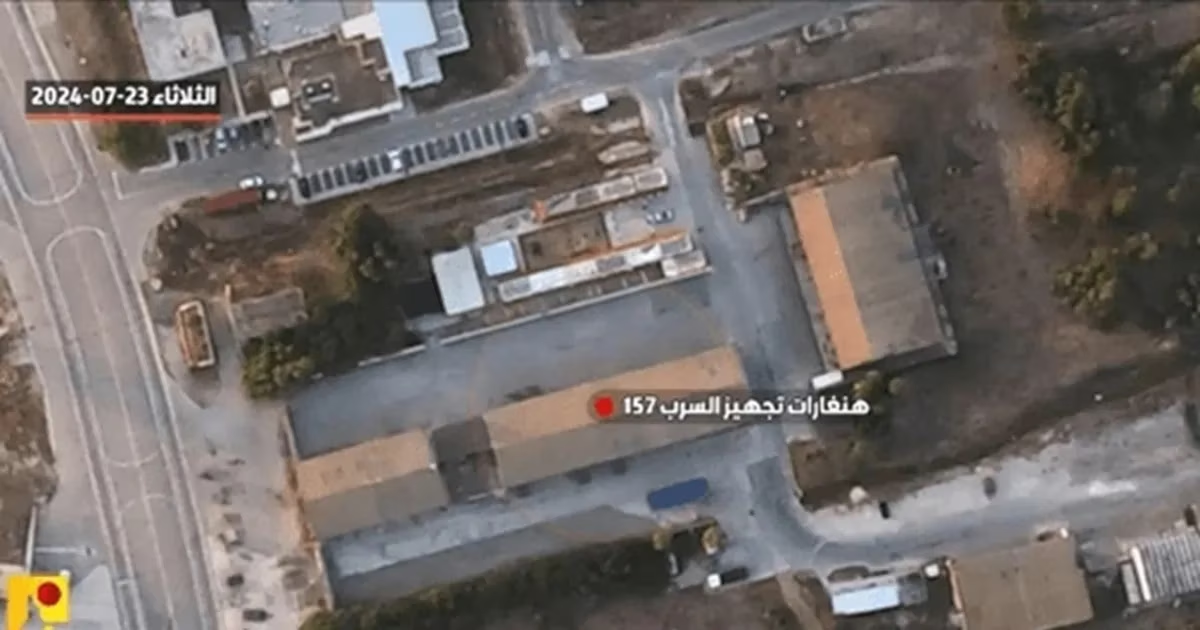
Hezbollah had previously published videos in early 2024 taken by a 'Hudhud' drone showing precise details of the Ramat David base from within. These shots included accurate monitoring of runways, aircraft hangars, and logistical facilities, which enabled the missile force to identify weaknesses and target them with extreme precision during the direct confrontation.

According to the technical information revealed, the Iranian missile hit a facility belonging to Squadron '157', which is permanently stationed at the base. The targeted location was precisely identified as a hangar designated for the technical and logistical equipment of this squadron, reflecting a development in missile guidance capabilities and intelligence cooperation among the parties of the axis of resistance.

This admission raises widespread questions within Israeli circles about the effectiveness of air defense systems in protecting the most fortified airbases. It also highlights the failure to prevent reconnaissance aircraft from photographing sensitive sites, which ultimately facilitated the arrival of Iranian missiles to their precisely drawn targets.

Military censorship allowed the disclosure of an aircraft hangar being hit inside the Ramat David airbase by an Iranian missile in the recent bombardment.

PALESTINE

Thu 11 Jun 2026 10:08 am - Jerusalem Time

Colombian President attacks Israel from the UN Security Council podium, likening its practices to Nazism

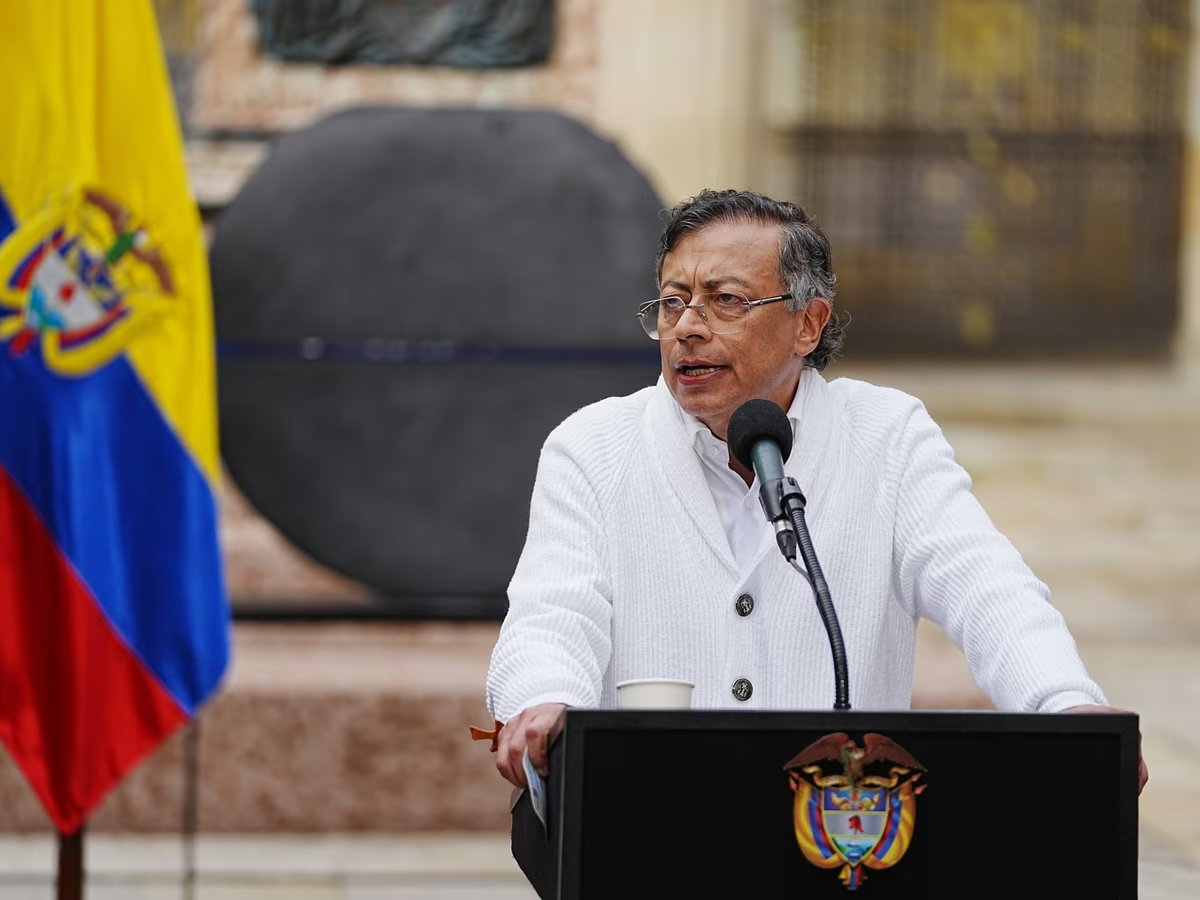
Colombian President Gustavo Petro launched a scathing attack on Israeli authorities during a speech at the UN Security Council, where he likened their military practices in the Gaza Strip to the crimes of the 'Nazi regime'. Petro affirmed that the world is witnessing a war of genocide that cannot be overlooked or have its casualty figures hidden under any political or economic pretext.

In his speech, the Colombian President clarified that tens of thousands of Palestinians have fallen victim to the Israeli war machine, which has spared neither children nor civilians, noting that intense rocket shelling has affected all aspects of life in the Strip. He considered what is happening in Gaza to be a common denominator with the atrocities committed during the Nazi era, which necessitates a firm international stance.

In response, Israeli circles quickly condemned these statements, with Israeli Foreign Minister Gideon Sa'ar describing the Colombian President as a 'stain' on his country's forehead. Sa'ar accused Petro of antisemitism and systematically downplaying the memory of the Holocaust, claiming that his communist leanings are driving his foreign policy towards Tel Aviv.

For his part, the Israeli representative to the United Nations, Danny Danon, criticized the use of the Security Council platform to launch what he described as 'distorted ideological ideas'. Danon claimed that the Colombian President's statements were unjustified and represented a direct insult to the memory of the 'Holocaust', considering that the international organization was not established to be an arena for such historical comparisons.

This diplomatic confrontation comes at a time when relations between Bogota and Tel Aviv are experiencing a complete collapse, following Colombia's official decision to cut its diplomatic ties in May 2024. Petro justified this decision by the existence of an Israeli government openly practicing genocide, a position that Colombia reinforced by requesting to join South Africa's lawsuit before the International Court of Justice.

Field reports indicate that the ongoing war of extermination since October 2023 has resulted in a heavy toll of approximately 73,000 martyrs and over 173,000 injured. US-backed military operations have also caused the destruction of nearly 90% of the infrastructure and vital facilities in the Gaza Strip, creating an unprecedented humanitarian catastrophe.

On the domestic political front, Israeli officials linked Petro's statements to the approaching Colombian presidential elections scheduled for June 21st. Although Petro will not run for a new term, Tel Aviv is banking on a change in Colombian foreign policy with the departure of the current leftist administration from power.

It is worth noting that Colombia was one of the first Latin American countries to take escalating diplomatic measures against Israel, starting with recalling its ambassador for consultations a few weeks after the aggression began. Bogota continues to lead an international political movement aimed at legally prosecuting Israeli leaders for committing war crimes against the Palestinian people.

No political or economic interest can hide the truth of tens of thousands killed; we are effectively returning to the Nazi era.

ARAB AND WORLD

Thu 11 Jun 2026 10:08 am - Jerusalem Time

Washington announces end of wave of strikes against Iran, Trump hints at broader escalation

The US Central Command announced the conclusion of a series of military operations it described as "additional defensive strikes" against sites in Iran. Military sources explained that this round primarily focused on destroying Iranian radar systems, as part of the response to ongoing threats faced by US forces in the region.

For his part, US President Donald Trump hinted at expanding the scope of military operations, threatening to launch more powerful strikes if Tehran does not change its behavior. These threats came after an attack targeting a US Army Apache helicopter, which the White House considered an unacceptable escalation, especially with the death toll of US soldiers in the Gulf region reaching 13.

On the political front, Trump accused the Iranian leadership of deliberately stalling nuclear program negotiations, reiterating his criticism of the 2015 agreement, which he considered a loophole that allowed Tehran to get closer to acquiring a nuclear weapon. In contrast, Tehran insists on linking any progress in the negotiation process to a ceasefire in Lebanon, a condition that Washington has so far rejected, amidst concerns within the US administration about a repeat of historical crises that could affect internal political stability.

Iranian leadership is stalling nuclear negotiations, and we will respond forcefully if our forces continue to be targeted.

PALESTINE

Thu 11 Jun 2026 10:07 am - Jerusalem Time

In his first appearance in a year.. Kamal Adwan Hospital director appears shackled before an Israeli court

The director of Kamal Adwan Hospital in the northern Gaza Strip, Dr. Hussam Abu Safiya, appeared before the Israeli Supreme Court, shackled, via video conference from his detention. This is the first appearance of the detained doctor in over a year, as public news of him had ceased since February 2025 following the broadcast of clips showing him restrained at the moment of his arrest by occupation forces.

Human rights sources reported that the occupation authorities imposed a strict media blackout on the court proceedings, as the court decided to prevent journalists from attending or covering the session. The sources indicated that this measure aims to conceal details of the deteriorating health condition in which the detained doctor appeared, a result of the harsh detention conditions he faces.

During the session, the court allowed lawyer Nasser Abu Odeh to present his legal arguments for a brief period before suddenly ordering him to leave the hall. The court and the public prosecution justified this action by their desire to discuss what they called 'secret indictment clauses' that should not be disclosed, which raises concerns about the fairness of the legal procedures taken against him.

Ramy Abdu, Chairman of the Euro-Mediterranean Human Rights Monitor, confirmed that leaked photos from the session clearly show signs of extreme exhaustion on Abu Safiya's features. Abdu also pointed out the clear signs indicating that he was subjected to systematic torture and ill-treatment inside Israeli prisons, which contradicts international laws protecting medical personnel.

These developments come just a few days after warnings issued by the doctor's legal team regarding the severe deterioration of his health inside detention. Lawyer Nasser Abu Odeh explained that his client is being held in inhumane conditions, where he remains shackled hand and foot around the clock, and faces a severe shortage of basic necessities such as food and potable water.

The imprisoned doctor suffers from several chronic diseases that require special medical care and regular medication, which the prison administration has deliberately denied him recently. Leaked information revealed that he was transferred on June 3rd from 'Naqab' prison to solitary confinement cells in 'Nafha' desert prison, which further increases the danger to his health and psychological state.

Abu Safiya's appearance in this condition sparked a new wave of human rights condemnations, with international organizations demanding the immediate release of abducted Palestinian medical personnel. Activists stressed that targeting hospital directors falls within the occupation's policy to destroy the health system in the Gaza Strip and punish medical teams who insisted on performing their humanitarian duty.

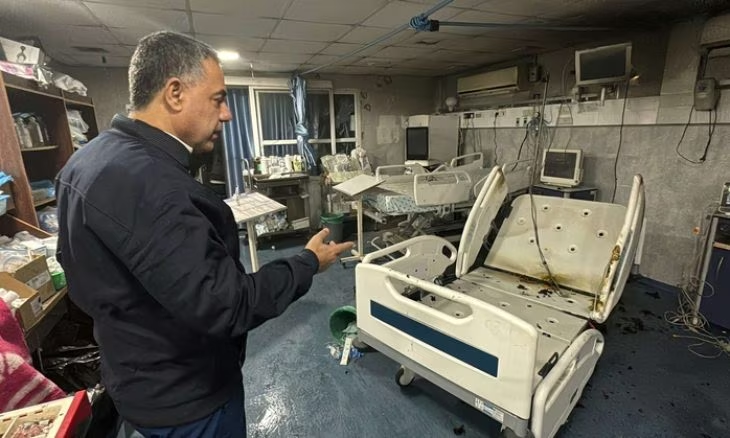
The leaked photo shows signs of severe exhaustion, in addition to clear signs of torture and ill-treatment suffered by Dr. Abu Safiya.

OPINIONS

Thu 11 Jun 2026 10:07 am - Jerusalem Time

Electoral Boycott as an Act of Resistance: A Reading on Exposing Regimes and Withdrawing Legitimacy

Ramallah - “Alquds ” dot com

Ramallah - “Alquds ” dot com

Opinion Writer

The issue of boycotting electoral processes in non-democratic environments sparks a wide intellectual and political debate about the utility of working within official institutions. Observers believe that this behavior goes beyond mere passive abstention from voting, transforming into a strategic political stance that rejects existing institutional rules.

Deconstructing the structure of these regimes leads many political actors, including parties and independent figures, to adopt boycotting as a choice based on a precise reading of the general scene. They believe that the absence of guarantees for genuine competition turns ballot boxes into a mere tool for reproducing ruling elites and solidifying the status quo.

The importance of boycotting stems from its ability to expose superficial political paths and withdraw popular and international legitimacy from them. Instead of being a retreat, it becomes an effective means to put the rules of the game 'on hold' and redefine the concept of true opposition.

'Electoral abstention' contributes to shifting political action from the corridors of formal institutions to the broad societal sphere. This transition aims to build an alternative legitimacy based on popular awareness and direct engagement with street issues, away from official dictates.

Advocates of this approach emphasize that engaging in a political process that lacks sovereign decision-making weakens the opposition and makes it a partner in failure. Participation in elections with predetermined controls grants the regime free endorsement before internal and external public opinion.

Based on this intellectual framework, boycotting and engaging with reality from outside official walls becomes the stance most consistent with democratic principles. This choice protects the moral capital and popular credibility, which represent the true wealth of serious opposition forces.

This abstention falls within the forms of peaceful resistance and conscious protest, and is not a withdrawal as its opponents promote. It is a responsible call to rebuild the political field on foundations of freedom and integrity, away from the superficial beautification of institutions that lack powers.

Groups that adopt this option shift from the logic of parliamentary work to arenas of guiding public opinion and sparking major debates. Their activity focuses on the nature of the constitution, the separation of powers, and the utility of institutions described as lacking actual decision-making authority.

Through their political alternative, these forces seek to create a societal awareness that rejects identification with the rules of the game set by the regime that monopolizes power. They present their assessments as a moral alternative that refuses to compromise on principles in exchange for small political gains or fleeting positions.

This parallel action constitutes continuous pressure on the authority, pushing it to try to improve its image or offer concessions to absorb tensions. This proves that influence from outside can often be more profound than 'tamed' opposition within legislative councils.

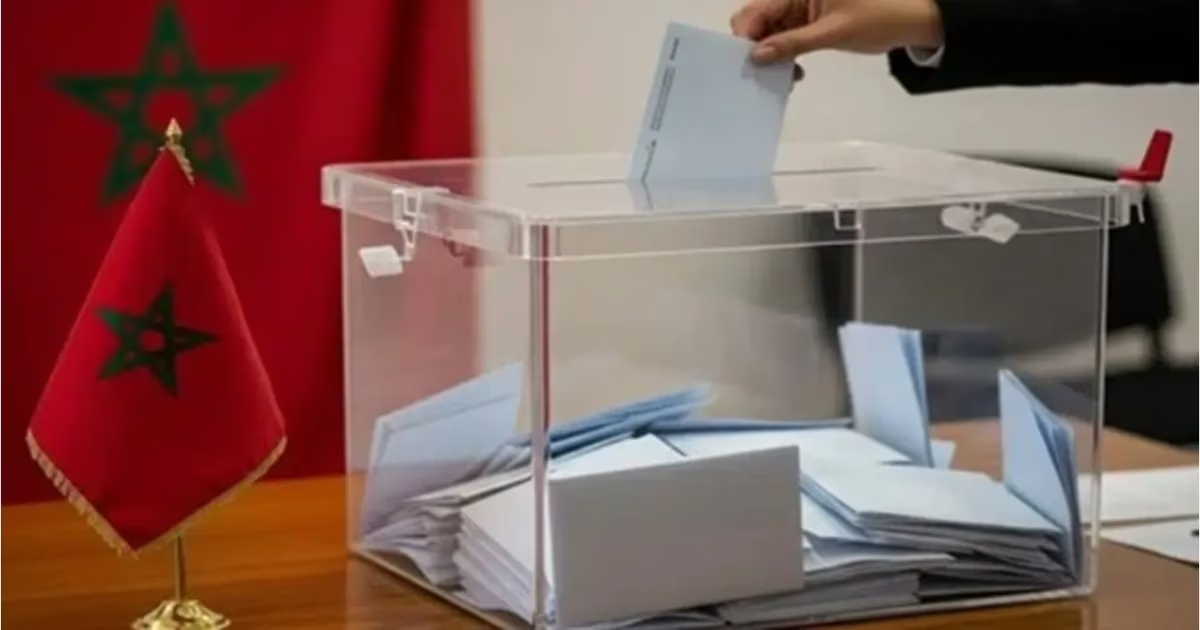
In the Moroccan context, the Al Adl Wa Al Ihssane group stands out as one of the most prominent currents that has insisted on this approach for decades. The group bases its stance on deeply rooted theoretical and practical foundations in its political literature that reject any concessions to the regime.

The group views the existing institutional game as a trap that leads its participants towards moral and material 'political demise'. It bases this on the experiences of other bodies and parties that entered the parliamentary experiment and ended up losing their popular credibility and ideological distinctiveness.

This historical awareness leads the group to take a decisive, uncompromising stance, preferring to remain within the sphere of societal and educational action. Analysis indicates that the group may choose to transform into a purely advocacy current rather than participate in elections that do not guarantee real change.

In conclusion, the electoral boycott remains a strategy aimed at protecting the political project from erosion and disappearance. It reflects a desire to avoid the confusion that afflicted other actors who accepted integration into the regime's structure without possessing the ability to influence its authoritarian essence.

Participation in elections with known outcomes in advance is merely a means to grant the existing regime a certificate of absolution and endorsement before the international community.

OPINIONS

Thu 11 Jun 2026 10:07 am - Jerusalem Time

Geography as a Tool of Domination: How is the Palestinian Space Being Reshaped Through Roads, Symbols, and Infrastructure?

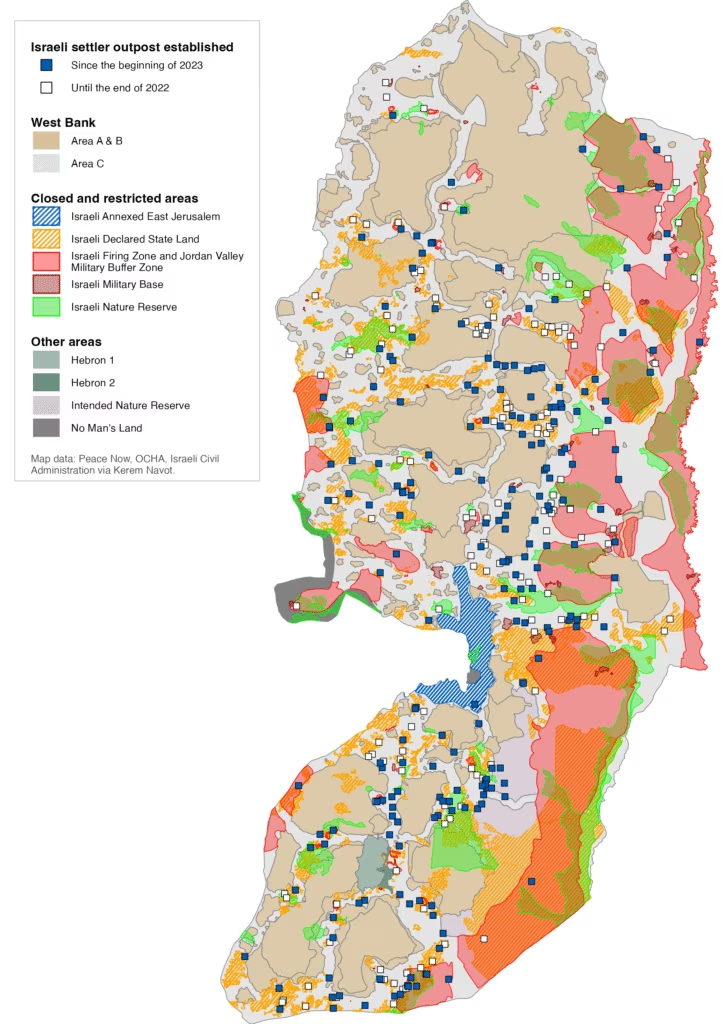
Control over land is not limited to military force or legal procedures; it extends to shaping the visual and geographical landscape that people see daily. Roads, signs, flags, bridges, monuments, entrances to cities and villages, and even the locations of springs and high ground, all transform into tools carrying political and cultural messages that seek to redefine space and reshape the relationship between people and land. In the West Bank, this phenomenon manifests through a set of practices aimed at establishing a new geographical and psychological reality.Among the most prominent scenes that catch the attention of Palestinians as they travel between governorates is the widespread presence of Israeli flags along many main and bypass roads, around settlements, intersections, and on hills overlooking Palestinian communities. The role of these flags is not limited to expressing a political identity; they become a permanent visual tool that seeks to entrench a specific presence, sovereignty, and narrative in the public sphere.The continuous repetition of these symbols along the roads connecting Palestinian cities aims to make them a part of the ordinary daily landscape, thus becoming a silent political message that asserts control over the geographical space and reshapes people's perception of the place and the identity of those who control it.Language plays a fundamental role in shaping spatial identity. When Hebrew signs appear on roads connecting Palestinian governorates, they do not only serve an informative function but also carry a symbolic message related to who has the authority to define, name, and manage the place. A name is not just a word; it is an expression of a historical narrative and a political identity that each party seeks to entrench in public consciousness.It is noticeable that the majority of settlements were established on mountain peaks and high hills, while most Palestinian towns and villages are spread in valleys and low slopes. This positioning grants a geographical and visual advantage that allows for oversight of surrounding roads and lands. This urban pattern cannot be viewed as merely an architectural coincidence, but rather as part of a philosophy based on demonstrating presence and control from top to bottom, making the settlement visible from long distances, while Palestinian communities appear geographically encircled between mountains and bypass roads.In many areas, infrastructure appears that allows settlers' movement to pass over bridges and elevated roads, while Palestinians pass through tunnels or underpasses. This scene has become part of daily life in a number of locations within the West Bank. This arrangement carries a symbolic dimension that goes beyond traffic function, reflecting a disparity in the use of geographical space and reinforcing the feeling of different levels of movement and control within the same place.The urban planning of entrances reflects a different philosophy in dealing with residents and movement. In many settlements, modern roundabouts and wide intersections are built to facilitate access and connection to the main road network, while many Palestinian towns face gates, checkpoints, or limited access points. This disparity produces indirect messages about the nature of the place and the level of openness or restriction experienced by its residents.Monuments are not only erected to commemorate events or people, but also used as a means to entrench a historical and political narrative in the public sphere. When these landmarks are erected at road intersections or near settlements, they become part of the daily landscape that reproduces the memory and narrative associated with the place. Thus, stone and monuments become a means of asserting a historical and symbolic presence in contemporary geography.Water springs represent an authentic part of Palestinian natural heritage, but in some areas, they have become a target for frequent visits by settlers and attempts to link them to specific religious and historical narratives or interpretations. With the repetition of these activities, springs transform from natural and heritage sites into arenas of conflict over memory, identity, and belonging, where each party seeks to establish its own narrative about the place.Some spatial practices cannot be separated from the ideological and religious dimension that attempts to confer symbolic legitimacy on the control of land. When religious narratives or doctrinal interpretations are employed to describe geography, distribute populations, and select control sites, the place becomes part of a broader project that seeks to integrate geography with creed, politics, and identity.These phenomena collectively reveal that the conflict is not only about land, but about how it is seen, understood, and defined. Roads, flags, signs, high ground, bridges, springs, and monuments transform into tools used to reshape collective consciousness and redefine the relationship between people and place. Hence, the battle of geography is not merely a battle of borders and spaces, but a battle of narrative, identity, memory, and existence.A reading of the geographical landscape in the West Bank reveals that infrastructure and spatial symbols have become an essential part of the conflict over land and identity. The daily scene that citizens see as they travel between governorates is not just urban or traffic details, but reflects deep political and cultural interactions that seek to reshape the place and its narrative. Therefore, protecting Palestinian spatial memory, documenting the national narrative, and strengthening Palestinian presence on the ground remain essential elements in confronting attempts to reshape geography and consciousness together.

OPINIONS

Thu 11 Jun 2026 10:07 am - Jerusalem Time

Senate bill raises fears of opening US secrets to Israel

Washington Message

Washington – Said Arikat – 11/6/2026

News Analysis

A bill before the US Senate is sparking growing controversy within political and security circles in Washington, after it included a clause that could force the US administration to expand the sharing of sensitive intelligence information with Israel in an unprecedented way. Critics see this as an infringement on the independence of US intelligence decisions and a potential threat to the national security of the United States.

According to an analysis published by Paul Pillar, a former official at the US Central Intelligence Agency (CIA), on the "Responsible Statecraft" website, Article 622, included in the 192-page Intelligence Authorization Act, is titled “Enhancing Intelligence Sharing Between the United States and Israel.” However, in his view, it goes beyond mere traditional cooperation to the level of obliging the US administration to expand the scope of information exchange with the Israeli government on most Middle East issues.

The bill is backed by Republican Senator Tom Cotton, chairman of the Senate Intelligence Committee, who proposes preventing any US administration from suspending or reducing this intelligence cooperation unless the President determines there is a specific and clear threat to US national security. Even in this case, the White House would have to submit a detailed report to Congress within fifteen days explaining the reasons for the decision, the nature of the information affected by it, and its potential repercussions on regional security.

It is worth noting that Senator Tom Cotton is considered one of Israel's staunchest friends and the Palestinians' fiercest enemies, and owes his position largely to the "AIPAC" organization, which provided him with extensive support during his many years in the Senate.

Critics of the bill argue that this formulation makes any future attempt to restrict intelligence cooperation with Israel politically and procedurally complex, transforming an issue that should remain within the purview of the executive branch and security agencies into a matter subject to pressure from Congress and pro-Israel lobbying groups.

This move comes at a time when opinion polls indicate a significant decline in Israel's popularity among the American public, especially after the war on Gaza and the accompanying international accusations of widespread human rights violations. Pillar believes that Israel's defenders in Washington are trying to compensate for the decline in popular support by strengthening other forms of strategic ties between the two countries, which are less visible to the public than direct military and economic aid.

After decades of American support exceeding hundreds of billions of dollars, the relationship began to move towards deeper forms of military and security integration that are difficult for the public to monitor or hold accountable. From this perspective, Article 622 appears to be an attempt to transfer this integration to the intelligence field, which is the most opaque and least subject to popular oversight.

From Support to Integration

The debate in Washington is no longer just about the amount of US aid to Israel, but about the nature of the relationship itself. The new bill reflects a shift from the concept of “support” to the concept of “institutional integration” between the two countries. While Congress and the public can monitor financial and military aid, intelligence cooperation takes place behind closed doors and away from the spotlight. Therefore, opponents of the bill fear that legislating information exchange will create a permanent commitment that successive administrations cannot easily modify, even when Israeli policies conflict with US interests or regional security priorities.

Pillar emphasizes that intelligence relationships are inherently highly complex and cannot be managed through rigid legislative texts. Intelligence agencies build their cooperation with other countries based on changing considerations related to common interests, the level of trust, and the risks associated with revealing secret sources and methods.

He points out that US intelligence agencies manage a wide network of relationships with multiple countries, and any legal obligation to give special priority to one country could disrupt this network and affect Washington's relations with other partners in the region and the world.

The author goes further when he talks about Israel's record of spying on the United States. He cites the case of spy Jonathan Pollard, who was convicted of delivering massive amounts of American secrets to Israel during the 1980s, in one of the most serious espionage cases the United States has faced from an allied country.

Pillar reminds us that senior American officials considered the damage caused by Pollard to be exceptional in terms of scale and seriousness, while Israel later welcomed him as a national hero after his release.

A Crisis of Trust within the Alliance

The repeated return to the Pollard case reveals a deeper dilemma than just a historical espionage incident. The core of the problem lies in the absence of complete trust between the two allies in the intelligence field. Countries exchange sensitive information when they are convinced that the other party will not use it in a way that harms their interests or transfer it to third parties. When former American officials raise the issue of Israeli espionage or the leakage of American technology to other countries, they highlight an existing gap within the security relationship itself, no matter how solid it may appear on the surface.

The author warns that the danger is not limited to the possibility of information leakage, but also includes how it is used. Information provided by the United States may be used in military or political operations that are inconsistent with American interests or regional stability goals.

In this context, Pillar links the bill to the growing differences between the administration of US President Donald Trump and the government of Israeli Prime Minister Benjamin Netanyahu regarding regional issues, especially Iran and Lebanon.

He believes that the recent war with Iran revealed fundamental differences between Washington's goals and Tel Aviv's goals, despite the continued close alliance between them. He believes that Israel often seeks to expand the scope of regional confrontations, while the United States tries to avoid sliding into open and long-term conflicts.

Restricting the White House

The most dangerous aspect of Article 622, according to its critics, is not the expansion of information exchange itself, but the restriction of the US President's ability to use intelligence cooperation as a political leverage. US administrations usually resort to adjusting the levels of military or security cooperation with allies to influence their behavior when necessary. However, if information exchange becomes mandatory by law, this margin will be significantly reduced. Instead of intelligence cooperation being a foreign policy tool, it could become a fixed commitment that grants Israel permanent strategic advantages, regardless of the nature of its policies or their compatibility with US interests.

Ultimately, Pillar believes that the bill is not just about intelligence sharing, but reflects a broader battle over the future and limits of the US-Israeli relationship. While its supporters present it as a necessary step to enhance Israel's security, its critics view it as an attempt to enshrine a long-term institutional link that could restrict American decision-making freedom and make Washington more attached to Israel's regional policies at a stage when questions are increasing within the United States itself about the usefulness of this path and its consequences for security and stability in the Middle East.

PALESTINE

Thu 11 Jun 2026 10:06 am - Jerusalem Time

Hebrew reports reveal the establishment of a massive American base on the Gaza Strip border

Hebrew press reports have revealed that the US Army has begun extensive construction operations to build a massive military base located directly on the separation fence surrounding the Gaza Strip. Sources clarified that the chosen site for the new facility is located near the 'Re'im' base belonging to the occupation army, reflecting high-level security coordination in the border area.

This base is set to play a pivotal role as an integrated military and civilian headquarters for receiving and managing international bodies and forces expected to arrive in the region in the coming period. This step comes within the framework of efforts aimed at providing logistical infrastructure capable of advancing and implementing the provisions of Trump's plan on the ground, and securing the required international presence.

Data indicates that the new facility will be the strategic alternative to the multinational headquarters that was previously centered in the 'Kiryat Gat' area. This relocation aims to bring command and control centers closer to the Gaza Strip borders to ensure rapid response and direct supervision of the field movements of international forces participating in the anticipated missions.

In the context of technical preparations, the base's engineering plan includes the construction of an advanced observation tower dedicated to command and control purposes and linking units deployed in the field. This tower will serve as a central nerve for managing operations and directing forces, giving supervising entities a high capability to accurately monitor movements in the areas surrounding the security fence.

The US administration has already begun issuing various commercial tenders to accelerate construction operations, including requests for the supply of mobile buildings and prefabricated residential units. These temporary facilities will be used as accommodations for forces and command and control centers until the completion of permanent buildings and fortifications scheduled within the project's timeline.

The base will serve as an alternative to the multinational headquarters that was based in Kiryat Gat, and will be used as a military and civilian headquarters for international forces.

ARAB AND WORLD

Thu 11 Jun 2026 10:06 am - Jerusalem Time

Military Escalation in the Strait of Hormuz: Naval Clashes Between Iranian and American Forces

The strategic Strait of Hormuz region witnessed, at dawn on Thursday, the outbreak of what were described as violent naval confrontations between Iranian forces and units of the US Army. These rapid field developments come in the wake of the United States launching a second wave of military attacks targeting vital sites within Iranian territory, leading to an explosion of the situation on the ground in the vital waterways.

Media sources confirmed heavy exchange of fire at sea, where naval units from both sides engaged in direct clashes whose final outcomes are not yet clear. Despite the scarcity of official details about the extent of the losses, field reports indicate that the region is experiencing an unprecedented state of military alert in years, amidst international anticipation of the consequences of this direct confrontation.

In a related context, initial reports revealed that warships belonging to the US fleet were subjected to coordinated attacks using guided missiles and suicide drones. Informed sources stated that the Iranian armed forces are behind these attacks targeting the American military presence in the vicinity of the strait, with news indicating the possibility of direct casualties on some American naval units participating in the operations.

On other fronts, the escalation was not limited to the maritime domain, as the targeting extended to the 'Harir' base, which houses American forces in the city of Erbil in the Kurdistan Region of Iraq. This expansion in the scope of the confrontation indicates military coordination aimed at pressuring American bases spread across the region, in response to the airstrikes that hit deep inside Iran in the past hours.

For its part, Israel raised the alert level of its forces to the maximum, in anticipation of the spark of confrontation spreading to other fronts or its interests being subjected to missile attacks. Political and military circles in the region are closely monitoring developments in the Strait of Hormuz, in the absence of any official confirmation from Washington regarding the extent of the damage to its naval units or the nature of the expected response to this Iranian escalation.

Sources reported an exchange of fire at sea between Iranian forces and US Army forces in the vicinity of the Strait of Hormuz.

ARAB AND WORLD

Thu 11 Jun 2026 10:06 am - Jerusalem Time

Widespread Military Escalation: Washington Launches New Wave of Strikes Inside Iranian Territory

The US Central Command (CENTCOM) announced the launch of a new wave of aerial military operations against what it described as defensive targets deep inside Iranian territory. Sources clarified that these strikes began at 5:15 PM Eastern Time, based on direct orders from the Commander-in-Chief of the US Armed Forces, Donald Trump.

Washington affirmed that this military action comes as a response to what it described as continuous and unjustified Iranian aggression in the region. These developments come just hours after statements by President Trump, in which he confirmed his country's readiness to deliver powerful strikes exceeding in intensity the attacks carried out last Tuesday.

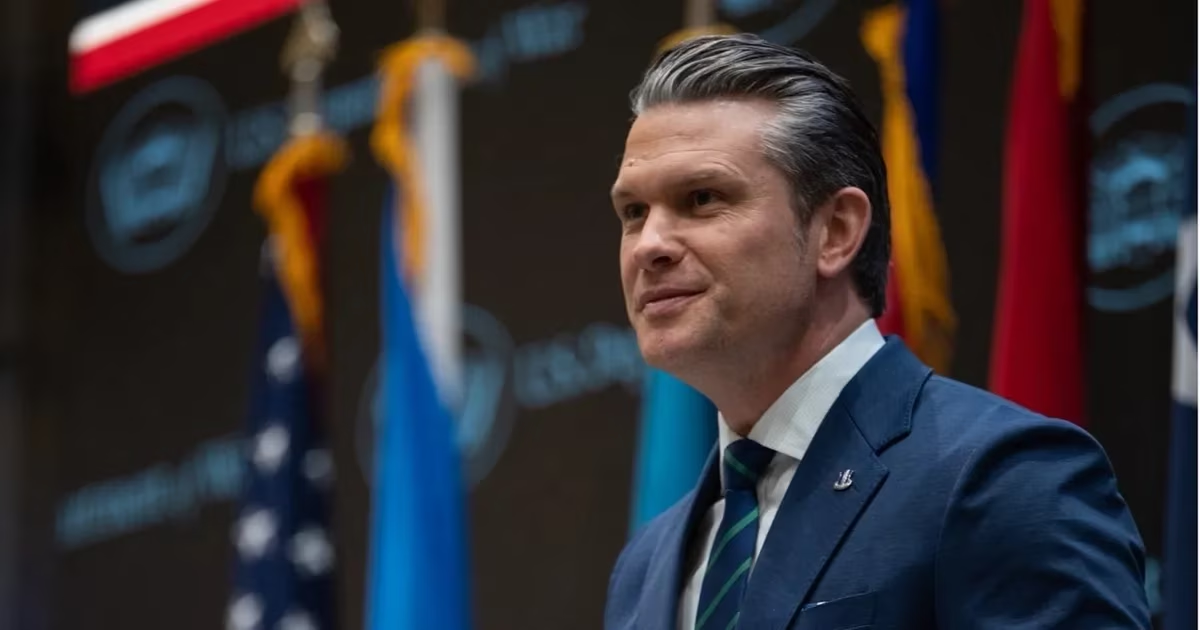
For his part, US Secretary of War Pete Hegseth revealed the characteristics of the targeted objectives, indicating that they include vital and strategic facilities within Iranian territory. Hegseth clarified during a press conference in Florida that the coming hours will witness intensive military activity to reinforce American interests and support Washington's diplomatic position.

In the field, local media sources in Iran reported hearing violent explosions in the city of Sirik and the vicinity of Minab city, located in southern Iran. This coincided with the activation of air defense systems in the western areas of the capital Tehran, without immediate official statements clarifying the nature of the intercepted targets.

Iranian President Masoud Pezeshkian responded to these threats, considering Washington's resort to targeting civilian and vital infrastructure as evidence of impotence, not strength. Pezeshkian stressed that his country would not be drawn into a position of weakness in the face of the increasing military pressures exerted by the current US administration.

Regarding military readiness, sources quoted an Iranian military official as saying that the armed forces have been placed on high alert to confront any potential scenarios. The source warned that any overreach in American aggression would be met with harsh reactions affecting Washington's interests in the region in an unprecedented manner.

This direct confrontation comes at a time when the region is witnessing shuttle diplomatic movements, with a Qatari negotiating delegation arriving in Tehran in an attempt to conclude a final agreement and de-escalate the situation. The Qatari mediation aims to bridge viewpoints after intensive consultations conducted by Doha with the American side in recent days.

President Trump had previously stated that Tehran was stalling in reaching a political settlement, threatening to target power stations and vital bridges as legitimate targets. Observers believe that this escalation aims to exert maximum military pressure to force the Iranian regime to make fundamental concessions in the negotiation file.

It is worth noting that military tension between the two sides reached its peak last Tuesday following an exchange of missile fire, leading to a partial collapse of previous implicit understandings. International circles are watching with concern the repercussions of this direct clash on the security of navigation in the Gulf and the stability of global energy markets amid the blockade imposed on Iranian ports.

Any hostile American action will be met with strong reactions again, and we will target new American interests if Washington launches an attack against us.

OPINIONS

Thu 11 Jun 2026 10:06 am - Jerusalem Time

Trump threatens to strike Iran \"very violently\" and reveals US operations against its oil amid escalating tensions in the Gulf

Washington's Message\n\nWashington – Said Arikat – 10/6/2026\n\nIn a new escalation that threatens to expand the confrontation in the Gulf region, US President Donald Trump hinted at launching harsh attacks against Iran if an agreement is not reached to end the current tension, asserting that the United States \"will attack them very strongly\" and announcing, at the same time, that Washington has carried out continuous operations targeting Iranian oil, a move that would raise widespread questions about the nature of increasing American involvement in the conflict.\n\nTrump's statements came during his remarks to reporters at the White House, where he linked his stance to what he described as Iranian provocations, referring to the downing of an \"Apache\" helicopter in the Strait of Hormuz, which he considered an additional reason to intensify pressure on Tehran.\n\n"The US President said that his country \"will attack Iran very violently\" if a peace agreement is not reached, adding that the Iranian strike on the American helicopter represents a dangerous development that cannot be ignored. He also reiterated his assertion that Iran would be struck in the coming hours, which heightened fears that the region was approaching an open military confrontation that could go beyond the limited skirmishes witnessed in recent months.\n\nBut the most intriguing aspect of Trump's statements was his revelation of American operations directly targeting Iranian oil. He said that the United States \"is extracting millions of barrels of Iranian oil every night,\" asserting that these operations have been ongoing for a long time, and that Tehran only recently realized their scale.\n\nHe added that the removal of these huge quantities of Iranian oil contributed, in his opinion, to keeping global oil prices within levels ranging between $85 and $90 per barrel, considering that prices would have jumped to $250 per barrel had it not been for these measures. However, the US President did not provide any additional details about the nature of these operations, the parties carrying them out, or the legal basis on which they are based.\n\nThese statements open the door to a series of political, legal, and military questions. The public acknowledgment of operations targeting the resources of a sovereign state could be interpreted as a shift from traditional economic sanctions policy to more direct forms of pressure and coercion, which could prompt Tehran to respond by various means, whether in the Gulf or through other regional arenas.\n\nThese developments come at a time when the region is experiencing an unprecedented state of tension, amid increasing warnings that any miscalculation could lead to a widespread confrontation involving international shipping lanes and vital energy facilities, which threatens the global economy and puts markets before highly turbulent possibilities.\n\nObservers believe that Trump's rhetoric reflects an attempt to increase maximum pressure on Iran in order to push it to make political and security concessions. However, past experiences have shown that the policy of military threat does not necessarily lead to quick results, but may push the targeted parties to further rigidity and adherence to their positions.\n\nTrump between a show of force and the risks of involvement\n\nThe US President finds himself facing a highly complex equation. On the one hand, he wants to appear as a decisive leader capable of imposing American will through military and economic force, and on the other hand, he realizes that any widespread confrontation with Iran could turn into a costly war whose course or outcomes are difficult to control. Verbal escalation gives him internal political momentum and sends deterrent messages to adversaries, but at the same time, it raises expectations and limits his room for maneuver. If he does not translate his threats into concrete actions, he may face accusations of backing down, but if he carries them out, he may find the United States mired in a new conflict whose repercussions cannot be predicted.\n\nThe dilemma of deterrence and the limits of American power\n\nTrump's statements reveal a deeper crisis related to the effectiveness of American deterrence in the Middle East. The United States possesses tremendous military superiority, but it faces an adversary that has repeatedly proven its ability to use unconventional tools to prolong confrontations and exhaust its opponents. Therefore, threatening to strike Iran does not necessarily mean achieving a quick political or strategic victory. Rather, any military operation could open the door to reciprocal responses that threaten American forces deployed in the region and endanger global economic interests. Here lies the real dilemma: the ability to start a war does not mean the ability to end it on the required terms.\n\nBetween promises of peace and the realities of escalation\n\nTrump has always presented himself as a president who seeks to end wars and avoid involvement in long conflicts, but recent developments place him before a clear contradiction between this rhetoric and the field reality heading towards further escalation. The higher the level of military threats, the more difficult it becomes to return to the negotiating table without political losses. Allies and adversaries alike are monitoring the consistency of American policy and its ability to combine pressure and compromise. Therefore, Trump seems to be at a critical crossroads today: either the success of pressures in imposing an agreement that spares him war, or sliding into a confrontation that may reshape the balance of power in the region and leave long-term effects on the United States' standing and its global role.

OPINIONS

Thu 11 Jun 2026 10:02 am - Jerusalem Time

Erasing Anything Palestinian: Amnesty International’s Indictment of a State Project of Dispossession


By: Said Arikat


June 11, 2026


News analysis


Washington, D.C- There are moments when a human rights report does more than document abuses; it strips away the language governments use to obscure reality. Amnesty International’s Erasing Anything Palestinian is one such report. It is not merely an account of settler violence, land confiscation, or forced displacement in the occupied West Bank. It is a powerful indictment of what Amnesty describes as a systematic, state-driven campaign to remove Palestinians from their land and erase their presence from large areas of occupied territory.


The report challenges one of the most persistent narratives surrounding Israel’s settlement enterprise: that violence against Palestinians is primarily the work of a handful of extremist settlers acting beyond state control. Instead, Amnesty argues that the displacement of Palestinians is neither accidental nor incidental. It is the predictable outcome of policies and practices designed to consolidate permanent Israeli control over Palestinian land while making Palestinian life increasingly untenable.


At a time when global attention remains focused on Gaza, Amnesty warns that another, less visible campaign is accelerating across the occupied West Bank. Entire communities are being pressured, intimidated, and driven from lands they have inhabited for generations. The process may not always generate dramatic headlines, but it is steadily transforming the demographic and geographic reality of the territory.


For Amnesty International, this is not simply a human rights crisis. It is evidence that the erasure of Palestinian existence is becoming an organizing principle of Israeli policy in occupied territory.


At the center of the report is the story of Khirbet Zanuta, a Palestinian Bedouin village in the South Hebron Hills. For generations, its residents lived from herding, farming, and dairy production, sustaining a way of life rooted in the land. Designated as part of Area C under the Oslo II Accord, Zanuta falls under full Israeli military and administrative control.


The village’s ordeal intensified in 2021 with the establishment of the Meitarim Farm outpost less than a kilometer away. According to Amnesty’s findings, settlers launched a sustained campaign of intimidation and violence. Villagers reported assaults, threats, destruction of homes and infrastructure, attacks on educational facilities, contamination of farmland, and repeated efforts to make daily life impossible.


Yet the significance of Zanuta extends far beyond a single community. Amnesty presents the village as a microcosm of a wider process unfolding throughout Area C. Dozens of Palestinian Bedouin and herding communities have already been displaced or are at imminent risk of displacement. Families who have lived on the land for generations increasingly face a grim choice: abandon their homes or endure escalating violence and insecurity.


The report’s most consequential finding is its rejection of the claim that such developments are the result of rogue actors. For decades, Israeli governments have sought to distinguish between official policy and settler conduct. Whenever attacks on Palestinians attracted international criticism, officials frequently portrayed them as isolated incidents carried out by extremists operating outside state authority.


Amnesty disputes that characterization.


The organization argues that settler violence functions as an instrument of state policy rather than a departure from it. According to the report, the interaction between settlers, military authorities, planning institutions, and government agencies creates a system in which violence and displacement become mutually reinforcing tools of territorial expansion.


The pattern described in the report is strikingly consistent. Palestinian communities face repeated attacks. Protection is absent or ineffective. Residents eventually leave under the weight of constant intimidation. The land they vacate then becomes available for settlement expansion or strategic control. Viewed separately, these incidents may appear localized; viewed collectively, Amnesty argues, they reveal a coherent political strategy.


This conclusion shifts responsibility beyond individual perpetrators to the institutions that enable and benefit from displacement. Amnesty’s central argument is that the campaign unfolding in Area C is state-sanctioned, state-driven, and state-implemented.


The report places these developments within the broader framework of what Amnesty has previously described as apartheid and unlawful occupation. It also argues that the intensification of displacement in the West Bank is occurring while international attention remains concentrated on Gaza, allowing territorial realities in the West Bank to be reshaped with limited scrutiny.


Whether governments agree with every aspect of Amnesty’s legal analysis is ultimately secondary to the reality documented on the ground. Palestinian communities are disappearing. Homes are being abandoned. Livelihoods are being destroyed. Entire populations are being pushed from areas they have inhabited for generations.


This reality exposes a profound contradiction at the heart of international diplomacy.


Many governments continue to endorse a two-state solution while tolerating policies that steadily undermine the territorial foundations necessary for such a solution to exist. Settlement expansion continues. Outposts proliferate. Palestinian communities shrink or disappear. Yet the international response rarely moves beyond expressions of concern and routine diplomatic criticism.


The result is a widening gap between rhetoric and reality.


Amnesty’s report therefore challenges not only Israel but also the governments that continue to treat settlement expansion as a manageable political dispute rather than a systematic process of dispossession. The organization argues that the cumulative pattern amounts to ethnic cleansing, a charge carrying profound legal and moral implications.


Critics may contest that terminology. Yet the evidence assembled in the report raises a more fundamental question: what language should be used when a population is systematically pressured to leave its land through violence, coercion, and conditions designed to make continued existence impossible?


For Palestinians in communities such as Zanuta, the debate is not academic. It is existential.


The destruction of these communities represents far more than the loss of property. It severs ties to history, identity, and belonging. Entire ways of life built over generations are placed at risk. Every abandoned home, deserted pasture, and displaced family becomes part of a broader process through which Palestinian presence is steadily erased from the landscape.


That is why the title Erasing Anything Palestinian resonates so powerfully. Amnesty International is not describing a series of isolated incidents. It is documenting what it views as a systematic effort to remove Palestinian existence from contested spaces and replace it with irreversible facts on the ground.


The report ultimately leaves the international community with a stark choice. It can continue to describe these developments as unfortunate consequences of a long-running conflict, or it can confront the possibility that a deliberate project of displacement is unfolding in plain sight. History will judge not only those who carried out such policies, but also those who watched them unfold and chose the comfort of ambiguity over the demands of accountability.

ARAB AND WORLD

Wed 10 Jun 2026 12:35 pm - Jerusalem Time

Pentagon Reduces Approved Religions in US Military, Sparks Widespread Controversy

The US Department of Defense has approved a radical update to its religious affiliation regulations for armed forces personnel, reducing the number of approved religious symbols from approximately 200 to just 31. The department justified this move by stating it aims to help military chaplains organize spiritual support services more efficiently and clearly. This direction has sparked a wave of controversy within religious and military circles, especially with the exclusion of dozens of previously recognized beliefs.

According to media sources, the department removed nearly 180 religions and beliefs from the official list, in compliance with direct directives issued by Secretary of Defense Pete Hegseth. This change came based on an internal memo signed by Under Secretary of Defense Anthony Tata, which emphasized the need to simplify administrative procedures related to religious classifications. Observers believe this decision may affect how cultural diversity is handled within the world's largest military institution.

For its part, the Department of Defense clarified that this measure is not intended to restrict freedom of belief or exclusively limit recognized religions, but rather is a purely organizational procedure. The department affirmed that military personnel will retain their right to register their specific beliefs on military ID cards, even if those beliefs are not included in the new abbreviated list. The memo aims to provide a database easily accessible by chaplains to anticipate the religious needs of soldiers.

Despite the significant reduction, the new list still includes major religions such as Islam, Judaism, Hinduism, Buddhism, and Sikhism. It also included major Christian denominations, among them Catholics, Baptists, Lutherans, and Methodists, in addition to the agnostic category. However, strong protests emerged from the Mormon community, who expressed their dissatisfaction at not being independently included or within the approved Christian faith classifications in the new structure.

Secretary of Defense Pete Hegseth defended his decision in previous statements, considering that the old system suffered from an unjustified inflation of religious symbols that were not actually used on the ground. Hegseth pointed out that the vast majority of military personnel originally belong to a limited number of core symbols, making it impractical to maintain a list of 200 symbols. He stressed that the change reflects the spiritual role of chaplains as clergy first and foremost.

In contrast, the decision faced sharp criticism from former military chaplains and analysts, who considered that removing such a large number of religious categories sends a negative message about the inclusivity of the military. They warned that reducing options could lead to the marginalization of religious minorities within the armed forces and weaken the image of diversity that the institution is keen to project. Attention was also drawn to the integration of the atheism classification, which was previously independent, into a new structural framework that raised additional questions.

Reports indicate that this shift in Pentagon policy comes in the context of a comprehensive review of internal systems under the current administration, with the aim of focusing on operational aspects and reducing bureaucratic complexities. As the controversy continues, the challenge for the department remains in balancing these administrative simplifications with ensuring respect for the individual religious rights of thousands of soldiers from diverse and complex faith backgrounds.

The previous system had expanded significantly after exceeding 200 religious symbols, some of which were not actually used in military reality.

OPINIONS

Wed 10 Jun 2026 12:35 pm - Jerusalem Time

An Ethical Vision for Protecting Humanity in the Digital Age...Pope Leo XIV Launches First Encyclical on Artificial Intelligence: "Wonderful Humanity"

On May 25, 2026, the Vatican witnessed an official meeting chaired by His Holiness Pope Leo XIV to present the first encyclical of his pontificate, titled "Wonderful Humanity," dedicated to the theme of "Protecting Humanity in the Age of Artificial Intelligence." This event is considered one of the most prominent milestones at the beginning of the new pontificate, given the encyclical's ethical and spiritual vision regarding the profound transformations the world is experiencing amidst the digital revolution and the accelerating development of artificial intelligence technologies. This event was exceptional and important for the Holy See, as the Pope personally participated for the first time in presenting the document he authored.The meeting was attended by a number of prominent ecclesiastical and academic figures, and ambassadors accredited to the Holy See, led by the Prefect of the Dicastery for the Doctrine of the Faith, Cardinal Víctor Manuel Fernández, and the Prefect of the Dicastery for Promoting Integral Human Development, Cardinal Michael Czerny. Also noteworthy was the presence of American researcher Christopher Olah, co-founder of Anthropic and specialist in AI interpretability research, whom the Pope welcomed and thanked for his contribution to the discussion on the future of this technology and its impact on human lives.The encyclical addresses both the Church and the world, offering a human and faith-based approach to contemporary challenges related to human dignity, social justice, and the future of human civilization. From the very first pages, the Pope demonstrates a deep awareness of the increasing impact of the artificial intelligence revolution in various aspects of life, emphasizing that technology is not evil in itself, but neither is it neutral; it reflects the values and choices adopted by its developers, funders, and users. As it seems to be in an endless race, His Holiness stresses the need to establish controls and laws to regulate its use in a way that preserves humanity, human dignity, and faith in God's power.This encyclical, "Wonderful Humanity," consists of five chapters totaling 245 paragraphs, forming an integrated path for reflection on the relationship between humanity and technology in light of Christian faith, the Church's social teaching, and the interconnectedness of science and faith. Through this systematic structure, Pope Leo XIV calls for a rediscovery of the concept of the common good as the ethical framework that should guide scientific and technological development. He emphasizes that preserving human humanity in the age of artificial intelligence requires adopting a courageous mindset based on shared responsibility and partnership among peoples, institutions, and individuals, away from the logic of domination and contempt. He believes that the real challenge lies not in what technology can do, but in the kind of human being we want to create through it. Therefore, he affirms that the world is called to realize anew that the human heart is the place where God wants to dwell, and that any progress that does not safeguard this truth remains incomplete, no matter its technical and scientific achievements, noting that machines are devoid of emotions and feelings.Based on the principle of the common good, the Pope calls for directing technological innovation towards serving humanity and promoting its dignity, rather than transforming it into a tool for domination, exclusion, or discrimination. He believes that the future of technology should be measured by its contribution to human flourishing and the protection of fundamental human rights, and by harnessing technology for the common good, not by its ability to generate profits or expand influence. The document also indicates that artificial intelligence and modern technology may contribute to the emergence of new forms of slavery, exploitation, and the marginalization of labor groups in various development sectors, particularly through harsh working conditions associated with the extraction of raw materials necessary for digital technologies, as well as by transforming personal and life data into an exploitable economic resource, constituting a new form of digital colonialism. The Pope affirms that combating these phenomena represents a crucial ethical test in the era of digital transformation and immense technological development, reiterating the Church's categorical condemnation of all forms of slavery and human trafficking, and warning that complacency with the violation of human dignity makes one a partner in it. He also expresses the Church's regret for its historical delay in condemning slavery, emphasizing adherence to the role of the United Nations and other international organizations while keeping pace with contemporary developments, within the framework of the "Civilization of Love" project proposed by the Church as a model based on solidarity, justice, brotherhood, and the service of the global common good. The text criticizes the normalization of war in contemporary political and media discourse, the decline of historical memory, and the dominance of military and economic interests that fuel conflicts, and calls for transcending the theory of "just war" as a framework often used to justify wars, while retaining the right to legitimate self-defense in its narrow sense. Regarding military artificial intelligence, he affirms that ethical decisions cannot be delegated to machines, and that the use of lethal force must remain subject to direct human responsibility, with strict international controls to prevent an arms race and protect civilians and human dignity. He also noted the danger of promoting a culture of force that makes war easier and more devoid of human dimension, through automation, media disinformation, and arms races.The document affirms that the common good is the social expression of the inherent dignity of every human being, and cannot be achieved apart from respecting the right of peoples to exist and to self-determination, and preserving their distinct identity away from control and occupation, and contributing their unique characteristics to the human family. From this perspective, any project or attempt aimed at eliminating or subjugating a people is ethically condemned, considering it a grave violation of human dignity and the fundamental rights of peoples.One of the most prominent points raised by the encyclical is the call for "disarming artificial intelligence" (To Disarm AI), similar to historical international calls for nuclear disarmament. This call gains special importance in the context of the encyclical's stance on war and violence, while preserving the right to self-defense, as it re-examines the concept of "just war" which has been used throughout history to justify armed conflicts, considering it no longer valid to address the complexities of the current era. Instead, the document calls for establishing a culture of dialogue, diplomacy, and forgiveness, emphasizing that true peace is not imposed by force, but is built on the foundations of justice, understanding, and reconciliation. It stresses that technical decisions must not be separated from ethical awareness and human responsibility; because technology's weakening of human critical capacity threatens the foundations of true peace based on justice, not merely the absence of war. In contrast, the challenge is not limited to mitigating risks, including the misuse of artificial intelligence, but also requires building a common human future. Based on His Holiness's experience in reconstruction after natural disasters in Peru, he affirms that true building does not only mean compensating for what was physically lost, but also includes restoring human relationships, regaining trust, and reviving hope, in a collective process that individuals cannot accomplish in isolation from each other.He strongly criticized the intellectual trends associated with the movements called "transhumanism and posthumanism," which see technological progress as a means to transcend natural human limits or radically reshape humanity through the integration of humans and machines and advanced technologies. His Holiness believes that the problem lies not in technology itself, but in the anthropological vision behind it; for when humans are reduced to a material capable of improvement or a being to be surpassed, their dignity becomes linked to efficiency and performance rather than being an inherent value. The document warns that this logic could lead to justifying discrimination against the weak or considering some humans less valuable in the name of progress and improving the human race. Therefore, the Church's social teaching emphasizes the need to integrate technological development within a human and ethical vision that recognizes the equal dignity of all persons, and rejects, in contrast, any conception that promises a purely technical salvation or imagines a future in which the fundamental limits of the human condition are abolished. The document believes that human limits, weakness, and suffering are not deficiencies to be overcome, but part of human nature and a source of growth in compassion, love, and wisdom. Therefore, technological progress should serve human dignity and relationships, not seek to replace or transcend human nature; because human perfection is achieved in love and openness to God and others, not in technical superiority alone.The Pope also emphasized the pivotal role of the family as an institution based on the stable union between man and woman, seeing it as a fundamental social good and the indispensable primary cell in building society. Therefore, he calls for its support and protection through social and labor policies that promote stability and respect the human rhythm of life and work, ensuring society's ability to build its future and sustain its development, warning against the negative consequences of prioritizing technology at the expense of family cohesion.The encyclical's vision is based on the Bible and the Church's social teaching, placing the common good, human rights, and integral human development at its core. It also warns against the dangers of using technology as a tool to impose new forms of digital colonialism or to perpetuate wars and strengthen systems of control and domination. In the face of what it describes as a "culture of force," the document calls for building a "civilization of love" based on solidarity, shared responsibility, and respect for human dignity.In one of the most symbolic passages, the Pope indicates that humanity today stands before two choices: rebuilding the Tower of Babel, with all it symbolizes of division, conflict, and competition, or building the city of Jerusalem as a symbol of unity, coexistence, and communion between humanity and God. This symbolic depiction summarizes the document's essential message, which believes that technological progress must be a means to promote human brotherhood, not a cause for further divisions and fragmentation.The encyclical also affirms that the Church does not oppose science or innovation, but encourages scientific and technological progress as part of the process of human development. However, this progress imposes unprecedented ethical responsibilities in an era where humanity possesses an enormous capacity to influence its destiny and future. Hence comes the warning that the uncontrolled use of technology, and through artificial intelligence, could lead to the erosion of the human dimension and the reduction of humanity to standards of productivity, efficiency, and profitability.In a historically significant evocation, Pope Leo XIV links his encyclical to the legacy of Pope Leo XIII, who in 1891 issued the encyclical "Rerum Novarum," defending the rights of workers in the face of the challenges of the Industrial Revolution, and reminding that "at pivotal moments in history, the Church is called to read the new things in the light of the Gospel and human dignity... He then realized that the Church could not remain on the sidelines of these profound changes... So the encyclical 'Rerum Novarum' clearly expressed the Church's evangelical and social vision towards this stage."He affirmed that just as the Church then stood by humanity in the face of forms of economic exploitation, it finds itself today facing a similar ethical responsibility in dealing with the challenges of the digital revolution and artificial intelligence.Through "Wonderful Humanity," Pope Leo XIV sets out the parameters of a new vision that combines faith, ethics, and technology, affirming that any true civilizational progress can only be achieved if humanity, as a creature made in God's image and likeness, remains the center and ultimate goal of development.The encyclical calls for promoting dialogue as an alternative to the culture of force, and for moving towards a culture based on negotiation and understanding, while emphasizing the crucial importance of interreligious dialogue as a means of spreading the message of peace. It also rejects the use of God's name to justify terrorism, violence, or war, considering it a distortion of the nature of religion itself. It indicates that the diplomacy of the Holy See adopts the principle of evangelical mercy as a practical criterion for political action, while emphasizing the importance of prayer, because peace in its essence is a divine gift.At the conclusion of his address to the attendees, His Holiness called on everyone to be vigilant and responsible in facing the challenges of the age, and to play an active role as "makers of hope" who contribute to building the present and the future, concluding with the wish that the spirit of the Risen Christ would support joint efforts in the service of humanity and society.This document expresses the profound wisdom and compassionate humanity of His Holiness Pope Leo XIV, and his deep concern for human dignity, justice, and the welfare of humanity, and the exploitation of artificial intelligence to destroy humanity and its civilizational achievements through wars, as we have seen in the war on Gaza or the ongoing war between Russia and Ukraine. It is a very important document for building humanity and protecting it from the actions of evil people.In conclusion, we see that the document has anticipated events, and its centrality is humanity and the protection of the future of humanity with the accelerating technological development, especially artificial intelligence. We hope that this document will be read carefully, and that it will be linked to the "Human Fraternity" document signed by the late Pope Francis with the Grand Imam Sheikh Ahmed Al-Tayeb, and perhaps we will introduce amendments to our provisional constitution to keep pace with the challenges of the age. In my opinion, it is important to make a decision to include this document in the curricula of schools and universities, especially Catholic ones, for its potential to contribute to building nations, societies, and homelands on the foundations of truth, justice, and peace, placing humanity at the center.


ARAB AND WORLD

Wed 10 Jun 2026 12:35 pm - Jerusalem Time

Trump's Threats to Oman Alarm Gulf Allies and Raise Questions About U.S. Policy Stability

An international press report revealed a growing state of anxiety in Gulf capitals following the sharp statements made by U.S. President Donald Trump against the Sultanate of Oman. Media sources indicated that these threats, which included hinting at military action, raised deep questions about the predictability of the American approach in the region, especially amidst ongoing tensions with Iran and maritime security in the Strait of Hormuz.

The sources explained that Trump's threat to bomb the long-standing partner and trusted regional mediator, the Sultanate of Oman, increased the confusion among Washington's traditional allies. This sudden shift in American rhetoric reflects a significant gap between economic and political interests, as Trump's family company had previously announced massive investments in the Sultanate estimated at $500 million.

Muscat finds itself today at the heart of a diplomatic storm after Trump's public warning to it to change its policies or face dire consequences. This unprecedented attack targeted a country known for decades for its diplomatic neutrality and its ability to facilitate secret and public communication channels between Washington and Tehran, making it a pillar of regional stability.

Observers believe that Trump's anger stems from his suspicions that the Sultanate might support Iranian efforts to impose fees on ships passing through the Strait of Hormuz. Despite Oman's categorical denial of these accusations and its affirmation of commitment to international law and freedom of navigation, the U.S. administration continues to exert maximum pressure to force Muscat to fully engage in its strategy.

In analyzing these developments, experts at international research centers pointed out that Trump seeks to extract any strategic gain in his confrontation with Iran by pressuring allies. It appears that the U.S. administration believes that countries that do not fully align with its vision, or those that hinder its efforts, must bear the consequences of this stance directly and strictly.

Reports indicate that the U.S. President's frustration over his failure to force Tehran to reopen the vital waterway on his terms led him to vent his anger on regional mediators. From the White House's perspective, the failure to achieve a diplomatic victory with Iran places the responsibility on Gulf countries to make concessions to compensate for this failure.

American pressure is not limited to the maritime issue but extends to demanding Arab governments accelerate the pace of normalizing relations with the occupying state. This American desire clashes with regional opposition that links any progress in this matter to the necessity of achieving tangible progress in the issue of establishing an independent Palestinian state.

This shift in the American approach has prompted many Gulf governments to monitor the situation with extreme caution and reconsider their strategic bets. This incident has reinforced fears that complete reliance on the American security umbrella may entail uncalculated risks under an administration whose decisions are characterized by volatility and surprise.

As a result of these policies, countries in the region have begun to seriously seek to diversify their international partnerships with other global powers to ensure a balance of their interests. Despite continued close military and defense cooperation with Washington, the trend towards building strong economic and diplomatic relations with alternative international poles has become an unavoidable strategic option.

Ultimately, the Sultanate of Oman remains committed to its traditional role as a voice of reason and wisdom in a region plagued by crises, despite immense pressures. Gulf capitals are closely watching how Muscat will deal with these bouts of American anger, and whether Washington will realize the importance of preserving its allies instead of threatening their stability.

Act like other countries, or you will face dire consequences.

PALESTINE

Wed 10 Jun 2026 12:35 pm - Jerusalem Time

Thorough Inspection and Forced Confiscations.. Harsh Testimonies of Palestinians Returning to Gaza via Rafah Crossing

Palestinian travelers returning to the Gaza Strip via the Rafah land crossing face a series of complex security procedures and meticulous inspections that exacerbate the burden of displacement and treatment abroad. Testimonies from returnees reveal a bitter reality where physical exhaustion mixes with psychological pressure, as essential belongings and vital medications are lost in the corridors of the crossing, which is under strict control from multiple parties, turning the return journey into a harsh experience lacking the most basic humanitarian standards.

In one painful story, citizen Umm Muhammad recounted the details of losing a chemotherapy dose intended for her husband, who suffers from cancer. She had placed it in a thermal container to ensure its safety during travel. The woman confirmed that she was surprised by the disappearance of the dose after the inspection stages, which are supervised by international and Israeli parties, noting that the loss of this treatment represents a severe blow to a patient fighting a daily battle for survival, given the difficulty of securing medical alternatives within the besieged Strip.
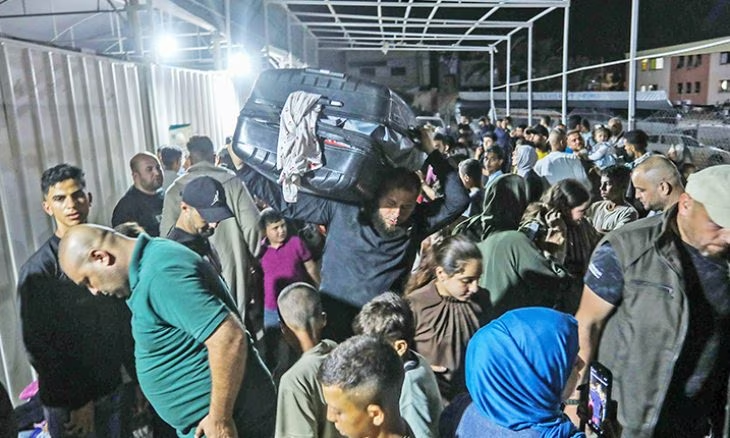
On another note, strict restrictions on personal belongings stand as an additional obstacle for returnees, as regulations prohibit the entry of more than one mobile phone per person. Umm Jihad, who returned with her injured son, recounted how she had to seek mediation and coordination to secure the entry of phones she had bought for her family, explaining that the control at the crossing was so precise that they knew the number of devices she had before she even reached the final inspection point, reflecting the extent of the imposed surveillance.

The suffering was not limited to medications and devices but extended to the confiscation and destruction of goods that the occupation prohibits from entering in commercial quantities, such as cigarettes, which are scarce in Gaza's markets. Shaima Yahya, who was accompanying her amputee sister, reported that the occupation authorities confiscated quantities of tobacco she had and burned them in front of her eyes in designated ovens in the inspection area, a scene she described as shocking and provocative, especially given the difficult health conditions her family is experiencing.

These testimonies summarize the reality of crossing through Rafah, where administrative and security procedures turn into tools to multiply the suffering of the wounded and sick. While returnees hope to reach their homes safely, their aspirations clash with the reality of confiscations and humiliating inspections, making the crossing an additional point of attrition added to the series of crises experienced by the residents of the Gaza Strip amidst the ongoing war and siege.

What hurts is not the loss of belongings, but the loss of a dose of treatment needed by a cancer patient who has been fighting death for months.

PALESTINE

Wed 10 Jun 2026 12:35 pm - Jerusalem Time

Targeting Palestinian Children.. A Recurring Israeli Pattern Beyond the Limits of 'Military Errors'

The Israeli occupation army continues to claim the lives of Palestinian children across the occupied territories, using live ammunition and warplane missiles daily. These violations are starkly concentrated in the Gaza Strip, which has been under siege for nearly two decades, where over 2.2 million people face harsh living and security conditions.

Field statistics indicate that the ongoing genocide against the Strip has resulted in the martyrdom of approximately 73,000 Palestinians, with children accounting for up to 30 percent. These figures reflect the scale of direct targeting of vulnerable groups in Palestinian society, placing the international community before its moral responsibilities.

In addition to the martyrs, military operations have injured over 173,000 people, the vast majority of whom are children under the age of eighteen. Thousands of bodies remain missing under the rubble, with reports indicating that the intensity of explosions in some cases led to the complete disintegration of victims' bodies.

In the West Bank, the martyrdom of seven-month-old infant Sam Abu Heikal sparked widespread anger in Palestinian circles. The infant was killed by occupation soldiers' bullets in the city of Hebron a few days ago, in an incident described by media sources as an expression of the ease with which the trigger is pulled.

Sources reported that a military force directly fired at the Abu Heikal family's car in broad daylight, resulting in the infant being shot in the head. The father had completely stopped the vehicle in response to the soldiers' orders, but this did not prevent them from opening fire on the back seats where the child was in his mother's lap.

For his part, the spokesperson for the occupation army admitted that the targeted family members were not involved in any security or military activity. The army claimed in its initial justification that the soldiers mistakenly believed the car was accelerating towards them, a justification that is repeated in most incidents of civilian killings.

Hebrew-language press reports criticized the military language used to describe these crimes, considering the description of children's deaths as a 'tragedy' or 'exceptional incident' as an attempt to bury the truth. The sources emphasized that these incidents should not pass through superficial internal investigations that usually end without real accountability for those responsible.

The sources stressed that Israel faces a moral and operational failure that is expanding day by day in both the West Bank and the Gaza Strip. Palestinian citizens pay the price for these policies with their blood, despite having no connection to any armed confrontations or activities that pose a real threat.

Reports recalled the incident in the town of Tamoun last March, when four members of one family were killed while shopping for Eid al-Fitr. That incident, carried out by special forces, left children injured and harsh testimonies about the targeting of civilian vehicles without prior warning.

With the increase in these incidents, it becomes difficult to classify them as isolated cases or individual errors; rather, they are a recurring pattern that reflects a specific combat doctrine. The repetition of the scene in different areas and geographies confirms that there is a green light given to soldiers to use lethal force against civilians.

Sources held the Chief of Staff of the occupation army directly responsible for the deterioration of military discipline and the normalization of killing Palestinians. They considered that the military leadership's silence on these transgressions grants implicit legitimacy to the deadly practices carried out by soldiers in the field.

What is needed now is not just statements of regret or remorse, but a serious and comprehensive examination of the instructions that permit firing with alarming ease. Responsibility extends from the soldier who pulled the trigger to the highest institutional hierarchy that sets the rules for the use of force.

Observers confirm that Palestinian blood has become permissible in the absence of international oversight and effective legal accountability. The killing of infants and children should not be treated as a fleeting detail in the daily scene of the conflict, but rather as a full-fledged war crime.

In conclusion, the Palestinian child remains the biggest victim of systematic occupation policies, whether through the suffocating siege in Gaza or through snipers' bullets in the West Bank. This tragedy continues amid international silence that fuels the impunity of perpetrators and allows for the repetition of massacres against innocents.

What we are witnessing is not a series of isolated incidents, but a recurring pattern that reflects a serious moral and operational failure within the military establishment.

OPINIONS

Wed 10 Jun 2026 12:35 pm - Jerusalem Time

Between a Non-Aggression Pact and a Just Peace: Lebanon and Palestine Face the Verdict of History

"Peace not founded on justice remains a temporary truce, while peace based on rights is the only one capable of shaping the future."Recent statements by Lebanese President Joseph Aoun regarding the pursuit of a non-aggression pact with Israel, rather than a comprehensive peace, have sparked a wide political debate inside and outside Lebanon. This debate is legitimate, not only because of the sensitivity of the Lebanese-Israeli relationship, but also because its repercussions extend to the Palestinian cause and to the future of stability in the entire region.It is the right of Lebanon, as a state and a people, to seek security and stability, and to strive to protect its borders and sovereignty, and to rebuild its economy and institutions after long years of crises and wars. It is the right of the Lebanese to look forward to a secure future away from the cycles of open confrontation and continuous attrition, especially after the heavy burdens the country has endured, for which the state, society, and economy have paid a heavy price.However, the search for security should not turn into an تجاوز (overlooking) of the political and historical realities that still constitute the core of the conflict in the region. The fundamental problem has never been the absence of security arrangements, but rather the absence of just political solutions based on ending the occupation, respecting the rights of peoples, and enabling them to freely and independently determine their own destiny.The talk of a non-aggression pact between Lebanon and Israel may be understandable from the perspective of Lebanon's need for stability, reconstruction, and the restoration of the state's role and institutions, but it should not become an entry point for bypassing fundamental outstanding issues or a gateway to marginalizing legitimate Arab and Palestinian rights. True peace is not built on power balances alone, but on justice, rights, mutual recognition, and common interests.At the Lebanese level, the responsibility of the state and all political forces requires managing this file with utmost wisdom, transparency, and national consensus, away from internal divisions or external pressures. Lebanon needs to protect its sovereignty, stability, and national unity, just as it needs to preserve its historical position in support of Palestinian and Arab rights, and not slide into approaches that reduce the conflict to its security aspects only and ignore its political, humanitarian, and legal dimensions.As for the Palestinian side, the accelerating regional developments necessitate a comprehensive national review that transcends narrow divisions and factional conflicts. The longer Palestinians delay in rebuilding their national unity and representative institutions on inclusive democratic foundations, the more others will be able to determine the fate of their cause on their behalf.Protecting the Palestinian cause begins first with restoring the unity of Palestinian national decision-making and reinstating the comprehensive national project capable of representing the Palestinian people in the homeland and the diaspora.Any talk of lasting peace or sustainable stability in the Middle East will remain incomplete unless it is accompanied by a just resolution of the Palestinian issue, as it is the core of the conflict and the key to a solution in the region. The Palestinian people are still under occupation, and their legitimate national rights remain unfulfilled, foremost among them their right to self-determination and the establishment of their fully sovereign independent state on their national land with Jerusalem as its capital.Among these rights, the right of return for Palestinian refugees stands out as a political, legal, and humanitarian right, both individual and collective, that does not lapse by prescription and cannot be abrogated or circumvented under any circumstances.The importance of this issue is particularly heightened for Lebanon, as it is one of the most prominent countries that has hosted Palestinian refugees and has borne, along with its people and institutions, significant humanitarian, political, and economic burdens over many decades.Lebanon, which rejects resettlement to preserve its national identity and internal balances, finds itself more concerned than others with upholding the right of return as the natural and just solution to the Palestinian refugee issue. Abandoning this right not only threatens Palestinians alone but also places host countries before challenges and complexities that they did not cause, and constitutes an infringement on the principles of justice, international law, and relevant international legitimacy resolutions.Regionally, it is no longer acceptable for the Palestinian issue to remain hostage to slogans, bidding, or conflicting regional calculations. What is needed is a rational and balanced Arab stance that supports legitimate Palestinian rights and at the same time works to protect the stability of the region and prevent its slide into endless wars.Also needed is the restoration of the Arab political initiative based on the principle of land for peace and rights for stability.As for regionally and internationally, true stability will not be achieved through temporary security arrangements or limited tactical understandings. The region needs a comprehensive political solution that addresses the roots of the conflict, not just its symptoms. Any attempt to bypass the Palestinian issue, marginalize it, or impose unilateral solutions will only lead to the production of new crises and more complex conflicts.Successive experiences have proven that security based on military superiority alone does not create lasting peace, and that ignoring the national rights of peoples only leads to postponing the explosion and reproducing the causes of conflict in new forms. Therefore, the responsibility of the international community is not limited to containing crises and preventing wars, but extends to addressing their true causes and working seriously to apply the rules of international law and relevant United Nations resolutions.The region stands today at a pivotal historical moment; either a transition to a new phase characterized by just settlements and regional partnerships based on mutual respect and equal rights, or remaining captive to the cycle of conflicts, wars, and instability.Between a non-aggression pact and a just peace, the most important truth remains that peace is not merely a document to be signed, nor security arrangements to be concluded, but rather an integrated system of justice, rights, mutual recognition, and balanced interests.Unless these conditions are met, agreements will remain fragile, stability will remain temporary, and the region will continue to search for a peace that is not yet complete. There is no lasting security without justice, no true peace without an end to occupation, and no sustainable stability without fairness for the Palestinian people and their empowerment with their full and undiminished national rights, foremost among them the right of return and the right to self-determination and the establishment of their independent state.This is the message that everyone should hear in Beirut, Ramallah, Gaza, and Jerusalem, as well as in Arab, regional, and international capitals: that the peace that endures is peace based on truth, while peace that bypasses rights or tries to jump over them will be nothing but a temporary truce in a conflict whose causes have not yet ended.

PALESTINE

Wed 10 Jun 2026 12:34 pm - Jerusalem Time

Between the Drums of War in Tel Aviv and Cairo Negotiations: Hamas Accepts 'Weapon Confinement' with Conditions, and the Occupation Prepares for a Wide-Scale Operation

Hebrew media sources revealed that the Chief of Staff of the Israeli Occupation Army, Eyal Zamir, approved a set of operational plans aimed at resuming widespread fighting in the Gaza Strip. These moves come amid security assessments claiming that the Hamas movement has exploited the past months to rebuild its military capabilities and restore vital parts of the tunnel network damaged during previous stages of the war.

Reports clarified that the commander of the Southern Command in the occupation army, Yaniv Asor, presented multiple scenarios for returning to intensive military operations during closed discussions. Asor believes that the absence of an international body capable of undertaking the task of disarming the resistance may force the army to carry out a large-scale attack at a later stage to ensure that the movement does not regain its field control.

Israeli military estimates indicate that Hamas has succeeded in rebuilding some of its headquarters and command and control systems, despite the significant human and material losses it has incurred. Southern Command leaders are pushing for the accelerated implementation of these plans, warning that merely maintaining the status quo in the buffer zones may give the resistance a greater opportunity to strengthen its positioning.

Despite military readiness, the political level in Tel Aviv has not yet given the final green light for expanding operations. Nevertheless, Prime Minister Benjamin Netanyahu continues to pressure the military establishment to raise the level of preparedness, in anticipation of the collapse of the ongoing diplomatic track in the Egyptian capital, Cairo.

In contrast, the Hamas movement announced progress in the ongoing negotiations, confirming that 'acceptable approaches' have been reached regarding the thorny issues related to the ceasefire agreement. A spokesman for the movement stated that the factions dealt flexibly and positively with the proposals presented by mediators in Egypt, Qatar, and Turkey, with the aim of stopping the ongoing genocide.

Informed sources revealed that the Palestinian factions meeting in Cairo agreed in principle to the issue of 'weapon confinement' in the Gaza Strip, provided that it is in the hands of a nationally agreed-upon Palestinian body. This development represents a significant shift in the negotiation process, as the weapons file was the most prominent obstacle to reaching a final agreement.

Despite this Palestinian openness, expectations indicate the possibility of the occupation rejecting this conditional formula, as Tel Aviv insists on handing over all weapons to international stabilization forces. These Israeli demands are consistent with the vision put forward by the previous US administration within what is known as the Trump plan for resolving the conflict.

On the ground, the occupation continues its control over about 60% of the Gaza Strip through what is known as the 'Yellow Line,' which complicates efforts to return to normal life. The continuous Israeli violations since October 2025 have resulted in the martyrdom of about 985 people and the injury of thousands of others, threatening the collapse of any fragile truce that may be reached.

These developments come at a time when the toll of the ongoing war of extermination since October 2023 has reached catastrophic figures, with about 73,000 Palestinians martyred and more than 173,000 injured. Military operations have also caused the destruction of approximately 90% of the Strip's infrastructure, leading to unprecedented levels of deterioration in humanitarian conditions.

The Hamas movement called on mediators and guarantor states to exert real pressure on the occupation to compel it to stop violations and accept the proposed approaches to enter the second phase of the agreement. Anticipation remains the master of the situation between the possibility of reaching a comprehensive truce or the renewed explosion of the situation in light of the continuous Israeli military buildup.

Acceptable approaches have been reached by the parties participating in the dialogues, related to the thorny issues of the ceasefire agreement.