PALESTINE

Sun 21 Dec 2025 8:39 am - Jerusalem Time

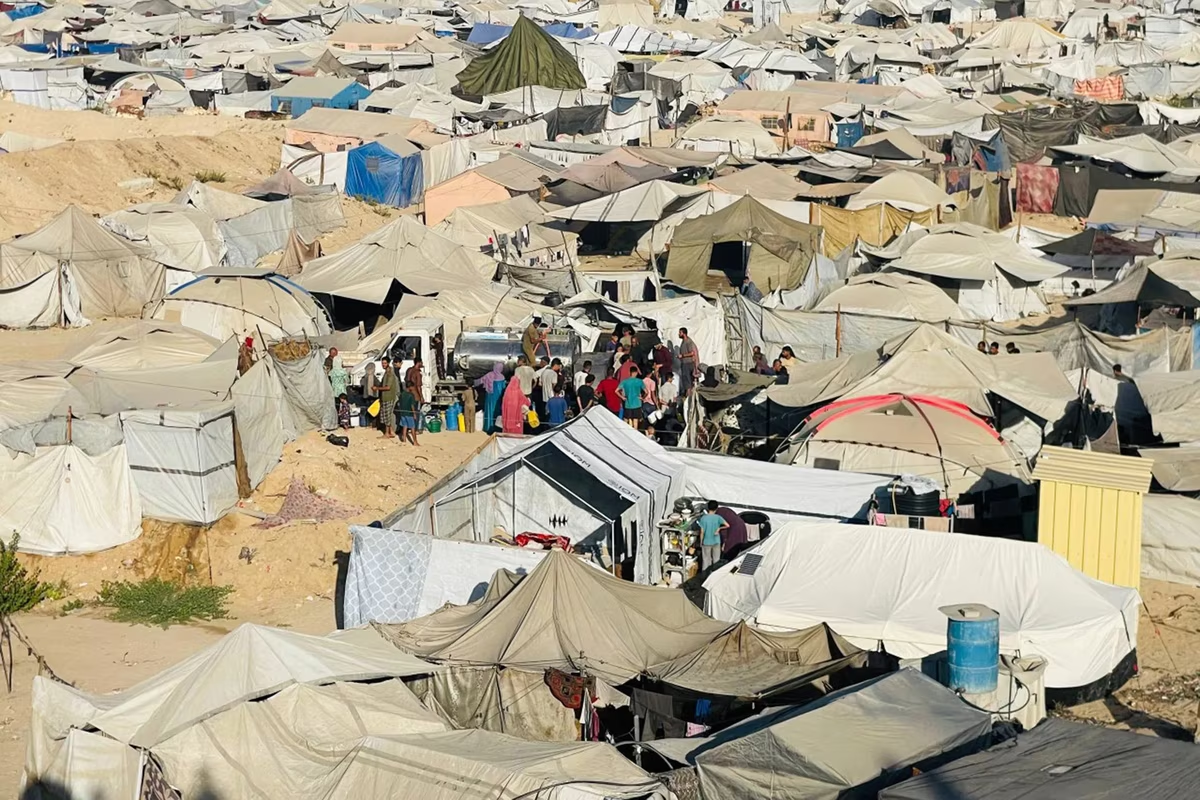
The humanitarian situation in Gaza deteriorates amid the severe cold.. and the occupation continues to fire

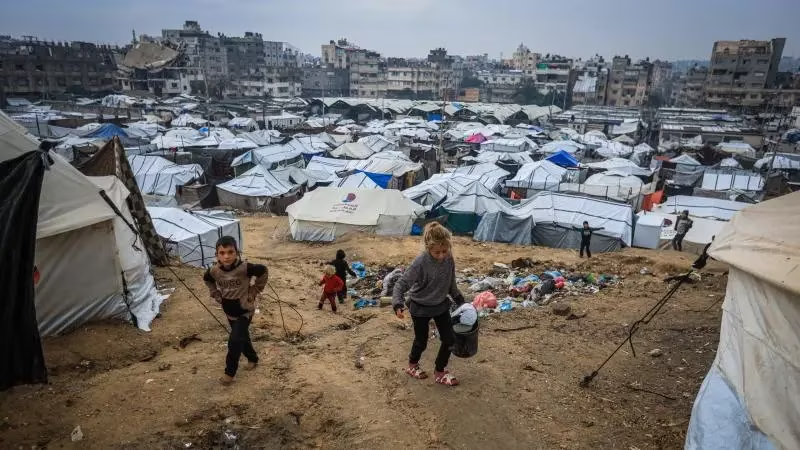
The humanitarian situation in the Gaza Strip is witnessing rapid deterioration amid the severe cold, and amid the continuation of Israeli military operations and the exacerbation of living crises, according to what Islam Badr reported from Gaza City.

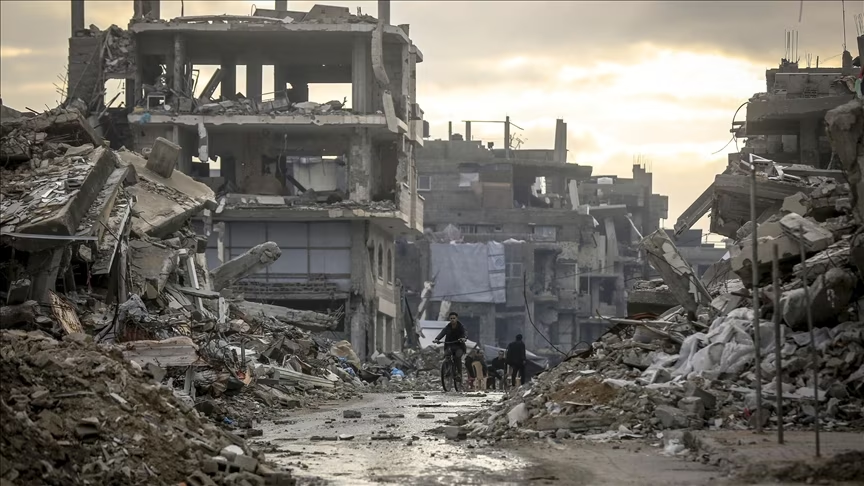
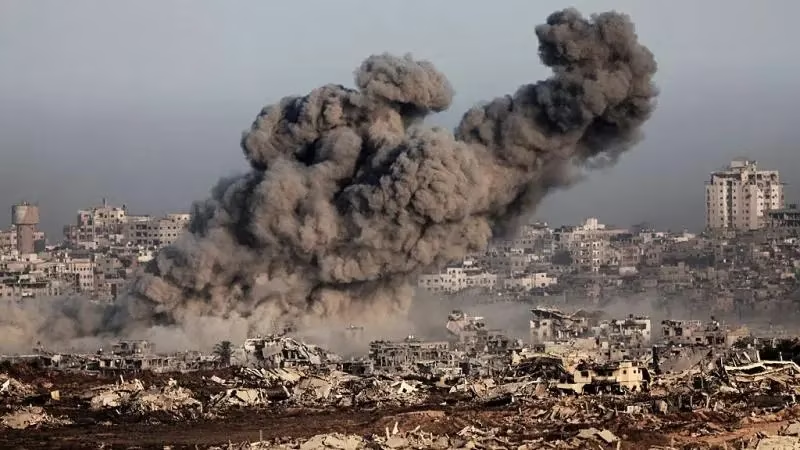
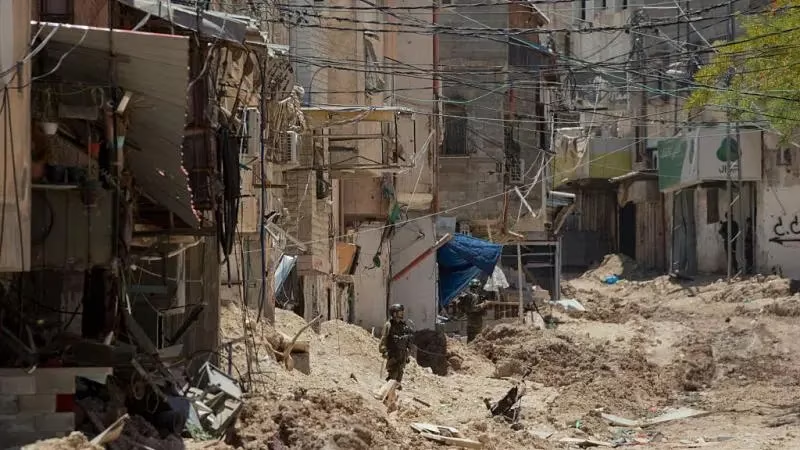
On the ground, the firing continues from the occupation army on the areas adjacent to what is called the "yellow line", starting from advanced Israeli military positions inside the sector, where the sound of gunfire is heard repeatedly, alongside bombing carried out by warplanes and extensive demolition operations.

And he confirmed that the war has not practically stopped in those areas, with the continued destruction of residential buildings, alongside intensive flights of Israeli reconnaissance aircraft at low altitude and loud noise throughout the sector, not only in specific areas.

Homes at risk of collapse in Gaza

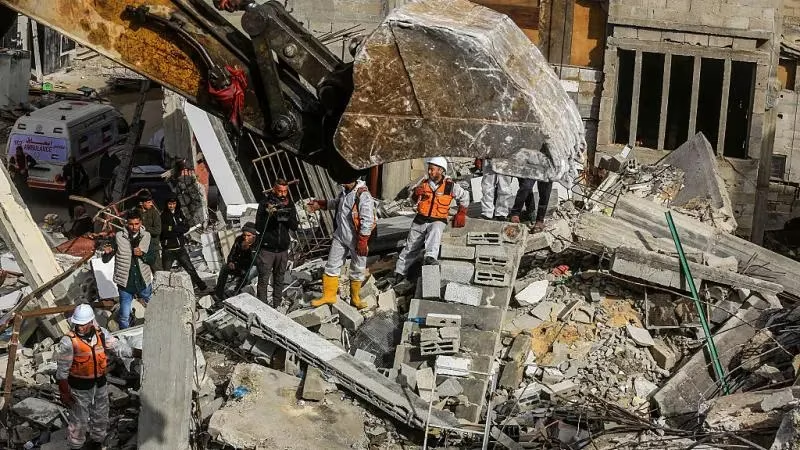
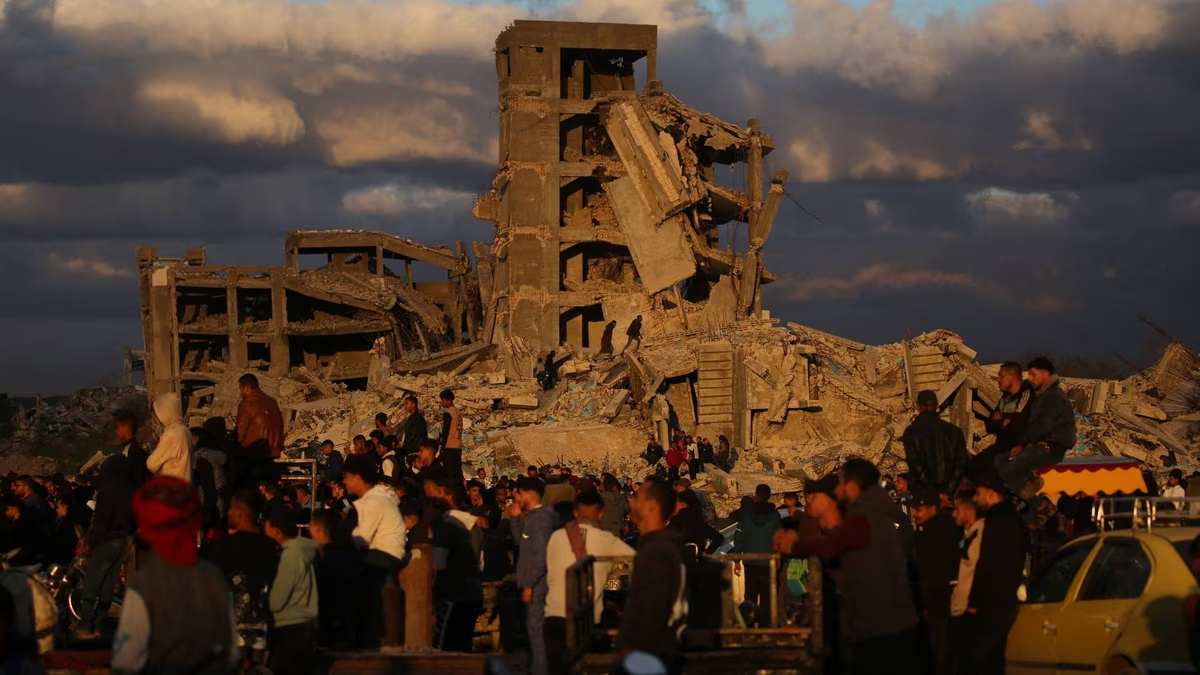
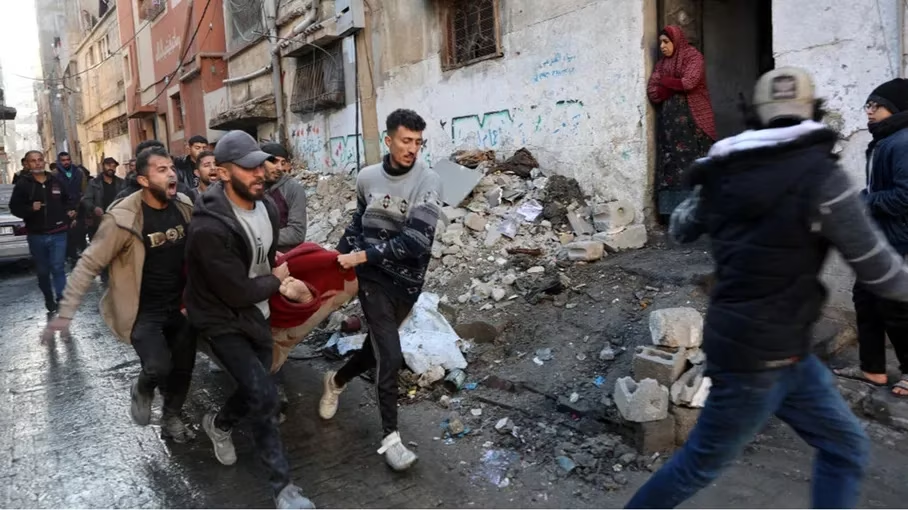
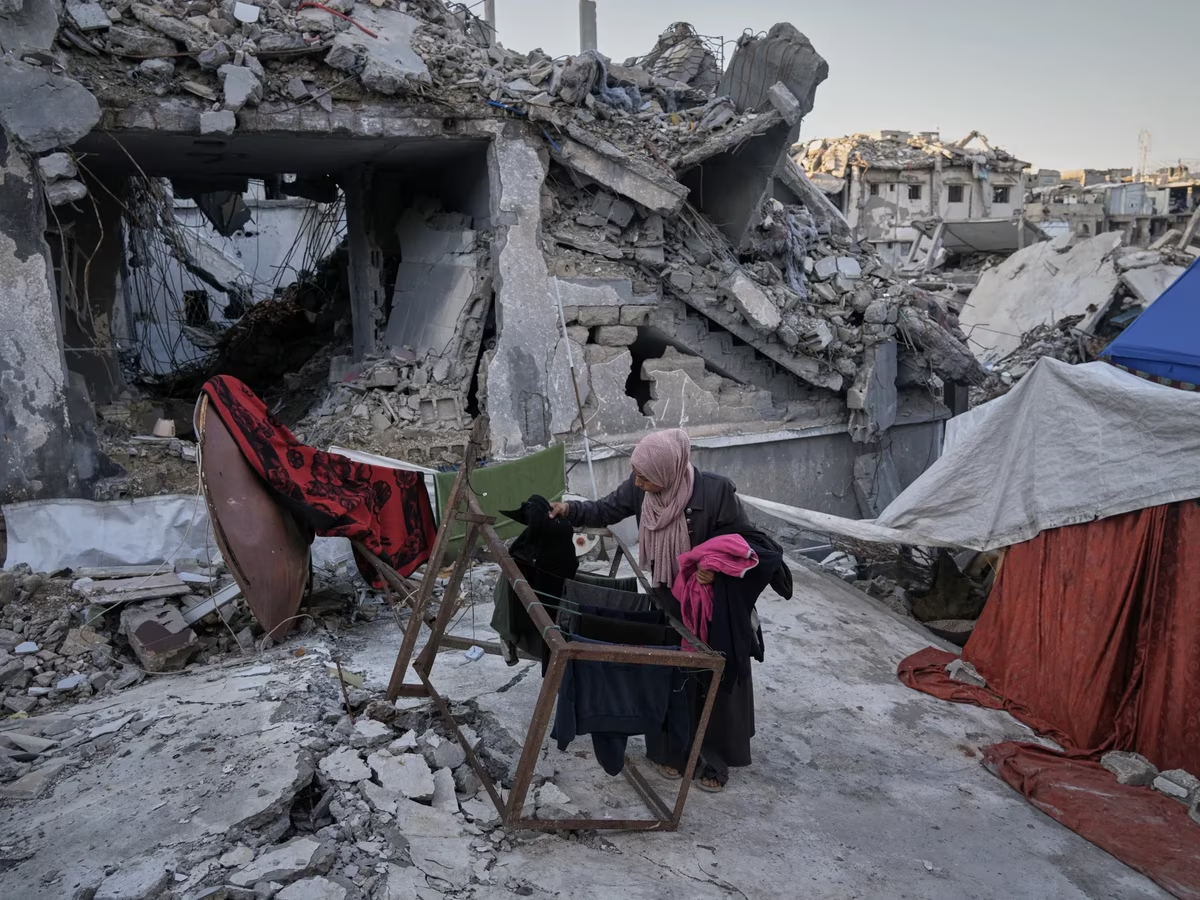
And last night witnessed the collapse of a multi-story residential building for the Labad family in the Sheikh Radwan neighborhood north of Gaza City, in an incident added to a series of collapses that affected other homes in recent weeks, whether due to weather depressions or as a result of their impact from previous Israeli bombing.

And estimates from the civil defense indicate the existence of hundreds of homes classified as at risk of collapse and unfit for habitation, yet Palestinian families still reside in them out of necessity, amid the lack of alternatives, which exposes them to serious risks.

Humanitarianly, the crisis in the Gaza Strip is exacerbating on various levels, amid a new reality imposed by the war and the widespread destruction it left behind, in addition to the strict Israeli restrictions on the entry of humanitarian aid.

And he explained that Israel only allows the entry of a small portion of what the sector actually needs, where what enters does not exceed a quarter of the basic needs, including food, medicine, clothing, and medical supplies.

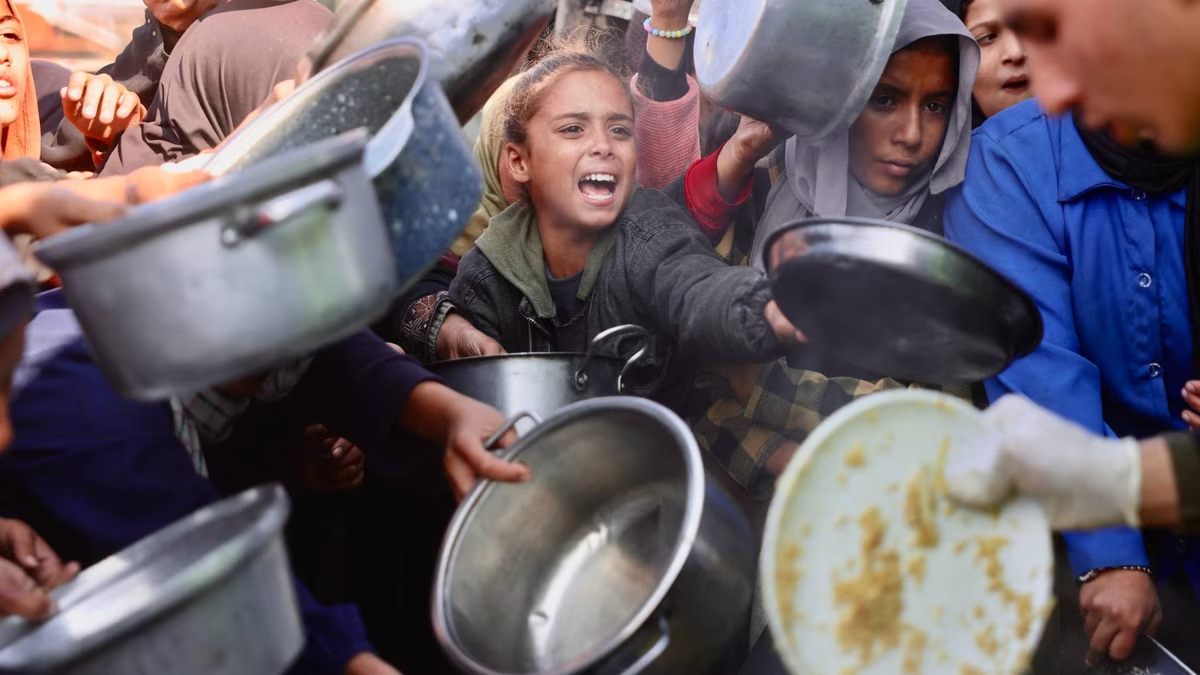
According to the United Nations, the famine classification in Gaza has decreased from level five to four, but the difference remains limited, as the sector is still on the brink of famine, amid a severe shortage of basic materials.

And the data indicates the near absence or complete absence of building materials, reconstruction supplies, communication networks, energy, and fuel, at a time when Israel imposes a long list of materials classified under the "dual-use" category, and prevents their entry on the pretext of their possible use in resistance activities.

Israel also restricts the entry of additional materials except under exceptional conditions and high-cost arrangements, such as solar panels, batteries, and even car tires, which leads to a significant increase in their prices and doubles the living burdens on the residents, contributing to deepening the humanitarian crisis to levels that are difficult to contain.

Await what the international meetings and communications may bring

Politically, the residents of the Gaza Strip await what the coming days may bring, amid the recent international meetings and communications, and the upcoming meeting between Israeli Prime Minister Benjamin Netanyahu and US President Donald Trump.

And attention is directed towards the "second phase" of the ceasefire agreement, on which many Palestinians pin their hopes, not only to stop the war, but to open horizons for returning to their homes.

And the number of Palestinians who have not been able to return to their homes is estimated at about one million people, due to their areas being behind the yellow line, including entire cities and neighborhoods such as Rafah and Beit Hanoun, and large parts of Bani Suhaila and Absan, in addition to large areas

PALESTINE

Sat 20 Dec 2025 7:54 pm - Jerusalem Time

Khalil al-Hayya meets Turkish intelligence chief to discuss second phase of Gaza agreement

The head of Hamas in the Gaza Strip and its chief negotiator, Khalil al-Hayya, met today, Saturday, with the head of Turkish intelligence, Ibrahim Kalin, and discussed the necessary measures to move to the second phase of the ceasefire agreement in the sector.

Turkish security sources stated that Kalin met with the Hamas delegation in Istanbul as part of the ceasefire agreement in Gaza, and that the two sides discussed the necessary steps to prevent what they described as Israeli violations of the ceasefire.

The sources added, without going into details, that they also discussed the necessary measures to resolve outstanding issues in preparation for moving to the second phase of the plan.

The Hamas delegation affirmed during the meeting with the head of Turkish intelligence its commitment to the rules of the ceasefire, and provided information regarding the violations committed by the Israeli side.

The meeting focused on the intensive efforts made by Turkey, as a guarantor state, to implement the ceasefire in Gaza. The steps that can be taken to prevent Israeli violations were also evaluated.

The two sides consulted on preparing the necessary conditions to move to the second phase of the peace plan in Gaza, and the necessary measures to address existing problems.

On the ground, the Civil Defense Department in the Gaza Strip announced on Saturday the recovery of the bodies of 94 Palestinians who were buried haphazardly in one of the streets of Gaza City during the Israeli genocide war, in preparation for transferring them to official cemeteries.

During two years of the Israeli genocide war, thousands of Palestinians were forced to bury their relatives in temporary and mass graves, and in school yards, hospitals, and streets, due to the impossibility of reaching official cemeteries under the intense Israeli bombardment.

The Civil Defense said in a statement that its crews, in cooperation with the families, "transferred the bodies of 94 martyrs who had been buried during the war in a random cemetery on al-Sahaba Street in the center of Gaza City".

The statement clarified that the bodies were handed over to the forensic medicine department at al-Shifa Medical Complex to take the necessary measures, in preparation for burying them in the Martyrs' Cemetery in Deir al-Balah city in the center of the sector.

The Civil Defense indicated that in cooperation with the Ministries of Health and Endowments, it has completed during the past period the transfer of the bodies of thousands of killed people who were buried in random places as a result of war conditions, noting that part of the bodies have unidentified owners.

Civil Defense members have been working since the beginning of the genocide war in a highly dangerous health environment, due to the spread of bodies in open places and the sector's lack of protective equipment and biological testing tools.

The Israeli restrictions and the prevention of entry of basic medical supplies have complicated the crews' tasks, making them susceptible to diseases and infections during the recovery and transfer of bodies operations.

On October 10 of the current month, an agreement for a ceasefire in Gaza and prisoner exchange between Hamas and Israel came into effect, according to the plan of US President Donald Trump.

The agreement ended the genocide war committed by Israel with American support in Gaza, which resulted in about 71,000 Palestinian martyrs and 171,000 injured, most of them children and women, in addition to massive destruction, with the cost of rebuilding the sector estimated at about 70 billion dollars, according to the United Nations.

Nevertheless, the Israeli occupation army continues to violate the ceasefire agreement in the Gaza Strip, with the resumption of gunfire and artillery shelling.

Areas east of Gaza City are witnessing building demolition operations, continuous artillery shelling, and gunfire from occupation helicopters.

In the center of the sector, occupation vehicles continue their artillery shelling east of al-Maghazi camp.

East of Khan Yunis and Rafah city in the south of the sector are also subjected to continuous gunfire from occupation vehicles and artillery shelling.

It is noteworthy that 6 Palestinians were martyred yesterday evening, Friday, after artillery shelling by the Israeli occupation on a training center affiliated with the Ministry of Education that shelters displaced families in al-Tuffah neighborhood east of Gaza City.

ARAB AND WORLD

Sat 20 Dec 2025 10:04 am - Jerusalem Time

New Israeli incursion into the countryside of Quneitra and establishment of a military checkpoint

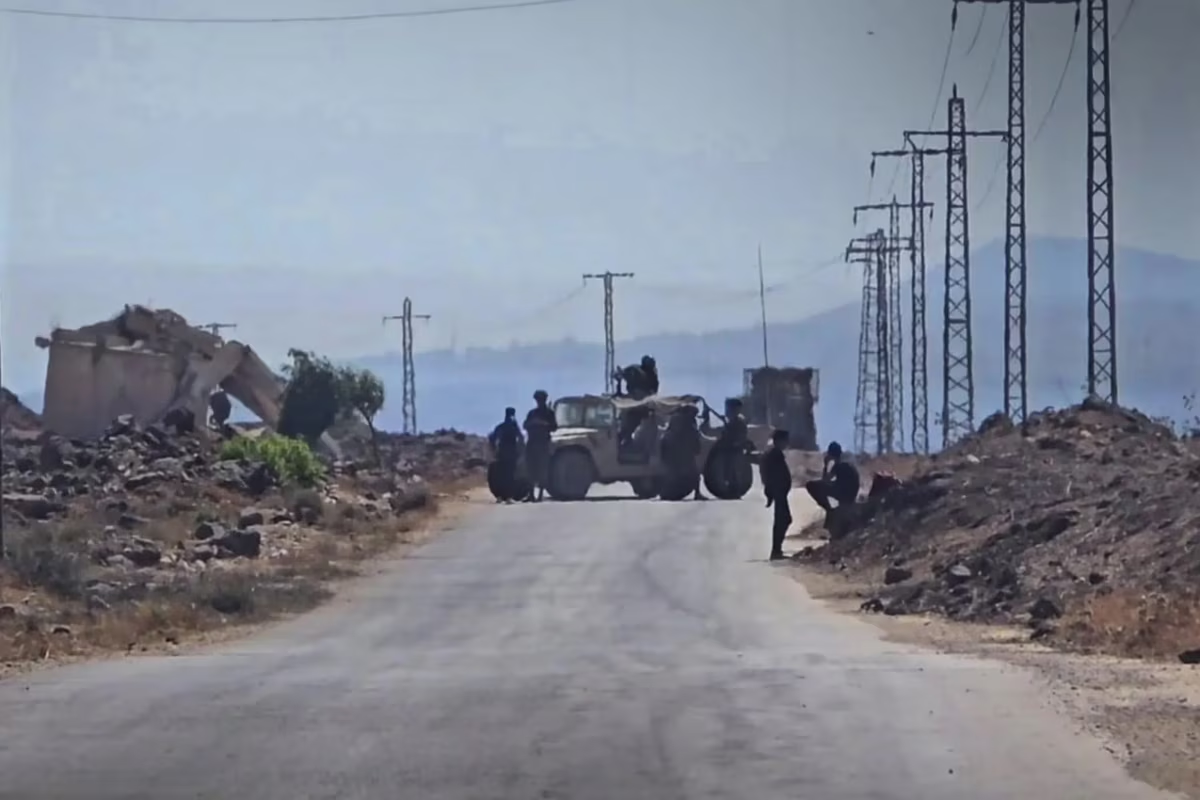
A patrol belonging to the Israeli occupation army infiltrated today, Saturday, into the village of Ain Ziwan in the countryside of Quneitra governorate in southern Syria, where the infiltrating forces proceeded to establish a military checkpoint to inspect passersby.

The Israeli army renewed its violation of Syrian sovereignty through this incursion, noting that the occupation army used 5 military vehicles to install the inspection checkpoint in the village.

This development comes one day after Israeli forces infiltrated towards the towns of Al-Asha, Bir Ajam, Briqa, Um Al-Othaim, and Ruweihina in the southern countryside of Quneitra.

Yesterday, Friday, the city of Salam in Quneitra governorate witnessed a protest stand where dozens of Syrians participated, condemning the ongoing Israeli aggressions against citizens and their property.

The participants in the stand - organized by "Syrians with Palestine" in cooperation with the governorate's sons - raised banners affirming popular rejection of the occupation's repeated violations of Syrian lands.

The occupation forces have been carrying out semi-daily incursions in southern Syria, specifically in Quneitra governorate, interspersed with arrests, setting up barriers, and land leveling, which has sparked a rising wave of popular anger.

Despite the decline in direct military threats, the Israeli army continues to launch air raids that result in civilian casualties and the destruction of sites and facilities belonging to the Syrian army.

It is worth noting that Israel had announced following the fall of Bashar al-Assad's regime on December 8, 2024, the collapse of the "disengagement agreement" concluded in 1974, and began occupying the buffer zone and infiltrating deep into Syrian territories.

Syrians see that the continuation of these violations hinders efforts to restore stability in the region and undermines initiatives aimed at improving the economic reality in southern Syria.

OPINIONS

Sat 20 Dec 2025 10:03 am - Jerusalem Time

Disarmament Without Settlement: An Open Recipe for Sustaining the War in Gaza

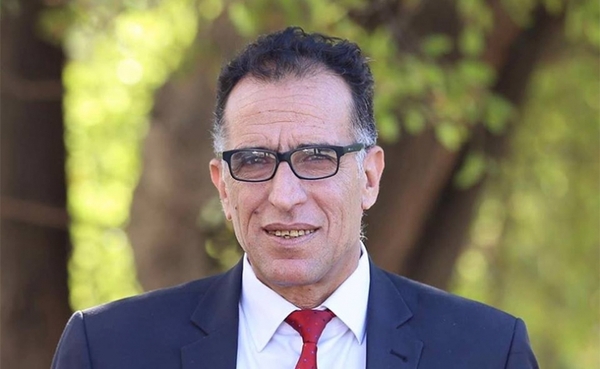
Mustafa Ibrahim

Mustafa Ibrahim

Opinion Writer

The political and security indicators coming from Doha, particularly the meeting held by the US Central Command regarding the “international force” in Gaza, converge on one conclusion: no real breakthrough, no practical answers, and no international consensus that can be built upon. According to media reports, the meeting was not decisive or fruitful compared to the expectations of the US administration, and the abstention of several countries from participating constituted a clear signal of the fragility of the idea itself and the depth of the international division regarding it.


From the Israeli perspective, these indicators appear overwhelmingly negative. Israel insists on reducing the role of any potential international force to a single issue: disarming Gaza. However, at the same time, it does not hide its lack of confidence in these forces and practically declares that it is the only entity capable – or authorized – to carry out this task, even if the price is returning to war or imposing a long-term attrition plan. The direct result of this approach is the consolidation of the status quo in Gaza: no actual cessation of the war, no reconstruction, and no political horizon.


In this context, it becomes clear that disarmament outside the framework of a comprehensive political settlement, in which “Hamas” is a key party, is nothing but an empty slogan. Experience, as well as field realities, proves that any purely security approach, detached from a realistic political solution, is doomed to failure. And if Israel's and “Hamas's” positions do not change, and mediations fail to produce sustainable solutions, the final decision will remain in the hands of the US administration, which will sooner or later be forced to deal with this complex dilemma, not just manage it.


Within this scene, the Israeli government continues to evade forward through a policy of assassinations. The assassination of the Hamas leader Raed Saad, whom Israel describes as one of the planners of the October 7 attack and responsible for rehabilitating the movement's military wing, was met with widespread welcome in Israel. However, this celebration conceals Israel's true intentions: non-commitment to the agreement and evasion of any serious political path.


Even Israeli military analysts acknowledge that Saad's death does not constitute a decisive blow to “Hamas.” Despite losing a large part of its senior leadership and suffering heavy losses, the movement remains the only party capable of imposing itself in Gaza. As one of them wrote: “There is no one in Gaza who challenges Hamas, which has quickly returned, frustratingly, to be the undisputed master of the house,” at a time when the United States has failed to formulate a multinational force capable of assuming security responsibility or enforcing a disarmament path.


According to Israeli analysts, concern is rising in Israel with the emergence of the “Eight Countries Alliance,” which includes five Arab countries (Saudi Arabia, Egypt, Jordan, the UAE, Qatar) and three Islamic countries (Turkey, Pakistan, Indonesia). This alliance is considered a new phenomenon in regional political arrangements, as it links geographically non-adjacent countries with diverse political orientations and interests.


The roots of this alliance go back to the Arab-Islamic summit in Riyadh in November 2023, an exceptional step aimed at demonstrating a unified position on the war in Gaza, which worries Israel and prompts it to work diligently to dismantle it.


In the same context, the disagreement between Tel Aviv and Washington over Turkey's role deepens. While US officials believe that Ankara should be part of the stabilization force, given its military capabilities and influence channels in Gaza, Israel considers that a red line. From its perspective, a party that maintains relations with “Hamas” cannot be classified as a stabilization force; rather, its inclusion could undermine the very essence of the declared goal of the international force.


This disagreement reflects a broader crisis in vision: the United States is seeking crisis management, while Israel insists on perpetuating it under the banner of “security.”


According to Israeli analysts, it seems that US President Donald Trump's patience is beginning to run out. Netanyahu's upcoming visit comes within a political hourglass aimed at preparing the ground for a decisive meeting between them. Washington wants to verify whether Netanyahu is ready to move to the next phase of the US plan and what the limits of his flexibility are on the Gaza file and the international force.


From Israel's perspective, this moment represents a test of how to say “yes” to a political path without conceding, even symbolically, to the “red lines” of security. From the United States' perspective, the question is simpler and more dangerous: Is Netanyahu a reliable partner, or a leader who prefers to keep the arenas ablaze?


It is no longer possible to describe what is happening in Gaza as a failure in mediation or American inability to exert pressure. The accumulating data clearly indicates that the United States is not incapable of pressuring Israel, but chooses not to do so. Washington, which possesses unprecedented political, military, and financial leverage tools, continues to grant Tel Aviv an open margin to sabotage any serious political path, under security pretexts that have become exposed.


Israel, for its part, systematically works to obstruct everything that could end the war. It empties the idea of the international force of its content, reduces it to the disarmament issue, then doubts its usefulness and insists on monopolizing its implementation by force, even if that leads to new rounds of fighting or a long-term attrition war. Thus, every political initiative turns into a tool for managing the war, not ending it.


The US administration also provides political cover for this behavior by continuing to talk about “calm planning” and “permanent peace,” while allowing Israel to set new conditions, delay the transition to the second phase, and link any withdrawal to open-ended temporal criteria related to disarmament. More dangerously, the US administration knows that disarming “Hamas” outside a comprehensive political settlement is an unrealistic demand, but continues to present it as a prerequisite, giving Israel the perfect pretext to perpetuate occupation and war.


Therefore, sustaining the war in Gaza is not the result of miscalculation, but the product of a complete political partnership: Israel refuses to end the war, and the United States refrains from imposing that on it. Between this refusal and that abstention, Gaza is left hostage to killing, starvation, and destruction, while the discourse of “stability” is recycled to justify the continuation of the crime.


The Israeli government is not ready to advance in any serious political path, nor to formulate the day after or launch a real reconstruction process in Gaza. What is happening is not a pursuit of stability, but a conscious management of an open-ended war in various forms, for which Israel and the US administration bear direct responsibility.

ARAB AND WORLD

Sat 20 Dec 2025 9:56 am - Jerusalem Time

Emirati Humanitarian Institutions Collaborate in Preparing the Cargo of the Ship 'Mohammed Bin Rashid' Heading to Gaza

In response to the directives of the Emirati President, Sheikh Mohammed bin Zayed Al Nahyan, the UAE announced the launch of the humanitarian ship "Mohammed Bin Rashid " from Khalifa Port, and these steps come within the framework of Operation "The Brave Knight 3", as part of the ongoing humanitarian efforts exerted by the UAE to support the brothers in the Gaza Strip, and embodying its established approach in extending a helping hand and relief during humanitarian crises.

Various Reliefs 

The ship carries on board various humanitarian and relief aids, with a total cargo exceeding 7,300 tons, distributed as 65% food items, 27% winter clothing, tents, and shelter supplies, in addition to 8% nutritional supplements dedicated to children and women, in response to the urgent humanitarian needs in the Gaza Strip.

This step is part of the initiative of the Mohammed Bin Rashid Al Maktoum Global Initiatives Foundation, which contributed to preparing 10 million food meals for the people of the sector, within the framework of the Emirati humanitarian work aimed at enhancing food security and meeting the basic needs of the most affected groups.

Collaboration of Humanitarian Institutions

A number of charitable and humanitarian institutions in the UAE contributed to preparing the ship's cargo, in a manner that reflects the integration of national efforts and the cohesion of humanitarian work institutions, where each of the Mohammed Bin Rashid Al Maktoum Initiatives Foundation, the UAE Red Crescent Authority, the Khalifa Bin Zayed Al Nahyan Foundation for Humanitarian Works, the Zayed Foundation for Charitable and Humanitarian Works, the Mohammed Bin Rashid Al Maktoum Foundation for Charitable and Humanitarian Works, Dar Al Ber Association, the Union Charitable Foundation, Sharjah Charitable Association, Dubai Charitable Association, the Global Charitable Works Authority, and the Ihsaan Charitable Association participated.

Through Operation "The Brave Knight 3", the UAE affirms its steadfast humanitarian commitment to stand by the brotherly Palestinian people, and support the relief efforts aimed at alleviating the suffering of civilians in the Gaza Strip, in cooperation with various humanitarian partners, and in accordance with the highest humanitarian and regulatory standards.

ARAB AND WORLD

Sat 20 Dec 2025 9:54 am - Jerusalem Time

Washington Presses Quietly: Dual American Messages to Israel on Settler Violence, Gaza, and Disarming Hamas

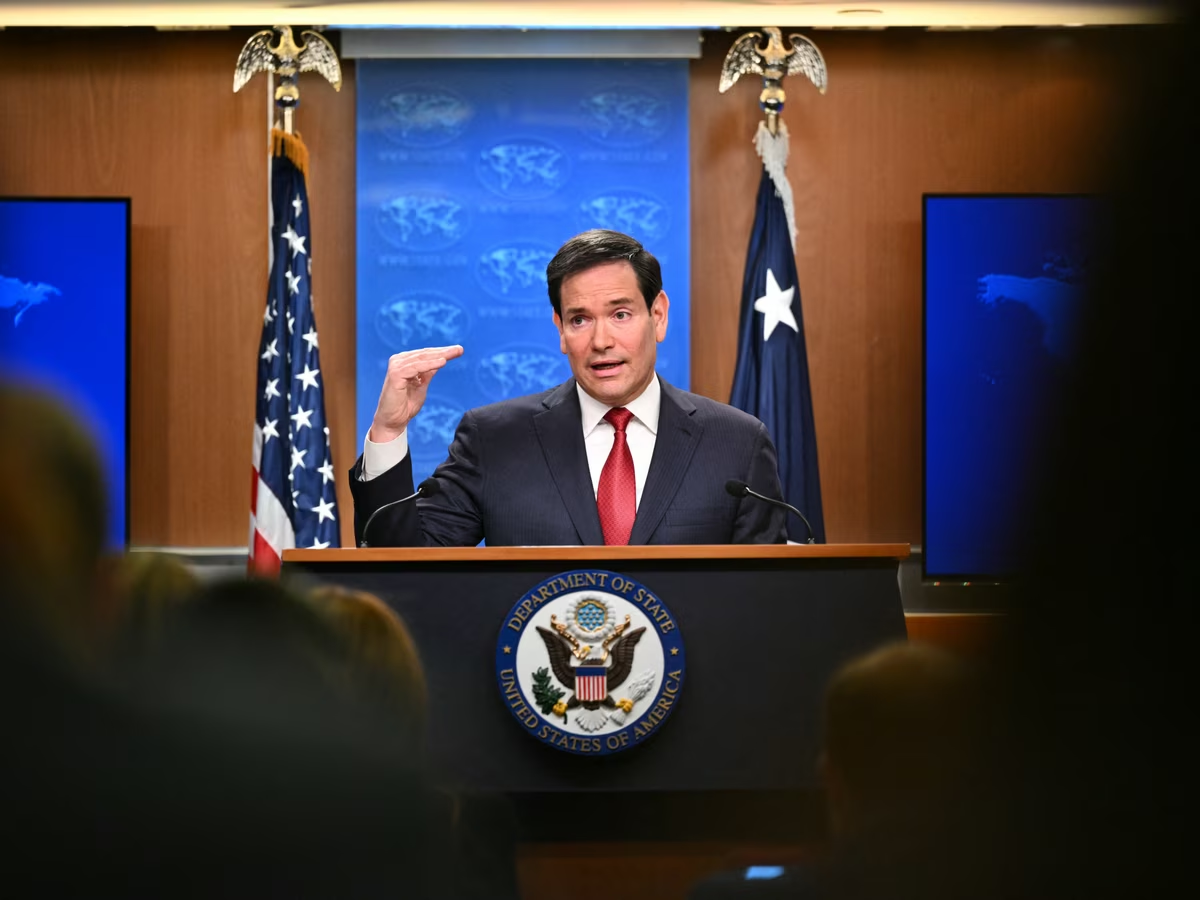
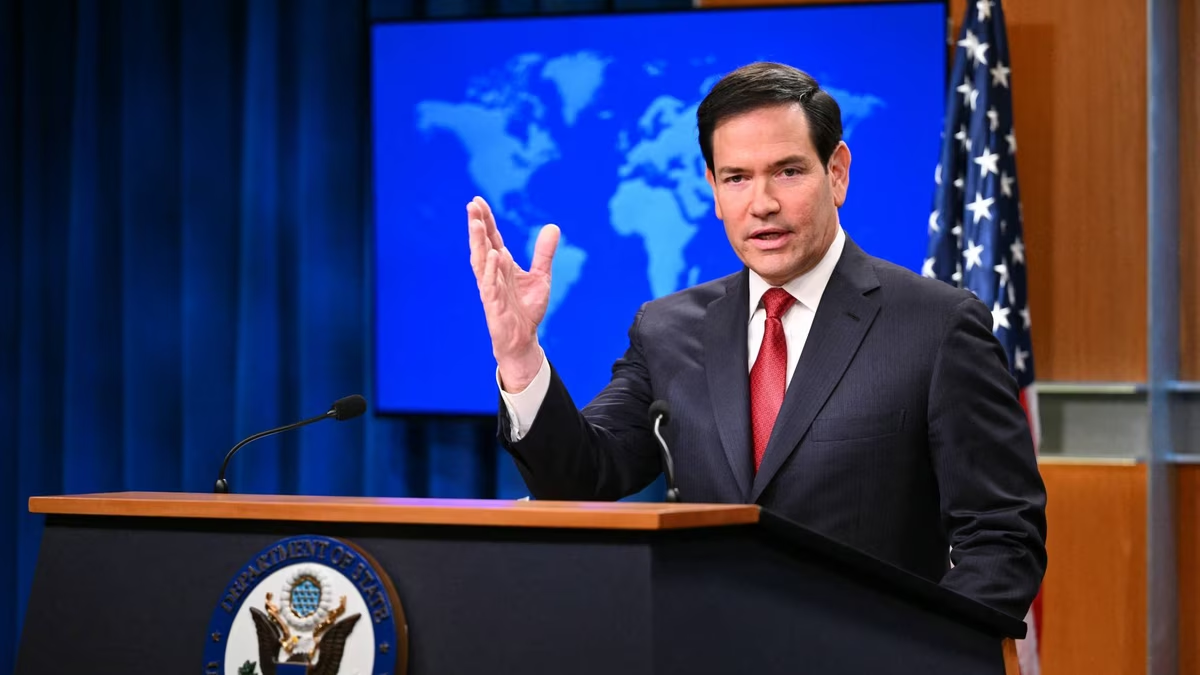
US Secretary of State Marco Rubio's statements during a press conference at the State Department reflect a cautious but multi-faceted American approach toward Israel and the intertwined regional issues, from settler violence in the West Bank, to the humanitarian catastrophe in Gaza, and the file of disarming Hamas and tensions on the Lebanese front.


Without explicitly naming the phenomenon, Rubio acknowledged that Washington is exerting special pressure on Israel regarding the escalation of settler violence against Palestinians in the West Bank, which has become, according to previous American descriptions, almost unchecked by accountability. He pointed out that the US Embassy has issued public statements about specific incidents that 'raise concern' and constitute a 'point of severe friction' in the broader efforts to achieve stability. He also recalled that the US Ambassador to Israel, Mike Huckabee, recently addressed this issue 'in a firm tone,' indirectly referring to his description of this violence as 'terrorism.'


Rubio's language here reveals a familiar American paradox: acknowledgment of the problem, measured criticism, but without moving to overt coercive actions or directly linking the continuation of violence to tangible political repercussions on the bilateral relationship. The Secretary emphasized that Washington 'will continue to convey its position' regarding the impact of this violence on the 'broader challenges,' suggesting that the issue is managed through closed diplomatic channels, avoiding direct confrontation with the Israeli government.


In parallel, Rubio addressed the ongoing humanitarian crisis in Gaza, affirming the US administration's desire to increase the volume of aid allowed into the sector. He spoke of efforts to activate what he called a 'Peace Council,' alongside post-war mechanisms, in an attempt to show that Washington is not only thinking about managing the war but also the day after it. However, these statements remain general and do not address the political and security obstacles that Israel places in front of the flow of aid or any actual arrangement for managing Gaza in the future.


As for the Hamas file, Rubio did not implicitly rule out a scenario of 'selective' disarmament, distinguishing between heavy and light weapons, a proposal that has been circulating in diplomatic backchannels for months. Despite refusing to delve into negotiation details, he stressed that any disarmament formula must prevent Hamas from possessing capabilities that enable it to threaten Israel. He directly linked disarmament to the possibility of achieving peace and attracting investments for Gaza's reconstruction, arguing that the absence of this condition will keep the specter of war present in the coming years.


Rubio confirmed that any potential agreement must have Israel's approval and be imposed on Hamas through pressure from 'partners,' referring to regional and international parties. This position reflects American insistence on prioritizing Israeli security, even when discussing solutions that are supposed to be political or transitional.


On the Lebanese front, Rubio expressed cautious optimism regarding direct talks between Israel and Lebanon, expressing hope that they lead to a path that prevents sliding into a new confrontation. But he acknowledged at the same time that Israel reserves the right to continue military operations against Hezbollah if it feels threatened. The solution, from his perspective, lies in a 'strong Lebanese state' capable of asserting its sovereignty and stripping Hezbollah of its 'armed threat' status, whether for Israel or for the Lebanese state itself.


Rubio's statements reveal an American policy based on managing crises rather than resolving them, and on sending contradictory messages to the parties: measured criticism of Israel on one hand, and constant affirmation of the centrality of its security on the other. The pressure on settler violence remains verbal, while any solutions in Gaza or Lebanon are tied to strict Israeli security conditions. This approach may temporarily alleviate tensions, but it fails to address the roots of the conflict, leaving Washington captive to an old equation: fragile stability, without political justice, and without a real horizon for a sustainable settlement.

PALESTINE

Sat 20 Dec 2025 9:51 am - Jerusalem Time

Injury of Palestinians and Arrest of 3 Others in the West Bank

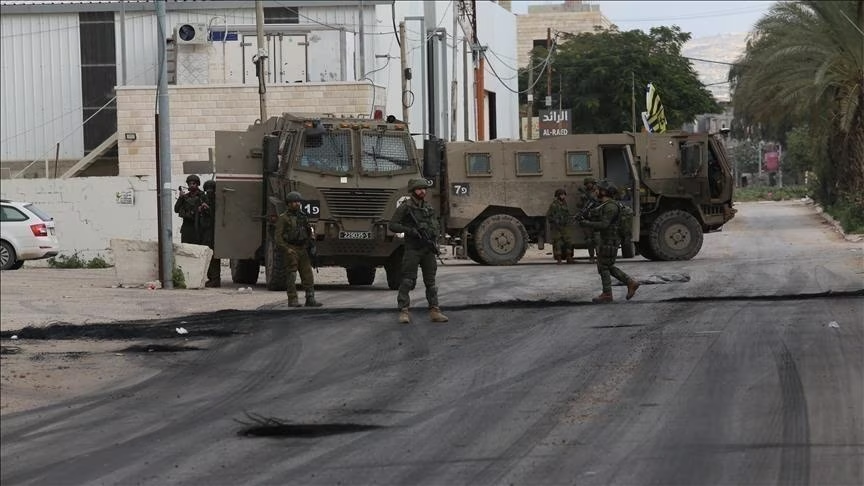
On Saturday, the Israeli army injured two Palestinians with gunfire and beatings, and arrested 3 others, in a campaign of raids that covered various areas of the occupied West Bank.

The Palestinian Red Crescent Society stated in a statement that its crews "dealt with a serious injury to a young man shot in the head, in the town of Qarawa Bani Zeid northwest of Ramallah in the center of the West Bank, and he was transferred to the hospital".

In the town of Al-Zawiya west of Salfit (north), Israeli forces conducted house raids, accompanied by operations to smash their contents, and arrested one of the young men and assaulted another with beatings.

Local sources indicated that those forces "assaulted the citizen Iyad Abdul Halim with beatings, and he was subsequently transferred to the Al-Zawiya Specialized Center for treatment".

The Israeli army also arrested the young man Muhammad Shaqir, son of the mayor of Al-Zawiya, after raiding his family's home, according to the same sources.

In the south of the West Bank, the Israeli army raided the town of Al-Karmel south of Hebron, and arrested the released prisoner Montaser Abu Aram, after raiding and searching his home, according to local sources.

The army also raided the town of Dura southwest of Hebron, and arrested the young man Muadh Ibrahim Nassar, after raiding and searching his home and tampering with its contents, according to eyewitnesses.

Israeli forces usually raid cities and towns in the West Bank, and arrest citizens on the pretext that they are wanted for security reasons.

Since the start of the genocide war on the Gaza Strip that lasted two years, the Israeli army and settlers in the West Bank have killed more than 1100 Palestinians, injured about 11,000, in addition to arresting more than 21,000.

Meanwhile, the Israeli genocide war in Gaza has left more than 70,000 Palestinian dead and 171,000 injured, mostly children and women, along with massive destruction with a reconstruction cost estimated by the United Nations at about 70 billion dollars.

PALESTINE

Sat 20 Dec 2025 9:45 am - Jerusalem Time

Collapse of two damaged buildings due to previous bombing in Gaza

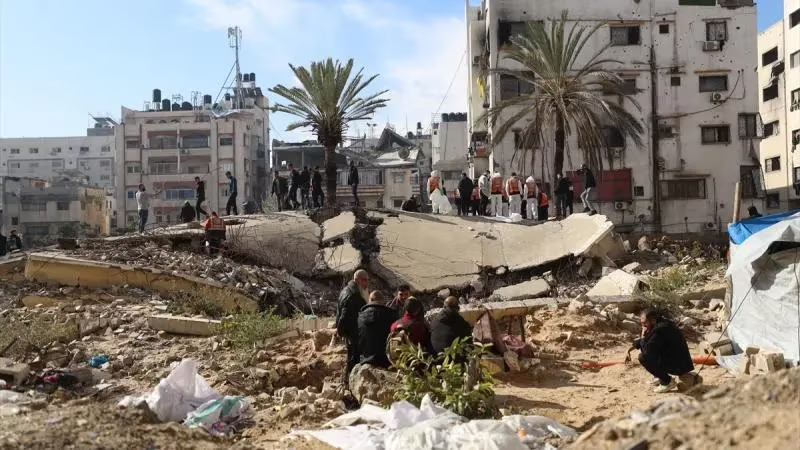
Two buildings damaged by previous Israeli bombing in Gaza City, northern Gaza Strip, collapsed early Saturday morning due to the effects of the recent low-pressure system accompanied by heavy rains.

The Gaza Civil Defense announced that its crews managed to evacuate residents of the "Return 6" tower, consisting of 7 floors in the Tel al-Hawa area southwest of Gaza City, after cracks and collapse occurred in the last four floors.

The statement indicated that no injuries were recorded due to the incident.

On the other hand, local sources and eyewitnesses reported the collapse of a building belonging to the Mughni family in al-Nasr neighborhood in Gaza City, without any deaths or injuries.

The sources added that the building had been previously evacuated and damaged by Israeli bombing during the years of the genocide.

Recently, the Gaza Strip has witnessed incidents of collapse of several homes and residential buildings previously damaged by Israeli bombing, due to the impact of heavy rains and winds, leading to the death and injury of a number of Palestinians, according to government sources.

Palestinians are forced to reside in cracked and dilapidated buildings due to the lack of options amid Israel's destruction of most buildings in the sector, and its prevention of importing mobile homes and construction materials and reconstruction, despite more than two months having passed since the ceasefire agreement in effect since October 10 last year.

The low-pressure systems that struck the sector caused thousands of tents inhabited by displaced people to flood and fly away, greatly exacerbating their suffering.

Since the beginning of December this year, the repercussions of the low-pressure systems that struck the Gaza Strip have resulted in the death of 17 Palestinians, including 4 children, and the collapse of 17 homes and the flooding of about 90% of the shelters for displaced people whose homes were destroyed by Israel, according to a Wednesday statement from Civil Defense.

Israel shirks its commitments stipulated in the agreement, including opening the crossings and allowing the entry of 300,000 tents and mobile homes to secure the basic level of housing after the massive destruction left by the genocide, which affected 90% of the civilian infrastructure.

The agreement ended a genocide started by Israel on October 8, 2023, lasting two years, leaving more than 70,000 Palestinian deaths and over 171,000 injured, with reconstruction costs estimated by the United Nations at about 70 billion dollars.

PALESTINE

Sat 20 Dec 2025 8:58 am - Jerusalem Time

Intensive communications to push the Gaza agreement to the second phase.. What are the alternative options?

Diplomatic communications are intensifying in an attempt to push the Gaza agreement to a new phase, with increasing focus on transitioning to the second phase of the ceasefire, amid efforts led by the United States with the participation of active regional parties.

While the city of Miami hosted a meeting between US President’s envoy Steve Witkoff and Qatari Prime Minister and Foreign Minister Sheikh Mohammed bin Abdulrahman Al Thani, and Turkish Foreign Minister Hakan Fidan and Egyptian Foreign Minister Badr Abdel Ati, US Secretary of State Marco Rubio announced that the war in Gaza has ended, and that work is underway to transition to the second phase of the agreement, noting that the current situation in the sector is unsustainable.

Rubio revealed that the United States is working on creating a new governance structure for Gaza, based on an international council and a Palestinian body of technocrats, followed by the deployment of an international force to achieve stability, in an effort to consolidate the fragile ceasefire.

He explained that progress has been made in identifying the names of Palestinians who will join the technocrats group, and that Washington aims to form governance bodies soon, without providing a specific timeline.

For its part, the Islamic Resistance Movement "Hamas" has clearly set its conditions, where it quoted the movement's leader Bassem Naim as saying that the Miami talks must put an end to Israeli violations, and obligate the occupation to the requirements of the Sharm el-Sheikh agreement, emphasizing that the Palestinian people are waiting for practical steps, not statements.

As for the Israeli side, it reported that the occupation government held a meeting on Thursday evening led by Israeli Prime Minister Benjamin Netanyahu to discuss scenarios for the next phase of the agreement to end the war on Gaza, without reaching clear decisions.

It indicated that all battlefields in Gaza and Lebanon remain in a state of stagnation until the date of Netanyahu's meeting with US President Donald Trump scheduled for the 29th of this month in Florida, to determine the shape of the next phase.

It quoted the broadcasting authority that the meeting held by Netanyahu on Thursday evening discussed several scenarios, including: the possibility of Washington reducing its intervention in the Gaza Strip, or the involvement of forces through private companies and private entities on the ground, and a scenario in which Israel disarms the "Hamas" movement by force, even if it ultimately leads to the formation of an Israeli military government in the sector.

According to reports, Tel Aviv realizes that the next phase of the Gaza agreement will include fulfilling the commitments related to the second phase, opening the Rafah crossing in both directions, allowing reconstruction, and a greater withdrawal of occupation forces, which the occupation government has so far evaded, claiming that it is still waiting for the body of the last prisoner from inside the Gaza Strip.

From the United Nations headquarters, Secretary-General Antonio Guterres emphasized the necessity of transitioning to the second phase of the ceasefire agreement, warning against obstructing this path.

Amid diplomatic pressures and arrangements that have not yet been completed, the transition to the second phase of the Gaza agreement remains subject to political understandings and field commitments.

PALESTINE

Sat 20 Dec 2025 7:53 am - Jerusalem Time

Israeli occupation army expresses 'regret' for harming civilians and claims to investigate the bombing of 'Al-Tuffah neighborhood'

The Israeli occupation opens an investigation into targeting Al-Tuffah neighborhood.

The Israeli occupation army announced the opening of an investigation into a bombing operation that targeted Al-Tuffah neighborhood in the Gaza Strip, while expressing regret for casualties among those it described as "uninvolved."

Investigation and regret

The occupation army confirmed in its statement that it is conducting an official investigation into the circumstances of the recent bombing that hit Al-Tuffah neighborhood in Gaza City.

In a related context, the occupation army stated that it "regrets any harm to the uninvolved in Gaza," emphasizing that its forces work as much as possible to minimize the harm that may befall them during military operations.

Suspicion and gunfire

On the ground level in the north of the sector, the occupation army clarified that its forces proceeded to fire at a group of people after suspecting them while they were inside buildings located west of what is called the "yellow line" in the north of the Gaza Strip.

Read also: A young man injured with fractures in his feet after being run over by settlers east of Nablus - Video

Local Palestinian sources had reported on Friday that at least six Palestinians were martyred and others injured as a result of an Israeli occupation air strike targeting a school near Al-Durra Hospital in Al-Tuffah neighborhood east of Gaza City.

The sources explained that the raid occurred while the school was sheltering hundreds of displaced people, leading to a state of panic and widespread destruction in the building's facilities, which is used as a shelter for families fleeing military operations.

Eyewitnesses stated that the Israeli bombing focused on the second floor of the school building, at a sensitive time when a wedding ceremony was being held in its corridors, turning manifestations of joy into a tragedy after the fall of the dead and wounded among civilians.

PALESTINE

Fri 19 Dec 2025 11:01 pm - Jerusalem Time

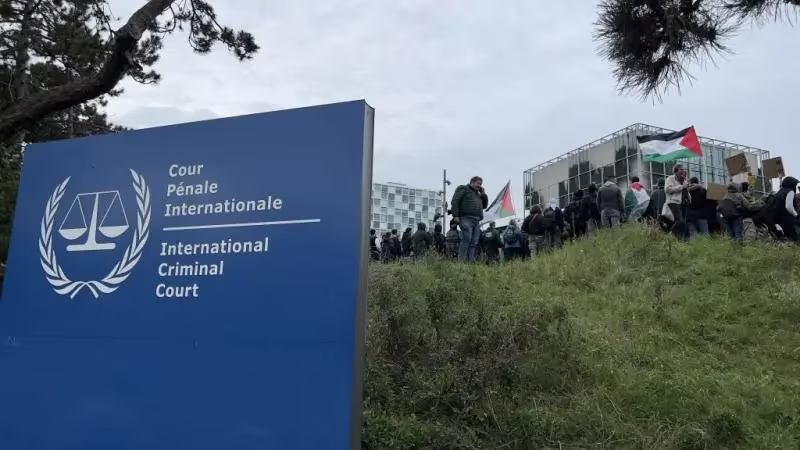
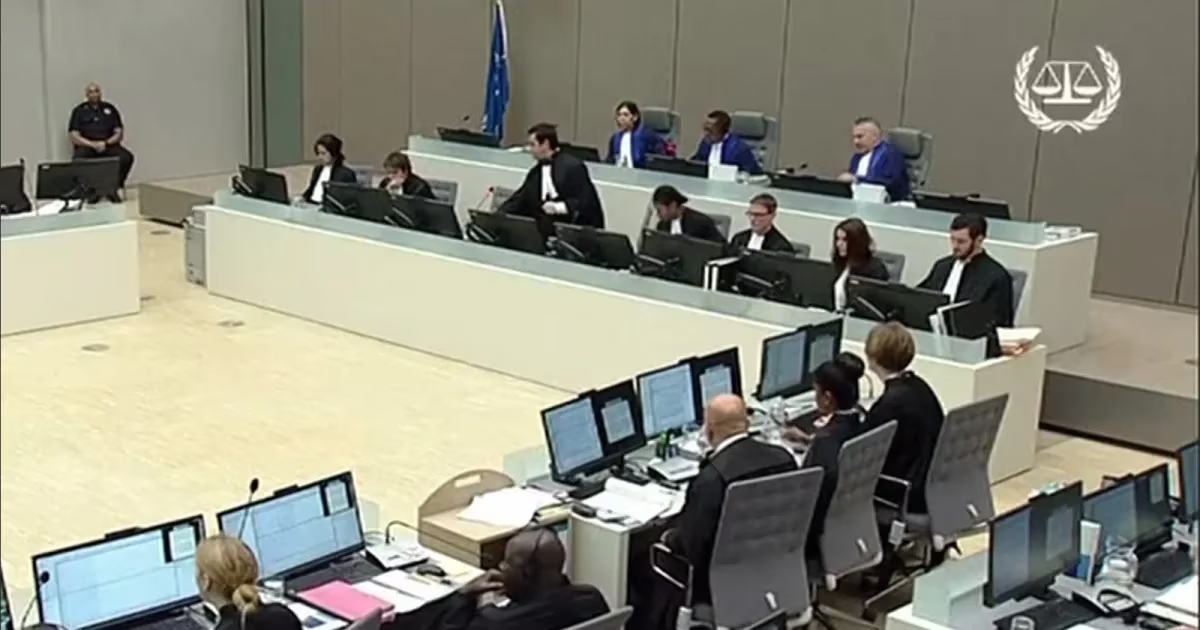
The United Nations condemns US sanctions on two judges in the International Criminal Court

The United Nations condemned, on Friday, the sanctions imposed by the administration of US President Donald Trump on two judges in the International Criminal Court due to investigations related to Israel.

The office of the UN High Commissioner for Human Rights said on the X platform that the sanctions imposed on the two judges represent a new escalation in "retaliatory measures" against international institutions.

The UN Commissioner's office confirmed that "sanctions on judges, prosecutors, or experts at the United Nations contradict the rule of law and the administration of justice".

The two judges sanctioned by the US are: Georgian Gucha Lordkipanidze, and Mongolian Erdenedalai Batbayar, who had voted this week against a challenge submitted by Israel to close an investigation into war crimes in Gaza.

These measures come as part of a series of US sanctions that previously targeted nine judges and prosecutors in the court over the investigation into war crimes allegedly committed by Israel in the Gaza Strip.

The sanctions are linked to the International Criminal Court's decision in November 2024 to issue arrest warrants for Israeli Prime Minister Benjamin Netanyahu and former Defense Minister Yoav Gallant on charges of war crimes and crimes against humanity.

US Secretary of State Marco Rubio said that the two judges covered by the sanctions voted this week in favor of maintaining the two arrest warrants.

In July, Washington also imposed sanctions on the UN Special Rapporteur on human rights in the occupied Palestinian territories, Francesca Albanese, after her repeated accusations against Israel of committing genocide in Gaza.

PALESTINE

Fri 19 Dec 2025 10:56 pm - Jerusalem Time

Rubio: Implementing the second and third phases of the Gaza agreement will take more than 3 years

US Secretary of State Marco Rubio said that the work on implementing the second and third phases of the Gaza agreement will take a long period exceeding 3 years, while the two American envoys will hold another meeting today with officials from Qatar, Egypt, and Turkey regarding Gaza.

Rubio added -in a press conference in Washington- that it is important to complete the first phase of the ceasefire agreement in Gaza and move to the second phase. He explained, "We are in a hurry to end this phase of the agreement so that aid flows and we move to reconstruction."

The US Secretary of State continued, "We want to reach a stage where security is a fundamental part of the process of providing humanitarian aid."

Rubio expressed Washington's desire to accelerate steps to establish a stabilization force in Gaza and form a technocratic government, "because that will lead to the delivery of aid," and acknowledged -at the same time- that the matter is not easy.

He pointed out that the Gaza war is one of the biggest challenges facing President Donald Trump's administration, confirming that the ceasefire in Gaza is one of the greatest achievements that the US administration is proud of.

Rubio said, "I have great confidence that we have a number of countries acceptable to all parties in this matter, and they are ready to participate in the stabilization force." He explained that Pakistan has offered to participate in this force.

The US Secretary of State accused the Islamic Resistance Movement (Hamas) of "violating the ceasefire agreement in Gaza by firing at Israeli soldiers," and emphasized that "if Hamas is able in the future to threaten or attack Israel, there will be no peace, and it will not be possible to convince anyone to invest money in Gaza if they believe that a new war will erupt within two or three years."

He emphasized that a successful donors' conference on Gaza cannot be held before ensuring who will take charge of security in the sector.

The US Secretary of State accused the United Nations Relief and Works Agency for Palestine Refugees (UNRWA) of "corruption," saying that "it cannot be reformed, and we can provide aid in the Gaza Strip without the need for the United Nations."

In the meantime, attention is turning to Miami, where a White House spokesperson said that the American envoys Steve Witkoff and Jared Kushner will hold another meeting today with officials from Qatar, Egypt, and Turkey.

The spokesperson explained that Witkoff will discuss in Miami with the Qatari, Egyptian, and Turkish mediators the transition to the second phase of the ceasefire agreement.

The Axios website had reported, citing sources, that the officials Witkoff will meet are Qatari Prime Minister and Foreign Minister Sheikh Mohammed bin Abdulrahman Al Thani, and Turkish Foreign Minister Hakan Fidan, and Egyptian Foreign Minister Badr Abdel Ati.

In this context, Hamas Political Bureau member Bassem Naim said that the talks scheduled in Miami to move to the next phase of the ceasefire in Gaza must lead to stopping Israel's violations of the truce.

Naim added to Agence France-Presse, "Our people expect from these talks that the attendees agree to put an end to the ongoing Israeli recklessness and stop all violations and breaches and oblige the occupation to the requirements of the Sharm el-Sheikh agreement."

Qatar and Egypt -which play the role of mediators and guarantors for the ceasefire in Gaza- recently urged moving to the next phase of the American president's plan.

The second phase stipulates that Hamas hands over its weapons and Israel withdraws from its current positions in Gaza, and a transitional authority takes over governance in the sector with the deployment of an international stabilization force.

PALESTINE

Fri 19 Dec 2025 10:34 pm - Jerusalem Time

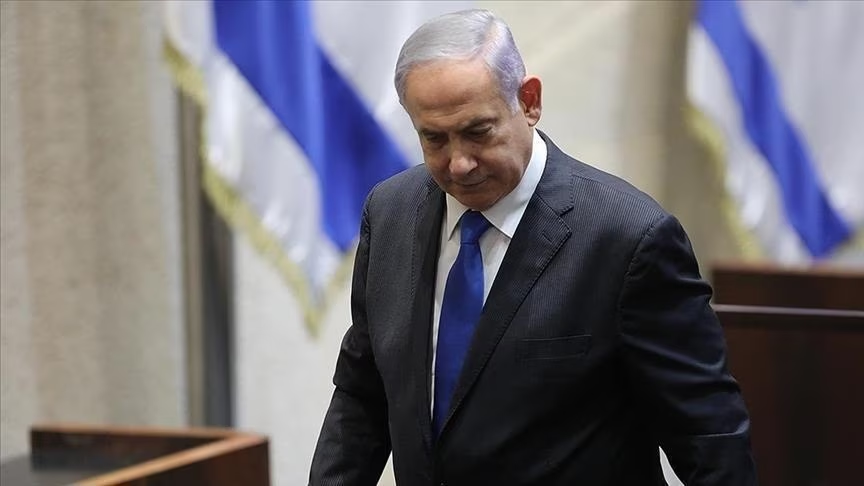
Netanyahu awaits meeting with Trump to decide on Gaza file.. and political stagnation dominates the sector

The Israeli Prime Minister Benjamin Netanyahu is awaiting his anticipated meeting with US President Donald Trump in Florida at the end of December of this month, while the Gaza Strip file is witnessing a state of political stagnation, according to what an informed Israeli source told the official broadcasting authority on Friday.

The Hebrew authority quoted the unnamed source as saying that Netanyahu prefers to postpone taking decisive decisions related to the Gaza Strip until after his meeting with Trump, noting that the vision regarding the sector's future is still immature, amid the absence of clear consensus on the next steps.

The source clarified that the field and political scene in various areas, including the Gaza Strip, Lebanon, and Syria, has not witnessed major changes, and that developments are linked to the results of the planned meeting between Netanyahu and Trump.

He added that the recent discussions regarding the next phase of Trump's plan for the Gaza Strip ended without taking practical decisions, despite addressing essential files, including disarming Hamas movement, a broader withdrawal of Israeli army forces from the sector, in addition to launching a path for reconstruction.

According to the source, several possible scenarios for dealing with the Gaza Strip were raised during these discussions, ranging between a complete American withdrawal from any direct role, and an American field presence through private security companies, as well as the possibility that the Israeli army itself would undertake the task of disarming Hamas, which may ultimately lead to imposing military administration on the sector.

Earlier this December, the Israeli government spokesperson said that Netanyahu will meet Trump on the 29th of the same month, to discuss the next stages in the ceasefire agreement in Gaza.

Yesterday Thursday, Trump said that Netanyahu will likely visit him in Florida during the Christmas holiday, without mentioning a specific date.

It is recalled that on September 29 last year, Trump announced a peace plan and ceasefire in Gaza consisting of 20 points, including: the release of Israeli prisoners, ceasefire, disarming Hamas movement, Israeli withdrawal from the sector, forming a technocratic government, and deploying an international stabilization force.

On October 10 last year, the first phase of the ceasefire agreement came into effect, while Israel violated some of its provisions and delayed transitioning to the second phase, claiming the remaining of one of its soldiers captive in Gaza, despite the Palestinian factions continuing their search operations amid the massive destruction caused by the Israeli genocide that lasted for two years.

The agreement was supposed to end a genocide committed by Tel Aviv over two years starting from October 8, 2023, which resulted in the killing of more than 70,000 Palestinians, and injuring more than 171,000, but Israel continues its violations and suffocating blockade on the sector to this day.

PALESTINE

Fri 19 Dec 2025 8:42 pm - Jerusalem Time

Heavy artillery bombardment east of Gaza kills and injures displaced people

A heavy artillery bombardment that targeted the Tuffah neighborhood east of Gaza City on Friday evening resulted in the martyrdom and injury of a number of Palestinian civilians displaced in the area, while the occupation forces deliberately prevented rescue and ambulance crews from reaching the targeted location.

A local source said that artillery shelling targeted the training building affiliated with the Directorate of Education and Training in the Tuffah neighborhood east of Gaza, which is located opposite the Dar Al-Shifa Hospital for Children, targeting displaced people inside it and in the vicinity of the hospital, causing a number of martyrs and injured, some of whom were torn to pieces due to the intensity of the bombardment.

The source emphasized that the occupation forces prevented the entry of ambulances to the targeted location to retrieve the martyrs and injured, as the occupation forces impose a aerial siege on the area and prevent approaching the place.

The targeted area is one of the areas from which the occupation army withdrew, in implementation of the ceasefire agreement in force in the Gaza Strip since October 11.

Since that date, the occupation forces have continued their violations of the agreement that ended the Israeli genocide war in the sector, committing about 738 violations, killing more than 395 Palestinians, according to the latest report from the Government Media Office in Gaza.

The genocide left more than 70,000 Palestinian martyrs and 171,000 injured, most of them children and women, and massive destruction with a reconstruction cost estimated by the United Nations at about 70 billion dollars.

PALESTINE

Fri 19 Dec 2025 8:30 pm - Jerusalem Time

US Secretary of State: Hamas cannot remain in a position threatening 'Israel'

US Secretary of State: Agreement to end the war in Gaza is moving forward

US Secretary of State Marco Rubio confirmed that the United States adheres to its position rejecting the survival of the "Hamas" movement in a position that allows it to threaten the security of the Israeli occupation entity, emphasizing that any political settlement must ensure the complete dismantling of the movement's military capabilities.

Rubio explained that this measure primarily aims to prevent the recurrence of any future attacks similar to the Al-Aqsa Flood operation on October 7, 2023, where Washington sees the dismantling of the movement's infrastructure as an utmost necessity for achieving lasting stability in the region.

In the context of ongoing diplomatic efforts, Rubio indicated that the agreement aimed at ending the war in the Gaza Strip "is moving forward" despite field challenges, noting the existence of tangible progress in formulating details that ensure the cessation of combat operations alongside achieving security objectives.

This statement comes at a time when the US administration is intensifying its communication with regional parties to implement the "Trump Peace Plan," which includes deploying an international stabilization force and forming a peace council to manage the sector's affairs in the coming phase.

It is expected that the US envoy Steve Witkoff will hold high-level meetings with foreign ministers of Qatar, Egypt, and Turkey to discuss mechanisms for transitioning the agreement to its second phase.

Washington emphasizes in its talks that the next phase requires establishing a Palestinian civil authority that assumes responsibility away from the control of armed factions, while ensuring the opening of crossings and the unconditional delivery of humanitarian aid to the population, to avoid the collapse of the understandings recently reached.

PALESTINE

Fri 19 Dec 2025 8:12 pm - Jerusalem Time

A complex and organized network stands behind operations to transfer hundreds of Palestinians from the Gaza Strip to third countries

A journalistic report revealed a complex and organized network behind operations to transfer hundreds of Palestinians from the Gaza Strip to third countries such as South Africa, Malaysia, Indonesia, and primarily involving the Majd Company and the newly established Israeli Voluntary Migration Office.

The report stated that a group of about 100 Palestinians from Gaza left Israel on the evening of Wednesday, November 12, 2025, having left Gaza early in the morning of Wednesday, and after undergoing Israeli security checks at the Kerem Shalom crossing, they were transported by buses to Ramon Airport near Eilat, where they boarded a chartered flight to Nairobi in Kenya, and from there transferred to another chartered plane that landed in Johannesburg on Thursday morning.

However, the Gazans were shocked that the South African government refuses to accept them and wants to return them to Gaza, and according to sources at the airport who were waiting for the group, they said they were informed that South African authorities refuse to allow the passengers to disembark, and that they are not injured or sick and do not hold dual citizenship.

The newspaper added that this is the second group of Gazans traveling to South Africa in the past two weeks, noting that the previous group followed the same route and entered Johannesburg without any problem.

The Coordinator of Government Activities in the Territories (COGAT) stated that the departure of Gazans is usually coordinated directly between Israeli authorities and the receiving countries in the case of dual citizens or students with study visas, or through the World Health Organization, which oversees the evacuation of the injured and sick to host countries.

The newspaper concluded that before reaching a ceasefire in Gaza, a security source said that after the announcement by US President Donald Trump of a plan to transfer Gaza residents out of the sector, the Israeli government decided to ease restrictions on Palestinians wishing to leave, and among the measures is significantly easing security standards. According to the source, at least 95% of exit requests are now approved, compared to a much lower rate before the government decision.

Israel currently allows Gaza residents to leave through two main routes: transferring them to Ramon Airport if the receiving country sends a plane to pick them up, or through the Allenby Bridge crossing to Jordan. So far, about 7,000 Palestinians have left Gaza through the Kerem Shalom crossing, either towards Jordan or to travel abroad via Ramon Airport, while about 30,000 others have left to Egypt through the Rafah crossing.

General background: From “voluntary migration” to soft displacement from Gaza

Suspicious air flights: Documenting displacement routes from Ramon to Africa and Asia

The “Majd Europe” Association: A humanitarian front for displacing Gazans and collecting their data

The Voluntary Migration Office in Israel: The official cover for emptying Gaza of its population

Tomer Lind and the network of fake companies: The hidden role in managing displacement projects

Kobi Blitzstein and the Israeli right: The political dimension of the plan to empty Gaza

Aviation data documents the flights

According to information obtained by Haaretz newspaper, the latest flight that took place in November 2025 left Gaza early in the morning of Wednesday.

From the Kerem Shalom crossing, they were transported by buses to Ramon Airport near Eilat, where they boarded a chartered flight to Nairobi in Kenya. There, they transferred to another chartered plane that landed in Johannesburg on Thursday morning.

By reviewing the records of planes that left Eilat towards Kenya, it was found that there was a plane belonging to the FLYYO company, a Romanian commercial airline company led by CEO Ziv Maybridge, who is Israeli.

The company began its operations in Israel in February of this year, which raises suspicions about the company's dealings with Israel, and after only one month, the Israeli Migration Office announced the start of transferring Gazans in the same month to countries in Africa and Asia.

By searching the company's aircraft records, it was found that one of them bears the registration number YR-ADD, and by reviewing its records, it had no flights from Israel to Africa except this flight on November 12.

This plane left Ramon Airport near Eilat on Wednesday, November 12, at 17:00 GMT (7:00 PM Israel time), and arrived in the Kenyan capital Nairobi at 21:59 GMT (11:59 PM Israel time).

Flight path from Eilat to Nairobi (Al Jazeera)

Then we moved to track the plane that transported the passengers from Nairobi to South Africa, and by reviewing Johannesburg airport records, we found only one plane that landed in the morning at the airport coming from Nairobi on Thursday, November 13, 2025.

It turned out that the plane belongs to the South African company Global Aviation, with registration number ZS-GAC, and it is a commercial transport plane that usually operates on the passenger line between South Africa and Kenya, and the plane took off at 02:07 GMT — that is, about 5 hours after the arrival of the flight believed to have carried the Gazans — and arrived in Johannesburg at 06:19 GMT.

Flight path from Nairobi to South Africa (Al Jazeera)

Not the first time

And this was not the first time it is believed to have transported Gazans from Gaza, as according to reports, the first flights to transport Gazans were on March 19, 2025, when 70 Gazans holding foreign nationalities or with family ties abroad left Ramon Airport in southern Israel on a Romanian military plane heading to Europe, and Israeli authorities said they assisted in the evacuation operation as part of the migration policy they adopt.

And we actually found a Romanian military plane that left Ramon Airport heading to Romania on March 19, 2025, with registration number 6166 of the C130 model.

This flight was repeated on September 17, 2025, when a Romanian military plane with number 9143 of the C130 model also moved from Ramon Airport to Romania, and on the same day, several Israeli sources reported that 550 people left Gaza to various destinations (including Romania), where the Coordination Office (COGAT) said that most of those who left Gaza that day were Palestinian patients and their caregivers.

Other flights

Haaretz said that a group of Gaza residents, consisting of 57 people, left the sector on May 27, 2025, and on the night before their departure, dozens of residents received a message via the “WhatsApp” app containing a specific address in the sector to go to, and from there, they headed by buses to the “Kerem Shalom” crossing.

The bus departed after Israeli inspection to Ramon Airport, where the group boarded a chartered plane from the Romanian company “Flylili”, which headed to Budapest, and from there the travelers continued their journey to Indonesia and Malaysia.

By reviewing Flylili company flights, we found that it had a flight from Eilat to Budapest in Hungary on May 27, 2025, with number FL7000, which was not recorded on any similar flight, unlike the repeated second plane flights.

PALESTINE

Fri 19 Dec 2025 8:05 pm - Jerusalem Time

UN Report: 1.6 Million People in Gaza Face Acute Food Insecurity Until 2026

A UN report revealed on Friday that at least 1.6 million people in the Gaza Strip are facing a high level of acute food insecurity until mid-April 2026.

This comes according to the Integrated Food Security Phase Classification report prepared by UN agencies, which includes projections of the situation in Gaza during the period from December 1, 2025, to April 15, 2026.

The report stated, "According to the latest analysis of the Integrated Food Security Phase Classification following the announcement of the ceasefire on October 10, 2025, significant improvements in food security and nutrition were observed compared to the previous analysis, which indicated famine in August 2025."

It added, "Despite recent improvements, at least 1.6 million people will continue to face a high level of acute food insecurity until mid-April 2026."

The report predicts recording about 101,000 cases of acute malnutrition among children aged 6 to 59 months in Gaza between October 2025 and October 2026, of which 31,000 cases are expected to be severe.

It indicated that about 37,000 pregnant and lactating women will need urgent nutritional support.

The report emphasized that the situation in Gaza is extremely fragile, and any improvements recorded so far depend on the sustainable, expanded, and uninterrupted access of humanitarian and commercial aid.

It warned that in the worst-case scenarios, including the resumption of conflict and the cessation of humanitarian aid, the entire Gaza Strip could face the risk of famine by mid-April 2026.

It is worth noting that the population of Gaza has declined to 2,114,301 people, according to a report prepared by the Palestinian Central Bureau of Statistics on the occasion of World Population Day in July.

Before the start of the genocide war launched by Israel on Gaza, the population of the Strip was about 2,226,544 people, according to Palestinian statistics.

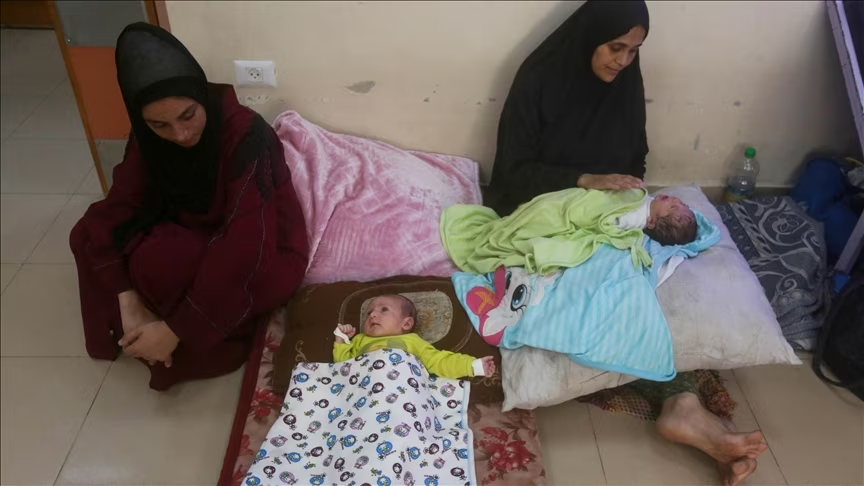
Hundreds of thousands of displaced people in the Strip are suffering from harsh living conditions after the destruction of their homes and forced displacement, amid a severe shortage of blankets and heating means, and a widespread deterioration in humanitarian conditions with the onset of winter.

This suffering comes amid Israel's failure to fulfill its commitments stipulated in the ceasefire of October 10 and its humanitarian protocol, including the entry of shelter materials and 300,000 tents and mobile homes, as confirmed repeatedly by the Gaza Government Media Office.

The genocide that began on October 8, 2023, supported by Washington and lasted two years, has left more than 70,000 Palestinian dead and 171,000 injured, mostly children and women, and immense destruction with reconstruction costs estimated by the United Nations at about $70 billion.

PALESTINE

Fri 19 Dec 2025 7:08 pm - Jerusalem Time

Guterres: War must be stopped to save Gaza from imminent famine

The UN Secretary-General, António Guterres, issued stark warnings about the humanitarian situation in the Gaza Strip, confirming that 1.6 million people are expected to face extreme levels of acute food insecurity.

The Secretary-General emphasized that there is an urgent need for a permanent ceasefire to save lives and provide necessary aid.

Guterres strongly called for the immediate transition to the second phase of the agreement to end the war in Gaza, stating that "there should be no excuses" for delaying this decisive step, and saw that the agreement is the only path to achieving stability, with the necessity to move forward towards a two-state solution as a comprehensive political framework for the conflict.

In the context of relief efforts, the Secretary-General emphasized the need to respect the safety of UN staff stationed in the sector, reiterating his full support for the "UNRWA" agency as the backbone of humanitarian work in Gaza, and rejecting any interference with its vital role.

PALESTINE

Fri 19 Dec 2025 6:44 pm - Jerusalem Time

The United Nations Emphasizes the Need for a Permanent Ceasefire in Gaza

The United Nations emphasized today, Friday, the need for a permanent ceasefire in Gaza, confirming that life-saving shelter aid does not reach Palestinians in the sector on a wide scale, due to the lack of urgent access and the restrictions imposed on it.

The UN Secretary-General Antonio Guterres said in a press conference that it is necessary to move to the second phase of the agreement and fully implement the terms of the agreement, which contributes to stabilizing the calm and improving the humanitarian situation in the Gaza Strip.

He confirmed that 1.6 million people in Gaza are expected to face extreme levels of acute food insecurity, amid Israel's prevention of the entry of sufficient aid as stipulated in the ceasefire agreement that came into effect on October 10 last year.

Guterres renewed his support for the United Nations Relief and Works Agency for Palestine Refugees (UNRWA) amid the Israeli campaign it has faced for more than two years, emphasizing Israel's need to respect the safety of United Nations staff in Gaza.

He added that we must move towards a two-state solution. He also highlighted the dire conditions in the occupied West Bank, saying that tens of thousands have been displaced due to operations carried out by Israeli forces in the north of the West Bank.

In a related context, the spokesperson for the United Nations International Organization for Migration, Afand Aziz Agha, said that Gaza residents need improved conditions to ensure access to clean water, sanitation services, and toilets, in addition to protection from living in cold conditions.

This came in statements made by Agha alongside the spokesperson for the World Health Organization, Tarik Jasarevic, during the weekly press conference of the United Nations office in Geneva.

He noted that winter conditions, including heavy rains and storms that cause floods in destroyed neighborhoods and flood tents, currently lead to people being exposed to diseases more and facing increased risks.

He called for urgent and unrestricted access of humanitarian aid to the Gaza Strip, at a time when Israel does not allow the entry of tents and shelter materials into the Gaza Strip, forcing hundreds of thousands of residents to live in dilapidated and rudimentary tents.

For its part, the World Health Organization said that 1,092 patients died in the Gaza Strip while waiting for medical evacuation between July 2024 and November last year.

The ceasefire agreement was supposed to end the genocide, but Israel continues its violations, killing hundreds of Palestinian civilians between martyrs and wounded, in addition to violating the humanitarian protocol related to aid and shelter supplies.

ARAB AND WORLD

Fri 19 Dec 2025 6:39 pm - Jerusalem Time

The United States Imposes Sanctions on Two Judges at the International Criminal Court

The United States imposed sanctions on two judges at the International Criminal Court, in a move that sparked widespread criticism, after they voted against an appeal filed by Israel regarding the court's jurisdiction to investigate suspected crimes in the Gaza Strip.

U.S. Secretary of State Marco Rubio announced the sanctions, justifying the decision by saying that the judges targeted a state "defending its sovereignty," referring to Israel, a step welcomed by the Israeli government and considered a political and legal defense of it.

According to the data, the two judges, one from Georgia and the other from Mongolia, voted earlier this week against Israel's appeal regarding the court's jurisdiction, which Washington described as a "legal war" on Israel.

For its part, the International Criminal Court expressed rejection of the U.S. sanctions, considering them a blatant assault on the independence of an international judicial body and an attempt to intimidate judges and influence the course of justice.

The U.S. move sparked widespread reactions among activists and international law experts around the world, with many questioning American double standards, as noted by the "Hashtag" program in its episode (2025/12/18).

In this context, journalist Natalia Morris commented, criticizing the U.S. position and its complete bias towards Israel, saying:

"The United States and Israel are not members of the International Criminal Court; imposing sanctions on its judges while denying its jurisdiction is a clear contradiction. Define your position, and just a reminder, you do not represent Israel."

From a legal perspective, human rights activist Sarah Leah Whitson considered the International Criminal Court's response insufficient, and wrote:

"Rejecting these sanctions alone is not enough; the court should legally pursue this blatant interference and intimidation of judges under Article 70 of the Rome Statute, which criminalizes any interference or tampering with the administration of justice within the International Criminal Court, to protect the court and its judges from political pressure and blackmail."

In a direct political question, Tom Elliott wrote, criticizing Washington's position and its role as the "world's policeman":

"Why should the United States intervene at all? What happened to what the administration initially said about the United States stepping back from its supposed role as the world's policeman?"

As for Marcus, he summed up his criticism with biting sarcasm, saying:

"We love imposing sanctions on judges instead of criminals; it seems we have to live with this."

In a broader comment on the impact of this step, an account concerned with international law wrote, warning of the repercussions of the U.S. move:

"Such actions targeting judges and prosecutors elected by the state parties undermine the rule of law, and when judicial actors are threatened for applying the law, the international legal system itself is at risk."

In conclusion of the interactions, a blogger expressed his fundamental skepticism about the viability of the international legal system, saying:

"Overall, this reinforces what I have always believed: international law has no real existence. This does not mean it should not usually be adhered to, but ultimately it is just a political theater, and it is better to master this game."

These sanctions come in a recurring context, as the United States previously imposed sanctions in March 2025 on two judges from France and Canada, in addition to two prosecutors at the court, on the grounds of their participation in efforts to investigate or issue arrest warrants against American or Israeli citizens.

The United States and Israel base their position on the fact that they have not signed the Rome Statute that established the International Criminal Court, considering that the court has no authority to prosecute them, in a message described as clear and loud, meaning that any legal actions against non-signatory states will face consequences.

PALESTINE

Fri 19 Dec 2025 5:55 pm - Jerusalem Time

Hamas: Miami talks must lead to stopping Israeli violations

The Hamas leader, Bassem Naim, said today, Friday, that the talks scheduled in Miami to move to the second phase of the ceasefire agreement in Gaza must lead to stopping Israeli violations.

He quoted Naim as saying that "the Palestinian people expect from these talks that the attendees agree to put an end to the ongoing Israeli rampage, stop all violations and breaches, and oblige the occupation to the requirements of the Sharm el-Sheikh agreement."

The member of the Hamas Political Bureau expressed hope that the talks would lead to obliging Israel "to the requirements of the Sharm el-Sheikh agreement, foremost among them the clauses related to humanitarian conditions, entry of aid, opening the Rafah crossing in both directions, and introducing all reconstruction and infrastructure rehabilitation needs."

The Hamas leader also emphasized the necessity for the discussions during these meetings to include "how to implement what remains of the Trump plan, in a way that achieves sustainable stability, launches a comprehensive reconstruction process, and establishes a political path through which the Palestinian governs himself, ending with an independent state with full sovereignty."


"Political Marathon"


The United States is hosting talks in Miami, Florida, today, where the special envoy of President Donald Trump, Steve Witkoff, is expected to meet senior officials from the mediating countries Qatar, Egypt, and Turkey, to advance the second phase of the agreement.

The Axios website quoted a White House official and two other sources as saying that Steve Witkoff will meet today, Friday, in Miami with Qatar's Prime Minister and Foreign Minister Sheikh Mohammed bin Abdulrahman Al Thani, and Foreign Ministers Turkish Hakan Fidan and Egyptian Badr Abdel Ati to discuss the next phase of the Gaza agreement.

American media describe the Miami meeting as a "political marathon," and said it is an attempt to prevent the return of war in Gaza and to save the entire peace plan, which they see as approaching imminent collapse.

As for the New York Times, it sees a kind of evasion of the commitments of the second phase, according to what journalist Abdul Rahman Yusuf reported.

Yusuf explained in his talk from Washington that from the perspective of American journalism, Hamas is evading the disarmament issue, while Israel is evading the abolition of the buffer zones idea and the gradual withdrawal from the entire sector.


Egyptian call to stop breaching the agreement


Meanwhile, Egypt - which plays the role of mediator between Israel and Hamas - affirms that it is pushing for a quick implementation of the second phase of the war ceasefire agreement in Gaza.

Egyptian Foreign Minister Badr Abdel Ati said that speed of implementation is necessary to achieve all elements of the agreement, but he emphasized at the same time the need to take steps to stop ceasefire violations.

Abdel Ati affirmed in a press conference in Cairo the "importance of the international community assuming its responsibilities and exerting real and effective pressures to stop all violations that occur daily to the ceasefire agreement."

Qatar and Egypt, which act as mediators and guarantors for the ceasefire in Gaza, have recently urged the transition to the next phase of US President Donald Trump's plan.

Amid these calls, the Israeli army continues its violations of the ceasefire in Gaza, the latest of which was launching air raids and artillery shelling this morning, Friday, on several areas of the sector.

The scene was not limited to direct targeting, but also included intense hovering of Israeli drones, which have not left the skies of the sector since the start of the war, and continued even after the ceasefire entered into force.

PALESTINE

Fri 19 Dec 2025 5:43 pm - Jerusalem Time

Palestinians Injured by Israeli Army Gunfire in Ramallah

Two Palestinians were injured, on Friday, by gunfire from the Israeli army during its raid on Jalazone camp north of Ramallah in the occupied West Bank.

The Palestinian Red Crescent said in a statement that its crews in Ramallah treated two gunshot wounds, one in the abdomen and the other in the foot during the camp's raid.

Local sources reported that Israeli forces raided Jalazone camp, positioned themselves between the houses, and fired bullets and tear gas canisters towards the residents.

Since Israel began its genocide war in Gaza, its army and settlers in the West Bank have killed more than 1100 Palestinians, injured about 11,000, in addition to arresting more than 21,000.

Meanwhile, the genocide supported by the United States and lasting two years has left more than 70,000 Palestinian dead and 171,000 injured, mostly children and women, and massive destruction with reconstruction costs estimated by the UN at about 70 billion dollars.

PALESTINE

Fri 19 Dec 2025 3:40 pm - Jerusalem Time

World Health Organization: 1092 Patients Died in Gaza Awaiting Medical Evacuation

The Director-General of the World Health Organization, Tedros Adhanom Ghebreyesus, confirmed that 1092 patients who were awaiting medical evacuation from the Gaza Strip lost their lives during the period between July 2024 and November 28, 2025.

Ghebreyesus said in a post on the "X" platform (formerly Twitter) on Friday: "The World Health Organization and its partners have evacuated more than 10,600 patients suffering from serious health issues from Gaza since October 2023, including more than 5,600 children."

Ghebreyesus added: "A much larger number of patients in Gaza are still awaiting evacuation to receive appropriate healthcare. According to the Ministry of Health, 1,092 patients died while waiting for medical evacuation during the period between July 2024 and November 28, 2025, and nevertheless, this number is believed to be lower than the actual figure probably."

He pointed out that they are demanding more countries open their doors to patients coming from Gaza, and resume medical evacuation operations in the occupied West Bank, including East Jerusalem.

It is worth noting that "Israel" prevents the entry of sufficient amounts of food, medicine, and medical supplies into Gaza, where about 2.4 million Palestinians live in catastrophic inhuman conditions.

It was supposed that the ceasefire agreement in effect since October 10 last year would end the genocide war launched by "Israel" on Gaza on October 8, 2023, which left more than 70,000 Palestinian martyrs and 170,000 injured, most of them children and women.

The occupation army launched air raids and artillery shelling on the Gaza Strip on Friday morning, within the areas it continues to occupy. Eyewitnesses reported that the Israeli attacks targeted the eastern areas of Gaza City in the north of the sector, in addition to the northern and eastern areas of Khan Yunis city in the south of the sector.

In the eastern areas of Khan Yunis, Israeli warplanes carried out raids coinciding with artillery shelling that hit several areas, amid the sound of violent explosions.

Those areas also witnessed intermittent gunfire since dawn hours from Israeli military vehicles.

In the west of Khan Yunis, Israeli warships fired their machine guns towards fishing boats in the sea.

PALESTINE

Fri 19 Dec 2025 2:26 pm - Jerusalem Time

Israeli Human Rights Organization: Israel is Carrying Out Genocide in Gaza and Deliberate Starvation

The Israeli human rights organization B'Tselem published a detailed report on Israeli crimes in the Gaza Strip, particularly the forced displacement of the sector's residents during the war period, confirming that the Israeli regime has been carrying out ongoing genocide in the sector since October 2023.

The organization's report first addresses the numbers of victims, martyrs, and injured during the war, relying on reports from the Palestinian Ministry of Health in Gaza, which estimated the number of deaths resulting from the direct attack at around 68,519 people, the vast majority of whom were civilians who did not participate in the fighting, while estimating the number of injured at around 170,382 people.

However, the organization noted that a series of studies published over the months of the attack indicate that these figures represent an underestimate of the number of deaths, and that there is reasonable cause to believe that the number of victims claimed by Israeli attacks is much higher.

The organization discusses in its report -among other things- the main "waves of displacement" in the Gaza Strip since October 2023, noting that dividing what happened into "waves" is a simplification of the routine of displacement and the dynamic and continuous pushing of residents to flee their areas, which dictated the life path of Gaza Strip residents without interruption since October 2023.

It stated that between October 2023 and October 2025, the Israeli army issued at least 161 evacuation orders to the sector's residents, many of which ordered the evacuation of dozens of areas at the same time.

The organization mentioned in its report that the Israeli army issued on October 13, 2023 (that is, only 6 days after the outbreak of the war) the first collective evacuation orders for Gaza Strip residents, which ordered about 1.1 million people from the northern sector to leave their homes and head south within 24 hours.

It said that hundreds of thousands of people -who were exposed to intense bombing at the time- were forced to make a hasty decision about where to flee, without knowing if they would be able to return to their homes and when. As a result, many began fleeing to the central and southern sectors with little equipment that they could carry on their bodies.

The second wave came in December 2023, that is, about two months after the start of the war, coinciding with the start of the attack on the Khan Yunis city area in the south of the sector, where the Israeli army ordered about half a million people who were in Khan Yunis and the central sector, half of whom were approximately displaced people who had arrived in those areas from the north during the previous two months, to evacuate an area of 80.8 square kilometers, which is about 22% of the sector's area. Most of them reached the Rafah city area.

On May 6, 2024, the army issued new evacuation orders asking those in Rafah city to move to what it described as the "new and expanded humanitarian zone" in the Moasi area, which shrank from December 2023 to May 2024 from about 22% to about 17% of the sector's area, according to the report.

October 2024 witnessed another wave of displacement, following the launch of what was known as the Generals' Plan, which sought to attempt to displace the remaining civilians in northern Gaza through starvation and siege.

During that time, residents of Gaza City and the towns of Beit Hanoun, Beit Lahia, and Jabalia were asked to head south to the "humanitarian zone" in the Moasi area.

The organization mentioned that Israel's practices in the northern sector, including the policy of starvation, widespread destruction, and displacement of hundreds of thousands of residents from their homes, were considered by many experts -including the UN Secretary-General- as an attempt to implement ethnic cleansing.

Between January and March 2025, about half a million displaced people returned to the north, after the ceasefire signed at the beginning of 2025, and many spoke of the immense destruction and devastation they saw with their own eyes in the places where their homes, neighborhoods, and cities once stood.

The organization said that since the violation of the ceasefire on March 18, 2025, until September 2025, Israel completely stopped designating "humanitarian zones" in the evacuation orders it distributed to the sector's residents, but at the same time continued to displace people from their homes in various areas, whether in the northern sector or in the south.

By the end of August and the beginning of September 2025, Israel launched a large-scale attack on Gaza City, and for the first time since March 2025, designated a new "humanitarian zone" around Khan Yunis, extending over about 11% of the sector's area.

The organization extensively discussed the harsh conditions prevailing in the displaced camps, including severe overcrowding, acute shortages of food and clean water, and basic services, in addition to the spread of epidemics, lack of care for the injured and disabled, and the prevention of entry of basic necessities such as crutches and sanitary pads.

It also discussed the ongoing effects of displacement, including severe effects on the mental health of Gaza Strip residents.

It pointed to a study on the displaced in the sector, conducted in October 2024, which found that between 70% and 90% of participants met the diagnostic criteria for post-traumatic stress disorder.

The study also showed that 63% of them had serious indicators of anxiety, depression, and post-traumatic stress disorder at the same time.

Researchers believed that unlike previous conflicts, where displaced people were able to find alternative shelter at some point, displaced people in the sector this time remained trapped inside a raging war zone for several months, without the possibility of resettling or ensuring basic security for themselves or starting the recovery process, according to the report.

In addition to the successive waves of collective displacement, the organization said in its report that famine in Gaza is not a secondary result of the war, but the expected result of Israel's deliberate and declared starvation policy, after it systematically destroyed and disrupted most of the food production and distribution systems that existed in the sector.

It said that while systematically preventing the entry of food into the sector, an American entity called the "Gaza Humanitarian Foundation" (GHF) began operating 4 "relief centers" in the sector at the end of May 2025, and these centers, which were established with encouragement and support from Israel, aimed -according to the report- among other things, to force the sector's residents to gather in the crowded areas designated by Israel as humanitarian zones.

It mentioned that from the first days of its activity, a UN representative described these complexes as "death traps," where crowds of starving and exhausted people are forced to stand in severe congestion and compete among themselves for the few aid packages, under the fire of Israeli forces present in the area, which were ostensibly securing the distribution of food.

It added that almost every day the centers were operated, dozens of people were killed by gunfire in their vicinity, most of them from displaced camp residents who arrived there in an attempt to obtain a little food for themselves and their families.

At the end of the report, the organization confirmed that in light of the seriousness of the crimes for which the Israeli leadership bears responsibility, it is the duty of the international community to act immediately and decisively to ensure that Israeli decision-makers are brought to justice and held accountable for their actions.

It also confirmed that -in addition to that- the international community must ensure the entry of the required humanitarian aid in the immediate term, then begin the process of rebuilding the Gaza Strip, which is expected to last for decades, without delay and in an effective manner, overcoming the difficulties and obstacles placed by Israel, and which it is expected to continue placing in front of the reconstruction process as stated in the report.

PALESTINE

Fri 19 Dec 2025 1:45 pm - Jerusalem Time

The Palestinian-Israeli Issue Tops Global Newspaper Coverage

The Palestinian-Israeli issue tops the coverage of major global newspapers, with notable focus on the future of the war in the Gaza Strip and its political and humanitarian repercussions.

The Wall Street Journal viewed US President Donald Trump's peace plan for Gaza as widely considered a "victory" despite major obstacles, primarily the issue of disarming the Islamic Resistance Movement (Hamas).

It quoted analysts as saying that Washington is ready to proceed with implementing the plan even without a clear commitment from Hamas to disarm.

In the same context, former US Ambassador to Israel Daniel Shapiro said that Trump opposes Israel resuming its major military operations, fearing damage to his credibility linked to ending the war, revealing the US administration's efforts to deploy a force of 10,000 soldiers in Gaza under American command, which will take most of next year to prepare.

The British Financial Times addressed the catastrophic conditions in Gaza amid winter storms, noting the suffering of residents trapped in tents.

It quoted Erika Guevara Rosas, senior researcher at Amnesty International, as saying that scenes of tents flooded with water and collapsed buildings are not the result of weather alone, but the inevitable outcome of the ongoing genocide and Israel's deliberate policy of preventing the entry of shelter and reconstruction materials for the displaced.

On the Israeli side, Haaretz in its editorial said that Benjamin Netanyahu's government passed a series of laws threatening democracy in Israel, considering that these legislations do not address post-war crises in Gaza, but strengthen government control and "make the state more corrupt, indebted, and less democratic."

The newspaper warned that the upcoming elections will be a referendum on "the future of Israel itself, not on the Palestinian issue."

Internationally, Politico reported that the US State Department decided to impose sanctions on two judges at the International Criminal Court, alleging they carried out "political and unlawful" actions against Israel, a step reflecting ongoing US pressure on international institutions to prevent criticism of Tel Aviv.

In other files, the American "Washington Post" quoted David Miliband, head of the International Rescue Committee, describing the situation in Sudan as a glaring example of the new global chaos and the international system's inability to deal with it.

As for the British Times, it reported that European leaders agreed to grant Ukraine a loan worth 90 billion euros after a grueling summit in Brussels, considered the most tense and decisive in the modern history of the European Union.

The New York Times addressed Trump's escalation against Venezuela, warning of his use of misleading legal justifications, while the British Independent concluded by noting Britain's commitment to confronting violence against women as a threat on the scale of terrorism.

ARAB AND WORLD

Fri 19 Dec 2025 1:40 pm - Jerusalem Time

5 False Claims in Trump's Speech.. Highlighting Inflation and Immigration

A report published by an American magazine reviewed 5 pieces of information mentioned in the year-end speech delivered by US President Donald Trump the day before yesterday, Wednesday, which mixed inaccurate claims and exaggerations partially based on real data, according to the magazine.

The speech comes amid declining political support for Trump and political pressures within the Republican Party to improve the economic situation ahead of the 2026 midterm elections.

Instead of outlining his future policies, the President chose to highlight his achievements and declared that 'America is the best in the world,' but avoided discussing sensitive issues such as tensions with Venezuela or relations with China and Russia, according to the magazine's correspondent Jesus Mesa.

Trump mentioned that 25 million immigrants entered the United States during the tenure of former President Joe Biden, describing it as an invasion, but official data from border protection forces recorded less than that.

Trump mentioned that more than 11,000 criminals entered the country, but the report confirmed that this statistic dates back to cumulative data over 40 years, and is not linked only to Biden's period.

Trump announced that he completely stopped inflation after it peaked in 2022. However, the report clarified that inflation did decrease but did not stop, relying on data from the Bureau of Labor Statistics showing inflation rising by 3% in September 2025, according to the magazine.

The report also debunked the President's claim that the inflation he inherited was 'the worst historically,' explaining that inflation rates reached 14.8% in 1980 and more than 23% in 1920, which are much higher than the levels Trump faced.

The magazine added that what it described as the third misleading claim was about fuel prices, as Trump said that the price per gallon (the American gallon equals about 3.7 liters) dropped to $1.99 in several states.

The magazine noted that the national average price is around $2.94, and any prices below $2 were individual cases at limited stations, and there is no single state where the average prices reach the low figure mentioned by the President.

Trump announced in his speech that his administration secured new investments worth $18 trillion since taking office, but a review of White House figures shows that the announced investments do not exceed $9.6 trillion.

Economists confirmed that even this figure is higher than the actual investments, as it includes 'commitments and proposals' in their early stages that have not yet been implemented.

Finally, the President said that the number of employed Americans is the highest in history, but the writer warned that this claim is 'partially true' but misleading, as the increase simply stems from overall population growth.

He explained that the employment rate compared to the population—which is the more accurate measure of market strength—actually decreased from 60.1% in January to 59.7% in September 2025.

ARAB AND WORLD

Fri 19 Dec 2025 12:04 pm - Jerusalem Time

Eurovision.. European countries withdraw from the competition due to Israel's participation

American-European journalist Dave Keating said that if new countries join those that have announced they will not participate in the European Song Contest "Eurovision" in protest against allowing Israel to participate, the competition will not be able to continue.

Keating noted that the European Broadcasting Union will not be able to make the necessary reforms to ensure the return of the countries that withdrew from the competition.

Recently, five European countries—Spain, the Netherlands, Ireland, Slovenia, and Iceland—officially announced their withdrawal from the European Song Contest in protest against allowing Israel to participate, shortly after the European Broadcasting Union announced allowing Israel to participate.

Keating pointed out that the withdrawal decisions from the competition were not only due to the situation in Gaza, but were also influenced by the ongoing controversy over the politicization of the voting process.

He added: "Last year, Israel took first place in the public vote. It also achieved a very high score the year before. Since the song last year or in the last competition did not perform well on the 'Spotify' platform, this seemed suspicious to many. No one was really listening to that song."

Keating mentioned that the Israeli government paid a consulting firm to manage a campaign urging people to vote for Israel as a form of support.

He continued: "I have friends in the United States who received these text messages, even though the United States does not broadcast the Eurovision contest. No one in America knows what this event is. I have some friends who voted for Israel despite never having watched this competition in their lives."

Keating noted that Israel thus "politicized the voting," pointing out that the Israeli government did not violate the written rules, but violated the "spirit of the competition."

He mentioned that the European Broadcasting Union, despite warnings from many countries, did not make the required updates to the voting and campaign rules.

He concluded: "The reason for that is that the European Broadcasting Union does not want to appear as if it is saying that Israel made some mistake."

He pointed out that participating countries will face difficulty in finding singers to send to the competition in the coming phase. He mentioned that 16 singers who competed to represent Portugal in Eurovision announced that they would refuse to participate in the competition if selected.

Keating confirmed that this situation may occur in other participating countries, such as Sweden, which is a cornerstone in Eurovision.

He continued: "If Sweden does not participate in the Eurovision 2026 contest, the whole thing will end."

He pointed out that the Eurovision Song Contest is the most watched television event in the world after sports, and it is the only large-scale cultural event organized without the participation of the United States.

He added: "If Europe loses the Eurovision contest due to discussions related to Israel, it will be a very big loss and truly regrettable."

On Thursday, 170 Belgian artists condemned the decision of the Belgian Broadcasting and Television Authority to participate in the European Song Contest "Eurovision 2026," due to Israel's participation in it.

In May last year, about 4,000 artists from five Scandinavian countries (Norway, Denmark, Sweden, Iceland, and Finland), including artists who had previously participated in the Eurovision contest, demanded Israel's exclusion from the competition and considered its participation "whitewashing" the genocide being committed in the Gaza Strip.

The Israeli genocide war in Gaza, which began on October 8, 2023, and lasted for two years, left more than 70,000 dead and over 171,000 injured, mostly children and women.

PALESTINE

Fri 19 Dec 2025 11:28 am - Jerusalem Time

The occupation intends to demolish 25 homes in Nour Shams camp

The Israeli occupation army intends to demolish 25 homes in Nour Shams camp, threatening between 90 and 100 Palestinian families with an unknown fate, according to local estimates.

This came after the Israeli Supreme Court rejected a petition submitted by the "Adalah" legal center to stop the demolition operations, considering that the authority to make this decision belongs to the military authority of the occupation army.

Christine Rinawi reported that this decision is a formal procedure that allows the occupation army to invade the area and begin implementing the demolition operations, noting that the demolition notices were delivered to the Palestinian side last Sunday.

The correspondent explained that this step comes within the framework of the ongoing aggression on Nour Shams camp since February last year, as part of a military operation named "Iron Walls" by the occupation army, which targeted a number of Palestinian camps, and included demolishing homes, bulldozing roads, and carrying out extensive arrest campaigns.

She added that these operations led to radical changes in the geographical features of the camp, after the occupation forces dug wide roads inside it, confirming, quoting Palestinian sources, that the upcoming demolition operations will prevent about half of the camp's residents from returning to their homes.

The occupation army had linked its previous withdrawal from the camp to a set of conditions, including stopping dealings with the United Nations Relief and Works Agency for Palestine Refugees in the Near East (UNRWA), which it describes as "terrorist," and transforming the camps from refugee gatherings into neighborhoods affiliated with neighboring cities, conditions that the Palestinian side rejected.

While the occupation army justifies the demolition operations as "operational requirements," Palestinians see what is happening as having political dimensions rather than security ones, aiming to undermine the right of return and the refugee issue, and affecting the core of the constants and Palestinian identity

OPINIONS

Fri 19 Dec 2025 10:24 am - Jerusalem Time

Palestine's Educational Cry… Generations Lost… A System Dismantled

Tharwat Zaid Al-Kilani

Tharwat Zaid Al-Kilani

Opinion Writer

The Palestinian educational system is subjected to a systematic war of extermination waged by the occupation on all aspects of life and education, aiming to dismantle the educational structure and empty the future of its essence and true value. The danger is compounded by the conditions imposed by donors, which impose restrictions that limit educational sovereignty and hinder the ability to protect time and curricula. The national response has been made within the limits of possibilities and pressures, but it has faced serious challenges that led to the loss of the educational compass, and the emergence of decisions that lead to a gradual collapse of the system, and the reduction of educational time and content, depriving students of their right to comprehensive, dignified learning with depth of knowledge.

The leniency in reducing time and content does not represent a solution to the issue of teachers' rights in regular salaries and preserving their professional and occupational dignity, but rather constitutes a direct threat to the stability and sovereignty of the system, and to the ability of Palestinian generations to build knowledge, awareness, values, and achieve the educational mission. Education is not a privilege that can be relinquished, but rather a national existential pillar and a safety valve for the individual and society, and any tampering with it is tampering with the Palestinian entity and the future of its generations.

First: Educational time as a pillar for building and meaning

The class period in its complete educational structure is 45 minutes long, and the complete school break is an integral part of the school day, so it is not permissible to reduce it or treat it as a superficial transient service. These time frames are not mere formal numbers, but foundational standards on which curricula and their deep structure were built, designed to ensure balanced distribution of content, regulate cognitive load, and organize gradual transitions between concepts, while considering the psychological and cognitive rhythm of learners, and the individual characteristics of each child, their level of comprehension, and their mental and attentional abilities, that is, considering psychometrics in its full educational sense.

Each educational unit, each learning objective, and each classroom activity is designed according to this framework to establish gradual knowledge accumulation and achieve organized methodological continuity that ensures the achievement of national and educational goals, making learning a comprehensive process in which knowledge, skills, values, and awareness are formed, and the physical, psychological, and emotional structure of the student interacts together, achieving balance between mind, body, sentiment, and spirit, and granting the learner the ability to transform knowledge into true meaning, and deep understanding that enables them to consciously interact with their environment and society.

This construction extends over 180 actual days distributed throughout the academic year according to a specific weekly schedule, ensuring the regularity of classes and completion of breaks, forming the time structure that creates understanding and gradually builds knowledge accumulation. Any reduction from this framework is not considered an organizational adjustment, but a direct assault on the educational structure and the curriculum itself, and a gradual demolition of knowledge accumulation and students' skills, transforming learning from meaning to mere formal passing, which cannot be repaired by reduction or forced adaptation.

Second: The gradual collapse and the logic of retreat

The current reality reveals a gradual deterioration in the education system, manifested in reducing the class time from 45 to 40 minutes, deducting 10 minutes from the daily break time, reducing weekly working days from six to five, then four, and finally three days, with simultaneous miniaturization of educational content, while formally maintaining the number of annual working days at 180 days. These measures do not express phased organization or technical crisis management, but rather a cumulative path of reduction that reshapes school time in a lower manner, emptying it of its educational function in building gradual learning and cognitive meaning.

This retreat occurred without any scientific redesign of curricula, or adjustment of their educational structure, or consideration of the necessary knowledge accumulation and methodological continuity to achieve national and educational goals. This has led to a structural flaw that touches the core of the educational process, undermining the official school's ability to perform its mission in building cohesive knowledge, solid skills, and critical values and awareness among students. What is happening, no matter how many justifications it has, does not represent circumstantial management of a sudden financial crisis, but rather gradual normalization with reduction, and a silent path that redefines education as managed time, not a national educational project to be built.

The numbers are shocking: the annual loss of class and break time approaches 27 days, and if the school week is reduced to 4 days without redistributing classes, an additional weekly school day is added, bringing the loss to about 63 days. If attendance is transformed to 3 days, the loss rises to about 99 days, that is, more than half of the complete academic year. The student is asked to deal with a curriculum designed for time that no longer exists.

This is not an educational loss in the narrow sense, but a collapse in methodological continuity and knowledge accumulation. The sequence of concepts is broken, and forced cognitive leaps are imposed on the student without foundation, transforming learning from real building to formal passing. Lessons that are supposed to be built on what preceded them become separate units, understanding becomes fragile, comprehension superficial, and learning incomplete.

The impact extends to the psychological, social, and emotional structure of students. The ability to consider individual differences decreases, support spaces narrow, and the classroom becomes an environment of constant pressure. The child is deprived of time for consolidation, questioning, and organized social interaction. Even the break, as a tool for restoring emotional balance and organizing attention, is fragmented, as if the body and emotions are surplus to the educational process.

Third: The financial crisis and occupation as restrictions on educational rights

Silence on this issue is not neutrality, but conscious relinquishment of one of the pillars of national resilience, and adaptation to the ongoing reduction of educational time is not realism, but hidden normalization with a path that dismantles the educational system from within. Responsibility here is not limited to a ministry or institution, but a collective national responsibility that requires a radical vision and comprehensive mobilization of all expertise: economists and public finance experts, educators, national capital owners, research centers, and unions, to jointly work on fair and sustainable solutions that protect the teacher's dignity, ensure the student's full right to comprehensive and balanced learning, and fortify educational sovereignty and independence away from any external or circumstantial conditions that crises or donors may impose.

The financial crisis facing Palestinian schools is not a mere passing incident, but an extension of a rooted economic and social reality, intertwined with the occupation of Palestinian lands and the piracy of clearance funds, which limits the state's ability to fully and sustainably finance education. Nevertheless, no circumstance, whether resulting from occupation or conditional funding from donors, should turn the fixed educational right into a hostage. These crises cannot be used as a pretext for deducting educational time, reducing classes and breaks, fragmenting the curriculum, or depriving Palestinian generations of their full right to comprehensive and conscious learning.

This ongoing reduction of educational time and content, in the context of the financial crisis, directly harms the role of the official public institution in providing free and equitable education to all students, as it weakens its ability to fulfill its educational responsibilities, leading to the transfer of some students to private schools, which consolidates class differences and creates unfair educational discrimination, weakening the public right to equal and comprehensive education. This reality threatens the stability and sovereignty of the educational system, transforming education from a constitutional and social right into a commodity subject to variation between affluent and non-affluent families, exacerbating social inequality and undermining national educational justice.

Fourth: The stern call for full attendance and protection of school time

Palestinian education constitutes a pillar of the nation's future, and any reduction from it does not affect students and teachers alone, but touches the core of the state and society as a whole. Protecting educational rights is not a choice or luxury, but a national duty imposed by reality, requiring the affirmation of the stability of the educational system and the sustainability of the teacher's dignity, and ensuring the student's right to free, comprehensive, meaningful, and dignified learning. Any financial solutions must be built on the foundations of efficiency and justice, not on depriving future generations of equal and free education that preserves educational values, ensures salary regularity and protection of teachers' professional and occupational rights, and preserves the stability and sovereignty of the system.

The call is clear and decisive: the second semester must be implemented with full attendance, with complete time slots (45 minutes) and complete breaks, and every school day preserved out of 180 actual days, with a comprehensive educational program that includes curricula, classes, breaks, and classroom activities and educational programs, without any reduction or fragmentation. Protecting school time and the complete educational program is not merely organizing time or distributing content, but preserving the future, securing the Palestinian human, and enhancing national sovereignty. Palestinian education cannot tolerate any further retreat, because reducing time or curriculum content constitutes the beginning of dismantling the human, and breaking the human is dismantling the nation in the long term.


PALESTINE

Fri 19 Dec 2025 10:16 am - Jerusalem Time

The West Bank and the United States: Managing the Explosion, Not Preventing It

In a rare yet revealing scene, the U.S. Ambassador to Israel, Mike Huckabee, met with Palestinian Authority Deputy Chairman Hussein Al-Sheikh in Ramallah, a step that reflects the confusion in U.S. policy more than it reflects a genuine shift in its approach to the conflict. The meeting, only the second since the start of U.S. President Donald Trump's second term, came at a moment of slow explosion in the West Bank, where settler violence escalates unchecked, Israeli military operations expand, while Washington settles for the role of a concerned observer rather than an influential actor.
The meeting was not the fruit of a well-studied U.S. political initiative, but rather a forced response to a field deterioration that threatens the collapse of what remains of the fragile "stability" in the West Bank. Nevertheless, the content of the discussion reveals the limits of the U.S. role: verbal concern, behind-the-scenes pressures, and the near-total absence of any real coercive tools toward Israel, the ally that is practically granted freedom of action.

One of the most prominent files discussed was settler violence, which has transformed from a marginal phenomenon into a fait accompli policy enjoying implicit protection from the Israeli army. Despite U.S. officials' acknowledgment that Washington urges Israel to act, this "urging" has not gone beyond soft diplomatic rhetoric, at a time when the U.S. administration refuses to use available pressure tools, from conditional aid to political accountability. Thus, U.S. policy appears as a passive partner in perpetuating impunity.

The financial file is no less indicative of this approach. Israel's continued withholding of Palestinian clearance funds, which constitute the backbone of the Authority's budget, has turned the political crisis into a suffocating livelihood crisis. Despite Washington's knowledge that this measure pushes the Authority toward paralysis and possibly collapse, its intervention remained superficial, governed by internal U.S. calculations and a constant fear of any clash with the Israeli government, especially given the influence of the far-right within it.

The paradox is that the U.S. administration claims concern over the weakness of the Palestinian Authority, yet it tolerates Israeli policies that undermine this Authority daily. This contradiction reveals the essence of the U.S. approach: preserving the Authority as an administrative and security apparatus without empowering it politically or financially, ensuring the management of occupation rather than its end.

The religious and humanitarian aspect of the meeting, related to the freedom of movement for Palestinian Christians during the holidays, also reveals the narrow horizon of U.S. intervention. Instead of addressing the structure of Israeli control that chokes the West Bank with checkpoints, the issue is reduced to seasonal facilitations, as if the problem is a temporary humanitarian one rather than a structural political one.

Politically, the meeting carries an additional significance related to redefining the U.S.-Palestinian relationship. The closure of the U.S. Consulate in Jerusalem during Trump's first term was not just an administrative measure, but a political declaration of downgrading the Palestinians' status in U.S. calculations. Today, despite the resumption of dialogue, this downgrading remains in place, as relations with the Palestinian Authority are managed from the U.S. Embassy to Israel, practically consecrating the Israeli narrative.

The Palestinian Authority's acceptance of this reality does not reflect satisfaction, but compulsion. Political isolation, financial pressure, and declining international interest have pushed Ramallah to adopt a pragmatic approach based on the minimum communication with Washington, even if at the expense of the political position. However, this pragmatism may turn into an internal burden if it continues without tangible results.

In conclusion, the Huckabee-Al-Sheikh meeting does not appear as an indicator of a shift in U.S. policy, so much as additional evidence of a crisis management policy instead of resolving it. Washington, preoccupied with its internal calculations and traditional alliances, prefers to keep the conflict in a state of "fragile balance," even if the price is more violence and political erosion in the Palestinian territories.

The fundamental problem in U.S. policy lies in its separation between diagnosis and action. Washington fully understands the risks of settler violence and the collapse of the Palestinian Authority, but it lacks, or feigns the lack of, the political will to use its real influence. This hesitation does not reflect weakness, but a conscious choice to prioritize the alliance with Israel over any commitment to international law or long-term stability.

As for the Palestinian side, the continued reliance on a biased U.S. role has proven its failure repeatedly. Engagement with Washington, without rebuilding political and popular strength cards, turns the Authority into a party receiving promises instead of imposing facts. Amid the blockage of the political horizon, this approach may become one of the factors eroding internal legitimacy, rather than an entry point to alleviate the crisis.