ARAB AND WORLD

Tue 23 Dec 2025 9:18 pm - Jerusalem Time

Israeli Minister Attacks Qatar and Considers Assassination Attempt on Hamas Leaders There 'Correct'

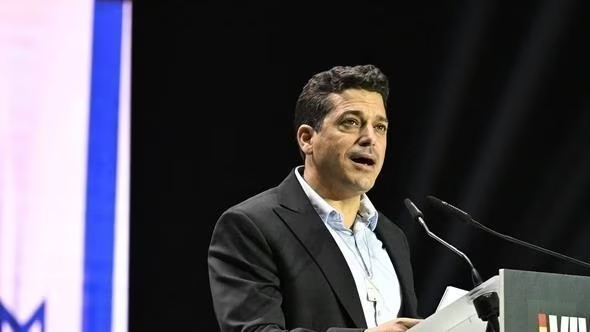
Israeli Diaspora Minister Amihai Chikli attacked Qatar on Tuesday evening and considered the assassination attempt on "Hamas" movement leaders on its territory "a correct thing", despite Prime Minister Benjamin Netanyahu's apology for the attack.

As of 16:30 (GMT), Qatar has not commented on Chikli's statements, which he made to "103 FM" radio affiliated with the Hebrew newspaper "Maariv".

On September 29 last year, Netanyahu responded to Qatar's condition for continuing its mediation between Tel Aviv and "Hamas", and apologized in a phone call to its Prime Minister Mohammed bin Abdul Rahman for the Israeli attack on Doha, according to what was published by the official Hebrew Broadcasting Corporation at the time.

The corporation explained at the time that Netanyahu made the call with the participation of US President Donald Trump during their meeting at the White House.

It added: "The Qatari Prime Minister demanded that Netanyahu apologize for violating Qatar's sovereignty during the assassination attempt on Hamas leaders in Doha".

Netanyahu also apologized to the Qatari Prime Minister for the death of a Qatari security guard during the attack, according to the same source.

Chikli said: "Considering Qatar as a mediator is one of the grave mistakes", according to his expression.

He added: "They have also greatly delayed the ability to achieve achievements, especially on the issue of hostage deals".

The minister, affiliated with the Likud party led by Netanyahu, continued his attack on Qatar, considering it "not a neutral mediator as it is the capital of the Muslim Brotherhood group, their stronghold in the world, and leads very aggressive campaigns against the State of Israel", as he claimed.

He added: "Israel acted correctly recently in its attempt to assassinate Hamas leadership in Qatar, and this is the kind of relationship that should be with the Qataris".

On September 9 last year, the Israeli army carried out an air attack on "Hamas" leaders in Doha, which Qatar condemned and confirmed its right to respond to the aggression that killed a Qatari security element.

While "Hamas" announced the survival of its negotiating delegation led by its president in Gaza, Khalil al-Hayya, from the assassination attempt, and the killing of his office director Jihad Lubad, his son Hamam al-Hayya, and 3 escorts.

The Israeli aggression on Qatar's sovereignty provoked Arab and international condemnations, with calls to deter Tel Aviv to stop the assaults that violate international law.

The Israeli genocide in the Gaza Strip over two years since its start on October 8, 2023, has left about 71,000 Palestinian dead and 171,000 injured, mostly children and women, in addition to massive destruction, with reconstruction costs estimated by the United Nations at about 70 billion dollars.

PALESTINE

Tue 23 Dec 2025 8:45 pm - Jerusalem Time

Smotrich: Agreement to relocate Israeli army camps allows doubling the area of Beit El settlement

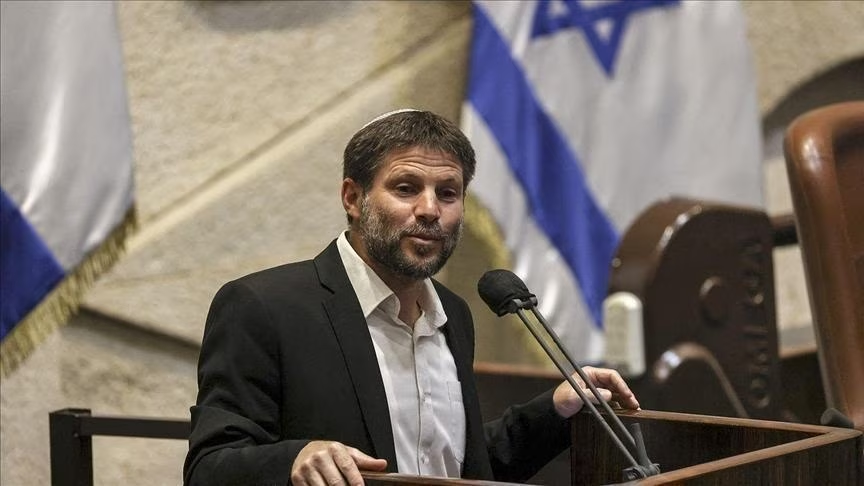
Israeli Finance Minister Bezalel Smotrich announced on Tuesday evening the signing of an agreement to relocate army camps outside Beit El, which will allow doubling the area of the settlement established on Palestinian lands confiscated from the occupied West Bank.

Beit El is located on lands from the cities of al-Bireh and Ramallah, and includes the headquarters of the Civil Administration affiliated with the Israeli Ministry of Defense, which is a military governing body operating in the West Bank.

These lands were seized by military orders in 1970, then allocated to settlers in 1977-1978, despite being illegal under international law.

Smotrich, who is also a minister in the Ministry of Defense, said via the American company "X" platform: "I signed today an agreement to evacuate the army camps from the Beit El settlement."

He added: "It is a step that will allow the construction of 1200 new housing units (settlement) in Beit El and almost doubling the settlement's area."

For decades, the Palestinian Authority has unsuccessfully demanded that the international community pressure Israel to end settlement in the occupied territories, which the United Nations considers "illegal."

In another post, Smotrich later clarified: "We signed today a historic agreement to transfer the Civil Administration units from the army base in Beit El to a civilian building affiliated with the government housing administration under my responsibility in the Ministry of Finance."

Smotrich, leader of the far-right "Religious Zionism" party, concluded: "We continue to practice Zionism and develop the settlements."

About 750,000 Israeli settlers live in hundreds of settlements in the West Bank, including 250,000 in East Jerusalem, and they commit daily assaults against Palestinians with the aim of forcibly displacing them.

Since the start of the genocide war in Gaza on October 8, 2023, Israel has intensified its crimes to annex the West Bank to it, especially through demolishing Palestinian homes, displacing them, and expanding settlements, according to Palestinian authorities.

Israel's official annexation of the West Bank would end the possibility of implementing the two-state solution (Palestinian and Israeli), as stipulated in resolutions issued by the United Nations.

In 1948, Israel was established on lands occupied by armed Zionist gangs that committed massacres and displaced hundreds of thousands of Palestinians, then Tel Aviv occupied the rest of the Palestinian lands, and refuses to withdraw and establish a Palestinian state.

PALESTINE

Tue 23 Dec 2025 8:42 pm - Jerusalem Time

Occupation's War Minister Retracts His Statements Regarding Settlement in Northern Gaza

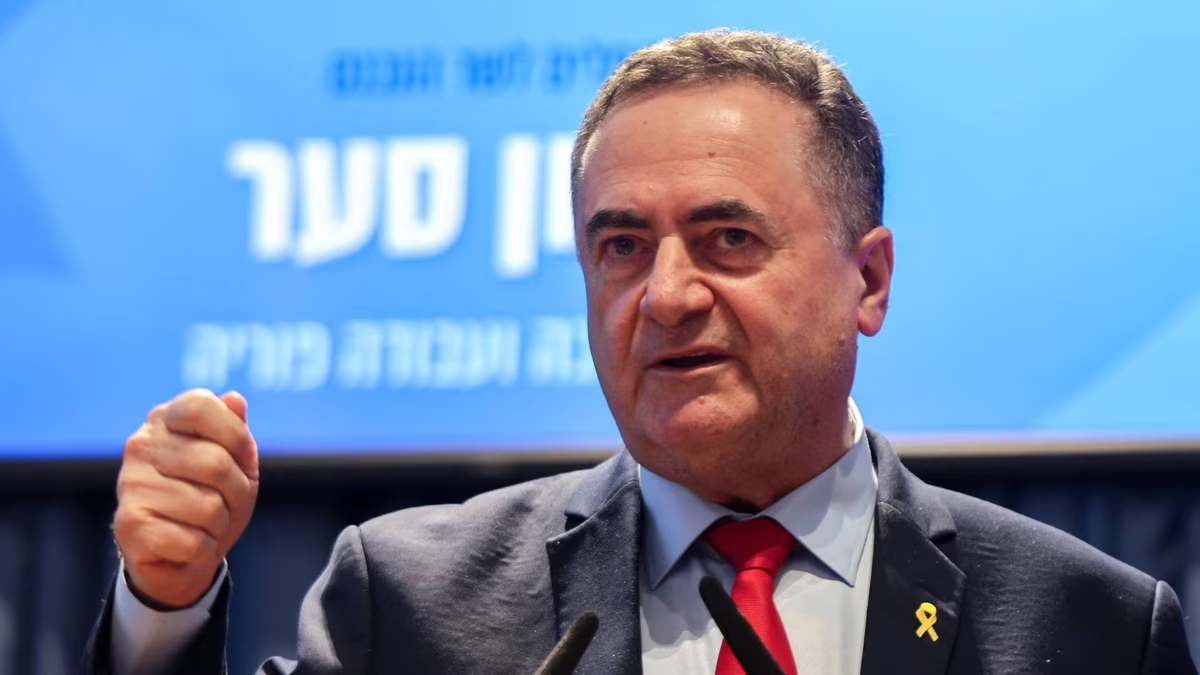
The political corridors witnessed on Tuesday a state of confusion and tension following controversial statements made by the Occupation's War Minister, Yisrael Katz, regarding the army's permanent stay in the Gaza Strip, statements that led to American anger expressed by influential officials in Washington.

Katz was forced to quickly retract his position, issuing a clarifying statement through his office confirming that the government does not intend to build settlements in the sector, attempting to justify the presence of the "Nahal Brigade" as purely for security purposes, in an effort to contain the diplomatic crisis with the American ally.

The spark of the crisis erupted during Katz's participation in the ceremony of signing an agreement to build 1200 housing units in the "Beit El" settlement near Ramallah in the West Bank, where he claimed at the time that the army would never fully withdraw from Gaza, and even went beyond that by saying that the occupation would establish settlement outposts in the north of the sector at the appropriate time.

These surprising statements prompted firm American intervention, where an official at the military coordination headquarters led by Washington said that the Americans demanded broad clarifications, considering that this approach completely contradicts the "Trump Plan" for peace, which stipulates a gradual and complete withdrawal of the army from the sector.

For its part, Hamas did not delay in responding to these threats, as its spokesperson, Hazem Qassem, appeared in a video speech describing Katz's positions as a "blatant violation" of the ceasefire agreement signed last October.

Qassem accused the occupation of pre-planning to displace Gaza's residents, pointing out that these intentions strike at the international understandings that US President Donald Trump sought to establish in the region, which prohibit the re-establishment of civilian settlements in the coastal sector.

Although the Occupation's Prime Minister Benjamin Netanyahu had repeatedly ruled out during the war the possibility of returning to settlement in Gaza, his war minister's statements revealed the extent of the pressures exerted by the extremist members in the ruling coalition to re-occupy the sector.

The firm American position, which manifested in rejecting any new settlement expansion, remains the stumbling block in front of the ambitions of the far-right, and the main driver for Katz's retraction of his statements that almost swept away the fragile ceasefire agreement.

ARAB AND WORLD

Tue 23 Dec 2025 8:07 pm - Jerusalem Time

Head of the Communications Department in the Turkish Presidency: Israel's hysterical approach towards Turkey's power and influence is laughable

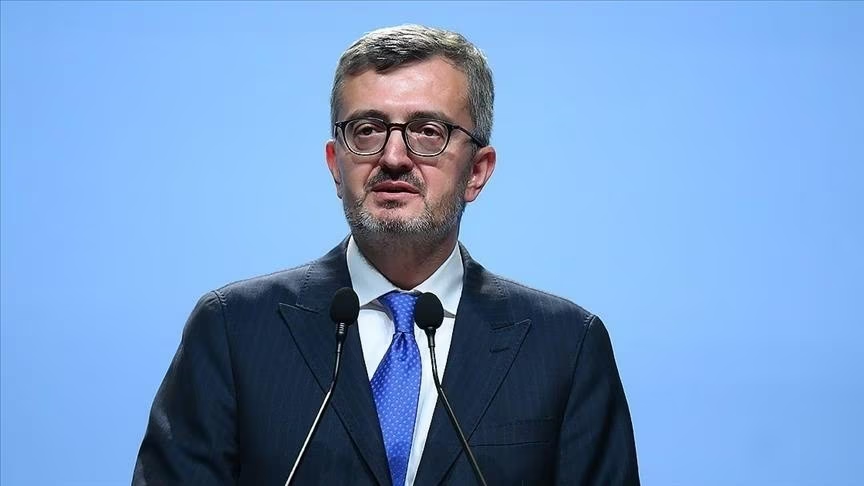
The Head of the Communications Department in the Turkish Presidency, Fahrettin Altun, stated that Israel's hysterical approach towards Turkey's power and influence cannot be described as anything but laughable, emphasizing that Ankara will continue to firmly stand by everyone who seeks peace and stability.

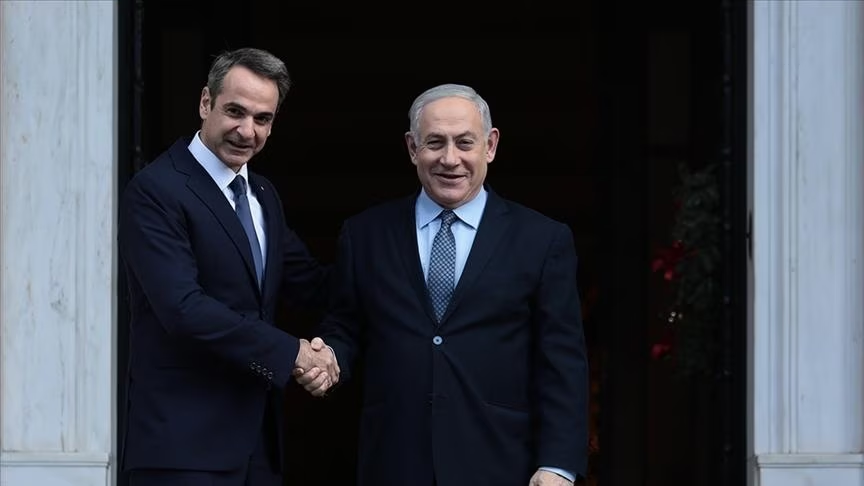
This came in a post on his account on the Turkish platform "X", on Tuesday, in response to statements by Israeli Prime Minister Benjamin Netanyahu during his meeting yesterday, Monday, with his Greek counterpart Kyriakos Mitsotakis and the leader of Greek Cyprus Nikos Christodoulides in West Jerusalem.

Altun explained that the talk by Israeli officials about the imperial ambitions of others in the region constitutes a stark contradiction in the face of the reality of their committing one of the most horrific genocides in history.

He said: "The ongoing hysterical approach for a long time by Israel, the force that destabilizes the region, towards Turkey's power and influence, cannot be described as anything but laughable, as Turkey under the leadership of President Recep Tayyip Erdoğan has become a guarantor of peace and stability".

Altun added: "In contrast, Netanyahu's government has brought blood and tears to the region, and while the Israeli government continues to be an occupying force in Palestine and Syria, it tries to cover up its expansionist ambitions with pretexts of so-called national security".

Altun pointed out that Israel has launched attacks on 7 countries in the Middle East in the past two years, noting that Netanyahu's government has been a disaster in every sense of the word, not only for the region but also for the Israeli people.

He stressed that Netanyahu's government seeks to distract attention by attacking Turkey in order to cover up the crimes it commits.

Altun continued: "We in Turkey will continue to firmly stand by everyone who seeks peace and stability, and such cheap tricks and ridiculous statements by the Israeli Prime Minister will not deter us from our support for our Palestinian brothers".

He added: "Peace will surely triumph despite those who seek to eliminate it".

ARAB AND WORLD

Tue 23 Dec 2025 7:54 pm - Jerusalem Time

How is Israel working to undermine the new Syrian government?

Published an exclusive in-depth report on how Israel is working to undermine the new Syrian government.

The report, prepared by four of the newspaper's correspondents from Jerusalem, states that Israel's strategy for carrying out its covert operations against the Syrian government includes supporting Druze militias to enhance their role in the region and confront Damascus's influence, in addition to occupying strategic areas and conducting airstrikes to prevent weapons from reaching Damascus.

The report indicates that Israeli operations in Syria began immediately after the overthrow of Bashar al-Assad's regime in December 2024, as Israel viewed Syrian President Ahmed al-Sharaa as a continuing threat to it, given his history and previous affiliations, prompting it to develop covert strategies to deal with him.

The most prominent Israeli activities, according to the report, were providing comprehensive support to Syrian Druze militias from the outset. On December 17, 2024, Israeli helicopters began transporting shipments of weapons and military equipment to southern Syria.

These shipments included 500 rifles, ammunition, and body armor, which were airdropped to arm a Druze militia called the "Military Council." This support comes as part of efforts to back the Druze, a religious minority with long historical ties to Israel.

In addition to the arms shipments, the report adds, Israel provided monthly financial payments ranging from 100 to 200 dollars to approximately 3,000 Druze fighters, with the aim of enhancing their capabilities in confronting Syrian government forces.

Furthermore, the report notes that Druze fighters, including women, continued to receive training before the fall of the Assad regime in the Kurdish areas in the north of the country by the Syrian Democratic Forces, a militia led by Kurds that maintains close relations with Israel.

Upon the fall of Assad, Israeli ground forces quickly moved to occupy 155 square miles of Syrian territory, including additional sites on Mount Hermon, a strategic peak on the Syrian-Lebanese border.

In addition, the Israeli Air Force launched hundreds of airstrikes on Syrian military facilities to prevent the new government from accessing weapons, to weaken its ability to unify the country.

The other aspect of this strategy lies in supporting Druze figures such as Sheikh Hikmat al-Hijri, who called for secession and affirmation of Druze self-rule, and received Israeli support in this endeavor.

The report mentioned that al-Hijri prepared maps for a proposed Druze state extending to Iraq and presented them to at least one major Western government in early 2025.

However, some internal conflicts emerged among Druze leaders, leading to rifts within the Druze community. For example, Tariq al-Shoufi, leader of the "Suwayda Military Council" and former officer in the Assad regime's army, was accused of collaborating with al-Sharaa, forcing him to hide for fear of arrest by al-Hijri's men.

At the same time, al-Hijri and his son faced accusations of involvement in kidnapping operations and dealings with regional drug trafficking networks, including Hezbollah.

Israel understood from the beginning that achieving "power balance" in Syria requires precision in execution and tactical flexibility; therefore, it continued to provide humanitarian aid and non-lethal military supplies such as medicines and protective vests to Druze fighters, and in late September, Israeli helicopters secretly transported these aids to Suwayda.

At the same time, Israel sought to benefit from negotiations with al-Sharaa, aiming to secure a form of self-rule for the Druze within any future security agreement.

Al-Sharaa sometimes rejected Israel's demands, such as disarming the southern Damascus area, but expressed readiness to reach a de-escalation agreement when necessary.

The report explains that Israeli activities in Syria provoked sharp tension with the Syrian government and also with US President Donald Trump's administration, which considers support for al-Sharaa part of its strategy to achieve stability in Syria. It also led to widespread criticism from several countries in the region that view these steps as threatening the stability of the Middle East.

The newspaper noted al-Sharaa's confirmation, in a recent interview with it in Washington before his meeting with Trump at the White House, that Israel's "expansionist" policy prolongs the conflict and threatens the entire regional security, including Jordan, Iraq, Turkey, and Gulf countries.

The report says that Israel's goals in Syria include providing support to the Druze as a religious minority facing threats amid a complex conflict, and not allowing a new system hostile to Israel to unify Syria and turn into a future threat.

It stated that there is strong support within Israel for intervention in Syria by the security establishment and the army as a means to enhance regional security and achieve stability. This support is led by prominent figures such as the Israeli Druze Hasson Hasson, former Israeli brigadier general and presidential military secretary, who advocated for comprehensive intervention to support the Druze and turn them into reliable allies for Israel.

The report confirmed that Israel faces, despite its well-studied strategies and ongoing support, major challenges in achieving its goals in Syria, the most prominent of which are continued coordination with other international powers, maintaining a precise balance in relations with various factions in Syria, and dealing with increasing criticism from the international community and regional countries.

The newspaper said in its report that Israel realizes that heavy reliance on Druze factions may not be sustainable in the long term, due to internal conflicts among Druze leaders and the fragility of their internal situations, therefore, it adopts a pragmatic approach that relies on continuous adaptation and rapid response to changing conditions on the ground.

The newspaper concluded that Israel's covert activities and its policy towards supporting the Druze remain directed towards achieving deeper strategic objectives, such as shaping the balance of power in Syria and preventing the emergence of new threats on its borders with Israel.

ANALYSIS

Tue 23 Dec 2025 7:10 pm - Jerusalem Time

Political Analyses: Israel's Policies Hinder US Efforts to Calm the Situation in the Middle East

Political analyses have warned that Israel's current policies are hindering US efforts aimed at calming the situation in the Middle East, particularly in the files of Gaza, Lebanon, and Syria, confirming that the continuation of military operations and refusal to engage in comprehensive political paths threaten the chances of establishing a ceasefire and transitioning to broader settlement phases in the region.

An article by Nimrod Novik, who worked as a political advisor and special envoy to the former Israeli Prime Minister Shimon Peres, was published, in which he said that President Trump deserves praise for his efforts to stabilize three tension hotspots in the Middle East - Gaza, Lebanon, and Syria, and yet, Israel, the strongest player in the region and seemingly the closest ally to the United States, undermines Trump's strategy in the Middle East on all three fronts.

He added in the article that after the shock of Hamas's attacks on October 7, Israel adopted the principle of "no risk-taking" which prioritizes the use of force and control over territories at the expense of diplomacy. The contradiction is stark: the policy of continuous preemptive strikes increases the risk of escalation - which is the opposite of the "no risk-taking" principle.

He continued that Israeli Prime Minister Benjamin Netanyahu intends to meet Trump in the United States on December 29, and to prevent slipping back into war again, the American president should be clear and firm with Netanyahu, and he should detail the requirements for regional stability, and show his expectations from Netanyahu to act accordingly, and before this meeting, it would be better for Arab leaders to show their support for Trump's program, and to make the transition to the second phase of his peace plan in Gaza a priority.

He added that in Lebanon, the call from the American administration to disarm Hezbollah, the strongest military and political force in the country and Israel's arch-enemy, was ignored almost immediately, the global norms for disarmament as a gradual process, and set unrealistic expectations. And when these expectations were not met, Israel threatened the possibility of launching a large-scale military operation, despite the ceasefire mediated by the United States and France for a year. And Israel already occupies five settlement points inside Lebanon, and conducts daily raids and incursions.

He continued "In Syria, Israel conducts repeated military incursions, while demanding the disarmament of the entire area between Damascus and the Golan Heights, adjacent to its northeastern border" and at the same time, it clings to what it considers a security zone inside Syrian territory".

The article's writer said that the Gaza Strip remains the most dangerous tension hotspot. Netanyahu's refusal of any role for the Palestinian Authority in the sector threatens to undermine Trump's 20-point plan that led to the October ceasefire agreement, and his objection has nothing to do with national security, but relates to threatening the annexation groups he chose as partners in government to withdraw from his coalition if he accepts a role for the Palestinian Authority in Gaza, which would end his term.

He pointed out that Trump's plan calls for an international stabilization force as a necessity for disarming Hamas, enabling more Israeli withdrawals, protecting the civilian committee that will manage the sector, and providing security for the subsequent reconstruction process. However, the Arab countries, most of which have a Muslim majority, that may contribute forces to this force, consider the participation of the Palestinian Authority necessary, no matter how symbolic at first.

He continued that without it, the residents of the participating countries in the stabilization force, along with many others in the Arab world and Gaza, will view this force as merely replacing Israeli occupation with another occupation. No agreement can be legitimized except by invitation from the Palestinian Authority, and its participation from the beginning. The Arab countries also see the Authority's participation as a step towards unifying Gaza and the West Bank, which is a fundamental condition for a two-state solution.

He added that the second phase of Trump's plan - disarming Hamas, the complete Israeli withdrawal from the remaining half of Gaza that it still controls, reconstruction, and forming the stabilization force - is stalled in the absence of Arab participation. And at the same time, the ceasefire, which represents the core of the first phase, is at risk. Daily clashes threaten it, while two million Gazans suffer inhuman conditions.

The article's writer added that Israeli officials received Washington's optimistic announcements about the imminent start of the second phase with skepticism and doubt, and with a position that suggests "if we don't disarm Hamas, no one will" - which implicitly indicates readiness to resume the war. And with the return of all living Israeli hostages and the dead except for one hostage, an important incentive for Israel to fulfill its commitments in the first phase has disappeared.

He said that "Realizing that Israeli escalation threatens his entire regional structure, Trump intervened, so in a phone call on December 1, reports indicated that he urged Netanyahu to "take it easy" in Syria, Netanyahu responded with gestures aimed at showing "I'm listening to you" without real change in policy.

Based on this principle, he agreed to reopen the Rafah crossing to Egypt, one of the most important crossings from and to Gaza, but in one direction only: there are exits, but no return or passage for humanitarian aid, which completely contradicts what was stated in Trump's plan, which called for allowing the movement of people and humanitarian aid in both directions.

He added that regarding Lebanon, Netanyahu softened his talk about imminent escalation, and sent a civilian liaison official with a limited economic mission. As for Syria, the Israeli government claimed the possibility of reaching an agreement - provided that Israel's maximum security demands are met.

These meager concessions may explain the reason for Trump's call for a direct meeting with Netanyahu, which is the sixth for him during his second term.

The article's writer pointed out that over the past year, whenever Middle Eastern leaders presented Trump with a united front, an implementable plan, and readiness to bear the greater burden while praising him for success, he would take the initiative to act. On the eve of his inauguration, they guaranteed Hamas's agreement to a ceasefire if Trump obtained Netanyahu's approval, and he did. In March, they supported an Egyptian reconstruction plan that ignored Trump's dream of a "Gaza Riviera", so he agreed. In July, a Saudi-French initiative linked Gaza's stability to broader Israeli-Palestinian negotiations and regional integration. These elements were incorporated into his 20-point plan.

He continued that it can be repeated, Arab partners and Europeans and others should present a concise list to the White House including changes in Israeli policy necessary to activate the second phase. This list may include accepting the participation of the Palestinian Authority and more Israeli withdrawals in parallel with the gradual disarmament of Hamas. It may also include increasing humanitarian aid and reopening the Rafah crossing in both directions, in addition to agreeing on a list, under Egyptian supervision, including independent Palestinian experts to work in the committee tasked with managing Gaza.

The article's writer continued that until Trump agrees to impose these conditions on Netanyahu, he must receive a clear message from these leaders: "If you deliver Netanyahu, we will deliver Hamas. And if Israel commits to the terms of your peace plan, we pledge to provide contributions to the international stabilization force and the Gaza reconstruction fund".

He concluded that the choice facing the President now is clear without ambiguity: either impose discipline on America's closest regional allies, or watch a fragile structure collapse under the weight of Netanyahu's gradual escalation. The opportunity to avoid another war is shrinking.


PALESTINE

Tue 23 Dec 2025 6:54 pm - Jerusalem Time

"Bloomberg": Washington Renews Efforts to Hold an International Conference for Rebuilding Gaza

The American agency "Bloomberg" said that the United States and its allies are seeking to hold an international conference for the reconstruction of the Gaza Strip, which may be held in Washington next month, with Egypt and several alternative sites being considered for hosting the conference.

The American agency clarified that the convening of the conference is linked to the completion of the formation of the Peace Council chaired by US President Donald Trump, which will oversee the transitional government in Gaza.

In the context of preparations, the Hebrew Channel "15" reported from Washington that it presented to the occupation a list of proposed Palestinian names to manage the technocrat government in Gaza, while the occupation's agencies are working to examine these names in preparation for the upcoming meeting between the occupation's Prime Minister Benjamin Netanyahu and US President Trump on the 29th of this month.

The American envoy Steve Witkoff also met during the weekend with officials from Egypt, Turkey, and Qatar in Florida to discuss ways to implement the ceasefire and enhance reconstruction efforts.

The conference comes as part of the American peace plan prepared by Trump, consisting of 20 points, distributed over two phases, aimed at maintaining political momentum and ensuring stability in Gaza after agreeing to a ceasefire on October 10 last year.

Palestinian data indicates that the occupation government committed 875 violations of the ceasefire agreement, leading to the martyrdom of 411 Palestinians and the injury of 1,112 others, with aid entering not exceeding 41% of the agreed amount, which exacerbated the suffering of civilians in the sector.

ARAB AND WORLD

Tue 23 Dec 2025 6:54 pm - Jerusalem Time

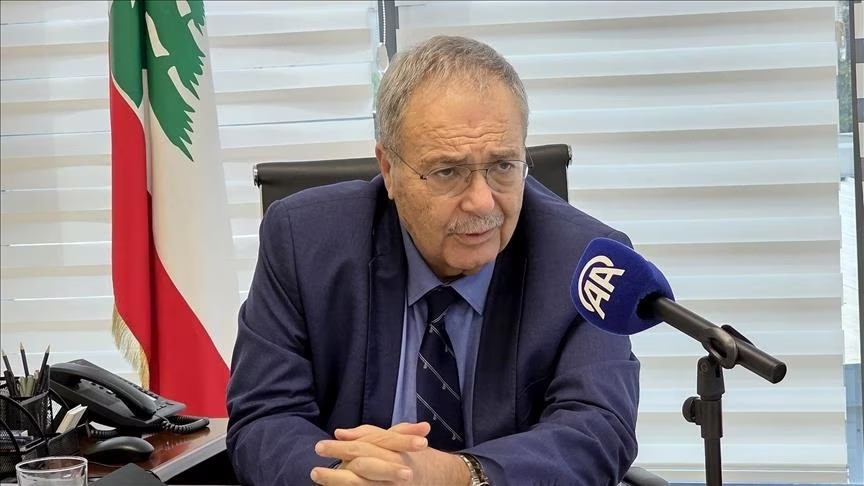
Lebanese Deputy Prime Minister: No Guarantees Against Israel Engaging in New Escalation

Lebanese Deputy Prime Minister Tarik Mitri revealed on Tuesday that "there are no guarantees that Israel will not engage in new escalation," but exaggerating fears of a possible escalation from Tel Aviv "is unjustified."

Mitri stated that "there are no guarantees or assurances for Lebanon that Israel will not engage in new escalation in the coming period."

However, he also noted that exaggerating fears of Israeli escalation "is unjustified and not based on serious information," calling for "not succumbing to estimates not based on reliable data."

In recent days, the Hebrew media has not stopped talking about the Israeli army "completing" preparations for a plan to launch a "wide-scale attack" against Hezbollah-affiliated sites if the Lebanese government and army fail to implement their commitment to dismantle its weapons before the end of 2025.

These discussions coincide with international and Arab efforts to reduce the pace of escalation in southern Lebanon and prevent sliding into a broad confrontation with Israel.

The Lebanese Deputy Prime Minister emphasized that "it is our duty to cut off any pretext for the enemy to attack Lebanon."

He pointed out that "the Mechanism Committee has taken this path by researching how to verify the Lebanese army's commitment to its tasks according to the executive plan it has set."

The "Mechanism" committee was established under the ceasefire agreement in effect since November 2024, and it monitors its implementation, consisting of military representatives from Lebanon, France, Israel, the United States, and the United Nations Interim Force in Lebanon "UNIFIL."

Mitri indicated that the international engagement with Lebanon is witnessing a shift, especially in terms of supporting the Lebanese army, revealing "preparations for an imminent visit by Army Commander Rudolph Haikal to the United States," without specifying a date.

He considered Washington's approval to hold a special conference to support the army as an indicator of this shift.

On Thursday, Paris announced the organization of an international conference to support the Lebanese army in February 2026, with participation from France, the United States, and Saudi Arabia.

Mitri explained that the United States no longer adopts the Israeli accusations that spoke of negligence or complicity by the Lebanese army, but has come to recognize its efforts despite limited capabilities, with international understanding recorded for the field conditions that may lead to delays in implementing some provisions of the military plan.

On August 5, the Lebanese Council of Ministers approved monopolizing weapons in the hands of the state, including Hezbollah's weapons, and tasked the army with developing and implementing a plan before the end of 2025.

However, Hezbollah Secretary-General Na'im Qassem has repeatedly affirmed that the party "will not hand over its weapons," and called for ending the Israeli occupation of Lebanese lands, while Israel accuses the Lebanese army of failing to activate disarmament, accusations that Beirut rejects.

Mitri added that there is international recognition of the Lebanese army's logistical and financial needs, which has revived discussions on holding an international conference to support it under a French-Saudi initiative.

Israel has killed more than 4,000 people and injured nearly 17,000 others during its aggression on Lebanon, which it began in October 2023, before turning it into a comprehensive war in September 2024, which stopped with a ceasefire agreement that entered into force in November 2024.

It has also breached the ceasefire agreement more than 4,500 times, resulting in hundreds of deaths and injuries, in addition to occupying 5 Lebanese hills it controlled in the recent war, plus other areas it has occupied for decades.

ARAB AND WORLD

Tue 23 Dec 2025 5:32 pm - Jerusalem Time

Hakabi threatens Iran and accuses it of not understanding the message

Washington – Saeed Arikat –

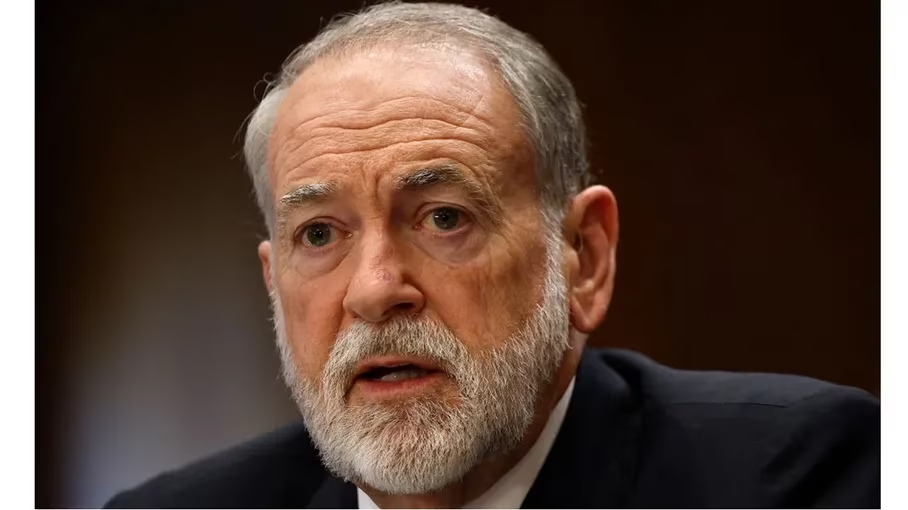
The statements by the US ambassador to Israel, Mike Hakabi, regarding Iran's failure to "fully understand the message" following the recent US airstrikes, reflect a clear state of confusion in assessing the results of the short military confrontation, while also revealing the escalation of Israeli pressures to push Washington towards a new round of confrontation with Tehran, despite the absence of decisive indicators of a change in its strategic behavior.

Hakabi, who was speaking in an interview with Israel's National Security Studies Institute, implicitly acknowledged that the strikes targeting Iranian nuclear facilities, including the heavily fortified Fordow facility, did not produce the political or deterrent impact that Washington and Tel Aviv had hoped for. The hint that Iran continues to rebuild and deepen the fortification of its sites means that the logic of the "deterrent strike" has not succeeded in imposing a long-term deterrence equation.

The most dangerous aspect of Hakabi's statements is not the doubt about Iran's level of understanding of the message, but the indirect link between that and the possibility of US support for an additional Israeli attack. This link reflects a troubled reality that Israel is experiencing after the Twelve Days War, where Iranian ballistic missiles proved their ability to penetrate Israeli depth, breaking one of the most important assumptions of Israeli security superiority.

According to American media reports, Israeli Prime Minister Benjamin Netanyahu is preparing to pressure President Donald Trump to obtain political and military support for a new strike, under the pretext that the Iranian threat is no longer just nuclear, but has become primarily missile-based. This shift in Israeli discourse reveals the failure of the previous approach that focused exclusively on the nuclear program, ignoring the development of Iran's conventional deterrence systems.

However, Hakabi, despite his tough tone, appeared cautious in defining a clear American position, contenting himself with affirming that the decision is "political" and is made in the White House. This reservation reflects American awareness that getting dragged behind Israeli calculations could open the door to a broad regional confrontation, whose paths or costs cannot be controlled.

Since the ceasefire, President Trump has intensified his public threats against Iran, vowing new strikes if uranium enrichment resumes, even going so far as to threaten the destruction of Iran's missile capabilities. However, these statements, despite their media strength, clash with the reality that Iran has not retreated from its strategic constants, but has redefined its losses as temporary and containable.

In contrast, Tehran insists that its nuclear program is a sovereign right that cannot be relinquished, and treats the issue of enrichment as part of national dignity. As for the ballistic missile program, Iran sees it as the last line of defense against Israel and the United States, and refuses to include it in any future negotiation agreement, which complicates any possible diplomatic path.

Hakabi's statements reveal a growing gap between American rhetoric and the reality of deterrence on the ground. The admission of not "understanding the message" means that the military strikes have not translated into behavioral change, but may have strengthened Iran's conviction of the need to deepen fortifications and expand defensive capabilities, instead of submitting to pressure.

The ongoing Israeli pressure to wage a new war reflects a crisis of confidence within the Israeli security establishment in its ability to contain the Iranian threat without direct American intervention. This puts Washington before a difficult equation: either support its ally, or avoid getting involved in an open regional attrition war.

The recent experience also shows that the logic of force alone is not sufficient to impose permanent settlements with Iran. Every escalation round reproduces the same conditions, with higher costs and fewer control limits. Without a comprehensive political path, "military messages" will remain susceptible to misunderstanding or deliberate disregard.

PALESTINE

Tue 23 Dec 2025 5:26 pm - Jerusalem Time

Interaction with the words of the Latin Patriarch of Jerusalem in Gaza: "It will not turn into a tourist resort, and we will rebuild our lives anew"

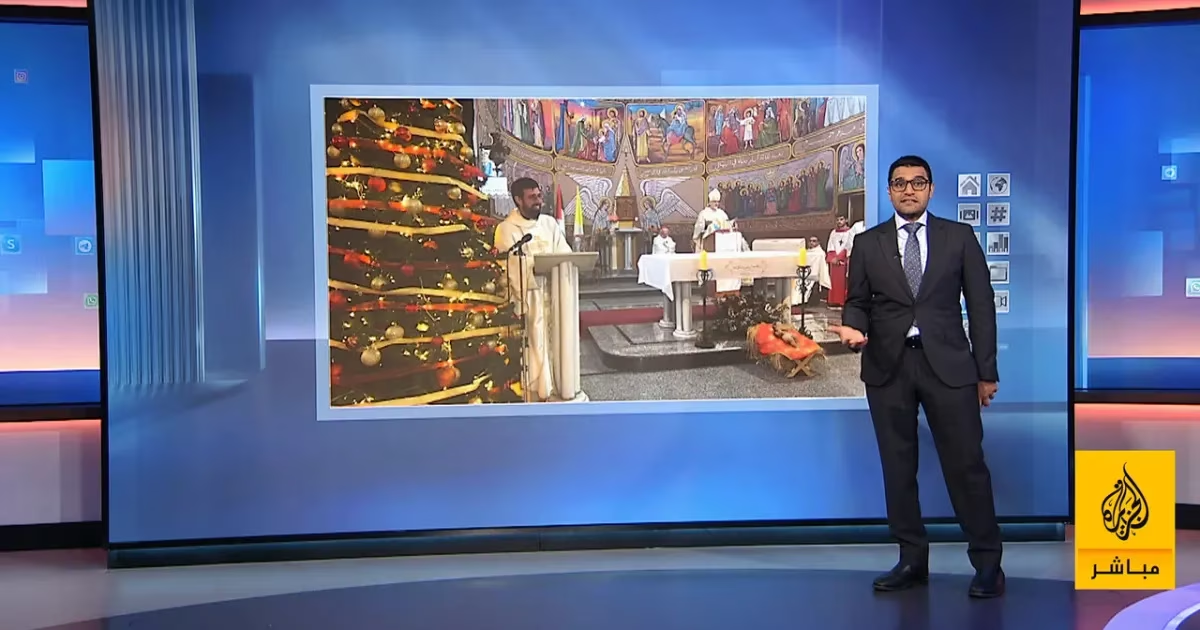
Users of social media sites interacted with the words of the Latin Patriarch of Jerusalem, Cardinal Pierbattista Pizzaballa, during his presiding over a mass at the Holy Family Church in the city of Gaza on the occasion of Christmas.

The Cardinal Pizzaballa said during the mass: "After two years of war, we are still here. There were plans at the beginning of the war to turn Gaza into a tourist resort. Gaza will not turn into a tourist resort, and we will rebuild our lives anew as we wish."

The "Hashtag" program aired a clip from the Cardinal's sermon and reviewed some of the interactions on social media platforms with the Cardinal's words.

Among the comments, Maher Al-Masri wrote: "Israel tried to distort the image of the Palestinian people, whom it seeks to seize their land and ethnically cleanse them."

One of the biggest propaganda strategies used by Israel to distort the image of the Palestinian people is the claim that it is fighting Islamic terrorism and jihadists, while the reality is that Israel was fighting the Palestinian people regardless of their religion in order to seize their land and ethnically cleanse them.

For his part, Prince Hassan wrote:

Christians in the Holy Land celebrate Christmas despite the pain caused to them by Zionism, not Islam.

As for Nicholas Sawaya, he said that any attempt to plant hope and restore some normal life in the Gaza Strip deserves praise.

It is difficult to celebrate Christmas under the tragic conditions in Gaza, but any attempt to plant hope and restore some normal life deserves praise.

As for Gabriel, he directed a message to the US Ambassador to Israel, Mike Hakabee:

Ambassador Hakabee missed this mass.. No resorts!

The writer Suzan Abu Al-Hawa wrote that the Cardinal's statements in Gaza are a rejection of "imperial plans".

The Catholic Patriarch in Gaza rejects imperial plans. And reconstruction will be with authentic Palestinian design.

For his part, journalist Paolo Moschetti indicated that the Cardinal's words in Gaza confirm that Christian institutions will remain standing alongside their inhabitants.

Pierbattista Pizzaballa is one of the most prominent Christian voices in the Holy Land today, and has held the position of Latin Patriarch of Jerusalem since 2020. And now he is in Gaza, confirming that Christian institutions will remain standing alongside their inhabitants.

PALESTINE

Tue 23 Dec 2025 5:24 pm - Jerusalem Time

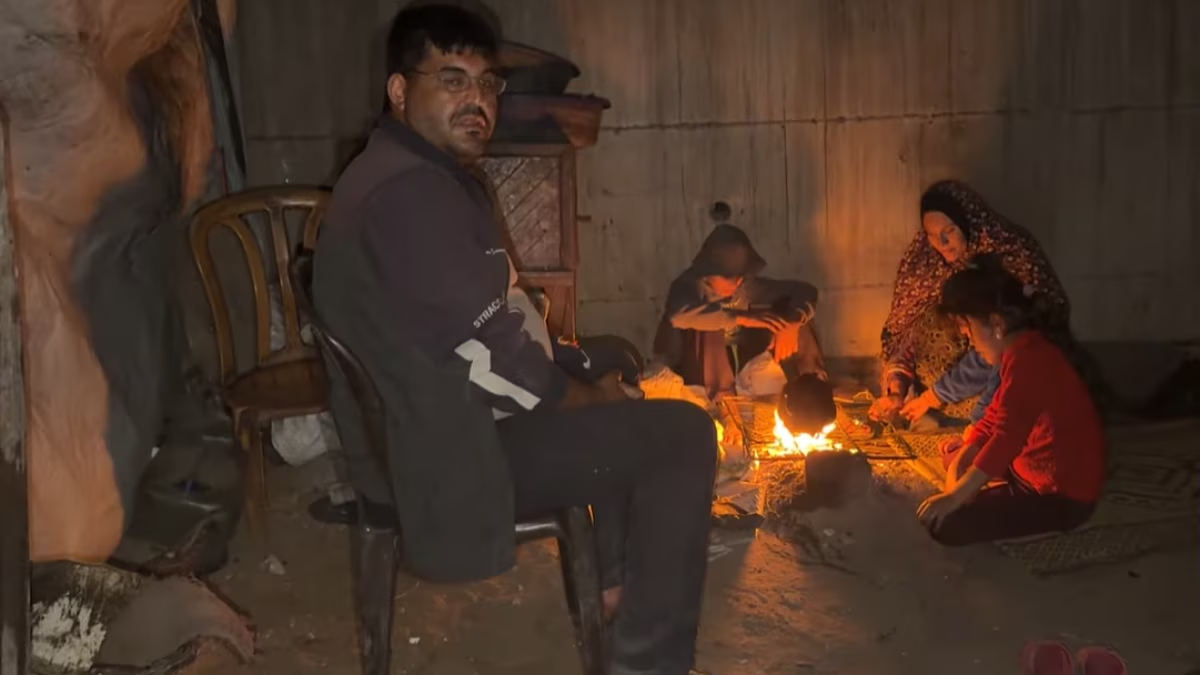
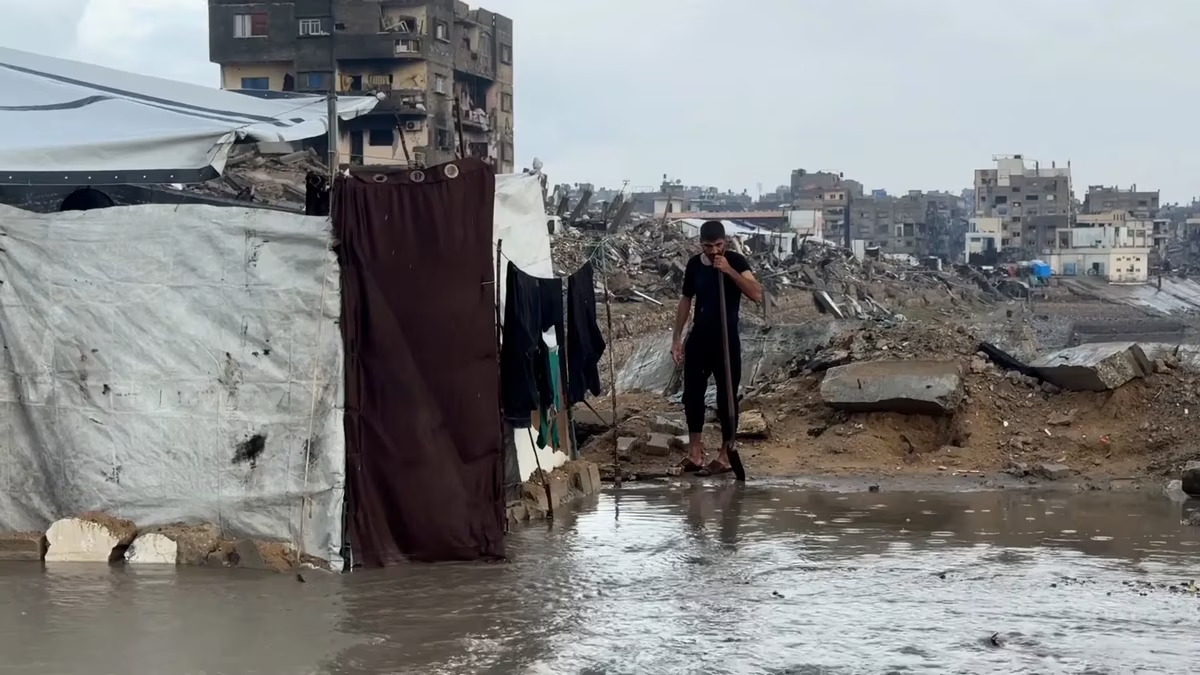
A displaced Palestinian family living next to a landfill in Gaza

During a field tour inside Gaza City, a human tragedy was observed for a Palestinian family forced to live next to a landfill designated for shelters, after their repeated attempts to find a safe place inside the crowded camps, schools, or shelters failed.

The family of the displaced citizen Hamada Abu Leila lives inside a tent set up amidst piles of garbage, in conditions lacking the basic necessities of life, amidst the absence of services, lack of security, and the spread of foul odors, insects, rodents, and stray dogs.

The head of the family, Hamada Abu Leila, said in his statement that resorting to this place came after a long series of forced displacement between the north and south of the sector.

He added, "I resorted to this place after displacing several times, moving between the north and south, I didn't find a place in the camps or schools or shelters, so I didn't find a place except next to the landfill."

Abu Leila pointed to the cruel irony in his life's path, explaining that he holds 3 university degrees and worked as a teaching assistant at the university before the war.

He added, "I am an educated person with 3 university degrees, I was a teaching assistant at the university and had a 98% average in the Faculty of Da'wah, I was standing in lecture halls teaching students, and today I live amidst a landfill among epidemics and diseases."

With the arrival of night, the family's suffering doubles, where hours of rest turn into hours of terror, according to what he conveys.

Abu Leila describes what he experiences at night, saying, "Night is rest for people, but I hate when night comes, I wake up from sleep and find rats or a snake next to me, God bless you, God, it happened to me that I woke up and found a snake playing in the clothes and bags, and I have nothing to do but be patient."

When asked about how he deals with these scenes, especially with children inside the tent, Abu Leila clarified that helplessness was harsher than fear.

He said, "The only thing I do is cry, I couldn't hold myself back, how can a person who was a teaching assistant at the university become a displaced person sleeping in a landfill among rats and insects, God, it's psychological suffering."

These harsh conditions directly affect the children's health, where the head of the family explains that he had to take his daughter to the hospital due to skin infections resulting from pollution.

During the winter season, the catastrophe worsened after polluted rainwater mixed with garbage and sewage flooded the tent, due to its low location compared to the landfill's height.

Abu Leila explains what happened, saying, "Rainwater entered us because the tent is in a low area, and the landfill is 10 or 12 meters higher than us, and the water level inside the tent rose to 40 centimeters, and it was dirty water and sewage that flooded the clothes and children's belongings."

From her side, Hamada Abu Leila's wife spoke about the daily suffering the family lives, especially at night, with the absence of any real means of protection.

She said in her statement, "Insects fly from the landfill onto the food we eat, there's no kitchen, no clean place, we are 7 people living among filth and germs, and the tent doesn't protect from dog, cat, or insects."

She added that the children wake up terrified at night due to the sounds of dogs and cats gathering around the tent, confirming that sleep is almost non-existent.

At the end of the tour, Hamada Abu Leila addressed a message to the world in English with the approach of a new year, calling for stopping the war, confirming that the suffering of Gaza's residents has not ended yet.

Abu Leila said, "Stop the war, for the war has not ended yet, and we are still suffering."

ARAB AND WORLD

Tue 23 Dec 2025 5:00 pm - Jerusalem Time

Greek opposition party: Tripartite summit with Israel creates danger in the Eastern Mediterranean

The Greek opposition party "New Left" stated that the tripartite summit that brought together Greece, Israel, and the Greek Cypriot administration creates a danger in the Eastern Mediterranean.

This came in a written statement issued by the party on Tuesday regarding the summit held by the leaders of Greece, Israel, and the southern Greek Cypriot administration in West Jerusalem on Monday.

The statement pointed out that the government of Greek Prime Minister Kyriakos Mitsotakis is transforming the tripartite cooperation into a military polarization structure, and is playing dangerous games in the Eastern Mediterranean by involving Israeli counterpart Benjamin Netanyahu, who is under prosecution by the International Criminal Court.

It emphasized that the tripartite summit between Greece, the southern Greek Cypriot administration, and Israel does not send messages of stability, peace, and respect for international law, but rather directs a message of tension and hostility, especially towards Turkey.

It continued: "We are facing a discourse and practice that ignores international law, overlooks the genocide in Gaza, and adapts the country to the policy of militarizing the region."

The statement noted the existence of a unique contradiction represented in talking about military partnerships on one hand, and offering promises of dialogue and multilateral cooperation on the other, confirming that this diplomatic approach not only poses a danger, but also contradicts the interests of Greece and the southern Greek Cypriot administration.

Netanyahu held a joint press conference yesterday Monday in Jerusalem with Mitsotakis and Greek Cypriot leader Nikos Christodoulides, during which they affirmed strengthening cooperation in defense and other fields.

Netanyahu said in the press conference that they discussed in detail during the tripartite summit ways of cooperation, headed by security, in addition to energy, technology, and others.

The Israeli Prime Minister claimed the existence of parties "seeking to reimpose historical dominance" on Greece, Greek Cyprus, and Israel.

He continued: "We are determined to defend ourselves, and we have the ability to do so."

PALESTINE

Tue 23 Dec 2025 4:33 pm - Jerusalem Time

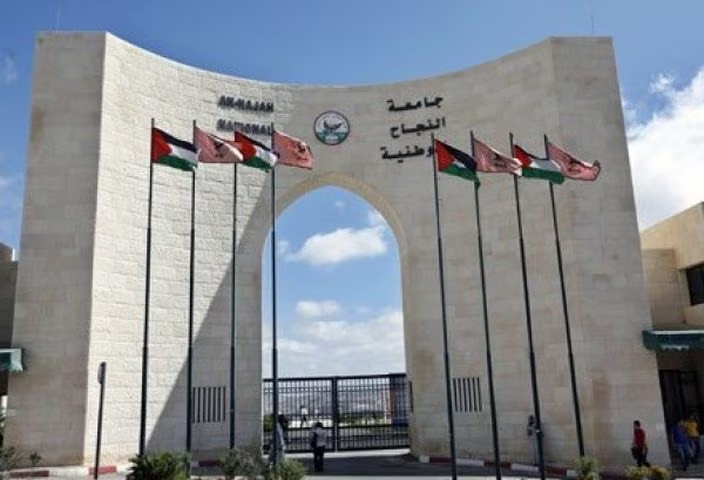
Secures 29th place Arab-wide…An-Najah University tops Palestinian universities in the 2025 Arab ranking

An-Najah National University has achieved a new academic accomplishment added to its scientific record, as it topped Palestinian universities and ranked first among 9 Palestinian universities, securing the 29th position Arab-wide in the 2025 Arab Universities Ranking, third edition, issued by the Arab Universities Union.

This ranking is considered one of the most important academic rankings at the level of the Arab world, supervised by the Arab Universities Ranking Council, established in cooperation with the Arab Universities Union, the Arab Scientific Research Councils Union, and the Arab Organization for Education, Culture and Science (ALECSO), with the aim of enhancing the quality of higher education and elevating the level of Arab universities according to objective and transparent standards.

The ranking this year witnessed a noticeable increase in the number of participating universities and countries, as it included 236 universities from 20 Arab countries, and relies on a comprehensive methodology based on four main axes: teaching and learning, scientific research, creativity and entrepreneurship and innovation, and local and international cooperation and community service.

The President of An-Najah University, Professor Dr. Abdul Nasser Zaid, expressed his happiness with this achievement, which reflects the continuous efforts exerted by the university in developing its academic programs, enhancing scientific research, supporting innovation, and opening up to the local and international community, contributing to improving its position within Arab and international rankings.

In turn, Professor Dr. Waleed Sawalha, Dean of Scientific Research and Director of the Global Academic Rankings Department at the university, indicated that the university's achievement of this accomplishment confirms that it is proceeding with steady steps towards achieving its strategic goals, particularly those related to research, innovation, and community service.

PALESTINE

Tue 23 Dec 2025 4:20 pm - Jerusalem Time

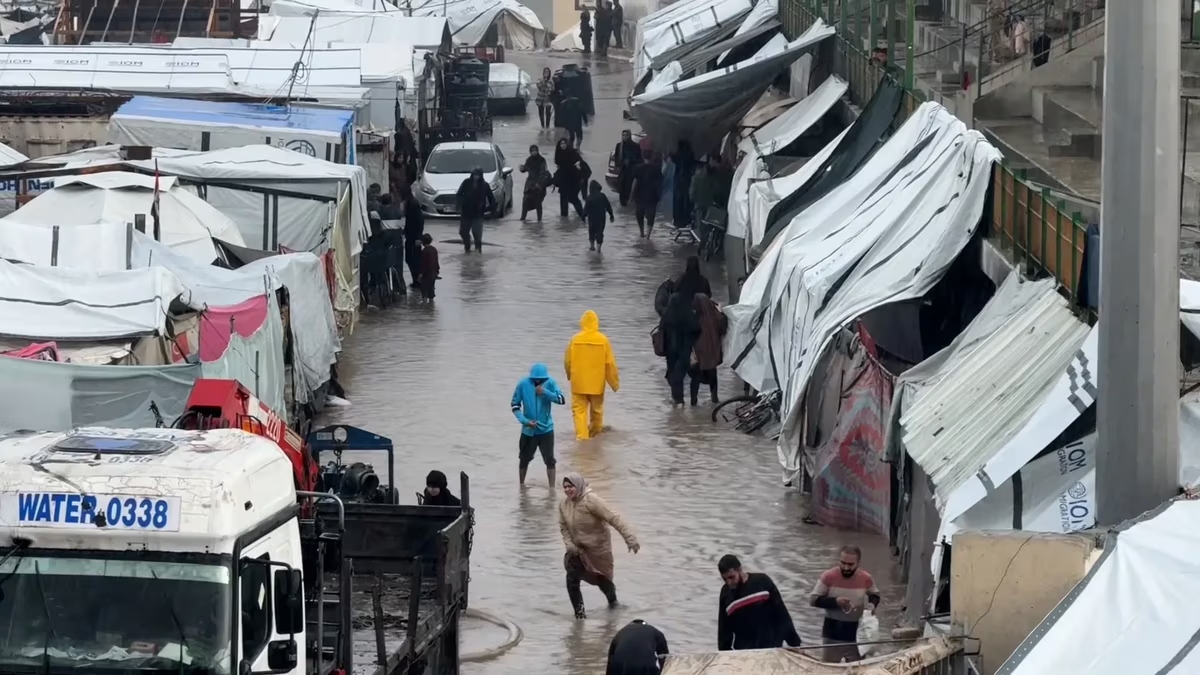
World newspapers: Gaza is experiencing a harsh winter.. and European divisions prevent punishing Israel

World newspapers and websites addressed the worsening humanitarian tragedy in the Gaza Strip with the arrival of winter, amid shortages of food and basic services, and the reflection of European divisions on the Union's inability to take deterrent positions towards Israel, in addition to other international issues that were present in media coverage.

Indeed, Gaza is experiencing a new winter of suffering despite the ceasefire, indicating the continuation of the food crisis and harsh living conditions, with the health system unable to meet the minimum needs of the population.

And it quoted an international committee of experts that about three-quarters of the sector's population suffer from severe food insecurity, while winter storms have claimed the lives of dozens of Palestinians, amid accusations against Israel of preventing the entry of humanitarian aid.

And in the same context, it highlighted the suffering of pregnant women in Gaza, through the testimony of Hadeel Al-Gharbawi who gave birth to her second child inside an ambulance, considering that her story reflects the transformation of childbirth into a real danger due to the war, displacement, and collapse of healthcare.

As for the French website Mediapart, it saw that divisions within the European Union, alongside the influence of officials sympathetic to Israel, prevented the imposition of any sanctions on it, despite violations of international law, in addition to ignoring Israeli disinformation campaigns.

And outside Gaza, it revealed that dozens of former leaders of Bashar al-Assad's regime live in Moscow away from justice, including those involved in developing chemical weapons and managing security apparatuses accused of torture.

And it addressed the repercussions of American pressures on Venezuela, indicating its air isolation and the harm to millions of citizens, with rising travel costs and difficulties in delivering medicines and thousands of Venezuelans stranded abroad.

And in Ukraine, the number of casualties is greater than what Kyiv announces, with estimates of huge human losses on both sides, while it indicated the rise of hostile sentiments towards Ukrainian refugees in Poland and other European countries.

PALESTINE

Tue 23 Dec 2025 4:19 pm - Jerusalem Time

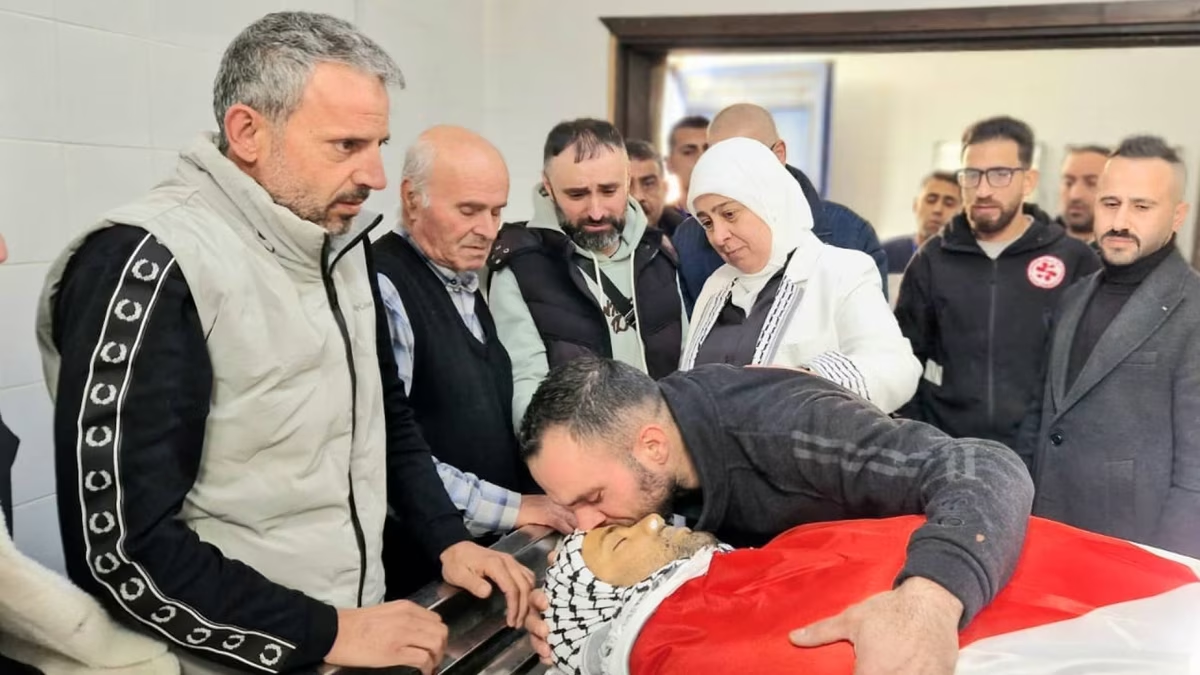
Death of a Palestinian youth by occupation bullets north of Salfit

The Palestinian youth Youssef Omar Aql, "33 years old," was martyred on Tuesday from the town of Bidya west of the city of Salfit in the northwest West Bank, succumbing to his wounds resulting from being shot a week ago in the town of Al-Ram while trying to reach his workplace in the occupied interior.

Palestinian sources reported that the youth "Aql" was immediately transferred to Palestine Medical Complex in Ramallah upon injury, where he remained in intensive care, before his martyrdom was announced today due to his wounds.

The occupation continues to target Palestinian workers who attempt to cross the wall to reach their workplaces inside the city of Jerusalem and the occupied areas, as part of a systematic policy of repression against Palestinian workers.

PALESTINE

Tue 23 Dec 2025 2:56 pm - Jerusalem Time

Israel Announces Construction of 1,200 New Settlement Units and Levels Land to Rebuild Sanur Settlement

Israeli Defense Minister Yoav Gallant announced the start of construction of 1,200 new settlement units in the Beit El settlement, located north of Ramallah city, in a step described as a direct extension of accelerated expansion plans.

Gallant's announcement came during a field visit to the Beit El settlement to participate in the project inauguration ceremony, where he confirmed that settlement construction continues at an escalating pace.

He also pointed to work on establishing additional settlement outposts as part of what is known as the "Nahal" project, within broader plans to rebuild settlements and Israeli army camps in the north of the occupied West Bank.

Israeli media reported that the project includes paving a new bypass road that serves these plans, especially in the vicinity of the town of Silat al-Dhahr north of Nablus.

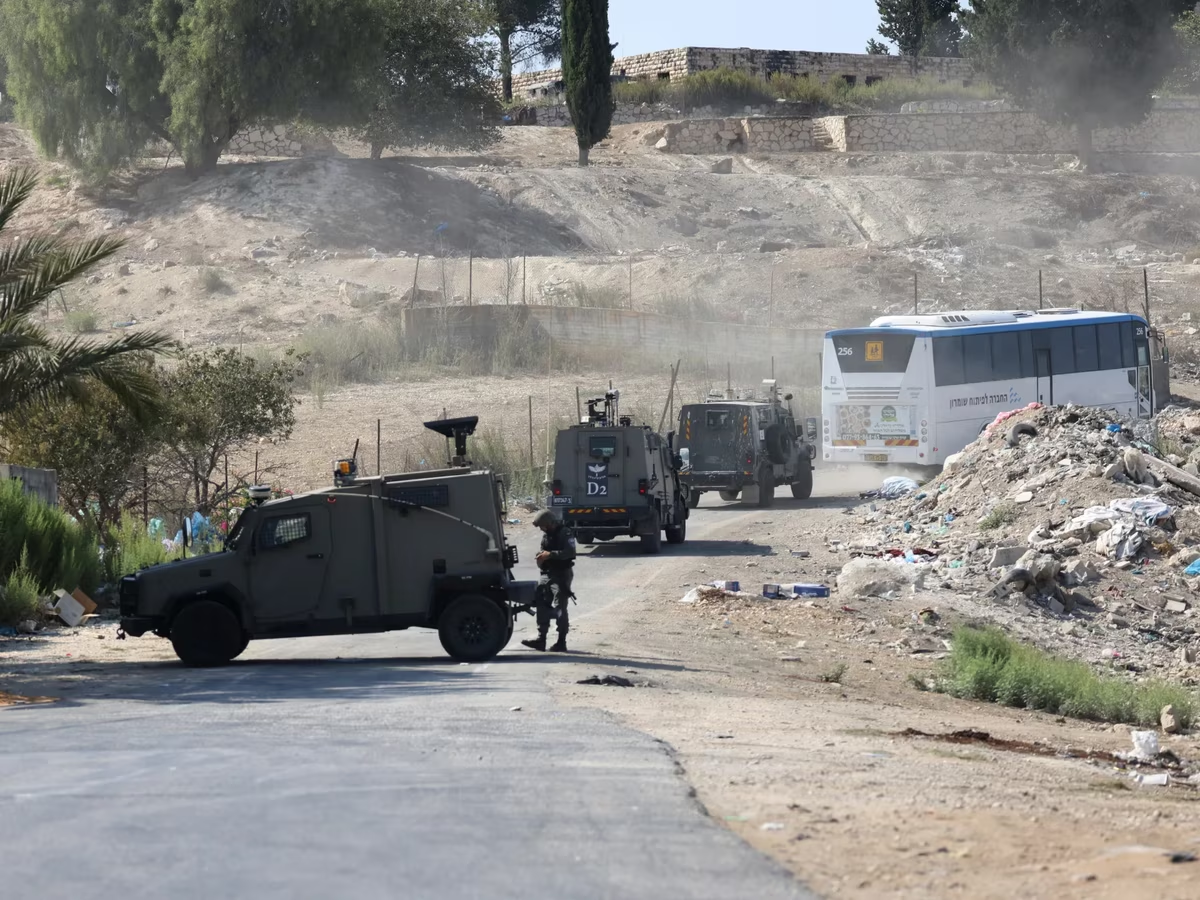
In the south of the West Bank, Israeli occupation forces deployed military bulldozers accompanied by a military convoy to the Sanur settlement south of Jenin, and began leveling operations in preparation for rebuilding it.

Sanur is one of the settlements that were evacuated in 2005 as part of the disengagement plan, but recent moves indicate a clear intention to revive it.

A correspondent reported that 4 military bulldozers stormed the site, within a broader plan to legitimize and build 19 new settlement outposts in the West Bank, including 4 settlements in Jenin governorate.

Parallel to the settlement expansion, the Palestinian Water Authority and international institutions have monitored a dangerous escalation in Israeli violations of the Palestinian water sector since October 7, 2023. These violations include sabotaging water networks, controlling natural springs, and diverting water sources in favor of settlements and settlement outposts, which has widened the water consumption gap between Palestinians and Israelis.

Field reports showed entire Palestinian villages being deprived of water, a matter that led to deterioration in living conditions and forced some population groups to forced displacement.

In the Al-Auja area east of the occupied West Bank, Palestinians were deprived of access to the Al-Auja spring, one of the oldest and largest water basins in Palestine, due to a settlement outpost established nearby. This led to depriving residents and their livestock of water and pasture, forcing them to live within fenced areas for fear of settler attacks.

Field scenes also showed the drying up of spring paths, despite heavy rains in recent weeks, as a result of settlers pumping water from their main sources. Instead of obtaining water from their natural sources, Palestinians are forced to buy it from the Israeli company "Mekorot", which has installed pumps at most wells.

In the center of the West Bank, field reports documented the encirclement of Ein Samia, one of the largest groundwater basins that used to feed 19 Palestinian villages and on which more than 100,000 people depend, where the area has become besieged by settlement outposts, with recorded operations of water pumping and sabotage of Palestinian equipment and pipes.

These developments coincided with a tour by Israeli Finance Minister Bezalel Smotrich in the area, where he praised the role of settlers, considering that they "regained control of the water wells", in statements that provoked widespread criticism from Palestinian and human rights parties.

Official Palestinian data indicates that Palestinians are prevented from exploiting more than 85% of their water resources, despite their lands extending to the Mediterranean Sea, the Dead Sea, the Jordan River, and containing hundreds of groundwater and surface wells.

After the genocide war on the Gaza Strip, more than 200 new settlement outposts were established, most of them pastoral, around water wells, leading to the Israelis and settlers exceeding their water share by 8 times the Palestinians' share.

On the ground, a correspondent reported a large Israeli military gathering near the Qalandia checkpoint north of occupied Jerusalem, where occupation forces fired sound and gas bombs, raided commercial stores in the vicinity of Qalandia camp and the town of Kafr Aqab, coinciding with extensive raids on neighborhoods in the city of Birzeit and areas north of Jerusalem.

These developments collectively reflect a multi-dimensional escalation in the West Bank, combining settlement expansion, military incursions, and control over natural resources, at a time when Palestinian and international parties warn of dangerous repercussions on the future of stability and Palestinian existence in the region.

PALESTINE

Tue 23 Dec 2025 1:16 pm - Jerusalem Time

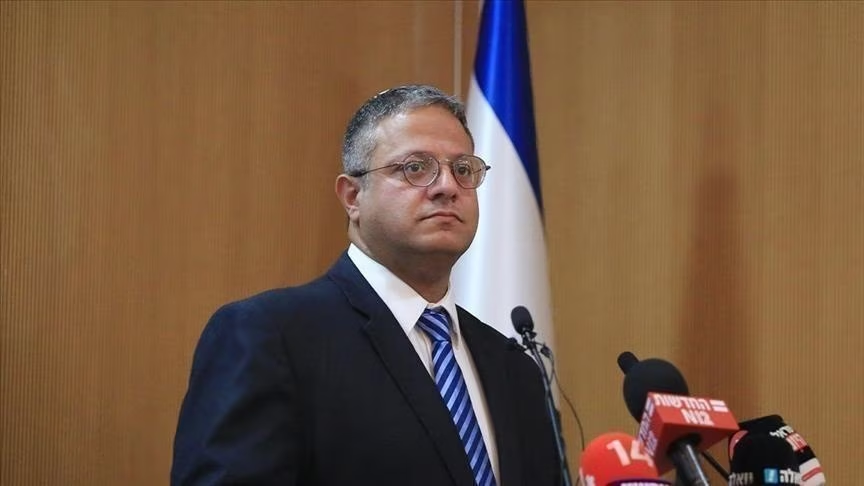
Ben Gvir: 100 doctors volunteered to carry out the execution of Palestinian prisoners

Israeli National Security Minister Itamar Ben Gvir said on Tuesday that 100 doctors have volunteered to carry out the execution of Palestinian prisoners if the bill is passed.

This came according to his statements during a heated debate session of the Knesset (Parliament) National Security Committee on the bill proposed by Ben Gvir to execute any prisoner proven to have participated in the killing of a Jew.

Under the bill, the execution would take place within 90 days of the issuance of the execution decision, using lethal injection.

Ben Gvir said, according to a video clip of the session broadcast on the Telegram platform: "Since the living hostages (prisoners) have returned (from Gaza), there is no excuse or justification for not applying this law."

Despite the Israeli Medical Association previously announcing that it would not participate in implementing the law if it is passed, Ben Gvir said: "More than 100 doctors have submitted requests, and said: We are volunteers to participate in carrying out the death penalty."

He pointed out that "the Israeli General Security Service (Shin Bet) supports the bill and believes that this punishment will increase deterrence."

In response to Ben Gvir, Einat Ovadia, the executive director of the "Zulat" Institute for Equality and Human Rights, said during the session: "You are the last person who can talk about deterrence or governance or security, and the last person to be advised to receive recommendations from him regarding punishment."

Ovadia added: "The death penalty is not a punishment, but murder," to which Ben Gvir responded by saying: "Shame on you, you support the murderers, you support Hamas," according to the same video clip.

In November last year, the Knesset voted in the first reading on a bill to execute Palestinian prisoners, and it still needs to be voted on in the second and third readings before becoming a binding law.

Repeatedly, Ben Gvir has called for the approval of a bill that allows the execution of Palestinian prisoners in Israeli prisons, and has significantly tightened the conditions of the detainees, amid an increase in crimes against them and deprivation of their rights.

Among the tightened measures, banning visits and reducing the food allowed for prisoners to obtain, as well as reducing bathing opportunities in prison, according to Palestinian institutions concerned with prisoner affairs.

The preparation for issuing a law to execute prisoners comes while Palestinians suffer the repercussions of a genocide committed by Israel in the Gaza Strip for two years since October 8, 2023, in addition to a bloody and destructive aggression on the occupied West Bank.

OPINIONS

Tue 23 Dec 2025 1:09 pm - Jerusalem Time

The Dilemma of the Israeli-Palestinian Conflict: Not a State of Chaos, but the Product of a Sustained Control System

Dr. Ibrahim Nairat

Dr. Ibrahim Nairat

Opinion Writer

The dilemma of the Israeli-Palestinian conflict cannot be understood as a chaotic conflict or a state of perpetual anarchy between two equal parties, but rather as the product of a sustained control system that has historically formed and evolved through complex political, security, and economic tools. This conflict, as it exists today, did not arise from a vacuum nor is it managed randomly, but rather it is subject to the logic of regulation and management, where Israel, by virtue of its military superiority and actual control over the land, has the ability to determine its ceiling, boundaries, and rhythm.

Since 1967, Israel has not left a true sovereign vacuum in the Palestinian territories, but rather established a comprehensive control system that governs borders, movement, resources, economy, and even the details of Palestinians' daily lives. Within this system, it is difficult to consider any Palestinian movement, whether political or field-based, outside the scope of general control. This does not mean that every event is meticulously planned, but rather that the environment that allows it to occur or contain it is a tightly controlled one, where tools of prevention or permission are activated according to calculations of cost and benefit.

The conflict, in this sense, is not a state of administrative or security failure, but rather part of a long-term management system aimed at keeping it at a controllable level without reaching a radical solution that imposes unwanted political or legal costs. Escalation is not only used as a means of deterrence, but also as a tool to reorder the Palestinian scene, impose new facts, and strengthen internal and external security narratives. As for de-escalation, it is not necessarily a step towards peace, but a functional measure taken when the cost of tension becomes higher than its benefit.

This logic also extends to the Palestinian political structure. The emergence of the Palestine Liberation Organization, then recognition of it, and later the establishment of the Palestinian Authority, came in the context of seeking a Palestinian entity to represent the population and manage their affairs, without Israel bearing the full burden of direct occupation with its imposed legal and ethical obligations towards a people under its control. This arrangement continued as long as it fulfilled the function of an administrative and political intermediary, transferring responsibility for education, health, economy, and street control to a Palestinian entity, while Israel retained actual control over the land, borders, security, and resources.

This reality does not negate the legitimacy of Palestinian representation nor diminish the sacrifices made by Palestinians, but it places this representation within a structural context that limits its ability for independent action. The continuation of Palestinian political entities was conditional on their degree of harmony with the logic of managing the conflict rather than ending it, and with transforming the issue from a national liberation project into an administrative and security file that can be fragmented and postponed.

The most dangerous aspect of this model is that it produces a constant impression of chaos, while it is in essence a highly disciplined system. Palestinian geography is fragmented into separate units, communities are separated from each other, and daily rights such as movement, work, and services are linked to conditions of behavior and stability. Thus, life itself is transformed into a tool of control, and stability is redefined as the absence of explosion rather than the presence of justice.

In this context, Palestinian rights are not treated as fixed legal entitlements, but as political variables subject to bargaining. Improved living conditions are granted as a temporary alternative to political freedom, and time is used as a tool of attrition, so that major questions about sovereignty and self-determination are replaced by daily questions about salaries, crossings, and permits. Over time, continuing the conflict becomes less costly than resolving it, and less risky than opening a horizon for a real settlement that redefines the relationship between the controller and the controlled.
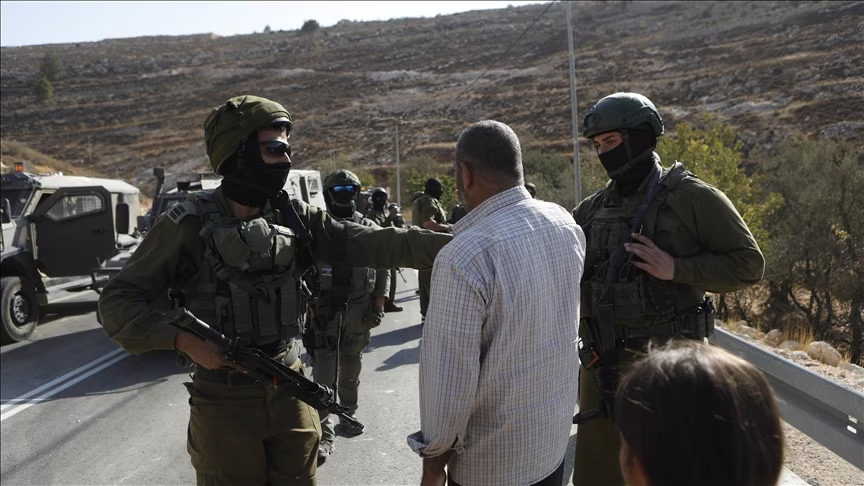
Here, the shift from searching for the spark of violence to questioning the mechanism that makes this violence renewable becomes an analytical necessity, not a linguistic choice. The spark, no matter how shocking, remains a transient moment that does not explain why violence recurs at the same pace, and why the same scene returns in different forms and places. Focusing on the event gives a false impression that violence is an exception, while reality indicates that it is part of a cycle produced within a system capable of absorbing shocks and reproducing them.

This mechanism does not rely on military force alone, but on an integrated management of political, economic, and psychological factors, creating a permanent environment of uncertainty, where rights are temporary, calm is conditional, and the future is not plannable. In such a reality, violence no longer becomes an act separate from the context, but one of the possible forms of expression within a closed space, not because it is the best choice, but because it is one of the few remaining options.

Conversely, this system allows each round of violence to be re-presented as an emergency event, for which the same security discourses are invoked, and through which the same policies are justified, without approaching the structural question related to why the conditions that make the spark possible in the first place persist. Thus, violence is transformed from a sign of structural flaw into a tool for sustaining it.

Saying that the conflict remains open not because it is out of control, but because it is governed by it more than it appears, means that the absence of a solution is not the result of chaos, but of a calculated management of time and risks. The conflict, when managed instead of resolved, becomes a political tool in itself, used to regulate the interior, reorder priorities, and postpone major commitments. In this framework, peace becomes a deferred option not because of its impossibility, but because its political cost may be higher than the cost of continuing the existing situation.

Understanding the Israeli-Palestinian conflict in this way does not detract from the humanity of any party, nor does it justify violence or suffering, but rather opens a different horizon for discussion and responsibility. It shifts the discussion from condemning isolated events to questioning the structure that allows their repetition, and from searching for a momentary culprit to dismantling a control system that makes the renewal of violence a predictable matter. Without recognizing the existence of this system, the conflict will remain open, not because it is out of control, but because it is governed by it more than it appears.

ARAB AND WORLD

Tue 23 Dec 2025 12:44 pm - Jerusalem Time

US Ambassador Doubts Iran's Comprehension of Washington's Message and Warns of Continued Strengthening of Its Influence

US Ambassador to the occupying state Mike Huckabee doubted Iran's comprehension of the message that the United States wanted to convey through the attack on the Fordow nuclear facility in June/June last year, warning of Tehran's continued attempts to strengthen its regional influence.

He said during a speech at a conference of the Israeli Institute for National Security Studies: "I don't know if Iran took Trump seriously until the night B-2 bombers flew over Fordow."

The US ambassador added, "I hope they understood the message, but perhaps they didn't fully understand it, as it seems they are trying to rebuild their influence and find a new way to deepen and tighten the noose, making it more secure."

Huckabee warned European countries about Iran, saying, "If Europeans do not realize that this represents a real threat to all of Europe, they are stupider than I sometimes think."

This comes at a time when Hebrew and American media said on Monday that occupying government Prime Minister Benjamin Netanyahu is seeking to obtain a green light from US President Donald Trump for a new attack on Iran without direct American participation.

Trump will host Netanyahu in Miami, Florida, on December 29.

Quoting unnamed Israeli official sources, the Hebrew newspaper "Yedioth Ahronoth" said that Netanyahu will present Trump with updated intelligence information related to Iran and the Hamas Hezbollah movement, in an attempt to convince him of the danger of what the occupation considers an acceleration in Iran's production of ballistic missiles.

The sources considered Trump's approval of a solo Israeli strike against Tehran as a major achievement for Netanyahu, given the occupation's awareness that the United States does not want to engage directly in a new military confrontation.

Last Saturday, Israeli Chief of Staff Eyal Zamir called US Central Command Commander Brad Cooper and informed him that the occupation is concerned about a missile maneuver launched by the Iranian Revolutionary Guard a few days ago, according to the "Axios" website quoting American and Israeli sources.

The sources said that Zamir informed Cooper that the recent Iranian missile movements and other operational steps may be a cover for a surprise attack, and urged American coordination with the occupation regarding defensive preparations.

The Army Radio quoted an unnamed security official on Monday as saying: "We are monitoring Iranian efforts to manufacture ballistic missiles at a high pace."

The security official added that Iranian armament will be central to Netanyahu and Trump's talks during their upcoming meeting next week.

According to the occupation's claims, at the end of the war, Iran had 1,500 missiles left, down from 3,000 it had, and 200 launch pads out of 400.

It added that the Iranians have begun taking steps to rebuild their forces, but they have not returned to the level they were at before the war.

ARAB AND WORLD

Tue 23 Dec 2025 12:20 pm - Jerusalem Time

Psychological Trauma in Israel.. A Time-Bombed Economic Bomb of 160 Billion Dollars

The losses of wars are not limited to material destruction and direct military spending, but their profound effects extend to the mental health of societies, and the long-term economic and social burdens that follow.

A recent and shocking report issued by the Israeli "Natal" Center reveals that the psychological trauma resulting from the attack by the Islamic Resistance Movement (Hamas) on the south of the occupation state on October 7, 2023, and the war that followed, is not just a humanitarian crisis, but a time-bombed economic threat to human capital and sustainable growth for many years to come.

The "Natal" Center is a non-profit organization that provides treatment and psychological and emotional support to victims of traumas resulting from war and violence.

The journalist Maayan Hoffman discussed the results reached by the Israeli center in an article published on the "Ynet" website affiliated with Yedioth Ahronoth newspaper, citing the American website "The Media Line".

Hoffman - who is a journalist at the independent American website "The Media Line" - mentioned that Israel will face a hefty bill estimated at about 500 billion shekels (approximately 160 billion dollars) over 5 years, including direct and indirect expenses related to the repercussions of psychological trauma.

She pointed out that the report confirms that the largest part of this cost does not appear immediately in government budgets, but manifests gradually in the erosion of human capital, declining productivity, and rising rates of illness, violence, and addiction.

The report explains that many workers, especially in the age group 25-38 years, which forms the backbone of the workforce, have become unable to work efficiently, or have abandoned their high-value specialties (such as engineering) in favor of fields that do not require much effort due to psychological exhaustion.

Hoffman reported that the "Natal" report warns of an unprecedented surge in post-traumatic stress disorder rates in Israel, which may reach about 30% of the population, a figure that far exceeds the global average.

It is also estimated that more than 600,000 Israelis will suffer from psychological effects that hinder their ability to work or learn, with tens of thousands who may develop severe symptoms requiring long-term therapeutic intervention.

The repercussions do not stop at the boundaries of the formal economy, as Hoffman says, adding that the report indicates a sharp increase in fatal road accidents, domestic violence, drug use, and the use of sedatives and opioids, in addition to a worrying increase in heart diseases and strokes linked to psychological stress.

The report's authors point out that these phenomena are not temporary, but form a pattern that has repeated after previous wars, which strengthens the credibility of current predictions.

In contrast, the report - according to the article's writer - presents an alternative vision based on early investment in mental health as an economically sound choice. It bases this on a study issued by the World Health Organization showing that every dollar spent on treating anxiety and depression can achieve a return of up to 4 times through improved productivity and reduced future costs. However, failure to invest in this field leads to completely opposite results.

The report calls for structural reforms including expanding community mental health services, integrating psychotherapy with vocational rehabilitation, and enhancing national coordination between different institutions, alongside integrating concepts of "trauma-sensitive work" into workplaces, education, and healthcare.

The report concludes that the cost of psychological trauma lies not only in what is spent on treatment, but in what is wasted of human energies, and what is lost of growth opportunities. While Israel is still in the "acute phase" of the crisis, the report's authors see that rapid intervention can prevent the trauma from turning into a chronic economic and social burden that weighs on the state for decades to come.

It is noted that most studies that addressed the psychological impact of the October 7, 2023 attack confirmed that the event produced a contemporary model of post-traumatic stress disorder, a psychological disorder that appears after exposure to a stressful or terrifying and unexpected event, and its effects are clearly reflected on both the individual and society.

In his scientific paper published by the Al-Zaytouna Center for Studies and Consultations, the expert in future studies and foresight, Dr. Walid Abdul Hai, sees that the phenomenon of suicide is one of the most prominent potential outcomes of this disorder, as it has been a focus of attention for psychologists, sociologists, and doctors.

Data reveals a rise in suicide rates among Israeli army personnel after the Hamas attack, which imposes the necessity of studying this phenomenon in light of psychological and social theories, especially since Israel tops Middle Eastern countries in suicide rates.

PALESTINE

Tue 23 Dec 2025 12:02 pm - Jerusalem Time

The occupation army continues its violations of the ceasefire agreement.. and famine threatens Gaza again

The Israeli occupation army continues its violations of the ceasefire agreement, with renewed aerial and artillery bombardment on various parts of the Gaza Strip, amid international warnings that the specter of famine is looming over the sector again.

Abdullah Muqdad reported from Deir al-Balah that the occupation aircraft carried out a raid in the east of Deir al-Balah city in the central Gaza Strip, targeting a residential area in the east of what is known as the yellow line, which are areas controlled by the occupation army and turned into a security zone.

He pointed out that the occupation vehicles opened fire on the eastern area of Gaza City and the Tuffah neighborhood, while carrying out large demolition operations of residential buildings east of Khan Yunis in the south of the Strip.

Expanding the Yellow Line

He explained that the most prominent development is the expansion of the area of the yellow line zone in the Jabalia camp in the north of the Gaza Strip, where the Israeli military vehicles advanced and strengthened some elevated military positions in that area, thus forcing the residents who live in tents or among the ruins of their destroyed homes to displace towards the western areas.

And he explained that the occupation aims thereby to turn these areas into points for launching Israeli aggressions and targeting Palestinians, whether through small marches or even through the vehicles and elevated military positions that oversee and control the largest part of the population concentrations in the Gaza Strip.

Famine threatens Gaza again

On the humanitarian front, international organizations warned that the specter of famine is looming over the Gaza Strip again, amid the restrictions imposed by the occupation on the entry of humanitarian aid.

In this context, the United Nations Relief and Works Agency for Palestine Refugees in the Near East "UNRWA" confirmed that the situation in Gaza is still tragic, making its humanitarian needs enormous.

The UN agency indicated that about one million six hundred thousand Gazans are facing a severe shortage in food.

Adnan Abu Hasna, the media advisor to the agency, said in a statement that the humanitarian situation in the Gaza Strip remains tragic amid food insecurity, confirming that about one million Palestinians in the Gaza Strip suffer from food insecurity.

For its part, the International Rescue Committee said that hunger in the Gaza Strip is still at catastrophic levels, as nearly one hundred thousand Gazans live in conditions similar to famine.

The committee indicated that hundreds of thousands of Gaza children suffer from severe malnutrition, which threatens serious health consequences for children, weakens the immune system, and harms brain development.

In the context, the media official at the "Save the Children" organization in Gaza, Shuruq Al-Ayla, said that the humanitarian catastrophe in the sector has not ended despite the ceasefire agreement, stressing in a statement the urgent need to introduce mobile homes and winter clothes, especially for children amid the bitter cold.

Serious health complications

"Doctors Without Borders" also warned that the new Israeli decisions to register international non-governmental organizations may deprive hundreds of thousands in the Gaza Strip of life-saving healthcare by next year.

As for the Palestinian Medical Relief Society, it warned of many health complications for chronic disease patients in the Gaza Strip due to the unavailability of their medications and Israel's prevention of their travel abroad for treatment.

Mohammed Abu Afash, director of the society, said in a statement that 1200 Palestinian patients died due to the unavailability of treatment for them in the Gaza Strip and their prevention from traveling to complete treatment, without specifying the time period.

The director of the World Health Organization, Tedros Adhanom Ghebreyesus, said on Friday that 1092 patients in the Gaza Strip died while waiting for medical evacuation between July 2024 and November 2025.

The medical evacuation process for patients from the Gaza Strip is still proceeding at a slow pace, as Israel continues to impose its strict restrictions on the exit of patients from the sector, despite the great shortage in medical supplies in the sector's hospitals.

On Sunday, the Ministry of Health in Gaza warned of a serious deterioration in drug stocks in the sector's hospitals due to shortages reaching 52 percent in medicines and 71 percent in medical consumables.

It explained that Israel continues to reduce the entry of medical trucks into the sector to less than 30 percent of the monthly need, shirking its commitments stipulated in the ceasefire that came into effect on October 10 last year.

PALESTINE

Tue 23 Dec 2025 11:58 am - Jerusalem Time

"We will never leave Gaza".. Katz announces the start of the "practical sovereignty" phase and approves a plan to build "settlement nuclei" in the north

Katz described the current government as a "settlement government" par excellence.

Israeli occupation war minister Yisrael Katz announced on Tuesday, December 23, 2025, strict government directives to proceed with expanding the settlement area to include both the Gaza Strip and the occupied West Bank, decisively dispelling doubts about the "Israeli" future intentions by affirming that Israel "will never leave the Gaza Strip".

Settlement in northern Gaza

Hebrew media quoted Katz as saying, during his participation in the inauguration ceremony of a new settlement project, that the current government actually plans to establish what it calls "settlement nuclei" in areas of northern Gaza Strip, noting that this will be done "at the appropriate time and in the appropriate way".

In the context of media coverage of these statements, Hebrew Channel 14 reported that Katz emphasized in his speech the serious work to establish permanent settlement sites in the northern sector.

Meanwhile, the Hebrew Broadcasting Corporation quoted Katz as decisively affirming that the military and civilian presence in the Gaza Strip is a "strategic decision with no turning back," repeating his explicit phrase: "We will never leave the Gaza Strip".

1200 units in "Beit El"

On the West Bank front, while present in the "Beit El" settlement established north of Ramallah city, Katz revealed the approval of building 1,200 new settlement housing units in the aforementioned settlement.

Katz described the current government as a "settlement government" par excellence, expressing its political orientations by saying: "If sovereignty can be imposed on the West Bank, it will be imposed."

The "practical sovereignty" phase

In his analysis of the current political and security reality, Katz added that Tel Aviv is now, in his words, going through the "practical sovereignty" phase, noting that the rapid developments following the October 7 attack have created, in his view, "opportunities that have not been available for a long time," clearly referring to the government's determination to exploit the security situation to strengthen the settlement project and impose new facts on the ground that change the shape of the conflict.

PALESTINE

Tue 23 Dec 2025 11:53 am - Jerusalem Time

Injuries among Palestinians due to direct shooting by the occupation near 'Ourt'a checkpoint'

The Palestinian Red Crescent Society reported injuries among citizens as a result of Israeli occupation forces directly shooting at their vehicle, near the Ourt'a military checkpoint located north of the occupied West Bank.

Medical sources at the Red Crescent confirmed that their crews treated three injured individuals at the scene of the incident, resulting from this targeting of the vehicle. This incident comes amid the ongoing tensions witnessed at military checkpoints and roads in the northern West Bank areas.

This incident occurs within the framework of a broad security and military escalation campaign launched by occupation forces on various cities and villages of the West Bank, where targeting vehicles and passersby at checkpoints has become a prominent feature of the daily scene.

Occupation forces continue to practice the policy of "hunting" Palestinian citizens by deploying checkpoints and intensifying shooting operations under the pretext of "suspicion", in addition to night and day raids targeting camps and towns, leaving dozens of martyrs, injuries, and detainees, in an attempt to impose a pressing and suffocating security reality on the lives of Palestinians.

PALESTINE

Tue 23 Dec 2025 10:46 am - Jerusalem Time

Arrest of 40 Palestinians in the West Bank

Israeli forces arrested at least 40 Palestinians at dawn on Tuesday during a widespread campaign of raids and searches carried out in several governorates of the occupied West Bank, which included searching homes and tampering with their contents.

The "Prisoners' Media" office (non-governmental), in a statement, said that the Israeli army launched a widespread arrest campaign at dawn on Tuesday in cities and towns of the West Bank.

It reported that the Israeli army arrested 9 Palestinians from the northern West Bank, including 8 from Tulkarm governorate, and one from Qalqilya city.

The Israeli army also arrested 31 Palestinians from southern West Bank governorates, including 22 from Dura town south of Hebron, and 9 from Tuqu' town south of Bethlehem, according to the same source.

It added that the escalation of arrest campaigns carried out by occupation forces in various areas of the West Bank, through raiding homes, searching them, and assaulting citizens, comes within the framework of a systematic repressive policy that targets Palestinians daily.

The "Prisoners' Media" office held Israel fully responsible for the safety of the detainees, calling on human rights and humanitarian institutions to monitor their conditions and intervene urgently to stop the ongoing violations against them.

Israeli forces usually raid cities and towns in the West Bank and carry out arrest campaigns against Palestinians on the pretext that they are "security wanted".

Concurrently with the genocide war launched by Israel on Gaza on October 8, 2023, which lasted two years, the Israeli army and settlers escalated their attacks in the West Bank, resulting in the killing of 1,102 Palestinians, injuring about 11,000, in addition to arresting more than 21,000.

Meanwhile, Israel's genocide war on the Gaza Strip has left about 71,000 Palestinian dead and more than 171,000 injured, mostly children and women, alongside massive destruction, with UN estimates indicating that the cost of reconstruction could reach about $70 billion.

ARAB AND WORLD

Tue 23 Dec 2025 10:37 am - Jerusalem Time

Israeli Army Reports Killing 3 Hezbollah Members in Bombing of Southern Lebanon

The Israeli Army, on Tuesday, spoke of killing 3 members of "Hezbollah" in a bombing that targeted the Sidon district in southern Lebanon.

It added in a statement: "The Israeli Army eliminated yesterday (Monday) three members of Hezbollah in southern Lebanon".

It claimed they "pushed plans against Israeli Army forces, and were intending to attempt to rebuild military infrastructure".

It alleged that "the raid resulted in the elimination of a Hezbollah member who served simultaneously in the intelligence unit affiliated with the Lebanese Army".

The Israeli Army said it "views with utmost seriousness the cooperative relations between the Lebanese Army and Hezbollah".

Threatening escalation, it added that it "will continue to work to remove any threat to the citizens of the State of Israel", according to its expressions.

It indicated that the three are Ali Abdullah, whom it claimed served in the intelligence unit of the Lebanese Army, Mustafa Muhammad Balut, and Hassan Hamdan.

Until 8:00 (GMT), no comment has been issued from "Hezbollah" or the Lebanese Army regarding the Israeli claims.

On Monday, the Lebanese News Agency reported that an Israeli drone targeted a car on the road between the towns of Aqtanit - Al-Qantara - Al-Maamariya in the Sidon district, "which led to the fall of 3 martyrs who were inside it".

Hebrew media has been talking for a week about the Israeli Army completing preparations for a "broad attack" against what it claims are sites for "Hezbollah" in Lebanon.

Tel Aviv conditions launching the possible attack on the failure of the Lebanese government and army to implement their commitment to disarm "Hezbollah" before the end of 2025.

On August 5, 2024, the Lebanese Council of Ministers approved monopolizing arms, including those possessed by "Hezbollah", in the hands of the state, and tasked the army with developing a plan and implementing it before the end of 2025.

However, Hezbollah Secretary-General Naim Qassem has repeatedly announced the party's rejection of disarming, and called for the withdrawal of the Israeli Army from Lebanese territories.

Israel has killed more than 4,000 people and injured nearly 17,000 others during an aggression on Lebanon that it began in October 2023, and turned into a comprehensive war in September 2024.

Daily, it violates a ceasefire agreement that began on November 27, 2024, which has cost the lives of hundreds of Lebanese, and it occupies 5 hills it seized in the recent war, in addition to other Lebanese areas it has occupied for decades.

ARAB AND WORLD

Tue 23 Dec 2025 10:22 am - Jerusalem Time

Escalating Controversy in Britain Over Hunger Strike by 'Palestine Action' Activists

The controversy in Britain continues to escalate regarding solidarity campaigns with activists from the 'Palestine Action' organization who are on hunger strike in prisons, amid increasing popular protests and legal actions that threaten to reach the Supreme Court, against a government silence that supporters of the strikers describe as 'deliberate and inhuman'.

The British capital, London, witnessed notable protests on Monday evening in Piccadilly Square, where Swedish activist Greta Thunberg led crowds of sympathizers who closed the square in protest against the continued detention of 8 activists from the 'Palestine Action' organization and their hunger strike that has lasted for weeks.

The protesters raised slogans demanding the release of the strikers or the opening of official dialogue channels with them, holding the British government responsible for endangering their lives.

Activists on social media harshly criticized the position of British Prime Minister Keir Starmer, considering his refusal to intervene even 'out of humanitarian or empathetic motives' shocking, especially given his professional background as a former human rights lawyer.

Activists saw that the government's silence contradicts the values that Starmer had long defended before assuming the premiership.

According to reports, 8 activists from the 'Palestine Action' organization began an open-ended hunger strike on November 2, protesting their continued detention and the denial of bail, as well as the British government's support for Israel's war on Gaza, as they put it. Their supporters affirm that the strike also aims to pressure for stopping the genocide against Palestinians.

In recent days, legal representatives of the strikers announced their intention to initiate legal proceedings against Foreign Secretary and Justice Secretary David Lammy, accusing him of violating clear government policies regarding the handling of hunger-striking prisoners, after weeks of receiving no response or official contact from the government.

In a warning letter, 'Palestine Action' lawyers gave the government a deadline until noon today, Tuesday, to respond, threatening to appeal to the Supreme Court against Justice Secretary David Lammy's refusal to meet with representatives of the strikers. They indicated that the government's continued disregard could constitute a violation of human rights.

The lawyers relied on prison policies that stipulate that the government must make 'maximum efforts' to understand the reasons for the prisoner's refusal of food and work on addressing these reasons.

In a related development, an official letter addressed to the government announced that activist Qaisar Zahra had ended her strike after 48 days of abstaining from food.

Zahra had been transferred to the hospital last week coinciding with protests outside Bronzefield Prison, claiming she was deprived of full medical care.

So far, 3 out of the 8 activists have stopped their strike, while the rest continue to abstain from food.

For his part, a spokesperson for the Ministry of Justice said they want these prisoners to 'accept support so they can recover,' but emphasized that the ministry will not take actions that could encourage others to endanger their lives through hunger strikes.

PALESTINE

Tue 23 Dec 2025 10:07 am - Jerusalem Time

Two million Palestinians in Gaza face a harsh winter after the destruction of 85% of homes

Two million Palestinians in Gaza, exhausted after two years of war, are now facing harsh winter climatic conditions, at a time when the occupation has destroyed more than 85% of homes.

The bleak picture of the humanitarian situation in the Gaza Strip with the arrival of winter, where the suffering of the residents left by the war is exacerbated to take a new form no less cruel, manifested in the bitter cold, heavy rains, and the absence of decent living conditions.

Life has not regained its nature despite more than two months since the ceasefire, as the cessation of bombing did not lead to actual stability, but to a daily silent suffering that seeps through the details of life, from water leaking into tents, to the collapse of damaged buildings, and the death of people, including children, due to the cold.

The report indicates that the occupation army destroyed more than 85% of homes in Gaza, while reconstruction materials and basic aid are still restricted from entry, leaving about two million people, mostly displaced, facing the winter directly inside dilapidated tents and uninhabitable buildings.

The recent storms accompanied by strong winds and heavy rains have led to the flooding of camps with mud, the destruction of thousands of tents, and the loss of families' few remaining belongings, amid complete inability to protect themselves and their property.

On the other hand, the article highlights the deep psychological and social impact of the crisis, where a general feeling of exhaustion, despair, and anxious waiting prevails, as residents no longer fear only the return of fighting, but also the continuation of the slow bleeding of daily life, and new waves of displacement that narrow the space and eliminate options.

Despite the repeated talk of reconstruction, these promises seem unattainable in the absence of the simplest means of resilience, from food, medicine, and heating.
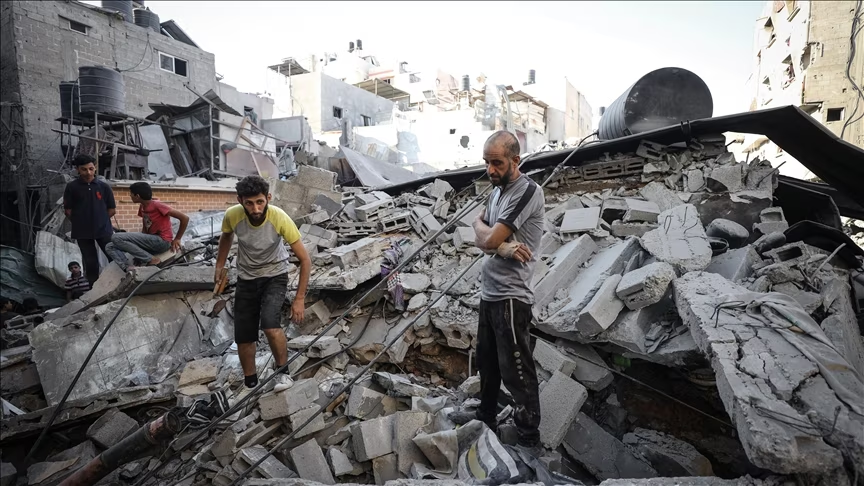
In parallel, the education sector suffers from severe disruption after the destruction of schools and universities, and students' compulsion to study in tents or remotely despite electricity and internet outages, yet many young people cling to education despite that as the last thing left for them, and as a tool for moral resistance against total collapse.

The article concludes that Gaza is experiencing increasing isolation, where daily losses accumulate amid a fragile truce that has not given residents security or a clear horizon for the future.

PALESTINE

Tue 23 Dec 2025 10:03 am - Jerusalem Time

3 Children Injured and Sheep Slaughtered in Settlers' Attack on a House in Hebron

Three Palestinian children were injured and sheep were slaughtered in an attack carried out by Israeli settlers on a house in the Hebron governorate in the occupied West Bank.

Under the title "Jewish terrorism in Hebron," the official Israeli Broadcasting Corporation said on Tuesday: "Jewish rioters stormed a Palestinian home in the town of As-Samu' south of Hebron last night, smashed windows, threw stones at the residents, and beat the sheep in the adjacent pen."

The corporation added: "Three children injured in the assault were taken to the hospital, and several sheep were slaughtered."

It quoted the Israeli police as saying that they arrested "five suspects involved in a severe violence incident that occurred near As-Samu'."

The police also found "evidence during searches, including pepper gas used by the attackers during the assault."

According to data from the Palestinian Anti-Wall and Settlement Resistance Commission (governmental) for the month of November/December last year, Israeli settlers carried out 621 assaults in the West Bank against Palestinians and their property.

Coinciding with the years of the Israeli genocide on Gaza, the Israeli army and settlers escalated their assaults in the West Bank, resulting in the killing of more than 1,102 Palestinians, injuring about 11,000, in addition to arresting more than 21,000.

Meanwhile, the Israeli genocide in Gaza, which began on October 8, 2023, and lasted for two years, left about 71,000 Palestinian deaths, more than 171,000 injured, and massive destruction affecting 90% of the civilian infrastructure.

PALESTINE

Tue 23 Dec 2025 9:30 am - Jerusalem Time

The Israeli Army Launches Raids and Artillery Bombardment on Gaza

The Israeli army launched air raids and artillery shelling on the Gaza Strip early Tuesday, in areas it controls under the ceasefire.

This comes as part of the ongoing Israeli violations of the ceasefire agreement that came into effect on October 10 last month.

Eyewitnesses said that Israeli fighter jets carried out a series of raids on various areas east of Gaza City, within the areas controlled by the army.

They indicated that the army's vehicles and helicopters opened fire east of the city.

In the middle of the sector, warplanes launched a raid on an evacuated residential building east of Deir al-Balah city within its control areas, according to the witnesses.

Israeli artillery shelled several areas east of the central governorate, within the army's control areas.

No casualties were reported from the shelling and gunfire.

Israel continues its violations of the ceasefire, committing 875 breaches that resulted in the killing of 411 Palestinians and injuring 1,112 others, according to the Gaza Government Media Office on Monday evening.
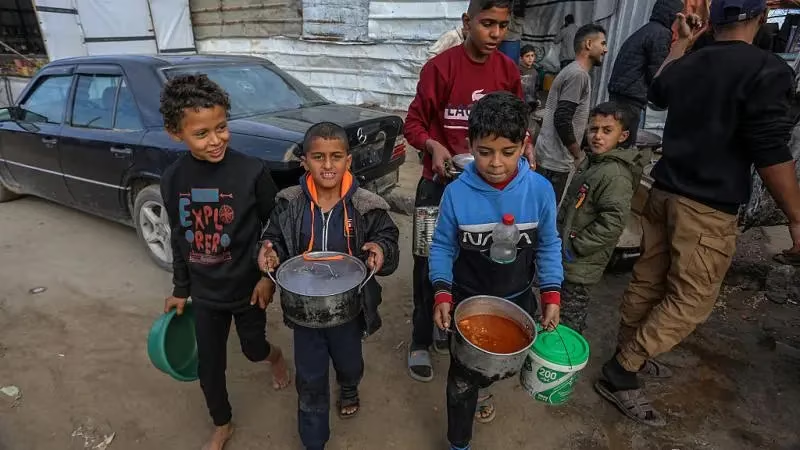
Israel, with American support, began committing genocide in the Gaza Strip on October 8, 2023, lasting two years, resulting in about 71,000 Palestinian deaths and more than 171,000 injured, and massive destruction affecting 90% of the civilian infrastructure.

PALESTINE

Tue 23 Dec 2025 9:06 am - Jerusalem Time

Hamas accuses the occupation of attempting to impose new rules of engagement in Gaza.. and Washington prepares a list of technocrats to manage the sector

The Islamic Resistance Movement "Hamas" accused the Israeli occupation of attempting to impose new rules of engagement in the Gaza Strip, aimed at desecrating the sector and perpetuating the humanitarian catastrophe.

This comes at a time when the American administration is working on preparing a list of technocrats to manage Gaza,

In this context, the Hamas leader Bassem Naim confirmed that the impressions coming from the Miami dialogues indicate that they were "positive and constructive", regarding the evaluation of the first phase, noting that what is required to move to the second phase.

Naim added in a tweet on the "X" platform that the most important question is the extent of Washington's willingness to pressure Benjamin Netanyahu and his government to commit to implementing the agreement's obligations, especially regarding the first phase.

Naim added that the resistance forces have fulfilled all their duties in this phase, "while the enemy is trying to impose new rules of engagement", aimed at desecrating the sector security-wise, and perpetuating the humanitarian catastrophe with new tools that he described as "less noisy", and preparing the conditions for silent migration when the crossings are opened.

Reconstruction conference

Israel has committed 875 violations of the ceasefire agreement in effect since October 10 last year, leading to the martyrdom of 411 Palestinians and the injury of 1112, and introduced aid that does not exceed 41% of what was agreed upon, exacerbating the suffering of civilians, according to what the Gaza government announced yesterday Monday.

The Government Media Office in the sector said in a statement that "the occupation continued, since the ceasefire decision came into effect on October 10, 2025, until the evening of Sunday, December 21, 2025 (for 73 days), to commit serious and systematic violations of the agreement".

In the same context, it quoted informed sources as saying that the United States and its allies are renewing their efforts to hold a conference on Gaza's reconstruction.

According to the same sources, Washington was discussed as a possible location for the conference, which may be held as early as next month. Egypt is also among several other sites under study.

The conference will not be held until after the completion of the formation of the Peace Council chaired by US President Donald Trump, which will oversee the transitional government in Gaza.

Technocrats government

This comes in parallel with what the Israeli Channel 15 reported, that Washington has conveyed to Israel a list of proposed Palestinian names to manage the technocrats government in Gaza.

According to the channel, the Israeli security agencies are now working on examining the list of proposed names, noting that the mediators hope to obtain answers before the upcoming meeting between Israeli Prime Minister Benjamin Netanyahu and US President Donald Trump on the 29th of this month.

In Jerusalem, Abdel Qader Abdel Halim reported that Hamas's statements about the positivity in the Miami talks were also conveyed by the US envoy Steve Witkoff, in addition to the Turkish statements yesterday Monday, which predicted the start of the second phase of the ceasefire agreement in Gaza at the beginning of next year.

However, he pointed out that this optimistic tone from the Americans and mediators did not reflect on the Israeli statements yesterday, as Israeli Energy Minister Eli Cohen reiterated that the second phase of the ceasefire agreement "will not begin except under the same previous Israeli precondition, which is the handover of the last Israeli body in the Gaza Strip.

He added that there are Israeli conditions being discussed behind the scenes related to Israeli security issues, including the withdrawal points of the Israeli occupation army and withdrawal schedules, in addition to the international stabilization force whose features have not yet become clear despite all the talk about it.