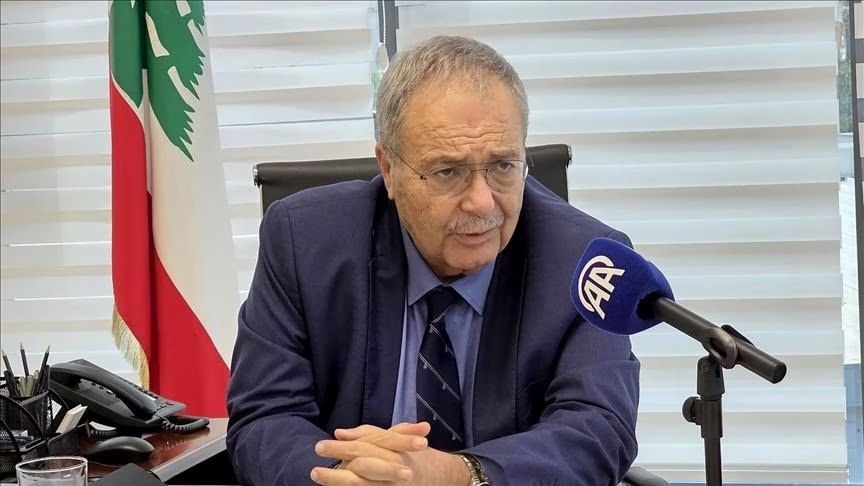







Lebanese Deputy Prime Minister Tarik Mitri revealed on Tuesday that "there are no guarantees that Israel will not engage in new escalation," but exaggerating fears of a possible escalation from Tel Aviv "is unjustified."
Mitri stated that "there are no guarantees or assurances for Lebanon that Israel will not engage in new escalation in the coming period."
However, he also noted that exaggerating fears of Israeli escalation "is unjustified and not based on serious information," calling for "not succumbing to estimates not based on reliable data."
In recent days, the Hebrew media has not stopped talking about the Israeli army "completing" preparations for a plan to launch a "wide-scale attack" against Hezbollah-affiliated sites if the Lebanese government and army fail to implement their commitment to dismantle its weapons before the end of 2025.
These discussions coincide with international and Arab efforts to reduce the pace of escalation in southern Lebanon and prevent sliding into a broad confrontation with Israel.
The Lebanese Deputy Prime Minister emphasized that "it is our duty to cut off any pretext for the enemy to attack Lebanon."
He pointed out that "the Mechanism Committee has taken this path by researching how to verify the Lebanese army's commitment to its tasks according to the executive plan it has set."
The "Mechanism" committee was established under the ceasefire agreement in effect since November 2024, and it monitors its implementation, consisting of military representatives from Lebanon, France, Israel, the United States, and the United Nations Interim Force in Lebanon "UNIFIL."
Mitri indicated that the international engagement with Lebanon is witnessing a shift, especially in terms of supporting the Lebanese army, revealing "preparations for an imminent visit by Army Commander Rudolph Haikal to the United States," without specifying a date.
He considered Washington's approval to hold a special conference to support the army as an indicator of this shift.
On Thursday, Paris announced the organization of an international conference to support the Lebanese army in February 2026, with participation from France, the United States, and Saudi Arabia.
Mitri explained that the United States no longer adopts the Israeli accusations that spoke of negligence or complicity by the Lebanese army, but has come to recognize its efforts despite limited capabilities, with international understanding recorded for the field conditions that may lead to delays in implementing some provisions of the military plan.
On August 5, the Lebanese Council of Ministers approved monopolizing weapons in the hands of the state, including Hezbollah's weapons, and tasked the army with developing and implementing a plan before the end of 2025.
However, Hezbollah Secretary-General Na'im Qassem has repeatedly affirmed that the party "will not hand over its weapons," and called for ending the Israeli occupation of Lebanese lands, while Israel accuses the Lebanese army of failing to activate disarmament, accusations that Beirut rejects.
Mitri added that there is international recognition of the Lebanese army's logistical and financial needs, which has revived discussions on holding an international conference to support it under a French-Saudi initiative.
Israel has killed more than 4,000 people and injured nearly 17,000 others during its aggression on Lebanon, which it began in October 2023, before turning it into a comprehensive war in September 2024, which stopped with a ceasefire agreement that entered into force in November 2024.
It has also breached the ceasefire agreement more than 4,500 times, resulting in hundreds of deaths and injuries, in addition to occupying 5 Lebanese hills it controlled in the recent war, plus other areas it has occupied for decades.
There are no guarantees or assurances for Lebanon that Israel will not engage in new escalation in the coming period.


Share your opinion
Lebanese Deputy Prime Minister: No Guarantees Against Israel Engaging in New Escalation