PALESTINE

Sun 28 Dec 2025 10:31 am - Jerusalem Time

Settlers Burn Vehicles and Scrawl Threats in the West Bank

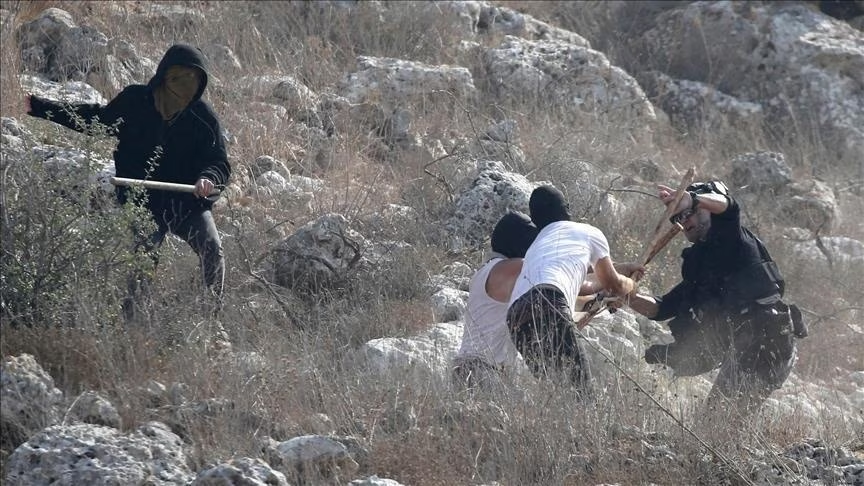
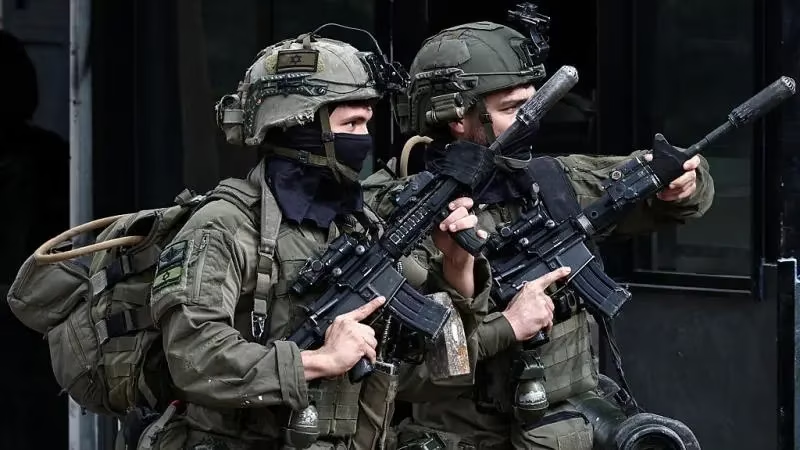
Israeli settlers burned Palestinian vehicles, scrawled threats on house walls, and attacked property, in a series of attacks they carried out at dawn on Sunday, in scattered areas of the occupied West Bank.

Local sources reported that settlers attacked two homes in the town of Hawara south of Nablus in the northern West Bank, burned two vehicles belonging to Palestinian citizens, in addition to writing threatening slogans on the walls of the homes.

In the village of Al-Jaba west of Bethlehem in the southern West Bank, the official Palestinian News Agency reported that settlers burned a vehicle belonging to the citizen Rizq Muhammad Musa Abu Luha, and scrawled hostile slogans on the walls of one of the houses in the village.

In a related context, it reported that a group of settlers stormed the town of Turmus Ayya northeast of Ramallah in the central West Bank, and attacked citizens' property, where they proceeded to remove and steal doors from homes under construction.

According to data from the Palestinian Anti-Wall and Settlement Resistance Commission (governmental) for the month of November/Tishrei last, settlers carried out 621 attacks in the West Bank against Palestinians and their property.

The United Nations confirms that settlement in the occupied Palestinian territories is illegal, undermines the possibility of implementing the two-state solution; Palestinian and Israeli, and has been calling for decades to stop it without success.

According to official Palestinian reports, the number of settlers in the West Bank reached about 770 thousand at the end of 2024, distributed over more than 180 settlements and 256 settlement outposts.

OPINIONS

Sun 28 Dec 2025 10:04 am - Jerusalem Time

The 'Somaliland' region.. a strategic window for Israel

Dr. Murad Harfoush

Dr. Murad Harfoush

Opinion Writer

Israeli Prime Minister Netanyahu announced yesterday mutual recognition in the region of Somaliland, which forms a strategic site for international trade and security for global navigation, overlooking the Red Sea coast and close to the Bab el-Mandeb Strait. Israel realized its importance after October 7th, following the threats it faced from the Houthis as a support front for the Gaza sector during the genocide war launched by Israel against the Palestinian people. It was also rumored on more than one occasion that this region might accept Palestinians on its territory in exchange for recognizing its legitimacy, which it has not received as a political entity except from the state of Israel. Recently, international interest in controlling maritime ports has increased amid the development of events and regional and international conflicts, as well as international competition in the Horn of Africa region, with Somalia in the middle. This strategic window for Israel and against it will help reshape regional dynamics and increase geopolitical conflict and competition in this area.
Implications of the timing of recognizing the Somaliland region:
On the eve of Israeli Prime Minister Benjamin Netanyahu's trip to the United States and his meeting with Donald Trump at Mar-a-Lago resort in Florida, all eyes are on this important meeting and the two axes regarding arrangements for the day after in Gaza and moving to the second phase of the ceasefire within the Sharm el-Sheikh agreement signed on October 10th according to Trump's 20-point plan. There are conflicting statements and priorities between the administrations in Tel Aviv and Washington, and frantic attempts by the Israeli Prime Minister to convince Trump of what serves the ruling Israeli right-wing project in the state of Israel. But in my opinion, all these statements and conflicting priorities may change after this meeting following this political, security, and strategic breakthrough for Israel in recognizing Somaliland in order to work greatly from Israeli lobbies in America to convince Trump to recognize this region. Netanyahu will not hesitate to use his influence from components of the American administration and the Israeli pressure group 'Christian Zionists' to recognize this region in order to besiege Chinese presence in the Horn of Africa, especially the military base in Djibouti. This region will be an advanced base for Israel and America in facing the threat of Iranian influence and its arms in the region, especially the Houthi group, and given the strategic importance of this region, which controls 460 miles of coastline along the Gulf of Aden, making it the southern gateway to the Bab el-Mandeb Strait through which approximately a third of global maritime trade passes annually. It is also a strategic location at the junction of the Indian Ocean with the Red Sea in the Horn of Africa region. This is like a card to attract the United States around the safety of navigation and maritime trade in this area, which will be a hot spot in the near future for competition among regional and world powers. But despite the importance mentioned, in my opinion, Netanyahu will try to achieve the strategic goal of his project by convincing Trump to recognize this region, and then re-propose what is more dangerous than recognition, which is the displacement of Palestinians. This file has remained present on Netanyahu's agenda, and he tirelessly tries to implement it after this great destruction in the sector and the stumbling in transitioning to the second phase, obstructing all efforts to start the reconstruction project and recovery program for the sector and other pending issues where Netanyahu succeeds in putting sticks in the wheels of Trump's plan and implementing the Sharm el-Sheikh agreement. This is what we fear, especially since Israel is approaching an election year, and Netanyahu wants not to disappear from the political scene in front of judicial issues pursuing him, as well as political and popular pressure demanding the formation of an investigation committee into the failure on October 7th.  
Regional and Arab reactions to recognizing Somaliland:
The Israeli recognition of the Somaliland region faced widespread condemnation from Arab and regional countries and African Union countries. This was expressed by Arab League Secretary-General Ahmed Aboul Gheit, who 'confirmed the complete rejection of this step, considering it a violation of international law rules and encroachment on the principle of territorial integrity and state sovereignty, which is the cornerstone in the UN Charter and international relations'. For its part, the Egyptian Ministry of Foreign Affairs said that Egyptian Foreign Minister Badr Abdel Ati conducted calls with Turkish, Djiboutian, and Somali foreign ministers, and they confirmed 'the complete rejection and condemnation of this step, and that recognition of parts of Somali territory constitutes a dangerous precedent and a threat to international peace and security'.
The Somali Minister of Information called for holding an emergency meeting of the Arab League Council to discuss the repercussions of the Israeli recognition of the Somaliland region. The African Union also expressed 'its absolute rejection of any recognition of Somaliland, affirming strict commitment to Somalia's unity and sovereignty'. The office of the Israeli Prime Minister announced that this recognition of the Republic of Somaliland 'as an independent and sovereign state', and that Israel will intensify this cooperation in the fields of agriculture, technology, economy, and health. Israeli Foreign Minister Gideon Sa'ar said on the (X) platform 'that this agreement will include establishing full diplomatic relations, including opening embassies and appointing ambassadors'. In return, the Somaliland region will obtain Israeli smart technology in agriculture, water management, and port security.
In conclusion: This recognition constitutes a dangerous precedent in the Horn of Africa region and the unity of political entities, as well as a strategic pivot point for the state of Israel in this region, its overlooking of important ports, establishing military, security, and intelligence bases to besiege Iranian influence and the Houthis, as well as increasing the intensity of regional competition, especially Turkey, Egypt, Ethiopia, and Iran, and a turning point in re-engineering the balance of power in the Red Sea basin, in addition to increasing competition in the Horn of Africa between the United States and China.  

OPINIONS

Sun 28 Dec 2025 9:59 am - Jerusalem Time

Israel's Recognition of Somaliland: Maritime Control and Reshaping Regional Influence

By: Ra'id Muhammad Al-Daba'i

By: Ra'id Muhammad Al-Daba'i

Opinion Writer

   The Somaliland region is distinguished by its highly sensitive geopolitical location on the coast of the Gulf of Aden, in the northern Horn of Africa, and on the southern shore of the Red Sea opposite Yemen,  bordered to the west by Djibouti, to the south by Ethiopia, and to the east by the Gulf of Aden, while it is legally considered part of Somalia under the existing international system.
Historically, the region was a British protectorate until 1960, before voluntarily uniting with Italian Somalia to declare the formation of the Somali Republic,  but this union soon revealed structural imbalances, manifested in the political and economic marginalization of the north, the absence of equal partnership in power, in addition to the bloody repression practiced by Siad Barre's regime, especially in the late 1980s. With the collapse of the Somali state in 1991, the northern elites and clans agreed to declare secession, based on the logic of "survival"  and building a stable entity in a turbulent regional environment.
In this context, "Israel" announced its recognition of the Somaliland region as an independent sovereign state, becoming the first and only country to take this step, and the recognition was met with international and regional reactions rejecting it, ranging from implicit affirmation of the principle of Somali territorial unity, as in the position of the United Nations, to explicit reaffirmation of this principle as done by the United States and the European Union, up to outright rejection and condemnation of the step as a threat to regional stability and a violation of Somalia's sovereignty, as issued by  the African Union and the Arab League, and central countries such as Saudi Arabia, Egypt, Algeria, Qatar, and Turkey.
The Israeli recognition cannot be read in isolation from Somaliland's strategic geopolitical position, especially since it is located directly opposite the coasts under Houthi control on the Gulf of Aden. This location provides Israel, from a security–strategic perspective, a network of potential regional anchor points in a maritime environment that has become highly turbulent,  for Israel lacks real strategic depth on the Red Sea, with its direct presence limited to the port of Eilat, making any threat to navigation in the Bab el-Mandeb a matter that directly affects its national security.
From here, the recognition falls within the framework of what can be called "shadow war in the Red Sea",  for Israel sees in this step an opportunity to alleviate the pressure exerted by the Iranian–Houthi axis, encircle Houthi influence, neutralize the Bab el-Mandeb, and reduce Iran's ability to choke international navigation through this vital passage,  as the recognition also allows for indirect intelligence and security cooperation, without appearing as a direct occupying power, and without the need to establish declared military bases in Africa, in line with Israel's pattern of influence based on undeclared partnerships and low-profile presence.
In addition to the security dimension, Israel views Somaliland as a gateway to expanding its influence beyond the borders of the Middle East towards the African continent,  for the region constitutes a partner that desperately needs international recognition and external support, and at the same time is characterized by structural weakness that makes it more susceptible to unequal relationships. In this framework, Israel employs the discourse of "developmental cooperation" based on its expertise in agriculture, health, technology, and economy, which are sectors that Somaliland needs to enhance its resilience and gain international legitimacy.
One of the main points of "attraction"  for Somaliland lies, not for Israel alone but for a number of international actors, most notably the UAE,  Taiwan, and Ethiopia,  in being a relatively stable entity compared to its surroundings, governed by a government and institutions for more than three decades, despite the absence of international recognition. This practical stability, coupled with legal isolation, makes external recognition a valuable tool for breaking isolation, and turns legitimacy into a tradable political commodity.
Moreover, the step cannot be separated from the context of the "Abraham Accords",  but within new geographical boundaries that go beyond the Arab world,  for recognizing Somaliland presents Israel as a non-isolated regional power, capable of expanding its sphere of influence and building networks of relations in new geopolitical spaces. This creates regional leverage cards and a new negotiating reality, enhancing Israel's position in the region's balances, helping it break its international political isolation, and presenting itself as a diplomatic player capable of initiative rather than just reacting.
Finally, this recognition falls within a broader pattern in Israeli strategy based on “dividing the divided” and deepening divisions in the Arab world and the region, from Sudan, through Iraqi Kurdistan, the Druze areas in Syria, up to Somaliland. In this framework, the recognition is not understood as principled support for the right to self-determination, but rather as a selective political tool used to reshape the political geography in a way that serves Israeli power interests, even if the price is destabilizing regional stability and weakening the international legal system.

PALESTINE

Sun 28 Dec 2025 9:53 am - Jerusalem Time

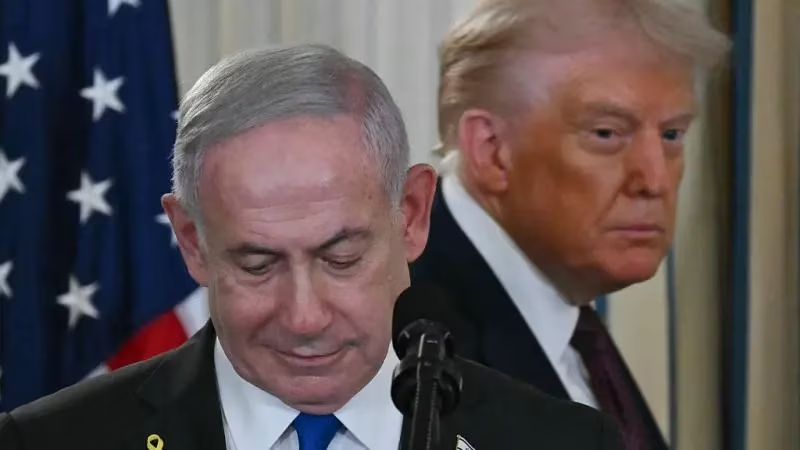
Trump-Netanyahu Meeting.. The Second Phase of the Gaza Agreement Tops the Hot Files

Dr. Dalal Araqat: Trump-Netanyahu meeting an opportunity to direct a message expressing the official Palestinian position in the absence of direct communication with the American administration
Yasser Mana: Gaza agreement may proceed partially and conditionally with high potential for stumbling at any moment and Israeli-American divergence over agreement priorities
Adnan Al-Sabah: The United States and the occupation state are heading towards seeking "proxies" to implement goals on their behalf through creating internal contradictions and local conflicts
Dr. Omar Rahal: Gaza agreement will remain "stagnant" as it neither officially collapses nor actually progresses and stays in a gray area interspersed with Israeli evasions
Fayez Abbas: Netanyahu will try to divert attention from the Gaza file and push to focus on the "Iranian threat" which leads to marginalizing the suffering of the sector
Talal Awaql: Netanyahu seeks to convince Trump to "poison" the transition to the second phase of the agreement and give him the green light to wage war on Lebanon and the possibility of striking Iran


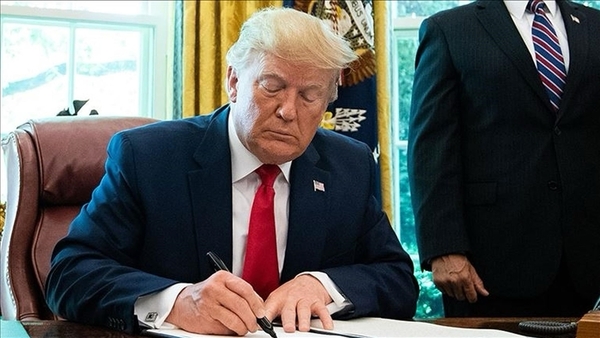
The world awaits the upcoming meeting between US President Donald Trump and Israeli Prime Minister Benjamin Netanyahu, which is seen as a sensitive station for managing hot files in the Middle East, at the forefront of which is the Gaza sector, the Iranian file, and the Syrian and Lebanese arenas.
Books and political analysts, specialists, and university professors, in separate talks with "ے", indicate that the meeting focuses on transitioning to the second phase of the Gaza agreement, amid clear divergence between Washington and Israel over implementation priorities, with American readiness to move towards reconstruction and disarmament in exchange for Israeli stumbling in committing to the conditions of the next phase.
The books, analysts, specialists, and university professors point out that Netanyahu deliberately uses evasion and maneuvers, whether through expanding settlement in the West Bank or strengthening security control, in an attempt to postpone any substantial political commitments.
And they see that the ceasefire agreement in Gaza remains fragile and limited in its impact, with selective and temporary steps implemented, which reflects that negotiations are proceeding within a gray area.

Ideological-strategic partnership and integration of interests

Professor of Diplomacy and Conflict Resolution at the Arab American University, Dr. Dalal Araqat, believes that the upcoming meeting on Monday between former US President Donald Trump and Israeli Prime Minister Benjamin Netanyahu cannot be read as a passing political meeting, but comes within a relationship that transcends circumstantial alliance to an ideological-strategic partnership based on integration of interests and exchange of roles.
And she explains that the nature of the relationship between the two sides makes it likely to prioritize the "deal mentality" over the logic of comprehensive political solution, especially regarding the Gaza sector.
According to Araqat, Trump may deal with the war on Gaza from the angle of "pacifying conflicts" rather than addressing them radically, aiming to open the way for broader regional deals, at the forefront of which is reviving what is known as the Abraham Accords.
And Araqat points out that any possible American pressure on Netanyahu to reduce the pace of the war will not be driven by humanitarian or legal considerations, but by a desire to achieve a marketable political achievement domestically and internationally.
And Araqat notes that the previous personal differences between Trump and Netanyahu are likely to recede in the face of political pragmatism, where Trump may re-utilize Netanyahu as a tool to pass a vision that serves Israeli strategic interests, including consolidating security control and imposing permanent facts on the ground, in exchange for phased military calm that alleviates political and financial burdens on the United States.
And Araqat warns that the meeting may form a political cover for Netanyahu that allows him to buy time and maneuver, whether through expanding settlement in the West Bank or deepening demographic changes, alongside diplomatic discourse that suggests openness to solutions without actual engagement in a serious political path.
And regarding the ceasefire agreement in the Gaza sector, Araqat cautiously doubts its ability to endure.
And Araqat clarifies that Netanyahu deals with the ceasefire agreement in the Gaza sector as a tool for time management rather than an entry to settlement, likely to achieve only the first phase, especially what concerns releasing prisoners, with delaying the transition to a second phase that requires comprehensive withdrawal and permanent cessation of war.
And Araqat notes that any agreement that does not address the core of the conflict represented by occupation will remain fragile, amid readiness of Israeli security pretexts to breach understandings.
And she affirms that marginalizing the Palestinian side as an independent political partner constitutes one of the most dangerous elements of weakness in any agreement, warning against reducing Gaza to a "managed humanitarian file" instead of being a national liberation issue, which makes any understanding susceptible to stumbling at the first serious political test.
She also affirms that the Trump-Netanyahu meeting constitutes an opportunity for Palestinians to direct an official message expressing the official Palestinian position, amid the absence of the official Palestinian voice and the absence of direct communication channel with the American administration.
And Araqat explains that the future of the Palestinian cause, whether regarding ceasefire or Gaza sector or West Bank, is being drawn in the White House or in regional capitals without the presence of the Palestinian side, considering that this reality requires, at least, directing an official Palestinian message before the meeting convenes clarifying the Palestinian position clearly.
And Araqat affirms that this message must include confronting the reality and facts imposed by occupation on the ground, noting that despite previous American statements rejecting annexation of the West Bank, what is actually happening is the escalation of settlement, which constitutes actual annexation of the West Bank.

Gaza agreement may proceed partially and conditionally

The writer and researcher in Israeli affairs, Yasser Mana, clarifies that the Gaza agreement may proceed partially and conditionally, amid high potential for stumbling at any moment, as a result of deep political and security differences surrounding its implementation path, especially ahead of the upcoming meeting between US President Donald Trump and Israeli Prime Minister Benjamin Netanyahu.
And he clarifies that a fundamental divergence emerges between the United States and Israel over prioritizing the next phase of the agreement, as Washington pushes towards rapid transition to the second phase through a parallel path that combines disarmament and reconstruction, in an attempt to stabilize and prevent return of confrontations.
And Mana points out that in contrast, Israel insists on making disarmament of Hamas movement a prerequisite for any reconstruction operation, which places major obstacles in front of implementing the next phase of the agreement.
And he notes that what is happening on the ground reflects this flaw in approaches, where selective and limited steps are implemented, especially in Rafah city in the south of the sector, which suggests partial readiness for the next phase without full or clear commitment to its clauses, which enhances the state of ambiguity and uncertainty.
He also notes that the ambiguity related to forming the supposed multinational force and its roles and authorities constitutes an additional pressure factor that may lead to slowing down the implementation of the agreement or even freezing it, which makes the agreement formally existing but fragile and susceptible to stumbling at any time.
And regarding the upcoming meeting between Trump and Netanyahu, Mana expects it to focus on managing hot and intertwined files, at the forefront of which is the Gaza sector, the Iranian file, in addition to the Syrian and Lebanese arenas, with focus on containing escalation, controlling the pace of confrontations, and coordinating American-Israeli positions to prevent the region from slipping towards a wide explosion.

The meeting will discuss multiple files

The writer and political analyst Adnan Al-Sabah believes that the upcoming meeting between Israeli Prime Minister Benjamin Netanyahu and US President Donald Trump in Florida will discuss multiple files, but the central issue in it will be Gaza and the West Bank, within a broader regional context that includes Syria, Lebanon, Iraq, and Yemen, in addition to intertwined international interactions.
And he clarifies that any bet on this meeting establishing a direct war declaration on any front is "not possible", affirming that the United States and the occupation state are today heading towards seeking "proxies" to implement goals on their behalf, through creating internal contradictions and local conflicts, alongside seeking to separate Gaza from the West Bank and turn it into a "cause, crisis, and tragedy" existing by itself.
And he points out that preparations are underway for joint goals between Netanyahu and Trump, who desires to seize Gaza.
And Al-Sabah notes that Netanyahu's visit comes after the occupation's announcement of recognition of what is called "Somaliland", considering that this recognition is not free, and leaks indicate its link to arrangements related to accepting settlement of Palestinians from Gaza there.
And Al-Sabah sees that Trump's orientations have not changed, citing his previous proposal regarding Greenland and appointing a representative for him there, considering that these steps come within a broader American policy targeting control over influential and active areas globally, and spreading conflicts and wars to weaken everyone to ensure American supremacy worldwide.
And he points out that the United States reaps huge profits from ongoing wars worldwide, as Washington seeks to reorder the global system on the basis of a new "American world", similar to what happened after the First and Second World Wars.
Regarding Gaza, Al-Sabah sees that "the Gaza agreement has practically ended", clarifying that its main goal was recovering prisoners and reducing military and political losses for the occupation, and exiting the ground confrontation that inflicted great damage on it.
And Al-Sabah affirms that the occupation today does not see haste for any solutions, amid absence of direct confrontation, and its continuation in expanding control areas and imposing new facts, alongside escalating work in the West Bank towards Judaization and annexation and changing the demographic scene.

A highly sensitive political station

The writer and political analyst Dr. Omar Rahal considers that the upcoming meeting on Monday between Trump and Netanyahu constitutes a highly sensitive political station, likely that Netanyahu will seek through it to redirect discussion priorities with Washington away from the Gaza sector, towards the Iranian file as the "greatest strategic threat" to Israel.
And he clarifies that the recent media escalation issued by Netanyahu and occupation leaders, accompanied by an increasing threatening tone towards Iran, reflects a clear Israeli orientation towards raising regional tension levels.
In Rahal's view, this behavior does not limit itself to exaggerating Iran's danger, but primarily aims to remove Gaza from the center of American attention, and turn it into a secondary file dealt with from security, administrative, and relief angles, away from any real political treatment.
And Rahal points out that Netanyahu does not settle for limited calm in Gaza, but seeks to expand the circle of regional ignition, so that Gaza becomes part of a tense regional scene, not the central scene itself.
And he clarifies that according to this vision, expanding the tension area may alleviate the political and humanitarian pressures imposed on the occupation government, especially those related to the second phase of the Gaza agreement, and grant Netanyahu a wider margin for maneuvering in front of Washington and the international community.
And Rahal points out that Netanyahu realizes the sensitivity of the relationship with the American administration, and therefore works on managing the disagreement with Washington rather than confronting it, as while Trump's calculations move within political and economic frameworks related to American hegemony and its major interests, Netanyahu's calculations are "narrower and more personal", and basically relate to his staying in power and protecting his political future.
And Rahal notes that Netanyahu wants a war without political horizon, a war used to decide internal and regional files, at the forefront of which is consolidating his political position and ensuring Israel's superiority in any future regional arrangements.
And Rahal predicts that Netanyahu will show a degree of tactical flexibility in front of the Americans, through accepting not attacking Iran in the current phase, in exchange for calculated calm in Gaza and opening limited humanitarian paths, without providing any commitment to a clear political path or radical solutions for the sector.
And regarding the future of the Gaza agreement, Rahal affirms that the option of stumbling will remain strongly present after this meeting, pointing out that political and field data indicate that Netanyahu is systematically working to obstruct the second phase of the agreement.
And Rahal clarifies that this phase represents a transition from the logic of military force to the logic of politics, and this transition is seen by Netanyahu as a direct threat to the cohesion of his ruling coalition, and may open the door to holding him accountable on corruption files and military failures in Gaza.
And he sees that security pretexts will remain present, such as "absence of partner in Gaza", refusal to involve the Palestinian Authority, and claiming incomplete security conditions, in addition to the debate over the role of any possible international force.
According to Rahal, the ceasefire agreement in the Gaza sector will remain "stagnant", as it neither officially collapses nor actually progresses, but stays in a gray area interspersed with Israeli evasions, limited humanitarian steps, controlled escalation, and assassination operations, followed by temporary retreat.
And Rahal sees that Netanyahu seeks through this policy to buy more time, whether by igniting the region or blocking any political horizon, pressing in two parallel directions: the first personal related to his political protection and the possibility of raising the pardon file, and the second strategic aiming to keep the region in a state of tension that requires a wider American presence to decide files that Israel cannot handle alone, but in partnership with the United States.

The upcoming meeting will be "very tense"

The writer specialized in Israeli affairs, Fayez Abbas, sees that the upcoming meeting between Trump and Netanyahu will be "very tense", especially in everything related to the Gaza sector file and the future of the war, pointing out that the main disagreement revolves around Trump's insistence on transitioning to the second phase of his political plan.
And he clarifies that Trump sees in proceeding with this phase a great political opportunity, which may form an entry to achieving a major international achievement, which may reach the level of the Nobel Peace Prize, which drives him to pressure Netanyahu to end the current phase and move to new arrangements in the sector.
In contrast, Abbas expects Netanyahu to place multiple obstacles in front of this orientation, despite indicators suggesting that Trump will seek to oblige him to go towards the second phase.
And Abbas points out that Netanyahu, for more than a week, has been leaking to Israeli media narratives talking about Iranian readiness to direct a military strike on Israel, under the pretext of responding to the American-Israeli bombing that targeted Iran and its nuclear facilities, in a clear attempt to raise the regional tension level.
According to Abbas, Netanyahu will try during his visit to the United States to divert attention from the Gaza file, and push negotiations and American media to focus on the "Iranian threat", which leads to marginalizing the suffering of the Gaza sector and the Palestinian people. However, Abbas predicts that the American president will not allow Netanyahu to fail his plan related to ending the war in the sector.
And he believes that Netanyahu will condition the transition to the second phase on preventing any participation of forces from Turkey or Qatar within the stabilization force, with insistence on Israel remaining the party that undertakes "security maintenance" in the Gaza sector, under the pretext of not trusting any foreign military force.


Israel deliberately escalates war discourse

The writer and political analyst Talal Awaql clarifies that Israel deliberately, in the context of preparing for the sixth upcoming meeting between President Trump and Netanyahu, escalates war discourse at the regional level, in an attempt to influence the meeting's path and results, especially what concerns transitioning to the second phase of the American plan for the Gaza sector.
And he clarifies that the Israeli escalation campaign does not limit itself to threatening a possible war with Iran, but advances in parallel with continuing the tough discourse towards Gaza, Lebanon, and Syria, without any reduction in its intensity.
And Awaql points out that statements by occupation army minister Yoav Gallant about settlement in Gaza and staying in areas occupied by the Israeli army, then retracting them and later returning to raise the same file, reflect a state of intended political maneuvering.
And he notes that statements by other Israeli ministers, at the forefront of which is Bezalel Smotrich, regarding waiting for the announcement of "sovereignty" over the West Bank after Netanyahu's return from Washington, fall within the same context.
According to Awaql, this behavior reflects a clear Israeli awareness that Trump insists on transitioning to the second phase of his plan in Gaza, which Netanyahu is trying to circumvent.
And Awaql predicts that Netanyahu will seek to convince Trump to accept delaying or "poisoning" this transition, in exchange for giving him the green light to wage war on Lebanon, which is the most likely scenario, without ruling out directing strikes at Iran in the near or later time.
And Awaql affirms that Netanyahu has come to realize that he no longer possesses convincing pretexts for delaying the transition to the second phase, and that returning to escalation in Gaza under the pretext of "eliminating Hamas" is no longer sufficient to convince Trump to allow failing his plan.
And Awaql considers that what is happening is misleading political propaganda aimed at manipulating the American administration, in order to continue wars and raise tension levels in the region, in service of a political approach that Netanyahu has become captive to, and works to consolidate it no matter the regional and international cost.


ARAB AND WORLD

Sun 28 Dec 2025 9:46 am - Jerusalem Time

Trump Rejects Recognition of Somaliland: Sovereignty, Displacement, and Political Geography Calculations in the Horn of Africa

In the midst of escalating international controversy following Israel's announcement of recognizing the Somaliland region (Land of Somalia)  as an independent state to stir up the region, U.S. President Donald Trump came out to clearly affirm that the United States does not intend to follow this path. Trump's stance, which reaffirmed the traditional U.S. policy supporting the unity of Somali territories, was not a passing detail, but reflected a complex network of political and security calculations, at a moment when files of sovereignty, forced displacement, and geopolitical competition intersect in the Horn of Africa.

It is noted that Israel is the first UN member state to grant "Land of Somalia" official recognition since its declaration of secession in 1991, effectively breaking the "diplomatic embargo" imposed on the region for 34 years. In exchange for this recognition, Israel gains direct access to a coastline 850 kilometers long overlooking the Gulf of Aden, allowing it for the first time to deploy surveillance and tracking systems for drones and Houthi missiles at the entrance to the Bab el-Mandeb, which puts Egypt and Turkey in front of a new security reality that grants Israel direct military influence in their historical spheres of influence.

Trump, who seemed reserved and even sometimes dismissive of the idea of recognition, emphasized that Washington does not see, at the present time, an interest in breaking the international consensus supporting Somalia's sovereignty. This position comes despite pressures from some U.S. circles that see Somaliland as a relatively stable entity compared to Somalia, and a highly sensitive strategic location on the Gulf of Aden and near global trade routes.

Somaliland, which unilaterally declared its secession in 1991, has succeeded over the past decades in building local governance institutions, conducting elections, and imposing a degree of internal security, but it has failed to gain broad international recognition. And until Israel's recent move, the region remained outside the official international system, under African rejection of any tampering with borders inherited from colonialism.

Israel's recognition of Somaliland opened the door to deeper questions beyond bilateral relations, especially in light of reports and analyses that spoke of Israel's renewed-old interest in the Horn of Africa, not only for security or maritime reasons, but also within undeclared conceptions related to the Palestinian file. Over the past years, scenarios have been proposed in Western and Israeli research centers addressing "resettlement" of Palestinians outside their land, within approaches that go beyond traditional political solutions.

In this context, the name Somaliland emerged, alongside other areas in Africa, in informal discussions linking international recognition, economic support, and transforming the region into a potential reception space for forcibly displaced Palestinians, whether from Gaza or other areas, under humanitarian or developmental pretexts. These proposals, even if not officially declared, raised deep concerns in African capitals that saw in them a reproduction of new colonial models with different facades.

The previous U.S. administration had touched on these ideas indirectly, especially during Trump's first term, when projects "Economic Peace" and "Settlement Outside Palestine" were proposed as political alternatives. And although Washington did not officially adopt any forced displacement plan, the ambiguity surrounding some proposals opened the door for Israel to test regional and international reactions.

Trump's rejection of recognizing Somaliland at this timing can also be read as a reassurance message to African allies, and a curb on attempts to use international recognition as a card for demographic engineering in the Middle East. The United States, despite its close alliance with Israel, realizes that any involvement in forced displacement projects will undermine its position in Africa, threaten its security partnerships, and fuel hostility in a highly sensitive region.
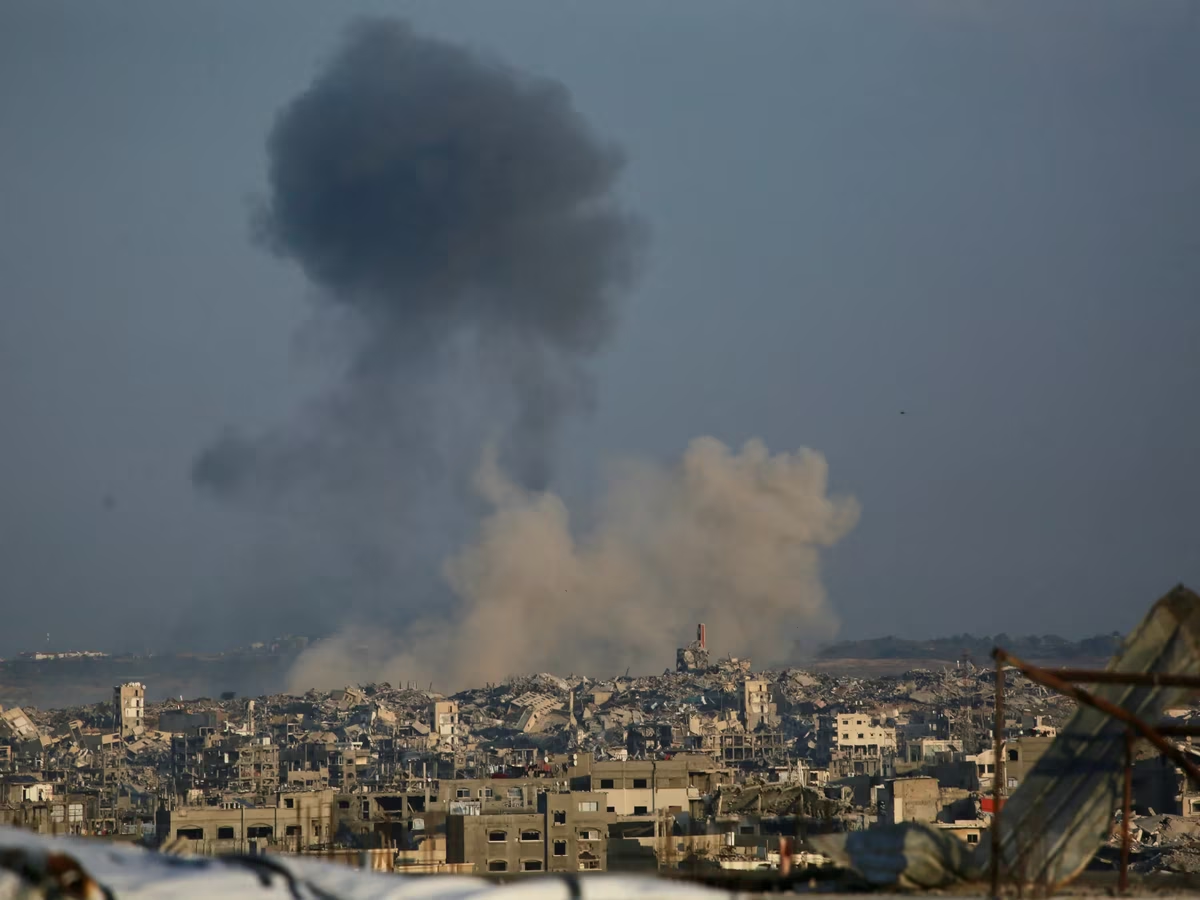
In contrast, Israel finds itself relatively isolated in this step, after its recognition of Somaliland faced explicit rejection from the African Union, the Arab League, and several regional powers that considered the move a blatant violation of Somalia's sovereignty, and a prelude to border chaos on the continent.
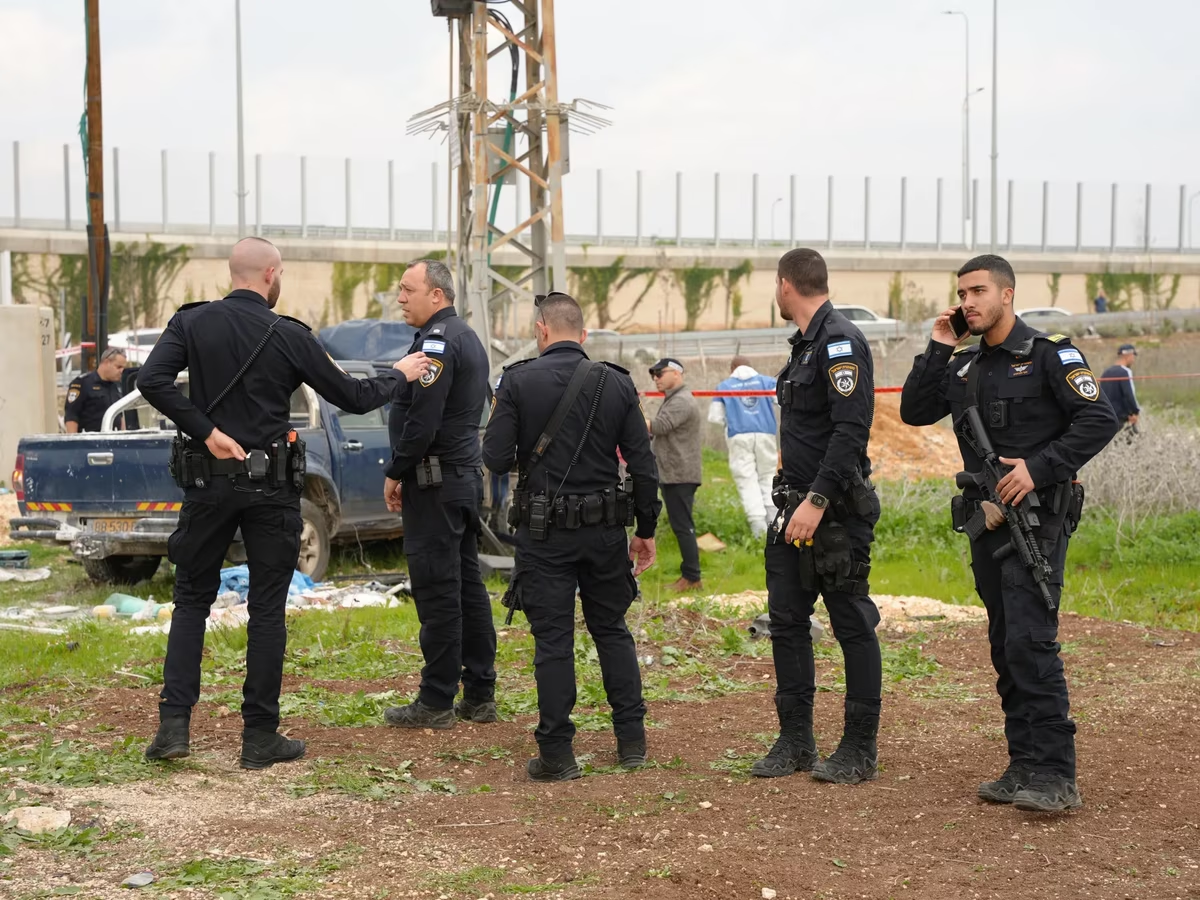
Trump's position, in essence, is a reflection of political pragmatism that balances support for Israel and avoiding slipping into uncalculated geopolitical adventures. It keeps the door ajar for future reviews, but at the same time sets red lines against using international recognition as a tool to liquidate the Palestinian issue outside its land.
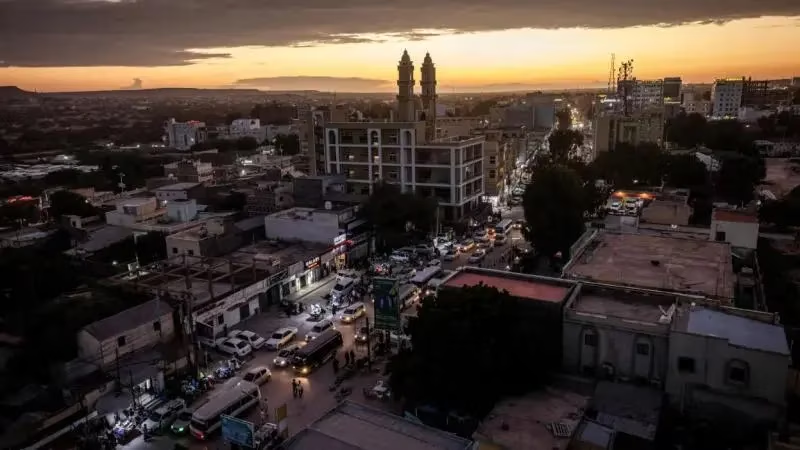
The Somaliland issue reveals how concepts of sovereignty and recognition are used selectively in the international system. Israel's sudden support does not stem from conviction in the right to self-determination, but from political exploitation of marginal areas in service of larger agendas. Washington's rejection here does not reflect moral commitment as much as it reflects fear of unraveling the rules of the international order if the door to recognition outside regional consensus is opened.

Presenting Africa as an alternative space to solve "The Palestinian Question" reflects a dual moral and political failure: first, in recognizing the roots of the conflict, and second, in respecting African peoples' sovereignty. Any displacement project, no matter how wrapped in humanitarian discourse, will remain an extension of the logic of forced displacement. From here, rejecting these scenarios does not serve Palestinians alone, but protects Africa's own stability

In the broader context, according to experts, these developments cannot be separated from a systematic policy to fragment the Arab world, with Syria and Iraq as its most prominent arenas, as an integral part of the Zionist colonial project in the region. Weakening central states, dismantling their armies, and occupying their societies with internal conflicts and sub-identities constitutes a structural condition to ensure long-term Israeli superiority. This fragmentation does not target geography alone, but the Arab political will, ensuring that Arab states remain in a state of chronic incapacity to formulate a unified position or provide effective and sustainable support to the Palestinian cause, which remains the biggest loser in the equation of regional disintegration.

PALESTINE

Sun 28 Dec 2025 9:21 am - Jerusalem Time

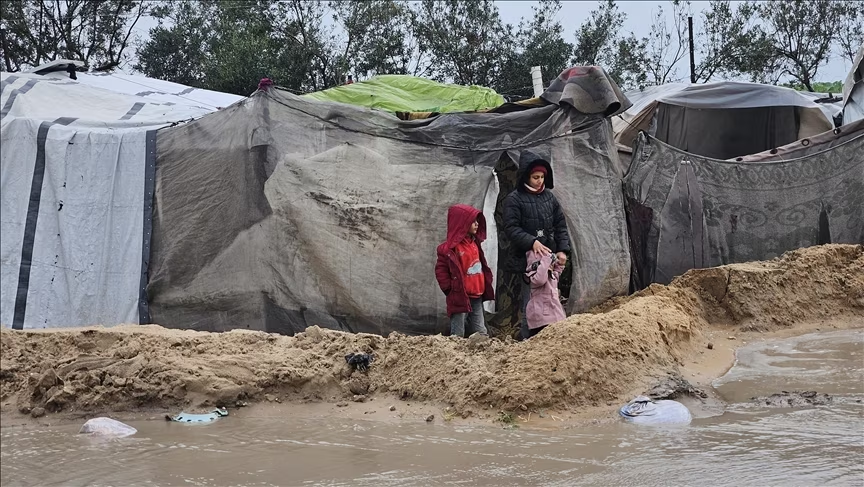
Death of a Palestinian young woman due to a house wall collapsing on her tent due to winds in Gaza

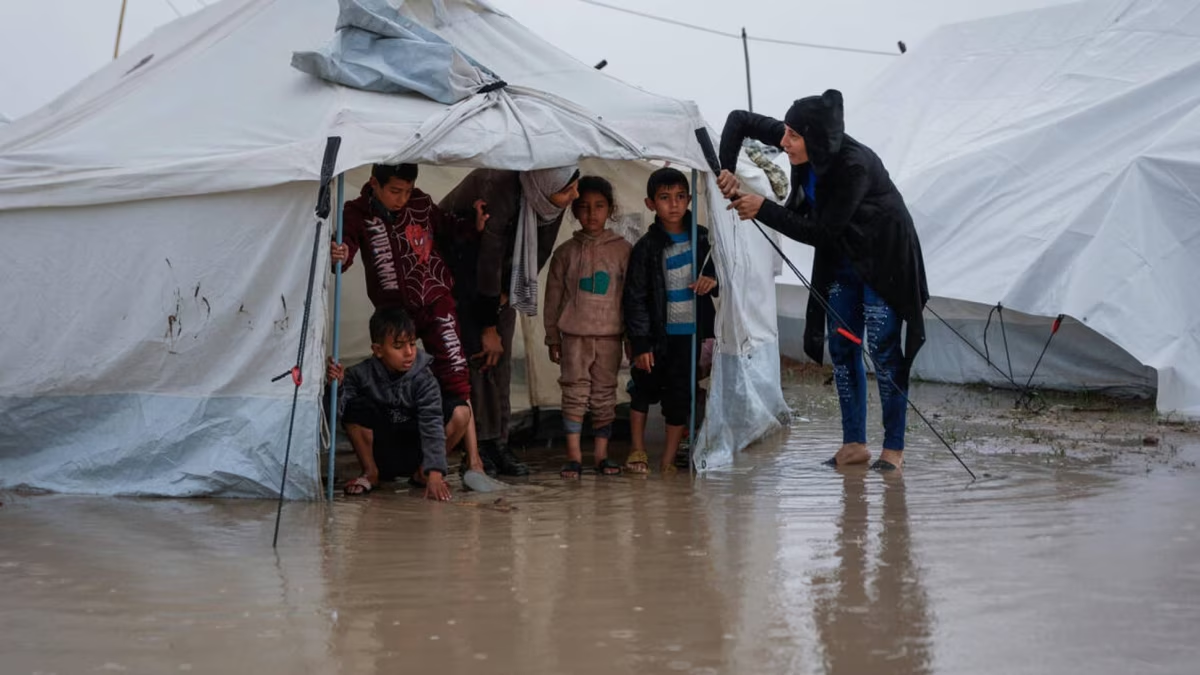
A Palestinian young woman was killed after a wall of a house bombed by Israel during the genocide war collapsed on her tent in the Al-Rimal neighborhood west of Gaza City, while the rainwater and strong winds hitting the sector since Saturday evening caused thousands of tents of Palestinian displaced people to flood and fly away.

Medical sources reported that a Palestinian young woman (30 years old) died instantly after a house wall collapsed on her tent in the Port area of Al-Rimal neighborhood.

Eyewitnesses explained that a wall of a house partially destroyed due to previous Israeli bombing during the genocide war on the sector collapsed due to the fierce winds on a tent for displaced people adjacent to the house, which led to its destruction, the death of the Palestinian young woman, and the injury of several members of her family.

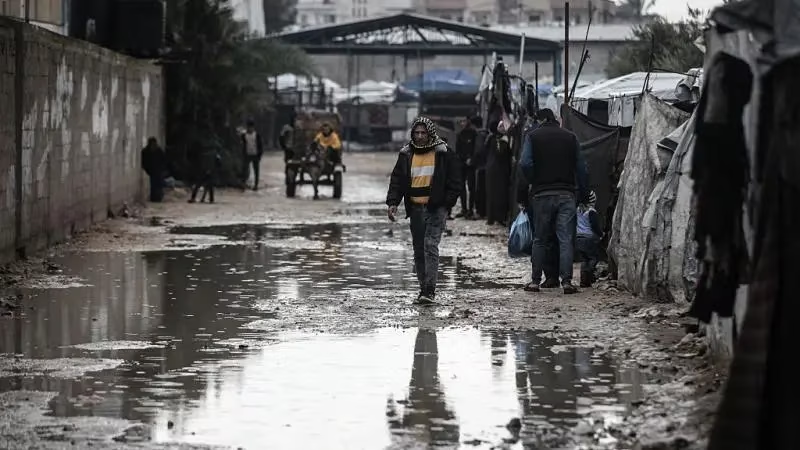
In a related development, the rainwater and strong winds hitting the Gaza Strip since Saturday evening caused thousands of tents of Palestinian displaced people in various areas of the sector to fly away and flood, according to eyewitnesses.

Also, hundreds of tents of displaced people set up on the beach of Khan Yunis city south of the sector were flooded due to the surge of sea waves resulting from the low pressure system.

ARAB AND WORLD

Sun 28 Dec 2025 8:47 am - Jerusalem Time

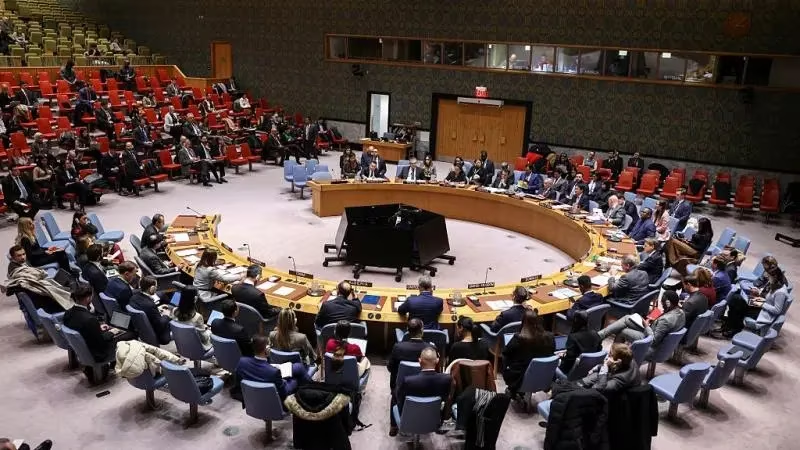
The United Nations Security Council holds an emergency session to discuss Israel's recognition of Somaliland

The United Nations Security Council intends to hold an exceptional emergency session on Monday to discuss Israel's recognition of Somaliland.

The Israeli mission to the United Nations informed journalists that the session is expected to be held next Monday at 15:00 New York time.

In commenting on the upcoming emergency meeting of the Security Council, the permanent Israeli representative to the United Nations, Danny Danon, said: "We will not hesitate in political discussions."

Danon claimed, in a post on the "X" platform, that Israel "will continue to act responsibly and cautiously to enhance cooperation with its partners who contribute to regional stability."

On Friday, the office of the Israeli Prime Minister announced in a statement that Benjamin Netanyahu's "official recognition of the Republic of Somaliland as an independent sovereign state," a step that met widespread Arab and international rejection.

The "Somaliland" region, which has not enjoyed official recognition since declaring its secession from Somalia in 1991, acts as an independent entity administratively, politically, and security-wise, with the central government unable to extend its control over the region, or its leadership to achieve independence.

Following Tel Aviv's recognition, the Federal Government of Somalia affirmed its "absolute and non-negotiable commitment to the sovereignty, unity, and integrity of the country."

It emphasized in Friday's statement the "categorical rejection of the illegal step taken by Israel claiming to recognize the northern region of Somalia."

The federal government confirmed that "the Somaliland region is an integral part of the sovereign territories of the Federal Republic of Somalia, and it may not be separated or disposed of."

Several countries and organizations also rushed to express their rejection of Israel's unilateral step, including Egypt, Turkey, Saudi Arabia, Qatar, Palestine, Jordan, Djibouti, Yemen, the Arab League, the Gulf Cooperation Council, the Organization of Islamic Cooperation, the African Union, and the European Union.

PALESTINE

Sun 28 Dec 2025 1:37 am - Jerusalem Time

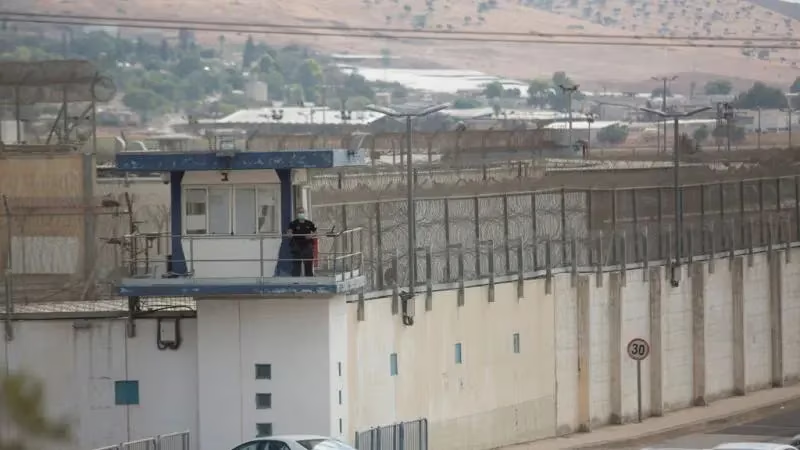
Serious escalation in the Israeli Ramon prison and collective mistreatment of Palestinian prisoners

The Palestinian Prisoners' Media Office reported on Saturday that the Israeli Ramon prison witnessed a "serious escalation" during the current December, including collective mistreatment of prisoners who are suffering difficult humanitarian conditions with the onset of winter.

According to previous data published by the Palestinian Prisoners' Club (non-governmental), the number of Palestinian prisoners in Israeli prisons reached 10,800 as of early August, including 49 female prisoners and 450 children.

The club clarified that the total number does not include detainees in military camps affiliated with the Israeli army, including prisoners from Lebanon and Syria.

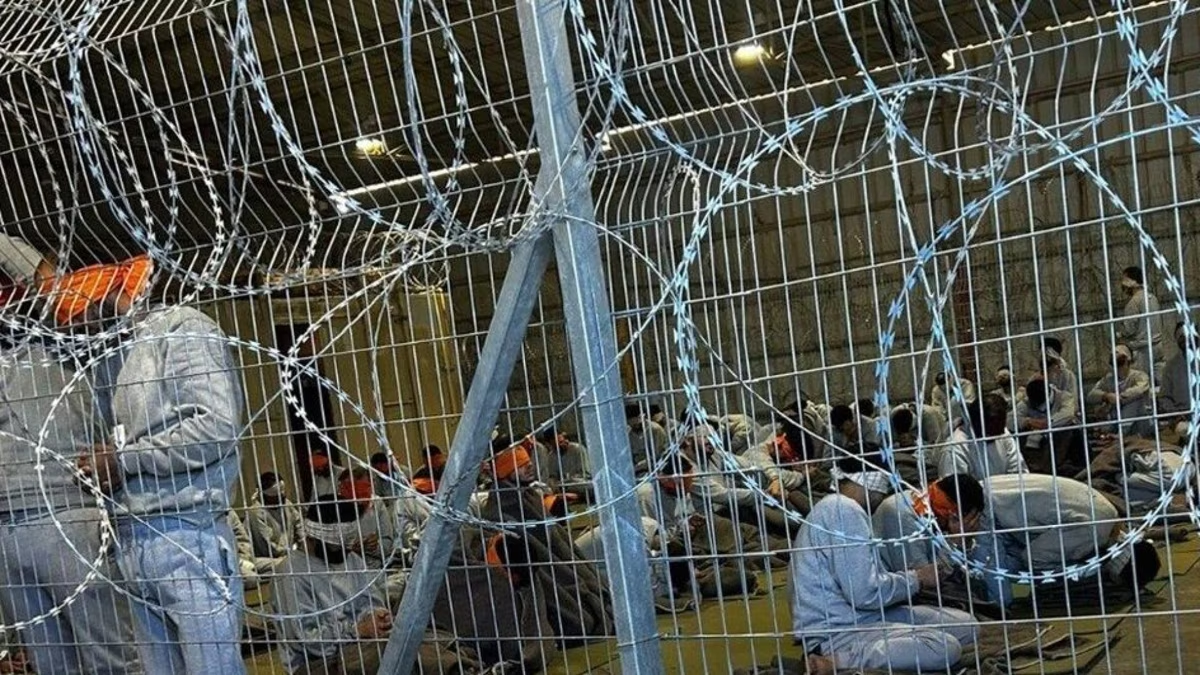
The Palestinian Prisoners' Media Office mentioned in a statement that the "Janot" prison (Ramon) in southern Israel witnessed during the current December, "the implementation of 3 consecutive suppression campaigns on the dates of 14, 16, and 19 of the month".

Also, "storming the prisoners' rooms and assaulting them with beating and collective mistreatment without exception", amid "the continuation of harsh isolation conditions without any improvements", according to the office.

The statement pointed out the deprivation of Palestinian prisoners from "the simplest necessities of life", where "solitary confinement poses an increasing danger to the prisoners' lives".

The office said that the prisoners in the prison live "difficult humanitarian conditions with the onset of winter, with extreme cold and the absence of the minimum heating, and a severe shortage in winter clothing".

It explained that "each prisoner has only two blankets and one jacket that are not sufficient to face the cold, with almost complete absence of winter underwear, and the suffering worsens during night hours due to the drop in temperatures".

The office warned of "direct negative effects on the prisoners' physical health and their ability to endure, with the continuation of the policy of deliberate neglect and non-response to basic needs".

The office considered what is happening in the Israeli prison as "punitive measures and systematic collective punishment".

The Palestinian Prisoners' Media Office held Israel "fully responsible for the safety of the prisoners, warning of "serious repercussions for the continuation of the policy of isolation and repression".

It called for "urgent legal and humanitarian intervention to stop the crimes inside Israeli prisons".

PALESTINE

Sun 28 Dec 2025 12:57 am - Jerusalem Time

German journalist reveals she was raped in occupation prisons

The German journalist and activist in the "Zora" organization, Anna Luedtke, revealed that she was raped while detained by the Israeli occupation authorities, during her participation in the Freedom Flotilla alliance that aimed to break the siege on the Gaza Strip.

Luedtke was arrested while performing her journalistic work on board the "Conscience" ship belonging to the Flotilla, which was hijacked by Israel in October last year.

Luedtke, who was detained for five days, clarified that announcing her case aims to expose the systematic violence faced by Palestinians daily inside Israeli prisons.

The German journalist also confirmed that the matter goes beyond her personal experience.

In the same context, human rights organizations indicated that this case is additional evidence of the systematic sexual violations inside the occupation's detention centers.

The "Conscience" ship, which carried 93 journalists, doctors, and other activists, was one of the Freedom Flotilla ships that continued sailing towards the Gaza Strip.

However, the International Committee to Break the Siege later announced that the ship was attacked by an Israeli military helicopter, before being hijacked by Israeli naval forces.

Activists, human rights defenders, and journalists have more than once sought to break the Israeli siege imposed on the Gaza Strip through a fleet of naval ships carrying humanitarian aid.

PALESTINE

Sun 28 Dec 2025 12:15 am - Jerusalem Time

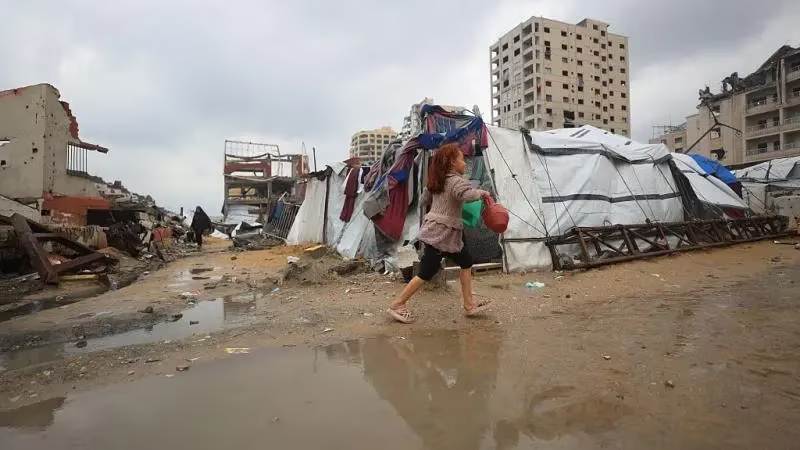
Civil Defense in Gaza: Tents deteriorated, winds uprooted some, and families live in the open

The humanitarian crisis in the Gaza Strip continues to worsen, reaching a new peak of cruelty, where thousands of displaced families are subjected to a bitter test in the face of a fierce winter storm currently hitting the region.

The Civil Defense Department in the sector reported that its crews are receiving a flood of distress calls moment by moment, due to the heavy rains and violent winds that have turned the shelter camps into arenas for confrontation with nature and homelessness.

According to field data, the dilapidated and worn-out tents, exhausted by the sun and rain over the past months, did not withstand the intensity of the storm; their fabrics were torn and their poles completely uprooted, leaving women and children exposed without protection from the bitter cold.

Sources indicate that rainwater has flooded what remains of the displaced people's meager belongings, adding the soaking of clothes and bedding to their hunger and deprivation, in a scene described by Civil Defense as "beyond bearable capacity."

Despite the acute shortage of equipment and limited capabilities imposed by the occupation through the suffocating siege, rescue teams are trying to perform their humanitarian duty with whatever rudimentary tools are available.

The crews are working under extremely dangerous weather and security conditions to provide aid to those suffering from the cold or trapped under the rubble of what remains of residential structures, in a race against time to protect lives before the depression intensifies in the coming hours.

In the midst of this bleak scene, Civil Defense renewed its urgent appeals to international organizations and humanitarian bodies for the immediate intervention to provide weather-resistant shelters and secure heating tools and blankets.

What is happening today in Gaza is not just a passing weather condition, but a comprehensive human catastrophe that requires an international stance to put an end to this slow death creeping into the frail bodies under the roofs of torn tents.

PALESTINE

Sat 27 Dec 2025 11:27 pm - Jerusalem Time

Collective Punishment.. A Continuing Israeli Policy in the Occupied West Bank

From the first moment of announcing the identity of the perpetrator of the Al-Afula operation, the Israeli occupation army rushed to implement the policy of collective punishment on Palestinians in the occupied West Bank.

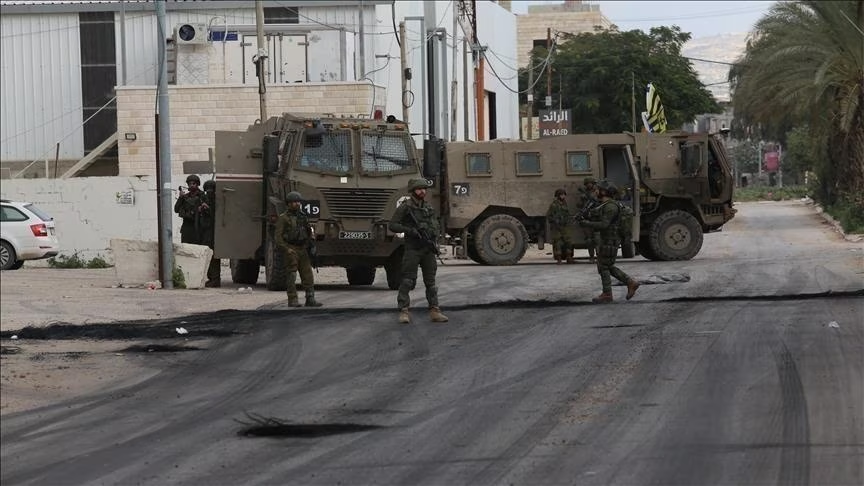
The occupation army imposed a curfew in the town of Qabatiya south of Jenin, and turned the perpetrator's house into a field investigation center, after taking its measurements in preparation for its demolition. The soldiers also closed roads in the town, raided a number of homes, and conducted field investigations with their residents, in implementation of the instructions of Israeli Security Minister Yisrael Katz following the operation.

And in other villages of the West Bank, the situation was not much different, as incursions, arrests, and seizures of homes continue. Nevertheless, Israeli Prime Minister Benjamin Netanyahu admits his government's failure to thwart operations, despite the many operations carried out by his soldiers in the past year.

And amid the Israeli government's insistence on adopting the security approach in dealing with the West Bank file, the military institution warned of a major security explosion as a result of the policy of economic strangulation of the West Bank, calling on the political authorities to allow the legal and organized return of Palestinian workers to the interior, after the crossings were closed to them since October 7, 2023.

And in contrast to strangling the West Bank and its people economically, Israeli settlements are witnessing expansion, as the small security cabinet approved the establishment of 19 new settlements in the West Bank, raising the number of settlements approved by Israeli authorities in the past three years to 69 settlements.

This number raised concern among 13 European countries in addition to Japan, prompting them to warn that settlement expansion harms the chances of achieving peace and security in the long term in the region.

In this context, Jamal Zahalka, a lecturer at the Arab American University in Jenin, says that the Al-Afula operation was "a very big blow to the Israeli security institution and the political leadership and the new concept of Israeli security after October 7, because Israel shifted after this date from deterrence to prevention".

And Zahalka adds that "Israel used to carry out deterrence operations, but after October 7, 2023, it carries out unprecedented incursions in the West Bank to prevent the formation of any organization or armed groups that carry out operations either against settlements or inside Israel".

And he confirms that the operation represents "a blatant failure", pointing to the size of the forces that Israel deployed to the north of the West Bank, the repetition of incursions into Qabatiya, and what it did in the Jenin and Tulkarm camps.

And he adds: "Despite all that, this operation happened, and it is a very big blow, and a number of Israeli officers and generals severely criticized the security forces, pointing to the weakness of organization within the Israeli army, police, and Shin Bet, so that a driver can carry out several consecutive operations that last a long time before the Israeli security forces arrive".

And he explains that Netanyahu's statements about "crushing resistance in the West Bank" do not reflect reality, adding that "the Israeli conclusion from this operation is not rethinking, but using more force".

And he points out that the north of the West Bank is witnessing a major settlement project, aimed at building new settlements, and the Israeli forces carry out operations to protect settlers, and what is happening in Qabatiya is not just a response to the operation, but a continuation of military operations to destroy any possibility of resistance in the West Bank, in addition to the vengeful motive.

In turn, the academic and political researcher Jihad Harb sees that Israel is imposing collective punishments on Palestinians, taking multiple forms, including what is happening today in Qabatiya, such as curfew and mistreatment of Palestinian citizens and depriving them of movement, and including what relates to the economic aspect.

And Harb adds that "the economic aspect takes multiple dimensions, including clearance, meaning the Palestinian funds collected by Israel on behalf of the Palestinian Authority and withheld or deducted parts of them through arbitrary procedures, which first deprives Palestinians of the Authority's ability to provide basic services such as education, health, and social affairs".

PALESTINE

Sat 27 Dec 2025 7:59 pm - Jerusalem Time

North Gaza Municipalities Union Demands Urgent International Intervention to Save the Sector

The North Gaza Municipalities Union called on Saturday for the international community to intervene urgently to save what remains of human life in the sector, noting that the Israeli occupation destroyed about 90% of the wells in the governorate during the two years of genocide.

The union explained that the occupation also destroyed 80% of the sewage networks, in addition to destroying 90% of the heavy machinery belonging to the municipalities, especially vehicles for transporting and relocating waste, which number about 200 vehicles.

The union added that Israel seized 60% of the municipalities' jurisdiction in the north of the sector, and destroyed 50,000 dunams of agricultural crops, leading to a complete absence of food security in North Gaza governorate.

It indicated that more than 85% of the transportation and communications sector in the governorate was destroyed, which ended the crafts and light industries, and exacerbated the humanitarian and living conditions for the residents.

In this context, Asim Al-Nabieh, from the Gaza sector, stated that people were suffering before the ceasefire announcement, and their suffering may increase during weather depressions due to their difficult living conditions, where they do not have the basic necessities to protect themselves and their children, not even enough winter clothes or bedding to warm themselves and their families.

He pointed out that more than half of the sector's population currently lives in tents, and even those who remained in their homes, many of these homes are destroyed, fragile, or have structural and engineering problems, and several homes collapsed during previous depressions, resulting in casualties.

He explained that the suffering is not limited to water leakage into the displaced people's tents or the collapse of homes, but includes a complete failure in the citizens' vital system, as the sick citizen does not find an equipped hospital or sufficient medicines or medical staff, and the municipal crews do not have enough fuel to operate the sewage pumps.

The damages reached 100% in the sewage pumps and stations in Gaza City, either completely or partially, which forced the municipalities to pump this polluted water directly into the sea to relieve pressure, leading to the destruction of marine life, while the other part leaks into the streets, alleys, accommodation centers, displaced people's tents, and groundwater, which may require years or even decades to resolve.

He indicated that the daily suffering of the residents has doubled due to weather depressions and the general conditions after two years of genocide, confirming that the remaining service provider crews, whether civil defense, the Ministry of Health, or municipalities, do not have even the minimum capabilities necessary to serve the citizens.

He added that all this suffering comes amid the continuation of Israeli restrictions on the entry of aid, preventing the work of international institutions and organizations, and increasing the measures that hinder the work of these institutions inside the Gaza sector, leading to the continuation of the residents' suffering despite the ceasefire announcement, without real intervention to save them after two years of genocide and the continuation of the war.

OPINIONS

Sat 27 Dec 2025 5:04 pm - Jerusalem Time

A State Without War: Why Does the Israeli Right Fear the Palestinian Authority More Than It Fears Chaos?

Dr. Ibrahim Na'irat

Dr. Ibrahim Na'irat

Opinion Writer

In the Israeli political narrative, especially among the right, the conflict with the Palestinians is presented as a security struggle with a violent or chaotic entity that cannot be coexisted with. However, a deeper reading of Israeli policies reveals a fundamental paradox: the real danger facing the Israeli right is not the armed Palestinian as much as it is the organized, calm Palestinian capable of operating within the rules of international politics.

For the entity that does not wave weapons but legitimacy, and does not threaten with rockets but with legal files and international recognitions, represents a strategic threat of a different kind. The existence of a “peaceful” Palestinian Authority, even at its minimum level, capable of managing population affairs and building institutions, keeps the idea of a Palestinian state alive and capable of gradual development through international law and UN resolutions. This path does not require war, nor does it assume a military defeat for Israel, which fundamentally contradicts the right's vision for the future of “Greater Israel”.

From this perspective, the Israeli right does not work to completely dismantle the Palestinian Authority, nor does it allow it to succeed at the same time. The adopted policy is to keep it in a fragile intermediate state: administratively present, sovereignly absent; responsible for the population, but without real control over the land or resources. In this gray area, the Authority transforms from a transitional national project into a tool for population management, while politics is emptied of its content and any real possibility of a solution is suspended.

This managed vacuum allows Israel to accelerate its true project on the ground: expanding settlements, fragmenting the geography, and imposing demographic realities that make any future talk of a connected and viable Palestinian state almost impossible. This is not a policy of resolving the conflict, but a long-term management policy for it, based on freezing the political path in exchange for accelerating field control, and turning the idea of self-governance into an expanded municipal administration without a national horizon.

In this equation, Gaza plays a highly functional role. It is presented in the Israeli discourse to the world as a cautionary model: this is what happens when Palestinians are left to govern themselves. The siege, destruction, and repeated wars are used to cement a narrative that any Palestinian sovereignty will inevitably lead to violence and instability. In contrast, the West Bank is not allowed to present an opposite model: a calm, organized, and viable entity. Gaza is militarily besieged, and the West Bank is politically engineered, so the first is not left to live, and the second is not allowed to become a state.

But this functional use of Gaza does not work in the same direction in the long term. With the repetition of wars and the blockage of horizons, the Gaza model is no longer used only to frighten the world, but has also become material for review within Palestinian society itself. Over time, an increasing segment of Palestinians has begun to rethink the form of the possible political entity and the cost of different options.

In this context, the model of the “peaceful” Palestinian Authority, despite all its weaknesses and failures, has taken an increasing place in the thinking of people in Palestine. Not as an ideal or final model, but as the antithesis of a state of permanent destruction and open war. The daily comparison between the besieged and exhausted reality of Gaza and the relatively managed reality of the West Bank has led many to question the value of stability, even if deficient, and the possibility of developing it politically instead of the ongoing dependence on the logic of open confrontation.

It is here specifically that the real concern of the Israeli right lies. For the danger of the Palestinian Authority is not limited to international recognition or existing institutions, but in the possibility that it may, over time, transform into a popularly accepted idea as a starting point for building a state without war. A state that grows slowly, through time and legitimacy, not through the decisive battle. This type of state is what the right does not know how to deal with.

In this sense, it can be said that what the Israeli and Palestinian extremism tried to build over the past years has begun to turn against its creators. The Israeli extremism that bet on dismantling the Palestinian national project through siege and division has contributed, unwittingly, to keeping the idea of the state alive, but in a calmer and more internationally marketable form. Conversely, the Palestinian extremism that bet on imposing the equation by military force has, over time, presented a model that exhausted society more than it exhausted the adversary, and pushed broad sectors to seek less costly and more viable alternatives.

The result unfolding today does not serve extremist ideologies as much as it exposes their limits. Managing the conflict by force or coercive engineering of reality has not ended the Palestinian issue, but has reintroduced it with different tools: popular awareness, international legitimacy, and long time. In this path, the Palestinian state that the Israeli right fears most may be the one born from patience, not from war.

PALESTINE

Sat 27 Dec 2025 3:01 pm - Jerusalem Time

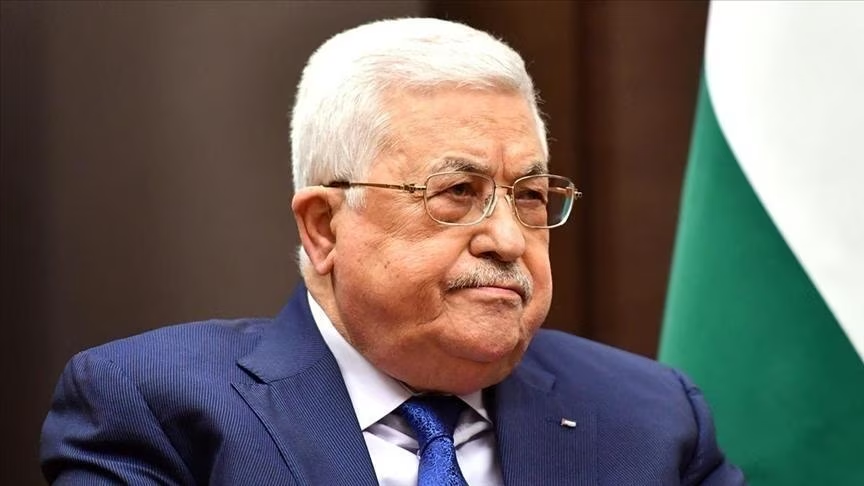
President Abbas rejects Israel's recognition of 'Somaliland' and considers it an attempt to deport Palestinians

Palestinian President Mahmoud Abbas expressed, on Saturday, his rejection of the mutual recognition between Israel and the separatist region of 'Somaliland', considering that this step comes as part of desperate attempts by Tel Aviv to deport Palestinians to Somalia.

On Friday, the office of Israeli Prime Minister Benjamin Netanyahu said in a statement that the latter 'announced the official recognition of the Republic of Somaliland as an independent sovereign state', a step that met with widespread international rejection.

In response, Abbas, in a statement carried by the Palestinian News Agency 'WAFA', expressed 'his support for the unity and integrity of Somali territories, and his complete rejection of any steps that could undermine Somali sovereignty or undermine the foundations of stability in the country'.

And he emphasized 'Palestine's support for the legitimate institutions of the Somali state, and rejection of any attempts to impose parallel entities that conflict with the unity of the Somali state'.

And the Palestinian President praised the rejecting positions on this step 'which aims at desperate attempts to deport Palestinians to Somalia'.

During the months of the Israeli war on Gaza, official Israeli statements escalated regarding proceeding with plans to deport Gaza Palestinians outside the sector, while Hebrew media spoke about possible destinations including African countries such as Somalia.

And the announcement of Israel's mutual recognition of the separatist region of 'Somaliland' escalated fears that the step could be a prelude to deporting Palestinians from the sector to the region.

And the region of 'Somaliland', which has not enjoyed official recognition since declaring secession from Somalia in 1991, acts as an independent entity administratively, politically, and security-wise, with the central government's inability to extend its control over the region, or its leadership's failure to achieve independence.

Following Tel Aviv's recognition, Somalia confirmed in its government statement on Friday, 'its absolute and non-negotiable commitment to its sovereignty, national unity, and territorial integrity', emphasizing 'the categorical rejection of the illegal step taken by Israel claiming to recognize the northern region of Somalia'.

And it emphasized that 'the Somaliland region is an integral part of the territories of the Federal Republic of Somalia, and it is not permissible to separate or dispose of it'.

Meanwhile, several countries and organizations hastened to reject the unilateral Israeli step, including Egypt, Turkey, Saudi Arabia, Qatar, Palestine, Jordan, Djibouti, Yemen, the Arab League, the Gulf Cooperation Council, the Organization of Islamic Cooperation, and the African Union.

PALESTINE

Sat 27 Dec 2025 2:41 pm - Jerusalem Time

Calls for the Release of Doctor Hussam Abu Safiya and Dozens of Detained Healthcare Workers

Activists and human rights organizations renewed their calls for the release of dozens of healthcare workers who remain detained by Israeli occupation forces, including Doctor Hussam Abu Safiya, who was arrested on this day last year from his workplace at Kamal Adwan Hospital in northern Gaza.

The organization "CodePink" stated: "We will not forget Doctor Abu Safiya, and more than 360 healthcare workers abducted by Israel from Gaza since October 2023".

Before the first anniversary of the occupation's abduction of Doctor Hussam Abu Safiya from the hospital he managed in Gaza, Doctor Yiping Guo, a member of the "Doctors Against Genocide" organization, said in a post on social media: "A year ago, the Israeli army abducted Doctor Hussam Abu Safiya along with dozens of medical staff during a terrifying raid on Kamal Adwan Hospital in Gaza. Release Hussam Abu Safiya. Release them all".

In turn, activist Petra Schornhofer said: "A year has passed since the illegal abduction and detention of Doctor Hussam Abu Safiya. Since then, he has been languishing in an Israeli prison and subjected to cruel and inhuman treatment. Do not forget him, and do not stop demanding his release", and in a poignant appeal, Albina Abu Safiya, the detained doctor's wife, said: "Save my husband before it's too late. His only crime was saving the wounded and treating injured children".

Abu Safiya (52 years old), director of Kamal Adwan Hospital, was arrested on December 27, 2024, during the ongoing siege and raids by occupation forces on the hospital in Beit Lahia in northern Gaza, and the Israeli army claimed, without providing evidence, that the hospital, which was then the last major operating hospital in northern Gaza, was being used as a command center for Hamas, and during a previous occupation attack on the hospital, Abu Safiya's 15-year-old son was martyred in a drone strike, and the doctor himself was seriously injured in a separate attack that left six shrapnel in his leg.

Abu Safiya was transferred after his arrest to Sde Teiman prison in the Negev desert, where numerous deaths of detainees were recorded, and reports of torture and sexual assaults, before being later transferred to Ofer prison in the occupied West Bank.

Abu Safiya reported being subjected to torture, including beatings with sticks and electric shocks, in addition to severe weight loss and rib fractures and other injuries, which he said deprived him of appropriate medical care, and this was confirmed by several documented reports indicating that healthcare workers were subjected to torture, sometimes to death, as in the case of Doctor Adnan Al-Bursh, head of the orthopedic department at Al-Shifa Hospital in Gaza City.

According to the UN Special Rapporteur on the occupied Palestinian territories, Francesca Albanese, Al-Bursh "is likely to have been raped to death", a fate said to have befallen other Palestinians during their detention in occupation prisons, according to the "Common Dreams" platform.

Abu Safiya remains in detention without any formal charges being brought against him, while Israeli courts have extended his detention several times under what is known as the "unlawful combatant" laws, and in January last year, Abu Safiya's mother died from a heart attack, and the American organization "MedGlobal", with which he worked as a lead doctor in Gaza, said the death came as a result of "intense grief" over her son's fate.

For its part, Amnesty International confirmed that the arrest and ongoing arbitrary detention of Doctor Abu Safiya without charges or trial – based on the abusive unlawful combatants law – represents Israel's systematic targeting of Palestinian healthcare workers, and its destruction of the healthcare system in Gaza, with the aim of imposing living conditions intended for the physical destruction of Palestinians.

According to UN agencies and international experts, Israeli forces destroyed or caused severe damage to most Gaza hospitals in hundreds of attacks since October 7, 2023, while more than 1,500 Palestinian healthcare workers were martyred, and an independent UN investigation committee concluded last year that the occupying state pursued a deliberate policy to destroy the health system in Gaza, amounting to war crimes and crimes against humanity amounting to genocide.

The occupying state currently faces a genocide lawsuit filed by South Africa before the International Court of Justice, and the International Criminal Court issued arrest warrants for Netanyahu and former Defense Minister Yoav Gallant, on charges of committing war crimes and crimes against humanity, including killing and forced starvation.

PALESTINE

Sat 27 Dec 2025 1:35 pm - Jerusalem Time

The low-pressure system exacerbates the suffering of Gaza residents.. and the displaced face the bitter cold

The residents of the Gaza Strip have been severely affected by the low-pressure system that hit the sector, accompanied by a sharp drop in temperatures and heavy rainfall, which exacerbated an already existing humanitarian suffering due to the difficult living conditions.

The rains caused flooding in tents and damaged homes, especially in low-lying areas and shelters, forcing many families to spend cold nights without heating means.

Hundreds of thousands of displaced people suffer from a severe shortage of blankets and winter clothing, at a time when the cold poses a direct threat to children, the elderly, and the sick.

The strong winds also damaged temporary tents and caused water to seep inside them, increasing health concerns and the spread of diseases related to humidity and cold.

The low-pressure system also affects the fragile infrastructure, where water flooded some roads, and the electricity and sanitation crises worsened.

With the continuation of restrictions and lack of capabilities, municipalities and relief agencies find it difficult to respond quickly to the population's needs.

In light of these conditions, calls are renewed to intensify urgent humanitarian support and provide basic winter supplies to protect civilians in Gaza from the consequences of the harsh weather, which increases the difficulty of their daily reality and doubles their suffering.

Ahmed Al-Batta from Khan Yunis said that the low-pressure system brings back scenes of suffering that the sector witnessed in recent weeks, without any tangible change in the humanitarian reality.

He pointed out that the new tents and "caravans" stipulated to be introduced under the humanitarian protocol in the ceasefire agreement have not entered yet, despite being the most capable of facing rain and cold.

He explained that thousands of Palestinians who lost their homes not only need better tents, but also basic necessities for living, such as winter clothes, blankets, and bedding, amid a near-total loss of heating means. He noted that the current tents made of plastic materials or light fabrics provide no protection from the bitter cold.

He added that the risks are not limited to tent dwellers, as thousands of families live in destroyed or collapse-threatened homes, pointing to the collapse of dozens of buildings since the beginning of winter. He indicated that the continuation of Israeli violations and delays in implementing the agreement portend the continuation of these tragic scenes in the coming weeks.

PALESTINE

Sat 27 Dec 2025 1:21 pm - Jerusalem Time

Association of Municipalities of North Gaza: Israel Destroyed 90% of Water Wells and 80% of Sewage Networks

The Association of Municipalities of North Gaza Governorate said on Saturday that Israel destroyed during the two years of genocide 90% of its wells, 80% of water and sewage networks, and 90% of its heavy machinery, and warned of a health and environmental catastrophe in the region.

This came during a press conference held by the association in the Al-Fakhoura area north of the sector, to highlight the humanitarian reality in the governorate, over which Israel controls vast areas pursuant to the ceasefire agreement that entered into force on October 10, 2025.

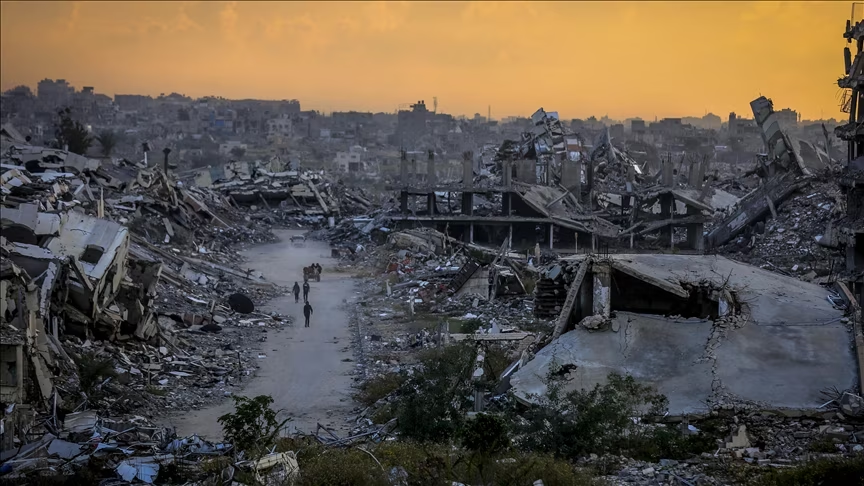
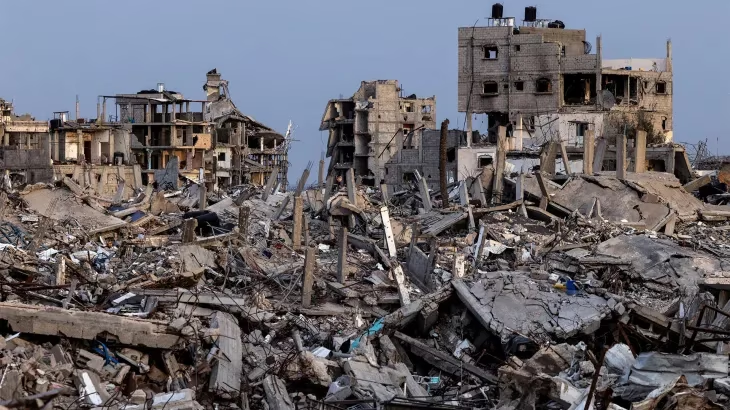
This agreement ended a genocide war launched by Israel on October 8, 2023, lasting two years, leaving about 71,000 Palestinian dead and more than 171,000 injured, and massive destruction affecting 90% of the civilian infrastructure at a reconstruction cost estimated by the United Nations at about $70 billion.

The association warned of an environmental and health catastrophe in the northern governorate, which the Israeli genocide turned into a "disaster-stricken area unfit for habitation."

It reported the accumulation of more than a quarter million tons of waste in the streets and alleys, where it is impossible to transport it due to Israel's destruction during the genocide months of most transportation vehicles.

It added in this regard: "The Israeli army destroyed 90% of the heavy machinery, especially waste transport and transfer vehicles, amounting to 200 heavy vehicles."

It pointed out that the acute shortage of fuel prevents operating the remaining vehicles and rescuing what can be saved from the area.

The association clarified that Israel devoured 60% of the jurisdiction of the northern sector municipalities, while the municipalities of Beit Hanoun and Um Al-Nasr remained entirely within the areas it controls pursuant to the ceasefire agreement.

In addition to the municipalities' losses, the association said that Israel destroyed during the two years of genocide more than 150 kilometers of roads and streets, and all municipal headquarters and facilities.

It explained that the Israeli army also destroyed 70 main water wells, and 85 sewage pumps, including 15 large pumps.

In addition, the association pointed to Israel's destruction of all subsidiary desalination plants, amounting to 80 plants, and all electricity generators for its facilities, numbering 180 large generators.

It mentioned that the Israeli army also destroyed 50,000 dunams of agricultural crops, causing complete food insecurity in North Gaza Governorate.

The Israeli army also destroyed more than 85% of the transportation and communications sector in the governorate, and eliminated crafts and light industries.

The association said that the municipalities of North Gaza face "serious" challenges, including the lack of sufficient fuel to operate the remaining water and sewage pumps, which caused wastewater flooding in the streets.

In addition to the acute shortage in machinery and maintenance equipment necessary to repair water and sewage networks, and to remove rubble and open roads, according to the association.

The association issued an "urgent distress call to international and governmental institutions," and called on the international community to intervene to save what remains of human life in Gaza, which is guaranteed by international laws and regulations.

It also called for the necessity of working to provide the municipalities' needs, especially the fuel necessary to operate water wells and sewage pumps and the remaining waste transport and transfer vehicles, in addition to importing the materials necessary to repair the damaged wells and pumps.

Israel shirks its commitments stipulated in the ceasefire agreement, by opening crossings and importing the agreed quantities of food, relief, medical materials, and reconstruction and housing materials.

Israel also commits hundreds of violations, including bombing and firing towards areas where Palestinians are allowed to move pursuant to the agreement, which has resulted since October 11 last year in the killing of 410 Palestinians and the injury of 1,134 others, according to official data.

PALESTINE

Sat 27 Dec 2025 12:49 pm - Jerusalem Time

The West Bank.. Gradual and Complex Israeli Escalation in 2025

As 2025 approaches its end, the West Bank appears to have been subjected to a gradual and complex Israeli escalation, combining military incursions, settlement expansion, house demolitions, and forced displacement, in a clear effort to impose a new demographic reality.

From Hebron, Muntaser Nassar describes the southern governorate as one of the most exposed areas in the West Bank to closures and barriers, with a wide spread of iron gates and an intensified settler presence during the current year.

Nassar points out that the Israeli government has approved the conversion of dozens of sites into official settlements, including the site "Tarusa" west of Dura, which is one of 19 sites announced as legalized during 2025.

Settlement activity witnessed a notable escalation during 2024 and 2025, with an increase of about 40% since Benjamin Netanyahu took over the government, and the establishment of about 114 new settlement outposts in various parts of the West Bank.

Nassar confirms that most of these outposts were established to connect existing settlements with each other, leading to the confiscation of hundreds of dunams of Palestinian land to pave settler roads and expand the geographical influence of the settlers.

In Nablus, Muhammad Al-Atrash says that settlement policies have clearly reflected on the Bedouin communities, which have been subjected to forced displacement as a result of the ongoing attacks by settlers.

Al-Atrash adds that the "Yanun" community south of Nablus was completely evacuated in the last hours, joining 33 Bedouin communities displaced in the past two years, out of about 200 Bedouin communities in the West Bank.

He explains that Israel considers these communities an obstacle to its settlement projects, which has led to escalating attacks and deliberate arson, with about 450 fires carried out by settlers in one year.

Displacement, according to Al-Atrash, is not limited to Bedouin communities, as military operations in the north of the West Bank have led to the displacement of about 40,000 Palestinians from the camps of Jenin, Tulkarm, and Nur Shams, as part of a security and geopolitical reconfiguration of the area.

From Qalandiya north of Jerusalem, Thuraya Shaqra monitors the scenes of destruction left by the occupation's bulldozers, confirming that demolitions have affected homes and residential and commercial facilities in various towns of the West Bank.

Shaqra says that occupation forces have demolished more than a thousand structures since the beginning of 2025, while the number of structures destroyed since October 7, 2023, has exceeded 3,500, leading to the displacement of thousands of Palestinians.

She points to an unprecedented acceleration in the implementation of demolition orders, under the pretext of unlicensed construction or classifying lands as "state lands", in addition to demolishing homes of families of martyrs and prisoners.

Politically, Fatima Khamaisi from Ramallah links this escalation to the discourse of the extreme Israeli right, which treats the West Bank as a field for consolidating electoral projects.

Khamaisi explains that the Israeli government, led by Netanyahu, is proceeding to strengthen settlement and undermine the two-state solution, by weekly approving settlement projects and converting outposts into official settlements.

She notes that decisions such as canceling administrative detention orders against settlers have provided full cover for their attacks, in a path aimed at imposing a policy of fait accompli despite the escalating international criticism.

In this complex scene, 2025 ends on a West Bank burdened with destruction, where settlement, displacement, and demolition intersect in one project, seeking to redraw the Palestinian geography by force.

PALESTINE

Sat 27 Dec 2025 12:49 pm - Jerusalem Time

World Newspapers: Gaza.. Individual Stories Reflecting the Scale of Destruction and Suffering

World newspapers and websites covered the harsh humanitarian conditions in the Gaza Strip following the Israeli war, shedding light on individual stories that reflect the scale of destruction and suffering, from the destruction of homes to torture in prisons, in a scene that goes beyond material loss to the disintegration of life itself.

The Washington Post conveyed a painful image of the suffering of the Palestinian Diana Shams and her family, focusing on their repeated displacement experience during the war, before colliding upon her return with an even harsher reality, after their family home was turned into rubble by Israeli bombing.

The targeting of the home occurred in the final hours before the ceasefire came into effect, which doubled the sense of loss. Diana says the house was not just a shelter, but a family heritage lost in an instant, which prompted her to consider emigration after a long insistence on staying in Gaza.

As for The New York Times, it highlighted the tragedy of Haitham Salem, described as the harshest, as his loss was not limited to the house, but extended to the loss of his wife and three children, in one of the most painful stories left by the war.

The Israeli army arrested Haitham, aged 31, at a military checkpoint while trying to flee, and detained him for 11 months in Sde Teiman and Ofer prisons, in addition to the Negev detention center, without any formal charges.

During the detention period, Haitham says he was subjected to harsh forms of physical and psychological torture, which made him wish for death, and after his release as part of a prisoner exchange deal, he discovered that his family had perished in Israeli bombing, leaving him with only photos saved on his phone.

In a related context, The Guardian published an article by the writer Aya Al-Hatab from Gaza, in which she saw that the repeated international talk of peace after the ceasefire does not reflect on the daily lives of Palestinians, which remain immersed in fear, siege, and lack of living essentials.

The writer explained that Gaza residents live without potable water, electricity, or internet, amid a sharp economic collapse and absence of a sense of security, while families are forced to reside in destroyed or collapse-threatened homes, some of which are actually submerged in floods and mud.

Away from Gaza, Foreign Policy magazine warned of the worsening humanitarian crisis in Sudan, considering it the worst globally, especially after the fall of the city of El Fasher in Darfur, amid accusations against the Rapid Support Forces of committing violations amounting to genocide.

In another file, Time magazine addressed the debate between Nigeria and the United States regarding the file of religious freedoms, noting the denial by Nigerian President Bola Tinubu of the American accusations, despite experts acknowledging the existence of security threats from extremist groups, the majority of whose victims are Muslims.

The British Times newspaper revealed an active role for the royal family in strengthening relations with the administration of US President Donald Trump, predicting an upcoming visit by King Charles III to Washington, the first for a British monarch in two decades, within precise arrangements.

In the economic affairs, Financial Times highlighted the sharp decline in Iran's handmade carpet industry, as a result of sanctions and financial restrictions, leading to the loss of traditional markets and the entry of regional and international competitors to fill the void left by Iran's absence.

PALESTINE

Sat 27 Dec 2025 11:53 am - Jerusalem Time

Israeli Army Closes Villages West of Ramallah on Pretext of Gunfire That Turned Out to Be Hunting Activity

The Israeli army closed, on Saturday morning, the entrances to Palestinian villages west of the city of Ramallah in the center of the occupied West Bank, on the pretext of gunfire at a military checkpoint in that area, before it became clear that it was a regular hunting activity and not an attack.

Local sources reported that the Israeli army closed the entrances to the villages of Ni'lin, Bil'in, and Kharbatha Bani Harith west of the city of Ramallah, this morning, by closing the iron gates installed on them, and preventing entry or exit from them.

The sources mentioned that the Israeli measures followed circulating news about gunfire at the Ni'lin checkpoint military crossing.

They clarified that the closure caused the prevention of movement for residents of 13 Palestinian villages in that area to and from the city of Ramallah.

For its part, the Israeli army said in a statement: "A short while ago, a saboteur carried out a shooting operation near the security fence near the Hashmonaim checkpoint and fled, without any injuries," according to its expression.

It added: "Large forces rushed to the area and began sweeping operations in search of the saboteur, and imposed a cordon on a number of villages in the area."

Before Hebrew media reported that the Israeli army said that the shooting was not an attack, but rather for hunting purposes.

The army added: "The forces continue to pursue the shooter to confiscate the weapon."

This coincides with the Israeli army continuing, for the second day, a wide-scale aggression on the town of Qabatiya south of Jenin in the north of the occupied West Bank, according to local sources.

According to the sources, the Israeli army deployed new military reinforcements to the town on Saturday morning, and its vehicles spread in its neighborhoods, and bulldozers closed main streets leading to it with earthen barriers.

It indicated that the Israeli army continued to impose a curfew on the town, stormed a large number of homes and destroyed their contents, in addition to bulldozing streets and sabotaging infrastructure.

The sources added that the occupation forces turned the home of Ahmad Abu al-Rub, the perpetrator of the Baysan and Afoula operation yesterday, Friday, into a military barracks, and took several young men there and tortured them.

It pointed out that the Israeli army arrested several Palestinians in Qabatiya, including Ahmad Hassan Nazal, Yasser Khazmiya, Faras Talib, Niji Nazal, and Ja'far Shabut.

This operation falls within the policy of collective punishment that the Israeli army adopts against Palestinian towns from which citizens carry out operations, a policy prohibited by international humanitarian law, and considered a war crime according to the Geneva Conventions.

The official Israeli Broadcasting Corporation reported on Friday that the operation came following "instructions issued to the army to prepare for expanding its military activity in Qabatiya," as part of "a political and security message aimed at holding the environment surrounding the perpetrator of the attack indirectly responsible, and deterring similar operations in the future."

The Israeli army has been continuing since January 21, 2025, a wide-scale military operation in the north of the West Bank, which it began in Jenin camp and then expanded to Nur Shams and Tulkarm camps.

Since then, the army has imposed a strict siege on the three camps, and continues to destroy the infrastructure, homes, and shops of citizens, which has led to the displacement of about 50,000 Palestinians, according to official data.

Israel is intensifying, in parallel, its policies aimed at annexing the West Bank, through demolishing Palestinians' homes, displacing them, and expanding settlements, according to Palestinian authorities, which would undermine the two-state solution stipulated in United Nations resolutions.

PALESTINE

Sat 27 Dec 2025 10:33 am - Jerusalem Time

"Prisoners' Shoes in the Dishes".. Released Prisoners Reveal Details of the Starvation and Humiliation War Inside Occupation Prisons

In vivid and horrifying testimonies that reveal the other side of suffering inside prisons, released prisoners confirmed that the occupation authorities did not suffice with depriving them of their freedom behind iron bars, but turned "food" - which represents the most basic necessities of human life - into a deadly tool for psychological and physical torture, and a systematic means to break the will and humiliate human dignity.

Shocking narratives from the released prisoners within the "Al-Aqsa Flood" deal, Ibrahim Baris and Bilal Musa, shed light on the "dirty starvation" policy pursued by the prison administration, where prisoners are forced to consume what is unfit for humans, or face death by hunger.

And in the details of this tragedy, the released prisoner Ibrahim Baris explained that the food provided to prisoners was far from any health standards, but was part of a collective punishment; as the prison administration deliberately leaves the meals for long hours under the scorching sun until decay seeps into them and foul odors emanate from them before they are placed in the hands of the detainees.

And the matter did not stop at the poor quality of the food, but went beyond to "sadistic" behaviors practiced by the guards; where "Baris" confirmed that they deliberately stepped with their dirty shoes inside the food containers in front of the prisoners' eyes, in a clear message of humiliation. And he added that "bread", the basic component of food, was deliberately thrown on the contaminated ground, forcing the prisoner to pick it up from among the dirt if he wanted to satisfy his hunger.

He also pointed to another health catastrophe, represented by the fall of bird droppings inside the food dishes without the prison administration replacing or removing them, putting the prisoner between two bitter choices: either consume food contaminated with filth, or remain without food, knowing that any objection was immediately met with repression and severe punishment.

For his part, the released prisoner Bilal Musa provided a testimony no less cruel, describing the food as "unfit for human use".

And "Musa" recounted an incident he witnessed himself, where they were given a rotten choice emanating foul odors, and more dangerously, it was covered with "fuel" material, in blatant disregard for the prisoners' lives and health.

And in a scene that reflects the degradation of treatment, "Musa" narrated how he saw a police dog place its foot inside the food container designated for prisoners before it was presented to them, confirming that these practices were not individual or exceptional cases, but a fixed approach and daily behavior aimed at destroying the detainee's psyche.

And the released prisoners concluded their testimonies by affirming that this food war did not stop at the limits of psychological pain, but translated into actual diseases and physical pains; where many prisoners suffered from acute health complications after consuming these contaminated meals, in the absence of any medical care, and the lack of any legal accountability for the prison administration over these crimes that violate all international covenants and human rights.

ARAB AND WORLD

Sat 27 Dec 2025 10:28 am - Jerusalem Time

Gaza between the Fragile Ceasefire and the Manufacture of 'Non-Peace': A New Reality or a Permanent Impasse?

Gaza has entered a phase that can be described as the 'new normal (realistic) situation,' a characterization that carries no positive dimension as much as it reflects the transition of the conflict from a comprehensive war to a low-intensity but persistent dispute. Despite the cessation of widespread fighting and the partial entry of humanitarian aid since the ceasefire came into effect on October 10, the overall scene does not suggest a genuine path toward peace or reconstruction, but rather toward cementing a state of non-war and non-peace, according to Daniel Byman, a professor at Georgetown University and director of the Program on War, Unconventional Threats, and Terrorism at the Center for Strategic and International Studies, in a lengthy article in 'Foreign Affairs' magazine.

Formally, according to Byman, the ceasefire appears as an achievement: the release of nearly two thousand Palestinian prisoners, the return of all living Israeli captives and most of the bodies of the deceased, the opening of several crossings, and the commitment to admit 600 trucks daily. The Israeli occupation army has also redeployed to what is known as the 'yellow line,' effectively controlling more than half of the sector's area. However, these steps, despite their humanitarian importance, have not translated into a clear political path, but have been accompanied by the continuation of limited clashes and casualties from both sides, mostly Palestinian civilians (400 people according to the Gaza Health Ministry).

The core problem is that the ceasefire was not an entry point for a political solution, but a mechanism for managing the conflict. Relations between Israel and Hamas are now managed according to the logic of mutual containment: limited strikes, messages of strength, and preventing a major explosion without addressing the structural causes of the conflict. In this context, the American plan with its twenty points seems ambitious in theory, but practically frozen, especially in the aspects of disarming Hamas and building an alternative authority in Gaza.

For its part, the United States is trying to play the role of coordinator more than being a pressuring party. Visits by senior American officials and the establishment of a military-civil coordination center are symbolic steps reflecting a desire to maintain the ceasefire, but they do not rise to the level of the political and security investment required to bring about a real transformation. The American administration avoids direct involvement in reconstruction or imposing coercive security arrangements, which opens the door to a long-term political and security vacuum.

On the ground, Byman points to the continuation of the humanitarian tragedy. About 90 percent of Gaza's population remains displaced, and more than 1.5 million people need emergency shelter. Despite Israeli promises, the average entry of aid has not exceeded 120 trucks per day, according to UN reports, while rains and cold have increased the severity of suffering. This harsh humanitarian reality does not produce sufficient political pressure, but is managed as a chronic crisis that can be contained.

The researcher also affirms that one of the most complex issues is the idea of establishing an international force for stabilization. Israel sees it as necessary to prevent Hamas's return, but conditions its right of veto on its formation. The United States promotes the idea but refuses to participate in it, while Arab and Islamic countries hesitate, fearing it will turn into a tool to suppress Palestinians on behalf of Israel without a clear political horizon for a Palestinian state. As for obtaining UN authorization, it clashes with the Russian-Chinese political veto in the framework of international power struggles.

Byman says: 'Disarming Hamas seems the most realistic file on paper and impossible in implementation. The movement, ideologically and practically, sees the weapon as the source of its legitimacy and survival. Past experiences confirm that Hamas will not voluntarily relinquish its military power, as it is the only guarantor of its internal control and protection from its rivals. Moreover, its behavior after the ceasefire, including targeting influential families opposed to it, aims to re-establish its prestige and send a clear message that it is still the effective authority in Gaza.'

Moreover, reconstructing Gaza does not seem any closer. The estimated cost of about 70 billion dollars, and the American condition that Arab countries bear the financial burden, are met with clear lukewarm response. Investing in a region witnessing intermittent violence and open to sudden escalation is not an attractive option for any donor party.

As for the question 'Who governs Gaza?' it remains unanswered. The talk of a technocratic government or a 'reformed' Palestinian authority hides the reality of the absence of any viable alternative between two bitter choices: the continuation of Hamas rule or the return of direct Israeli military occupation. Any political entity that does not enjoy the acceptance of both sides will be incapable of governing or providing security, which reproduces the cycle of violence.

Israel, for its part, does not want a new comprehensive war, but is not ready to accept Hamas as a permanent neighbor. Internal pressures, declining military gains, and international costs are all factors pushing toward controlling the conflict rather than resolving it. The expected result is periodic Israeli strikes to prevent Hamas's power from growing, without seeking to overthrow it completely.

Hamas, in turn, does not want a comprehensive war, but sees limited violence as a necessary tool to control the interior and prove existence. With any real attempt to undermine its political or military influence, it is likely to resort to escalation, even if the price is additional destruction for Gaza, because that enhances its narrative as a 'resistance movement' facing Israel and 'collaborating authorities.'

Byman warns that over time, with the decline of international interest, the 'yellow line' may turn into semi-permanent borders, and Gaza becomes a forgotten space managed by crises rather than solutions. Without continuous American pressure and long-term political investment, which does not align with the pattern of foreign policy under the Trump administration, what awaits Gaza is not peace, but the sustainability of the conflict with less noisy and more cruel tools.

The ceasefire experience in Gaza reveals how the international community has shifted from seeking to resolve the dispute to managing its repercussions. Instead of addressing the roots of the conflict—occupation, blockade, and the absence of a political horizon—the focus is on temporary security arrangements and conditional humanitarian aid. This approach does not end the violence, but reproduces it periodically, keeping Palestinians captive to a fragile reality where life is measured by its ability to endure rather than evolve.

The paradox is that all parties declare their rejection of the current situation, but practically contribute to its consolidation. Israel prefers containment over risk, Hamas prefers survival over change, and the United States prefers formal achievement over long-term commitment. In the shadow of this negative convergence, Gaza becomes a laboratory for the failure of international policy, where peace is replaced by crisis management, and justice by temporary equations of power.

ARAB AND WORLD

Sat 27 Dec 2025 9:59 am - Jerusalem Time

Progress in Security Talks Between Syria and the Israeli Occupation

Israeli media outlets, citing a Syrian source close to President Ahmed al-Shar'a, revealed significant progress in the undeclared talks between Syria and the Israeli occupation regarding reaching a security agreement, suggesting that it may be signed in the coming period.

The past few weeks have witnessed an important breakthrough in the negotiation process, amid talk of the possibility of holding a high-level Syrian-Israeli meeting in one of the European countries, which may witness the official signing of the agreement.

The Syrian source indicated that this progress is primarily due to "the great efforts exerted by US President Donald Trump," noting that the anticipated agreement may include a diplomatic annex alongside security arrangements, and it is not ruled out that it will be signed in a direct meeting between Syrian President Ahmed al-Shar'a and Israeli Prime Minister Benjamin Netanyahu.

In the same context, Syrian Foreign Minister Asaad al-Shibani had announced last month that Damascus expects to reach a security agreement with Tel Aviv before the end of the year, based on the 1974 Disengagement Agreement, with "minor modifications," and without creating new buffer zones.

In contrast, the Israeli occupation still rejects Damascus's demand for the withdrawal of the Israeli army from all points it controlled within Syrian territory after the fall of the deposed Bashar al-Assad's regime.

Sources in Israel report that the Israeli army may withdraw from some of the nine points it currently controls, but this is conditional only on signing a full peace agreement with Syria, not just a security agreement.

Coinciding with these leaks, Israeli Prime Minister Benjamin Netanyahu escalated his rhetoric towards Syrian President Ahmed al-Shar'a, considering that the latter "has begun taking steps that Tel Aviv will not accept." The Israeli Broadcasting Corporation reported that Netanyahu strongly attacked al-Shar'a during a meeting of the Narrow Security Cabinet (Cabinet), upon his return from a visit described as "historic" to the White House.

The Corporation quoted Netanyahu as saying: "The Golanite returned inflated from Washington and started doing everything we will not accept," referring to the nom de guerre by which al-Shar'a was previously known, adding that the Syrian president "is seeking to bring Russian forces to the Syrian-Israeli border."

The Corporation indicated that al-Shar'a had told US President Donald Trump, during his visit to Washington about a week and a half ago, that Israel violated the 1974 Disengagement Agreement after the fall of the previous regime, expanded its military presence inside Syrian territory, expelled UN forces, and carried out more than a thousand attacks, including sensitive sites such as the presidential palace and the Ministry of Defense.

The Syrian president clarified that his country refrained from military response to those violations, in order to focus on rebuilding the state in the post-fall of the previous regime.

In the same context, the Corporation mentioned that Netanyahu and his Defense Minister Yisrael Katz conducted a field tour inside Syrian territory, a step that provoked widespread criticism.

Despite the Syrian government's assurances that it poses no threat to the occupation, the Israeli army continues its repeated incursions into Syrian territory, alongside launching air raids that resulted in civilian casualties and the destruction of military sites, vehicles, and weapons belonging to the Syrian army.

Syrian residents in the border areas also complain about the repeated Israeli aggressions on their agricultural lands, which are their only source of livelihood, in addition to the destruction of hundreds of dunams of forests, the arrest of civilians, the establishment of military checkpoints, and the imposition of searches on passersby.

PALESTINE

Sat 27 Dec 2025 9:39 am - Jerusalem Time

Qabatiya under fire for the second day.. The occupation imposes a curfew in Jenin

The occupation army continued, on Saturday, its military escalation in the town of Qabatiya south of the city of Jenin in the northern West Bank, for the second consecutive day, amid widespread deployment of forces and imposition of strict measures that affected the residents and infrastructure.

Palestinian sources reported that occupation forces pushed additional military reinforcements into the town since early morning hours, including vehicles and bulldozers, which spread out in several neighborhoods, while closing main entrances and streets with earthen barriers, leading to near-total paralysis in the movement of citizens.

Occupation forces continue to impose a strict curfew, coinciding with the storming of dozens of homes, tampering with their contents, in addition to carrying out extensive bulldozing and destruction operations that affected streets and infrastructure networks.

In a related context, occupation forces arrested a number of citizens during the raids, including Ahmed Hassan Nazal, Yasser Khuzaymiyya, and the father of the martyr Marouh and the prisoner Mahmoud, after raiding his home in the town.

Occupation forces had arrested, on Friday, the citizen Yunus Abu al-Rab after storming his home in Qabatiya, and took him to an unknown destination, while his family underwent field investigations.

This escalation comes after the town was stormed on Friday with a large military force consisting of about 50 vehicles and several bulldozers, accompanied by the deployment of special forces and snipers on rooftops of homes and buildings, alongside intensive reconnaissance aircraft flights, which created a state of tension and alert among the locals.

The occupation army announced, in a statement issued on Friday, the start of a military operation in Qabatiya claiming to 'thwart terrorist acts,' according to its claim.

This aggression is considered an extension of the collective punishment policy pursued by the occupation against Palestinian towns in the West Bank, which manifests in repeated incursions, arrest operations, and destruction of public and private property.

PALESTINE

Sat 27 Dec 2025 6:27 am - Jerusalem Time

Israel is losing the war of perceptions and ideas

Israel launched Operation "Wrath of God" to assassinate a group of Palestinian leaders in a retaliatory move after the Munich Olympics operation in 1972, but the assassination list was not primarily directed at the military and political officials responsible for the Munich operation; instead, it focused on leaders with media, cultural, and diplomatic roles. The assassination of figures like Bassel al-Kubaisi, a prominent Iraqi academic, and the Algerian Muhammad Boudia, who had extensive connections with global resistance movements, and even in the Beirut operation, two of those targeted in the assassination led by Ehud Barak were engaged in media and cultural affairs in the Palestinian revolution.

Reflecting on the map of Israeli assassinations, which extended into the space of many countries around the world, leads to questioning an early Israeli plan to strike any bright and modern image of Palestinians, confining them within the image of the extremist terrorist representing a society inferior in civilization to Europeans and Americans, translating the saying of a land without a people.

In Madrid in 1991, the world was surprised by the appearance of an elderly doctor and political and social activist heading the Palestinian negotiating delegation, and it seems that the charisma of Dr. Haider Abdel Shafi was more than Israel could bear or allow, for Palestinians should not have their version of De Gaulle or Mandela, and what is happening is embarrassing, especially since the quiet presence of Abdel Shafi was bringing out the demagogic charisma of a stubborn person with a broad history of violence and cruelty, like Israel's Prime Minister at the time, Yitzhak Shamir.

Palestinians were not allowed to have a special face from the beginning, as the Nakba occurred while colonial ideas about the backwardness of the East, and sometimes its savagery, still lived in Western societies, and the images of the Nakba and exile were distant, not showing Palestinian faces, thus withdrawing part of their human credit, and stifling the idea of sympathy in its cradle.

In contrast, with the rise of Nazism, thousands of Jewish professionals and academics emigrated to American universities, and in an intellectually flattened environment somewhat under the direct influence of pragmatism, and without the historical depth of society in America, the emigrants from the Jewish intelligentsia turned into stars drawing a large part of their brilliance from investing in the victimization of anti-Semitism, engaging in a rising issue at the time related to minorities and identity anxiety, entering first into intellectual leftist circles and politically Democrats, integrating that with the media and extensive dominance over cultural production. The Arab media in its stumbling and faltering beginnings offered only what complicates the situation and deepens the negative image of the Arab, compared to the positive one enjoyed by the Jew, so the mobilization and incitement discourse launched by Egyptian President Gamal Abdel Nasser, which was directed for local consumption, was utilized in the opposite direction, casting an image of a gang with an unrealistic tendency on the Arabs.

This extends to the Palestinians, although Abdel Nasser himself adopted a rational discourse when speaking calmly with foreign journalists, but the sifting process takes place within the broader and calmer cultural and media manufacturing system in the West, so that sympathy with Israel, as a human and moral remorse for the scandal represented by anti-Semitism, became a fad that Western intellectuals and influencers rush to adopt and affirm, as if it were one of the necessities of the civilized person.

The poet Mahmoud Darwish noted in his way this unfair situation, but no effective action was taken institutionally, and Palestinians remained among the absent, or specifically presented in the space of misunderstanding, and with the entry of Islamic extremism, the image became loaded with more fears among Westerners, so Palestinians are forbidden from presenting their fair share of the available narrative to the world, then the war on Gaza came to represent a fundamental reversal in the war of perceptions that was woven to besiege Palestinians, for the issue is no longer Palestinian in the polarizing sense of the conflict, but it has taken a global dimension, and from American and European universities, campaigns of advocacy for Palestine were launched by youth raised in the West, resembling Westerners in their behaviors and actions, and the value structures they carry, and that was embarrassing and an entry to raising the big and unspoken questions among American politicians, especially among Republicans, who began to rally around the slogan "America First."

This different tone that rose in the last two years attracted the attention of the right-wing activist Charlie Kirk, whose last weeks of life will remain in the category of puzzles for a long time, and may join other American puzzles like the assassination of Kennedy and the disappearance of Oscar Zeta Acosta, the activist for the rights of Americans of Latin origin.

Kirk remained close to university circles in his political activity, and stopped at the moral burden that Israel constitutes on his country, and with his political sense, he adopted the slogans carried by hundreds of thousands of students in American universities, and although he did not take clear or heroic positions, or even minimally human ones, until a clash was forming with Benjamin Netanyahu and the lobby that supports him in Washington, New York, and Los Angeles, the influential cities, but not all of the American pulse, especially among Republicans concentrated in states with white majorities, large sectors of which began to see the ugly face of Israel, which is shedding the makeup that carries the ashes of the Holocaust.

The major transformation is carried by one of the influencers in Republican circles, Tucker Carlson, who confronted with great patience and nervousness the accusation of anti-Semitism, which remained the last bullet in the Zionist lobby's arsenal, in the face of questions expanding on the populist scale among Republicans, and in recent days, Carlson contacted Trump, to start a broad internal battle before the midterm elections next year, which Republicans can lose a lot of their ground in, due to the tension and chaos left by Trump in foreign policy, and the Israeli file is at the forefront of the hot friction points in the Republican camp.

Trump, bound by family and business relations with the American Zionist elite, will not do much expected, in the face of escalating pressures in Washington and influential cities, but that does not extend to those preparing for succession, especially his deputy JD Vance, who spoke in an unusual way for first-tier American leaders, in his recent visit to Israel, and it is expected that he will take advanced positions if he can overcome the caution and awe he lives with to avoid any mistakes that hinder his political career, and Carlson himself realizes that, and declares that he will not become a burden on Vance in the upcoming electoral battle.

Netanyahu with his brazen face that seeks to win everything, and to exploit a major humanitarian catastrophe for his benefit, and his survival and protection of his corruption, will harm Israel in the long term, but it seems that the bulldozing process that occurred with the rise of settlers and extremists in Israel has damaged the position that Israel stole in the war of perceptions and ideas, in contrast, a new generation of youth is emerging to gain positions that Palestinians and their supporters were not expected to have, a generation consisting of Palestinian, Arab, and Muslim students and activists, including Zahran Mamdani, and although governed by the major American equations, it can enter a new struggle on an open ground after decades of monopolizing perceptions and ideas for the Israeli narrative almost exclusively.

ANALYSIS

Sat 27 Dec 2025 6:23 am - Jerusalem Time

Christian Zionism: A Theological Contradiction and Historical Paradox

The notion of 'Christian Zionism' appears to be a strange theological paradox. Christian theology, as established by Paul in the first century AD, was based on transitioning Christianity from a Jewish reform movement to a universal religion, by opening it to non-Jews (Gentiles), focusing on Jesus' crucifixion and resurrection as the path to salvation—which the Noble Quran later denied—and on concepts of grace, faith, and the New Covenant. This transformation constituted a radical break and decisive transcendence of Judaism.

In contrast, the rabbinic Jewish current, which crystallized after Jesus' death, remained steadfast in rejecting the messianic nature of the latter, rejecting the idea of the 'New Covenant,' affirming the supremacy of Torah law over faith, and opposing the reconciliation attempt made by Paul and others between law and faith.

From this perspective, Christianity in its essence represents a negation, transcendence, and interpretive and theological break with Talmudic Judaism and with any subsequent utilization of Hebrew texts in modern ideological projects, chief among them Zionism. Therefore, any talk of 'Christian Zionism' entails not only a deep philosophical and theological contradiction but also reveals a glaring historical paradox.

But what is this 'Christian Zionism' that many believe in, especially in America? It is, in essence, a theological belief based on faith in the second coming of Christ on the land of Israel. Among the fundamental principles of Christian Zionism is the assertion that the establishment of the modern state of Israel and the return of Jews to what is called the 'Promised Land' constitute a direct fulfillment of biblical prophecies, and that this reality will prepare the theological stage for the second return of the Lord Christ.

Based on that, supporting Israel becomes a religious duty viewed as a divine commitment. However, the essence of this support is not linked to Israel in itself, as much as it is linked to its symbolic role as a prerequisite for Christ's return in an eschatological vision. Therefore, this support remains steadfast and unconditional, regardless of the genocidal crimes or systematic discriminatory policies committed by Israel against Palestinians.

The Catholic and Orthodox churches reject 'Christian Zionism' from a theological perspective, albeit to varying degrees. The Catholic Church does not officially classify it as heresy, but it explicitly rejects it because it is based on a theology of 'two covenants' instead of the single covenant fulfilled in Christ, peace be upon him, and because it links biblical prophecies to modern political entities. The Catholic Church affirms, based on its fundamental doctrinal documents, especially the decrees of the Second Vatican Council (1962–1965), that there are no sacred political entities, but rather Christ is the perfection and fullness of the covenant, and the Church is the community of the New Covenant, not a substitute state or a sacred geographical entity.

As for the Orthodox churches, they view Christian Zionism largely as a grave theological error, which may sometimes rise to the level of heresy, because (Orthodoxy) rejects the literal reading of prophecies and rejects any return to the concept of 'election' that is ethnic or geographical after Christ, that is, after the fulfillment of his message with its universal and comprehensive dimension, as understood by traditional Christian theology.

Christian Zionism in the United States is considered a widespread religious-political current, especially within evangelical Protestant circles. This current is based on the belief that the establishment of the state of Israel falls within a 'divine plan' that requires strengthening Israel's power in preparation for Christ's return. According to this eschatological perspective, ethical and political considerations are marginalized; for settlement, nor the apartheid system in the West Bank, nor the ongoing genocide in Gaza, are considered issues of significant moral weight, because Palestinian suffering is reduced to secondary details in the face of the 'greater plan,' that is, ensuring Israel's strength and security as a prerequisite for Christ's return.

Of course, many in Israel are aware of these theological backgrounds that essentially transcend mere 'Israel's security.' According to this conception, Israel itself becomes a transitional entity that loses its importance after the realization of Christ's return. Nevertheless, a pragmatic alliance exists between the two sides, as the settler right supports this current and exploits it politically because it serves its expansionist and racist goals on the ground.

In conclusion, 'Christian Zionism' is not considered an expression of Christian faith as much as it reveals a dangerous eschatological deviation, in which the spiritual message is reduced to a political function, and the sacred is reproduced as a tool to justify power, violence, and killing. When the logic of salvation is replaced by the logic of geography, and the ethical universality is replaced by awaiting a temporal end conditioned by oppression and displacement, theology transforms from a horizon of liberation to a device for human annihilation.

The most dangerous aspect of this current is not only its theological contradiction, but its ability to disable the moral conscience in the name of prophecy, and to legitimize genocide in the name of salvation. At this point, silence is no longer a neutral position, but becomes complicity; and debate is no longer merely a doctrinal disagreement, but a moral test for humanity itself: either a faith that saves humanity, or a theology that justifies killing and extermination.

PALESTINE

Sat 27 Dec 2025 5:37 am - Jerusalem Time

The Israeli Army Launches Raids and Artillery Bombardment East of Gaza

On Friday evening, the Israeli army launched airstrikes and artillery bombardment on various areas east of Gaza City, within the areas it still controls under the ceasefire agreement.

This comes as part of the ongoing Israeli violations of the agreement that entered into force on October 10, 2025.

Eyewitnesses said that the Israeli army carried out two consecutive airstrikes east of the Zaytoun neighborhood east of Gaza City, while Israeli artillery shelled various areas of the Sanafur junction in the Tuffah neighborhood east of Gaza City.

These violations came hours after a Palestinian was martyred by occupation gunfire in the Jabalia camp north of the Gaza Strip, within the areas from which Israel withdrew under the agreement.

This also came in the wake of Egypt accusing Israeli Prime Minister Benjamin Netanyahu of seeking to obstruct the implementation of the second phase of the agreement and attempting to ignite the region.

The second phase of the agreement includes several essential files, most notably reconstruction, expanding the Israeli withdrawal, forming a technocratic committee to manage the sector, disarming Hamas, in addition to forming a peace council and establishing international forces.

Israel is shirking its commitments stipulated in the first phase of the agreement, most notably stopping hostile actions, as it continues to fire and bomb in scattered areas of the sector, resulting since October 11 until Wednesday in the killing of 406 Palestinians and injuring 1,118 others.

The agreement ended a war of genocide launched by Israel on October 10, 2023 with American support and lasted two years, leaving about 71,000 Palestinian martyrs and more than 171,000 injured, and massive destruction affecting 90% of the infrastructure with a reconstruction cost estimated by the United Nations at around 70 billion dollars.

PALESTINE

Sat 27 Dec 2025 5:30 am - Jerusalem Time

Israeli helicopters open fire from their machine guns in Qabatiya and bulldozers close internal roads

Israeli helicopters opened fire from their machine guns in open areas inside the town of Qabatiya south of Jenin on Friday evening, while occupation bulldozers began closing internal roads in the town.

This came after the Israeli army announced the start of a military operation in Qabatiya by forces from the paratroopers, Duvdevan unit, Shin Bet, and prison service to thwart what it called terrorism, following the killing of two Israelis in the operation that took place near the city of Beit She'an northeast of Israel.

The Israeli army stated in a statement that its forces raided the home of the perpetrator of the operation and are preparing to demolish it, and that they continue to comb additional sites in the area to arrest wanted individuals and seize combat means.

For its part, a Hebrew newspaper reported that a force from the Israeli army raided the home of the family of the perpetrator of the operation, whom it identified as Ahmed Abu al-Rub (37 years old), and arrested his father, Yunis Abu al-Rub.

A military source said that the army and Shin Bet are interrogating members of the family of the perpetrator of the Beit She'an operation after raiding their home in Qabatiya.

Local sources reported that about 44 military vehicles and several bulldozers raided Qabatiya while imposing a curfew on it, and soldiers spread out in its streets, while snipers climbed the roofs of several buildings.

The sources indicated that the Israeli forces closed main roads leading to the town.

Israeli National Security Minister Itamar Ben-Gvir said that the operation carried out by what he described as the "killer" from the north of the West Bank shows once again the urgent need to pass a law imposing the death penalty on perpetrators.

Ben-Gvir added that "anyone who goes out to carry out an anti-Semitic terrorist operation with the aim of killing should know that Israel will not allow him to continue living and will send him to hell."

The Israeli ambulance service announced the death of two people and the injury of two others in a combined ramming and stabbing operation in Beit She'an and Afula.

The Israeli police said that the operation occurred at 3 sites, and that its perpetrator is injured and was transferred to the hospital.

The Israeli army radio quoted a security source as saying that the perpetrator of the Beit She'an operation infiltrated from the security fence area in the Jerusalem area, and that he was banned from entering Israel, and was imprisoned 10 years ago for participating in confrontations with army forces.

International humanitarian law explicitly prohibits collective punishment measures against civilians for crimes they did not commit, including Article 33 of the Fourth Geneva Convention, which stipulates the prohibition of collective penalties and considers them war crimes.

The Israeli army has been continuing a large-scale military operation in the north of the West Bank since January 21, 2025, which it began in Jenin camp and then expanded to Nur Shams and Tulkarm camps.

Since then, the Israeli army has imposed a strict siege on the three camps, and continues to destroy the infrastructure and homes and shops of citizens, leading to the displacement of about 50,000 Palestinians, according to official data.

ARAB AND WORLD

Sat 27 Dec 2025 4:23 am - Jerusalem Time

Trump: Not Ready to Recognize 'Somaliland'... and the Somali Government Rejects Israeli Recognition

US President Donald Trump announced that he is not ready to recognize the independence of "Somaliland" at this time, unlike Israel, which became the first country in the world to recognize "Somaliland as an independent and sovereign state" yesterday Friday.

This comes as the Somali government, on Friday evening, confirmed its "categorical" rejection of Israel's declaration recognizing the independence of "Somaliland," emphasizing that Somalia is "one country," and the Israeli recognition is considered "null and void."

Trump told an American newspaper that he "will not rush to follow in the footsteps of Israeli Prime Minister Benjamin Netanyahu in recognizing the independence of Somaliland, noting that the matter requires more research and study."

Trump wondered: "Does anyone really know what Somaliland is?"

Yesterday Friday, Netanyahu recognized the independence of "Somaliland," pledging to President of Somaliland Abdurahman Mohamed Abdullahi to convey a message on this matter to Trump during their scheduled meeting next Monday in Florida.

Netanyahu said during a video call with Somaliland President Abdurahman Mohamed Abdullahi: "I will convey to President Trump your readiness and desire to join the Abraham Accords."

However, Trump confirmed that he is not influenced by this proposal, indicating that his talks with Netanyahu will focus on the Gaza sector.

The US President did not show enthusiasm for the offer of "Somaliland" to host an American military port near the entrance to the Red Sea, saying dismissively: "Not a big deal. Everything is under study. I study many things and always make great decisions, and their results are correct."

For its part, the office of Somali Prime Minister Hamza Abdi Barre stated in a statement that "the Federal Republic of Somalia renews its absolute and non-negotiable commitment to its sovereignty, national unity, and territorial integrity," describing Israel's recognition of the independence of "Somaliland" as "a deliberate attack on Somalia's sovereignty and an illegal step."

The statement affirmed that "the Somaliland region is an integral part of the sovereign territories of the Federal Republic of Somalia, and it is not permissible to separate or dispose of it," adding that the federal government confirms that Somalia is "one sovereign state that cannot be divided, and any recognition that seeks to undermine this reality is null and void."

The government warned that "such unlawful actions (Israel's recognition) seriously undermine regional peace and stability, and exacerbate political and security tensions in the Horn of Africa, the Red Sea, the Gulf of Aden, the Middle East, and the entire region."

It emphasized that such actions "contradict the collective responsibilities of states in combating terrorism, including Al-Shabaab and ISIS, and threaten to create favorable conditions for terrorist groups to exploit political instability and undermine efforts made to achieve peace and security."

The government affirmed its determination to "take all necessary diplomatic, political, and legal measures, in accordance with international law, to defend its sovereignty, unity, and internationally recognized borders."

It also called on the Republic of Somalia "all countries and international partners to respect international law, adhere to the principles of non-interference and regional integrity, and act responsibly for the sake of peace, stability, and security in the Horn of Africa."

Since declaring its secession from Somalia in 1991, the "Somaliland" region, which does not enjoy official recognition, has acted as an administratively, politically, and security-wise independent entity, with the central government unable to extend its control over the region, or its leadership to achieve independence.

The Somali government refuses to recognize the Somaliland region as an independent state, considers it an integral part of the territories of the Federal Republic of Somalia, and views any deal or direct dealings with it as an assault on the country's sovereignty and unity.

PALESTINE

Sat 27 Dec 2025 3:19 am - Jerusalem Time

Gaza Agreement File Returns to the Forefront of International Decision-Making Again

In a moment of extreme political and security sensitivity, the Gaza file returns to the forefront of international decision-making with the approach of a meeting described as 'decisive' between Israeli Prime Minister Benjamin Netanyahu and US President Donald Trump, amid divergences in positions between Washington and Tel Aviv regarding the future of the ceasefire agreement and the transition to its second phase.

Between American pressures to consolidate the calm and launch a political path that includes a technocratic government, an international force, and gradual disarmament, and Israeli insistence on stringent security conditions and using escalation as a pressure card, the Gaza Strip stands before two contradictory fates: either consolidating a fragile political path or sliding again towards confrontation, awaiting what the decisions in Florida will yield.

The United States appears, according to what has leaked from positions within the White House, more eager than Israel to push the agreement forward. There is a clear sense of frustration among Trump's team with the performance of the Israeli government, as reported by Israeli Channel 12 from White House officials.

The channel also quoted these officials as saying that the American administration believes Netanyahu is placing political and security obstacles that prevent moving to the next stage, whether through statements rejecting withdrawal from the Gaza Strip or through the field behavior of the Israeli army, which is viewed Americanly as threatening the ceasefire.

In contrast, Netanyahu seeks to readjust the agreement's path to serve his internal and security priorities, benefiting from Trump's sensitivity towards Israeli security issues. While primarily betting on convincing the American president to adopt his tough stance on disarming 'Hamas' and rejecting any loose formulations.

However, this bet collides with the reality of a clear gap between Netanyahu on one hand and Trump's key advisors Jared Kushner and Steve Witkoff on the other. According to the Israeli channel, what Washington is proposing today goes beyond mere ceasefire to a comprehensive vision that includes establishing a peace council chaired by Trump and forming a Palestinian technocratic government to manage civil administration in Gaza, in addition to deploying an international stabilization force.

This vision enjoys Egyptian, Qatari, and Turkish support, but faces deep Israeli reservations, especially regarding the Turkish role and the mechanism for dealing with weapons, and even towards the idea of a Palestinian government relatively independent of direct Israeli control.

Since the American administration realizes that the success of any political path in Gaza depends on providing a minimum of humanitarian and security stability, the pressures that will be exerted on Netanyahu in the Florida meeting will include a clear commitment to ceasefire, protecting civilians, and facilitating the entry of aid, according to what Israeli media report from officials in Trump's administration.

Therefore, the future of the Gaza agreement will not be decided only in the field, which remains susceptible to daily Israeli violations, but at the political table in Washington. And the meeting in Florida may outline the general framework for the next phase: either a gradual political path fraught with challenges, or a return to the repeated cycle of Israeli aggression, with all its repercussions on Gaza and the region as a whole.