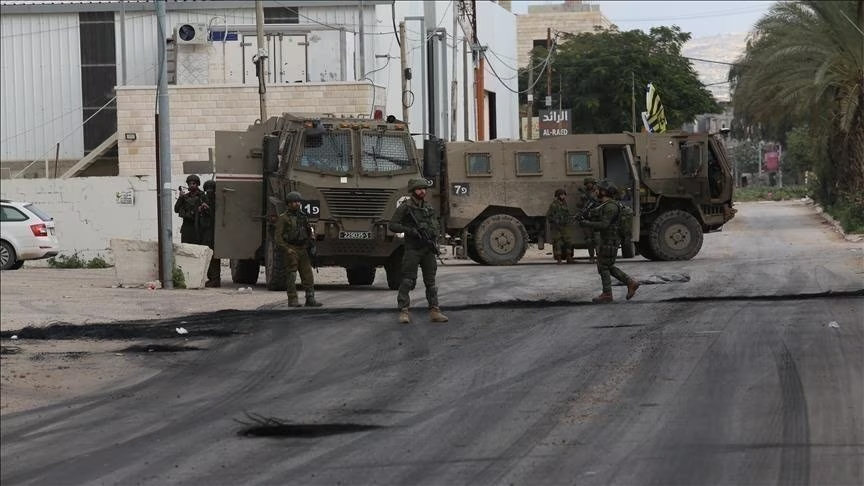







The Israeli army closed, on Saturday morning, the entrances to Palestinian villages west of the city of Ramallah in the center of the occupied West Bank, on the pretext of gunfire at a military checkpoint in that area, before it became clear that it was a regular hunting activity and not an attack.
Local sources reported that the Israeli army closed the entrances to the villages of Ni'lin, Bil'in, and Kharbatha Bani Harith west of the city of Ramallah, this morning, by closing the iron gates installed on them, and preventing entry or exit from them.
The sources mentioned that the Israeli measures followed circulating news about gunfire at the Ni'lin checkpoint military crossing.
They clarified that the closure caused the prevention of movement for residents of 13 Palestinian villages in that area to and from the city of Ramallah.
For its part, the Israeli army said in a statement: "A short while ago, a saboteur carried out a shooting operation near the security fence near the Hashmonaim checkpoint and fled, without any injuries," according to its expression.
It added: "Large forces rushed to the area and began sweeping operations in search of the saboteur, and imposed a cordon on a number of villages in the area."
Before Hebrew media reported that the Israeli army said that the shooting was not an attack, but rather for hunting purposes.
The army added: "The forces continue to pursue the shooter to confiscate the weapon."
This coincides with the Israeli army continuing, for the second day, a wide-scale aggression on the town of Qabatiya south of Jenin in the north of the occupied West Bank, according to local sources.
According to the sources, the Israeli army deployed new military reinforcements to the town on Saturday morning, and its vehicles spread in its neighborhoods, and bulldozers closed main streets leading to it with earthen barriers.
It indicated that the Israeli army continued to impose a curfew on the town, stormed a large number of homes and destroyed their contents, in addition to bulldozing streets and sabotaging infrastructure.
The sources added that the occupation forces turned the home of Ahmad Abu al-Rub, the perpetrator of the Baysan and Afoula operation yesterday, Friday, into a military barracks, and took several young men there and tortured them.
It pointed out that the Israeli army arrested several Palestinians in Qabatiya, including Ahmad Hassan Nazal, Yasser Khazmiya, Faras Talib, Niji Nazal, and Ja'far Shabut.
This operation falls within the policy of collective punishment that the Israeli army adopts against Palestinian towns from which citizens carry out operations, a policy prohibited by international humanitarian law, and considered a war crime according to the Geneva Conventions.
The official Israeli Broadcasting Corporation reported on Friday that the operation came following "instructions issued to the army to prepare for expanding its military activity in Qabatiya," as part of "a political and security message aimed at holding the environment surrounding the perpetrator of the attack indirectly responsible, and deterring similar operations in the future."
The Israeli army has been continuing since January 21, 2025, a wide-scale military operation in the north of the West Bank, which it began in Jenin camp and then expanded to Nur Shams and Tulkarm camps.
Since then, the army has imposed a strict siege on the three camps, and continues to destroy the infrastructure, homes, and shops of citizens, which has led to the displacement of about 50,000 Palestinians, according to official data.
Israel is intensifying, in parallel, its policies aimed at annexing the West Bank, through demolishing Palestinians' homes, displacing them, and expanding settlements, according to Palestinian authorities, which would undermine the two-state solution stipulated in United Nations resolutions.
The forces continue to pursue the shooter to confiscate the weapon.

Share your opinion
Israeli Army Closes Villages West of Ramallah on Pretext of Gunfire That Turned Out to Be Hunting Activity