LATEST NEWS

Tue 16 Jun 2026 7:35 pm - Jerusalem Time

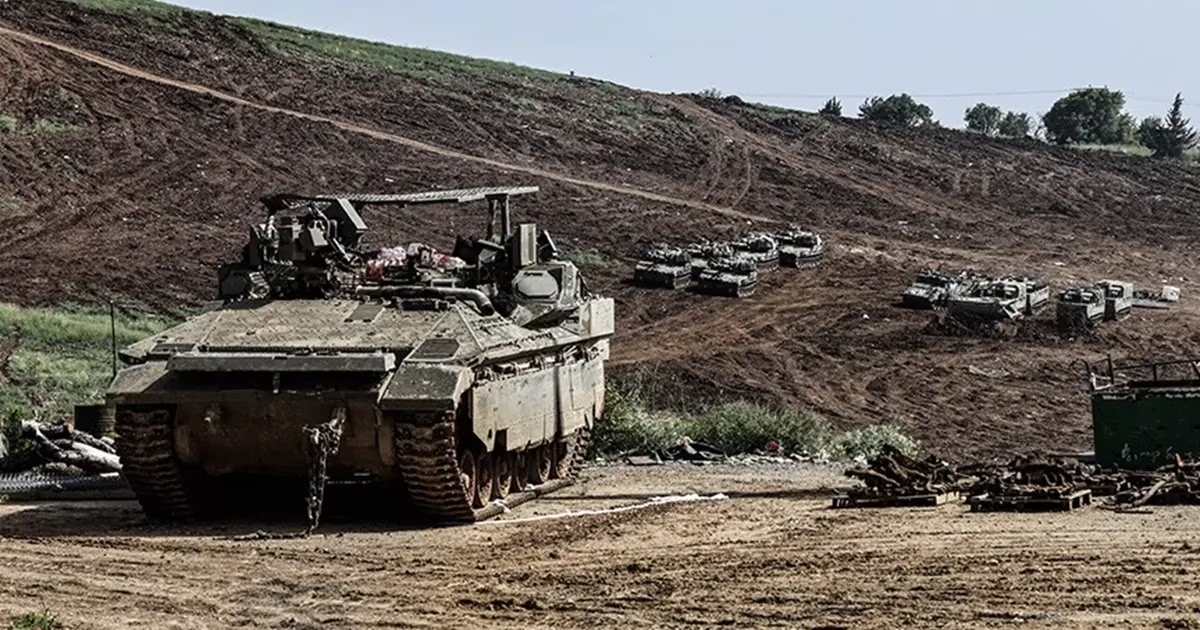
Field escalation in southern Lebanon and Netanyahu insists on military presence

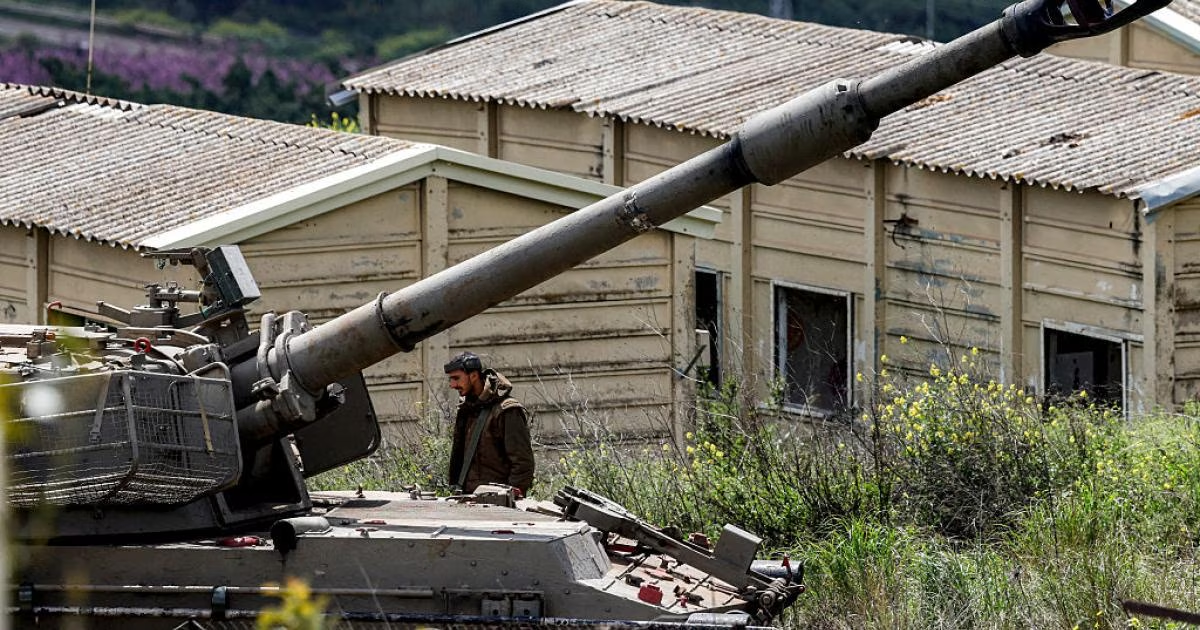
Mutual military attacks resumed in the border areas of southern Lebanon, where an Israeli drone targeted a 'van' type vehicle on the road between the towns of Hadatha and Haris in the Bint Jbeil district. This attack coincided with artillery shelling around the town of Rihan, amid intense low-altitude drone flights over the villages of Zahrani, Baalbek city, and the Beqaa region in the east of the country.

On the other side, field sources reported that the Israeli army launched interceptor missiles from the Metulla area towards targets deep inside Lebanese territory. Israeli authorities did not sound sirens in the border settlements, justifying this by stating that the operations were offensive and directed towards Lebanese territory and did not pose a direct threat to residential areas inside.

For its part, the Israeli army announced that its forces were subjected to a series of attacks during Monday night, including rocket barrages, anti-tank missiles, and suicide drones. Military sources confirmed that these attacks did not result in any casualties among soldiers, but they reflect escalating tension in the contact areas.

Israeli forces also carried out four preemptive strikes targeting what they described as 'threat factors' that were moving near their deployment sites in southern Lebanon. The occupation usually uses this term to justify targeting individuals or movements suspected of approaching the front lines it controls within Lebanese territory.

Field data indicates that the pace of current operations, although less intense than before the recent understandings, represents a clear return to a policy of limited targeting. Hezbollah claimed responsibility for carrying out several military operations targeting Israeli army movements stationed within Lebanese territory.

Recently, the scope of Israeli targeting has expanded to distances exceeding three kilometers from the front line controlled by the occupying forces. This expansion raises serious concerns among observers about the possibility of the situation sliding towards a wider confrontation if the existing rules of engagement continue to be violated.

On the political front, Israeli Prime Minister Benjamin Netanyahu blocked hopes of an imminent withdrawal, stressing that Tel Aviv does not intend to evacuate the areas it currently controls in the south. Netanyahu emphasized that maintaining what he called 'freedom of military action' within Lebanon is a fundamental pillar of Israel's security strategy for the next phase.

Netanyahu clarified that these hardline positions were clearly communicated to the US administration, claiming that Washington showed understanding for Israeli security requirements. These statements come at a sensitive time, coinciding with international attempts to solidify understandings related to the recent US-Iranian agreement that included multiple regional issues.

In the absence of the full text of the new agreement being published so far, the limits of mutual commitments and implementation mechanisms remain vague and unclear to those concerned. The US administration faces increasing pressure to prevent the collapse of fragile understandings, especially since the Lebanese file was strongly present behind the scenes of the negotiations that preceded the announcement of the comprehensive calm.

Israel does not intend to withdraw from the areas it occupies in southern Lebanon, and maintaining freedom of action within Lebanese territory is a top security priority.

PALESTINE

Tue 16 Jun 2026 7:35 pm - Jerusalem Time

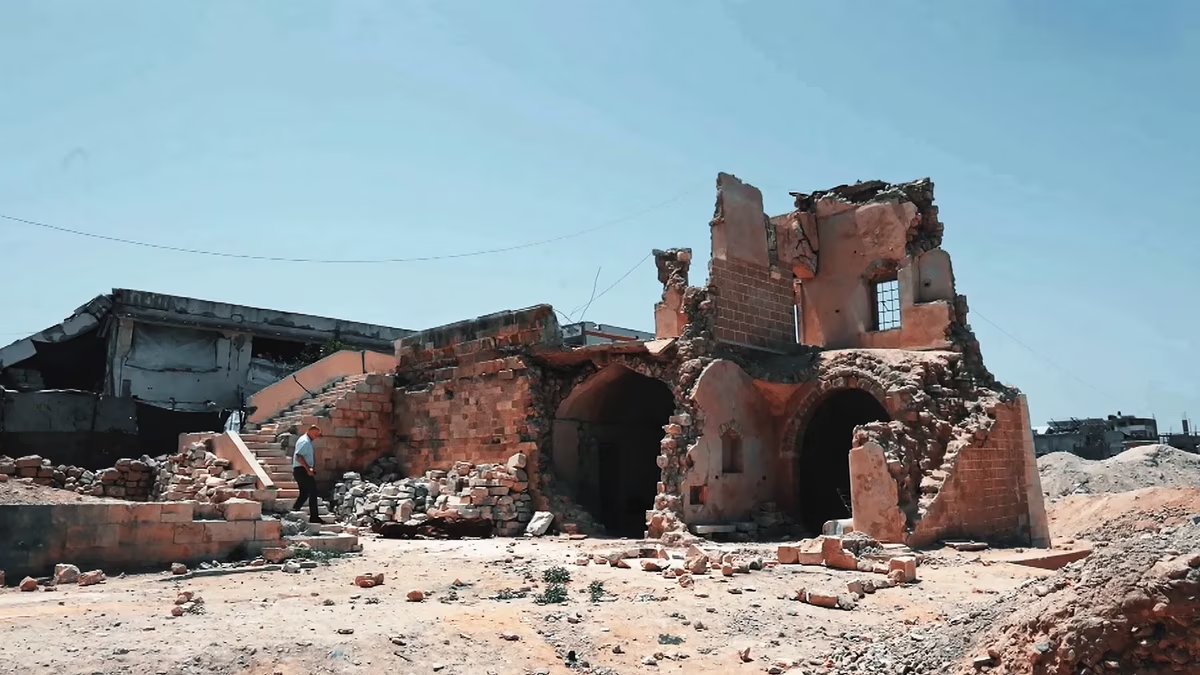
Under the Rubble of Memories.. Gaza's Elderly Face the Harshness of Displacement and Loss of Care on Their International Day

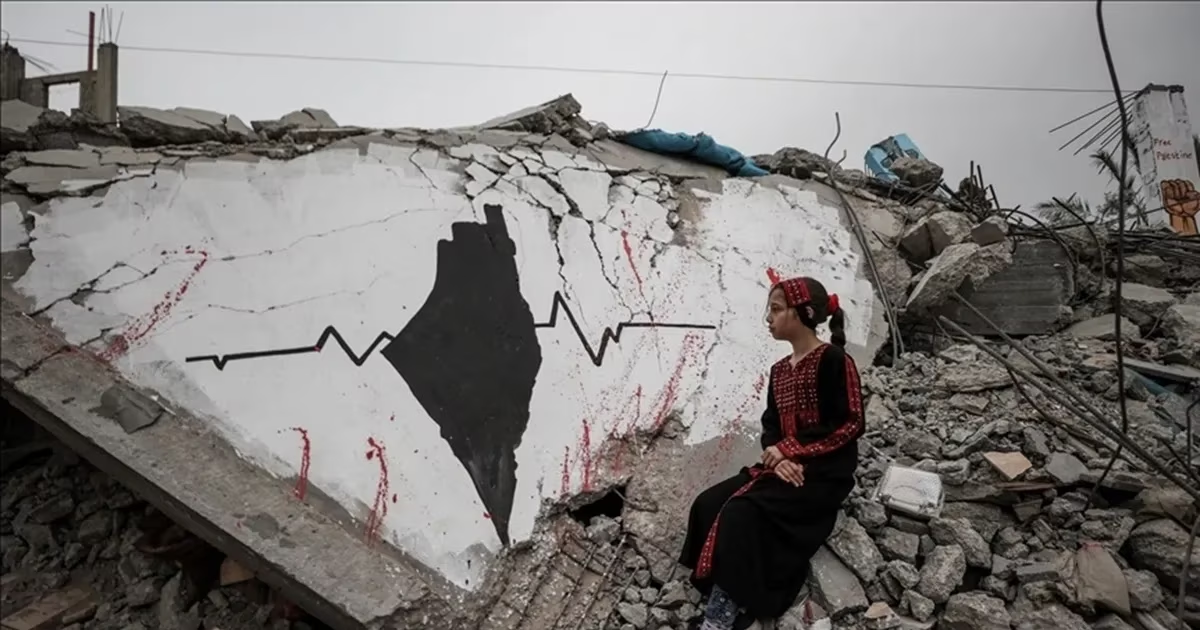
This year, the annual commemoration of the International Day for Awareness of Elder Abuse coincides with a tragic reality experienced by the elderly in the Gaza Strip, where they find themselves caught between the hammer of forced displacement and the anvil of losing their homes. This group, which spent decades building their lives, is now witnessing the demise of their memories under the rubble of homes destroyed by the ongoing Israeli war, which has exacerbated their isolation and their psychological and physical suffering.

In a field tour by journalistic sources from within the section dedicated to caring for the elderly, the effects of destruction and displacement on their daily lives were clearly visible, after the residents were forced to move from their original center in the city of Al-Zahra to a cramped temporary headquarters inside Al-Wafa Hospital. This transfer came as a result of the severe damage to the main center, making care provision a difficult task under conditions not prepared to receive critical cases.

Ashraf Hamada, head of the elderly department at Al-Wafa Hospital, confirmed that medical and administrative staff are making strenuous efforts to provide health and living services around the clock despite the lack of resources. Hamada explained that the war has left deep scars on the souls of the elderly who spent long months in a state of constant terror and deprivation of the most basic necessities for a dignified life.

Hamada revealed a painful statistic indicating the death of more than 20 elderly men and women during the months of the war, not only due to direct targeting, but also as a result of the bitter cold, extreme fear, and the repercussions of the bombing that targeted their centers. These numbers reflect the fragility of this societal segment whose weak bodies are no longer able to withstand the harshness of the deteriorating humanitarian conditions in the shelters.

The head of the department described the displacement journey he undertook with the elderly as arduous and fraught with dangers, as they moved from the city of Al-Zahra to Deir al-Balah in the central Gaza Strip before temporarily settling in the current location. This repeated movement, and the accompanying severe shortage of food and medicine, led to a deterioration in the general health of many residents and an exacerbation of their chronic diseases.

The center's administration faces successive logistical and financial crises, as it suffers from extreme difficulty in providing specialized medicines and appropriate meals for the elderly. The working staff also continues to perform their humanitarian duties despite salary cuts and limited available resources, which places additional pressure on the quality of services provided in this exceptional circumstance.

The current headquarters in Al-Wafa Hospital is considered a temporary solution that lacks the open spaces and recreational facilities necessary for the psychological health of the elderly, which increases their feelings of loneliness and depression. The cramped space also hinders the movement of medical staff and limits the ability to accommodate additional numbers of elderly people who have lost their breadwinners or homes during military operations.

In a moving testimony, one of the displaced elderly women recounted how her life transformed from travel and lively family gatherings to living in a cramped room awaiting the unknown. She bitterly expressed the loss of all her belongings and family photos that represented her personal history, confirming that her home, which she dreams of returning to, has turned into a pile of rubble due to the bombing.

These stories embody a collective reality for Gaza's elderly, where the loss is not limited to material aspects but extends to include the loss of a sense of security and social belonging. With the continuation of the war, the dream of returning home remains the only driving force for what remains of hope in their souls, despite many of them realizing that the places they knew no longer exist on the map.

More than 20 elderly men and women lost their lives during the war due to cold, fear, and the repercussions of the bombing that targeted their shelters.

PALESTINE

Tue 16 Jun 2026 7:34 pm - Jerusalem Time

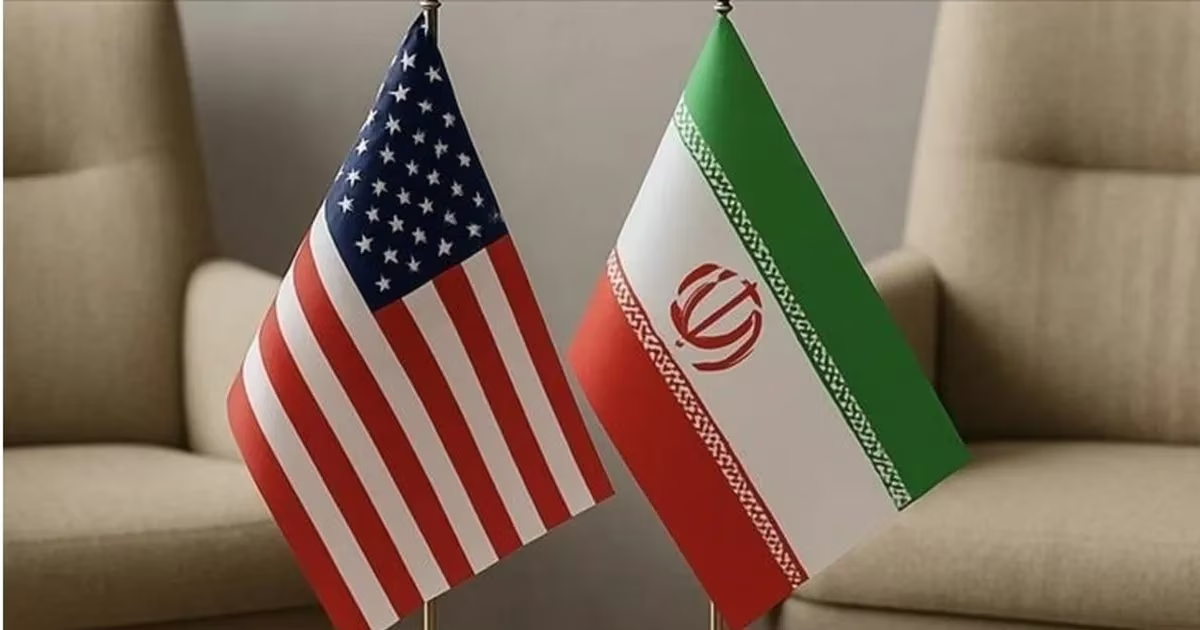
Washington and Tehran Agreement… Has the War Laid Down Its Burdens?

Dr. Saeed Shaheen: The war showed the limited military options, and Israel views the agreement as a strategic failure because it did not achieve the set goals.

Talal Awkal: Trump no longer has many options except to move towards a memorandum of understanding that allows him to market an achievement that alleviates internal and external pressures on him.

Nabhan Khraisha: The success of signing the agreement does not mean the end of the conflict, but rather represents the beginning of a new test of the ability to translate understandings into a reality that prevents the return of open confrontation.

Dr. Tamara Haddad: The expected memorandum of understanding represents a trial phase during which the commitment of both parties to the terms of the truce and the implementation of initial steps will be tested before moving to a more comprehensive agreement.

Labib Taha: The Israeli raid on the southern suburb was part of attempts to obstruct the ongoing understandings and keep the escalation climate alive, but it did not succeed in doing so.

Daoud Kuttab: The strike on the southern suburb reinforced Washington's push to offer greater flexibility and additional concessions to Tehran, which strengthened its negotiating position.

Ramallah - Exclusive to "Al-Quds" -

After months of escalating military and successive regional tensions, attention is turning to diplomatic efforts aimed at formulating an understanding between the United States of America and Iran, and signing a memorandum of understanding in the coming days, in a move seen as a significant shift in the course of the crisis, marking the beginning of a phase of testing intentions and the resilience of the agreement.

According to writers, political analysts, and university professors, in separate interviews with "Al-Quds", this political movement comes amidst declining reliance on military solutions, after recent confrontations showed the difficulty of imposing new equations by force or achieving decisive gains on the ground.

Writers, analysts, and university professors confirm that the atmosphere surrounding the negotiations reflects a growing awareness among the concerned parties that the continuation of the conflict carries high political, economic, and security costs, which has enhanced the chances of seeking temporary arrangements that allow for containing tension and opening the way for addressing more complex contentious issues.

Any anticipated understandings are expected to form an initial framework for testing intentions and building trust before moving to more sensitive negotiation stages.

At the same time, these developments raise questions about the potential agreement's ability to withstand regional challenges, especially in light of Israeli objections and attempts to influence the outcomes of the negotiations and the new political scene, which was reflected in the preemptive strike on the southern suburb of Beirut against the negotiations.

An important achievement for both parties

Dr. Saeed Shaheen, Professor of Political Media at Hebron University, believes that reaching a memorandum of understanding between the United States and Iran represents an important achievement for both parties after a long period of confrontation and escalation, suggesting that these understandings will endure and be followed by prolonged negotiation rounds during which each party seeks to enhance its political and strategic gains, amidst a growing conviction of the impossibility of resolving the conflict militarily.

Shaheen explains that the war showed the limited military options available to both parties, as there is no longer room for a complete resolution except through means that are regionally or internationally unacceptable.

Shaheen points out that among the most prominent reasons for the failure of the military campaign against Iran was Tehran's ability to withstand and maintain the cohesion of its internal front, contrary to expectations that bet on the collapse of the regime after targeting its military and security leaders and striking its military capabilities in the early stages of the war.

Iran's success in containing the strikes

Shaheen confirms that Iran succeeded in containing the effects of the strikes by quickly rebuilding the command system and adopting a strategy of "long patience," in addition to employing multiple pressure cards that included missile power, targeting American interests and assets in the region, threatening to close the Strait of Hormuz, as well as activating the fronts of its allies in the region and entering into direct confrontation with Israel, which led to increased political and economic pressures on the United States and its allies.

Negative impacts on the American interior

Shaheen notes that the war negatively affected the American interior through rising prices and declining public support for the continuation of the confrontation, in addition to the emergence of divisions within US President Donald Trump's base and a decline in support indicators for the Republican Party in opinion polls, which contributed to pushing Washington towards the option of understanding.

Israel and strategic failure

Shaheen believes that Israel views the agreement as a strategic failure, as it did not achieve the goals it announced since the beginning of the war, foremost among them the overthrow of the Iranian regime and the definitive end of the nuclear project.

Shaheen points out that linking the Lebanese arena to the new understandings raises widespread Israeli objection, because it limits the freedom of military action that Tel Aviv considers an essential part of its security doctrine, and undermines its efforts to dismantle the axis of resistance, which has not been achieved according to current data. Rather, the proposed understandings give this axis a greater presence in future political and security equations.

Washington and Tel Aviv's failure to achieve war goals

Political writer and analyst Talal Awkal believes that the move towards an American-Iranian understanding came as a result of the failure of the United States and Israel to achieve the goals they announced at the beginning of the war, despite the intensive military operations, siege, and pressures exerted during the past period.

Awkal believes that US President Donald Trump no longer has many options except to move towards an agreement or memorandum of understanding that allows him to market a political achievement that alleviates the increasing internal and external pressures on him.

Awkal explains that the war damaged American interests, at a time when Israel seemed more committed to continuing the confrontation, which led to increasing divergence between the priorities of the two allies.

Prioritizing American interests

According to Awkal, Washington ultimately chose to prioritize its direct interests and reassert the independence of American decision-making, even if this led to a decline in the Israeli role in shaping the political arrangements related to the conflict.

Awkal points out that the difficulty of reaching a comprehensive agreement on the Iranian nuclear file pushed the US administration to accept a transitional memorandum of understanding that allows Trump to declare a political success, especially in files related to navigation security and opening the Strait of Hormuz. Awkal notes that, in return, Iran feels that it has emerged with important political and economic gains as a result of its steadfastness during the confrontation, without abandoning its sovereignty, its nuclear project, or its network of regional alliances.

The preemptive strike in the southern suburb

Regarding the recent Israeli escalation in the southern suburb of Beirut coinciding with the decisive phase of the negotiations, Awkal believes that this strike came as part of a preemptive effort led by Israeli Prime Minister Benjamin Netanyahu to create new facts on the ground and improve Israel's conditions in any future arrangements, in addition to attempting to disrupt the expected American-Iranian understanding.

Tehran puts Netanyahu in confrontation with Washington

Awkal believes that Netanyahu hoped to push Iran into a military response that would disrupt the negotiations, but Tehran contented itself with political threats and hinting at reconsidering the negotiations without being drawn into a direct confrontation.

Awkal points out that this Iranian stance put Netanyahu in direct confrontation with the US administration, which became more keen on the success of the understandings, which pushed Trump to exert pressure on Israel and hold it responsible for any attempt to thwart the agreement.

The beginning of a long path of complex negotiations

Awkal emphasizes that the next phase does not mean the end of the conflict, but rather the beginning of a long path of complex negotiations on the fundamental outstanding issues, warning that Israel may continue its attempts at sabotage and escalation across multiple arenas including Gaza, the West Bank, Lebanon, Syria, and perhaps Iraq and Yemen, amidst the continuation of the major strategic shifts produced by the war and its political consequences.

Facing the test of the agreement's resilience

Journalist and writer Nabhan Khraisha believes that the talk about the United States and Iran approaching an agreement to end the war and sign it in Switzerland raises questions that go beyond the content of the anticipated understanding to its ability to withstand the political and military challenges surrounding it, especially in light of the Israeli position rejecting any arrangements that might grant Tehran political or strategic gains.

Khraisha explains that the forty-eight hours preceding the talk about the signing witnessed a remarkable Israeli escalation, represented by intensified military operations inside Lebanon and expansion into new southern areas, in addition to targeting the southern suburb of Beirut at a politically sensitive time, coinciding with the American-Iranian negotiations approaching their final stages.

Khraisha believes that these movements were not just isolated field operations, but rather came within a clear Israeli attempt to obstruct the ongoing understandings.

According to Khraisha, Israel intended to send two main messages through this escalation; the first is a rejection of any agreement that might strengthen Iran's regional position or grant it political and security gains, and the second is to emphasize that the Lebanese arena and Israel's freedom of military action there must remain outside any understandings between Washington and Tehran.

Khraisha points out that the announcement of the agreement, if it actually happens, will mean that attempts to disrupt it at the last minute did not achieve their primary goal of preventing the understanding or pushing the region towards a wider confrontation.

An attempt to solidify the negotiations

This will also reflect, according to Khraisha, a strategic decision by the United States and Iran not to allow field developments or external pressures to derail the negotiations after they have reached advanced stages.

However, Khraisha stresses that the real challenge will begin after the signing, explaining that the future of the agreement will be determined by three main factors: first, the nature of the Iranian response to any subsequent Israeli provocations, and whether Tehran will continue its policy of self-restraint or resort to direct military responses.

The second factor, according to Khraisha, is related to the United States' position and its willingness to protect the agreement and exert effective pressure on Israel to prevent its undermining.

According to Khraisha, the third factor is Israeli behavior itself and the possibility of Tel Aviv moving from attempting to overthrow the agreement to attempting to empty it of its content by continuing the escalation in Lebanon, Syria, and other arenas.

Khraisha suggests that the agreement will remain in place even if limited tensions continue, but it may remain fragile and vulnerable to instability.

Khraisha also raises another possibility, which is the success of real American pressure on Israel to expand the scope of the truce and give the agreement a greater chance of survival, as opposed to a more dangerous scenario based on escalating Israeli military operations that would push Iran or its allies into larger responses that would return the region to a spiral of escalation.

Khraisha believes that the success of signing the agreement does not mean the end of the conflict, but rather represents the end of one phase and the beginning of a new test of the ability of the different parties to translate political understandings into a practical reality that prevents the region from returning to open confrontation.

Fragility of previous agreements raises concerns

Writer and political researcher Dr. Tamara Haddad explains that current indicators point to the imminent signing of a framework understanding between Washington and Tehran in the coming days in Switzerland, clarifying that the expected understanding includes establishing a ceasefire, halting military operations, and opening negotiation channels to address thorny issues, most notably the Iranian nuclear program, navigation security in the Strait of Hormuz, and economic sanctions imposed on Iran.

Haddad points out that the main challenge lies not so much in announcing the agreement as in its ability to endure, noting that previous experiences in the region have shown the fragility of agreements concluded under the pressure of military confrontations unless they transform into broader and more firmly established political and security understandings.

Core issues still pending

Haddad notes that many core issues are still postponed to later negotiation stages, which makes the anticipated understanding closer to a truce framework or a ceasefire than to a final and comprehensive settlement of the conflict.

The Dahiyeh strike failed

Meanwhile, Haddad explains that the recent Israeli strike on the southern suburb of Beirut came at a highly sensitive time, and seemed like an attempt to impose new facts on the ground and improve Israel's negotiating position before the announcement of the American-Iranian understanding.

Despite the angry reactions the strike provoked in Tehran, it did not succeed, according to Haddad, in disrupting political contacts or stopping mediation efforts, which reflects an international and regional will to maintain the negotiation process and not allow it to collapse due to a single military incident.

Haddad believes that the strike simultaneously revealed the extent of the differences between the various parties, and confirmed that any future agreement will remain vulnerable to instability as long as the tension arenas in Lebanon and Gaza are open, or if some parties continue to use military escalation to achieve political gains.

Challenges facing the anticipated understanding

Haddad indicates that there are internal and external challenges facing the anticipated understanding, foremost among them the objection of conservative currents within Iran, in addition to the Israeli position rejecting any agreement that Tel Aviv sees as a threat to its interests or its security approach towards Iran and its allies in the region.

Haddad believes that the expected memorandum of understanding represents a first trial phase between Washington and Tehran that may extend for about sixty days, during which the commitment of both parties to the terms of the truce and the implementation of initial steps will be tested before moving to a more comprehensive agreement.

Iran's opportunity to achieve gains

Haddad points out that Iran views this phase as an opportunity to achieve political and economic gains, including easing sanctions, releasing part of frozen funds, and ensuring navigation security in the Strait of Hormuz.

Haddad suggests that Tehran will avoid a direct response to the Israeli strike on the southern suburb of Beirut, in order not to derail the ongoing negotiations, and to show that the party obstructing the understandings is Israel and not Iran.

Haddad points out that the Iranian leadership realizes that engaging in a wide confrontation could dissipate the gains it seeks to achieve through the negotiation process.

Negotiating under fire

Haddad believes that what is currently happening falls within what can be described as "negotiating under fire," where each party seeks to improve its political conditions through military force tools in parallel with the continuation of diplomatic contacts.

According to Haddad, Israel is trying to confirm that it will not accept changing the rules of engagement or strengthening the influence of Iran's allies, while Tehran seeks to consolidate its regional influence and ensure that its allies are not harmed.

Continued contacts through mediators

Haddad expects continued contacts between Washington and Tehran through mediators, increased American pressure on Israel to prevent the expansion of the confrontation, in addition to continued limited skirmishes in some regional arenas without sliding into a comprehensive war.

Haddad believes that the possibilities of the understandings collapsing still exist, but an open regional war is not the most likely scenario at the current stage, given all parties' awareness of the exorbitant political, economic, and human costs of any wide confrontation, which gives the chances of continued negotiation and reaching larger understandings greater than the chances of returning to war, despite the option of military escalation remaining on the table if the negotiation process fails in the coming period.

Confrontation no longer serves interests

Political writer and analyst Labib Taha suggests that the coming days will witness the signing of an agreement between the United States and Iran after a long period of negotiations that preceded, continued during, and followed the war, stressing that both parties have reached a conviction that continued confrontation no longer serves their interests in light of the increasing political, economic, and military costs.

Taha explains that the United States does not wish to engage in long-term direct wars, especially in light of internal constraints and political and international considerations governing American decision-making, while Iran is tired of years of siege, pressures, and conflicts, and seeks to restore a degree of stability that allows it to improve its economic and living conditions.

Truce is a common interest

Taha believes that peace or a truce has become a common interest for both parties after each achieved what they could of their goals during the confrontation phase.

Taha believes that Israel stands in opposition to any American-Iranian understanding, considering that its strategy is based on keeping the region in a state of permanent conflict, whether in Gaza, Lebanon, or with Iran. According to Taha, Israel seeks one of two goals; either the continuation of the war indefinitely, or pushing Iran to a complete and comprehensive surrender, which is unattainable in the foreseeable future.

Israeli attempts to obstruct ongoing understandings

Taha points out that the Israeli raid on the southern suburb of Beirut came as part of attempts to obstruct the ongoing understandings and keep the escalation climate alive, but it did not succeed in changing the general direction towards the agreement.

Taha notes that the chances of the anticipated understanding enduring remain linked to American interests, pointing out that American policy has accustomed itself to dealing flexibly with alliances and agreements according to its changing interests, citing the cancellation of the nuclear agreement signed in 2015 a few years after its conclusion.

Excluding a comprehensive war

Taha rules out the return of a comprehensive, large-scale war in the near future, despite the possibility of some limited skirmishes, stressing that all parties are now aware of the extent of the losses that could result from any new regional confrontation.

Taha believes that Iran made a strategic mistake when it stopped or reduced the confrontation before ending the war on Lebanon, even though Hezbollah bore significant burdens in the confrontation with Israel.

Taha believes that the United States erred when it engaged in the war in response to the goals of Israeli Prime Minister Benjamin Netanyahu, without achieving the results it sought, foremost among them a change in the Iranian regime, noting that the outcomes of the Iranian nuclear file will become clearer after the official announcement of the details of the anticipated agreement.

The strike contributed to improving negotiations

Political writer and analyst Daoud Kuttab suggests that the anticipated agreement between the United States and Iran will endure, considering that its chances of survival seem greater than its chances of collapse, despite the surrounding regional complexities.

Kuttab points out that the path related to the Lebanese arena may face obstacles and setbacks during the next phase, due to the continued field tensions and the intertwining of regional calculations related to Lebanon.

Kuttab believes that the recent Israeli strike, contrary to expectations, contributed to improving the terms of negotiation in favor of Iran instead of weakening its position.

Kuttab believes that the Israeli escalation in the southern suburb of Beirut gave Tehran an opportunity to obtain additional concessions during the ongoing discussions, whether regarding commitments related to the nuclear file or regarding the extent of economic facilities and funds that may be released or the easing of restrictions imposed on them within the framework of any anticipated understanding.

Israeli electoral considerations

Kuttab points out that recent developments indicate that political and electoral considerations within Israel played an influential role in pushing events towards this path, more than their connection to direct Israeli strategic interests, which ultimately reflected on the negotiation process by pushing Washington to offer greater flexibility and additional concessions in favor of Tehran, thereby strengthening its negotiating position before reaching the awaited agreement.


ARAB AND WORLD

Tue 16 Jun 2026 7:34 pm - Jerusalem Time

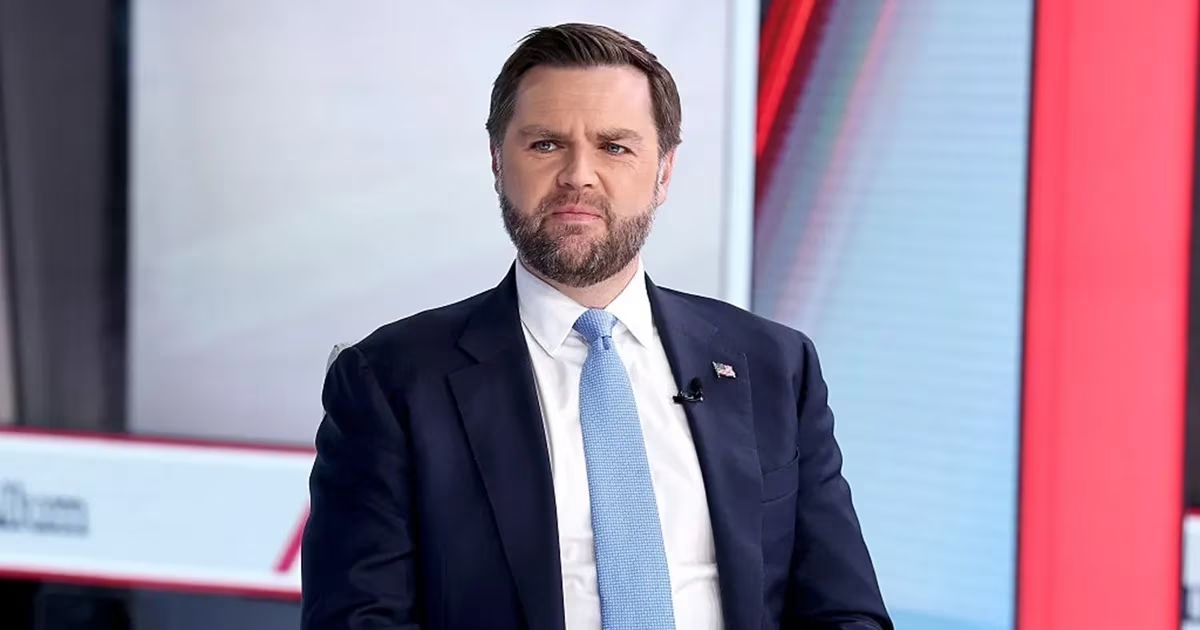
Vance reveals features of the 'framework agreement' with Iran: Gulf funding and return of international inspectors

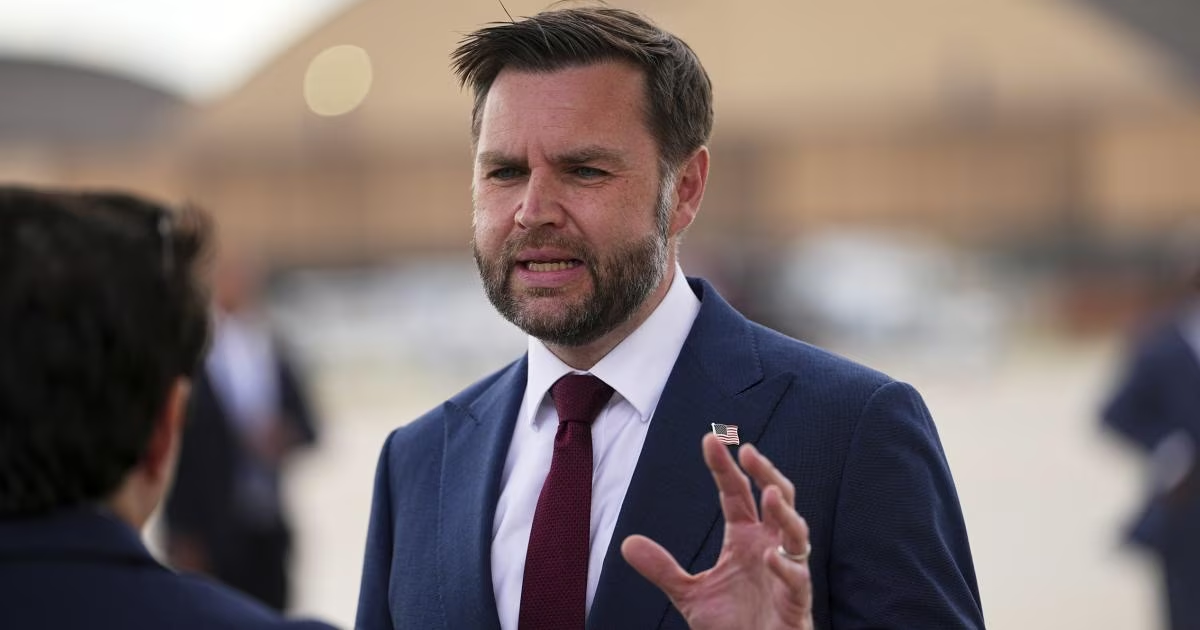
US Vice President JD Vance made important statements, revealing that the recently signed memorandum of understanding between the United States and Iran is merely a 'general framework' for basic principles. Vance clarified that this document is not the final version of the agreement, but rather a prelude to in-depth technical negotiations that will take place at later stages to complete outstanding details.

In a press interview with American media, Vance described the memorandum as very brief, not exceeding one and a half pages, outlining the general lines for the exchange of commitments between the two parties. He indicated that the main goal of this move is to build common ground that ensures the achievement of Washington's and Tehran's interests alike in thorny issues.

The Vice President touched upon the content of 'Paragraph One' of the memorandum, emphasizing that it obliges the Iranian side to the principles of peace and stability in the Middle East region. This commitment, according to the American vision, includes stopping financial and logistical support for groups classified by the United States as terrorist organizations operating in the region.

Vance stressed that the essence of the understanding is based on the necessity of ending what he described as 'destabilizing activities' attributed to Tehran, in exchange for mutual benefits guaranteed by the American administration. He considered that maintaining regional security is the primary driver of these understandings that the Trump administration seeks to establish as a new political reality.

In an economic surprise, Vance revealed the possibility of Iran obtaining massive reconstruction funding, potentially reaching $300 billion, with contributions from some Gulf countries. He clarified that this financial support is conditional on Tehran's full commitment to the terms of the agreement and tangible progress in the ongoing negotiation process between the two capitals.

Regarding the skeptical Israeli position, Vance expressed confidence that Tel Aviv will ultimately accept the agreement despite current differences in viewpoints. He acknowledged the existence of disagreements with Benjamin Netanyahu's government over ways to end regional conflicts, but stressed that common interests will ultimately prevail.

The Vice President affirmed that the US administration sees this proposed agreement as an effective means to enhance Israel's long-term security, not the opposite. He expected the Israeli government to support the diplomatic path as implementation stages progress and tangible results emerge on the ground regarding direct threats.

For his part, Israeli Prime Minister Benjamin Netanyahu commented on these developments by indicating that his country and President Donald Trump do not always agree. This statement reflects the extent of the gap in assessing the situation regarding the nuclear file and Iranian influence, despite the close alliance between the two parties.

On the technical front, Vance explained that the agreement will reopen the door for the return of International Atomic Energy Agency inspectors to Iranian facilities. Washington considers international oversight to be the primary guarantee for ensuring the peaceful nature of the nuclear program and adherence to enrichment restrictions.

The memorandum also includes clear provisions for dealing with Iran's current stockpile of highly enriched uranium, which previous reports estimated to be around 12 tons. The mechanism for disposing of or reducing this stockpile will be through trilateral coordination involving the IAEA, Tehran, and Washington to ensure transparency.

Regarding the timeline, Vance announced that next Friday will see a crucial meeting to officially sign the agreement, followed by the immediate commencement of technical negotiations. These negotiations will focus on setting precise timelines for the gradual implementation of the provisions to ensure testing the intentions of all concerned parties.

These developments come in the context of a comparison with the 2015 agreement, as the current agreement seeks to impose stricter restrictions on international navigation. Sources indicate that the Trump 2026 agreement includes immediately opening the Strait of Hormuz to global trade without any restrictions or military threats.

The current understandings also include an immediate cessation of military operations on all fronts, including the Lebanese arena, with a 60-day truce. This truce aims to provide a suitable environment for negotiating more complex issues, such as ballistic missiles and the timeframes for suspending enrichment.

In a confidence-building step, the United States is expected to release approximately $25 billion of frozen Iranian assets as part of the comprehensive deal. The Trump administration claims that this path is the only way to prevent Iran from acquiring a nuclear weapon and protect the region from scenarios of comprehensive escalation.

The memorandum is a general document that outlines an agreement based on the exchange of commitments and benefits between Washington and Tehran to enhance stability.

OPINIONS

Tue 16 Jun 2026 7:34 pm - Jerusalem Time

Analysis: Structural Transformations of the Egyptian State Under the New 'Strategic Leadership'

Ramallah - “Alquds ” dot com

Ramallah - “Alquds ” dot com

Opinion Writer

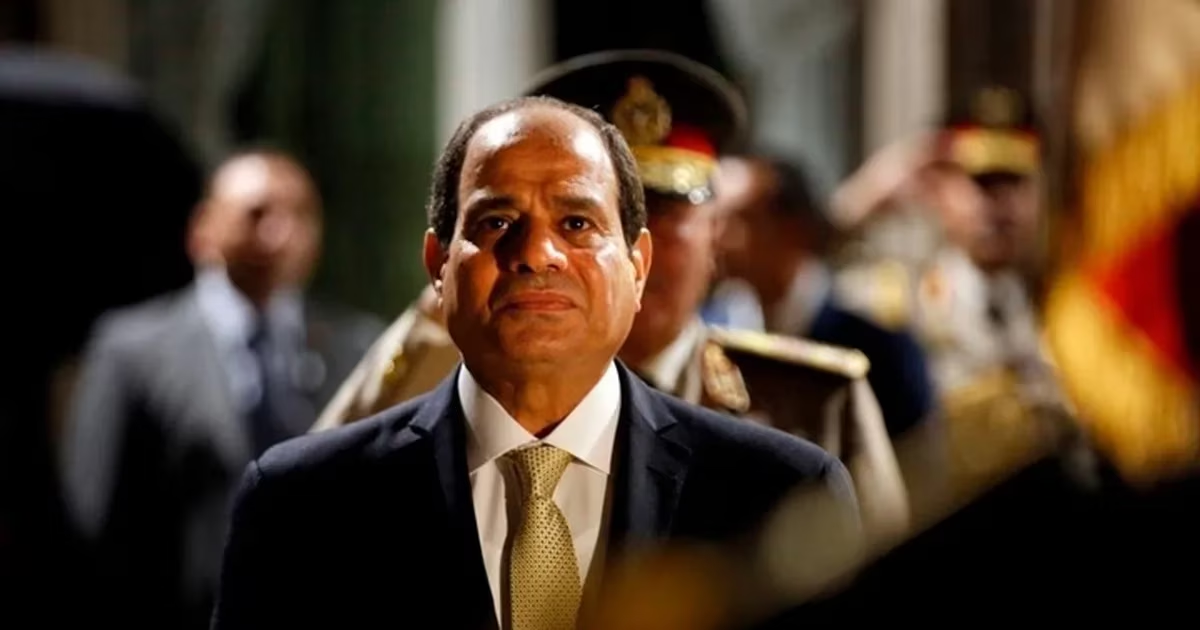
The Egyptian state is witnessing a radical transformation in its governance philosophy and institutional management. The features of this change have emerged in official statements confirming that the strategic leadership center in the New Administrative Capital represents the leadership of the entire state. This orientation indicates a desire to move beyond the traditional structures of the armed forces and civilian ministries towards a more centralized and controlled model.

Observers believe that the current plan aims to accurately describe the current situation to prevent falling into the trap of a lack of vision, as decision-makers believe that the army represents the 'deep state' capable of resolving intractable crises. This has been evident in the military institution being tasked with housing files, demolishing illegal buildings, and managing urban expansions away from the private sector.

This vision reflects a desire for comprehensive control over the joints of public life, extending to intervention in the religious and moral affairs of citizens. The analysis suggests that the authority is trying to entrench the concept of the 'chosen leader' who transcends the status of an elected president, which puts it in confrontation with ancient institutions such as Al-Azhar Al-Sharif.

Political comparisons highlight a similarity in behavior with previous governance models that relied on individualism in resolving complex jurisprudential and social issues. Efforts are being made to approve legislation concerning divorce and inheritance in line with a modern Western vision, with a clear marginalization of traditional scholars and specialists in these fields.

On the political front, the dismantling of the concept of party pluralism is clearly evident in favor of ceremonial parties that support the existing authority without exercising real opposition. This approach has led to the absence of actual political competition, and the scene has turned into a single color that rejects any attempts at rival candidacy, even from within the military establishment itself.

The 'military entity' or the strategic leadership center in the Administrative Capital is the executive tool for this new vision, extending over a vast area exceeding 90 square kilometers. This center, designed to be larger than the 'Pentagon,' aims to provide complete informational control over all data and facilities of the Egyptian state.

The tasks of this center are distributed between managing unified data and controlling strategic networks that centrally manage the state's administrative apparatus. It also includes advanced centers for controlling national communications and managing emergency services and field security, ensuring a rapid response to any potential public movements.

In the context of dismantling civilian ministries, 'Mostakbal Misr' company emerged as an effective alternative to the Ministry of Agriculture in managing major national projects and land reclamation. This company is led by military cadres away from the supervision of the Council of Ministers, which reinforces the concept of a 'single institution state' that swallows the traditional powers of ministries.

Sources indicate that the protocol treatment of civilian ministers and governors reflects a decline in their role in favor of military leaders in public events. Civilian officials are embarrassed by sudden technical questions, while military project leaders are given more space to speak and showcase achievements to public opinion.

This shift towards absolute centralization raises deep questions about the system's ability to continue in the absence of scientific feasibility studies for major projects. Relying on 'boldness' in decision-making instead of scientific methodology may lead to exorbitant economic and social costs that the state will bear in the near future.

The analysis suggests that attempts to transform the state into a 'barracks' or 'central committee' similar to totalitarian regimes may clash with the reality of their unsustainability in the long run. Despite security and informational control, the will for popular change and economic pressures remain crucial factors in determining the lifespan of this political model.

It seems that the current gamble is on gaining time and completing the infrastructure of the Administrative Capital to be an impregnable administrative and security fortress. However, the exclusion of civilian competencies and the marginalization of established institutions may weaken the overall structure of the state and make it more vulnerable to shocks in the event of any sudden crises.

The continuation of this situation beyond 2030 requires additional constitutional and structural amendments to ensure the current authority remains at the top of the leadership pyramid. But historical experiences indicate that systems that abolish pluralism and rely on a single individual face existential challenges when attempting to institutionalize this influence permanently.

Finally, the question remains about how to exit this path, which some describe as a political and economic 'quagmire,' requiring an in-depth reading of the cost of continuing this approach. The future does not depend solely on the survival of the authority, but on the ability of the Egyptian state as an institution and history to withstand these major structural transformations.

The strategic leadership in the New Administrative Capital is the leadership of the state, not just the general leadership of the armed forces.

ANALYSIS

Tue 16 Jun 2026 7:34 pm - Jerusalem Time

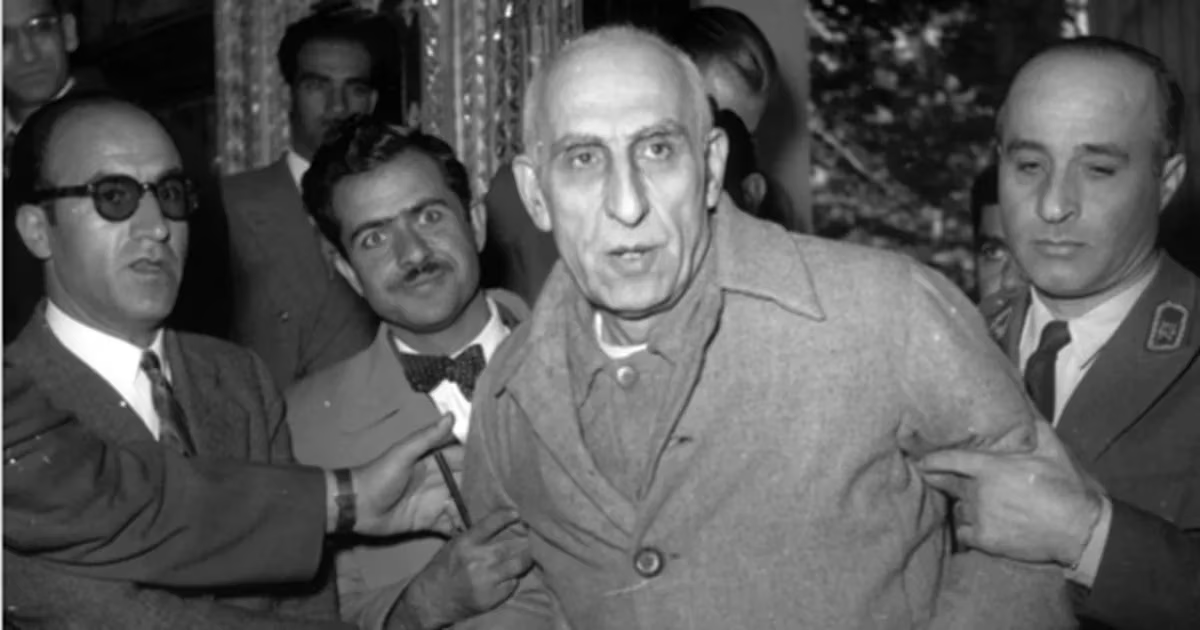
American writer: The recent war revived 'Mossadegh's' legacy and transformed Iran into a global symbol of defiance

Iranian-American writer Azadeh Moaveni believes that the roots of the current conflict between Tehran and Washington extend back many decades. In an article for 'The New York Times', Moaveni recalled the speech of the late Iranian Prime Minister Mohammad Mossadegh in 1951, asserting that the principles of independence he advocated still shape the collective Iranian consciousness.

The writer explained that Mossadegh's overthrow in 1953 by the United States and Britain, following his decision to nationalize oil, was a historical turning point. This event was not merely a military coup, but transformed into a global symbol of resistance against Western hegemony over the resources of developing nations and their national sovereignty.

Moaveni considered that the recent policies adopted by the American administration against Iran have unexpectedly revived this historical legacy. She pointed out that targeting Tehran came at a time of major geopolitical shifts, as many countries seek to reduce their dependence on American decisions and move towards new international poles.

According to the article, a widespread wave of solidarity with Iran emerged in various parts of the non-Western world, in what the writer described as an 'I am Iran' moment. This solidarity did not necessarily stem from agreement with Tehran's internal policies, but from a shared fear of external interventions and the forceful imposition of international wills.

The writer emphasized that Iran did not merely withstand military challenges, but also proved its effectiveness in influencing the balance of the global economy. The continuous threat to navigation in the Strait of Hormuz gave it additional weight in the international arena, forcing major powers to re-evaluate their stance on Tehran's regional role.

In the context of international reactions, sources reported that China and Russia exploited this confrontation to strengthen their discourse rejecting unipolarity. Leaders Xi Jinping and Vladimir Putin described American actions as 'treacherous', reflecting the depth of the new alliances formed in opposition to Washington.

Moaveni noted that official Chinese media used AI techniques to portray the conflict, with the United States appearing as a predatory eagle, while Iran was represented by a proud Persian cat. This media coverage reflects the extent of cultural and political polarization caused by the war in the Asian continent.

Regionally, countries such as Turkey, Malaysia, and Pakistan witnessed notable popular and official stances supporting Iran. In Turkey, opinion polls showed that the vast majority of citizens reject American attacks, while President Erdogan described the war as an absurd act lacking legal legitimacy.

In Malaysia, Parliament took a symbolic step by observing a minute of silence for the victims of the war, while Prime Minister Anwar Ibrahim warned of the repercussions of these attacks. Ibrahim considered what happened a dangerous precedent that threatens the stability of the international order and the rules governing relations between states.

In India, despite official rapprochement with the Israeli occupation, widespread popular solidarity campaigns emerged with the Iranian people. These campaigns included financial donations and the sending of medical and humanitarian aid, reflecting a gap between official political orientations and popular sympathy for issues of sovereignty.

Discussions extended to the African continent, where the Strait of Hormuz crisis raised serious concerns about energy and food security. The writer quoted politicians in South Africa on the necessity of strengthening cooperation within the 'BRICS' group to reduce dependence on economic systems controlled by Western powers.

Moaveni linked the killing of the former Iranian Supreme Leader in an American-Israeli raid to the escalation of the 'collapsing empire' narrative. She indicated that this event, instead of weakening the regime, contributed to uniting the Iranian internal front behind the banner of defending the homeland and threatened sovereignty.

The writer concluded that the war led to results completely contrary to what Washington and Tel Aviv had planned, as the intensity of internal criticism of the regime decreased. Many Iranians now see the state as a bulwark against bombing and external pressures, which gave the regime new legitimacy derived from the cause of independence.

In concluding her analysis, Moaveni affirmed that Iran today possesses a new narrative capable of marketing itself to the world as a resilient state in the face of great powers. This narrative may make Tehran a key player in shaping the new international order that is forming away from absolute American hegemony.

Trump and the Israeli occupation have, unintentionally, contributed to strengthening the Iranian state and solidifying its position as a symbol of defiance and resistance.

PALESTINE

Tue 16 Jun 2026 7:34 pm - Jerusalem Time

Beyond the 'Grand Bargain': How War Reshaped the Middle East's Reality?

While the world awaited rational outcomes from parties characterized by recklessness, the populations affected by the bombing found themselves forced to coexist with terrorism as an imposed daily reality. The human capacity to endure pain and poverty, as described in global literature, transformed in the context of the current conflict into a tool to normalize war and make it an inescapable reality.

This situation was clearly manifested in the confrontation between the United States and Iran, where for months scattered strikes, volatile rhetoric, and promises of an imminent end to hostilities that never materialized prevailed. This severe political crisis led to profound human suffering and economic disruptions that directly and unprecedentedly affected the lives of the region's peoples.

Despite Donald Trump's announcement of a 'grand bargain' to end the war, the days preceding this announcement witnessed a dangerous escalation, including orders for strikes deep inside Iran. Washington's desire to control the strategic Kharg Island, which is the main artery for exporting 90% of Iranian crude oil, also emerged, reflecting the magnitude of the economic threat.

Global markets responded with sharp fluctuations to the agreement's announcement, but the general public received the promises with lukewarm reception due to their repetition dozens of times without tangible effect on the ground. Trump had been calling for calm, claiming the war was nearing its end, at a time when missiles and drones were redrawing the map of pain in the region.

The effects of the conflict extended to Arab countries that Tehran considered allies or proxies of Washington, as Jordan, Kuwait, and Bahrain were subjected to Iranian shelling after the collapse of previous understandings. The UAE, Saudi Arabia, and Qatar were not immune to this targeting, which affected energy infrastructure and claimed civilian lives, shattering a sense of security that will take years to rebuild.

Economically, the war caused a severe shortage in global liquefied natural gas supplies by up to 17% due to the impact on Qatari facilities. The use of the Strait of Hormuz as a weapon in the war also pushed Saudi Arabia to reorder its economic priorities, directing massive investments towards building alternative ports and data centers to ensure sustainability.

In Dubai, the aviation and trade sectors experienced immense pressure with the continued suspension of international flights and expectations of a sharp economic contraction. These material consequences, though measurable, do not reflect the extent of the psychological and social upheaval that affected millions whose professional and personal lives were tied to the region's stability.

Observers believe that the partnership between Trump and Benjamin Netanyahu was the primary driver of these rapid and aggressive transformations, as both parties sought to achieve specific agendas without regard for the consequences. This coordination led to a redefinition of the concept of war itself, where killing and displacement continue even under what is called a 'ceasefire'.

In the Gaza Strip, figures show the horror of the reality, with nearly a thousand martyrs since the ceasefire announcement last October, confirming the falsity of the calm. In Lebanon, Israeli raids have continued since April, resulting in the martyrdom of hundreds and the displacement of about a million people from their homes, especially in Beirut and the south.

Statistics indicate that a third of the victims of the recent escalation in Lebanon are children, which places the international community before its moral responsibilities towards 'truces' that do not provide protection. A new political lexicon has emerged describing these agreements as 'fragile' or 'under test', while drones continue to claim lives.

Thorny issues such as Iranian uranium enrichment, the missile program, and the management of the Strait of Hormuz remain major obstacles to any real and sustainable peace. The absence of certainty in this process makes it akin to a bloody chess game, where threats of withdrawal from talks are exchanged immediately upon any new field escalation.

On the ground, Israeli occupation forces continue to control about 20% of Lebanese territory, amid indications of Netanyahu's desire to exploit the situation to impose a new reality. The occupation prime minister seems inclined to challenge the US administration by launching unilateral attacks aimed at undermining any stability that might result from an agreement with Tehran.

The prolongation of the war has created complex agendas that are difficult to unravel or return the region to what it was before the outbreak of the current conflict. While Trump promises peace, he continues to threaten to completely destroy Iranian infrastructure, revealing a state of confusion in managing the most dangerous regional crisis in contemporary history.

Ultimately, signing agreements will not solve the accumulated crises in Lebanon, Gaza, and the Gulf overnight, as wounds are still open and displaced people have not found their way back. The impossible balance between Washington, Tehran, and Tel Aviv will continue to govern the fate of Arab countries, in a reality that proves that humans, unfortunately, endure a lot of killing.

Humans endure a lot of killing, but the dark side of this resilience is the extent to which regimes can normalize terrorism as part of daily life.

PALESTINE

Tue 16 Jun 2026 7:33 pm - Jerusalem Time

Marjayoun Convoy Massacre 2006: When the Occupation Betrayed Displaced Civilians Under UNIFIL's White Flags

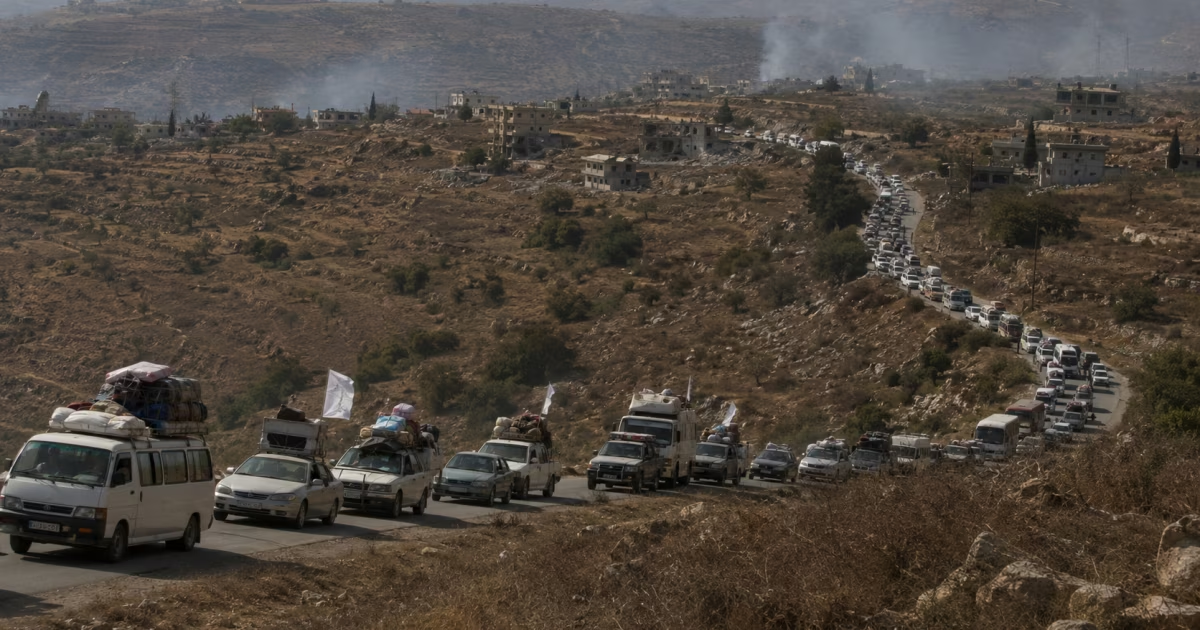
Every year on August 11th, Lebanese memory recalls the tragedy of the Marjayoun convoy massacre, which occurred during the 2006 summer aggression, when Israeli occupation aircraft targeted thousands of civilians fleeing the inferno of shelling. The convoy, comprising about a thousand vehicles, had set off based on prior coordination and security guarantees provided by the international emergency forces 'UNIFIL', but the occupation reneged on its promises as usual.

The tragedy began when occupation tanks seized the joint security force barracks in Marjayoun a few days before the end of the war, prompting Lebanese forces to decide to withdraw. Hundreds of displaced families from Marjayoun and Arqoub villages joined the military convoy, seeking a safe passage towards the Western Bekaa, away from the raging front lines.

Field reports indicate that the convoy was delayed in setting off due to roads being damaged by previous raids, which necessitated the intervention of 'UNIFIL' bulldozers to clear the paths. The arduous journey began under the surveillance of Israeli reconnaissance aircraft that never left the skies, despite international assurances that the agreed-upon route was immune from military targeting.

Upon the convoy's arrival at the outskirts of Jub Jannin town in the Western Bekaa around 10 PM, warplanes suddenly attacked the displaced civilians with a series of concentrated missiles. The raids targeted the front, middle, and rear of the convoy simultaneously, leading to a state of extreme panic among thousands of civilians who were riding buses and civilian cars flying white flags.

This treacherous aggression resulted in the martyrdom of seven people, including a paramedic, and the injury of dozens with varying degrees of severity, with estimates ranging between 36 and 65 wounded. The road, which was supposed to be a passage to safety, turned into a scene of death and destruction, with many vehicles burned and the belongings of the displaced scattered across the area.

In an attempt to evade legal and moral responsibility, the occupation army quickly presented conflicting narratives about the reasons for the targeting. Hebrew sources at the time claimed that forces suspected the transport of weapons for Hezbollah inside the trucks, and also alleged that 'UNIFIL' had not obtained final permission for the movement of such a large number of vehicles.

'UNIFIL' forces firmly responded to these claims, with its commander at the time, General Alain Pellegrini, confirming that the Israeli side had explicitly given the green light for the operation. International sources clarified that the coordination included specifying the route and timing of the movement, making the Israeli targeting a deliberate violation of field understandings and the rules of international humanitarian law.

For its part, 'Human Rights Watch' refuted the Israeli narrative in a detailed report, describing the occupation's justifications as unbelievable and contradicting tangible facts. The organization stressed that the convoy was clearly visible to aircraft, and its size and the civilian nature of the vehicles within it warranted refraining from shelling under the laws of war.

This massacre is part of a broader context of the 2006 aggression, which lasted 34 days and left massive destruction in Lebanese infrastructure, including bridges, power stations, and airports. The economic cost of that war amounted to about seven billion dollars, under the scorched-earth policy adopted by the occupation to pressure the popular base of the resistance.

Historical sources confirm that the 'True Promise' operation carried out by Hezbollah in July 2006 aimed to liberate prisoners, but the Israeli response exceeded all military limits, directly targeting civilians. The Marjayoun massacre is a stark example of the policy of targeting displaced persons that was repeated in other locations such as Marwahin and Qana during the same war.

Living memory of this massacre still demands justice and truth, as survivors and the families of the martyrs insist on prosecuting those responsible for issuing the bombing orders. The issue is not just a historical event, but part of a long record of violations for which the occupation has not been held internationally accountable to this day.

Subsequent investigations proved that the convoy did not contain any military targets, and that all those on board were civilians and security personnel with light weapons, which were disarmed before departure. This reality places the international community before its responsibilities to protect civilians in armed conflicts, especially in light of the repetition of the same criminal patterns.

In conclusion, the Marjayoun convoy massacre remains a testament to the treachery of the occupation, which does not respect international conventions or the guarantees it provides through intermediaries. The stories of the survivors who witnessed the night of terror in the Western Bekaa continue to narrate chapters of Lebanese steadfastness in the face of a war machine that did not differentiate between a child, a paramedic, and a soldier.

Documenting these crimes aims to prevent the obliteration of the Palestinian and Lebanese narrative in the face of Israeli propaganda that always tries to distort facts. Massacres do not expire, and the right of victims to justice remains as long as collective memory preserves the details of that bloody night in August 2006.

Knowing that a large civilian convoy was heading north, and observing the white flags, should have been enough for the Israeli army not to carry out this raid.

PALESTINE

Tue 16 Jun 2026 7:33 pm - Jerusalem Time

International Reports Reveal: Gaza Reconstruction Plans a Facade for Completing Forced Displacement and 'Urban Genocide'

International press reports have highlighted a new strategy pursued by the Israeli occupation authorities in cooperation with the United States, aimed at transforming the issue of Gaza Strip reconstruction into a tool for completing forced displacement plans. This vision relies on imposing urban plans from outside that reject any Palestinian participation, reinforcing the policy of 'urban genocide' that targets the erasure of the physical and moral presence of the indigenous population in the Strip.

Media sources quoted architect Eyal Weizman, founder of 'Forensic Architecture,' as saying that what is happening in Gaza goes beyond military destruction to systematic colonial urban planning. Weizman affirmed that the destruction of hospitals, water and sewage networks, and agricultural lands is not random, but rather a literal application of a slow killing strategy through the destruction of the essential foundations of life, which aligns with international definitions of genocide.

The report indicated that the systematic destruction has pushed Palestinians into narrow, overcrowded pockets that the occupation army describes as 'humanitarian areas,' while in reality they lack the most basic elements of housing and essential services. Heavy machinery and bulldozers have played a pivotal role in obliterating the features of entire cities and villages in Rafah, Beit Hanoun, and Jabalia, transforming vast areas into an uninhabitable environment due to chemical pollution and heavy metals.

Sources touched upon the concept of 'cultural genocide,' which has historically been absent from international agreements under pressure from colonial powers, and is now being applied in Gaza through the targeting of heritage sites, schools, and libraries. This destruction aims not only to eliminate the biological existence of Palestinians but also seeks to sever the social and historical continuity of the Palestinian national group and prevent it from reshaping its identity on its land.

Regarding the field reality, investigations revealed the division of the Gaza Strip into two areas separated by what is known as the 'Yellow Line,' with the occupation army currently controlling more than 54% of the Strip's area. Satellite images have monitored the construction of earthen dams and permanent military installations, in addition to extending electricity and lighting networks, indicating the occupation's intention to transform these points into permanent, not temporary, control centers.

Investigative reports clarified that the occupation has established seven new military sites, some of which were built over completely destroyed cemeteries, in a blatant violation of sanctities and human dignity. These field movements coincide with absolute control over the flow of humanitarian aid, which is used as a political and military pressure tool to push residents towards options of forced migration or facing slow death under the weight of epidemics and health collapse.

On the political front, suspicious real estate development projects have emerged, such as the 'Sunrise Project' proposed by Jared Kushner, which includes building luxury skyscrapers and industrial complexes over the ruins of destroyed cities. These engineering plans precisely follow the military routes carved by the army to divide the Strip, revealing an investment aspect of the displacement plan aimed at transforming Gaza into an investment zone devoid of its indigenous population.

Leaked documents also revealed a pilot project called 'Alternative Safe Communities' being implemented east of Rafah, aiming to cram tens of thousands of displaced people into compounds surrounded by walls and advanced biometric checkpoints. This surveillance system aims to turn Palestinian lives into a large prison, while offering material incentives and facilities to those who decide to 'voluntarily migrate' outside the Strip, in an attempt to empty the land through soft methods.

In contrast to these imposed plans, national Palestinian initiatives, such as the 'Phoenix Gaza Initiative' presented by the Association of Municipalities in cooperation with Palestinian experts and architects, have been completely excluded. The Palestinian vision relies on rebuilding neighborhoods and camps based on accurate property records to preserve the social fabric, which the occupation and its allies reject because it roots the residents in their land.

The report noted that the US administration's description of Gaza as a 'demolition site' reflects a premeditated intention to consider the Strip as empty land requiring radical 'development' that bypasses the existence of the landowners. This approach serves the Israeli vision that sees in the rubble an opportunity to reshape the geography of the Strip to ensure the security of the occupation and its settlement expansion at the expense of Palestinian national rights.

Displaced persons in areas under local administration live in catastrophic conditions, with waste accumulating and sewage flowing between overcrowded tents, portending an imminent environmental and health disaster. Sources confirm that the continued siege and prevention of essential building materials aim to drive the population to a state of absolute despair, making acceptance of external plans the only available 'option of necessity'.

The analytical reading of the scene concluded that the genocide in Gaza is passing through two integrated stages; the first is the comprehensive destruction of the national model through brutal military force, and the second is the imposition of colonial architectural projects. These projects do not aim for reconstruction in its humanitarian sense, but rather aim to legitimize the occupation and permanently change Palestinian demographics to serve the strategic interests of Israel and its allies.

The international community's insistence on ignoring Palestinian urban alternatives contributes to reinforcing the crime of genocide, as Gaza is treated as a laboratory for security and real estate experiments. Experts demand the necessity of empowering Palestinian institutions to lead the reconstruction process to ensure the return of displaced persons to their original homes and preserve the historical identity of the cities and camps that the occupation tried to erase from the map.

In conclusion, the struggle over the future 'shape of Gaza' remains the core of the current political battle, as Palestinians seek to rebuild their lives over the ruins, while the occupation seeks to transform those ruins into a platform for launching a new settlement project. Confronting these plans requires legal and international action that rejects the politicization of reconstruction and affirms the right of the Palestinian people to self-determination in their urban and political future.

Genocide continues in the Strip through a colonial urban planning strategy that implicitly aims to eradicate Palestinian life.

ARAB AND WORLD

Tue 16 Jun 2026 7:33 pm - Jerusalem Time

Trump announces agreement with Iran moving to second phase, praises Qatari mediation

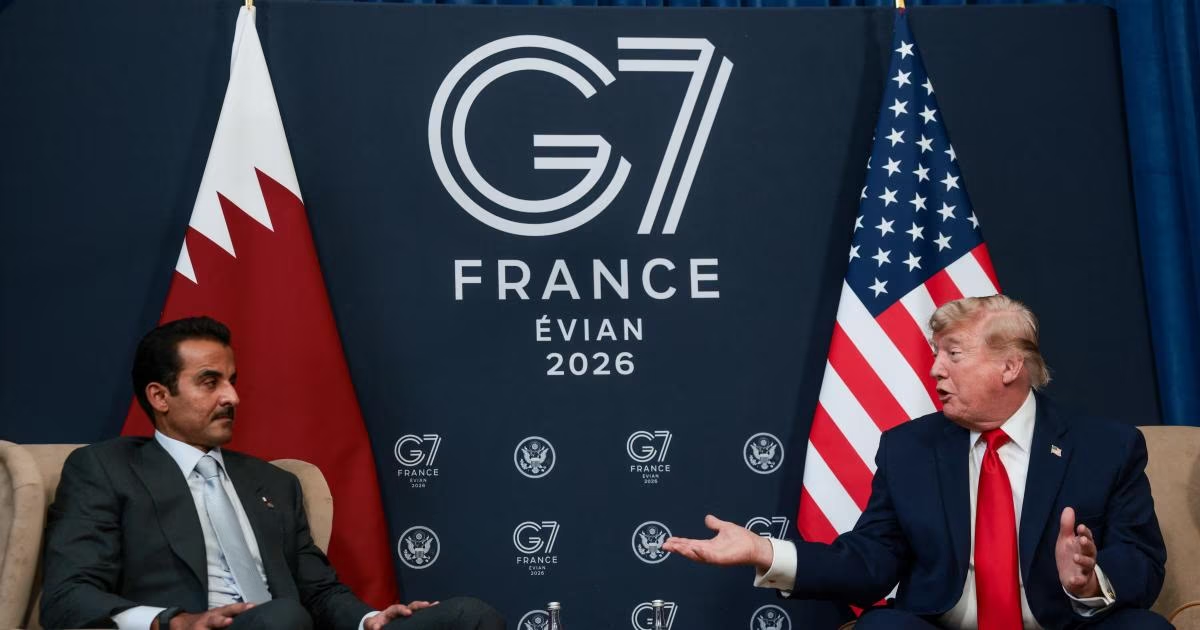
The Emir of the State of Qatar, Sheikh Tamim bin Hamad Al Thani, held a bilateral meeting with US President Donald Trump on the sidelines of the G7 Summit in Evian, France. The meeting addressed a range of regional and international issues of common interest, foremost among them the developments in the Iranian nuclear file and the diplomatic efforts to enhance stability in the Middle East.

Sheikh Tamim bin Hamad described the US-Iranian agreement as a highly significant strategic step, while emphasizing that additional work still needs to be done to ensure the success of these paths. The Emir affirmed that this agreement serves the interests of both the region and Iran, expressing Doha's constant readiness to provide support and assistance whenever friends request it.

For his part, US President Donald Trump revealed that understandings with Tehran are about to move to a second, more advanced phase, praising the pivotal role played by the State of Qatar in bridging viewpoints. Trump explained that cooperation with the Qatari side has been very fruitful, describing them as strong partners who provided real assistance in managing the crisis with Iran.

In a related context, the US President reiterated that the United States will not inject any direct financial investments into Iran, stressing that the primary goal is to ensure that Tehran does not possess nuclear weapons. Trump warned that any Iranian attempt to cross these red lines would be met with a violent military response, describing a potential confrontation in such a case as a 'fierce war'.

Regarding the Lebanese file, Trump touched upon his relations with Israeli Prime Minister Benjamin Netanyahu, noting that it is an excellent relationship but requires a greater degree of responsibility. The US President conveyed a message about the necessity for Netanyahu to act more consciously regarding the escalation in Lebanon, to avoid the region sliding into broader confrontations with unpredictable outcomes.

In a striking proposal reflecting the US administration's vision for regional arrangements, Trump indicated that he suggested to the Israeli side that Syria take responsibility for dealing with the Lebanese Hezbollah file. This statement comes at a time when the Lebanese front is witnessing escalating tensions, indicating Washington's desire to find regional actors to limit the influence of armed groups.

The meeting concluded with both parties affirming the continuation of close coordination and consultation between Doha and Washington on various issues. The Emir of Qatar stressed that his country always seeks to achieve peace and end conflicts in the region, away from seeking narrow economic gains, emphasizing that regional stability is the top priority of Qatari policy.

The agreement with Iran will move to a second phase, and work with Qatar on mediation has been positive and excellent.

PALESTINE

Tue 16 Jun 2026 7:33 pm - Jerusalem Time

After a year and a half of displacement.. Residents of Nur Shams camp inspect the rubble of their homes amidst strict occupation measures

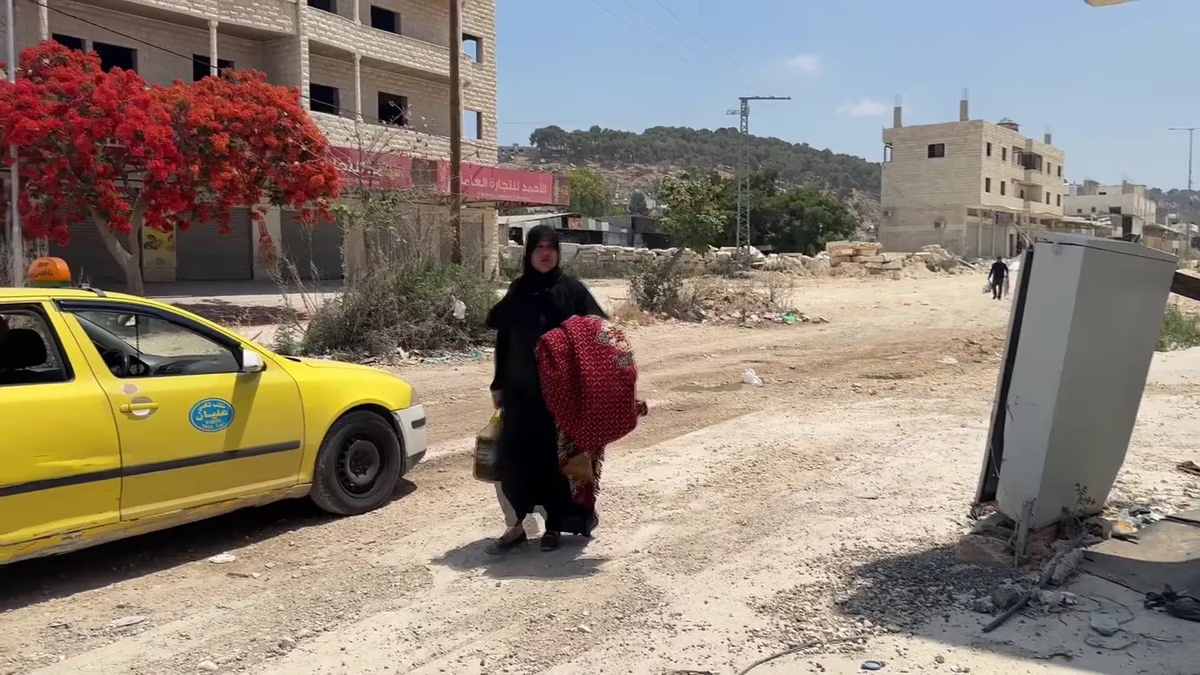
Dozens of residents of Nur Shams camp in Tulkarm city were able to enter the alleys of their camp and inspect their homes for the first time in a year and a half, following coordination that allowed Israeli occupation forces to permit residents to return temporarily for limited hours. Field sources reported that the occupation army imposed strict security measures at the entrances, including confiscating personal IDs and mobile phones and conducting thorough searches of women and the elderly, while a number of young men were arrested on the pretext of having previous security files.

Returnees described the scene inside the camp as shocking, as Israeli bulldozers not only demolished homes but also extended the destruction to infrastructure, water and electricity networks, and uprooted trees, which led to the obliteration of the geographical and social features of the place. Ms. Siham Abu Watfa confirmed that she could not recognize her residential neighborhood due to the accumulated rubble, noting that her home and her children's homes were completely razed to the ground in a clear attempt to erase the memory of refuge and resistance rooted in the camp.

For her part, Ms. Shurooq expressed the bitterness of returning to shattered streets and a completely burned home that the family had inherited from their ancestors since 1950, considering what happened a crime against history and humanity. Despite the magnitude of the tragedy, Shurooq stressed that the determination of the camp residents would not be broken, and that the insistence on staying and starting anew is the only response to the policies of forced displacement practiced by the occupation against the residents of Palestinian camps.

In another testimony, citizen Mohammed Sabri recounted the details of his journey, which he described as a 'journey of humiliation,' as he entered the camp hoping to retrieve some essential belongings such as electrical appliances to help his family in the displacement center, but he found his home empty and destroyed in a way that made it impossible to extract anything from under the rubble. Sabri explained that the risk of entering was great given the spread of snipers and military vehicles that turned the process of inspecting homes into a mission fraught with dangers and psychological intimidation.

Citizen Saif al-Din Hassan Saeed, who witnessed the destruction of his home's furniture and infrastructure, criticized the absence of an effective role for international relief agencies and official Palestinian institutions in supporting the distressed camp residents. Saeed pointed out that the displaced face suffocating financial crises and difficult living commitments amid salary cuts and high living costs, stressing that the aid provided does not rise to the level of the catastrophe that befell Nur Shams and Tulkarm camps in recent months.

In another corner of suffering, Ms. Umm Raja was able to retrieve some household utensils from her home, which partially survived demolition, expressing joy mixed with pain when she found a 'bottle of oil' and a can of olives that had remained intact for two years. Umm Raja considered these simple possessions to represent a symbol of steadfastness and attachment to the land, although she will return with them to the 'shelter' where she currently resides, awaiting a radical solution that will end their ongoing displacement tragedy.

Official estimates issued by local authorities indicate that Israeli military operations in Tulkarm camps have led to the complete demolition of 600 homes and the partial demolition of more than 2,500 homes since the beginning of the recent escalation. This systematic policy has resulted in the displacement of about 500 families and the displacement of approximately 25,000 people, creating a worsening humanitarian crisis that requires urgent international intervention for reconstruction and sheltering families who have become homeless.

The camp has turned into destruction upon destruction, and I could not identify the location of my home due to the uprooting of trees and stones and the complete alteration of the neighborhoods' features.

ARAB AND WORLD

Tue 16 Jun 2026 7:33 pm - Jerusalem Time

Trump intends to present Iran agreement to Congress and officially sign in Switzerland on Friday

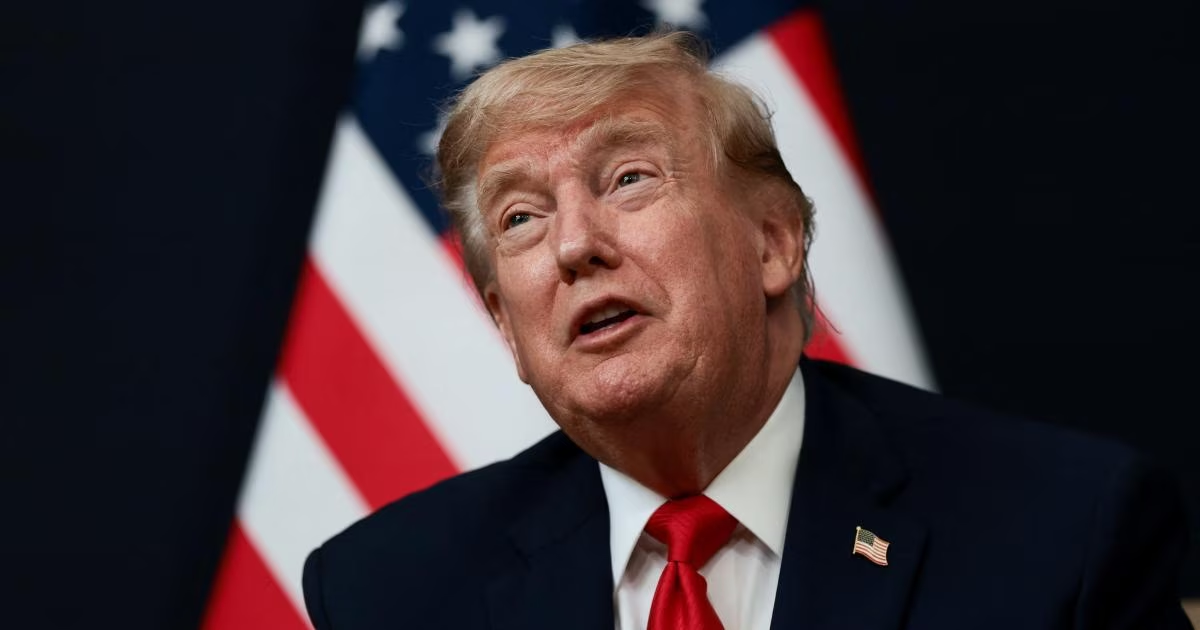
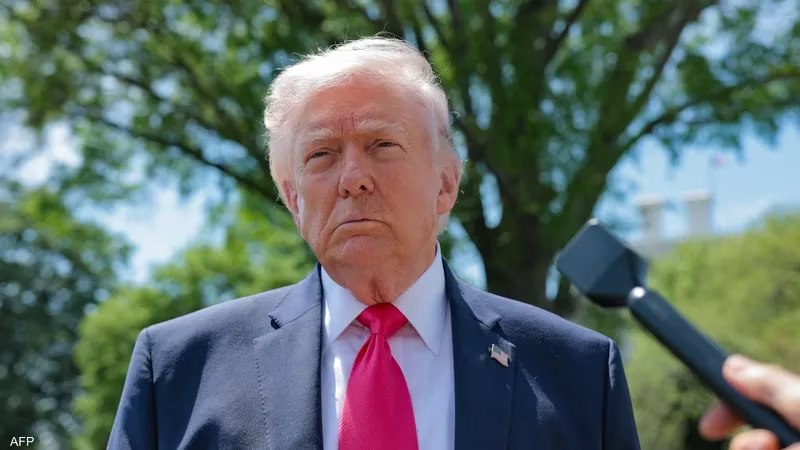
US President Donald Trump revealed his desire to refer the agreement concluded with Iran to the US Congress for review, pledging to read the full text of the document to the media. Trump explained during statements made on the sidelines of the G7 summit held in the French city of Evian that the idea of involving parliament in this process now appeals to him to ensure full transparency.

The American President affirmed that he will not only publish the text of the agreement but will also hold an extensive press conference to read its provisions verbatim to journalists. Trump aims by this step to ensure that media coverage will be accurate and comprehensive, away from any interpretations that might tarnish the content of the understandings reached with the Iranian side.

Regarding the signing ceremony, the Swiss Ministry of Foreign Affairs announced that the memorandum of understanding signing ceremony will take place next Friday, June 19. The ceremony will be held in a luxurious hotel located on Bürgenstock mountain overlooking Lake Lucerne, a location carefully chosen due to its ease of security and difficulty of access for intruders.

Swiss sources indicated that the selection of this strategic location was based on proposals from international mediators including Pakistan and Qatar, in addition to the approval of the United States and Iran. The Bürgenstock complex is one of the historical sites that previously hosted major international events, the last of which was the peace conference on Ukraine in 2024.

Procedurally, official reports stated that the memorandum of understanding has already been signed electronically in preparation for the official ceremony. The electronic signing included both President Trump and his deputy J.D. Vance, and from the Iranian side, the Speaker of the Shura Council, Mohammad Bagher Ghalibaf, who also serves as the chief negotiator in this round.

J.D. Vance is expected to lead his country's delegation in Switzerland, while Ghalibaf will head the Iranian delegation to complete the protocol ceremonies. Vance told international media that the current document is general in nature and consists of only one and a half pages, noting the possibility of Trump personally attending the ceremony despite his commitments at the G7 summit.

In the context of parallel international movements, Chinese Foreign Minister Wang Yi held a phone call with his Pakistani counterpart Ishaq Dar to discuss the latest developments of the agreement. Wang Yi warned that the next phase of negotiations will be more complex and difficult compared to the first phase that led to the current memorandum of understanding.
The Chinese minister stressed the need for the United Nations Security Council to play a more effective role in the coming stages to ensure a final and sustainable deal. Beijing considered the current consensus a new starting point, not the end, affirming its readiness to cooperate with Islamabad to support regional stability.

At its core, this memorandum seeks to end the ongoing conflict in the Middle East, which has directly affected the security of international navigation. The issue of the Strait of Hormuz stands out as one of the most important unresolved issues, where its partial closure by Iran and the corresponding American blockade caused a suffocating global energy crisis.

During their consultations, the Chinese and Pakistani sides agreed on the importance of joint action to open vital maritime passages for international trade. The Pakistani Ministry of Foreign Affairs affirmed that securing the Strait of Hormuz is a fundamental pillar for the stability of the global economy and energy security, which has been severely affected in recent months.

Reports indicate that China, as Iran's largest trading partner and a close ally of Pakistan, played a pivotal behind-the-scenes role in bridging viewpoints. The economic and diplomatic pressures exerted by Beijing contributed to pushing the parties towards the negotiating table in Switzerland to end the political stalemate.

Despite the cautious optimism surrounding Friday's ceremony, observers point out that the technical details of the agreement still require in-depth discussions. Experts believe that Trump's sending of the agreement to Congress may open a new chapter of internal debate in Washington about the nature of the concessions made by both sides.

All eyes remain on Bürgenstock mountain on Friday, where the features of a new era in US-Iran relations are expected to emerge. The text of the agreement that Trump promised to read publicly will be the decisive factor in determining the seriousness of the parties in ending military escalation and returning to the diplomatic path.

In conclusion, this step represents a significant shift in the Trump administration's policy towards the Iranian file, moving from a policy of maximum pressure to seeking negotiated solutions. The biggest challenge remains how to transform this general memorandum into a comprehensive agreement that meets the aspirations of regional and international powers and ensures lasting peace.

I will send the agreement to Congress, this idea appeals to me, and I will hold a press conference to read the text verbatim to you.

OPINIONS

Tue 16 Jun 2026 7:33 pm - Jerusalem Time

Palestinian Economy in the West Bank on the Brink of Collapse Amid Growing International Neglect

Washington Message

Washington – Said Arikat – 16/6/2026

The economic situation in the occupied West Bank is heading towards an unprecedented stage of deterioration that could lead to a comprehensive collapse, amidst continued strict Israeli restrictions and declining international interest in what is happening outside the circle of war in Gaza. In a striking warning, a new report by the “International Crisis Group” confirmed that the Palestinian economy is no longer facing merely a transient crisis, but is undergoing a process of “systematic dismantling” that affects the foundations upon which any future Palestinian state could be built.

The report paints a grim picture of the economic and social reality in the West Bank, where restrictions on movement and trade intersect with the withholding of tax revenues and the expansion of land control, which has led to the weakening of private companies, the depletion of Palestinian families, and pushed the Palestinian Authority to the brink of complete financial insolvency.

According to the report, Israeli measures are not limited to managing the occupation or imposing security considerations, but reflect a trend aimed at consolidating Israeli control and preventing the emergence of an independent Palestinian state. The report concludes that “the economic conditions necessary for any Palestinian future not based on permanent submission are being rapidly dismantled.”

The study was based on extensive interviews with Palestinian businessmen, mayors, and government officials, which revealed the extent of the pressures facing various economic sectors. Participants pointed to a sharp decline in commercial and investment activity, and increasing difficulties faced by companies in meeting their obligations to employees, suppliers, and contractors.

For decades, the Palestinian economy has suffered from the effects of military occupation and its accompanying barriers, checkpoints, and restrictions on the movement of people and goods. However, conditions have significantly worsened since the outbreak of the Israeli war on Gaza following the October 7, 2023 attack.

After the attack, Israel revoked work permits for most Palestinians who were working inside it, numbering nearly 200,000 workers. While Israeli authorities justified the decision on security grounds, the practical result was depriving the Palestinian economy of about $400 million per month, nearly a quarter of the West Bank's total economic output.

The data in the report indicates that the unemployment rate among Palestinians in the West Bank is about 30 percent, while the economy has experienced a sharp contraction over the past two years. Private sector activity has also declined by about 50 percent compared to before the war, due to strict movement restrictions, supply chain disruptions, and escalating uncertainty.

The report warns that Palestinian society is still resilient, but it lives in a continuous state of impoverishment and depletion. It emphasizes that continuing this path without real solutions will erode hope among the population and increase the likelihood of social explosion, escalating violence, and instability.

The Palestinian Authority is at the heart of this crisis as the largest employer and provider of public services in the West Bank. Government institutions have been forced to borrow increasingly to cover basic expenses, while employees suffer from delayed or reduced salaries, at a time when infrastructure and public services are deteriorating.

Lack of funding has led to a decline in hospitals' ability to provide necessary healthcare, and has also negatively impacted the education sector and municipal services. Water networks and roads are continuously deteriorating, in the absence of sufficient financial resources for maintenance and development.

The Palestinian Authority relies mainly on tax and customs revenues collected by Israel on its behalf, due to its control over crossings and borders. However, the government of Israeli Prime Minister Benjamin Netanyahu has continued to withhold billions of dollars from these revenues and impose unilateral deductions on them. According to the report, the Authority has not received any financial transfers since May 2025, exacerbating the liquidity crisis and threatening its ability to continue.

Joost Hiltermann, Special Advisor for the Middle East and North Africa at the International Crisis Group and author of the report, said in a press statement that the global focus on the war in Gaza over the past two years has obscured the profound transformations taking place in the West Bank. He added that these changes may have a greater impact on the future of Palestinian national aspirations than many of the ongoing military developments in the region.

Hiltermann noted that Israeli officials refused to participate in the preparation of the report, but he pointed out that there are disagreements within the Israeli government itself regarding how to deal with the Palestinian economy. While settler leaders push for more rigidity, some security agencies express concern about the complete collapse of the Palestinian Authority.

Israeli security officials believe that the collapse of the Palestinian Authority or economy will ultimately force Israel to bear the burden of directly administering the West Bank, including civil and economic services, a scenario that carries exorbitant political, security, and economic costs.

The danger of what is happening in the West Bank lies in the fact that the crisis is no longer merely a side effect of the political conflict, but has become a tool that directly affects the future of Palestinian society. When hundreds of thousands of people are deprived of job opportunities and income, and the ability of public institutions to provide basic services declines, this creates fertile ground for despair and social tension. More dangerously, these transformations are taking place amidst a clear decline in international attention, and the preoccupation of major capitals with other wars and crises, which gives the existing reality an opportunity to solidify and turn into a permanent situation that will be difficult to change in the future.

The report highlights a striking paradox: the international community continues to talk about a two-state solution, while the economic and administrative components necessary for a viable Palestinian state are eroding daily. States are not built on political slogans alone; they need a productive economy, capable institutions, and stable financial resources. When these elements are continuously undermined, talk of a political settlement becomes detached from reality. Hence, the current economic crisis not only threatens the Palestinian present but directly impacts the potential for any future political solution.

The crisis also reveals the limits of a purely security approach to managing the conflict. Historical experiences have shown that stability is not achieved through economic restrictions and mass impoverishment, but through providing a political horizon and economic development. With continued decline in living standards, rising unemployment, and deteriorating public services, the likelihood of popular resentment and loss of trust in existing institutions increases. If these trends continue without serious international intervention, the West Bank may face a period of profound instability whose effects will extend beyond Palestinian borders to impact the entire regional landscape.

OPINIONS

Tue 16 Jun 2026 10:01 am - Jerusalem Time

Do US-Iranian Understandings Pave the Way for Ending the War on Gaza?

As Washington and Tehran reach understandings to end the war, which may redraw the region's priorities, a fundamental question arises: Will ending the war on Gaza become part of the new stability arrangements, or will the Palestinian issue remain outside the equations of settlement despite its escalating presence in global consciousness?

Indicators are increasing that the US-Iranian understandings extend beyond the nuclear file to broader security and political arrangements related to the future and stability of the region. Although the details of these understandings have not yet fully crystallized, they raise a crucial question for Palestinians: Can they open the way for ending the war on Gaza, or will they lead to a rearrangement of the region's priorities without addressing the core of the Palestinian tragedy?

Over the past months, it seemed that various parties were betting on achieving additional gains before moving to the settlement phase. However, the continuation of the war, the expanding humanitarian cost, and the increasing political and diplomatic pressures on Israel are all factors that have pushed towards finding a way out that stops the fighting without any party appearing completely defeated.

In this context, the US-Iranian understandings may acquire special importance. Washington, which seeks to establish regional stability that allows it to focus on other international priorities, does not seem interested in keeping the region hostage to an open war that could erupt at any moment. Iran, if it succeeds in extracting understandings related to sanctions or its regional status, may also find an interest in stabilizing de-escalation on its various fronts.

Hence, the possibility arises that Gaza could transform from a stalled issue outside the understandings to one of their indirect beneficiaries, not because the concerned parties have found a solution to the Palestinian issue, but because ending the war may become a necessity to serve broader regional arrangements.

However, this possibility does not mean that Israel has abandoned its goals or changed its vision for the war. The Tel Aviv government still seeks to translate what it considers military achievements into long-term political and security realities, ensuring it the greatest possible control over the future of the Strip.

But the extended experience since the beginning of the war has also shown the limits of military power. Despite the enormous destruction and unprecedented human losses, Israel has not been able to impose a stable political vision for the day after.

Therefore, any ceasefire, whether it comes as a result of regional understandings, international pressure, or mutual attrition, will not resolve the fundamental questions related to the future of Gaza and its political and administrative identity.

Stopping the fighting may be closer than it was in previous months, but ending the war does not necessarily mean ending the crisis. The real dilemma begins with the day after.

Who will govern the Strip? What is the nature of the security arrangements? Which Palestinian entity will represent Gaza to the world and to donors? And how can a return to a new cycle of destruction and conflict be prevented?

These questions cannot be answered by the US-Iranian understandings, because they relate, first and foremost, to the internal Palestinian situation and the nature of the Palestinian political system and the future of its national representation.

This dilemma takes on double importance when discussing reconstruction. The extent of the destruction in Gaza far exceeds what was witnessed in previous wars, meaning that the reconstruction process will require enormous financial resources and a long-term Arab and international commitment.

However, Arab countries and donor agencies do not seem prepared to finance a new cycle of reconstruction in the absence of a clear political vision or a unified Palestinian authority capable of managing the process efficiently and transparently.

Therefore, the question is no longer just about the amount of money required, but about the existence of a stable political environment that ensures that reconstruction becomes a project for life and stability, not a temporary stop before a new round of destruction.

At a time when the Palestinian issue is witnessing an unprecedented expansion of global sympathy and support, Palestinians face one of their deepest internal crises. The ongoing division, the multiplicity of decision-making centers, and the erosion of the legitimacy of national institutions are all factors that limit the ability to capitalize on the ongoing transformations in the international arena.

Here, a special responsibility falls on both the Palestinian Authority and Hamas. The Authority is required to renew its legitimacy and rebuild its institutions on the basis of partnership and representation, away from domination and exclusion, while Hamas is required to undertake deep political reviews that open the door to a genuine national partnership that transcends the logic of exclusivity. Without restoring national unity, Palestinians will remain the weakest link in any future regional arrangements, no matter how much international sympathy their cause receives.

Even if the US-Iranian understandings succeed in lowering the level of regional tension and ending the war on Gaza, this will not change a fundamental truth: the roots of the conflict still exist.

The Palestinian issue is not just a humanitarian crisis, nor merely a manageable security file, but the cause of a people striving for freedom, self-determination, and an end to occupation. Past decades have proven that bypassing this truth or postponing it does not lead to the disappearance of the problem, but to its return in more complex and costly forms.

Therefore, any regional stability resulting from the new understandings will remain fragile unless it is accompanied by a serious political path that addresses Palestinian national rights and puts an end to the continued occupation, settlement, and policies of imposing facts on the ground.

However, the decisive factor in the future of the next phase will not only be what is agreed upon between Washington and Tehran, nor the limits of Israeli power or international pressure, but the ability of the Palestinians themselves to regain the initiative.

The real breakthrough begins with rebuilding the Palestinian political system on the foundations of partnership, democracy, and representation, and agreeing on a comprehensive program that balances national constants with the requirements of the phase, and makes the protection of Palestinian existence and steadfastness a central priority.

In this context, especially in light of the external and internal challenges facing the National Committee for the Administration of the Strip, there is an urgent need to form a non-factional national consensus government that enjoys a political mandate from all Palestinians, enabling it to act as a transitional authority to oversee the administration of the Strip's affairs, relief and reconstruction efforts, and to create the conditions for addressing the internal Palestinian impasse. Its primary mission should be to reunify Palestinian institutions and pave the way for general elections, presidential and legislative, as the main entry point for renewing the political system, restoring the unity of Palestinian representation and decision-making, and preventing Tel Aviv from tearing apart the national entity.

The US-Iranian understandings may contribute to opening a window towards ending the war, and may help prevent the region from sliding into a wider confrontation, but they alone will not be able to shape the future of Gaza or resolve the Palestinian issue. That will remain linked, above all else, to the ability of Palestinians to transform the steadfastness and sacrifices accumulated by their people, and the growing moral and political presence their cause has achieved in the world, into a unified national project capable of asserting itself as a partner in shaping the future, not merely a subject of others' decisions.

If regional understandings may open the door to ending the war, what will determine the shape of the next phase is whether Palestinians are able to cross this door united, or whether they will enter it still prisoners of the same division and crisis that has accompanied them throughout the past years, and hindered their ability to transform their people's sacrifices into sustainable political and national achievements.

OPINIONS

Tue 16 Jun 2026 10:01 am - Jerusalem Time

Sanders Leads Campaign to Remove Military Integration Clause with Israel from Pentagon Budget

Washington Message

Washington – Said Arikat – 16/6/2026

A new political battle is escalating within the US Congress over the National Defense Authorization Act for fiscal year 2027, after progressive Senator Bernie Sanders called for the removal of a controversial clause aimed at expanding military and technological integration between the United States and Israel, considering that this approach grants Tel Aviv privileges beyond what NATO countries enjoy.

Sanders said that a small percentage of Americans support the continued unrestricted arming of Israel, questioning the reasons for Congress's insistence on including a clause that grants it an unprecedented level of military integration with the United States. He stressed that "Section 219" of the defense budget bill must be completely removed from the final legislation.

This clause holds particular importance because it embodies a vision long advocated by Israeli Prime Minister Benjamin Netanyahu, who on previous occasions considered it part of his strategic plan to reshape military relations between the two countries. This comes at a time when Netanyahu faces increasing international criticism and accusations of committing war crimes and crimes against humanity in Gaza.

Earlier, the House Armed Services Committee rejected an amendment proposed by Democratic Representative Ro Khanna to repeal the clause, before proceeding to approve the broader bill. The Senate Armed Services Committee also approved referring the bill to the next legislative stages.

In a notable development, Republican Representative Thomas Massie, known for his anti-foreign intervention stances, announced that he, in cooperation with Khanna, had submitted a new amendment to remove the clause. The proposal needs the support of a sufficient number of members of the House Rules Committee to be put to a vote.

The controversy is not limited to Section 219 alone, as the bill also includes Section 622, which provides for the expansion and enhancement of intelligence sharing between Washington and Tel Aviv. Proposed areas of cooperation include cybersecurity, counter-terrorism, monitoring missile threats, drones, and advanced military technology, in addition to exchanging information related to governmental and non-governmental entities in the region.

This clause, introduced by Republican Senator Tom Cotton, grants Israel broader access to US intelligence information, while reducing restrictions on the exchange of that information.

Opponents of the project believe that these clauses reflect a growing trend within Washington to redefine the relationship with Israel in a way that goes beyond traditional military aid towards a deep and lasting institutional partnership that is difficult to subject to political and popular oversight.

In this context, former CIA official Paul Pillar wrote that US support for Israel over the past decades has exceeded $300 billion, mostly in the form of military and economic aid. He pointed out that Netanyahu has sought in recent years to adapt to the decline in American public support for Israel by pushing for alternatives that are less visible to the public than direct aid, but are more entrenched and sustainable.

According to Pillar, the strategy of Israel and its allies within the United States is to replace clear financial aid with deeper forms of military, technological, and institutional integration, so that the relationship becomes less subject to public debate and more difficult to reverse in the future.

Section 219 provides for the establishment of a formal defense technology cooperation initiative between the United States and Israel, and obliges the US Secretary of Defense to appoint a senior official within the Pentagon to coordinate and expand defense and technology cooperation programs between the two sides.

These proposals acquire additional sensitivity in light of previous warnings issued by the US Department of Defense regarding the growing risks of espionage associated with Israel, which has a long record of intelligence activity within the United States. In recent months, accusations have also emerged against Israel of attempting to influence efforts to end the war with Iran, which has intensified the debate within American political and security circles.

The ongoing battle over Section 219 reveals a qualitative shift in the nature of the US-Israeli relationship. The dispute is no longer focused on the size or financial value of aid, but on a more strategic issue related to the extent of integration between the two military establishments. Critics of the project fear that this path will reduce the ability of future US administrations to re-evaluate the relationship with Israel according to changing US national interests, because a deep institutional link becomes more difficult to dismantle than traditional aid programs that Congress can amend or cancel by direct political decision.

Sanders', Massie's, and Khanna's positions also reflect a rare intersection between ideologically distant political currents. Progressives oppose the project because of the war in Gaza and its humanitarian consequences, while isolationist conservatives reject it based on considerations of national sovereignty and avoiding involvement in foreign conflicts. This unusual alliance indicates a growing trend within American politics that questions the traditional assumption that support for Israel should remain outside the scope of debate. It also reveals a widening gap between public sentiment and some political elites who unconditionally support Israel.

If these clauses are approved in their current form, they could establish a new phase of bilateral relations that goes beyond the concept of a traditional ally to a semi-integrated security partnership. However, this transformation carries political and strategic risks, as it may link the United States more closely to Israeli military options in the region, and increase the likelihood of its being drawn into crises in which it is not a direct party. It may also raise increasing questions about the limits of American decision-making independence, especially amid the ongoing internal debate about the cost of involvement in Middle East conflicts and US national security priorities.

ARAB AND WORLD

Tue 16 Jun 2026 10:01 am - Jerusalem Time

Balance of Power After the Iran War: Tehran Survives Politically, Israel Faces Strategic Setback

International experts and analysts have unanimously agreed that the military confrontation witnessed in the Middle East over the past four months did not result in a clear winner in the traditional sense. Despite the weakening of Iran's military and economic structure, Tehran succeeded in thwarting the major strategic objectives that the United States and Israel had set their sights on at the outbreak of the conflict.

This assessment comes after the surprise signing of a memorandum of understanding between Washington and Tehran in Switzerland, a step that postponed the resolution of more complex issues and opened the door for sixty days of arduous negotiations. This agreement put Israel in a critical position on the sidelines, while the major powers try to rearrange their cards in the turbulent region.

Iran emerges from this conflict burdened with deep wounds, especially after the devastating blow it received on the first day of the war, which was the killing of Supreme Leader Ali Khamenei. Despite the absence of his presumed successor, his son Mojtaba Khamenei, from the public scene so far, the power structure in Tehran showed unexpected cohesion in the face of intense airstrikes.

Researcher Ross Harrison believes that Iran achieved a 'survival victory,' as it prevented its adversaries from overthrowing the regime or definitively destroying its ballistic and nuclear capabilities. Harrison considered that Tehran was able to re-establish its deterrence concept, although this came at a very high cost in terms of human and material losses.

For her part, researcher Burcu Özçelik pointed out that Tehran's ability to threaten the Strait of Hormuz remained its strongest card throughout the conflict. She explained that the continuation of this threat will cast a shadow over regional security for many years, as Iran will use it as a pressure tool to extract major concessions during upcoming rounds of negotiations with the US administration.

The recent agreement included provisions that grant Iran significant economic breathing room, including the recovery of billions of dollars in frozen assets abroad and the suspension of sanctions imposed on the oil sector. In return, Tehran agreed to reopen the Strait of Hormuz to international navigation, while retaining the right to impose transit fees under a legal clause added at the last moments of the negotiations.

On the American side, President Donald Trump was quick to describe the agreement as a historic victory, coinciding with his 80th birthday celebration. Observers believe that Trump's primary motive was to lower global energy prices and secure oil flow, especially with the approaching congressional midterm elections, which represent a real test of his popularity and his party.

However, French analysts, including Bernard Hourcade, believe that what Trump achieved was a 'media victory' rather than a political one, emphasizing that the war proved the limits of American military power. Hourcade added that the United States lost a significant part of its international credibility after failing to resolve the conflict militarily and ultimately resorting to the negotiating table with a regime it sought to overthrow.

Major capitals such as Moscow and Beijing are closely monitoring the results of this conflict to draw lessons on how Washington manages its alliances and international crises. Security experts believe that the way the war ended will directly affect the shaping of future crises in other parts of the world, far from the borders of the Middle East.

In contrast, Israel appears to be the party most affected by this diplomatic path, described as the 'biggest loser' in this round. The postponement of a decision on the Iranian nuclear file dashed Israeli hopes of definitively ending this threat, and the momentum for normalization and strategic relations with countries in the region declined.

Israeli Prime Minister Benjamin Netanyahu faces immense internal pressure and criticism from his American ally himself, with Trump describing him as a 'tough guy.' The Israeli opposition accuses Netanyahu of failing to achieve any of the war's objectives, and even endangering Israel's security through military operations in Lebanon that nearly derailed the major negotiations.

Although the agreement stipulates a cessation of hostilities between Israel and Hezbollah, the roots of the conflict in Lebanon remain unresolved. Observers warn that continued Iranian support for armed factions will remain the main obstacle that could reignite the situation at any moment during the next sixty days.

The Iranian nuclear issue remains the 'ticking time bomb' that the current agreement has not directly touched, leaving it for anticipated marathon negotiations. Despite Trump's repeated assurances that Iran will not possess nuclear weapons, the reality on the ground indicates that Tehran is closer than ever to possessing the necessary technology.

In conclusion, it seems that the region has entered a phase of 'anxious truce,' where each party seeks to repair its losses and prepare for the next round of diplomatic conflict. While Washington celebrates the return of oil flow, and Tehran fortifies itself with its political gains, Israel remains in a state of anticipation and concern about an uncertain future that does not guarantee its national security as it had hoped.

Strategically and geopolitically, the only real winner in this phase is Iran, but it is a high-cost victory that Tehran paid to prevent its adversaries from achieving their goals.

OPINIONS

Tue 16 Jun 2026 10:01 am - Jerusalem Time

Two Days After Trump Announced Agreement with Iran: Cautious Resilience Amid Doubts and a Tough Test at the G7 Summit

Washington Message

Washington – Said Arikat – 6/16/2026

News Analysis

Forty-eight hours after US President Donald Trump announced a framework agreement with Iran to end the four-month confrontation, initial indications appear encouraging for supporters of the deal. So far, neither Washington nor Tehran has issued conflicting statements or taken field actions that would undermine the announced understandings, nor have public disagreements emerged over the basic terms that were agreed upon. In the world of diplomacy, where understandings often collapse in their early hours under the weight of political calculations or internal pressures, the passing of the first day without setbacks is an important indicator, though insufficient to judge the fate of the agreement.
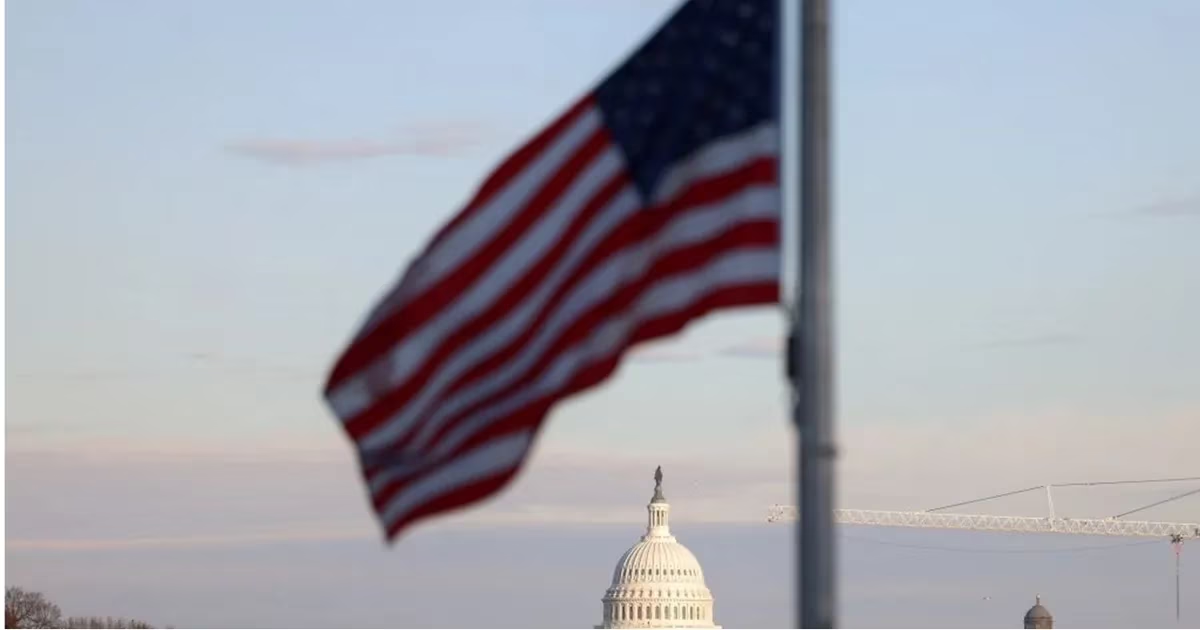
This initial resilience gains double importance with the convening of the G7 summit, where the US-Iranian agreement has become one of the most prominent issues on the table for Western leaders. The understanding announced by Trump does not represent merely a ceasefire or a limited bilateral settlement; rather, it constitutes a test for the future of stability in the Middle East and for the American administration's ability to transform war outcomes into lasting political and diplomatic gains. It also places European allies before a new reality that differs greatly from the scenarios that were on the table weeks ago, when the region seemed closer to a widespread regional confrontation than to a negotiated settlement.

Under the memorandum of understanding announced by both parties, a roadmap has been established to end hostilities, gradually reopen the Strait of Hormuz to international navigation, and begin a sixty-day negotiation phase to address the most sensitive issues, foremost among them Iran's nuclear program, economic sanctions, and regional security arrangements. However, the importance of the agreement lies not only in its announced provisions but in the fact that it represents the first practical acknowledgment by both parties that the cost of continuing the war has become higher than the cost of returning to negotiations.

In this context, recent experience reveals once again that military force, no matter how intense, does not guarantee the achievement of stated political objectives. The war began under slogans related to stopping Iran's nuclear program and forcing Tehran to change its regional behavior, but it ended with both parties returning to the negotiating table. This outcome raises an old question about the limits of power in managing complex conflicts, where military confrontations often end in political settlements very similar to the proposals that were on the table before the outbreak of the conflict.

Despite the positive atmosphere surrounding the announcement, the agreement leaves the most complex issues open. Iran's nuclear program, which constituted the primary justification for the war according to the American narrative, has not yet been resolved; instead, it has been deferred to subsequent rounds of negotiations. Issues of uranium enrichment, ballistic missiles, Iran's relations with its regional allies, monitoring mechanisms, and the lifting of sanctions also remained outside the framework of a final solution.

It is likely that the coming weeks will witness more difficult negotiations than those that preceded the agreement's announcement. The deferred issues are not technical matters that can be easily settled; rather, they are directly linked to the balance of power in the Middle East and to the security and political considerations of both parties. If negotiations fail to make tangible progress, the agreement could turn into a temporary truce that prevents immediate explosion but does not address the real causes of the conflict.

The agreement also highlights the contradiction between political rhetoric and the actual outcomes of the war. The Trump administration presented the confrontation as a means to impose new conditions on Iran, but it ultimately found itself negotiating most of the same issues that were points of contention before the outbreak of fighting. This does not necessarily mean a failure of diplomacy, but rather indicates that political solutions might have been available from the beginning, and that the cost of resorting to force exceeded the gains ultimately achieved.

Diplomatic circles expect Iran to quickly leverage the agreement to improve its economic situation and recover some of its frozen funds, which could provide the Iranian leadership with important breathing room after months of pressure. However, the success of this path will remain contingent on Washington's readiness to fulfill its economic commitments, as any slowdown or retreat could revive the atmosphere of doubt and distrust that has characterized relations between the two countries for decades.

On the regional level, the agreement reflects a growing realization among various parties that continued confrontation threatens everyone's interests. The Strait of Hormuz crisis demonstrated the interconnectedness between regional security and global economic stability, and that any long-term disruption in the Gulf could directly impact energy markets and global supply chains. Therefore, economic calculations appear to have played a role no less important than military considerations in pushing the parties towards de-escalation.

Conversely, Israeli opposition to the agreement is not expected to cease. Rather, it is likely to escalate in the coming period, both within Israel and among influential circles in Washington. Many Israeli officials and commentators believe that the current settlement does not achieve the objectives that were discussed since the beginning of the war, which explains the increasing criticism faced by Prime Minister Benjamin Netanyahu from various political parties who believe that the outcomes of the confrontation fell short of announced expectations.

It is also likely that the American political arena will witness increasing debate about the outcome of the war itself. While Trump will try to present the agreement as a historic achievement that ended the conflict and prevented the outbreak of a widespread regional war, his critics will argue that Washington ended up accepting a settlement similar to what could have been reached months before the fighting and losses.

The most important question remains concerning the future of the regional order after this war. If the agreement succeeds in holding up in the coming weeks, it could open the door to broader security arrangements in the Gulf and the Middle East, including navigation and energy security and regional de-escalation. However, this scenario will remain contingent on Washington's and Tehran's ability to build a minimum level of mutual trust, a task that does not seem easy in light of decades of conflict and mutual suspicions.

In conclusion, the passing of a full day since Trump's announcement of the agreement without clear signs of its collapse represents an encouraging development, but it is not enough to remove the doubts surrounding its future. The war has stopped, but its causes have not disappeared. The agreement has withstood its first test, but tougher tests still await it, whether at the negotiating table during the next sixty days or in the corridors of the G7 summit, where Western leaders seek to find out whether this settlement represents the beginning of a sustainable peace or merely a temporary respite in a long conflict whose final chapters have not yet been written.

ANALYSIS

Tue 16 Jun 2026 10:00 am - Jerusalem Time

Russian Analysis: Conflict with Iran Reveals Erosion of American Deterrence and Military Bases Becoming a Security Burden

Sergei Lebedev, an expert in international political affairs, highlighted a series of structural flaws in the American approach to the Iranian issue. In an article published by the Russian newspaper 'Izvestia', Lebedev noted that Washington is in a state of confusion between verbal escalation and promises of peaceful solutions. This contradiction is clearly evident in Donald Trump's statements threatening to control the Strait of Hormuz, coinciding with leaks about an imminent agreement in mid-June.

Reports from Tehran speak of a document being prepared that includes 14 clauses for a potential settlement, reflecting the complexity of the diplomatic scene between the two parties. Regardless of the outcome of these negotiations, the current conflict has revealed the limits of American strategic action in managing complex crises. Observers believe that America's ability to impose its political will is facing unprecedented challenges in light of recent technological developments.

The issue of American military bases spread across Iran's neighboring countries is one of the most prominent weaknesses that has recently surfaced. After these bases once symbolized strength and protection, they have practically become direct targets for Iranian missiles and drones. This shift has led regional allies to reconsider the utility of hosting these forces, which now attract threats instead of deterring them.

Sources reported that the discussion within Arab political circles has become more intense regarding the security risks associated with the American military presence. Iran has succeeded in proving that these bases are not immune, but rather 'magnets' for precise strikes targeting vital infrastructure. This reality places Washington in a strategic dilemma regarding how to protect its assets and allies simultaneously.

This strategic concern extends to other international theaters, especially in the event of a potential confrontation between the United States and China over Taiwan. If Iran has succeeded in turning American bases into a security burden, China possesses far greater capabilities to target the 'first island chain'. This places countries like Japan, South Korea, and the Philippines before extremely complex and dangerous security equations.

The Asian theater lacks a comprehensive alliance umbrella similar to NATO, making host countries for American bases more vulnerable. Despite bilateral agreements, the space for neutrality narrows for these countries in the event of a direct conflict between great powers. Japan's options, in particular, appear limited and complex given its organic link to the American defense system.

The conflict also revealed a surprising Iranian ability to cause 'partial blindness' to American intelligence and surveillance capabilities in the region. Iranian drones targeted at least ten sites containing highly advanced and sensitive radar systems. Among these systems are AN/TPY-2 radars, which are a fundamental pillar of the American missile defense system.

On the military field level, the United States has not succeeded in fully neutralizing Iranian firepower despite intensive strikes. Estimates indicate that Tehran retained sufficient capability to carry out effective strikes even after the destruction of part of its launch platforms. This resilience reflects the limits of traditional military superiority in the face of technological 'guerrilla warfare' strategies and flexible platforms.

International powers such as Russia and China adopt an 'anti-access/area denial' (A2/AD) doctrine to undermine the freedom of American military action. This approach aims to create prohibited zones that impose exorbitant costs on any hostile forces attempting to intervene or operate within them. What Iran is doing today is seen as a miniature model of what Washington might face in future major conflicts.

Historically, past decades have proven that the United States often excels on the military field but fails to achieve the desired political victory. The Iraqi model is a stark example of this inability to translate firepower into stability or sustainable political influence. In the Iranian case, it appears that Washington lost the political gamble early on before achieving any real military decisive action.

Washington long bet on the movement of the 'internal opposition' to overthrow the Iranian regime under the weight of economic and military pressures, but the results were counterproductive. External pressure led to the cohesion of Iranian society behind a national anti-American discourse, postponing internal disagreements. This cohesion thwarted the 'change from within' strategy that American diplomacy usually relies on.

Technological development has brought about a qualitative shift in the balance of power, where the weaker party is now able to employ low-cost tools to contain a major power. Drones and cruise missiles have changed the rules of engagement, making it difficult for traditional armies to protect vast areas of targets. This Iranian military innovation has forced Washington to conduct a comprehensive reassessment of the cost of any direct confrontation.

The deeper dilemma lies in the limits of American political capacity to bear the human and material costs of long conflicts domestically. Modern wars are not only decided by advanced technological systems from afar, but also require actual control on the ground and human power willing to engage. It seems that the American public is less willing to engage in 'forever wars' that do not serve direct national interests.

The analysis concluded that the Trump administration, despite its inclination towards compromises, clashes with hard geopolitical realities that require indivisible resolve. War, as political theorists described it, is either fought with full seriousness and clear objectives or not fought at all. The current American hesitation between escalation and de-escalation only serves to strengthen the position of adversaries and expose more weaknesses.

War must be fought with full seriousness, or not at all; and the United States always fails to translate its field superiority into political decisiveness.

PALESTINE

Tue 16 Jun 2026 9:59 am - Jerusalem Time

Occupation Continues to Detain 14 Doctors from Gaza Amid Reports of Systematic Torture

Hebrew press sources revealed that the Israeli occupation authorities continue to detain a group of doctors from the Gaza Strip without trial or clear evidence of conviction against them. The case of Dr. Hussam Abu Safiya, director of Kamal Adwan Hospital, has come to the forefront following widespread international and human rights demands for his immediate release.

A recent photo of Dr. Abu Safiya, whose hospital in the northern Gaza Strip was completely destroyed by the occupation, sparked a wave of anger and human rights criticism. The doctor, who has been detained since December 2024, appeared in a deteriorating health condition and remarkably emaciated body, reflecting the extent of suffering inside prisons.

Sources observed clear signs of bruises and skin injuries on Abu Safiya's arms, which observers considered definitive indicators of the physical torture he is subjected to. This appearance occurred during a Supreme Court session held via video conference to consider a petition against his continued detention.

Data indicates that the occupation is holding Abu Safiya along with 13 other doctors from Gaza under the umbrella of the 'Unlawful Combatant' law. This legal framework allows the occupation to detain Palestinians for long periods without the need to file an indictment or conduct a regular criminal trial.

The detention of these medical personnel is periodically extended every six months by a decision of the Central Court in Beersheba. Reports confirm that these procedures lack the minimum standards of international justice and are based on secret files that the defense is not allowed to access.

In a serious development, testimonies from detainees reported the transfer of Dr. Abu Safiya from his cell in 'Ketziot' prison to solitary confinement in 'Nafha' prison. Human rights activists believe that this transfer was a direct punitive measure in response to his recourse to the judiciary and challenging the legality of his continued detention.

Human rights organizations confirmed that the policy of solitary confinement has become a common practice against prisoners who try to assert their legal rights. These steps are consistent with the escalation of violations inside Israeli prisons since the far-right took control of the Ministry of National Security.

Lawyers revealed that many detainees now prefer to waive their right to appear before the judiciary for fear of physical assaults. Prisoners are subjected to systematic abuse during their transfer from cells to video conference rooms or courtrooms.

Dr. Hussam Abu Safiya is considered one of the most prominent symbols of medical resilience in Gaza, as he continued to perform his professional duty despite the harsh conditions. He continued to manage Kamal Adwan Hospital despite the martyrdom of his son by occupation fire and his own injury in previous attacks.

International reports warned that the continued detention of doctors exacerbates the humanitarian catastrophe in the Gaza Strip, which is suffering from the collapse of its health system. The absence of these personnel deprives hundreds of thousands of citizens of necessary medical care amid the ongoing war of annihilation.

On the international level, the prestigious medical journal 'The Lancet' published a petition signed by dozens of international medical organizations. The petition calls for a boycott of the Israeli Medical Association due to its silence and failure to uphold professional ethics regarding what is happening in Gaza.

The petition accused doctors within the Israeli prison system of participating in or covering up the torture of Palestinian prisoners. The signatories demanded the need for international pressure to stop these blatant violations of international laws and medical norms.

The sources stressed that if the occupation possesses any evidence against Abu Safiya, it should present it publicly before the judiciary and provide clear charges. Continued arbitrary detention is a war crime that requires immediate intervention from UN institutions to release all medical staff.

It is worth noting that the last visual documentation of Dr. Abu Safiya before the last session was in February 2025, where he appeared shackled under heavy guard. The footage at the time showed him being abused and subjected to show interrogations by occupation intelligence officers inside one of the detention centers.

The continued detention of Abu Safiya and other doctors not only represents an injustice to them but also affects hundreds of thousands of Palestinians who need their medical services.

OPINIONS

Tue 16 Jun 2026 9:59 am - Jerusalem Time

The Empire's Dilemma: How Resistance Reshapes the Laws of Political Physics?

Ramallah - “Alquds ” dot com

Ramallah - “Alquds ” dot com

Opinion Writer

Politics, in its complexities, resembles natural sciences like nuclear and quantum physics, where systems and spaces intertwine in a way that understanding political phenomena requires multiple levels of interpretation. Just as the rules of mechanics alone are insufficient to explain atomic phenomena, political action demands analytical tools that transcend traditional linear logic.

Great powers often fall into the trap of using outdated thinking tools to confront the challenges of a new era, leading to a gap between changing reality and political decisions. This detachment from reality explains why empires fail to predict moments of popular uprising or radical shifts in non-material power balances.

The dilemma of imperial collapse lies in the realist school's inability to explain the erosion of power despite overwhelming material superiority, as this logic overlooks the role of legitimacy and popular acceptance. When a dominant power loses the consent of the governed, a silent erosion begins within its structure, unseen by eyes engrossed in calculations of weapons and money.

Dominant powers deny their new reality and, instead of adapting to it, insist on policies of elimination and monopolization, relying on past glories and tools that are no longer valid. This insistence generates accumulated grievances that, at a certain historical moment, lead to a sudden explosion that shatters linear interpretations of events.

What the world is witnessing today represents a profound shift in consciousness and will, the two most dangerous factors for any hegemonic system, as changing perceptions are the true key to historical change. Peoples have begun to transcend the patterns of thinking imposed by great powers, moving towards a new world based on challenge and rejection of subservience.

The importance of the current stage lies in the steady change in human thought's view of the United States and Israel, as their standing in people's hearts has changed unprecedentedly. The grievances of hegemony have accumulated in various arenas, whether through economic, intellectual, or political marginalization, creating a global environment that rejects the status quo.

Resistance communities have succeeded in delegitimizing the occupation and breaking the illusion of weakness that had overshadowed the region for decades, motivating peoples to reclaim their will. This actual resurgence began with faith in rights and freedom, and evolved into possessing the will to defend and sacrifice, deepening the justifications for a culture of resistance.

The historical steadfastness and field creativity that emerged since the 'Al-Aqsa Flood' events represent a major turning point that revealed the hidden truth behind the American and Israeli facade. According to analytical sources, the resistance front alone was able to repel the most severe attack in modern history thanks to the cohesion of political and military paths.

What the occupation and Washington promote as military achievements quickly turns out to be a strategic loss in the broader cognitive and social system of the world. The overall calculation of profit and loss cannot be confined to one angle, but requires a comprehensive vision that takes into account the surrounding systems of the action and their interactions.

What is required at this stage, as the confrontation approaches decisive stations, is steadfastness and continued will to challenge the most powerful hegemonic force known to history. Humanity today is transcending the tools of American administration, which have become completely exposed, while rising powers seek a foothold in a multipolar world.

The American administration is in a state of regurgitating past tools despite their limitations and the decline of its systemic creativity, which is clearly evident in its commitment to the agenda of the far-right in Israel. This agenda, based on spreading chaos and destabilizing nation-states, increases Washington's isolation even among its traditional allies.

The world today sees its interests lying in stability and construction, while the 'system of chaos' pursued by dominant powers poses a threat to the elements of trust necessary for international cooperation. The policy of destabilization abroad will not remain confined there, but will inevitably find its way into the troubled American interior.

American society suffers from internal conflicts and identity disputes, which makes the export of chaos abroad negatively rebound on its internal cohesion due to the intertwining of global systems. Betting on military force alone without moral or legal cover is a gamble with the future of the empire itself.

In conclusion, a reading of the depths of history confirms that popular consciousness is the rock upon which the illusions of absolute power are shattered, and that the next stage will witness further erosion in the influence of powers that refuse to recognize the legitimate rights of peoples, foremost among them the Palestinian people.

The most dangerous thing facing a hegemonic power is the loss of acceptance of its control, which the empire usually does not notice due to its immersion in the illusion of material power.

ARAB AND WORLD

Tue 16 Jun 2026 9:59 am - Jerusalem Time

Between Two Eras: A Comprehensive Comparison of Trump's New Deal with Iran Versus Obama's 2015 Agreement

The intensity of political debate in the United States escalated with the unveiling of the preliminary agreement reached by President Donald Trump's administration with Tehran. Trump insists that his current formula is significantly superior to the nuclear deal concluded by Barack Obama in 2015. Trump claims that the previous agreement paved the way for Iran to acquire a nuclear arsenal, while his new agreement imposes strict restrictions that definitively prevent this path.

In contrast, former President Barack Obama questioned the validity of claims describing the new agreement as 'fundamentally different,' considering that the technical foundations for dealing with the Iranian nuclear file remain constant. These developments come as international circles await the official signing of the memorandum in Geneva, Switzerland, amidst hopes of ending decades of tension in the Middle East.

Looking at the details of the 2015 agreement, it primarily focused on the technical nuclear aspect, obliging Iran to a maximum uranium enrichment level not exceeding 3.67% for 15 years. The agreement also included a massive 98% reduction in enriched uranium stockpiles, ensuring that Iran's stockpile would not exceed 300 kilograms, which was considered sufficient to prevent armament at the time.

Obama's agreement also included reducing the number of centrifuges from 19,000 to only about 6,000 first-generation centrifuges, along with redesigning the Arak heavy water reactor. These steps aimed to prevent the production of military-grade plutonium, in exchange for a gradual lifting of international sanctions and the unfreezing of Iranian financial assets in global banks.

As for the features of Trump's 2026 agreement, they appear more comprehensive from a geopolitical perspective, as they include an immediate and comprehensive cessation of military operations on all fronts, including the Lebanese arena. The opening of the Strait of Hormuz stands out as one of the most important achievements, as the agreement aims to ensure freedom of navigation and global trade without restrictions or additional fees, which Trump sees as a historic achievement.

Reports indicate that Trump's agreement includes a temporary truce for 60 days, the deadline set for comprehensive negotiations on more complex issues that have not yet been resolved. During this period, the United States commits not to impose any new sanctions, with a pledge to lift oil sanctions for a specified period to allow Tehran to collect revenues from its crude sales.

Trump's financial vision includes the release of $25 billion in frozen Iranian assets through direct cash transfers and financial credit lines. Washington also pledges to coordinate with its regional allies to develop a comprehensive plan for reconstruction and development in Iran, representing a radical shift in strategy for dealing with the Iranian regime from maximum pressure to economic incentives.

Regarding the nuclear file, under Trump's memorandum, Iran agrees to completely refrain from producing or possessing nuclear weapons, while maintaining the current status of its program during the negotiation period. Mechanisms for dealing with Iran's current stockpile of highly enriched uranium, estimated at about 12 tons, are to be addressed in the final agreement to be concluded later.

Sources reported that Trump aims to make the Strait of Hormuz 'free forever,' considering that this agreement will protect the region and prevent the 'annihilation of Israel,' in his words. Trump sharply criticized some regional parties, accusing Israeli Prime Minister Benjamin Netanyahu of attempting to obstruct the diplomatic path led by the White House.

The new vision also includes the idea of 'protection for payment,' where Trump proposes the principle of regional countries contributing financially in exchange for the American security umbrella that the new agreement will provide. Observers believe that this approach reflects Trump's business mindset in managing international affairs, transforming ideological conflicts into mutual economic and security deals.

The upcoming negotiations in Switzerland will also discuss imposing strict controls and immediate, unconditional inspection mechanisms for Iranian nuclear facilities to ensure full compliance. The final provisions are expected to include a suspension of uranium enrichment for long periods ranging from 15 to 20 years, which exceeds some provisions of the 2015 agreement in its strictness.

Sources indicated that the military operations witnessed last February were the primary driver that pushed Tehran to the negotiating table, according to US administration estimates. Trump indirectly praised international roles such as Russia and China in contributing to de-escalating tensions, which paved the way for these initial understandings.

The biggest challenge for Trump's agreement remains how to transform this memorandum into a permanent treaty accepted by legislative institutions and regional allies. While Trump focuses on economic aspects and opening waterways, concerns remain about Iran's ability to maneuver during the 60-day period allocated for final negotiations on outstanding issues.

In conclusion, the divergence between Obama's 'technical' approach and Trump's 'comprehensive' approach represents the peak of the political struggle in Washington over how to contain Iranian ambitions. Whether Trump succeeds in completing his 'grand deal' or not, the features of the current agreement redraw the map of balances in the Middle East, with a focus on economy and navigation as alternative tools to direct wars.

Trump: My current agreement is the complete opposite of Obama's agreement, which was an easy path to acquiring a nuclear weapon.

ANALYSIS

Tue 16 Jun 2026 9:59 am - Jerusalem Time

Istanbul-Jeddah Train: Revival of a Historic Project and Reshaping Regional Influence

The railway project connecting Istanbul to Damascus and extending to the Hejaz is once again at the forefront of the region's strategic landscape, reviving Sultan Abdul Hamid II's vision aimed at strengthening ties between the center of the Caliphate and the Arab world. This project, which was aborted during World War I, now emerges as a geopolitical necessity that transcends mere commercial transport to forge strong regional alliances.

International and regional powers recognize that connecting Anatolia to the heart of the Arabian Peninsula represents a strategic step to bridge political and economic distances. Previous attempts to disrupt this line primarily aimed to deepen the division between Arab and Turkish components, which the new Saudi-Turkish initiative currently seeks to overcome.

This move has raised serious concerns among Israeli circles, with Hebrew press reports describing the agreement as laying stakes in a new regional system that will dominate the Middle East over the next decade. These circles view the Turkish-Saudi move as circumventing connectivity projects that Israel had hoped to be central to.

'Yedioth Ahronoth' newspaper considered that Turkish President Recep Tayyip Erdogan succeeded in transforming successive regional crises into strategic opportunities that enabled him to break international isolation. The newspaper indicated that Turkey is no longer merely a player on the scene, but has become the scene itself where major interests intersect due to this diplomatic acumen.

While military powers in the region were depleting their forces on multiple fronts, Ankara focused on strengthening its presence through cross-border infrastructure projects. This approach ensures that Turkey will not be an excluded party in any future arrangements of the regional order, but rather an active element and a driver of events.

The benefits of this railway line are not limited to the Turkish side alone, but extend to all countries through which it passes, foremost among them the Kingdom of Saudi Arabia. The project gives Riyadh a golden opportunity to diversify its oil and product export routes away from the routes that Israel is trying to impose via the port of Haifa.

This approach represents a liberation for the Kingdom from economic and political pressures it has faced for many years, especially in light of the major transformations the region is witnessing. This cooperation comes to reinforce the positive stances Saudi Arabia has recently taken towards central Arab and Islamic issues.

Turkish foreign policy has demonstrated a remarkable ability to balance bearing the repercussions of international crises and seizing opportunities to achieve massive national interests. This approach has enabled the Turkish leadership to regain its popular momentum and overcome internal challenges by commanding the respect of international powers for its country's regional standing.

Success in strengthening regional presence requires more than just internal military power; it needs an economic vision that connects the common interests of peoples. And Turkey, despite the historical upheavals it has experienced, is still treated based on its heritage, which dictates a leading role in its surroundings.

The railway project is viewed from a broad perspective as a tool to reshape the geopolitical and social map of the region's peoples. Historically, the railway was a lifeline connecting the periphery to the center, which the current project aims to achieve again.

Calls are increasing for the necessity of protecting this project from attempts at obstruction or abortion that may be led by parties that do not want stability or renaissance for this nation. The challenges that faced the project a century ago still exist in different forms and shapes in the modern era.

Perhaps the completion of this railway connection will open the door to a comprehensive economic renaissance that will lift the peoples of the region out of their state of distress and dependence on external forces. Economic integration is the only way to confront the successive crises that have plagued the Arab world in recent years.

Arab peoples have suffered from repeated cycles of setbacks, and whenever a glimmer of hope appeared on the horizon, external factors intervened to thwart it. The train project represents a real test of the will of the region's countries to shape their future away from interventions aimed at maintaining dependency.

Amidst the bleak landscape surrounding many regional issues, the Istanbul-Jeddah railway project stands out as a potential new chapter. Will the shared political will succeed in transforming this historical dream into a tangible reality that changes the face of the Middle East?

Erdogan has not only returned to the scene, but has become the scene itself by transforming regional disasters into strategic gains.

ARAB AND WORLD

Tue 16 Jun 2026 9:59 am - Jerusalem Time

Secret British Intelligence Unit Exposed for 'Consciousness Engineering' and Public Opinion Control

British press reports have revealed intriguing details about a secret intelligence unit operating under the supervision of the Home Office, aimed at controlling citizens' reactions to hate crimes and racially motivated incidents. This unit is known as the 'Research, Information and Communications Unit,' a bureaucratic designation described as a cover for complex operations designed to engineer public consciousness and direct media narratives to serve the stability of the authorities.

The report indicated that this unit, which includes spies, experts, and soldiers, was actively involved during the recent anti-immigration protests and violence in Belfast. The unit operates covertly to control social tensions through various tools, ranging from disseminating directed news to using field agents to influence public sentiment at hot spots.

The unit's roots trace back to 2007, when it was founded by former British intelligence officer Charles Farr, as part of the 'Prevent' counter-terrorism strategy. Although its initial goal was to counter the propaganda of extremist organizations like Al-Qaeda, its influence expanded to include intervention in shaping official discourse and controlling how sensitive issues related to multiculturalism are addressed.

Among the controversial methods employed by the unit, undercover agents place flowers at the sites of terrorist attacks to create an atmosphere of sorrow and prevent the escalation of public anger. Sources also revealed that the unit secretly funded musical groups to perform anti-extremism songs in schools, in an attempt to indirectly influence the intellectual convictions of young people.

In the recent events in Northern Ireland, the unit provided technical advice to the police on how to 'control the narrative' and portray protesters as advocates of violence undeserving of public sympathy. The unit works in coordination with police intelligence to identify online instigators and draft media statements aimed at defusing tensions arising from stabbings or killings linked to immigrants.

The unit faces sharp criticism from within the British government, with some officials describing it as 'out of control' and threatening freedom of expression values. This was evident in its pressure to record 'non-criminal hate incidents,' a measure that prevented individuals from expressing their views on issues of race and religion, before the government was forced to cancel it under political pressure.

Documents indicate that the unit intervened directly after the London Bridge attacks in 2017, where its agents distributed flowers to foster solidarity and prevent retaliatory reactions against Muslim communities. The unit also used similar methods after the execution of aid worker Alan Henning, by promoting symbolic images in the media aimed at strengthening a shared national identity in the face of extremism.

In another incident, the unit funded a public relations agency to highlight the role of the Finsbury Park Mosque imam in protecting an extremist attacker from an angry crowd in 2017. This type of intervention aims to highlight positive role models that contribute to calming the streets, but it raises questions about the ethics of intelligence intervention in news production.

The unit is also behind extensive campaigns on social media platforms such as the #WeStandTogether hashtag, in which senior politicians and security officials participated without disclosing the campaign's true source. The unit uses these platforms to infiltrate discussions within targeted communities and change the course of public discourse in line with the state's security objectives.

Sir William Shawcross, in a 2023 review of the 'Prevent' program, criticized the unit's approach, considering that it focuses its efforts on pursuing the far-right more than its concern for threats from extremist Islamist groups. This disparity in targeting angered conservative politicians who believed that resources were being wasted on pursuing political opponents instead of criminals.

For his part, former minister Sir Jacob Rees-Mogg accused the unit of deviating from its professional path and focusing on monitoring and directing the behavior of elected politicians. Critics believe that the continued operation of this unit in the shadows grants it power not subject to legal or parliamentary accountability, making it a tool for imposing soft censorship on British society.

Despite these accusations, the unit insists that its role is vital in protecting the social fabric from right-wing groups that exploit sensitive issues, such as sexual exploitation gangs, to incite hatred. The unit claims that its interventions are necessary to prevent a slide into civil war or widespread ethnic unrest that could threaten the national security of the United Kingdom.

In a brief official response, a Home Office spokesperson stated that the unit provides strategic analyses of how extremists exploit the internet to spread their destructive propaganda. The spokesperson declined to comment on the details of the secret operations or field methods employed by the unit, emphasizing that its work falls within the general framework of counter-terrorism.

The debate continues regarding the boundaries between protecting national security and manipulating collective consciousness and restricting public freedoms, amidst the increasing reliance on intelligence 'soft power.' These leaks reveal the depth of security penetration into the daily lives of British citizens, and how 'national consensus' is manufactured through closed rooms in Westminster.

The unit's bureaucratic name is merely part of a camouflage operation that conceals the nature of its work, which is based on deception and misinformation to deal with the challenges of multiculturalism.

ARAB AND WORLD

Tue 16 Jun 2026 9:59 am - Jerusalem Time

Behind the Scenes of the Trump-Iran Agreement: End of War, Survival of the Regime, and the Nuclear File on the Negotiation Table

International press sources revealed details of the agreement announced by US President Donald Trump with the Iranian leadership, confirming that it put an end to a costly war that lasted for several weeks. Despite the cessation of military operations, the agreement kept the Iranian regime in power, leaving the most complex issues, especially the nuclear program, for future negotiation rounds whose final features have not yet been clarified.

Trump announced the end of the military campaign against Tehran with a sharply economic message, calling for the reopening of global trade routes and energy supply lines. The US President called on the world's ships to resume their activity and pump oil again into global markets, a clear indication of his desire to end the state of confusion that afflicted the international economy due to the confrontation.

According to reports, the end of the fighting restored the field conditions to what they were before the outbreak of the American-Israeli confrontation against Iran on February 28th. This retreat comes despite the fact that the declared goals at the beginning of the conflict sought to bring about a radical change in the structure of Iranian rule and support the internal protests that Washington had bet on.

The first hours of the war witnessed the killing of Iranian Supreme Leader Ali Khamenei, which Western circles at the time considered a golden opportunity for the collapse of the regime. However, the popular uprising that the White House expected did not materialize on the ground; instead, Tehran showed military resilience and the ability to close the strategic Strait of Hormuz, which put immense pressure on the American administration.

The sources explained that the current agreement includes an initial Iranian commitment not to seek to acquire nuclear weapons, but officials in Tehran link the actual start of enrichment negotiations to the lifting of the comprehensive US naval blockade. Corridors of the US administration speak of a proposal to hand over Iran's enriched uranium stockpile to the United States to ensure its complete destruction.

In a remarkable shift in political discourse, Trump affirmed in press statements that he never sought to change the regime in Iran, describing the current group he is negotiating with as 'the most rational.' This change reflects Washington's realization of the difficulty of military options and their exorbitant cost to regional stability and the interests of allies.

For his part, US Vice President J.D. Vance defended the agreement, considering it a strategic shift that will change the face of the Middle East for the next fifty years. Vance indicated that Iran's commitment to the terms of the agreement will end the state of chaos that the region has suffered from for decades, stressing that the war achieved military objectives by destroying naval capabilities and high-ranking leaders.

In contrast, skepticism prevails among experts and analysts, with researchers believing that the agreement maintains a regime that possesses all tools of regional threat, from ballistic missiles to drones. Experts warned that Tehran succeeded in transforming the Strait of Hormuz from a theoretical bargaining chip into a real tool of influence that imposed its conditions on the international table.

On the domestic American front, Trump faced criticism from his Republican allies, with Senator Lindsey Graham demanding that any nuclear agreement be presented to Congress for review and vote. Conservative media figures also expressed their dissatisfaction with the non-publication of the memorandum of understanding, warning of significant gaps between the American and Iranian narratives of the agreement's content.

Leaked information indicates that the agreement includes a 60-day truce to negotiate thorny issues, with the release of approximately $25 billion in frozen Iranian assets. These steps come at a time when Iran possesses a huge stockpile of highly enriched uranium estimated at 12 tons, which makes the upcoming negotiations extremely sensitive.

On the Israeli side, former officials such as Moshe Ya'alon warned of political and security collapses resulting from the failure of the strategy adopted against Iran. Ya'alon considered that current policies are leading to a dead end, given the dissatisfaction of the head of the occupation government, Benjamin Netanyahu, with any understandings that might threaten his political future or give Tehran a chance to catch its breath.

Through this agreement, Tehran seeks to obtain billions of dollars needed to rebuild what the aggression destroyed, while maintaining its regional influence in Lebanon, Iraq, and Yemen. Observers believe that Iran has proven its ability to withstand the long war losses, which forced Washington to retreat from its high demands announced at the beginning of the conflict.

The official signing of the agreement is expected next Friday, amid strict measures to prevent the leakage of details before they are fully matured. This secrecy aims to protect the understandings from external and internal political pressures that could lead to the failure of negotiations at the last minute, especially concerning the future of centrifuges.

The question remains about the extent to which this 'fragile' agreement will withstand field and political challenges, especially with regional parties that see it as a threat to their interests. The coming days will reveal whether Trump has indeed succeeded in achieving 'historic peace' or if it is merely a postponement of a major confrontation to come, given Iran's continued possession of nuclear power capabilities.

Oh ships of the world, start your engines, let the oil flow; the war is over and the regime remains.

PALESTINE

Tue 16 Jun 2026 9:58 am - Jerusalem Time

From the heart of the rubble.. Gaza supports the Egyptian national team in the opening of its World Cup journey

Palestinian youth in the Gaza Strip defied the harsh war conditions and the continuous deprivation for years, to express their strong support for the Egyptian national team at the start of its journey in the 2026 World Cup against its Belgian counterpart. Dozens gathered in one of the tents that the locals had set up to be a simple cafe, where they sat on modest chairs in front of a single television screen to follow the anticipated football match amidst an atmosphere of enthusiasm.

Egyptian flags were raised above the tent's roof and throughout its corners, while a group of young people wrapped themselves in the Egyptian flag, expressing the unity of blood and destiny with their brethren. Sources reported that the scene reflected a strong will to live, as cameras captured war wounded sitting in wheelchairs following the match with great interest, cheering for the 'Pharaohs' warmly despite the physical and psychological pain left by the ongoing war.

These scenes come at a time when the Palestinian sports sector is suffering from complete paralysis, due to the war that erupted in October 2023 and led to more than 120,000 injured and the destruction of all stadiums and sports facilities. Palestinian sports also lost dozens of cadres and players who were martyred during the bombing, as part of a systematic destruction policy that affected all aspects of life and entertainment in the besieged Strip.

Throughout history, Palestinians in Gaza have consistently shown their absolute support for Arab national teams in international forums, which was clearly evident in previous World Cup editions. Arab participation in the World Cup is a long-standing legacy that Egypt began in 1934, leading to the historic achievement of the Moroccan national team in Qatar 2022 when it ranked fourth globally, which raised the ceiling of public aspirations.

The current edition of the 2026 tournament is witnessing a remarkable expansion with the increase in the number of teams to 48, which has given Arab football greater opportunities for representation and competition across the continents of Asia and Africa. The public in the Palestinian territories and the Arab region is keen to follow these matches closely, as live broadcast times and kickoff are coordinated according to Doha time, with hopes of achieving honorable results.

Despite all the hardships and sorrows they suffer, this did not prevent Gazans from expressing their support for the Egyptian national team, affirming the strong ties that bind them to the Arab peoples.

PALESTINE

Tue 16 Jun 2026 9:58 am - Jerusalem Time

War of Identity: Palestinian Efforts to Save Thousands of Artifacts from Under the Rubble of Gaza's Museums

The cultural and historical legacy in the Gaza Strip faces unprecedented existential challenges, three years after military operations turned cultural landmarks into piles of rubble. Field sources reported that archaeological artifacts dating back thousands of years are either lost or damaged as a result of direct shelling, threatening the loss of an irreplaceable visual and historical memory for future generations.

Al-Qarara Museum is one of the most prominent testimonies to this tragedy, with estimates indicating that more than 3,500 rare artifacts are still buried under the rubble of the destroyed building. The damage was not limited to private museums but extended to the historic 'Pasha's Palace,' dating back to the Mamluk era, which lost about 70% of its contents that formed the core of the National Museum since its official opening in 2010.

For his part, Dr. Hamouda Al-Dehdar, Director of the Department of Sites and Excavation at the Ministry of Tourism and Antiquities, explained that the occupation deliberately targeted tangible and intangible cultural heritage systematically from the first days of the war. Al-Dehdar pointed out that the shelling affected ancient historical neighborhoods such as Shujaiya and Tuffah, in addition to specialized museums like Al-Aqqad Museum, causing the loss of priceless archaeological finds belonging to the Byzantine and Roman eras.

Official statistics indicate that the Pasha's Palace Museum was a major tourist and educational destination, receiving approximately 70,000 visitors annually before the outbreak of confrontations. Experts in antiquities believe that the speed of targeting these sites a few days after the start of the war reflects a clear desire to obliterate Palestinian identity and erase the material evidence that proves the historical rootedness of the Palestinian people in their land.

Despite the harsh conditions and forced displacement of specialized cadres, Palestinian academic initiatives have begun to move to save what can be saved from under the rubble. These teams work in complex security conditions to document the damage and archive the remaining pieces, considering this mission to transcend professional work to become a national battle to protect Palestinian existence from attempts at cultural annihilation.

At the conclusion of these efforts, those in charge of the restoration operations affirm that rebuilding the destroyed museums is a promise they have made to themselves despite the horror of the destruction that befell the old city. Digital archiving and field documentation remain the last line of defense, proving that Palestinian identity, deeply rooted in history, is stronger than to perish under the weight of shelling or be erased from human memory.

Targeting museums is an attempt to break Palestinian dignity by erasing its historical evidence, but preserving them is an integral part of our struggle for survival.

ARAB AND WORLD

Tue 16 Jun 2026 9:58 am - Jerusalem Time

Vance reveals details of the memorandum of understanding with Iran, and Pezeshkian describes it as a 'honorable document'

US Vice President J.D. Vance made important statements revealing that the recently signed memorandum of understanding between the United States and Iran is a very brief and general document. Vance clarified that the precise and final details of this agreement will be drafted during rounds of technical negotiations scheduled for later stages, noting that the current goal is to lay the groundwork for ending the conflict.

Washington and Tehran, mediated by Pakistan, announced earlier this week that they had reached an agreement to end the war that erupted on February 28th. This development comes after months of military escalation that included multiple fronts, with both parties now seeking through this memorandum to transition from direct confrontation to a diplomatic path.

In an interview with international media, Vance confirmed that the document does not exceed one and a half pages, and is limited to defining the basic principles that will govern the future relationship between the two countries. He stressed that this general framework ensures Iran will receive economic and political benefits if it fully adheres to the provisions contained in the memorandum, especially regarding regional security.

The US Vice President indicated that the first paragraph of the agreement primarily focuses on Tehran's commitment to 'regional peace and stability'. He explained that this commitment necessarily includes Iran ceasing to fund organizations that Washington considers terrorist groups, which is a fundamental condition for continuing to operate under these new understandings.

For his part, US President Donald Trump announced that the agreement has already been signed, confirming that the strategic Strait of Hormuz will return to full operation for international navigation starting next Friday. This announcement represents a major breakthrough in the global energy crisis, which has been severely affected by military tensions in vital waterways.

In contrast, Tehran confirmed that the official signing ceremony of the memorandum will take place in Geneva, Switzerland, next Friday. Iranian sources described this step as the beginning of a new phase of negotiations that will last for 60 days, focusing particularly on the issues of lifting economic sanctions and Iran's nuclear program.

Iranian President Masoud Pezeshkian commented on the agreement, saying that it represents an 'honorable document' for the Islamic Republic if all its provisions are implemented faithfully and accurately. Pezeshkian noted in a post that the understanding received the support of the vast majority of members of Iran's Supreme National Security Council, giving it strong legal and political cover within the country.

Pezeshkian expressed his gratitude to the Iranian negotiating team, praising the efforts of Parliament Speaker Mohammad Bagher Ghalibaf and Foreign Minister Abbas Araghchi. He considered what has been achieved a fundamental step towards stopping the bloodshed of war and initiating serious dialogue, despite his affirmation that the final comprehensive agreement has not yet fully materialized.

Additional reports indicate that the agreement includes 14 clauses covering an immediate and comprehensive cessation of hostilities on all fronts, including the Lebanese arena. Leaks also speak of financial arrangements including the release of approximately $12 billion in frozen Iranian assets as a gesture of goodwill, with the possibility of the amount reaching $24 billion later.

On the ground, the naval blockade imposed on Iranian ports since mid-April is expected to be lifted, coinciding with the withdrawal of US forces from areas surrounding Iran. Tehran will manage the arrangements for reopening the Strait of Hormuz in cooperation with the Sultanate of Oman, with fees imposed on maritime services provided to passing ships.

Regarding the nuclear file, sources quoted President Trump as saying that an agreement could be reached to suspend uranium enrichment in Iran for a period ranging from 15 to 20 years. However, Iranian media reports indicate that the ballistic missile program and support for resistance factions in the region were not included in the agenda of the current negotiations.

The agreement has been widely welcomed by Arab and international countries and organizations, with Saudi Arabia, Qatar, Egypt, the UAE, and Jordan praising the mediation efforts made by Pakistan and Turkey. These countries called for the necessity of building on this understanding to achieve sustainable stability in the Middle East and end the state of tension that has plagued the region throughout the past months.

It is worth noting that this conflict began in February 2026 with military attacks launched by the United States and Israel against Iranian targets, to which Tehran responded with strikes targeting American interests. Intensive diplomatic efforts succeeded in reaching a temporary ceasefire last April, before these efforts culminated in the current memorandum of understanding.

The memorandum of understanding does not exceed one and a half pages, and it establishes a framework that ensures Iranians benefit from the agreement in exchange for fulfilling their obligations.

ARAB AND WORLD

Tue 16 Jun 2026 9:57 am - Jerusalem Time

Trump's Grand Plan: A $300 Billion Fund for a Final Deal with Iran

The administration of US President Donald Trump is considering a strategic proposal that includes allowing the establishment of a massive investment fund worth up to $300 billion dedicated to Iran. This approach comes within the framework of seeking a final and comprehensive settlement that ends the state of animosity between Washington and Tehran, and puts an end to tensions related to the Iranian nuclear program, which raises widespread international concern.

Informed sources stated that Washington has seriously discussed the possibility of easing economic sanctions imposed on Tehran in parallel with the launch of this fund dedicated to the country's reconstruction. The sources indicated that these major financial incentives will be closely linked to the extent of the Iranian side's commitment to the terms of the memorandum of understanding expected to be officially signed in Switzerland next Friday.

The US administration is setting strict conditions for activating this fund, most notably reaching a final settlement within the framework of the proposed memorandum, and extending the ceasefire agreement for an additional 60 days. US requirements also include guaranteeing freedom of navigation and the full reopening of the Strait of Hormuz, with technical negotiations continuing on the nuclear file to ensure its peaceful nature.

Regarding the structural details of the fund, officials explained that the money will not be paid from government budgets or taxpayers, but will rely entirely on investments from private companies wishing to enter the Iranian market. Iran represents an attractive market for investment privileges due to its population of nearly 90 million people, in addition to its vast reserves of energy resources and natural gas.

A wide range of international companies, especially from Europe, South Korea, and Japan, as well as major American companies, have shown initial interest in investing in vital Iranian sectors. However, the legal and administrative mechanism that will govern the operation of this fund and its organizational structure is still under discussion to ensure that funds are not leaked to unintended parties.

For his part, US Vice President J.D. Vance stated that this fund represents both a pressure tool and an incentive, emphasizing that it is one of the privileges available to Iran if it proves its seriousness. Vance stressed that access to these huge sums is entirely contingent on Tehran fulfilling all its obligations under the anticipated agreement, without any leniency in security standards.

This plan faces internal political challenges in Washington, as Trump seeks to balance offering economic incentives with avoiding criticism that might accuse him of rewarding the Iranian regime. This step recalls the sharp criticism Trump previously directed at the 2015 agreement, where he accused the previous administration at the time of providing cash financial facilities without obtaining sufficient guarantees.

Based on the new approach, any easing of sanctions or release of frozen Iranian assets in international banks will be carried out according to a strict timeline and in multiple stages. Each stage of funding will remain linked to tangible progress in nuclear negotiations, where Washington may resort to providing limited financial steps initially as a gesture to build trust between the two parties.

Regarding the technical nuclear aspect, Washington and Tehran have agreed on a mechanism for dealing with enriched uranium stockpiles, which includes reducing the quantities within Iranian territory. Reports indicate that Iran currently possesses more than 9,000 kilograms of uranium, including about 440 kilograms that have reached critical enrichment levels approaching the requirements for producing a nuclear weapon, which will be placed under close international supervision.

The reconstruction fund represents one of the privileges that Iran can obtain as long as it adheres to its part of the agreement.
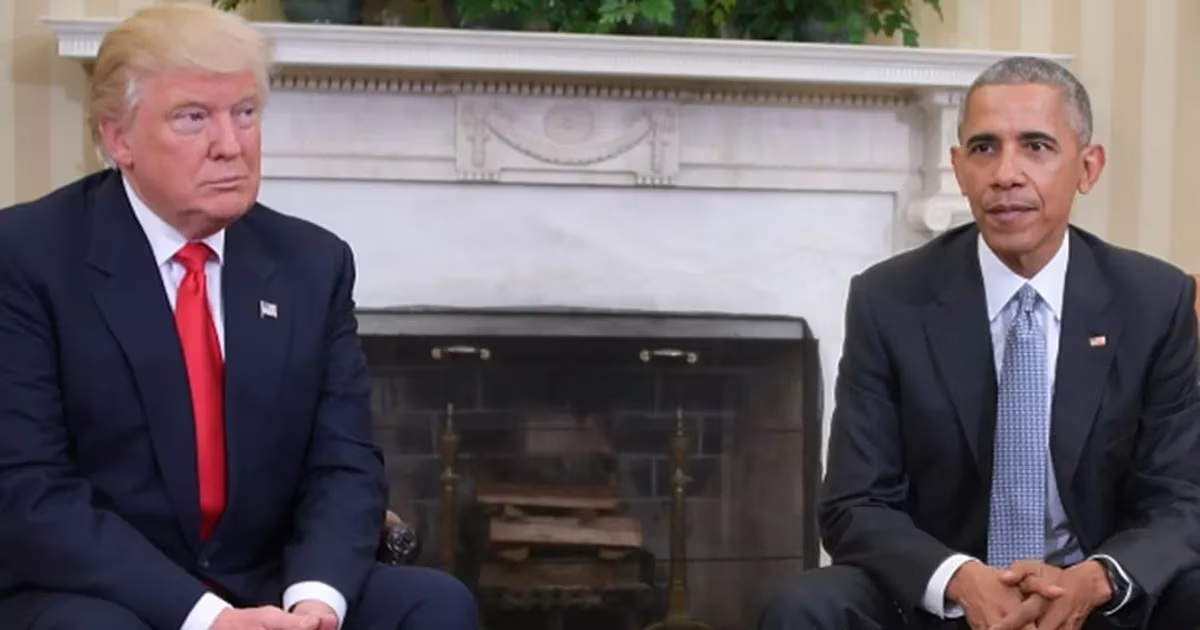
PALESTINE

Tue 16 Jun 2026 9:57 am - Jerusalem Time

Escalation of Settlement in the West Bank: Destruction of Umm Safa Water Network and Government Funding for 'Hilltop Youth'

Groups of settlers, on Monday, destroyed the main and only water pipeline that supplies the village of Umm Safa, located in the central occupied West Bank, with its basic needs. This step comes amidst a frantic escalation of attacks targeting agricultural lands and Palestinian infrastructure, with the aim of pressuring residents and forcing them into displacement.

Local sources reported that the act of sabotage coincided with settlers carrying out extensive bulldozing operations in citizens' lands and paving a new settlement road in the vital 'Al-Harash' area. This newly constructed road connects Umm Safa village with the neighboring Deir Sudan village, threatening to confiscate vast areas of agricultural land that residents depend on.

For his part, Marwan Sabah, head of the Umm Safa Village Council, warned that the village is subjected to a real and systematic displacement project implemented by the occupation authorities and their settlers. Sabah explained that the village is now surrounded by settlement outposts from all sides, making it dangerous for farmers to access their fields due to repeated attacks.

In a related context, Hebrew press reports revealed the intention of Benjamin Netanyahu's government to allocate a huge budget to support the extremist right-wing 'Hilltop Youth' movement. According to leaked information, the allocated amount reaches about 5.5 million shekels, equivalent to approximately 1.89 million US dollars, which will be disbursed from the official state budget.

The 'Hilltop Youth' movement is known as an extremist settlement organization whose members are active in the random outposts scattered over the hills of the West Bank. This group is accused of being responsible for a long series of terrorist attacks that targeted Palestinian villages, including burning homes and mosques and vandalizing private property under the protection of the occupation army.

Data indicates that these groups are led by extremist Zionist figures, most notably Avri Ran and Meir Bartler, and are formed by elements originating from settlements and major cities. These individuals are not affiliated with a traditional party framework, but rather are united by a hardline right-wing ideology based on absolute hostility to the Palestinian presence in the region.

The head of the Palestinian National Council, Ruhi Fattouh, condemned this Israeli government approach, considering it conclusive evidence of the official establishment's involvement in sponsoring organized terrorism. Fattouh stressed that pumping funds to these groups grants them legal and political immunity to continue their crimes against unarmed civilians and their property.

Fattouh also emphasized that the international community's silence regarding these public fundings encourages the occupation to commit more blatant violations of international law. He called on international institutions to take urgent action to hold accountable those responsible for funding these gangs that wreak havoc and destruction in villages adjacent to settlements.

Various areas of the West Bank are witnessing a state of severe tension due to the continued burning and bulldozing operations and preventing farmers from accessing their lands. Field sources confirm that these attacks are often carried out with the direct support of occupation soldiers, who provide security cover for settlers during their attacks on Palestinian villages.

The decision to fund the 'Hilltop Youth' provides political, legal, and financial cover for settler gangs that carry out organized crimes against Palestinians.

ARAB AND WORLD

Tue 16 Jun 2026 9:57 am - Jerusalem Time

Zelensky proposes meeting Putin in Washington, Trump optimistic about ending the war

Ukrainian President Volodymyr Zelensky announced a new diplomatic initiative aimed at breaking the stalemate in the years-long war, proposing a direct meeting with Russian President Vladimir Putin on American soil. This announcement followed telephone consultations between Zelensky and US President Donald Trump, during which they discussed ways to advance the peace process.

In a video address broadcast across social media platforms, Zelensky explained that Sunday's discussions with Trump focused on drafting a framework for this anticipated meeting. The Ukrainian president indicated that the proposed format for the meeting in the United States was carefully designed to be an offer that would be difficult for the Kremlin to ignore or reject at this time.

For his part, US President Donald Trump expressed notable optimism during his presence at the G7 summit in France, affirming his serious efforts to end the fighting in Ukraine and Lebanon. Trump stated that he had constructive talks with both Zelensky and Putin, expressing his belief that both parties are showing unprecedented openness to reaching a settlement that would end the armed conflict.

Despite this optimism, the Russian position remains cautious, as Putin had previously stated the futility of direct meetings without a clear draft peace agreement. Sources in the Ukrainian presidency indicate that the latest proposal was passed through multiple intelligence and diplomatic channels, but Moscow has not provided an official or clear response to date.

These moves come at a time when the international arena is witnessing increasing pressure to end the war, which has exceeded its fourth year, with Putin recently ignoring calls to attend the G7 summit in France. Through this initiative, Zelensky seeks to embarrass the Russian position internationally or push it towards the negotiating table under direct Washington patronage.

In the context of European support, the leaders of Britain, France, and Germany announced in a joint statement issued from London their full endorsement of Zelensky's proposals aimed at a ceasefire. The European leaders affirmed their countries' commitment to playing a pivotal role in any political process that leads to the restoration of stability on the old continent and the end of humanitarian suffering.

This diplomatic activity coincided with the US President's praise for another preliminary agreement concerning the Iranian file, reflecting the US administration's desire to resolve major international crises. Observers believe that Washington's entry as a host for the Putin-Zelensky meeting could shift the balance of power in the negotiating process, which has repeatedly faltered in the past.
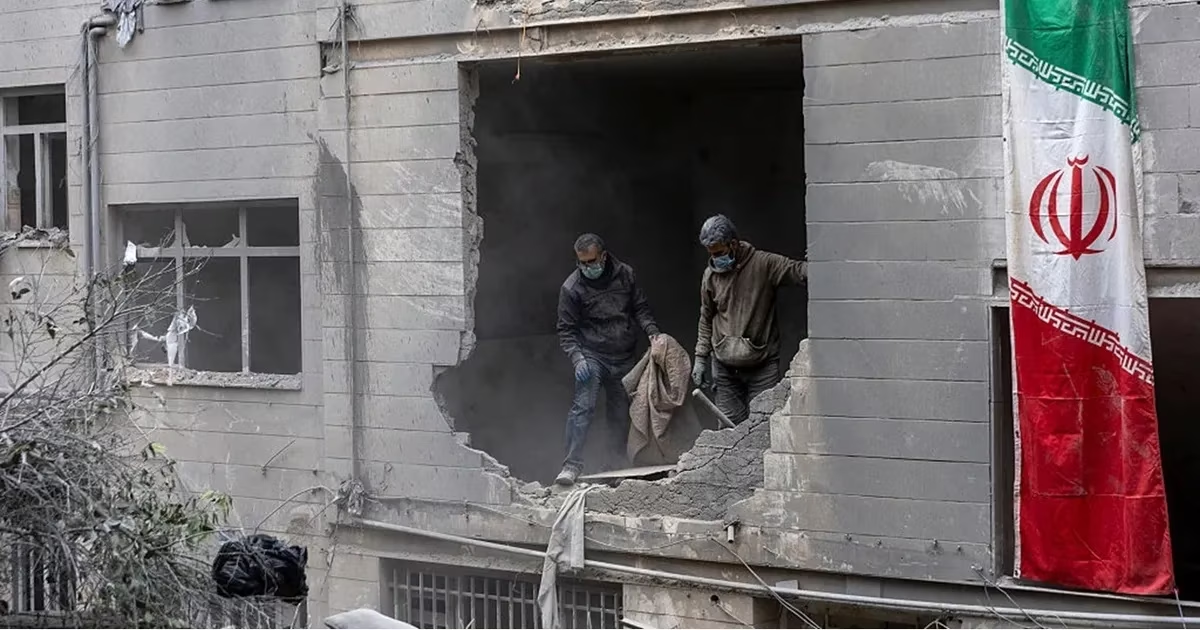
Anticipation remains the order of the day, awaiting official reactions from the Kremlin to the American-backed Ukrainian offer in the coming days. International circles hope that this initiative will constitute a real turning point, ending Europe's longest military conflict in the 21st century.
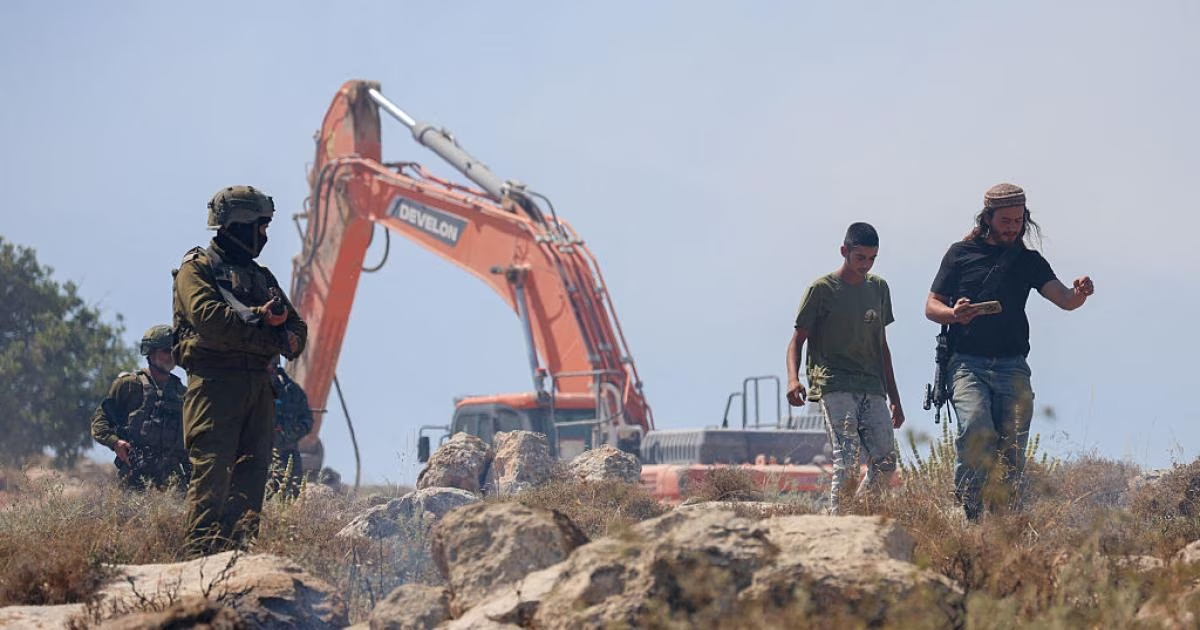
I discussed with President Trump the possibility of organizing a meeting in the United States in a format that would be very difficult for Putin to refuse.