PALESTINE

Sun 25 Jan 2026 3:01 pm - Jerusalem Time

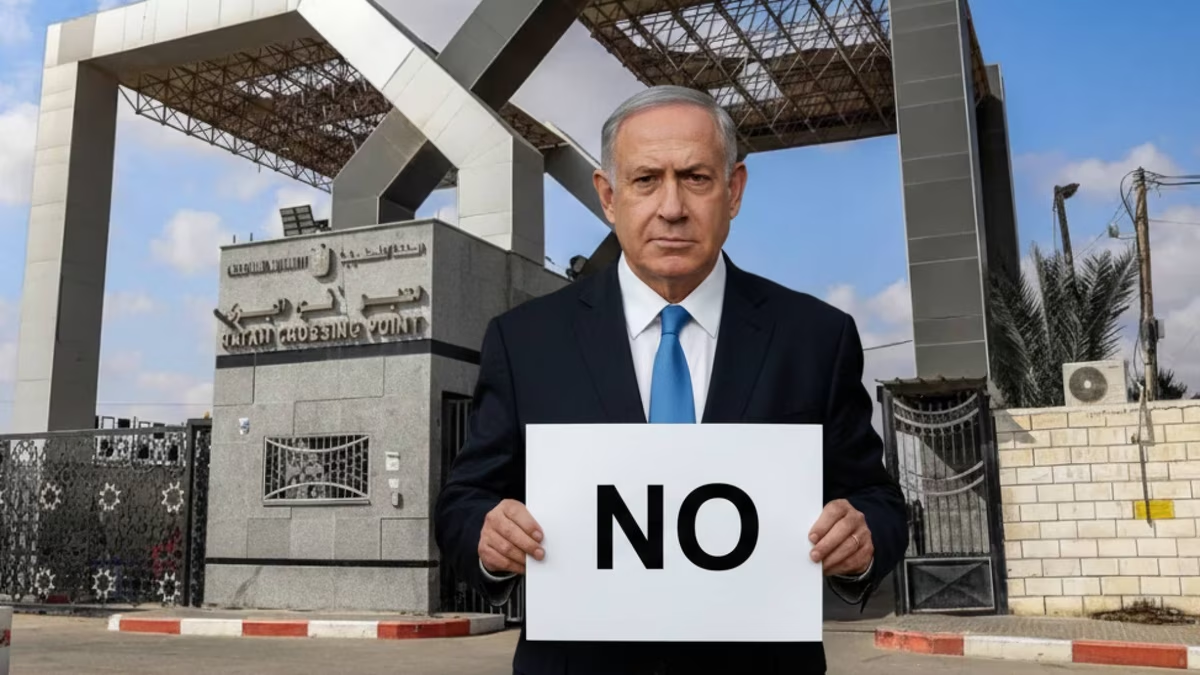
Alternative Crossing Plan.. US Pressure to Open Rafah and Netanyahu Demands the "Last Body"

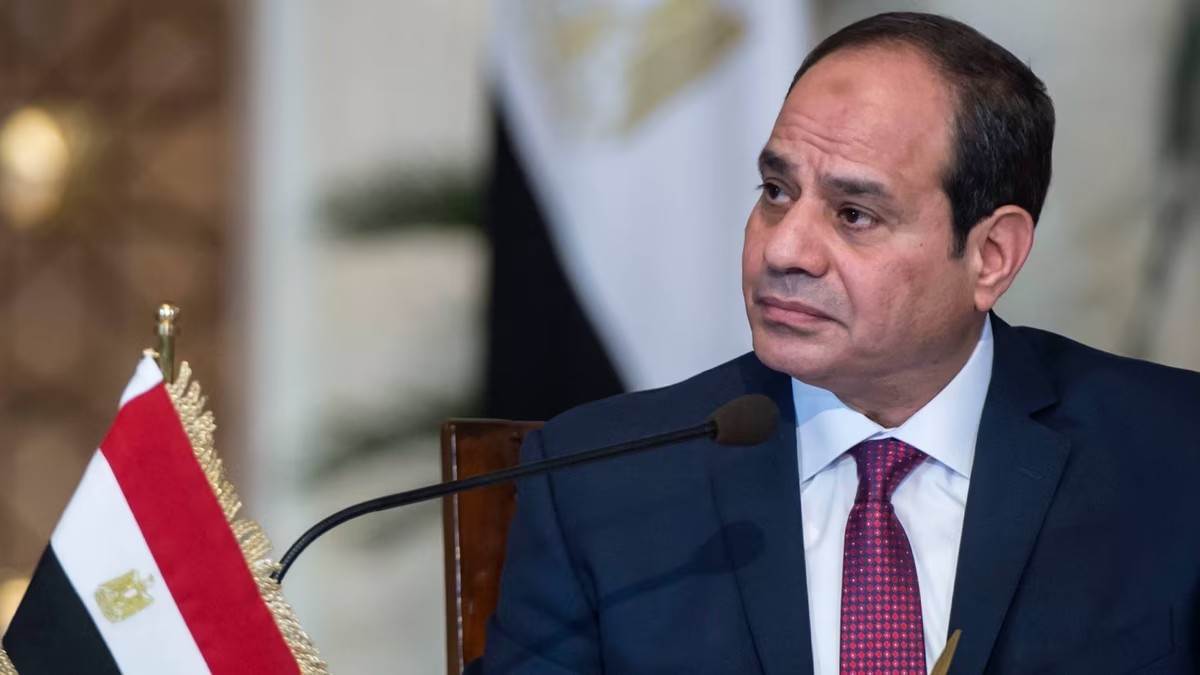
Hebrew media revealed Tel Aviv's intentions to establish a "new crossing" near Rafah. All eyes are on Sunday's crucial meeting of the mini-"Israeli" cabinet (the Cabinet) to discuss the implementation of the second phase of the war cessation agreement in Gaza, particularly the thorny issue of the Rafah crossing, amidst sharp disagreements between Prime Minister Benjamin Netanyahu and US envoys.

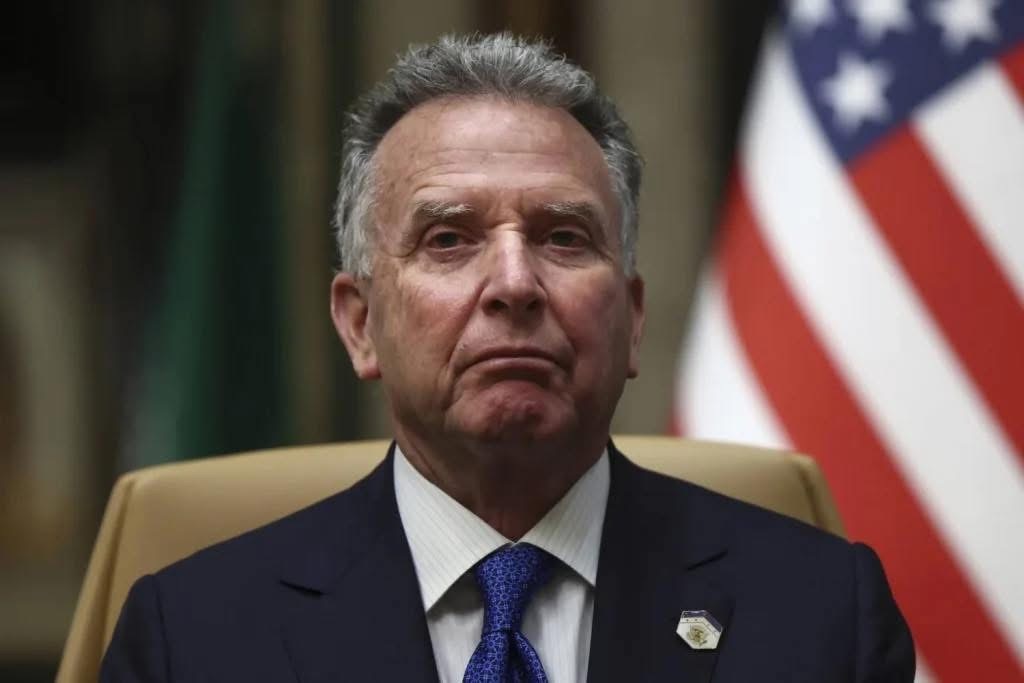
The "Yedioth Ahronoth" newspaper revealed that a meeting held yesterday between Netanyahu and US President's envoys, Jared Kushner and Steve Witkoff, showed differing positions. Netanyahu linked the reopening of the crossing to two conditions:

Retrieval of the last body of a detainee (which reports indicate is a policeman).

Disarming the Hamas movement.

In contrast, the newspaper quoted an "Israeli" official saying that Kushner and Witkoff "objected to linking the opening of the crossing to the return of the body," considering the opening of the crossing a "necessary civilian step" to support de-escalation and achieve long-term peace.

In a related context, Hebrew media revealed Tel Aviv's intentions to establish a "new crossing" near Rafah, to be an alternative to the traditional crossing, according to a mechanism that ensures indirect Israeli security dominance:

Field administration: The European Union will manage the Palestinian side in coordination with Palestinian intelligence.

Security control: Passenger lists (entry and exit) will pass to the "Israeli" internal security service (Shin Bet) for final review.

Inspection procedures: Include thorough X-ray and fingerprint checks and identity verification under direct "Israeli" supervision.

This "Israeli" intransigence comes despite statements by Ali Shaath, head of the Palestinian National Committee for Gaza Administration, last Thursday in Davos, that "the crossing will open within days."

It is worth noting that "Israel" did not adhere to the provisions of the first phase (which began on October 10) regarding the opening of transportation, violating the truce, which led to the martyrdom of 477 Palestinians during the ceasefire period.

The second phase of the agreement, which the Cabinet is discussing today, includes fundamental steps, most notably:

Additional withdrawal of the "Israeli" army.

Deployment of an international force in the Strip.

Beginning of reconstruction: which the United Nations estimates will cost about $70 billion, after a two-year war that left more than 71,000 martyrs and destroyed 90% of the infrastructure.

PALESTINE

Sun 25 Jan 2026 3:01 pm - Jerusalem Time

UN warnings: Gaza Strip is the most dangerous place in the world for journalists and humanitarian workers

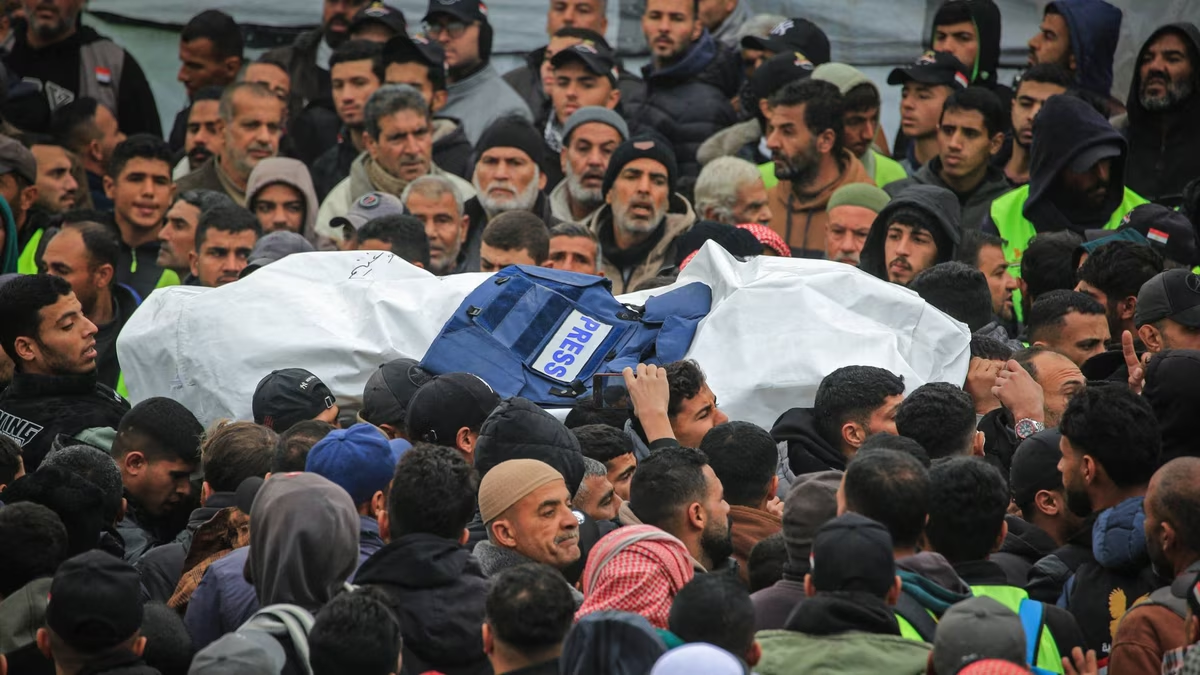
“Philippe Lazzarini”, Commissioner-General of the United Nations Relief and Works Agency for Palestine Refugees (UNRWA), reported that more than two hundred and thirty journalists have been martyred in the Gaza Strip since the beginning of the war, stressing that the Strip has become the most dangerous environment in the world for workers in the fields of media and humanitarian relief.

The UN official explained that these figures reflect the magnitude of the harsh challenges facing the transmission of facts from the field.

Lazzarini praised the essential role played by Palestinian journalists, describing them as the “eyes and ears” that conveyed the atrocities of the war and its impactful humanitarian consequences to the world.

He affirmed that these professionals worked bravely and courageously despite all field difficulties, paying a heavy price alongside their colleagues in the humanitarian field, with more than 230 of them losing their lives while performing their duties.

In the context of his report, Lazzarini criticized the continued prevention of international journalists from entering the Gaza Strip independently since the beginning of the conflict, considering this ban undermines media freedom and contributes to the absence of impartial oversight.

The Commissioner-General warned that this measure fuels media disinformation campaigns and reinforces polarized rhetoric and extremist narratives.

The UN official stated that the purpose of preventing media access is to cast doubt on direct data and eyewitness testimonies, including those issued by international humanitarian organizations, as well as attempts to dehumanize Palestinians by concealing their suffering from global public opinion.

Lazzarini stressed that the ban on foreign journalists has been prolonged, and the decision to lift it is long overdue.

He called for the necessity of ensuring media access and providing the necessary protection for journalistic teams, in accordance with international humanitarian law.

These statements come at a time when international pressure is increasing to facilitate the work of relief organizations and media outlets, to ensure an accurate picture of the situation on the ground, and to reduce the impact of conflicting messages resulting from the absence of independent journalistic coverage within the Strip.

OPINIONS

Sun 25 Jan 2026 2:36 pm - Jerusalem Time

Gaza First Again... And the West Bank?

Dr. Ibrahim Nairat

Opinion Writer

Gaza is at the heart of the scene once again, all eyes on it, while the West Bank seems absent from calculations. "Gaza first" is not just a description of the war, but a reminder of a recurring political dilemma: saving the Strip without linking it to the West Bank means reproducing a fragmented conflict, instead of a comprehensive solution.

Gaza first, a phrase that returns strongly to the forefront today, not as a description of the war alone, but as a political entry point that brings to mind a previous Palestinian moment whose outcomes have not yet been decided. When we go back to 1994, we recall Yasser Arafat's insistence on including Jericho alongside Gaza in the first agreement stemming from Oslo. This was not a fleeting geographical detail, but a clear expression of a deep fear that the political path would open only through Gaza, and then close before reaching the West Bank. He realized that a fragmented beginning carried within it the risk of turning into a fragmented end, and that if Gaza was left alone, it might become a title for an incomplete solution that would not be finalized.

That fear was not born out of skepticism about the political process itself, but from an early understanding of the nature of the Israeli approach to a solution, an approach based on fragmenting geography and breaking down the issue into separate stages and files, which are easy to control and manage without reaching a comprehensive solution. The formula of Gaza-Jericho First came as an attempt to curb this logic, or at least to restrict it, and to link the Strip to the West Bank from the very first moment. But what was intended to be a transitional beginning, over time turned into a permanent pattern, until fragmentation became a political and geographical reality, not just a possibility.

Today, nearly three decades later, the same scene returns but under harsher conditions. The focus is entirely on Gaza, while the West Bank is absent from the political equation, not by public rejection, but by deliberate neglect. The West Bank is left to swing between accelerating settlement, eroding land, and the absence of a political horizon, as if it is a suspended area outside any conception of a solution. It has no presence in ceasefire formulas, nor in post-war maps, nor in the concepts being circulated about the future of the conflict.

In contrast, Gaza today bears a double burden. It needs to be saved from the clutches of war, and hearts tremble at the mere thought of returning to destruction and death. The overwhelming humanitarian scene draws all eyes to it, and all attention is focused on what will happen there, how it will be managed, and who will control its future. This focus is understandable humanely, but dangerous politically, because it is reproduced without any clear link to the unity of the cause and the path.

In this climate, the Palestinian Authority finds itself once again on the defensive. It is not in a position of initiative, but in a position of seeking to prevent being bypassed. It is called upon when needed, and excluded when concepts are drawn up, and it is treated again as an administrative or security title, not as a bearer of a political project. And as in previous stages, the solution is reproduced from above, without real partnership with those who are supposed to be the owners of the cause.

Israel, for its part, is not driven to seek a solution out of a desire for peace, but because it is now forced to choose, or at least to manage this choice. Today, it deals with an undeclared Palestinian entity, but one that is embodied on the ground as a complete people, whose population is no less than that of Israelis. This demographic and political reality imposes itself, and makes the continuation of the status quo a decision in itself, not a state of neutrality.

In principle, the options are clear. Either full annexation, with all its legal, moral, and demographic consequences, or granting Palestinians full freedom and sovereignty. But Israel, due to its security concerns, wants neither. It does not want annexation at its cost, nor does it want Palestinian sovereignty with its repercussions. And here begins the gray area, where politics is managed through temporary solutions, hybrid arrangements, and formulas that do not state their true name.

From this dilemma emerges what Netanyahu and the Israeli right call thinking outside the box. In essence, it is a search for a creative solution in an unprecedented formula, especially in the West Bank. The focus is not on the land as a political unit, but on population centers. Separating people from land, and managing Palestinians as separate human groups, not as a political community with collective rights. Extended self-rule here, civil administration there, strict security arrangements everywhere, without sovereignty, without a horizon, and without a final solution.

In this context, Gaza once again becomes a laboratory, while the West Bank turns into a postponed file, or a testing ground for new forms of conflict management. And here lies the real danger, not only in the fragmentation of geography, but in the redefinition of the Palestinian issue itself, from a matter of liberation and self-determination, to a matter of population management.

The political warning here cannot be understated. Any path that starts from Gaza, ignores the West Bank, and treats Palestinians as numbers and gatherings rather than as a single political entity, is a path that reproduces the conflict instead of solving it. Gaza deserves to be saved from the war, yes, but saving it outside the context of the unity of the cause will once again make it a gateway to an incomplete solution, which Palestinians are asked to live with as the maximum possible.

History does not literally repeat itself, but it persistently repeats its logic. And unless the logic of the fragmented solution is broken, the same cycle will continue, Gaza first, West Bank suspended, creative solutions without justice, and a reality imposed and then demanded to be accepted. This is not a pessimistic reading, but the conclusion of a long experience that says that what is not politically resolved, is drained over time, until it loses its meaning.


PALESTINE

Sun 25 Jan 2026 2:01 pm - Jerusalem Time

Occupation raids on Gaza and 4 citizens injured simultaneously with the demolition of buildings east of Al-Tuffah neighborhood

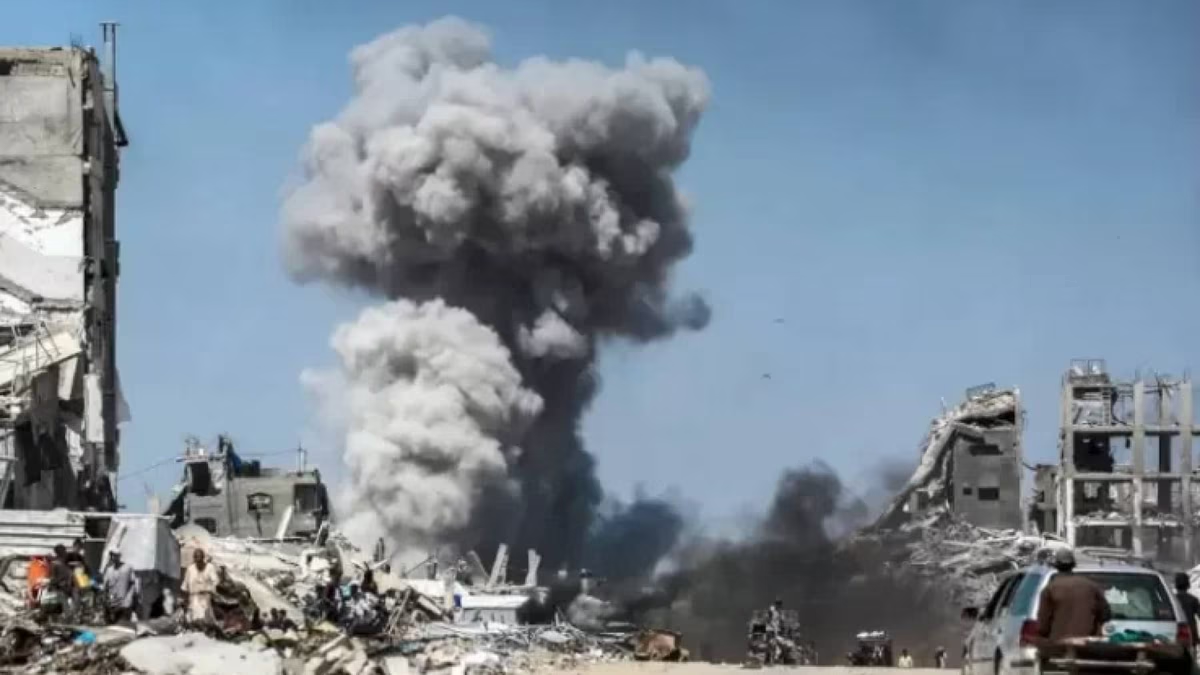
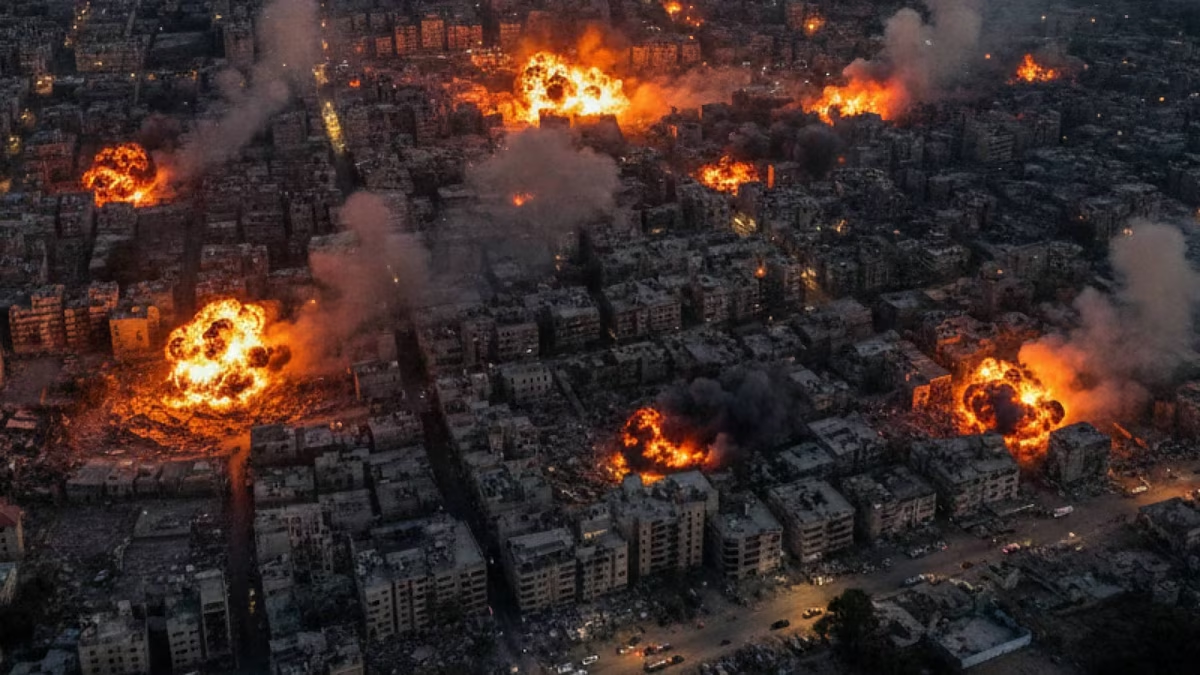
On Sunday, the occupation army launched aerial and artillery attacks on various areas of the Gaza Strip, resulting in the injury of four citizens, coinciding with the demolition of residential buildings east of Al-Tuffah neighborhood in Gaza City.

Palestinian sources reported that the demolition operations were concentrated near Al-Batsh cemetery in Al-Tuffah neighborhood, accompanied by airstrikes and artillery shelling targeting the neighborhood and its northeastern surroundings. Meanwhile, four citizens were injured after a "quadcopter" drone attacked the transmission tower above the "Shawa and Hasri" tower in the city center.

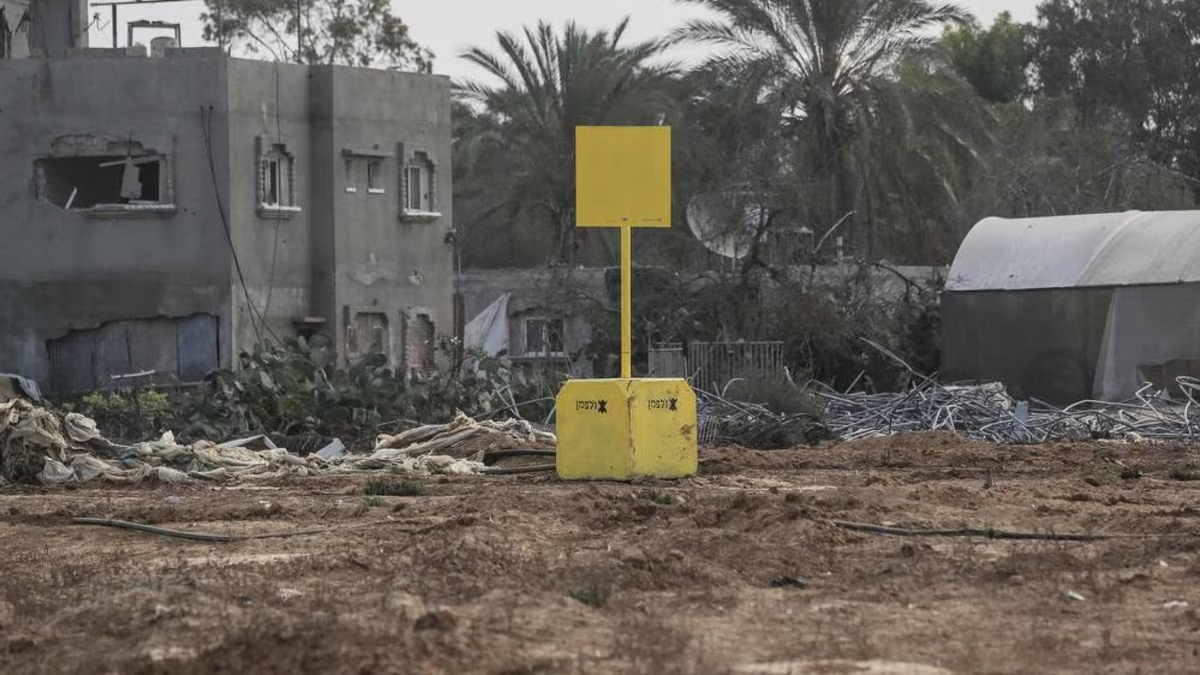
At the same time, Israeli military vehicles advanced in a limited manner along what is known as the "Yellow Line," which separates the areas of army deployment and the areas where Palestinians are allowed to move westward.

The northern Gaza Strip witnessed intense artillery shelling on the outskirts of Jabalia refugee camp, while the eastern areas of Bani Suheila town, east of Khan Yunis in the south, were subjected to continuous artillery shelling, accompanied by heavy gunfire in the vicinity of the area.

The occupation navy also fired at fishermen's boats off the coast of Khan Yunis, with no injuries reported.

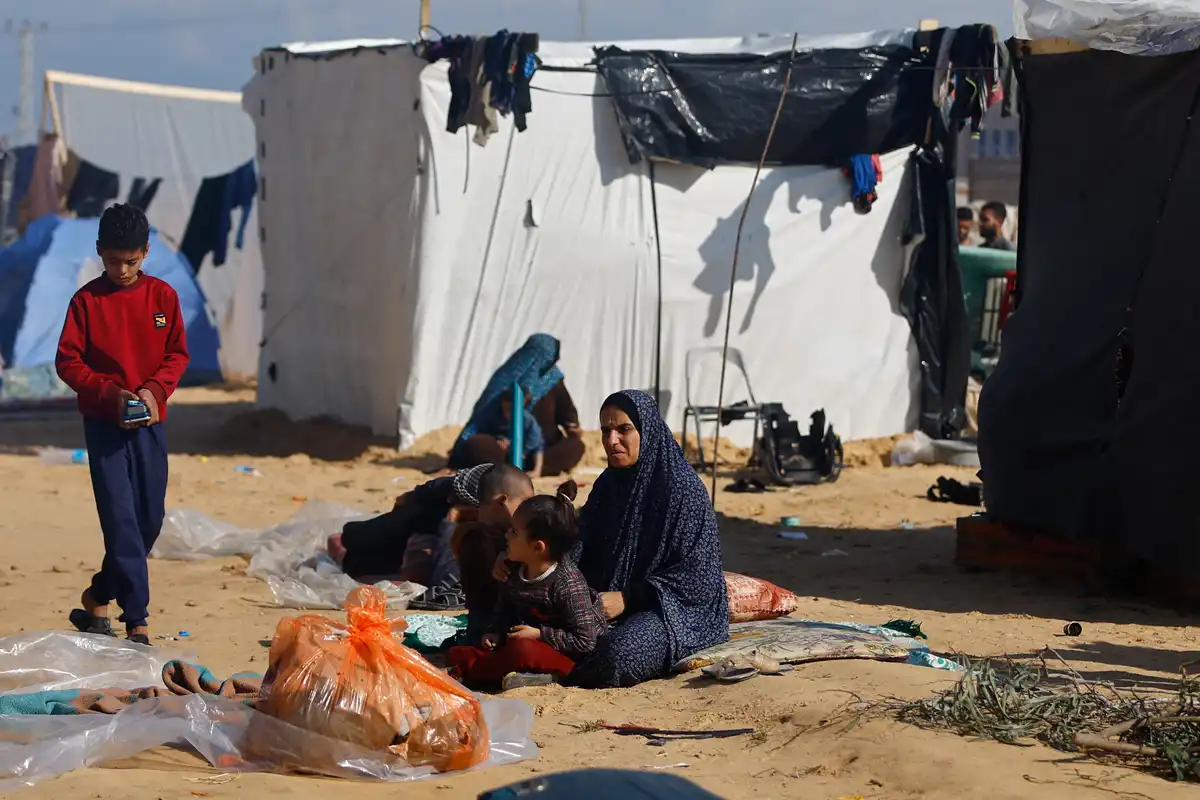
Gaza is witnessing an exacerbation of the humanitarian crisis, after cold waves claimed the lives of ten people, including a three-month-old infant, while repeated violations of the agreement have resulted in the martyrdom of 481 Palestinians and the injury of 1313 others so far.

These developments coincide with the arrival of US envoys Steve Witkoff and Jared Kushner to "Israel" to discuss Gaza Strip issues, including the second phase of understandings, the reopening of the Rafah crossing, and the formation of a council to manage the affairs of the Strip.

PALESTINE

Sun 25 Jan 2026 1:01 pm - Jerusalem Time

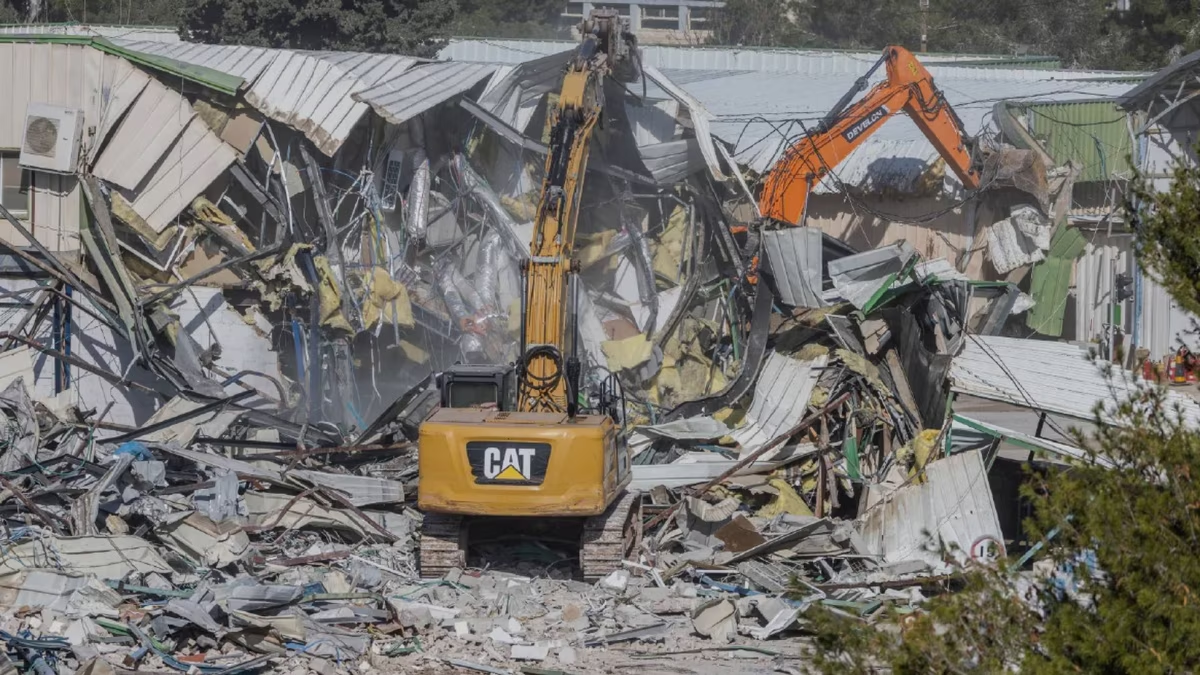
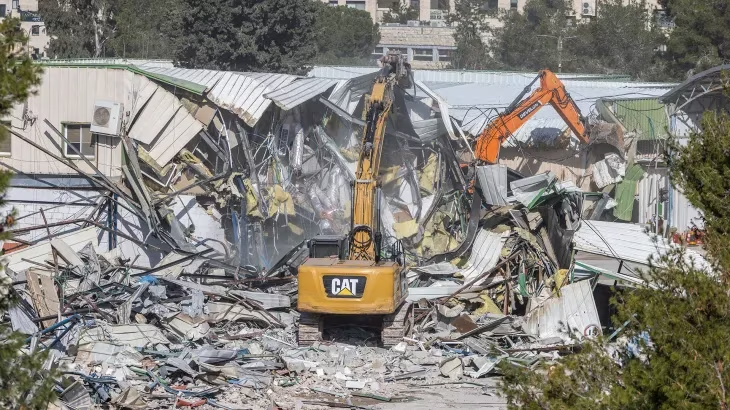
UNRWA: Demolishing our headquarters in Jerusalem means embassies will be next tomorrow

The Commissioner-General of the United Nations Relief and Works Agency for Palestine Refugees (UNRWA), Philippe Lazzarini, issued a strong warning to the international community on Sunday, considering the demolition of the agency's compound in occupied East Jerusalem, which occurred on January 20, 2026, not merely an attack on a UN building, but an undermining of the principles of international immunity, cautioning that the repercussions of this event will not be limited to UNRWA alone.

In his official comment on the incident, Lazzarini painted a bleak picture of the future of international work in light of these violations, stating: "What is happening to UNRWA today will happen tomorrow to any other international organization or diplomatic mission," clearly indicating that this threat is not confined to the occupied Palestinian territories, but is a precedent that can be repeated "anywhere in the world" if it goes unaddressed or without deterrence.

The UN official emphasized the legal dimension of the issue, reminding UN member states of their firm and binding obligations under law; international charters stipulate the necessity of providing full protection for UN facilities and respecting their sanctity, calling on those states to assume their responsibilities in enforcing respect for international law and protecting the global order from collapse.

PALESTINE

Sun 25 Jan 2026 1:01 pm - Jerusalem Time

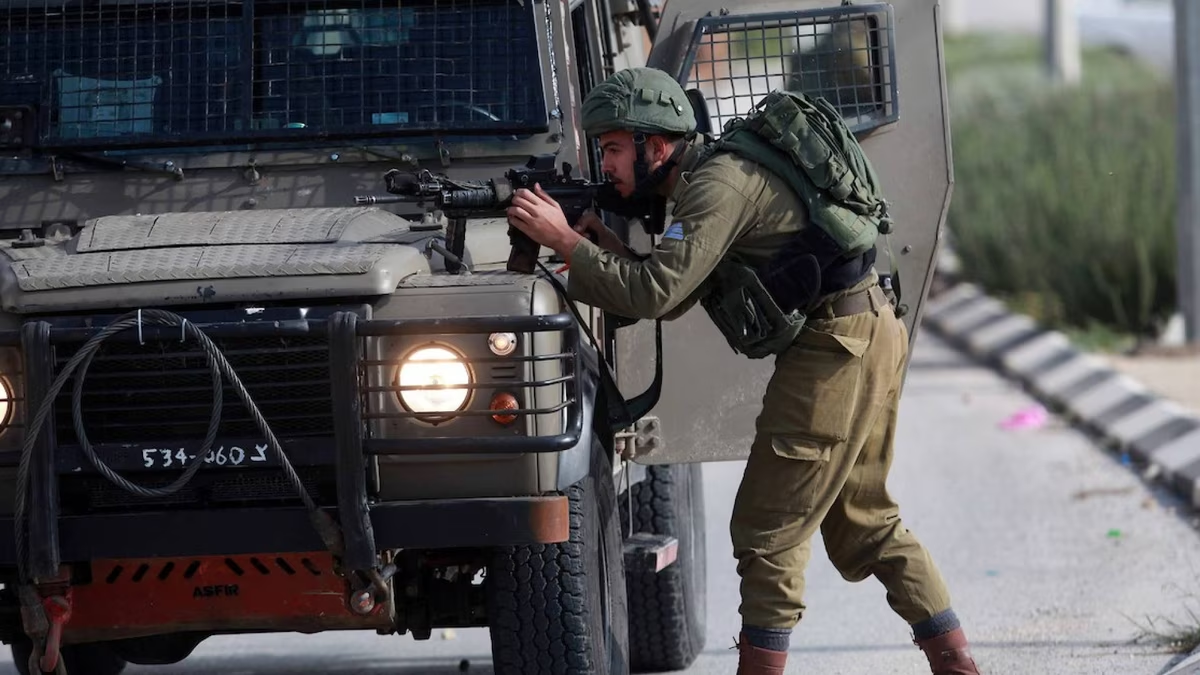
A Palestinian killed by occupation army fire north of Ramallah

A young Palestinian man was killed on Sunday by "Israeli" occupation forces' bullets after his vehicle was shot at in the "Ayoun al-Haramiyah" area north of Ramallah city in the central West Bank.

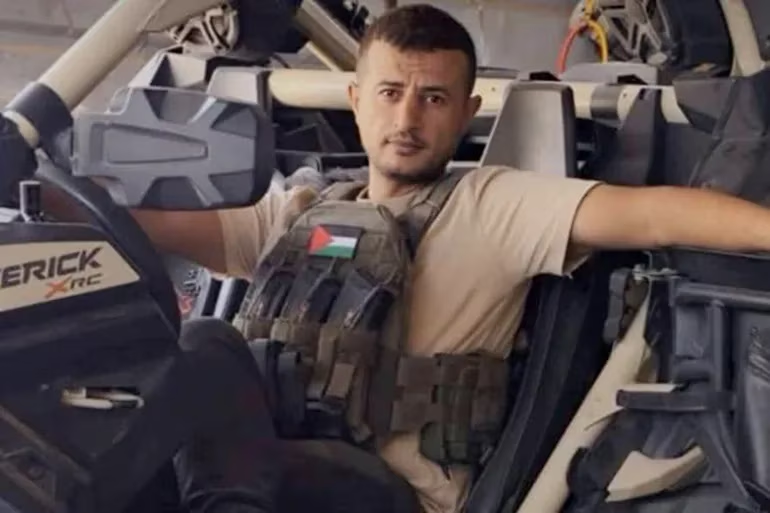
The Palestinian Ministry of Health reported that the dead is Ammar Majed Hassan Hijazi (34 years old) from Nablus city, noting that the occupation forces opened fire on him while he was in the area.

Palestinian sources clarified that the occupation forces opened fire on the Palestinian after he attempted to flee, while the occupation police claimed that the driver did not stop at the checkpoint and collided his vehicle with a concrete barrier.

Medical teams were called to the scene, and investigations are ongoing to examine the circumstances of the incident.

PALESTINE

Sun 25 Jan 2026 10:59 am - Jerusalem Time

Between the bullets of the occupation soldiers and the violence of the settlers.. a worker injured and "Khillet al-Sidra" in Jerusalem militarily closed

A worker was injured by the bullets of the occupation forces north of Jerusalem, while settlers launched an attack on the Bedouin community of "Khillet al-Sidra" near the town of Mikhmas, north of Jerusalem, causing extensive damage to homes, barns, solar panels, and surveillance cameras.

The Palestinian Red Crescent reported that its crews received the worker, who was injured by live bullets below the knee, at the Qalandia military checkpoint after he crossed the apartheid and expansion wall in the town of Al-Ram. Medical teams then transported him to Ramallah Hospital for treatment.

For its part, the Jerusalem Governorate confirmed that the attack comes after the occupation forces stormed the community, forced foreign solidarity activists to leave it, and declared the area a "closed military zone" for one year, delivering a decision to those present prohibiting anyone from entering the community during this period.

The Governorate added that a field visit was conducted to the community in cooperation with partner institutions, including the Wall and Settlement Resistance Commission, to assess the damage and initial needs of the citizens, while working to provide the necessary materials for rebuilding the damaged homes. However, the military closure decision will hinder the entry of these materials into the community.

A previous attack by settlers on the community had resulted in injuries to several citizens and foreign solidarity activists, in addition to the burning of several homes and two vehicles.

OPINIONS

Sun 25 Jan 2026 10:41 am - Jerusalem Time

Occupation Prisons... Where Death is Made and Hearts Resist with Freedom

In Israeli cells, time does not pass as we know it. No sun enters to announce the morning, and no night falls to grant the body a moment of rest. There, time stops, and the Palestinian body becomes an open space for pain. Silence becomes a daily language, and mere survival becomes an act of resistance. In these places isolated from the world, not only is the Palestinian detained, but their humanity is slowly crushed, as if the prison was created to be another homeland for suffering.
For many decades, detention in the Palestinian experience has not been an exceptional event, but a collective fate that pursues people in their homes, fields, streets, and dreams. More than a million arrests since 1967, numbers that have lost their meaning in the face of the immense pain they contain. Children grew up behind bars, mothers bid farewell to their sons and no longer recognized their features, entire families lived their lives suspended on news of a postponed release. And with October 7, 2023, the gates of hell opened wide.
Inside the prisons, everything changed except the cruelty. Violent raids, screams, beatings, confiscation of everything that connects the detainee to life. Books were snatched from hands, Qurans were confiscated, blankets were pulled away, and even spoons were not spared. Detainees were left with their bare bodies except for their clothes, and with thin bedding that offered no protection from the winter cold, the summer heat, or the harsh ground. Doors were closed on prolonged hunger, and with them, visits were stopped, and families were deprived of seeing their children, as if the punishment was not imposed on the prisoner alone, but on their entire family.
Hunger there is not a fleeting sensation, but a constant companion. Meals are barely visible, undercooked rice, dry bread, an egg shared by more than one exhausted body. Bodies waste away, weights drop, sunken eyes try to cling to life. Food is no longer a right, but a tool of punishment, as Ben Gvir openly intended when he spoke of reducing it as a deterrent. In Israeli prisons, deterrence means breaking the body before breaking the will.
As for illness, it is another story of silent torment. Cancer patients are left to their fate, those with chronic diseases await medicine that never comes, and the injured find only neglect. Water is available for only one hour a day, and hygiene is an impossible luxury, so scabies spread on the bodies of detainees as sorrow spreads in Palestinian memory. Even bathing turned into a means of torture, water cold enough to cause pain in winter, and hot enough to burn in summer.
In this darkness, police dogs are used, and tear gas inside closed rooms. Detainees are forced to kneel, to bow their heads, to raise their shackled hands behind their backs. Intentional humiliation, as if the goal is not just punishment, but the erasure of the human from within. Some could not bear it, attempted suicide, and others emerged as bodies without souls, or never emerged at all.
In the "Sde Teiman" camp, cruelty is embodied in its most horrific forms. There, where there is desert and silence, Gaza detainees are held blindfolded, handcuffed, not knowing if the day has begun or ended. Surgeries are performed without anesthesia, limbs are amputated, bodies are violated, and screams are heard by no one. Even when a brutal sexual assault by soldiers against a prisoner was revealed, Israeli anger was not directed at the crime, but at holding those who committed it accountable, as if Palestinian pain was a detail not worth dwelling on.
Many have died inside prisons since the beginning of the war, some from hunger, some from illness, and some under torture. Names disappeared, and bodies were returned or buried in silence, while the world turns its face away. International law is present on paper, absent in the cells, and the Palestinian human is left alone to face a machine that sees them only as a danger to be broken.
Israeli prisons are not just buildings of cement and iron, but a mirror of an entire system based on dehumanization, on turning pain into policy, and silence into an accomplice. In every cell, there is a story yet untold, a body awaiting justice that never comes, and a faint voice whispering, despite everything, that freedom, no matter how delayed, must be born from the womb of this darkness.


OPINIONS

Sun 25 Jan 2026 10:39 am - Jerusalem Time

Who Won the Gaza War..? A Legal Approach to Responsibility, Loss, and the Collapse of the Legitimacy Standard!

Searching for a "winner" in the Gaza War is a misleading question from the perspective of international law, because armed conflicts are not measured by their military outcomes alone, but by the extent to which the rules of international humanitarian law are respected, legitimate political goals are achieved, and harm to the civilian population is minimized.
According to these standards, the recent Gaza War embodies a model of a legally and strategically failed war, which resulted in severe losses for all parties, without producing a recognized or sustainable victory.

The Palestinian People: The Protected and Violated Victim

Palestinian civilians are classified, under the Fourth Geneva Conventions, as protected persons.
Nevertheless, the Palestinian people bore the brunt of the war, both in terms of human losses and widespread destruction of civilian property and infrastructure.
The nature of the military operations raised serious legal issues related to the principles of distinction and proportionality, which are fundamental pillars of international humanitarian law.
This loss is not only humanitarian but also legal, as it leaves the issue of international accountability open, and holds the international community responsible for failing to fulfill its duty to protect and prevent grave violations.

The Palestinian Cause: Existing Rights and a Stalled Path

Legally, the Palestinian cause has not suffered any diminution in its essence, as the right to self-determination, ending the occupation, and the return of refugees remain fixed rights guaranteed by resolutions of international legitimacy.
However, the war contributed to stalling the political and legal path, and transforming the issue again into a humanitarian relief file, instead of dealing with it as a decolonization issue.
This loss is represented by the marginalization of legal and diplomatic tools in favor of crisis management, a path that prolongs the conflict and does not end it.

Hamas: The Problem of Armed Action Outside the Comprehensive Legal Framework

The war shows that the Hamas movement, despite its continuation as a field actor, found itself in a legal and political dilemma.
The absence of a unified national reference, and the failure to integrate military action within an internationally recognized political strategy, made the movement vulnerable to being held responsible for the human cost, regardless of the legitimacy of resisting occupation in principle.
The loss here is not purely military, but a loss in the ability to transform the legitimacy of resistance into a sustainable legal and political gain.

Israel: Abuse of Power and Limits of Military Superiority

Despite its military superiority, Israel failed to achieve a legal or political victory, as it did not end the conflict, nor did it impose a settlement, but rather faced an escalation in accusations of committing grave violations of international humanitarian law, which may amount to war crimes.
Internally, the war revealed a deep crisis of confidence in leadership and institutions, and externally, it led to the erosion of Israel's legal and moral image, and the widening circle of demands for accountability.
This is a deferred strategic loss, whose effects appear in international legitimacy, not on the battlefield.
Who won then...?!
From a strict legal perspective, no one won. The weaker party paid the highest human price, while the stronger party lost part of its international legitimacy. In contemporary wars, the erosion of legitimacy is more dangerous than the decline of power.
How can losses be minimized...?
Unifying Palestinian political representation within a recognized legal framework.
Subordinating any armed action to national interest calculations and respecting the rules of international law.
Activating international accountability mechanisms instead of merely rhetorical condemnation.

How can losses be compensated?

Legally: by internationalizing violations and prosecuting those responsible.
Politically: by restoring credibility to a solution based on ending the occupation.
Humanitarianly: by reconstruction that ensures human dignity and does not reproduce fragility.
In conclusion: The Gaza War proves that military force, when separated from law, loses its strategic meaning. The real question is no longer who won, but: who has the ability to return the conflict to its just legal path, instead of leaving it hostage to open cycles of violence?

TECHNOLOGY

Sun 25 Jan 2026 10:29 am - Jerusalem Time

Digital Illiteracy in the Age of Artificial Intelligence

For a long time, digital illiteracy was treated as synonymous with not using technology, or ignorance of computer and internet basics. The “digitally illiterate” person was someone who didn't own a device, or didn't know how to open their email, or interact with a digital platform. This definition was logical in a time when technology was a relative luxury, or exclusive to a certain group, or an option that could be dispensed with.


But this understanding is no longer sufficient in the age of artificial intelligence.

We are living in an era where refraining from using technology is no longer possible, and where everyone, without exception, has become a forced user of digital tools. Here, digital illiteracy has not disappeared, but rather changed its form.


Contemporary digital illiteracy does not mean the absence of use, but rather its superficiality. It is not manifested in staying away from technology, but in being dependent on it without understanding. A person who uses AI tools daily, without understanding their mechanisms, limitations, or biases, may be more digitally illiterate than someone who uses them less, but with greater awareness.


In this context, the fundamental question becomes:

Are we using artificial intelligence… or are we being used by it?


New generations, born into the heart of the digital environment, are often described as “the most technologically savvy.” However, this description hides a deep problem. Familiarity with screens does not mean the ability to think critically, and speed of interaction does not mean understanding algorithms. Digital illiteracy today is not related to age or access, but to the nature of the relationship with technology.


In the age of artificial intelligence, digital illiteracy takes on more dangerous dimensions. Tools are no longer limited to searching or communicating, but now produce texts, analyze data, and participate in decision-making. Anyone who treats these outputs as definitive facts, without verification or questioning, falls into the heart of digital illiteracy, even if they appear technically advanced.


Here, digital illiteracy intersects with education, culture, and ethics. The absence of questioning skills, verification, formulating requests, and understanding context makes artificial intelligence a tool for reproducing ignorance, not for expanding the horizons of knowledge. The most dangerous forms of digital illiteracy today are those that hide behind the language of modernity.


In the Palestinian and Arab context, this problem becomes more complex. The introduction of technology into schools and institutions does not necessarily mean combating digital illiteracy, unless it is accompanied by building critical awareness and educational methodologies that prioritize thinking over copying, and understanding over consumption. Technology without awareness can deepen dependence instead of reducing it.


Digital illiteracy in the age of artificial intelligence is not a lack of skill, but a flaw in awareness; it is not a problem of tools, but a problem of understanding. Today, it is more dangerous than traditional illiteracy, because it operates covertly, producing the illusion of knowledge instead of knowledge itself.


Here, progress is not measured by the number of applications we use, nor by the speed with which we interact with smart tools, but by our ability to control our relationship with them. In a world driven by algorithms, awareness becomes the dividing line between empowerment and illiteracy, and between the human who uses technology and the human who is swallowed by it without realizing it.

PALESTINE

Sun 25 Jan 2026 10:20 am - Jerusalem Time

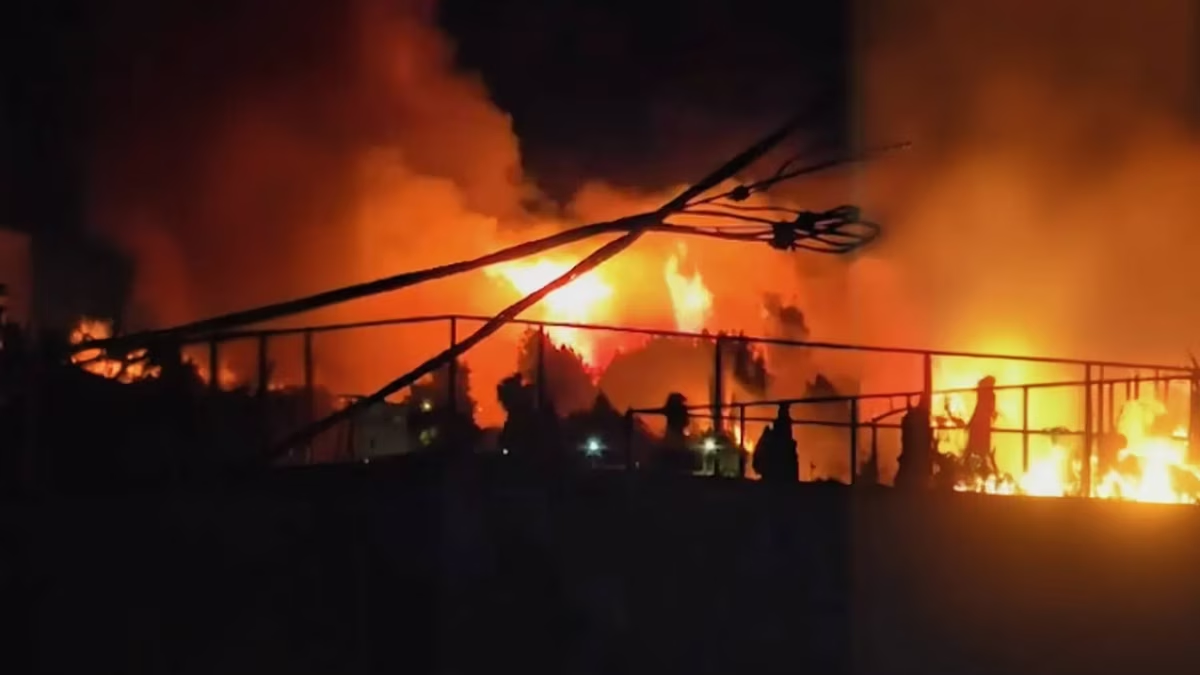
8 Firefighting Teams Surround Fire in UNRWA Ruins in Jerusalem

A fire broke out on Sunday night in the ruins of the former UNRWA compound near Ammunition Hill in Jerusalem, prompting the intervention of eight firefighting teams during the night to combat the flames.

Sources said that firefighting teams worked to prevent the fire from spreading to nearby homes, after the government had previously ordered the demolition of the compound and its evacuation of residents.

Authorities continue to monitor the situation, with a focus on full control of the fire and securing the surrounding area, while no injuries have been reported so far.

PALESTINE

Sun 25 Jan 2026 10:13 am - Jerusalem Time

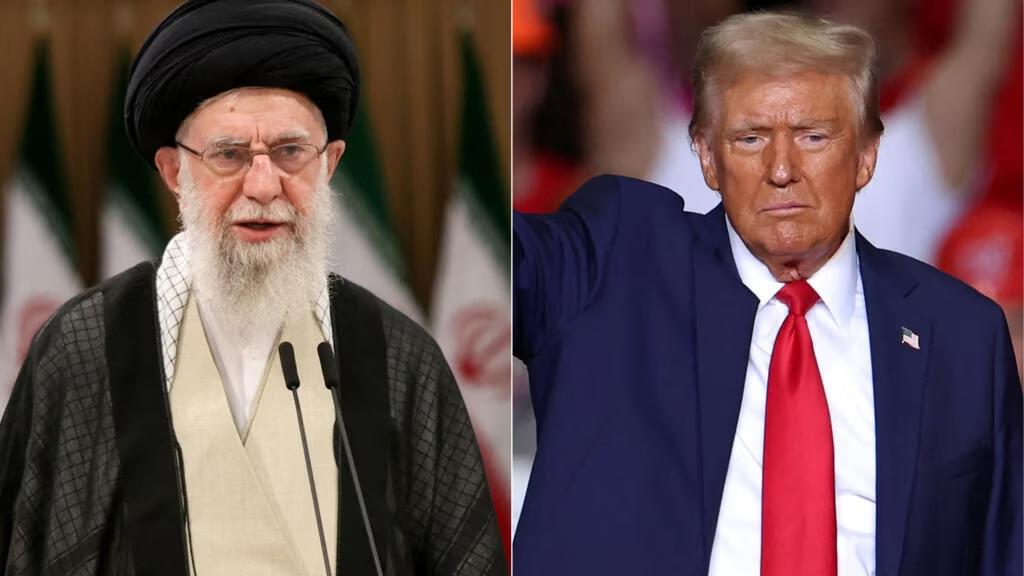
Mobilization against Iran: American political messages with military tools

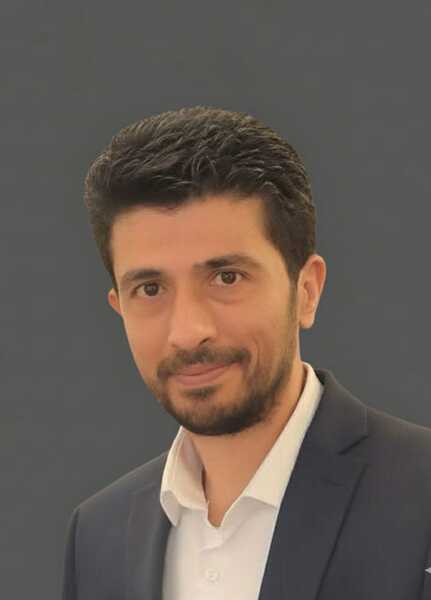
Dr. Ibrahim Freihat: The goal of these movements is political and psychological pressure to improve negotiation terms with Iran, not an automatic move towards war.
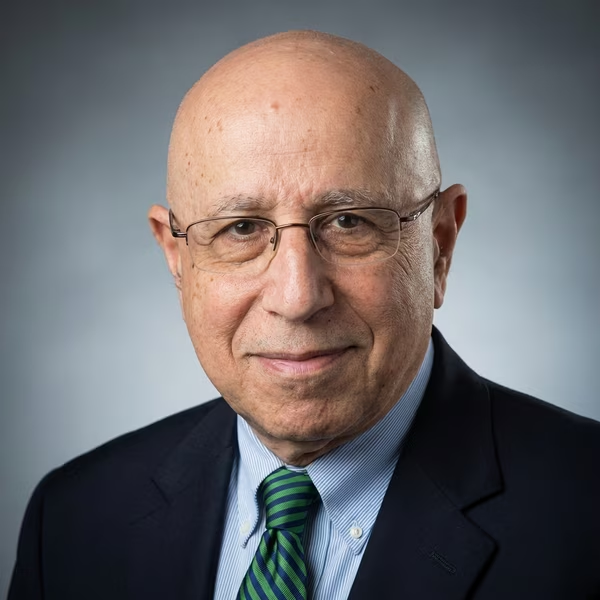
Dr. Raed Al-Dabai: Political and military indicators do not suggest an approaching comprehensive war with Iran, but rather conflict management within calculated levels of escalation.
Adnan Al-Sabah: The United States seeks to encircle Iran through its regional surroundings by inciting various parties against it and attempting to fragment neighboring countries.
Dr. Hassan Ayoub: Subduing Iran without a comprehensive war remains possible amidst transatlantic political and military mobilization and weak international reactions.
Dr. Raed Abu Badawiya: What is happening is not a prelude to a major war, but rather a calculated tension management that achieves maximum political benefit for the United States at minimum military cost.
Daoud Kuttab: What is happening is part of the maximum pressure policy to improve negotiation terms with Tehran and perhaps reach a formula close to the previous nuclear agreement.


Ramallah - Exclusive to "Al-Quds"-

 The region has recently witnessed a remarkable escalation in American military movements, including the dispatch of warships, the transfer of weapons, and a rise in the rhetoric of US President Donald Trump, who has hinted at a military option against Iran. This has brought back widespread questions about the nature of these movements and whether they are a prelude to an open war or part of a more complex political pressure game.
The readings of a number of experts, political analysts, and university professors, in separate conversations with "Al-Quds", converge on the view that these movements cannot be separated from the context of managing the conflict with Tehran. Military buildup and media escalation are seen as negotiating tools aimed at improving negotiation terms, deterring the adversary, and keeping it under constant pressure, without necessarily being drawn into a comprehensive military confrontation with high regional and international costs.
In contrast, estimates vary regarding potential scenarios. Some favor the continuation of managed containment and escalation policies, while others do not rule out limited and painful strikes within a controlled political and military ceiling. Still others believe that Washington is working to manage a wider network of regional and international conflicts to serve its strategic goals, as part of a long-term struggle that extends beyond Iran to affect the shape and balances of the international system.

Military Tools for Negotiation Management

Dr. Ibrahim Freihat, Professor of International Conflicts at the Doha Institute for Graduate Studies, explains that the dispatch of American naval vessels to the region, the transfer of weapons, and the escalation of political rhetoric hinting at a military option against Iran do not necessarily mean an imminent military strike. He emphasizes that these movements are primarily part of the negotiation process tools and not an inevitable indicator of a military confrontation.
Freihat points out that what is happening in terms of military preparations and escalatory statements is understood within the framework of what is known as "the threat of using force," which is a common method in international negotiation management and is often more effective than the actual use of force.
He clarifies that the goal of these movements is political and psychological pressure to improve negotiation terms with Iran, not an automatic move towards war.
Freihat indicates that the threat of force constitutes an essential part of the ongoing negotiation process between Washington and Tehran, which, according to the American vision, revolves around a number of issues, primarily the Iranian nuclear program, the missile program, in addition to economic aspects, and what the United States can gain economically if understandings or agreements are reached.

Decisive Moments at the Last Minute

Freihat affirms that the decision to launch a military strike or not is not made in the early stages, but is usually decided at the very last moments, perhaps just minutes or hours before the start of any potential operation.
He notes that negotiations remain open and continuous until the last moment, in parallel with full military readiness, so that all options remain on the table until the final decision is made by the top of the decision-making hierarchy.
Freihat explains that military preparation, including planning, transferring weapons, and equipping forces, is an inherently continuous process that serves the purpose of threatening the use of force, without necessarily implying an intention to actually use it.
Freihat points out that even the American leadership itself, including the US President, would not have decided on the option of a strike or not at this stage, but rather continues to receive reports, assessments, and various options until the decision is made at the last minute.

Limited Military Action

Regarding potential scenarios, Freihat suggests that if military action were to be resorted to, it would be limited in terms of time and scope, in line with the current US administration's pattern, which is not inclined to engage in long-term wars or "nation-building" projects.
Freihat explains that any potential strike would be short-term, lasting hours or days, with clear beginning and end.
He points out that Iran, as the weaker party in this equation, often ceases escalation when the American side stops, and that any potential Iranian responses would be limited and directed towards specific military targets, such as military bases in the region, with limited impact that does not escalate to the level of a comprehensive regional war.
Freihat explains that the current weakness of Iran's regional allies, such as Hezbollah and Hamas, reduces the likelihood of conflict expansion and reinforces the assessment that any potential military confrontations, if they occur, will remain within narrow and calculated limits, without sliding into a wide regional war.

Hybrid Warfare and the Attempt to Weaken the Regime

Dr. Raed Al-Dabai, Professor of Political Science at An-Najah National University, believes that the United States is not heading towards a comprehensive conventional war with Iran, but is actually managing a long-term conflict based on the logic of hybrid warfare, aimed at exhausting the Iranian regime and containing its regional and nuclear behavior, without seeking to overthrow it by direct military force.
Al-Dabai explains that this American option is based on a deep understanding of the nature of the Iranian regime, which possesses a highly cohesive security structure that controls the political, security, and economic decision-making joints simultaneously.
Al-Dabai points out that the centers of power in Iran, especially the Revolutionary Guard, do not operate merely as security agencies, but represent a "state within a state," possessing vast economic influence that has enabled the regime to build a parallel economy capable of circumventing sanctions and continuing under accumulated pressures.
Al-Dabai clarifies that American decision-makers realize the limited reliance on internal change in Iran, given the reality of an opposition suffering from severe structural division and lacking a unifying leadership or a coherent alternative political project.
Al-Dabai notes that the Iranian opposition, despite its media and political presence, has not yet succeeded in acquiring effective pressure tools, such as long-term general strikes or comprehensive civil disobedience, that could paralyze state institutions or break the regime's security grip, making the scenario of rapid internal change unrealistic from the American perspective.
He points out that the United States has chosen to expand the scope of hybrid warfare against Iran, through a mix of targeted financial sanctions, diplomatic pressure, cyber warfare, and information warfare, in addition to using indirect regional arenas to raise the cost of Iranian behavior, without sliding into an open confrontation.
Al-Dabai notes that this strategy does not aim to overthrow the regime, but to weaken its ability to maneuver, restrict its regional influence, and keep it under constant and systematic pressure.
Al-Dabai affirms that Washington takes into account Iran's possession of unconventional deterrence capabilities, which allow it to create high levels of instability, whether through threatening maritime straits, primarily the Strait of Hormuz, or influencing global trade and energy markets, or through its regional networks.
Al-Dabai indicates that the regional environment does not seem prepared for a decisive war; Israel, despite its escalatory rhetoric, may not be ready for a long and multi-front war, while Gulf states do not show a desire for an open military confrontation that could threaten their economic security and internal stability.

Calculated Levels of Escalation

In his reading of potential scenarios, Al-Dabai explains that political and military indicators do not suggest an approaching comprehensive war with Iran, but rather conflict management within calculated levels of escalation.
Al-Dabai considers that the first and most likely scenario is the continuation of managed containment and escalation policies, where the United States continues to raise the level of military, economic, and political pressure, while avoiding direct confrontation, with the aim of deterring Iran and changing its behavior, while maintaining indirect communication channels to prevent an explosion.
The second scenario, according to Al-Dabai, is a limited or selective strike, a precise cyber or military strike, in the event of a development that Washington considers a crossing of red lines, such as a qualitative nuclear escalation or a direct targeting of American or Israeli interests.
Al-Dabai believes that this type of strike does not aim to change the regime, but to re-establish the balance of deterrence and send a calculated political message, while ensuring the containment of any Iranian response.
Al-Dabai points out that the third scenario is based on an indirect horizontal escalation led by Iran, through its regional tools or threatening international navigation and energy, without direct confrontation with the United States, reflecting the traditional Iranian response logic of expanding the conflict arena and raising its cost for adversaries.
Al-Dabai believes that the scenario of an open confrontation remains the least likely, given that all parties realize that the cost of a comprehensive war would be exorbitant and uncontrollable, suggesting the continuation of a long-term crisis managed by hybrid tools combining economic pressure, political exhaustion, limited military deterrence, and a struggle of wills, without a final military resolution.

Militarization of the World

Writer and political analyst Adnan Al-Sabah confirms that since October 7, 2023, the United States has been rapidly moving towards the militarization of the world, seeking to achieve its strategic goals by exploiting crises and conflicts in various regions of the globe. He points out that Washington is working to transform seas and international waterways into military zones under its influence.
Al-Sabah explains that the United States has recently militarized the Atlantic Ocean, the Mediterranean Sea, the Indian Ocean, and the Black Sea, in addition to using the war on Gaza as an entry point to strengthen its naval military presence, as part of a broader plan aimed at transforming the world into a network of American military bases, not only in the context of confrontation with Iran, but to seize all global spheres of influence.
Al-Sabah indicates that Washington exploits every event and every regional tension to ignite conflicts and turn different regions into hotbeds of conflict, noting that it seeks to create internal conflicts within the regions themselves, as it is trying to do in the Russian-Ukrainian conflict, by turning it into a conflict between Eastern and Western Europe.
Al-Sabah points out that the United States is also fueling tension in the South China Sea through Taiwan and countries surrounding China, as well as inciting Argentina against China, and inciting countries like Japan and South Korea, which serves its strategy of exhausting major powers.
Al-Sabah clarifies that Washington does not work to extinguish conflicts, and even if it sometimes intervenes to calm some of them, it is temporary and according to its interests, as happened in some conflicts between India and Pakistan, or between Thailand and Cambodia.
Al-Sabah points to the United States' continued ignition or fueling of other conflicts, such as the conflict between Egypt and Ethiopia, and conflicts in Yemen, Iraq, and Sudan, with the aim of weakening everyone and later controlling the outcomes of these conflicts.

Manufacturing Wars Between Different Parties

Regarding Iran, Al-Sabah affirms that the United States will not go to direct war with it unless a suitable internal opportunity arises, consisting of an internal Iranian action and forces capable of influencing that Washington can support and rely on.
Al-Sabah notes that American policy is based on manufacturing wars between different parties, then intervening at the appropriate moment to impose control, as it did in Syria, when it allowed the parties to the conflict to exhaust each other before intervening and imposing its will.
Al-Sabah believes that the United States seeks to encircle Iran through its regional surroundings, by inciting various parties against it, attempting to fragment neighboring countries, and moving towards Azerbaijan, making Iran surrounded by parties that can form a spearhead for implementing American goals, as part of a long-term strategy for managing conflicts rather than directly engaging in them.

"Peace Through Strength" Strategy

Dr. Hassan Ayoub, a writer, political analyst, and specialist in American affairs, confirms that the administration of US President Donald Trump has entered a new and advanced stage of implementing the "Peace Through Strength" strategy, noting that Trump's traditional slogan "Make America Great Again" is no longer merely political or economic, but has become coupled with the use of hard power as a central tool for achieving American goals.
Ayoub explains that what American policy is witnessing today represents a clear re-production of the neoconservative approach during the era of former President George W. Bush, but with two fundamental differences; first, avoiding involvement in a direct and widespread military invasion of targeted countries, and second, abandoning the traditional liberal discourse that justified interventions under the banners of spreading democracy and human rights, in favor of explicit discourse based on imposing will by force.
Ayoub clarifies that this strategy began to materialize in South America, especially in Venezuela, before branching out into two main directions aimed at bringing about far-reaching geopolitical changes, even if at the expense of traditional US allies in Europe and the Middle East.
The first direction, according to Ayoub, is an attempt to seize Greenland, while the second and more dangerous direction is to deliver a decisive military strike against Iran.
Ayoub points out that the central goal of this approach is to establish an international system based on "naked power" without controls or restrictions, in a preemptive step aimed at hindering or delaying the formation of a multipolar international system in which China and Russia are decisive powers.
Ayoub believes that according to this perception, subduing Iran, whether through a widespread military strike or through a serious threat of force, is an essential condition for the success of this American strategy.
Ayoub notes that the military scenario could take the form of a large-scale strike accompanied by intelligence operations inside Iran to ignite a state of chaos, leading either to a reshaping of the Iranian regime to serve American interests, or to transforming Iran into a failed state.

Subduing Iran Without a Comprehensive War

In contrast, Ayoub affirms that the scenario of subduing Iran without a comprehensive war remains possible, given the transatlantic political and military mobilization against Tehran, and Washington's exploitation of the weak international reactions to previous experiences, such as dealing with the Venezuelan issue.
Ayoub points out that the Trump administration does not pay real attention to the calculations and concerns of its regional allies, especially the Gulf states and Turkey, in contrast to almost complete coordination with its most important ally, Israel.
Ayoub considers that Tel Aviv is the second, and perhaps first, beneficiary of any American move against Iran, given the transformation of the surrounding countries into fragmented entities or failed states, which opens the way for long-term Israeli hegemony over the region.
Ayoub notes that Israeli Prime Minister Benjamin Netanyahu's statements about Israel's status as a major regional, and perhaps international, power reflect this path, pointing out that Tel Aviv's pursuit of military independence from Washington is consistent with a clear Israeli priority of destroying Iran or overthrowing its regime, which increases the likelihood of an American military strike, and makes the question not about whether it will happen, but when, and whether developments might prevent it.

Calculated Strategic Maneuver

Dr. Raed Abu Badawiya, Professor of International Law and International Relations at the Arab American University, confirms that the escalating American threats of war against Iran do not reflect actual readiness for a comprehensive war or a decisive strike that would overthrow the Iranian regime. Rather, they fall within the framework of a calculated strategic maneuver aimed at delivering a painful and limited strike, with carefully planned timing and objectives, without sliding into an open confrontation.
Abu Badawiya explains that the administration of US President Donald Trump understands a number of strategic realities that make the option of overthrowing the Iranian regime unrealistic at the present stage, most notably the absence of a ready political alternative that can be relied upon, and the danger of any internal collapse in Iran that could lead to uncontrollable regional chaos, in addition to the United States' unwillingness to bear the political, military, and economic costs of re-engineering a country the size and complexity of Iran.
Abu Badawiya clarifies that the proposed American option is to deliver a strong blow without seeking regime change, in a way that re-establishes American hegemony, imposes a new ceiling for Iranian regional and nuclear behavior, and also uses this blow domestically in the United States and Israel as proof of firmness and the ability to impose deterrence.

Brinkmanship

Abu Badawiya believes that this approach clearly reflects a policy of "brinkmanship" rather than a decision for war, meaning approaching confrontation as much as possible without jumping into the abyss.
Abu Badawiya points out that the most likely scenario is the execution of a limited but painful American, or coordinated American-Israeli, military strike targeting sensitive military installations, strategic infrastructure, and specific missile or cyber capabilities, provided that the operation is short-term, with a clear political ceiling, without declaring war or ground involvement.
Abu Badawiya believes that this strike will carry multi-directional messages: to Iran with the aim of curbing its regional and nuclear ambitions, to the world to confirm that Washington is still capable of dictating the rules of the game, and to Israel through direct support that serves Prime Minister Benjamin Netanyahu amidst internal and electoral calculations.

Calculated Iranian Response

Abu Badawiya expects the Iranian response to be calculated in turn, through a symbolic or indirect response, and through regional pressure tools without crossing red lines, in order to maintain the balance of deterrence and prevent sliding into a comprehensive war.
Abu Badawiya affirms that what is happening does not constitute a prelude to a major war, but rather a calculated tension management that achieves maximum political benefit for the United States at minimum military cost, by weakening Iran without overthrowing it, and striking it without bearing the consequences of the post-strike period, in a fragile international system that cannot withstand a large-scale explosion.

Improving Negotiation Terms

Writer and political analyst Daoud Kuttab confirms that the threats made by US President Donald Trump to wage war on Iran, in parallel with sending warships to the region, reflect a high level of seriousness, but do not necessarily mean a move towards a widespread and comprehensive war at the current stage.
Kuttab explains that the American military buildup falls within the framework of the maximum pressure policy, with the aim of improving negotiation terms with Tehran, suggesting that Washington and Iran will seek a formula of understanding close to the previous nuclear agreement that Trump tore up during his first term, in response to Israeli pressure led by Israeli Prime Minister Benjamin Netanyahu.
Kuttab points out that this agreement may return to a pivotal position in any future negotiations, with amendments related to Iran's ballistic missile program alongside the nuclear file.
Kuttab clarifies that Iran, given its limited ability to fully protect its airspace, may not be willing to make concessions on the missile issue.
Regarding potential scenarios, Kuttab expects an increase in the level of American military pressure to achieve a negotiating breakthrough, with the possibility of a limited and rapid strike to demonstrate American seriousness without sliding into a comprehensive confrontation.
Kuttab believes that the majority of Arab and Islamic countries, in addition to influential currents within the Republican Party, do not support waging a short or long war with a country that is not in direct hostility with the United States, which reinforces the hypothesis that the current escalation remains within the limits of political and military maneuvering.

OPINIONS

Sun 25 Jan 2026 9:57 am - Jerusalem Time

The Unity of Arab Lists in the Interior

The news of the agreement of the Arab lists in the interior brought renewed hope after years of division that led to the fragmentation and loss of votes, which deprived the Arab voice of its presence and influence. In contrast, the sole beneficiary of this was the extremist right-wing parties, which were able to decisively form a rigid and extremist government that practices hooliganism, enacts racist laws and legislation, and ignites crises within the Arab community with its components and factions.
The agreement of the Arab lists carries dimensions beyond just the political electoral context. This joint unity means fortifying the internal front, strengthening the power of Arab presence, enhancing public awareness, and combating scourges, foremost among them the acts of killing and crime that have become the greatest danger facing the Arab community, threatening its unity and common destiny, amidst deliberate inaction by the authorities responsible for combating crime in the Arab sector.
A racist view intends for crime to escalate and the pace of killing to increase in the Arab community. For this reason, crime-fighting agencies are negligent, and the competent authorities remain silent, leaving the Arab community in the interior in a confusing state, amidst the division of Arab parties which led to a decline in their influence in decision-making centers. Meanwhile, the racist right took this as an opportunity to enact laws and legislation specifically targeting Arabs, and this would not have happened without the division and lack of unity of the active Arab parties in the Arab community within the entity.
Amidst the growth of racist right-wing parties, the rise of fascist discourse, slogans calling for hatred, and legislation in the occupation Knesset, it is imperative for Arab parties to unite, not only because they are targeted, but to ward off dangers from the Arab masses, and to elevate the status of Arab representation as a present force with influence, and to be a guarantor in confronting crime and societal targeting, in addition to defending political, educational, and other life rights.
The unity of Arab parties is an important step towards the retreat of the extremist racist right, and it is a decisive force not only in the ballot box but in various fields and issues that concern the Arab community in the interior. So, congratulations to you, our people, on your unity and cohesion that will strengthen the Palestinian Arab presence on its land and homeland. S

ARAB AND WORLD

Sun 25 Jan 2026 9:53 am - Jerusalem Time

Witkoff and Kushner in Tel Aviv to Convince Netanyahu that Phase Two is in Israel's Interest

Said Erikat

Opinion Writer

Informed sources in Washington reported that American envoys Steve Witkoff and Jared Kushner held talks in Tel Aviv with Israeli Prime Minister Benjamin Netanyahu on Saturday, as part of American efforts to push for the implementation of the second phase of the understandings related to the ceasefire in Gaza. These moves come at a time when Washington is working to market a comprehensive political and security plan to manage the post-war phase, amidst clear discrepancies regarding implementation mechanisms and their implications for the humanitarian situation in the Strip.

The White House spoke of a twenty-point plan (which President Trump had launched from the White House on September 29, 2025, in Netanyahu's presence), while details were leaked about a "new Gaza" to be built from scratch: residential towers, data centers, and coastal resorts. A discourse closer to an investment brochure than a humanitarian project, ignoring that Gaza is not an empty land but a wounded society, exhausted by bombing, siege, and mass killings. Thus, reconstruction turns into a political tool, conditioned on Israeli security and the disarmament of Palestinians, not on their national rights.

In the background, the issue of the body of the last Israeli hostage, Ran Gvili, surfaces, which the Israeli government uses as a pretext to slow down any humanitarian relief for Gaza. However, leaks reveal that Washington exerted direct pressure on Israel to reopen the Rafah crossing, not in response to the needs of more than two million besieged people, but as part of a comprehensive political deal announced from Davos, far from Gaza and its people.

According to experts, the reopening of the crossing, as its details become clear, is not a restoration of Palestinian sovereignty nor an actual lifting of the siege, but a re-production of a more complex system of control and surveillance: remote Israeli monitoring, electronic device inspection, prior approvals, and nearby military deployment. A crossing without Israeli soldiers in the picture, but with a full security grip behind the scenes.

Even the management of the crossing was entrusted to an old international framework (the EU mission) with limited Palestinian security participation, in a tested formula that previously failed and ended with the closure of the crossing after weeks. All this suggests that what is marketed as a humanitarian step is merely a temporary security arrangement, subject to cancellation at any moment, according to the Israeli political mood.

As for the shocking numbers of casualties in Gaza, which have exceeded 71,000 killed since October 2023, they only appear as footnotes in the Western narrative, always accompanied by phrases of doubt, while the initial Israeli narrative is re-established as the sole starting point for history.

The second phase that Washington is talking about practically means a partial withdrawal of Israeli forces, in exchange for the disarmament of Gaza and the handover of its administration, in an equation where the Palestinian issue is reduced to a security matter, and popular will and the right to self-determination are excluded. It is a peace intended to be born conditional, fragile, and subject to the logic of power, not justice.

Recent American moves indicate that Washington's approach to the Gaza file has focused more on managing the post-war phase than on addressing its causes. The proposed reconstruction plan is presented within a comprehensive political and security package, linked to the reordering of authority and disarmament, not to lifting the siege or ensuring civilian rights. This interconnectedness reflects an American orientation to stabilize through long-term control tools, amidst questions about the ability of this approach to produce sustainable calm.

Experts also believe that opening the Rafah crossing in this manner reveals the essence of the next phase as control without direct occupation, and siege without tanks at the gate, or what is considered an updated version of conflict management, not its resolution. The most dangerous aspect is that these arrangements are presented as Israeli concessions, while in reality they are a consolidation of a broader control network, managed internationally and implemented by Israel. In such contexts, humanitarian language becomes a cover for a harsh political reality, reproduced in the name of peace.  


OPINIONS

Sun 25 Jan 2026 9:50 am - Jerusalem Time

"The Armada arrived!

Dr. Ibrahim Melhem

Editor-in-Chief

Trump does not stop astonishing with his controversial and amusing words and actions at the same time. He summoned the emperor from the belly of history, "The Armada," in the context of intimidating Iran and threatening to crush it, claiming to be victorious for the protesters against the regime.
"The Armada" was the largest Catholic Spanish fleet in that era of colonial history, which attacked Protestant England in the sixteenth century, as Philip II was determined to subjugate England, losing most of his soldiers, which paved the way for the "British Crown" to become the superpower, whose sun never set on its colonies for about two hundred years after the defeat of the "Spanish Armada."
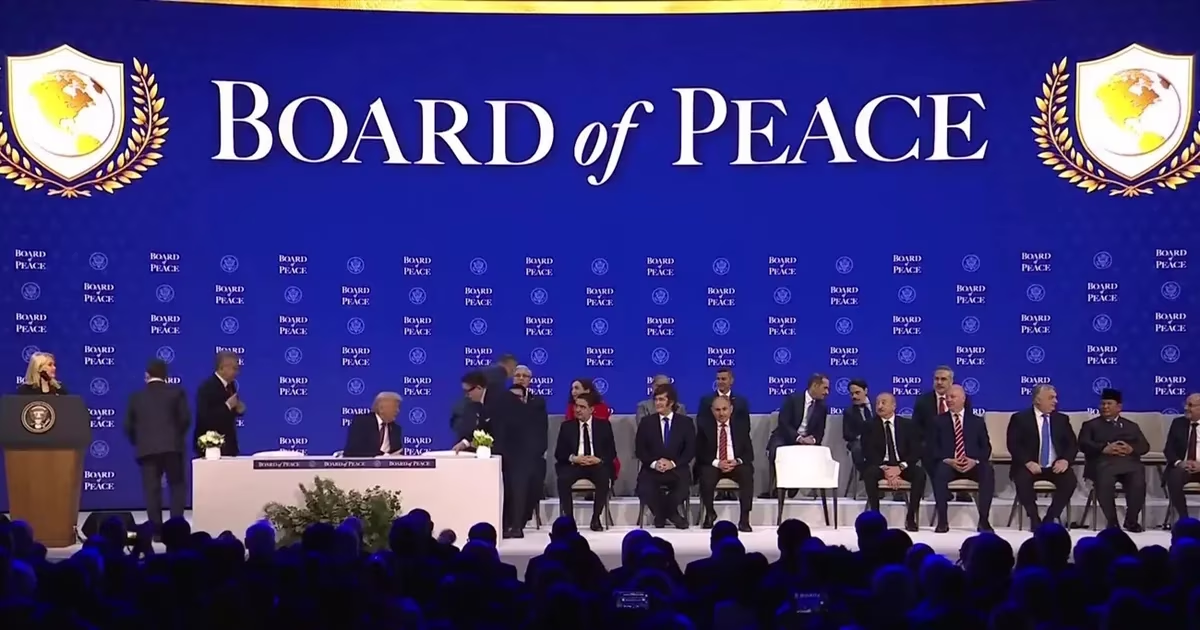
Among the ironies of the man fascinated by his power, and possessed by overflowing narcissism, is that while he formed a peace council, he does not stop igniting fires and practicing thuggery in the manner of "Pirate Morgan" who attacked pirate ships and stole them, under the pretext that he attacks thieves to achieve justice!
Between forming alleged peace councils and beating the drums of war, Trump appears as "Don Quixote" in the age of "cyber" and "internet," chasing windmills, which shows him as a man still living in the sixteenth century.        
Under the weight of feeling proud of his excess power, the man with the volatile mood misses that history only repeats itself as a comedy, and that the winds that destroyed Philip II's fleet may not this time bring what his warships and aircraft carriers, which are flocking to warm waters, desire.

PALESTINE

Sun 25 Jan 2026 5:35 am - Jerusalem Time

CBS editor-in-chief refuses to condemn "Israel" after assassination of photographer working with her

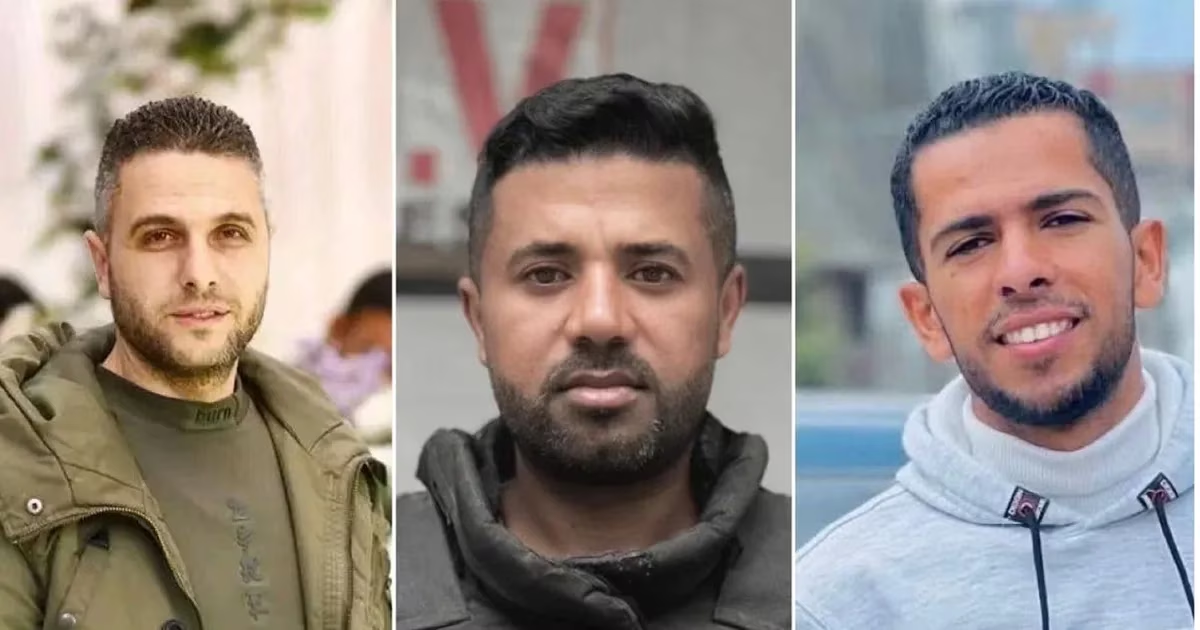
The Israeli occupation assassinated three Palestinian journalists, including a photographer and collaborator with the American network "CBS NEWS", after targeting a vehicle accompanying a media crew while covering the distribution of humanitarian aid in the central Gaza Strip, in an incident that sparked widespread condemnations from media and human rights organizations, in contrast to the silence of the network's editor-in-chief herself.

Field sources stated that journalists Muhammad Salah Qashta, Abdul Raouf Samir Shaat, and Anas Ghoneim were using a drone to film an activity of the Egyptian Relief Committee in the Al-Zahra area when an airstrike hit one of the committee's cars.

The spokesman for the Egyptian Relief Committee, Mohamed Mansour, told Agence France-Presse that "the Israeli army criminally targeted the car," while the occupation army announced that its forces had detected "suspects operating a Hamas drone in the central Gaza Strip, in a manner that posed a threat."

Palestinian human rights and media organizations deny this narrative, pointing to the repeated accusation of journalists and civilian cadres of belonging to armed factions without providing public evidence.

CBS News said that Abdul Raouf Samir Shaat, who was in his thirties and recently married, had worked for years as a freelance photographer with the network and other international media outlets.

Agence France-Presse also issued a statement mourning Shaat, describing him as a committed journalist, and demanded a full and transparent investigation into his martyrdom, noting the increasing number of local journalists who have been martyred in Gaza amid the continued prevention of foreign journalists from entering.

Shaat's colleagues at the CBS News office in London expressed their sadness, describing him as a brave journalist. In contrast, no public comment was issued by Bari Weiss, the network's editor-in-chief, which drew criticism from observers and media professionals, especially given the known positions of her media platform "Free Press" which supports "Israel."

In contrast to this silence, international organizations defending press freedom were quick to condemn the incident. The Palestinian Journalists' Syndicate described what happened as a deliberate assassination and a war crime, while organizations such as "Reporters Without Borders" and the "Committee to Protect Journalists" called for an independent investigation.

Sarah Qaddah, the regional director of the Committee to Protect Journalists, said that "the targeting of a civilian car bearing clear markings led to the killing of independent photojournalists, despite the ongoing ceasefire," stressing that "Israel is obligated under international law to protect journalists."

PALESTINE

Sun 25 Jan 2026 3:50 am - Jerusalem Time

Wall Street Reveals Israel's Support for New Militias in Gaza Against Hamas

The Wall Street Journal reported on Israel's unannounced reliance on new Palestinian militias inside the Gaza Strip to confront the Islamic Resistance Movement (Hamas), a move aimed at circumventing restrictions imposed on the Israeli army under the ceasefire agreement, according to the newspaper. These armed groups operate in Israeli-controlled areas but carry out attacks within areas supposedly outside the scope of Israeli military operations, benefiting from direct support including intelligence, aerial support from drones, and various supplies.

Israel's reliance on these groups became public when Hussam Al-Astal, a leader of one of these militias, boasted about claiming responsibility for killing a Hamas police official in the Al-Mawasi area, threatening to continue targeting members of the movement. Al-Astal told the newspaper in a phone interview, speaking about the policeman, that he "was causing problems for people who wanted to come to us. He was hurting us. Anyone who tried to reach us was shot. And whoever replaces him will be killed." Al-Astal said in a video message, in which he appeared brandishing an assault rifle, "We say to Hamas and to everyone who belongs to Hamas: just as we reached them, we will reach you too."

Tools for Occupation

Al-Astal's group includes dozens of armed men living in a part of Gaza controlled by Israel. Hamas described the team that carried out the killing as "tools for the Israeli occupation" and threatened to punish those who cooperate with Israel, saying that "the price of betrayal is high and costly."

Al-Astal denied receiving any assistance from Israel except food, but testimonies from Israeli officials and soldiers confirm close coordination and Israeli intervention to protect him and his group when needed. Yaron Buskila, who served as a senior operations officer in the Israeli army's Gaza Division until the ceasefire came into effect in October, said, "When they go and carry out activities against Hamas, we are there to monitor them and sometimes to help them. This means helping them with information, and if we see Hamas trying to threaten them or approach them, we intervene effectively."

The American newspaper believes that this cooperation, which arose from a shared animosity towards Hamas, is a useful tool for Israel after its forces were restricted by the terms of the ceasefire in Gaza, as these militias can access areas under Hamas control that are supposed to be off-limits to Israeli forces, such as Al-Mawasi where Al-Astal's men killed the police official.

No Popularity, No Legitimacy

The Wall Street Journal report indicates Israel's use of other militias, such as the "Popular Forces," in complex field operations, including an attempt to lure Hamas fighters out of tunnels in Rafah, in addition to their participation in killings of movement members, documented with video clips published on social media.

An Israeli reserve soldier stationed in Gaza said he accompanied aid convoys supplying a militia in Rafah during the summer, and the supplies included food, water, cigarettes, and sealed boxes with unknown contents, placed in vehicles by the Israeli internal security service (Shin Bet).

This policy, according to the newspaper, comes amid the Israeli government's refusal to replace Hamas with the Palestinian Authority in Gaza, and after the failure of previous attempts to cooperate with local clans due to Hamas's elimination of candidates for local governance.

Despite some militias managing to survive and form small communities in Israeli-controlled areas, they have not yet succeeded in becoming a real alternative to Hamas, due to their limited popularity, some being linked to looting and criminal activities, and Hamas's continued ability to re-establish its influence. A large segment of Gaza's population also views these groups as collaborators with Israel, which limits their ability to gain local legitimacy.

ISRAELI AFFAIRS

Sun 25 Jan 2026 1:15 am - Jerusalem Time

Israeli Admission: Gaza Peace Council is the Truest Expression of "Our Political Failure"

While the occupying state expresses its objection to the composition of the Peace Council and the administrative committee for the Gaza Strip, Israelis are raising sharp questions to their government, which has led to Turkey and Qatar participating in the Peace Council that will govern Gaza, claiming that this poses a security risk to them, given that both countries support Hamas and are not friends of the occupation, while Turkey generally seeks regional hegemony.

Avi Shilon, a writer for Yedioth Ahronoth, stated that "the right-wing government is responsible for the deterioration of affairs to this level, because one of the options was to replace the Hamas regime with another Palestinian system, but it refused to allow the Palestinian Authority to control Gaza, claiming it could not be trusted. Among other options was involving more moderate countries, such as Egypt and Saudi Arabia, but the Israeli refusal to respond to the Saudi demand to announce its agreement to the two-state solution, even in principle, also led to the collapse of this option."

Shilon added in an article that "another option is to continue fighting Hamas and militarily govern Gaza, but despite Smotrich's ambitions, the cost of staying in Gaza is extremely high, almost impossible, even for a right-wing government. Thus, the government, which rejects any possibility of negotiating with the Palestinians themselves, found itself facing the only remaining option to replace the Hamas regime through a 'Peace Council' that will govern Gaza, and which includes, it should be noted, friendly countries, alongside Turkey and Qatar."

The writer explained that "the United States has its own interests in involving Qatar and Turkey in the administration of Gaza, but it is important to remember that without the pressure exerted by these two specific countries on Hamas to agree to Trump's plan, the movement would not have accepted it. Therefore, the problem for Netanyahu, who deceived Israelis with the slogan of 'complete victory,' lies in his inability to tell them the truth, because for those who oppose any Palestinian option and at the same time reject the occupation of Gaza, the best possible alternative is an international council that includes powers not aligned with Israel."

Shilon pointed out that "another reason for this current reality is the government's refusal to discuss 'the day after' throughout the war, and its failure to initiate any plan for post-Hamas, which allowed the United States under Trump to impose its position. It now seems too late to argue with the administration, especially since Trump's handling of the French president, due to his opposition to the policy towards Greenland, indicates the seriousness of entering into disputes with him."

He also affirmed that "the current scene in Gaza today expresses the reality of Israeli political failure, despite the military achievement that weakened Hamas. However, this is the chronic problem of the Likud, which suffers from the difficulty of converting military achievements into political options, and contenting itself with a policy of reactions. This calls for the potential opposition bloc to define its alternative policy, and not just be content with the clear need for correction from the current government's policy."

ARAB AND WORLD

Sun 25 Jan 2026 1:00 am - Jerusalem Time

Widespread attack on Saudi newspaper over article criticizing Abu Dhabi's actions.. What is the occupation's connection?

Activists and "Israeli" writers, led by the famous journalist Barak Ravid, launched a scathing attack on Saudi Arabia after an article was published in "Al Jazeera" newspaper discussing Saudi-Emirati relations and criticizing normalization with the occupation.

Al-Jarida newspaper published an article by writer Ahmed bin Othman Al-Tuwaijri, in which he addressed Emirati-Saudi relations, directing clear criticism at Abu Dhabi's regional role and its role, which he described as destructive in Arab countries and even against Muslim minorities in the world.

The sentence that angered the occupation was "Israel is on its way to rapid demise, and the nation remains." Following the Israeli criticism, several accounts stated that "Al Jazeera" newspaper deleted the article from its official website and platforms, but it is still visible on its official website.

The well-known Israeli journalist Barak Ravid posted a quote from the article on the "X" platform, saying, "As part of the media war waged by Saudi Arabia against the UAE, Saudi press is filled with articles containing anti-Israel conspiracy theories, anti-Abraham Accords rhetoric, and even antisemitic language. This article is just one example among many. It is clear that this trend comes from the highest levels."

Jonathan Greenblatt of the Anti-Defamation League, along with Israeli officials, expressed their deep concern about this article published by Saudi Press, which they said contained "antisemitic language."

It was noteworthy that Emirati writers on the "X" platform, led by Amjad Taha, celebrated the Israeli media attack on Saudi Arabia, because of what they said was a retraction and deletion of the article, considering it a victory for the Israeli narrative and confirmation of the occupation's strength within the ongoing squabbles between Saudi and Emirati media that erupted after the events in Yemen.

ISRAELI AFFAIRS

Sun 25 Jan 2026 1:00 am - Jerusalem Time

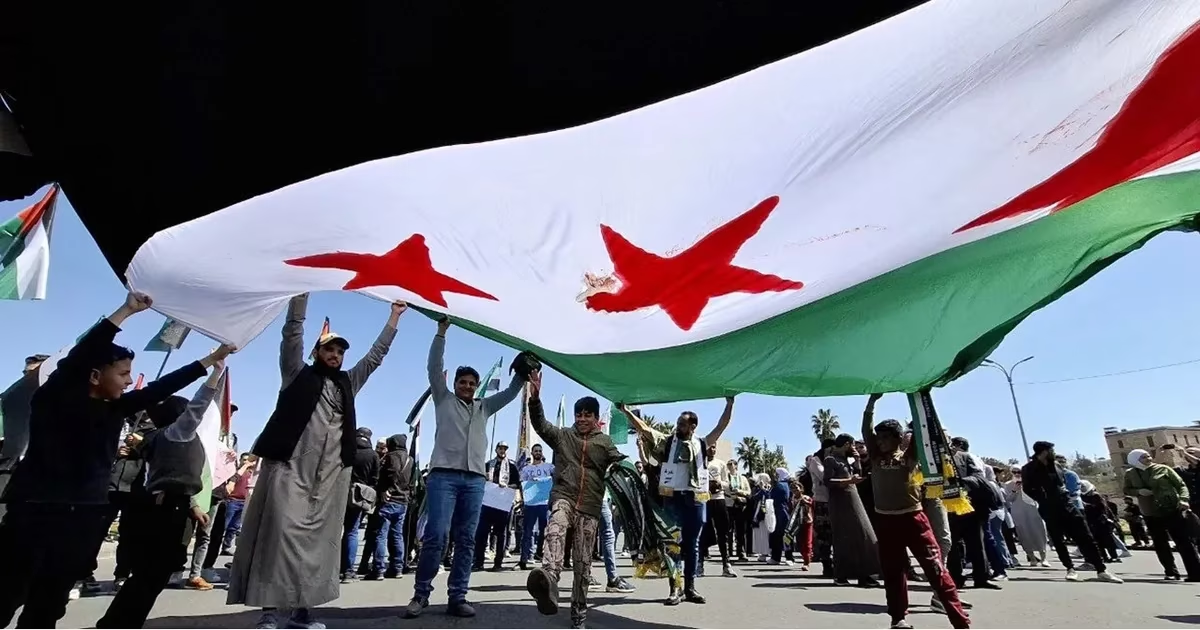
Israeli calls for a security agreement and normalization with Syria

While the occupation continues its aggression against Syria, Israeli voices are emerging calling for a new reading of what they consider "common interests with the new regime," and advocating for placing them at the forefront of political action in the future relationship between Damascus and Tel Aviv.

The former head of the National Security Council, Tzachi Hanegbi, affirmed in an article published by the "Yedioth Ahronoth" newspaper that "the Israeli political and security agenda revolves around important developments in two areas: in Gaza, where the second phase of the 'Twenty Points' plan launched by US President Donald Trump has begun; and in Iran, where a phase of anticipation has begun, characterized by ambiguity regarding the future of the protests and its policy towards them."

Hanegbi added that "in both areas, Israel's ability to influence events seems limited. Therefore, I propose starting a political move in another area, which is the Syrian area, with the aim of quickly reaching a comprehensive security agreement with it, after the previous agreement with it for the separation of forces signed in 1974 after the October War lasted fifty years, which is the longest duration for any other agreement with an Arab country, despite the many challenges that threatened its validity."

He explained that "the fall of Bashar al-Assad's regime in December 2024 effectively ended this agreement, as the Israeli army, under the guidance of the political leadership, launched 'Operation Bashan Arrow,' moving quickly and decisively, and took control of areas adjacent to the Syrian border with the Golan Heights, including Mount Hermon. At the same time, Israel launched widespread attacks throughout Syria to destroy strategically important weapons caches and prevent them from falling into the hands of the new regime."

He affirmed that "during the period since then, Israel has strived to achieve two ambitious political goals in the north: first, to exploit the ceasefire agreement signed in November 2024 to promote Lebanon's accession to the normalization and peace process; and in Syria, the goal is to formulate a two-stage process that begins with organizing security arrangements on the common border, and continues with Syria's accession to the normalization agreements."

He pointed out that "without effective American participation, it is impossible to make progress on these two axes, and therefore the US President appointed his ambassador to Turkey, Tom Barrack, as his personal envoy to promote this vision, who showed diligence and initiative, and made great efforts, working in full harmony with Minister Ron Dermer, seeking to resolve disputes with Lebanon and Syria. However, the current situation shows a complex picture."

He explained that "the situation in Lebanon is characterized by portraying President Joseph Aoun as a leader committed to the future of his country, not to external interests, especially Iranian ones, which brought him to the brink of the abyss. Despite his good intentions, he failed in his attempts to implement the central clause in the agreement signed with Israel, which is the disarmament of Hezbollah throughout Lebanon, and there are many reasons for this, the most important of which is the inherent weakness of the Lebanese army, and Aoun and his government's fear of an escalation of the civil war."

He added that this "coincides with the severe blows Hezbollah has already suffered during a year of fighting with Israel, and is evident in its decision to refrain from responding to hundreds of assassinations and violent attacks launched against it as part of its policy of imposing sanctions for violations of the agreement by force. However, thanks to its clear military superiority, it deters its opponents from taking any bold political moves, and the result is no practical progress in the tripartite dialogue led by the United States on the issues of the dispute on the Israeli-Lebanese border."

He noted that "Israel has made it clear that its forward military deployment in southern Lebanon will not change as long as Hezbollah poses a threat to northern settlers; and an escalation of the conflict now seems more likely than reaching understandings, and as reported, a continuous political dialogue has been ongoing between Tel Aviv and the new regime in Syria for some time, and I participated in it, and I saw that common interests outweigh divisive interests."

He revealed that "as part of my mission as head of the National Security Council, I held a series of secret meetings on the Syrian issue, and Israel's main concern is that Syria becomes a Turkish protectorate on its northern border, and given President Erdogan's hostile rhetoric, this concern is not unfounded, because the most effective way to thwart this scenario is to maximize Syria's expected gains from joining the Middle East peace initiative launched by Trump, because it was and still is the American strategy."

He affirmed that "in the absence of American influence, finding a balance between the interests of Tel Aviv and Damascus becomes more difficult, but it is possible, because in negotiations aimed at establishing new security arrangements, the Syrians are likely to demand an Israeli withdrawal from the new areas that the Israeli army has been preparing to defend since the end of 202, and the solution to this issue may be based on finding the optimal balance between the Israeli presence on Syrian territory, and the actual implementation of measures that guarantee the vital security interests of the occupation, which will increase Israel's margin of flexibility."

PALESTINE

Sat 24 Jan 2026 4:00 pm - Jerusalem Time

The "Israeli" army claims to have targeted "militants" after they crossed the yellow line north of the Gaza Strip, alleging they planted an explosive device

Hebrew media circulated claims from the occupation army, alleging that they monitored and targeted a group of Palestinians in the northern areas of the Gaza Strip, under the pretext of their attempt to carry out a security operation across the separation fence.

According to what was published by Hebrew media, the occupation army claims that its field forces dealt with what it described as an "infiltration" by a group of militants after they crossed what is called the "yellow line" in the northern Gaza Strip.

The narrative issued by the occupation claims that this group planted an explosive device in the area before they were targeted by military units, claims that the occupation has consistently published to justify the continuous shootings in the border areas.

The occupation's claims are based on the penetration of what is called the "yellow line," which is the zone where the occupation army imposes buffer zones that Palestinian citizens are prohibited from being in.

Through these claims, the occupation seeks to justify its constant monitoring and targeting of any movement along the fence, claiming that the group's activity was targeting its military vehicles.

PALESTINE

Sat 24 Jan 2026 4:00 pm - Jerusalem Time

Sisi warns of consequences of displacing Gaza residents and calls for an end to obstruction of humanitarian aid

Egyptian President Abdel Fattah El-Sisi stressed Egypt's categorical rejection of any attempts aimed at displacing the Palestinian people from their land, warning of the international repercussions of this step, and at the same time emphasizing the need to facilitate the unimpeded access of relief convoys to the Gaza Strip.

In a firm stance reflecting Egyptian constants, President Abdel Fattah El-Sisi reiterated his rejection of attempts to forcibly displace Palestinians from their lands, considering that the displacement of Gaza residents will not only affect the region but will lead to major global crises.

The President explained that this scenario would result in the displacement of hundreds of thousands of Palestinians towards Europe and Western countries, placing the international community before a direct responsibility to prevent the emptying of the Palestinian issue of its content and to avoid exacerbating the global refugee crisis.

Regarding relief efforts, President Sisi reiterated during his speech the necessity of not obstructing humanitarian aid directed to the Gaza Strip. He pointed out that Egypt is making strenuous efforts to ensure the smooth entry of basic needs, noting that the "Sharm El Sheikh Agreement" stands as a prominent witness to Egyptian endeavors aimed at supporting brethren in Gaza and alleviating the severity of the humanitarian tragedy suffered by civilians there.

The President linked regional stability with the strength of the national state, reiterating Egypt's categorical rejection of the establishment of any entities or militias parallel to official state institutions. He affirmed that Egypt will remain an oasis of security and stability, and that preserving the prestige of national institutions is the only way to confront the challenges facing the region, whether security or political, which reflects Cairo's vision in strengthening the concept of sovereignty and legitimacy.

These statements came during the President's participation in the celebration of the seventy-fourth anniversary of Police Day, which falls on January 25, at the Conference Complex at the Police Academy in New Cairo. The President was keen to use this national occasion to send comprehensive messages to both domestic and international audiences, emphasizing that Egypt's security and stability are closely linked to protecting Palestinian rights and preventing any steps that threaten demographic or security balance in the region and the world.

PALESTINE

Sat 24 Jan 2026 3:00 pm - Jerusalem Time

Protected by the occupation army.. injuries in a series of settler attacks in the West Bank

Various areas of the occupied West Bank have witnessed, since Saturday morning, a serious escalation in settler attacks, carried out under the cover and protection of the Israeli occupation army forces, targeting citizens, their property, and their agricultural crops.

In the vicinity of occupied Jerusalem, armed settlers attacked farmers in their lands in the village of Mikhmas (northeast), and tried to prevent them from working by force of arms. This attack comes days after a similar assault on the Bedouin gathering of "Khillet al-Sidra" near the village, which resulted in injuries to citizens and foreign solidarity activists, and the burning of homes and vehicles.

In Hebron (south), a Palestinian woman was injured as a result of an attack launched by settler militias on the home of the Wadi Sa'ir guard north of the governorate.

In Ramallah Governorate, the attacks focused on the towns of Turmus Ayya and Sinjil:

Turmus Ayya: Settlers from the "Shilo" settlement attacked the home of the "Abu Awwad" family, in an attempt to impose forced isolation on them. It is worth noting that the occupation recently bulldozed thousands of dunams and uprooted 4,000 olive trees around the house for the benefit of a new settlement outpost.

Sinjil: Settlers grazed their sheep in citizens' crops in the areas of "Abu Al-Awf" and "Sha'ab Al-Nimr"; which led to their destruction. The mayor, Moataz Tawafsha, confirmed that the occupation has prevented access to 8,000 dunams in that area since the events of October 7, 2023.

In the context of monitoring, the Wall and Settlement Resistance Commission documented alarming figures for the extent of attacks during the past month, reaching 766 attacks, distributed as follows:

Ramallah and Al-Bireh: 195 attacks.

Nablus: 179 attacks.

Hebron: 126 attacks.

On the other hand, the occupation forces set up a military checkpoint at the entrance to the village of Marah Rabah, south of Bethlehem, where they detained a number of young men and checked the identities of citizens, causing a severe traffic jam.

PALESTINE

Sat 24 Jan 2026 2:00 pm - Jerusalem Time

On the 105th day of the truce.. one dead and injuries by occupation fire and "quadcopter" targets civilians in Khan Yunis

Eyewitnesses confirmed that an Israeli drone of the "quadcopter" type fired at him near the Jasser building intersection, in a continuation of the escalating series of Israeli occupation violations of the ceasefire agreement that has been in effect for 105 days. A Palestinian citizen was killed and others were injured, on Saturday morning, as a result of direct targeting by the Israeli occupation army in various areas south and north of the Gaza Strip.

Martyrdom and "drone" bullets

Local and medical sources reported details of the attacks recorded in the past hours:

Jabalia (north): A local source confirmed the martyrdom of one person and several injuries; as a result of the occupation forces targeting a group of citizens in Jabalia al-Balad on the old Gaza street this morning.

Khan Yunis (south): A citizen (47 years old) was shot in the head early this morning in the city center. Eyewitnesses confirmed that an Israeli drone of the "quadcopter" type fired at him near the Jasser building intersection, an area from which the occupation army had previously withdrawn under the terms of the agreement.

Beit Lahia (north): A citizen was shot by the occupation in the Al-Salatin area west of the city.

Intense aerial and naval bombardment

Violations were not limited to direct shooting, as the eastern and coastal areas witnessed military escalation:

Air raids: Occupation aircraft launched raids on areas southeast of Khan Yunis.

Naval bombardment: Warships fired randomly towards the coast of Khan Yunis city.

Artillery shelling: Israeli artillery heavily shelled the eastern areas of Gaza City, while vehicles stationed east of Al-Maghazi camp (central Gaza Strip) fired towards citizens' homes.

Blood statistics: After and before the "halt"

According to official statistics, the number of Israeli violations since the ceasefire agreement came into effect has reached:

496 martyrs.

1301 injured.

It is worth noting that this agreement came to end a two-year genocide war (which began on October 8, 2023), and left catastrophic numbers:

More than 71,000 martyrs.

More than 171,000 injured.

90% of civilian infrastructure destroyed.

Reconstruction cost estimated by the UN at about $70 billion.

PALESTINE

Sat 24 Jan 2026 2:00 pm - Jerusalem Time

UN Warning.. Lazzarini: West Bank Faces the Worst "Humanitarian Catastrophe" Since 1967

In a strongly worded UN warning reflecting the silent catastrophe sweeping through the Palestinian territories, the Commissioner-General of the United Nations Relief and Works Agency for Palestine Refugees (UNRWA), Philippe Lazzarini, sounded the alarm, declaring that the occupied West Bank is experiencing the "worst humanitarian crisis since 1967."

In a post published on his official account on the "X" platform (formerly Twitter), Lazzarini linked this unprecedented deterioration to ongoing Israeli military operations. The UN official revealed alarming figures related to the results of the military operation that the occupation named "Iron Wall," stating: "One year after the start of the Israeli military operation called (Iron Wall), 33,000 people remain forcibly displaced from Palestinian refugee camps in the northern West Bank."

The issue was not limited to displacement, as Lazzarini pointed to the systematic destruction of infrastructure, explaining: "Israeli forces continue to demolish large areas of the camps; which reduces the chances of these communities recovering," in reference to the difficulty of restoring life to normal amidst the massive destruction.

Regarding the agency's field situation, Lazzarini affirmed that UNRWA teams are still working on the ground to assist refugees who "have been newly displaced and pushed into further poverty," warning of the absence of viable alternatives for accessing healthcare, education, and social services.

The Commissioner-General concluded his statement with an appeal to the international community, emphasizing: "UNRWA continues its work, but to continue this work, we need sustained political and financial support from member states"; to ensure the lifeline for Palestinian refugees remains.

PALESTINE

Sat 24 Jan 2026 1:00 pm - Jerusalem Time

Satellite images reveal: "Israel" shifts "Yellow Line" and encroaches on parts of Al-Tuffah neighborhood, east of Gaza

Satellite images and analysis, along with testimonies from local residents, showed that "Israel" moved concrete blocks into the Al-Tuffah neighborhood in Gaza City; a move Palestinians considered a "clear violation" of the US-backed ceasefire agreement, which was supposed to define the "Yellow Line" as a dividing line between Israeli forces and Palestinian-controlled areas.

The images indicate that the blocks, which were initially on the borders of the "Yellow Line," were moved up to 200 meters into territories controlled by the "Hamas" movement; leading to the destruction of dozens of buildings and the displacement of thousands of residents who had sought refuge in the Al-Tuffah neighborhood after the ceasefire came into effect last October. The images also showed "Israel" establishing at least six military fortifications in different areas, some of which are located only 264 meters from the control line.

Palestinians say they were forced to flee, including Manal Abu Al-Kas and her family, who lost two of her children in the neighborhood, and had to leave their home after the blocks were moved. She said: "We stayed at home until they started placing the yellow stone, then we left under pressure and bombardment."

Reports indicate that the movement of blocks and destruction of buildings were not limited to the Al-Tuffah neighborhood, but also included other areas in Gaza, including Khan Yunis; where two blocks were placed at distances of up to 390 and 220 meters behind the "Yellow Line," in addition to the destruction of tent encampments designated for displaced persons.

For its part, the Israeli army denied in a statement that it had changed the "Yellow Line," noting that its demarcation is done visually according to terrain and topographical conditions, and that the published maps of the line were "illustrative," but it did not explain why the blocks were moved or buildings destroyed. In contrast, Hazem Qassem, a spokesman for "Hamas," said that "Israel" continues to push the Yellow Line westward; which narrows the area of the Strip and confines its residents to a strip 30 percent smaller than the original area," stressing that the US-backed agreement limits "Israel's" control to more than half of the Strip, linking the withdrawal of forces to the disarmament of "Hamas."

Despite the ceasefire agreement, Israel continues to fire on Palestinians in areas surrounding the Yellow Line, accusing militants of attempting to cross the line or attack forces, while the army uses drones to monitor the area. Fighting since the agreement came into effect in October has resulted in the deaths of more than 460 Palestinians, including children, compared to the deaths of three Israeli soldiers.

These movements raise fears of an actual division of the Strip, with the possibility of reconstruction operations being limited to areas under Israeli control, while millions of Palestinians remain forced to live in cramped areas or in tents and destroyed buildings.

PALESTINE

Sat 24 Jan 2026 10:21 am - Jerusalem Time

Transfer of Civil Administration in Gaza Begins Amidst Ambiguity Over Hamas's Political Future

Said Erikat

Opinion Writer

News Analysis

While US President Donald Trump celebrates the launch of what is known as the "Peace Council," the outlines of a complex transitional path are unfolding on the ground in the Gaza Strip, governed by Israeli restrictions and shrouded in deep political and security questions. Despite Israel's continued prevention of members of the "Gaza Administration Committee" from entering the Strip, data indicates that initial steps to transfer civil administration from the "Hamas" movement to the committee have already begun.

Sky News Arabia reported that meetings took place between Sami Nesman, a member of the Gaza Administration Committee tasked with overseeing the Ministry of Interior, and his counterpart in the Hamas movement, Jamal Al-Jarrah. The discussions focused on mechanisms for transferring operational powers related to the police and internal security. However, the Israeli newspaper "Haaretz" quoted a high-ranking Palestinian official as saying that what is happening does not amount to a "complete professional handover," but is limited at this stage to administrative coordination that includes exchanging employee names and understanding the procedures in place during Hamas's rule.

According to multiple news reports, Nesman is well-known in Gaza. He was born in the Shati refugee camp and lived for many years in the Sheikh Radwan neighborhood, which gave him a precise knowledge of the family and tribal structure and the social balance of power in the Strip. In his youth, he joined the "Shabiba" movement affiliated with "Fatah" and participated in the First Intifada, and was wanted by the Israeli "Shin Bet" on suspicion of participating in the liquidation of collaborators.

After fleeing Gaza, Nesman returned in 1994 following the signing of the Oslo Accords, taking advanced positions in the Palestinian intelligence apparatus, where he worked under the late Major General Amin Al-Hindi, and contributed to efforts to prevent the entrenchment of Hamas's influence in the Strip. However, Hamas's takeover of Gaza in 2007 forced him to leave the Strip again and settle in Ramallah, while the movement continued to pursue him, later accusing him of running intelligence networks against it, and he was sentenced in absentia to 15 years in prison in 2016.

In recent years, Nesman was marginalized within the Palestinian Authority institutions, especially after joining the group of retired officers affiliated with Mohammed Dahlan, who has relations with a number of members of the Gaza Administration Committee, including its head, Ali Shaath. Despite this controversial legacy, Hamas did not officially object to Nesman's appointment, as it does not have veto power over the selection of committee members.

Observers recall here the experience of 2017, when Egyptian-sponsored talks, with the participation of the UAE, took place regarding the formation of a committee to administer Gaza headed by Dahlan, with reports at the time speaking of Abu Dhabi allocating $15 million to fund its work. Despite the failure of that initiative, the UAE's joining the "Peace Council" reinforces estimates that Dahlan and his allies are preparing for the next stage, with the committee's work on the ground approaching, according to experts.

In a parallel context, "Sky Arabia" published an unconfirmed report stating that Hamas and the United States had reached a preliminary understanding that the movement would abandon its weapons and hand over maps of undiscovered tunnels, in exchange for being allowed to transform into a legitimate political party, and ensuring the exit of its elements from Gaza without threat. According to the report, Israel strongly objected to some provisions of this proposal.

Despite the absence of official confirmation, previous statements by Bishara Bahbah (who works for the team of US envoy Steve Witkoff, who played a liaison role between Hamas and the White House) spoke of disarming the movement "in stages" as part of broader arrangements related to a ceasefire agreement. Also, the discussion of reopening the Rafah crossing and beginning rubble removal and reconstruction operations, before complete disarmament, may reflect a degree of American flexibility, despite Trump's publicly tough rhetoric.

The most prominent challenge facing the Gaza Administration Committee, according to American sources, is the huge functional structure left by Hamas. About 11,000 police officers and employees worked in the Ministry of Interior alone, while estimates indicate that more than 50,000 civil servants—including teachers, doctors, and engineers—were paid by the Hamas government. According to Palestinian sources, it was agreed to continue the work of employees in the education, health, and civil defense sectors after subjecting them to security checks, in exchange for the gradual retirement of those working in the security apparatus.

Palestinian officials acknowledge that the committee will not be able, in the foreseeable future, to dispense with cadres who previously worked with Hamas, given the new administration's need for continuity of services. However, control over these institutions, through which reconstruction funds will pass, may turn into the next arena of political conflict, in the absence of direct Israeli oversight mechanisms over the civil aspect of the "Peace Council."

Experts estimate that what is happening in Gaza cannot be separated from the re-engineering of the entire Palestinian scene, where open military conflict is being replaced by a conflict of administrative and financial influence. The transfer of civil administration does not mean the end of Hamas, but rather its transition to a less confrontational and more flexible space, allowing it to reproduce its influence from within institutions. In this context, the question becomes not whether Hamas will disappear, but how it will return, with what tools, and under what political cover.

These believe that the public expressions of gratitude directed by Palestinian factions to the Trump administration represent a striking linguistic and political shift, reflecting an understanding that international power balances are not managed by slogans but by pragmatic positioning. However, this shift carries its risks, as it may be understood as implicit acceptance of a political framework that does not address the roots of the Palestinian issue. Relying solely on international legitimacy, without genuine national unity, may reproduce the crisis.


PALESTINE

Sat 24 Jan 2026 9:04 am - Jerusalem Time

The Flood: A New Book by Mohamed El-Tamawy Discusses the Strategic Dimensions of the Gaza War

The book “The Flood: Gaza Between Gunpowder and Diplomacy” by Dr. Mohamed El-Tamawy, a researcher in political economy and international relations, was recently published by Knooz Publishing and Distribution House. The book presents an in-depth analytical study of the events of October 7, 2023, through a comprehensive approach to the recent Gaza war, placing it in its broader political and strategic context, far from simplification or preconceived notions.


The book starts from the premise that the war on Gaza is a complex phenomenon in which military, political, and economic dimensions intertwine, and it cannot be understood as merely a traditional military confrontation. The author seeks to deconstruct the logic of modern warfare, explaining how armed conflicts have become part of an international system where military decisions are influenced by broader strategic calculations, including power balances, arms industries, and international political interactions.


The book addresses the geopolitical and economic importance of the Gaza Strip, especially its location on the map of the Eastern Mediterranean, explaining that the imposed blockade is not limited to security considerations but is also linked to economic and strategic factors, including natural resources and development potential. The author presents a vision that considers Gaza's economic future a crucial element in any equation for sustainable regional stability.

The book also pauses at the events of October 7, analyzing the political and humanitarian context that preceded them, in a framework that seeks understanding, not justification or condemnation. The author presents a series of questions related to strategic choices, their humanitarian repercussions, and their impact on Gazan society, in an attempt to provide a balanced critical reading that acknowledges the complexity of reality and the intertwining of its factors.

The author dedicates chapters to analyzing internal Israeli policies, especially the impact of internal political considerations on conflict management, explaining how wars in some contexts can turn into tools for managing political crises, without definitively determining their long-term security outcomes. He also points to divisions within Israeli society, the challenges to the deterrence image, and the repercussions of the war on Israel's international standing.

At the international level, the book discusses the positions of major powers, frameworks for dealing with the humanitarian crisis, and the role of regional mediations, with special attention to the Egyptian role in containing escalation and preventing its regional expansion, and maintaining communication channels amidst the complexities of the international scene.

In its final chapters, the book offers a deeper intellectual reading, linking what is happening in Gaza to theories of conflict management, population control, and the use of non-military tools in modern conflicts, such as blockade, economic pressure, and media discourse, as influential elements in shaping political and social reality.

The book concludes that the Gaza war represents a contemporary model for the complexities of the international system, where humanitarian considerations intersect with political and strategic calculations, emphasizing that understanding these interactions is an essential prerequisite for any realistic approach seeking stability and peace.

It is worth noting that Dr. Mohamed El-Tamawy previously published the book “The Encrypted Future Between International Crises and Digital Currencies: How Blockchain Changes Economy, Law, and Governance,” with an introduction by Professor Dr. Mohamed Sami Abdel-Sadek, President of Cairo University, in which he analyzed contemporary technological transformations and their impacts on the global economy, legal systems, and governance mechanisms, within an academic analytical framework.

PALESTINE

Sat 24 Jan 2026 8:35 am - Jerusalem Time

Demolition of UNRWA headquarters.. Targeting UN immunity in Jerusalem

Adnan Abu Hasna: Israel is working to end UNRWA's presence in Jerusalem and is placing obstacles to its work in the West Bank and Gaza

Dr. Riyad Al-Aila: Demolishing and seizing UNRWA headquarters is a direct assault on the UN's mandate and the system of legal protection

Mazen Al-Jaabari: Targeting UNRWA in Jerusalem is a practical announcement of the demise of international legitimacy and a shocking message to all who bet on its effectiveness

Dr. Talal Abu Afifa: What happened under Ben Gvir's supervision is an assault on the United Nations and international law that requires action to prevent the continuation of the crime

Osama Al-Sharif: It is not surprising that a UN headquarters was demolished coinciding with Trump's attempt to seize Greenland and replace the global system with a council he personally leads

Fadl Tahboub: Israeli policy is based on trying to end the camps, as happened through the displacement of their residents in the northern West Bank and continued targeting

Exclusive to "Al-Quds" - The demolition of the headquarters of the United Nations Relief and Works Agency for Palestine Refugees (UNRWA) in the Sheikh Jarrah neighborhood of Jerusalem last week, by Israeli occupation forces and with the presence and supervision of Israeli National Security Minister Itamar Ben Gvir, was nothing but a step with deep political and legal dimensions, opening a wide door to serious repercussions affecting the immunity and status of the United Nations and its role in the occupied Palestinian territories. 

Officials, writers, and political analysts, in an interview with "Al-Quds", believe that the scene that accompanied the bulldozers was not limited to removing buildings, but rather touched the essence of UN immunity, and sent a direct message challenging the international law system in one of the most sensitive issues.

According to officials and writers, this demolition comes within a gradual context of measures aimed at undermining UNRWA's presence in East Jerusalem, including closing schools and clinics, cutting off basic services, preventing the access of humanitarian aid, and restricting the movement of international staff. These steps, according to officials and writers, indicate a clear endeavor to empty the Holy City of any UN presence that reminds of the legal status of the occupation and the issue of Palestinian refugees, and to turn the humanitarian dimension into a tool of political pressure affecting the lives of thousands of families.

As for the broader goals, they indicate that targeting UNRWA headquarters goes beyond the agency itself, to fall within the framework of an attempt to erase the refugee file from the political scene, by striking the most prominent international witness to the right of return.

In light of the international community's contentment with statements of concern and condemnation, officials and writers believe that fears are escalating that this step will become a precedent that legitimizes the violation of international immunity, and puts what remains of the prestige of the international system to a decisive test between the logic of force and the force of law.


A dangerous precedent


Adnan Abu Hasna, media advisor to UNRWA, confirms that what happened to the headquarters of the United Nations Relief and Works Agency for Palestine Refugees (UNRWA) is a dangerous precedent that has never occurred before in the relationship between the United Nations system and a member state such as Israel. 

Abu Hasna stresses that Israel has absolutely no right to carry out this cruel and illegal act against any UN facility or organization.

Abu Hasna explains that UNRWA obtained this headquarters from the Jordanian government in 1952, and it is considered one of the most immune UN sites in the Middle East, equivalent in its immunity to the UN building in New York or Geneva.


Encouraging violent groups to repeat the event


Abu Hasna points out that a minister in the Israeli government accompanying bulldozers to demolish a UN headquarters is an extremely dangerous step, and may set a precedent that encourages violent groups or other countries to violate diplomatic norms, including lowering national flags or forcibly raising host country flags.

The media advisor to UNRWA explains that this development represents a major and serious violation of international law, and was preceded by many measures and violations, such as the closure of six UNRWA schools, the closure of health clinics, and the planning to establish a settlement on the site of UNRWA's headquarters in Sheikh Jarrah or in the Qalandia Vocational Training Center, in addition to cutting off water and electricity.


Actual pursuit to end UNRWA's existence


Abu Hasna points out that Israel is practically working to end UNRWA's presence in East Jerusalem in grave violation of international humanitarian law, and is also placing obstacles to the agency's work in the West Bank and Gaza Strip, including preventing international staff from entering Jerusalem, the West Bank and Gaza, and canceling permits for staff in the West Bank and preventing them from accessing Jerusalem.

Abu Hasna refers to the prevention of thousands of trucks carrying food, medicine and urgent shelter supplies from entering the Gaza Strip since last March until now, in a clear violation of international humanitarian law.


Need for intervention to stop the undermining of international law


Abu Hasna confirms that these measures have met with widespread international condemnation, but what is required of the international community now is to intervene to stop the undermining of international law and the destruction of the principles and values of the United Nations and its charters, especially since any state that joins the United Nations must sign its charter which guarantees the protection of its facilities and personnel and ensures their immunity, while Israel disregards all of this.

Abu Hasna points out that what is surprising is the unpunished passage of statements by the Deputy Mayor of Jerusalem, in which he openly called for the killing of UNRWA employees, which has never happened before.


An attempt to erase the witness to the refugee issue


Political analyst Dr. Riyad Ali Al-Aila confirms that the targeting of the United Nations Relief and Works Agency for Palestine Refugees (UNRWA) in East Jerusalem is no longer a fleeting event or an administrative measure that can be justified by flimsy legal pretexts, but has become an exposed link in a long series of Israeli occupation government policies aimed at dismantling the international presence in the Holy City, and erasing one of the most important UN witnesses to the issue of Palestinian refugees and the right of return to their homes that were usurped in 1948.

Al-Aila believes that the demolition or seizure of UNRWA headquarters does not only mean the closure of concrete buildings, but represents a direct assault on the mandate of the United Nations itself, and on the system of legal protection that is supposed to govern the behavior of states, especially in territories under occupation. 

Al-Aila points out that when UN facilities are bulldozed by the occupation, the message is clear: there is no immunity for international law, and no weight for UN institutions when they conflict with projects to impose a fait accompli by force.


Redefining Jerusalem politically and legally


Al-Aila believes that what is more dangerous is that this targeting is taking place in East Jerusalem, the city occupied since 1967, which is an integral part of the Palestinian state's territories according to international legitimacy resolutions, not an open arena for settling scores with an international organization.

Al-Aila points out that undermining UNRWA's work in Jerusalem is nothing but an exposed attempt to redefine the city politically and legally, by canceling any UN presence that reminds that Palestinian refugees have rights that cannot be demolished or confiscated.


Humanitarian need as a tool of political pressure


Al-Aila believes that the humanitarian repercussions of these steps lead to the disruption of education, health, and relief services, which pushes thousands of Palestinian families towards more poverty and fragility, and turns humanitarian need into a tool of political pressure, which exposes the falsity of claims that these measures are purely administrative, while in essence they are collective punishment, and an end to the refugee issue. 

Al-Aila stresses that the war of extermination still being waged by the occupation state by destroying and erasing refugee camps in the Gaza Strip, is wrapped in legal language, but this behavior practiced by the occupation puts the international community to a real test. 


Silence is a green light for more aggression


Al-Aila explains that silence or merely issuing statements of concern does not rise to the level of the violation, but rather gives a green light for more aggression against international institutions. 

Al-Aila asks: If a UN headquarters can be demolished in broad daylight without accountability, what remains of the prestige of the current international system?

Al-Aila points out that what is happening to UNRWA in Jerusalem is not just targeting an international agency, but an attempt to remove the refugee file from the political table, by striking the international witness before settling the issue itself. 

Al-Aila believes that defending UNRWA today is defending international law, and what remains of the idea of justice in a global system that is, alarmingly, leaning towards the logic of force rather than the force of law.

Al-Aila confirms that the demolition of UNRWA headquarters is not the end of a story, but an early warning of the collapse of red lines. Either the international community acts to protect its institutions and decisions, or it practically acknowledges that Jerusalem is governed by the law of the bulldozer, not by the scales of justice.


Striking the foundations of the international system


Jerusalemite writer Mazen Al-Jaabari believes that what the Sheikh Jarrah neighborhood in Jerusalem witnessed, from the storming of the headquarters of the United Nations Relief and Works Agency for Palestine Refugees (UNRWA), and the beginning of the demolition of its buildings and the confiscation of its lands in favor of what is called the "Israel Land Authority", and the raising of the Israeli flag over its ruins, cannot be considered a fleeting field aggression, but rather represents a practical announcement of the demise of what is known as "international legitimacy", and a shocking message to all who bet on the effectiveness of its system.

Al-Jaabari confirms that the statements of Aryeh King, the deputy mayor of the occupation and the godfather of settlement, in which he described a UN organization as a "Nazi enemy" and openly incited the liquidation of its employees, reveal that the targeting does not only affect administrative headquarters, but strikes the legal and political foundations upon which the international system was built since the partition resolution in 1947, stressing that this scene exposes the reality of the global system governed by the balance of power, not the rules of law.

Writer Al-Jaabari points out that attempts to liquidate UNRWA are based on the illusion that ending the agency's work means erasing the issue of Palestinian refugees.

Al-Jaabari explains that the agency is merely a political witness and a relief tool, while the right of return remains an existential and inherent right that does not derive its legitimacy from international funding or recognition, and does not fall with the demise of international institutions that have proven to operate within the margins imposed by dominant powers.


Ending the agency's role


Jerusalemite writer Dr. Talal Abu Afifa confirms that Israeli policy under the far-right government, led by Benjamin Netanyahu, Itamar Ben Gvir, and Bezalel Smotrich, with the support of US President Donald Trump, is working to end the role of the international relief agency, which was established after the 1948 Nakba by an international resolution to help Palestinian refugees who were forced to leave their cities, villages, and lands and were scattered in most parts of the world, the majority of whom initially settled in tents, and then camps were built for them in the West Bank and Gaza Strip with international funding.

Abu Afifa points out that what happened a few days ago, when Israeli bulldozers, under the supervision of the extremist Ben Gvir, demolished facilities in the UNRWA building in Jerusalem, which is the agency's headquarters in the West Bank, is a criminal act and a blatant assault on the United Nations and international law, requiring the international community, especially those who contributed to the establishment of the United Nations in 1945 and those who decided to establish UNRWA in 1950 thereafter, to act to prevent the continuation of this international crime.

Abu Afifa says: "We know, and the international community knows, that the Israeli plan against the international relief agency and its main headquarters in Jerusalem aims primarily to end the status of the Palestinian refugee who was displaced in 1948 and 1967, and to end the right of return for Palestinian refugees, and at the same time to end the role of the United Nations in caring for and supporting Palestinian refugees, especially since the Israeli occupation closed all schools supervised by the international relief agency in Jerusalem, especially in Shuafat refugee camp."


The important UN action


Abu Afifa believes that the Arab and Islamic worlds first, and the international world second, are required to act seriously against Israeli plans to end UNRWA's role in caring for and assisting Palestinian refugees, until the Palestinian issue is justly resolved, based on Resolution 194 issued by the United Nations in 1949, otherwise this plan will continue indefinitely, not only ending UNRWA's role in Palestine, but ending the role of the United Nations and its affiliated institutions worldwide, which is also what the Trump administration is working on by marginalizing and weakening the United Nations.


The synchronicity between what happened and Trump's plans


Jordanian analyst Osama Al-Sharif explains that, at a striking time, the storming of the UNRWA building in East Jerusalem and the demolition of parts of it coincided with an unprecedented escalation of transatlantic tension.

Al-Sharif points out that US President Donald Trump threatened to seize Greenland, downplayed the importance of NATO, and mocked the role of the United Nations, thereby turning his back on international law and the entire global system.

Al-Sharif confirms that this synchronicity reveals a striking similarity between the Trump administration and the far-right government in Israel. 

Al-Sharif explains that Israel has always acted as a rogue state, and Netanyahu has not stopped belittling the United Nations and international legitimacy resolutions, even accusing the General Assembly of anti-Semitism merely for standing by Palestinian rights and respecting international law.

Al-Sharif says: "It is not surprising that Israel would demolish a UN headquarters in a clear violation of international law and bilateral agreements, while Trump tries to seize Greenland and seeks to replace the global system and the United Nations with an international council he personally leads."

Jordanian analyst Al-Sharif believes that Trump, by turning his back on international law, provides full cover for Israel, noting that if Israel has long been a rogue state, the world today is witnessing America itself turning into a rogue state through the arrogance of its president and his policies.


Attempt to get rid of the refugee issue


Political analyst Fadl Tahboub confirms that the attack on UNRWA is an attack on international law, pointing out that the policy pursued by Israel is based on attacking and trying to eliminate the camps, as it has displaced large numbers of camp residents in the northern West Bank, and this policy is still ongoing.

Tahboub explains that targeting UNRWA as an international institution comes in the context of Israel's attempt to get rid of the refugee issue and the international institution that cares for them, questioning the impact of these measures and their repercussions on the refugees themselves.

Tahboub confirms that refugees suffer greatly, as UNRWA used to provide them with health, educational, and sometimes food services, pointing out that these measures will greatly affect them, and will also reflect on the conditions of refugees in other host countries such as Lebanon and Syria.

Tahboub explains that UNRWA operates in multiple places around the world, and despite about 150 countries emphasizing the necessity of the agency's continued work, Israel does not adhere to international law or international humanitarian law, and pays no attention to them.


OPINIONS

Sat 24 Jan 2026 8:31 am - Jerusalem Time

Hebron... Between Judaization and Chaos
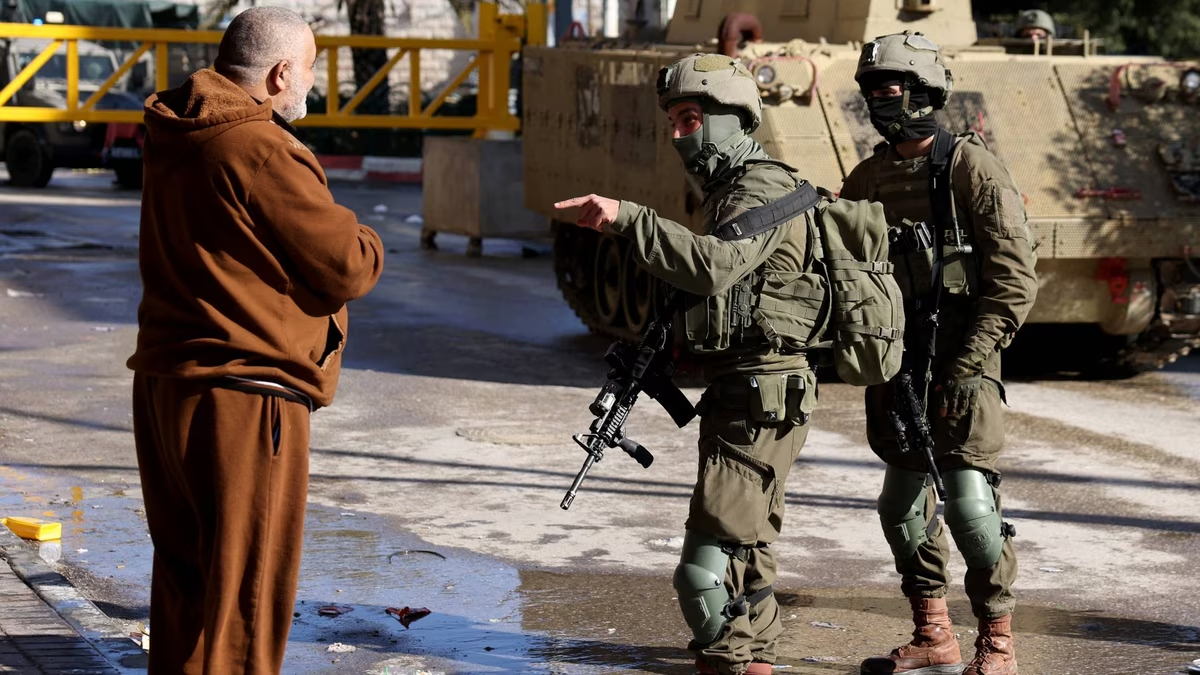
For the fifth consecutive day, southern Hebron awakens to the sound of a military campaign that resembles less “security measures” and more a harsh test of the will of the place and its inhabitants. Tens of thousands of Palestinians found themselves besieged within a closed geography, managed by force, where the details of daily life are suffocated, in a scene that redefines chaos not as popular anarchy, but as a systematic policy managed from above.

The occupation declares its goal is to “establish security” and dismantle what it calls “terrorist cells,” but the facts on the ground expose the true meaning of this campaign. The alleged security begins with closing the southern area of the city with iron gates, confiscating the movement of citizens and their vehicles, and transforming public space into a monitored and punished area. Here, suspicion is not besieged; rather, the entire society is punished.

The widespread arrest campaigns and night raids advance the repressive scene, where the sanctity of homes is violated, their residents are abused, and houses are turned into military barracks. The home, as the last remaining sanctuary for Palestinians, is stripped of its meaning, becoming merely an extension of military control.

With the obstruction of movement and the imposition of curfews, life stops at the asphalt's edge. Patients are prevented from accessing their treatment, and appeals for medical and municipal relief escalate, while students are deprived of their school seats by the closure of nearly twenty government schools. This is how Hebron's generations are targeted: its sick and its students, its present and its future, all at once.

The economic cycle was not spared from this strangulation; shops were closed, movement in the markets was paralyzed, coinciding with power outages and basic services, as if the city is being pushed towards darkness, not as a side effect, but as a deliberate political choice.

All of this cannot be separated from the broader context: the attempt to Judaize Hebron and impose a new reality, demographically and geographically, within the framework of annexation and settlement expansion. The goal is beyond a temporary campaign; it is a slow emptying of the area of its original inhabitants, and an expansion of the closed area within the Old City and the vicinity of the Ibrahimi Mosque, i.e., the H2 areas under Israeli control since the 1997 agreement.

The striking irony is that the occupation, which has controlled these areas for nearly three decades, is the same one that fueled chaos and disorder within them, and today it returns wearing the mask of “counter-terrorism.” How can the creator of chaos claim to fight it? And how can he who confiscated sovereignty claim to restore order?

The picture becomes clearer with what is leaked about the occupation's intention to link the Kiryat Arba settlement with the Tel Rumeida settlement area, in a step that redraws the map by force, and transforms Palestinian neighborhoods into isolated islands within a continuous settlement sea. This coincides with the withdrawal of the Ibrahimi Mosque's powers from the Hebron municipality, and the expulsion of Sheikh Moataz Abu Sneineh from the Ibrahimi Sanctuary for two weeks, in a direct targeting of the religious and symbolic dimension of the place, and an attempt to empty it of its visitors and guardians of its spirit.

What is happening in Hebron is not a fleeting event or a limited security measure; it is a comprehensive project, in which the tools of siege, arrest, services, economy, and religion are used to re-engineer the city and its inhabitants. It is a battle for existence, where Hebron is intended to be reduced to security maps, while it remains, despite everything, a city resistant to erasure, writing its daily resilience with life itself.

In Hebron, Judaization intersects with manufactured chaos, and humans are tested in their most basic rights. But Hebron, which has endured centuries of oppression, knows well that the place besieged today is the same place that will witness tomorrow the survival of its people, no matter how intense the siege.