





Dr. Ibrahim Freihat: The goal of these movements is political and psychological pressure to improve negotiation terms with Iran, not an automatic move towards war.
Dr. Raed Al-Dabai: Political and military indicators do not suggest an approaching comprehensive war with Iran, but rather conflict management within calculated levels of escalation.
Adnan Al-Sabah: The United States seeks to encircle Iran through its regional surroundings by inciting various parties against it and attempting to fragment neighboring countries.
Dr. Hassan Ayoub: Subduing Iran without a comprehensive war remains possible amidst transatlantic political and military mobilization and weak international reactions.
Dr. Raed Abu Badawiya: What is happening is not a prelude to a major war, but rather a calculated tension management that achieves maximum political benefit for the United States at minimum military cost.
Daoud Kuttab: What is happening is part of the maximum pressure policy to improve negotiation terms with Tehran and perhaps reach a formula close to the previous nuclear agreement.
Ramallah - Exclusive to "Al-Quds"-
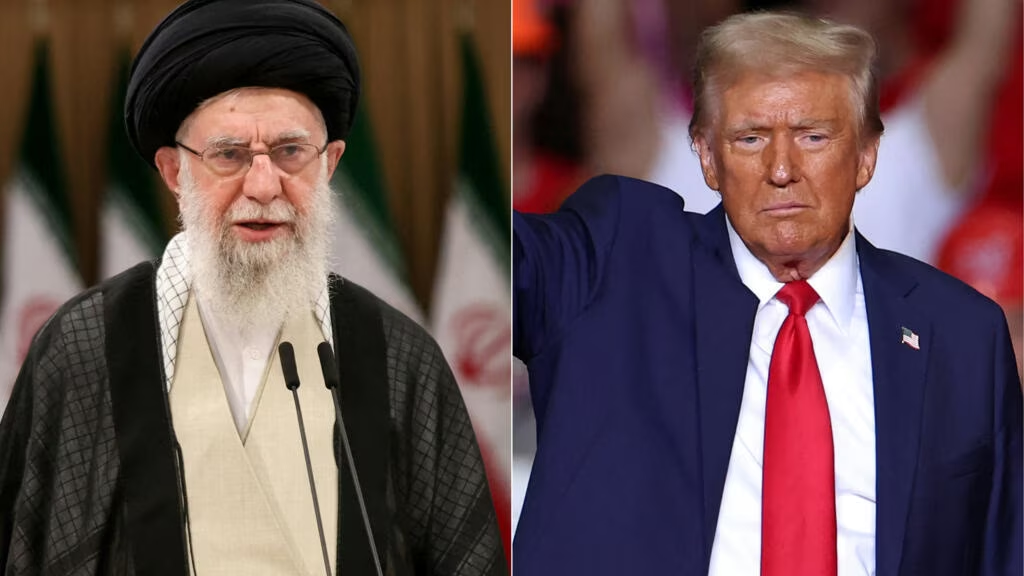
The region has recently witnessed a remarkable escalation in American military movements, including the dispatch of warships, the transfer of weapons, and a rise in the rhetoric of US President Donald Trump, who has hinted at a military option against Iran. This has brought back widespread questions about the nature of these movements and whether they are a prelude to an open war or part of a more complex political pressure game.
The readings of a number of experts, political analysts, and university professors, in separate conversations with "Al-Quds", converge on the view that these movements cannot be separated from the context of managing the conflict with Tehran. Military buildup and media escalation are seen as negotiating tools aimed at improving negotiation terms, deterring the adversary, and keeping it under constant pressure, without necessarily being drawn into a comprehensive military confrontation with high regional and international costs.
In contrast, estimates vary regarding potential scenarios. Some favor the continuation of managed containment and escalation policies, while others do not rule out limited and painful strikes within a controlled political and military ceiling. Still others believe that Washington is working to manage a wider network of regional and international conflicts to serve its strategic goals, as part of a long-term struggle that extends beyond Iran to affect the shape and balances of the international system.
Military Tools for Negotiation Management
Dr. Ibrahim Freihat, Professor of International Conflicts at the Doha Institute for Graduate Studies, explains that the dispatch of American naval vessels to the region, the transfer of weapons, and the escalation of political rhetoric hinting at a military option against Iran do not necessarily mean an imminent military strike. He emphasizes that these movements are primarily part of the negotiation process tools and not an inevitable indicator of a military confrontation.
Freihat points out that what is happening in terms of military preparations and escalatory statements is understood within the framework of what is known as "the threat of using force," which is a common method in international negotiation management and is often more effective than the actual use of force.
He clarifies that the goal of these movements is political and psychological pressure to improve negotiation terms with Iran, not an automatic move towards war.
Freihat indicates that the threat of force constitutes an essential part of the ongoing negotiation process between Washington and Tehran, which, according to the American vision, revolves around a number of issues, primarily the Iranian nuclear program, the missile program, in addition to economic aspects, and what the United States can gain economically if understandings or agreements are reached.
Decisive Moments at the Last Minute
Freihat affirms that the decision to launch a military strike or not is not made in the early stages, but is usually decided at the very last moments, perhaps just minutes or hours before the start of any potential operation.
He notes that negotiations remain open and continuous until the last moment, in parallel with full military readiness, so that all options remain on the table until the final decision is made by the top of the decision-making hierarchy.
Freihat explains that military preparation, including planning, transferring weapons, and equipping forces, is an inherently continuous process that serves the purpose of threatening the use of force, without necessarily implying an intention to actually use it.
Freihat points out that even the American leadership itself, including the US President, would not have decided on the option of a strike or not at this stage, but rather continues to receive reports, assessments, and various options until the decision is made at the last minute.
Limited Military Action
Regarding potential scenarios, Freihat suggests that if military action were to be resorted to, it would be limited in terms of time and scope, in line with the current US administration's pattern, which is not inclined to engage in long-term wars or "nation-building" projects.
Freihat explains that any potential strike would be short-term, lasting hours or days, with clear beginning and end.
He points out that Iran, as the weaker party in this equation, often ceases escalation when the American side stops, and that any potential Iranian responses would be limited and directed towards specific military targets, such as military bases in the region, with limited impact that does not escalate to the level of a comprehensive regional war.
Freihat explains that the current weakness of Iran's regional allies, such as Hezbollah and Hamas, reduces the likelihood of conflict expansion and reinforces the assessment that any potential military confrontations, if they occur, will remain within narrow and calculated limits, without sliding into a wide regional war.
Hybrid Warfare and the Attempt to Weaken the Regime
Dr. Raed Al-Dabai, Professor of Political Science at An-Najah National University, believes that the United States is not heading towards a comprehensive conventional war with Iran, but is actually managing a long-term conflict based on the logic of hybrid warfare, aimed at exhausting the Iranian regime and containing its regional and nuclear behavior, without seeking to overthrow it by direct military force.
Al-Dabai explains that this American option is based on a deep understanding of the nature of the Iranian regime, which possesses a highly cohesive security structure that controls the political, security, and economic decision-making joints simultaneously.
Al-Dabai points out that the centers of power in Iran, especially the Revolutionary Guard, do not operate merely as security agencies, but represent a "state within a state," possessing vast economic influence that has enabled the regime to build a parallel economy capable of circumventing sanctions and continuing under accumulated pressures.
Al-Dabai clarifies that American decision-makers realize the limited reliance on internal change in Iran, given the reality of an opposition suffering from severe structural division and lacking a unifying leadership or a coherent alternative political project.
Al-Dabai notes that the Iranian opposition, despite its media and political presence, has not yet succeeded in acquiring effective pressure tools, such as long-term general strikes or comprehensive civil disobedience, that could paralyze state institutions or break the regime's security grip, making the scenario of rapid internal change unrealistic from the American perspective.
He points out that the United States has chosen to expand the scope of hybrid warfare against Iran, through a mix of targeted financial sanctions, diplomatic pressure, cyber warfare, and information warfare, in addition to using indirect regional arenas to raise the cost of Iranian behavior, without sliding into an open confrontation.
Al-Dabai notes that this strategy does not aim to overthrow the regime, but to weaken its ability to maneuver, restrict its regional influence, and keep it under constant and systematic pressure.
Al-Dabai affirms that Washington takes into account Iran's possession of unconventional deterrence capabilities, which allow it to create high levels of instability, whether through threatening maritime straits, primarily the Strait of Hormuz, or influencing global trade and energy markets, or through its regional networks.
Al-Dabai indicates that the regional environment does not seem prepared for a decisive war; Israel, despite its escalatory rhetoric, may not be ready for a long and multi-front war, while Gulf states do not show a desire for an open military confrontation that could threaten their economic security and internal stability.
Calculated Levels of Escalation
In his reading of potential scenarios, Al-Dabai explains that political and military indicators do not suggest an approaching comprehensive war with Iran, but rather conflict management within calculated levels of escalation.
Al-Dabai considers that the first and most likely scenario is the continuation of managed containment and escalation policies, where the United States continues to raise the level of military, economic, and political pressure, while avoiding direct confrontation, with the aim of deterring Iran and changing its behavior, while maintaining indirect communication channels to prevent an explosion.
The second scenario, according to Al-Dabai, is a limited or selective strike, a precise cyber or military strike, in the event of a development that Washington considers a crossing of red lines, such as a qualitative nuclear escalation or a direct targeting of American or Israeli interests.
Al-Dabai believes that this type of strike does not aim to change the regime, but to re-establish the balance of deterrence and send a calculated political message, while ensuring the containment of any Iranian response.
Al-Dabai points out that the third scenario is based on an indirect horizontal escalation led by Iran, through its regional tools or threatening international navigation and energy, without direct confrontation with the United States, reflecting the traditional Iranian response logic of expanding the conflict arena and raising its cost for adversaries.
Al-Dabai believes that the scenario of an open confrontation remains the least likely, given that all parties realize that the cost of a comprehensive war would be exorbitant and uncontrollable, suggesting the continuation of a long-term crisis managed by hybrid tools combining economic pressure, political exhaustion, limited military deterrence, and a struggle of wills, without a final military resolution.
Militarization of the World
Writer and political analyst Adnan Al-Sabah confirms that since October 7, 2023, the United States has been rapidly moving towards the militarization of the world, seeking to achieve its strategic goals by exploiting crises and conflicts in various regions of the globe. He points out that Washington is working to transform seas and international waterways into military zones under its influence.
Al-Sabah explains that the United States has recently militarized the Atlantic Ocean, the Mediterranean Sea, the Indian Ocean, and the Black Sea, in addition to using the war on Gaza as an entry point to strengthen its naval military presence, as part of a broader plan aimed at transforming the world into a network of American military bases, not only in the context of confrontation with Iran, but to seize all global spheres of influence.
Al-Sabah indicates that Washington exploits every event and every regional tension to ignite conflicts and turn different regions into hotbeds of conflict, noting that it seeks to create internal conflicts within the regions themselves, as it is trying to do in the Russian-Ukrainian conflict, by turning it into a conflict between Eastern and Western Europe.
Al-Sabah points out that the United States is also fueling tension in the South China Sea through Taiwan and countries surrounding China, as well as inciting Argentina against China, and inciting countries like Japan and South Korea, which serves its strategy of exhausting major powers.
Al-Sabah clarifies that Washington does not work to extinguish conflicts, and even if it sometimes intervenes to calm some of them, it is temporary and according to its interests, as happened in some conflicts between India and Pakistan, or between Thailand and Cambodia.
Al-Sabah points to the United States' continued ignition or fueling of other conflicts, such as the conflict between Egypt and Ethiopia, and conflicts in Yemen, Iraq, and Sudan, with the aim of weakening everyone and later controlling the outcomes of these conflicts.
Manufacturing Wars Between Different Parties
Regarding Iran, Al-Sabah affirms that the United States will not go to direct war with it unless a suitable internal opportunity arises, consisting of an internal Iranian action and forces capable of influencing that Washington can support and rely on.
Al-Sabah notes that American policy is based on manufacturing wars between different parties, then intervening at the appropriate moment to impose control, as it did in Syria, when it allowed the parties to the conflict to exhaust each other before intervening and imposing its will.
Al-Sabah believes that the United States seeks to encircle Iran through its regional surroundings, by inciting various parties against it, attempting to fragment neighboring countries, and moving towards Azerbaijan, making Iran surrounded by parties that can form a spearhead for implementing American goals, as part of a long-term strategy for managing conflicts rather than directly engaging in them.
"Peace Through Strength" Strategy
Dr. Hassan Ayoub, a writer, political analyst, and specialist in American affairs, confirms that the administration of US President Donald Trump has entered a new and advanced stage of implementing the "Peace Through Strength" strategy, noting that Trump's traditional slogan "Make America Great Again" is no longer merely political or economic, but has become coupled with the use of hard power as a central tool for achieving American goals.
Ayoub explains that what American policy is witnessing today represents a clear re-production of the neoconservative approach during the era of former President George W. Bush, but with two fundamental differences; first, avoiding involvement in a direct and widespread military invasion of targeted countries, and second, abandoning the traditional liberal discourse that justified interventions under the banners of spreading democracy and human rights, in favor of explicit discourse based on imposing will by force.
Ayoub clarifies that this strategy began to materialize in South America, especially in Venezuela, before branching out into two main directions aimed at bringing about far-reaching geopolitical changes, even if at the expense of traditional US allies in Europe and the Middle East.
The first direction, according to Ayoub, is an attempt to seize Greenland, while the second and more dangerous direction is to deliver a decisive military strike against Iran.
Ayoub points out that the central goal of this approach is to establish an international system based on "naked power" without controls or restrictions, in a preemptive step aimed at hindering or delaying the formation of a multipolar international system in which China and Russia are decisive powers.
Ayoub believes that according to this perception, subduing Iran, whether through a widespread military strike or through a serious threat of force, is an essential condition for the success of this American strategy.
Ayoub notes that the military scenario could take the form of a large-scale strike accompanied by intelligence operations inside Iran to ignite a state of chaos, leading either to a reshaping of the Iranian regime to serve American interests, or to transforming Iran into a failed state.
Subduing Iran Without a Comprehensive War
In contrast, Ayoub affirms that the scenario of subduing Iran without a comprehensive war remains possible, given the transatlantic political and military mobilization against Tehran, and Washington's exploitation of the weak international reactions to previous experiences, such as dealing with the Venezuelan issue.
Ayoub points out that the Trump administration does not pay real attention to the calculations and concerns of its regional allies, especially the Gulf states and Turkey, in contrast to almost complete coordination with its most important ally, Israel.
Ayoub considers that Tel Aviv is the second, and perhaps first, beneficiary of any American move against Iran, given the transformation of the surrounding countries into fragmented entities or failed states, which opens the way for long-term Israeli hegemony over the region.
Ayoub notes that Israeli Prime Minister Benjamin Netanyahu's statements about Israel's status as a major regional, and perhaps international, power reflect this path, pointing out that Tel Aviv's pursuit of military independence from Washington is consistent with a clear Israeli priority of destroying Iran or overthrowing its regime, which increases the likelihood of an American military strike, and makes the question not about whether it will happen, but when, and whether developments might prevent it.
Calculated Strategic Maneuver
Dr. Raed Abu Badawiya, Professor of International Law and International Relations at the Arab American University, confirms that the escalating American threats of war against Iran do not reflect actual readiness for a comprehensive war or a decisive strike that would overthrow the Iranian regime. Rather, they fall within the framework of a calculated strategic maneuver aimed at delivering a painful and limited strike, with carefully planned timing and objectives, without sliding into an open confrontation.
Abu Badawiya explains that the administration of US President Donald Trump understands a number of strategic realities that make the option of overthrowing the Iranian regime unrealistic at the present stage, most notably the absence of a ready political alternative that can be relied upon, and the danger of any internal collapse in Iran that could lead to uncontrollable regional chaos, in addition to the United States' unwillingness to bear the political, military, and economic costs of re-engineering a country the size and complexity of Iran.
Abu Badawiya clarifies that the proposed American option is to deliver a strong blow without seeking regime change, in a way that re-establishes American hegemony, imposes a new ceiling for Iranian regional and nuclear behavior, and also uses this blow domestically in the United States and Israel as proof of firmness and the ability to impose deterrence.
Brinkmanship
Abu Badawiya believes that this approach clearly reflects a policy of "brinkmanship" rather than a decision for war, meaning approaching confrontation as much as possible without jumping into the abyss.
Abu Badawiya points out that the most likely scenario is the execution of a limited but painful American, or coordinated American-Israeli, military strike targeting sensitive military installations, strategic infrastructure, and specific missile or cyber capabilities, provided that the operation is short-term, with a clear political ceiling, without declaring war or ground involvement.
Abu Badawiya believes that this strike will carry multi-directional messages: to Iran with the aim of curbing its regional and nuclear ambitions, to the world to confirm that Washington is still capable of dictating the rules of the game, and to Israel through direct support that serves Prime Minister Benjamin Netanyahu amidst internal and electoral calculations.
Calculated Iranian Response
Abu Badawiya expects the Iranian response to be calculated in turn, through a symbolic or indirect response, and through regional pressure tools without crossing red lines, in order to maintain the balance of deterrence and prevent sliding into a comprehensive war.
Abu Badawiya affirms that what is happening does not constitute a prelude to a major war, but rather a calculated tension management that achieves maximum political benefit for the United States at minimum military cost, by weakening Iran without overthrowing it, and striking it without bearing the consequences of the post-strike period, in a fragile international system that cannot withstand a large-scale explosion.
Improving Negotiation Terms
Writer and political analyst Daoud Kuttab confirms that the threats made by US President Donald Trump to wage war on Iran, in parallel with sending warships to the region, reflect a high level of seriousness, but do not necessarily mean a move towards a widespread and comprehensive war at the current stage.
Kuttab explains that the American military buildup falls within the framework of the maximum pressure policy, with the aim of improving negotiation terms with Tehran, suggesting that Washington and Iran will seek a formula of understanding close to the previous nuclear agreement that Trump tore up during his first term, in response to Israeli pressure led by Israeli Prime Minister Benjamin Netanyahu.
Kuttab points out that this agreement may return to a pivotal position in any future negotiations, with amendments related to Iran's ballistic missile program alongside the nuclear file.
Kuttab clarifies that Iran, given its limited ability to fully protect its airspace, may not be willing to make concessions on the missile issue.
Regarding potential scenarios, Kuttab expects an increase in the level of American military pressure to achieve a negotiating breakthrough, with the possibility of a limited and rapid strike to demonstrate American seriousness without sliding into a comprehensive confrontation.
Kuttab believes that the majority of Arab and Islamic countries, in addition to influential currents within the Republican Party, do not support waging a short or long war with a country that is not in direct hostility with the United States, which reinforces the hypothesis that the current escalation remains within the limits of political and military maneuvering.

PALESTINE
Sun 25 Jan 2026 10:13 am - Jerusalem Time
Mobilization against Iran: American political messages with military tools
Tags
MORE FROM PALESTINE
Settler escalation in Ramallah: Attempt to burn a mosque and widespread attacks on properties
Abbas issues extensive amendments to Palestinian election law, including raising legislative seats and lowering the age of candidacy

France reveals Israeli company's involvement in manipulation and digital interference in elections

Share your opinion
Mobilization against Iran: American political messages with military tools