






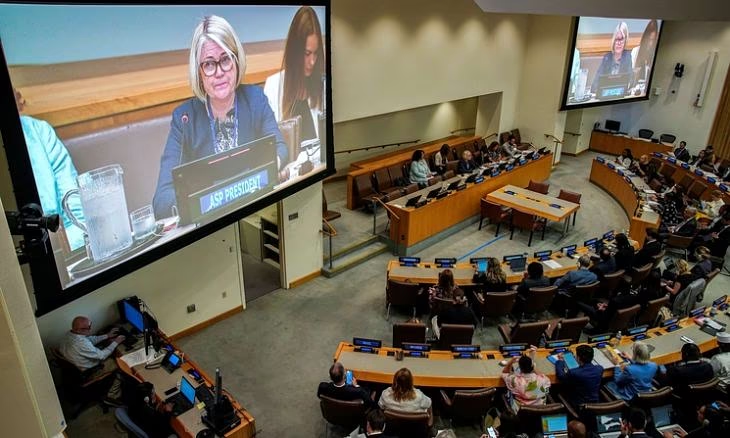
In an unprecedented move, the Assembly of States Parties to the International Criminal Court decided to remove Prosecutor Karim Khan from his position after a vote held at the United Nations headquarters in New York. The decision was supported by 82 out of 125 member states of the Court, during a secret ballot held in a special closed meeting to discuss the recommendations of the Court's oversight body.
This dismissal comes against the backdrop of accusations leveled against the 56-year-old British official, related to inappropriate sexual conduct with a junior staff member on his team. Despite Khan's categorical denial of these allegations, the majority of member states relied on the results of investigations that recommended ending his tenure to ensure the integrity of the international institution.
For its part, the legal team of the ousted prosecutor quickly announced its rejection of the decision and challenged its legitimacy, describing the procedures as unfair and not based on tangible material evidence. Lawyer Tayeb Ali affirmed that his client would pursue all available legal avenues to restore his reputation and refute what he described as false allegations that have affected his professional career.
In the first official reaction, the Israeli occupation authorities welcomed the dismissal decision, with Foreign Minister Gidon Sa'ar considering this step to reveal what he called Khan's 'moral bankruptcy'. Israel attempted to leverage this development to push for the cancellation of the arrest warrants issued against Prime Minister Benjamin Netanyahu and former Defense Minister Yoav Gallant.
Sa'ar claimed in his statements that the arrest requests submitted by Khan were an attempt to cover up his personal misconduct, which he feared would be exposed to the public. The Israeli minister demanded that the Court immediately retract the warrants, considering them 'politicized and disgraceful' and not falling within the jurisdiction of the International Court, as Israel is not a member of it.
Despite Israeli pressure, legal sources confirmed that the arrest warrants remain legally valid and are not automatically affected by the departure of the prosecutor. The sources clarified that Pre-Trial Chamber I is the judicial body that issued the warrants based on criminal evidence, and only the judges of the Court themselves have the authority to withdraw or cancel them.
The International Criminal Court had previously settled the issue of its territorial jurisdiction, affirming its authority over crimes committed in the Gaza Strip, the West Bank, and East Jerusalem. This decision came after the State of Palestine joined the Rome Statute, granting the Court the right to prosecute those responsible for war crimes in those areas.
In a related context, Israel's envoy to the United Nations, Danny Danon, exploited the dismissal decision to attack the Court and the prosecutor, claiming that Khan tried to use the 'campaign against Israel' as a shield to protect himself. Danon also issued veiled threats to some local officials in New York who called for the implementation of international arrest warrants if Netanyahu visited the city.
The International Criminal Court is currently facing existential challenges, especially with the United States announcing its intention to launch a broad diplomatic campaign to dismantle the Court. Washington, which previously imposed sanctions on Khan and other judges, views the Court's actions as a threat to its sovereignty and the sovereignty of its allies in the region.
It is worth noting that the arrest warrants issued in November 2024 accuse Netanyahu and Gallant of responsibility for war crimes including the use of starvation as a weapon, murder, and persecution. The Court found reasonable grounds to believe that the Israeli leaders deliberately directed attacks against the civilian population in the Gaza Strip during ongoing military operations.
Karim Khan is the third prosecutor of the International Criminal Court since its inception, but he is the first to leave his post through the dismissal mechanism by the Assembly of States Parties. The Court is expected to soon begin complex procedures to select his successor, amidst sharp international polarization over the Court's role in major conflicts.
Reports indicate that the process of electing a new prosecutor may take a long time, which could place the Prosecutor's Office under interim management for a period that may extend into next year. Observers fear that this leadership vacuum could slow down the pace of ongoing investigations into sensitive cases, especially the Palestinian file and the war in Ukraine.
Despite Washington and Tel Aviv not being members of the Court, the pressure exerted by the two countries has clearly affected the political climate surrounding the Court. European member states of the Court remain divided between commitment to the independence of international justice and consideration of strategic alliances with the United States and Israel.
The question remains in the halls of the Court in The Hague about the institution's ability to withstand these violent administrative and political upheavals. While some see Khan's dismissal as a victory for the Court's internal justice, others fear that the decision could be the beginning of a phase of retreat in prosecuting leaders of major countries and their allies.
Khan will challenge the legality and fairness of the decision through all available judicial mechanisms.




Share your opinion
ICC Member States Remove Prosecutor Karim Khan with 82 Votes