






Washington's Message
Washington – Said Arikat - 21/6/2026
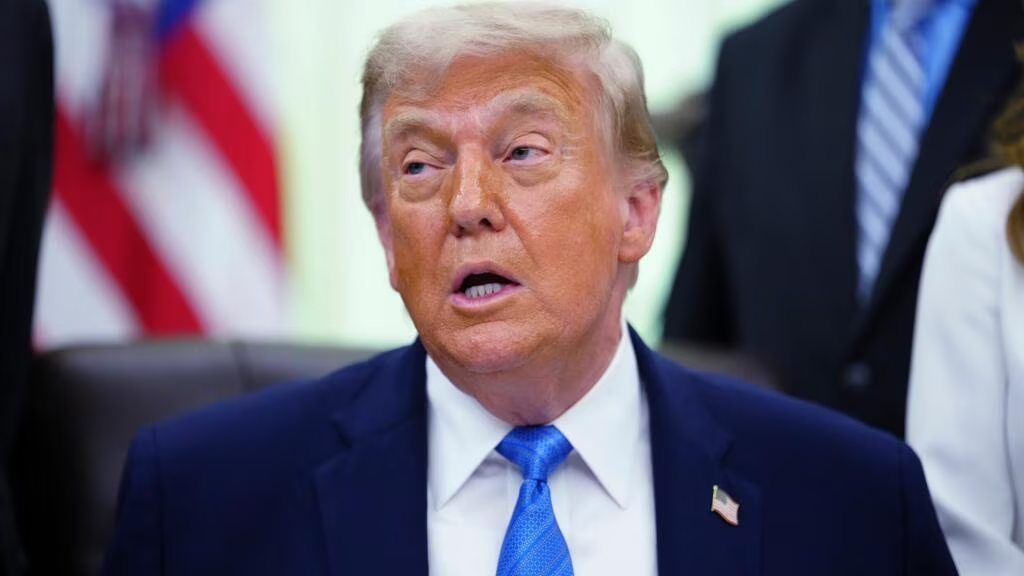
US President Donald Trump escalated his rhetoric towards Iran, threatening to launch new strikes against it if it does not work to stop what he described as "its proxies' activities" in Lebanon, in reference to Hezbollah, coinciding with the start of a new round of indirect talks between Washington and Tehran in Switzerland, mediated by Pakistan and Qatar.
Trump said in a post on the "Truth Social" platform that Iran must "immediately stop its heavily funded proxies in Lebanon from causing trouble," adding: "If they don't, we will hit Iran very hard again, just as we did last week, but more severely."
This threat comes as US Vice President J.D. Vance heads to a round of talks with Iranian officials, as part of efforts aimed at solidifying the sixty-day ceasefire agreement between the United States and Iran, and opening the door for broader understandings related to the Iranian nuclear file and regional crises, foremost among them the situation in Lebanon.
Trump had previously linked the success of these negotiations to the performance of his negotiating team, indicating that their failure would directly hold his vice president responsible, a move that reflects the importance the current US administration places on this diplomatic path.
According to the arrangements that followed the recent military confrontation between Washington and Tehran, the temporary de-escalation agreement also includes the Lebanese arena, which continues to witness Israeli raids and military operations against sites that the Israeli army says are linked to Hezbollah, amidst Israeli accusations against the party of threatening the security of northern settlements.
During his presence in Switzerland, Vance assured journalists that the Trump administration "has made greater efforts than any other government in recent months to stop the conflict in Lebanon," emphasizing that achieving peace requires "mutual concessions and continuous effort."
The US Vice President added that Trump is not only seeking to conclude an agreement between the United States and Iran but is also working to achieve "broader regional peace," considering that settling outstanding issues in the region is an essential part of the new American vision for the Middle East.
The US-Iranian talks in Switzerland are expected to address the confrontation between Israel and Hezbollah, despite the absence of Israeli representatives from the current negotiation sessions, which raises questions about the ability of the participating parties to reach practical understandings regarding the Lebanese arena.
In his latest threat, Trump refers to the military strikes carried out by the United States against targets inside Iran last week, after accusing Tehran of stalling in reaching an agreement to end the dispute over its nuclear program. The US administration had justified those strikes as a means to push Iran to return seriously to the negotiating table.
Trump's statements reveal a clear attempt to link regional arenas to each other, so that the Iranian nuclear file is no longer separate from Iranian influence in Lebanon, Iraq, or elsewhere. The US administration seems convinced that any long-term agreement with Tehran will not be viable unless it is accompanied by understandings about the roles of Iran's regional allies. From this perspective, Lebanon becomes a real testing ground for Tehran's willingness to make political and security concessions that go beyond the limits of its nuclear program, which makes the current negotiations more complex than any previous rounds.
The American threat also reflects the continued reliance on a policy of "pressure and negotiation" simultaneously, an approach that Trump has always favored in dealing with international adversaries. While negotiators sit at the dialogue table in Switzerland, the White House continues to send harsh military deterrence messages to Iran. This strategy is based on convincing the Iranian leadership that the cost of escalation will be high, in exchange for offering political and economic incentives if it chooses the path of settlement. However, this approach carries significant risks, as any field error or miscalculation could derail negotiations and return the region to a cycle of open confrontation.
As for Lebanon, the ongoing developments confirm that the fate of internal stability is increasingly linked to regional and international balances. The continuation of the confrontation between Israel and Hezbollah gives external powers an increasing role in shaping the country's security and political future. If the US-Iranian talks succeed in reaching broader understandings, Lebanon may witness a period of relative calm. However, if negotiations falter or the ceasefire collapses, the Lebanese arena could once again become one of the main flashpoints between Washington and Tehran, with all the risks that entails for regional security as a whole.
Share your opinion
Trump threatens to strike Iran again if it doesn't curb Hezbollah attacks in Lebanon