







By: Said Arikat
May 10, 2026
News analysis
Washington, D.C- For decades, the United States cultivated the image of an invincible global power capable of reshaping nations, toppling governments, and imposing political realities through overwhelming military force. From Washington’s perspective, wars were not merely battles over territory or security, but demonstrations of American supremacy itself. Yet the war with Iran may ultimately be remembered as the moment that illusion finally collapsed.
Political scientist John Mearsheimer has argued with unusual bluntness that the conflict represents an unmistakable defeat for the United States and that President Donald Trump has no viable exit except admitting failure. His assessment is sobering not simply because of its severity, but because it reflects a growing reality that even many within Washington’s foreign policy establishment can no longer ignore: the United States entered another war it could begin easily, escalate recklessly, but could not win politically.
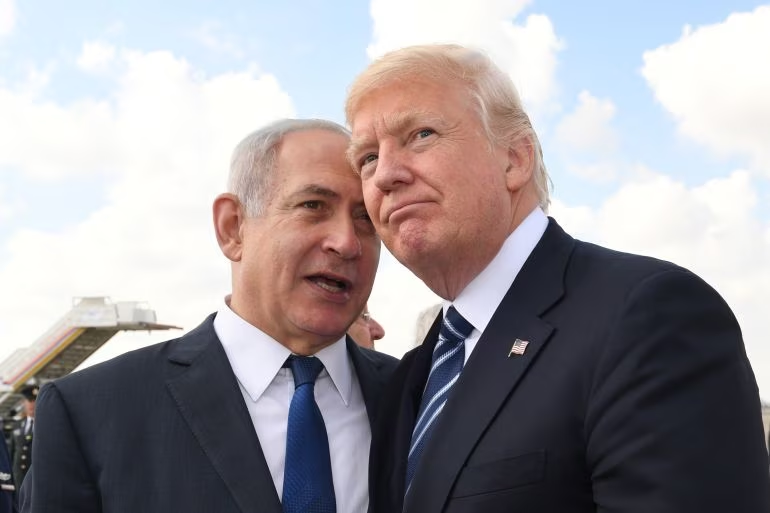
Central to this catastrophe was Israeli Prime Minister Benjamin Netanyahu, whose decades-long obsession with confronting Iran helped push Washington toward a disastrous confrontation. Reports surrounding a February 11, 2026 meeting in the White House Situation Room suggest Netanyahu personally pressed Trump to embrace military escalation against Tehran, arguing that eliminating the first and second tier of Iranian leadership would trigger the collapse of the Islamic Republic.
It was a seductive fantasy, and a familiar one. Iraq was supposed to become a democratic model after Saddam Hussein fell. Libya was expected to stabilize after Muammar Gaddafi’s overthrow. Syria was repeatedly predicted to collapse under pressure. Instead, each intervention unleashed chaos, fragmentation, and long-term instability that strengthened anti-American sentiment throughout the region.
Iran proved even more resistant because its political system, despite internal divisions and widespread public frustration, possesses institutional depth, ideological cohesion, and nationalist resilience developed through decades of sanctions, isolation, and external threats. The assumption that assassinating senior leaders would produce state collapse reflected not strategic sophistication, but a profound misunderstanding of Iranian society and political history.
That miscalculation now defines the war itself.
Washington’s objectives were sweeping. Iran was supposed to be weakened into submission, its regional influence dismantled, its missile capabilities neutralized, and its government forced either into surrender or collapse. Some within the administration and allied circles appeared convinced that the killing of senior military and political figures would create panic, fragmentation, and eventual regime implosion. Instead, the opposite occurred. The Iranian state survived. Its leadership structure adapted. Its military institutions absorbed severe blows without disintegrating. And perhaps most dangerously for Washington, the conflict transformed into a prolonged confrontation that steadily exhausted American political credibility while strengthening Iranian resolve.
The deeper problem is not merely that the United States failed to achieve decisive victory. It is that the conflict exposed structural weaknesses in American power that Washington has spent decades trying to conceal.
Since the end of the Cold War, American policymakers operated under the assumption that no regional actor could meaningfully resist U.S. military supremacy. Iraq descended into catastrophe. Afghanistan became the longest war in American history before ending in humiliating withdrawal. Libya collapsed into fragmentation after Western intervention. Yet despite these failures, Washington continued behaving as though military dominance guaranteed political outcomes.
Iran shattered that illusion more forcefully than any conflict before it.
Unlike weaker states previously targeted by the United States, Iran possessed strategic depth, regional alliances, missile deterrence capabilities, and the political will to endure extraordinary punishment. More importantly, Tehran understood something Washington repeatedly failed to grasp: survival itself can constitute victory against a stronger adversary. Iran did not need to defeat the United States militarily. It merely needed to deny Washington its objectives while imposing mounting economic, political, and geopolitical costs.
Energy markets were shaken. Global shipping routes faced disruption. American allies in Europe and the Gulf grew increasingly anxious over Washington’s judgment and unpredictability. China and Russia seized opportunities to deepen diplomatic and economic influence while presenting themselves as comparatively stable actors. Meanwhile, within the United States itself, public fatigue deepened as the costs of another endless Middle Eastern war became impossible to ignore.
This is precisely why Mearsheimer argues that Trump has no genuine path forward. Escalation risks regional catastrophe without guaranteeing success. Retreat without achieving objectives appears indistinguishable from defeat. Claims of victory ring hollow because Iran remains standing, defiant, and capable of continued resistance. The White House therefore appears trapped between an unattainable military triumph and the political humiliation of acknowledging strategic failure.
Perhaps the most alarming aspect of this war is what it reveals about the intellectual exhaustion of American foreign policy thinking. Washington’s political class has spent years recycling the same assumptions despite repeated collapse. Every failure is treated not as evidence that the strategy itself is flawed, but as proof that previous wars were insufficiently aggressive, prolonged, or ruthless. The result is a dangerous cycle in which lessons are never truly learned.
Empires rarely recognize the moment of decline while living through it. They continue projecting confidence long after credibility erodes. They mistake rhetoric for power and military expenditure for strategic wisdom. The danger for the United States is not simply that it may lose one war. It is that it may continue launching wars to deny the reality that the world has fundamentally changed.
Netanyahu’s illusion of regime change, and Trump’s willingness to believe it, may enter history beside Vietnam and Iraq: not as demonstrations of strength, but as warnings about arrogance, deception, and the consequences of leaders who confuse power with reality.
Share your opinion
Netanyahu’s Fatal Deception Led to Trump’s Blunder in Iran