






From beneath the rubble of destroyed homes in the Gaza Strip emerge shattered mobile phones or ones locked behind passwords, carrying in their digital memory the last breaths of martyrs, their photos, and their unfinished messages. For grieving families, these devices are no longer mere communication tools; they have become final windows overlooking the faces of their departed loved ones, and essential keys to reclaiming financial rights needed by orphaned children.
Subhiya Sharab recounts the story of her husband, journalist Abdul Rahman Al-Abadla, who was martyred in May 2025 while performing his professional duty. His wife received a 'Redmi 9' device with a shattered screen and damaged body, but it carried the heaviest material trace remaining of her husband, prompting her to embark on an arduous journey to find a way to reactivate it despite the grief that weighed heavily on her.
Subhiya faced a harsh economic obstacle, as phone repair costs in the Strip skyrocketed due to a shortage of parts and security conditions. After a six-month wait, she managed to repair the phone for 1200 shekels, an exorbitant amount equivalent to the price of a new phone, but for her, it was a small price to pay to retrieve video clips her husband had documented until the moment he was targeted.
In a similar context, citizen Mohammed Sabah is experiencing a compounded loss after the martyrdom of his wife and five daughters all at once. Sabah carries five phones belonging to his deceased family and moves them between repair shops in Gaza, central, and southern areas, hoping to retrieve a single photo or voice recording that might alleviate the burden of his deadly loneliness.
After arduous attempts lasting months, Sabah managed to access the login code of only one phone, while the other devices remained locked and inaccessible to technicians. He sought help from relatives to guess passwords by recalling birth dates and his daughters' favorite numbers, in a desperate attempt to break the digital isolation imposed by the locked devices.
As for Mohammed Sobeih, he views his martyred brother's phone as both a 'memory and money wallet,' as the device contains banking account details and electronic wallets essential for supporting his brother's children. His attempts are met with complex legal and technical procedures that require official documents and certifications from specialized authorities in Ramallah, at a cost that could consume half of the existing savings.
Journalist Dina Farawana's story stands out as an example of significant digital loss, as she lost two brothers and a husband, and with them, a digital memory containing over 5,000 photos of her brother Huthayfa was lost. Dina says her husband's phone contained details of their daily lives and moments of their children's growth, and today she struggles to save this data to serve as living proof for her children about their father when they grow up.
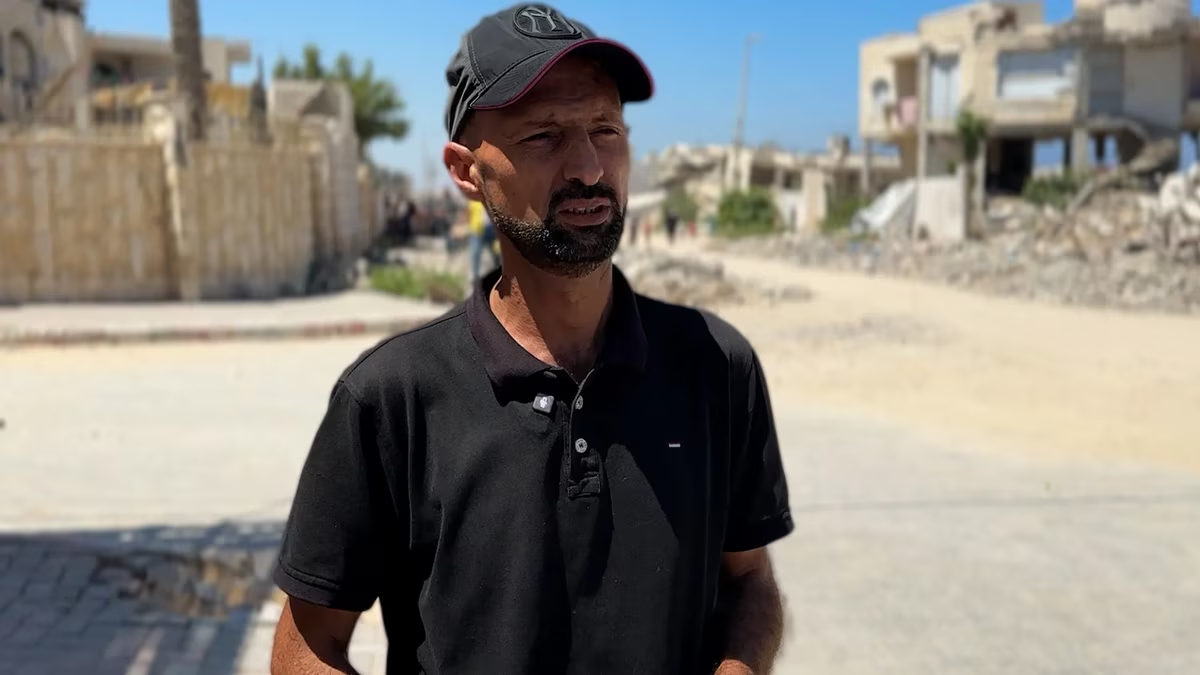
Inside programming workshops in Gaza, technician Nabil Faraj describes the phones arriving from martyrs' families as the 'heaviest devices' he deals with professionally and humanely. Faraj indicates that his shop has turned into a waiting room for hope, where families watch computer screens making millions of guesses to unlock protection codes, as if waiting for a loved one to return from behind the glass.
Faraj explains that the technical process can take continuous days of work on a single device, and if successful, families burst into tears as soon as the first image appears on the screen. These moments reflect how technology has transformed from a means of communication into a repository of Palestinian collective memory that the occupation tries to erase by destroying homes and their inhabitants.
For his part, Musa Totah, an Apple device repair specialist, points out that the complexities of protection in iPhones make the task more difficult and costly. Despite this, customers are willing to pay amounts exceeding the market value of the device just to retrieve data, confirming that the human value of the content far outweighs the value of the shattered physical hardware.
Repair shops suffer from a severe shortage of screens, batteries, and integrated circuits, making the repair of phones retrieved from under the rubble a complex and sometimes almost impossible process. This shortage exacerbates the suffering of families who see a phone malfunction as a second loss of their loved ones, and the loss of the last trace left by the martyr before his departure.
The journey to find the 'last voice' in broken phones reflects the Palestinians' determination to cling to their memory and identity in the face of annihilation. Every retrieved photo and every working video clip represents a small victory for love and life over the machine of destruction that tried to bury these stories under tons of cement and rubble.
These phones ultimately transform into sacred personal archives, carefully preserved and displayed in family night gatherings to evoke the absent. As the war continues, repair shops in Gaza remain witnesses to stories of loyalty, where the living strive with all their might to keep the voices of their martyrs alive, even through the headphones of a dilapidated phone.
In the absence of clear graves due to bulldozing and desecration, digital memory has become the 'symbolic grave' and safe haven for memories. It is a battle fought by Gazans against oblivion, using charging cables and programming software to mend what has been broken in their souls, and to document their right to life that the cruel war has stolen.
Repairing the phone was very expensive, but my longing for my husband overwhelmed me; I wanted to hear his voice and see his last moments that he documented before the targeting.
Share your opinion
Martyrs' Phones in Gaza.. Stores of Pain and Memory Trapped Under Rubble