







- The controversy surrounding the photo's publication is considered a "qualitative shift" in how Western media addresses the Palestinian issue. - The photo's spread was a milestone that revealed the power of a single image to move global public opinion. - It is not enough for the story to be told; it must be supported by evidence, as law is not based on narrative but on what can be proven. - The photo succeeded in conveying the reality of Palestinians who own nothing in the face of the arrogance of settlers and the occupation army. Ramallah - Exclusive to "Al-Quds" - The young lawyer Meyad Jamal Abu Al-Rub from the town of Qabatiya, south of Jenin, while working with the Wall and Settlement Resistance Commission to support residents during a field activity in the Soba area of Idhna town, west of Hebron, did not know that her photo, taken by Italian photojournalist Pietro Mastrozo about six months ago during an olive picking event, was merely documentation of a local event. Instead, it turned into global media material, gracing the cover of the Italian magazine L'Espresso, later opening a wide discussion that extended from Europe to the United States about the Palestinian narrative and what is happening on the ground, and re-shedding light on the scene of the conflict in Palestine from both a humanitarian and political angle.
Fieldwork that went global On the morning of October 12, 2025, lawyer Meyad Abu Al-Rub participated in an olive picking event as part of "support and steadfastness" activities organized by the Wall and Settlement Resistance Commission in lands threatened with confiscation in the Soba area of Idhna town. The event was not exceptional in the context of her work, but rather part of a recurring activity aimed at enabling Palestinian farmers to access their lands amidst continuous restrictions and field difficulties imposed by the Israeli occupation army and settlers.
Abu Al-Rub states in an interview with "Al-Quds," "These activities are organized in more than one governorate, and include accompanying farmers to their lands and assisting in olive picking in areas where the commission's teams often face harassment or friction with the Israeli army or settlers."
However, what was unexpected, according to her account, was that a simple field moment would later turn into a photo that would reach European media, specifically the cover of the Italian newspaper L'Espresso, published on the twelfth of this month, becoming the focus of a wide political and media debate.
Provocative moment Abu Al-Rub explains that the photo was taken while she was on land supporting residents in picking olives in Idhna town, without being directly aware of the camera or the shooting angle, noting that the photographer who took it was most likely a foreign journalist, and it was later revealed that he was Italian.
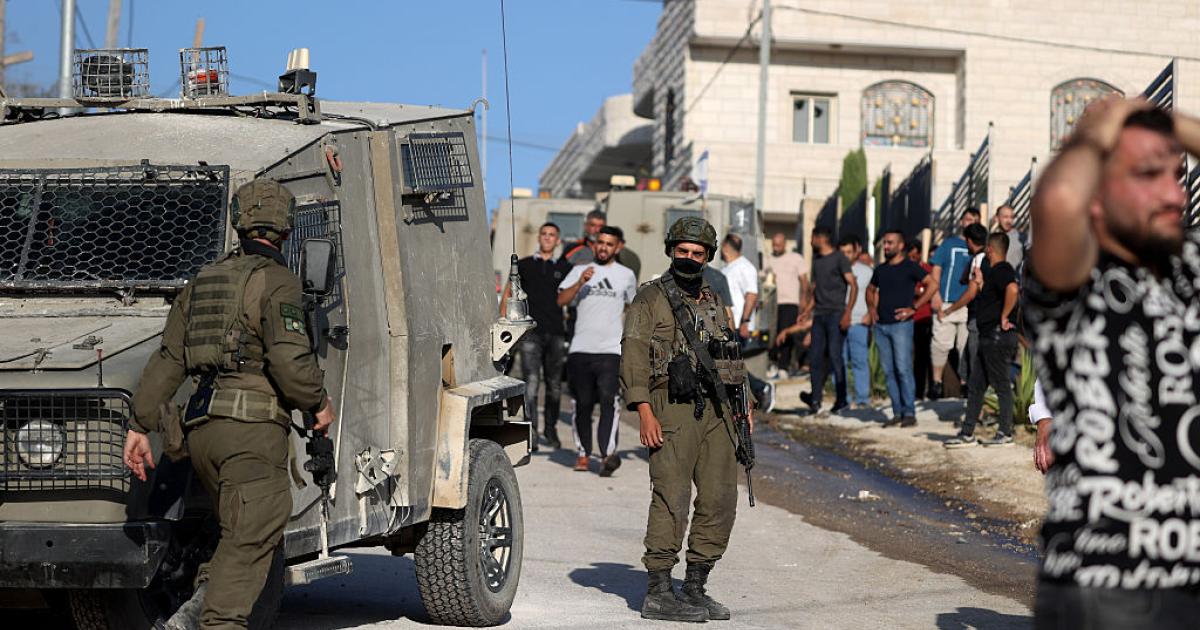
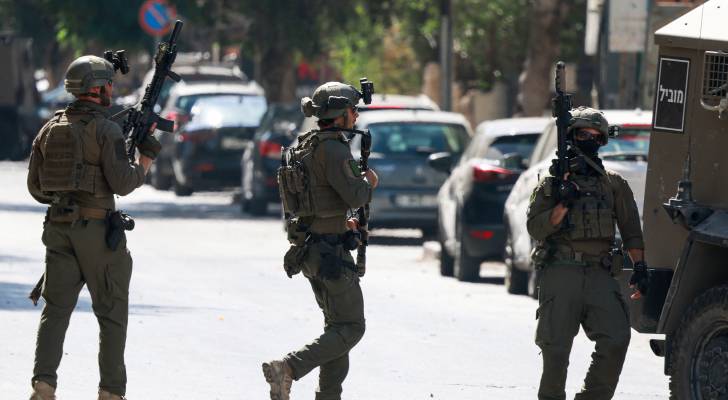
Abu Al-Rub says: "The moments were difficult, as the scene was full of challenges, with the presence of armed settlers, some of whom were wearing Israeli occupation army uniforms, and they were provoking and mocking us, and the photo showed part of what happened."
Abu Al-Rub points out that the activity in Idhna town, despite its peaceful nature, faced field escalation at certain moments, as she spoke of the presence of armed settlers in military uniform, and of attempts at provocation, verbal and physical assaults. Abu Al-Rub indicates that an elderly participant was pushed, and she tried to assist him in the field.
Unexpected reactions After the photo spread, as Meyad recounts, reactions escalated unexpectedly. In a short time, it became material circulated by various European media outlets, described as reflecting a humanitarian scene of the conflict in the Palestinian territories.
However, this spread, according to Abu Al-Rub, did not pass without counter-reactions, as she indicated that the Israeli ambassador in Rome considered the photo "misleading" and accused it of being part of a media propaganda that does not reflect reality, even going so far in some statements as to question its authenticity and consider it "fabricated or AI-supported."
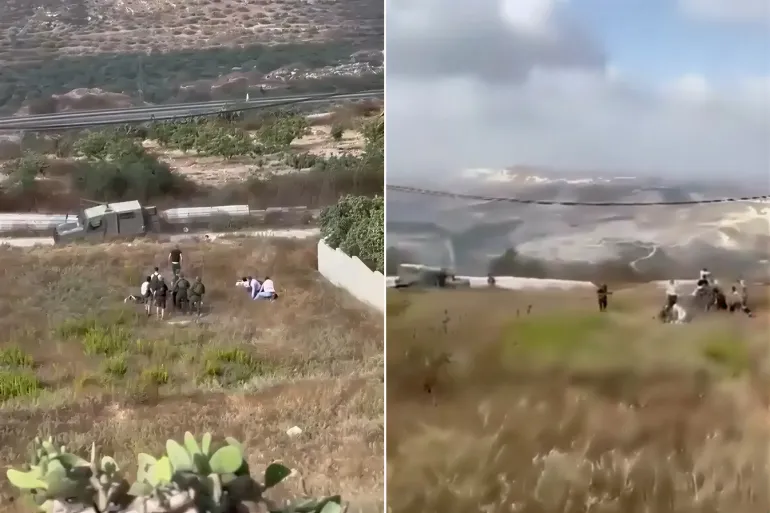
This controversy, according to her account, prompted the journalist who took the photo to publish a field video documenting the same moment, in an attempt to confirm that the scene was real and not fabricated, which contributed to reigniting the media debate about the incident.
Wide spread But what Abu Al-Rub considers most important was not the technical debate about the photo or video, but the extent of the international interaction that followed.
Abu Al-Rub says: "The photo moved from one newspaper to another, gracing pages in Italy, Germany, France, and Britain, and later reached American media, becoming a subject of discussion about the nature of what is happening in the West Bank, especially in areas classified as (C) in the West Bank."
Abu Al-Rub indicates that the Palestinian Ambassador to Italy, Mona Abu Amara, personally contacted her and informed her that the photo had sparked wide interaction and sympathy in European media circles, and that it contributed to opening a new discussion about the Palestinian narrative in Western media.
Abu Al-Rub points out that the controversy surrounding the photo's publication prompted some parties to consider it a "qualitative shift" in how Western media addresses the Palestinian issue, where the issue is no longer discussed only from a traditional political angle, but through field photos that reflect the details of daily life in areas of friction.
Abu Al-Rub emphasizes that this media spread highlights the suffering of Palestinians, considering that any photo or media material that helps convey this reality to international public opinion is an important step in the context of human rights and legal work.
Abu Al-Rub believes that the spread of the photo was not just a fleeting media event, but a milestone that revealed the power of a single image to move global public opinion and re-present the Palestinian issue in Western media from a more human perspective.
According to Abu Al-Rub, what happened may be the beginning of a broader shift in international attention, but at the same time, it does not negate the extent of the daily suffering experienced by Palestinians on the ground, which remains much greater than what any photo can convey.
A wide door to field violations Meyad Abu Al-Rub confirms that this coverage was not just visual interest but opened a wide door for discussing the field violations that Palestinians are subjected to during their attempts to access their lands, noting that what happened in that event was not isolated from a broader context of daily friction, provocations, and assaults carried out by the Israeli occupation army and settlers.
Abu Al-Rub confirms that she personally has been subjected to harassment and assaults long before that, recalling another scene from her field experience, when she was seven months pregnant about two years ago and the activity she participated in was subjected to tear gas bombs, which led to her being taken to the hospital for several hours, considering that this reflects the nature of the risks faced by teams working in this field.
Abu Al-Rub insists that the activities remain completely peaceful, and their primary goal is to support Palestinian farmers and enable them to access their lands, amidst the policies of the occupation and settlers that sometimes prevent them from reaching their fields, or subject olive trees to vandalism and cutting.
Abu Al-Rub says: "The photo that spread globally was only a very small part of a broader and more complex reality," emphasizing that what is published in the media does not always reflect the extent of the daily suffering experienced by residents in those areas, but this photo came to reinforce the nature of the violations taking place.
The photo is important in the legal battle Meyad cites her photo taken by an Italian photographer, confirming that Israel tried to discredit it, but the journalist came with a video reinforcing the narrative.
Abu Al-Rub stresses that documentation, through photos and videos, has become a crucial tool in confronting attempts to cast doubt, and for her, the integration of evidence is what gives truth its power, making its denial more difficult.
But what goes beyond the debate about photos is the broader goal she seeks, as Meyad emphasizes that what matters to her is not her person, but the ability of any documented material to move the international community, whether through media, courts, or legal platforms, saying: "We need to shed light on the suffering of our people," noting that every story or massacre needs documentation, so that it can be conveyed to the world in a language it understands.
She recalls in her speech the importance of the photo in international forums, where it was on more than one occasion sufficient to convey the suffering of an entire people.
As for the photo taken by an Italian photographer of her in Idhna town, in her opinion, it may have this impact, if it succeeds in conveying the reality of Palestinians who own nothing in the face of the arrogance of settlers and the Israeli occupation army.
Abu Al-Rub says in a firm tone: "Our activities were peaceful, we did not carry weapons, but we were always the party that was attacked, and then they try to condemn us, so the battle of law, image, and documentation is the important path we have towards revealing the truth."
Daily events turn into legal files In her office in Ramallah, in the legal department of the Wall and Settlement Resistance Commission, lawyer Meyad Abu Al-Rub sits, following the daily stories of citizens and transforming their stories of settler attacks into legal files, documenting the suffering in papers and evidence.
For Meyad, it is not enough for the story to be told; it must be supported by evidence, for the law, as she says, is not based on narrative but on what can be proven.
Abu Al-Rub explains that her work is not limited to presenting the narrative of assaulted citizens, but to building a complete file of evidence.
Escalation of attacks In her office in the legal department, lawyer Meyad Abu Al-Rub continues her work amidst a daily escalation in the volume of cases, saying: "The pace of work increases with each passing day, as a result of the increasing attacks and settlement expansion, which directly reflects on the number of files reaching the commission."
Lawyer Meyad Abu Al-Rub describes a very large reality of escalating violations, noting that settler attacks occur under the protection of the occupation army and with the constant presence of weapons with those settlers. These attacks extend from stealing sheep to burning homes, barracks, and tents.
Abu Al-Rub explains that the extent of suffering appears daily through the influx of citizens to the commission, carrying their stories and what they are subjected to in communities, and in the face of this, the commission relies on the documentation department to monitor these violations and convert them into evidence that preserves the victims' narrative and supports the legal follow-up process.
Continuous follow-up She explains that the nature of their work begins with receiving landowners threatened with confiscation, or those who have received demolition notices for their homes or facilities. Then the legal team takes over the file, prepares the papers, and checks for deficiencies, in preparation for converting it into a clear legal path.
Within this path, according to Abu Al-Rub, the commission relies on a network of lawyers with Israeli licenses, to whom files are transferred for follow-up before the relevant Israeli authorities. Abu Al-Rub emphasizes that the work does not stop at transferring the file, but includes continuous follow-up with lawyers to ensure the progress of procedures, in an attempt to protect what can be protected for citizens and their property.
The Commission... The first interface for citizens Lawyer Meyad Abu Al-Rub confirms that the Wall and Settlement Resistance Commission is the first interface for citizens who are subjected to various forms of aggression from settlers, as its door remains open to receive them and provide support.
Meyad Abu Al-Rub explains that the commission's role is not limited to legal follow-up only, but extends to organizing support campaigns, most notably during olive picking seasons.
Meyad indicates that the support includes in-kind and material assistance aimed at strengthening the steadfastness of citizens in their lands, by providing mobile housing units and basic facilities, in addition to compensation for tents and property that are burned, and even providing sheep and trees, in an attempt to keep them on their land despite the violations.
The steadfast lawyer Meyad Abu Al-Rub talks about an early stage in her life, when she finished high school and faced two choices that for her represented the path to the future: journalism or law. These were not just academic specializations, but rather means to try to understand the Palestinian reality and convey it to the world.
Abu Al-Rub says: "This decision was linked to an awareness that formed within her from a young age, amidst influential events that remained present in her memory, such as the story of Mohammed Al-Durra and other scenes that accompanied her generation in its early years, which made her feel a constant need to convey the truth as it is."
Since her childhood, Meyad noticed the extent of violations against Palestinians, as well as the experience her father lived as a prisoner in Israeli occupation prisons and then his release and becoming a member of the Legislative Council, which generated in her a strong desire to be part of the process of documenting this reality and conveying it to others, as if she was looking for a means to "reveal what is happening to the world," considering that law gave her an opportunity to defend this goal from both a legal and humanitarian perspective.
The loving mother of her homeland and family The context of what happened with the young Meyad Abu Al-Rub was not separate from a reality she lived and lives in the details of her life, as Abu Al-Rub confirms that her work in the legal department of the Wall and Settlement Resistance Commission, in addition to the documentation and support and steadfastness departments, puts her in direct contact with these facts, as the commission works to document violations and support the steadfastness of residents in areas threatened with confiscation.
Lawyer Meyad Jamal Abu Al-Rub is married and a mother of four children (Rizq, 7 years old; Jad, 6 years old; and twins Qais and Sama, 1.5 years old). Her origins are from the town of Qabatiya, south of Jenin, and she works and lives in Ramallah. Her father, the released prisoner and Fatah leader, Jamal Abu Al-Rub from Qabatiya, south of Jenin, spent approximately 24 years in occupation prisons intermittently, which Meyad considers part of what she lived in a personal and family context that reflects on her awareness and involvement in this work.
Great challenges eased by persistence Meyad's work is not limited to the commission's headquarters; she also continues her work from home. Between work calls and the noise of interviews, lawyer Meyad Abu Al-Rub tries to catch her breath, while the cries of her twin children rise around her. She smiles and says that the most frequent question in her day was: How do you balance your work and motherhood of four children? A question that seems simple, but it summarizes daily life crowded with challenges, between following up with her twin children, teaching her other children, household demands, and work pressure, the equation seems complex, but for her, it is possible.
Abu Al-Rub admits that the secret lies not only in time management but in the inner drive that gives her strength, saying: "My children are the motivation," recalling her upbringing which was linked to the land as an existential value, as well as a firm conviction that losing the land means losing meaning and existence.
Meyad tries to convey this awareness to her children, who initially feared for her when she went to activities, especially since she sometimes goes out on days not part of her official working hours. They would anxiously ask her about the presence of the occupation army and settlers, and about the dangers she might face, but today she notices a clear shift in their attitude; they have replaced fear with a desire to participate, saying they want to accompany her and defend their homeland. They are even happy when they see her photos and videos showing her work with the commission's teams, and this was not just a fleeting moment, but a moment when Meyad felt she was growing in their eyes.
She concludes her speech in a calm tone: "This feeling gives me an additional motivation to continue, not only as a mother, but as a human being who sees her work as a mission, especially when dealing daily with painful stories that make me more committed to what I do."
Share your opinion
Meyad Abu Al-Rub talks about the story of the photo that swept Western media and angered Tel Aviv