







Washington – Said Arikat – 3/9/2026
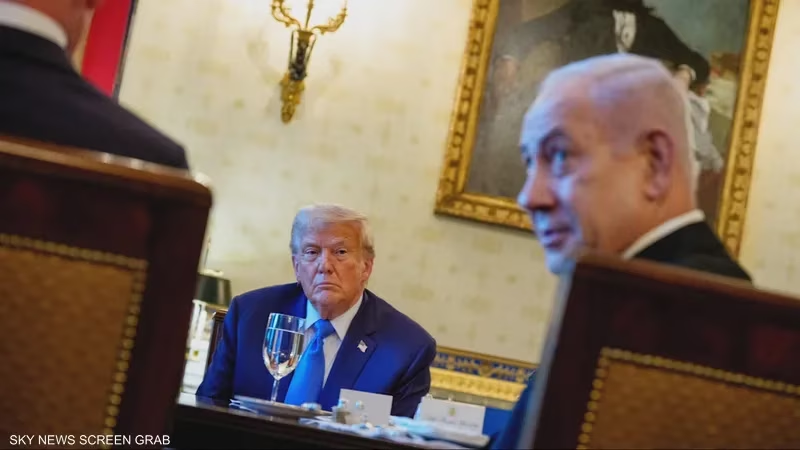
Amidst an unprecedented escalation of tension in the Middle East, US President Donald Trump announced that the decision to end the ongoing war with Iran would not be a unilateral American decision, but would be coordinated "to some extent" with Israeli Prime Minister Benjamin Netanyahu. This statement reflects the extent of military and political entanglement between Washington and Tel Aviv in managing the conflict, at a time when the region is witnessing a series of rapid military and political developments that could redraw regional power balances.
Trump's statement came at a time when Tehran announced a sensitive transition in the religious and political hierarchy, with the appointment of Mojtaba Khamenei as the new Supreme Leader, succeeding his father Ali Khamenei. This development is considered one of the most dangerous political shifts in Iran in decades, as the position of Supreme Leader represents the ultimate authority in the state and controls major military and strategic decisions, including managing the confrontation with the United States and Israel.
In parallel with these political developments, the region witnessed a significant military escalation. Iran launched a number of missiles towards Israel, while strong explosions were heard in the Qatari capital, Doha, amidst reports of aerial interceptions targeting drones and missiles. Both Saudi Arabia and Kuwait also announced that their air defenses intercepted aerial targets believed to be drones or missiles that crossed the region's airspace during the escalation.
This geographical expansion of confrontations indicates that the war is no longer confined to one arena, but has transformed into a multi-front regional conflict extending across the Gulf and the Middle East. It also reflects the extent of concerns among neighboring countries about the confrontation spreading to their territories, especially given the presence of US military bases and strategic energy corridors in the region.
In another development that increases the tension, the US military announced the death of a seventh American soldier in the ongoing war in the Middle East. This number is an indicator of the deepening US military involvement in the conflict, which could open the door to internal discussions in the United States about the cost of the war and its political and military limits.
The US President escalated his rhetoric towards the new Iranian leadership, warning that the next Supreme Leader would not be able to remain in his position "for long" without the acceptance or approval of the United States. This statement reflects a clear pressure message directed at the new Iranian leadership, in an attempt to impose a political and military deterrence equation during the power transition phase.
Observers believe that these statements come within a broader American strategy aimed at weakening Iran's ability to quickly reorganize its political leadership after the power transition. Washington also seeks, according to several estimates, to use military and political pressure to push Tehran to reconsider its calculations in the regional confrontation.
In contrast, field indicators suggest that Iran is trying to demonstrate its ability to respond and establish its own deterrence equation, whether through launching missiles or by expanding the scope of indirect operations in the region. It appears that both sides are on a path of calculated escalation, with each trying to achieve strategic gains without sliding into a full-scale open war.
Amidst this complex scene, the issue of ending the war remains linked to several intertwined factors, including the military balance of power, developments in political leadership within Iran, and the extent of the United States' and Israel's ability to achieve their strategic goals. Until then, it seems that the Middle East is heading for a period of uncertainty, the outcomes of which may determine the shape of the regional order for many years to come.
Trump's statement about a "joint decision" with Israel shows the extent of the organic alliance between Washington and Tel Aviv in managing the war. Military coordination between the two countries is not new, but it has become more evident in this crisis. This also reflects the US administration's understanding that any settlement of the conflict cannot be imposed without considering Israeli security calculations. However, this approach may also raise regional concerns about marginalizing the role of other powers, and further complicate any potential diplomatic path to end the war.
Mojtaba Khamenei's appointment as Supreme Leader represents a pivotal moment in Iranian politics. The transfer of power within the ruling religious family may spark internal debate about the legitimacy of this arrangement, but at the same time, it provides continuity in the state's political and military approach. Amidst the war, the new leadership may use the rhetoric of steadfastness and resistance to bolster its internal legitimacy. Therefore, the coming period is likely to witness greater rigidity in Iranian positions, rather than openness to quick settlements.
The widening scope of strikes to include the Gulf airspace highlights the danger of the war turning into a wide-ranging regional conflict. Gulf states, despite their attempts to avoid direct involvement, find themselves at the heart of the tension due to their geographical location and the presence of foreign military bases on their territories. Any further escalation could threaten global energy routes and affect the international economy. Therefore, the importance of international diplomatic efforts to contain the crisis before it develops into a comprehensive regional confrontation that is difficult to control is increasing.

Share your opinion
Regional Escalation and Power Transition in Tehran: Trump Links Ending War with Iran to Coordination with Netanyahu