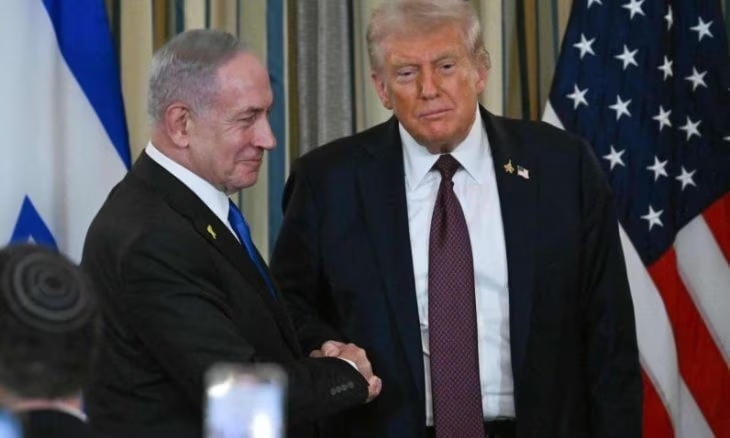







Well-informed sources revealed details of a pivotal phone call on Monday, February 23, between Israeli Prime Minister Benjamin Netanyahu and US President Donald Trump, which carried highly critical intelligence. The information indicated that Israeli intelligence had detected a plan for a meeting involving Iranian Supreme Leader Ali Khamenei and his senior advisors at a single location in the capital Tehran on Saturday morning, representing an unprecedented operational opportunity.
Reports confirmed that Netanyahu emphasized during his call with Trump that a focused aerial strike at that time would be sufficient to eliminate the entire Iranian leadership hierarchy in one blow. American and Israeli officials considered this call the moment that officially put the war on track, providing the decisive answer to those who doubted the timing of the sudden military escalation.
Despite Trump's prior inclination to deliver strong blows to Iran, the Israeli intelligence information was the decisive factor in determining the zero hour. The two months preceding the outbreak of the confrontation witnessed unprecedented intensive coordination, with the two leaders meeting twice and speaking by phone on fifteen occasions to study available military options and refine targets.
At Trump's direct request, the US Central Intelligence Agency began conducting independent verification operations that confirmed the accuracy of reports from Israeli military intelligence regarding Khamenei's movements. The strike was originally scheduled to be carried out a week earlier, but intelligence and operational circumstances, including bad weather, necessitated its postponement to ensure the success of the operation.
In a tactical move to ensure the element of surprise, the US President deliberately avoided excessive focus on the Iranian file during his State of the Union address delivered before the operation. According to White House officials, the aim of this media calm was to avoid raising any suspicions with the Iranian leader that might prompt him to change his plans or disappear before the planned attack was carried out.
By Thursday, intelligence reports had definitively confirmed that all targeted individuals would be present at the specified location. Meanwhile, Trump's envoys, Jared Kushner and Steve Witkoff, were holding talks in Geneva with Iranian officials, but they later informed Washington that the diplomatic path had not made any tangible progress that satisfied the aspirations of the US administration.
On the other hand, the Omani mediator was making last-dditch efforts to avert an explosion, as Omani Foreign Minister Badr Al Busaidi revealed that Tehran had agreed to conditions described as unprecedented. Al Busaidi explained that Iran had agreed to zero out its enriched uranium stockpile and accept a comprehensive and precise inspection regime by the International Atomic Energy Agency to ensure it did not possess a nuclear weapon.
Despite these significant Iranian concessions conveyed by Muscat, the US President considered that the diplomatic path had reached a dead end and could not be trusted. It seemed that the conviction in Washington and Tel Aviv was leaning towards a military solution as the only option to fundamentally end the Iranian threat, away from diplomatic promises that the administration considered insufficient.
At precisely 3:38 PM on Friday, Eastern Seaboard time, Trump issued his final order to commence the aerial assault. Just eleven hours after the order was issued, bombs began falling on their targets in Tehran, leading to the death of Ali Khamenei and igniting the spark of a comprehensive war that changed the balance of power in the region.
Sources clarified that the US administration was working on two parallel tracks; one diplomatic, led by the negotiation team, and the other military, coordinating precisely with the Israeli side. Trump was constantly evaluating the results of both tracks, but he found in the close partnership with Netanyahu and the rare intelligence opportunity sufficient motivation to tip the scales towards military force over negotiations.
US Secretary of State Marco Rubio defended the decision to go to war, emphasizing that the confrontation was inevitable and unavoidable given Iranian behavior. Rubio indicated that the military operation had to happen eventually, and the debate was only about choosing the optimal timing to achieve the greatest strategic impact.
For his part, an Israeli official revealed that Trump had wanted to deliver the strike as early as January, but it was Netanyahu who requested the postponement to ensure complete field coordination. While original plans suggested execution in the spring to build domestic support, the Israeli side pushed to accelerate the operation as soon as the golden intelligence became available regarding the location of the Iranian leadership meeting.
Netanyahu informed Trump and his team that a single devastating aerial strike could eliminate Khamenei and his inner circle entirely.
Share your opinion
Behind the Scenes of the Final Moments: How an Intelligence Tip from Netanyahu Decided Trump's Decision to Start the War and Assassinate Khamenei?