






Recent analytical reports have issued serious warnings against the United States launching a military attack on Iran, considering that such a step could lead to a widespread security explosion in the region. Sources indicated that the prevailing assessments in the White House regarding the possibility of Tehran's rapid surrender under the weight of military pressure reflect a misunderstanding of the nature of internal Iranian calculations.
Observers believe that US President Donald Trump tends to think that the economic and political weakness currently suffered by Iran will force it to make major concessions. However, the reality indicates that tightening the noose on the Iranian leadership may push it towards suicidal options to defend its survival and political prestige in front of its public and allies.
Confidence in circles close to Trump is based on past experiences, where decisive decisions such as moving the US embassy to Jerusalem in 2018 did not lead to the catastrophes predicted by foreign policy experts. This past success reinforces the current administration's conviction in its ability to contain any potential Iranian reaction to specific military strikes.
Despite this confidence, analyses indicate that the current Iranian situation is complex, as the current fragility leaves no room for maneuver or compromise. Instead of military pressure being a means of de-escalation, it turns, from the Iranian perspective, into a motive for deterrence through harsh escalation to demonstrate strength.
It appears that American options regarding the Iranian file have been limited to two paths, with no third: either imposing a comprehensive agreement that ends Tehran's nuclear ambitions and missile program, or resorting directly to force. This division puts the region on the brink of an abyss, especially with Washington's insistence on achieving a symbolic victory that transcends complex technical details.
Historically, the Iranian leadership has proven that it does not back down in the face of external pressures except in cases where it feels a direct existential threat to the regime's continuity. Analysts recall Tehran's acceptance of a ceasefire in its war with Iraq in 1988 as a unique example of forced retreat after a long attrition.
At present, Supreme Leader Ali Khamenei appears less willing to make fundamental concessions, especially in light of the internal challenges facing the country. Maintaining an appearance of strength and steadfastness is a fundamental pillar of Tehran's survival strategy in the face of regional and international adversaries.
Iran fully realizes its inability to win a comprehensive conventional war against the United States or face a large-scale ground invasion. However, this realization does not mean silence, but may push it to launch preemptive or retaliatory strikes to avoid appearing helpless in the face of repeated blows.
Estimates indicate that the Iranian response may directly target the concentrated American military presence in the region, where about 40,000 soldiers are deployed in 13 military bases. These bases are within the effective range of Iranian missiles and drones, making them potential targets in any confrontation.
In addition, the interests of the Israeli occupation emerge as a primary target in the Iranian target bank, as Tehran seeks to link any American attack to regional complicity. This linkage aims to raise the cost of any military adventure against it by directly threatening the security of Washington's allies in the region.
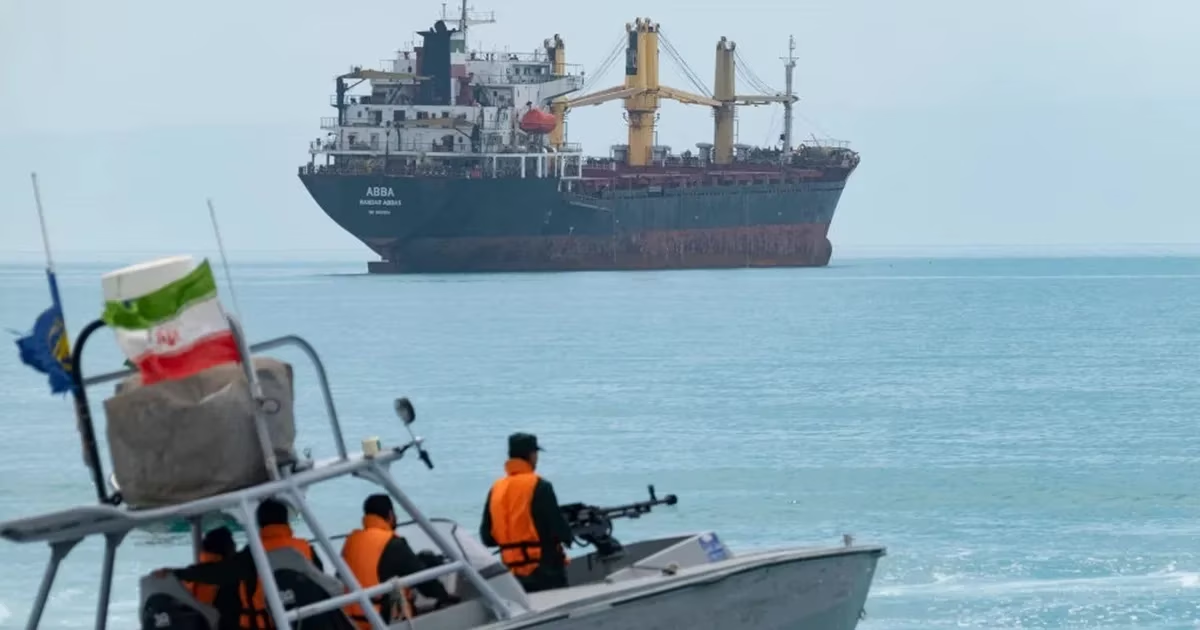
Iranian threats extend to vital waterways, most notably the Strait of Hormuz and the Red Sea, which could lead to a paralysis of global trade. Any disruption in these passages will inevitably lead to huge jumps in energy prices, putting economic pressure on the entire international community.
Tehran also has the ability to activate its network of regional allies, foremost among them the Houthi group in Yemen, to target commercial ships and oil tankers. This type of proxy warfare gives Iran the ability to harm American and Western interests without entering into a direct and open confrontation.
In conclusion, sources confirm that Washington's continued approach of maximum pressure without opening real diplomatic channels may close all doors to peaceful solutions. Iran, despite its relative weakness, still possesses disruptive tools capable of inflicting severe harm on American strategic interests in the Middle East.
Iran's current fragility does not open the door to concessions, but rather narrows the margin for compromise, making any military pressure a catalyst for escalation.
Share your opinion
Warnings of Washington's Miscalculation: Attack on Iran Could Ignite Unprecedented Regional Escalation