







Indicators of tension are escalating in occupied Jerusalem with the advent of the holy month of Ramadan, amidst increasing accusations against the Israeli occupation authorities of seeking to impose a new reality within the blessed Al-Aqsa Mosque. Field reports indicate that recent security measures have exceeded all historical understandings that have governed the holy site for many decades, threatening an explosion of the situation in the region.
International press sources quoted experts warning that the agreement that regulated prayer affairs in the Noble Sanctuary for six decades has effectively collapsed. This collapse is a result of continuous pressures from extremist Temple groups that enjoy direct and unprecedented support from ministers in the current Israeli government, who seek to change the identity of the place.
Ramadan's first days witnessed a series of blatant violations, most notably the arrest of the Al-Aqsa Mosque Imam and police forces raiding the courtyards during worshipers' evening and Tarawih prayers. These actions represent a clear breach of the status quo since 1967, which restricts the right to pray in the Noble Sanctuary to Muslims alone.
The occupation police and the General Security Service (Shin Bet) are currently under the command of a far-right political leadership that adopts an overt agenda to undermine the role of the Islamic Endowments Department. Observers believe that these policies aim to assert full Israeli control over the site and force Palestinians to accept daily incursions as an unchangeable reality.
Sources in the Islamic Endowments Department in Jerusalem confirmed that the Shin Bet detained a number of its employees administratively without clear charges, in a move aimed at intimidating staff. Decisions were also issued to prevent dozens of employees and imams from entering the mosque to perform their religious and administrative duties, which disrupted the department's ability to organize the influx of worshipers.
The restrictions were not limited to human aspects but extended to include preventing necessary maintenance work and looting endowment offices inside the Sanctuary. The occupation authorities deprived worshipers of the most basic services, preventing the installation of sun-protective awnings or the establishment of temporary medical clinics to deal with emergencies during Fridays and crowded days.
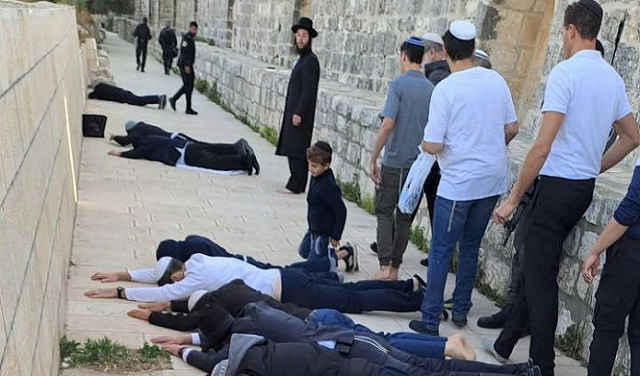
In a provocative move, the occupation police extended the hours of settler and tourist incursions into Al-Aqsa Mosque during the morning period. Eyewitnesses documented the entry of hundreds of settlers who performed Talmudic rituals and chanted religious songs loudly inside the courtyards, in a blatant challenge to the feelings of fasting Muslims.
The National Security Minister, Itamar Ben-Gvir, is leading this escalatory trend through his repeated statements about his desire to raise the Israeli flag inside Al-Aqsa and build a Jewish synagogue. Ben-Gvir has given settlers the green light to bring in printed prayer books, which was strictly prohibited previously by the Israeli security services themselves.
Legal experts and international advisors described the situation in Jerusalem as a 'ticking time bomb' that could explode at any moment due to the desecration of the holy site. They pointed out that any real or perceived threat to Al-Aqsa has always been the primary driver of major unrest in the Palestinian territories, as happened in the Al-Aqsa Intifada in 2000.
Analysts believe that the current Israeli government feels a sense of impunity, which pushes it to cross red lines without regard for international public opinion. This feeling stems from its ability to implement extreme military and political policies in Gaza and the West Bank without facing real international pressure that would compel it to retreat.
The Islamic Endowments Department, affiliated with the Jordanian Ministry of Endowments, faces immense pressure to maintain its role in managing the site under Hashemite custodianship. However, unilateral Israeli measures weaken the institution's ability to protect the mosque and provide services to thousands of worshipers who travel to it from various regions.
Figures issued by the Jerusalem Governorate indicate that the campaign of arrests and expulsions systematically targeted active personnel in the mosque before and during Ramadan. The occupation aims to empty the mosque of its guards and custodians to facilitate incursions and implement the temporal and spatial plans it seeks to impose.
The repeated police raids on the mosque courtyards during Tarawih prayers reflect a desire to break the morale of Jerusalemites and prevent them from performing i'tikaf. Occupation forces sometimes use excessive force to evacuate the courtyards, leading to injuries and arrests among the young men stationed inside the Noble Sanctuary.
Al-Aqsa Mosque remains the central axis of the conflict, as all parties realize that tampering with it means entering a new phase of comprehensive confrontation. With the continued 'brinkmanship' policy pursued by the right-wing government, eyes remain fixed on Jerusalem, fearing a deterioration of the situation to undesirable consequences.
Al-Aqsa is like a ticking time bomb, and what we are witnessing today are repeated provocations that make the situation significantly more sensitive, especially with the West Bank turning into a powder keg.
Share your opinion
International Report Warns of 'Status Quo' Collapse in Al-Aqsa Under Pressure of Israeli Extremism