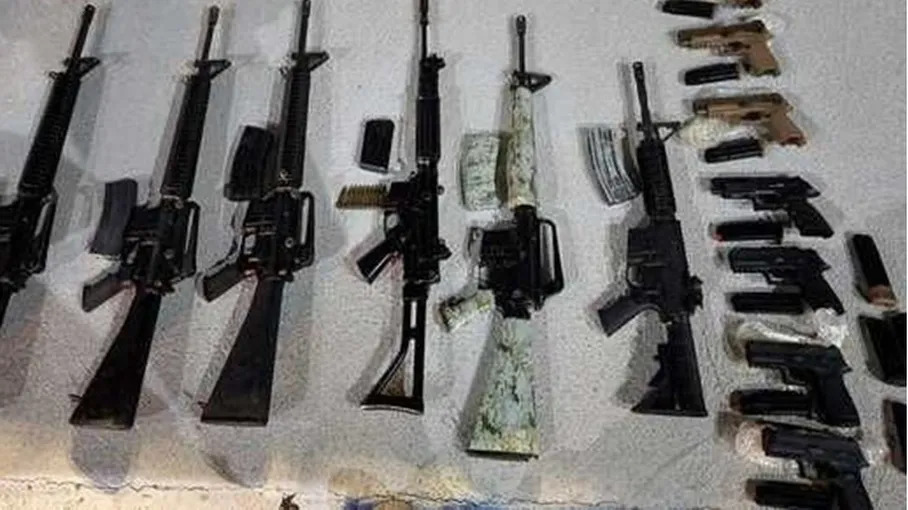







The Israeli fears regarding the risks arising from the increase in smuggling operations across neighboring borders with Egypt, Jordan, Syria, and Lebanon do not cease, whether it is drug smuggling for the criminal world or weapons for resistance forces. This has heightened warnings that what began with the smuggling of drugs and weapons on bicycles may end in a serious security incident, approaching the severity of the Al-Aqsa flood, regardless of its strength and danger.
Yair Kraus, a security correspondent for Yedioth Ahronoth, focused in his remarks on the border with Syria, noting that a new reality has begun to take shape in an unfamiliar arena. Since October 2023, it has become a new and dangerous smuggling route. While it is currently used for criminal purposes, it may become a route for infiltrating militants.
He added in a lengthy report that "this criminal axis will later take on national dimensions and will achieve successes at the expense of Israeli security. This means that a complex reality is currently forming in the Syrian area near the border. On one hand, people live routine lives, and on the other hand, there are many hostile elements that want to harm us."
He explained that "what increases the security danger of the border with Syria is that there is no police or government to enforce order, and smuggling along the northern border, especially the Golan Heights, is significantly affected by geopolitical and security changes."
He confirmed that "dozens of smuggling operations are running smoothly, and the responsibility falls on the army." He quoted Major Oshri Amour, the commander of the border unit established about three decades ago to deal with smuggling, stating that "on the night of October 7, 2023, we were ambushed on the Lebanese border while we were standing by the fence. Initially, the unit was called the 'Lebanese Border Unit,' but over the years, the challenge increased, and it was deployed along the entire northern border for hundreds of kilometers, now including the Syrian border as well."
Kraus revealed that "on the morning of October 7, when we saw trucks crossing the border in the south at the Gaza border, we immediately organized all the soldiers to go there to assist the army and settlers. However, the area commander advised us not to do so, fearing a real threat of Hezbollah joining in and breaching the northern border. Therefore, we stayed to protect it. Today, he and his men could not have imagined two years and a month ago that they would be standing at the same border after the collapse of the Assad regime and Hezbollah receiving a fatal blow."
He clarified that "Israel has achieved successes in the security field in the north, but facing smuggling operations constitutes an ongoing struggle that is still far from achieving victory in it. Because when one smuggling route for drugs and weapons is closed, smugglers immediately look for another route, like new buds after rain. Now, it seems they have found at least one route in Syria. The reasons for this are multiple; before the war, while the Syrian border was exposed and flooded with water, the Lebanese border was filled with dense thickets that made it easier for smugglers to hide, and at the same time, Israel was hesitant to attack it."
He pointed out that "throughout the fighting in the north, smuggling operations from the Lebanese border ceased, and anyone approaching the fence is considered dead. Access to the Syrian border has also become extremely difficult. Currently, the presence of the army in Lebanon still affects smuggling routes, but at the same time, the rate of smuggling from Jordan, Israel's longest border, has increased, where efforts are concentrated. Despite the decline in smuggling on the Syrian border, it still attracts significant attention from the police, army, and Shin Bet, because what was once unfamiliar has now become a phenomenon and a changing, evolving event."
Kraus emphasized that "if anyone approaching the fence on the Lebanese border is at risk of death, and the area adjacent to it is forbidden for Lebanese to enter, the reality in Syria, where a buffer zone has been established with Israeli soldiers present, has become much more complicated, as have the security efforts to combat the smuggling of weapons and drugs and infiltration attempts."
He explained that "on the other side, there is life, roads, and homes very close to the fence, where people live. Ultimately, it is enough for there to be a road that allows a private car to approach the fence, and then someone jumps for a few seconds, in phone contact with the smuggler from the Israeli side, and throws pistols into his pockets, and the incident ends in the blink of an eye."
He confirmed that "on the Syrian side, the driver escapes deep into the area

Share your opinion
The occupation is concerned about the increase in arms smuggling across the borders... and fears of armed infiltrators.