






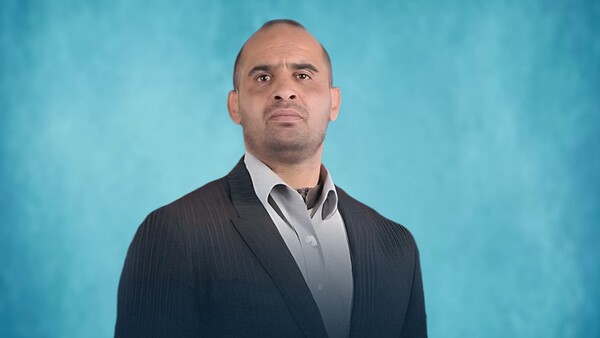

The report by the British Guardian newspaper published on October 14, 2025, was not just a fleeting journalistic piece about Palestinian prisoners, but rather a damning document in the face of the world, a cry sealed with the blood of those who emerged from the Israeli hell with violated bodies and shattered souls. The report, prepared by the well-known British writer Owen Jones, did not present exceptional scenes, but rather revealed a systematic reality of brutality that feeds the occupation system, where torture becomes a daily ritual, starvation an official policy, and humiliation a method of governance.
The report tells the story of the released prisoner Naseem Al-Rad'e, a thirty-three-year-old government employee from Beit Lahia in northern Gaza, who was arrested on December 9, 2023, from a school that had turned into a displacement center. He spent twenty-two months in Israeli prisons, including one hundred days in an underground cell, without any charges being brought against him. He emerged with one eye after receiving a "farewell gift" from the Israeli guards who shackled him and beat him severely before his release. He recounts to the Guardian: "The guards would suddenly enter, bind our hands and feet, and then start beating us mercilessly. The beatings were not an exception but part of a regular system of torture." The cells were overcrowded, fourteen people in a room barely large enough for five, the air was suffocating, the food contaminated, and skin and fungal diseases gnawed at the exhausted bodies. But when he left prison, he found himself facing an even harsher tragedy: the martyrdom of his wife and children in an Israeli bombing of their home. He said with a voice dripping with bitterness: "I was happy that my release day coincided with my daughter Saba's third birthday... I wanted to celebrate with her, but she went with my family, and with her went my joy."
In another testimony, the released prisoner Mohammed Al-Asalia, a twenty-two-year-old university student, spoke about his arrest from Jabalia and his detention in Nafha prison in the Negev desert. Al-Asalia said: "There was no medical care. We tried to treat our wounds using floor disinfectant, but it made them worse." The prison was a laboratory of pain: filthy mattresses, contaminated food, emaciated bodies, and an unhealthy environment that turned the walls into graves for the living. He spoke of a room that the guards called "the disco," where they played loud music non-stop for two consecutive days to psychologically torture the prisoners.
He added: "They would hang us on the walls, spray us with cold water, and sometimes throw pepper powder on our bodies." Medical care was non-existent, and detainees treated themselves with whatever they could find, while hunger was used as a collective disciplinary weapon, making each bite a daily battle for survival.
The report indicates that these practices are not isolated incidents but a systematic institutional policy. According to the "Public Committee Against Torture in Israel" (PCATI), approximately 2,800 Palestinians from Gaza are held in Israeli prisons and detention centers without charges. The Israeli Knesset amended what is known as the "Illegal Combatants Law" in December 2023 to allow for indefinite administrative detention based on the "discretion of an officer" who deems the detainee a threat. Thus, Israel turned the law into a legal cover for systematic torture and enforced disappearance. The executive director of the committee, Tal Steiner, stated clearly: "We see torture as part of a policy led by Israeli decision-makers like Itamar Ben Gvir and others."
In this context, the name of the extremist National Security Minister Itamar Ben Gvir emerged, who openly boasts about policies of starvation and humiliation. In a post on social media last July, he wrote: "I am here to ensure that terrorists receive the bare minimum of food." These are not reckless words from an isolated extremist, but an official expression of a state policy that sees depriving a prisoner of a morsel of bread as a "security" measure. The figures in the report are alarming: losing thirty kilograms of weight has become common among detainees. Naseem Al-Rad'e entered prison weighing ninety-three kilograms and emerged weighing sixty, while Al-Asalia lost more than thirty kilograms. The body melts away just as humanity melts away in the depths of the cells.
Signs of torture are evident on the bodies
Dr. Iyad Qadi'ah from Nasser Hospital in Khan Younis, which received a number of released prisoners, states that signs of torture are clear on their bodies: bruises, fractures, wounds, marks from being dragged on the ground, and signs of restraints embedded in flesh down to the bone. He adds that many were transferred directly to the emergency department due to their poor health condition, and
Share your opinion
When "The Guardian" reveals the true face of Israel