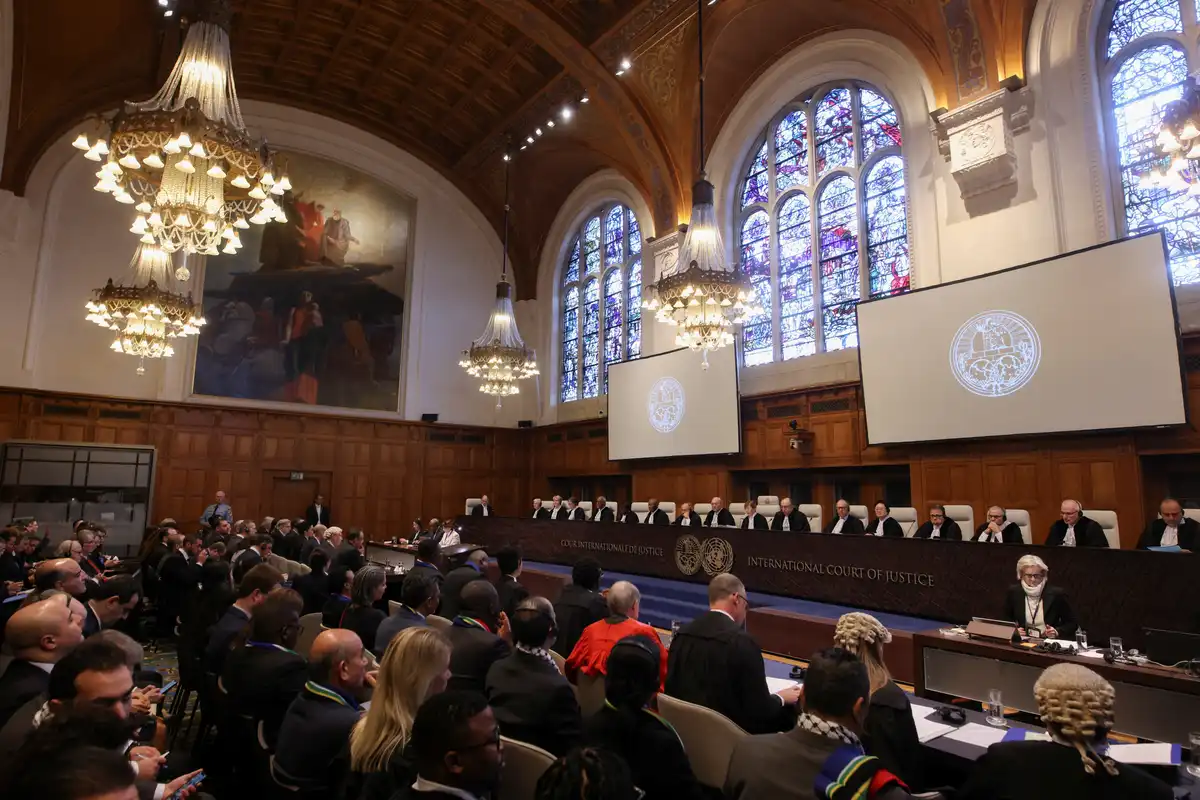







While Palestinians starve and world opinion hardens (against deliberate starvation), the International Court of Justice (ICJ) may not issue a ruling until 2027 or later, The Guardian reported on Sunday.
The newspaper explains that while increasing numbers of Palestinians in Gaza are dying daily from starvation, and a growing number of legal scholars, aid officials, and politicians are beginning to describe Israel's actions as genocide, a final ruling on the matter from the world's highest court will take a long time.
Experts at the International Court of Justice said a ruling on whether Israel is committing genocide in Gaza is unlikely before the end of 2027 at the earliest, amid warnings that the international community should not use the court's slow process as an excuse to delay action to stop the killing.
It should be noted that Israel was originally scheduled to submit its response to South Africa's genocide charge on Monday, but the court granted its lawyers a six-month extension. The 17-judge panel accepted Israel's argument that it needed more than the allotted nine months to prepare its case, claiming that "evidential issues" in South Africa's submission meant that "the scope of the case remains unclear."
The South African legal team responded that none of the arguments presented by the Israeli lawyers constituted a legitimate reason for the delay, and that prolonging the case was unjustified in light of the humanitarian emergency in Gaza. The court sided with Israel, which now has until next January to present its case.
"I think the [ICJ] is being very cautious here because of the political climate," Juliet McIntyre, a senior lecturer in law at the University of South Australia, was quoted as saying by the newspaper. "They don't want to be accused of ignoring Israel's procedural rights and finding that it committed genocide without giving them a full opportunity to respond."
Since its founding in 1945, the International Court of Justice has always prioritized caution over speed in its role as a final arbiter between states. "The ICJ is known for its slow deliberations," said Eva Vukošić, assistant professor of international history at Utrecht University. "It's 80 years old and wants to operate in a certain way."
It should be noted that after Israel presents its defense next January, each side is usually given sufficient time to prepare another round of arguments to counter the other side's points and new developments.
“The second round typically takes about six months for each side, which is another year, and then we get to January 2027,” said Michael Baker, who served as a legal officer at the International Court of Justice from 2010 to 2014 and is now an assistant professor of international human rights law at Trinity College Dublin.
"If things go smoothly and there are no further incidents or interruptions in the proceedings, a hearing will take place sometime in 2027, perhaps early enough in the year that a ruling can be issued by the end of the year," he told the newspaper.
However, a number of factors could delay the case until 2028, including requests from other states to intervene. The International Court of Justice has a tool to address the disparity between the pace of its proceedings and the need to address catastrophic situations like Gaza. In 2024, the court issued three sets of "provisional measures," in the form of instructions to Israel, in response to South Africa's requests.
In January of last year, the International Court of Justice ruled that the genocide claim was "plausible" and acknowledged that "the catastrophic humanitarian situation in the Gaza Strip is at serious risk of deteriorating before the Court renders its final judgment."
Israel has completely ignored the interim measures, rejecting the genocide accusation as "outrageous and false." South Africa has not requested any further measures, despite periods of a comprehensive blockade imposed by Israel on Gaza this year. According to a source close to its legal team, intense pressure from Washington has had an effect.
Last February, US President Donald Trump issued an executive order halting aid to South Africa, criticizing its stance before the International Court of Justice and claiming, without evidence, that the country's white Afrikaners were "victims of unjust apartheid." However, the South African government insisted it had no intention of dropping the Gaza case.
Despite the ICJ's deliberately slow pace, the standard of proof required to reach a ruling on genocide is extremely high. On the first page, the 1948 Genocide Convention does not set a high standard, defining genocide as the intentional destruction "in whole or in part" of a national, ethnical, racial, or religious group, according to the court's experts.
However, in its interpretation of the Convention, the International Court of Justice required "absolutely conclusive" evidence that the accused state had genocidal intent in committing mass killings, and that there were no other possible competing motives, such as counterinsurgency or territorial seizure. Under this standard, the court has yet to rule against any state for genocide.
Whatever the outcome, many international humanitarian law experts fear that focusing on the genocide ruling could be a dangerous distraction, delaying decisive action by the international community pending the ICJ ruling while allowing provable crimes against humanity to continue.




Share your opinion
The International Court of Justice's postponement of its ruling on genocide in Gaza undermines its credibility.