





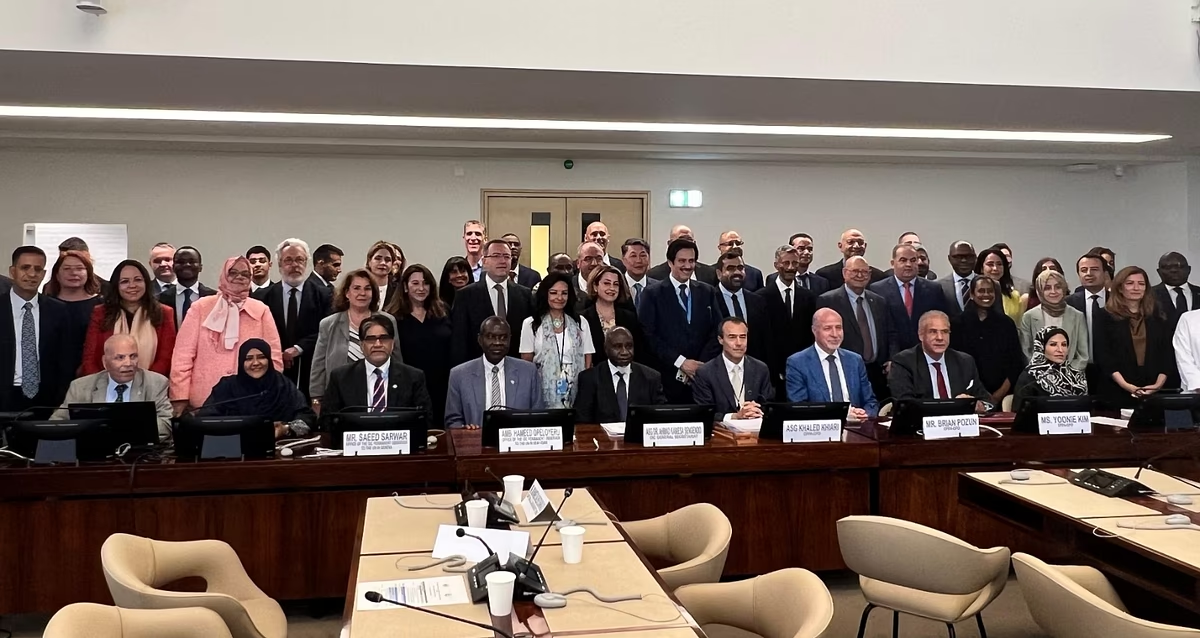
Mohamed Salem Sharqawi, the acting director of Bayt Mal Al-Quds Al-Sharif Agency, called for greater coordination among international humanitarian organizations to contribute to "preserving the special status of Jerusalem, fortifying its religious and civilizational center, and providing livelihood security and stability for its Palestinian residents," in integration with international efforts at various levels. Sharqawi stated, in his speech during the opening of the seventeenth session of the General Meeting between the United Nations and the Organization of Islamic Cooperation, which opened today, Wednesday, at the United Nations headquarters in Geneva, and will continue for three days: that there is a need to "develop a joint mechanism to rationalize efforts and unify goals to achieve the desired results," especially in light of the increasing challenges witnessed by the Holy City and its surroundings, based on the values of unity, freedom, justice, peace, and coexistence. He pointed out that the economic and social conditions of Palestinians "remain worrying" due to the daily challenges they face, and the difficulties they encounter in managing their livelihoods, movement, and mobility, which reinforces Bayt Mal Al-Quds Agency's commitment to continue providing all possible forms of support, in implementation of the high directives of His Majesty King Mohammed VI, Chairman of the Al-Quds Committee. He added that the work of humanitarian institutions operating in Jerusalem and Palestine "collides with the effects of accelerating events in the Middle East," noting that the role of the Al-Quds Committee, chaired by His Majesty King Mohammed VI, remains "important and influential" in advancing peace efforts and drying up the sources of conflict. He stressed that the Agency's action plan for the period 2025-2030 stems from a comprehensive vision aimed at consolidating the institution's role as a sustainable development mechanism, combining social support programs for the most needy groups, economic empowerment and human development projects, and supporting emerging enterprises in the fields of renewal and innovation. Today, in Geneva, the General Meeting between the United Nations and the Organization of Islamic Cooperation began, with the aim of strengthening strategic partnership and developing mechanisms for joint coordination between the bodies and agencies of the two organizations. The meeting discusses the progress made in areas of cooperation on issues of common concern, including political challenges, regional conflicts, combating terrorism, cultural, social and economic files, and sustainable development, in addition to exchanging views on ways to address regional and international challenges, and launching new initiatives that support efforts for peace, development, stability, and prosperity. The Organization of Islamic Cooperation is the second largest international organization after the United Nations, with 57 member states spread across four continents, and is headquartered in Jeddah, Saudi Arabia. It is worth noting that Bayt Mal Al-Quds Al-Sharif Agency, the executive arm of the Al-Quds Committee chaired by His Majesty King Mohammed VI, continues to implement its field programs and projects in the city of Jerusalem, in the sectors of education, health, social support, economic empowerment, and heritage preservation, in support of the resilience of Jerusalemites and to strengthen their presence in their city, and to preserve its civilizational and religious identity.

الأربعاء 22 يوليو 2026 5:40 مساءً - بتوقيت القدس
Sharqawi from Geneva: Protecting the special status of Jerusalem requires greater coordination among international humanitarian organizations
شارك برأيك
Sharqawi from Geneva: Protecting the special status of Jerusalem requires greater coordination among international humanitarian organizations