






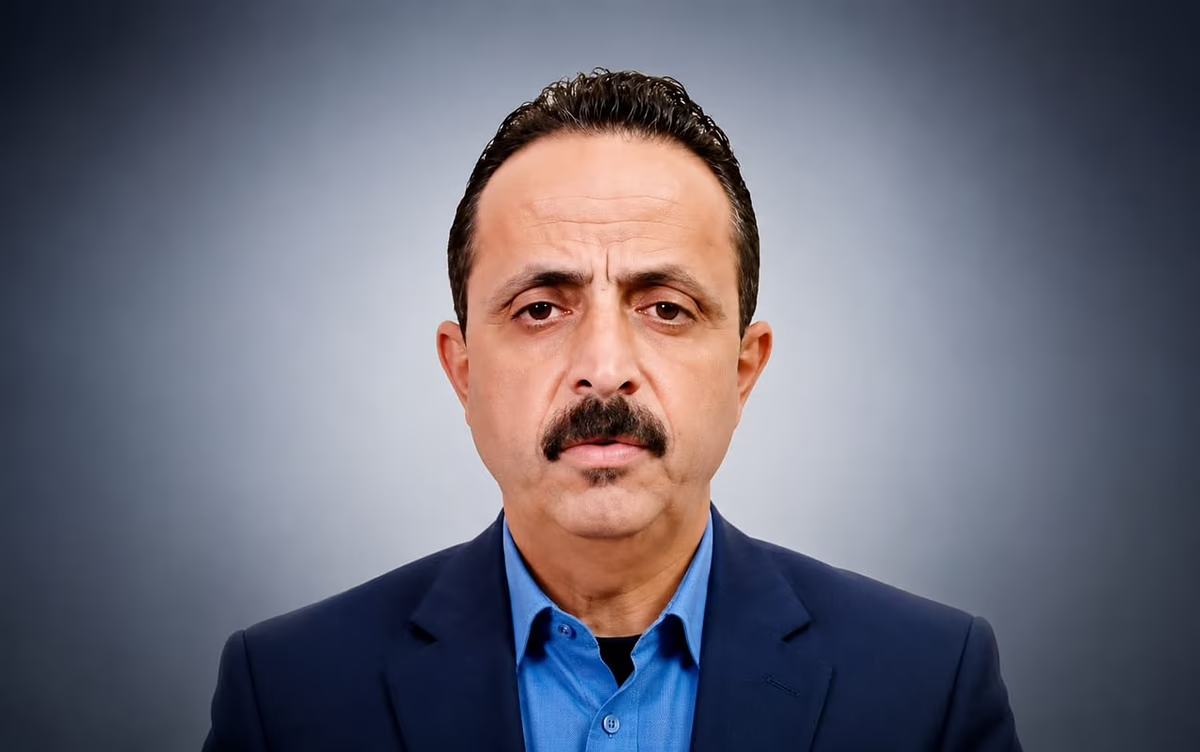
Writer: Munadhil Hanani.
There is no doubt that the Israeli Knesset (Parliament) elections will be held on October 27, 2026, which is the legally stipulated original date. The Knesset will dissolve itself on July 17, 2026. These are the first elections to be held on schedule since 1988, and the current Netanyahu government (the 37th) will be the first government to complete its full term since 1973. 
These elections are considered a referendum on the performance of Netanyahu and his far-right government, especially after the events of October 7, 2023, and the subsequent wars in Gaza, Lebanon, and Iran, and consequently amidst the escalating extremism in Israeli society, particularly towards the entire Palestinian presence. 
Therefore, current opinion polls in (July 2026)
• Gadi Eizenkot (former Chief of Staff, “Yashar” party) is strongly leading or competing with Likud, with 22-23 seats in most polls. 
• Likud (Netanyahu): approximately 21-25 seats.
• “Together” alliance (Bennett and Lapid): declining to 15-18 seats.
• Other parties: Yisrael Beiteinu and Democrats (Golan) approximately 10 seats each, Shas, United Torah Judaism, and Otzma Yehudit (Ben Gvir) approximately 8 each.
• Blocs: The Zionist opposition (without Arab parties) is approaching 57-60 seats, and the current coalition is around 49-53. Forming a government may require complex negotiations or limited Arab support. 
Netanyahu faces difficulty in forming a new coalition, but the opposition is not entirely unified.
The West Bank and Settlement Policies
The current government (especially Smotrich and Ben Gvir) is accelerating the de facto annexation of the West Bank before the elections, to create “facts on the ground” that are difficult to change:
• Unprecedented settlement expansion: establishment of dozens of settlement outposts (185 since 2023), legalization of hundreds of housing units, control over more than one million dunams (about 18% of the West Bank). 
• Cabinet decisions: facilitating land registration and purchase by settlers, transferring security and civil powers, abolishing restrictions on land sales to Jews, and establishing a “Tabu” (land registration) unit with a large budget. 
• Displacement and attacks: expulsion of Palestinian communities, settler attacks (thousands of documented cases), construction of bypass roads, and expansion of control over Area (C).
• Goal: geographically connecting settlements, fragmenting Palestinian lands, and making future evacuation legally and politically difficult.
These policies are described as a “settlement revolution” and weaken the prospects of a two-state solution.
The Expected Impact of the Elections on the West Bank
• Continuation of the Right (Netanyahu + extremists): continuation or acceleration of annexation and expansion.
• Opposition victory (Eizenkot/center-right): may slow the pace slightly, but most Zionist opposition parties do not support a full Palestinian state or significant withdrawal. Differences are often tactical rather than radically strategic, and Lapid, the opposition leader's statements, are the biggest proof of this when he said we would annex Area C and have autonomy in A and B, and there would be no Palestinian state. 
Consequently, the situation in the West Bank is characterized by escalating tension, with an Israeli focus on strengthening control and changing the demographic situation and expanding land confiscation before any potential government change in Israel.
شارك برأيك
Upcoming Israeli Elections and the West Bank