





Washington Message\n\nWashington – Said Arikat – 7/8/2026\n\nNews Analysis\n\nThe question within the American Democratic Party is no longer whether Israel should be supported, but rather how to save the American-Israeli relationship from the policies of Benjamin Netanyahu's government. From this perspective, Rahm Emanuel, former White House Chief of Staff under President Bill Clinton, is trying to present himself as the statesman capable of protecting this historic alliance, even if it requires unprecedented criticism of the Israeli government.\n\nEmanuel's statements, coming from Israel where he is on a private visit, do not seem to be merely a reaction to developments in the Gaza war or to the performance of Netanyahu's government, as much as they reflect deep transformations within the Democratic Party, and also reveal an early start to a political positioning that may serve his ambitions in the presidential elections scheduled for 2028.\n\nEmanuel's discourse appears to be based on three main objectives.\n\nFirst, his repositioning within the Democratic Party. For decades, his name has been associated with the traditional pro-Israel wing. He served as an advisor to former US President Bill Clinton, then as White House Chief of Staff under Barack Obama, and was always among the politicians closest to the Israeli establishment. However, the mood within the Democratic Party has changed radically since the Gaza war, and the electoral base, especially youth and minorities, has become more sympathetic to Palestinians and more critical of Israeli policies. Therefore, Emanuel seems to be trying to maintain his identity as a supporter of Israel, but with new conditions that align with the transformations within the party.\n\nSecond, separating Israel from Netanyahu, which is perhaps the most important message in his speech. He does not say that the American-Israeli alliance has become a burden on Washington, but rather that Netanyahu's government has become a burden on this alliance. By doing so, he seeks to convince the American voter that supporting Israel does not necessarily mean supporting the current government, and that maintaining the strategic relationship requires a change in leadership and policies within Israel.\n\nThird, presenting himself as a realistic presidential candidate. Foreign policy has often been a weakness for many Democratic candidates, while Emanuel has long experience in Middle East affairs. Through this discourse, he tries to show himself as capable of criticizing an ally when it errs, without abandoning the commitment to its security, a position that may attract centrist voters who are concerned about the rising polarization within the party.\n\nHowever, it is also noteworthy that Emanuel does not adopt the discourse of the Democratic left, which calls for imposing isolation on Israel or severing relations with it. Instead, he proposes a different vision based on using American pressure tools to force Israel to change its behavior, rather than punishing or abandoning it. Therefore, he calls for an end to traditional military aid, imposing sanctions on settlers involved in violence, and limiting settlement expansion, while maintaining the security and political alliance between the two countries.\n\nA shift beyond the disagreement with Netanyahu\n\nThe importance of Rahm Emanuel's discourse lies in the fact that it reflects a shift within the traditional pro-Israel current in the Democratic Party, more than it reflects a personal disagreement with Benjamin Netanyahu. For decades, this current considered supporting Israel a matter beyond partisan considerations. Today, however, it has come to see that the continuation of the current Israeli government's policies threatens this historical consensus. Consequently, the criticism is no longer directed at Israel as a state, but at the political approach that, in the view of many, weakens its position within the American political community and depletes its strategic capital.\n\nFrom an Israeli perspective, this discourse represents a very important indicator, because it comes from a figure who cannot easily be accused of hostility towards Israel. Emanuel belongs to the American circles most connected to the Hebrew state, and his political history confirms his continuous support for it. When this type of criticism comes from a figure with such a background, it reflects the extent of concern within the Democratic establishment that the policies of Netanyahu's government are threatening Israel's position within the United States itself.\n\n2028 Election Stakes\n\nEmanuel's positions also reveal a growing realization that the upcoming presidential elections will not be decided solely by economic issues, but also by the candidates' ability to present a coherent vision for foreign policy. From this perspective, he tries to leverage his long experience in managing Middle East affairs to present himself as a pragmatic leader who combines supporting allies and defending American interests. However, this positioning remains fraught with risks, as he must strike a delicate balance between the demands of the changing Democratic base and the positions of traditional supporters of Israel, without losing either side.\n\nAs for his presidential ambitions, it is clear that Emanuel seeks to occupy the middle ground that has become almost vacant within the Democratic Party. He rejects the slogans of the radical left, just as he rejects the policies of the Israeli right, and presents himself as a representative of the "political pragmatism" current. However, the success of this strategy will depend on his ability to convince the Democratic base that he is not defending Israel at the expense of Palestinians, and at the same time convince pro-Israel voters that he is capable of protecting the historical alliance with it.\n\nFuture of the American-Israeli Relationship\n\nIf prominent figures from the Democratic establishment continue to adopt this discourse, the American political scene may witness the beginning of a new phase in managing the relationship with Israel, based on linking political and military support more closely to the behavior and policies of Israeli governments. This will not necessarily mean a decline in the strategic alliance, but rather its transition to a more conditional and accountable formula. If this trend takes root, future Israeli governments may find themselves facing a different American reality, in which the unconditional political guarantees they have relied on for decades will diminish.\n\nIn conclusion, Rahm Emanuel's discourse should not be seen as merely a criticism of the Netanyahu government, but rather as an attempt to redefine the foundations of the American-Israeli relationship at a stage witnessing a profound change in American public opinion. It also reflects the willingness of figures from the heart of the Democratic establishment to say that the continuation of current policies could lead to an erosion of American support for Israel, a development that the political establishment in Washington had avoided discussing publicly for many years.\n\nIn this context, Emanuel's positions can be read not only as a message to Israelis, but also as part of an early political campaign to present himself as a potential president capable of reshaping American policy in the Middle East, and finding a new balance between commitment to Israel's security and pushing for a just political settlement that guarantees Palestinian rights while preserving American interests in the region.

الأربعاء 08 يوليو 2026 6:48 صباحًا - بتوقيت القدس
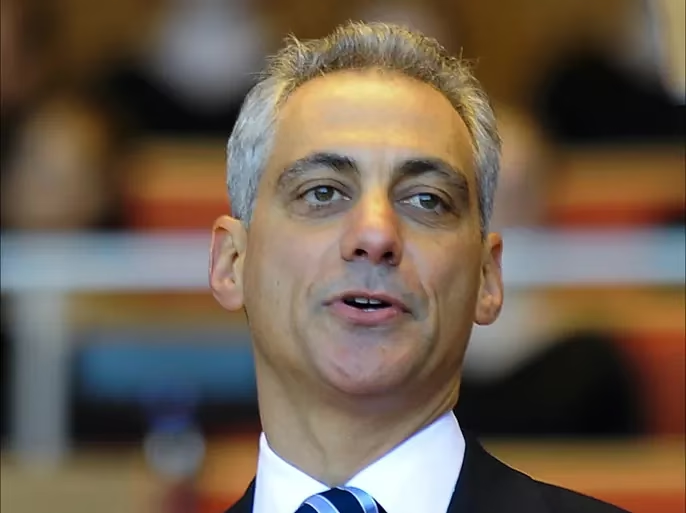
Rahm Emanuel outlines a new Democratic policy towards Israel... and early messages from the White House race
شارك برأيك
Rahm Emanuel outlines a new Democratic policy towards Israel... and early messages from the White House race