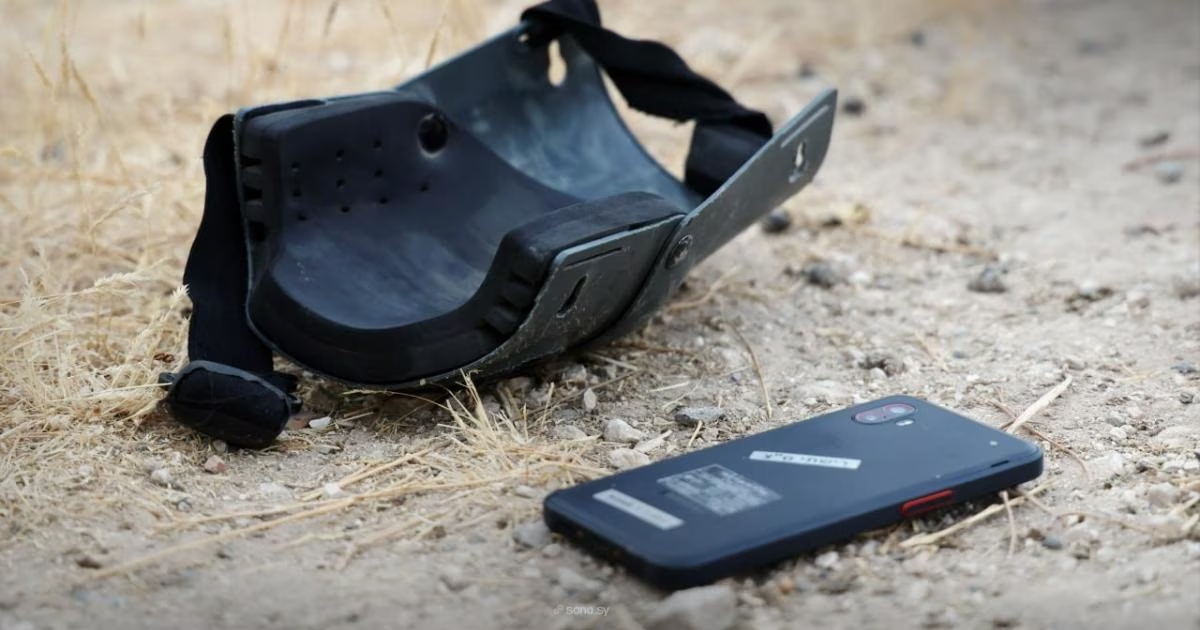







A state of confusion and concern prevailed within Israeli military circles following the revelation that a soldier lost a sensitive military device during an incursion into southern Syria. Field reports indicated that the device fell into the hands of civilians in Daraa province, raising serious fears of a leak of intelligence data and precise geographical information stored on the digital system.
Media sources reported that the incident occurred after clashes in the western Daraa countryside, where Israeli forces attempted to infiltrate the area before encountering popular resistance from residents. This field engagement led to a rapid retreat of the Israeli force, resulting in some military equipment and personal belongings being left on the battlefield.
The details of the incident began when the occupation army attacked Syrian territory, targeting the town of Tal al-Maghar with artillery shells and helicopter machine guns in an attempt to impose a new field reality. As the forces approached the Tal Kudna point, dozens of residents gathered in a popular confrontation that forced the soldiers to withdraw, leaving behind advanced technical devices that aroused the curiosity of the residents.
Preliminary investigations revealed that the lost device belongs to a sophisticated digital system known as 'OLAR', which is exclusively designated for military field use. This device is not like traditional smartphones; rather, it functions as an independent platform that provides high-precision digital maps to help soldiers navigate complex environments without the need for internet connection.
The 'OLAR' system is characterized by its ability to operate away from traditional communication networks, making it immune to external electronic breaches under normal conditions. The Israeli army has relied heavily on this system during its ongoing aggression on the Gaza Strip, where it provided ground units with 3D models of terrain and residential buildings.
The importance of the device lies in its ability to simulate the movement of military vehicles and estimate the best possible routes for advancement in the field and avoiding geographical obstacles. According to military experts, the access of this device to unfriendly parties could reveal the operational mechanisms of Israeli units and their methods for identifying targets and field movement.
Immediately after confirming the loss of the device, the Israeli military command quickly activated emergency protocols to remotely disable the system in an attempt to close security loopholes. Despite this step, concerns remain about the ability of technical experts to recover some data actually stored on the device's hard drive, such as previous navigation logs and checkpoints.
Informed sources reported that the Israeli army tried through several means to recover the lost device before residents reached it, but the swift movement of the area's residents prevented that. This failure led to a comprehensive internal investigation within the responsible military unit to identify those responsible for failing to protect sensitive equipment during external operations.
On social media platforms, the discovery of the device sparked a wide wave of interaction and debate among Syrian users who circulated photos of the military device. Comments varied between those who considered it a valuable intelligence catch and those who warned of the security consequences of retaining such complex technological devices.
Field activists, including Khaled al-Zaher, warned that the device might be a technical 'bait' designed by the occupation to track the locations of individuals who found it. Al-Zaher pointed to the possibility of using the device as a means to penetrate the inner circles of local groups and learn about their capabilities and logistical potential by monitoring the device's movement.
For his part, Hussam al-Ayoubi stressed the need to deal with the device with extreme caution, suggesting that it might be booby-trapped or contain sensitive listening devices that work even after being turned off. Al-Ayoubi called on residents not to operate the device or attempt to charge it, emphasizing that the occupation monitors the signals of these devices with extreme precision via satellites.
In a related context, some commentators, such as 'Abu al-Fadl', called for the necessity of thoroughly examining the digital content of the device by specialists, considering that it might contain evidence incriminating the occupation. He pointed out that the stored data could reveal details related to crimes committed in the Gaza Strip, given the use of this system in managing combat operations there.
The lost device is not a traditional phone, but a secure field platform containing digital maps and secret military navigation information.


شارك برأيك
Israeli Security Alert After Loss of Sensitive Military Device in Daraa Countryside