






Washington's Message
Washington – Saeed Erikat – 1/7/2026
News Analysis
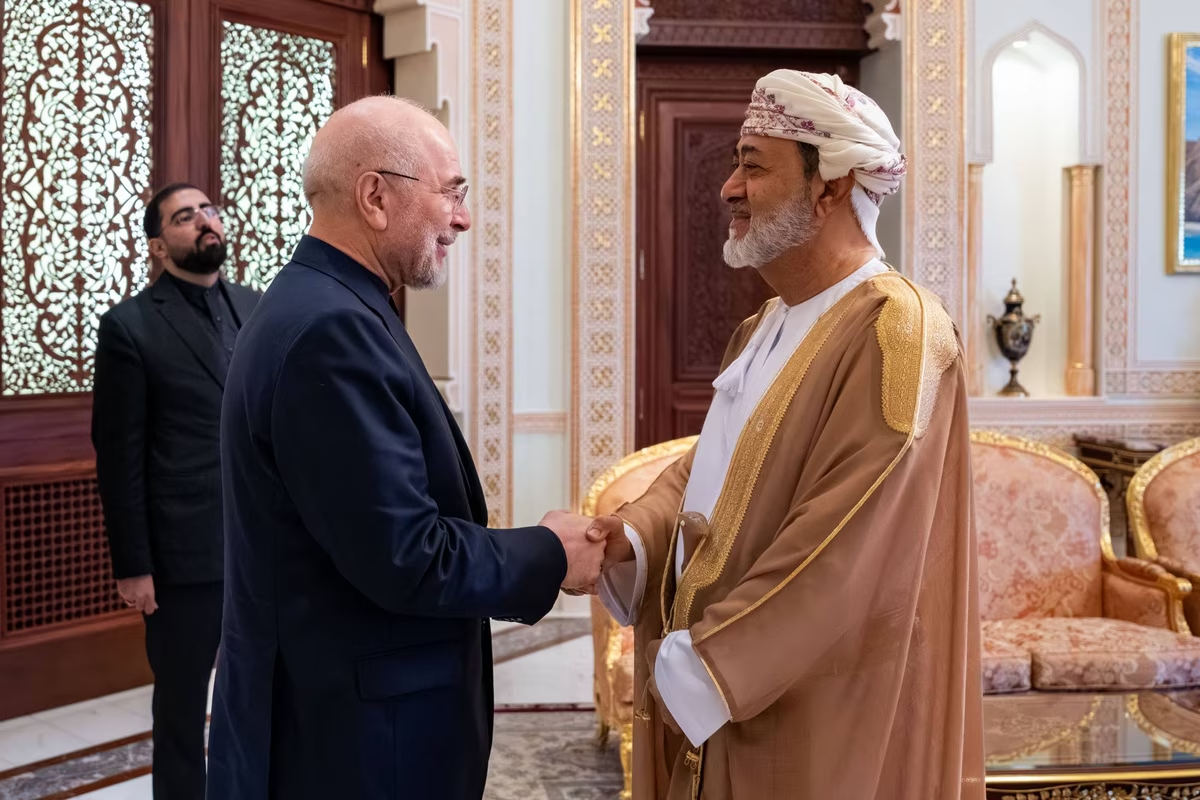
After it became clear that the anticipated US-Iranian meeting in Doha on Tuesday, June 30, 2026, would not take place, despite the presence of chief US negotiators Steve Witkoff and Jared Kushner in the Qatari capital, attention quickly shifted from the stalled diplomatic track to an equally sensitive issue, one that could have an even greater impact on the global economy and energy security: the future management of the Strait of Hormuz. At a time when direct talks between Washington and Tehran have halted, new information has emerged indicating progress in consultations between the Sultanate of Oman and Iran regarding the establishment of a joint mechanism for collecting fees or service charges from ships transiting the Strait. This move carries political, legal, and strategic dimensions far beyond the financial aspect, and opens a new diplomatic confrontation between the United States and Iran, with ramifications extending to Europe and the Gulf states.
Information circulating among diplomatic and Iranian sources indicates that the Omani proposal is not, from a legal standpoint, based on imposing fees for the right of passage itself, but rather on establishing a system to fund navigation services, including maritime pilotage operations, emergency response, marine environmental protection, and maintenance of infrastructure related to navigation security. Muscat states that the proposed model is inspired by arrangements in place in the Straits of Malacca and Singapore, where navigation services are funded through contributions linked to the use of maritime lanes without prejudice to the principle of freedom of passage.
However, this formula did not resolve the dispute; instead, it elevated it to a more complex level. While the Sultanate of Oman asserts that contributions will be voluntary, Iran believes they should be mandatory as part of the new arrangements resulting from the recent war. Washington, meanwhile, rejects both principles if they directly or indirectly set a precedent allowing financial burdens to be imposed on transiting vessels in one of the most important international maritime passages.
The American position was made clear by Secretary of State Marco Rubio, who affirmed that the United States opposes the imposition of any payments on navigation traffic, regardless of the terminology used, whether described as fees, contributions, donations, or service charges. From the American perspective, this could open the door to restricting freedom of navigation, which is one of the fundamental principles of international maritime law.
This crisis gains additional importance because it comes as the temporary arrangements stipulated by the ceasefire agreement between Washington and Tehran are nearing their end. That agreement guaranteed freedom of passage in the Strait of Hormuz for only sixty days, during which a permanent understanding on the management of the maritime passage was to be reached. With the political track stalled, this issue appears to be gradually becoming one of the most complex in the relationship between the two parties.
Tehran believes that the recent US-Israeli war fundamentally altered the balance of power in the Gulf, and that during the confrontation, it succeeded in imposing effective control over navigation traffic within the Strait. This led to significant disruptions in global energy markets, raising oil prices to over one hundred dollars per barrel, and also impacted fuel prices within the United States and several major industrial economies. From this perspective, the Iranian leadership believes that the influence gained in the Strait should not be relinquished with the end of military operations, but rather should be transformed into a permanent political and strategic gain.
In contrast, President Donald Trump's administration views the Omani-Iranian project as a new test of its ability to protect the principle of freedom of navigation, which has for decades been a cornerstone of American policy in the Gulf. However, Washington also recognizes that the Sultanate of Oman still represents the most acceptable mediator to both parties, and that losing its role could lead to the closure of one of the last existing diplomatic channels between the United States and Iran. Therefore, American sources confirm that dialogue with Muscat is ongoing, and that the current disagreement does not rise to the level of threatening strategic relations between the two countries, while acknowledging that reaching a consensual formula will require complex technical and political negotiations.
On the European side, the approach appears quite different. European capitals do not support imposing navigation fees, but they tend to seek a legal solution that preserves the flow of global trade and avoids a new confrontation in the region. Therefore, Europeans are focusing on the possibility of developing a voluntary formula that does not constitute legal recognition of Iran's right to impose fees, but at the same time allows for the funding of maritime services in a way that does not conflict with the rules of international law.
Within the Gulf context, the Omani-Iranian project raises a significant degree of reservation. Saudi Foreign Minister Prince Faisal bin Farhan stressed the necessity of restoring the Strait to its pre-war status, considering that the international community should not accept new arrangements imposed by the results of a military confrontation, as this could entrench precedents that would be difficult to reverse later, and grant regional powers additional tools to influence global trade.
Observers believe that the current debate is not about the fees themselves, but about who has the right to set the rules for the new security order in the Gulf. Iran seeks to transform what it considers a field achievement into a permanent political reality, while the United States tries to prevent the entrenchment of any new equation that could be interpreted as an acknowledgment of the decline of its traditional influence in the region. Between these two positions, the Sultanate of Oman attempts to maintain its role as a trusted mediator by offering compromises that prevent the collapse of the understandings reached after the war.
Estimates suggest that the most likely scenario is the establishment of a temporary mechanism based on voluntary contributions to fund navigation services, allowing each party to present the agreement as a political victory without compromising stated positions. However, the possibility of these efforts failing remains, which could push Iran to take unilateral steps within the waters it considers under its sovereignty, potentially opening the door to legal disputes and perhaps new maritime friction.
Should a direct understanding prove impossible, European powers, in coordination with the International Maritime Organization, might push for the establishment of an independent international mechanism to manage and fund navigational services, thereby reducing direct friction between Iran and Western countries. A number of diplomats also suggest that the Strait of Hormuz issue will become one of the main bargaining chips in any upcoming round of US-Iranian talks, so that the future of fees becomes part of a broader deal addressing sanctions, the nuclear program, and security arrangements in the Gulf.
Thus, the Strait of Hormuz is no longer merely a passage for oil tankers; it has become a symbol of a broader struggle over the shape of the regional order in the post-war era. The confrontation is no longer just about freedom of navigation, but about who has the authority to set the new rules in the Gulf, and whether the military balance of power created by the war will translate into permanent political and legal arrangements, or if diplomatic pressure will succeed in restoring the Strait to its traditional rules. In this context, the Hormuz crisis appears poised to be the first test of the nature of the new balances generated by the war, and of Washington and Tehran's ability to manage their rivalry without sliding into a new military confrontation.
شارك برأيك
After the Doha Negotiations Stalled… An Omani-Iranian Project for Strait of Hormuz Fees Opens a New Front of Conflict with Washington