






By: Said Arikat
July 1, 2026
News analysis
Washington, D.C- Every few years, usually during periods of heightened tension in the Gulf, discussion resurfaces about how to manage the strategic vulnerabilities of the Strait of Hormuz. The latest reported idea—attributed to Omani diplomatic channels—suggests a framework involving closer coordination between Oman and Iran over aspects of maritime management in the Strait, potentially including new mechanisms affecting passage arrangements for vessels transiting one of the world’s most critical energy chokepoints. Whether such ideas are formal policy proposals or speculative reporting, their significance lies in what they reveal: the persistent search for stability in a waterway that sits at the center of global energy flows and regional rivalry.
The debate quickly follows a familiar pattern. Analysts and commentators reach for analogies—the Strait of Malacca, the Singapore Strait, the Dardanelles, the Suez Canal, the Panama Canal. Each comparison captures part of the truth, but none fully reflects the unique legal and strategic structure of Hormuz. The result is often analytical compression: distinct systems of governance are treated as interchangeable models, and policy conclusions are drawn from flawed equivalences.
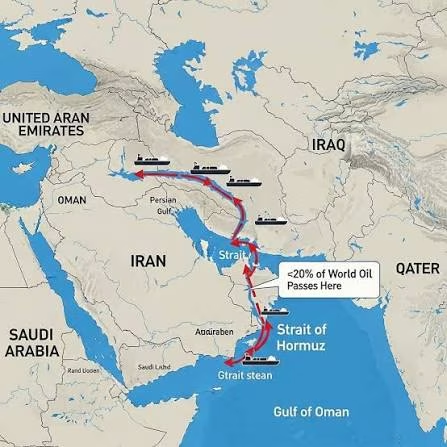
Unlike the Suez or Panama Canals, the Strait of Hormuz is not an engineered waterway administered by a single sovereign operator. It is a natural maritime passage linking the Persian Gulf to the Gulf of Oman and onward to the Arabian Sea. Roughly one-fifth of global seaborne oil trade, along with substantial volumes of liquefied natural gas, passes through its narrow shipping lanes. Any disruption—actual or even anticipated—feeds immediately into energy markets, freight rates, insurance pricing, and broader macroeconomic expectations.
This economic centrality is underpinned by a distinct legal regime.
Under the United Nations Convention on the Law of the Sea, international straits used for navigation between two parts of the high seas or exclusive economic zones are subject to the principle of transit passage. This framework allows vessels and aircraft to pass continuously and expeditiously, without prior authorization from coastal states. While Iran and Oman retain sovereignty over their respective territorial waters, that sovereignty is legally constrained by the obligation not to impede lawful transit.
In practice, this places Hormuz in a category very different from most coastal waters. It also explains why comparisons with other maritime passages are only partially useful.
The Suez Canal and Panama Canal are often cited as precedents for toll systems, but both are artificial infrastructures built, maintained, and operated by their respective states. Fees in those cases are payments for the use of engineered transport systems that reduce global shipping distances and require constant operational investment. Their logic is contractual and infrastructural, not territorial.
Hormuz, by contrast, is not a service provided by a state. It is a geographical necessity governed by international legal norms.
The Strait of Malacca offers a different but still limited analogy. Malaysia, Indonesia, and Singapore cooperate extensively on safety, navigation, environmental protection, and anti-piracy coordination. Yet they do not impose mandatory transit fees on vessels merely passing through the strait. Governance is cooperative rather than monetised.
The Dardanelles come closer to a legal analogue, governed by the 1936 Montreux Convention, which balances Turkish sovereignty with international navigation rights. But that arrangement is a historically specific settlement shaped by interwar geopolitical realities, not a general template for global application.
Against this backdrop, any suggestion of introducing formal transit fees or joint sovereign control over Hormuz would represent a significant departure from prevailing international practice. It would almost certainly encounter resistance from major maritime stakeholders, including the United States, Europe, China, Japan, South Korea, India, and others whose energy security depends on uninterrupted passage through the Strait.
Yet legal structure alone does not fully explain the strategic reality.
From Iran’s perspective, the Strait of Hormuz has long represented one of the few enduring strategic assets capable of offsetting conventional military asymmetry. Following periods of heightened confrontation with external powers, including episodes of direct military escalation and the breakdown of diplomatic momentum, Iranian strategic thinking has increasingly reflected a belief that economic pressure and military vulnerability cannot be separated from geographic leverage.
From Iran’s perspective, the aggression waged against it in a full-fledged war by the United States and Israel on February 28, marked a decisive turning point in its strategic environment. Iranian officials argue that the combination of military strikes and the breakdown of diplomatic engagement reinforced their long-held view that external pressure cannot be separated from security vulnerabilities. In that reading, the Strait of Hormuz assumed renewed importance not as an abstract legal corridor, but as one of the few tangible assets available to impose costs in a highly asymmetric confrontation. The gradual “weaponisation” of the Strait, in this sense, is presented in Tehran as a response to circumstances rather than an original strategy.
In that context, Hormuz is not merely a commercial corridor. It is a deterrence instrument embedded in geography.
This does not imply a constant or automatic intention to disrupt maritime traffic. Rather, it reflects a structural logic: states operating under sustained external pressure tend to reassess the value of any asset that can raise the costs of escalation for adversaries. The Strait of Hormuz, given its global importance, inevitably occupies a central place in that calculation.
The uncomfortable implication is that coercive pressure can sometimes amplify the strategic value of the very instruments it seeks to neutralize. What may be intended as containment can, in certain circumstances, reinforce the salience of chokepoints as tools of deterrence.
This helps explain why proposals involving structured governance or coordination mechanisms periodically surface. For Oman, which has built a diplomatic identity around mediation and de-escalation, the appeal of institutionalizing stability in such a sensitive corridor is understandable. Muscat has long maintained balanced relations with Iran while preserving close ties with Western and Gulf partners, positioning itself as a facilitator rather than a partisan actor.
In that sense, any Omani initiative is best understood as risk management rather than geopolitical redesign.
Still, the distinction between cooperation and control remains fundamental.
Practical collaboration on maritime safety, environmental monitoring, search-and-rescue operations, and navigational coordination is both feasible and already present in various forms across global straits. The challenge arises when cooperation moves toward mechanisms that resemble authority over transit rights or the monetization of passage itself.
At that point, the issue shifts from technical governance to foundational principle: the idea that international straits are shared arteries of global commerce, not assets from which passage rights can be extracted.
Even modest charges would introduce uncertainty into a system that depends heavily on predictability. Shipping firms would adjust risk premiums, insurers would reprice exposure, and energy markets would incorporate new geopolitical variables. The cumulative impact would extend far beyond the region, feeding into global price structures.
There is also a broader precedent concern. Altering the implicit norms governing one critical chokepoint could encourage pressure to revisit others, undermining the stability of maritime commerce more generally.
Ultimately, the Strait of Hormuz resists simple classification because it sits at the intersection of geography, law, and strategy in unusually concentrated form. It is at once a local maritime space and a global economic artery; a zone of sovereign adjacency and international legal constraint; and a commercial corridor that doubles as a latent instrument of deterrence.
That combination explains why analogies to canals or other straits repeatedly fall short. Hormuz is not another Suez, Panama, Malacca, or Dardanelles. It is a singular case whose stability rests on a delicate equilibrium between legal norms and strategic realities.
Any attempt to recalibrate that equilibrium—whether through cooperation or competition—will therefore require not only regional consent but broad international acceptance. The consequences of misjudging that balance would not remain confined to the Gulf. They would be transmitted through the core infrastructure of the global economy itself.
And we must all keep in mind that the Strait of Hormuz was open before the U.S and Israel waged their unnecessary, unprovoked war of aggression on Iran on February 28.
شارك برأيك
Rethinking the Strait of Hormuz: Why Geography, Law and Strategy Resist Simple Solutions