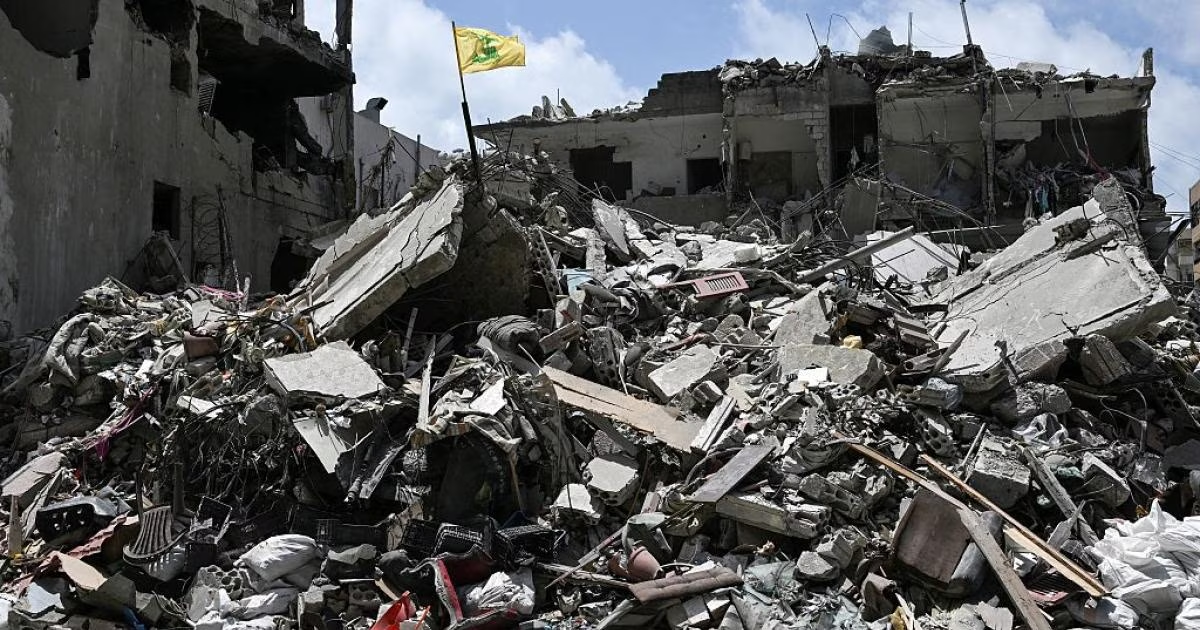







Lebanon entered a new political and security phase from the moment the framework agreement with Israel was signed in the American capital, Washington, where the discussion went beyond technical clauses to touch the core of the Lebanese entity. This shift raises deep questions about the shape of the state that will emerge after the war, and how to re-formulate the balances in a country that has lived for decades under the weight of division and occupation.
A wide current of supporters believes that this agreement represents a window of hope to restore the credibility of Lebanese state institutions and end years of duality in security and military decision-making. The agreement is expected to pave the way for the deployment of the Lebanese army in the south and the start of reconstruction and the return of displaced persons to their villages, which enhances the lost national sovereignty.
In contrast, opposition forces, led by Hezbollah and its allies, express great apprehension about the terms of the agreement, considering it a sovereign concession that does not reflect the real balance of power on the ground. These forces believe that Israeli conditions were inserted into the negotiations, especially regarding linking withdrawal to the disarmament issue, which they consider a threat to the resistance.
A third approach emerges, seeing the agreement as neither a decisive victory nor an absolute defeat for any party, but rather a reflection of a state of mutual impotence that imposed a forced settlement. This view considers what has been reached to be a temporary calm aimed at overcoming the phase of direct confrontation without providing final solutions to the structural crises in the country.
For her part, MP Najat Aoun Saliba considered that the framework agreement represents a real opportunity for the state to regain the initiative and activate dormant institutions. She affirmed in statements to media sources that the top priority currently is to secure the return of residents and displaced persons to their lands and ensure their stability in their border areas.
Regarding guarantees for Israeli withdrawal, Saliba clarified that the official Lebanese position adheres to full withdrawal according to the signed texts, but actual implementation is linked to gradual understandings. She indicated that addressing the arms issue must be done within the framework of an internal national discussion that ultimately aims to restore full state sovereignty.
In a related context, Hassan Qabalan, a member of the political bureau of the Amal Movement, warned that the features of the agreement are still incomplete and marred by a disturbing state of ambiguity. He pointed to reports of a secret security annex, which could put Lebanon in a situation that repeats previous experiences that were not in the interest of Lebanese national security.
Qabalan considered that the current agreement serves the political interests of the occupation government's prime minister, Benjamin Netanyahu, who seeks to achieve external gains to alleviate his internal crises. He criticized the absence of a binding timetable for withdrawal, warning against legitimizing concepts such as 'buffer zones' that directly affect Lebanese sovereignty.
Qabalan also warned of the danger of linking the return of displaced persons to the issue of resistance weapons, describing this link as a mine that could ignite internal Lebanese tensions at a sensitive time. He considered that this path could be a deliberate targeting to disrupt broader regional negotiation paths, putting Lebanon back in the eye of the storm.
For his part, political analyst Mounir Al-Rabie linked the agreement to major transformations in the regional and international conflict, emphasizing that Lebanon cannot isolate itself from its surroundings. He believed that the state entered into this quick settlement, thinking that it would protect itself, but the reality indicates that regional repercussions will remain present.
Al-Rabie described the agreement as the beginning of a new phase in which Israel tries to establish security and political facts that serve its long-term vision in the region. He stressed that the essence of the agreement is a 'declaration of intent' more than a final treaty, which makes it subject to conflicting interpretations or even disruption at any changing political moment.
Al-Rabie concluded by pointing to a shift in the traditional Lebanese path, as the agreement includes indications about seeking assistance from Arab and international parties to implement the clauses. This trend raises questions about the identity of these parties and their future role in Lebanon, and the extent of its impact on historical Arab commitments towards the Palestinian cause.
The framework agreement does not record a victory for any party nor a complete defeat, but rather is the result of a state of everyone's impotence that imposed a temporary settlement.

شارك برأيك
Lebanon at a Crossroads: Divergent Readings of the State's Future and Sovereignty After the Framework Agreement