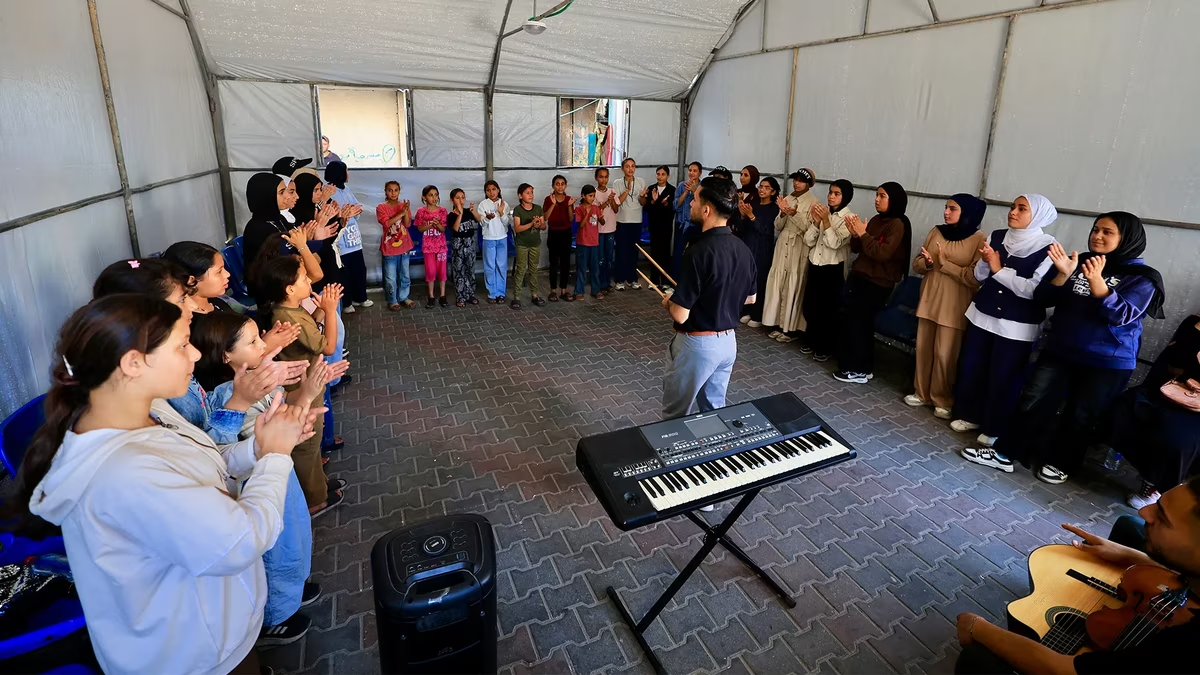







Singing occupies a prominent position in confronting the harsh reality of war in the Gaza Strip, as a cultural and humanitarian act that reorders humanity's relationship with its exhausted surroundings. Inside crowded displacement tents and shelters, new spaces for expression and training are being formed, where children continue to learn music despite the siege and fear.
Trainers invent their artistic tools from available materials in the surrounding environment, while artists carry their voices to camps and hospitals to establish the presence of art in people's lives. This return raises a humanitarian question about how children and youth find their way to singing at a time when they are surrounded by memories burdened with accumulated losses.
In Jabalia camp, Mohammed Abdel Karim Abu Matar stands alone after being part of a five-member prophetic praise band; his three brothers and close friend were martyred in a massacre that occurred in November 2023. Today, Mohammed begins his vocal pieces with a voice waiting for someone to complete it, transforming praise into a space to vent the pain of survivors and preserve the memory of the departed.
Mohammed says that praise was his way of alleviating worries with his brothers before the war, but today, worries have become like mountains after their departure. Despite this, he insists on continuing to sing in gatherings, considering that his voice carries his personal pain and the pain of the camp, which has lost many of its features and people.
In the tent of the Shatea Boys' School, the story of fifteen-year-old Malak Al-Tilmis stands out, who lost her entire family in an Israeli raid. Malak, who survived with her younger sister Bayan, found in the guitar a path to recover from the shock of the news she received while in a hospital bed.
Malak describes the guitar as her only solace during her most painful days, as she plays her sorrows to alleviate the burden of responsibility placed on her to care for her sister. Traces of sadness are clearly visible on her face, but music gives her a short time to breathe and return to herself away from the noise of war.
As for Mayar Al-Tahan, she found her way to music after a bitter journey of displacement and the loss of her father and home, which plunged her into a severe state of depression. Mayar joined courses at the Edward Said Institute, where she chose the guitar to be a bridge to get her out of her psychological isolation and help her regain focus and presence.
Mayar began to readjust the rhythm of her life on the strings of the instrument, transforming her time inside the tent into a meaning different from the deadly routine of displacement. Educational sources confirm that music has helped many children like Mayar improve their psychological state and increase their self-confidence in the current circumstances.
For his part, Fouad Khader, the music project coordinator, revived training in early 2024 after noticing the deterioration of his son's psychological state. The project started from a personal need to become a broad initiative targeting hundreds of children in displacement centers in Gaza City, Deir al-Balah, and Nuseirat.
The institute faced enormous challenges after its main headquarters in the Tal al-Hawa neighborhood was damaged by Israeli shelling, forcing the team to work in tents. Due to the scarcity of resources, trainers replaced lost instruments with water gallons and empty canned food containers to teach children the basics of musical rhythm.
Khader points out that the biggest obstacle they face is repeated displacement, as musical groups disperse a few days after their formation due to military attacks. Nevertheless, trainers continue to gather new groups and rearrange classes, believing that music is a practical way to extract children from the effects of trauma.
In another scene of challenge, artist Abdullah Natat returned to singing from his wheelchair just two months after his legs were amputated. Abdullah, who also lost his mother and brother, refuses to let his physical injury prevent him from delivering his artistic message to children and displaced people in hospitals.
Abdullah moves with his powerful voice among children's circles, performing traditional and popular pieces that add a temporary atmosphere of joy to the place. He emphasizes that he is keen for people to see him as a singer with a message and ability to perform, not as an injured person, transforming his personal ordeal into positive energy that inspires others.
The 'Gaza Beginnings' program, in cooperation with UNRWA, continues to offer choir, violin, and oud lessons, trying to create safe spaces for younger generations. These voices emanating from the tents remain a testament to the will to live in the Gaza Strip, where melody transforms into a path to salvation from loss and oblivion.
The guitar was my only solace during my most painful days, I carry it under my arm, and I begin to play my sorrows.
شارك برأيك
Melodies from beneath the rubble.. Music is the weapon of Gaza's children to confront loss and displacement