





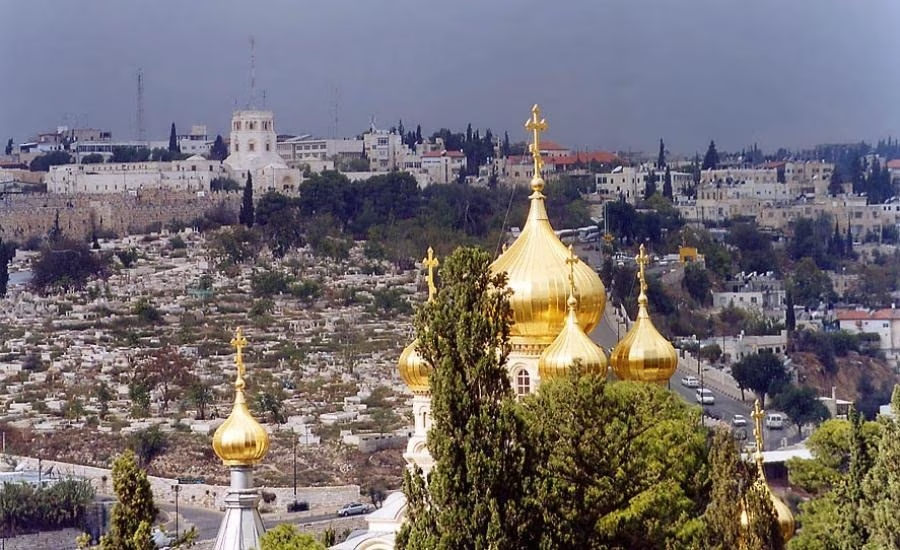
Jerusalem - "Al-Quds" Special Correspondent - In the city of Jerusalem, faith intertwines with history, and politics with real estate. Church properties are not merely financial assets or traditional real estate; rather, they constitute part of a broader battle related to the identity and Christian Palestinian presence in the Holy City. A report on Christian properties in the Holy City and the Palestinian interior, and the role of the Orthodox Patriarchate in preserving them, prepared by Wasel Al-Khatib, Director of the Media Department at the National Popular Conference for Jerusalem, stated that since the election of Patriarch Theophilos III as Patriarch of Jerusalem in 2005, the Orthodox Patriarchate has placed the file of protecting and restoring church properties at the forefront of its priorities, in the face of continuous settlement and legal attempts targeting one of the largest land-owning institutions in historical Palestine. The Patriarchate indicates that its strategy over the past two decades has not been limited to legal defense of disputed properties, but has also included the recovery of lands that had fallen out of its control due to old lease contracts or complex legal arrangements dating back to previous decades. Al-Khatib added in his report that among the most prominent successes announced by the Patriarchate in this context is the recovery of strategic land in the Abu Tor neighborhood, south of Jerusalem. After more than a decade of legal and financial follow-up, the Patriarchate was able in 2023 to recover its full rights to the land for approximately 80 million shekels, freeing it from legal restrictions and reservations resulting from previous agreements and leases. This land is of particular importance due to its location next to a historic Orthodox church and its containing Byzantine ruins, which led the Patriarchate to consider its recovery a model for the policy of "recovering and protecting Orthodox properties" that it has adopted for years. Tangible Successes Al-Khatib said in his report: The Patriarchate also succeeded in recovering vast areas of land belonging to the Qasr al-Yahud Monastery in the Jordan Valley area on the banks of the Jordan River, lands that had been under Israeli occupation control since 1967. Patriarch Theophilos III then considered this step to confirm the possibility of restoring the historical rights of the Church through long-term legal and diplomatic work, stressing that the battle to preserve Christian properties is not over yet. Complex Files The report added: However, the recovery file does not negate the existence of more complex files that are still subject to open dispute with the occupation authorities and settlement associations. Foremost among these files is what is known as the Jaffa Gate properties case at the entrance to the Old City of Jerusalem, which includes hotels and historical properties acquired by a settlement association through deals dating back to the era of the former Patriarch Irenaios. The Patriarchate, led by Patriarch Theophilos III, fought long legal battles to annul those deals, considering that they were based on forgery, corruption, and extortion, and that they aim to change the demographic and Christian character of the Old City. Despite the judicial setbacks suffered by the Patriarchate before the Israeli courts, it still considers the issue open politically, legally, and internationally. Silwan Issue The report stated: As for the Silwan neighborhood, which is witnessing one of the most sensitive real estate confrontations in occupied Jerusalem, some lands and properties belonging to the churches have become a focal point of escalating conflict between church institutions and settlement associations that seek to expand their presence around the Old City and Al-Aqsa Mosque. The Patriarchate affirms that any attempt to harm church properties in Silwan cannot be separated from a broader project aimed at encircling the Old City with a settlement ring that limits both the Islamic and Christian presence. The report added: These lands acquire exceptional importance due to their geographical location adjacent to the southern walls of Old Jerusalem, making them a constant target for settlement projects seeking to impose new realities on the ground. The Patriarchate bases its defense of these properties on the fact that it is one of the largest landowners in Jerusalem and Palestine. The Orthodox institution has accumulated over many centuries vast areas of land and endowments extending from Jerusalem to Bethlehem, the Jordan Valley, and parts of Galilee, and these properties have over time become one of the most important elements of Christian Palestinian steadfastness. Therefore, the Church views the protection of properties as a protection of the Christian presence itself, not merely a protection of real estate wealth. Parallel Tracks In this context, Al-Khatib's report indicated that the Patriarchate affirms that its efforts are distributed among several parallel tracks: litigation before the courts, recourse to international legal expertise, preserving Palestinian tenants in threatened properties, in addition to diplomatic work with governments and international churches to keep the issue of Christian properties present on the international agenda. Patriarch Theophilos III reiterates on many occasions that the real battle is not only over stones, but over the identity of Jerusalem and its religious and cultural diversity. The Historical Jordanian Role At the heart of these efforts, the Jordanian role stands out as one of the most important political protection umbrellas for Christian and Islamic holy sites in Jerusalem. Under the Hashemite custodianship led by King Abdullah II, the historical churches in Jerusalem enjoy continuous political and diplomatic support, and the Orthodox Patriarchate considers this support a fundamental pillar in confronting the pressures its properties are subjected to. Patriarch Theophilos III has on more than one occasion thanked the Jordanian monarch for his continuous support in the battles to establish property rights and defend the Christian presence in the Holy Land, stressing that the Hashemite custodianship is not limited to protecting holy sites, but includes defending the historical and religious character of Jerusalem with all its components. Continuous Confrontation over the Narrative Thus, the battle for Orthodox properties in Jerusalem appears to be larger than just a dispute over plots of land or historical buildings. It is a continuous confrontation over narrative, identity, and existence, in which court decisions intertwine with political and diplomatic calculations. While the Patriarchate has succeeded in recent years in recovering some strategic lands and thwarting attempts to control others, files such as Silwan, Jaffa Gate, and others confirm that the conflict over Christian properties in Palestine is still open, and that the preservation of these endowments has become part of a broader battle to defend the Arab Christian presence in Jerusalem and the Holy Land.

الإثنين 22 يونيو 2026 1:01 مساءً - بتوقيت القدس
Church Properties in the Eye of the Storm: How Does the Orthodox Patriarchate Defend Its Historical Rights?
شارك برأيك
Church Properties in the Eye of the Storm: How Does the Orthodox Patriarchate Defend Its Historical Rights?