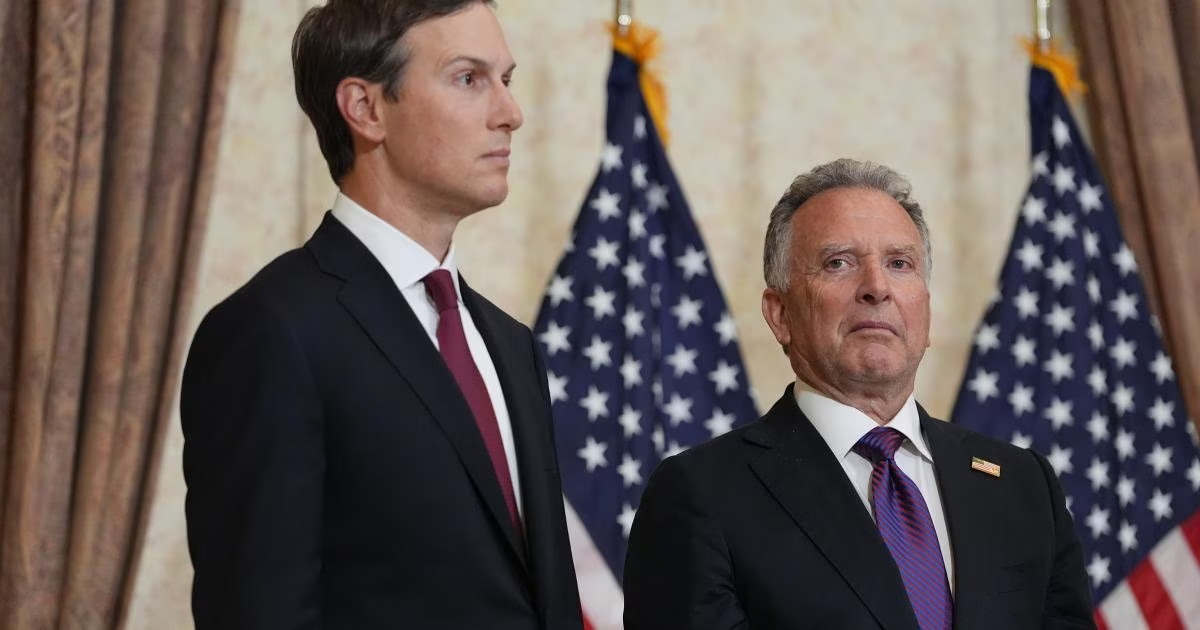







The diplomatic arena in Switzerland has witnessed accelerated American moves with the arrival of Steve Witkoff, Special Envoy of President Donald Trump, in preparation for direct talks with the Iranian side. These moves aim to formulate a new nuclear and ballistic agreement that would end the long-standing tension between the two countries.
Informed sources reported that Jared Kushner, the son-in-law of the American President, has already arrived in Swiss territory to participate in the logistical and political arrangements for this anticipated round. This step comes within the framework of the US administration's diligent efforts to open direct channels of communication to achieve a breakthrough in the thorny issues.
Despite these preparations, both Bern and Tehran announced the postponement of the first round of negotiations, which was supposed to begin on Friday at the Bürgenstock resort. The Swiss Foreign Ministry did not disclose the precise reasons for this postponement, merely stating the need to create suitable conditions.
For his part, Iranian Foreign Ministry spokesman Ismail Baqaei clarified that the start of the negotiation train depends on the implementation of specific provisions contained in the memorandum of understanding previously signed between the two parties. Baqaei stressed that the continued application of these provisions is the only guarantee for engaging in a formal and serious dialogue on outstanding issues.
Media reports indicated that the ongoing military escalation between Israel and Hezbollah in Lebanon played a pivotal role in obstructing the talks' timeline. Mediating parties believe that the continuation of fighting casts a negative shadow on the diplomatic climate and complicates the process of making fateful decisions.
In the same context, sources revealed that Iranian Foreign Minister Abbas Araqchi plans to travel to Switzerland on Saturday, but this date remains subject to field developments. Araqchi believes that establishing a ceasefire on the Lebanese front is a top priority and a crucial factor for the success of the negotiating path with Washington.
On the American side, Vice President J.D. Vance was expected to lead the negotiating delegation, but he decided to postpone his trip at the last minute on Thursday evening. Speculation remains about the possibility of him joining the delegation over the weekend if a breakthrough occurs in the political scene.
These negotiations are based on what is known as the 'Islamabad Memorandum of Understanding,' which was reached in mid-June and consists of 14 basic provisions. This memorandum was digitally signed by both Iranian President Masoud Pezeshkian and American President Donald Trump, representing a roadmap for a solution.
The memorandum includes essential provisions related to halting hostile operations on several regional fronts, including the Lebanese arena, and lifting the naval blockade imposed on Iranian ports. The understandings also include the full reopening of the Strait of Hormuz to international navigation to ensure the stability of global energy markets.
Tehran dispelled concerns about the closure of the Strait of Hormuz, with the Iranian Foreign Ministry spokesman denying the accuracy of reports about the disruption of ship traffic. He affirmed that Iranian forces continue to secure the strategic waterway to ensure the passage of commercial vessels and tankers without significant obstacles.
Regarding the nuclear file, Iran clarified that it has not issued a new invitation to the International Atomic Energy Agency to inspect additional facilities outside the agreed framework. It stressed that inspections will be limited to sites that were previously under surveillance, such as the Bushehr plant, while maintaining the security of its nuclear program.
The two parties set a 60-day timeframe to reach the final version of the comprehensive agreement, which puts diplomats under time pressure to achieve tangible results. This period is considered a real test of the seriousness of both parties in overcoming decades of hostility and building a relationship based on security and economic understandings.
Mediating countries play a vital role in conveying messages between Washington and Tehran, especially in the absence of full direct diplomatic relations so far. These countries affirm that the success of the Switzerland negotiations will represent a major turning point in the history of the Middle East, which could lead to a comprehensive de-escalation in the region.
Anticipation remains the order of the day, awaiting what the coming hours will bring in terms of diplomatic moves in the Swiss corridors, and the extent of the parties' ability to overcome the obstacle of field escalation. While Washington insists on an agreement that guarantees the containment of ballistic capabilities, Tehran demands a complete lifting of economic sanctions as a fundamental condition for stability.
Establishing a ceasefire in Lebanon is a top priority for Tehran, and a decisive factor for the course of negotiations with Washington.
شارك برأيك
Intense American Moves in Switzerland and Efforts to Launch Direct Negotiations with Tehran