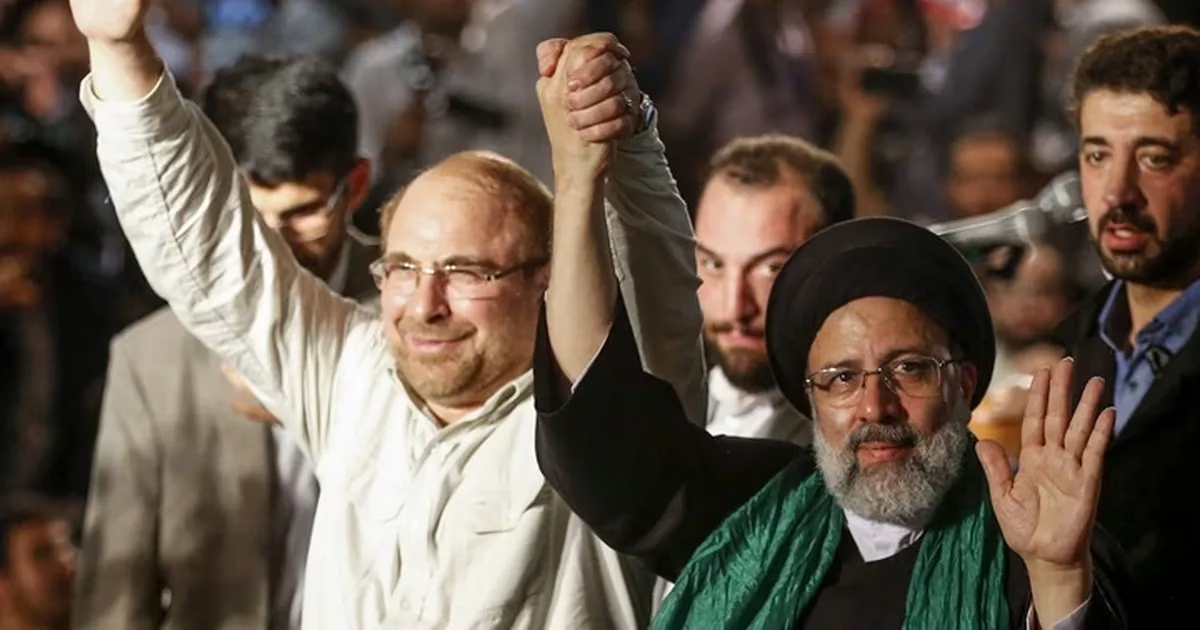







International press reports have revealed the behind-the-scenes details of marathon negotiations taking place in Pakistan between a high-level Iranian delegation and American officials, a move considered the highest-level representation in decades. The Iranian side is led by Parliament Speaker Mohammad Bagher Ghalibaf, who emerged as a pivotal figure in the political scene following a series of airstrikes targeting regime leaders, including the assassination of Supreme Leader Ali Khamenei by Israeli occupation forces.
Media sources stated that Ghalibaf, 64, managed to capture the attention of the American team as a skilled negotiator and a potential leader for the next phase, despite the stalemate in some issues. These developments come at a time when US President Donald Trump is seeking to replicate the 'Venezuelan scenario' in dealing with Tehran, by exerting maximum military and economic pressure to force the regime to make fundamental concessions.
The American approach relies on the experience of overthrowing Venezuelan President Nicolas Maduro, with Trump believing that a naval blockade and control over oil resources are key to subjugating the Iranian leadership. Trump has stated on several occasions that controlling Iranian oil is a strong option, praising the tactics that led to choking off energy revenues in Venezuela, which he is now trying to apply by tightening the blockade in the Gulf region.
In contrast, the new Iranian leadership, despite its involvement in negotiations, has shown a more militaristic and hardline tendency than its predecessors, with Revolutionary Guard commanders such as Ahmad Vahidi and Mohammad Bagher Zolghadr taking center stage. These leaders, whose names have been associated with internal repression and the development of weapons programs, view control over the Strait of Hormuz as a strategic pressure card that cannot be relinquished without a heavy price that ensures the regime's survival.
Leaked information indicates that Washington has offered a three-page plan to end the tension, which includes the release of approximately $20 billion in frozen Iranian funds abroad. The American proposal stipulates that in exchange for these funds, Tehran must completely abandon its enriched uranium stockpile and transfer it to a third country or under strict international supervision to ensure it is not used for military purposes.
However, a wide gap remains between the two sides regarding the duration of the halt to enrichment activities, with the United States demanding a period of no less than 20 years, while Iranian negotiators propose a period not exceeding 5 years. Tehran also demands raising the ceiling of released funds to $27 billion, while Washington insists on allocating specific amounts for humanitarian purposes only under international supervision.
Experts on Iranian affairs believe that Tehran's decentralized power structure makes it difficult to apply the 'Delcy Rodriguez' Venezuelan model, as power is distributed among the Revolutionary Guard, the judiciary, and national security councils. Analysts explained that the new leaders derive their legitimacy from the theocratic system itself, making the idea of an internal coup or smooth change according to the American vision a risky endeavor.
On the ground, the blockade of the Strait of Hormuz has caused major global economic repercussions, as Iran uses it as a tool to deter any comprehensive military attack targeting what remains of its leadership structure. The Iranian regime's losses due to this tension are estimated at $435 million per day, which puts immense pressure on Iranian negotiators to try to reach an agreement that alleviates the burden of the living crisis.
Amidst this complex scene, the name of Mojtaba Khamenei, the son of the late leader, emerges as a hidden force that still influences decision-making despite his absence from public view since the beginning of the war and reports of his injury. Mojtaba is known for his more radical tendencies, which could pose an obstacle to any agreement that hardliners in the Revolutionary Guard view as an 'humiliation' for the Iranian state before the 'Great Satan'.
Sources reported that the Iranians feel a kind of 'victory euphoria' for their ability to withstand despite the assassination of first-tier leaders, which makes them refuse to show flexibility unless they receive comprehensive security guarantees. Suzanne Maloney, a researcher at the Brookings Institution, confirms that the current leadership will not accept any deal that leads to the erosion of its regional influence or strips it of its nuclear deterrent capabilities.
Concerns are growing that Iran will become a more repressive state internally with the rise of the military current represented by Vahidi and Zolghadr, who wield wide influence in security circles. These leaders, who participated in suppressing previous protests, believe that any retreat in the face of external pressures will necessarily lead to the collapse of the internal front, and therefore they prefer the option of calculated confrontation.
For his part, President Trump described the current Iranian leadership as 'more rational' than its predecessor, in an attempt to market the negotiations to his domestic audience as a success of his strength-based strategy. Trump believes that 'the old regime has been destroyed,' and that dealing with new faces like Ghalibaf could open the door to a historic agreement that ends the hostility that has persisted since 1979.
Ambiguity remains regarding whether the proposed memorandum includes the ballistic missile program or the support Tehran provides to its allies in the region, issues that Washington considers a red line. The US administration insists that any nuclear agreement must be followed by an Iranian commitment to change its regional behavior, which Tehran has completely rejected so far, considering its external influence as part of its national security.
The success or failure of the Pakistan talks will largely depend on the ability of both sides to make painful concessions on issues of sovereignty and energy, under close scrutiny from regional powers and the occupying state. With the continued naval blockade and mutual threats, the region remains on a hot plate, awaiting the outcome of these unprecedented negotiations in the coming days.
You have crossed our red line, and you will pay the price, we will deliver devastating blows to you.
شارك برأيك
'New Iran' Negotiations: Washington Seeks Deal Amidst Assassinations and Hormuz Blockade